BIOPSY
Mahendraraj,M.T
110020599
Biopsy [BIO =LIFE
OPSIS=VISION]
Biopsy is the removal of the tissueremoval of the tissue from
the living organism for the purpose of
histopathological examinationhistopathological examination and
diagnosis.
A biopsy is the examination of tissueexamination of tissue
removed from a lesion and by extension
the term is also used to convey the
removal of the tissue.[WHO 1966]
NEED FOR BIOPSY
When lesion is clinically suspicious
To confirm a presumptive diagnosis made on
clinical and R/G findings.
When dentist cannot reach definite clinical
diagnosis
To determine the treatment plan
Valuable self teaching diagnostic aid.
To remove the cancerophobia
As a medicolegal record
INDICATIONS FOR BIOPSY
Any lesion that persists for more than 2 weeks
with no apparent etiologic basis
Any inflammatory lesion that does not respond
to local treatment after 10 to 14 days.
Persistent hyperkeratotic changes in surface
tissues.
Any persistent tumor, suspected being
neoplastic
Inflammatory changes of unknown cause that
persist for long periods
Lesion that interfere with local function
Any tissue surgically excised
Any tissue spontaneously expelled from a
body orifice.
Material from a persistent draining sinus
whose source can’t be readily identified,
together with some lining of the sinus.
Bone lesions not specifically identified by
clinical and radiographic findings
Any lesion that has the characteristics of
malignancy
Contraindications
Poor general condition.
An acute very virulent pyogenic infection
of the lesion is present
blood dyscrasia.
Vascular origin.
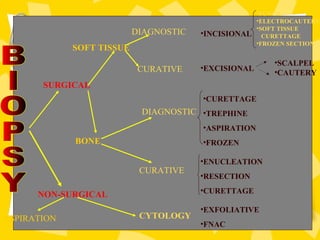
SURGICAL
NON-SURGICAL
SOFT TISSUE
BONE
DIAGNOSTIC
CURATIVE
•PUNCH
•ELECTROCAUTERY
•SOFT TISSUE
CURETTAGE
•FROZEN SECTION
•EXCISIONAL
DIAGNOSTIC
CURATIVE
•CURETTAGE
•TREPHINE
•ASPIRATION
•FROZEN
•ENUCLEATION
•RESECTION
•CURETTAGE
ASPIRATION CYTOLOGY
•SCALPEL
•CAUTERY
•EXFOLIATIVE
•FNAC
•INCISIONAL
TYPES
Excisional biopsy
Incisional biopsy
Punch biopsy
Frozen section biopsy
Exfoliative cytology
FNAC
Brush biopsy
SURGICAL PROCEDURE
ANESTHESIA
INCISION
HAEMOSTASIS
SURGICAL CLOSURE
HANDLING OF TISSUE
Excisional Biopsy
An excisional biopsy
implies to the complete
removal of the lesion for
microscopic study.
Technique:
The entire lesion with 2 to
3mm of normal appearing
tissue surrounding the
lesion is excised if benign.
ADVANTAGE
Both diagnostic and therapeutic
Need not perform separate surgery
INDICATIONS
– Should be employed with small lesions. Less
than 2cm
– The lesion on clinical exam appears benign.
– When complete excision with a margin of
normal tissue is possible without mutilation.
CONTRAINDICATION
– In large lesion >2cm.
a Incision around lesion.
Blunt undermining
of mucosa of wound margins after
removal of lesion
EXCISIONAL BIOPSYEXCISIONAL BIOPSY
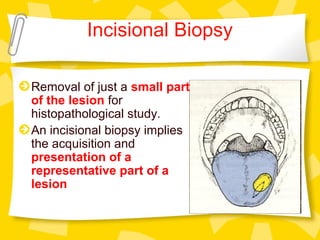
Incisional Biopsy
Removal of just a small part
of the lesion for
histopathological study.
An incisional biopsy implies
the acquisition and
presentation of a
representative part of a
lesion
Indications:
– Lesion larger than 2 cm.
– Dangerous location of the lesion (nerves, vessels)
– Great suspicion of malignancy
Technique:
– Representative areas are biopsied in a wedge fashion.
– Margins should extend into normal tissue on the deep
surface.
– Necrotic tissue should be avoided.
– A narrow deep specimen is better than a broad shallow
one
– Sharp blade
– Do not inject L.A
a Demarcation of incision.
b Surgical field after
removal of specimen.
c Operation site after suturing.
INCISIONAL BIOPSYINCISIONAL BIOPSY
Intraosseous and Hard Tissue
Biopsy
Intraosseous lesions are most often the
result of problems associated with the
dentition.
Indications
Any intraosseous lesion that fails to
respond to routine treatment of the
dentition.
Any intraosseous lesion that appears
unrelated to the dentition.
Punch biopsy
Small part of lesion obtained using
punch
Indication: mucosal lesion that cant be
reached by conventional method
Disadvantage: some amount of
crushing of tissues
Frozen section biopsy
To get immediate report of lesion
1.1. Tissue kept in deep freezeTissue kept in deep freeze
2.2. sectionedsectioned
3.3. stainedstained
4.4. examinedexamined
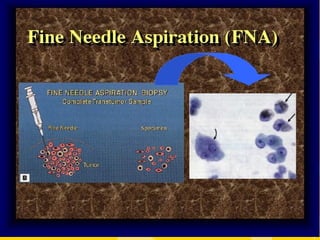
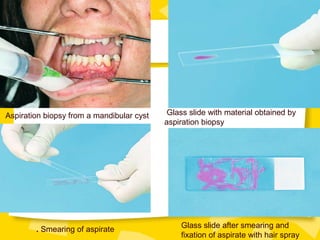
Aspiration Biopsy (FNAC)
Aspiration biopsy is the use of a needle and
syringe to penetrate a lesion for aspiration if its
contents.
18-24 gauge needle is used
INDICATIONS
– To determine the presence of fluid within a lesion
– To know the type of fluid within a lesion
– When exploration of an intraosseous lesion is
indicated
ADVANTAGE
Obtain cells from any sites of body
Less labour than biopsy
Fast
Permits early start of treatment
Can be done repeatedly on most masses/lesions
Enough material obtained for other studies also
DISADVANTAGE
Can be painful
Requires great skills
Needle can damage vital structure
Internal bleeding possible
Dissemination of tumor cells into damaged vessels.
NOT A DIAGNOSTIC PROCEDURE
ADJUNCT TO BIOPSY
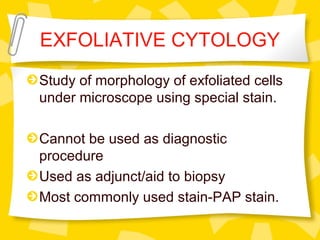
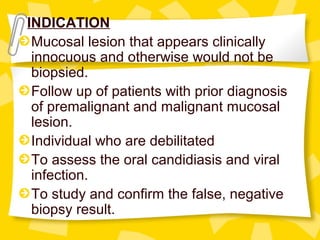
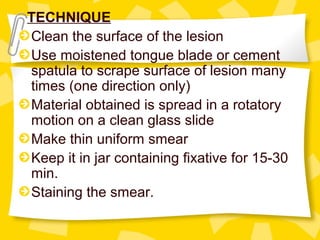
Aspiration biopsy from a mandibular cyst Glass slide with material obtained by
aspiration biopsy
Glass slide after smearing and
fixation of aspirate with hair spray
. Smearing of aspirate
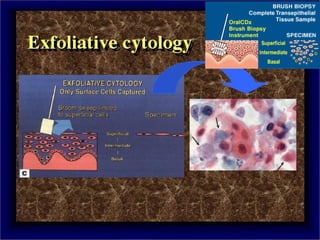
EXFOLIATIVE CYTOLOGY
Study of morphology of exfoliated cells
under microscope using special stain.
Cannot be used as diagnostic
procedure
Used as adjunct/aid to biopsy
Most commonly used stain-PAP stain.
INDICATION
Mucosal lesion that appears clinically
innocuous and otherwise would not be
biopsied.
Follow up of patients with prior diagnosis
of premalignant and malignant mucosal
lesion.
Individual who are debilitated
To assess the oral candidiasis and viral
infection.
To study and confirm the false, negative
biopsy result.
TECHNIQUE
Clean the surface of the lesion
Use moistened tongue blade or cement
spatula to scrape surface of lesion many
times (one direction only)
Material obtained is spread in a rotatory
motion on a clean glass slide
Make thin uniform smear
Keep it in jar containing fixative for 15-30
min.
Staining the smear.
Advantage
Developed as a diagnostic screening procedure
to monitor large tissue areas for dysplastic
changes.
May be helpful with monitoring postradiation
changes, herpes, pemphigus.
Disadvantage
Not very reliable with many false positives.
Expertise in oral cytology is not widely available
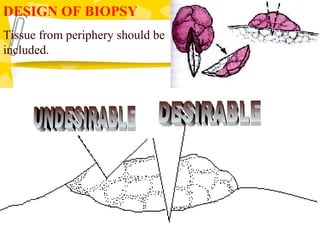
DESIGN OF BIOPSY
Tissue from periphery should be
included.
In large lesions
Accessible area
Characteristic portion.
For multiple lesions
Most representative site.
Material curetted from interior of the lesion .
SPECIAL CONSIDERATIONS
Fixative agent---10% formalinFixative agent---10% formalin
Placement of specimen in vial
Site of biopsySite of biopsy
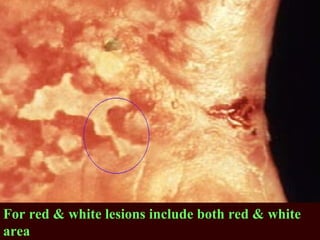
For red & white lesions include both red & white
area
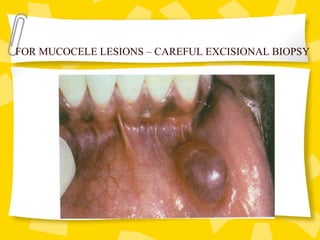
FOR MUCOCELE LESIONS – CAREFUL EXCISIONAL BIOPSY
FOR MAJOR SALIVARY GLAND/LYMPH GLAND LESIONS
FNAC MAY BE USEFUL
For Vesiculobullous lesions
Fluid is more representative. Intact vesicle or bulla should be
biopsied.
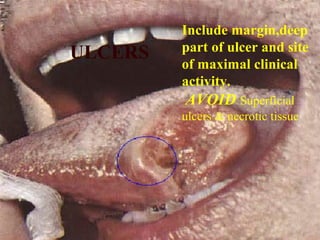
ULCERS
Include margin,deep
part of ulcer and site
of maximal clinical
activity.
AVOID Superficial
ulcers & necrotic tissue
DANGERS OF BIOPSY
– Spreading
– Haemorrhage
– Infection
– Wounding of cancer tissue
– Operative trauma
RefferenceRefference
Oral Surgery-Fragiskos D. Fragiskos
Text book of OMFS- Neelima malik
Biopsy

Biopsy

  • 1.
  • 2.
    Biopsy [BIO =LIFE OPSIS=VISION] Biopsyis the removal of the tissueremoval of the tissue from the living organism for the purpose of histopathological examinationhistopathological examination and diagnosis. A biopsy is the examination of tissueexamination of tissue removed from a lesion and by extension the term is also used to convey the removal of the tissue.[WHO 1966]
  • 3.
    NEED FOR BIOPSY Whenlesion is clinically suspicious To confirm a presumptive diagnosis made on clinical and R/G findings. When dentist cannot reach definite clinical diagnosis To determine the treatment plan Valuable self teaching diagnostic aid. To remove the cancerophobia As a medicolegal record
  • 4.
    INDICATIONS FOR BIOPSY Anylesion that persists for more than 2 weeks with no apparent etiologic basis Any inflammatory lesion that does not respond to local treatment after 10 to 14 days. Persistent hyperkeratotic changes in surface tissues. Any persistent tumor, suspected being neoplastic Inflammatory changes of unknown cause that persist for long periods
  • 5.
    Lesion that interferewith local function Any tissue surgically excised Any tissue spontaneously expelled from a body orifice. Material from a persistent draining sinus whose source can’t be readily identified, together with some lining of the sinus. Bone lesions not specifically identified by clinical and radiographic findings Any lesion that has the characteristics of malignancy
  • 6.
    Contraindications Poor general condition. Anacute very virulent pyogenic infection of the lesion is present blood dyscrasia. Vascular origin.
  • 7.
    SURGICAL NON-SURGICAL SOFT TISSUE BONE DIAGNOSTIC CURATIVE •PUNCH •ELECTROCAUTERY •SOFT TISSUE CURETTAGE •FROZENSECTION •EXCISIONAL DIAGNOSTIC CURATIVE •CURETTAGE •TREPHINE •ASPIRATION •FROZEN •ENUCLEATION •RESECTION •CURETTAGE ASPIRATION CYTOLOGY •SCALPEL •CAUTERY •EXFOLIATIVE •FNAC •INCISIONAL
  • 8.
    TYPES Excisional biopsy Incisional biopsy Punchbiopsy Frozen section biopsy Exfoliative cytology FNAC Brush biopsy
  • 9.
  • 10.
    Excisional Biopsy An excisionalbiopsy implies to the complete removal of the lesion for microscopic study. Technique: The entire lesion with 2 to 3mm of normal appearing tissue surrounding the lesion is excised if benign.
  • 11.
    ADVANTAGE Both diagnostic andtherapeutic Need not perform separate surgery INDICATIONS – Should be employed with small lesions. Less than 2cm – The lesion on clinical exam appears benign. – When complete excision with a margin of normal tissue is possible without mutilation. CONTRAINDICATION – In large lesion >2cm.
  • 12.
    a Incision aroundlesion. Blunt undermining of mucosa of wound margins after removal of lesion EXCISIONAL BIOPSYEXCISIONAL BIOPSY
  • 13.
    Incisional Biopsy Removal ofjust a small part of the lesion for histopathological study. An incisional biopsy implies the acquisition and presentation of a representative part of a lesion
  • 14.
    Indications: – Lesion largerthan 2 cm. – Dangerous location of the lesion (nerves, vessels) – Great suspicion of malignancy Technique: – Representative areas are biopsied in a wedge fashion. – Margins should extend into normal tissue on the deep surface. – Necrotic tissue should be avoided. – A narrow deep specimen is better than a broad shallow one – Sharp blade – Do not inject L.A
  • 15.
    a Demarcation ofincision. b Surgical field after removal of specimen. c Operation site after suturing. INCISIONAL BIOPSYINCISIONAL BIOPSY
  • 16.
    Intraosseous and HardTissue Biopsy Intraosseous lesions are most often the result of problems associated with the dentition. Indications Any intraosseous lesion that fails to respond to routine treatment of the dentition. Any intraosseous lesion that appears unrelated to the dentition.
  • 17.
    Punch biopsy Small partof lesion obtained using punch Indication: mucosal lesion that cant be reached by conventional method Disadvantage: some amount of crushing of tissues
  • 18.
    Frozen section biopsy Toget immediate report of lesion 1.1. Tissue kept in deep freezeTissue kept in deep freeze 2.2. sectionedsectioned 3.3. stainedstained 4.4. examinedexamined
  • 19.
    Aspiration Biopsy (FNAC) Aspirationbiopsy is the use of a needle and syringe to penetrate a lesion for aspiration if its contents. 18-24 gauge needle is used INDICATIONS – To determine the presence of fluid within a lesion – To know the type of fluid within a lesion – When exploration of an intraosseous lesion is indicated
  • 21.
    ADVANTAGE Obtain cells fromany sites of body Less labour than biopsy Fast Permits early start of treatment Can be done repeatedly on most masses/lesions Enough material obtained for other studies also DISADVANTAGE Can be painful Requires great skills Needle can damage vital structure Internal bleeding possible Dissemination of tumor cells into damaged vessels. NOT A DIAGNOSTIC PROCEDURE ADJUNCT TO BIOPSY
  • 22.
    Aspiration biopsy froma mandibular cyst Glass slide with material obtained by aspiration biopsy Glass slide after smearing and fixation of aspirate with hair spray . Smearing of aspirate
  • 23.
    EXFOLIATIVE CYTOLOGY Study ofmorphology of exfoliated cells under microscope using special stain. Cannot be used as diagnostic procedure Used as adjunct/aid to biopsy Most commonly used stain-PAP stain.
  • 24.
    INDICATION Mucosal lesion thatappears clinically innocuous and otherwise would not be biopsied. Follow up of patients with prior diagnosis of premalignant and malignant mucosal lesion. Individual who are debilitated To assess the oral candidiasis and viral infection. To study and confirm the false, negative biopsy result.
  • 25.
    TECHNIQUE Clean the surfaceof the lesion Use moistened tongue blade or cement spatula to scrape surface of lesion many times (one direction only) Material obtained is spread in a rotatory motion on a clean glass slide Make thin uniform smear Keep it in jar containing fixative for 15-30 min. Staining the smear.
  • 27.
    Advantage Developed as adiagnostic screening procedure to monitor large tissue areas for dysplastic changes. May be helpful with monitoring postradiation changes, herpes, pemphigus. Disadvantage Not very reliable with many false positives. Expertise in oral cytology is not widely available
  • 28.
    DESIGN OF BIOPSY Tissuefrom periphery should be included.
  • 29.
    In large lesions Accessiblearea Characteristic portion. For multiple lesions Most representative site. Material curetted from interior of the lesion . SPECIAL CONSIDERATIONS
  • 30.
    Fixative agent---10% formalinFixativeagent---10% formalin Placement of specimen in vial
  • 31.
  • 32.
    For red &white lesions include both red & white area
  • 33.
    FOR MUCOCELE LESIONS– CAREFUL EXCISIONAL BIOPSY
  • 34.
    FOR MAJOR SALIVARYGLAND/LYMPH GLAND LESIONS FNAC MAY BE USEFUL
  • 35.
    For Vesiculobullous lesions Fluidis more representative. Intact vesicle or bulla should be biopsied.
  • 36.
    ULCERS Include margin,deep part ofulcer and site of maximal clinical activity. AVOID Superficial ulcers & necrotic tissue
  • 37.
    DANGERS OF BIOPSY –Spreading – Haemorrhage – Infection – Wounding of cancer tissue – Operative trauma
  • 38.
    RefferenceRefference Oral Surgery-Fragiskos D.Fragiskos Text book of OMFS- Neelima malik