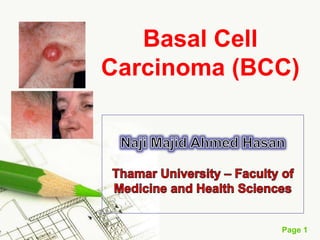




Basal cell carcinoma (BCC)

Editor's Notes

  • #3 The PTCH1 gene provides instructions for producing the patched-1 protein, which functions as a receptor. Receptor proteins have specific sites into which certain other proteins, called ligands, fit like keys into locks. A protein called Sonic Hedgehog is the ligand for the patched-1 receptor. Together, ligands and their receptors trigger signals that affect cell development and function.Patched-1 and Sonic Hedgehog function in a pathway that is essential for early development. This pathway plays a role in cell growth, cell specialization, and determining the shape (patterning) of many different parts of the developing body. When Sonic Hedgehog is not present, patched-1 prevents cells from growing and dividing (proliferating). When Sonic Hedgehog is attached, patched-1 stops suppressing cell proliferation. Based on its role in preventing cells from proliferating in an uncontrolled way, PTCH1 is called a tumor suppressor gene.