Definition
Biopsy is a surgical procedure to obtain

tissue from a living organism for its
microscopical examination, usually to
perform a diagnosis.
Indications for Biopsy
Inflammatory changes of unknown cause that

persist for long periods
Lesion that interfere with local function
Bone lesions not specifically identified by clinical
and radiographic findings
Any lesion that has the characteristics of
malignancy
Characteristics of lesions that raise
.the suspicion of malignancy
Erythroplasia- lesion is totally red or has a speckled red

appearance.
Ulceration- lesion is ulcerated or presents as an ulcer.
Duration- lesion has persisted for more than two weeks.
Growth rate- lesion exhibits rapid growth
Bleeding- lesion bleeds on gentle manipulation
Induration- lesion and surrounding tissue is firm to the
touch
Fixation- lesion feels attached to adjacent structures
Types of Biopsy
The four major types of biopsy routinely used in and

around the oral cavity are :
cytology,
aspiration biopsy,
incisional biopsy,
and excisional biopsy.
Oral Cytology
Oral cytology is typically used as an adjunct to, not a

substitute for, incisional or excisional biopsy
procedures
Cytology allows examination of individual cells, but
cannot provide the histologic features crucial for an
accurate and definitive diagnosis
 Developed as a diagnostic screening procedure to
monitor large tissue areas for dysplastic changes.
Lesions that lend themselves to cytologic
examination may include; post-radiation changes,
herpes, fungal infections, and pemphigus.
Procedures of cytological biopsy
In a cytologic examination, the lesion is scraped

repeatedly and firmly with a moistened tongue
depressor or cytology brush.
The cells are then transferred to and smeared evenly
on a glass slide.
The slide is immediately immersed in a fixing
solution or sprayed with a fixative, such as hairspray.
 The cells can be stained with any of a myriad of
laboratory preparations and examined under the
microscope.
The Advantages andDisadvantage of oral
:cytological procedures include
Advantages
Cytology may be helpful when large areas of
mucosal change are noted, or in areas with
difficult surgical access
Disadvantages
Not very reliable with many false positives.
Expertise in oral cytology is not widely available
Aspiration Biopsy
Aspiration biopsy is the use of a needle and syringe to

remove a sample of cells or contents of a lesion.
 The inability to withdraw fluid or air indicates that
the lesion is probably solid
Aspiration Biopsy
Indications:
To determine the presents of fluid within a lesion
To a certain the type of fluid within a lesion
When exploration of an intraosseous lesion is indicated
Aspiration
Procedures:
An 18-gauge needle is connected to a 5 or 10 ml syringe

and is inserted into the center of the mass via a small hole
in the lesion.
The tip of the needle may need to be positioned in
multiple directions to locate a potential fluid center.
 The material withdrawn during aspiration biopsy can be
submitted for pathologic examination and/or culturing.
The inability to withdraw fluid or air indicates that

the lesion is probably solid.
 A radiolucent lesion in the jaw that yields strawcolored fluid on aspiration is most likely a cystic
lesion.
If purulent exudate (pus) is withdrawn, then an
inflammatory or infectious process should be
considered..
The aspiration of blood might indicate a vascular

malformation within the bone.
Any intrabony radiolucent lesion should be aspirated
before surgical intervention to rule out a vascular
lesion.
 If the lesion is determined to be vascular in nature,
the flow rate (high versus low) should be determined
because uncontrollable hemorrhage can occur if
incised
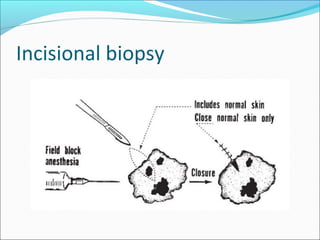
Incisional Biopsy
The intent of an incisional biopsy is to sample only a

representative portion of the lesion.
If the lesion is large or has many differing
characteristics, more than one area may require
sampling.
Incisional Biopsy
Indications of incisional biopsy
whenever the lesion is difficult to excise because of its

extensive size
 in cases where appropriate excisional surgical
management requires hospitalization or complicated
wound management.
Technique of Incisional Biopsy
Representative areas are biopsied in a wedge fashion.
Margins should extend into normal tissue on the deep

surface.
Necrotic tissue should be avoided.

 The sample should be taken from the edge of the lesion to include

surrounding normal tissue
 It should be deep enough to include underlying changes of the
surface lesion.
Incisional biopsy
Punch biopsy
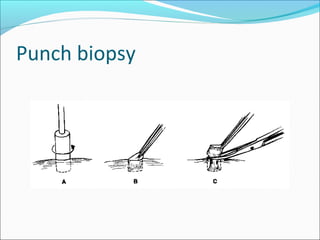
Punch biopsy
. Another tool that can be used for incisional or

excisional purposes.
biopsy is especially well suited for diagnosis of oral
manifestations of mucocutaneous and
vesiculoulcerative diseases, such as lichen planus,
pemphigus, etc
Brush biopsy
Firm pressure with a circular

brush is applied, rotated
five to ten times, causing
light abrasion.

 The cellular material picked

up by the brush is transferred
to a glass slide, preserved,
and dried.
Technique of punch biopsy
biopsy punches should range in size from 2-10 mm in

diameter
 the smaller diameters should be avoided due to the
risk of over-manipulating and crushing the tissue .
The technique is easily performed with a low
incidence of postsurgical morbidity.
Suturing in regards to a punch biopsy procedure is
usually not required as the surgical wounds heal by
secondary intention.
Disadvantages
One disadvantage of using the biopsy punch is that it

is difficult to obtain adequate, representative tissue
deeper than the superficial lamina propria (1).
Excisional Biopsy
Indications:
Should be employed with small lesions. Less than 1cm
The lesion on clinical exam appears benign.
When complete excision with a margin of normal tissue

is possible without mutilation.
Technique
An excisional biposy implies the complete removal of the lesion.

A perimeter of normal tissue (2-3 mm) surrounding the

lesion is included with the specimen.
 Excisional biopsy should be performed on smaller lesions
(less than 1 cm in diameter) that appear clinically benign.
 Pigmented and vascular lesions should be removed, if
possible, in their entirety. This avoids seeding of the
melanin producing tumor cells into the wound site or in
the case of a hemangioma, allows the clinician to address
the feeder vessels.
Exisional biopsy
Anesthesia
Block anesthesia is preferred to infiltration
When blocks are not possible distant infiltration may

be used
Never inject directly into the lesion
Tissue Stabilization
Digital stabilization
Specialized retractors/forceps
Retraction sutures
Towel Clips
Hemostasis
Suction devices should be avoided
Gauze compresses are usually adequate
Gauze wrapped low volume suction may be used if

needed
Incisions

Incisions should be made with a scalpel.
They should be converging
Should extend beyond the suspected depth of the lesion
They should parallel important structures
Margins should include 2 to 3mm of normal appearing

tissue if the lesion is thought to be benign.
5mm or more may be necessary with lesions that appear
malignant, vascular, pigmented, or have diffuse borders.
Handling of the Tissue Specimen
special care should be undertaken to hold the

specimen gently at the periphery of the sample.
Injection of large amounts of anesthetic solution in
the biopsy area, while providing hemostasis, can
produce hemorrhage, which masks the normal
cellular architecture.
 Infiltration of local anesthetic around the lesion is
acceptable if the field is wide enough in relation to
the lesion;
Handling of the Tissue Specimen
injection directly into the lesion should be avoided.
 Use of electrocautery to excise the specimen remains a

common complicating factor in determining an accurate
microscopic diagnosis.
Heat produced by these units alters both the epithelium
and the underlying connective.
Small tissue biopsies to rule out malignancy are usually
nondiagnostic if excised by electrocautery, as the presence
of epithelial atypia is typically obscured
If electrocautery is to be used, the incision margin should
be far enough away from the interface of the lesion to
prevent thermal changes at that interface (2).

Specimen Care
The specimen should be immediately placed in 10%

formalin solution, and be completely immersed.
Margins of the Biopsy
Margins of the tissue should be identified to orient

the pathologist. A silk suture is often adequate.
Illustrations are also very helpful and should be
included.
Surgical Closure
Primary closure of the wound is usually possible
Mucosal undermining may be necessary
Elliptical incision on the hard palate or attached

gingiva may be left to heal by secondary intention.
Biopsy Data Sheet
A biopsy data sheet should be completed and the

specimen immediately labeled. All pertinent history
and descriptions of the lesion must be conveyed.
The biopsy report
It should include
the name of the clinician,
date the specimen was obtained
pertinent characteristics of the specimen.
The location/site, size, color, number, borders or

margins, consistency, and relative radiodensity of the
lesion are all important findings that should be
included in the description of the specimen.
 If the lesion is evident on radiographs, it is very
important to submit good quality radiographs with
the specimen to aid in pathologic correlation and
diagnosis.
Intraosseous and Hard Tissue Biopsy
Intraosseous lesions are most often the result of

problems associated with the dentition.
Indications for Intraosseous Biopsy
Any intraosseous lesion that fails to respond to

routine treatment of the dentition.
Any intraosseous lesion that appears unrelated to the
dentition.
Principles of Surgery
Mucperiosteal flaps should be designed to allow

adequate access for incisional/excisional biopsy.
Incisions should be over sound bone
Cortical perforation must be considered when
designing flaps
Flaps should be full thickness
Major neurovascular structures should be avoided
Principles of Surgery
Osseous windows should be submitted with the

specimen
Osseous preformations can be enlarged to gain
access
Avoid roots and neurovascular structures
The tissue consistency and nature of the lesion will
determine the ease of removal
Principles of Surgery
Incisional biopsies only require removal of a

section of tissue
Soft tissue overlying the lesion should be
reapproximated following thorough irrigation of
the operative site.
The specimen should be handled as previously
described
When To Refer For Biopsy
When the health of the patient requires special

management that the dentist feel unprepared to handle
The size and surgical difficulty is beyond the level of skill
that the dentist feels he/she possesses
If the dentist is concerned about the possibility of
malignancy
References
1. Lynch DP, Morris LF. The oral mucosal punch

biopsy: indica-tions and technique. J Am Dent Assoc
1990 Jul;121(1):145-9.
2. Margarone JE, Natiella JR, Vaughan CD. Artifacts in
oral biopsy specimens. J Oral Maxillofac Surg 1985
Mar;43(3):163-72.
3. Sheehan DC, Hrapchak BB. Theory and practice of
histo-technology. Saint Louis: C. V. Mosby Co.; 1973.
Dent Assoc 1996 Mar;127(3):363-8.
4. Abbey LM, Sweeney WT. Fixation artifacts in oral

biopsy specimens. Va Dent J 1972 Dec;49(6):31-4.
5. Zegarelli DJ. Common problems in biopsy
procedure. J Oral Surg 1978 Aug;36(8):644-7.
6.Sol Silverman, L Roy Eversole , Edmond L.
Truelove, Essentials of Oral Medicine .Hamilton,
Ontario 2002 BC Decker Inc

Biopsy

  • 3.
    Definition Biopsy is asurgical procedure to obtain tissue from a living organism for its microscopical examination, usually to perform a diagnosis.
  • 4.
    Indications for Biopsy Inflammatorychanges of unknown cause that persist for long periods Lesion that interfere with local function Bone lesions not specifically identified by clinical and radiographic findings Any lesion that has the characteristics of malignancy
  • 5.
    Characteristics of lesionsthat raise .the suspicion of malignancy Erythroplasia- lesion is totally red or has a speckled red appearance. Ulceration- lesion is ulcerated or presents as an ulcer. Duration- lesion has persisted for more than two weeks. Growth rate- lesion exhibits rapid growth Bleeding- lesion bleeds on gentle manipulation Induration- lesion and surrounding tissue is firm to the touch Fixation- lesion feels attached to adjacent structures
  • 6.
    Types of Biopsy Thefour major types of biopsy routinely used in and around the oral cavity are : cytology, aspiration biopsy, incisional biopsy, and excisional biopsy.
  • 7.
    Oral Cytology Oral cytologyis typically used as an adjunct to, not a substitute for, incisional or excisional biopsy procedures Cytology allows examination of individual cells, but cannot provide the histologic features crucial for an accurate and definitive diagnosis  Developed as a diagnostic screening procedure to monitor large tissue areas for dysplastic changes. Lesions that lend themselves to cytologic examination may include; post-radiation changes, herpes, fungal infections, and pemphigus.
  • 8.
    Procedures of cytologicalbiopsy In a cytologic examination, the lesion is scraped repeatedly and firmly with a moistened tongue depressor or cytology brush. The cells are then transferred to and smeared evenly on a glass slide. The slide is immediately immersed in a fixing solution or sprayed with a fixative, such as hairspray.  The cells can be stained with any of a myriad of laboratory preparations and examined under the microscope.
  • 9.
    The Advantages andDisadvantageof oral :cytological procedures include Advantages Cytology may be helpful when large areas of mucosal change are noted, or in areas with difficult surgical access Disadvantages Not very reliable with many false positives. Expertise in oral cytology is not widely available
  • 10.
    Aspiration Biopsy Aspiration biopsyis the use of a needle and syringe to remove a sample of cells or contents of a lesion.  The inability to withdraw fluid or air indicates that the lesion is probably solid
  • 11.
    Aspiration Biopsy Indications: To determinethe presents of fluid within a lesion To a certain the type of fluid within a lesion When exploration of an intraosseous lesion is indicated
  • 12.
    Aspiration Procedures: An 18-gauge needleis connected to a 5 or 10 ml syringe and is inserted into the center of the mass via a small hole in the lesion. The tip of the needle may need to be positioned in multiple directions to locate a potential fluid center.  The material withdrawn during aspiration biopsy can be submitted for pathologic examination and/or culturing.
  • 13.
    The inability towithdraw fluid or air indicates that the lesion is probably solid.  A radiolucent lesion in the jaw that yields strawcolored fluid on aspiration is most likely a cystic lesion. If purulent exudate (pus) is withdrawn, then an inflammatory or infectious process should be considered..
  • 14.
    The aspiration ofblood might indicate a vascular malformation within the bone. Any intrabony radiolucent lesion should be aspirated before surgical intervention to rule out a vascular lesion.  If the lesion is determined to be vascular in nature, the flow rate (high versus low) should be determined because uncontrollable hemorrhage can occur if incised
  • 15.
    Incisional Biopsy The intentof an incisional biopsy is to sample only a representative portion of the lesion. If the lesion is large or has many differing characteristics, more than one area may require sampling.
  • 16.
  • 17.
    Indications of incisionalbiopsy whenever the lesion is difficult to excise because of its extensive size  in cases where appropriate excisional surgical management requires hospitalization or complicated wound management.
  • 18.
    Technique of IncisionalBiopsy Representative areas are biopsied in a wedge fashion. Margins should extend into normal tissue on the deep surface. Necrotic tissue should be avoided.  The sample should be taken from the edge of the lesion to include surrounding normal tissue  It should be deep enough to include underlying changes of the surface lesion.
  • 19.
  • 20.
  • 21.
    Punch biopsy . Anothertool that can be used for incisional or excisional purposes. biopsy is especially well suited for diagnosis of oral manifestations of mucocutaneous and vesiculoulcerative diseases, such as lichen planus, pemphigus, etc
  • 23.
    Brush biopsy Firm pressurewith a circular brush is applied, rotated five to ten times, causing light abrasion.  The cellular material picked up by the brush is transferred to a glass slide, preserved, and dried.
  • 24.
    Technique of punchbiopsy biopsy punches should range in size from 2-10 mm in diameter  the smaller diameters should be avoided due to the risk of over-manipulating and crushing the tissue . The technique is easily performed with a low incidence of postsurgical morbidity. Suturing in regards to a punch biopsy procedure is usually not required as the surgical wounds heal by secondary intention.
  • 25.
    Disadvantages One disadvantage ofusing the biopsy punch is that it is difficult to obtain adequate, representative tissue deeper than the superficial lamina propria (1).
  • 26.
    Excisional Biopsy Indications: Should beemployed with small lesions. Less than 1cm The lesion on clinical exam appears benign. When complete excision with a margin of normal tissue is possible without mutilation.
  • 27.
    Technique An excisional biposyimplies the complete removal of the lesion. A perimeter of normal tissue (2-3 mm) surrounding the lesion is included with the specimen.  Excisional biopsy should be performed on smaller lesions (less than 1 cm in diameter) that appear clinically benign.  Pigmented and vascular lesions should be removed, if possible, in their entirety. This avoids seeding of the melanin producing tumor cells into the wound site or in the case of a hemangioma, allows the clinician to address the feeder vessels.
  • 28.
  • 30.
    Anesthesia Block anesthesia ispreferred to infiltration When blocks are not possible distant infiltration may be used Never inject directly into the lesion
  • 31.
    Tissue Stabilization Digital stabilization Specializedretractors/forceps Retraction sutures Towel Clips
  • 32.
    Hemostasis Suction devices shouldbe avoided Gauze compresses are usually adequate Gauze wrapped low volume suction may be used if needed
  • 33.
    Incisions Incisions should bemade with a scalpel. They should be converging Should extend beyond the suspected depth of the lesion They should parallel important structures Margins should include 2 to 3mm of normal appearing tissue if the lesion is thought to be benign. 5mm or more may be necessary with lesions that appear malignant, vascular, pigmented, or have diffuse borders.
  • 34.
    Handling of theTissue Specimen special care should be undertaken to hold the specimen gently at the periphery of the sample. Injection of large amounts of anesthetic solution in the biopsy area, while providing hemostasis, can produce hemorrhage, which masks the normal cellular architecture.  Infiltration of local anesthetic around the lesion is acceptable if the field is wide enough in relation to the lesion;
  • 35.
    Handling of theTissue Specimen injection directly into the lesion should be avoided.  Use of electrocautery to excise the specimen remains a common complicating factor in determining an accurate microscopic diagnosis. Heat produced by these units alters both the epithelium and the underlying connective. Small tissue biopsies to rule out malignancy are usually nondiagnostic if excised by electrocautery, as the presence of epithelial atypia is typically obscured If electrocautery is to be used, the incision margin should be far enough away from the interface of the lesion to prevent thermal changes at that interface (2). 
  • 36.
    Specimen Care The specimenshould be immediately placed in 10% formalin solution, and be completely immersed.
  • 37.
    Margins of theBiopsy Margins of the tissue should be identified to orient the pathologist. A silk suture is often adequate. Illustrations are also very helpful and should be included.
  • 38.
    Surgical Closure Primary closureof the wound is usually possible Mucosal undermining may be necessary Elliptical incision on the hard palate or attached gingiva may be left to heal by secondary intention.
  • 39.
    Biopsy Data Sheet Abiopsy data sheet should be completed and the specimen immediately labeled. All pertinent history and descriptions of the lesion must be conveyed.
  • 40.
    The biopsy report Itshould include the name of the clinician, date the specimen was obtained pertinent characteristics of the specimen.
  • 41.
    The location/site, size,color, number, borders or margins, consistency, and relative radiodensity of the lesion are all important findings that should be included in the description of the specimen.  If the lesion is evident on radiographs, it is very important to submit good quality radiographs with the specimen to aid in pathologic correlation and diagnosis.
  • 42.
    Intraosseous and HardTissue Biopsy Intraosseous lesions are most often the result of problems associated with the dentition.
  • 43.
    Indications for IntraosseousBiopsy Any intraosseous lesion that fails to respond to routine treatment of the dentition. Any intraosseous lesion that appears unrelated to the dentition.
  • 44.
    Principles of Surgery Mucperiostealflaps should be designed to allow adequate access for incisional/excisional biopsy. Incisions should be over sound bone Cortical perforation must be considered when designing flaps Flaps should be full thickness Major neurovascular structures should be avoided
  • 45.
    Principles of Surgery Osseouswindows should be submitted with the specimen Osseous preformations can be enlarged to gain access Avoid roots and neurovascular structures The tissue consistency and nature of the lesion will determine the ease of removal
  • 46.
    Principles of Surgery Incisionalbiopsies only require removal of a section of tissue Soft tissue overlying the lesion should be reapproximated following thorough irrigation of the operative site. The specimen should be handled as previously described
  • 47.
    When To ReferFor Biopsy When the health of the patient requires special management that the dentist feel unprepared to handle The size and surgical difficulty is beyond the level of skill that the dentist feels he/she possesses If the dentist is concerned about the possibility of malignancy
  • 48.
    References 1. Lynch DP,Morris LF. The oral mucosal punch biopsy: indica-tions and technique. J Am Dent Assoc 1990 Jul;121(1):145-9. 2. Margarone JE, Natiella JR, Vaughan CD. Artifacts in oral biopsy specimens. J Oral Maxillofac Surg 1985 Mar;43(3):163-72. 3. Sheehan DC, Hrapchak BB. Theory and practice of histo-technology. Saint Louis: C. V. Mosby Co.; 1973. Dent Assoc 1996 Mar;127(3):363-8.
  • 49.
    4. Abbey LM,Sweeney WT. Fixation artifacts in oral biopsy specimens. Va Dent J 1972 Dec;49(6):31-4. 5. Zegarelli DJ. Common problems in biopsy procedure. J Oral Surg 1978 Aug;36(8):644-7. 6.Sol Silverman, L Roy Eversole , Edmond L. Truelove, Essentials of Oral Medicine .Hamilton, Ontario 2002 BC Decker Inc