WELCOME
TO
MY
PRESENTATION
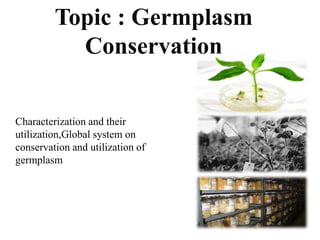
Topic : Germplasm
Conservation
Characterization and their
utilization,Global system on
conservation and utilization of
germplasm
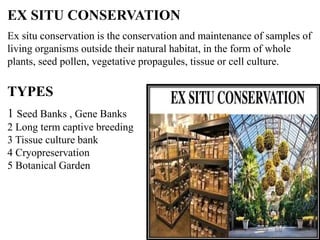
EX SITU CONSERVATION
Ex situ conservation is the conservation and maintenance of samples of
living organisms outside their natural habitat, in the form of whole
plants, seed pollen, vegetative propagules, tissue or cell culture.
TYPES
1 Seed Banks , Gene Banks
2 Long term captive breeding
3 Tissue culture bank
4 Cryopreservation
5 Botanical Garden
1. SEED BANK
The seed bank preserves dried seeds by
storing them at a very low temperature spores and
pteridophytes are conserved in seed bank but other seedless
plants such as tuber crops can not be preserved this away
Major seed bank in the world:
AVRDC-The World Vegetative Center(Taiwan)
Camino Verde(Peru)
Great Lakes Bioneers Chicago(GLBC)Seed Saving Initiative
New York City Native plant conservation initiative.
GENE BANK
A collection of seeds, planys , animals,
maintained as a repository of genetic material, typically to
preserve genetic diversity.
TYPES OF GENE BANK
 Tissue bank
 Cryo Bank
 Pollen Bank
 Field Gene Bank
 Ova Bank
TISSUE BANK
 In this techniques buds,
protocorms and meristematic
cells are conserved through
particular light and temperature
arrangements in a nutrient
media.
 This is used to preserve
seedless plants and plants
which reproduce asexually.
CRYO BANK
In this technique a seed or embryo
is preserved at a very low
temperature
In liquid nitrogen at – 196 ℃℃his
is helpful for the conservation
of species facing extinction.
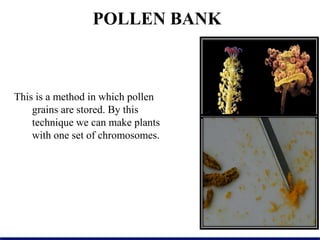
POLLEN BANK
This is a method in which pollen
grains are stored. By this
technique we can make plants
with one set of chromosomes.
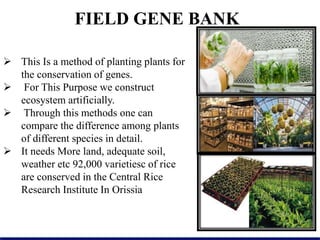
FIELD GENE BANK
 This Is a method of planting plants for
the conservation of genes.
 For This Purpose we construct
ecosystem artificially.
 Through this methods one can
compare the difference among plants
of different species in detail.
 It needs More land, adequate soil,
weather etc 92,000 varietiesc of rice
are conserved in the Central Rice
Research Institute In Orissia
OVA BANK
A ova bank or egg cell bank is a facility that
collects and stores ova or egg cells
mainly for conservation of gene.
2 . Long term captive breeding
The method involves capture maintenance and
captive breeding long term basis of individuals of the
endangered spp. which have lost their habitat
permanently or certain highly unfavourable conditions
are present in their habitat.
3. Tissue culture bank
Tissue culture is a biological research method
in which fragments of tissue from an animal or plant
are transferred to an artificial environment in which
they can continue to survive and function. In tissue
culture bank, tissues are preserved.
4. Cryopreservation
 Cryopreservation literally means in the frozen state. The
principle involved in cryopreservation to bring the plant cells and
tissue cultures to a zero metabolism or non- dividing state by
reducing the temperature in the presences of cryoprotectants.
CRYOPRESERVATION broadly means the storage of
germplasm at very low temperatures :
 Over solid carbon dioxide(at -79℃)
 Low temperature deep freezer (at -80℃)
 In liquid nitrogen(at -196℃)
In fact, cryopreservation has been successfully applied for
germplasm conservation of a wide range of Plant species e.g rice
,wheat, peanut, sugarcane, coconut.
Cryopreservation is 3 types
 Long term cryopreservation : Conservation of
germplasm under low temperature for long time using
cryoprotectants is known as long term
cryopreservation. It is one of the best and effective
way to conserve germplasm.
 Mid term cryopreservation : Microorganism and
viruses are mainly conserved in mid term
cryopreservation.
 Short term cryopreservation : Conservation of
germplasm for short time using cryoprotectant and
low temperature.
MECHANISM OF CRYOPRESERVATION
 The technique of freeze preservation is based on the transfer of
water present in the cells from a liquid to solid state.
 Due to the presence of salts and organic molecules in the cells,
the cell water requires much more lower temperature to
freeze(even up to -68℃)compared to the freezing point of pure
water (around 0℃).
 When stored at low temperature, the metabolic processes and
biological deteriorations in the cells or tissues almost come to
sandstill.
TECHNIQUE OF CRYOPRESERVATION
The cryopreservation of plant cell culture followed the generation
of plants broadly involves the following stages:
 Development of sterile tissue cultures
 Addition of cryoprotectants and pretreatment, freezing
 Storage
 Thawing
 Re-culture
 Measurement of viability
 Plant regeneration
a. DEVELOPMENT OF STERILE TISSUE
CULTURE
 The selection of plant species and the tissue with particular
references to the morphological and physiological characters
largely influences the ability of the explant to survive in
cryopreservation.Any tissues can be used e.g: meristems,
embroys, endosperm, ovules, seeds etc.
b. ADDITION OF CRYOPROTECTANT
 Cryoprotectants are the compounds that can prevent the
damage caused to cells by freezing or thawing, There are
several cryopeotectant which include:
DMSO,GLYCEROL,ETHYLENE
PROPYLENE,SUCROSE,GLUCOSE .
c. FREEZING
The sensitivity of the cells to low temperature is variable and
largely depends on the plant species. Four different types of
freezing methods are used—
• Slow freezing method
• Rapid freezing method
• Stepwise freezing method
• Dry freezing method
d. STORAGE
In general, the frozen cells/tissues are kept for storage at
temperature in the range of (-72 to -196)℃.Storage is ideally done
in liquid nitrogene refrigerator at 150c in the vapour phase, at -
196℃ in the liquid phase.
The ultimate objectives of storage is to stop all the cellular
metabolic activities and maintain their viability.
e. THAWING
Thawing is usually carried out by plunging the frozen sample
in ampoules into the warm water . As the thawing occurs(ice
completely) the ampoules are quickly transferred to a water
bath at temperature (22-25)℃.This transfer is necessary since
the cells get damaged if left for long in warm (37-45)℃ water
bath.
f. RECULTURE
In general, thawed germplasm is washed several times to
remove cryoprotectants . The material is then cultured in a
fresh media.
g. PLANT REGENERATION
The ultimate purpose of cryopreservation of germplasm is to
regenerate the desired plant.
 For appropriate plant growth and regeneration , the cryopreserved
cell/tissue have to be carefully nursed and grown.
 Addition of certain growth promoting substances, besides
maintenance of appropriate environmental conditions is often
necessary for successful plant regeneration.
APPLICATION OF CRYOPRESERVSTION
 It is an ideal method for long term conservation of cell cultures
which produce secondary metabolities. e.g. medicines.
 Disease free plant materials can be frozen and propagated
whenever required.
 Recalcitrant seeds can be maintained for long.
 Conservation of somaclonal and gametoclonal variations in
cultures.
 Conservation of pollen for enhancing longevity.
 It is a good method for the selection of cold resistant mutant cell
lines which could develop into frost resistant plants.
Topic 3 germplasm

Topic 3 germplasm

  • 1.
  • 2.
    Topic : Germplasm Conservation Characterizationand their utilization,Global system on conservation and utilization of germplasm
  • 3.
    EX SITU CONSERVATION Exsitu conservation is the conservation and maintenance of samples of living organisms outside their natural habitat, in the form of whole plants, seed pollen, vegetative propagules, tissue or cell culture. TYPES 1 Seed Banks , Gene Banks 2 Long term captive breeding 3 Tissue culture bank 4 Cryopreservation 5 Botanical Garden
  • 4.
    1. SEED BANK Theseed bank preserves dried seeds by storing them at a very low temperature spores and pteridophytes are conserved in seed bank but other seedless plants such as tuber crops can not be preserved this away Major seed bank in the world: AVRDC-The World Vegetative Center(Taiwan) Camino Verde(Peru) Great Lakes Bioneers Chicago(GLBC)Seed Saving Initiative New York City Native plant conservation initiative.
  • 5.
    GENE BANK A collectionof seeds, planys , animals, maintained as a repository of genetic material, typically to preserve genetic diversity. TYPES OF GENE BANK  Tissue bank  Cryo Bank  Pollen Bank  Field Gene Bank  Ova Bank
  • 6.
    TISSUE BANK  Inthis techniques buds, protocorms and meristematic cells are conserved through particular light and temperature arrangements in a nutrient media.  This is used to preserve seedless plants and plants which reproduce asexually.
  • 7.
    CRYO BANK In thistechnique a seed or embryo is preserved at a very low temperature In liquid nitrogen at – 196 ℃℃his is helpful for the conservation of species facing extinction.
  • 8.
    POLLEN BANK This isa method in which pollen grains are stored. By this technique we can make plants with one set of chromosomes.
  • 9.
    FIELD GENE BANK This Is a method of planting plants for the conservation of genes.  For This Purpose we construct ecosystem artificially.  Through this methods one can compare the difference among plants of different species in detail.  It needs More land, adequate soil, weather etc 92,000 varietiesc of rice are conserved in the Central Rice Research Institute In Orissia
  • 10.
    OVA BANK A ovabank or egg cell bank is a facility that collects and stores ova or egg cells mainly for conservation of gene.
  • 11.
    2 . Longterm captive breeding The method involves capture maintenance and captive breeding long term basis of individuals of the endangered spp. which have lost their habitat permanently or certain highly unfavourable conditions are present in their habitat. 3. Tissue culture bank Tissue culture is a biological research method in which fragments of tissue from an animal or plant are transferred to an artificial environment in which they can continue to survive and function. In tissue culture bank, tissues are preserved.
  • 12.
    4. Cryopreservation  Cryopreservationliterally means in the frozen state. The principle involved in cryopreservation to bring the plant cells and tissue cultures to a zero metabolism or non- dividing state by reducing the temperature in the presences of cryoprotectants. CRYOPRESERVATION broadly means the storage of germplasm at very low temperatures :  Over solid carbon dioxide(at -79℃)  Low temperature deep freezer (at -80℃)  In liquid nitrogen(at -196℃) In fact, cryopreservation has been successfully applied for germplasm conservation of a wide range of Plant species e.g rice ,wheat, peanut, sugarcane, coconut.
  • 13.
    Cryopreservation is 3types  Long term cryopreservation : Conservation of germplasm under low temperature for long time using cryoprotectants is known as long term cryopreservation. It is one of the best and effective way to conserve germplasm.  Mid term cryopreservation : Microorganism and viruses are mainly conserved in mid term cryopreservation.  Short term cryopreservation : Conservation of germplasm for short time using cryoprotectant and low temperature.
  • 14.
    MECHANISM OF CRYOPRESERVATION The technique of freeze preservation is based on the transfer of water present in the cells from a liquid to solid state.  Due to the presence of salts and organic molecules in the cells, the cell water requires much more lower temperature to freeze(even up to -68℃)compared to the freezing point of pure water (around 0℃).  When stored at low temperature, the metabolic processes and biological deteriorations in the cells or tissues almost come to sandstill.
  • 15.
    TECHNIQUE OF CRYOPRESERVATION Thecryopreservation of plant cell culture followed the generation of plants broadly involves the following stages:  Development of sterile tissue cultures  Addition of cryoprotectants and pretreatment, freezing  Storage  Thawing  Re-culture  Measurement of viability  Plant regeneration
  • 16.
    a. DEVELOPMENT OFSTERILE TISSUE CULTURE  The selection of plant species and the tissue with particular references to the morphological and physiological characters largely influences the ability of the explant to survive in cryopreservation.Any tissues can be used e.g: meristems, embroys, endosperm, ovules, seeds etc. b. ADDITION OF CRYOPROTECTANT  Cryoprotectants are the compounds that can prevent the damage caused to cells by freezing or thawing, There are several cryopeotectant which include: DMSO,GLYCEROL,ETHYLENE PROPYLENE,SUCROSE,GLUCOSE .
  • 17.
    c. FREEZING The sensitivityof the cells to low temperature is variable and largely depends on the plant species. Four different types of freezing methods are used— • Slow freezing method • Rapid freezing method • Stepwise freezing method • Dry freezing method d. STORAGE In general, the frozen cells/tissues are kept for storage at temperature in the range of (-72 to -196)℃.Storage is ideally done in liquid nitrogene refrigerator at 150c in the vapour phase, at - 196℃ in the liquid phase. The ultimate objectives of storage is to stop all the cellular metabolic activities and maintain their viability.
  • 18.
    e. THAWING Thawing isusually carried out by plunging the frozen sample in ampoules into the warm water . As the thawing occurs(ice completely) the ampoules are quickly transferred to a water bath at temperature (22-25)℃.This transfer is necessary since the cells get damaged if left for long in warm (37-45)℃ water bath. f. RECULTURE In general, thawed germplasm is washed several times to remove cryoprotectants . The material is then cultured in a fresh media.
  • 19.
    g. PLANT REGENERATION Theultimate purpose of cryopreservation of germplasm is to regenerate the desired plant.  For appropriate plant growth and regeneration , the cryopreserved cell/tissue have to be carefully nursed and grown.  Addition of certain growth promoting substances, besides maintenance of appropriate environmental conditions is often necessary for successful plant regeneration.
  • 21.
    APPLICATION OF CRYOPRESERVSTION It is an ideal method for long term conservation of cell cultures which produce secondary metabolities. e.g. medicines.  Disease free plant materials can be frozen and propagated whenever required.  Recalcitrant seeds can be maintained for long.  Conservation of somaclonal and gametoclonal variations in cultures.  Conservation of pollen for enhancing longevity.  It is a good method for the selection of cold resistant mutant cell lines which could develop into frost resistant plants.