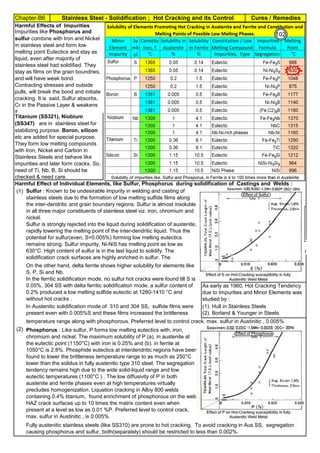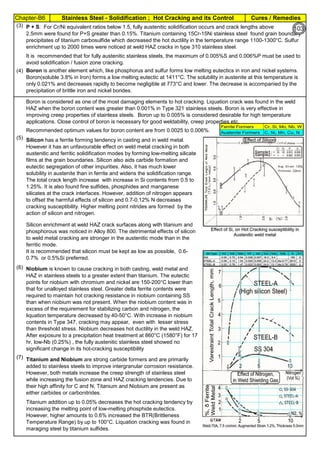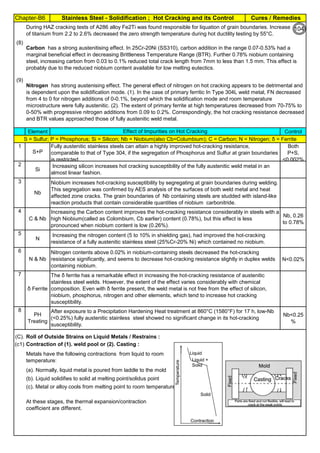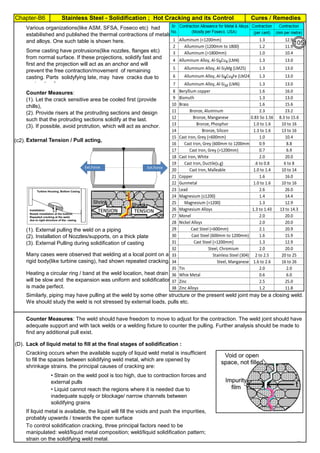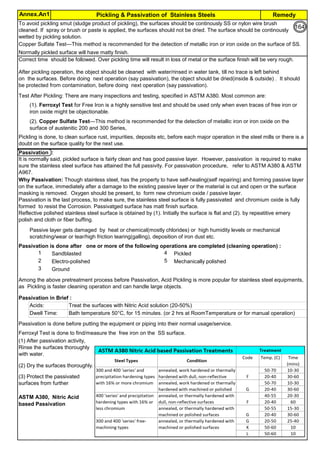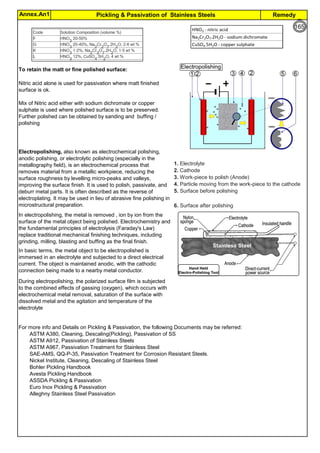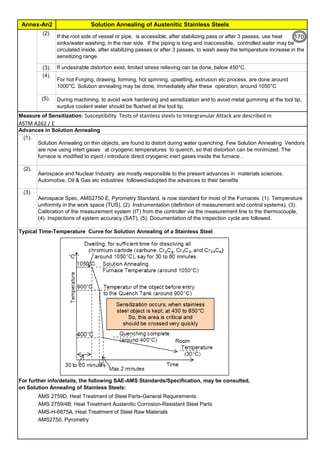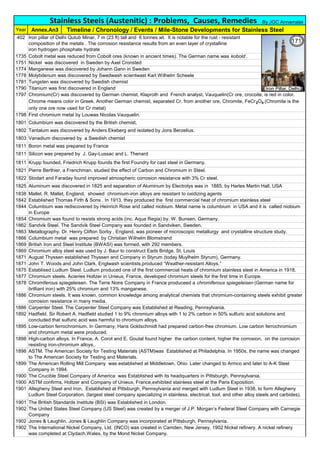



1
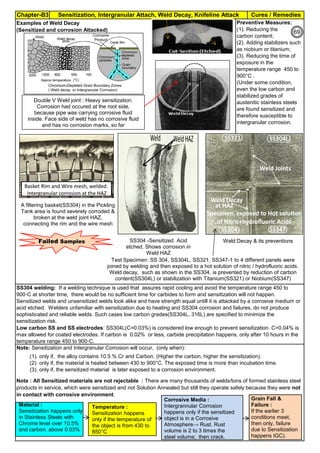
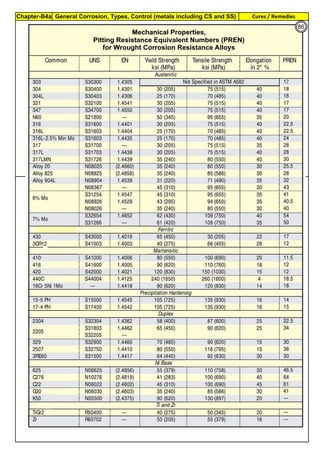
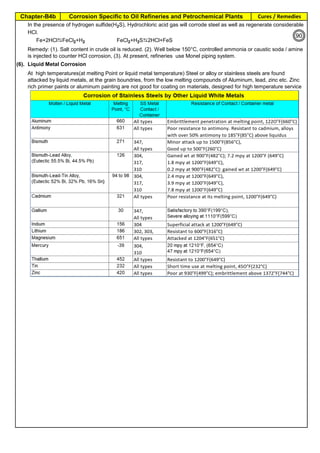
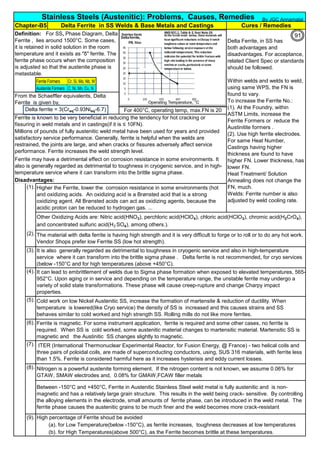
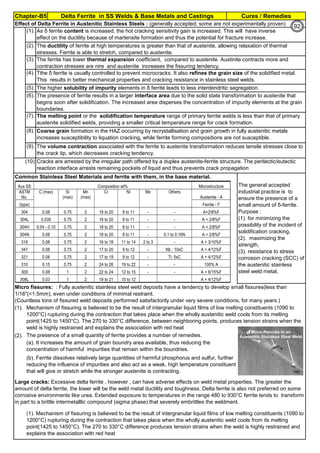
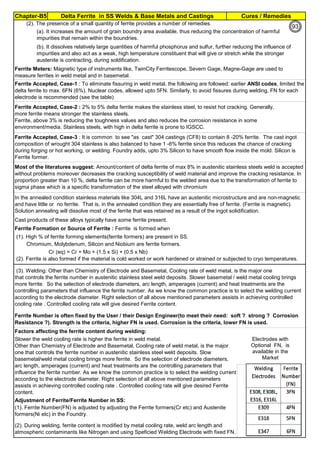
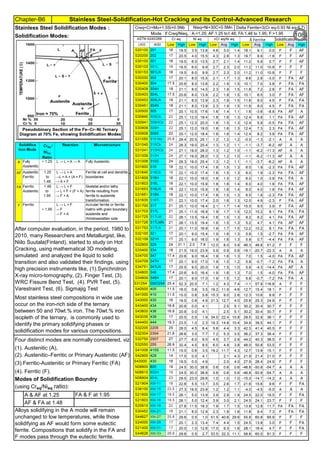
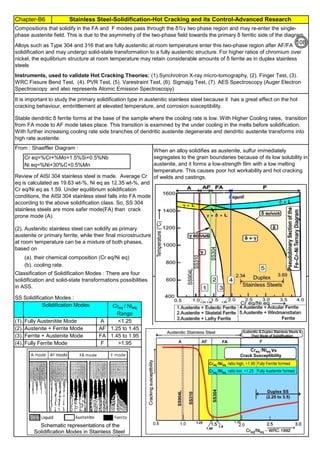
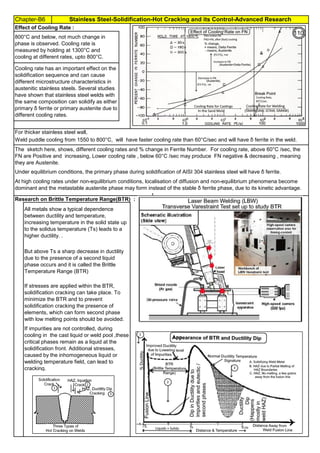
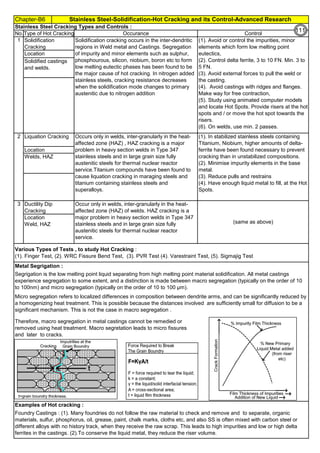
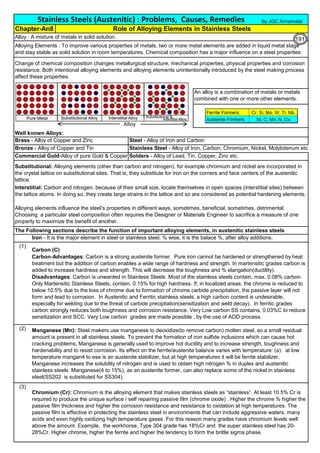
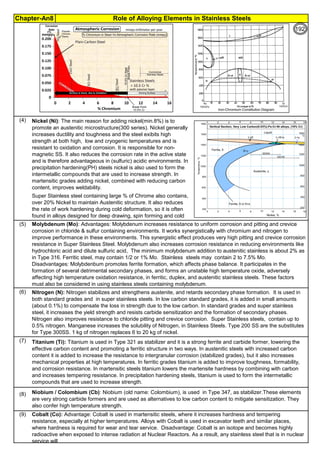
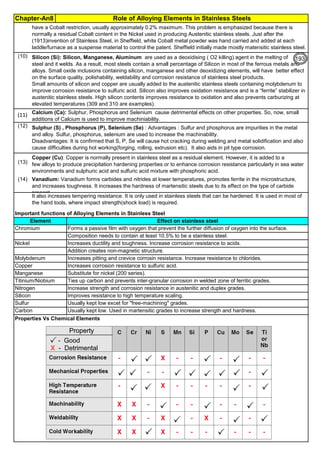
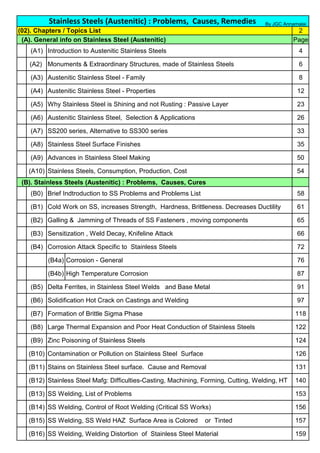
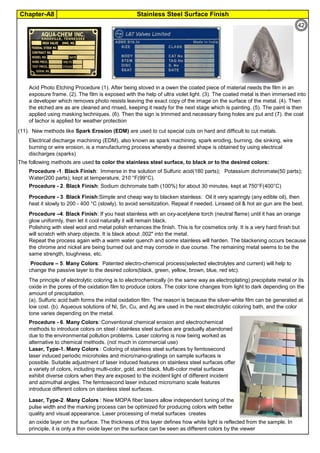
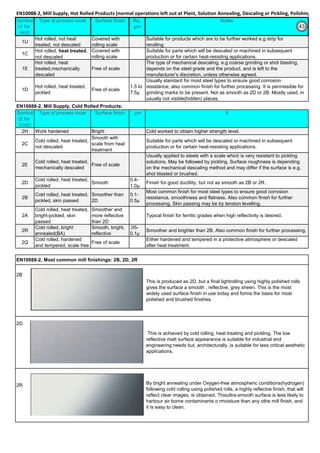
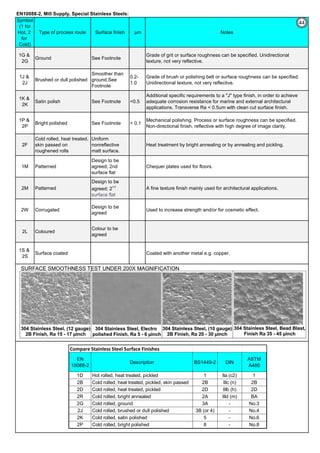
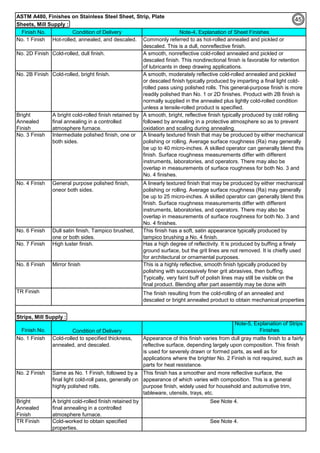
(02). Chapters / Topics List 2
(A). General info on Stainless Steel (Austenitic) Page
(A1) Introduction to Austenitic Stainless Steels 4
(A2) Monuments & Extraordinary Structures, made of Stainless Steels 6
(A3) Austenitic Stainless Steel - Family 8
(A4) Austenitic Stainless Steel - Properties 12
(A5) Why Stainless Steel is Shining and not Rusting : Passive Layer 23
(A6) Austenitic Stainless Steel, Selection & Applications 26
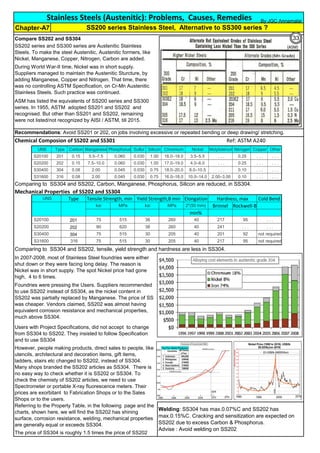
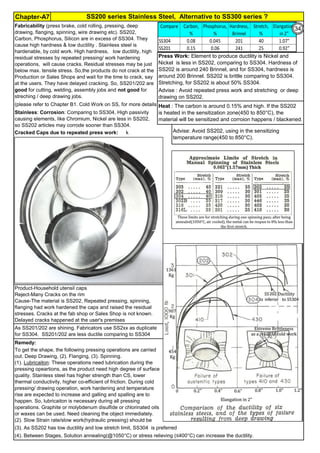
(A7) SS200 series, Alternative to SS300 series 33
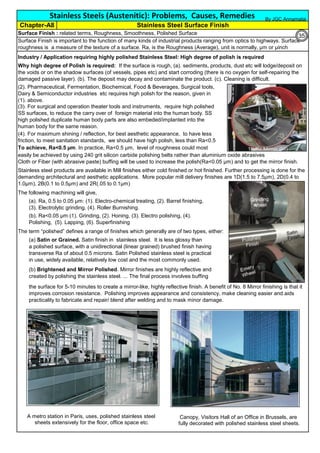
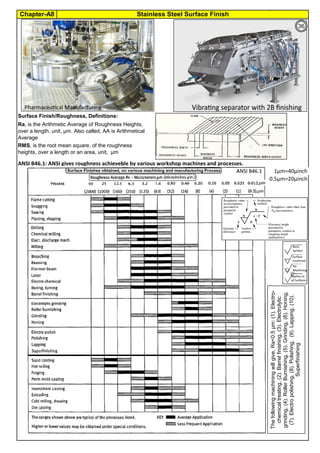
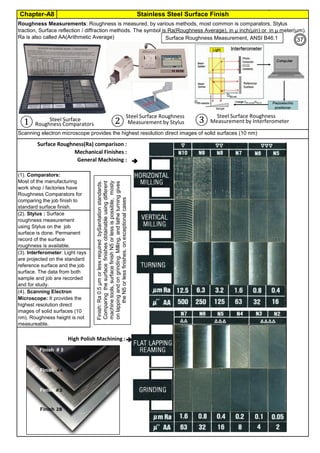
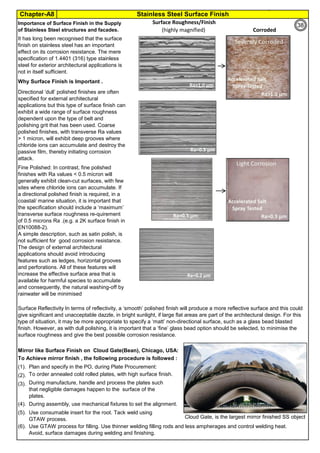
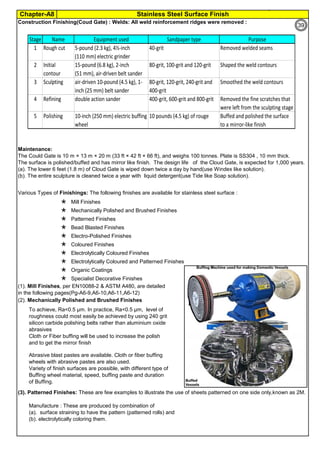
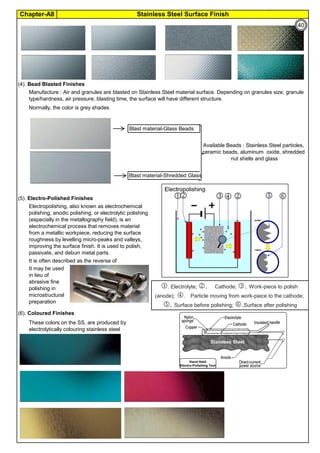
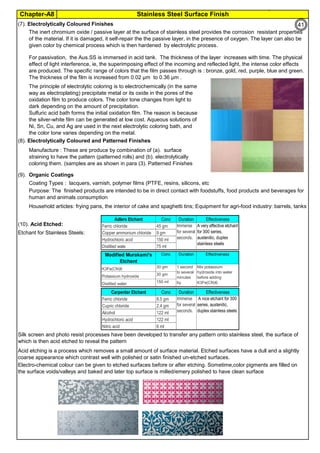
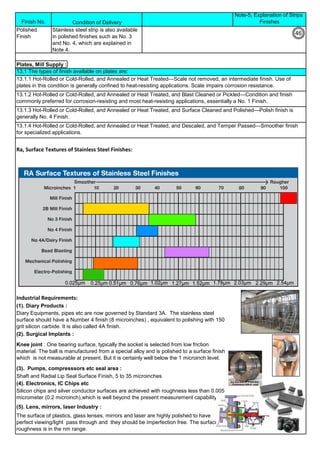
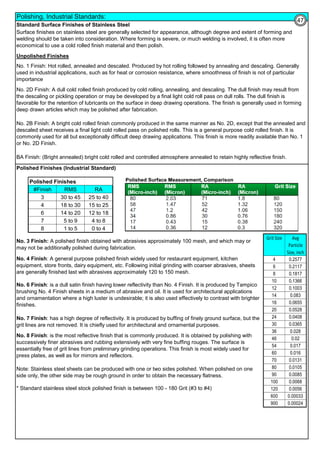
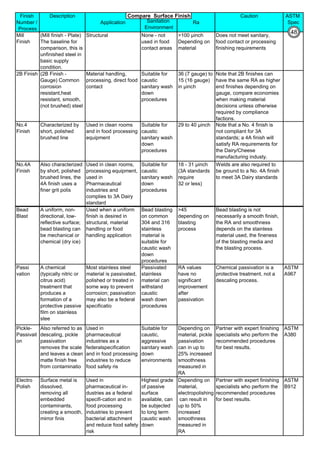
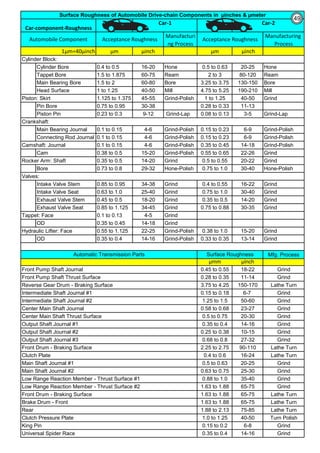
(A8) Stainless Steel Surface Finishes 35
(A9) Advances in Stainless Steel Making 50
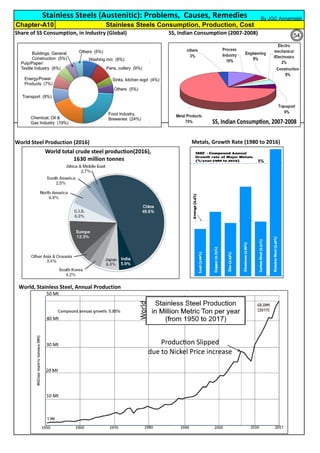
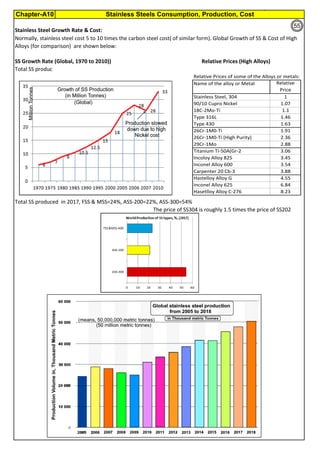
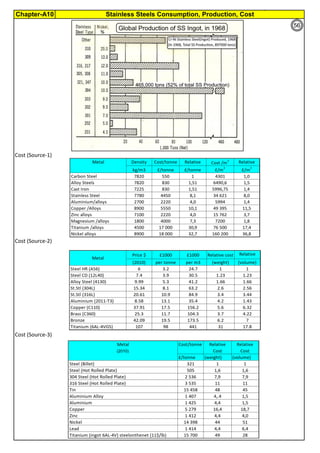
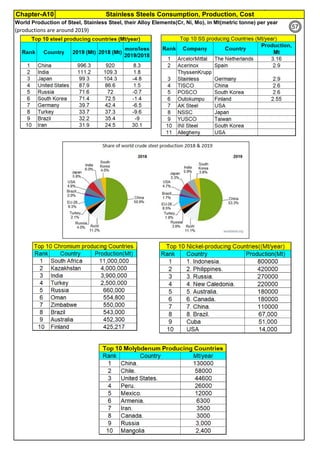
(A10) Stainless Steels, Consumption, Production, Cost 54
(B). Stainless Steels (Austenitic) : Problems, Causes, Cures
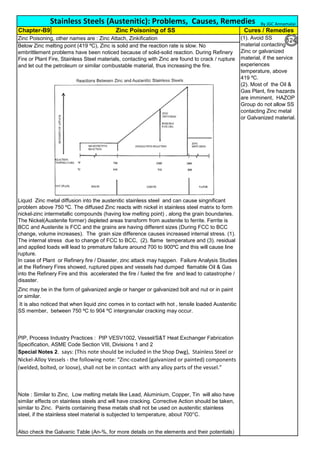
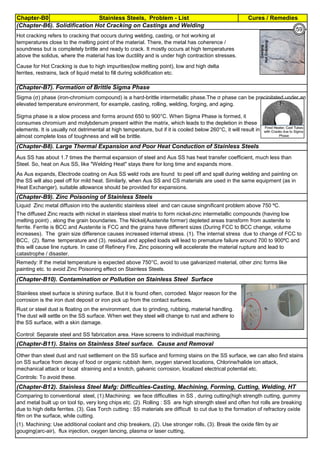
(B0) Brief Indtroduction to SS Problems and Problems List 58
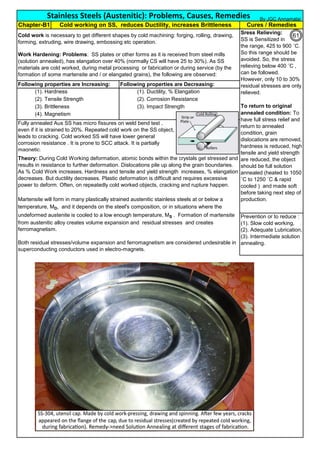
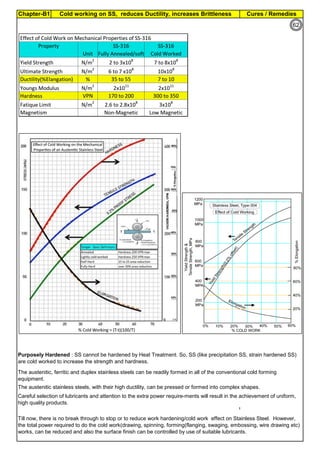
(B1) Cold Work on SS, increases Strength, Hardness, Brittleness. Decreases Ductility 61
(B2) Galling & Jamming of Threads of SS Fasteners , moving components 65
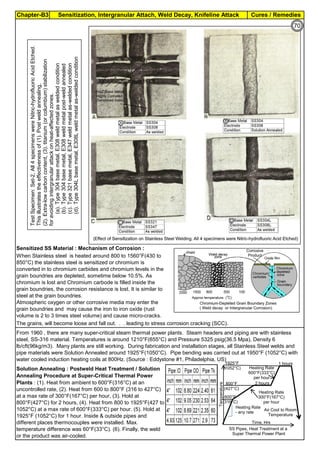
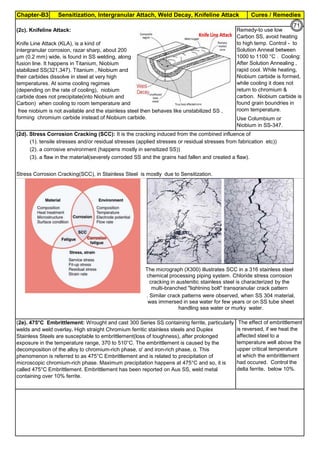
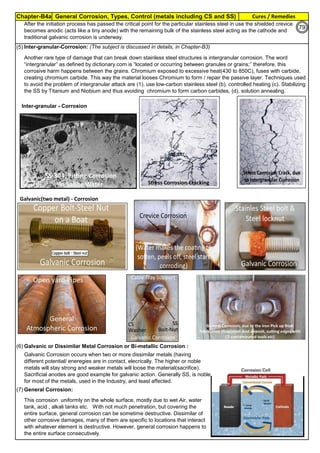
(B3) Sensitization , Weld Decay, Knifeline Attack 66
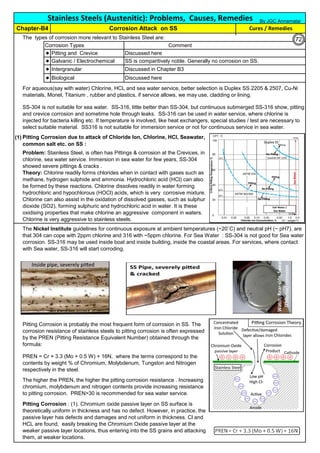
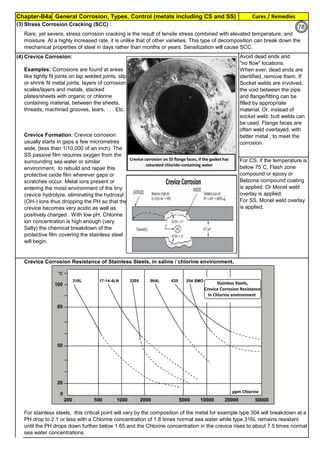
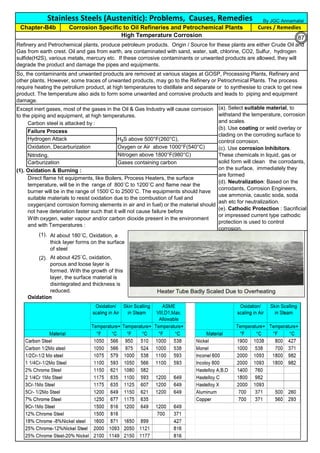
(B4) Corrosion Attack Specific to Stainless Steels 72
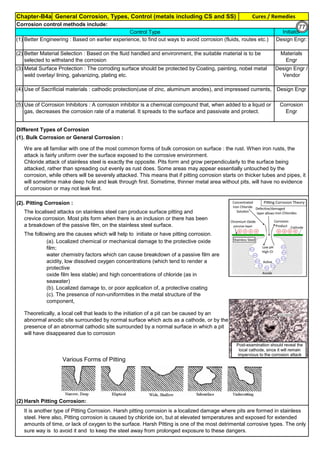
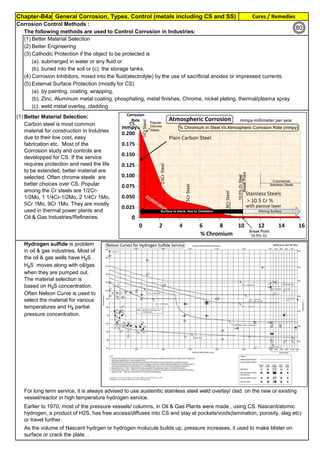
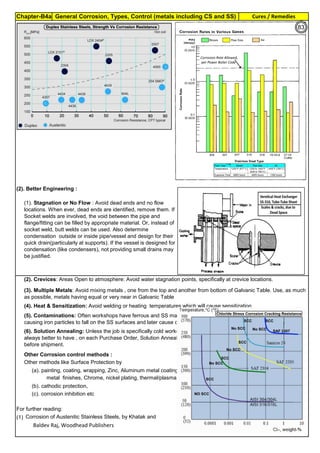
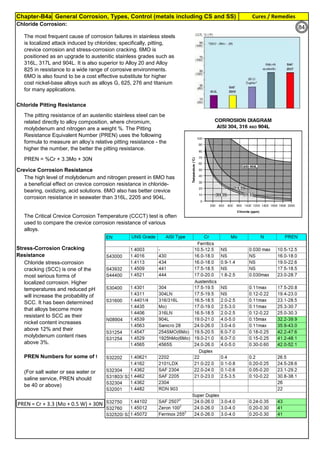
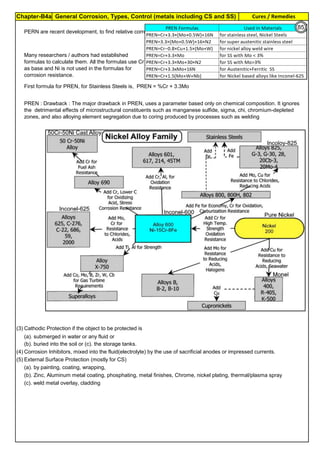
(B4a) Corrosion - General 76
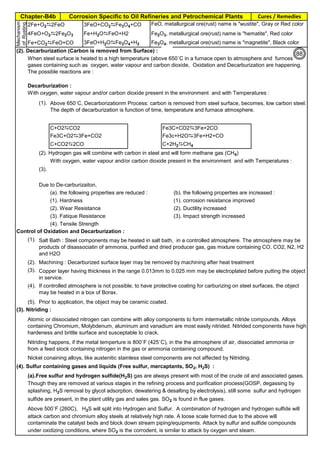
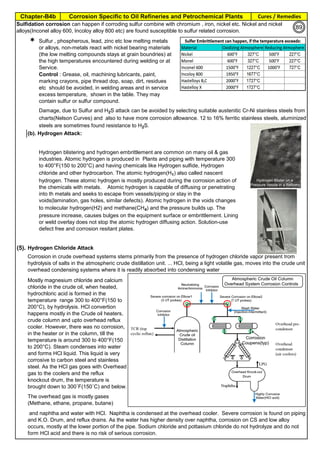
(B4b) High Temperature Corrosion 87
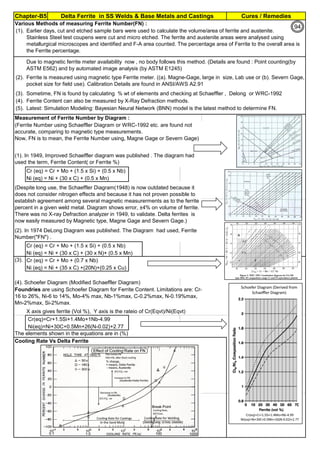
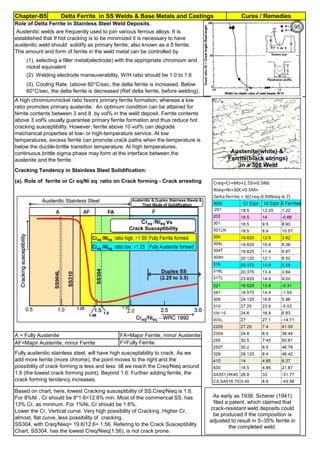
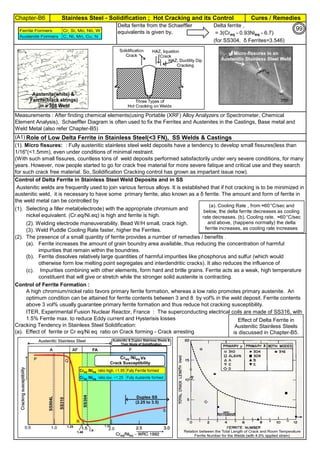
(B5) Delta Ferrites, in Stainless Steel Welds and Base Metal 91
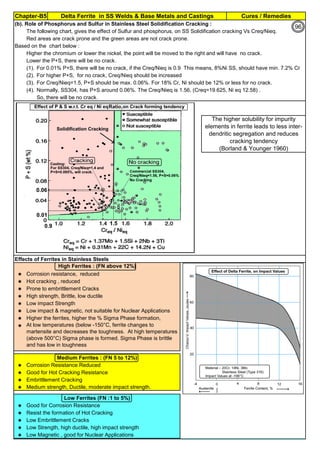
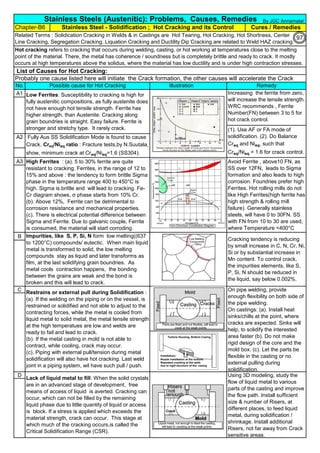
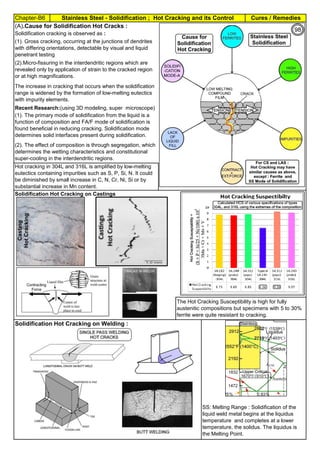
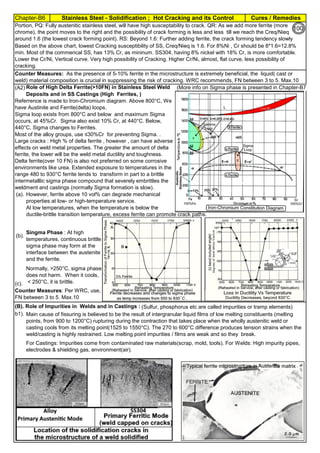
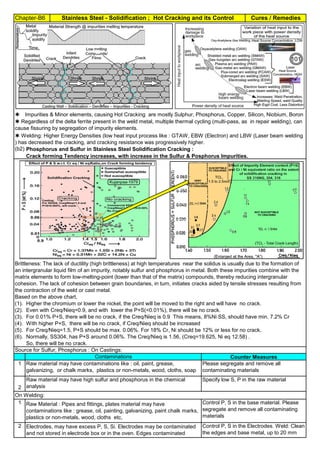
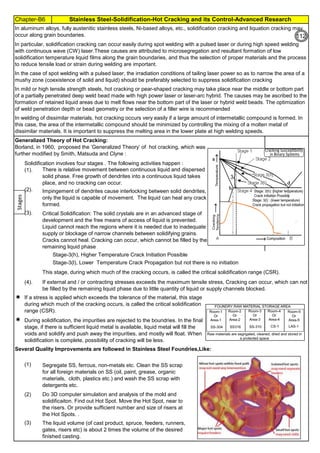
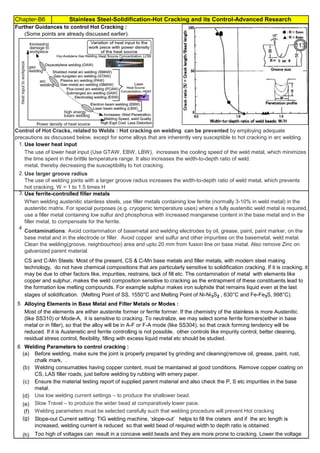
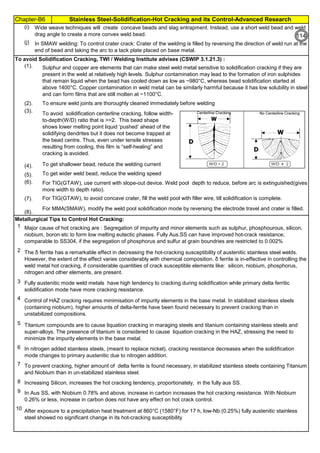
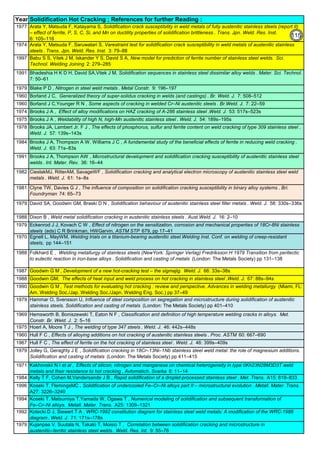
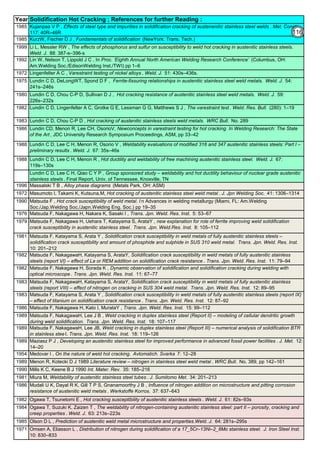
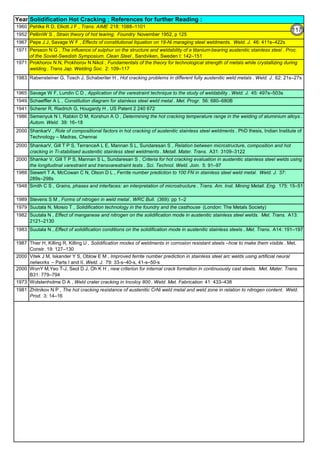
(B6) Solidification Hot Crack on Castings and Welding 97
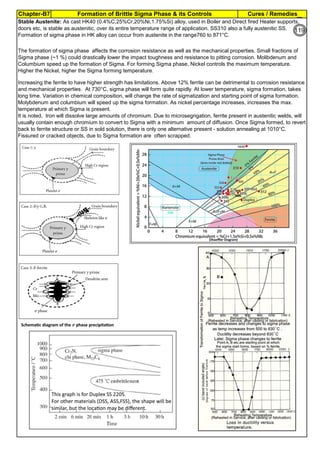
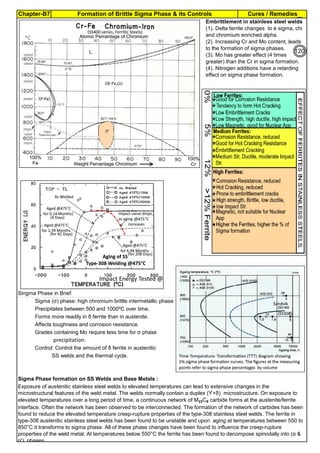
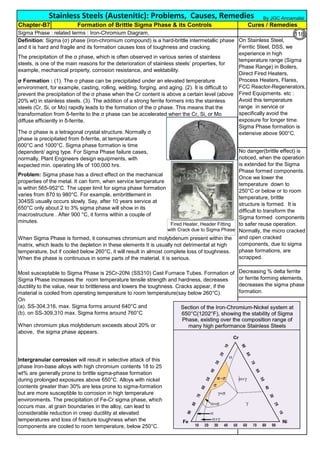
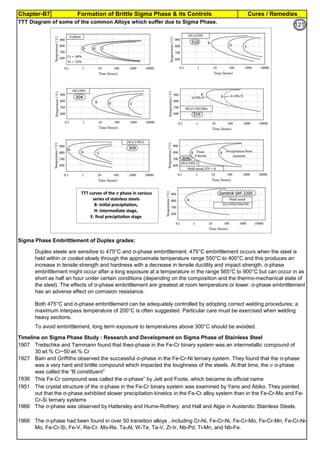
(B7) Formation of Brittle Sigma Phase 118
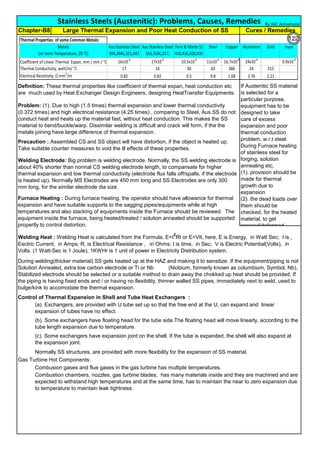
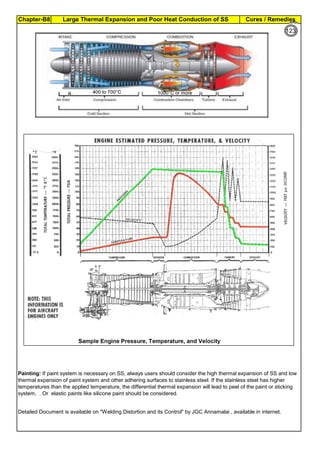
(B8) Large Thermal Expansion and Poor Heat Conduction of Stainless Steels 122
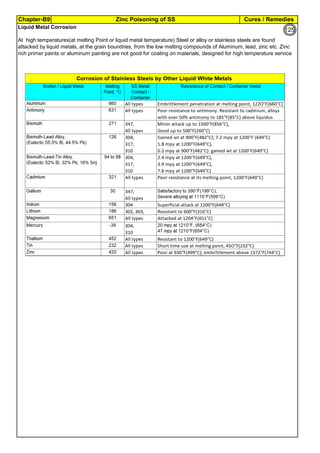
(B9) Zinc Poisoning of Stainless Steels 124
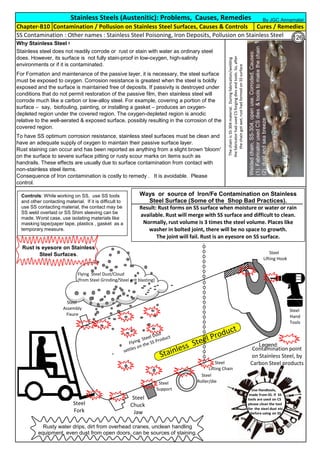
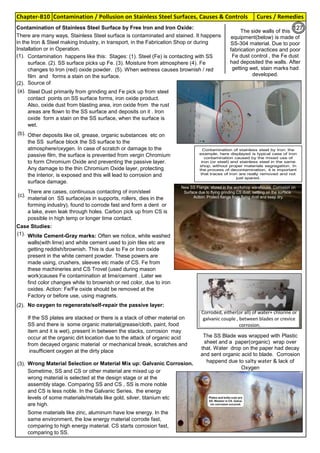
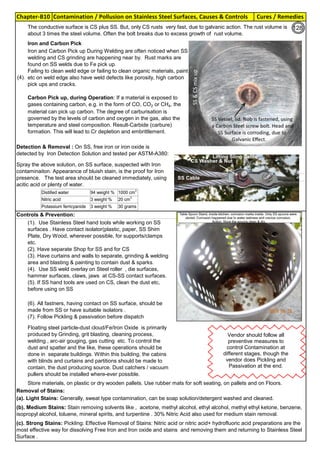
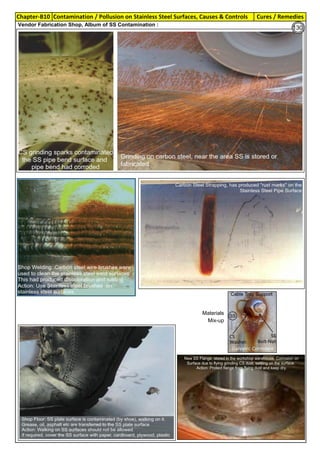
(B10) Contamination or Pollution on Stainless Steel Surface 126
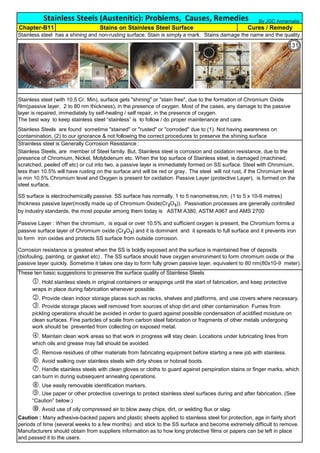
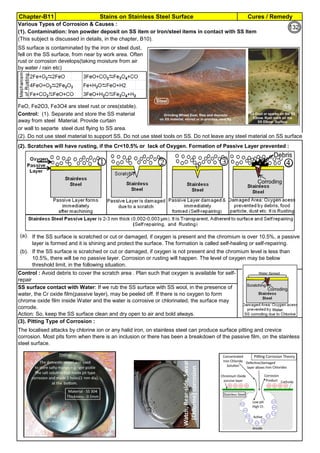
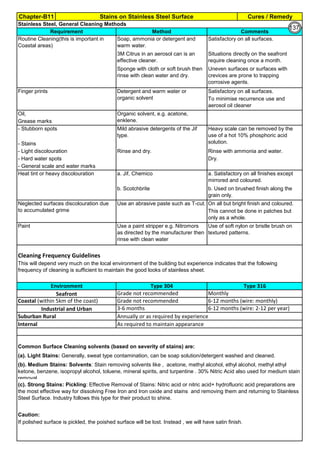
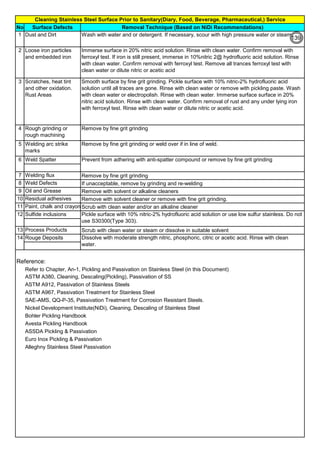
(B11) Stains on Stainless Steel surface. Cause and Removal 131
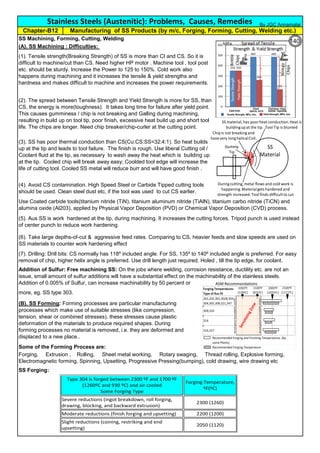
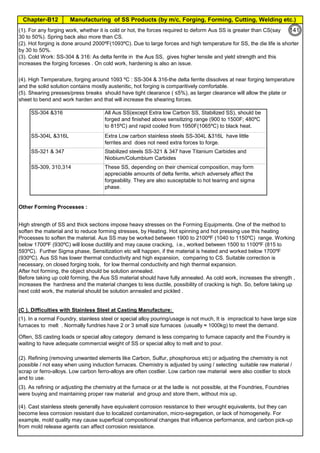
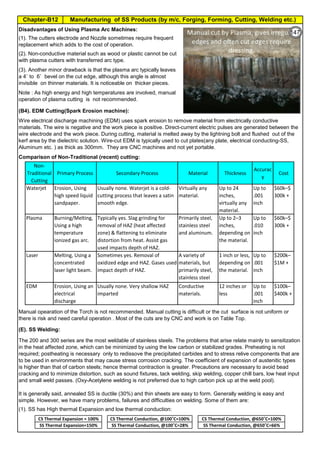
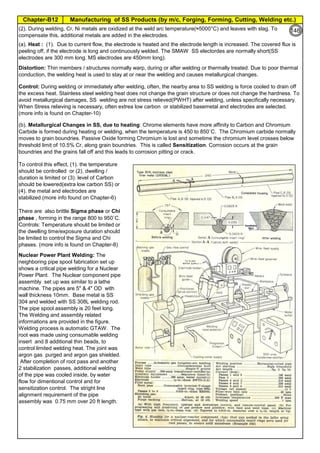
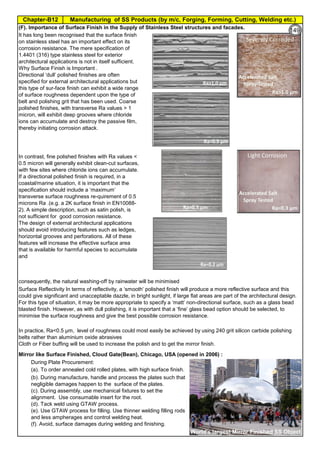
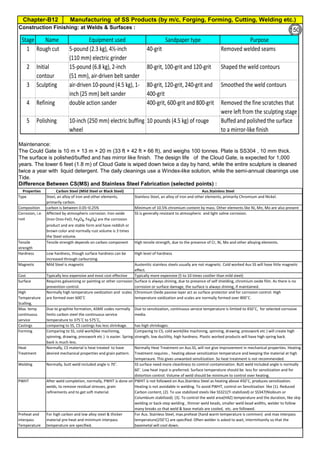
(B12) Stainless Steel Mafg: Difficulties-Casting, Machining, Forming, Cutting, Welding, HT 140
(B13) SS Welding, List of Problems 153
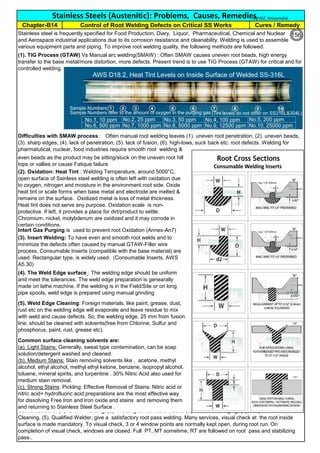
(B14) SS Welding, Control of Root Welding (Critical SS Works) 156
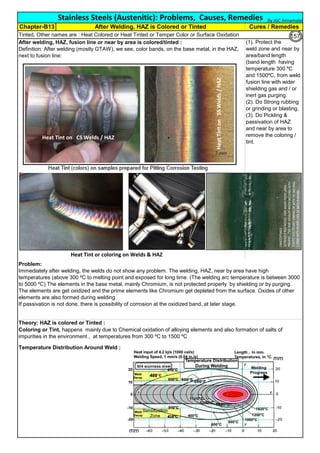
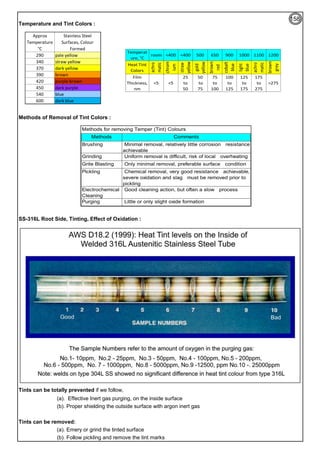
(B15) SS Welding, SS Weld HAZ Surface Area is Colored or Tinted 157
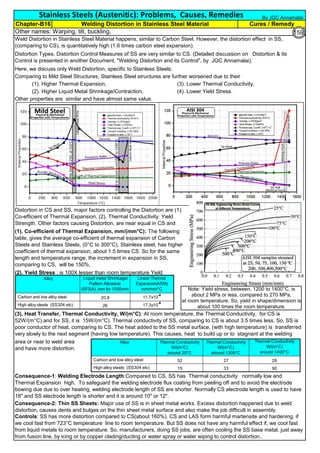
(B16) SS Welding, Welding Distortion of Stainless Steel Material 159
Stainless Steels (Austenitic) : Problems, Causes, Remedies By JGC Annamalai
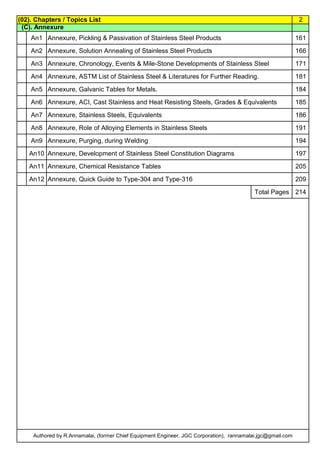
(02). Chapters / Topics List 2
By JGC Annamalai
(C). Annexure
An1 Annexure, Pickling & Passivation of Stainless Steel Products 161
An2 Annexure, Solution Annealing of Stainless Steel Products 166
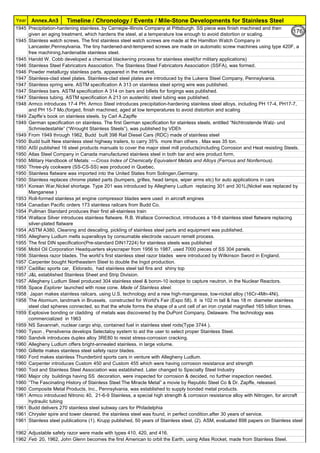
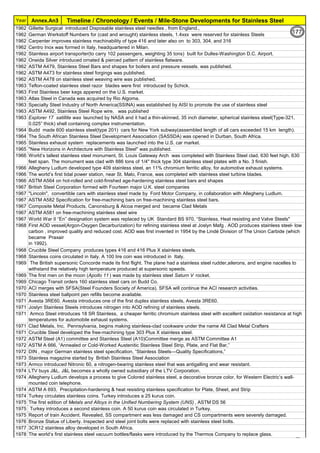
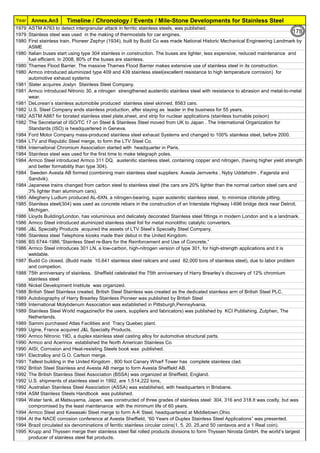
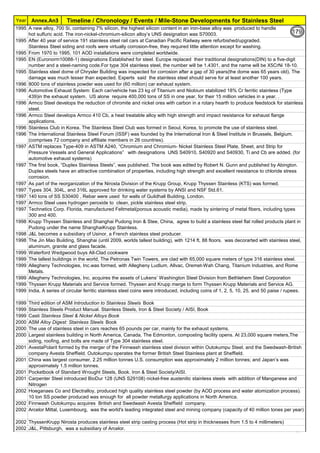
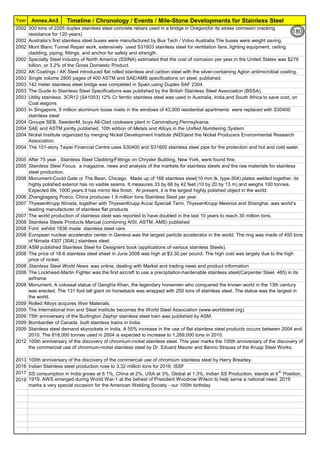
An3 Annexure, Chronology, Events & Mile-Stone Developments of Stainless Steel 171
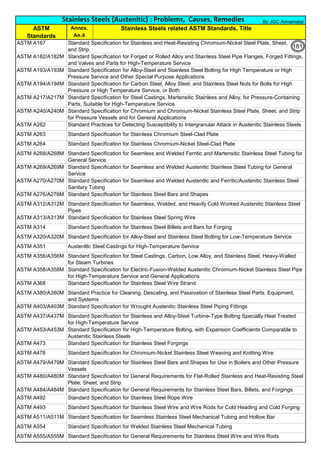
An4 Annexure, ASTM List of Stainless Steel & Literatures for Further Reading. 181
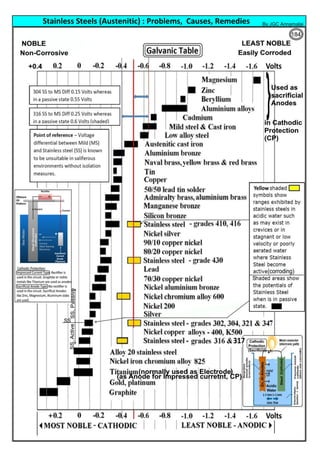
An5 Annexure, Galvanic Tables for Metals. 184
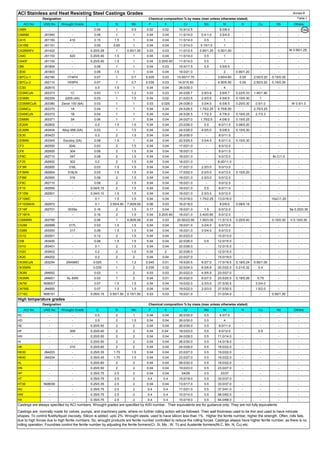
An6 Annexure, ACI, Cast Stainless and Heat Resisting Steels, Grades & Equivalents 185
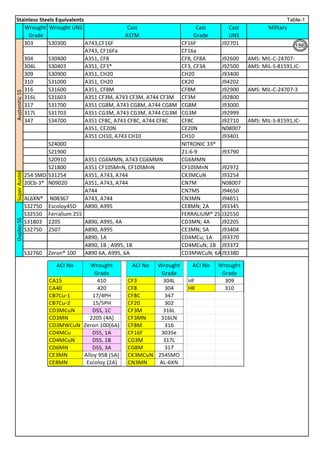
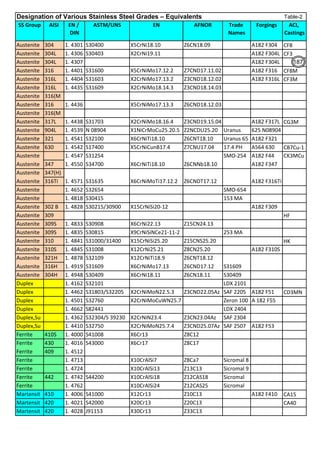
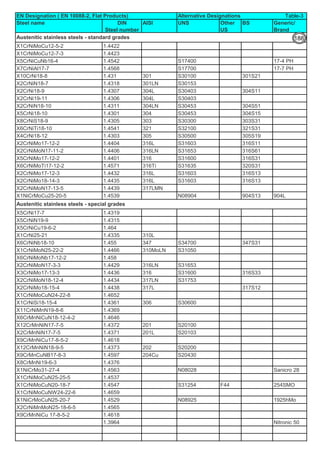
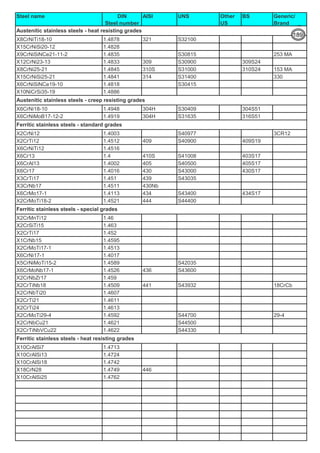
An7 Annexure, Stainless Steels, Equivalents 186
An8 Annexure, Role of Alloying Elements in Stainless Steels 191
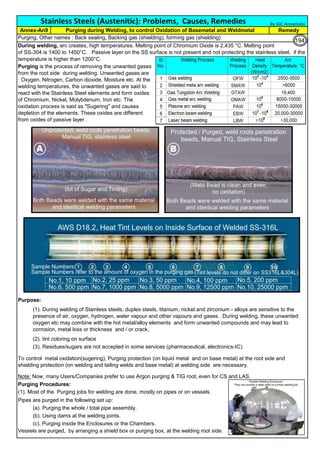
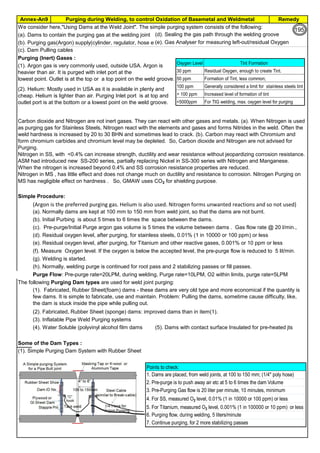
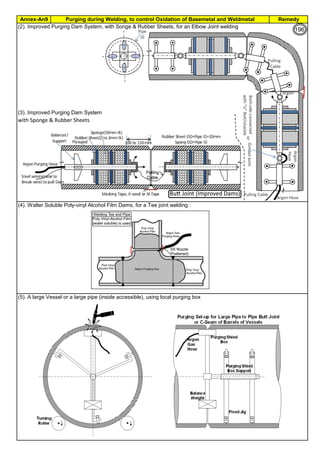
An9 Annexure, Purging, during Welding 194
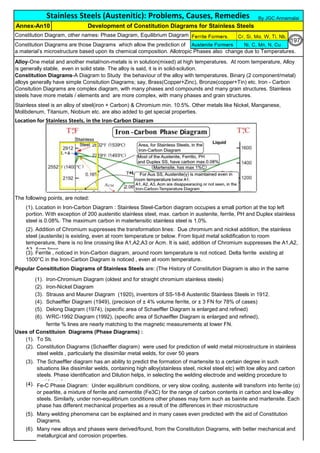
An10 Annexure, Development of Stainless Steel Constitution Diagrams 197
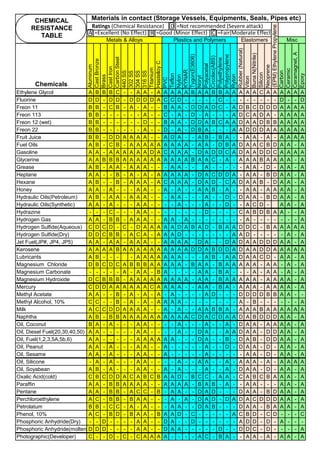
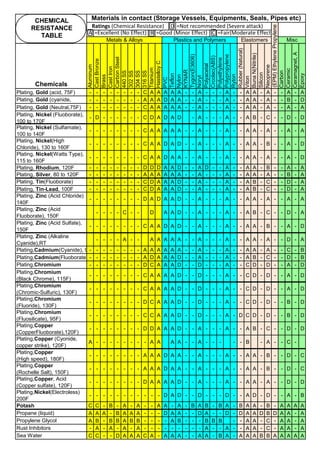
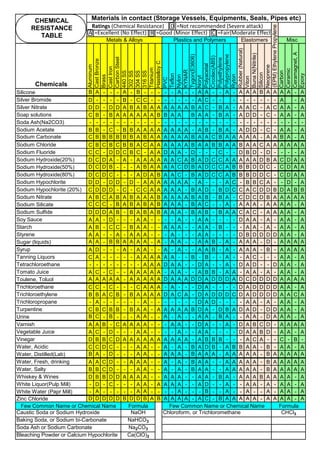
An11 Annexure, Chemical Resistance Tables 205
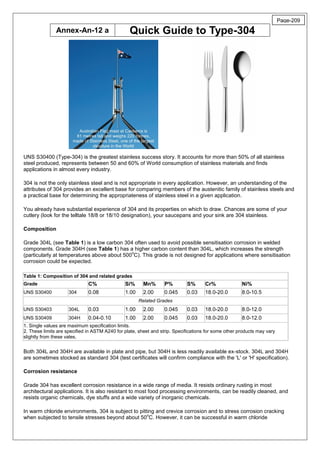
An12 Annexure, Quick Guide to Type-304 and Type-316 209
Total Pages 214
Authored by R.Annamalai, (former Chief Equipment Engineer, JGC Corporation), rannamalai.jgc@gmail.com
Stainless Steels (Austenitic) : Problems, Causes, Remedies
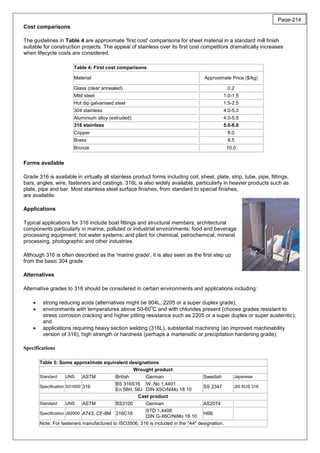
Stainless Steel, other names : SS, SUS. Inox, Silver Steel, Rustless Steel
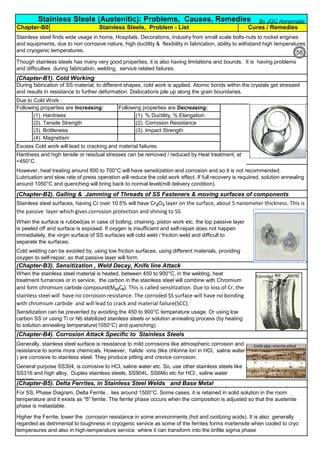
Aus. SS are face-centered cubic structure. Though generally SS is ductile, easily formable and easily weldable, some
grades can be prone to sensitization at the weld heat-affected zone and crack at hot weld metal or in service condition.
Engineers aware that stainless steel is corrosion resistant, strong, good for high temperature and low temperature service.
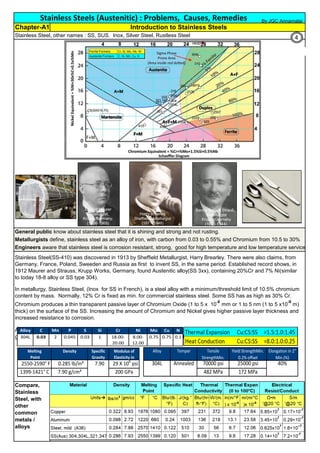
Metallurgists define, stainless steel as an alloy of iron, with carbon from 0.03 to 0.55% and Chromium from 10.5 to 30%
General public know about stainless steel that it is shining and strong and not rusting.
Chapter-A1 Introduction to Stainless Steels
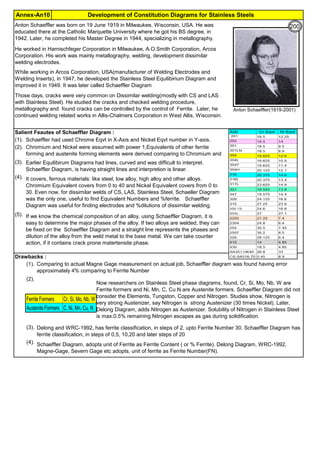
Stainless Steel(SS-410) was discovered in 1913 by Sheffield Metallurgist, Harry Brearley. There were also claims, from
Germany, France, Poland, Sweeden and Russia as first to invent SS, in the same period. Established record shows, in
1912 Maurer and Strauss, Krupp Works, Germany, found Austenitic alloy(SS 3xx), containing 20%Cr and 7% Ni(similar
to today 18-8 alloy or SS type 304).
In metallurgy, Stainless Steel, (Inox for SS in French), is a steel alloy with a minimum/threshold limit of 10.5% chromium
content by mass. Normally, 12% Cr is fixed as min. for commercial stainless steel. Some SS has as high as 30% Cr.
Chromium produces a thin transparent passive layer of Chromium Oxide (1 to 5 x 10⁻⁶
mm or 1 to 5 nm (1 to 5 x10
-9
m)
thick) on the surface of the SS. Increasing the amount of Chromium and Nickel gives higher passive layer thickness and
increased resistance to corrosion.
Compare,
Stainless
Steel, with
other
common
metals /
alloys
By JGC Annamalai
Alloy C Mn P S Si Cr Ni Mo Cu N
304L 0.03 2 0.045 0.03 1 18.00-
20.00
8.00-
12.00
0.75 0.75 0.1
Alloy Temper Tensile
StrengthMin.
Yield StrengthMin.
0.2% offset
Elongation in 2"
Min.(%)
304L Annealed 70000 psi 25000 psi 40%
482 MPa 172 MPa
Melting
Point
Density Specific
Gravity
Modulus of
Elasticity in
2550-2590° F 0.285 lb/in³ 7.90 29 X 106
psi
1399-1421° C 7.90 g/cm³ 200 GPa
4
Chapter-A1 Introduction to Stainless Steels
By JGC Annamalai
Alloy C Mn P S Si Cr Ni Mo Cu N
304L 0.03 2 0.045 0.03 1 18.00-
20.00
8.00-
12.00
0.75 0.75 0.1
Alloy Temper Tensile
StrengthMin.
Yield StrengthMin.
0.2% offset
Elongation in 2"
Min.(%)
304L Annealed 70000 psi 25000 psi 40%
482 MPa 172 MPa
Melting
Point
Density Specific
Gravity
Modulus of
Elasticity in
2550-2590° F 0.285 lb/in³ 7.90 29 X 106
psi
1399-1421° C 7.90 g/cm³ 200 GPa
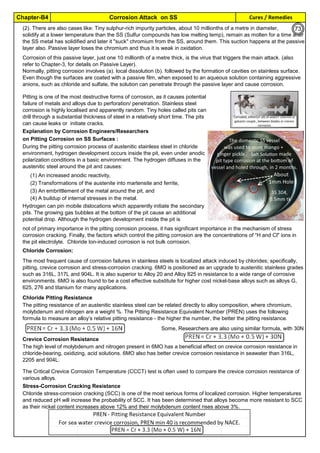
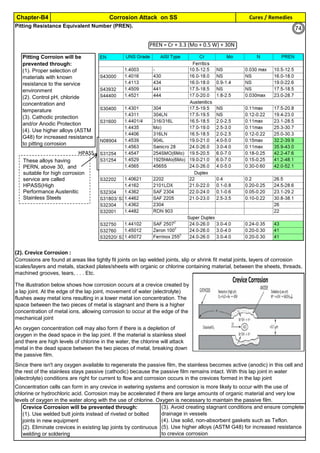
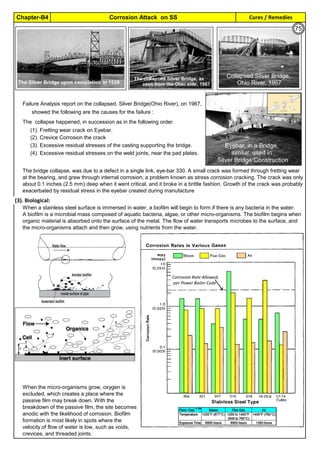
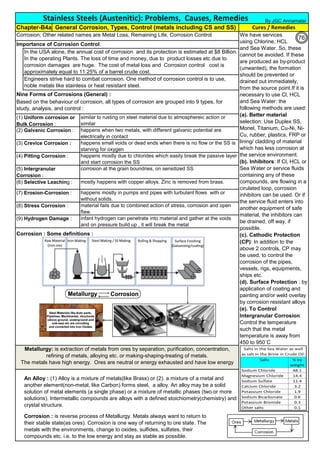
Many Problems, Failures, Difficulties, mentioned here, are noticed in Service. Source location is mostly Fabrication Shop.
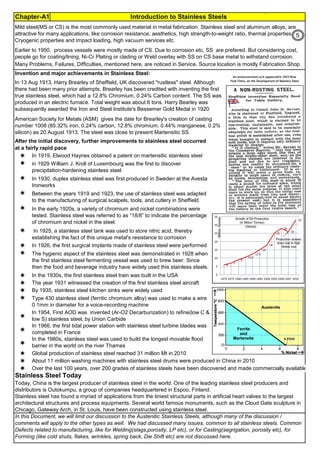
 In 1919, Elwood Haynes obtained a patent on martensitic stainless steel





 In 1926, the first surgical implants made of stainless steel were performed

 In the 1930s, the first stainless steel train was built in the USA
 The year 1931 witnessed the creation of the first stainless steel aircraft
 By 1935, stainless steel kitchen sinks were widely used




 Global production of stainless steel reached 31 million Mt in 2010
 About 11 million washing machines with stainless steel drums were produced in China in 2010
 Over the last 100 years, over 200 grades of stainless steels have been discovered and made commercially available
Stainless Steel Today
In this Document, we will limit our discussion to the Austenitic Stainless Steels, although many of the discussion /
comments will apply to the other types as well. We had discussed many issues, common to all stainless steels. Common
Defects related to manufacturing, like for Welding(slags,porosity, LP etc), or for Casting(segrigation, porosity etc), for
Forming (like cold shuts, flakes, wrinkles, spring back, Die Shift etc) are not discussed here.
Between the years 1919 and 1923, the use of stainless steel was adapted
to the manufacturing of surgical scalpels, tools, and cutlery in Sheffield
In 1930, duplex stainless steel was first produced in Sweden at the Avesta
Ironworks
Invention and major achievements in Stainless Steel:
In 13 Aug 1913, Harry Brearley of Sheffield, UK discovered "rustless" steel. Although
there had been many prior attempts, Brearley has been credited with inventing the first
true stainless steel, which had a 12.8% Chromium, 0.24% Carbon content. The SS was
produced in an electric furnace. Total weight was about 6 tons. Harry Bearley was
subsequently awarded the Iron and Steel Institute's Bessemer Gold Medal in 1920
American Society for Metals (ASM) gives the date for Brearley's creation of casting
number 1008 (85.32% iron, 0.24% carbon, 12.8% chromium, 0.44% manganese, 0.2%
silicon) as 20 August 1913. The steel was close to present Martensitic SS.
in 1929 William J. Kroll of Luxembourg was the first to discover
precipitation-hardening stainless steel
After the initial discovery, further improvements to stainless steel occurred
at a fairly rapid pace
Stainless steel has found a myriad of applications from the tiniest structural parts in artificial heart valves to the largest
architectural structures and process equipments. Several world famous monuments, such as the Cloud Gate sculpture in
Chicago, Gateway Arch, in St. Louis, have been constructed using stainless steel.
In the early 1920s, a variety of chromium and nickel combinations were
tested. Stainless steel was referred to as “18/8” to indicate the percentage
of chromium and nickel in the steel.
In 1925, a stainless steel tank was used to store nitric acid, thereby
establishing the fact of this unique metal's resistance to corrosion
The hygienic aspect of the stainless steel was demonstrated in 1928 when
the first stainless steel fermenting vessel was used to brew beer. Since
then the food and beverage industry have widely used this stainless steels.
Today, China is the largest producer of stainless steel in the world. One of the leading stainless steel producers and
distributors is Outokumpu, a group of companies headquartered in Espoo, Finland.
In 1954, First AOD was invented (Ar-O2 Decarburization) to refine(low C &
low S) stainless steel, by Union Carbide
In 1966, the first tidal power station with stainless steel turbine blades was
completed in France
In the 1980s, stainless steel was used to build the longest movable flood
barrier in the world on the river Thames
Type 430 stainless steel (ferritic chromium alloy) was used to make a wire
0.1mm in diameter for a voice-recording machine
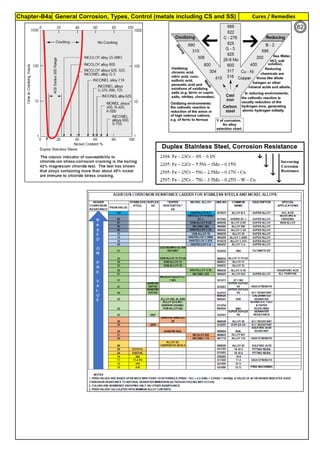
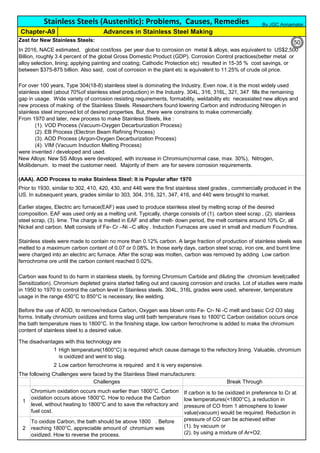
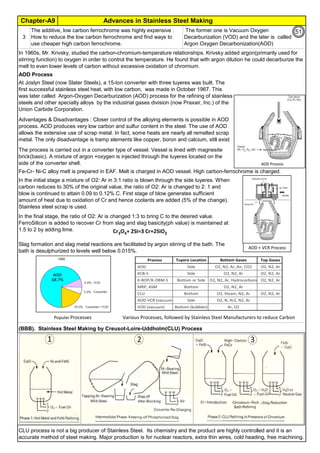
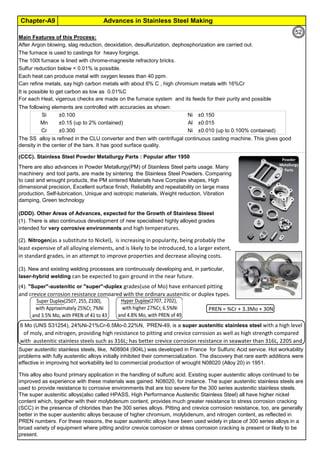
Earlier to 1950, process vessels were mostly made of CS. Due to corrosion etc, SS are prefered. But considering cost,
people go for coating/lining, Ni-Cr Plating or clading or Weld overlay with SS on CS base metal to withstand corrosion.
Mild steel(MS or CS) is the most commonly used material in metal fabrication. Stainless steel and aluminum alloys, are
attractive for many applications, like corrosion resistance, aesthetics, high strength-to-weight ratio, thermal properties,
Cryogenic properties and impact loading, high vacuum services etc.
5
Stainless Steels (Austenitic): Problems, Causes, Remedies
Monuments & Extraordinary Structures, made of Stainless SteelsChapter-A2
SS surface is highly polished to have mirror effect
By JGC Annamalai
6
Monuments & Extraordinary Structures, made of Stainless SteelsChapter-A2
By JGC Annamalai
22
7
Other names : Stainless Steel Group, Stainless Steel Types, Stainless Steel Categories
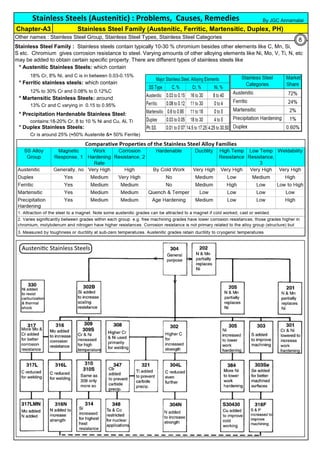
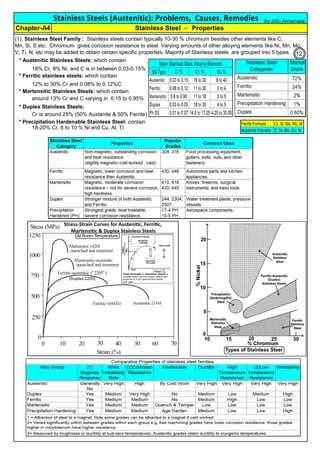
* Austenitic Stainless Steels: which contain
* Ferritic stainless steels: which contain
* Martensitic Stainless Steels: around
* Duplex Stainless Steels:
Stainless Steels (Austenitic) : Problems, Causes, Remedies
Stainless Steel Family : Stainless steels contain typically 10-30 % chromium besides other elements like C, Mn, Si,
S etc. Chromium gives corrosion resistance to steel. Varying amounts of other alloying elements like Ni, Mo, V, Ti, N, etc
may be added to obtain certain specific property. There are different types of stainless steels like
13% Cr and C varying in 0.15 to 0.95%
* Precipitation Hardenable Stainless Steel:
Chapter-A3 Stainless Steel Family (Austenitic, Ferritic, Martensitic, Duplex, PH)
12% to 30% Cr and 0.08% to 0.12%C
Cr is around 25% (≈50% Austenite &≈ 50% Ferrite)
contains:18-20% Cr, 8 to 10 % Ni and Cu, Al, Ti
18% Cr, 8% Ni, and C is in between 0.03-0.15%
By JGC Annamalai
8
Chapter-A3 Stainless Steel Family (Austenitic, Ferritic, Martensitic, Duplex, PH)
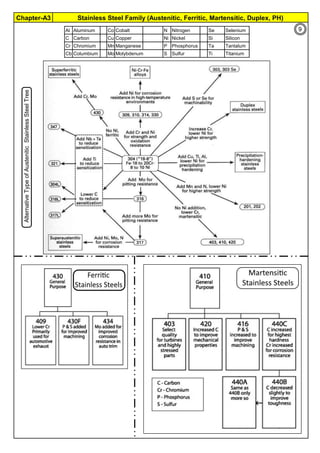
Al Aluminum Co Cobalt N Nitrogen Se Selenium
C Carbon Cu Copper Ni Nickel Si Silicon
Cr Chromium Mn Manganese P Phosphorus Ta Tantalum
Cb Columbium Mo Molybdenum S Sulfur Ti Titanium
AlternativeTypeofAusteniticStainlessSteelTree 9
Chapter-A3 Stainless Steel Family (Austenitic, Ferritic, Martensitic, Duplex, PH)
Others, commonly used are:
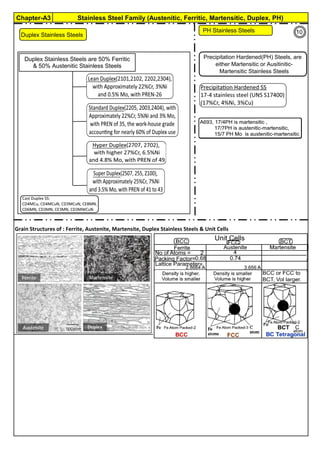
Grain Structures of : Ferrite, Austenite, Martensite, Duplex Stainless Steels & Unit Cells
Here 17/4 means :
average 17% Cr & 4% Ni.
Precipitation Hardened(PH) Steels, are
either Martensitic or Ausitinitic-
Martensitic Stainless Steels
Duplex Stainless Steels
PH Stainless Steels
Duplex Stainless Steels are 50% Ferritic
& 50% Austenitic Stainless Steels
10
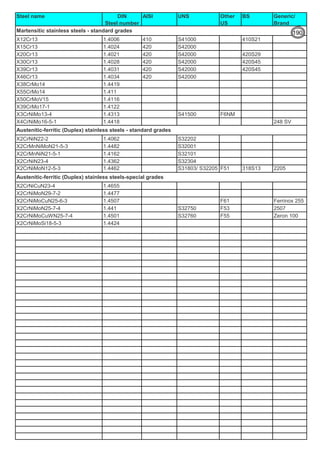
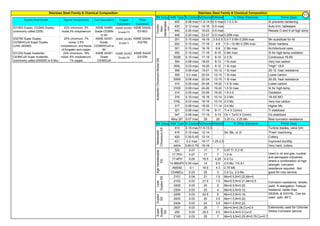
SS Group AISI Type % Carbon%Chrome%Nickel % Other Elements Prime Uses
405 0.08 max 11.5-14.5 0.5 max 0.1-0.3 Al Al prevents hardening
430 0.12 max 14-18 0.5 max - Auto trim, tableware
442 0.25 max 18-23 0.5 max - Resists O and S at high temp
446 0.20 max 23-27 0.5 max 0.25N max
201 0.15 max 16-18 3.5-5.5 5.0-7.5 Mn 0.25N max Mn substitute for Ni
202 0.15 max 17-19 4-6 7.5—10 Mn 0.25N max Strain hardens
301 0.15 max 16-18 6-8 2 Mn max Architectural uses
302 0.15 max 17-19 8-10 2 Mn max Si for high-temp.oxidation
302B 0.15 max 17-19 8-10 2-3 Si Continuous 18-8S
304 0.08 max 18-20 8-12 1 Si max Very low carbon
304L 0.03 max 18-20 8-12 1 Si max "High" 18-8
308 0.08 max 19-21 10-12 1 Si max 25-12, hear resistance
309 0.2 max 22-24 12-15 1 Si max Lower carbon
309S 0.08 max 22-24 12-15 1 Si max 25-20, heat resistance
310 0.25 max 24-26 19-22 1.5 Si max Lower carbon
310S 0.08 max 24-26 19-22 1.5 Si max Si for high-temp.
314 0.25 max 23-26 19-22 1.5-3.0 Oxidation
316 0.10 max 16-18 10-14 2-3 Mo 18-SS MO
316L 0.03 max 16-18 10-14 2-3 Mo Very low carbon
317 0.08 max 18-20 11-14 3-4 Mo Higher Mo
321 0.08 max 17-19 8-11 Ti 4 X C(min) Ti stabilized
347 0.08 max 17-19 9-13 Cb + Ta10 X C(min) Cb stabilized
Alloy 20* 0.07 max 29 20 3.25 Cu, 2.25 Mo Best corrosion resistance
SS Group AISI Type % Carbon%Chrome%Nickel % Other Elements Prime Uses
410 0.15 max 11.5-13.5 - - Turbine blades, valve trim
416 0.15 max 12-14 - Se, Mo, or Zr "Free" machining
420 0.35-0.45 12-14 - - Cutlery
431 0.2 max 15-17 1.25-2.5 - Improved ductility
440A 0.60-0.75 16-18 - - Very hard; cutters
322 0.07 17 7 0.07 Ti, 0.2 Al
17-7PH 0.07 17 7 1.0 Al
17-4PH 0.05 16.5 4.25 4.0 Cu
14-8MoPH 0.05 max 14 8.5 2.5 Mo, 1% A1
AM350 0.1 16.5 4.3 2.75 M0
CD4MCu 0.03 25 5 3.0 Cu, 2.0 Mo
2101 0.04 21 1.5 Mo=0.5,N=0.22,Mn=5
2102 0.03 21.5 1.5 Mo=0.5,N=0.21,Mn=2.5
2202 0.03 22 2 Mo=0.5,N=0.22,
2304 0.03 23 4 Mo=0.5,N=0.12,
2205 0.03 22.5 5 Mo=3.2,N=0.16,
2003 0.03 20 3.5 Mo=1.5,N=0.22,
2404 0.03 24 3.5 Mo=1.5,N=0.22,
2507 0.03 25 7 Mo=4,N=0.28,Cu=0.5
255 0.03 25.5 5.5 Mo=3.4,N=0.2,Cu=2
Z100 0.03 25 7 Mo=3.5,N=0.25,W=0.75,Cu=0.75
Stainless Steel Family & Chemical Composition Stainless Steel Family & Chemical Composition
AusteniticChromium-NickelSSFerritic
Non-
hardenable
SS
Martensitic
ChromiumSS
AgeHaredenable
SS
Used in oil and gas, nuclear
and aerospace industries
where a combination of high
strength, corrosion
resistance required. Not
good for cryo service.
Lean
DuplexSS
Corrosion resistance, tensile,
yield, % elangation, Fatique
resitance better than
SS304L & SS316L. Can be
used upto -46°C
Duplex
SS
Super
Duplex
SS
Extensively used for Chloride
Stress Corrosion service
11
* Austenitic Stainless Steels: which contain
* Ferritic stainless steels: which contain
* Martensitic Stainless Steels: which contain
* Duplex Stainless Steels:
Cr is around 25% (50% Austenite & 50% Ferrite)
18-20% Cr, 8 to 10 % Ni and Cu, Al, Ti
around 13% Cr and C varying in 0.15 to 0.95%
* Precipitation Hardenable Stainless Steel: contain
Stainless Steels (Austenitic): Problems, Causes, Remedies
(1). Stainless Steel Family : Stainless steels contain typically 10-30 % chromium besides other elements like C,
Mn, Si, S etc. Chromium gives corrosion resistance to steel. Varying amounts of other alloying elements like Ni, Mn, Mo,
V, Ti, N, etc may be added to obtain certain specific properties. Majority of Stainless steels are grouped into 5 types.
12% to 30% Cr and 0.08% to 0.12%C
18% Cr, 8% Ni, and C is in between 0.03-0.15%
Stainless Steel - PropertiesChapter-A4
By JGC Annamalai
Ferrite Formers Cr, Si, Mo, Nb, W
Austenite Formers C, Ni, Mn, Cu, N
12
Stainless Steel - PropertiesChapter-A4
By JGC Annamalai
Ferrite Formers Cr, Si, Mo, Nb, W
Austenite Formers C, Ni, Mn, Cu, N
(2). Why Stainless Steel is Shining, non rusting & corrosive resistance ? ; Reason - Passive Layer
(3). Some more metallurgical properties of Austenitic Stainless Steels:
(a).
(c).
(d).
(e).
(f).
Stainless steels is not affected by Citric Acid and vinegars and acids in the vegitables .From 1920, all most all kitchen
hardwares/ tablewares and vessels and tools to store or handle food related items use stainless steel material.
Corrosion Resistant: Due to Corrosion Resistance, Stainless Steel is used in Food Industry, Diary, Distillary, Chemical
and Oil & Gas Industry, Nuclear Plants, Space Research & in household utencils and hand rails, stairs, decorative frames
etc. (it is not fully stain-proof in low-oxygen, high-salinity, or when it is contaminated).
Steel with chromium 10.5% and above is called Stainless Steel. If the surface is cut or machined, a passive layer of
chromium oxide (say 3.5 nm thickness) is immediately formed. This layer protect the SS from general corrosion. So, it is
Stainless Steel. More details are found on "Passive Layer" in the forth-coming pages.
Stainless steels are not rusting and not affected by body fluids and fairly maintenance free. It has hygienic surface and so
used in surgery tools. (EHEDG,European Hygenc Engg & Design Gr, Doc. 8, 2004: Hygienic Equipment Design Criteria).
High Temperatures: Higher carbon will increase the mechanical strength. 0.25% C is allowed in SS310 and 0.2 to
0.6%C is allowed in HK high temperature steels. Here corrosion is considered , as second priority.
Heat Treatment: Nickel stabilizes the austenite at room temperature or further below. There is no phase change.
So, austenitic stainless steel cannot be quenched and hardened or heat treatment cannot improve mech.
properties. There is no formation of martensite (the hardening component), due to temperatures increase from
room tempertures. .
Further, no heat treatment is done above 450°C as there is a possibility of forming Sensitization. So, normally,
Heat Treatment is not recommended. Sometime, Stress relieving is done below 450°C. This way only 20 to 30% of
residual stresses are removed.
PWHT: Normally, PWHT is not done. Reason, same as for Heat Treatment. Sometime, PWHT is applied or
thicker SS or CS cladded with SS.
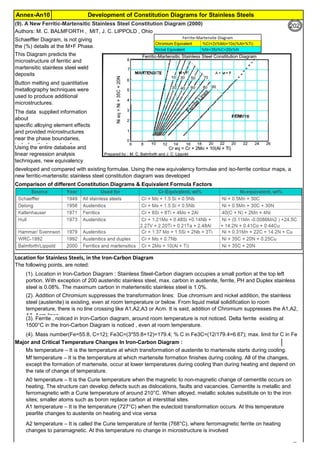
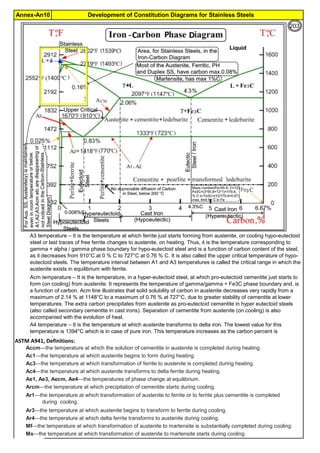
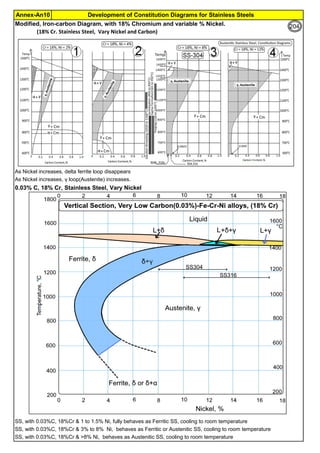
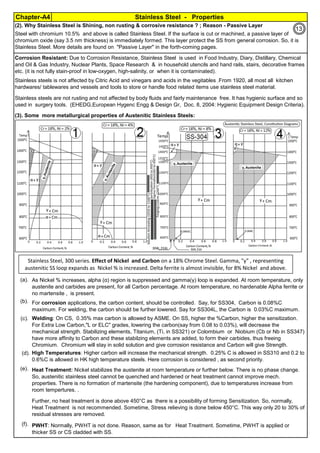
As Nickel % increases, alpha (α) region is suppressed and gamma(γ) loop is expanded. At room temperature, only
austenite and carbides are present, for all Carbon percentage. At room temperature, no hardenable Alpha ferrite or
no martensite , is present.
(b). For corrosion applications, the carbon content, should be controlled. Say, for SS304, Carbon is 0.08%C
maximum. For welding, the carbon should be further lowered. Say for SS304L, the Carbon is 0.03%C maximum.
Welding: On CS, 0.35% max carbon is allowed by ASME. On SS, higher the %Carbon, higher the sensitization.
For Extra Low Carbon,"L or ELC" grades, lowering the carbon(say from 0.08 to 0.03%), will decrease the
mechanical strength. Stabilizing elements, Titanium, (Ti, in SS321) or Colombium or Niobium (Cb or Nb in SS347)
have more affinity to Carbon and these stabilzing elements are added, to form their carbides, thus freeing
Chromium. Chromium will stay in solid solution and give corrosion resistance and Carbon will give Strength.
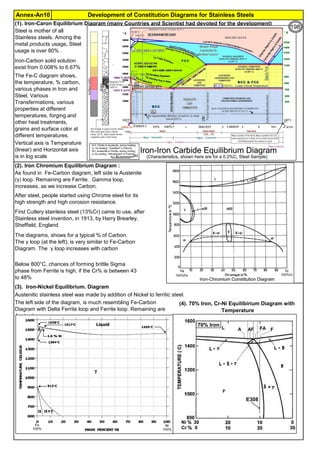
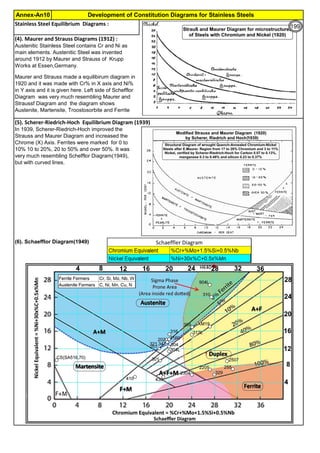
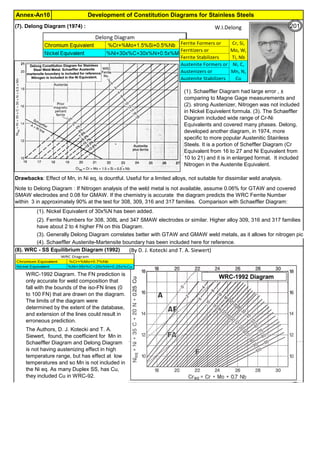
Stainless Steel, 300 series. Effect of Nickel and Carbon on a 18% Chrome Steel. Gamma, "γ" , representing
austenitic SS loop expands as Nickel % is increased. Delta ferrite is almost invisible, for 8% Nickel and above.
13
Stainless Steel - PropertiesChapter-A4
By JGC Annamalai
Ferrite Formers Cr, Si, Mo, Nb, W
Austenite Formers C, Ni, Mn, Cu, N
(g).
(h).
(4). SS Castings are always specified by ACI numbers. Wrought grades are specified by AISI number. Their equivalents
(5). Cold Working on Stainless Steels:
(6). Electricity and Magnetism, (of Stainless Steels)
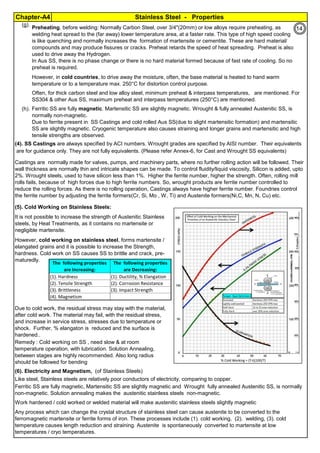
Preheating, before welding: Normally Carbon Steel, over 3/4"(20mm) or low alloys require preheating, as
welding heat spread to the (far away) lower temperature area, at a faster rate. This type of high speed cooling
is like quenching and normally increases the formation of martensite or cementite. These are hard material/
compounds and may produce fissures or cracks. Preheat retards the speed of heat spreading. Preheat is also
used to drive away the Hydrogen.
In Aus SS, there is no phase change or there is no hard material formed because of fast rate of cooling. So no
preheat is required.
However, in cold countries, to drive away the moisture, often, the base material is heated to hand warm
temperature or to a temperature max. 250°C for distortion control purpose.
Ferritic SS are fully magnetic. Martensitic SS are slightly magnetic. Wrought & fully annealed Austenitic SS, is
normally non-magnetic.
Due to ferrite present in SS Castings and cold rolled Aus SS(due to slight martensitic formation) and martensitic
SS are slightly magnetic. Cryogenic temperature also causes straining and longer grains and martensitic and high
tensile strengths are observed.
It is not possible to increase the strength of Austenitic Stainless
steels, by Heat Treatments, as it contains no martensite or
negligible martensite.
Often, for thick carbon steel and low alloy steel, minimum preheat & interpass temperatures, are mentioned. For
SS304 & other Aus SS, maximum preheat and interpass temperatures (250°C) are mentioned.
However, cold working on stainless steel, forms martensite /
elangated grains and it is possible to increase the Strength,
hardness. Cold work on SS causes SS to brittle and crack, pre-
maturedly.
Castings are normally made for valves, pumps, and machinery parts, where no further rolling action will be followed. Their
wall thickness are normally thin and intricate shapes can be made. To control fluidity/liquid viscosity, Silicon is added, upto
2%. Wrought steels, used to have silicon less than 1%. Higher the ferrite number, higher the strength. Often, rolling mill
rolls fails, because of high forces due to high ferrite numbers. So, wrought products are ferrite number controlled to
reduce the rolling forces. As there is no rolling operation, Castings always have higher ferrite number. Foundries control
the ferrite number by adjusting the ferrite formers(Cr, Si, Mo , W, Ti) and Austenite formers(Ni,C, Mn, N, Cu) etc.
are for guidance only. They are not fully equivalents. (Please refer Annex-6, for Cast and Wrought SS equivalents)
Like steel, Stainless steels are relatively poor conductors of electricity, comparing to copper.
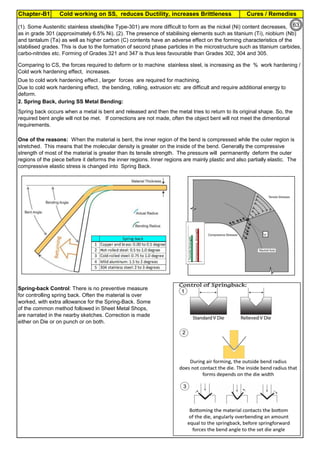
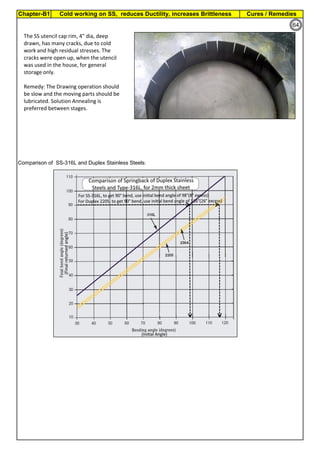
Due to cold work, the residual stress may stay with the material,
after cold work. The material may fail, with the residual stress,
and increase in service stress, stresses due to temperature or
shock. Further, % elangaton is reduced and the surface is
hardened..
Remedy : Cold working on SS , need slow & at room
temperature operation, with lubrication. Solution Annealing,
between stages are highly recommended. Also long radius
should be followed for bending
Ferritic SS are fully magnetic, Martensitic SS are slightly magnetic and Wrought fully annealed Austenitic SS, is normally
non-magnetic. Solution annealing makes the austenitic stainless steels non-magnetic.
Work hardened / cold worked or welded material will make austenitic stainless steels slightly magnetic
Any process which can change the crystal structure of stainless steel can cause austenite to be converted to the
ferromagnetic martensite or ferrite forms of iron. These processes include (1). cold working, (2). welding, (3). cold
temperature causes length reduction and straining. Austenite is spontaneously converted to martensite at low
temperatures / cryo temperatures.
The following properties
are Increasing:
The following properties
are Decreasing:
(1). Hardness (1). Ductility, % Elangation
(2). Tensile Strength (2). Corrosion Resistance
(3). Brittleness (3). Impact Strength
(4). Magnetism
14
Stainless Steel - PropertiesChapter-A4
By JGC Annamalai
Ferrite Formers Cr, Si, Mo, Nb, W
Austenite Formers C, Ni, Mn, Cu, N
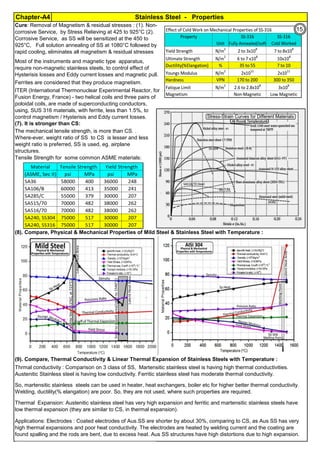
Tensile Strength for some common ASME materials:
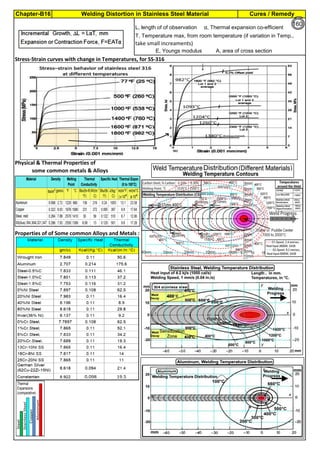
(8). Compare, Physical & Mechanical Properties of Mild Steel & Stainless Steel with Temperature :
(9). Compare, Thermal Conductivity & Linear Thermal Expansion of Stainless Steels with Temperature :
Cure: Removal of Magnetism & residual stresses : (1). Non-
corrosive Service, by Stress Relieving at 425 to 925°C (2).
Corrosive Service, as SS will be sensitized at the 450 to
925°C, Full solution annealing of SS at 1080°C followed by
rapid cooling, eliminates all magnetism & residual stresses
(7). It is stronger than CS:
Thrmal conductivity : Comparison on 3 class of SS, Martensitic stainless steel is having high thermal conductivities.
Austenitic Stainless steel is having low conductivity. Ferritic stainless steel has moderate thermal conductivity.
So, martensitic stainless steels can be used in heater, heat exchangers, boiler etc for higher better thermal conductivity.
Welding, ductility(% elangation) are poor. So, they are not used, where such properties are required.
Thermal Expansion: Austenitic stainless steel has very high expansion and ferritic and martensitic stainless steels have
low thermal expansion (they are similar to CS, in thermal expansion).
Applications: Electrodes : Coated electrodes of Aus.SS are shorter by about 30%, comparing to CS, as Aus SS has very
high thermal expansions and poor heat conductivity. The electrodes are heated by welding current and the coating are
found spalling and the rods are bent, due to excess heat. Aus SS structures have high distortions due to high expansion.
Ferrites are considered that they produce magnetism.
Most of the instruments and magnetic type apparatus,
require non-magnetic stainless steels, to control effect of
Hysterisis losses and Eddy current losses and magnetic pull.
ITER (International Thermonuclear Experimental Reactor, for
Fusion Energy, France) - two helical coils and three pairs of
poloidal coils, are made of superconducting conductors,
using, SUS 316 materials, with ferrite, less than 1.5%, to
control magnetism / Hysterisis and Eddy current losses.
The mechanical tensile strength, is more than CS. .
Where-ever, weight ratio of SS to CS is lesser and less
weight ratio is preferred, SS is used, eg. airplane
structures.
15
Stainless Steel - PropertiesChapter-A4
By JGC Annamalai
Ferrite Formers Cr, Si, Mo, Nb, W
Austenite Formers C, Ni, Mn, Cu, N
(11). Forming is easier on Full annealed Austenitic SS and to Weld:
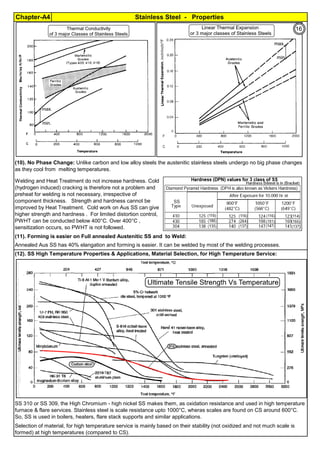
(12). SS High Temperature Properties & Applications, Material Selection, for High Temperature Service:
Selection of material, for high temperature service is mainly based on their stability (not oxidized and not much scale is
formed) at high temperatures (compared to CS).
(10). No Phase Change: Unlike carbon and low alloy steels the austenitic stainless steels undergo no big phase changes
as they cool from melting temperatures.
Welding and Heat Treatment do not increase hardness. Cold
(hydrogen induced) cracking is therefore not a problem and
preheat for welding is not necessary, irrespective of
component thickness. Strength and hardness cannot be
improved by Heat Treatment. Cold work on Aus SS can give
higher strength and hardness . For limited distortion control,
PWHT can be conducted below 400°C. Over 400°C ,
sensitization occurs, so PWHT is not followed.
Annealed Aus SS has 40% elangation and forming is easier. It can be welded by most of the welding processes.
SS 310 or SS 309, the High Chromium - high nickel SS makes them, as oxidation resistance and used in high temperature
furnace & flare services. Stainless steel is scale resistance upto 1000°C, wheras scales are found on CS around 600°C.
So, SS is used in boilers, heaters, flare stack supports and similar applications.
16
Stainless Steel - PropertiesChapter-A4
By JGC Annamalai
Ferrite Formers Cr, Si, Mo, Nb, W
Austenite Formers C, Ni, Mn, Cu, N
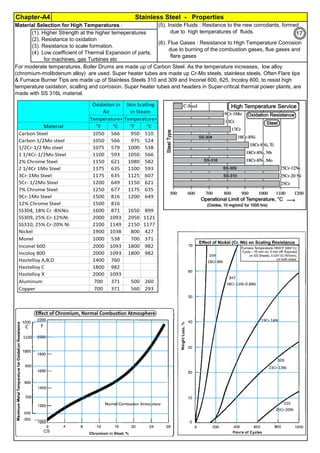
Material Selection for High Temperatures : (5). Inside Fluids : Resitance to the new corrodants, formed
due to high temperatures of fluids.
(6). Flue Gases : Resistance to High Temperature Corrosion
due to burning of the combustion gases, flue gases and
flare gases
For moderate temperatures, Boiler Drums are made up of Carbon Steel. As the temperature increases, low alloy
(chromium-molibdenum alloy) are used. Super heater tubes are made up Cr-Mo steels, stainless steels. Often Flare tips
& Furnace Burner Tips are made up of Stainless Steels 310 and 309 and Inconel 600, 625, Incoloy 800, to resist high
temperature oxidation, scalling and corrosion. Super heater tubes and headers in Super-critical thermal power plants, are
made with SS 316L material.
(1). Higher Strength at the higher temeperatures
(2). Resistance to oxidation
(3). Resistance to scale formation.
(4). Low coefficient of Thermal Expansion of parts,
for machines, gas Turbines etc
17
Stainless Steel - PropertiesChapter-A4
By JGC Annamalai
Ferrite Formers Cr, Si, Mo, Nb, W
Austenite Formers C, Ni, Mn, Cu, N
(14). Material Selection, High/ultra high Vacuum Service:
(17). Stainless Steel for Food and Sanitation(Medical):
EHEDG Material Requirement: (3).mechanically stable (6). Inert to the Product,
(1).Not tranfer undesirable odours. (4).non-toxic, (7).corrosion resistant,
(2). Inert to the detergents and disinfectants (5).non-tainting, (8).their surface finish must not be adversely affected
EN1672-2, Food Processing Machinery, Basic Concept; EHEDG Glossary EHEDG Position Papers
ISO14159, Safety of Equipments, Hygienic requirements EHEDG Spreads, Issue
EHEDG Doc-3, Packing Food EHEDG Overview – Guidelines
EHEDG Doc-4, Pesturization of Food Processing Eqpt EHEDG Doc 17- Hygienic design of pumps, homogenizer
EHEDG Doc-08, Design Principle EHEDG Doc-45, Cleaning;
How to identify Austenitic Stainless Steel:
Metal Identification Methods / Tests:
(1). Detailed Chemical Analysis for elements, from Chips and Samples(ASTM E350, E352, Chemical Analysis Methods)
(2). Detailed Spark Spectrum-Analysis on Chips and Samples
(3). Spot Analysis on object, using, Portable Metal Analysers (working on X-ray Diffraction / Fluorescence Technique)
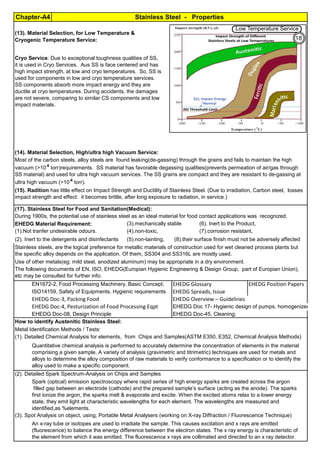
(13). Material Selection, for Low Temperature &
Cryogenic Temperature Service:
Cryo Service: Due to exceptional toughness qualities of SS,
it is used in Cryo Services. Aus SS is face centered and has
high impact strength, at low and cryo temperatures. So, SS is
used for components in low and cryo temperature services.
SS components absorb more impact energy and they are
ductile at cryo temperatures. During accidents, the damages
are not severe, comparing to similar CS components and low
impact materials.
Stainless steels, are the logical preference for metallic materials of construction used for wet cleaned process plants but
the specific alloy depends on the application. Of them, SS304 and SS316L are mostly used.
Use of other metals(eg: mild steel, anodized aluminum) may be appropriate in a dry environment.
Quantitative chemical analysis is performed to accurately determine the concentration of elements in the material
comprising a given sample. A variety of analysis (gravimetric and titrimetric) techniques are used for metals and
alloys to determine the alloy composition of raw materials to verify conformance to a specification or to identify the
alloy used to make a specific component.
An x-ray tube or isotopes are used to irradiate the sample. This causes excitation and x rays are emitted
(fluorescence) to balance the energy difference between the electron states. The x ray energy is characteristic of
the element from which it was emitted. The fluorescence x rays are collimated and directed to an x ray detector.
Spark (optical) emission spectroscopy where rapid series of high energy sparks are created across the argon
filled gap between an electrode (cathode) and the prepared sample’s surface (acting as the anode). The sparks
first ionize the argon, the sparks melt & evaporate and excite. When the excited atoms relax to a lower energy
state, they emit light at characteristic wavelengths for each element. The wavelengths are measured and
identified,as %elements.
(15). Radition has little effect on Impact Strength and Ductility of Stainless Steel. (Due to irradiation, Carbon steel, losses
impact strength and effect: it becomes brittle, after long exposure to radiation, in service.)
The following documents of EN, ISO, EHEDG(Europian Hygienic Engineering & Design Group, part of Europian Union),
etc may be consulted for further info.
Most of the carbon steels, alloy steels are found leaking(de-gassing) through the grains and fails to maintain the high
vacuum (>10-6
torr)requirements. SS material has favorable degassing qualities(prevents permeation of air/gas through
SS material) and used for ultra high vacuum services. The SS grains are compact and they are resistant to de-gassing at
ultra high vacuum (>10-6
torr).
During 1900s, the potential use of stainless steel as an ideal material for food contact applications was recognized.
18
Stainless Steel - PropertiesChapter-A4
By JGC Annamalai
Ferrite Formers Cr, Si, Mo, Nb, W
Austenite Formers C, Ni, Mn, Cu, N
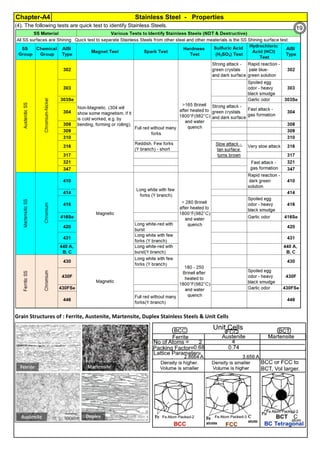
(4). The following tests are quick test to identify Stainless Steels.
Grain Structures of : Ferrite, Austenite, Martensite, Duplex Stainless Steels & Unit Cells
19
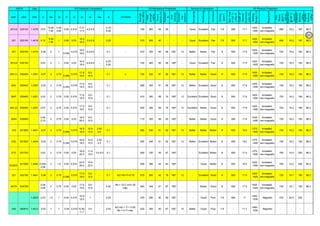
DIN
AISI UNS DIN C Mn Si P S Cr Ni Mo N OTHERS
Strength
limit(MPa)
Yield
strength
(MPa)
Elon'n
50mm(%)
Rockwell-
B
Cold
bending
Erichsen
cup
test(mm)
Formability
Weldability
Corrosion
Density
(g/cm3
)
Spe.Heat
0-100°C
(J/Kg.K)
Coeff.of
thermal
Expansion
(μ/m°C)
Melting
Range(°C)
Magnetism
Elec.
Resist.
@20°C
(nΩ.m)
HeatCond.
@100°C
(w/m.K)
Elasticity
Modulus
(GPa)
Rigidity
Modulus
(GPa)
201LN S20153 1.4376 0.03
'6.40-
7.50
0.20-
0.60
0.05 0.015
17.0-
17.5
4.0-4.5 -
0.15-
0.25
700 500 45 95 - - Good Excellent Fair 7.8 500 17.1
1400 -
1450
Annealed.
non-magnetic
690 16.2 197 86.2
201 S20100 1.4618 0.15
'5.50-
7.50
1 0.06 0.03
16.0-
18.0
3.5-5.5 - 0.25 515 260 40 - - - Good Excellent Fair 7.8 500 17.1
1400 -
1450
Annealed.
non-magnetic
690 16.2 197 86.2
301 S30100 1.4310 0.05 2 1
0.045
0.015
16.0-
18.0
6.0-8.0 - 0.1 - 910 320 46 86 180° 13 Better Better Fair 8 500 17.5
1400 -
1420
Annealed.
non-magnetic
720 16.2 193 86.2
301LN S30153 - 0.03 2 1 0.05 0.03
16.0-
18.0
6.0-8.0 -
0.07-
0.20
700 400 50 90 180º - Good Excellent Fair 8 500 17.5
1400 -
1425
Annealed.
non-magnetic
720 16.2 193 86.2
304 (1) S30400 1.4301 0.07 2 0.75
0.045
0.015
17.5-
19.5
8.0-
10.5
- 0.1 c 720 320 57 84 180° 12 Better Better Good 8 500 17.8
1400 -
1450
Annealed.
non-magnetic
720 16.2 193 86.2
304L S30403 1.4307 0.03 2 0.75
0.045
0.015
17.5-
19.5
8.0-
10.5
- 0.1 - 690 320 51 80 180° 12 Better Excellent Good 8 500 17.8
1400 -
1450
Annealed.
non-magnetic
720 16.2 193 86.2
304T S30400 1.4301 0.03 2 0.75 0.05 0.015
17.5-
19.5
9.0-
10.5
- 0.1 610 280 58 74 180º 12 Excellent Excellent Good 8 500 17.8
1400 -
1450
Annealed.
non-magnetic
720 16.2 196 86.2
304 (2) S30400 1.4301 0.07 2 0.75 0.05 0.015
17.5-
19.5
8.0-
10.5
- 0.1 600 280 58 75 180º 12 Excellent Better Good 8 500 17.8
1400 -
1450
Annealed.
non-magnetic
720 16.2 196 86.2
304H S30409 -
0.04-
0.10
2 0.75 0.05 0.03
18.0-
20.0
8.0-
10.5
- - 710 320 58 83 180º - Better Better Good 8 500 17.8
1400 -
1450
Annealed.
non-magnetic
720 16.2 193 86.2
316 S31600 1.4401 0.07 2 0.75
0.045
0.015
16.5-
18.0
10.0-
13.0
2.00-
2.5
0.1 - 650 340 51 82 180° 12 Better Better Better 8 500 16.5
1375 -
1400
Annealed.
non-magnetic
740 16.2 193 86.2
316L S31603 1.4404 0.03 2 0.75
0.045
0.015
16.5-
18.0
10.0-
13.0
2.00-
2.5
0.1 - 650 340 51 82 180° 12 Better Excellent Better 8 500 16.5
1375 -
1400
Annealed.
non-magnetic
740 16.2 193 86.2
317L S31703 - 0.03 2 0.75 0.05 0.03
18.0-
20.0
11.0-
15.0
3.0-4.0 0.1 650 330 45 87 180º - - Excellent Better 8 500 17.5
1375 -
1400
Annealed.
non-magnetic
790 14.4 200 86.2
310S/H
S31008 1.4845 0.035-
0.08
2 1.5 0.05 0.015
24.0-
26.0
19.0-
22.0
- - 600 380 42 83 180º - - Good Better 8 500 16.5
1400 -
1450
Annealed.
non-magnetic
780 14.2 200 86.2
321 S32100 1.4541 0.08 2 0.75
0.045
0.015
17.0-
19.0
9.0-
12.0
- 0.1 5(C+N)<Ti<0.70 670 260 42 78 180° 12 - Excellent Good 8 500 17.5
1400 -
1425
Annealed.
non-magnetic
720 16.1 193 86.2
347/H S34709 -
0.04-
0.08
2 0.75 0.05 0.03
17.0-
19.0
9.0-
13.0
- 0.02
Nb = 10 C min1.00
máx.
645 345 51 87 180º - - Better Good 8 500 17.5
1400 -
1425
Annealed.
non-magnetic
730 16.1 193 86.2
- - 1.4003 0.03 1.5 1 0.04 0.015
10.5-
12.5
1 - 0.03 475 280 30 80 180° - - Good Poor 7.8 460 11
1480 -
1530
Magnetic 570 24.9 200
409 S40910 1.4512 0.03 1 1 0.04 0.015 10.50-
11.7
0.5 - 0.03
6(C+N) < Ti < 0.50;
Nb = 0.17 máx.
420 250 40 67 180° 10 Better Good Poor 7.8 - 11.7
1480 -
1530
Magnetic - - - -
SS Physical PropertiesASTM SS Chemical Composition SS Mechanical Properties Service & Fabrication
20
DIN
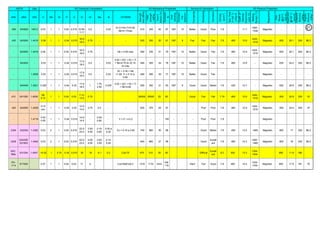
AISI UNS DIN C Mn Si P S Cr Ni Mo N OTHERS
Strength
limit(MPa)
Yield
strength
(MPa)
Elon'n
50mm(%)
Rockwell-
B
Cold
bending
Erichsen
cup
test(mm)
Formability
Weldability
Corrosion
Density
(g/cm3
)
Spe.Heat
0-100°C
(J/Kg.K)
Coeff.of
thermal
Expansion
(μ/m°C)
Melting
Range(°C)
Magnetism
Elec.
Resist.
@20°C
(nΩ.m)
HeatCond.
@100°C
(w/m.K)
Elasticity
Modulus
(GPa)
Rigidity
Modulus
(GPa)
SS Physical PropertiesASTM SS Chemical Composition SS Mechanical Properties Service & Fabrication
409 S40920 14512 0.03 1 1 0.04 0.015 10.50-
11.7
0.5 - 0.03
10 (C+N)<Ti<0.50;
Nb=0.17max
410 245 40 67 180° 10 Better Good Poor 7.8 - 11.7
1480 -
1530
Magnetic - - - -
430 S43000 1.4016 0.08 1 1 0.04 0.015
16.0-
18.0
0.75 - - - 520 350 30 81 180° 9 Fair Fair Fair 7.8 460 10.9
1425 -
1510
Magnetic 600 26.1 200 86.2
- S43000 1.4016 0.08 1 1 0.04 0.015
16.0-
18.0
0.75 - - Nb = 0.60 máx. 480 330 31 79 180° 10 Better Good Fair 7.8 460 10.9
1425 -
1510
Magnetic 600 26.1 200 86.2
- S43932 - 0.03 1 1 0.04 0.015
17.0-
19.0
0.5 - 0.03
0.20 + 4(C + N) < Ti
+ Nb<0.75 Al =0.15
AI máx
460 305 34 76 180° 10 Better Good Fair 7.8 460 10.9 - Magnetic 630 24.2 200 86.2
- - 1.4509 0.03 1 1 0.04 0.015
17.5-
18.5
0.5 - 0.03
3C + 0.30 < Nb
<1.00; Ti = 0.10 a
0.60
460 295 35 77 180° 10 Better Good Fair - - - - Magnetic - - - -
- S44400 1.4521 0.025 1 1 0.04 0.03
17.5-
18.5
1
1.75-
2.50
0.035
0.20 + 4(C + N) < Ti
+ Nb<0.80
520 350 31 83 180° 9 Good Good Better 7.8 420 10.7 - Magnetic 620 26.8 200 86.2
410 S41000 1.4006
.08-
0.15
1 1 0.04 0.03
11.5-
13.5
0.75 65000 30000 20 80 Good Fair Fair 7.74 460 10.9
1450 -
1510
Magnetic 550 24.9 200 81
420 S42000 1.4028
0.15
min
1 1 0.04 0.03
12.0-
14.0
0.75 0.5 - - 620 370 26 87 - - - Poor Poor 7.8 460 10.9
1450 -
1510
Magnetic 550 24.9 200 81
- - 1.4116
0.45-
0.55
1 1 0.04 0.015
14.0-
14.5
-
0.50-
0.80
- V = 0.1 a 0.2 - - - 100 - - - Poor Poor 7.8 Magnetic
2304 S32304 1.4362 0.03 2 1 0.04 0.015
22.0-
24.0
3.50-
5.50
0.10-
0.60
0.05 a
0.20
Cu = 0.10 a 0.60 740 560 30 96 - - - Good Better 7.8 450 13.5 1465 Magnetic 800 17 200 86.2
2205
S32205/
S31803
1.4462 0.03 2 1 0.03 0.015
22.0-
23.0
4.50-
6.50
3.00-
3.50
0.14-
0.20
- 840 660 27 98 - - Good
Excell
ent
7.8 460 14.3
1460 -
1465
Magnetic 800 16 200 86.2
SSC
6Mo
S31254 1.4547 <0.02 1 0.70 0.30 0.010 20 18 6.1 0.2 Cu0.75 675 310 35 90 Difficult
Excell
ent
8.2 500 15.3
1354-
1404
890 11.8 196
PH-
17.4
S17400 0.07 1 1 0.04 0.03 17 4 Cu4,Nb&Ta0.3 1319 1170 5min
108-
116
Hard Fair Good 7.8 460 10.4
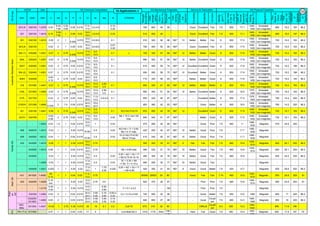
1400-
1450
Magnetic 800 17.9 197 70
21
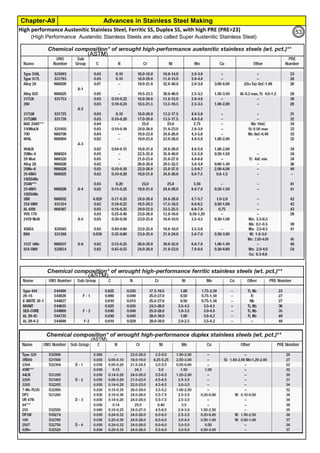
Duplex Stainless Steel-Cast-Forged-Plate Equivalents: Group AISI Type % Carbon%Chrome%Nickel % Other Elements Prime Uses
201 0.15 max 16-18 3.5-5.5 5.0-7.5 Mn 0.25N max Mn substitute for Ni
202 0.15 max 17-19 4-6 7.5—10 Mn 0.25N max Strain hardens
301 0.15 max 16-18 6-8 2 Mn max Architectural uses
302 0.15 max 17-19 8-10 2 Mn max Si for high-temp.oxidation
302B 0.15 max 17-19 8-10 2-3 Si Continuous 18-8S
304 0.08 max 18-20 8-12 1 Si max Very low carbon
304L 0.03 max 18-20 8-12 1 Si max "High" 18-8
308 0.08 max 19-21 10-12 1 Si max 25-12, hear resistance
309 0.2 max 22-24 12-15 1 Si max Lower carbon
309S 0.08 max 22-24 12-15 1 Si max 25-20, heat resistance
310 0.25 max 24-26 19-22 1.5 Si max Lower carbon
310S 0.08 max 24-26 19-22 1.5 Si max Si for high-temp.
314 0.25 max 23-26 19-22 1.5-3.0 Oxidation
316 0.10 max 16-18 10-14 2-3 Mo 18-SS MO
316L 0.03 max 16-18 10-14 2-3 Mo Very low carbon
317 0.08 max 18-20 11-14 3-4 Mo Higher Mo
321 0.08 max 17-19 8-11 Ti 4 X C(min) Ti stabilized
347 0.08 max 17-19 9-13 Cb + Ta10 X C(min) Cb stabilized
Alloy 20* 0.07 max 29 20 3.25 Cu, 2.25 Mo Best corrosion resistance
405 0.08 max 11.5-14.5 0.5 max 0.1-0.3 Al Al prevents hardening
430 0.12 max 14-18 0.5 max - Auto trim, tableware
442 0.25 max 18-23 0.5 max - Resists O and S at high temp
446 0.20 max 23-27 0.5 max 0.25N max
410 0.15 max 11.5-13.5 - - Turbine blades, valve trim
416 0.15 max 12-14 - Se, Mo, or Zr "Free" machining
420 0.35-0.45 12-14 - - Cutlery
431 0.2 max 15-17 1.25-2.5 - Improved ductility
440A 0.60-0.75 16-18 - - Very hard; cutters
322 0.07 17 7 0.07 Ti, 0.2 Al
17-7PH 0.07 17 7 1.0 Al
17-4PH 0.05 16.5 4.25 4.0 Cu
14-8MoPH 0.05 max 14 8.5 2.5 Mo, 1% A1
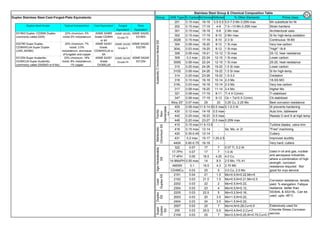
AM350 0.1 16.5 4.3 2.75 M0
CD4MCu 0.03 25 5 3.0 Cu, 2.0 Mo
2101 0.04 21 1.5 Mo=0.5,N=0.22,Mn=5
2102 0.03 21.5 1.5 Mo=0.5,N=0.21,Mn=2.5
2202 0.03 22 2 Mo=0.5,N=0.22,
2304 0.03 23 4 Mo=0.5,N=0.12,
2205 0.03 22.5 5 Mo=3.2,N=0.16,
2003 0.03 20 3.5 Mo=1.5,N=0.22,
2404 0.03 24 3.5 Mo=1.5,N=0.22,
2507 0.03 25 7 Mo=4,N=0.28,Cu=0.5
255 0.03 25.5 5.5 Mo=3.4,N=0.2,Cu=2
Z100 0.03 25 7 Mo=3.5,N=0.25,W=0.75,Cu=0.75
Stainless Steel Group & Chemical Composition Table
Duplex
SS
Super
Duplex
SS
AusteniticChromium-NickelSSAgeHaredenable
SS
Martensitic
ChromiumSS
Lean
DuplexSS
Extensively used for
Chloride Stress Corrosion
service
Corrosion resistance, tensile,
yield, % elangation, Fatique
resitance better than
SS304L & SS316L. Can be
used upto -46°C
Used in oil and gas, nuclear
and aerospace industries
where a combination of high
strength, corrosion
resistance required. Not
good for cryo service.
Ferritic
Non-
hardenable
SS
22
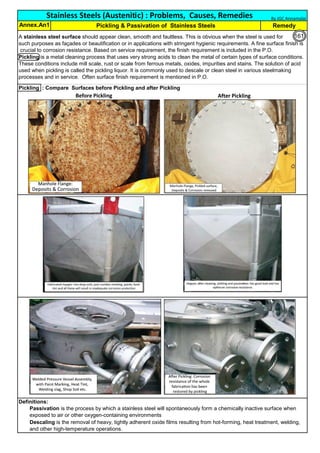
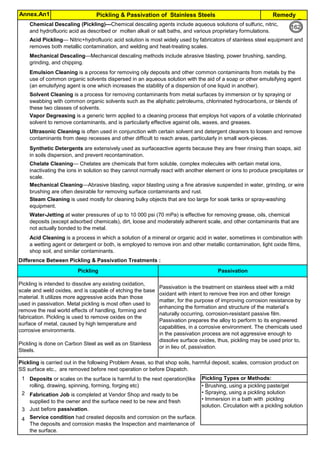
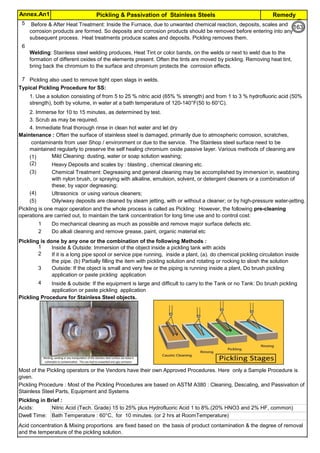
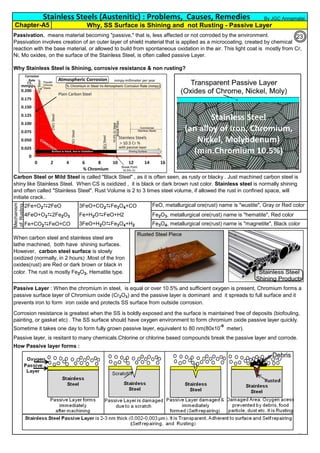
Why Stainless Steel is Shining, corrosive resistance & non rusting?
2Fe+O2D2FeO 3FeO+CO2DFe3O4+CO FeO, metallurgical ore(rust) name is "wustite", Gray or Red color
4FeO+O2D2Fe2O3 Fe+H2ODFeO+H2 Fe2O3, metallurgical ore(rust) name is "hematite", Red color
Fe+CO2DFeO+CO 3FeO+H2ODFe3O4+H2 Fe3O4, metallurgical ore(rust) name is "magnetite", Black color
How Passive layer forms :
When carbon steel and stainless steel are
lathe machined, both have shining surfaces.
However, carbon steel surface is slowly
oxidized (normally, in 2 hours) .Most of the Iron
oxides(rust) are Red or dark brown or black in
color. The rust is mostly Fe2O3, Hematite type.
Stainless Steels (Austenitic) : Problems, Causes, Remedies
Chapter-A5 Why, SS Surface is Shining and not Rusting - Passive Layer
Passivation, means material becoming "passive," that is, less affected or not corroded by the environment.
Passivation involves creation of an outer layer of shield material that is applied as a microcoating, created by chemical
reaction with the base material, or allowed to build from spontaneous oxidation in the air. This light coat is mostly from Cr,
Ni, Mo oxides, on the surface of the Stainless Steel, is often called passive Layer.
Carbon Steel or Mild Steel is called "Black Steel" , as it is often seen, as rusty or blacky . Just machined carbon steel is
shiny like Stainless Steel. When CS is oxidized , it is black or dark brown rust color. Stainless steel is normally shining
and often called "Stainless Steel". Rust Volume is 2 to 3 times steel volume, if allowed the rust in confined space, will
initiate crack..
Passive layer, is resitant to many chemicals.Chlorine or chlorine based compounds break the passive layer and corrode.
Passive Layer : When the chromium in steel, is equal or over 10.5% and sufficient oxygen is present, Chromium forms a
passive surface layer of Chromium oxide (Cr2O3) and the passive layer is dominant and it spreads to full surface and it
prevents iron to form iron oxide and protects SS surface from outside corrosion.
Corrosion resistance is greatest when the SS is boldly exposed and the surface is maintained free of deposits (biofouling,
painting, or gasket etc) . The SS surface should have oxygen environment to form chromium oxide passive layer quickly.
Sometime it takes one day to form fully grown passive layer, equivalent to 80 nm(80x10
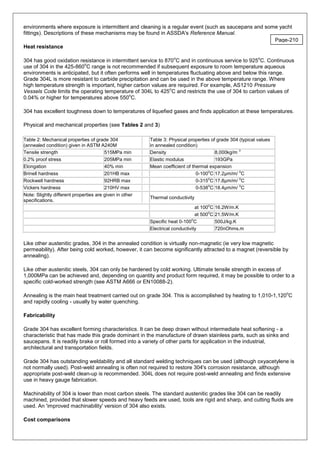
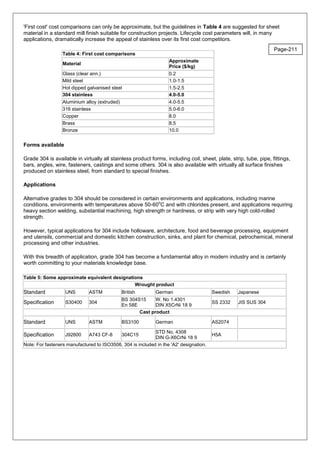
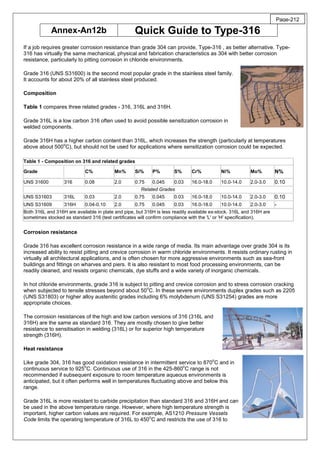
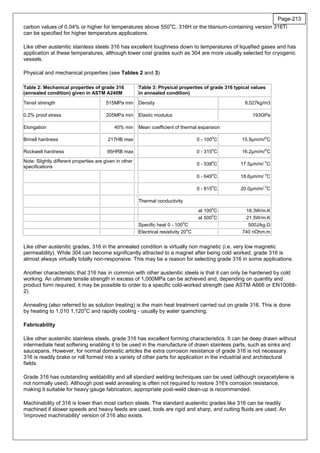
-9
meter).
By JGC Annamalai
Mechanism
ofRusting
23
Chapter-A5 Why, SS Surface is Shining and not Rusting - Passive Layer
By JGC Annamalai
(1). passive layer is damaged,
(2).
(3).
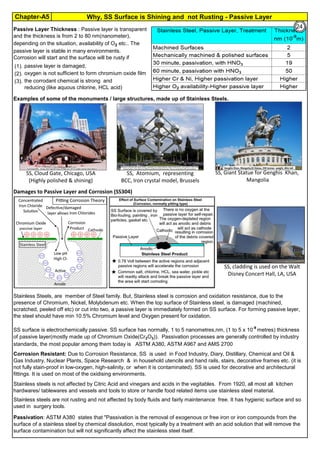
Examples of some of the monuments / large structures, made up of Stainless Steels.
Damages to Passive Layer and Corrosion (SS304)
Passivation: ASTM A380 states that "Passivation is the removal of exogenous or free iron or iron compounds from the
surface of a stainless steel by chemical dissolution, most typically by a treatment with an acid solution that will remove the
surface contamination but will not significantly affect the stainless steel itself.
Passive Layer Thickness : Passive layer is transparent
and the thickness is from 2 to 80 nm(nanometer),
depending on the situation, availability of O2 etc.. The
passive layer is stable in many environments.
Corrosion will start and the surface will be rusty if
oxygen is not sufficient to form chromium oxide film
the corrodant chemical is strong and
reducing (like aquous chlorine, HCL acid)
SS surface is electrochemically passive. SS surface has normally, 1 to 5 nanometres,nm, (1 to 5 x 10⁻⁹
metres) thickness
of passive layer(mostly made up of Chromium Oxide(Cr2O3)). Passivation processes are generally controlled by industry
standards, the most popular among them today is ASTM A380, ASTM A967 and AMS 2700
Corrosion Resistant: Due to Corrosion Resistance, SS is used in Food Industry, Diary, Distillary, Chemical and Oil &
Gas Industry, Nuclear Plants, Space Research & in household utencils and hand rails, stairs, decorative frames etc. (it is
not fully stain-proof in low-oxygen, high-salinity, or when it is contaminated). SS is used for decorative and architectural
fittings. It is used on most of the oxidising environments.
Stainless steels is not affected by Citric Acid and vinegars and acids in the vegitables. From 1920, all most all kitchen
hardwares/ tablewares and vessels and tools to store or handle food related items use stainless steel material.
Stainless steels are not rusting and not affected by body fluids and fairly maintenance free. It has hygienic surface and so
used in surgery tools.
Stainless Steels, are member of Steel family. But, Stainless steel is corrosion and oxidation resistance, due to the
presence of Chromium, Nickel, Molybdenum etc. When the top surface of Stainless steel, is damaged (machined,
scratched, peeled off etc) or cut into two, a passive layer is immediately formed on SS surface. For forming passive layer,
the steel should have min 10.5% Chromium level and Oxygen present for oxidation.
SS, Cloud Gate, Chicago, USA
(Highly polished & shining)
SS, Atomium, representing
BCC, Iron crystal model, Brussels
SS, cladding is used on the Walt
Disney Concert Hall, LA, USA
SS, Giant Statue for Genghis Khan,
Mangolia
24
Chapter-A5 Why, SS Surface is Shining and not Rusting - Passive Layer
By JGC Annamalai
(1).
(2).
(1).
(2).
(3).
(4).
(B2). Galling & Jamming of Threads of SS Fasteners , moving components
(B3). Sensitization , Weld Decay, Knifeline Attack
(B4). Corrosion Attack on Stainless Steels
(B9). Contamination or Pollution on Stainless Steel Surface
(B12). Stainless Steel Weld HAZ Area is Colored or Tinted
Bright Annealing or Solution Annealing : Bright annealing (partly Solution Annealing) is heating the stainless steel to a
suitably high temperature (usually more than 1,900°F(1,040°C) in a reducing atmosphere such as dry hydrogen gas.
Organic contaminants are volatilized and most metal oxides (including those of iron, nickel, and chromium) will be reduced,
resulting in a clean, oxide-free surface. The stainless steel then is rapidly cooled (through the temperature range of 1,600
and 800°F(870 and 425°C) to prevent carbide precipitation, and then at lower temperatures exposed to air, where the
protective oxide film forms spontaneously.
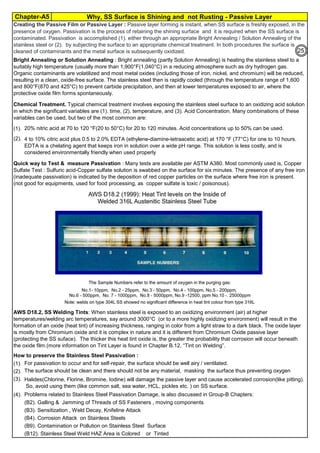
Creating the Passive Film or Passive Layer : Passive layer forming is instant, when SS surface is freshly exposed, in the
presence of oxygen. Passivation is the process of retaining the shining surface and it is required when the SS surface is
contaminated. Passivation is accomplished (1). either through an appropriate Bright Annealing / Solution Annealing of the
stainless steel or (2). by subjecting the surface to an appropriate chemical treatment. In both procedures the surface is
cleaned of contaminants and the metal surface is subsequently oxidized.
Halides(Chlorine, Florine, Bromine, Iodine) will damage the passive layer and cause accelerated corrosion(like pitting).
So, avoid using them (like common salt, sea water, HCL, pickles etc. ) on SS surface.
Problems related to Stainless Steel Passivation Damage, is also discussed in Group-B Chapters:
4 to 10% citric acid plus 0.5 to 2.0% EDTA (ethylene-diamine-tetraacetic acid) at 170 °F (77°C) for one to 10 hours.
EDTA is a chelating agent that keeps iron in solution over a wide pH range. This solution is less costly, and is
considered environmentally friendly when used properly
Quick way to Test & measure Passivation : Many tests are available per ASTM A380. Most commonly used is, Copper
Sulfate Test : Sulfuric acid-Copper sulfate solution is swabbed on the surface for six minutes. The presence of any free iron
(inadequate passivation) is indicated by the deposition of red copper particles on the surface where free iron is present.
(not good for equipments, used for food processing, as copper sulfate is toxic / poisonous).
The surface should be clean and there should not be any material, masking the surface thus preventing oxygen
supply.
AWS D18.2, SS Welding Tints: When stainless steel is exposed to an oxidizing environment (air) at higher
temperatures/welding arc temperatures, say around 3000°C (or to a more highly oxidizing environment) will result in the
formation of an oxide (heat tint) of increasing thickness, ranging in color from a light straw to a dark black. The oxide layer
is mostly from Chromium oxide and it is complex in nature and it is different from Chromium Oxide passive layer
(protecting the SS suface). The thicker this heat tint oxide is, the greater the probability that corrosion will occur beneath
the oxide film.(more information on Tint Layer is found in Chapter B.12, “Tint on Welding”.
How to preserve the Stainless Steel Passivation :
For passivation to occur and for self-repair, the surface should be well airy / ventilated.
Chemical Treatment. Typical chemical treatment involves exposing the stainless steel surface to an oxidizing acid solution
in which the significant variables are (1). time, (2). temperature, and (3). Acid Concentration. Many combinations of these
variables can be used, but two of the most common are:
20% nitric acid at 70 to 120 °F(20 to 50°C) for 20 to 120 minutes. Acid concentrations up to 50% can be used.
25
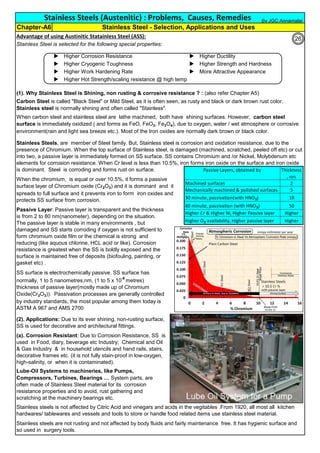
Advantage of using Austinitic Statainless Steel (ASS):
Stainless Steel is selected for the following special properties:
u Higher Corrosion Resistance u Higher Ductility
u Higher Cryogenic Toughness u Higher Strength and Hardness
u Higher Work Hardening Rate u More Attractive Appearance
u Higher Hot Strength/scaling resistance @ high temp
(1). Why Stainless Steel is Shining, non rusting & corrosive resistance ? : (also refer Chapter A5)
Stainless Steels (Austenitic) : Problems, Causes, Remedies
Carbon Steel is called "Black Steel" or Mild Steel, as it is often seen, as rusty and black or dark brown rust color.
Stainless steel is normally shining and often called "Stainless".
When carbon steel and stainless steel are lathe machined, both have shining surfaces. However, carbon steel
surface is immediately oxidized ( and forms as FeO, FeO2, Fe3O4), due to oxygen, water / wet atmosphere or corrosive
environment(rain and light sea breeze etc.). Most of the Iron oxides are normally dark brown or black color.
Chapter-A6 Stainless Steel - Selection, Applications and Uses
Stainless steels is not affected by Citric Acid and vinegars and acids in the vegitables .From 1920, all most all kitchen
hardwares/ tablewares and vessels and tools to store or handle food related items use stainless steel material.
Stainless steels are not rusting and not affected by body fluids and fairly maintenance free. It has hygienic surface and
so used in surgery tools.
When the chromium, is equal or over 10.5%, it forms a passive
surface layer of Chromium oxide (Cr2O3) and it is dominant and it
spreads to full surface and it prevents iron to form iron oxides and
protects SS surface from corrosion.
Passive Layer: Passive layer is transparent and the thickness
is from 2 to 80 nm(nanometer), depending on the situation.
The passive layer is stable in many environments , but
damaged and SS starts corroding if oxygen is not sufficient to
form chromium oxide film or the chemical is strong and
reducing (like aquous chlorine, HCL acid or like). Corrosion
resistance is greatest when the SS is boldly exposed and the
surface is maintained free of deposits (biofouling, painting, or
gasket etc) .
SS surface is electrochemically passive. SS surface has
normally, 1 to 5 nanometres,nm, (1 to 5 x 10⁻⁹
metres)
thickness of passive layer(mostly made up of Chromium
Oxide(Cr2O3)). Passivation processes are generally controlled
by industry standards, the most popular among them today is
ASTM A 967 and AMS 2700
(a). Corrosion Resistant: Due to Corrosion Resistance, SS is
used in Food, diary, beverage etc Industry; Chemical and Oil
& Gas Industry & in household utencils and hand rails, stairs,
decorative frames etc. (it is not fully stain-proof in low-oxygen,
high-salinity, or when it is contaminated).
(2). Applications: Due to its ever shining, non-rusting surface,
SS is used for decorative and architectural fittings.
Lube-Oil Systems to machineries, like Pumps,
Compressors, Turbines, Bearings … System parts, are
often made of Stainless Steel material for its corrosion
resistance properties and to avoid, rust gathering and
scratching at the machinery bearings etc.
Stainless Steels, are member of Steel family. But, Stainless steel is corrosion and oxidation resistance, due to the
presence of Chromium. When the top surface of Stainless steel, is damaged (machined, scratched, peeled off etc) or cut
into two, a passive layer is immediately formed on SS surface. SS contains Chromium and /or Nickel, Molybdenum etc
elements for corrosion resistance. When Cr level is less than 10.5%, iron forms iron oxide on the surface and iron oxide
is dominant. Steel is corroding and forms rust on surface. Passive Layers, obtained by Thickness
, nm
Machined surfaces 2
Mechanically machined & polished surfaces 5
30 minute, passivation(with HNO3) 19
60 minute, passivation (with HNO3) 50
Higher Cr & Higher Ni, Higher Passive layer Higher
Higher O2 availability, Higher passive layer Higher
By JGC Annamalai
26
Chapter-A6 Stainless Steel - Selection, Applications and Uses
Passive Layers, obtained by Thickness
, nm
Machined surfaces 2
Mechanically machined & polished surfaces 5
30 minute, passivation(with HNO3) 19
60 minute, passivation (with HNO3) 50
Higher Cr & Higher Ni, Higher Passive layer Higher
Higher O2 availability, Higher passive layer Higher
By JGC Annamalai
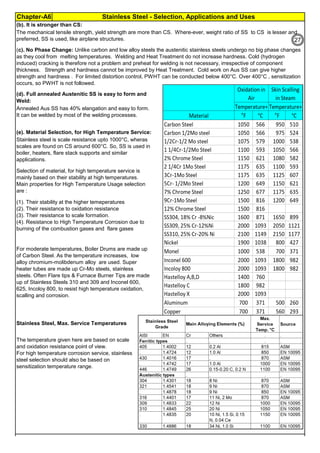
(e). Material Selection, for High Temperature Service:
(d). Full annealed Austenitic SS is easy to form and
Weld:
Stainless Steel, Max. Service Temperatures
The temperature given here are based on scale
and oxidation resistance point of view.
For high temperature corrosion service, stainless
steel selection should also be based on
sensitization temperature range.
(b). It is stronger than CS:
(c). No Phase Change: Unlike carbon and low alloy steels the austenitic stainless steels undergo no big phase changes
as they cool from melting temperatures. Welding and Heat Treatment do not increase hardness. Cold (hydrogen
induced) cracking is therefore not a problem and preheat for welding is not necessary, irrespective of component
thickness. Strength and hardness cannot be improved by Heat Treatment. Cold work on Aus SS can give higher
strength and hardness . For limited distortion control, PWHT can be conducted below 400°C. Over 400°C , sensitization
occurs, so PWHT is not followed.
The mechanical tensile strength, yield strength are more than CS. Where-ever, weight ratio of SS to CS is lesser and
preferred, SS is used, like airplane structures.
Annealed Aus SS has 40% elangation and easy to form.
It can be welded by most of the welding processes.
Stainless steel is scale resistance upto 1000°C, wheras
scales are found on CS around 600°C. So, SS is used in
boiler, heaters, flare stack supports and similar
applications.
Selection of material, for high temperature service is
mainly based on their stability at high temperatures.
Main properties for High Temperature Usage selection
are :
(1). Their stability at the higher temeperatures
(2). Their resistance to oxidation resistance
(3). Their resistance to scale formation.
(4). Resistance to High Temperature Corrosion due to
burning of the combustion gases and flare gases
For moderate temperatures, Boiler Drums are made up
of Carbon Steel. As the temperature increases, low
alloy chromium-molibdenum alloy are used. Super
heater tubes are made up Cr-Mo steels, stainless
steels. Often Flare tips & Furnace Burner Tips are made
up of Stainless Steels 310 and 309 and Inconel 600,
625, Incoloy 800, to resist high temperature oxidation,
scalling and corrosion.
27
Chapter-A6 Stainless Steel - Selection, Applications and Uses
Passive Layers, obtained by Thickness
, nm
Machined surfaces 2
Mechanically machined & polished surfaces 5
30 minute, passivation(with HNO3) 19
60 minute, passivation (with HNO3) 50
Higher Cr & Higher Ni, Higher Passive layer Higher
Higher O2 availability, Higher passive layer Higher
By JGC Annamalai
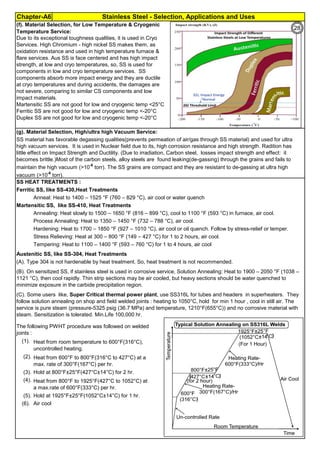
SS HEAT TREATMENTS :
Ferritic SS, like SS-430,Heat Treatments
Anneal: Heat to 1400 – 1525 °F (760 – 829 °C), air cool or water quench
Martensitic SS, like SS-410, Heat Treatments
Annealing: Heat slowly to 1500 – 1650 °F (816 – 899 °C), cool to 1100 °F (593 °C) in furnace, air cool.
Process Annealing: Heat to 1350 – 1450 °F (732 – 788 °C), air cool.
Hardening: Heat to 1700 – 1850 °F (927 – 1010 °C), air cool or oil quench. Follow by stress-relief or temper.
Stress Relieving: Heat at 300 – 800 °F (149 – 427 °C) for 1 to 2 hours, air cool.
Tempering: Heat to 1100 – 1400 °F (593 – 760 °C) for 1 to 4 hours, air cool
Austenitic SS, like SS-304, Heat Treatments
(A). Type 304 is not hardenable by heat treatment. So, heat treatment is not recommended.
(1).
(2).
(3). Hold at 800°F±25°F(427°C±14°C) for 2 hr.
(4).
(5). Hold at 1925°F±25°F(1052°C±14°C) for 1 hr.
(6). Air cool
Heat from room temperature to 600°F(316°C),
uncontrolled heating.
Heat from 600°F to 800°F(316°C to 427°C) at a
max. rate of 300°F(167°C) per hr.
Heat from 800°F to 1925°F(427°C to 1052°C) at
a max.rate of 600°F(333°C) per hr.
The following PWHT procedure was followed on welded
joints :
(g). Material Selection, High/ultra high Vacuum Service:
SS material has favorable degassing qualities(prevents permeation of air/gas through SS material) and used for ultra
high vacuum services. It is used in Nuclear field due to its, high corrosion resistance and high strength. Radition has
little effect on Impact Strength and Ductility. (Due to irradiation, Carbon steel, losses impact strength and effect: it
becomes brittle.)Most of the carbon steels, alloy steels are found leaking(de-gassing) through the grains and fails to
maintain the high vacuum (>10-6
torr). The SS grains are compact and they are resistant to de-gassing at ultra high
vacuum (>10-6
torr).
(B). On sensitized SS, if stainless steel is used in corrosive service, Solution Annealing: Heat to 1900 – 2050 °F (1038 –
1121 °C), then cool rapidly. Thin strip sections may be air cooled, but heavy sections should be water quenched to
minimize exposure in the carbide precipitation region.
(C). Some users like, Super Critical thermal power plant, use SS316L for tubes and headers in superheaters. They
follow solution annealing on shop and field welded joints : heating to 1050°C, hold for min 1 hour , cool in still air. The
service is pure steam (pressure-5325 psig (36.7 MPa) and temperature, 1210°F(655°C)) and no corrosive material with
steam. Sensitization is tolerated. Min.Life 100,000 hr.
Due to its exceptional toughness qualities, it is used in Cryo
Services. High Chromium - high nickel SS makes them, as
oxidation resistance and used in high temperature furnace &
flare services. Aus SS is face centered and has high impact
strength, at low and cryo temperatures, so, SS is used for
components in low and cryo temperature services. SS
components absorb more impact energy and they are ductile
at cryo temperatures and during accidents, the damages are
not severe, comparing to similar CS components and low
impact materials.
Martensitic SS are not good for low and cryogenic temp <25°C
Ferritic SS are not good for low and cryogenic temp <-20°C
Duplex SS are not good for low and cryogenic temp <-20°C
(f). Material Selection, for Low Temperature & Cryogenic
Temperature Service:
28
Chapter-A6 Stainless Steel - Selection, Applications and Uses
Passive Layers, obtained by Thickness
, nm
Machined surfaces 2
Mechanically machined & polished surfaces 5
30 minute, passivation(with HNO3) 19
60 minute, passivation (with HNO3) 50
Higher Cr & Higher Ni, Higher Passive layer Higher
Higher O2 availability, Higher passive layer Higher
By JGC Annamalai
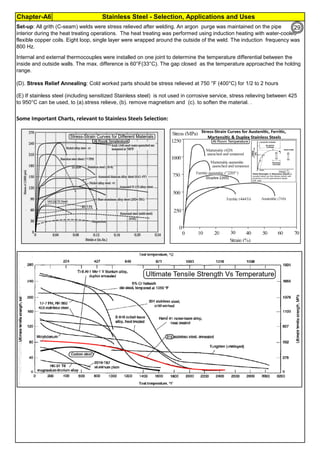
Some Important Charts, relevant to Stainless Steels Selection:
(E) If stainless steel (including sensitized Stainless steel) is not used in corrosive service, stress relieving between 425
to 950°C can be used, to (a).stress relieve, (b). remove magnetism and (c). to soften the material. .
Internal and external thermocouples were installed on one joint to determine the temperature differential between the
inside and outside walls. The max. difference is 60°F(33°C). The gap closed as the temperature approached the holdng
range.
(D). Stress Relief Annealing: Cold worked parts should be stress relieved at 750 °F (400°C) for 1/2 to 2 hours
Set-up: All grith (C-seam) welds were stress relieved after welding. An argon purge was maintained on the pipe
interior during the heat treating operations. The heat treating was performed using induction heating with water-cooled
flexible copper coils. Eight loop, single layer were wrapped around the outside of the weld. The induction frequency was
800 Hz.
29
DIN
AISI UNS DIN C Mn Si P S Cr Ni Mo N OTHERS
Strength
limit(MPa)
Yield
strength
(MPa)
Elon'n
50mm(%)
Rockwell-
B
Cold
bending
Erichsen
cup
test(mm)
Formability
Weldability
Corrosion
Density
(g/cm3
)
Spe.Heat
0-100°C
(J/Kg.K)
Coeff.of
thermal
Expansion
(μ/m°C)
Melting
Range(°C)
Magnetism
Elec.
Resist.at
Room
Temp.
Heat
Cond.100
°C(w/m.K)
Modulus
of
Elasticity
Modulus
of
Rigidity(G
201LN S20153 1.4376 0.03
'6.40-
7.50
0.20-
0.60
0.05 0.015
17.0-
17.5
4.0-4.5 -
0.15-
0.25
700 500 45 95 - - Good Excellent Fair 7.8 500 17.1
1400 -
1450
Annealed.
non-magnetic
690 16.2 197 86.2
201 S20100 1.4618 0.15
'5.50-
7.50
1 0.06 0.03
16.0-
18.0
3.5-5.5 - 0.25 515 260 40 - - - Good Excellent Fair 7.8 500 17.1
1400 -
1450
Annealed.
non-magnetic
690 16.2 197 86.2
301 S30100 1.4310 0.05 2 1
0.045
0.015
16.0-
18.0
6.0-8.0 - 0.1 - 910 320 46 86 180° 13 Better Better Fair 8 500 17.5
1400 -
1420
Annealed.
non-magnetic
720 16.2 193 86.2
301LN S30153 - 0.03 2 1 0.05 0.03
16.0-
18.0
6.0-8.0 -
0.07-
0.20
700 400 50 90 180º - Good Excellent Fair 8 500 17.5
1400 -
1425
Annealed.
non-magnetic
720 16.2 193 86.2
304 (1) S30400 1.4301 0.07 2 0.75
0.045
0.015
17.5-
19.5
8.0-
10.5
- 0.1 c 720 320 57 84 180° 12 Better Better Good 8 500 17.8
1400 -
1450
Annealed.
non-magnetic
720 16.2 193 86.2
304L S30403 1.4307 0.03 2 0.75
0.045
0.015
17.5-
19.5
8.0-
10.5
- 0.1 - 690 320 51 80 180° 12 Better Excellent Good 8 500 17.8
1400 -
1450
Annealed.
non-magnetic
720 16.2 193 86.2
304T S30400 1.4301 0.03 2 0.75 0.05 0.015
17.5-
19.5
9.0-
10.5
- 0.1 610 280 58 74 180º 12 Excellent Excellent Good 8 500 17.8
1400 -
1450
Annealed.
non-magnetic
720 16.2 196 86.2
304 (2) S30400 1.4301 0.07 2 0.75 0.05 0.015
17.5-
19.5
8.0-
10.5
- 0.1 600 280 58 75 180º 12 Excellent Better Good 8 500 17.8
1400 -
1450
Annealed.
non-magnetic
720 16.2 196 86.2
304H S30409 -
0.04-
0.10
2 0.75 0.05 0.03
18.0-
20.0
8.0-
10.5
- - 710 320 58 83 180º - Better Better Good 8 500 17.8
1400 -
1450
Annealed.
non-magnetic
720 16.2 193 86.2
316 S31600 1.4401 0.07 2 0.75
0.045
0.015
16.5-
18.0
10.0-
13.0
2.00-
2.5
0.1 - 650 340 51 82 180° 12 Better Better Better 8 500 16.5
1375 -
1400
Annealed.
non-magnetic
740 16.2 193 86.2
316L S31603 1.4404 0.03 2 0.75
0.045
0.015
16.5-
18.0
10.0-
13.0
2.00-
2.5
0.1 - 650 340 51 82 180° 12 Better Excellent Better 8 500 16.5
1375 -
1400
Annealed.
non-magnetic
740 16.2 193 86.2
317L S31703 - 0.03 2 0.75 0.05 0.03
18.0-
20.0
11.0-
15.0
3.0-4.0 0.1 650 330 45 87 180º - - Excellent Better 8 500 17.5
1375 -
1400
Annealed.
non-magnetic
790 14.4 200 86.2
310S/H S31008 1.4845
0.035-
0.08
2 1.5 0.05 0.015
24.0-
26.0
19.0-
22.0
- - 600 380 42 83 180º - - Good Better 8 500 16.5
1400 -
1450
Annealed.
non-magnetic
780 14.2 200 86.2
321 S32100 1.4541 0.08 2 0.75
0.045
0.015
17.0-
19.0
9.0-
12.0
- 0.1 5(C+N)<Ti<0.70 670 260 42 78 180° 12 - Excellent Good 8 500 17.5
1400 -
1425
Annealed.
non-magnetic
720 16.1 193 86.2
347/H S34709 -
0.04-
0.08
2 0.75 0.05 0.03
17.0-
19.0
9.0-
13.0
- 0.02
Nb = 10 C min1.00
máx.
645 345 51 87 180º - - Better Good 8 500 17.5
1400 -
1425
Annealed.
non-magnetic
730 16.1 193 86.2
- - 1.4003 0.03 1.5 1 0.04 0.015
10.5-
12.5
1 - 0.03 475 280 30 80 180° - - Good Poor 7.8 460 11
1480 -
1530
Magnetic 570 24.9 200
409 S40910 1.4512 0.03 1 1 0.04 0.015
10.50-
11.7
0.5 - 0.03
6(C+N) < Ti < 0.50;
Nb = 0.17 máx.
420 250 40 67 180° 10 Better Good Poor 7.8 - 11.7
1480 -
1530
Magnetic - - - -
409 S40920 14512 0.03 1 1 0.04 0.015
10.50-
11.7
0.5 - 0.03
10 (C+N)<Ti<0.50;
Nb=0.17max
410 245 40 67 180° 10 Better Good Poor 7.8 - 11.7
1480 -
1530
Magnetic - - - -
430 S43000 1.4016 0.08 1 1 0.04 0.015
16.0-
18.0
0.75 - - - 520 350 30 81 180° 9 Fair Fair Fair 7.8 460 10.9
1425 -
1510
Magnetic 600 26.1 200 86.2
- S43000 1.4016 0.08 1 1 0.04 0.015
16.0-
18.0
0.75 - - Nb = 0.60 máx. 480 330 31 79 180° 10 Better Good Fair 7.8 460 10.9
1425 -
1510
Magnetic 600 26.1 200 86.2
- S43932 - 0.03 1 1 0.04 0.015
17.0-
19.0
0.5 - 0.03
0.20 + 4(C + N) < Ti
+ Nb<0.75 Al =0.15
AI máx
460 305 34 76 180° 10 Better Good Fair 7.8 460 10.9 - Magnetic 630 24.2 200 86.2
- - 1.4509 0.03 1 1 0.04 0.015
17.5-
18.5
0.5 - 0.03
3C + 0.30 < Nb
<1.00; Ti = 0.10 a
0.60
460 295 35 77 180° 10 Better Good Fair - - - - Magnetic - - - -
- S44400 1.4521 0.025 1 1 0.04 0.03
17.5-
18.5
1
1.75-
2.50
0.035
0.20 + 4(C + N) < Ti
+ Nb<0.80
520 350 31 83 180° 9 Good Good Better 7.8 420 10.7 - Magnetic 620 26.8 200 86.2
410 S41000 1.4006
.08-
0.15
1 1 0.04 0.03
11.5-
13.5
0.75 65000 30000 20 80 Good Fair Fair 7.74 460 10.9
1450 -
1510
Magnetic 550 24.9 200 81
420 S42000 1.4028
0.15
min
1 1 0.04 0.03
12.0-
14.0
0.75 0.5 - - 620 370 26 87 - - - Poor Poor 7.8 460 10.9
1450 -
1510
Magnetic 550 24.9 200 81
- - 1.4116
0.45-
0.55
1 1 0.04 0.015
14.0-
14.5
-
0.50-
0.80
- V = 0.1 a 0.2 - - - 100 - - - Poor Poor 7.8 Magnetic
Dupl
ex
SS
- S32304 1.4362 0.03 2 1 0.04 0.015
22.0-
24.0
3.50-
5.50
0.10-
0.60
0.05 a
0.20
Cu = 0.10 a 0.60 740 560 30 96 - - - Good Better 7.8 450 13.5 1465 Magnetic 800 17 200 86.2
-
S32205/
S31803
1.4462 0.03 2 1 0.03 0.015
22.0-
23.0
4.50-
6.50
3.00-
3.50
0.14-
0.20
- 840 660 27 98 - - Good
Excell
ent
7.8 460 14.3
1460 -
1465
Magnetic 800 16 200 86.2
SSC
6Mo
S31254 1.4547 <0.02 1 0.70 0.30 0.010 20 18 6.1 0.2 Cu0.75 675 310 35 90 Difficult
Excell
ent
8.2 500 15.3
1354-
1404
890 11.8 196
PH
PH-17.4 S17400 0.07 1 1 0.04 0.03 17 4 Cu4,Nb&Ta0.3 1319 1170 5min 108-
116
Hard Fair Good 7.8 460 10.4 1400-
1450
Magnetic 800 17.9 197 70
AusteniticStainlessSteelFerriticSS
ASTM
Mart.SS
SS Physical PropertiesSS Mechanical Properties Service & Fabrication
SSGroup
SS Chemical Composition
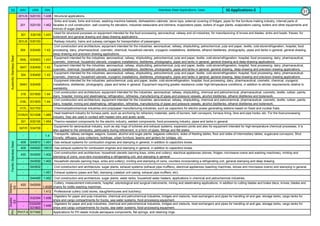
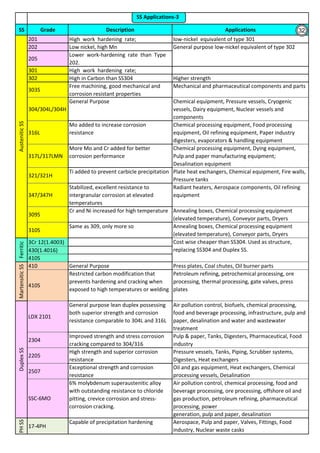
SS Applications-1 30
SS AISI UNS DIN Stainless Steel Applications, Uses
201LN S20153 1.438 Structural applications.
201 S20100 1.462
Sinks and bowls, forks and knives, washing-machine baskets, dishwashers cabinets, stove tops, external covering of fridges, pipes for the furniture-making industry, internal parts of
facades in civil construction, wall covering for elevators, industrial restaurants and kitchens, evaporators pipes, boilers of sugar plants, evaporators casing, boilers and other equipments and
mirrors of sugar plants.
301 S30100 1.431
Used for structural purposes on equipment intended for the food processing, aeronautical, railway and oil industries; for manufacturing of knives and blades, sinks and bowls, friezes; for
boilerwork and general drawing and deep-drawing applications.
301LN S30153 - Railway industry: trains and subway carriages for transportation of passengers.
304 S30400 1.43
Civil construction and architecture; equipment intended for the industries: aeronautical, railway, shipbuilding, petrochemical, pulp and paper, textile, cold-store/refrigeration, hospital, food
processing, dairy, pharmaceutical, cosmetic, chemical; household utensils, cryogenic installations, distilleries, ethanol distilleries, photography, pipes and tanks in general, general drawing,
deep-drawing and precision drawing applications.
304L S30403 1.431
Equipment intended for the industries: aeronautical, railway, shipbuilding, petrochemical, pulp and paper, textile, cold-store/refrigeration, hospital, food processing, dairy, pharmaceutical,
cosmetic, chemical; household utensils, cryogenic installations, distilleries, photography, pipes and tanks in general, general drawing and deep-drawing applications.
304T S30400 1.43
Equipment intended for the industries: aeronautical, railway, shipbuilding, petrochemical, pulp and paper, textile, cold-store/refrigeration, hospital, food processing, dairy, pharmaceutical,
cosmetic, chemical; household utensils, cryogenic installations, distilleries, photography, pipes and tanks in general, general drawing, deep-drawing and precision drawing applications.
304 S30400 1.43
Equipment intended for the industries: aeronautical, railway, shipbuilding, petrochemical, pulp and paper, textile, cold-store/refrigeration, hospital, food processing, dairy, pharmaceutical,
cosmetic, chemical; household utensils, cryogenic installations, distilleries, photography, pipes and tanks in general, general drawing, deep-drawing and precision drawing applications.
304H S30409 -
Equipment intended for the industries: petrochemical, pulp and paper, textile, cold-store/refrigeration, hospital, food processing, dairy, pharmaceutical, cosmetic, chemical; cryogenic
installations, distilleries, photography, pipes and tanks in general. Equipment requiring greater resistance under high-temperature conditions, in addition to stricter requirements relative to
weldability.
316 S31600 1.44
Civil construction and architecture; equipment intended for the industries: aeronautical, railway, shipbuilding, chemical and petrochemical, pharmaceutical, cosmetic, textile, rubber, paints,
dairy, hospital; mining and steelmaking; refrigeration, refineries, manufacturing of pipes and pressure vessels, alcohol distilleries, ethanol distilleries and boilerwork.
316L S31603 1.44
Civil construction and architecture; equipment intended for the industries: aeronautical, railway, shipbuilding, chemical and petrochemical, pharmaceutical, cosmetic, textile, rubber, paints,
dairy, hospital; mining and steelmaking; refrigeration, refineries, manufacturing of pipes and pressure vessels, alcohol distilleries, ethanol distilleries and boilerwork.
317L S31703 - Chemical/petrochemical industries and pulp/paper manufacturing industries; such as capacitors for electric-power generating stations based on fossil and nuclear fuels.
310S/H S31008 1.485
Heat treatment industry for furnace parts, such as anchoring for refractory materials, parts of burners, belt conveyors, furnace lining, fans and pipe hooks, etc. For the food-processing
industry, they are used in contact with heated citric and acetic acids.
321 S32100 1.454 Thermo-resistant components for the electric industry, welded components, food-processing industry, pipes and tanks in general.
347/H S34709 -
Equipment for aeronautical industry, such as slip rings of turbines and exhaust systems, expansion joints and also for equipment intended for high-temperature chemical processes. It is
also applied to the oilindustry, particularly during refinement, in a form of pipes, fittings and flat plates.
- - 1.4
Transports: railway carriages, wagons, busses; alcohol and sugar plants: bagasse collectors, sides of feeding tables, floor and sides of intermediary tables, sugarcane conveyors, Shut
Donelly, diffusers, juice collectors; buildings, urban furniture, beams and girders for bridges, etc.
409 S40910 1.451 Gas exhaust systems for combustion engines and stamping in general, in addition to capacitors boxes.
409 S40920 14512 Gas exhaust systems for combustion engines and stamping in general, in addition to capacitors boxes.
430 S43000 1.402
Civil construction and architecture; household utensils (serving trays, sinks and cutlery), electrical appliances (stoves, fridges, microwave ovens and washing machines), minting and
stamping of coins, coun-ters incorporating a refrigerating unit, and stamping in general.
- S43000 1.402 Household utensils (serving trays, sinks and cutlery), minting and stamping of coins, counters incorporating a refrigerating unit, general stamping and deep drawing.
- S43932 - Civil construction and architecture: sugar plants, exhaust systems (exhaust pipe mufflers), electrical appliances (washing machines, stoves and microwave ovens) and stamping in general.
- - 1.451 Exhaust systems (pipes and flat), stamping (catalyst unit casing, exhaust pipe mufflers, etc).
- S44400 1.452 Civil construction and architecture: sugar plants, water tanks, household water heaters, applications in chemical and petrochemical industries.
420 S42000
1.4028
Cutlery, measurement instruments, hospital, odontological and surgical instruments; mining and steelmaking applications, in addition to cutting blades and brake discs, knives, blades and
chains for bottle washing machines.
- - 1.412 Professional cutlery (cold stores, slaughterhouses and butchery).
- S32304 1.436
Digesters for paper and pulp industries, chemical and petrochemical industries, bridges and viaducts, heat exchangers and pipes for handling oil and gas, storage tanks, cargo tanks for
ships and cargo compartments for trucks, sea water systems, food-processing equipment.
-
S32205/
S31803
1.446
Digesters for paper and pulp industries, chemical and petrochemical industries, bridges and viaducts, heat exchangers and pipes for handling oil and gas, storage tanks, cargo tanks for
ships and cargo compartments for trucks, sea water systems, food-processing equipment.
PH
PH17.4 S17400 Applications for PH steels include aerospace components, flat springs, and retaining rings.
FerriticStainlessSteel
Marten.
SS
Duplex
SS
AusteniticStainlessSteel
SS Applications-2 31
SS Grade Description Applications
201 High work hardening rate; low-nickel equivalent of type 301
202 Low nickel, high Mn General purpose low-nickel equivalent of type 302
205
Lower work-hardening rate than Type
202.
301 High work hardening rate;
302 High in Carbon than SS304 Higher strength
303S
Free machining, good mechanical and
corrosion resistant properties
Mechanical and pharmaceutical components and parts
304/304L/304H
General Purpose Chemical equipment, Pressure vessels, Cryogenic
vessels, Dairy equipment, Nuclear vessels and
components
316L
Mo added to increase corrosion
resistance
Chemical processing equipment, Food processing
equipment, Oil refining equipment, Paper industry
digesters, evaporators & handling equipment
317L/317LMN
More Mo and Cr added for better
corrosion performance
Chemical processing equipment, Dying equipment,
Pulp and paper manufacturing equipment;
Desalination equipment
321/321H
Ti added to prevent carbicle precipitation Plate heat exchangers, Chemical equipment, Fire walls,
Pressure tanks
347/347H
Stabilized, excellent resistance to
intergranular corrosion at elevated
temperatures
Radiant heaters, Aerospace components, Oil refining
equipment
309S
Cr and Ni increased for high temperature Annealing boxes, Chemical processing equipment
(elevated temperature), Conveyor parts, Dryers
310S
Same as 309, only more so Annealing boxes, Chemical processing equipment
(elevated temperature), Conveyor parts, Dryers
3Cr 12(1.4003)
430(1.4016)
410S
410 General Purpose Press plates, Coal chutes, Oil burner parts
410S
Restricted carbon modification that
prevents hardening and cracking when
exposed to high temperatures or welding
Petroleum refining, petrochemical processing, ore
processing, thermal processing, gate valves, press
plates
LDX 2101
General purpose lean duplex possessing
both superior strength and corrosion
resistance comparable to 304L and 316L
Air pollution control, biofuels, chemical processing,
food and beverage processing, infrastructure, pulp and
paper, desalination and water and wastewater
treatment
2304
Improved strength and stress corrosion
cracking compared to 304/316
Pulp & paper, Tanks, Digesters, Pharmaceutical, Food
industry
2205
High strength and superior corrosion
resistance
Pressure vessels, Tanks, Piping, Scrubber systems,
Digesters, Heat exchangers
2507
Exceptional strength and corrosion
resistance
Oil and gas equipment, Heat exchangers, Chemical
processing vessels, Desalination
Air pollution control, chemical processing, food and
beverage processing, ore processing, offshore oil and
gas production, petroleum refining, pharmaceutical
processing, power
generation, pulp and paper, desalination
PHSS
17-4PH
Capable of precipitation hardening Aerospace, Pulp and paper, Valves, Fittings, Food
industry, Nuclear waste casks
MartensiticSSDuplexSS
SSC-6MO
6% molybdenum superaustenitic alloy
with outstanding resistance to chloride
pitting, crevice corrosion and stress-
corrosion cracking.
Cost wise cheaper than SS304. Used as structure,
replacing SS304 and Duplex SS.
FerriticAusteniticSS
SS Applications-3
32
Compare SS202 and SS304
Chemical Composion of SS202 and SS301 Ref: ASTM A240
Comparing to SS304 and SS202, Carbon, Manganese, Phosphorus, Silicon are reduced, in SS304.
Mechanical Properties of SS202 and SS304
Comparing to SS304 and SS202, tensile, yield strength and hardness are less in SS304.
In 2007-2008, most of Stainless Steel foundries were either
shut down or they were facing long delay. The reason is
Nickel was in short supply. The spot Nickel price had gone
high, 4 to 6 times.
Foundries were pressing the Users. Suppliers recommended
to use SS202 instead of SS304, as the nickel content in
SS202 was partially replaced by Manganese. The price of SS
was cheaper. Vendors claimed, SS202 was almost having
equivalent corrosion resistance and mechanical properties,
much above SS304.
Users with Project Specifications, did not accept to change
from SS304 to SS202. They insisted to follow Specification
and to use SS304
However, people making products, direct sales to people, like
utencils, architectural and decoration items, gift items,
ladders, stairs etc changed to SS202, instead of SS304.
Many shops branded the SS202 articles as SS304. There is
no easy way to check whether it is SS202 or SS304. To
check the chemisty of SS202 articles, we need to use
Spectrometer or portable X-ray fluorescence meters. Their
prices are exorbitant to Fabrication Shops or to the Sales
Shops or to the users.
SS202 series and SS300 series are Austenitic Stainless
Steels. To make the steel Austenitic, Austenitic formers, like
Nickel, Manganese, Copper, Nitrogen, Carbon are added.
During World War-II time, Nickel was in short supply.
Suppliers managed to maintain the Austenitic Sturcture, by
adding Manganese, Copper and Nitrogen. That time, there
was no controlling ASTM Specification, on Cr-Mn Austenitic
Stainless Steels. Such practice was continued.
ASM has listed the equivalents of SS200 series and SS300
series. In 1955, ASTM adopted SS201 and SS202 and
recognised. But other than SS201 and SS202, remaining
were not listed/not recognized by AISI / ASTM, till 2015.
Stainless Steels (Austenitic): Problems, Causes, Remedies
Chapter-A7 SS200 series Stainless Steel, Alternative to SS300 series ?
Referring to the Property Table, in the following page and the
charts, shown here, we will find the SS202 has shining
surface, corrosion resistance, welding, mechanical properties
are generally equal or exceeds SS304.
The price of SS304 is roughly 1.5 times the price of SS202
Welding: SS304 has max.0.07%C and SS202 has
max.0.15%C. Cracking and sensitization are expected on
SS202 due to excess Carbon & Phosphorus.
Advise : Avoid welding on SS202
Recommendations: Avoid SS201 or 202, on jobs involving excessive or repeated bending or deep drawing/ stretching.
Compare Carbon,
%
Phosphorus,
%
Hardness,
Brinnel
Stretch,
%
Elangation,
in 2"
By JGC Annamalai
M
M
3
6
H
H
UNS Type Elongation Cold Bend
ksi MPa ksi MPa 2"(50 mm) Brinnel Rockwell-B
min%
S20100 201 75 515 38 260 40 217 95 . . .
S20200 202 90 620 38 260 40 241 . . . . . .
S30400 304 75 515 30 205 40 201 92 not required
S31600 316 75 515 30 205 40 217 95 not required
Hardness, maxTensile Strength, min Yield Strength,B min
UNS Type Carbon Manganese Phosphorus Sulfur Silicon Chromium Nickel Molybdenum Nitrogen Copper Other
S20100 201 0.15 5.5–7.5 0.060 0.030 1.00 16.0–18.0 3.5–5.5 . . . 0.25 . . . . . .
S20200 202 0.15 7.5–10.0 0.060 0.030 1.00 17.0–19.0 4.0–6.0 . . . 0.25 . . . . . .
S30400 304 0.08 2.00 0.045 0.030 0.75 18.0–20.0 8.0–10.5 . . . 0.10 . . . . . .
S31600 316 0.08 2.00 0.045 0.030 0.75 16.0–18.0 10.0–14.0 2.00–3.00 0.10 . . . . . .
33
Chapter-A7 SS200 series Stainless Steel, Alternative to SS300 series ?
Compare Carbon,
%
Phosphorus,
%
Hardness,
Brinnel
Stretch,
%
Elangation,
in 2"
SS304 0.08 0.045 201 40 1.07"
By JGC Annamalai
M
M
3
6
H
H
UNS Type Elongation Cold Bend
ksi MPa ksi MPa 2"(50 mm) Brinnel Rockwell-B
min%
S20100 201 75 515 38 260 40 217 95 . . .
S20200 202 90 620 38 260 40 241 . . . . . .
S30400 304 75 515 30 205 40 201 92 not required
S31600 316 75 515 30 205 40 217 95 not required
Hardness, maxTensile Strength, min Yield Strength,B min
UNS Type Carbon Manganese Phosphorus Sulfur Silicon Chromium Nickel Molybdenum Nitrogen Copper Other
S20100 201 0.15 5.5–7.5 0.060 0.030 1.00 16.0–18.0 3.5–5.5 . . . 0.25 . . . . . .
S20200 202 0.15 7.5–10.0 0.060 0.030 1.00 17.0–19.0 4.0–6.0 . . . 0.25 . . . . . .
S30400 304 0.08 2.00 0.045 0.030 0.75 18.0–20.0 8.0–10.5 . . . 0.10 . . . . . .
S31600 316 0.08 2.00 0.045 0.030 0.75 16.0–18.0 10.0–14.0 2.00–3.00 0.10 . . . . . .
Cracked Caps due to repeated press work: k
Remedy:
(4). Between Stages, Solution annealing(@1050°C) or stress relieving (≤400°C) can increase the ductility.
Product-Household utensil caps
Reject-Many Cracks on the rim
Cause-The material is SS202, Repeated pressing, spinning,
flanging had work hardened the caps and raised the residual
stresses. Cracks at the fab shop or Sales Shop is not known.
Delayed cracks happened at the user's premises
Stainless: Corrosion: Comparing to SS304, High passivity
causing elements, like Chromium, Nickel are less in SS202,
so SS202 articles may corrode sooner than SS304.
(please refer to Chapter B1. Cold Work on SS, for more details)
Fabricability (press brake, cold rolling, pressing, deep
drawing, flanging, spinning, wire drawing etc). SS202,
Carbon, Phosphorus, Silicon are in excess of SS304. They
cause high hardness & low ductility . Stainless steel is
hardenable, by cold work. High hardness, low ductility, high
residual stresses by repeated pressing/ work hardening
operations, will cause cracks. Residual stresses may be just
below max. tensile stress. So,the products do not crack at the
Production or Sales Shops and wait for the time to crack, say
at the users. They have delayed cracking. So, SS201/202 are
good for cutting, welding, assembly jobs and not good for
streching / deep drawing jobs.
As SS201/202 are shining. Fabricators use SS2xx as duplicate
for SS304. SS201/202 are less ductile comparing to SS304
To get the shape, the following pressing operations are carried
out. Deep Drawing, (2). Flanging, (3). Spinning.
(1). Lubricaiton: These operations need lubrication during the
pressing opeartions, as the product need high degree of surface
quality. Stainless steel has higher strength than CS, lower
thermal conductivity, higher co-efficient of friction. During cold
pressing/ drawing operation, work hardening and temperature
rise are expected to increase and galling and spalling are to
happen. So, lubricaiton is necessary during all pressing
operations. Graphite or molybdenum disulfide or chlorinated oils
or waxes can be used. Need cleaning the object immediately.
(2). Slow Strain rate/slow work(hydraulic pressing) should be
used..(3). As SS202 has low ductility and low stretch limit, SS304 is preferred
Advise: Avoid SS202, using in the sensitizing
temperature range(450 to 850°C).
Press Work: Element to produce ductility is Nickel and
Nickel is less in SS202, comparing to SS304. Hardness of
SS202 is around 240 Brinnel, and for SS304, hardness is
around 200 Brinnel. SS202 is brittle comparing to SS304.
Stretching, for SS202 is about 50% SS304.
Advise : Avoid repeated press work and stretching or deep
drawing on SS202.
Heat : The carbon is around 0.15% and high. If the SS202
is heated in the sensitization zone(450 to 850°C), the
material will be sensitized and corroion happens / blackened.
Compare Carbon,
%
Phosphorus,
%
Hardness,
Brinnel
Stretch,
%
Elangation,
in 2"
SS304 0.08 0.045 201 40 1.07"
SS201 0.15 0.06 241 25 0.92"
34
Industry / Application requiring highly polished Stainless Steel: High degree of polish is required
The term “polished” defines a range of finishes which generally are of two types, either:
(a) Satin or Grained. Satin finish in stainless steel. It is less glossy than
a polished surface, with a unidirectional (linear grained) brushed finish having
transverse Ra of about 0.5 microns. Satin Polished stainless steel is practical
in use, widely available, relatively low cost and the most commonly used.
the surface for 5-10 minutes to create a mirror-like, highly reflective finish. A benefit of No. 8 Mirror finishing is that it
improves corrosion resistance. Polishing improves appearance and consistency, make cleaning easier and aids
practicality to fabricate and repair/ blend after welding and to mask minor damage.
(b) Brightened and Mirror Polished. Mirror finishes are highly reflective and
created by polishing the stainless steel. ... The final process involves buffing
Stainless Steels (Austenitic): Problems, Causes, Remedies
Surface Finish : related terms, Roughness, Smoothness, Polished Surface
Surface Finish is important to the function of many kinds of industrial products ranging from optics to highways. Surface
roughness is a measure of the texture of a surface. Ra, is the Roughness (Average), unit is normally, µm or µinch
Stainless steel products are available in Mill finishes either cold finished or hot finished. Further processing is done for the
demanding architectural and aesthetic applications. More popular mill delivery finishes are 1D(1.5 to 7.5µm), 2D(0.4 to
1.0µm), 2B(0.1 to 0.5µm) and 2R(.05 to 0.1µm)
Why high degree of Polish is required: If the surface is rough, (a). sediments, products, dust etc will lodge/deposit on
the voids or on the shadow surfaces (of vessels, pipes etc) and start corroding (there is no oxygen for self-repairing the
damaged passive layer). (b). The deposit may decay and contaminate the product. (c). Cleaning is difficult.
(4). For maximum shining / reflection, for best aesthetic appearance, to have less
friction, to meet sanitation standards, we should have high polish, less than Ra<0.5
(3). For surgical and operation theater tools and instruments, require high polished
SS surfaces, to reduce the carry over of foreign material into the human body. SS
high polished duplicate human body parts are also embeded/implanted into the
human body for the same reason.
(2). Pharmaceutical, Fermentation, Biochemical, Food & Beverages, Surgical tools,
Dairy & Semiconductor industries etc requires high polish for the reason, given in
(1). above.
Chapter-A8 Stainless Steel Surface Finish
To achieve, Ra<0.5 µm. In practice, Ra<0.5 µm, level of roughness could most
easily be achieved by using 240 grit silicon carbide polishing belts rather than aluminium oxide abrasives
Cloth or Fiber (with abrasive paste) buffing will be used to increase the polish(Ra<0.05 µm) and to get the mirror finish.
The following machining will give,
(a). Ra, 0.5 to 0.05 µm: (1). Electro-chemical treating, (2). Barrel finishing,
(3). Electrolytic grinding, (4). Roller Burnishing.
(b). Ra<0.05 µm (1). Grinding, (2). Honing, (3). Electro polishing, (4).
Polishing, (5). Lapping, (6). Superfinishing
By JGC Annamalai
Canopy, Visitors Hall of an Office in Brussels, are
fully decorated with polished stainless steel sheets.
A metro station in Paris, uses, polished stainless steel
sheets extensively for the floor, office space etc.
35
Chapter-A8 Stainless Steel Surface Finish
By JGC Annamalai
Surface Finish/Roughness, Definitions:
ANSI B46.1: ANSI gives roughness achieveble by various workshop machines and processes.
1µm=40µinch
0.5µm=20µinch
RMS, is the root mean square, of the roughness
heights, over a length or an area, unit, µm
Ra, is the Arithmetic Average of Roughness Heights,
over a length, unit, µm. Also called, AA is Arithmetical
Average
36
Thefollowingmachiningwillgive,Ra<0.5µm:(1).Electro-
chemicaltreating,(2).Barrelfinishing,(3).Electrolytic
grinding,(4).RollerBurnishing,(5).Grinding,(6).Honing,
(7).Electropolishing,(8).Polishing,(9).Lapping,(10).
Superfinishing
Chapter-A8 Stainless Steel Surface Finish
By JGC Annamalai
Scanning electron microscope provides the highest resolution direct images of solid surfaces (10 nm)
Roughness Measurements: Roughness is measured, by various methods, most common is comparators, Stylus
traction, Surface reflection / diffraction methods. The symbol is Ra(Roughness Average), in µ inch(µin) or in µ meter(µm).
Ra is also called AA(Arithmetic Average)
High Polish Machining :
General Machining :
Mechanical Finishes :
Surface Roughness(Ra) comparison :
(1). Comparators:
Most of the manufacturing
work shop / factories have
Roughness Comparators for
comparing the job finish to
standard surface finish.
(2). Stylus : Surface
roughness measurement
using Stylus on the job
surface is done. Permanent
record of the surface
roughness is available.
(3). Interferometer: Light rays
are projected on the standard
reference surface and the job
surface. The data from both
sample and job are recorded
and for study.
(4). Scanning Electron
Microscope: It provides the
highest resolution direct
images of solid surfaces (10
nm). Roughness height is not
measureable.
Steel Surface Roughness
Steel Surface Measurement by StylusRoughness Comparators
Steel Surface Roughness
Measurement by Interferometer① ② ③
Surface Roughness Measurement, ANSI B46.1


37
Finish:Ra0.5µmorlessrequiredbySanitationstandards.
Comparingthesurfacefinishesobtainableusingdifferent
machinetools,surfacefinishN5orlessispossible,mosty
onlappingandongrinding.Milling,andlatheturninggives
theN5orlessfinishes,onexceptionalcases
Chapter-A8 Stainless Steel Surface Finish
By JGC Annamalai
Surface Roughness/Finish
Mirror like Surface Finish on Cloud Gate(Bean), Chicago, USA:
To Achieve mirror finish , the following procedure is followed :
(1). Plan and specify in the PO, during Plate Procurement:
(2). To order annealed cold rolled plates, with high surface finish.
(3).
(4).
(5).
(6). Use GTAW process for filling. Use thinner welding filling rods and less ampherages and control welding heat.
Avoid, surface damages during welding and finishing.
Directional ‘dull’ polished finishes are often
specified for external architectural
applications but this type of surface finish can
exhibit a wide range of surface roughness
dependent upon the type of belt and
polishing grit that has been used. Coarse
polished finishes, with transverse Ra values
> 1 micron, will exhibit deep grooves where
chloride ions can accumulate and destroy the
passive film, thereby initiating corrosion
attack.
Importance of Surface Finish in the Supply
of Stainless Steel structures and facades. Corroded(highly magnified)
During manufacture, handle and process the plates such
that negligible damages happen to the surface of the
plates.
Use consumable insert for the root. Tack weld using
GTAW process.
During assembly, use mechanical fixtures to set the alignment.
Fine Polished: In contrast, fine polished
finishes with Ra values < 0.5 micron will
generally exhibit clean-cut surfaces, with few
sites where chloride ions can accumulate. If
a directional polished finish is required, in a
coastal/ marine situation, it is important that
the specification should include a ‘maximum’
transverse surface roughness re-quirement
of 0.5 microns Ra .(e.g. a 2K surface finish in
EN10088-2).
A simple description, such as satin polish, is
not sufficient for good corrosion resistance.
The design of external architectural
applications should avoid introducing
features such as ledges, horizontal grooves
and perforations. All of these features will
increase the effective surface area that is
available for harmful species to accumulate
and consequently, the natural washing-off by
rainwater will be minimised
Surface Reflectivity In terms of reflectivity, a ‘smooth’ polished finish will produce a more reflective surface and this could
give significant and unacceptable dazzle, in bright sunlight, if large flat areas are part of the architectural design. For this
type of situation, it may be more appropriate to specify a ‘matt’ non-directional surface, such as a glass bead blasted
finish. However, as with dull polishing, it is important that a ‘fine’ glass bead option should be selected, to minimise the
surface roughness and give the best possible corrosion resistance.
It has long been recognised that the surface
finish on stainless steel has an important
effect on its corrosion resistance. The mere
specification of 1.4401 (316) type stainless
steel for exterior architectural applications is
not in itself sufficient.
Why Surface Finish is Important .
Cloud Gate, is the largest mirror finished SS object
38
Chapter-A8 Stainless Steel Surface Finish
By JGC Annamalai
Various Types of Finishings: The following finishes are available for stainless steel surface :
 Mill Finishes
 Mechanically Polished and Brushed Finishes
 Patterned Finishes
 Bead Blasted Finishes
 Electro-Polished Finishes
 Coloured Finishes
 Electrolytically Coloured Finishes
 Electrolytically Coloured and Patterned Finishes
 Organic Coatings
 Specialist Decorative Finishes
(2). Mechanically Polished and Brushed Finishes
(3). Patterned Finishes: These are few examples to illustrate the use of sheets patterned on one side only,known as 2M.
Construction Finishing(Coud Gate) : Welds: All weld reinforcement ridges were removed :
Maintenance:
The Could Gate is 10 m × 13 m × 20 m (33 ft × 42 ft × 66 ft), and weighs 100 tonnes. Plate is SS304 , 10 mm thick.
The surface is polished/buffed and has mirror like finish. The design life of the Cloud Gate, is expected for 1,000 years.
(a). The lower 6 feet (1.8 m) of Cloud Gate is wiped down twice a day by hand(use Windex like solution).
(b). The entire sculpture is cleaned twice a year with liquid detergent(use Tide like Soap solution).
(1). Mill Finishes, per EN10088-2 & ASTM A480, are detailed
in the following pages(Pg-A6-9,A6-10,A6-11,A6-12)
To achieve, Ra<0.5 µm. In practice, Ra<0.5 µm, level of
roughness could most easily be achieved by using 240 grit
silicon carbide polishing belts rather than aluminium oxide
abrasives
Cloth or Fiber buffing will be used to increase the polish
and to get the mirror finish
Abrasive blast pastes are available. Cloth or fiber buffing
wheels with abrasive pastes are also used.
Variety of finish surfaces are possible, with different type of
Buffing wheel material, speed, buffing paste and duration
of Buffing.
Manufacture : These are produced by combination of
(a). surface straining to have the pattern (patterned rolls) and
(b). electrolytically coloring them.
Household Utensils polished at Pedestal Buffing
Stage Name Equipment used Sandpaper type Purpose
1 Rough cut 5-pound (2.3 kg), 4½-inch
(110 mm) electric grinder
40-grit Removed welded seams
2 Initial
contour
15-pound (6.8 kg), 2-inch
(51 mm), air-driven belt sander
80-grit, 100-grit and 120-grit Shaped the weld contours
3 Sculpting air-driven 10-pound (4.5 kg), 1-
inch (25 mm) belt sander
80-grit, 120-grit, 240-grit and
400-grit
Smoothed the weld contours
4 Refining double action sander 400-grit, 600-grit and 800-grit Removed the fine scratches that
were left from the sculpting stage
5 Polishing 10-inch (250 mm) electric buffing
wheel
10 pounds (4.5 kg) of rouge Buffed and polished the surface
to a mirror-like finish
39
Chapter-A8 Stainless Steel Surface Finish
By JGC Annamalai
(4). Bead Blasted Finishes
Normally, the color is grey shades
Blast material-Glass Beads
Blast material-Shredded Glass
(5). Electro-Polished Finishes
(6). Coloured Finishes
Electropolishing, also known as electrochemical
polishing, anodic polishing, or electrolytic polishing
(especially in the metallography field), is an
electrochemical process that removes material
from a metallic workpiece, reducing the surface
roughness by levelling micro-peaks and valleys,
improving the surface finish. It is used to polish,
passivate, and deburr metal parts.
Manufacture : Air and granules are blasted on Stainless Steel material surface. Depending on granules size, granule
type/hardness, air pressure, blasting time, the surface will have different structure.
It is often described as the reverse of
electroplating.It may be used
in lieu of
abrasive fine
polishing in
microstructural
preparation
These colors on the SS, are produced by
electrolytically colouring stainless steel
j. Electrolyte; k. Cathode; l. Work-piece to polish
(anode); m. Particle moving from work-piece to the cathode;
n. Surface before polishing; o.Surface after polishing
Available Beads : Stainless Steel particles,
ceramic beads, aluminum oxide, shredded
nut shells and glass
40
Chapter-A8 Stainless Steel Surface Finish
By JGC Annamalai
(7). Electrolytically Coloured Finishes
(8). Electrolytically Coloured and Patterned Finishes
(9). Organic Coatings
(10). Acid Etched:
Etchant for Stainless Steels:
Purpose: The finished products are intended to be in direct contact with foodstuffs, food products and beverages for
human and animals consumption
Household articles: frying pans, the interior of cake and spaghetti tins; Equipment for agri-food industry: barrels, tanks
Manufacture : These are produce by combination of (a). surface
straining to have the pattern (patterned rolls) and (b). electrolytically
coloring them. (samples are as shown in para (3). Patterned Finishes
The inert chromium oxide / passive layer at the surface of stainless steel provides the corrosion resistant properties
of the material. If it is damaged, it self-repair the the passive layer, in the presence of oxygen. The layer can also be
given color by chemical process which is then hardened by electrolytic process.
For passivation, the Aus.SS is immersed in acid tank. The thickness of the layer increases with time. The physical
effect of light interference, ie, the superimposing effect of the incoming and reflected light, the intense color effects
are produced. The specific range of colors that the film passes through is : bronze, gold, red, purple, blue and green.
The thickness of the film is increased from 0.02 µm to 0.36 µm .
The principle of electrolytic coloring is to electrochemically (in the same
way as electroplating) precipitate metal or its oxide in the pores of the
oxidation film to produce colors. The color tone changes from light to
dark depending on the amount of precipitation.
Sulfuric acid bath forms the initial oxidation film. The reason is because
the silver-white film can be generated at low cost. Aqueous solutions of
Ni, Sn, Cu, and Ag are used in the next electrolytic coloring bath, and
the color tone varies depending on the metal.
Coating Types : lacquers, varnish, polymer films (PTFE, resins, silicons, etc
Silk screen and photo resist processes have been developed to transfer any pattern onto stainless steel, the surface of
which is then acid etched to reveal the pattern
Acid etching is a process which removes a small amount of surface material. Etched surfaces have a dull and a slightly
coarse appearance which contrast well with polished or satin finished un-etched surfaces.
Electro-chemical colour can be given to etched surfaces before or after etching. Sometime,color pigments are filled on
the surface voids/valleys and baked and later top surface is milled/emery polished to have clean surface
Carpenter Etchant Conc Duration Effectiveness
Ferric chloride 8.5 gm
Cupric chloride 2.4 gm
Alcohol 122 ml
Hydrochloric acid 122 ml
Nitric acid 6 ml
Immerse
for several
seconds.
A nice etchant for 300
series, austenitic,
duplex stainless steels
Modified Murakami's
Etchant
Conc Duration Effectiveness
K3Fe(CN)6 30 gm
Potassium hydroxide 30 gm
Distilled water 150 ml
Mix potassium
hydroxide into water
before adding
K3Fe(CN)6.
1 second
to several
minutes
by
immersion
Adlers Etchant Conc Duration Effectiveness
Ferric chloride 45 gm
Copper ammonium chloride 9 gm
Hydrochloric acid 150 ml
Distilled wate 75 ml
Immerse
for several
seconds.
A very effective etchant
for 300 series,
austenitic, duplex
stainless steels
41
Chapter-A8 Stainless Steel Surface Finish
By JGC Annamalai
(11). New methods like Spark Erosion (EDM) are used to cut special cuts on hard and difficult to cut metals.
The following methods are used to color the stainless steel surface, to black or to the desired colors:
an oxide layer on the surface. The thickness of this layer defines how white light is reflected from the sample. In
principle, it is only a thin oxide layer on the surface can be seen as different colors by the viewer
Procedure –4. Black Finish: If you heat stainless with an oxy-acetylene torch (neutral flame) until it has an orange
glow uniformly, then let it cool naturally it will remain black.
Polishing with steel wool and metal polish enhances the finish. This is for cosmetics only. It is a very hard finish but
will scratch with sharp objects. It is black about .002" into the metal.
Repeat the process again with a warm water quench and some stainless will harden. The blackening occurs because
the chrome and nickel are being burned out and may corrode in due course. The remaining metal seems to be the
same strength, toughness, etc.
Electrical discharge machining (EDM), also known as spark machining, spark eroding, burning, die sinking, wire
burning or wire erosion, is a manufacturing process whereby a desired shape is obtained by using electrical
discharges (sparks)
Acid Photo Etching Procedure (1). After being stoved in a owen the coated piece of material needs the film in an
exposure frame. (2). The film is exposed with the help of ultra violet light. (3). The coated metal is then immersed into
a developer which removes photo resists leaving the exact copy of the image on the surface of the metal. (4). Then
the etched are as are cleaned and rinsed, keeping it ready for the next stage which is painting. (5). The paint is then
applied using masking techniques. (6). Then the sign is trimmed and necessary fixing holes are put and (7). the coat
of lachor is applied for weather protection
Procedure - 6. Many Colors: Conventional chemical erosion and electrochemical
methods to introduce colors on steel / stainless steel surface are gradually abandoned
due to the environmental pollution problems. Laser coloring is now being worked as
alternative to chemical methods. (not much in commercial use)
Laser, Type-1. Many Colors : Coloring of stainless steel surfaces by femtosecond
laser induced periodic microholes and micro/nano-gratings on sample surfaces is
possible. Suitable adjustment of laser induced features on stainless steel surfaces offer
a variety of colors, including multi-color, gold, and black. Multi-color metal surfaces
exhibit diverse colors when they are exposed to the incident light of different incident
and azimuthal angles. The femtosecond laser induced micro/nano scale features
introduce different colors on stainless steel surfaces.
Laser, Type-2. Many Colors : New MOPA fiber lasers allow independent tuning of the
pulse width and the marking process can be optimized for producing colors with better
quality and visual appearance. Laser processing of metal surfaces creates
Procdure – 5. Many Colors: Patented electro-chemical process(selected electrolytes and current) will help to
change the passive layer to the desired colors(black, green, yellow, brown, blue, red etc).
The principle of electrolytic coloring is to electrochemically (in the same way as electroplating) precipitate metal or its
oxide in the pores of the oxidation film to produce colors. The color tone changes from light to dark depending on the
amount of precipitation.
(a). Sulfuric acid bath forms the initial oxidation film. The reason is because the silver-white film can be generated at
low cost. (b). Aqueous solutions of Ni, Sn, Cu, and Ag are used in the next electrolytic coloring bath, and the color
tone varies depending on the metal.
Procedure -1. Black Finish: Immerse in the solution of Sulfuric acid(180 parts); Potassium dichromate(50 parts);
Water(200 parts); kept at temperature, 210 °F(99°C).
Procedure - 3. Black Finish:Simple and cheap way to blacken stainless: Oil it very sparingly (any edible oil), then
heat it slowly to 200 - 400 °C (slowly). to avoid sensitization. Repeat if needed. Linseed oil & hot air gun are the best.
Procedure - 2. Black Finish: Sodium dichromate bath (100%) for about 30 minutes, kept at 750°F(400°C)
42
EN10088-2, Mill Supply, Hot Rolled Products (normal operations left out at Plant, Solution Annealing, Descaling or Pickling, Polishing)
Symbol
(1 for
Hot)
Type of process route Surface finish Ra,
µm
Notes
1U
Hot rolled, not heat
treated, not descaled
Covered with
rolling scale
Suitable for products which are to be further worked e.g strip for
rerolling.
1C
Hot rolled, heat treated,
not descaled
Covered with
rolling scale
Suitable for parts which will be descaled or machined in subsequent
production or for certain heat-resisting applications.
1E
Hot rolled, heat
treated,mechanically
descaled
Free of scale
The type of mechanical descaling, e.g coarse grinding or shot blasting,
depends on the steel grade and the product, and is left to the
manufacturer’s discretion, unless otherwise agreed.
1D
Hot rolled, heat treated,
pickled
Free of scale
1.5 to
7.5µ
Usually standard for most steel types to ensure good corrosion
resistance; also common finish for further processing. It is permissible for
grinding marks to be present. Not as smooth as 2D or 2B. Mostly used, in
usually not visible(hidden) places.
EN10088-2, Mill Supply, Cold Rolled Products:
Symbol
(2 for
Cold)
Type of process route Surface finish µm 8
2H Work hardened Bright Cold worked to obtain higher strength level.
2C
Cold rolled, heat treated,
not descaled
Smooth with
scale from heat
treatment
Suitable for parts which will be descaled or machined in subsequent
production or for certain heat-resisting applications.
2E
Cold rolled, heat treated,
mechanically descaled
Free of scale
Usually applied to steels with a scale which is very resistant to pickling
solutions. May be followed by pickling. Surface roughness is depending
on the mechanical descaling method and may differ if the surface is e.g.
shot blasted or brushed.
2D
Cold rolled, heat treated,
pickled
Smooth
0.4-
1.0µ
Finish for good ductility, but not as smooth as 2B or 2R.
2B
Cold rolled, heat treated,
pickled, skin passed
Smoother than
2D
0.1-
0.5µ
Most common finish for most steel types to ensure good corrosion
resistance, smoothness and flatness. Also common finish for further
processing. Skin passing may be by tension levelling.
2A
Cold rolled, heat treated,
bright-pickled, skin
passed
Smoother and
more reflective
than 2D
Typical finish for ferritic grades when high reflectivity is desired.
2R
Cold rolled, bright
annealed(BA)
Smooth, bright,
reflective
.05-
0.1µ
Smoother and brighter than 2B. Also common finish for further processing.
2Q
Cold rolled, hardened
and tempered, scale free
Free of scale
Either hardened and tempered in a protective atmosphere or descaled
after heat treatment.
EN10088-2, Most common mill finishings: 2B, 2D, 2R
2B
2D
2R
This is produced as 2D, but a final lightrolling using highly polished rolls
gives the surface a smooth , reflective, grey sheen. This is the most
widely used surface finish in use today and forms the basis for most
polished and brushed finishes.
This is achieved by cold rolling, heat treating and pickling. The low
reflective matt surface appearance is suitable for industrial and
engineering needs but, architecturally ,is suitable for less critical aesthetic
applications.
By bright annealing under Oxygen-free atmospheric conditions(hydrogen)
following cold rolling using polished rolls, a highly reflectve finish, that will
reflect clear images, is obtained. Thisultra-smooth surface is less likely to
harbour air borne contaminants o rmoisture than any othe mill finish, and
it is easy to clean.
43
EN10088-2, Mill Supply, Special Stainless Steels:
Symbol
(1 for
Hot, 2
for
Cold)
Type of process route Surface finish µm Notes
1G &
2G
Ground See Footnote
Grade of grit or surface roughness can be specified. Unidirectional
texture, not very reflective.
1J &
2J
Brushed or dull polished
Smoother than
ground.See
Footnote
0.2-
1.0
Grade of brush or polishing belt or surface roughness can be specified.
Unidirectional texture, not very reflective.
1K &
2K
Satin polish See Footnote <0.5
Additional specific requirements to a "J" type finish, in order to achieve
adequate corrosion resistance for marine and external architectural
applications. Transverse Ra < 0.5um with clean cut surface finish.
1P &
2P
Bright polished See Footnote < 0.1
Mechanical polishing. Process or surface roughness can be specified.
Non-directional finish, reflective with high degree of image clarity.
2F
Cold rolled, heat treated,
skin passed on
roughened rolls
Uniform
nonreflective
matt surface.
Heat treatment by bright annealing or by annealing and pickling.
1M Patterned
Design to be
agreed; 2nd
surface flat
Chequer plates used for floors.
2M Patterned
Design to be
agreed; 2nd
surface flat
A fine texture finish mainly used for architectural applications.
2W Corrugated
Design to be
agreed
Used to increase strength and/or for cosmetic effect.
2L Coloured
Colour to be
agreed
1S &
2S
Surface coated Coated with another metal e.g. copper.
Compare Stainless Steel Surface Finishes
EN
10088-2
Description BS1449-2 DIN
ASTM
A480
1D Hot rolled, heat treated, pickled 1 IIa (c2) 1
2B Cold rolled, heat treated, pickled, skin passed 2B IIIc (n) 2B
2D Cold rolled, heat treated, pickled 2D IIIb (h) 2D
2R Cold rolled, bright annealed 2A IIId (m) BA
2G Cold rolled, ground 3A - No.3
2J Cold rolled, brushed or dull polished 3B (or 4) - No.4
2K Cold rolled, satin polished 5 - No.6
2P Cold rolled, bright polished 8 - No.8
44
ASTM A480, Finishes on Stainless Steel Sheet, Strip, Plate
Finish No. Condition of Delivery
No. 1 Finish Hot-rolled, annealed, and descaled.
No. 2D Finish Cold-rolled, dull finish.
No. 2B Finish Cold-rolled, bright finish.
Bright
Annealed
Finish
A bright cold-rolled finish retained by
final annealing in a controlled
atmosphere furnace.
No. 3 Finish Intermediate polished finish, one or
both sides.
No. 4 Finish General purpose polished finish,
oneor both sides.
No. 6 Finish Dull satin finish, Tampico brushed,
one or both sides.
No. 7 Finish High luster finish.
No. 8 Finish Mirror finish
Finish No. Condition of Delivery
Note-5, Explanation of Strips
Finishes
No. 1 Finish Cold-rolled to specified thickness,
annealed, and descaled.
No. 2 Finish Same as No. 1 Finish, followed by a
final light cold-roll pass, generally on
highly polished rolls.
Bright
Annealed
Finish
A bright cold-rolled finish retained by
final annealing in a controlled
atmosphere furnace.
TR Finish Cold-worked to obtain specified
properties.
Note-4, Explanation of Sheet Finishes
This is a highly reflective, smooth finish typically produced by
polishing with successively finer grit abrasives, then buffing.
Typically, very faint buff of polish lines may still be visible on the
final product. Blending after part assembly may be done with
Has a high degree of reflectivity. It is produced by buffing a finely
ground surface, but the grit lines are not removed. It is chiefly used
for architectural or ornamental purposes.
This finish has a soft, satin appearance typically produced by
tampico brushing a No. 4 finish.
A linearly textured finish that may be produced by either mechanical
polishing or rolling. Average surface roughness (Ra) may generally
be up to 25 micro-inches. A skilled operator can generally blend this
finish. Surface roughness measurements differ with different
instruments, laboratories, and operators. There may also be
overlap in measurements of surface roughness for both No. 3 and
No. 4 finishes.
The finish resulting from the cold-rolling of an annealed and
descaled or bright annealed product to obtain mechanical properties
TR Finish
Sheets, Mill Supply :
Strips, Mill Supply :
Appearance of this finish varies from dull gray matte finish to a fairly
reflective surface, depending largely upon composition. This finish
is used for severely drawn or formed parts, as well as for
applications where the brighter No. 2 Finish is not required, such as
parts for heat resistance.
This finish has a smoother and more reflective surface, the
appearance of which varies with composition. This is a general
purpose finish, widely used for household and automotive trim,
tableware, utensils, trays, etc.
See Note 4.
Commonly referred to as hot-rolled annealed and pickled or
descaled. This is a dull, nonreflective finish.
A smooth, moderately reflective cold-rolled annealed and pickled
or descaled finish typically produced by imparting a final light cold-
rolled pass using polished rolls. This general-purpose finish is more
readily polished than No. 1 or 2D finishes. Product with 2B finish is
normally supplied in the annealed plus lightly cold-rolled condition
unless a tensile-rolled product is specified.
A smooth, nonreflective cold-rolled annealed and pickled or
descaled finish. This nondirectional finish is favorable for retention
of lubricants in deep drawing applications.
A linearly textured finish that may be produced by either mechanical
polishing or rolling. Average surface roughness (Ra) may generally
be up to 40 micro-inches. A skilled operator can generally blend this
finish. Surface roughness measurements differ with different
instruments, laboratories, and operators. There may also be
overlap in measurements of surface roughness for both No. 3 and
No. 4 finishes.
A smooth, bright, reflective finish typically produced by cold rolling
followed by annealing in a protective atmosphere so as to prevent
oxidation and scaling during annealing.
See Note 4.
45
Finish No. Condition of Delivery
Note-5, Explanation of Strips
Finishes
Polished
Finish
Stainless steel strip is also available
in polished finishes such as No. 3
and No. 4, which are explained in
Note 4.
Ra, Surface Textures of Stainless Steel Finishes:
Industrial Requirements:
(1). Diary Products :
(2). Surgical Implants :
(3). Pumps, compresssors etc seal area :
Shaft and Radial Lip Seal Surface Finish, 5 to 35 microinches
(4). Electronics, IC Chips etc
(5). Lens, mirrors, laser Industry :
The surface of plastics, glass lenses, mirrors and laser are highly polished to have
perfect viewing/light pass through and they should be imperfection free. The surface
roughness is in the nm range.
Diary Equipments, pipes etc are now governed by Standard 3A. The stainless steel
surface should have a Number 4 finish (8 microinches) , equivalent to polishing with 150
grit silicon carbide. It is also called 4A finish.
Knee joint : One bearing surface, typically the socket is selected from low friction
material. The ball is manufactured from a special alloy and is polished to a surface finish
which is not measurable at present. But it is certainly well below the 1 microinch level.
Silicon chips and silver conductor surfaces are achieved with roughness less than 0.005
micrometer (0.2 microinch),which is well beyond the present measurement capability.
Plates, Mill Supply :
13.1.1 Hot-Rolled or Cold-Rolled, and Annealed or Heat Treated—Scale not removed, an intermediate finish. Use of
plates in this condition is generally confined to heat-resisting applications. Scale impairs corrosion resistance.
13.1.2 Hot-Rolled or Cold-Rolled, and Annealed or Heat Treated, and Blast Cleaned or Pickled—Condition and finish
commonly preferred for corrosion-resisting and most heat-resisting applications, essentially a No. 1 Finish.
13.1.3 Hot-Rolled or Cold-Rolled, and Annealed or Heat Treated, and Surface Cleaned and Polished—Polish finish is
generally No. 4 Finish.
13.1.4 Hot-Rolled or Cold-Rolled, and Annealed or Heat Treated, and Descaled, and Temper Passed—Smoother finish
for specialized applications.
13.1 The types of finish available on plates are:
46
Polishing, Industrial Standards:
Standard Surface Finishes of Stainless Steel
Polished Finishes (Industrial Standard)
* Standard stainless steel stock polished finish is between 100 - 180 Grit (#3 to #4)
Note: Stainless steel sheets can be produced with one or two sides polished. When polished on one
side only, the other side may be rough ground in order to obtain the necessary flatness.
Surface finishes on stainless steel are generally selected for appearance, although degree and extent of forming and
welding should be taken into consideration. Where forming is severe, or much welding is involved, it is often more
economical to use a cold rolled finish material and then polish.
Unpolished Finishes
No. 1 Finish: Hot rolled, annealed and descaled. Produced by hot rolling followed by annealing and descaling. Generally
used in industrial applications, such as for heat or corrosion resistance, where smoothness of finish is not of particular
importance
No. 2D Finish: A dull cold rolled finish produced by cold rolling, annealing, and descaling. The dull finish may result from
the descaling or pickling operation or may be developed by a final light cold roll pass on dull rolls. The dull finish is
favorable for the retention of lubricants on the surface in deep drawing operations. The finish is generally used in forming
deep drawn articles which may be polished after fabrication.
No. 2B Finish: A bright cold rolled finish commonly produced in the same manner as No. 2D, except that the annealed and
descaled sheet receives a final light cold rolled pass on polished rolls. This is a general purpose cold rolled finish. It is
commonly used for all but exceptionally difficult deep drawing applications. This finish is more readily available than No. 1
or No. 2D Finish.
BA Finish: (Bright annealed) bright cold rolled and controlled atmosphere annealed to retain highly reflective finish.
No. 3 Finish: A polished finish obtained with abrasives approximately 100 mesh, and which may or
may not be additionally polished during fabrication.
No. 4 Finish: A general purpose polished finish widely used for restaurant equipment, kitchen
equipment, store fronts, dairy equipment, etc. Following initial grinding with coarser abrasives, sheets
are generally finished last with abrasives approximately 120 to 150 mesh.
No. 6 Finish: is a dull satin finish having lower reflectivity than No. 4 Finish. It is produced by Tampico
brushing No. 4 Finish sheets in a medium of abrasive and oil. It is used for architectural applications
and ornamentation where a high luster is undesirable; it is also used effectively to contrast with brighter
finishes.
No. 7 Finish: has a high degree of reflectivity. It is produced by buffing of finely ground surface, but the
grit lines are not removed. It is chiefly used for architectural and ornamental purposes.
No. 8 Finish: is the most reflective finish that is commonly produced. It is obtained by polishing with
successively finer abrasives and rubbing extensively with very fine buffing rouges. The surface is
essentially free of grit lines from preliminary grinding operations. This finish is most widely used for
press plates, as well as for mirrors and reflectors.
Polished Finishes
#Finish RMS RA
3 30 to 45 25 to 40
4 18 to 30 15 to 25
6 14 to 20 12 to 18
7 5 to 9 4 to 8
8 1 to 5 0 to 4
Grit Size Avg
Particle
Size, inch
4 0.2577
6 0.2117
8 0.1817
10 0.1366
12 0.1003
14 0.083
16 0.0655
20 0.0528
24 0.0408
30 0.0365
36 0.028
46 0.02
54 0.017
60 0.016
70 0.0131
80 0.0105
90 0.0085
100 0.0068
120 0.0056
600 0.00033
900 0.00024
47
Finish
Number /
Process
Description
Application Sanitation
Environment
Ra
Caution ASTM
Spec
Mill
Finish
(Mill finish - Plate)
The baseline for
comparison, this is
unfinished steel in
basic supply
condition.
Structural None - not
used in food
contact areas
>100 µinch
Depending on
material
Does not meet sanitary,
food contact or processing
finishing requirements
2B Finish (2B Finish -
Gauge) Common
corrosion
resistant,heat
resistant, smooth,
(not brushed) steel
Material handling,
processing, direct food
contact
Suitable for
caustic
sanitary wash
down
procedures
36 (7 gauge) to
15 (16 gauge)
in µinch
Note that 2B finishes can
have the same RA as higher
end finishes depending on
gauge, compare economies
when making material
decisions unless otherwise
required by compliance
factions.
No.4
Finish
Characterized by
short, polished
brushed line
Used in clean rooms
and in food processing
equipment
Suitable for
caustic
sanitary wash
down
procedures
29 to 40 µinch Note that a No. 4 finish is
not compliant for 3A
standards; a 4A finish will
satisfy RA requirements for
the Dairy/Cheese
manufacturing industy.
No.4A
Finish
Also characterized
by short, polished
brushed lines, the
4A finish uses a
finer grit polis
Used in clean rooms,
processing equipment,
used in
Pharmaceutical
industries and
complies to 3A Dairy
standard
Suitable for
caustic
sanitary wash
down
procedures
18 - 31 µinch
(3A standards
require
32 or less)
Welds are also required to
be ground to a No. 4A finish
to meet 3A Dairy standards
Bead
Blast
A uniform, non-
directional, low-
reflective surface;
bead blasting can
be mechanical or
chemical (dry ice)
Used when a uniform
finish is desired in
structural, material
handling or food
handling application
Bead blasting
on common
304 and 316
stainless
material is
suitable for
caustic wash
down
procedures
>45
depending on
blasting
process
Bead blasting is not
necessarily a smooth finish,
the RA and smoothness
depends on the stainless
material used, the fineness
of the blasting media and
the blasting process.
Passi
vation
A chemical
(typically nitric or
citrus acid)
treatment that
produces a
formation of a
protective passive
film on stainless
stee
Most stainless steel
material is passivated,
polished or treated in
some way to prevent
corrosion; passivation
may also be a federal
specificatio
Passivated
stainless
material can
withstand
caustic
wash down
procedures
RA values
have no
significant
improvement
after
passivation
Chemical passivation is a
protective treatment, not a
descaling process.
ASTM
A967
Pickle-
Passivait
on
Also referred to as
descaling, pickle
passivation
removes the scale
and leaves a clean
matte finish free
from contaminatio
Used in
pharmaceutical
industries as a
federalspecification
and in food processing
industries to reduce
food safety ris
Suitable for
caustic,
aggressive
sanitary wash
down
environments
Depending on
material, pickle
passivation
can in up to
25% increased
smoothness
measured in
RA
Partner with expert finishing
specialists who perform the
recommended procedures
for best results.
ASTM
A380
Electro
Polish
Surface metal is
dissolved,
removing all
embedded
contaminants,
creating a smooth,
mirror finis
Used in
pharmaceutical in-
dustries as a federal
specifi-cation and in
food processing
industries to prevent
bacterial attachment
and reduce food safety
risk
Highest grade
of passive
surface
available, can
be subjected
to long term
caustic wash
down
Depending on
material,
electropolishing
can result in
up to 50%
increased
smoothness
measured in
RA
Partner with expert finishing
specialists who perform the
recommended procedures
for best results.
ASTM
B912
Compare Surface Finish
48
Manufacturi
ng Process
Manufacturing
Process
1µm=40µinch µm µinch µm µinch
Cylinder Block:
Cylinder Bore 0.4 to 0.5 16-20 Hone 0.5 to 0.63 20-25 Hone
Tappet Bore 1.5 to 1.875 60-75 Ream 2 to 3 80-120 Ream
Main Bearing Bore 1.5 to 2 60-80 Bore 3.25 to 3.75 130-150 Bore
Head Surface 1 to 1.25 40-50 Mill 4.75 to 5.25 190-210 Mill
Piston: Skirt 1.125 to 1.375 45-55 Grind-Polish 1 to 1.25 40-50 Grind
Pin Bore 0.75 to 0.95 30-38 0.28 to 0.33 11-13
Piston Pin 0.23 to 0.3 9-12 Grind-Lap 0.08 to 0.13 3-5 Grind-Lap
Crankshaft:
Main Bearing Journal 0.1 to 0.15 4-6 Grind-Polish 0.15 to 0.23 6-9 Grind-Polish
Connecting Rod Journal 0.1 to 0.15 4-6 Grind-Polish 0.15 to 0.23 6-9 Grind-Polish
Camshaft: Journal 0.1 to 0.15 4-6 Grind-Polish 0.35 to 0.45 14-18 Grind-Polish
Cam 0.38 to 0.5 15-20 Grind-Polish 0.55 to 0.65 22-26 Grind
Rocker Arm: Shaft 0.35 to 0.5 14-20 Grind 0.5 to 0.55 20-22 Grind
Bore 0.73 to 0.8 29-32 Hone-Polish 0.75 to 1.0 30-40 Hone-Polish
Valves:
Intake Valve Stem 0.85 to 0.95 34-38 Grind 0.4 to 0.55 16-22 Grind
Intake Valve Seat 0.63 to 1.0 25-40 Grind 0.75 to 1.0 30-40 Grind
Exhaust Valve Stem 0.45 to 0.5 18-20 Grind 0.35 to 0.5 14-20 Grind
Exhaust Valve Seat 0.85 to 1.125 34-45 Grind 0.75 to 0.88 30-35 Grind
Tappet: Face 0.1 to 0.13 4-5 Grind
OD 0.35 to 0.45 14-18 Grind
Hydraulic Lifter: Face 0.55 to 1.125 22-25 Grind-Polish 0.38 to 1.0 15-20 Grind
OD 0.35 to 0.4 14-16 Grind-Polish 0.33 to 0.35 13-14 Grind
Mfg. Process
µmm µinch
Front Pump Shaft Journal 0.45 to 0.55 18-22 Grind
Front Pump Shaft Thrust Surface 0.28 to 0.35 11-14 Grind
Reverse Gear Drum - Braking Surface 3.75 to 4.25 150-170 Lathe Turn
Intermediate Shaft Journal #1 0.15 to 0.18 6-7 Grind
Intermediate Shaft Journal #2 1.25 to 1.5 50-60 Grind
Center Main Shaft Journal 0.58 to 0.68 23-27 Grind
Center Main Shaft Thrust Surface 0.5 to 0.75 20-30 Grind
Output Shaft Journal #1 0.35 to 0.4 14-16 Grind
Output Shaft Journal #2 0.25 to 0.38 10-15 Grind
Output Shaft Journal #3 0.68 to 0.8 27-32 Grind
Front Drum - Braking Surface 2.25 to 2.75 90-110 Lathe Turn
Clutch Plate 0.4 to 0.6 16-24 Lathe Turn
Main Shaft Journal #1 0.5 to 0.63 20-25 Grind
Main Shaft Journal #2 0.63 to 0.75 25-30 Grind
Low Range Reaction Member - Thrust Surface #1 0.88 to 1.0 35-40 Grind
Low Range Reaction Member - Thrust Surface #2 1.63 to 1.88 65-75 Grind
Front Drum - Braking Surface 1.63 to 1.88 65-75 Lathe Turn
Brake Drum - Front 1.63 to 1.88 65-75 Lathe Turn
Rear 1.88 to 2.13 75-85 Lathe Turn
Clutch Pressure Plate 1.0 to 1.25 40-50 Turn Polish
King Pin 0.15 to 0.2 6-8 Grind
Universal Spider Race 0.35 to 0.4 14-16 Grind
Surface Roughness of Automobile Drive-chain Components in µinches & µmeter
Automatic Transmission Parts
Car-1 Car-2
Car-component-Roughness
Automobile Component Acceptance Roughness Acceptance Roughness
Surface Roughness
49
Zest for New Stainless Steels:
(AAA). AOD Process to make Stainless Steel: It is Popular after 1970
The disadvantages with this technology are
1
2 Low carbon ferrochrome is required and it is very expensive.
The following Challenges were faced by the Stainless Steel manufacturers:
In 2016, NACE estimated, global cost/loss per year due to corrosion on metal & alloys, was equivalent to US$2,500
Billion, roughly 3.4 percent of the global Gross Domestic Product (GDP). Corrosion Control practices(better metal or
alloy selection, lining; applying painting and coating; Cathodic Protection etc) resulted in 15-35 % cost savings, or
between $375-875 billion. Also said, cost of corrosion in the plant etc is equivalent to 11.25% of crude oil price.
If carbon is to be oxidized in preference to Cr at
low temperatures(<1800°C), a reduction in
pressure of CO from 1 atmosphere to lower
value(vacuum) would be required. Reduction in
pressure of CO can be achieved either
(1). by vacuum or
(2). by using a mixture of Ar+O2.
High temperature(1800°C) is required which cause damage to the refectory lining. Valuable, chromium
is oxidized and went to slag.
To oxidize Carbon, the bath should be above 1800
℃
. Before
reaching 1800°C, appreciable amount of chromium was
oxidized. How to reverse the process.
2
1
Earlier stages, Electric arc furnace(EAF) was used to produce stainless steel by melting scrap of the desired
composition. EAF was used only as a melting unit. Typically, charge consists of (1). carbon steel scrap , (2). stainless
steel scrap, (3). lime. The charge is melted in EAF and after melt- down period, the melt contains around 10% Cr, all
Nickel and carbon. Melt consists of Fe- Cr –Ni –C alloy . Induction Furnaces are used in small and medium Foundries.
Stainless Steels (Austenitic): Problems, Causes, Remedies
For over 100 years, Type 304(18-8) stainless steel is dominating the Industry. Even now, it is the most widely used
stainless steel (about 70%of stainless steel production) in the Industry. 304L, 316, 316L, 321, 347 fills the remaining
gap in usage. Wide variety of corrosion resisting requirements, formability, weldability etc necessiated new alloys and
new process of making of the Stainless Steels. Researchers found lowering Carbon and indtroducing Nitrogen in
stainless steel improved lot of desired properties. But, there were constrains to make commercially.
From 1970 and later, new process to make Stainless Steels, like :
(1). VOD Process (Vacuum-Oxygen Decarburization Process)
(2). EB Process (Electron Beam Refining Process)
(3). AOD Process (Argon-Oxygen Decarburization Process)
(4). VIM (Vacuum Induction Melting Process)
were invented / developed and used.
New Alloys: New SS Alloys were developed, with increase in Chromium(normal case, max. 30%), Nitrogen,
Molibdenum. to meet the customer need. Majority of them are for severe corrosion requirements.
Advances in Stainless Steel MakingChapter-A9
Prior to 1930, similar to 302, 410, 420, 430, and 446 were the first stainless steel grades , commercially produced in the
US. In subsequent years, grades similar to 303, 304, 316, 321, 347, 416, and 440 were brought to market.
Before the use of AOD, to remove/reduce Carbon, Oxygen was blown onto Fe- Cr- Ni -C melt and basic Cr2 O3 slag
forms. Initially chromium oxidizes and forms slag until bath temperature rises to 1800°C Carbon oxidation occurs once
the bath temperature rises to 1800°C. In the finishing stage, low carbon ferrochrome is added to make the chromium
content of stainless steel to a desired value.
Stainless steels were made to contain no more than 0.12% carbon. A large fraction of production of stainless steels was
melted to a maximum carbon content of 0.07 or 0.08%. In those early days, carbon steel scrap, iron ore, and burnt lime
were charged into an electric arc furnace. After the scrap was molten, carbon was removed by adding Low carbon
ferrochrome ore until the carbon content reached 0.02%.
Carbon was found to do harm in stainless steels, by forming Chromium Carbide and diluting the chromium level(called
Sensitization). Chromium depleted grains started falling out and causing corrosion and cracks. Lot of studies were made
in 1950 to 1970 to control the carbon level in Stainless steels. 304L, 316L grades were used, wherever, temperature
usage in the range 450°C to 850°C is necessary, like welding.
Chromium oxidation occurs much earlier than 1800°C. Carbon
oxidation occurs above 1800°C. How to reduce the Carbon
level, without heating to 1800°C and to save the refractory and
fuel cost.
Break ThroughChallenges
By JGC Annamalai
50
Advances in Stainless Steel MakingChapter-A9
By JGC Annamalai
AOD Process
The former one is Vacuum Oxygen
Decarburization (VOD) and the later is called
Argon Oxygen Decarbonization(AOD)
CLU process is not a big producer of Stainless Steel. Its chemistry and the product are highly controlled and it is an
accurate method of steel making. Major production is for nuclear reactors, extra thin wires, cold heading, free machining.
In the initial stage a mixture of O2: Ar in 3:1 ratio is blown through the side tuyeres. When
carbon reduces to 30% of the original value, the ratio of O2: Ar is changed to 2: 1 and
blow is continued to attain 0.09 to 0.12% C. First stage of blow generates sufficient
amount of heat due to oxidation of Cr and hence coolants are added (5% of the change).
Stainless steel scrap is used.
In the final stage, the ratio of O2: Ar is changed 1:3 to bring C to the desired value.
FerroSilicon is added to recover Cr from slag and slag basicity(ph value) is maintained at
1.5 to 2 by adding lime.
The process is carried out in a converter type of vessel. Vessel is lined with magnesite
brick(basic). A mixture of argon +oxygen is injected through the tuyeres located on the
side of the converter shell.
Slag formation and slag metal reactions are facilitated by argon stirring of the bath. The
bath is desulphurized to levels well below 0.015%.
Fe-Cr- Ni-C alloy melt is prepared in EAF. Melt is charged in AOD vessel. High carbon-ferrochrome is charged.
At Joslyn Steel (now Slater Steels), a 15-ton converter with three tuyeres was built. The
first successful stainless steel heat, with low carbon, was made in October 1967. This
was later called Argon-Oxygen Decarburization (AOD) process for the refining of stainless
steels and other specialty alloys by the industrial gases division (now Praxair, Inc.) of the
Union Carbide Corporation.
In 1960s, Mr. Krivsky, studied the carbon-chromium-temperature relationships. Krivsky added argon(primarily used for
stirring function) to oxygen in order to control the temperature. He found that with argon dilution he could decarburize the
melt to even lower levels of carbon without excessive oxidation of chromium.
The additive, low carbon ferrochrome was highly expensive .
How to reduce the low carbon ferrochrome and find ways to
use cheaper high carbon ferrochrome.
3
Advantages & Disadvantages : Closer control of the alloying elements is possible in AOD
process. AOD produces very low carbon and sulfur content in the steel. The use of AOD
allows the extensive use of scrap metal. In fact, some heats are nearly all remelted scrap
metal. The only disadvantage is tramp elements like copper, boron and calcium, still exist
(BBB). Stainless Steel Making by Creusot-Loire-Uddholm(CLU) Process
Process Tuyere Location Bottom Gases Top Gases
AOD Side O2, N2, Ar, Air, CO2 O2, N2, Ar
KCB-S Side O2, N2, Ar O2, N2, Ar
K-BOP/K-OBM-S Bottom or Side O2, N2, Ar, Hydrocarbons O2, N2, Ar
MRP, ASM Bottom O2, N2, Ar
CLU Bottom O2, Steam, N2, Ar O2, N2, Ar
AOD-VCR (vacuum) Side O2, N, Ar2, N2, Ar
VOD (vacuum) Bottom (bubbler) Ar, O2
Various Processes, followed by Stainless Steel Manufacturers to reduce CarbonPopular Processes
AOD + VCR Process
Cr3O4+ 2Si=3 Cr+2SiO2
51
Advances in Stainless Steel MakingChapter-A9
By JGC Annamalai
Main Features of this Process:
The furnace is used to castings for heavy forgings.
The 100t furnace is lined with chrome-magnesite refractory bricks.
Sulfur reduction below < 0.01% is possible.
Each heat can produce metal with oxygen lesses than 40 ppm.
It is possible to get carbon as low as 0.01%C
The following elements are controlled with accuracies as shown:
Si ±0.100 Ni ±0.150
Mn ±0.15 (up to 2% contained) Al ±0.015
Cr ±0.300 Ni ±0.010 (up to 0.100% contained)
(CCC). Stainless Steel Powder Metallurgy Parts : Popular after 1950
(DDD). Other Areas of Advances, expected for the Growth of Stainless Steeel
Super austenitic stainless steels, like, N08904 (904L) was developed in France for Sulfuric Acid service. Hot workability
problems with fully austenitic alloys initially inhibited their commercialization. The discovery that rare earth additions were
effective in improving hot workability led to commercial production of wrought N08020 (Alloy 20) in 1951.
6 Mo (UNS S31254), 24%Ni-21%Cr-6.5Mo-0.22%N, PREN-49, is a super austenitic stainless steel with a high level
of moly, and nitrogen, providing high resistance to pitting and crevice corrosion as well as high strength compared
with austenitic stainless steels such as 316L; has better crevice corrosion resistance in seawater than 316L, 2205 and
This alloy also found primary application in the handling of sulfuric acid. Existing super austenitic alloys continued to be
improved as experience with these materials was gained. N08020, for instance. The super austenitic stainless steels are
used to provide resistance to corrosive environments that are too severe for the 300 series austenitic stainless steels.
The super austenitic alloys(also called HPASS, High Performance Austenitic Stainless Steel) all have higher nickel
content which, together with their molybdenum content, provides much greater resistance to stress corrosion cracking
(SCC) in the presence of chlorides than the 300 series alloys. Pitting and crevice corrosion resistance, too, are generally
better in the super austenitic alloys because of higher chromium, molybdenum, and nitrogen content, as reflected in
PREN numbers. For these reasons, the super austenitic alloys have been used widely in place of 300 series alloys in a
broad variety of equipment where pitting and/or crevice corrosion or stress corrosion cracking is present or likely to be
present.
There are also advances in Powder Metallurgy(PM) of Stainless Steel parts usage. Many
machinery and tool parts, are made by sintering the Stainless Steel Powders. Comparing
to cast and wrought products, the PM sintered Materials have Complex shapes, High
dimensional precision, Excellent surface finish, Reliability and repeatability on large mass
production, Self-lubrication, Unique and isotropic materials, Weight reduction, Vibration
damping, Green technology
(4). "Super"-austenitic or "super"-duplex grades(use of Mo) have enhanced pitting
and crevice corrosion resistance compared with the ordinary austenitic or duplex types.
(1). There is also continuous development of new specialised highly alloyed grades
intended for very corrosive environments and high temperatures.
(2). Nitrogen(as a substitute to Nickel), is increasing in popularity, being probably the
least expensive of all alloying elements, and is likely to be introduced, to a larger extent,
in standard grades, in an attempt to improve properties and decrease alloying costs.
(3). New and existing welding processes are continuously developing and, in particular,
laser-hybrid welding can be expected to gain ground in the near future.
For each Heat, vigerous checks are made on the furnace system and its feeds for their purity and possible
contamination.
The SS alloy is refined in the CLU converter and then with centrifugal continuous casting machine. This gives good
density in the center of the bars. It has good surface quality.
After Argon blowing, slag reduction, deoxidation, desulfurization, dephosphorization are carried out.
Can refine metals, say high carbon metals with about 6% C , high chromium metals with 16%Cr
PREN = %Cr + 3.3Mo + 30N
52
Advances in Stainless Steel MakingChapter-A9
By JGC Annamalai
High performance Austenitic Stainless Steel, Ferritic SS, Duplex SS, with high PRE (PRE>23)
(High Performance Austenitic Stainless Steels are also called Super Austenitic Stainless Steel)
53
Share of SS Consumption, in Industry (Global) SS, Indian Consumption (2007-2008)
World Steel Production (2016) Metals, Growth Rate (1980 to 2016)
Stainless Steels (Austenitic): Problems, Causes, Remedies
Stainless Steels Consumption, Production, CostChapter-A10
By JGC Annamalai
5%
World, Stainless Steel, Annual Production
54
Stainless Steels Consumption, Production, CostChapter-A10
By JGC Annamalai
Stainless Steel Growth Rate & Cost:
SS Growth Rate (Global, 1970 to 2010)) Relative Prices (High Alloys)
Total SS produc
Total SS produced in 2017, FSS & MSS=24%, ASS-200=22%, ASS-300=54%
The price of SS304 is roughly 1.5 times the price of SS202
Normally, stainless steel cost 5 to 10 times the carbon steel cost( of similar form). Global Growth of SS & Cost of High
Alloys (for comparison) are shown below:
Relative Prices of some of the Alloys or metals:
Name of the alloy or Metal Relative
Price
Stainless Steel, 304 1
90/10 Cupro Nickel 1.07
18C-2Mo-Ti 1.1
Type 316L 1.46
Type 430 1.63
26Cr-1M0-Ti 1.91
26Cr-1M0-Ti (High Purity) 2.36
29Cr-1Mo 2.88
Titanium Ti-50A(Gr-2 3.06
Incoloy Alloy 825 3.45
Inconel Alloy 600 3.54
Carpenter 20 Cb-3 3.88
Hastelloy Alloy G 4.55
Inconel Alloy 625 6.84
Hasetlloy Alloy C-276 8.23
55
Stainless Steels Consumption, Production, CostChapter-A10
By JGC Annamalai
Cost (Source-1)
Cost (Source-2)
Cost (Source-3)
56
Stainless Steels Consumption, Production, CostChapter-A10
By JGC Annamalai
World Production of Steel, Stainless Steel, their Alloy Elements(Cr, Ni, Mo), in Mt(metric tonne) per year
(productions are around 2019)
57
(Chapter-B1). Cold Working
Due to Cold Work :
(1). Hardness (1). % Ductility, % Elangation
(2). Tensile Strength (2). Corrosion Resistance
(3). Brittleness (3). Impact Strength
(4). Magnetism
(Chapter-B2). Galling & Jamming of Threads of SS Fasteners & moving surfaces of components
(Chapter-B5). Delta Ferrites, in Stainless Steel Welds and Base Metal
For SS, Phase Diagram, Delta Ferrite , lies around 1500°C. Some cases, it is retained in solid solution in the room
temperature and it exists as "δ" ferrite. The ferrite phase occurs when the composition is adjusted so that the austenite
phase is metastable.
Higher the Ferrite, lower the corrosion resistance in some environments (hot and oxidizing acids). It is also generally
regarded as detrimental to toughness in cryogenic service as some of the ferrites forms martensite when cooled to cryo
temperaures and also in high-temperature service where it can transform into the brittle sigma phase
During fabrication of SS material, to different shapes, cold work is applied. Atomic bonds within the crystals get stressed
and results in resistance to further deformation. Dislocations pile up along the grain boundaries.
Sensitization can be prevented by avoiding the 450 to 900°C temperature usage. Or using low
carbon SS or using Ti or Nb stabilized stainless steels or solution annealing process (by heating
to solution annealing temperature(1050°C) and quenching).
When the stainless steel material is heated, between 450 to 900°C, in the welding, heat
treatment furnances or in service, the carbon in the stainless steel will combine with Chromium
and form chromium carbide compound(M23C6). This is called sensitization. Due to loss of Cr, the
stainless steel will have no corrosion resistance. The corroded SS surface will have no bonding
with chromium carbide and will lead to crack and material failure(SCC).
Generally, stainless steel surface is resistance to mild corrosions like atmospheric corrosion and
resistance to some more chemicals. However, halide ions (like chlorine ion in HCl, saline water
) are corrosive to stainless steel. They produce pitting and crevice corrosion.
General purpose SS304, is corrosive to HCl, saline water etc. So, use other stainless steels like
SS316 and high alloy, Duplex stainless steels, SS904L, SS6Mo etc for HCl , saline water
service.
Hardness and high tensile or residual stresses can be removed / reduced by Heat treatment, at
<450°C.
(Chapter-B3). Sensitization , Weld Decay, Knife line Attack
(Chapter-B4). Corrosion Attack Specific to Stainless Steels
Stainless steel surfaces, having Cr over 10.5% will have Cr2O3 layer on the surface, about 5 nanometer thickness. This is
the passive layer which gives corrosion protection and shining to SS.
However, heat treating around 600 to 700°C will have sensitization and corrosion and so it is not recommended.
Lubrication and slow rate of press operation will reduce the cold work effect. If full recovery is requiired, solution annealing
around 1050°C and quenching will bring back to normal level(mill delivery condition).
Following properties are Increasing: Following properties are Decreasing:
Excess Cold work will lead to cracking and material failures.
When the surface is rubbed(as in case of bolting, chaining, piston work etc. the top passive layer
is peeled off and surface is exposed. If oxygen is insufficient and self-repair does not happen
immediately, the virgin surface of SS surfaces will cold weld / friciton weld and difficult to
separate the surfaces.
Cold welding can be avoided by, using low friction surfaces, using different materials, providing
oxygen to self-repair, so that passive layer will form.
Stainless steel finds wide usage in home, Hospitals, Decorations, Industry from small scale bolts-nuts to rocket engines
and equipments, due to non corrosive nature, high ductility & flexibility in fabrication, ability to withstand high temperatures
and cryogenic temperatures.
Though stainless steels has many very good properties, it is also having limitations and bounds. It is having problems
and difficulties during fabrication, welding, service related failures.
Cures / Remedies
Stainless Steels (Austenitic): Problems, Causes, Remedies
Chapter-B0 Stainless Steels, Problem - List
By JGC Annamalai
58
Cures / RemediesChapter-B0 Stainless Steels, Problem - List
By JGC Annamalai
(Chapter-B6). Solidification Hot Cracking on Castings and Welding
(Chapter-B12). Stainless Steel Mafg: Difficulties-Casting, Machining, Forming, Cutting, Welding, HT
(Chapter-B11). Stains on Stainless Steel surface. Cause and Removal
(Chapter-B10). Contamination or Pollution on Stainless Steel Surface
(Chapter-B9). Zinc Poisoning of Stainless Steels
(Chapter-B8). Large Thermal Expansion and Poor Heat Conduction of Stainless Steels
Cause for Hot Cracking is due to high impurities(low melting point), low and high delta
ferrites, restrains, lack of liquid metal to fill during solidification etc.
The diffused Zinc reacts with nickel in stainless steel matrix to form nickel-zinc intermetallic compounds (having low
melting point) , along the grain boundaries. The Nickel(Austenite former) depleted areas transform from austenite to
ferrite. Ferrite is BCC and Austenite is FCC and the grains have different sizes (During FCC to BCC change, volume
increases). The grain size difference causes increased internal stress. (1). The internal stress due to change of FCC to
BCC, (2). flame temperature and (3). residual and applied loads will lead to premature failure around 700 to 900ºC and
this will cause line rupture. In case of Refinery Fire, Zinc poisoning will accelerate the material rupture and lead to
catastrophe / disaster.
Remedy: If the metal temperature is expected above 750°C, avoid to use galvanized material, other zinc forms like
painting etc. to avoid Zinc Poisoning effect on Stainless Steels.
Stainless steel surface is shining surface. But it is found often, corroded. Major reason for the
corrosion is the iron dust deposit or iron pick up from the contact surfaces.
As Aus expands, Electrode coating on Aus SS weld rods are found to peel off and spall during welding and painting on
the SS will also peel off for mild heat. Similarly, when Aus SS and CS materials are used in the same equipment (as in
Heat Exchanger), suitable allowance should be provided for expansions.
Liquid Zinc metal diffusion into the austenitic stainless steel and can cause singnificant problem above 750 ºC.
Rust or steel dust is floating on the environment, due to grinding, rubbing, material handling.
The dust will settle on the SS surface. When wet they steel will change to rust and adhere to
the SS surface, with a skin damage.
Control: Separate steel and SS fabrication area. Have screens to individual machining.
Other than steel dust and rust settlement on the SS surface and forming stains on the SS surface, we can also find stains
on SS surface from decay of food or organic rubbish item, oxygen starved locations, Chlorine/halide ion attack,
mechanical attack or local straining and a knotch, galvanic corrosion, localized electrical potential etc.
Hot cracking refers to cracking that occurs during welding, casting, or hot working at
temperatures close to the melting point of the material. There, the metal has coherence /
soundness but is completely brittle and ready to crack. It mostly occurs at high temperatures
above the solidus, where the material has low ductility and is under high contraction stresses.
Aus SS has about 1.7 times the thermal expansion of steel and Aus SS has heat transfer coefficient, much less than
Steel. So, heat on Aus SS, like "Welding Heat" stays there for long time and expands more.
Sigma phase is a slow process and forms around 650 to 900°C. When Sigma Phase is formed, it
consumes chromium and molybdenum present within the matrix, which leads to the depletion in these
elements. It is usually not detrimental at high temperature, but if it is cooled below 260°C, it will result in
almost complete loss of toughness and will be brittle.
Sigma (σ) phase (iron-chromium compound) is a hard-brittle intermetallic phase.The σ phase can be precipitated under an
elevated temperature environment, for example, casting, rolling, welding, forging, and aging.
(Chapter-B7). Formation of Brittle Sigma Phase
Controls: To avoid these.
Comparing to conventional steel, (1).Machining: we face difficulties in SS , during cutting(high strength cutting, gummy
and metal built up on tool tip, very long chips etc. (2). Rolling : SS are high strength steel and often hot rolls are breaking
due to high delta ferrites. (3). Gas Torch cutting : SS materials are difficult to cut due to the formation of refractory oxide
film on the surface, while cutting.
(1). Machining: Use additional coolant and chip breakers, (2). Use stronger rolls, (3). Break the oxide film by air
gouging(arc-air), flux injection, oxygen lancing, plasma or laser cutting,
59
Cures / RemediesChapter-B0 Stainless Steels, Problem - List
By JGC Annamalai
Tint is removed: by grinding, by pickling / acid etching or solution annealing.
(c). Tint is oxidation of Alloy Elements (like Cr, Ni, Mo etc) due to welding temperature. Just after welding, we can see
rainbow colors at the weld and on the basemetal adjacent to fusion line. Key elements loss means corrosion.
Tint is removed by grinding, or by pickling and passivation treatment.
(d). Welding decay or sensitization (discussed above in para.3 and Chapter: B3) is chromium depletion defect
when the SS metal or weld is held between temperatures, 450 to 900°C at grain boundries, for some time. When Cr is
depleted, reducing corrodants like HCl, salt water etc will corrode the weld and basemetal and will lead to Cr2O3 oxide
or loose metal to fall or crack or SCC.
Control : Weld decay or sensitization can be controlled by (1). Avoiding the sensitizing temperatures range, 450 to
900°C , (2). If it is necessary to use it, at 450 to 900°C, the dwell time should be very short, more time will cause more
sensitization (3). Using extra low carbon base metal and electrodes, (4). Using stabilized basemetal and electrodes., (5).
Solution Annealing(heating to 1050°C and holding for 30 to 60 min. and water quenching);
No action: If the SS is sensitized and the service is corrosion free(from reducing agents or atmospheric), many people
ignore the sensitization effect on welding & on the structure, without any special care, mentioned above(1) to (5) as
weld decay or crack appears only when the sensitized material is exposed to corrosion.
(b). Root of the welding is very critical part in
welding and root is facing the fluid in the pipe or
vessel. The surface is oxidized due to poor
shielding, high temperature etc. Oxidation is loss
of metal. Designers do not agree for oxidation.
To avoid oxidation, Argon purging gas is used to
shield at the root side. GTAW: Sometime, the
(Chapter-B13). Problems with Stainless Steel (Austenitic) Welding
SS welding has problems like: Hot cracking, root oxidation, Tint on SS surface, high thermal expansion, weld decay due to
sensitization, ferrite formation etc.
(a). Hot cracking can be controlled by controlling the impurities in the base metal and electrode, root oxiation and
tinting by suitable purging, weld decay can be controlled by using Ti, Nb stabilized and extra low Carbon base metal and
electrode etc. ferrite formation is controlled by weling manuvarability, ferrite in base metal and in electrode.
Welding distortion is often ignored, by Quality Control, as Distortion was not listed as defect in Quality. However, during
assembly of structures, piping, supports, construction people face the distortion problem. Distortion often changes the
shape and dimensions of equipments, piping, structures etc. Various methods to control distortion are discussed.
(Chapter-B14). SS Welding, Tints on Metal Surfaces
(Chapter-B15). SS Welding-Problems at the Root Welding
(Chapter-B16). SS Welding-Distortion
Stainless steel surface is often colored, due to oxidation of different alloying elements, in SS, if sufficient protection is not
given to the heat affected zones and at root.
Root welding of stainless is considered, severe in services related to critical welding(Nuclear, aerospace, Oil & Gas, Power
Plant). The welding has LP, LF or Tinting. Following "insert welding" and back purging, these problems can be removed.
60
(1). Hardness (1). Ductility, % Elangation
(2). Tensile Strength (2). Corrosion Resistance
(3). Brittleness (3). Impact Strength
(4). Magnetism
Stainless Steels (Austenitic): Problems, Causes, Remedies
Cures / Remedies
Following properties are Increasing: Following properties are Decreasing:
Cold work is necessary to get different shapes by cold machining: forging, rolling, drawing,
forming, extruding, wire drawing, embossing etc operation.
Theory: During Cold Working deformation, atomic bonds within the crystals get stressed and
results in resistance to further deformation. Dislocations pile up along the grain boundaries.
As % Cold Work increases, Hardness and tensile and yield strength increases, % elangation
decreases. But ductility decreases. Plastic deformation is difficult and requires excessive
power to deform. Often, on repeatedly cold worked objects, cracking and rupture happen.
Work Hardening: Problems: SS plates or other forms as it is received from steel mills
(solution annealed), has elangation over 40% (normally CS will have 25 to 30%). As SS
materials are cold worked, during metal processing or fabrication or during service (by the
formation of some martensite and / or elangated grains), the following are observed:
Chapter-B1 Cold working on SS, reduces Ductility, increases Brittleness
Both residual stresses/volume expansion and ferromagnetism are considered undesirable in
superconducting conductors used in electro-magnets.
Fully annealed Aus SS has micro fissures on weld bend test ,
even if it is strained to 20%. Repeated cold work on the SS object,
leads to cracking. Cold worked SS will have lower general
corrosion resistance . It is prone to SCC attack. It is partially
magnetic.
Prevention or to reduce :
(1). Slow cold working,
(2). Adequate Lubrication,
(3). Intermediate solution
annealing.
Sress Relieving:
SS is Sensitized in
the range, 425 to 900 ˚C.
So this range should be
avoided. So, the stress
relieving below 400 ˚C ,
can be followed.
However, only 10 to 30%
residual stresses are only
relieved.
To return to original
annealed condition: To
have full stress relief and
return to annealed
condition, grain
dislocations are removed,
hardness is reduced, high
tensile and yield strength
are reduced, the object
should be full solution
annealed (heated to 1050
˚C to 1250 ˚C & rapid
cooled ) and made soft
before taking next step of
production.Martensite will form in many plastically strained austenitic stainless steels at or below a
temperature, MD, and it depends on the steel's composition, or in situations where the
undeformed austenite is cooled to a low enough temperature, MS . Formation of martensite
from austenitic alloy creates volume expansion and residual stresses and creates
ferromagnetism.
By JGC Annamalai
61
Cures / RemediesChapter-B1 Cold working on SS, reduces Ductility, increases Brittleness
By JGC Annamalai
Purposely Hardened : SS cannot be hardened by Heat Treatment. So, SS (like precipitation SS, strain hardened SS)
are cold worked to increase the strength and hardness.
The austenitic, ferritic and duplex stainless steels can be readily formed in all of the conventional cold forming
equipment.
The austenitic stainless steels, with their high ductility, can be pressed or formed into complex shapes.
Careful selection of lubricants and attention to the extra power require-ments will result in the achievement of uniform,
high quality products.
Till now, there is no break through to stop or to reduce work hardening/cold work effect on Stainless Steel. However,
the total power required to do the cold work(drawing, spinning, forming(flanging, swaging, embossing, wire drawing etc)
works, can be reduced and also the surface finish can be controlled by use of suitable lubricants.
62
Cures / RemediesChapter-B1 Cold working on SS, reduces Ductility, increases Brittleness
By JGC Annamalai
Due to cold work hardening effect , larger forces are required for machining.
2. Spring Back, during SS Metal Bending:
Spring-back Control: There is no preventive measure
for controlling spring back. Often the material is over
worked, with extra allowance for the Spring-Back. Some
of the common method followed in Sheet Metal Shops,
are narrated in the nearby sketches. Correction is made
either on Die or on punch or on both.
One of the reasons: When the material is bent, the inner region of the bend is compressed while the outer region is
stretched. This means that the molecular density is greater on the inside of the bend. Generally the compressive
strength of most of the material is greater than its tensile strength. The pressure will permanently deform the outer
regions of the piece before it deforms the inner regions. Inner regions are mainly plastic and also partially elastic. The
compressive elastic stress is changed into Spring Back.
Spring back occurs when a metal is bent and released and then the metal tries to return to its original shape. So, the
required bent angle will not be met. If corrections are not made, often the object bent will not meet the dimentional
requirements.
(1). Some Austenitic stainless steels(like Type-301) are more difficult to form as the nickel (Ni) content decreases,
as in grade 301 (approximately 6.5% Ni). (2). The presence of stabilising elements such as titanium (Ti), niobium (Nb)
and tantalum (Ta) as well as higher carbon (C) contents have an adverse effect on the forming characteristics of the
stabilised grades. This is due to the formation of second phase particles in the microstructure such as titanium carbides,
carbo-nitrides etc. Forming of Grades 321 and 347 is thus less favourable than Grades 302, 304 and 305.
Comparing to CS, the forces required to deform or to machine stainless steel, is increasing as the % work hardening /
Cold work hardening effect, increases.
Due to cold work hardening effect, the bending, rolling, extrusion etc are difficult and require additional energy to
deform.
TensileStrength
CompressiveStrength
63
Cures / RemediesChapter-B1 Cold working on SS, reduces Ductility, increases Brittleness
By JGC Annamalai
Comparison of SS-316L and Duplex Stainless Steels:
The SS utencil cap rim, 4" dia, deep
drawn, has many cracks, due to cold
work and high residual stresses. The
cracks were open up, when the utencil
was used in the house, for general
storage only.
Remedy: The Drawing operation should
be slow and the moving parts should be
lubricated. Solution Annealing is
preferred between stages.
64
Galling: other names: Seizing, Jamming, Friction Welding, Cold Welding
Cures / Remedies
Stainless Steels (Austenitic): Problems, Causes, Remedies
a). Apply slow rotation
of nuts, on bolt.
(b). Heat is catalyst for
cold weld. Avoid faster
rotation of nut during bolt
tightening or have the
bolting work in shaded
area or assemble in Air
conditioned area. Avoid to
use motorized or air
operated wrench.
(c). Use anti-seize thread
lubricants (eg.moly coat
grease).
(d). Use different
materials for bolt and nut.
(say Austenitic bolt with
martensitic or ferritic nut)
(e). Check possibilities of
chromium oxide passive
layer, immediately, after
the passive layer is
removed.
(f). Use strain hardened
bolt threads and normal
solution annealed nuts or
vice-versa.
(g). Use Surface
treatment like Aluminizing
or kolsterizing for higher
surface hardness
(h). Low-temperature
carburizing is another
option that virtually
eliminates galling.
(1). Definition: During bolting, rubbing movement of SS parts, like bolt thread takes place.
Top layers of the objects(threads), got sheared .Solids got clogged in the voids and prevents
the oxygen entry to the peeled off surface. As the surface crest with passive layer is chopped
off due to pressure and there is less or no oxygen available for immediate self-healing/self-
repair(no passive layer formed), the surfaces are got bonded due to pressure / friction weld /
cold welded together. This causes the two surfaces cold welded, non-separable and it is said
as “seized”.
(2). Problem: We often see the threads of SS bolts and nut assembly, used in flanged joints,
tray supports, various supports and brackets are jammed and it is often impossible to open
the bolts and nuts.
This happens due to the following: (mainly due to peeling off of surface passive layer(Cr2O3))
and cold welding.
(3). Cause for the Bolt Galling / Jam / Bolt Seize:
(4). Theory: It is established that during tightening workmen give faster nut rotation or over
torquing than required. As the nut turns on the bolt, if there is no lubrication, there is some
friction at the male-female thread surfaces, causing the Chromium oxide (passive) film to
peel off, resulting in virgin SS bolt material & virgin SS nut material to contact and cold
weld/friction weld, without breakage. Cut section analysis of the bonded & failed bolt-nut joint
showed, virgin SS surface , cold weld(friction weld) with bolting pressure and heat, with no
oxygen present there. Once cold welded , it is near impossible to open the bolt-nut joint . To
break, we need to cut the shank of the bolt or use extra-force to make threads to shear off
and break. Often the bolt and nut threads are found damaged.
(5). Galling in other components: Wear and galling problems are also noticed in stainless
steel Bush and chain belt joint, link on chain belt, bushing and chain joint, rod end bearing
joint, valve stem joint and they happen when joint lubrication fails.
(1). Applying more torque for tightening or for loosening makes the surface passive
layer to peel of and cold weld
(2). The speed of turning the nut is faster and the surface layer peels off and cold
welds
(4). The environment temperature is high and accelerates faster to peel off surface
skin and cold weld.
(3). No lubrication and thread surface is rough. Bolt friction makes the surface to peel
off passive layer and that leads to cold weld.
Chapter-B2 Thread Galling (Friction Welded or Cold Welded)
Galling is wear and adhesion that is caused by microscopic transfer of material between
metallic surfaces (mostly FCC materials, like SS, Al, ), during transverse motion (sliding). It
occurs frequently whenever metal surfaces are in contact, sliding against each other, with
poor lubrication. It often occurs in high load, low speed applications, but also in high-speed
applications with very little load. Galling is a common problem in bolts & nuts, sheet metal
forming, bearings and pistons in engines, hydraulic cylinders, air motors, chains, levers and
many other industrial operations
Air Fin-Fan, Cooler Header Box SS Plug.
Thread jammed and removed by thread
shearing
Flange Bolt &
Nut, jammed
and shank
sheared
Area of Contact,
before Failure
Cr Oxide/passive layer
Sheared(peeled off)/no
oxygen / new surfaces
.friction welded, under
pressure
By JGC Annamalai
65
Sensitization: other related names: Carbide Precipitation, Intergranular Attack, Weld Decay, Stress Corrosion Cracking
Sensitization & Intergranular Corrosion :
On SS, Avoid , metal
temperature (welding, heat
treatment, cutting etc
operation, stress relieving)
in the range 430°C and
850°C
To bring back chromium
into solid solution, the
object should be solution
annealed (heated to
1050°C to 1250°C & rapid
cooled) .(1). SS cast
product, soft for machining,
(2). hot worked products &
cold worked products to
have residual stress free &
to have desired strength
and to have desired
hardness and safely move
to next stage of process,
(3). stainless steel free of
chromium carbides at the
grain boundries ,
Definition: Inside the SS Grain, the carbon is able to diffuse/move around and to grain
boundries. Chrome does not diffuse. When austenitic stainless steels are heated or cooled
or kept through the temperature range 800 to 1650°F(430 to 900°C), the chromium along
grain boundries tends to combine with carbon to form chromium carbides and precipites in
the grain boundry. This is called Carbide Precipitation or Sensitization. This effect of
depletion of chromium results in lowering of corrosion resistance in areas adjacent to Grain
Boundries. Authors / Researchers differ on Sensitization lower Temp.(430 to 450°C) and
upper temp. (800 to 950°C)
Problem: Chromium (10.5% min.) is the threshold limit to have passive layer. If Chromium
is depleted at the grains below 10.5%, causes the stainless steel or alloy grain boundries to
become susceptible to Intergranular corrosion like SCC attack.
Stainless Steels (Austenitic): Problems, Causes, Remedies
(2a). Sensitization :
Effect of Sensitization: Austenitic SS often has service related failures like: Stress Corrosion Cracking(SCC),
InterGranular Corrosion(IGC). When the material temperature is 430 to 850°C, Carbon in SS move randomly and have
more affinity to Chromium and forms Chromium Carbides, (M23C6) at the grain boundries. Result, Cr level is reduced.
Carbides: M23C6 is a more general notation for Cr23C6, as often, Ni,Mo and Fe are found to substitute partially for
chromium. If the Chromium level in the boundries goes below 10.5% (threshold limit for Stainless Steel), (a). formation
of passive layer, (b). corrosion resistance and (c). mechanical strength etc will be reduced. When the surface or the
grain boudries which are in touch with corrosive media, corrosion forms at the grain boundries. Corrosion products are 2
to 3 times steel volume and lead to crack. At a later stage, the grains will fall out, leaving a void, creating micro crack or
a larger crack or Stress Corrosion Crack(SCC) and at the end - metal failure.
Chapter-B3 Sensitization, Intergranular Attach, Weld Decay, Knifeline Attack Cures / Remedies
By JGC Annamalai
- What Happens -
Schematic Representation
of grains & Cr carbides
Etched Photo Micrograph Etched Photo
Micrograph
Corroded Test Piece
Precipitation of Chromium Carbide, Cr23C6 at the
grain boundaries during sensitization in SS.
Corrosion attack , mostly by reducing acids, at
the Grain Boundries and the grains fallen out
IncubationTime
Grains Fallen
out
Grains
Fallen out
1
2
5431
Within time-periods applicable to welding (about 40 minutes), Cr-Ni stainless steels
(with 0.05% carbon) would be quite free from grain boundary precipitation.
66
Chapter-B3 Sensitization, Intergranular Attach, Weld Decay, Knifeline Attack Cures / Remedies
By JGC Annamalai
Sensitization and its Control:
Derived Formula :
Controls & Revert Back to normal Stainless Steel :
Way
All ASTM material require Solution Annealing, after the forming operation. Sensitization may happen in : At (1).
Fabrication Shop, (2). at Heat Treatment Shop, (3). at Service, (4). earlier incomplete Solution annealing operation
C, % Carbon in Stainless Steel. For SS304,
carbon is 0.08%
Measure of Sensitization: Susceptibility Test of SS to intergranular attack are described in ASTM A262
Temperature
Control
Practice A—Oxalic Acid Etch Test for Classification of Etch Structures of Austenitic Stainless Steels. The Oxalic
Acid Etch Test is used for acceptance of wrought or cast austenitic stainless steel material but not for rejection of
material. Use of A262 Practice A as a stand-alone test may reject material that the applicable hot acid test would
find acceptable;
Practice B—Ferric Sulfate-Sulfuric Acid Test for Detecting Susceptibility to Intergranular Attack in Austenitic
Stainless Steels. This practice describes the procedure for conducting the boiling 120-h ferric sulfate–50 % sulfuric
acid test which measures the susceptibility of austenitic stainless steels to intergranular attack.
Practice C—Nitric Acid Test for Detecting Susceptibility to Intergranular Attack in Austenitic Stainless Steels. This
practice describes the procedure for conducting the boiling nitric acid test as employed to measure the relative
susceptibility of austenitic stainless steels to intergranular attack.
(1). All stainless steels, including Duplex SS, PH SS etc have chromium as their corrosion
resisting element. But, when the material is heated and / or kept at 425 to 950°C, they are
sensitized. In the corrosion environment, the stainless steel will corrode. (2). During cold
working, the grains are piled up and elangated. This results in high tensile stress, high
hardness and low elangation and low ductility. (3). During prolonged heating at 850 to 950°C,
the material changes to Sigma phase and during shut down or turn around, cooling below
250°C, the SS material start cracking. (4). As cast material surface has high hardness and
high strength at the surface, due to uneven temperature and asymmetical structure.
Sensitization, low ductility, Sigma formation etc are reversed or restored to normal annealed
condition, by heating to around 1050°C and rapid cooling. This is called full Solution
Annealing. Details on Solution Annealing, are found in Annexture-An2.
Sensitization, Cold Working,
Sigma formation etc are fully
reversed or restored to the
original grain, by full solution
annealing (say for SS304, at
1050°C). Solution Annealing
also makes SS soft, removes
magnetism and surface is
bright.
Sensitization is proprotional to
Temperature (normally SS-304
has low sensitization around
450°C and high sensitization
around 850°C)
Findings
FullSolutionAnnealingto
recoverChromium
0.02% is min. threshold limit for Carbon in Fe-C steel solid solution
(1). Extra Low Carbon SS: Use base metal and weld metal containing, as min. carbon as
possible like SS304L, SS316L(ASTM specify 0.03%C, but some Vendors offer 0.02% also)
(2). Stabilized SS: Use Titanium stabilized, SS321 or Niobium(Columbium or Tantalum)
stabilized SS347 as they have more affinity towards Carbon and they immediately form their
carbides, leaving Chromium free in the solid solution to form passive layer. Chromium Oxide
passive layer on the surface make the SS as corrosion resistance.
Control
CarbonControl
Stabilization
DwellTimeControl
T, Sensitization Incubation Time (material
starting sensitization , in minute)
Time: For SS-304, Sensitization starts, just after 40 sec, when the material temperature is 800°C. Faster Cooling:
Cooling from 900 to 400°C, within 2 Minutes will produce negligible sensitization.
Solution Annealing Temperatures: For all SS grades, stainless steel must be cooled rapidly enough to avoid the
formation of secondary phases like Chromium Carbide(Cr23C6) which forms below about 900C(1650F). For High alloys,
the secondary phases will form at high temperatures. Chi phase is forming at 1095C(2000F). So the high alloys, must be
the Solution Annealed at high temperatures, say about 1095(2000F).
So, for process like Solution Annealing, the SS material,
should be fast cooled (for SS304,1.34 min) ie before
incubation start temperature, to 400°C.
Sensitization is proportional to
Carbon (SS-304 has 0.08%C.
It has high sensitization & SS-
304L has 0.03%C; has low
sensitization)
Keep the SS material, for a minimum time in the sensitizing temperature zone, during welding,
heating for rolling, forging, tube bending etc. Or take the temperature above sensitizing
temperature (say above 950°C). Often, after rolling, forging, hot bending etc operations are
done, heat the material to solution annealing temperature above 950°C. do rapid water
quench to reach black hot 400°C or below. Normal thick SS welding: Use heat sink, close to
weld. Welding Heat is = I
2
Rt Joules. Have intermittant welding. Often, allow weld to cool or
skip welding or back step welding or stagger welding.
Spot welds of SS thin sheets, current flows in milli seconds. No sensitization or corrosion is
noticed for several years. Incubation time is inversely proportional to Carbon %
Sensitization is proportional to
Dwelling Time (normally spot
welding of thin sheet, in 0.001
sec, has no sensitization;
Multilayer, High Energy
Welding, Heat Treatment etc.
has high sensitization)
Stainless steel is sensitized at temperature , 425 to 950°C. So, plan to avoid this temperature
range, during fabrication, construction and in plant operation. For forging, rolling, hot bending
etc operations, heat the piece, above 900°C and work. Do not stress relieve, in the sensitizing
range. For SS, Stress relieving is not preferred, but may be done, below 400°C (relieves
residual stresses 30 to 40%)
T=10((3.96-(47.92*C))
T=10^[3.96-(47.92*C)]
67
Chapter-B3 Sensitization, Intergranular Attach, Weld Decay, Knifeline Attack Cures / Remedies
By JGC Annamalai
Definition: Weld Decay is Sensitization of Stainless Steel, during welding.
Recovery: Solution Annealing : Sensitization is removed or chromium is brought back to its original condition by Solution
Annealing heat treatment, carried out mostly at 1040°C or above. But this annealing should be done, before corrosion
start or before the grain starts separation / micro cracking. (Details on Solution Annealing is discribed in Annex. An2)
Practice F—Copper–Copper Sulfate–50 % Sulfuric Acid Test for Detecting Susceptibility to Intergranular Attack in
Molybdenum-Bearing Austenitic Stainless Steels. This practice describes the procedure for conducting the boiling
copper–copper sulfate–50 sulfuric acid test, which measures the susceptibility of stainless steels to inter- granular
attack.
(2b). Weld Decay on SS Welds :
When unstabilized SS(304, SS316) are heated or cooled or in continuous service in
Sensitizing Zone (425°C to 870°C ), carbon at the grain boundaries combines with
chromium and forms chromium rich carbide (M23C6). Chromium depleted band(<10.5%Cr),
next to grain boundry, exhibits little corrosion resistance. Under certain corrosive conditions
intergranular corrosion attack takes place. This is called weld decay.
Practice E—Copper–Copper Sulfate–Sulfuric Acid Test for Detecting Susceptibility to Intergranular Attack in
Austenitic Stainless Steels. This practice describes the procedure by which the copper–copper sulfate–16 %
sulfuric acid test is conducted to determine the susceptibility of austenitic stainless steels to intergranular attack.
Corrosion: On sensitized stainless steels, the inside grains are protected by passive film [1
to 5 x 10
-6
mm(1 to 5 nm) thick] whereas the grain boundries are not protected. Corrosive
media may enter and corrode the grain boundry area, where Cr is depleted. Further the
grains and grain boundries have potional difference and this will set up a corrosive galvanic
cell and accelerate the corrosion.
Cooling:
(1). Keep copper bands/
plates, on the sides of the
weld so that the plate will
act as heat sink
(2). Without affecting the
weld/ weld groove, Cool
the area adjacent to weld
by other means like
keeping water soaked
sponge. (3). Use Dry Ice
(solid Carbon dioxide),
adjacent to the weld metal,
to cool the basemetal.
(4). Hot Rolling & Hot
Forging are done around
1100°C : After hot rolling or
hot forging , do Solution
annealing at 1050 to
1260°C ), immediately. (5).
Slow down the welding. Use
skip welding, back-step
welding or staggered
welding technique to avoid
heating (425°C to 870°C )
the basemetal.
68
Chapter-B3 Sensitization, Intergranular Attach, Weld Decay, Knifeline Attack Cures / Remedies
By JGC Annamalai
SS304 welding: If a welding technique is used that assures rapid cooling and avoid the temperature range 450 to
900◦C at shorter time, there would be no sufficient time for carbides to form and sensitization will not happen.
Sensitized welds and unsensitized welds look alike and have strength equal untill it is attacked by a corrosive medium or
acid etched. Welders unfamiliar with sensitization due to heating and SS304 corrosion and failures, do not produce
sophisticated and reliable welds. Such cases low carbon grades(SS304L, 316L) are specified to minimize the
sensitization risk.
Low carbon SS and SS electrodes: SS304L(C=0.03%) is considered low enough to prevent sensitization. C=0.04% is
max allowed for coated electrodes. If carbon is 0.02% or less, carbide precipitation happens, only after 10 hours in the
temperature range 450 to 900◦C.
Note : All Sensitized materials are not rejectable : There are many thousands of welds/tons of formed stainless steel
products in service, which were sensitized and not Solution Annealed but still they operate safely because they were not
in contact with corrosive environment.
(1). only if, the alloy contains 10.5 % Cr and Carbon. (Higher the carbon, higher the sensitization).
(2). only if, the material is heated between 430 to 900°C, The exposed time is more than incubation time.
(3). only if, the sensitized material is later exposed to a corrosion environment.
Examples of Weld Decay
(Sensitized and corrosion Attacked)
Note: Sensitization and Intergranular Corrosion will occur, (only when):
Preventive Measures:
(1). Reducing the
carbon content;
(2). Adding stabilizers such
as niobium or titanium;
(3). Reducing the time of
exposure in the
temperature range 450 to
900°C .
(Under some condition,
even the low carbon and
stabilized grades of
austenitic stainless steels
are found sensitized and
therefore susceptible to
intergranular corrosion.
SS304 -Sensitized. Acid
etched. Shows corrosion in
Weld HAZ
Weld Decay & its preventions
Test Specimen: SS 304, SS304L, SS321, SS347-1 to 4 different panels were
joined by welding and then exposed to a hot solution of nitric / hydrofluoric acids.
Weld decay, such as shown in the SS304, is prevented by reduction of carbon
content(SS304L) or stabilization with Titanium(SS321) or Niobium(SS347)
Double V Weld joint : Heavy sensitization.
Corrosion had occured at the root side,
because pipe was carrying corrosive fluid
inside. Face side of weld has no corrosive fluid
and has no corrosion marks, so far
A filtering basket(SS304) in the Pickling
Tank area is found severely corroded &
broken at the weld joint HAZ,
connecting the rim and the wire mesh
Failed Samples
Material :
Sensitization happens only
in Stainless Steels with
Chrome level over 10.5%
and carbon, above 0.03%
Temperature :
Sensitization happens
only if the temperature of
the object is from 430 to
850°C
Grain Fall &
Failure :
If the earlier 3
conditions meet,
then only, failure
due to Sensitization
happens IGC).
Corrosive Media :
Intergrannular Corrosion
happens only if the sensitized
object is in a Corrosive
Atmosphere→ Rust. Rust
volume is 2 to 3 times the
steel volume; then crack.
69
Chapter-B3 Sensitization, Intergranular Attach, Weld Decay, Knifeline Attack Cures / Remedies
By JGC Annamalai
Sensitized SS Material : Mechanism of Corrosion :
Solution Annealing : Postweld Heat Treatment / Solution
Annealing Procedure at Super-Critical Thermal Power
Plants : (1). Heat from ambient to 600°F(316°C) at an
uncontrolled rate, (2). Heat from 600 to 800°F (316 to 427°C)
at a max rate of 300°F(167°C) per hour, (3). Hold at
800°F(427°C) for 2 hours, (4). Heat from 800 to 1925°F(427 to
1052°C) at a max rate of 600°F(333°C) per hour. (5). Hold at
1925°F (1052°C) for 1 hour. Inside & outside pipes and
different places thermocouples were installed. Max.
temperature difference was 60°F(33°C). (6). Finally, the weld
or the product was air-cooled.
From 1960 , there are many super-critical steam thermal power plants. Steam headers and piping are with stainless
steel, SS-316 material. Temperatures is around 1210°F(655°C) and Pressure 5325 psig(36.5 Mpa), Density 6
lb/cft(96kg/m3). Many plants are still working. During fabrication and installation stages, all Stainless Steel welds and
pipe materials were Solution Annealed around 1925°F(1050°C). Pipe bending was carried out at 1950°F (1052°C) with
water cooled induction heating coils at 800Hz. (Source : Eddystone #1, Philadelphia, US)
When Stainless steel is heated around 800 to 1560°F(430 to
850°C) the stainless steel is sensitized or chromium is
converted in to chromium carbides and chromium levels in the
grain boundries are depleted, sometime below 10.5%. As
chromium is lost and Chromium carbode is filled inside the
grain boundries, the corrosion resistance is lost. It is similar to
steel at the grain boundries.
Atmospheric oxygen or other corrosive media may enter the
grain boundries and may cause the iron to iron oxide (rust
volume is 2 to 3 times steel volume) and cause micro-cracks.
The grains, will become loose and fall out. . . leading to stress corrosion cracking (SCC).
TestSpecimen:Set-2,All4specimenswereNitric-hydrofluoricAcidEtched.
Thisillustratestheeffectivenessof(1).Postweldannealing,
(2).Extra-lowcarboncontent,(3).titanium(orcolumbium)stabilization
foravoidingintergranularattackonheat-affectedzones.
(a).Type304basemetal,E308weldmetalasweldedcondition
(b).Type304basemetal,E308weldmetalpost-weldannealed
(c).Type321basemetal,E347weldmetalas-weldedcondition
(d).Type304Lbasemetal,E308Lweldmetalas-weldedcondition
600°F
(316°C)
1925°F
(1052°C)
800°F
(427°C)
Air Cool to Room
Temperature
1 hours
2 hours
Time, Hrs
Temperature
SS Pipes, Heat Treatment at a
Super Thermal Power Plant
Heating Rate
300°F(167°C)
per hour
Heating Rate
- any rate
Heating Rate
600°F(333°C)
per hour
70
Chapter-B3 Sensitization, Intergranular Attach, Weld Decay, Knifeline Attack Cures / Remedies
By JGC Annamalai
(2c). Knifeline Attack:
The effect of embrittlement
is reversed, if we heat the
affected steel to a
temperature well above the
upper critical temperature
at which the embrittlement
had occured. Control the
delta ferrite, below 10%.
Use Columbium or
Niobium in SS-347.
Remedy-to use low
Carbon SS, avoid heating
to high temp. Control - to
Solution Anneal between
1000 to 1100 °C . Cooling:
After Solution Annealing ,
rapid cool. While heating,
Niobium carbide is formed,
while cooling it does not
return to chromium &
carbon. Niobium carbide is
found grain boundries in
room temperature.free niobium is not available and the stainless steel then behaves like unstabilized SS ,
forming chromium carbide instead of Niobium carbide.
(2e). 475°C Embrittlement: Wrought and cast 300 Series SS containing ferrite, particularly
welds and weld overlay. High straight Chromium ferritic stainless steels and Duplex
Stainless Steels are susceptable to embrittlement(loss of toughness), after prolonged
exposure in the temperature range, 370 to 510°C. The embrittlement is caused by the
decomposition of the alloy to chromium-rich phase, α' and iron-rich phase, α. This
phenomenon is referred to as 475°C Embrittlement and is related to precipitation of
microscopic chromium-rich phase. Maximum precipitation happens at 475°C and so, it is
called 475°C Embrittlement. Embrittlement has been reported on Aus SS, weld metal
containing over 10% ferrite.
Knife Line Attack (KLA), is a kind of
intergranular corrosion, razar sharp, about 200
µm (0.2 mm) wide, is found in SS welding, along
fusion line. It happens in Titanium, Niobium
stabilized SS(321,347). Titanium , Niobium and
their carbides dissolve in steel at very high
temperatures. At some cooling regimes
(depending on the rate of cooling), niobium
carbide does not precipitate(into Niobium and
Carbon) when cooling to room temperature and
Stress Corrosion Cracking(SCC), in Stainless Steel is mostly due to Sensitization.
(2d). Stress Corrosion Cracking (SCC): It is the cracking induced from the combined influence of
(1). tensile stress and/or residual stress(1). tensile stresses and/or residual stresses (applied stresses or residual stresses from fabrication etc))
(2). a corrosive environment(2). a corrosive environment (happens mostly in sensitized SS))
(3). a flaw in the material(severely corroded SS and the grains had fallen and created a flaw).
The micrograph (X300) illustrates SCC in a 316 stainless steel
chemical processing piping system. Chloride stress corrosion
cracking in austenitic stainless steel is characterized by the
multi-branched "lightning bolt" transgranular crack pattern
. Similar crack patterns were observed, when SS 304 material,
was immersed in sea water for few years or on SS tube sheet
handling sea water or murky water.
71
Corrosion Types
 Pitting and Crevice
 Galvanic / Electrochemical
 Intergranular
 Biological
(1).
Theory: Chlorine readily forms chlorides when in contact with gases such as
methane, hydrogen sulphide and ammonia. Hydrochloric acid (HCl) can also
be formed by these reactions. Chlorine dissolves readily in water forming
hydrochloric and hypochlorous (HOCl) acids, which is very corrosive mixture.
Chlorine can also assist in the oxidation of dissolved gasses, such as sulphur
dioxide (SO2), forming sulphuric and hydrochloric acid in water. It is these
oxidising properties that make chlorine an aggressive component in waters.
Chlorine is very aggressive to stainless steels.
The Nickel Institute guidelines for continuous exposure at ambient temperatures (~20˚C) and neutral pH (~ pH7), are
that 304 can cope with 2ppm chlorine and 316 with ~5ppm chlorine. For Sea Water : SS-304 is not good for Sea water
corrosion. SS-316 may be used inside boat and inside building, inside the coastal areas. For services, where contact
with Sea water, SS-316 will start corroding.
Pitting Corrosion is probably the most frequent form of corrosion in SS. The
corrosion resistance of stainless steels to pitting corrosion is often expressed
by the PREN (Pitting Resistance Equivalent Number) obtained through the
formula:
PREN = Cr + 3.3 (Mo + 0.5 W) + 16N, where the terms correspond to the
contents by weight % of Chromium, Molybdenum, Tungston and Nitrogen
respectively in the steel.
The higher the PREN, the higher the pitting corrosion resistance . Increasing
chromium, molybdenum and nitrogen contents provide increasing resistance
to pitting corrosion. PREN>30 is recommended for sea water service.
Pitting Corrosion : (1). Chromium oxide passive layer on SS surface is
theoretically uniform in thickness and has no defect. However, in practice, the
passive layer has defects and damages and not uniform in thickness. Cl and
HCL are found, easily breaking the Chromium Oxide passive layer at the
weaker passive layer locations, thus entering into the SS grains and attacking
them, at weaker locations.
The types of corrosion more relevant to Stainless Steel are:
Comment
Discussed here
Discussed in Chapter B3
SS is comparitively noble. Generally no corrosion on SS.
Discussed here
Stainless Steels (Austenitic): Problems, Causes, Remedies
Cures / RemediesChapter-B4 Corrosion Attack on SS
Pitting Corrosion due to attack of Chloride Ion, Chlorine, HCl, Seawater,
common salt etc. on SS :
Problem: Stainless Steel, is often has Pittings & corrosion at the Crevices, in
chlorine, sea water service. Immersion in sea water for few years, SS-304
showed severe pittings & cracks .
For aqueous(say with water) Chlorine, HCL and sea water service, better selection is Duplex SS 2205 & 2507, Cu-Ni
materials, Monel, Titanium , rubber and plastics, if service allows, we may use, cladding or lining.
SS-304 is not suitable for sea water. SS-316, little better than SS-304, but continuous submerged SS-316 show, pitting
and crevice corrosion and sometime hole through leaks. SS-316 can be used in water service, where chlorine is
injected for bacteria killing etc. If temperature is involved, like heat exchangers, special studies / test are necessary to
select suitable material. SS316 is not suitable for immersion service or not for continuous service in sea water.
By JGC Annamalai
72
Cures / RemediesChapter-B4 Corrosion Attack on SS
By JGC Annamalai
Explanation by Corrosion Engineers/Researchers
on Pitting Corrosion on SS Surfaces :
(1) An increased anodic reactivity,
(2) Transformations of the austenite into martensite and ferrite,
(3) An embrittlement of the metal around the pit, and
(4) A buildup of internal stresses in the metal.
Chloride Corrosion:
Chloride Pitting Resistance
Some, Researchers are also using similar formula, with 30N
Crevice Corrosion Resistance
Stress-Corrosion Cracking Resistance
Pitting is one of the most destructive forms of corrosion, as it causes potential
failure of metals and alloys due to perforation/ penetration. Stainless steel
corrosion is highly localised and apparently random. Tiny holes called pits can
drill through a substantial thickness of steel in a relatively short time. The pits
can cause leaks or initiate cracks.
(2). There are also cases like: Tiny sulphur-rich impurity particles, about 10 millionths of a metre in diameter,
solidify at a lower temperature than the SS (Sulfur compounds has low melting temp), remain as molten for a time after
the SS metal has solidified and later it "suck" chromium from the SS, around them. This suction happens at the passive
layer also. Passive layer loses the chromium and thus it is weak in oxidation.
Hydrogen can pin mobile dislocations which apparently initiate the secondary
pits. The growing gas bubbles at the bottom of the pit cause an additional
potential drop. Although the hydrogen development inside the pit is
not of primary importance in the pitting corrosion process, it has significant importance in the mechanism of stress
corrosion cracking. Finally, the factors which control the pitting corrosion are the concentrations of “H and Cl" ions in
the pit electrolyte. Chloride Ion-induced corrosion is not bulk corrosion.
Chloride stress-corrosion cracking (SCC) is one of the most serious forms of localized corrosion. Higher temperatures
and reduced pH will increase the probability of SCC. It has been determined that alloys become more resistant to SCC
as their nickel content increases above 12% and their molybdenum content rises above 3%.
The most frequent cause of corrosion failures in stainless steels is localized attack induced by chlorides; specifically,
pitting, crevice corrosion and stress-corrosion cracking. 6MO is positioned as an upgrade to austenitic stainless grades
such as 316L, 317L and 904L. It is also superior to Alloy 20 and Alloy 825 in resistance to a wide range of corrosive
environments. 6MO is also found to be a cost effective substitute for higher cost nickel-base alloys such as alloys G,
625, 276 and titanium for many applications.
The pitting resistance of an austenitic stainless steel can be related directly to alloy composition, where chromium,
molybdenum and nitrogen are a weight %. The Pitting Resistance Equivalent Number (PREN) uses the following
formula to measure an alloy’s relative pitting resistance - the higher the number, the better the pitting resistance.
The high level of molybdenum and nitrogen present in 6MO has a beneficial effect on crevice corrosion resistance in
chloride-bearing, oxidizing, acid solutions. 6MO also has better crevice corrosion resistance in seawater than 316L,
2205 and 904L.
The Critical Crevice Corrosion Temperature (CCCT) test is often used to compare the crevice corrosion resistance of
various alloys.
Corrosion of this passive layer, just one 10 millionth of a metre thick, is the virus that triggers the main attack. (also
refer to Chapter-3, for details on Passive Layer).
Normally, pitting corrosion involves (a). local dissolution (b). followed by the formation of cavities on stainless surface.
Even though the surfaces are coated with a passive film, when exposed to an aqueous solution containing aggressive
anions, such as chloride and sulfate, the solution can penetrate through the passive layer and cause corrosion.
During the pitting corrosion process of austenitic stainless steel in chloride
environment, hydrogen development occurs inside the pit, even under anodic
polarization conditions in a basic environment. The hydrogen diffuses in the
austenitic steel around the pit and causes:
73
Cures / RemediesChapter-B4 Corrosion Attack on SS
By JGC Annamalai
Pitting Resistance Equivalent Number (PREN).
(2). Crevice Corrosion :
Corrosions are found at areas like tightly fit joints on lap welded joints, slip or shrink fit metal joints, layers of corrosion
scales/layers and metals, stacked plates/sheets with organic or chlorine containing material, between the sheets, threads,
machined grooves, tears, . . . Etc.
The illustration below shows how corrosion occurs at a crevice created by
a lap joint. At the edge of the lap joint, movement of water (electrolyte)
flushes away metal ions resulting in a lower metal ion concentration. The
space between the two pieces of metal is stagnant and there is a higher
concentration of metal ions, allowing corrosion to occur at the edge of the
mechanical joint
An oxygen concentration cell may also form if there is a depletion of
oxygen in the dead space in the lap joint. If the material is stainless steel
and there are high levels of chlorine in the water, the chlorine will attack
metal in the dead space between the two pieces of metal, breaking down
the passive film.
Since there isn't any oxygen available to regenerate the passive film, the stainless becomes active (anodic) in this cell and
the rest of the stainless stays passive (cathodic) because the passive film remains intact. With this lap joint in water
(electrolyte) conditions are right for current to flow and corrosion occurs in the crevices formed in the lap joint
Concentration cells can form in any crevice in watering systems and corrosion is more likely to occur with the use of
chlorine or hydrochloric acid. Corrosion may be accelerated if there are large amounts of organic material and very low
levels of oxygen in the water along with the use of chlorine. Oxygen is necessary to maintain the passive film.
Crevice Corrosion will be prevented through:
(1). Use welded butt joints instead of riveted or bolted
joints in new equipment
(2). Eliminate crevices in existing lap joints by continuous
welding or soldering
(3). Avoid creating stagnant conditions and ensure complete
drainage in vessels
(4). Use solid, non-absorbent gaskets such as Teflon.
(5). Use higher alloys (ASTM G48) for increased resistance
to crevice corrosion
Pitting Corroion will be
prevented through:
(1). Proper selection of
materials with known
resistance to the service
environment
(2). Control pH, chloride
concentration and
temperature
(3). Cathodic protection
and/or Anodic Protection
(4). Use higher alloys (ASTM
G48) for increased resistance
to pitting corrosion
PREN = Cr + 3.3 (Mo + 0.5 W) + 30N
These alloys having
PERN, above 30, and
suitable for high corrosion
service are called
HPASS(High
Performance Austenitic
Stainless Steels
HPASS
74
Cures / RemediesChapter-B4 Corrosion Attack on SS
By JGC Annamalai
Failure Analysis report on the collapsed, Silver Bridge(Ohio River), on 1967,
showed the following are the causes for the failure :
The collapse happened, in succession as in the following order.
(1). Fretting wear crack on Eyebar.
(2). Crevice Corrosion the crack
(3). Excessive residual stresses of the casting supporting the bridge.
(4). Excessive residual stresses on the weld joints, near the pad plates.
(3). Biological:
When the micro-organisms grow, oxygen is
excluded, which creates a place where the
passive film may break down. With the
breakdown of the passive film, the site becomes
anodic with the likelihood of corrosion. Biofilm
formation is most likely in spots where the
velocity of flow of water is low, such as voids,
crevices, and threaded joints.
The bridge collapse, was due to a defect in a single link, eye-bar 330. A small crack was formed through fretting wear
at the bearing, and grew through internal corrosion, a problem known as stress corrosion cracking. The crack was only
about 0.1 inches (2.5 mm) deep when it went critical, and it broke in a brittle fashion. Growth of the crack was probably
exacerbated by residual stress in the eyebar created during manufacture
When a stainless steel surface is immersed in water, a biofilm will begin to form if there is any bacteria in the water.
A biofilm is a microbial mass composed of aquatic bacteria, algae, or other micro-organisms. The biofilm begins when
organic material is absorbed onto the surface of the metal. The flow of water transports microbes to the surface, and
the micro-organisms attach and then grow, using nutrients from the water.
75
Corrosion; Other related names are Metal Loss, Remaining Life, Corrosion Control
Importance of Corrosion Control:
Nine Forms of Corrosions (General) :
Corrosion : Some definitions :
Based on the behaviour of corrosion, all types of corrosion are grouped into 9 types, for
study, analysis, and control :
An Alloy : (1) Alloy is a mixture of metals(like Brass) or (2). a mixture of a metal and
another element(non-metal, like Carbon) forms steel, a alloy. An alloy may be a solid
solution of metal elements (a single phase) or a mixture of metallic phases (two or more
solutions). Intermetallic compounds are alloys with a defined stoichiometry(chemistry) and
crystal structure.
infant hydrogen can penetrate into material and gather at the voids
and on pressure build up , it will break the metal
material fails due to combined action of stress, corrosion and open
flaw.
happens mostly in pumps and pipes with turbulant flows with or
without solids.
Metallurgy: is extraction of metals from ores by separation, purification, concentration,
refining of metals, alloying etc. or making-shaping-treating of metals.
The metals have high energy. Ores are neutral or energy exhausted and have low energy
(9) Hydrogen Damage :
(4) Pitting Corrosion :
(5) Intergranular
Corrosion :
(6) Selective Leaching :
(7) Erosion-Corrosion :
(8) Stress Corrosion :
Corrosion : is reverse process of Metallurgy. Metals always want to return to
their stable state(as ores). Corrosion is one way of returning to ore state. The
metals with the environments, change to oxides, sulfides, sulfates, their
compounds etc. i.e. to the low energy and stay as stable as possible.
Stainless Steels (Austenitic): Problems, Causes, Remedies
Chapter-B4a General Corrosion, Types, Control (metals including CS and SS) Cures / Remedies
In the USA alone, the annual cost of corrosion and its protection is estimated at $8 Billion.
In the operating Plants. The loss of time and money, due to product losses etc due to
corrosion damages are huge. The cost of metal loss and Corrosion control cost is
approximately equal to 11.25% of a barrel crude cost.
We have services
using Chlorine, HCL
and Sea Water. So, these
cannot be avoided. If these
are produced as by-product
(unwanted), the formation
should be prevented or
drained out immediately,
from the source point.If it is
necessary to use Cl, HCL
and Sea Water: the
following methods are used:
(a). Better material
selection: Use Duplex SS,
Monel, Titanium, Cu-Ni, Ni-
Cu, rubber, plastics, FRP or
lining/ cladding of material
which has less corrosion at
the service environment.
(b). Inhibitors: If Cl, HCL or
Sea Water or service fluids
containing any of these
compounds, are flowing in a
cirulated loop, corrosion
inhibitors can be used. Or if
the service fluid enters into
another equipment of safe
material, the inhibitors can
be drained, off way, if
possible.
(c). Cathodic Protection
(CP): In addition to the
above 2 controls, CP may
be used, to control the
corrosion of the pipes,
vessels, rigs, equipments,
ships etc.
(d). Surface Protection : by
application of coating and
painting and/or weld overlay
by corrosion resistant alloys
(e). To Control
Intergranular Corrosion:
Control the temperature
such that the metal
temperature is away from
450 to 950˚C
similar to rusting on steel material due to atmosphereic action or
similar
mostly happens with copper alloys. Zinc is removed from brass.
corrosion at the grain boundries, on sensitized SS
happens mostly due to chlorides which easily break the passive layer
and start corrosion the SS
happens small voids or dead ends when there is no flow or the SS is
starving for oxygen
happens when two metals, with different galvanic potential are
electrically in contact
Engineers strive hard to combat corrosion. One method of corrosion control is to use,
noble metals like stainless or heat resistant steel.
(1) Uniform corrosion or
Bulk Corrosion :
(2) Galvanic Corrosion :
(3) Crevice Corrosion :
By JGC Annamalai
76
Chapter-B4a General Corrosion, Types, Control (metals including CS and SS) Cures / Remedies
By JGC Annamalai
Corrosion control methods include:
Different Types of Corrosion
(1). Bulk Corrosion or General Corrosion :
(2). Pitting Corrosion :
The following are the causes which will help to initiate or have pitting corrosion.
(2).Harsh Pitting Corrosion:
(3)
(4)
(5)
(a). Localized chemical or mechanical damage to the protective oxide
film;
water chemistry factors which can cause breakdown of a passive film are
acidity, low dissolved oxygen concentrations (which tend to render a
protective
oxide film less stable) and high concentrations of chloride (as in
seawater)
(b). Localized damage to, or poor application of, a protective coating
(c). The presence of non-uniformities in the metal structure of the
component,
The localised attacks on stainless steel can produce surface pitting and
crevice corrosion. Most pits form when there is an inclusion or there has been
a breakdown of the passive film, on the stainless steel surface.
Theoretically, a local cell that leads to the initiation of a pit can be caused by an
abnormal anodic site surrounded by normal surface which acts as a cathode, or by the
presence of an abnormal cathodic site surrounded by a normal surface in which a pit
will have disappeared due to corrosion
It is another type of Pitting Corrosion. Harsh pitting corrosion is a localized damage where pits are formed in stainless
steel. Here also, Pitting corrosion is caused by chloride ion, but at elevated temperatures and exposed for extended
amounts of time, or lack of oxygen to the surface. Harsh Pitting is one of the most detrimental corrosive types. The only
sure way is to avoid it and to keep the steel away from prolonged exposure to these dangers.
Initiator
Design Engr:
Materials
Engr
Better Engineering : Based on earlier experience, to find out ways to avoid corrosion (fluids, routes etc.)
Better Material Selection : Based on the fluid handled and environment, the suitable material is to be
selected to withstand the corrosion
Control Type
(1)
(2)
Design Engr /
Vendor
Design Engr
Corrosion
Engr
Metal Surface Protection : The corroding surface should be protected by Coating, painting, nobel metal
weld overlay/ lining, galvanizing, plating etc.
Use of Sacrificial materials : cathodic protection(use of zinc, aluminum anodes), and impressed currents,
Use of Corrosion Inhibitors : A corrosion inhibitor is a chemical compound that, when added to a liquid or
gas, decreases the corrosion rate of a material. It spreads to the surface and passivate and protect.
We are all familiar with one of the most common forms of bulk corrosion on surface : the rust. When iron rusts, the
attack is fairly uniform over the surface exposed to the corrosive environment.
Chloride attack of stainless steel is exactly the opposite. Pits form and grow perpendicularly to the surface being
attacked, rather than spreading out evenly as rust does. Some areas may appear essentially untouched by the
corrosion, while others will be severely attacked. This means that if pitting corrosion starts on thicker tubes and pipes, it
will sometime make deep hole and leak through first. Sometime, thinner metal area without pits, will have no evidence
of corrosion or may not leak first.
Various Forms of Pitting
77
Chapter-B4a General Corrosion, Types, Control (metals including CS and SS) Cures / Remedies
By JGC Annamalai
(3).Stress Corrosion Cracking (SCC) :
(4).Crevice Corrosion:
Crevice Corrosion Resistance of Stainless Steels, in saline / chlorine environment.
Rare, yet severe, stress corrosion cracking is the result of tensile stress combined with elevated temperature, and
moisture. At a highly increased rate, it is unlike that of other varieties. This type of decomposition can break down the
mechanical properties of steel in days rather than months or years. Sensitization will cause SCC.
Avoid dead ends and
"no flow" locations.
When ever, dead ends are
identified, remove them. If
Socket welds are involved,
the void between the pipe
and flange/fitting can be
filled by appropriate
material. Or, instead of
socket weld, butt welds can
be used. Flange faces are
often weld overlayed, with
better metal , to meet the
corrosion.
Examples: Corrosions are found at areas
like tightly fit joints on lap welded joints, slip
or shrink fit metal joints, layers of corrosion
scales/layers and metals, stacked
plates/sheets with organic or chlorine
containing material, between the sheets,
threads, machined grooves, tears, . . . Etc.
Crevice Formation: Crevice corrosion
usually starts in gaps a few micrometres
wide, (less than 1/10,000 of an inch). The
SS passive film requires oxygen from the
surrounding sea water or similar
environment, to rebuild and repair this
protective oxide film wherever gaps or
scratches occur. Metal ions present or
entering the moist environment of the tiny
crevice hydrolyze, eliminating the hydroxyl
(OH-) ions thus dropping the PH so that the
crevice becomes very acidic as well as
positively charged . With low pH, Chlorine
ion concentration is high enough (very
Salty) the chemical breakdown of the
protective film covering the stainless steel
will begin.
For CS, if the temperature is
below 75˚C, Flash zone
compound or epoxy or
Belzona compound coating
is applied. Or Monel weld
overlay is applied.
For SS, Monel weld overlay
is applied.
For stainless steels, this critical point will vary by the composition of the metal for example type 304 will breakdown at a
PH drop to 2.1 or less with a Chlorine concentration of 1.8 times normal sea water while type 316L remains resistant
until the PH drops down further below 1.65 and the Chlorine concentration in the crevice rises to about 7.5 times normal
sea water concentrations.
78
Chapter-B4a General Corrosion, Types, Control (metals including CS and SS) Cures / Remedies
By JGC Annamalai
(5).Inter-granular-Corrosion: (The subject is discussed in details, in Chapter-B3)
(6).Galvanic or Dissimilar Metal Corrosion or Bi-metallic Corrosion :
(7).General Corrosion:
This corrosion uniformly on the whole surface, mostly due to wet Air, water
tank, acid , alkali tanks etc. With not much penetration, but covering the
entire surface, general corrosion can be sometime destructive. Dissimilar of
other corrosive damages, many of them are specific to locations that interact
with whatever element is destructive. However, general corrosion happens to
the entire surface consecutively.
Galvanic Corrosion occurs when two or more dissimilar metals (having
different potential/ eneregies are in contact, elecrically. The higher or noble
metals will stay strong and weaker metals will loose the material(sacrifice).
Sacrificial anodes are good example for galvanic action. Generally SS, is noble
for most of the metals, used in the Industry, and least affected.
After the initiation process has passed the critical point for the particular stainless steel in use the shielded crevice
becomes anodic (acts like a tiny anode) with the remaining bulk of the stainless steel acting as the cathode and
traditional galvanic corrosion is underway.
Another rare type of damage that can break down stainless steel structures is intergranular corrosion. The word
“intergranular” as defined by dictionary.com is “located or occurring between granules or grains;” therefore, this
corrosive harm happens between the grains. Chromium exposed to excessive heat(430 to 850C), fuses with carbide,
creating chromium carbide. This way the material looses Chromium to form / repair the passive layer. Techniques used
to avoid the problem of intergranular attack are (1). use low-carbon stainless steel (b). controlled heating (c). Stabilizing
the SS by Titanium and Niobium and thus avoiding chromium to form carbon carbides, (d). solution annealing.
Inter-granular - Corrosion
Galvanic(two metal) - Corrosion
79
Chapter-B4a General Corrosion, Types, Control (metals including CS and SS) Cures / Remedies
By JGC Annamalai
Corrosion Control Methods :
The following methods are used to Control Corrosion in Industries:
(1).Better Material Selection
(2).Better Engineering
(3).Cathodic Protection if the object to be protected is
(a). submerged in water or any fluid or
(b). buried into the soil or (c). the storage tanks.
(4).Corrosion Inhibitors, mixed into the fluid(electrolyte) by the use of sacrificial anodes or impressed currents.
(5).External Surface Protection (mostly for CS)
(a). by painting, coating, wrapping,
(b). Zinc, Aluminum metal coating, phosphating, metal finishes, Chrome, nickel plating, thermal/plasma spray
(c). weld metal overlay, cladding
(1).Better Material Selection:
For long term service, it is always advised to use austenitic stainless steel weld overlay/ clad on the new or existing
vessel/reactor in high temperature hydrogen service.
Earlier to 1970, most of the pressure vessels/ columns, in Oil & Gas Plants were made , using CS. Nascent/atomic
hydrogen, a product of H2S, has free access/diffuses into CS and stay at pockets/voids(lamination, porosity, slag etc)
or travel further.
As the volume of Nascent hydrgen or hydrogen molucule builds up, pressure increases, it used to make blister on
surface or crack the plate. .
Hydrogen sulfide is problem
in oil & gas industries. Most of
the oil & gas wells have H2S .
H2S moves along with oil/gas
when they are pumped out.
The material selection is
based on H2S concentration.
Often Nelson Curve is used to
select the material for various
temperatures and H2 partial
pressure concentration.
Carbon steel is most common
material for construction in Indutries
due to their low cost, easy
fabrication etc. Most of the
Corrosion study and controls are
developped for CS. If the service
requires protection and need the life
to be extended, better material are
selected. Often chrome steels are
better choices over CS. Popular
among the Cr steels are 1/2Cr-
1/2Mo, 1 1/4Cr-1/2Mo, 2 1/4Cr 1Mo,
5Cr 1Mo, 9Cr 1Mo. They are mostly
used in thermal power plants and
Oil & Gas Industries/Refineries.
80
Chapter-B4a General Corrosion, Types, Control (metals including CS and SS) Cures / Remedies
By JGC Annamalai
Chlorine, HCL, Seawater Service:
At present, most of the vessels are made from killed CS plates or with UT check for finding lamination and defects &
repair or use of SS cladded and / or weld overlay or fully SS
Stainless steels, is a steel having stain free , non-rusting and ever shining surface and has over 10.5% chrome . It is
not rusting easily. It is generally shinning even in rain and light sea breeze. Stainless steel is corrosion and oxidation
resistance, due to the presence of Chromium.
Type 304(18Cr–8Ni) stainless steel is simple stainless steel. Chloride/chlorine can easily penetrate the oxide passive
layer /barrier of SS. Oxide Passive layer normal thickness is 1 to 5x10⁻⁹
meters
(3). Organic material contains carbon. Due to organic material decay, carbon will be abundant and may combine
with Chromium and form chromium Carbide and in that place, Chromium will be depleted and the material will start
to corrode.
(4). Iron dust from industry environment, will deposit on the SS surface. If rains or in the high humid atmosphere or
mixed with water, the iron will form grey or black color corrosion/oxide marks on the surface.
For dry Chlorine or dry HCL, SS-304 or SS-316 are OK. However, for aqueous(say with water) Chlorine, HCL and sea
water service, better selection is Duplex SS 2205 & 2507, Cu-Ni materials, Monel, Titanium , rubber and plastics, if
service allows use, cladding or lining.
SS-304 is not suitable for sea water. SS-316, is little better. SS-316 can be used in water service, where chlorine is
injected for bacteria killing etc. If temperature is involved, like heat exchangers, special studies / test are necessary to
select suitable material.SS316 is not suitable for immersion service or not for continuous service in sea water.
Most of the Oil companies, operating in Off-Shore, use Duplex Stainless Steels(2205), Inco-625 etc materials for sub-
sea service.
(1). If the material stored contains, chloride or chlorine or evolve these products during the process, stainless steel
will corrode.
(2). If the oxide layer is damaged, by scratch or erosion etc, SS surface environment should have oxygen present,
so that SS-304 will get the oxide layer back quickly otherwise, it will corrode.
Most of the large Industries / Plants, know their service fluids and products and they will have detailed service history for
most of the equipments and piping. They have detailed material selection procedures and corrosion control methods
and always specify better / right material for the service, in their Design Documents.
Some of the fluids (services) and their suitable matrial selection are :
81
Chapter-B4a General Corrosion, Types, Control (metals including CS and SS) Cures / Remedies
By JGC Annamalai
82
Chapter-B4a General Corrosion, Types, Control (metals including CS and SS) Cures / Remedies
By JGC Annamalai
(2). Better Engineering :
Other Corrosion control methods :
(a). painting, coating, wrapping, Zinc, Aluminum metal coating, phosphating, Cadmium plating
metal finishes, Chrome, nickel plating, thermal/plasma spray,
(b). cathodic protection,
(c). corrosion inhibition etc
For further reading:
(1) Corrosion of Austenitic Stainless Steels, by Khatak and
Baldev Raj, Woodhead Publishers
(5). Contaminations: Often workshops have ferrous and SS materials and machining operations, near by, thus
causing iron particles to fall on the SS surfaces and later cause corrosion.
(6). Solution Annealing: Unless the job is specifically cold worked or thermal treated to get specific properties, it is
always better to have , on each Purchase Order, Solution Annealing on all SS parts, at the end of job completion or
before shipment.
Other methods like Surface Protection by
(1). Stagnation or No Flow : Avoid dead ends and no flow
locations. When ever, dead ends are identified, remove them. If
Socket welds are involved, the void between the pipe and
flange/fitting can be filled by appropriate material. Or, instead of
socket weld, butt welds can be used. Also determine
condensation outside or inside pipe/vessel and design for their
quick drain(particularly at supports). If the vessel is designed for
condensation (like condensers), not providing small drains may
be justified.
(2). Crevices: Areas Open to atmosphere: Avoid water stagnation points, specifically at crevice locations.
(3). Multiple Metals: Avoid mixing metals , one from the top and another from bottom of Galvanic Table. Use, as much
as possible, metals having equal or very near in Galvanic Table
(4). Heat & Sensitization: Avoid welding or heating temperatures which will cause sensitization.
83
Chapter-B4a General Corrosion, Types, Control (metals including CS and SS) Cures / Remedies
By JGC Annamalai
Chloride Corrosion:
Chloride Pitting Resistance
PREN = %Cr + 3.3Mo + 30N
Crevice Corrosion Resistance
The most frequent cause of corrosion failures in stainless steels
is localized attack induced by chlorides; specifically, pitting,
crevice corrosion and stress-corrosion cracking. 6MO is
positioned as an upgrade to austenitic stainless grades such as
316L, 317L and 904L. It is also superior to Alloy 20 and Alloy
825 in resistance to a wide range of corrosive environments.
6MO is also found to be a cost effective substitute for higher
cost nickel-base alloys such as alloys G, 625, 276 and titanium
for many applications.
The pitting resistance of an austenitic stainless steel can be
related directly to alloy composition, where chromium,
molybdenum and nitrogen are a weight %. The Pitting
Resistance Equivalent Number (PREN) uses the following
formula to measure an alloy’s relative pitting resistance - the
higher the number, the better the pitting resistance.
The high level of molybdenum and nitrogen present in 6MO has
a beneficial effect on crevice corrosion resistance in chloride-
bearing, oxidizing, acid solutions. 6MO also has better crevice
corrosion resistance in seawater than 316L, 2205 and 904L.
The Critical Crevice Corrosion Temperature (CCCT) test is often
used to compare the crevice corrosion resistance of various
alloys.
(For salt water or sea water or
saline service, PREN should
be 40 or above)
Stress-Corrosion Cracking
Resistance
Chloride stress-corrosion
cracking (SCC) is one of the
most serious forms of
localized corrosion. Higher
temperatures and reduced pH
will increase the probability of
SCC. It has been determined
that alloys become more
resistant to SCC as their
nickel content increases
above 12% and their
molybdenum content rises
above 3%.
PREN Numbers for some of the Stainless Steels
PREN = Cr + 3.3 (Mo + 0.5 W) + 30N
84
Chapter-B4a General Corrosion, Types, Control (metals including CS and SS) Cures / Remedies
By JGC Annamalai
PERN are recent development, to find relative corrosion resistance of different materials for comparison.
First formula for PREN, for Stainless Steels is, PREN = %Cr + 3.3Mo
(3).Cathodic Protection if the object to be protected is
(a). submerged in water or any fluid or
(b). buried into the soil or (c). the storage tanks.
(4).Corrosion Inhibitors, mixed into the fluid(electrolyte) by the use of sacrificial anodes or impressed currents.
(5).External Surface Protection (mostly for CS)
(a). by painting, coating, wrapping,
(b). Zinc, Aluminum metal coating, phosphating, metal finishes, Chrome, nickel plating, thermal/plasma spray
(c). weld metal overlay, cladding
Many researchers / authors had established
formulas to calculate them. All the formulas use Cr
as base and Ni is not used in the formulas for
corrosion resistance.
PREN : Drawback : The major drawback in PREN, uses a parameter based only on chemical composition. It ignores
the detrimental effects of microstructural constituents such as manganese sulfide, sigma, chi, chromium-depleted
zones, and also alloying element segregation due to coring produced by processes such as welding
85
Chapter-B4a General Corrosion, Types, Control (metals including CS and SS) Cures / Remedies
By JGC Annamalai
86
Carbon steel is attacked by :
Failure Process
Hydrogen Attack H2S above 500°F(260°C),
Oxidation, Decarburization Oxygen or Air above 1000°F(540°C)
Nitriding, Nitrogen above 1800°F(980°C)
Carburization Gases containing carbon
(1). Oxidation & Burning :
(1).
(2).
Oxidation
CO
Refinery and Petrochemical plants, produce petroleum products. Origin / Source for these plants are either Crude Oil and
Gas from earth crest. Oil and gas from earth, are contaminated with sand, water, salt, chlorine, CO2, Sulfur, hydrogen
sulfide(H2S), various metals, mercury etc. If these corrosive contaminants or unwanted products are allowed, they will
degrade the product and damage the pipes and equipments.
So, the contaminants and unwanted products are removed at various stages at GOSP, Processing Plants, Refinery and
other plants. However, some traces of unwanted products, may go to the Refinery or Petrochmical Plants. The process
require heating the petrolium product, at high temperatures to distillate and separate or to synthesise to crack to get new
product. The temperature also aids to form some unwanted and corrosive products and leads to piping and equipment
damage.
Direct flame hit equipments, like Boilers, Process Heaters, the surface
temperature, will be in the range of 800˚C to 1200˚C and flame near the
burner will be in the range of 1500˚C to 2500˚C. The equipments should have
suitable materials to resist oxidation due to the combustion of fuel and
oxygen(and corrosion forming elements in air and in fuel) or the material should
not have deteriation faster such that it will not cause failure before
With oxygen, water vapour and/or carbon dioxide present in the environment
and with Temperatures :
Stainless Steels (Austenitic): Problems, Causes, Remedies
Chapter-B4b Corrosion Specific to Oil Refineries and Petrochemical Plants Cures / Remedies
High Temperature Corrosion
(a). Select suitable material, to
withstand the temperature, corrosion
and scales.
(b). Use coating or weld overlay or
clading on the corroding surface to
control corrosion.
(c). Use corrosion Inhibitors.
These chemicals in liquid, gas or
solid form will clean the corrodants,
on the surface, immediately they
are formed
(d). Neutralization: Based on the
corrodants, Corrosion Engineers,
use ammonia, caustic soda, soda
ash etc for neutralizaition.
(e). Cathodic Protection : Sacrificial
or impressed current type cathodic
protection is used to control
corrosion.
At about 180˚C, Oxidation, a
thick layer forms on the surface
of steel
At about 425˚C, oxidation,
porous and loose layer is
formed. With the growth of this
layer, the surface material is
disintegrated and thickness is
reduced.
Except inert gases, most of the gases in the Oil & Gas Industry will cause corrosion
to the piping and equipment, at high temperatures.
By JGC Annamalainism
ting
87
Chapter-B4b Corrosion Specific to Oil Refineries and Petrochemical Plants Cures / Remedies
By JGC Annamalai
2Fe+O2D2FeO 3FeO+CO2DFe3O4+CO FeO, metallurgical ore(rust) name is "wustite", Gray or Red color
4FeO+O2D2Fe2O3 Fe+H2ODFeO+H2 Fe2O3, metallurgical ore(rust) name is "hematite", Red color
Fe+CO2DFeO+CO 3FeO+H2ODFe3O4+H2 Fe3O4, metallurgical ore(rust) name is "magnetite", Black color
(2). Decarburization (Carbon is removed from Surface) :
Decarburization :
With oxygen, water vapour and/or carbon dioxide present in the environment and with Temperatures :
(1).
C+O2DCO2 Fe3C+CO2D3Fe+2CO
Fe3C+O2D3Fe+CO2 Fe3c+H2OD3Fe+H2+CO
C+CO2D2CO C+2H2DCH4
(2). Hydrogen gas will combine with carbon in steel and will form methane gas (CH4)
With oxygen, water vapour and/or carbon dioxide present in the environment and with Temperatures :
(3).
Due to De-carburizaiton,
(a). the following properties are reduced : (b). the following properties are increased :
(1). Hardness (1). corrosion resistance improved
(2). Wear Resistance (2). Ductility increased
(3). Fatique Resistance (3). Impact strength increased
(4). Tensile Strength
Control of Oxidation and Decarburization :
(1).
(2). Machining : Decarburized surface layer may be removed by machining after heat treatment
(3).
Co
(4).
(5). Prior to application, the object may be ceramic coated.
(3). Nitriding :
Nickel conaining alloys, like austenitic stainless steel components are not affected by Nitriding.
(4). Sulfur containing gases and liquids (Free sulfur, mercaptants, SO2, H2S) :
When steel surface is heated to a high temperature (above 650˚C in a furnace open to atmosphere and furnces
gases containing such as oxygen, water vapour and carbon dioxide, Oxidation and Decarburization are happening.
The possible reactions are :
Above 650˚C, Decarborizationm Process: carbon is removed from steel surface, becomes, low carbon steel.
The depth of decarburization is function of time, temperature and furnace atmosphere.
Salt Bath : Steel components may be heated in salt bath, in a controlled atmosphere. The atmosphere may be
products of disassociatin of ammonia, purified and dried producer gas, gas mixture containing CO, CO2, N2, H2
and H2O
Atomic or dissociated nitrogen can combine with alloy components to form intermetallic nitride compounds. Alloys
containing Chromium, Molybdenum, aluminum and vanadium are most easily nitrided. Nitrided components have high
hardeness and brittle surface and susceptable to crack.
Nitriding happens, if the metal temperture is 800˚F (425˚C), in the the atmosphere of air, dissociated ammonia or
from a feed stock containing nitrogen in the gas or ammonia containing compound.
(a).Free sulfur and hydrogen sulfide(H2S) gas are always present with most of the crude oil and associated gases.
Though they are removed at various stages in the refining process and purification process(GOSP, degassing by
splashing, H2S removal by glycol adsorption, dewatering & desalting by electrolysis), still some sulfur and hydrogen
sulfide are present, in the plant utility gas and sales gas. SO2 is found in flue gases.
Above 500˚F (260C), H2S will split into Hydrogen and Sulfur. A combination of hydrogen and hydrogen sulfide will
attack carbon and chromium alloy steels at relatively high rate. A loose scale formed due to the above will
contaminate the catalyst beds and block down stream piping/equipments. Attack by sulfur and sulfide compounds
under oxidizing conditions, where SO2 is the corrodent, is similar to attack by oxygen and steam.
Copper layer having thickness in the range 0.013mm to 0.025 mm may be electroplated before putting the object
in service.
If controlled atmosphere is not possible, to have protective coating for carburizing on steel surfaces, the object
may be heated in a box of Borax.
Mechanism
ofRusting
88
Chapter-B4b Corrosion Specific to Oil Refineries and Petrochemical Plants Cures / Remedies
By JGC Annamalai

(b). Hydrogen Attack:
(5). Hydrogen Chloride Attack
Sulfur , phospherous, lead, zinc etc low melting metals
or alloys, non-metals react with nickel bearing materials
(the low melting compounds stays at grain boundries) at
the high temperatures encountered during welding or at
Service.
Control : Grease, oil, machining lubricants, paint,
marking crayons, pipe thread dop, soap, dirt, residues
etc should be avoided, in welding areas and in service
excess temperature, shown in the table. They may
contain sulfur or sulfur compound.
Damage, due to Sulfur and H2S attack can be avoided by selecting suitable austenitic Cr-Ni stainless steels from
charts(Nelson Curves) and also to have more corrosion allowance. 12 to 16% ferritic stainless steels, aluminized
steels are sometimes found resistance to H2S.
Corrosion in crude overhead systems stems primarily from the presence of hydrogen chloride vapor present from
hydrolysis of salts in the atmospheric crude distillation unit. ... HCl, being a light volatile gas, moves into the crude unit
overhead condensing systems where it is readily absorbed into condensing water
Sulfidation corrosion can happen if corroding sulfur combine with chromium , iron, nickel etc. Nickel and nickel
alloys(Inconel alloy 600, Incoloy alloy 800 etc) are found susceptible to sulfur related corrosion.
Hydrogen blistering and hydrogen embrittlement are common on many oil & gas
industries. Atomic hydrogen is produced in Plants and piping with temperature 300
to 400°F(150 to 200°C) and having chemicals like Hydrogen sulfide, Hydrogen
chloride and other hydrocarbon. The atomic hydrogen(H1) also called nascent
hydrogen. These atomic hydrogen is mostly produced during the corrosion action of
the chemicals with metals. Atomic hydrogen is capable of diffusing or penetrating
into th metals and seeks to escape from vessels/piping or stay in the
voids(lamination, gas holes, similar defects). Atomic hydrogen in the voids changes
to molecular hydrogen(H2) and methane(CH4) and the pressure builds up. The
pressure increase, causes bulges on the equipment surface or embrittlement. Lining
or weld overlay does not stop the atomic hydrogen diffusing action. Solution-use
defect free and corrosion resitant plates.
The overhead gas is mostly gases
(Methane, ethane, propane, butane)
Mostly magnesium chloride and calcium
chloride in the crude oil, when heated,
hydrochloric acid is formed in the
temperature range 300 to 400°F(150 to
200°C), by hydrolysis. HCl convertion
happens mostly in the Crude oil heaters,
crude column and upto overhead reflux
cooler. However, there was no corrosion,
in the heater or in the column, till the
temperature is around 300 to 400°F(150
to 200°C). Steam condenses into water
and forms HCl liquid. This liquid is very
corrosive to carbon steel and stainless
steel. As the HCl gas goes with Overhead
gas to the coolers and the reflux
knockout drum, the temperature is
brought down to 300˚F(150˚C) and below.
and naphtha and water with HCl. Naphtha is condensed at the overhead cooler. Severe corrosion is found on piping
and K.O. Drum, and reflux drains. As the water has higher density over naphtha, corrosion on CS and low alloy
occurs, mostly at the lower portion of the pipe. Sodium chloride and pottasium chloride do not hydrolyze and do not
form HCl acid and there is no risk of serious corrosion.
89
Chapter-B4b Corrosion Specific to Oil Refineries and Petrochemical Plants Cures / Remedies
By JGC Annamalai
(6). Liquid Metal Corrosion
At high temperatures(at melting Point or liquid metal temperature) Steel or alloy or stainless steels are found
attacked by liquid metals, at the grain boundries, from the low melting compounds of Aluminum, lead, zinc etc. Zinc
rich primer paints or aluminum painting are not good for coating on materials, designed for high temperature service
Remedy: (1). Salt content in crude oil is reduced. (2). Well below 150°C, controlled ammonia or caustic soda / amine
is injected to counter HCl corrosion, (3). At present, refineries use Monel piping system.
Fe+2HClDFeCl2+H2 FeCl2+H2SD2HCl+FeS
In the presence of hydrogen sulfide(H2S), Hydrochloric acid gas will corrode steel as well as regenerate considerable
HCl.
90
Chapter-B5
(7).
(8).
(9).
Stainless Steels (Austenitic): Problems, Causes, Remedies
Cures / Remedies
(1).
Disadvantages:
(2).
(3).
(5).
(6).
Delta Ferrite in SS Welds & Base Metals and Castings
Cold work on low Nickel Austenitic SS, increase the formation of martensite & reduction of ductility. When
temperature is lowered(like Cryo service) the density of SS is increased and this causes strains and SS
behaves similar to cold worked and high strength SS. Rolling mills do not like more ferrites.
Nitrogen is a powerful austenite forming element. If the nitrogen content is not known, we assume 0.06% for
GTAW, SMAW electrodes and, 0.08% for GMAW,FCAW filler metals
Between -150°C and +450°C, Ferrite in Austenitic Stainless Steel weld metal is fully austenitic and is non-
magnetic and has a relatively large grain structure. This results in the weld being crack- sensitive. By controlling
the alloying elements in the electrode, small amounts of ferrite phase, can be introduced in the weld metal. The
ferrite phase causes the austenitic grains to be much finer and the weld becomes more crack-resistant
(a). for Low Temperature(below -150°C), as ferrite increases, toughness decreases at low temperatures
(b). for High Temperatures(above 500°C), as the Ferrite becomes brittle at these temperatures.
Ferrite is known to be very beneficial in reducing the tendency for hot cracking or
fissuring in weld metals and in castings(if it is ≤ 10FN).
Ferrite is magnetic. For some instrument application, ferrite is required and some other cases, no ferrite is
required. When SS is cold worked, some austenitic material changes to martensitic material. Martensitic SS is
magnetic and the Austinitic SS changes slightly to magnetic.
Millions of pounds of fully austenitic weld metal have been used for years and provided
satisfactory service performance. Generally, ferrite is helpful when the welds are
restrained, the joints are large, and when cracks or fissures adversely affect service
performance. Ferrite increases the weld strength level.
Ferrite may have a detrimental effect on corrosion resistance in some environments. It
also is generally regarded as detrimental to toughness in cryogenic service, and in high-
temperature service where it can transform into the brittle sigma phase.
Delta Ferrite, in SS has
both advantages and
disadvantages. For acceptance,
related Client Spec or standards
should be followed.
Within welds and welds to weld,
using same WPS, the FN is
found to vary.
To increase the Ferrite No.:
(1). At the Foundry, within
ASTM Limits, increase the
Ferrite Formers or reduce the
Austinitite formers .
(2). Use high ferrite electrodes.
For same Heat Number,
Castings having higher
thickness are found to have
higher FN. Lower thickness, has
lower FN.
Heat Treatment/ Solution
Annealing does not change the
FN, much.
Welds: Ferrite number is also
adjusted by weld cooling rate.
The material with delta ferrite is having high strength and it is very difficult to forge or to roll or to do any hot work.
Vendor Shops prefer low Ferrite SS (low hot strength).
Higher the Ferrite, lower the corrosion resistance in some environments (hot
and oxidizing acids. An oxidizing acid is a Brønsted acid that is a strong
oxidizing agent. All Brønsted acids can act as oxidizing agents, because the
acidic proton can be reduced to hydrogen gas. ...
Other Oxidizing Acids are: Nitric acid(HNO3), perchloric acid(HClO4), chloric acid(HClO3), chromic acid(H2CrO4),
and concentrated sulfuric acid(H2 SO4), among others.).
For 400°C, operating temp, max.FN is 20
Definition: For SS, Phase Diagram, Delta
Ferrite , lies around 1500°C. Some cases,
it is retained in solid solution in the room
temperature and it exists as "δ" ferrite. The
ferrite phase occurs when the composition
is adjusted so that the austenite phase is
metastable.
(4). It can lead to embrittlement of welds due to Sigma phase formation when exposed to elevated temperatures, 565-
952°C. Upon aging or in service and depending on the temperature range, the unstable ferrite may undergo a
variety of solid state transformations. These phase will cause creep-rupture and change Charpy impact
properties.
It is also generally regarded as detrimental to toughness in cryogenic service and also in high-temperature
service where it can transform into the brittle sigma phase . Delta ferrite is not recommended, for cryo services
(below -150°C and for high temperatures (above +450°C).
ITER (International Thermonuclear Experimental Reactor, for Fusion Energy, @ France) - two helical coils and
three pairs of poloidal coils, are made of superconducting conductors, using, SUS 316 materials, with ferrite less
than 1.5%. Ferrite is considered harmful here as it increases hysterisis and eddy current losses.
From the Schaeffler equivalents, Delta
Ferrite is given by,
Delta ferrite = 3(Creq-0.93Nieq-6.7)
High percentage of Ferrite shoud be avoided
By JGC Annamalai
Ferrite Formers Cr, Si, Mo, Nb, W
Austenite Formers C, Ni, Mn, Cu, N
91
Chapter-B5 Cures / RemediesDelta Ferrite in SS Welds & Base Metals and Castings
By JGC Annamalai
Ferrite Formers Cr, Si, Mo, Nb, W
Austenite Formers C, Ni, Mn, Cu, N
Effect of Delta Ferrite in Austenitic Stainless Steels : (generally accepted; some are not experimentally proven)
(1).
(2).
(3).
(4).
(5).
(6).
(7).
(8).
(9).
(10)
Common Stainless Steel Materials and ferrite with them, in the base material.
(1).
(2).
As δ ferrite content is increased, the hot cracking sensitivity gain is increased. This will have inverse
effect on the ductility because of martensite formation and thus the potential for fracture increase.
The higher solubility of impurity elements in δ ferrite leads to less interdendritic segregation.
Tthe δ ferrite is usually controlled to prevent microcracks. It also refines the grain size of the solidified metal.
This results in better mechanical properties and cracking resistance in stainless steel welds.
The ferrite has lower thermal expansion coefficient, compared to austenite. Austinite contracts more and
contraction stresses are nire and austenite increases the fissuring tendency.
Cracks are arrested by the irregular path offered by a duplex austenite-ferrite structure. The peritectic/eutectic
reaction interface arrests remaining pockets of liquid and thus prevents crack propagation
(1). Mechanism of fissuring is believed to be the result of intergranular liquid films of low melting constituents (1090 to
1200°C) rupturing during the contraction that takes place when the wholly austenitic weld cools from its melting
point(1425 to 1450°C). The 270 to 330°C difference produces tension strains when the weld is highly restrained and
explains the association with red heat
Mechanism of fissuring is believed to be the result of intergranular liquid films of low melting constituents (1090 to
1200°C) rupturing during the contraction that takes place when the wholly austenitic weld cools from its melting
point(1425 to 1450°C). The 270 to 330°C difference, between neighboring points, produces tension strains when the
weld is highly restrained and explains the association with red heat
Large cracks: Excessive delta ferrite , however , can have adverse effects on weld metal properties. The greater the
amount of delta ferrite, the lower will be the weld metal ductility and toughness. Delta ferrite is also not preferred on some
corrosive environments like urea. Extended exposure to temperatures in the range 480 to 930°C ferrite tends to transform
in part to a brittle intermetalllic compound (sigma phase) that severely embrittles the weldment.
Coarse grain formation in the HAZ occurring by recrystallisation and grain growth in fully austenitic metals
increases susceptibility to liquation cracking, while ferrite forming compositions are not susceptible.
The general accepted
industrial practice is to
ensure the presence of a
small amount of δ-ferrite.
Purpose :
(1). for minimizing the
possibility of the incident of
solidification cracking,
(2). maximizing the
strength,
(3). resistance to stress
corrosion cracking (SCC) of
the austenitic stainless
steel weld metal,
Micro fissures: : Fully austenitic stainless steel weld deposits have a tendency to develop small fissures(less than
1/16"(<1.5mm), even under conditions of minimal restraint.
(Countless tons of fissured weld deposits performed satisfactorily under very severe conditions, for many years.)
The ductility of ferrite at high temperatures is greater than that of austenite, allowing relaxation of thermal
stresses. Ferrite is able to stretch, compared to austenite.
The melting point or the solidification temperature range of primary ferrite welds is less than that of primary
austenite solidified welds, providing a smaller critical temperature range for crack formation.
The presence of ferrite results in a larger interface area due to the solid state transformation to austenite that
begins soon after solidification. The increased area disperses the concentration of impurity elements at the grain
boundaries.
The presence of a small quantity of ferrite provides a number of remedies.
(a). It increases the amount of grain boundry area available, thus reducing the
concentration of harmful impurities that remain within the boundries.
(b). Ferrite dissolves relatively large quantities of harmful phosphorus and sulfur, further
reducing the influence of impurities and also act as a weak, high temperature constituent
that will give or stretch while the stronger austenite is contracting.
The volume contraction associated with the ferrite to austenite transformation reduces tensile stresses close to
the crack tip, which decreases cracking tendency.
Aus SS Composition wt% Microstructure
ASTM
No.
C (max) Si
(max)
Mn
(max)
Cr Ni Mo Others
Austenite - A
(type) Ferrite - F
304 0.08 0.75 2 18 to 20 8 to 11 - - A+2/8%F
304L 0.035 0.75 2 18 to 20 8 to 11 - - A + 2/8%F
304H 0.04 - 0.10 0.75 2 18 to 20 8 to 11 - - A + 2/8%F
304N 0.08 0.75 2 18 to 20 8 to 11 - 0.1 to 0.16N A + 2/8%F
316 0.08 0.75 2 16 to 18 11 to 14 2 to 3 - A + 3/10%F
347 0.08 0.75 2 17 to 20 9 to 12 - Nb : 10xC A + 4/12%F
321 0.08 0.75 2 17 to 19 9 to 12 - Ti: 5xC A + 4/12%F
310 0.15 0.75 2 24 to 26 19 to 22 - - 100% A
309 0.08 1 2 22 to 24 12 to 15 - - A + 8/15%F
308L 0.03 1 2 19 to 21 10 to 12 A + 4/12%F
92
Chapter-B5 Cures / RemediesDelta Ferrite in SS Welds & Base Metals and Castings
By JGC Annamalai
Ferrite Formers Cr, Si, Mo, Nb, W
Austenite Formers C, Ni, Mn, Cu, N
(1). High % of ferrite forming elements(ferrite formers) are present in SS.
Cr (eq) = Cr + Mo + (1.5 x Si) + (0.5 x Nb)
Adjustment of Ferrite/Ferrite Number in SS:
(1). Ferrite Number(FN) is adjusted by adjusting the Ferrite formers(Cr etc) and Austenite
formers(Ni etc) in the Foundry.
(2). During welding, ferrite content is modified by metal cooling rate, weld arc length and
atmospheric contaminants like Nitrogen and using Speficied Welding Electrode with fixed FN.
(2). The presence of a small quantity of ferrite provides a number of remedies.
(a). It increases the amount of grain boundry area available, thus reducing the concentration of harmful
impurities that remain within the boundries.
(b). It dissolves relatively large quantities of harmful phosphorus and sulfur, further reducing the influence of
impurities and also act as a weak, high temperature constituent that will give or stretch while the stronger
austenite is contracting, during soldification.
Factors affecting the ferrite content during welding:
Ferrite Accepted, Case-2 : 2% to 5% delta ferrite makes the stainless steel, to resist hot cracking. Generally,
more ferrite means stronger the stainless steels.
Ferrite, above 3% is reducing the toughness values and also reduces the corrosion resistance in some
environment/media. Stainless steels, with high in delta ferrite is prone to IGSCC.
Ferrite Accepted, Case-3 : It is common to see "as cast" 304 castings (CF8) to contain 8 -20% ferrite. The cast ingot
composition of wrought 304 stainless is also balanced to have 1 -6% ferrite since this reduces the chance of cracking
during forging or hot working, or welding. Foundry adds, upto 3% Silicon to have smooth flow inside the mold. Silicon is
Ferrite former.
Ferrite Meters: Magnetic type of instruments like, TwinCity Ferritescope, Severn Gage, Magne-Gage are used to
measure ferrites in weld metal and in basemetal.
Ferrite Accepted, Case-1 : To eliminate fissuring in weld metal, the following are followed: earlier ANSI codes, limited the
delta ferrite to max. 6FN (6%). Nuclear codes, allowed upto 5FN. Similarly, to avoid fissures during welding, FN for each
electrode is recommended (see the table)
Ferrite Formation or Source of Ferrite : Ferrite is formed when
In the annealed condition stainless materials like 304L and 316L have an austenitic microstructure and are non-magnetic
and have little or no ferrite. That is, in the annealed condition they are essentially free of ferrite. (Ferrite is magnetic).
Solution annealing will dissolve most of the ferrite that was retained as a result of the ingot solidification.
Cast products of these alloys typically have some ferrite present.
(3). Welding: Other than Chemistry of Electrode and Basemetal, Cooling rate of weld metal, is the major one
that controls the ferrite number in austenitic stainless steel weld deposits. Slower basemetal / weld metal cooling brings
more ferrite. So the selection of electrode diameters, arc length, amperages (current) and heat treatments are the
controlling parameters that influence the ferrite number. As we know the common practice is to select the welding current
according to the electrode diameter. Right selection of all above mentioned parameters assists in achieving controlled
cooling rate . Controlled cooling rate will give desired Ferrite content.
Chromium, Molybdenum, Silicon and Niobium are ferrite formers.
Ferrite Number is often fixed by the User / their Design Engineer(to meet their need: soft ? strong ? Corrosion
Resistance ?). Strength is the criteria, higher FN is used. Corrosion is the criteria, lower FN is used.
(2). Ferrite is also formed if the material is cold worked or work hardened or strained or subjected to cryo temperatures.
Slower the weld cooling rate is higher the ferrite in weld metal.
Other than Chemistry of Electrode and Basemetal, Cooling rate of weld metal, is the major
one that controls the ferrite number in austenitic stainless steel weld deposits. Slow
basemetal/weld metal cooling brings more ferrite. So the selection of electrode diameters,
arc length, amperages (current) and heat treatments are the controlling parameters that
influence the ferrite number. As we know the common practice is to select the welding current
according to the electrode diameter. Right selection of all above mentioned parameters
assists in achieving controlled cooling rate . Controlled cooling rate will give desired Ferrite
content.
Most of the literatures suggest: Amount/content of delta ferrite of max 8% in austenitic stainless steels weld is accepted
without problems moreover decreases the cracking susceptibility of weld material and improve the cracking resistance. In
proportion greater than 10 %, delta ferrite can be more harmful to the welded area due to the transformation of ferrite to
sigma phase which is a specific transformation of the steel alloyed with chromium
Electrodes with
Optional FN, is
available in the
Market
93
Chapter-B5 Cures / RemediesDelta Ferrite in SS Welds & Base Metals and Castings
By JGC Annamalai
Ferrite Formers Cr, Si, Mo, Nb, W
Austenite Formers C, Ni, Mn, Cu, N
(1).
(3).
(4).
Cr (eq) = Cr + Mo + (1.5 x Si) + (0.5 x Nb)
Ni (eq) = Ni + (30 x C) + (0.5 x Mn)
Cr (eq) = Cr + Mo + (1.5 x Si) + (0.5 x Nb)
Ni (eq) = Ni + (30 x C) + (30 x N)+ (0.5 x Mn)
(3).
In
Cr (eq) = Cr + Mo + (0.7 x Nb)
Ni (eq) = Ni + (35 x C) +(20N)+(0.25 x Cu)
X axis gives ferrite (Vol %), Y axis is the rateio of Cr(Eqvt)/Ni(Eqvt)
Cr(eq)=Cr+1.5Si+1.4Mo+1Nb-4.99
Ni(eq)=Ni+30C+0.5Mn+26(N-0.02)+2.77
Cooling Rate Vs Delta Ferrite
(Despite long use, the Schaeffler Diagram(1948) is now outdated because it
does not consider nitrogen effects and because it has not proven possible to
establish agreement among several magnetic measurerments as to the ferrite
percent in a given weld metal. Diagram shows error, ±4% on volume of ferrite.
There was no X-ray Defraction analyzer in 1949, to validate. Delta ferrites is
now easily measured by Magnetic type, Magne Gage and Severn Gage.)
Latest: Simulation Modeling: Bayesian Neural Network (BNN) model is the latest method to determine FN.
(1). In 1949, Improved Schaeffler diagram was published . The diagram had
used the term, Ferrite Content( or Ferrite %)
(2).
Ferrite Content can also be measured by X-Ray Defraction methods.
Ferrite is measured using magnetic type Ferrite meter. ((a). Magne-Gage, large in size, Lab use or (b). Severn Gage,
pocket size for field use). Calibration Details are found in ANSI/AWS A2.91
Sometime, FN is found by calculating % wt of elements and checking at Schaeffler , Delong or WRC-1992
diagrams.
Various Methods of measuring Ferrite Number(FN) :
(2). In 1974 DeLong Diagram was published. The Diagram had used, Ferrite
Number("FN") .
(Ferrite Number using Schaeffler Diagram or WRC-1992 etc. are found not
accurate, comparing to magnetic type measurements.
Now, FN is to mean, the Ferrite Number using, Magne Gage or Severn Gage)
Measurement of Ferrite Number by Diagram :
Earlier days, cut and etched sample bars were used to calculate the volume/area of ferrite and austenite.
Stainless Steel test coupens were cut and micro etched. The ferrite and austenite areas were analysed using
metallurgical microscopes and identified and F-A area counted. The percentage area of Ferrite to the overall area is
the Ferrite percentage.
Due to magnetic ferrite meter availability now , no body follows this method. (Details are found : Point counting(by
ASTM E562) and by automated image analysis (by ASTM E1245)
Foundries are using Schoefer Diagram for Ferrite Content. Limitations are: Cr-
16 to 26%, Ni-6 to 14%, Mo-4% max, Nb-1%max, C-0.2%max, N-0.19%max,
Mn-2%max, Si-2%max.
(4). Schoefer Diagram (Modified Schaeffler Diagram)
(5).
The elements shown in the equations are in (%)
94
Chapter-B5 Cures / RemediesDelta Ferrite in SS Welds & Base Metals and Castings
By JGC Annamalai
Ferrite Formers Cr, Si, Mo, Nb, W
Austenite Formers C, Ni, Mn, Cu, N
Cracking Tendency in Stainless Steel Solidification:
(a). Role of ferrite or Cr eq/Ni eq ratio on Crack forming - Crack arresting
A = Fully Austenite FA=Major Ferrite, minor Austenite
AF=Major Austenite, minor Ferrite F=Fully Ferrite.
Based on chart, here, lowest Cracking susceptibility of SS,Creq/Nieq is 1.6.
For 8%Ni , Cr should be 8*1.6=12.8% min. Most of the commerical SS, has
13% Cr, as mininum. For 1%Ni, Cr should be 1.6%.
Lower the Cr, Vertical curve. Very high possibility of Cracking. Higher Cr,
almost, flat curve, less possibility of cracking.
SS304, with Creq/Nieq= 19.6/12.6= 1.56. Refering to the Crack Susceptibility
Chart, SS304, has the lowest Creq/Nieq(1.56), is not crack prone.
Fully austenitic stainless steel, will have high susceptability to crack. As we
add more ferrite (more chrome), the point moves to the right and the
possibility of crack forming is less and less till we reach the Creq/Nieq around
1.6 (the lowest crack forming point). Beyond 1.6: Further adding ferrite, the
crack forming tendency increases.
A high chromium/nickel ratio favors primary ferrite formation, whereas a low
ratio promotes primary austenite. An optimum condition can be attained for
ferrite contents between 3 and 8 by vol% in the weld deposit. Ferrite contents
above 3 vol% usually guarantee primary ferrite formation and thus reduce hot
cracking susceptibility. However, ferrite above 10 vol% can degrade
mechanical properties at low- or high-temperature service. At low
temperatures, excess ferrite can promote crack paths when the temperature is
below the ductile-brittle transition temperature. At high temperatures,
continuous brittle sigma phase may form at the interface between the
austenite and the ferrite.
(3). Cooling Rate. (above 60°C/sec, the delta ferrite is increased. Below
60°C/sec, the delta ferrite is decreased (Ref.delta ferrite, before welding).
(1). selecting a filler metal(electrode) with the appropriate chromium and
nickel equivalent
(2). Welding electrode maneuverability, W/H ratio should be 1.0 to 1.6
Role of Delta Ferrite in Stainless Steel Weld Deposits.
Austenitic welds are frequently used to join various ferrous alloys. It is
established that If hot cracking is to be minimized it is necessary to have
austenitic weld should solidify as primary ferrite, also known as a δ ferrite.
The amount and form of ferrite in the weld metal can be controlled by
As early as 1938, Scherer (1941)
filed a patent, which claimed that
crack-resistant weld deposits could
be produced if the composition is
adjusted to result in 5–35% ferrite in
the completed weld.
95
Chapter-B5 Cures / RemediesDelta Ferrite in SS Welds & Base Metals and Castings
By JGC Annamalai
Ferrite Formers Cr, Si, Mo, Nb, W
Austenite Formers C, Ni, Mn, Cu, N
(b). Role of Phosphorus and Sulfur in Stainless Steel Solidification Cracking :
The following chart, gives the effect of Sulfur and phosphorus, on SS Solidification cracking Vs Creq/Nieq.
Red areas are crack prone and the green areas are not crack prone.
Based on the chart below :
Higher the chromium or lower the nickel, the point will be moved to the right and will have no crack.
Lower the P+S, there will be no crack.
(1). For 0.01% P+S, there will be no crack, if the Creq/Nieq is 0.9 This means, 8%Ni SS, should have min. 7.2% Cr
(2). For higher P+S, for no crack, Creq/Nieq should be increased
(3). For Creq/Nieq=1.5, P+S should be max. 0.06%. For 18% Cr, Ni should be 12% or less for no crack.
(4). Normally, SS304, has P+S around 0.06%. The Creq/Nieq is 1.56, (Creq=19.625, Ni eq 12.58) .
So, there will be no crack.
Effects of Ferrites in Stainless Steels
 Corrosion resistance, reduced
 Hot cracking , reduced
 Prone to embrittlement Cracks
 High strength, Brittle, low ductile
 Low impact Strength
 Low impact & magnetic, not suitable for Nuclear Applications
 Higher the ferrites, higher the % Sigma Phase formation,

 Corrosion Resistance Reduced
 Good for Hot Cracking Resistance
 Embrittlement Cracking
 Medium strength, Ductile, moderate impact strength.
 Good for Corrosion Resistance
 Resist the formation of Hot Cracking
 Low Embrittlement Cracks
 Low Strength, high ductile, high impact strength
 Low Magnetic , good for Nuclear Applications
High Ferrites : (FN above 12%)
Medium Ferrites : (FN 5 to 12%)
Low Ferrites (FN :1 to 5%)
The higher solubility for impurity
elements in ferrite leads to less inter-
dendritic segregation and reduces
cracking tendency
(Borland & Younger 1960)
At low temperatures (below -150°C, ferrite changes to
martensite and decreases the toughness. At high temperatures
(above 500°C) Sigma phase is formed. Sigma Phase is brittle
and has low in toughness
96
Chapter-B6
A1
A2
A3
B
C
D
Stainless Steels (Austenitic): Problems, Causes, Remedies
Hot cracking refers to cracking that occurs during welding, casting, or hot working at temperatures close to the melting
point of the material. There, the metal has coherence / soundness but is completely brittle and ready to crack. It mostly
occurs at high temperatures above the solidus, where the material has low ductility and is under high contraction stresses.
Possible cause for Hot CrackingNo.
Cracking tendency is reducing
by small increase in C, N, Cr, Ni,
Si or by substantial increase in
Mn content. To control crack,
the impurities elements, like S,
P, Si, N should be reduced in
the liquid, say below 0.002%.
Illustration Remedy
Cures / RemediesStainless Steel - Solidification ; Hot Cracking and its Control
High Ferrites : (a). 5 to 30% ferrite are quite
resistant to cracking. Ferrites, in the range of 12 to
15% and above : the tendency to form brittle Sigma
phase in the temperature range 400 to 450°C is
high. Sigma is brittle and will lead to cracking. Fe-
Cr diagram shows, σ phase starts from 10% Cr.
(b). Above 12%, Ferrite can be detrimental to
corrosion resistance and mechanical properties.
(c). There is electrical potential difference between
Sigma and Ferrite. Due to galvanic couple, Ferrite
is consumed, the material will start corroding.
Avoid Ferrite , above10 FN, as
SS over 12FN, leads to Sigma
formation and also leads to high
corrosion. Foundries prefer high
Ferrites. Hot rolling mills do not
like High Ferrites(high ferrite has
high strength & rolling mill
failure). Generally stainless
steels, will have 0 to 30FN. SS
with FN from 10 to 30 are used,
where Temperature <400°C
Impurities, like S, P, Si, N form low melting((637
to 1200°C) compounds/ eutectic. When main liquid
metal is transformed to solid, the low melting
compounds stay as liquid and later transforms as
film, at the last solidifying grain boundries. As
metal cools contraction happens, the bonding
between the grains are weak and the bond is
broken and this will lead to crack.
Related Terms : Solidication Cracking in Welds & in Castings are Hot Tearing, Hot Cracking, Hot Shortness, Center
Line Cracking, Segregation Cracking. Liquation Cracking and Ductility Dip Cracking are related to Weld HAZ cracking.
Lack of liquid metal to fill: When the solid crystals
are in an advanced stage of development, free
means of access of liquid is averted. Cracking can
occur, which can not be filled by the remaining
liquid phase due to little quantity of liquid or access
is block. If a stress is applied which exceeds the
material strength, crack can occur. This stage at
which much of the cracking occurs,is called the
Critical Solidification Range (CSR).
List of Causes for Hot Cracking:
Probably one cause listed here will initiate the Crack formation, the other causes will accelerate the Crack
Low Ferrites: Susceptibility to cracking is high for
fully austenitic compositions, as fully austenite does
not have enough hot tensile strength. Ferrite has
higher strength, than Austenite. Cracking along
grain boundries is straight. Easy failure. Ferrite is
stronger and stretchy type. It rarely crack.
Fully Aus SS Solidification Mode is found to cause
Crack. Creq/Nieq ratio : Fracture tests,by N.Suutala,
show, minimum crack at Creq/Nieq=1.6 (SS304).
Increasing the ferrite from zero,
will increase the tensile strength.
WRC recommends , Ferrite
Number(FN) between 3 to 5 for
hot crack control.
(1). Use AF or FA mode of
solidification. (2). Do Balance
Creq and Nieq, such that
Creq/Nieq = 1.6 for crack control.
On pipe welding, provide
enough flexibility on both side of
the pipe welding.
On castings: (a). Install heat
sinks/chills at the point, where
cracks are expected. Sinks will
help, to solidify the interested
area faster (b). Do not make
rigid design of the core and the
mold box. (c). Let the parts be
flexible in the casting or no
external pulling during
solidification.
Restrains or external pull during Solidification :
(a). If the welding on the piping or on the vessel, is
restrained or solidified and not able to adjust to the
contracting forces, while the metal is cooled from
liquid metal to solid metal, the metal tensile strength
at the high temperatues are low and welds are
ready to fail and lead to crack.
(b). If the metal casting in mold is not able to
contract, while cooling, crack may occur.
(c). Piping with external pull/tension during metal
solidification will also have hot cracking. Last weld
joint in a piping system, wil have such pull / push.
Using 3D modeling, study the
flow of liquid metal to various
parts of the casting and improve
the flow path. Install sufficient
size & number of Risers, at
different places, to feed liquid
metal, during solidification /
shrinkage. Install additional
Risers, not far away from Crack
sensitive areas.
By JGC Annamalai
97
Chapter-B6 Cures / RemediesStainless Steel - Solidification ; Hot Cracking and its Control
By JGC Annamalai
Solidification cracking is observed as :
Solidification Hot Cracking on Castings
Solidification Hot Cracking on Welding :
(1). Gross cracking, occurring at the junctions of dendrites
with differing orientations, detectable by visual and liquid
penetrant testing
(2). The effect of composition is through segregation, which
determines the wetting characteristics and constitutional
super-cooling in the interdendritic regions.
(2).Micro-fissuring in the interdendritic regions which are
revealed only by application of strain to the cracked region
or at high magnifications.
The increase in cracking that occurs when the solidification
range is widened by the formation of low-melting eutectics
with impurity elements.
Recent Research:(using 3D modeling, super microscope)
Hot cracking in 304L and 316L is amplified by low-melting
eutectics containing impurities such as S, P, Si, N. It could
be diminished by small increase in C, N, Cr, Ni, Si or by
substantial increase in Mn content.
(1). The primary mode of solidification from the liquid is a
function of composition and FA/F mode of solidification is
found beneficial in reducing cracking. Solidification mode
determines solid interfaces present during solidification.
(A).Cause for Solidification Hot Cracks :
SS: Melting Range : Solidification of the
liquid weld metal begins at the liquidus
temperature and completes at a lower
temperature, the solidus. The liquidus is
the Melting Point.
The Hot Cracking Susceptibility is high for fully
austenitic compositions but specimens with 5 to 30%
ferrite were quite resistant to cracking.
Ferrite Formers Cr, Si, Mo, Nb, W
For CS and LAS cracking, have similar causes as above,
except : low & high Ferrite Problems
98
Chapter-B6 Cures / RemediesStainless Steel - Solidification ; Hot Cracking and its Control
By JGC Annamalai
(A1).
(1).
(2).
(a).
(b).
(c).
Cracking Tendency in Stainless Steel Solidification:
(a). Effect of ferrite or Cr eq/Ni eq ratio on Crack forming - Crack arresting
(1). Micro fissures: : Fully austenitic stainless steel weld deposits have a tendency to develop small fissures(less than
1/16"(<1.5mm), even under conditions of minimal restraint.
(With such small fissures, countless tons of weld deposits performed satisfactorily under very severe conditions, for many
years. However, now people started to go for crack free material for more severe fatique and critical use and they search
for such crack free material. So, Solidification Cracking control has grown as impartant issue now).
Role of Low Delta Ferrite in Stainless Steel(<3 FN), SS Welds & Castings
Measurements : After finding chemical elements(using Portable (XRF) Alloy Analyzers or Spectrometer, Chemical
Element Analysis), Schaeffler Diagram is often used to fix the Ferrites and Austenites in the Castings, Base metal and
Weld Metal (also refer Chapter-B5)
Control of Ferrite Formation :
Delta ferrite from the Schaeffler
equivalents is given by,
Delta ferrite ,
= 3(Creq - 0.93Nieq - 6.7)
(for SS304, δ Ferrites=3.546)
Austenitic welds are frequently used to join various ferrous alloys. It is established that if hot cracking is to be minimized in
austenitic weld, it is necessary to have some primary ferrite, also known as a δ ferrite. The amount and form of ferrite in
the weld metal can be controlled by
Ferrite increases the amount of grain boundry area available, thus reducing the concentration of harmful
impurities that remain within the boundries.
A high chromium/nickel ratio favors primary ferrite formation, whereas a low ratio promotes primary austenite. An
optimum condition can be attained for ferrite contents between 3 and 8 by vol% in the weld deposit. Ferrite contents
above 3 vol% usually guarantee primary ferrite formation and thus reduce hot cracking susceptibility.
Impurities combining with other elements, form hard and britle grains. Ferrite acts as a weak, high temperature
constituent that will give or stretch while the stronger solid austenite is contracting.
ITER, Experimental Fusion Nuclear Reactor, France : The superconducting electrical coils are made of SS316, with
1.5% Ferrite max. to reduce Eddy current and Hysterisis losses
Selecting a filler metal(electrode) with the appropriate chromium and
nickel equivalent. (Cr.eq/Ni.eq) is high and ferrite is high.
(2). Welding electrode maneuverability. Bead W/H small, crack high.
(3). Weld Puddle Cooling Rate faster, higher the Ferrites.
The presence of a small quantity of ferrite provides a number of remedies / benefits .
Ferrite dissolves relatively large quantities of harmful impurities like phosphorus and sulfur (which would
otherwise form low melting point segregates and interdendritic cracks). It also reduces the influence of
Control of Delta Ferrite in Stainless Steel Weld Deposits and in SS
Castings.
Ferrite Formers Cr, Si, Mo, Nb, W
Austenite Formers C, Ni, Mn, Cu, N
Effect of Delta Ferrite in
Austenitic Stainless Steels
is discussed in Chapter-B5.
(a). Cooling Rate , from ≈60 C/sec and
below, the delta ferrite decreases as cooling
rate decreases. (b). Cooling rate, ≈60 C/sec
and above, (happens normally) the delta
ferrite increases, as cooling rate increases
99
Chapter-B6 Cures / RemediesStainless Steel - Solidification ; Hot Cracking and its Control
By JGC Annamalai
(A2). (More info on Sigma phase is presented in Chapter-B7)
(a).
ductile-brittle transition temperature, excess ferrite can promote crack paths.
(b).
(c).
(B). Role of Impurities in Welds and in Castings : (Sulfur, phosphorus etc are called impurities or tramp elements)
b1).
w
Large cracks : High % of delta ferrite , however , can have adverse
effects on weld metal properties. The greater the amount of delta
ferrite, the lower will be the weld metal ductility and toughness.
Delta ferrite(over 10 FN) is also not preferred on some corrosive
environments like urea. Extended exposure to temperatures in the
range 480 to 930°C ferrite tends to transform in part to a brittle
intermetalllic sigma phase compound that severely embrittles the
weldment and castings (normally Sigma formation is slow).
Portion, PQ: Fully austenitic stainless steel, will have high susceptability to crack. QR: As we add more ferrite (more
chrome), the point moves to the right and the possibility of crack forming is less and less till we reach the Creq/Nieq
around 1.6 (the lowest crack forming point). RS: Beyond 1.6: Further adding ferrite, the crack forming tendency slowly
Main cause of fissuring is believed to be the result of intergranular liquid films of low melting constituents (melting
points, from 900 to 1200°C) rupturing during the contraction that takes place when the wholly austenitic weld or
casting cools from its melting point(1525 to 1550°C). The 270 to 600°C difference produces tension strains when the
weld/casting is highly restrained. Low melting point impurities / films are weak and so they break.
Role of High Delta Ferrite(>10FN) in Stainless Steel Weld
Deposits and in SS Castings (High Ferrites, )
Counter Measures: As the presence of 5-10% ferrite in the microstructure is extremely beneficial, the liquid( cast or
weld) material composition is crucial in suppressing the risk of cracking. WRC recommends, FN between 3 to 5. Max.10
Based on the above chart, lowest Cracking susceptibility of SS, Creq/Nieq is 1.6. For 8%Ni , Cr should be 8*1.6=12.8%
min. Most of the commerical SS, has 13% Cr, as mininum. SS304, having 8% nickel with 18% Cr, is more comfortable.
Lower the Cr/Ni, Vertical curve. Very high possibility of Cracking. Higher Cr/Ni, almost, flat curve, less possibility of
cracking.
Referrence is made to Iron-Chromium diagram. Above 800°C, We
have Austinite and Ferrite(delta) loops.
Sigma loop exists from 800°C and below and maximum Sigma
occurs, at 45%Cr. Sigma also exist 10% Cr, at 440°C. Below,
440°C, Sigma changes to Ferrites.
Most of the alloy groups, use ≤30%Cr for preventing Sigma. .
Normally, >250°C, sigma phase
does not harm. When it cools,
< 250°C, it is brittle.
At low temperatures, when the temperature is below the
Counter Measures: Per WRC, use,
FN between 3 to 5. Max.10
However, ferrite above 10 vol% can degrade mechanical
properties at low- or high-temperature service.
Singma Phase : At high
temperatures, continuous brittle
sigma phase may form at the
interface between the austenite
and the ferrite.
For Castings: Impurities come from contaminated raw materials(scrap, mold, tools). For Welds: High impurity pipes,
electrodes & shielding gas, environment(air).
100
Chapter-B6 Cures / RemediesStainless Steel - Solidification ; Hot Cracking and its Control
By JGC Annamalai
(b2).
Based on the above chart,
(1). Higher the chromium or lower the nickel, the point will be moved to the right and will have no crack.
(2). Even with Creq/Nieq=0.9, and with lower the P+S(<0.01%), there will be no crack.
(3). For 0.01% P+S, there will be no crack, if the Creq/Nieq is 0.9 This means, 8%Ni SS, should have min. 7.2% Cr
(4). With higher P+S, there will be no crack, if Creq/Nieq should be increased
(5). For Creq/Nieq=1.5, P+S should be max. 0.06%. For 18% Cr, Ni should be 12% or less for no crack.
(6). Normally, SS304, has P+S around 0.06%. The Creq/Nieq is 1.56, (Creq=19.625, Ni eq 12.58) .
So, there will be no crack.
Source for Sulfur, Phosphorus : On Castings:
2
On Welding:
1
Raw material may have contaminations like : oil, paint, grease,
galvanizing, or chalk marks, plastics or non-metals, wood, cloths, soap
etc,
Please segregate and remove all
contaminating materials
Brittleness: The lack of ductility (high brittleness) at high temperatures near the solidus is usually due to the formation of
an intergranular liquid film of an impurity, notably sulfur and phosphorus in metal. Both these impurities combine with the
matrix elements to form low-melting-point (lower than that of the matrix) compounds, thereby reducing intergranular
cohesion. The lack of cohesion between grain boundaries, in turn, initiates cracks aided by tensile stresses resulting from
the contraction of the weld or cast metal.
Control P, S in the base material. Please
segregate and remove all contaminating
materials
Raw material may have high sulfur and phosphorus in the chemical
analysis
1
Counter Measures
Raw Material : Pipes and fittings, plates material may have
contaminations like : grease, oil, painting, galvanizing, paint chalk marks,
plastics or non-metals, wood, cloths etc,
Contaminations
Specify low S, P in the raw material
Electrodes, may have excess P, S, Si. Electrodes may be contaminated
and not stored in electrode box or in the oven. Edges contaminated
Control P, S in the Electrodes. Weld: Clean
the edges and base metal, up to 20 mm
from fusion line
2
Impurities & Minor elements, causing Hot Cracking are mostly Sulphur, Phosphorus, Copper, Silicon, Niobium, Boron
 Welding: Higher Energy Densities (low heat input process like : GTAW, EBW (Electron) and LBW (Laser beam welding
) has decreased the cracking, and cracking resistance was progressively higher.
Phosphorus and Sulfur in Stainless Steel Solidification Cracking :
Crack forming Tendency increases, with increase in the Sulfur & Posphorus Impurities.
 Regardless of the delta ferrite present in the weld metal, multiple thermal cycling (multi-pass, as in repair welding), can
cause fissuring by segregation of impurity elements.
101
Chapter-B6 Cures / RemediesStainless Steel - Solidification ; Hot Cracking and its Control
By JGC Annamalai
Harmful Effect of Individual Elements, like Sulfur, Phosphorus during solidification of Castings and Welds :
(1)
(1). by H
(2). by Borla
(2)
temperature range along with phosphorous. Preferred level to control crack, max. sulfur in Austinitic , 0.005%
Sulfur : Known to be undesirable impurity in welding and casting of
stainless steels due to the formation of low melting sulfide films along
the inter-dendritic and grain boundary regions. Sulfur is almost insoluble
in all three major constituents of stainless steel viz. iron, chromium and
nickel.
Sulfur is strongly rejected into the liquid during solidification of austenite,
rapidly lowering the melting point of the inter-dendritic liquid. Thus the
potential for sulfur(even, S<0.005%) forming low melting eutectics
remains strong. Sulfur impurity, Ni-NiS has melting point as low as
630°C. High content of sulfur is in the last liquid to solidify. The
solidification crack surfaces are highly enriched in sulfur. The
segregation ratio between the top atom layer and the bulk metal wasOn the other hand, delta ferrite shows higher solubility for elements like
S, P, Si and Nb.
In the ferritic solidification mode, no sulfur hot cracks were found till S is
0.05%. 304 SS with delta ferritic solidification mode, a sulfur content of
0.2% produced a low melting sulfide eutectic at 1280-1410 °C and
without hot cracks .
Phosphorus : Like sulfur, P forms low melting eutectics with, iron,
chromium and nickel. The maximum solubility of P (a). in austenite at
the eutectic point (1150°C) with iron is 0.25% and (b). in ferrite at
1050°C is 2.8%. Phosphide eutectics at interdendritic regions have been
found to lower the brittleness temperature range to as much as 250°C
lower than the solidus in fully austenitic type 310 steel. The segregation
tendency remains high due to the wide solid-liquid range and low
eutectic temperatures (1100°C ) . The low diffusivity of P in both
austenite and ferrite phases even at high temperatures virtually
precludes homogenization. Liquation cracking in Alloy 800 welds
containing 0.4% titanium, found enrichment of phosphorous on the weld
HAZ crack surfaces up to 10 times the matrix content even when
present at a level as low as 0.01 %P. Preferred level to control crack,
max. sulfur in Austinitic , is 0.005%
Fully austenitic stainless steels (like SS310) are prone to hot cracking. To avoid cracking in Aus SS, segregation
causing phosphorus and sulfur, both(separately) should be restricted to less than 0.002%.
In Austenitic solidification mode of 310 and 304 SS, sulfide films were
present even with 0.005%S and these films increased the brittleness
Harmful Effects of Impurities
Titanium (SS321), Niobium
(SS347) are in stainless steel for
stabilizing purpose. Boron, silicon
etc are added for special purpose.
They form low melting compounds
with Iron, Nickel and Carbon in
Stainless Steels and behave like
impurities and later form cracks. So,
need of Ti, Nb, B, Si should be
checked & need care.
Impurities like Phosphorus and
sulfur combine with Iron and Nickel
in stainless steel and form low
melting point Eutectics and stay as
liquid, even after majority of
stainless steel had solidified. They
stay as films on the grain boundries,
and will have weak bond.
Contracting stresses and outside
pulls, will break the bond and initiate
cracking. It is said, Sulfur absorbs,
Cr in the Passive Layer & weakens
it.
As early as 1960, Hot Cracking Tendency
due to Impurities and Minor Elements was
studied by :
(1). Hull in Stainless Steels
(2). Borland & Younger in Steels.
Tend
102
Chapter-B6 Cures / RemediesStainless Steel - Solidification ; Hot Cracking and its Control
By JGC Annamalai
(3)
(4)
(5)
(6)
(7)
Niobium is known to cause cracking in both casting, weld metal and
HAZ in stainless steels to a greater extent than titanium. The eutectic
points for niobium with chromium and nickel are 150-200°C lower than
that for unalloyed stainless steel. Greater delta ferrite contents were
required to maintain hot cracking resistance in niobium containing SS
than when niobium was not present. When the niobium content was in
excess of the requirement for stabilizing carbon and nitrogen, the
liquation temperature decreased by 40-50°C. With increase in niobium
contents in Type 347, cracking may appear, even with lesser stress
than threshold stress. Niobium decreases hot ductility in the weld HAZ.
After exposure to a precipitation heat treatment at 860°C (1580°F) for 17
hr, low-Nb (0.25%) , the fully austenitic stainless steel showed no
significant change in its hot-cracking susceptibility
Boron is another element which, like phosphorus and sulfur forms low melting eutectics in iron and nickel systems.
Boron(soluble 3.8% in Iron) forms a low melting eutectic at 1411°C. The solubility in austenite at this temperature is
only 0.021% and decreases rapidly to become negligible at 773°C and lower. The decrease is accompanied by the
precipitation of brittle iron and nickel borides.
Boron is considered as one of the most damaging elements to hot cracking. Liquation crack was found in the weld
HAZ when the boron content was greater than 0.001% in Type 321 stainless steels. Boron is very effective in
improving creep properties of stainless steels. Boron up to 0.005% is considered desirable for high temperature
applications. Close control of boron is necessary for good weldability, creep properties etc.
Recommended optimum values for boron content are from 0.0025 to 0.006%.
P + S: For Cr/Ni equivalent ratios below 1.5, fully austenitic solidification occurs and crack lengths above
2.5mm were found for P+S greater than 0.15%. Titanium containing 15Cr-15Ni stainless steel found grain boundary
precipitates of titanium carbosulfide which decreased the hot ductility in the temperature range 1100-1300°C. Sulfur
enrichment up to 2000 times were noticed at weld HAZ cracks in type 310 stainless steel.
Titanium addition up to 0.05% decreases the hot cracking tendency by
increasing the melting point of low-melting phosphide eutectics.
However, higher amounts to 0.6% increased the BTR(Brittleness
Temperature Range) by up to 100°C. Liquation cracking was found in
maraging steel by titanium sulfides.
Silicon has a ferrite forming tendency in casting and in weld metal.
However it has an unfavourable effect on weld metal cracking in both
austenitic and ferritic solidification modes by forming low-melting silicate
films at the grain boundaries. Silicon also aids carbide formation and
eutectic segregation of other impurities. Also, it has much lower
solubility in austenite than in ferrite and widens the solidification range.
The total crack length increase with increase in Si contents from 0.5 to
1.25%. It is also found fine sulfides, phosphides and manganese
silicates at the crack interfaces. However, addition of nitrogen appears
to offset the harmful effects of silicon and 0.7-0.12% N decreases
cracking susceptibility. Higher melting point nitrides are formed by the
action of silicon and nitrogen.
It is recommended that for fully austenitic stainless steels, the maximum of 0.005%S and 0.006%P must be used to
avoid solidification / fusion zone cracking.
Silicon enrichment at weld HAZ crack surfaces along with titanium and
phosphorous was noticed in Alloy 800. The detrimental effects of silicon
to weld metal cracking are stronger in the austenitic mode than in the
ferritic mode.
It is recommended that silicon must be kept as low as possible, 0.6-
0.7% or 0.5%Si preferred.
Titanium and Niobium are strong carbide formers and are primarily
added to stainless steels to improve intergranular corrosion resistance.
However, both metals increase the creep strength of stainless steel
while increasing the fusion zone and HAZ cracking tendencies. Due to
their high affinity for C and N, Titanium and Niobium are present as
either carbides or carbonitrides.
Ferrite Formers Cr, Si, Mo, Nb, W
Austenite Formers C, Ni, Mn, Cu, N
103
Chapter-B6 Cures / RemediesStainless Steel - Solidification ; Hot Cracking and its Control
By JGC Annamalai
(8)
(9)
Control
1 Both
P+S,
<0.002%
2
3
4
Nb, 0.26
to 0.78%
5
6
N<0.02%
7
8
Nb<0.25
%
(C). Roll of Outside Strains on Liquid Metals / Restrains :
(c1).Contraction of (1). weld pool or (2). Casting :
Carbon has a strong austenitising effect. In 25Cr-20Ni (SS310), carbon addition in the range 0.07-0.53% had a
marginal beneficial effect in decreasing Brittleness Temperature Range (BTR). Further 0.78% niobium containing
steel, increasing carbon from 0.03 to 0.1% reduced total crack length from 7mm to less than 1.5 mm. This effect is
probably due to the reduced niobium content available for low melting eutectics.
Nitrogen has strong austenising effect. The general effect of nitrogen on hot cracking appears to be detrimental and
is dependent upon the solidification mode. (1). In the case of primary ferritic In Type 304L weld metal, FN decreased
from 4 to 0 for nitrogen additions of 0-0.1%, beyond which the solidification mode and room temperature
microstructure were fully austenitic. (2). The extent of primary ferrite at high temperatures decreased from 70-75% to
0-50% with progressive nitrogen additions from 0.09 to 0.2%. Correspondingly, the hot cracking resistance decreased
and BTR values approached those of fully austenitic weld metal.
Metals have the following contractions from liquid to room
temperature:
Fully austenitic stainless steels can attain a highly improved hot-cracking resistance,
comparable to that of Type 304, if the segregation of Phosphorus and Sulfur at grain boundaries
is restricted.
S = Sulfur; P = Phosphorus; Si = Silicon; Nb = Niobium(also Cb=Columbium); C = Carbon; N = Nitrogen; δ = Ferrite
After exposure to a Precipitation Hardening Heat treatment at 860°C (1580°F) for 17 h, low-Nb
(<0.25%) fully austenitic stainless steel showed no significant change in its hot-cracking
susceptibility.
PH
Treating
The δ ferrite has a remarkable effect in increasing the hot-cracking resistance of austenitic
stainless steel welds. However, the extent of the effect varies considerably with chemical
composition. Even with δ ferrite present, the weld metal is not free from the effect of silicon,
niobium, phosphorus, nitrogen and other elements, which tend to increase hot cracking
susceptibility.
Element Effect of Impurities on Hot Cracking
(c). Metal or alloy cools from melting point to room temperature.
(a). Normally, liquid metal is poured from laddle to the mold
around 100 to 200°C above melting point.(b). Liquid solidifies to solid at melting point/solidus point
At these stages, the thermal expansion/contraction
coefficient are different.
S+P
δ Ferrite
Nitrogen contents above 0.02% in niobium-containing steels decreased the hot-cracking
resistance significantly, and seems to decrease hot-cracking resistance slightly in duplex welds
containing niobium.
N & Nb
Increasing the nitrogen content (5 to 10% in shielding gas), had improved the hot-cracking
resistance of a fully austenitic stainless steel (25%Cr-20% Ni) which contained no niobium.
N
Increasing the Carbon content improves the hot-cracking resistance considerably in steels with a
high Niobium(called as Colombium, Cb earlier) content (0.78%), but this effect is less
pronounced when niobium content is low (0.26%).
C & Nb
Niobium increases hot-cracking susceptibility by segregating at grain boundaries during welding.
This segregation was confirmed by AES analysis of the surfaces of both weld metal and heat
affected zone cracks. The grain boundaries of Nb containing steels are studded with island-like
reaction products that contain considerable quantities of niobium carbonitride.
Nb
Increasing silicon increases hot cracking susceptibility of the fully austenitic weld metal in an
almost linear fashion.
Si
During HAZ cracking tests of A286 alloy Fe2Ti was found responsible for liquation of grain boundaries. Increase
of titanium from 2.2 to 2.6% decreased the zero strength temperature during hot ductility testing by 55°C.
104
Chapter-B6 Cures / RemediesStainless Steel - Solidification ; Hot Cracking and its Control
By JGC Annamalai
(c2). External Tension / Pull acting,
(1). External pulling the weld on a piping
(2). Installation of Nozzles/supports, on a thick plate
(3). External Pulling during solidification of casting
(D). Lack of liquid metal to fill at the final stages of solidification :
Various organizations(like ASM, SFSA, Foseco etc) had
estabilished and published the thermal contractions of metals
and alloys. One such table is shown here.
Some casting have protrusions(like nozzles, flanges etc)
from normal surface. If these projections, solidify fast and
first and the projection will act as an anchor and will
prevent the free contraction/movement of remaining
casting. Parts solidyfying late, may have cracks due to
contraction forces.
Counter Measures:
(1). Let the crack sensitive area be cooled first (provide
chills),
(2). Provide risers at the protruding sections and design
such that the protruding sections solidify at the last.
(3). If possible, avoid protrution, which will act as anchor.
Similarly, piping may have pulling at the weld by some other structure or the present weld joint may be a closing weld.
We should study the weld is not stressed by external loads, pulls etc.
Heating a circular ring / band at the weld location, heat drain
will be slow and the expansion was uniform and solidification
is made perfect.
Many cases were observed that welding at a local point on a
rigid body(like turbine casing), had shown repeated cracking.
Counter Measures: The weld should have freedom to move to adjust for the contraction. The weld joint should have
adequate support and with tack welds or a welding fixture to counter the pulling. Further analysis should be made to
find any additional pull exist.
Cracking occurs when the available supply of liquid weld metal is insufficient
to fill the spaces between solidifying weld metal, which are opened by
shrinkage strains. the principal causes of cracking are:
• Strain on the weld pool is too high, due to contraction forces and
external pulls
• Liquid cannot reach the regions where it is needed due to
inadequate supply or blockage/ narrow channels between
solidifying grains
If liquid metal is available, the liquid will fill the voids and push the impurities,
probably upwards / towards the open surface
To control solidification cracking, three principal factors need to be
manipulated: weld/liquid metal composition; weld/liquid solidification pattern;
strain on the solidifying weld metal.
105
Chapter-B6 Cures / RemediesStainless Steel - Solidification ; Hot Cracking and its Control
By JGC Annamalai
Solidification involves four stages . The following activities happen :
(1).
(2).
(3).
(4).


(1).
(2).
(3). The liquid volume (of cast product, spruce, feeders, runners, gates, risers etc) is about 2 times the volume
of the desired finished casting. And also follow SFSA Rules on Feeding, Risering and others
If a stress is applied which exceeds the tolerance of the material, this stage during which much of the cracking occurs,
is called the critical solidification range (CSR).
Impingement of dendrites cause interlocking between solid
dendrites, only the liquid is capable of movement. The liquid
can heal any crack formed.
Critical Solidification: The solid crystals are in an advanced
stage of development and the free means of access of liquid is
prevented. Liquid cannot reach the regions where it is needed
due to inadequate supply or blockage of narrow channels
between solidifying grains. Cracks cannot heal.
If external and / or contracting stresses exceeds the maximum
tensile stress, Cracking can occur, which can not be filled by
the remaining liquid phase due to little quantity of liquid or
supply channels blocked.
There is relative movement between continuous liquid and
dispersed solid phase Free growth of dendrites into a
continuous liquid takes place, and no cracking can occur.
Segregate SS, ferrous, non-metals etc. Clean the SS scrap for all foreign materials on SS (oil, paint,
grease, organic materials, cloth, plastics etc.) and wash the SS scarap with detergents etc.
Do 3D computer simulation and analysis of the mold and solidificaiton. Find out Hot Spot. Move the Hot
Spot, near to the risers. Or provide sufficient number and size of risers at the Hot Spots. .
During solidification, the impurities are rejected to the boundries. In the final stage, if there is sufficient liquid metal is
available, liquid metal will fill the voids and solidify and push away the impurities, and mostly will float. When
solidification is complete, possibility of cracking will be less.
Many Quality Improvements, implemented in Stainless Steel Foundries,
Borland, in 1960, proposed the ‘Generalized Theory’ of hot cracking, which
was further modified by Smith, Matsuda and Clyne :
Stages
106
Chapter-B6
1960
1999
He used an interface element with a limited strength in the brittle temperature range (BTR) (1200–1450°C).
Singh (1997) simulated the Trans-Varestraint test, where hot cracking is investigated by a 3D model. A
short weld in an interior slit of a plate is laid and an external force is applied in order to superimpose an
additional strain. This total strain, distributed over regions with different temperatures, is compared with the
ductility of the material. Hot cracking may occur in the region where the ductility is reduced. This test was
also studied by Munier and Lefebvre (1998).
Shiba
hara
1979 Kujanpa
a V,
Solidification Cracking and Microstructure in Sustenitic Ferritic Stainless Steel Welds, Kujanpaa
1980 Lundin Hot CrackingResistance of AusteniticStainless Stee Weld Metals
1982 Ogawa Hot Cracking Susceptibility of Austenitic Stainless Steels
Various Stages How the Lowest Melting Point Constituents are Pushed to the Grain Boundaries by the
Solidification Fronts as the Solid Particles Grow in Size
Hull,
Borland
Stainless Steels (Austenitic): Problems, Causes, Remedies
Researc
her
Developments in Solidification Hot Cracking Investigations
Jons
son
He estimated the risk for hot cracking of a butt-welded steel plate. They used a heuristic approach by
assuming that the increment in strain during cooling from 1400°C down to 1000°C is a valid measure for the
risk of cracking. An increase in this measure corresponded well with the statistics for cracks found in real
welds.
They studied hot cracking of a butt-welded aluminum plate. They assumed that the large solidification
shrinkage was compensated by re-feeding from the melt until a critical strain of 2% was reached. This value
was obtained by fitting simulations with experiments. Young's modulus was lowered to 0.01 MPa when the
critical strain was reached in order to imitate the softening effect on the material from the crack. They
obtained a good agreement between computed and measured locations of cracks near the edge of the
plate.
Berg
mann &
Hilbin
ger
1998
Dike,
Brooks
1955
They made a detailed analysis of the weld-pool region as a preparation for crack analysis, whereby they
observed that the computed strains are sensitive to the high-temperature properties. They favored damage
models to a strain-based criterion for fracture. They also evaluated three different latent heat release
models. They obtained a reasonably good agreement with the measured strain and temperature.
He performed an analysis of a bead-on-plate weld for a aluminum plate and evaluated the mechanical
strain near the weld pool. Yang. (1998, 2000) studied the same configuration and the prevention of hot
cracking by mechanical rolling by a trailing heat sink, respectively. They also used the mechanical strain as
a heuristic measure of the risk for cracks. Good agreement between experiments and simulations was
obtained.
Feng1997
1983
Year
Niilo
Suutala
(1). Effect of solidification condition on the solidification mode in austenitic SS(1983);
(2). Ferritic-austenitic solidification mode in austenitic SS welds(1980);
(3). Relationship between the solidification and microstructure in Austenitic and austenitic-ferritic SS welds
(1979);
(4). Austenitic Solidification mode in Aus.SS(1979);
(5). Effect of manganese and nitrogen on solidification mode in Aus.SS welds(1979);
(6). Solidification Technology in Foundry and casthouse(1980);
(7). Solidification Cracking (1984)
1980
to
2000
1977 Arata,
Matsud
a.
Solidification crack susceptibility in weld metals of fully austenitic stainless steels (report II) – effect of
ferrite, P, S, C, Si, and Mn on ductility properties of solidification brittleness. Varestraint test for solidification
crack susceptibility in weld metals of austenitic stainless steels
Hot Cracking Tendency due to Impurities and Minor Elements was studied by Hull in Stainless Steels and
by Borland & Younger in Steels.
Research on Solidification Modes, Cause for Hot Cracking, Controls etc. (say from 1955 to 2015) : Timeline
Stainless Steel-Solidification-Hot Cracking and its Control-Advanced Research
By JGC Annamalai
107
Chapter-B6 Stainless Steel-Solidification-Hot Cracking and its Control-Advanced Research
By JGC Annamalai
Stainless Steel Solidification Modes :
Four distinct modes are normally considered, viz
(1). Austenitic (A),
(2). Austenitic–Ferritic or Primary Austenitic (AF)
(3).Ferritic-Austenitic or Primary Ferritic (FA)
(4). Ferritic (F).
A & AF at 1.25 FA & F at 1.95
AF & FA at 1.48
Alloys solidifying in the A mode will remain
unchanged to low temperatures, while those
solidifying as AF would form some eutectic
ferrite. Compositions that solidify in the FA and
F modes pass through the eutectic ferrite.
Solidification Modes:
After computer evaluation, in the period, 1980 to
2010, many Researchers and Metallurgist, like,
Niilo Suutala(Finland), started to study on Hot
Cracking, using mathematical 3D modeling,
simulated and analyzed the liquid to solid
transition and also validated their findings, using
high precision instruments like, (1).Synchrotron
X-ray micro-tomography, (2). Finger Test, (3).
WRC Fissure Bend Test, (4). PVR Test, (5).
Varestraint Test, (6). Sigmajig Test
Most stainless steel compositions in wide use
occur on the iron-rich side of the ternary
between 50 and 70wt.% iron. The 70wt.% iron
isopleth of the ternary, is commonly used to
identify the primary solidifying phases or
solidification modes for various compositions.
Modes of Solidification Boundry
(using Creq/Nieq ratio):
108
Chapter-B6 Stainless Steel-Solidification-Hot Cracking and its Control-Advanced Research
By JGC Annamalai
SS Solidification Modes :
(1). A
(2). AF
(3). FA
(4). F
It is important to study the primary solidification type in austenitic stainless steel because it has a great effect on the hot
cracking behaviour, embrittlement at elevated temperature, and corrosion susceptibility.
Stable dendritic δ ferrite forms at the base of the sample where the cooling rate is low. With Higher Cooling rates, transition
from FA mode to AF mode takes place. This transition is examined by the under cooling in the melts before solidification.
With further increasing cooling rate side branches of dendritic austenite degenerate and dendritic austenite transforms into
high rate austenite.
From : Shaeffler Diagram :
Fully Ferrite Mode
Ferrite + Austenite Mode
Austenite + Ferrite Mode
Fully Austenitite Mode
Solidification Modes
Cr eq=%Cr+%Mo+1.5%Si+0.5%Nb
Ni eq=%Ni+30%C+0.5%Mn
Creq / Nieq
Range
<1.25
1.25 to 1.45
(b). cooling rate.
1.45 to 1.95
>1.95
Alloys such as Type 304 and 316 that are fully austenitic at room temperature enter this two-phase region after AF/FA
solidification and may undergo solid-state transformation to a fully austenitic structure. For higher ratios of chromium over
nickel, the equilibrium structure at room temperature may retain considerable amounts of δ ferrite as in duplex stainless
steels
Instruments, used to validate Hot Cracking Theories: (1).Synchrotron X-ray micro-tomography, (2). Finger Test, (3).
WRC Fissure Bend Test, (4). PVR Test, (5). Varestraint Test, (6). Sigmajig Test, (7). AES Spectroscopy (Auger Electron
Spectroscopy and also represents Atomic Emission Spectroscopy)
Review of AISI 304 stainless steel is made. Average Cr
eq is calculated as 19.63 wt-%, Ni eq as 12.35 wt-%, and
Cr eq/Ni eq as 1.59. Under equilibrium solidification
conditions, the AISI 304 stainless steel falls into FA mode
according to the above solidification class. So, SS 304
stainless steels are more safer mode(FA) than crack
prone mode (A).
(2). Austenitic stainless steel can solidify as primary
austenite or primary ferrite, while their final microstructure
at room temperature can be a mixture of both phases,
based on
(a). their chemical composition (Cr eq/Ni eq)
Classification of Solidification Modes : There are four
solidification and solid-state transformations possibilities
in ASS.
Compositions that solidify in the FA and F modes pass through the δDγ two phase region and may re-enter the single-
phase austenite field. This is due to the asymmetry of the two-phase field towards the primary δ ferritic side of the diagram.
When an alloy solidifies as austenite, sulfur immediately
segregates to the grain boundaries because of its low solubility in
austenite, and it forms a low-strength film with a low melting
temperature. This causes poor hot workability and hot cracking
of welds and castings.
108
Chapter-B6 Stainless Steel-Solidification-Hot Cracking and its Control-Advanced Research
By JGC Annamalai
Effect of Cooling Rate :
Research on Brittle Temperature Range(BTR) :
If impurities are not controlled, during
cooling in the cast liquid or weld pool ,these
critical phases remain as a liquid at the
solidification front. Additional stresses,
caused by the inhomogeneous liquid or
welding temperature field, can lead to
cracking.
At high cooling rates under non-equilibrium conditions, localisation of diffusion and non-equilibrium phenomena become
dominant and the metastable austenite phase may form instead of the stable δ ferrite phase, due to its kinetic advantage.
Under equilibrium conditions, the primary phase during solidification of AISI 304 stainless steel will have δ ferrite.
The sketch here, shows, different cooling rates and % change in Ferrite Number. For cooling rate, above 60°C /sec, the
FN are Positive and increasing, Lower cooling rate , below 60°C /sec may produce FN negative & decreasing , meaning
they are Austenite.
All metals show a typical dependence
between ductility and temperature,
increasing temperature in the solid state up
to the solidus temperature (Ts) leads to a
higher ductility. .
But above Ts a sharp decrease in ductility
due to the presence of a second liquid
phase occurs and it is called the Brittle
Temperature Range (BTR)
If stresses are applied within the BTR,
solidification cracking can take place. To
minimize the BTR and to prevent
solidification cracking the presence of
elements, which can form second phase
with low melting points should be avoided.
Cooling rate has an important effect on the
solidification sequence and can cause
different microstructure characteristics in
austenitic stainless steels. Several studies
have shown that stainless steel welds with
the same composition can solidify as either
primary δ ferrite or primary austenite due to
different cooling rates.
800°C and below, not much change in
phase is observed. Cooling rate is
measured by holding at 1300°C and
cooling at different rates, upto 800°C.
For thicker stainless steel wall,
Weld puddle cooling from 1550 to 800°C, will have faster cooling rate than 60°C/sec and will have δ ferrite in the weld.
110
Chapter-B6 Stainless Steel-Solidification-Hot Cracking and its Control-Advanced Research
By JGC Annamalai
Stainless Steel Cracking Types and Controls :
No.
1
2
3
Type of Hot Cracking
(1). Avoid or control the impurities, minor
elements which form low melting point
eutectics,
(2). Control delta ferrite, 3 to 10 FN. Min. 3 to
5 FN.
(3). Avoid external forces to pull the weld or
the casting.
(4). Avoid castings with ridges and flanges.
Make way for free contraction,
(5). Study using animated computer models
and locate Hot Spots. Provide risers at the hot
spots and / or move the hot spot towards the
risers.
(6). On welds, use min. 2 passes.
Location
Solidified castings
and welds.
Solidification cracking occurs in the inter-dendritic
regions in Weld metal and Castings. Segregation
of impurity and minor elements such as sulphur,
phosphourous, silicon, niobium, boron etc to form
low melting eutectic phases has been found to be
the major cause of hot cracking. In nitrogen added
stainless steels, cracking resistance decreases
when the solidification mode changes to primary
austenitic due to nitrogen addition
Examples of Hot cracking :
Therefore, macro segregation in metal castings cannot be remedied or
removed using heat treatment. Macro segretation leads to micro fissures
and later to cracks.
(1). In stabilized stainless steels containing
Titanium, Niobium, higher amounts of delta-
ferrite have been found necessary to prevent
cracking than in unstabilized compositions.
(2). Minimise impurity elements in the base
metal.
(3). Reduce pulls and restrains
(4). Have enough liquid metal to fill, at the Hot
Spots.
Location
Welds, HAZ
Solidification
Cracking
Occurance Control
Various Types of Tests , to study Hot Cracking :
(1). Finger Test, (2). WRC Fissure Bend Test, (3). PVR Test (4). Varestraint Test, (5). Sigmajig Test
Occurs only in welds, inter-granularly in the heat-
affected zone (HAZ) , HAZ cracking is a major
problem in heavy section welds in Type 347
stainless steels and in large grain size fully
austenitic steels for thermal nuclear reactor
service.Titanium compounds have been found to
cause liquation cracking in maraging steels and
titanium containing stainless steels and
superalloys.
Metal Segrigation :
Segrigation is the low melting point liquid separating from high melting point material solidification. All metal castings
experience segregation to some extent, and a distinction is made between macro segregation (typically on the order of 10
to 100nm) and micro segregation (typically on the order of 10 to 100 µm).
Micro segregation refers to localized differences in composition between dendrite arms, and can be significantly reduced by
a homogenizing heat treatment. This is possible because the distances involved are sufficiently small for diffusion to be a
significant mechanism. This is not the case in macro segregation .
Foundry Castings : (1). Many foundries do not follow the raw material to check and remove and to separate, organic
materials, sulfur, phosphorus, oil, grease, paint, chalk marks, cloths etc, and also SS is often mixed with carbon steel or
different alloys with no history track, when they receive the raw scrap. This leads to high impurities and low or high delta
ferrites in the castings. (2).To conserve the liquid metal, they reduce the riser volume.
Liquation Cracking
Ductility Dip
Cracking
Occur only in welds, inter-granularly in the heat-
affected zone (HAZ) of welds. HAZ cracking is a
major problem in heavy section welds in Type 347
stainless steels and in large grain size fully
austenitic steels for thermal nuclear reactor
service.
(same as above)
Location
Weld, HAZ
111
Chapter-B6 Stainless Steel-Solidification-Hot Cracking and its Control-Advanced Research
By JGC Annamalai
Solidification involves four stages . The following activities happen :
(1).
(2).
(3).
(4).


(1)
(2)
(3)
Generalized Theory of Hot Cracking:
Borland, in 1960, proposed the ‘Generalized Theory’ of hot cracking, which was
further modified by Smith, Matsuda and Clyne :
There is relative movement between continuous liquid and dispersed
solid phase. Free growth of dendrites into a continuous liquid takes
place, and no cracking can occur.
Impingement of dendrites cause interlocking between solid dendrites,
only the liquid is capable of movement. The liquid can heal any crack
formed.
Do 3D computer simulation and analysis of the mold and
solidificaiton. Find out Hot Spot. Move the Hot Spot, near to
the risers. Or provide sufficient number and size of risers at
the Hot Spots. .
The liquid volume (of cast product, spruce, feeders, runners,
gates, risers etc) is about 2 times the volume of the desired
finished casting.
If a stress is applied which exceeds the tolerance of the material, this stage
during which much of the cracking occurs, is called the critical solidification
range (CSR).
During solidification, the impurities are rejected to the boundries. In the final
stage, if there is sufficient liquid metal is available, liquid metal will fill the
voids and solidify and push away the impurities, and mostly will float. When
solidification is complete, possibility of cracking will be less.
Several Quality Improvements are followed in Stainless Steel Foundries,Like:
Stage-3(h), Higher Temperature Crack Initiation Possible
Stage-3(l), Lower Temperature Crack Propagation but not there is no initiation
Segregate SS, ferrous, non-metals etc. Clean the SS scrap
for all foreign materials on SS (oil, paint, grease, organic
materials, cloth, plastics etc.) and wash the SS scrap with
detergents etc.
In aluminum alloys, fully austenitic stainless steels, Ni-based alloys, etc., solidification cracking and liquation cracking may
occur along grain boundaries.
Critical Solidification: The solid crystals are in an advanced stage of
development and the free means of access of liquid is prevented.
Liquid cannot reach the regions where it is needed due to inadequate
supply or blockage of narrow channels between solidifying grains.
Cracks cannot heal. Cracking can occur, which cannot be filled by the
remaining liquid phase
If external and / or contracting stresses exceeds the maximum tensile stress, Cracking can occur, which can not
be filled by the remaining liquid phase due to little quantity of liquid or supply channels blocked.
This stage, during which much of the cracking occurs, is called the critical solidification range (CSR).
In the case of spot welding with a pulsed laser, the irradiation conditions of tailing laser power so as to narrow the area of a
mushy zone (coexistence of solid and liquid) should be preferably selected to suppress solidification cracking
In mild or high tensile strength steels, hot cracking or pear-shaped cracking may take place near the middle or bottom part
of a partially penetrated deep weld bead made with high power laser or laser-arc hybrid. The causes may be ascribed to the
formation of retained liquid areas due to melt flows near the bottom part of the laser or hybrid weld beads. The optimization
of weld penetration depth or bead geometry or the selection of a filler wire is recommended
In welding of dissimilar materials, hot cracking occurs very easily if a large amount of intermetallic compound is formed. In
this case, the area of the intermetallic compound should be minimized by controlling the mixing of a molten metal of
dissimilar materials. It is important to suppress the melting area in the lower plate at high welding speeds.
In particular, solidification cracking can occur easily during spot welding with a pulsed laser or during high speed welding
with continuous wave (CW) laser.These causes are attributed to microsegregation and resultant formation of low
solidification temperature liquid films along the grain boundaries, and thus the selection of proper materials and the process
to reduce tensile load or strain during welding are important.
Stages
112
Chapter-B6 Stainless Steel-Solidification-Hot Cracking and its Control-Advanced Research
By JGC Annamalai
1.
2.
3. Use ferrite-controlled filler metals
4
5 Alloying Elements in Base Metal and Filler Metals or Modes :
6
Too high of voltages can result in a concave weld beads and they are more prone to cracking. Lower the voltage
(Some points are already discussed earlier).
Further Guidances to control Hot Cracking :
Use low welding current settings – to produce the shallower bead.
Slow Travel – to produce the wider bead at comparatively lower pace.
Welding parameters must be selected carefully such that welding procedure will prevent Hot cracking
Slope-out Current setting: TIG welding machine, ‘slope-out’ helps to fill the craters and if the arc length is
increased, welding current is reduced so that weld bead of required width to depth ratio is obtained.
Welding Parameters to control cracking :
Use lower heat input
Use larger groove radius
CS and C-Mn Steels: Most of the present, CS & C-Mn base metals and filler metals, with modern steel making
technology, do not have chemical compositions that are particularly sensitive to solidification cracking. If it is cracking, it
may be due to other factors like, impurities, restrains, lack of fill etc. The contamination of metal with elements like
copper and sulphur, makes the weld composition sensitive to cracking as the entrapment of these constituents lead to
the formation low melting compounds. For example sulphur makes iron sulphide that remains liquid even at the last
stages of solidification. (Melting Point of SS, 1550°C and Melting Point of Ni-Ni3S2 , 630°C and Fe-Fe3S, 998°C).
Most of the elements are either austenite former or ferrite former. If the chemistry of the stainless is more Austenitic
(like SS310) or Mode-A, it is sensitive to cracking. To neutralize, we may select some ferrite formers(either in base
metal or in filler), so that the alloy will be in A-F or F-A mode (like SS304), so that crack forming tendency will be
reduced. If it is Austenetic and ferrite controlling is not possible, other controls like impurity control, better cleaning,
residual stress control, flexibility, filling with excess liquid metal etc should be studied.
Control of Hot Cracks, related to Welds : Hot cracking on welding can be prevented by employing adequate
precautions as discussed below, except for some alloys that are inherently very susceptible to hot cracking in arc welding.
The use of lower heat input (Use GTAW, EBW, LBW), increases the cooling speed of the weld metal, which minimizes
the time spent in the brittle temperature range. It also increases the width-to-depth ratio of weld.
metal, thereby decreasing the susceptibility to hot cracking.
The use of welding joints with a larger groove radius increases the width-to-depth ratio of weld metal, which prevents
hot cracking, W = 1 to 1.5 times H
When welding austenitic stainless steels, use filler metals containing low ferrite (normally 3-10% in weld metal) in the
austenitic matrix. For special purposes (e.g. cryogenic temperature uses) where a fully austenitic weld metal is required,
use a filler metal containing low sulfur and phosphorus with increased manganese content in the base metal and in the
filler metal, to compensate for the ferrite.
Contaminations: Avoid contamination of basemetal and welding electrodes by oil, grease, paint, paint marker, on the
base metal and in the electrode or filler. Avoid copper and sulfur and other impurities on the basemetal, weld metal.
Clean the welding(groove, neighbourhoo) area and upto 20 mm from fusion line on base metal. Also remove Zinc on
galvanized parent material.
Ensure the material testing report of supplied parent material and also check the P, S etc impurities in the base
metal.
Welding consumables having copper content, must be maintained at good conditions. Remove copper coating on
CS, LAS filler roads, just before welding by rubbing with emery paper.
•
Before welding, make sure the joint is properly prepared by grinding and cleaning(remove oil, grease, paint, rust,
chalk mark, .
(h)
(g)
(f)
(e)
(d)
(c)
(b)
(a)
113
Chapter-B6 Stainless Steel-Solidification-Hot Cracking and its Control-Advanced Research
By JGC Annamalai
To avoid Solidification Cracking, TWI / Welding Institute advises (CSWIP 3.1.21.3) :
(1).
(2).
(3).
(4).
(5).
(6).
(7).
(8).
Metallurgical Tips to Control Hot Cracking:
1
2
3
4
5
6
7
8
9
10
Wide weave techniques will create concave beads and slag entrapment. Instead, use a short weld bead and weld
drag angle to create a more convex weld bead.
For TIG(GTAW), to avoid concave crater, fill the weld pool with filler wire, till solidification is complete.
Sulphur and copper are elements that can make steel weld metal sensitive to solidification cracking if they are
present in the weld at relatively high levels. Sulphur contamination may lead to the formation of iron sulphides
that remain liquid when the bead has cooled down as low as ~980°C, whereas bead solidification started at
above 1400°C. Copper contamination in weld metal can be similarly harmful because it has low solubility in steel
and can form films that are still molten at ~1100°C.
Increasing Silicon, increases the hot cracking tendency, proportionately, in the fully aus SS.
In Aus SS, with Niobium 0.78% and above, increase in carbon increases the hot cracking resistance. With Niobium
0.26% or less, increase in carbon does not have any effect on hot crack control.
After exposure to a precipitation heat treatment at 860°C (1580°F) for 17 h, low-Nb (0.25%) fully austenitic stainless
steel showed no significant change in its hot-cracking susceptibility
For MMA(SMAW), modify the weld pool solidification mode by reversing the electrode travel and crater is filled.
Major cause of hot cracking are : Segregation of impurity and minor elements such as sulphur, phosphourous, silicon,
niobium, boron etc to form low melting eutectic phases. Fully Aus.SS can have improved hot-crack resistance,
comparable to SS304, if the segregation of phosphorus and sulfur at grain boundries are restricted to 0.002%
The δ ferrite has a remarkable effect in decreasing the hot-cracking susceptibility of austenitic stainless steel welds.
However, the extent of the effect varies considerably with chemical composition. δ ferrite is in-effective in controlling the
weld metal hot cracking, if considerable quantities of crack susceptible elements like: silicon, niobium, phosphorus,
nitrogen and other elements, are present.
Fully austenitic mode weld metals have high tendency to cracking during solidification while primary delta ferritic
solidification mode have more cracking resistance.
Control of HAZ cracking requires minimisation of impurity elements in the base metal. In stabilized stainless steels
(containing niobium), higher amounts of delta-ferrite have been found necessary to prevent cracking than in
unstabilized compositions.
Titanium compounds are to cause liquation cracking in maraging steels and titanium containing stainless steels and
super-alloys. The presence of titanium is considered to cause liquation cracking in the HAZ, stressing the need to
minimize the impurity elements in the base metal.
In nitrogen added stainless steels, (meant to replace nickel), cracking resistance decreases when the solidification
mode changes to primary austenitic due to nitrogen addition.
To prevent cracking, higher amount of delta ferrite is found necessary, in stabilized stainless steels containing Titanium
and Niobium than in un-stabilized stainless steel.
To ensure weld joints are thoroughly cleaned immediately before welding
To avoid solidification centerline cracking, follow width-
to-depth(W/D) ratio that is >>2. This bead shape
shows lower melting point liquid ‘pushed’ ahead of the
solidifying dendrites but it does not become trapped at
the bead centre. Thus, even under tensile stresses
resulting from cooling, this film is “self-healing” and
cracking is avoided.
To get shallower bead, reduce the welding current
To get wider weld bead, reduce the welding speed
For TIG(GTAW), use current with slope-out device. Weld pool depth to reduce, before arc is extinguished(gives
more width to depth ratio).
(j)
(i)
In SMAW welding: To control crater crack: Crater of the welding is filled by reversing the direction of weld run at the
end of bead and taking the arc to a tack plate placed on base metal.
114
Year
1977
1974
1997
1991
1979
1960
1960
1974
1975
1978
1984
1991
1982
1981
1979
1988
1979
1970
1988
1987
1988
1990
1979
1969
1975
1960
1967
1979
1971
1984
1996
1994
1992
1979
Brooks J A , Effect of alloy modifications on HAZ cracking of A-286 stainless steel .Weld. J. 53: 517s–523s
Brooks J A , Weldability of high N, high-Mn austenitic stainless steel . Weld. J. 54: 189s–195s
Solidification Hot Cracking ; References for further Reading :
Kujanpaa V, Suutala N, Takalo T, Moisio T , Correlation between solidification cracking and microstructure in
austenitic–ferritic stainless steel welds. Weld. Res. Int. 9: 55–76
Kotecki D J, Siewert T A , WRC-1992 constitution diagram for stainless steel weld metals: A modification of the WRC-1988
diagram . Weld. J. 71: 171s–178s
Hoerl A, Moore T J , The welding of type 347 steels . Weld. J. 46: 442s–448s
Hemsworth B, Boniszewski T, Eaton N F , Classification and definition of high temperature welding cracks in alloys. Met.
Constr. Br. Weld. J. 2: 5–16
Hull F C , The effect of ferrite on the hot cracking of stainless steel . Weld. J. 46: 399s–409s
Hull F C , Effects of alloying additions on hot cracking of austenitic stainless steels . Proc. ASTM 60: 667–690
Koseki T, Matsumiya T,Yamada W, Ogawa T , Numerical modeling of solidification and subsequent transformation of
Fe–Cr–Ni alloys. Metall. Mater. Trans. A25: 1309–1321
Koseki T, FlemingsMC , Solidification of undercooled Fe–Cr–Ni alloys part II – microstructural evolution . Metall. Mater. Trans.
A27: 3226–3240
Kelly T F, Cohen M,Vandersande J B , Rapid solidification of a droplet-processed stainless steel . Met. Trans. A15: 819–833
Kakhovskii N I et al , Effects of silicon, nitrogen and manganese on chemical heterogeneity in type 0Kh23N28M3D3T weld
metals and their resistance to hot cracking . Avtomatich. Svarka 8: 11–14
Jolley G, Geraghty J E , Solidification cracking in 18Cr–13Ni–1Nb stainless steel weld metal: the role of magnesium additions.
Solidification and casting of metals (London: The Metals Society) pp 411–415
David SA, Goodwin GM, Braski D N , Solidification behaviour of austenitic stainless steel filler metals . Weld. J. 58: 330s–336s
Clyne TW, Davies G J , The influence of composition on solidification cracking susceptibility in binary alloy systems . Bri.
Foundryman 74: 65–73
CieslakMJ, RitterAM, SavageWF , Solidification cracking and analytical electron microscopy of austenitic stainless steel weld
metals . Weld. J. 61: 1s–8s
Brooks J A, Thompson AW , Microstructural development and solidification cracking susceptibility of austenitic stainless steel
welds . Int. Mater. Rev. 36: 16–44
Brooks J A, Thompson A W, Williams J C , A fundamental study of the beneficial effects of ferrite in reducing weld cracking .
Weld. J. 63: 71s–83s
Hammar O, Svensson U, Influence of steel composition on segregation and microstructure during solidification of austenitic
stainless steels. Solidification and casting of metals (London: The Metals Society) pp 401–410
Goodwin G M , Test methods for evaluating hot cracking : review and perspective. Advances in welding metallurgy (Miami, FL:
Am. Welding Soc./Jap. Welding Soc./Japn. Welding Eng. Soc.) pp 37–49
Goodwin GM, The effects of heat input and weld process on hot cracking in stainless steel .Weld. J. 67: 88s–94s
Goodwin G M , Development of a new hot-cracking test – the sigmajig. Weld. J. 66: 33s–38s
Arata Y, Matsuda F, Katayama S, Solidification crack susceptibility in weld metals of fully austenitic stainless steels (report II)
– effect of ferrite, P, S, C, Si, and Mn on ductility properties of solidification brittleness . Trans. Jpn. Weld. Res. Inst.
6: 105–116
Borland J C,Younger R N , Some aspects of cracking in welded Cr–Ni austenitic steels . Br.Weld. J. 7: 22–59
Borland J C, Generalized theory of super-solidus cracking in welds (and castings) . Br. Weld. J. 7: 508–512
Blake P D , Nitrogen in steel weld metals . Metal Constr. 9: 196–197
Bhadeshia H K D H, David SA,Vitek J M, Solidification sequences in stainless steel dissimilar alloy welds . Mater. Sci. Technol.
7: 50–61
Babu S S, Vitek J M, Iskander Y S, David S A, New model for prediction of ferrite number of stainless steel welds. Sci.
Technol. Welding Joining 2: 279–285
Arata Y, Matsuda F, Saruwatari S, Varestraint test for solidification crack susceptibility in weld metals of austenitic stainless
steels . Trans. Jpn. Weld. Res. Inst. 3: 79–88
Brooks JA, Lambert Jr. F J , The effects of phosphorus, sulfur and ferrite content on weld cracking of type 309 stainless steel .
Weld. J. 57: 139s–143s
Folkhard E , Welding metallurgy of stainless steels (NewYork: Springer Verlag) Fredriksson H 1979 Transition from peritectic
to eutectic reaction in iron-base alloys . Solidification and casting of metals (London: The Metals Society) pp 131–138
Egnell L, MayWM, Welding trials on a titanium-bearing austenitic steel.Welding Inst. Conf. on welding of creep-resistant
steels, pp 144–151
Eckenrod J J, Kovach C W , Effect of nitrogen on the sensitization, corrosion and mechanical properties of 18Cr-8Ni stainless
steels (eds) C R Brinkman, HWGarvin, ASTM STP 679, pp 17–41
Dixon B , Weld metal solidification cracking in austenitic stainless steels . Aust.Weld. J. 16: 2–10
115
Year Solidification Hot Cracking ; References for further Reading :
1985
1985
1999
1992
1972
1975
1980
1982
1983
1986
1988
1988
1996
1972
1990
1976
1979
1981
1982
1982
1983
1983
1986
1989
1989
1989
1954
1989
1990
1981
1986
1982
1984
1985
1971
Ogawa T, Suzuki K, Zaizen T , The weldability of nitrogen-containing austenitic stainless steel: part II – porosity, cracking and
creep properties . Weld. J. 63: 213s–223s
Ogawa T, Tsunetomi E , Hot cracking susceptibility of austenitic stainless steels . Weld. J. 61: 82s–93s
Mudali U K, Dayal R K, Gill T P S, Gnanamoorthy J B , Influence of nitrogen addition on microstructure and pitting corrosion
resistance of austenitic weld metals . Werkstoffe Korros. 37: 637–643
Omsen A, Eliasson L , Distribution of nitrogen during solidification of a 17_5Cr–13Ni–2_8Mo stainless steel. J. Iron Steel Inst.
10: 830–833
Olson D L , Prediction of austenitic weld metal microstructure and properties.Weld. J. 64: 281s–295s
Matsuda F, Nakagawa H, Sorada K , Dynamic observation of solidification and solidification cracking during welding with
optical microscope . Trans. Jpn. Weld. Res. Inst. 11: 67–77
Matsuda F, NakagawaH, Katayama S, ArataY, Solidification crack susceptibility in weld metals of fully austenitic stainless
steels (report VI) – effect of La or REM addition on solidification crack resistance . Trans. Jpn. Weld. Res. Inst. 11: 79–94
Matsuda F, Katayama S, Arata Y , Solidification crack susceptibility in weld metals of fully austenitic stainless steels –
solidification crack susceptibility and amount of phosphide and sulphide in SUS 310 weld metal. Trans. Jpn. Weld. Res. Inst.
10: 201–212
Matsuda F, Nakagawa H, Uehara T, Katayama S, ArataY , new explanation for role of ferrite improving weld solidification
crack susceptibility in austenitic stainless steel. Trans. Jpn. Weld.Res. Inst. 8: 105–112
Matsuda F, Nakagawa H, Nakara K, Sasaki I , Trans. Jpn. Weld. Res. Inst. 5: 53–67
Matsuda F, NakagawaH, Lee JB, Weld cracking in duplex stainless steel (Report III) – numerical analysis of solidification BTR
in stainless stee l. Trans. Jpn. Weld. Res. Inst. 18: 119–126
Matsuda F, NakagawaH, Lee J B , Weld cracking in duplex stainless steel (Report II) – modeling of cellular dendritic growth
during weld solidification. Trans. Jpn. Weld. Res. Inst. 18: 107–117
Matsuda F, Nakagawa H, Kato I, MurataY , Trans. Jpn. Weld. Res. Inst. 15: 99–112
Matsuda F, Katayama S, Arata Y , Solidification crack susceptibility in weld metals of fully austenitic stainless steels (report IX)
– effect of titanium on solidification crack resistance . Trans. Jpn. Weld. Res. Inst. 12: 87–92
Matsuda F, NakagawaH, Katayama S, ArataY, Solidification crack susceptibility in weld metals of fully austenitic stainless
steels (report VIII) – effect of nitrogen on cracking in SUS 304 weld metal. Trans. Jpn. Weld. Res. Inst. 12: 89–95
Miura M, Weldability of austenitic stainless steel tubes . J. Sumitomo Met. 34: 201–213
Mills K C, Keene B J 1990 Int. Mater. Rev. 35: 185–216
Menon R, Kotecki D J 1989 Literature review – nitrogen in stainless steel weld metal . WRC Bull. No. 389, pp 142–161
Medovar I , On the nature of weld hot cracking. Avtomatich. Svarka 7: 12–28
Maziasz P J , Developing an austenitic stainless steel for improved performance in advanced fossil power facilities . J. Met. 12:
14–20
Li L, Messler RW , The effects of phosphorus and sulfur on susceptibility to weld hot cracking in austenitic stainless steels.
Weld. J. 88: 387-s–396-s
KurzW, Fischer D J , Fundamentals of solidification (NewYork: Trans. Tech.)
Matsuda F , Hot crack susceptibility of weld metal. I n Advances in welding metallurgy (Miami, FL: Am.Welding
Soc./Jap.Welding Soc./Japn.Welding Eng. Soc.) pp 19–35
Masumoto I, Takami K, Kutsuna.M, Hot cracking of austenitic stainless steel weld metal . J. Jpn Welding Soc. 41: 1306–1314
Lundin C D, Chou C-P D, Sullivan D J , Hot cracking resistance of austenitic stainless steel weld metals. Weld. J. 59:
226s–232s
Lundin C D, DeLongWT, Spond D F , Ferrite-fissuring relationships in austenitic stainless steel weld metals. Weld. J. 54:
241s–246s
Lingenfelter A C , Varestraint testing of nickel alloys . Weld. J. 51: 430s–436s.
Massalski T B , Alloy phase diagrams (Metals Park, OH: ASM)
Lin W, Nelson T, Lippold J C , In Proc. ‘Eighth Annual North American Welding Research Conference’ (Columbus, OH:
Am.Welding Soc./EdisonWelding Inst./TWI) pp 1–6
Lundin C D, Lee C H, Qiao C Y P , Group sponsored study – weldability and hot ductility behaviour of nuclear grade austenitic
stainless steels . Final Report, Univ. of Tennessee, Knoxville, TN
Lundin C D, Lee C H, Menon R , Hot ductility and weldability of free machining austenitic stainless steel. Weld. J. 67:
119s–130s
Lundin C D, Lee C H, Menon R, Osorio V , Weldability evaluations of modified 316 and 347 austenitic stainless steels: Part I –
preliminary results . Weld. J. 67: 35s–46s
Lundin CD, Menon R, Lee CH, OsorioV, Newconcepts in varestraint testing for hot cracking. In Welding Research: The State
of the Art , JDC University Research Symposium Proceedings, ASM, pp 33–42
Lundin C D, Chou C-P D , Hot cracking of austenitic stainless steels weld metals. WRC Bull. No. 289
Lundin C D, Lingenfelter A C, Grotke G E, Lessman G G, Matthews S J , The varestraint test . Weld. Res. Bull. (280): 1–19
Kujanpaa V P , Effects of steel type and impurities in solidification cracking of austenenitic stainless steel welds . Met. Constr.
117: 40R–46R 116
Year Solidification Hot Cracking ; References for further Reading :
1960
1952
1967
1971
1971
1983
1965
1949
1941
1986
2000
2000
2000
1988
1948
1989
1979
1982
1983
1987
2000
2000
1973
1981
Thier H, Killing R, Killing U , Solidification modes of weldments in corrosion resistant steels –how to make them visible . Met.
Constr. 19: 127–130
Zhitnikov N P , The hot cracking resistance of austenitic CrNi weld metal and weld zone in relation to nitrogen content. Weld.
Prod. 3: 14–16
Wolstenholme D A , Weld crater cracking in Incoloy 800 . Weld. Met. Fabrication 41: 433–438
WonY M,Yeo T-J, Seol D J, Oh K H , new criterion for internal crack formation in continuously cast steels. Met. Mater. Trans.
B31: 779–794
Vitek J M, Iskander Y S, Oblow E M , Improved ferrite number prediction in stainless steel arc welds using artificial neural
networks – Parts I and II. Weld. J. 79: 33-s–40-s, 41-s–50-s
Suutala N , Effect of solidification conditions on the solidification mode in austenitic stainless steels . Met. Trans. A14: 191–197
Suutala N , Effect of manganese and nitrogen on the solidification mode in austenitic stainless steel welds. Met. Trans. A13:
2121–2130
Suutala N, Moisio T , Solidification technology in the foundry and the casthouse (London: The Metals Society)
Stevens S M , Forms of nitrogen in weld metal . WRC Bull. (369): pp 1–2
Smith C S , Grains, phases and interfaces: an interpretation of microstructure . Trans. Am. Inst. Mining Metall. Eng. 175: 15–51
Siewert T A, McCowan C N, Olson D L , Ferrite number prediction to 100 FN in stainless steel weld metal. Weld. J. 37:
289s–298s
Shankar V, Gill T P S, Mannan S L, Sundaresan S , Criteria for hot cracking evaluation in austenitic stainless steel welds using
the longitudinal varestraint and transvarestraint tests . Sci. Technol. Weld. Join. 5: 91–97
ShankarV, Gill T P S, TerranceA L E, Mannan S L, Sundaresan S , Relation between microstructure, composition and hot
cracking in Ti-stabilised austenitic stainless steel weldments . Metall. Mater. Trans. A31: 3109–3122
ShankarV , Role of compositional factors in hot cracking of austenitic stainless steel weldments . PhD thesis, Indian Institute of
Technology – Madras, Chennai
Semenyuk N I, Rabkin D M, Korshun A O , Determining the hot cracking temperature range in the welding of aluminium alloys .
Autom. Weld. 39: 16–18
Scherer R, Riedrich G, Hougardy H , US Patent 2 240 672
Pepe J J, Savage W F , Effects of constitutional liquation on 18-Ni maraging steel weldments. Weld. J. 46: 411s–422s
PelliniW S , Strain theory of hot tearing. Foundry November 1952, p 125
Pehlke R D, Elliott J F , Trans. AIME 218: 1088–1101
Schaeffler A L , Constitution diagram for stainless steel weld metal . Met. Progr. 56: 680–680B
Savage W F, Lundin C D , Application of the varestraint technique to the study of weldability . Weld. J. 45: 497s–503s
Rabensteiner G, Tosch J, Schaberiter H , Hot cracking problems in different fully austenitic weld metals . Weld. J. 62: 21s–27s
Prokhorov N N, Prokhorov N Nikol , Fundamentals of the theory for technological strength of metals while crystallizing during
welding . Trans Jap. Welding Soc. 2: 109–117
Persson N G , The influence of sulphur on the structure and weldability of a titanium-bearing austenitic stainless steel . Proc.
of the Soviet-Swedish Symposium. Clean Steel , Sandviken, Sweden I: 142–151
117
Cures / RemediesChapter-B7 Formation of Brittle Sigma Phase & its Controls
118
The formation of sigma phase affects the corrosion resistance as well as the mechanical properties. Small fractions of
Sigma phase (~1 %) could drastically lower the impact toughness and resistance to pitting corrosion. Molibdenum and
Columbium speed up the formation of Sigma. For forming Sigma phase, Nickel controls the maximum temperature.
Higher the Nickel, higher the Sigma forming temperature.
Stable Austenite: As cast HK40 (0.4%C,25%Cr,20%Ni,1.75%Si) alloy, used in Boiler and Direct fired Heater supports,
doors etc, is stable as austenitic, over its entire temperature range of application. SS310 also a fully austenitic SS.
Formation of sigma phase in HK alloy can occur from austenite in the range760 to 871°C.
Increasing the ferrite to have higher strength has limitations. Above 12% ferrite can be detrimental to corrosion resistance
and mechanical properties. At 730°C, sigma phase will form quite rapidly. At lower temperature, sigma formation, takes
long time. Variation in chemical composition, will change the rate of sigmatization and starting point of sigma formation.
Molybdenum and columbium will speed up the sigma formation. As nickel percentage increases, increases the max.
temperature at which Sigma is present.
It is noted, Iron will dissolve large amounts of chromium. Due to microsegrigation, ferrite present in austenitic welds, will
usually contain enough chromium to convert to Sigma with a minimum amount of diffusion. Once Sigma formed, to revert
back to ferrite structure or SS in sold solution, there is only one alternative present - solution annealing at 1010°C.
Fissured or cracked objects, due to Sigma formation are often scrapped.
119
Cures / RemediesChapter-B7 Formation of Brittle Sigma Phase & its Controls
118
Singma Phase in Brief:
Sigma (σ) phase: high chromium brittle intermetallic phase.
Precipitates between 500 and 1000ºC over time.
Forms more readily in δ ferrite than in austenite.
Affects toughness and corrosion resistance.
Grades containing Mo require less time for σ phase
precipitation.
Control: Control the amount of δ ferrite in austenitic
SS welds and the thermal cycle.
Sigma Phase formation on SS Welds and Base Metals :
Exposure of austenitic stainless steel welds to elevated temperatures can lead to extensive changes in the
microstructural features of the weld metal. The welds normally contain a duplex (ϒ+δ) microstructure. On exposure to
elevated temperatures over a long period of time, a continuous network of M23C6 carbide forms at the austenite/ferrite
interface. Often the network has been observed to be interconnected. The formation of the network of carbides has been
found to reduce the elevated temperature creep-rupture properties of the type-308 stainless steel welds. The ferrite in
type-308 austenitic stainless steel welds has been found to be unstable and upon aging at temperatures between 550 to
850°C it transforms to sigma phase. All of these phase changes have been found to influence the creep-rupture
properties of the weld metal. At temperatures below 550°C the ferrite has been found to decompose spinodally into (α &
α') phases.
Embrittlement in stainless steel welds
(1). Delta ferrite changes to è sigma, chi
and chromium enriched alpha.
(2). Increasing Cr and Mo content, leads
to the formation of sigma phases.
(3). Mo has greater effect (4 times
greater) than the Cr in sigma formation.
(4). Nitrogen additions have a retarding
effect on sigma phase formation.
120
Cures / Remedies
Definition: Sigma (σ) phase (iron-chromium compound) is a hard-brittle intermetallic phase
and it is hard and fragile and its formation causes loss of toughness and cracking.
When Sigma Phase is formed, it consumes chromium and molybdenum present within the
matrix, which leads to the depletion in these elements It is usually not detrimental at high
temperature, but if cooled below 260°C, it will result in almost complete loss of toughness.
When the phase is continuous in some parts of the material, it is serious.
The precipitation of the σ phase, which is often observed in various series of stainless
steels, is one of the main reasons for the deterioration of stainless steels’ properties, for
example, mechanical property, corrosion resistance, and weldability.
σ Formation : (1). The σ phase can be precipitated under an elevated temperature
environment, for example, casting, rolling, welding, forging, and aging. (2). It is difficult to
prevent the precipitation of the σ phase when the Cr content is above a certain level (above
20% wt) in stainless steels. (3). The addition of a strong ferrite formers into the stainless
steels (Cr, Si, or Mo) rapidly leads to the formation of the σ phase. This means that the
transformation from δ-ferrite to the σ phase can be accelerated when the Cr, Si, or Mo
diffuse efficiently in δ-ferrite.
Sigma Phase : related terms : Iron-Chromium Diagram,
The σ phase is a tetragonal crystal structure. Normally σ
phase is precipitated from δ-ferrite, at temperature
600°C and 1000°C. Sigma phase formation is time
dependent/ aging type. For Sigma Phase failure cases,
normally, Plant Engineers design equipments, with
expected min. operating life of 100,000 hrs.
When chromium plus molybdenum exceeds about 20% or
above, the sigma phase appears.
Decreasing % delta ferrite
or ferrite forming elements,
decreases the sigma phase
formation.
No danger(brittle effect) is
noticed, when the operation
is extended for the Sigma
Phase formed components.
Once we lower the
temperature down to
250°C or below or to room
temperature, brittle
structure is formed. It is
difficult to transform the
Sigma formed components
to safer reuse operation.
Normally, the micro cracked
and open cracked
components, due to sigma
phase formations, are
scrapped.
Stainless Steels (Austenitic): Problems, Causes, Remedies
Chapter-B7 Formation of Brittle Sigma Phase & its Controls
Problem: Sigma phase has a direct effect on the mechanical
properties of the metal. It can form, when service temperature
is within 565-952°C. The upper limit for sigma phase formation
varies from 870 to 980°C. For example, embrittlement in
304SS usually occurs slowly. Say, after 10 years service at
650°C only about 2 to 3% sigma phase will show in its
macrostructure . After 900 °C, it forms within a couple of
minutes.
Most susceptable to Sigma Phase is 25Cr-20Ni (SS310) Cast Furnace Tubes. Formation of
Sigma Phase increases the room temperature tensile strength and hardness, decreases
ductility to the value, near to brittleness and lowers the toughness. Cracks appear, if the
material is cooled from operating temperature to room temperature(say below 260°C).
On
(a). SS-304,316, max. Sigma forms around 640°C and
(b). on SS-309,310 max. Sigma forms around 760°C
On Stainless Steel,
Ferritic Steel, DSS, we
experience in high
temperature range (Sigma
Phase Range) in Boilers,
Direct Fired Heaters,
Process Heaters, Flares,
FCC Reactor-Regenerators,
Fired Equipments. etc :
Avoid this temperature
range in service or
specifically avoid the
exposure for longer time.
Sigma Phase formation is
extensive above 900°C.
Intergranular corrosion will result in selective attack of this
phase Iron-base alloys with high chromium contents 18 to 25
wt% are generally prone to brittle sigma-phase formation
during prolonged exposures above 650°C. Alloys with nickel
contents greater than 30% are less prone to sigma-formation
but are more susceptible to corrosion in high temperature
environments. The precipitation of Fe-Cr sigma phase, which
occurs max. at grain boundaries in the alloy, can lead to
considerable reduction in creep ductility at elevated
temperatures and loss of fracture toughness when the
components are cooled to room temperature, below 250°C.
Fired Heater, Header Fitting
with Crack due to Sigma Phase
By JGC Annamalai
118
Cures / RemediesChapter-B7 Formation of Brittle Sigma Phase & its Controls
118TTT Diagram of some of the common Alloys which suffer due to Sigma Phase.
Sigma Phase Embrittlement of Duplex grades:
Timeline on Sigma Phase Study : Research and Development on Sigma Phase of Stainless Steel
1907
1927
1936
1951
1966
1966
Duplex steels are sensitive to 475°C and σ-phase embrittlement. 475°C embrittlement occurs when the steel is
held within or cooled slowly through the approximate temperature range 550°C to 400°C and this produces an
increase in tensile strength and hardness with a decrease in tensile ductility and impact strength. σ-phase
embrittlement might occur after a long exposure at a temperature in the range 565°C to 900°C but can occur in as
short as half an hour under certain conditions (depending on the composition and the thermo-mechanical state of
the steel). The effects of σ-phase embrittlement are greatest at room temperature or lower. σ-phase embrittlement
has an adverse effect on corrosion resistance.
Both 475°C and σ-phase embrittlement can be adequately controlled by adopting correct welding procedures; a
maximum interpass temperature of 200°C is often suggested. Particular care must be exercised when welding
heavy sections.
To avoid embrittlement, long term exposure to temperatures above 300°C should be avoided.
Treitschke and Tammann found that theσ-phase in the Fe-Cr binary system was an intermetallic compound of
30 wt.% Cr~50 wt.% Cr
The σ-phase had been found in over 50 transition alloys , including Cr-Ni, Fe-Cr-Ni, Fe-Cr-Mo, Fe-Cr-Mn, Fe-Cr-Ni-
Mo, Fe-Cr-Si, Fe-V, Re-Cr, Mo-Re, Ta-Al, W-Te, Ta-V, Zr-Ir, Nb-Pd, Ti-Mn, and Nb-Fe.
The σ-phase was observed by Hattersley and Hume-Rothery and Hall and Algie in Austenitic Stainless Steels.
The crystal structure of the σ-phase in the Fe-Cr binary system was examined by Yano and Abiko. They pointed
out that the σ-phase exhibited slower precipitation kinetics in the Fe-Cr alloy system than in the Fe-Cr-Mo and Fe-
Cr-Si ternary systems
This Fe-Cr compound was called the σ-phase” by Jett and Foote, which became its official name
Bain and Griffiths observed the successful σ-phase in the Fe-Cr-Ni ternary system. They found that the σ-phase
was a very hard and brittle compound which impacted the toughness of the steels. At that time, the 𝜎 σ-phase
was called the “B constituent”
121
Control of Thermal Expansion in Shell and Tube Heat Exchangers :
Normally SS structures, are provided with more flexibility for the expansion of SS material.
Gas Turbine Hot Components:
Stainless Steels (Austenitic): Problems, Causes, Remedies
Welding Electrode: Big problem is welding electrode. Normally, the SS welding electrode is
about 40% shorter than normal CS welding electrode length, to compansate for higher
thermal expansion and low thermal conductivity (electrode flux falls off/spalls, if the electrode
is heated up). Normally MS Electrodes are 450 mm long and SS Electrodes are only 300
mm long, for the similar electrode dia size.
Furnace Heating : During furnace heating, the operator should have allowance for thermal
expansion and have suitable supports to the sagging pipes/equipments while at high
temperatures and also stacking of equipments inside the Furnace should be reviewed. The
equipment inside the furnace, being heated/treated / solution annealed should be supported
propertly to control distortion.
Cures / Remedies
Definition: These thermal properties like coefficient of thermal expan, heat conduction etc
are much used by Heat Exchanger Design Engineers, designing HeatTransfer Equipments.
Problem: (1). Due to high (1.5 times) thermal expansion and lower thermal conductivity
(0.372 times) and high electrical resistance (4.25 times) , comparing to Steel, Aus.SS do not
conduct heat and heats up the material fast, without heat conduction. This makes the SS
material to bend/buckle/warp. Dissimilar welding is difficult and crack will form, if the the
metals joining have large difference of thermal expansion.
Precaution : Assembled CS and SS object will have distortion, if the object is heated up.
Take suitable counter measures to void the ill effects of these properties.
Chapter-B8 Large Thermal Expansion and Poor Heat Conduction of SS
If Austenitic SS material
is selected for a
particular purpose,
equipment has to be
designed to take
care of excess
expansion and poor
thermal conduction
problem, w.r.t steel.
During Furnace heating
of stainless steel for
forging, solution
annealing etc,
(1). provision should be
made for thermal
growth due to
expansion
(2). the dead loads over
them should be
checked, for the heated
material, to get
pressed/deformed.
During welding(thicker material) SS gets heated up at the HAZ and making it to sensitize. If the equipment/piping is not
Solution Annealed, extra low carbon electrode or Ti or Nb (Niobium, formerly known as columbium, Symbol, Nb),
Stabilized electrode should be selected or a suitable method to drain away the chokked up heat should be provided. If
the piping is having fixed ends and / or having no flexibility, thinner walled SS pipes, immediately next to weld, used to
bulge/kink to accomodate the thermal expansion.
Welding Heat : Welding Heat is calculated from the Formula, E=I
2
Rt or E=VIt, here, E is Energy, in Watt Sec; I is ,
Eectric Current, in Amps; R, is Electrical Resistance , in Ohms; t is time, in Sec; V is Electric Potential(Volts), in
Volts. (1 Watt-Sec is 1 Joule), 1KWHr is 1 unit of power in Electricity Distribution system.
(c). Some exchangers have expansion joint on the shell. If the tube is expanded, the shell will also expand at
the expansion joint.
(b). Some exchangers have floating head for the tube side.The floating head will move linearly, according to the
tube length expansion due to temperature.
(a). Exchangers, are provided with U tube set up so that the free end at the U, can expand and linear
expansion of tubes have no effect.
Combusion gases and flue gases in the gas turbine has multiple temperatures.
Combustion chambers, nozzles, gas turbine blades, has many materials inside and they are machined and are
expected to withstand high temperatures and at the same time, has to maintain the near to zero expansion due
to temperature to maintain leak tightness.
By JGC Annamalai
Thermal Properties of some Common Metals:
Metals
(at room Temperature, 20 °C)
Aus Stainless Steel
304,304L,321,347
Aus Stainless Steel
316,316L,317,
Ferri & Marte SS
410,416,420,431
Steel Copper Aluminum Gold Invar
Coefficient of Linear Thermal Expan, mm / mm / °C 16x10-6
17x10-6
10.5x10⁻⁶
11x10-6
16.7x10⁻⁶
24x10-6
0.9x10⁻⁶
Thermal Conductivity, watt/m/ °C 17 16 30 43 386 24 315
Electrical Resistivity, Ω mm2
/m 0.82 0.82 0.5 9.8 1.68 2.76 2.21
Thermal Expansion of some Common Metals:
Metals Aus Stainless
Steel
304,304L,321,347
Aus Stainless Steel
316,316L,317,
Ferri & Marte SS
410.416,420,431
Steel Copper Aluminum Invar
Coefficient of Linear Thermal Expan, mm / mm / °C 16x10
-6
16.5x10
-6
10.5x10
-6
11x10
-6
16.7x10
-6
24x10
-6
0.9x10
-6
Units : mm / mm /°C
122
Cures / RemediesChapter-B8 Large Thermal Expansion and Poor Heat Conduction of SS
By JGC Annamalai
Thermal Properties of some Common Metals:
Metals
(at room Temperature, 20 °C)
Aus Stainless Steel
304,304L,321,347
Aus Stainless Steel
316,316L,317,
Ferri & Marte SS
410,416,420,431
Steel Copper Aluminum Gold Invar
Coefficient of Linear Thermal Expan, mm / mm / °C 16x10-6
17x10-6
10.5x10⁻⁶
11x10-6
16.7x10⁻⁶
24x10-6
0.9x10⁻⁶
Thermal Conductivity, watt/m/ °C 17 16 30 43 386 24 315
Electrical Resistivity, Ω mm2
/m 0.82 0.82 0.5 9.8 1.68 2.76 2.21
Thermal Expansion of some Common Metals:
Metals Aus Stainless
Steel
304,304L,321,347
Aus Stainless Steel
316,316L,317,
Ferri & Marte SS
410.416,420,431
Steel Copper Aluminum Invar
Coefficient of Linear Thermal Expan, mm / mm / °C 16x10
-6
16.5x10
-6
10.5x10
-6
11x10
-6
16.7x10
-6
24x10
-6
0.9x10
-6
Units : mm / mm /°C
122
Detailed Document is available on "Welding Distortion and its Control" by JGC Annamalai , available in internet.
Painting: If paint system is necessary on SS, always users should consider the high thermal expansion of SS and low
thermal expansion of paint system and other adhering surfaces to stainless steel. If the stainless steel has higher
temperatures than the applied temperature, the differential thermal expansion will lead to peel of the paint or sticking
system, . Or elastic paints like silicone paint should be considered.
123
Also check the Galvanic Table (An-%, for more details on the elements and their potentials)
Stainless Steels (Austenitic): Problems, Causes, Remedies
Cures / Remedies
Zinc Poisoning, other names are : Zinc Attach, Zinkification
Below Zinc melting point (419 ºC), Zinc is solid and the reaction rate is slow. No
embrittlement problems have been noticed because of solid-solid reaction. During Refinery
Fire or Plant Fire, Stainless Steel materials, contacting with Zinc are found to crack / rupture
and let out the petroleum or similar combustable material, thus increasing the fire.
PIP, Process Industry Practices : PIP VESV1002, Vessel/S&T Heat Exchanger Fabrication
Specification, ASME Code Section VIII, Divisions 1 and 2
Special Notes 2. says: (This note should be included in the Shop Dwg), Stainless Steel or
Nickel-Alloy Vessels - the following note: “Zinc-coated (galvanized or painted) components
(welded, bolted, or loose), shall not be in contact with any alloy parts of the vessel.”
It is also noticed that when liquid zinc comes in to contact with hot , tensile loaded Austenitic
SS member, between 750 ºC to 904 ºC intergranular cracking may occur.
Chapter-B9 Zinc Poisoning of SS
Note : Similar to Zinc, Low melting metals like Lead, Aluminium, Copper, Tin will also have
similar effects on stainless steels and will have cracking. Corrective Action should be taken,
similar to Zinc. Paints containing these metals shall not be used on austenitic stainless
steel, if the stainless steel material is subjected to temperature, about 700°C.
Liquid Zinc metal diffusion into the austenitic stainless steel and can cause singnificant
problem above 750 ºC. The diffused Zinc reacts with nickel in stainless steel matrix to form
nickel-zinc intermetallic compounds (having low melting point) , along the grain boundaries.
The Nickel(Austenite former) depleted areas transform from austenite to ferrite. Ferrite is
BCC and Austenite is FCC and the grains are having different sizes (During FCC to BCC
change, volume increases). The grain size difference causes increased internal stress. (1).
The internal stress due to change of FCC to BCC, (2). flame temperature and (3). residual
and applied loads will lead to premature failure around 700 to 900ºC and this will cause line
rupture.
In case of Plant or Refinery fire / Disaster, zinc attack may happen. Failure Analysis Studies
at the Refinery Fires showed, ruptured pipes and vessels had dumped flamable Oil & Gas
into the Refinery Fire and this accelerated the fire / fueled the fire and lead to catastrophe /
disaster.
Zinc may be in the form of galvanized angle or hanger or galvanized bolt and nut or in paint
or similar.
(1). Avoid SS
material contacting
Zinc or galvanized
material, if the service
experiences
temperature, above
419 ºC.
(2). Most of the Oil &
Gas Plant, fire hazards
are imminent, HAZOP
Group do not allow SS
contacting Zinc metal
or Galvanized material.
By JGC Annamalai
124
Cures / RemediesChapter-B9 Zinc Poisoning of SS
By JGC Annamalai
Liquid Metal Corrosion
At high temperatures(at melting Point or liquid metal temperature) Steel or alloy or stainless steels are found
attacked by liquid metals, at the grain boundries, from the low melting compounds of Aluminum, lead, zinc etc. Zinc
rich primer paints or aluminum painting are not good for coating on materials, designed for high temperature service
125
Chapter-B10
SS Contamination : Other names : Stainless Steel Poisoning, Iron Deposits, Pollusion on Stainless Steel
Stainless Steels (Austenitic): Problems, Causes, Remedies
Why Stainless Steel Corrode :
For Formation and maintenance of the passive layer, it is necessary, the steel surface
must be exposed to oxygen. Corrosion resistance is greatest when the steel is boldly
exposed and the surface is maintained free of deposits. If passivity is destroyed under
conditions that do not permit restoration of the passive film, then stainless steel will
corrode much like a carbon or low-alloy steel. For example, covering a portion of the
surface – say, biofouling, painting, or installing a gasket – produces an oxygen-
depleted region under the covered region. The oxygen-depleted region is anodic
relative to the well-aerated & exposed surface, possibly resulting in the corrosion of the
covered region.
To have SS optimum corrosion resistance, stainless steel surfaces must be clean and
have an adequate supply of oxygen to maintain their passive surface layer.
Rust staining can occur and has been reported as anything from a slight brown 'bloom'
on the surface to severe surface pitting or rusty scour marks on items such as
handrails. These effects are usually due to surface contamination from contact with
non-stainless steel items.
Consequence of Iron contamination is costly to remedy . It is avoidable. Please
control.
Stainless steel does not readily corrode or rust or stain with water as ordinary steel
does. However, its surface is not fully stain-proof in low-oxygen, high-salinity
environments or if it is contaminated.
Cures / RemediesContamination / Pollusion on Stainless Steel Surfaces, Causes & Controls
ThechainisSS-304material.Duringfabrication/welding
thefabricatorhadusedCSforgingdiesandtools.So,after
thechaingotwet,rusthadformedonSSsurface
Controls: While working on SS, use SS tools
and other contacting material. If it is difficult to
use SS contacting material, the contact may be
SS weld overlaid or SS Shim sleeving can be
made. Worst case, use isolating materials like
masking tape/paper tape, plastics , gasket as a
temporary measure.
By JGC Annamalai
Ways or source of Iron/Fe Contamination on Stainless
Steel Surface (Some of the Shop Bad Practices).
Result: Rust forms on SS surface when moisture or water or rain
available. Rust will merge with SS surface and difficult to clean.
Normally, rust volume is 3 times the steel volume. Places like
washer in bolted joint, there will be no space to growth.
The joint will fail. Rust is an eyesore on SS surface.
-o-o-o-o-o-o-o-o-o-o-o-o-o-o-o-o-o--
Steel
Support
Steel
Lifting Hook
Flying Steel Dust/Cloud
(from Steel Grinding/Steel grit blasting)
Steel
Roller/die
Steel
Hand
Tools
Steel
Lifting Chain
Steel
Assembly
Fixure
Steel
Chuck
Jaw
Steel
Fork
Use Handtools,
made from Stainless
Steel. If the SS tools are
used on carbon steel,
please clean the tool,
for steel dust etc,
before use on SS
Use Handtools,
made from SS. If SS
tools are used on CS
please clean the tool
for the steel dust etc,
before using on SS
o-o-o-o-o-o-o-
Contamination point
on Stainless Steel, by
Carbon Steel products
Rust is eyesore on Stainless
Steel Surfaces.
Rusty water drips, dirt from overhead cranes, unclean handling
equipment, even dust from open doors, can be sources of staining.
Legend:
126
Chapter-B10 Cures / RemediesContamination / Pollusion on Stainless Steel Surfaces, Causes & Controls
By JGC Annamalai
Use Handtools,
made from Stainless
Steel. If the SS tools are
used on carbon steel,
please clean the tool,
for steel dust etc,
before use on SS
Use Handtools,
made from SS. If SS
tools are used on CS
please clean the tool
for the steel dust etc,
before using on SS
(1).
(2).
(a).
(b).
(c).
Case Studies:
(1).
(2). No oxygen to regenerate/self-repair the passive layer:
(3). Wrong Material Selection or Material Mix up: Galvanic Corrosion.
Source of
Contamination:
White Cement-Gray marks: Often we notice, white washed
walls(with lime) and white cement used to join tiles etc are
getting reddish/brownish. This is due to Fe or Iron oxide
present in the white cement powder. These powers are
made using, crushers, sleeves etc made of CS. Fe from
these machineries and CS Trovel (used during mason
work)causes Fe contamination at lime/cement . Later we
find color changes white to brownish or red color, due to iron
oxides. Action: Fe/Fe oxide should be removed at the
Factory or before use, using magnets.
If the SS plates are stacked or there is a stack of other material on
SS and there is some organic material(grease/cloth, paint, food
item and it is wet), present in between the stacks, corrosion may
occur at the organic dirt location due to the attack of organic acid
from decayed organic material or mechanical break, scratches and
insufficient oxygen at the dirty place
Steel Dust primarily from grinding and Fe pick up from steel
contact points on SS surface forms, iron oxide product.
Also, oxide dust from blasting area, iron oxide from the rust
areas are flown to the SS surface and deposits on it . Iron
oxide form a stain on the SS surface, when the surface is
wet.
Other deposits like oil, grease, organic substances etc on
the SS surface block the SS surface to the
atmosphere/oxygen. In case of scratch or damage to the
passive film, the surface is prevented from vergin Chromium
to form Chromium Oxide and preventing the passive layer.
Any damage to the thin Chromium Oxide layer, protecting
the interior, is exposed and this will lead to corrosion and
surface damage.
Sometime, SS and CS or other material are mixed up or
wrong material is selected at the design stage or at the
assembly stage. Comparing SS and CS , SS is more noble
and CS is less noble. In the Galvanic Series, the energy
levels of some materials/metals like gold, silver, titanium etc
are high.
Some materials like zinc, aluminum have low energy. In the
same environment, the low energy material corrode fast,
comparing to high energy material. CS starts corrosion fast,
comparing to SS.
There are cases, continuous contacting of iron/steel
material on SS surface(as in supports, rollers, dies in the
forming industry), found to corrode fast and form a dent or
a lake, even leak through holes. Carbon pick up from CS is
possible in high temp or longer time contact.
There are many ways, Stainless Steel surface is contaminated and stained. It happens
in the Iron & Steel making Industry, in transport, in the Fabrication Shop or during
Installation or in Operation.
Contamination of Stainless Steel Surface by Free Iron and Iron Oxide:
Contamination happens like this: Stages: (1). Steel (Fe) is contacting with SS
surface. (2). SS surface picks up Fe. (3). Moisture from atmosphere (4). Fe
changes to Iron (red) oxide powder. (5). When wetness causes brownish / red
film and forms a stain on the surface.
The side walls of this
equipment(below) is made of
SS-304 material. Due to poor
fabrication practices and poor
Fe dust control , the Fe dust
had deposited the walls. After
getting wet, stain marks had
developed.
The SS Blade was wrapped with Plastic
sheet and a paper(organic) wrap over
that. Water drop on the paper had decay
and sent organic acid to blade. Corrosion
happend due to salty water & lack of
Oxygen
Contamination of stainless steel by Iron: the
example, here displayed is typical case of Iron
contamination caused by the mixed use of
iron (or steel) and stainless steel in the same
shop, without proper materials segregation. In
the process of decontamination, it is important
that traces of Iron are really removed and not
just spared.
127
Chapter-B10 Cures / RemediesContamination / Pollusion on Stainless Steel Surfaces, Causes & Controls
By JGC Annamalai
Use Handtools,
made from Stainless
Steel. If the SS tools are
used on carbon steel,
please clean the tool,
for steel dust etc,
before use on SS
Use Handtools,
made from SS. If SS
tools are used on CS
please clean the tool
for the steel dust etc,
before using on SS
(4).
(c). Strong Stains: Pickling: Effective Removal of Stains: Nitric acid or nitric acid+ hydrofluoric acid preparations are the
most effective way for dissolving Free Iron and Iron oxide and stains and removing them and returning to Stainless Steel
Surface .
Iron and Carbon Pick
up During Welding:
(1). Use Stainless Steel hand tools while working on SS
surfaces . Have contact isolator(plastic, paper, SS Shim
Plate, Dry Wood, wherever possible, for supports/clamps
etc.
(2). Have separate Shop for SS and for CS
(3). Have curtains and walls to separate, grinding & welding
area and blasting & painting to contain dust & sparks.
(4). Use SS weld overlay on Steel roller , die surfaces,
hammer surfaces, claws, jaws at CS-SS contact surfaces.
(5). If SS hand tools are used on CS, clean the dust etc,
before using on SS
Floating steel particle-dust cloud/Fe/Iron Oxide is primarily
produced by Grinding, grit blasting, cleaning process,
welding , arc-air gouging, gas cutting etc. To control the
dust and spatter and the like, these operations should be
done in separate buildings. Within this building, the cabins
with blinds and curtains and partitions should be made to
contain, the dust producing source. Dust catchers / vacuum
pullers should be installed where-ever possible.
(6). All fastners, having contact on SS surface, should be
made from SS or have suitable isolators .
(7). Follow Pickling & passivation before dispatch
Iron and Carbon Pick up During Welding are often noticed when SS
welding and CS grinding are happening near by. Rust marks are
found on SS welds due to Fe pick up.
Failing to clean weld edge or failing to clean organic materials, paint
etc on weld edge also have weld defects like porosity, high carbon
pick ups and cracks.
Carbon Pick up, during Operation: If a material is exposed to
gases containing carbon, e.g. in the form of CO, CO2 or CH4, the
material can pick up carbon. The degree of carburisation is
governed by the levels of carbon and oxygen in the gas, also the
temperature and steel composition. Result-Carbide (carbure)
formation. This will lead to Cr depletion and embrittlement.
Store materials, on plastic or dry wooden pallets. Use rubber mats for soft seating, on pallets and on Floors.
Removal of Stains:
(a). Light Stains: Generally, sweat type contamination, can be soap solution/detergent washed and cleaned.
(b). Medium Stains: Stain removing solvents like , acetone, methyl alcohol, ethyl alcohol, methyl ethyl ketone, benzene,
isopropyl alcohol, toluene, mineral spirits, and turpentine . 30% Nitric Acid also used for medium stain removal.
Controls & Prevention:
The conductive surface is CS plus SS. But, only CS rusts very fast, due to galvanic action. The rust volume is
about 3 times the steel volume. Often the bolt breaks due to excess growth of rust volume.
Spray the above solution, on SS surface, suspected with Iron
contaminaiton. Appearance of bluish stain, is the proof for Iron
presence. The test area should be cleaned immediately, using
acitic acid or plenty of water.
Detection & Removal : On SS, free iron or iron oxide is
detected by Iron Detection Solution and tested per ASTM-A380:
Distilled water 94 weight % 1000 cm
3
Nitric acid 3 weight % 20 cm
3
Potassium ferricyanide 3 weight % 30 grams
SS&CSmixup
Vendor should follow all
preventive measures to
control Contamination at
different stages, though the
vendor does Pickling and
Passivation at the end.
128
Chapter-B10 Cures / RemediesContamination / Pollusion on Stainless Steel Surfaces, Causes & Controls
By JGC Annamalai
Use Handtools,
made from Stainless
Steel. If the SS tools are
used on carbon steel,
please clean the tool,
for steel dust etc,
before use on SS
Use Handtools,
made from SS. If SS
tools are used on CS
please clean the tool
for the steel dust etc,
before using on SS
(a). Daily Cleaning : The lower 6 feet (1.8 m) of Cloud Gate is
wiped down twice a day by hand. The daily cleanings use a Windex-
like solution.
(b). Annual: The entire sculpture is cleaned twice a year , wih 150 L
of liquid detergent(Tide).
(c). Damage : In 2009 , two names were found, etched by the
Visitor(s), letters about 1 inch (25 mm) tall . The damage was
removed by repeated polishing.
The sculpture , The Cloud Gate or The Bean (looking like a
very large mercury drop) in Chicago, was made in 2006,
using 10 mm thick, 304 stainless steel plates(168
numbers), welded together and top cap flush ground and
polished. The inside structural members are also SS.
Outside surface has mirror like finish. Even now, people
visiting The Bean (Cloud Gate) are mesmarized to see their
faces very clearly, their full body , the neighbourhoods
around , the buildings and the floor around the Could Gate.
Each and everybody, thousands of people visit the
monuments, touch and feel the effect. Their sweating
fingers make the surface dull. Their breath wax the surface.
There is also pollution by air around. Additionally, bird
droppings were also seen. In 2009, some body had etched
their names(1" tall letters), on the Sculpture.
This process may cause surface etching(matt finish), which may
be unacceptable for few people, on the restored
item. To return to original SS, the pickled SS surface should be
passivated by applying Nitric Acid solution on the surface.
Maintenance: When stainless steel was first discovered around
1920, it was claimed that it is Stainless, Rustless, Ever-Shining.
As with all other Structures and Objects, the stainless steel
objects also need periodical cleaning or maintenance to keep the
surface stainless or rustless or ever-shining.
Contamination / Damage :
For Further reference - ASTM A380, Cleaning, Descaling(Pickling), passivation of SS
Polishing : Cloud Gate,
Chicago :
Maintenance:
Cleaning Job Cleaning Agents to Clean SS Surfaces Comments
Routine Cleaning Warm Water, Soap, Ammonia, Detergent Apply with sponge or cloth. Can be
used on all finishes.
Fingerprints and
Smears
3M Stainless Steel Cleaner and Polish, Arcal 20, Lac-O-
Nu, Lumin Wash, O’Cedar Cream Polish, Stainless Shine
Provides barrier film to minimize
fingerprints. Can be used on all
finishes.
Stubborn Stains
and Discoloration
3M Stainless Steel Cleaner and Polish, Allchem
Concentrated Cleaner, Samae, Twinkle, Cameo Copper
Cleaner, Grade FFF or Grade F Italian Pumice, Whiting
or talc, Liquid Nu Steel, Copper’s or Revere Stainless
Steel Cleaner, Household Cleaners, Lumin Cleaner, Zud
Restoro, Sta-Clean, Highlite, Allen Polish, Penny-Brite,
Copper-Brite
Rub lightly, using dry or damp cloth,
in the direction of polish lines on the
stainless steel.
Grease and Blood,
Burnt-on or Baked-
on Foods
Scotch-Brite Power Pad 2001, Easy-Off, De-Grease-It,
4% to 6% hot solution of such agents as tri-sodium
polyphosphate, 5% to 15% caustic soda solution
Excellent removal on acids, all
finishes. Particularly useful where
rubbing is not practical.
Grease and Oil Any good commercial detergent or caustic cleanser. Apply with sponge or cloth in direction
of polish lines.
Pg.B9.4
Cloud Gate, during Daily Maintenance
Normal Stainless Steel Cleaning Methods :
Cloud Gate, with Visitors
129
Chapter-B10 Cures / RemediesContamination / Pollusion on Stainless Steel Surfaces, Causes & Controls
By JGC Annamalai
Use Handtools,
made from Stainless
Steel. If the SS tools are
used on carbon steel,
please clean the tool,
for steel dust etc,
before use on SS
Use Handtools,
made from SS. If SS
tools are used on CS
please clean the tool
for the steel dust etc,
before using on SS
Vendor Fabrication Shop, Album of SS Contamination :
Materials
Mix-up
of polish lines.
130
Strainless steel is Generally Corrosion Resistance :
These ten basic suggestions to preserve the surface quality of Stainless Steels
k. Provide clean indoor storage places such as racks, shelves and platforms, and use covers where necessary.
n. Remove residues of other materials from fabricating equipment before starting a new job with stainless.
o. Avoid walking over stainless steels with dirty shoes or hobnail boots.
q. Use easily removable identification markers.
s. Avoid use of oily compressed air to blow away chips, dirt, or welding flux or slag.
SS surface is electrochemically passive. SS surface has normally, 1 to 5 nanometres,nm, (1 to 5 x 10⁻⁹ metres)
thickness passive layer(mostly made up of Chromium Oxide(Cr2O3)). Passivation processes are generally controlled
by industry standards, the most popular among them today is ASTM A380, ASTM A967 and AMS 2700
Stainless Steels (Austenitic): Problems, Causes, Remedies
Chapter-B11 Stains on Stainless Steel Surface Cures / Remedy
Stainless steel has a shining and non-rusting surface. Stain is simply a mark. Stains damage the name and the quality.
m. Maintain clean work areas so that work in progress will stay clean. Locations under lubricating lines from
which oils and grease may fall should be avoided.
p. Handle stainless steels with clean gloves or cloths to guard against perspiration stains or finger marks, which
can burn in during subsequent annealing operations.
r. Use paper or other protective coverings to protect stainless steel surfaces during and after fabrication. (See
“Caution” below.)
Caution : Many adhesive-backed papers and plastic sheets applied to stainless steel for protection, age in fairly short
periods of time (several weeks to a few months) and stick to the SS surface and become extremely difficult to remove.
Manufacturers should obtain from suppliers information as to how long protective films or papers can be left in place
and passed it to the users.
Stainless Steels are found sometime "stained" or "rusted" or "corroded" due to (1). Not having awareness on
contamination, (2) to our ignorance & not following the correct procedures to preserve the shining surface
Stainless steel (with 10.5 Cr. Min), surface gets "shining" or "stain free", due to the formation of Chromium Oxide
film(passive layer, 2 to 80 nm thickness), in the presence of oxygen. Most of the cases, any damage to the passive
layer is repaired, immediately by self-healing / self repair, in the presence of oxygen.
The best way to keep stainless steel “stainless” is to follow / do proper maintenance and care.
Stainless Steels, are member of Steel family. But, Stainless steel is corrosion and oxidation resistance, due to the
presence of Chromium, Nickel, Molybdenum etc. When the top surface of Stainless steel, is damaged (machined,
scratched, peeled off etc) or cut into two, a passive layer is immediately formed on SS surface. Steel with Chromium,
less than 10.5% will have rusting on the surface and will be red or gray.. The steel will not rust, if the Chromium level
is min 10.5% Chromium level and Oxygen is present for oxidation. Passive Layer (protective Layer), is formed on the
steel surface,
Passive Layer : When the chromium, is equal or over 10.5% and sufficient oxygen is present, the Chromium forms a
passive surface layer of Chromium oxide (Cr2O3) and it is dominant and it spreads to full surface and it prevents iron
to form iron oxides and protects SS surface from outside corrosion.
Corrosion resistance is greatest when the SS is boldly exposed and the surface is maintained free of deposits
(biofouling, painting, or gasket etc) . The SS surface should have oxygen environment to form chromium oxide or the
passive layer quickly. Sometime it takes one day to form fully grown passive layer, equivalent to 80 nm(80x10-9 meter).
j. Hold stainless steels in original containers or wrappings until the start of fabrication, and keep protective
wraps in place during fabrication whenever possible.
l. Provide storage places well removed from sources of shop dirt and other contamination. Fumes from
pickling operations should be avoided in order to guard against possible condensation of acidified moisture on
clean surfaces. Fine particles of scale from carbon steel fabrication or fragments of other metals undergoing
work should be prevented from collecting on exposed metal.
By JGC Annamalai
131
Chapter-B11 Stains on Stainless Steel Surface Cures / Remedy
By JGC Annamalai
Various Types of Corrosion & Causes :
(1). Contamination: Iron powder deposit on SS item or Iron/steel items in contact with SS Item
FeO, Fe2O3, Fe3O4 are steel rust or ores(stable).
or wall to separte steel dust flying to SS area.
(2). Do not use steel material to support SS. Do not use steel tools on SS. Do not leave any steel material on SS surface
(2). Scratches will have rusting, if the Cr<10.5% or lack of Oxygen. Formation of Passive Layer prevented :
(a).
(b).
(3). Pitting Type of Corrosion :
If the SS surface is scratched or cut or damaged, if oxygen is not present and the chromium level is less than
10.5%, there will be no passive layer. Corrosion or rusting will happen. The level of oxygen may be below
threshold limit, in the following situation.
SS surface is contaminated by the iron or steel dust,
fell on the SS surface, from near by work area. Often
rust or corrosion develops(taking moisture from air
by water / rain etc)
Control: (1). Separate and store the SS material
away from steel Material. Provide curtain
(This subject is discussed in details, in the chapter, B10).
SS surface contact with Water: If we rub the SS surface with SS wool, in the presence of
water, the Cr oxide film(passive layer), may be peeled off. If there is no oxygen to form
chrome oxide film inside Water and the water is corrosive or chlorinated, the surface may
corrode.
Action: So, keep the SS surface clean and dry open to air and bold always.
Control : Avoid debris to cover the scratch area . Plan such that oxygen is available for self-
repair
The localised attacks by chlorine ion or any halid iron, on stainless steel can produce surface pitting and crevice
corrosion. Most pits form when there is an inclusion or there has been a breakdown of the passive film, on the stainless
steel surface.
If the SS surface is scratched or cut or damaged, if oxygen is present and the chromium is over 10.5%, a passive
layer is formed and it is shining and protect the surface. The formation is called self-healing or self-repairing.
132
Chapter-B11 Stains on Stainless Steel Surface Cures / Remedy
By JGC Annamalai
(4). Debris : O2 starving. Difference in Electrical Potential:
Control : Avoid or remove debris and let the SS surface stand bold.
(5). Intergranular corrosion or Sensitization :
(6). Bi-Metallic : SS is stored or mixed with another weak anodic metal.
Control:
(1). Separate SS material and Carbon steel material. Use SS material with SS.
Control : (1). change the Chlorine ions to another salt.
(2). to use high performance alloys, having PERN, above 30, like SS-904L, SMO-254, Duplex SS,Ferralium-255,
Incolloy825, Inconel-625, Hastelloy-C276, Carpenter-20 Mo-6
(2). Materials like washers will shine for some time, but on continuous use, it will rust and the rust stains will spread to
SS. As SS and CS are in contact, there will be a electrical circulation, through the air(when wet) and the low energy CS
will act
Pitting Corrosion is probably the most frequent form of corrosion in SS. SS304 is not suitable for Chlorine service.
Control : (1). Avoid, the use in 450 to 850°C, the sensitization range, (2). Control
carbon. Use low carbon stainless steels and electrodes, (3). Use stabilized stainless
steels and stabilized electrodes, (4).the temperature is in sensitizaiton zone and
cannot be avoided, use/expose, for short priod only
Chromium oxide passive layer on SS surface is theoretically uniform in thickness and has no defect. However,
in practice, the passive layer has defects, damages and not uniform in thickness. Cl and HCL are found, easily
breaking the Chromium Oxide passive layer at the weaker passive layer locations, thus entering into the SS
grains and attacking them, at weaker locations.
Happening : When the material temperature is 430 to 850°C, Carbon in SS move randomly and have more
affinity to Chromium and forms Chromium Carbides, (M23C6) at the grain boundries. If the Chromium level in
the boundries goes below 10.5% (threshold limit for Stainless Steel), formation of passive layer, corrosion
resistance and mechanical strength etc will be reduced. When the surface or the grain boudries which are in
touch with corrosive media, corrosion forms at the grain boundries.
Often, water, food stuff or marking or some deposit on SS
surface will cover the passive layer. Below the debris, there
will be no oxygen. If the area is unprotected(no oxygen) and
the passive layer is defective or thin, any trace of chloride
ion will attack the passive layer and break it. The oxygen
depleted region will act as anode and the debris will act as
cathode. The difference in electrical potential, will break the
passive layer and corrode the SS grains.
(This subject is extensively covered in Chapter-B3, Sensitization of Stainless Steel)
Happening: Galvanic Corrosion: By mistake or carelessly, SS material is mixed or
assembled or stored with low voltage anodic materials(steel, zinc, aluminum,
magnesium etc). The low energy(anodic) material is consumed/sacrificed and it
protects, SS material. But leaves a rust stain on the SS surface.
SchematicRepresentation
of grains & Cr carbides
Etched Photo Micrograph Etched Photo
Micrograph
Corroded Test Piece
Precipitation of Chromium Carbide, Cr23C6 at the grain
boundaries during sensitization in stainless steel.
Corrosion attack , mostly by reducing acids, at
the Grain Boundries and the grains had fallen out
Grains Fallen
out
Grains
Fallen out
1
2
5431
133
Chapter-B11 Stains on Stainless Steel Surface Cures / Remedy
By JGC Annamalai
as anode and will be consumed fast. The rust stains will be left on SS surface.
C
(8). Welding related stains, Tints
Welding and cutting of SS material, leaves, stains, called Tints, on the surface. It happens during welding or cutting at
melting temperatrues or above between 2000 to 5000°C. The tints are multi-coloured like rainbow and are
mostly oxides of Chromium, Nickel, Molybdenum.
Controls: The tints are mostly removed, by rubbing with emery paper or grinding or pickling. Tints on vessel and pipe
critical welding are controlled by Argon or helium gas purging the internal surface.
Method-3 : Fill stainless steel utensil with water. For every quart of water, add 2 tablespoons of cream of tartar(tartaric
acid, or potassium bi-carbonate), and stir until it's dissolved. Bring the mixture to a boil, and let it simmer for 10 to 15
minutes. This gets rid of many of the dark spots and restores the shine on stainless steel.
(9). Pickling and Passivation of Stainless Steel materials: (Please refer to Annex: An1, for more details).
Pickling is a metal cleaning process that uses very strong acids to clean the metal of certain types of surface
conditions. These conditions include mill scale, rust or scale from ferrous metals, oxides, impurities and stains. The
solution of acid used when pickling is called the pickling liquor. It is commonly used to descale or clean steel in various
steelmaking processes. Cleaning and Descaling is specified in ASTM A380.
Intense quick heat will sensitize(450 to 850°C) / oxidize (>870°C) and blaken
the shining SS surface. This happens, quickly on thin sheet materials, like
kitchen utensils.
One or more of the "Methods" may be followed depending on Stain level : Do
not mix the chemicals. Clean after each method
So, the shops, should not use CS washers or other materials on SS bolts or with SS materials.
(7). Dark stains or oxidization, on SS surface due to Heat.
Stain Removal :
Method-5 : Clean dark spots off with a special cleaner designed for stainless steel. Dab a little bit on a sponge or rag,
and rub it onto the stainless steel according to the label instructions. If you see a grain in the stainless steel item, rub in
the same direction as it. Afterward, buff the stainless steel with a dry rag. For cookware, utensils and other small items,
wash them in hot, soapy water, and then rinse.
Method-4 : Cut a lemon in eighths. Then, rub the stainless steel with the lemon piece, squeezing the juice out a bit in
the process. Lemon can turn a dark and dull stainless steel object into a bright and shiny one.
Method-2 : Wash the stainless steel
with vinegar. Dilute it first with equal
parts water, and then dip a rag in it.
Liberally wash the stainless steel.
Afterward, rinse with warm water or by
wiping it with a moist rag.
Method-1: Dampen a soft rag or
sponge with club soda. Rub the dark
spots with the rag or sponge, and apply
more club soda as needed. Repeat this
three or four times to remove the dark
heat stains on stainless steel.
134
Chapter-B11 Stains on Stainless Steel Surface Cures / Remedy
By JGC Annamalai
Most of the commercial cleaners are made from these chemicals. Most of the chemicals, mentioned above are
flammable. Keep them away from flames.
Water-Jetting at water pressures of up to 10 000 psi (70 mPa) is effective for removing grease, oils, chemical
deposits (except adsorbed chemicals), dirt, loose and moderately adherent scale, and other contaminants that
are not actually bonded to the metal.
Steam Cleaning is used mostly for cleaning bulky objects that are too large for soak tanks or spray-washing
equipment.
Acid Pickling— Nitric+hydrofluoric acid solution is most widely used by fabricators of stainless steel equipment and
removes both metallic contamination, and welding and heat-treating scales.
Other Cleaning Processes in the Industry:
Chemical Descaling (Pickling)—Chemical descaling agents include aqueous solutions of sulfuric, nitric,
and hydrofluoric acid as described or molten alkali or salt baths, and various proprietary formulations.
Household SS utensils, SS cookwares. For cleaning utensils, SS cookwares, etc, we will find "stainless steel cleaner" /
commercial cleaners on SS at Amazon or similar suppliers
Non-halogeneated solvents are acetone, ethyl alcohol, methyl ethyl ketone, benzene, isopropyl alcohol, toluene,
mineral sprits and turpentine are some of the chemicals used to clean SS surfaces.
Acid Cleaning is a process in which a solution of a mineral or organic acid in water, sometimes in combination with a
wetting agent or detergent or both, is employed to remove iron and other metallic contamination, light oxide films, shop
soil, and similar contaminants.
Mechanical Cleaning—Abrasive blasting, vapor blasting using a fine abrasive suspended in water, grinding, or wire
brushing are often desirable for removing surface contaminants and rust.
Chelate Cleaning— Chelates are chemicals that form soluble, complex molecules with certain metal ions, inactivating
the ions in solution so they cannot normally react with another element or ions to produce precipitates or scale.
Synthetic Detergents are extensively used as surface active agents because they are freer rinsing than soaps, aid in
soils dispersion, and prevent recontamination.
Ultrasonic Cleaning is often used in conjunction with certain solvent and detergent cleaners to loosen and remove
contaminants from deep recesses and other difficult to reach areas, particularly in small work-pieces.
Vapor Degreasing is a generic term applied to a cleaning process that employs hot vapors of a volatile chlorinated
solvent to remove contaminants, and is particularly effective against oils, waxes, and greases.
Solvent Cleaning is a process for removing contaminants from metal surfaces by immersion or by spraying or
swabbing with common organic solvents such as the aliphatic petroleums, chlorinated hydrocarbons, or blends of
these two classes of solvents.
Emulsion Cleaning is a process for removing oily deposits and other common contaminants from metals by the use of
common organic solvents dispersed in an aqueous solution with the aid of a soap or other emulsifying agent (an
emulsifying agent is one which increases the stability of a dispersion of one liquid in another).
Mechanical Descaling—Mechanical descaling methods include abrasive blasting, power brushing, sanding, grinding,
and chipping.
Cloud Gate, Chicago : World's Largest Stainless Steel Object, having Mirror like Finish
135
Chapter-B11 Stains on Stainless Steel Surface Cures / Remedy
By JGC Annamalai
Cloud Gate-Regular Maintenance :
(b). Bi-Annual: The entire sculpture is cleaned twice a year , wih 150 L of liquid detergent(Tide).
Cloud Gate, Chicago : World's Largest Stainless Steel Object, having Mirror like Finish
(a). Daily Cleaning : The lower 6 feet (1.8 m) of Cloud Gate is wiped down twice a day by hand. The daily
cleanings use a Windex-like solution.
(c). Damage : In 2009 , two names were found, etched by the Visitor(s), letters about 1 inch (25 mm) tall . The
damage was removed by repeated polishing.
SS surface is highly polished to have mirror effect
136
Chapter-B11 Stains on Stainless Steel Surface Cures / Remedy
By JGC Annamalai
Stainless Steel, General Cleaning Methods
Rinse and dry. Rinse with ammonia and water.
Dry.
Cleaning Frequency Guidelines
Common Surface Cleaning solvents (based on severity of stains) are:
Caution:
If polished surface is pickled, the poished surface will be lost. Instead , we will have satin finish.
Use an abrasive paste such as T-cut. On all but bright finish and coloured.
This cannot be done in patches but
only as a whole.
Heat tint or heavy discolouration a. Satisfactory on all finishes except
mirrored and coloured.
6-12 months (wire: 2-12 per year)3-6 monthsIndustrial and Urban
Annually or as required by experienceSuburban Rural
b. Used on brushed finish along the
grain only.
b. Scotchbrite
a. Jif, Chemico
Neglected surfaces discolouration due
to accumulated grime
As required to maintain appearanceInternal
Use a paint stripper e.g. Nitromors
as directed by the manufacturer then
rinse with clean water
Use of soft nylon or bristle brush on
textured patterns.
This will depend very much on the local environment of the building but experience indicates that the following
frequency of cleaning is sufficient to maintain the good looks of stainless sheet.
Type 316Type 304Environment
MonthlyGrade not recommendedSeafront
Paint
- Stubborn spots Mild abrasive detergents of the Jif
type.
Grease marks
Oil, Organic solvent, e.g. acetone,
enklene.
Heavy scale can be removed by the
use of a hot 10% phosphoric acid
solution.
Detergent and warm water or
organic solvent
Satisfactory on all surfaces.
To minimise recurrence use and
aerosol oil cleaner
Finger prints
Routine Cleaning(this is important in
Coastal areas)
Soap, ammonia or detergent and
warm water.
3M Citrus in an aerosol can is an
effective cleaner.
Sponge with cloth or soft brush then
rinse with clean water and dry.
Situations directly on the seafront
require cleaning once a month.
Uneven surfaces or surfaces with
crevices are prone to trapping
corrosive agents.
Satisfactory on all surfaces.
(a). Light Stains: Generally, sweat type contamination, can be soap solution/detergent washed and cleaned.
(b). Medium Stains: Solvents: Stain removing solvents like , acetone, methyl alcohol, ethyl alcohol, methyl ethyl
ketone, benzene, isopropyl alcohol, toluene, mineral spirits, and turpentine . 30% Nitric Acid also used for medium stain
removal.
Requirement Method Comments
- General scale and water marks
Coastal (within 5km of the coast) Grade not recommended 6-12 months (wire: monthly)
(c). Strong Stains: Pickling: Effective Removal of Stains: Nitric acid or nitric acid+ hydrofluoric acid preparations are
the most effective way for dissolving Free Iron and Iron oxide and stains and removing them and returning to Stainless
Steel Surface. Industry follows this type for their product to shine.
- Hard water spots
- Light discolouration
- Stains
137
Cleaning Types Cleaning Agents Method of Application Effect on Finish
Cleaning Agents are typical. You may use similar cleaning agents.
Reference:
Refer to Chapter, An-1, Pickling and Passivation on Stainless Steel (in this Document)
ASTM A380, Cleaning, Descaling(Pickling), Passivation of SS
ASTM A912, Passivation of Stainless Steels
ASTM A967, Passivation Treatment for Stainless Steel
SAE-AMS, QQ-P-35, Passivation Treatment for Corrosion Resistant Steels.
Nickel Development Institute(NiDi), Cleaning, Descaling of Stainless Steel
Bohler Pickling Handbook
Avesta Pickling Handbook
ASSDA Pickling & Passivation
Euro Inox Pickling & Passivation
Alleghny Stainless Steel Passivation
METHODS FOR CLEANING STAINLESS STEEL
(Based on NiDi, Nickel Development Institute Recommendations)
Routine Cleaning Sponge with cloth, then
rinse with clear water and
wipe dry.
Soap, ammonia, or
detergent and water
Stubborn Spots and Stains,
Baked-on Splatter, and
Other Light Discolorations
(c). Zud Rub with a damp cloth
(a).Revere Ware Cleaner,
Twinkle, or Cameo
Stainless Steel Cleaner
Apply with damp sponge
or cloth. Rub with damp
cloth.
Satisfactory for use on all
finishes. Satisfactory for use
on all finishes if rubbing is
light. Use in direction of
polish lines.
Apply with damp sponge
or cloth.
Rub with a damp cloth.
May contain chlorine
bleaches. Rinse thoroughly
after use.
Use in direction of polish
lines. May scratch or dull
highly polished finishes
(b). Goddard’s Stainless
Steel Care, Revere Ware
Stainless Steel Cleaner,
Soft-Scrub Household
cleansers, such as Old
Dutch, Bon Ami, Ajax,
Comet
Hard Water Spots and Scale Vinegar Swab or wipe with cloth
Rinse with water and dry.
Satisfactory for all finishes.
Apply with damp sponge or
cloth
Revere Ware Stainless
Steel Cleaner, Goddard’s
Stainless Steel Care
Heat Tint or Heavy
Discoloration
Burnt-On Foods and Grease,
Fatty Acids, Milk stone
(where swabbing or rubbing
is not practical)
Easy-Off Oven Cleaner Apply generous coating.
Allow to stand for 10 to 15
minutes. Rinse. Repeated
application may be
necessary.
Excellent
removal.Satisfactory for use
on all finishes.
138
No Surface Defects Removal Technique (Based on NiDi Recommendations)
Weld Spatter
7 Welding flux Remove by fine grit grinding
8 Weld Defects If unacceptable, remove by grinding and re-welding
9 Oil and Grease Remove with solvent or alkaline cleaners
10 Residual adhesives Remove with solvent cleaner or remove with fine grit grinding.
11 Paint, chalk and crayon Scrub with clean water and/or an alkaline cleaner
Sulfide inclusions
13 Process Products Scrub with clean water or steam or dissolve in suitable solvent
Rouge Deposits
Reference:
Refer to Chapter, An-1, Pickling and Passivation on Stainless Steel (in this Document)
ASTM A380, Cleaning, Descaling(Pickling), Passivation of SS
ASTM A912, Passivation of Stainless Steels
ASTM A967, Passivation Treatment for Stainless Steel
SAE-AMS, QQ-P-35, Passivation Treatment for Corrosion Resistant Steels.
Nickel Development Institute(NiDi), Cleaning, Descaling of Stainless Steel
Bohler Pickling Handbook
Avesta Pickling Handbook
ASSDA Pickling & Passivation
Euro Inox Pickling & Passivation
Alleghny Stainless Steel Passivation
14 Dissolve with moderate strength nitric, phosphoric, citric or acetic acid. Rinse with clean
water.
Dust and Dirt
Loose iron particles
and embedded iron
Scratches, heat tint
and other oxidation.
Rust Areas
2
1
3
Remove by fine grit grinding4
5
Rough grinding or
rough machining
Welding arc strike
marks
Remove by fine grit grinding or weld over if in line of weld.
Prevent from adhering with anti-spatter compound or remove by fine grit grinding
Pickle surface with 10% nitric-2% hydrofluoric acid solution or use low sulfur stainless. Do not
use S30300(Type 303).
12
Cleaning Stainless Steel Surface Prior to Sanitary(Diary, Food, Beverage, Pharmaceutical,) Service
Wash with water and or detergent. If necessary, scour with high pressure water or steam
Immerse surface in 20% nitric acid solution. Rinse with clean water. Confirm removal with
ferroxyl test. If iron is still present, immerse in 10%nitric 2@ hydrofluoric acid solution. Rinse
with clean water. Confirm removal with ferroxyl test. Remove all trances ferroxyl test with
clean water or dilute nitric or acetic acid
Smooth surface by fine grit grinding. Pickle surface with 10% nitric-2% hydrofluoric acid
solution until all traces are gone. Rinse with clean water or remove with pickling paste. Wash
with clean water or electropolish. Rinse with clean water. Immerse surface surface in 20%
nitric acid solution. Rinse with clean water. Confirm removal of rust and any under lying iron
with ferroxyl test. Rinse with clean water or dilute nitric or acetic acid.
6
139
(A). SS Machining : Difficulties:
Some of the Forming Process are:
(5). Aus SS is work hardened at the tip, during machining. It increases the cutting forces. Tripod punch is used instead
of center punch to reduce work hardening.
Use Coated carbide tools(titanium nitride (TiN), titanium aluminum nitride (TiAlN), titanium carbo nitride (TiCN) and
alumina oxide (Al203), applied by Physical Vapor Deposition (PVD) or Chemical Vapor Deposition (CVD) process.
Forging, Extrusion , Rolling, Sheet metal working, Rotary swaging, Thread rolling, Explosive forming,
Electromagnetic forming, Spinning, Upsetting, Progressive Pressing(bumping), cold drawing, wire drawing etc
SS Forging:
Stainless Steels (Austenitic): Problems, Causes, Remedies
(1). Tensile strength(Breaking Strength) of SS is more than CI and CS. So it is
difficult to machine/cut than CS. Need higher HP motor . Machine tool , tool post
etc. should be sturdy. Increase the Power to 125 to 150%. Cold work also
happens during machining and it increases the tensile & yield strengths and
hardness and makes difficult to machine and increases the power requirements.
(2). The spread between Tensile Strength and Yield Strength is more for SS, than
CS, the energy is more(toughness). It takes long time for failure after yield point.
This causes gumminess / chip is not breaking and Galling during machining,
resulting in build up on tool tip, poor finish, excessive heat build up and short tool
life. The chips are longer. Need chip breaker/chip-curler at the cutting point.
(3). SS has poor thermal conduction than CS(Cu:CS:SS=32:4:1). So heat builds
up at the tip and leads to tool failure. The finish is rough. Use liberal Cutting oil /
Coolant fluid at the tip, as necessary to wash away the heat which is building up
at the tip. Cooled chip will break away easy; Coolded tool edge will increase the
life of cutting tool. Cooled SS metal will reduce burr and will have good finish .
(4). Avoid CS contamination. High Speed Steel or Carbide Tipped cutting tools
should be used. Clean steel dust etc, if the tool was used to cut CS earlier.
SS Machining, Forming, Cutting, Welding
(6). Take large depths-of-cut & aggressive feed rates. Comparing to CS, heavier feeds and slow speeds are used on
SS materials to counter work hardening effect
(7). Drilling: Drill bits: CS normally has 118º included angle. For SS, 135º to 140º included angle is preferred. For easy
removal of chip, higher helix angle is preferred. Use drill length just required. Holed , till the tip edge, for coolant.
(B). SS Forming: Forming processes are particular manufacturing
processes which make use of suitable stresses (like compression,
tension, shear or combined stresses), these stresses cause plastic
deformation of the materials to produce required shapes. During
forming processes no material is removed, i.e. they are deformed and
displaced to a new place..
Addition of Sulfur: Free machining SS: On the jobs where welding, corrosion resistance, ductility etc. are not an
issue, small amount of sulfur additions will have a substantial effect on the machinability of the stainless steels.
Addition of 0.005% of Sulfur, can increase machinability by 50 percent or
more, eg. SS type 303.
Manufacturing of SS Products (by m/c, Forging, Forming, Cutting, Welding etc.)Chapter-B12
Type 304 is forged between 2300 ºF and 1700 ºF
(1260ºC and 930 ºC) and air cooled
Some Forging Type
Forging Temperature,
ºF(ºC)
Severe reductions (ingot breakdown, roll forging,
drawing, blocking, and backward extrusion)
2300 (1260)
Moderate reductions (finish forging and upsetting) 2200 (1200)
Slight reductions (coining, restriking and end
upsetting)
2050 (1120)
By JGC Annamalai
ASM Recommendations
Chipis not breaking and
havevery long helicalCoil.
Gummy
Tip
SS material, has poor heat conduction.Heat is
buildingupat the tip. Tool Tip is blunted
Duringcutting, metal flows and cold work is
happening.Materialgets hardened and
strength increased. Tool finds difficult to cut
SS
Material
140
Manufacturing of SS Products (by m/c, Forging, Forming, Cutting, Welding etc.)Chapter-B12
Type 304 is forged between 2300 ºF and 1700 ºF
(1260ºC and 930 ºC) and air cooled
Some Forging Type
Forging Temperature,
ºF(ºC)
Severe reductions (ingot breakdown, roll forging,
drawing, blocking, and backward extrusion)
2300 (1260)
Moderate reductions (finish forging and upsetting) 2200 (1200)
Slight reductions (coining, restriking and end
upsetting)
2050 (1120)
By JGC Annamalai
Chipis not breaking and
havevery long helicalCoil.
Gummy
Tip
SS material, has poor heat conduction.Heat is
buildingupat the tip. Tool Tip is blunted
Duringcutting, metal flows and cold work is
happening.Materialgets hardened and
strength increased. Tool finds difficult to cut
SS
Material
Other Forming Processes :
(C ). Difficulties with Stainless Steel at Casting Manufacture:
Extra Low carbon stainless steels SS-304L &316L have little
ferrites and does not need extra forces to forge.
Stabilized steels SS-321 & 347 have Titanium Carbides and
Niobium/Columbium Carbides
These SS, depending on their chemical composition, may form
appreciable amounts of delta ferrite, which adversely affect the
forgeability. They are also susceptable to hot tearing and sigma
phase.
(1). For any forging work, whether it is cold or hot, the forces required to deform Aus SS is greater than CS(say
30 to 50%). Spring back also more than CS.
(2). Hot forging is done around 2000ºF(1093ºC). Due to large forces and high temperature for SS, the die life is shorter
by 30 to 50%.
(3). Cold Work: SS-304 & 316: As delta ferrite in the Aus SS, gives higher tensile and yield strength and this
increases the forging forceses . On cold work, hardening is also an issue.
(4). Cast stainless steels generally have equivalent corrosion resistance to their wrought equivalents, but they can
become less corrosion resistant due to localized contamination, micro-segregation, or lack of homogeneity. For
example, mold quality may cause superficial compositional changes that influence performance, and carbon pick-up
from mold release agents can affect corrosion resistance.
(1). In a normal Foundry, stainless steel or special alloy pouring/usage is not much, It is impractical to have large size
furnaces to melt . Normally fundries have 2 or 3 small size furnaces (usually ≈ 1000kg) to meet the demand.
Often, SS casting loads or special alloy category demand is less comparing to furnace capacity and the Foundry is
waiting to have adequate commercial weight of SS or special alloy to melt and to pour.
(2). Refining (removing unwanted elements like Carbon, Sulfur, phosphorous etc) or adjusting the chemistry is not
possible / not easy when using induction furnaces. Chemistry is adjusted by using / selecting suitable raw material /
scrap or ferro-alloys. Low carbon ferro-alloys are often costlier. Low carbon raw material were also costlier to stock
and to use.
(3). As refining or adjusting the chemistry at the furnace or at the ladle is not possible, at the Foundries, Foundries
were buying and maintaining proper raw material and group and store them, without mix up.
SS-304 &316 All Aus SS(except Extra low Carbon SS, Stabilized SS), should be
forged and finished above sensitizing range (900 to 1500F; 480ºC
to 815ºC) and rapid cooled from 1950F(1065ºC) to black heat.
(4). High Temperature, forging around 1093 ºC : SS-304 & 316-the delta ferrite dissolves at near forging temperature
and the solid solution contains mostly austenitic, hot forging is comparitively comfortable.
(5). Shearing presses/press breaks should have tight clearance ( ≤5%), as larger clearance will allow the plate or
sheet to bend and work harden and that will increase the shearing forces.
High strength of SS and thick sections impose heavy stresses on the Forming Equipments. One of the method to
soften the material and to reduce forming stresses, by Heating. Hot spinning and hot pressing use this heating
Processes to soften the material. Aus SS may be worked between 1900 to 2100ºF (1040 to 1150ºC) range. Working
below 1700ºF (930ºC) will loose ductility and may cause cracking, i.e., worked between 1500 to 1100ºF (815 to
593ºC). Further Sigma phase, Sensitization etc will happen, if the material is heated and worked below 1700ºF
(930ºC). Aus SS has lower thermal conductivity and high expansion, comparing to CS. Suitable correction is
necessary, on closed forging tools, for low thermal conductivity and high thermal expansion.
After hot forming, the object should be solution annealed.
Before taking up cold forming, the Aus SS material should have fully annealed. As cold work, increases the strength ,
increases the hardness and the material changes to less ductile, possibility of cracking is high. So, before taking up
next cold work, the material should be solution annealed and pickled .
SS-304L &316L
SS-321 & 347
SS-309, 310,314
Cost in US$ per Ton
Moderate reductions (finish forging and upsetting) 2200 (1200)
Slight reductions (coining, restriking and end
upsetting)
2050 (1120)
141
Manufacturing of SS Products (by m/c, Forging, Forming, Cutting, Welding etc.)Chapter-B12
Type 304 is forged between 2300 ºF and 1700 ºF
(1260ºC and 930 ºC) and air cooled
Some Forging Type
Forging Temperature,
ºF(ºC)
Severe reductions (ingot breakdown, roll forging,
drawing, blocking, and backward extrusion)
2300 (1260)
Moderate reductions (finish forging and upsetting) 2200 (1200)
Slight reductions (coining, restriking and end
upsetting)
2050 (1120)
By JGC Annamalai
Chipis not breaking and
havevery long helicalCoil.
Gummy
Tip
SS material, has poor heat conduction.Heat is
buildingupat the tip. Tool Tip is blunted
Duringcutting, metal flows and cold work is
happening.Materialgets hardened and
strength increased. Tool finds difficult to cut
SS
Material
( D) . SS Metal Cutting / Parting
Traditional Cutting:
(A2). Abrasive grinding wheels are used to cut, from 20 - 100mm thick). Aluminium Oxide (Alumina) disc is recommed.
(A5). Oxy-Acetylene flame can be used to cut mild steel in the 3–1000 mm thickness range, cutting speeds are 5–15
cm/min.. The equipment is light and easy to set up.
Heavy cutting(300 mm to 1525mm) on Steel, is possible using Heavy Duty Oxy-Acetylene cutting torches. Always, do
experiment and do trial runs before starting "First time works".
Oxy-Acetylene flame cannot cut Stainless Steel , Aluminum etc refractory oxide producing materials, as the refractory
does not melt by Oxy-Acetylene flame temperature.
(4). Nickel price in October 2001 – was under $5,000/ton and it peaked in May 2007 at US$50,000/ton. In 2011, the
Nickel price was around $20,000/ton.
Around 2007, the Nickel was having shortage and Foundries were buying Nickel / ferro-nickel at exorbitant price, for
their use. Almost all Stainless Steel foundries did not have AOD or VOD Furnace to refine. Though Nitrogen and
manganese were established as an alternative to Nickel to maintain Austenitic structure, Users specifications were
rigid and the users did not agree to replace nickel by nitrogen or manganese, when there was Nickel shortage.
(A3). Sawing of Austenitic grades (300 Series) is made more difficult due to their tendency to work harden. In cutting
these grades the cut must be initiated without any riding of the saw on the work, a positive feed pressure must be
maintained, and no pressure, drag or slip should occur on the return stroke.
(A4). Shear or Press Brake: SS plates of thickness below 6 mm are shear cut. The die and punch tools should
produce minimum gap so that due to bending, not much work hardening takes place.
The following cutting processes are used to cut Aus SS: (1). Traditional Cutting, (2). Non Traditional Cutting.
(5). Steel mills or stainless steel mills normally have continuous casting unit and the cast product is immediately rolled
into different sections or plates/strips. But stainless steel foundries have different shapes, different thicknesses and
often the product is hollow. Each product needs study (better methoding) before pouring. Normally 50 to 100% extra
liquid stainless steel metal is poured to account for raisers, feeders, runners, pads etc(which are cut & scrapped).
(6). Further if sections of the casting are restrained, the shrinkage stresses can cause hot tears, particularly at changes
of section size and profile. So, to avoid hot tears, foundries often go for (a). a gradual change of cross section, (b).
Large radii at change of profile , (c). Inducing directional cooling, by providing chillers.
(7). To compensate the loss of some elements by oxidation (melting, pouring etc operations are slow and surface area
at the furnace, at the ladle and at the mould are large and open to atmosphere, the critical elements tend to oxidize)
during the casting process, modification of the furnace mix or addition of additional quantities of chromium, nickel are
necessary.
[1]. Traditional(Old): Machine Cutting: (a). Shear and Press Brake cutting, Abrasive Grinding Wheel cutting, Band
Saw & Power Saw cutting, Cutting by m/c tools(like lathe, milling & planning m/c), (b). Thermal Cutting: Carbon Arc-
Air Gouging, Oxygen Lance Cutting, O2 Oxy Acetylene flame with Iron Powder or Iron Powder + Aluminum Powder
Injection Cutting & Flux Injection Cutting.
[2]. Non-Traditional(Recent) : Water Jet Cutting, Laser Cutting, Plasma cutting, EDM
(A1). Shop Entry cutting : At the entry of the Shop process, most of the workshop, have Band Sawing or Power
Hacksawing or Abrasive wheel Cutting machines, to cut stocks to be used in the Shop. These machines can cut Aus
SS.
Cost in US$ per Ton
Pg.B10.1
94
142
Manufacturing of SS Products (by m/c, Forging, Forming, Cutting, Welding etc.)Chapter-B12
Type 304 is forged between 2300 ºF and 1700 ºF
(1260ºC and 930 ºC) and air cooled
Some Forging Type
Forging Temperature,
ºF(ºC)
Severe reductions (ingot breakdown, roll forging,
drawing, blocking, and backward extrusion)
2300 (1260)
Moderate reductions (finish forging and upsetting) 2200 (1200)
Slight reductions (coining, restriking and end
upsetting)
2050 (1120)
By JGC Annamalai
Chipis not breaking and
havevery long helicalCoil.
Gummy
Tip
SS material, has poor heat conduction.Heat is
buildingupat the tip. Tool Tip is blunted
Duringcutting, metal flows and cold work is
happening.Materialgets hardened and
strength increased. Tool finds difficult to cut
SS
Material
1 Fe + O → FeO + heat (267 KJ) (1 gm Fe produces, 4.78 KJ of heat)
2 2Fe +1.5O2 →Fe2O3+heat (825 KJ) (1 gm Fe produces, 7.39 KJ of heat)
3 3Fe + 2O2 →Fe3O4 + heat (1120KJ) (1 gm Fe produces, 6.68KJ of heat)
(A5.0). Modified Oxy-Acetylene Torch Cutting to Cut SS :
Except for stabilized types, stainless steels degrade under the heat
of metal powder or chemical flux processes. Carbide precipitation
occurs in the HAZ about 3 mm ( in.) from the edge. This process is
not really suitable for cutting stainless steel as it severely
contaminates the cut edge. This process has been largely replaced
by the plasma arc cutting.
The metal powder reacts chemically with the refractory oxides
produced in the kerf and increases their fluidity. The resultant
molten slags are washed out of the reaction zone by the oxygen jet.
Fresh metal surfaces are continuously exposed to the oxygen jet
and powder. Iron powder and mixtures of metallic powders, such as
iron and aluminum, are used.
But, Stainless steel, aluminum and other non-ferrous metals cannot
usually be cut using this process, owing to the formation of
refractory chrome oxides with melting points higher than the torch
temperature(Melting point 2,435 °C ). This refractory effectively
protects/shields the metal from further attack, from flame and
oxygen.
The cutting of oxidation-resistant steels using the metal powder
cutting method can be performed at approximately the same
speeds as oxyfuel gas cutting of carbon steel of equivalent
thicknesses. The cutting oxygen flow must be slightly higher with
the metal powder process.
(A5.2). Fluxing Injection : Fluxing agent can also be injected into
the cut. The fluxing agent, will react and continously expose fresh
surfaces. Flux cutting is an oxygen cutting process that uses the
heat from an oxy-fuel gas flame with a flux added to the flame to aid
in making the cut. This process is primarily intended for the cutting
of stainless steels. The flux is designed to react with oxides of
alloying elements, such as chromium and nickel, to produce
compounds with melting points approximating those of iron
oxides(iron oxide melts around 900ºC). Now, it has largely been
replaced by the plasma arc cutting process.
(A5.3). Carbon Arc Air Gouging: also called Air Carbon Arc
Gouging and Cutting (CACA): Gouging is to scoop out the metal
(partial thickness). Cutting is slicing in to two or many. Carbon Arc
is a physical means of metal removal in contrast to the oxidation
reaction in oxyfuel gas cutting (OFC). In the CAC-A, the intense
heat of the arc between the carbon electrode and the work piece
melts a portion of the workpiece. Simultaneously, a jet of air is
passed parallel to the arc and is of sufficient volume and velocity to
blow away the molten material. The exposed solid metal is then
melted by the heat of the arc, and the sequence continues.
Chemical Reaction Equations for Iron(Steel) and oxygen,at the kerf zone: Iron Burns with Oxygen (exothermic)
(A5.1). Powder Injection: Iron or iron+aluminum powder in a
flowing mixture can be introduced at the torch nozzle to increase
the flame temperature (through the thermite reaction) sufficiently to
melt the refractory oxides and permit the cutting of SS & non-
ferrous metals.
Flux-normallyCalcium
Carbonate(CaCO3)
Pg.B10.1
94143
Manufacturing of SS Products (by m/c, Forging, Forming, Cutting, Welding etc.)Chapter-B12
Type 304 is forged between 2300 ºF and 1700 ºF
(1260ºC and 930 ºC) and air cooled
Some Forging Type
Forging Temperature,
ºF(ºC)
Severe reductions (ingot breakdown, roll forging,
drawing, blocking, and backward extrusion)
2300 (1260)
Moderate reductions (finish forging and upsetting) 2200 (1200)
Slight reductions (coining, restriking and end
upsetting)
2050 (1120)
By JGC Annamalai
Chipis not breaking and
havevery long helicalCoil.
Gummy
Tip
SS material, has poor heat conduction.Heat is
buildingupat the tip. Tool Tip is blunted
Duringcutting, metal flows and cold work is
happening.Materialgets hardened and
strength increased. Tool finds difficult to cut
SS
Material
(A5.5). Oxygen Lance Cutting
2Fe +1.5O2 →Fe2O3+heat (825 KJ) 1gm of Iron burning gives out 7.4 KJ of heat
It finds variety of applications, (1). All Fab Shops, use Carbon Arc air Gouging to remove the defect on CS, SS and
other metal welds and to open the root side of double V joints, (2). to chop off rivet heads, (3) Shops in metal
fabrication, (4). casting/fettling shop to cut and to remove metal at the pads etc, (5). cutting & finishing operation in
chemical and petroleum technology, construction, mining industry, (6). general repair, and maintenance.
For efficient operation, Cross Section, Tube to wire to oxygen proportion should be 1.2 : 1 : 0.7.
Oxygen lance cutting (OLC) is an oxygen cutting process that uses oxygen supplied through a consumable steel pipe
(also called a lance) to produce the cut. The preheat required to start the cutting operation is obtained by other
means(heat from oxy-acetylene torch or welding on a scrap). With O2 supply, the steel pipe start to burn. Later the
heating torch/welding is withdrawn. The Lance can melt / cut cast iron, stainless, concrete etc. Oxygen lance cutting is
used, mostly in Steel Mill and Foundries to cut refractory brick and mortar and remove slag. It has also been used to
open furnace tap holes and to remove solidified material from vessels, ladles, and molds and large casting risers,
feeders etc. Stainless Steel, cast iron other refractory materials are also cut using Oxygen lance cutting. Finish is poor.
Min. 3mm dressing is required.
Modified lance involves a number of low-carbon steel wires packed into the steel tube. Tube is 3.2 m (10-1/2 ft) long
and 16 mm (0.625 in.) in diameter. Available tubes are typically 3 and 6 m long, and 1/2”, 3/8” and 1/4” in diameter.
CAC-A does not depend on oxidation to maintain the cut, so it is capable of cutting metals that OFC will not cut.
The process is used successfully on carbon steel, stainless steel, many copper alloys, and cast irons. The melting rate
is a function of current. The metal removal rate is dependent upon the melting rate and the efficiency of the air jet in
removing the molten metal. The air must be capable of lifting the molten metal out and clear of the arc region before
resolidification.
Lance can cut , Steel thickness tk - 100 to 300 mm (some people report they had cut 2m thick steel ingots)
More commonly used to cut steel slab/ingots/blooms in continuous casting steel mills and in demolishion work of
concrete and steel structure.
Advantage: This is similar to SMAW welding unit, except torch and additional Air supply and carbon Electrode. It is
easy to use. Most of the welders, doing SMAW can do the gouging / cutting job also.
Disadvantage: (1). Cutting thicker plate is limited by access of the electrode tip and visibility at the arc area. (2). It
creates lot of noise, gas and dust and spilling of washed out liquid metal. (3). A thin layer of higher carbon content
material will be produced along the cutting edge; this should be removed, normally 3 mm thick, burnt material is
removed by grinding, before joining or weld filling.
(A5.4). Waste Plate / Waste Rod : On SS plate to cut, carbon steel plate or rod is fixed, along the SS cutting line.
Just after starting the torch, SS metal is heated to white hot and then the wast steel plate/rod is melted and burnt. This
gives sufficient heat to melt the Chromium Oxide film. The flame is taken to the kerf area and SS is melted and
washed away.
The cuts are irregular . Contamination of the edges with Carbon steel, is noticed. Need dressing the cut edges.
Normally, 3mm to 6 mm thick metal on the edge is removed to get vergin SS. Normally used to cut scrap cutting and
for rough work.
Cutting a Steel mass , a Cast Iron Pipe, using O2 Lance. (Similarly, SS and other materials, inlcuding, bricks and Concrete can be cut)
Consumable
LancePipe 144
Manufacturing of SS Products (by m/c, Forging, Forming, Cutting, Welding etc.)Chapter-B12
Type 304 is forged between 2300 ºF and 1700 ºF
(1260ºC and 930 ºC) and air cooled
Some Forging Type
Forging Temperature,
ºF(ºC)
Severe reductions (ingot breakdown, roll forging,
drawing, blocking, and backward extrusion)
2300 (1260)
Moderate reductions (finish forging and upsetting) 2200 (1200)
Slight reductions (coining, restriking and end
upsetting)
2050 (1120)
By JGC Annamalai
Chipis not breaking and
havevery long helicalCoil.
Gummy
Tip
SS material, has poor heat conduction.Heat is
buildingupat the tip. Tool Tip is blunted
Duringcutting, metal flows and cold work is
happening.Materialgets hardened and
strength increased. Tool finds difficult to cut
SS
Material
1
2
3
4
5
6
7
8
9
Non-Traditional Cutting :
cut by - Lathe,
milling, planning
Material
All material
Grinding wheel
Breaks the material by shear force
Machine Tools, can also be used to
cut/part the material
Not possible to cut stainless steel, as the oxy-acetylene produces chromium oxide
refractory material. The temperature is not enough to melt & cut SS refractory.
Long steel tube, with clustered steel rods
inside, used as electrode, for start up.
Oxygen flows through the voides, inside the
tube.
Carbon electrode produces arc and melts
the steel or stainless steel. A powerful Air is
blown on the liquid metal to wash away the
liquid metal. Wider kerf is necessary for the
operator to see the cutting location and to
avoid electrode short-circuiting.
Similar to oxy-acetylene cutting, but flux is
added to dissolve the refractory material, at
the kerf.
Similar to oxy-acetylene cutting, but
aluminum or iron powder is added to the
kerf area, to get more exothermic heat, so
that the refractory material is melted.
Carbon steel,
stainless steel
and any
electrically
conductive
materials
Stainless Steel,
Aluminum
Stainless Steel,
Aluminum
Carbon-Arc Air
cutting, gouging.
Oxy-Acetylene, with
flux cutting
Oxy-Acetylene, with
Powder cutting
Method Process
Comparison of Traditional Cutting Methods of SS
Due to sparks, dust, smoke, distance etc the cutting location is not clearly visible to the operator. Need to experiment
before actual work starts.
Ignition temperature, white metal, 1200°C, Melting temperature 2000…2700°C, Oxygen pressure -8…15 bar
Other than, low cost(consumption is only oxygen and lance pipe). Equipment is less costly and mobile. Comparing
to powder cutting and flux cutting, Lance cutting has : Low noise level (only 70db (A) in 10 m distance);
(1). vibrationless; (2). low dust level , (3). mobile; (4). bulky sections produced for ease of transportation.
Depends on machines
All material,
including
stainless steel,
concrete.
(B1). Water Jet Cutting: An ultrahigh-pressure pump generates a stream of
water with pressure rated up to 94,000 psi (6,480 bar). This pressure is converted
into velocity via a tiny jewel orifice, creating a stream as small as a human hair
which can cut soft materials.
To increase cutting power by 1,000 times, garnet is added into the supersonic
waterjet stream. Water and garnet exit the cutting head at nearly four times the
speed of sound(Mach-4), capable of cutting steel over one foot thick.
There are two types of waterjet: (1). Pure and the other is (2). Abrasive.
Combined, these two technologies can cut virtually any material, any shape, at
any thickness. Ideal to cut Column/reactor stainless steel tray components
Pure waterjet cuts soft materials like gasket, foam, plastic, paper, disposable
diapers, insulation, cement board, automotive interiors, carpet, food.
(B2). Laser Cutting: Commercial carbon dioxide (CO2) lasers can emit
many hundreds of watts in a single spatial mode which can be
concentrated into a tiny spot. This emission is in the thermal infrared at
10.6 µm; such lasers are regularly used in industry for cutting and
welding. LASER cutting utilises the vast amount of heat liberated when
a Laser Beam (intense monochromatic light) strikes the work piece.
The heat is sufficient to melt or vaporise even the most heat resistant
refractory materials.
Limitation, Thickness
Saw cutting (power
hack saw, band saw)
All material
All material
normally 8" thick SS
Sawing
All material
15 mm dia electrode, 2000A
foundry grade torch can
cut/gouge 3/4" width &
depth. Electrode stick out is
maximum 7" long to
maintain adequate air
pressure at the flame.
normally 8" thick
Oxygen Lance
Cutting
Oxy-Acetylene
Cutting
Abrasive Cutting
Shear cutting
1.6m (5'3") thick steel /
stainless steel or concrete,
any wall can be cut
36" dia
Grinding wheel dia, 26"
Max 1/2"
Water Jet Cutting
145
Manufacturing of SS Products (by m/c, Forging, Forming, Cutting, Welding etc.)Chapter-B12
Type 304 is forged between 2300 ºF and 1700 ºF
(1260ºC and 930 ºC) and air cooled
Some Forging Type
Forging Temperature,
ºF(ºC)
Severe reductions (ingot breakdown, roll forging,
drawing, blocking, and backward extrusion)
2300 (1260)
Moderate reductions (finish forging and upsetting) 2200 (1200)
Slight reductions (coining, restriking and end
upsetting)
2050 (1120)
By JGC Annamalai
Chipis not breaking and
havevery long helicalCoil.
Gummy
Tip
SS material, has poor heat conduction.Heat is
buildingupat the tip. Tool Tip is blunted
Duringcutting, metal flows and cold work is
happening.Materialgets hardened and
strength increased. Tool finds difficult to cut
SS
Material
(B3). Plasma Arc Cutting:
Recent improvements in beam quality has extended the capability of
lasers, to that of fast high quality precision cutting up to 20mm thick stainless steel. These high speeds are attained
via high powered (8Kw) laser systems which generate beam temperatures in excess of 35 000°C.
Manufacturers claim CO2 Laser and Yag laser can cut SS plates,
with thickness 0.1 mm to 20 mm.
Produces high noise levels.The heat potentially causes toxic fumes & smoke.
Plasma cut can be used to cut all electrical conducting materials, including SS and aluminum.
Laser cutting has the advantages of very high speeds, narrow kerf
widths, high quality cut edges, low heat inputs and minimal workpiece
distortion. The process can cut any material and can easily cut
stainless steels. It can only be automated and thus integrated into a
programme controlled system for optimal use.
Plasma Arc Cutting is a metal cutting process that uses a high
temperature stream of ionised gas through a water-cooled nozzle at
very high velocity. An arc is formed between the electrode and the
workpiece, which is constricted by a fine bore copper nozzle.
Oxygen oxidises the workpiece material, and it is melted by the
exothermic reaction. The melted metal is then blown away from the
line of cut. Temperatures can reach up to 20,000˚C. Manual
(portable) or automated systems are common.
The plasma gases include argon, hydrogen, nitrogen and mixtures, plus air and oxygen.
Manual cutting, thickness up to 50mm is possible. Higher thicknesses, up to 150mm thick can be cut using,
heavy/CNC Equipment
The operating voltage to sustain the plasma is typically 50 to 60V. The open circuit voltage needed to initiate the arc
can be up to 400V DC. Shielding gas is argon, argon-H2 or nitrogen for the method with the tungsten electrode.
Plasma forming gases are constricted and passed through an arc
chamber, the arc supplying a large amount of electrical energy. The
electrical engergy ionizes the gases and they exit as a plasma, a
mixture of free electrons, positively charged ions and neutral atoms.
Advantage: The Laser can cut material with very accurate dimensions
and special shapes and repeat works, very easily. The cut edges are
true square and ready to use finish.
Disadvantage: The present technology, is limiting the material
thickness to max 20 mm (though some experiment claims over 25
mm). The work is fixed on table and programmed and cutting is
automatic.
For
Pilot Arc
146
Manufacturing of SS Products (by m/c, Forging, Forming, Cutting, Welding etc.)Chapter-B12
Type 304 is forged between 2300 ºF and 1700 ºF
(1260ºC and 930 ºC) and air cooled
Some Forging Type
Forging Temperature,
ºF(ºC)
Severe reductions (ingot breakdown, roll forging,
drawing, blocking, and backward extrusion)
2300 (1260)
Moderate reductions (finish forging and upsetting) 2200 (1200)
Slight reductions (coining, restriking and end
upsetting)
2050 (1120)
By JGC Annamalai
Chipis not breaking and
havevery long helicalCoil.
Gummy
Tip
SS material, has poor heat conduction.Heat is
buildingupat the tip. Tool Tip is blunted
Duringcutting, metal flows and cold work is
happening.Materialgets hardened and
strength increased. Tool finds difficult to cut
SS
Material
(B4). EDM Cutting(Spark Erosion machine):
Comparison of Non-Traditional (recent) cutting:
(E). SS Welding:
Manual opearation of the Torch is not recommended. Manual cutting is difficult or the cut surface is not uniform or
there is risk and need careful operation . Most of the cuts are by CNC and work is on Table Top.
Note : As high energy and high temperatures are involved, manual
operation of plasma cutting is not recommended.
(1). SS has High thermal Expansion and low thermal conduction:
It is generally said, annealed SS is ductile (30%) and thin sheets are easy to form. Generally welding is easy and
simple. However, we have many problems, failures and difficulties on welding. Some of them are:
Wire electrical discharge machining (EDM) uses spark erosion to remove material from electrically conductive
materials. The wire is negative and the work piece is positive. Direct-current electric pulses are generated between the
wire electrode and the work piece. During cutting, material is melted away by the lightning bolt and flushed out of the
kerf area by the dielectric solution. Wire-cut EDM is typically used to cut plates(any plate, electrical conducting-SS,
Aluminum etc. ) as thick as 300mm. They are CNC machines and not yet portable.
Disadvantages of Using Plasma Arc Machines:
(1). The cutters electrode and Nozzle sometimes require frequent
replacement which adds to the cost of operation.
(2). Non-conductive material such as wood or plastic cannot be cut
with plasma cutters with transferred arc type.
(3). Another minor drawback is that the plasma arc typically leaves
a 4˚ to 6˚ bevel on the cut edge, although this angle is almost
invisible on thinner materials. It is noticeable on thicker pieces.
The 200 and 300 series are the most weldable of stainless steels. The problems that arise relate mainly to sensitization
in the heat affected zone, which can be minimized by using the low carbon or stabilized grades. Preheating is not
required; postheating is necessary only to redissove the precipitated carbides and to stress relive components that are
to be used in environments that may cause stress corrosion cracking. The coefficient of expansion of austenitic types
is higher than that of carbon steels; hence thermal contraction is greater. Precautions are necessary to avoid bead
cracking and to minimize distortion, such as sound fixtures, tack welding, skip welding, copper chill bars, low heat input
and small weld passes. (Oxy-Acetylene welding is not preferred due to high carbon pick up at the weld pool).
CS Thermal Expansion = 100% CS Thermal Conduction, @100˚C=100% CS Thermal Conduction, @650˚C=100%
SS Thermal Expansion=150% SS Thermal Conduction, @100˚C=28% SS Thermal Conduction, @650˚C=66%
Non-
Traditional
Cutting
Primary Process Secondary Process Material Thickness
Accurac
y
Cost
Waterjet Erosion, Using
high speed liquid
sandpaper.
Usually none. Waterjet is a cold-
cutting process that leaves a satin
smooth edge.
Virtually any
material.
Up to 24
inches,
virtually any
material.
Up to
.001
inch
$60k–$
300k +
Plasma Burning/Melting,
Using a high
temperature
ionized gas arc.
Typically yes. Slag grinding for
removal of HAZ (heat affected
zone) & flattening to eliminate
distortion from heat. Assist gas
used impacts depth of HAZ.
Primarily steel,
stainless steel
and aluminum.
Up to 2–3
inches,
depending on
the material.
Up to
.010
inch
$60k–$
300k +
Laser Melting, Using a
concentrated
laser light beam.
Sometimes yes. Removal of
oxidized edge and HAZ. Gases used
impact depth of HAZ.
A variety of
materials, but
primarily steel,
stainless steel
and aluminum.
1 inch or less,
depending on
the material.
Up to
.001
inch
$200k–
$1M +
EDM Erosion, Using an
electrical
discharge
Usually none. Very shallow HAZ
imparted
Conductive
materials.
12 inches or
less
Up to
.001
inch
$100k–
$400k +
147
Manufacturing of SS Products (by m/c, Forging, Forming, Cutting, Welding etc.)Chapter-B12
Type 304 is forged between 2300 ºF and 1700 ºF
(1260ºC and 930 ºC) and air cooled
Some Forging Type
Forging Temperature,
ºF(ºC)
Severe reductions (ingot breakdown, roll forging,
drawing, blocking, and backward extrusion)
2300 (1260)
Moderate reductions (finish forging and upsetting) 2200 (1200)
Slight reductions (coining, restriking and end
upsetting)
2050 (1120)
By JGC Annamalai
Chipis not breaking and
havevery long helicalCoil.
Gummy
Tip
SS material, has poor heat conduction.Heat is
buildingupat the tip. Tool Tip is blunted
Duringcutting, metal flows and cold work is
happening.Materialgets hardened and
strength increased. Tool finds difficult to cut
SS
Material
(a). Heat : (1). Due to current flow, the electrode is heated and the electrode length is increased. The covered flux is
peeling off, if the electrode is long and continuously welded. The SMAW SS electordes are normally short(SS
electrodes are 300 mm long. MS electrodes are 450mm long).
Distortion: Thin members / structures normally warp, during or after welding or thermally treated. Due to poor thermal
conduction, the welding heat is used to stay at or near the welding and causes metallurgical changes.
(b). Metallurgical Changes in SS, due to heating: Chrome elements have more affinity to Carbon and Chromium
Carbide is formed during heating or welding, when the temperature is 450 to 850˚C. The Chromium carbide normally
moves to grain boundries. Passive Oxide forming Chromium is lost and sometime the chromium level crosses below
threshold limit of 10.5% Cr, along grain boundries. This is called Sensitization. Corrosion occurs at the grain
boundries and the grains fall off and this leads to corrosion pitting or crack.
To control this effect, (1). the temperature
should be controlled or (2). dwelling /
duration is limited or (3). level of Carbon
should be lowered(extra low carbon SS) or
(4). the metal and electrodes are
stabilized.(more info found on Chapter-6)
There are also brittle Sigma phase or Chi
phase , forming in the range 800 to 950˚C.
Controls: Temperature should be limited or
the dwelling time/exposure duration should
be limited to control the Sigma and Chi
phases. (more info is found on Chapter-8)
Nuclear Power Plant Welding: The
neighboring pipe spool fabrication set up
shows a critical pipe welding for a Nuclear
Power Plant. The Nuclear component pipe
assembly set up was similar to a lathe
machine. The pipes are 5" & 4" OD with
wall thickness 10mm. Base metal is SS
304 and welded with SS 308L welding rod.
The pipe spool assembly is 20 feet long.
The Welding and assembly related
informations are provided in the figure.
Welding process is automatic GTAW. The
root was made using consumable welding
insert and 8 additional thin beads, to
control limited welding heat. The joint was
argon gas purged and argon gas shielded.
After completion of root pass and another
2 stabilization passes, additional welding
of the pipe was cooled inside, by water
flow for dimentional control and for
sensitization control. The stright line
alignment requirement of the pipe
assembly was 0.75 mm over 20 ft length.
Control: During welding or immediately after welding, often, the nearby area to SS welding is force cooled to drain off
the excess heat. Stainless steel welding heat does not change the grain structure or does not change the hardness. To
avoid metallurgical damages, SS welding are not stress relieved(PWHT) after welding, unless specifically necessary.
When Stress relieving is necessary, often extrea low carbon or stabilized basemetal and electrodes are selected.
(more info is found on Chapter-10)
(2). During welding, Cr, Ni metals are oxidized at the weld arc temperature(≈5000°C) and leaves with slag. To
compensate this, additional metals are added in the electrodes.
CS Thermal Expansion = 100% CS Thermal Conduction, @100˚C=100% CS Thermal Conduction, @650˚C=100%
SS Thermal Expansion=150% SS Thermal Conduction, @100˚C=28% SS Thermal Conduction, @650˚C=66%
94
148
Manufacturing of SS Products (by m/c, Forging, Forming, Cutting, Welding etc.)Chapter-B12
Type 304 is forged between 2300 ºF and 1700 ºF
(1260ºC and 930 ºC) and air cooled
Some Forging Type
Forging Temperature,
ºF(ºC)
Severe reductions (ingot breakdown, roll forging,
drawing, blocking, and backward extrusion)
2300 (1260)
Moderate reductions (finish forging and upsetting) 2200 (1200)
Slight reductions (coining, restriking and end
upsetting)
2050 (1120)
By JGC Annamalai
Chipis not breaking and
havevery long helicalCoil.
Gummy
Tip
SS material, has poor heat conduction.Heat is
buildingupat the tip. Tool Tip is blunted
Duringcutting, metal flows and cold work is
happening.Materialgets hardened and
strength increased. Tool finds difficult to cut
SS
Material
Mirror like Surface Finished, Cloud Gate(Bean), Chicago, USA (opened in 2006) :
During Plate Procurement:
(a). To order annealed cold rolled plates, with high surface finish.
In contrast, fine polished finishes with Ra values <
0.5 micron will generally exhibit clean-cut surfaces,
with few sites where chloride ions can accumulate.
If a directional polished finish is required, in a
coastal/marine situation, it is important that the
specification should include a ‘maximum’
transverse surface roughness re-quirement of 0.5
microns Ra .(e.g. a 2K surface finish in EN10088-
2). A simple description, such as satin polish, is
not sufficient for good corrosion resistance.
The design of external architectural applications
should avoid introducing features such as ledges,
horizontal grooves and perforations. All of these
features will increase the effective surface area
that is available for harmful species to accumulate
and
consequently, the natural washing-off by rainwater will be minimised
It has long been recognised that the surface finish
on stainless steel has an important effect on its
corrosion resistance. The mere specification of
1.4401 (316) type stainless steel for exterior
architectural applications is not in itself sufficient.
Why Surface Finish is Important .
Directional ‘dull’ polished finishes are often
specified for external architectural applications but
this type of sur-face finish can exhibit a wide range
of surface roughness dependent upon the type of
belt and polishing grit that has been used. Coarse
polished finishes, with transverse Ra values > 1
micron, will exhibit deep grooves where chloride
ions can accumulate and destroy the passive film,
thereby initiating corrosion attack.
Surface Reflectivity In terms of reflectivity, a ‘smooth’ polished finish will produce a more reflective surface and this
could give significant and unacceptable dazzle, in bright sunlight, if large flat areas are part of the architectural design.
For this type of situation, it may be more appropriate to specify a ‘matt’ non-directional surface, such as a glass bead
blasted finish. However, as with dull polishing, it is important that a ‘fine’ glass bead option should be selected, to
minimise the surface roughness and give the best possible corrosion resistance.
In practice, Ra<0.5 µm, level of roughness could most easily be achieved by using 240 grit silicon carbide polishing
belts rather than aluminium oxide abrasives
Cloth or Fiber buffing will be used to increase the polish and to get the mirror finish.
(F). Importance of Surface Finish in the Supply of Stainless Steel structures and facades.
(b). During manufacture, handle and process the plates such that
negligible damages happen to the surface of the plates.
(c). During assembly, use mechanical fixtures to set the
alignment. Use consumable insert for the root.
(d). Tack weld using GTAW process.
(e). Use GTAW process for filling. Use thinner welding filling rods
and less ampherages and control welding heat.
(f). Avoid, surface damages during welding and finishing.
World's largest Mirror Finished Object
149
Manufacturing of SS Products (by m/c, Forging, Forming, Cutting, Welding etc.)Chapter-B12
Type 304 is forged between 2300 ºF and 1700 ºF
(1260ºC and 930 ºC) and air cooled
Some Forging Type
Forging Temperature,
ºF(ºC)
Severe reductions (ingot breakdown, roll forging,
drawing, blocking, and backward extrusion)
2300 (1260)
Moderate reductions (finish forging and upsetting) 2200 (1200)
Slight reductions (coining, restriking and end
upsetting)
2050 (1120)
By JGC Annamalai
Chipis not breaking and
havevery long helicalCoil.
Gummy
Tip
SS material, has poor heat conduction.Heat is
buildingupat the tip. Tool Tip is blunted
Duringcutting, metal flows and cold work is
happening.Materialgets hardened and
strength increased. Tool finds difficult to cut
SS
Material
Difference Between CS(MS) and Stainless Steel Fabrication (selected points) :
Construction Finishing: at Welds & Surfaces :
Maintenance:
The Could Gate is 10 m × 13 m × 20 m (33 ft × 42 ft × 66 ft), and weighs 100 tonnes. Plate is SS304 , 10 mm thick.
The surface is polished/buffed and has mirror like finish. The design life of the Cloud Gate, is expected for 1,000
years. The lower 6 feet (1.8 m) of Cloud Gate is wiped down twice a day by hand, while the entire sculpture is cleaned
twice a year with liquid detergent. The daily cleanings use a Windex-like solution, while the semi-annual cleanings use
Tide.
Stage Name Equipment used Sandpaper type Purpose
1 Rough cut 5-pound (2.3 kg), 4½-inch
(110 mm) electric grinder
40-grit Removed welded seams
2 Initial
contour
15-pound (6.8 kg), 2-inch
(51 mm), air-driven belt sander
80-grit, 100-grit and 120-grit Shaped the weld contours
3 Sculpting air-driven 10-pound (4.5 kg), 1-
inch (25 mm) belt sander
80-grit, 120-grit, 240-grit and
400-grit
Smoothed the weld contours
4 Refining double action sander 400-grit, 600-grit and 800-grit Removed the fine scratches that
were left from the sculpting stage
5 Polishing 10-inch (250 mm) electric buffing
wheel
10 pounds (4.5 kg) of rouge Buffed and polished the surface
to a mirror-like finish
Properties Carbon Steel (Mild Steel or Black Steel) Aus.Stainless Steel
Type Steel, an alloy of iron and other elements,
primarily carbon.
Stainless Steel, an alloy of iron and other elements, primarily Chromium and Nickel.
Composition carbon is between 0.05–0.25% Minimum of 10.5% chromium content by mass. Other elements like Ni, Mn, Mo are also present
Corrosion, i.e.
rust
Affected by atmospheric corrosion. Iron oxide
(Iron Ores-FeO, Fe2O3, Fe3O4) are the corrosion
product and are stable form and have reddish or
brown color and normally rust volume is 3 times
the Steel volume.
SS is generally resistant to atmospheric and light saline corrosion.
Tensile
strength
Tensile strength depends on carbon component High tensile strength, due to the presence of Cr, Ni, Mo and other alloying elements.
Hardness Low hardness, though surface hardness can be
increased through carburizing.
High level of hardness
Magnetic Mild Steel is magnetic Austenitic stainless steels usually are not magnetic. Cold worked Aus SS will have little magnetic
effect.
Cost Typically less expensive and most cost effective Typically more expensive (5 to 10 times costlier than mild steel)
Surface Requires galvanizing or painting or other corrosion
prevention control.
Surface is always shining, due to presence of self shielding, chromium oxide film. As there is no
corrosion or surface damage, the surface is always shining, if maintained.
High
Temperature
Scalling,
Normally high temperature oxidization and scales
are formed over 600˚C
Chromium Oxide passive layer act as surface protector and for corrosion control. High
temperature oxidization and scales are normally formed over 800˚C.
Max. temp
continuous
service
Due to graphite formation, ASME codes normally
limits carbon steel the continuous service
temperature to 375˚C to 575˚C,
Due to sensitization, continuous service temperature is limited to 450˚C, for selected corrosive
media.
Castings comparing to SS, CS castings has less shrinkage. has high shrinkages.
Forming Comparing to SS, cold work(like machining,
spinning, drawing, presswork etc ) is easier. Spring
back is much less.
Comparing to CS, cold work(like machining, spinning, drawing, presswork etc ) will create high
strength, low ductility, high hardness. Plastic worked products will have high spring back.
Heat
Treatment
Normally, CS material is heat treated to have
desired mechanical properties and grain pattern.
Normally Heat Treatment on Aus.SS, will not give improvement in mechanical properties. Heating
Treatment requires , heating above sensitization temperature and keeping the material at high
temperaure. This gives unwanted sensitization. So heat treatment is not recommended.
Welding Normally, butt weld included angle is 70˚. SS surface need more cleanliness to control contamination. Butt weld Included angle is normally
60˚. Low heat input is preferred. Surface temperature should be less for sensitization and for
distortion control. Volume of weld should be minimum to control over heating.
PWHT After weld completion, normally, PWHT is done on
welds, to remove residual stresses, grain
refinements and to get soft material.
PWHT is not followed on Aus.Stainless Steel as heating above 450˚C, produces sensitization.
Heating is not avoidable in welding. To avoid PWHT, control on Sensitization like (1). Reduced
Carbon content, (2). To use stabilized steels like SS321(Ti stabilized) or SS347(Niobium or
Columbium stabilized). (3). To control the weld area(HAZ) temperature and the duration, like skip
welding or back-step welding , thinner weld beads, smaller weld bead widths, welder to follow
many breaks so that weld & base metals are cooled, etc. are followed.
Preheat and
interpass
Temperature
For high carbon and low alloy steel & thicker
material pre-heat and minimum interpass
temperature are specified.
For Aus. Stainless Steel, max.preheat (hand warm temperature is common) and max interpass
temperature(250˚C) are specified. Often welder is asked to wait, intermittantly so that the
basemetal will cool down.
150
Chapter-B12 Temperature Distribution (contour) around Welds
Chart, below are typical Weld Temperature Distribution Contour for CS, SS and Aluminum. The distribution
may vary, on material, thickness, environment temperature and wind, electrode size, speed of travel, beed size etc.
By JGC Annamalai
151
Chapter-B12 Temperature Distribution (contour) around Welds By JGC Annamalai
152
1
2
3
7
4 6
5
14
6
15
7 14 Weld Groove Design:ASS has poor thermal conduction and has
higher thermal expansion, Larger shinkages. Normally, wider the
bevel angle means more weld metal filling... more energy , more
temperature rise ... More shrinkages, more distortion.
Therefore, Cold (hydrogen induced)
cracking is not a problem and preheat is not
necessary irrespective of component thickness.
(Cold countries, material is heated to hand wam
temperature to drive away moiture).
General : Austenitic stainless steels are metalurgically simple
alloys. They are either 100% austenite or austenite with a small
amount of ferrite. Unlike carbon and low alloy steels the
austenitic stainless steels undergo no phase changes as they
cool from high temperatures. They cannot therefore be quench
hardened to form martensite and their mechanical properties to a
great extent are unaffected by welding heat.
Hardening: As Aus SS, has no phase change, from liquid state
to room temperature, there is no formation of martensite and
there is no hardening. They cannot therefore be quench
hardened to form martensite and their mechanical properties to a
great extent are unaffected by welding. Cold (hydrogen induced)
cracking is therefore not a problem and preheat is not necessary
irrespective of component thickness. Carbon % in most of the
welding Stainless steels, are below 0.08%. If the carbon %
increases above 0.0965%, martensite compounds may form and
lead to cracking or other problems.
Strengthening :
(1). Hardening and improving mechanical properties are done by
cold working only.
(2). Cryogenic temperature treating leads to martensite and
increases hardeness and tensile strengths.
Welding Electrodes: During arc welding, arc temperature is
around 5000°C, Cr, Ni, Mo are oxidized, often the % composition
in the weld, is less(Cr, Ni, Mo etc elements are depleted) than the
specified and Stainless steels are de-graded.. To compensate
this loss, often, Electrodes are selected that they have higher
Chromium, hgher Nickel, higher Molybdenum etc
Additional metals are added through the
electrodes, to compensate the metal loss. For,
cellulose coated electrodes are not used, as lot
of Carbon is available at the weld during welding.
Rutile coated(TiO2) electrodes are used rarely.
Most common is low hydrogen lime(basic) coted
electrodes.
Preheating, before
welding is not
necessary. If the
temperature is
below 20°C or
moiture or rain
deposits on the
weld area, the area
may pe warmed to
120 to 150°C, to
drive away the
moisture.
Stainless Steels (Austenitic): Problems, Causes, Remedies
Please refer to the Chapter. The problem is discussed there, in more details.(all in Group-B, unless mentioned)
Cures / Remedy / Resolutions / ControlsAustenitic Stainless Steel Welding Problems
Chapter-B12 List of Problems related to Austenitic Stainless Steel Welding
Sulfur and phospherous have been progressively
reduced such that steels with less than 0.010%
sulphur and phosphorus less than 0.020% are
now readily available. Ideally a type 310 or type
317 alloy should have sulphur and phosphorus
levels below some 0.003%. Cleanliness the weld
surface, is also most important and thorough
degreasing must be carried out immediately prior
to welding.
Hot Cracking: Tramp Elements, Sulfur and Phosphorous:
Sulfur and Phospherous forms compounds with other
elements(Cr, Ni etc) and these compounds have low melting
point, than SS. When SS reaches such low temperatures, SS
start yielding, due to the lower melting point of these compounds
. They start cracking and have premature failures (say in cutting
tools, supports etc).
Root Oxidation: Root Weld: If the root weld is not
purged/protected, the root weld is often oxidized and scales are
found. Chromium and Nickel were oxidized. The root weld will
have poor corrosion resistance due to the Cr, Ni depletion.
Root side should be purged / protected with
innert gases like Argon or Nitrogen, during
welding of root. Normally purging is maintained
for root pass and 2 additional stabilizing passes.
Root weld is considered very critical in the weld. LP, LF, suck-
back, Tint (oxidation), high-low, excess penetration, un-even
beads are happening in the root weld and often they are not
accepted.
Visual check the root inside surface is made
mandatory. To visual check, 3 or 4 window
points are normally kept open, during root run.
On compleiton of visual check, windows are
closed. Full , PT, MT, sometime, RT are taken
on rootweld
For SS weld joint, weld
energy should be less. The
bevel angle should be less.
Bevel angle of 30° for SS, is
preferred(37° is used for CS)
By JGC Annamalai
θ θ
Bevel Angle, θ:
For CS = 37.5゜
For SS = 30゜
RefertotheChapter

153
Cures / Remedy / Resolutions / ControlsAustenitic Stainless Steel Welding Problems

15
8
14
9
16
10
5
11 3
3
Control the Ferrite in Aus SS, below 10 FN. Use
FN controlled Electrodes and welding electrode
maneuvers to control the FN. Use FN measuring
instruments, at each run, during welding.
Weld Surface Contamination: CS / Iron or rust on weld surface
or deposit, during welding, will increase the Carbon and Iron
content at the weld and they should be removed/cleaned or
controlled. Organic material, like oil, grease,salt, chlorides etc.
will give out carbon, sulfur, chlorine etc to the weld and will form
low temperature compound and these may lead to premature
weld failure.
Segrigate CS and SS metal storage Area and
welding area. Always clean the weld edges,
before welding. Have partition between weld
cabines / welders. Have sufficient welding and
purging gases.
For SS weld joint, the heat density should be high, total weld
deposit energy should be less. The bevel angle should be less.
To control distortion, heat energy in weld
and HAZ should be drained off, fast by
external cooling.
Due to high thermal expansion and to control of spalling of
electrode flux, SS welding electrode lengths are about 65% the
length of CS.
Skip welding or weld staggering, TIG(GTAW)
welding are most common to control distrotion.
Distortion : Due to high thermal expansion , low thermal
conductivity and high liquid metal shrinkage, the SS weld and
near by area is heated up , causing high distortion.
Ferrite in Carbon Steel, is called alpha (α) ferrite. It occurs
below 723ºC transformation line, because of split of Gamma (γ)
Iron.
The ferrite in Aus. Stainless Steel is a high temperature form
of ferrite, known as delta (δ) -ferrite and same is retained in room
temperature solid solution. Ferrite in SS is benificial, if it is below
10 Ferrite Number. 2 to 5 ferrite number is used to control hot
cracking in Aus SS. Ferrite Number over 10 is not recommended
as it lowers the corrosion resistance, increases the strength,
difficult to machine or to lowers the Impact Values, forms Sigma
phase at high temperatures.
(1). Avoid Sensitization Temperature exposure
(2). Use Extra low carbon Stainless base metal
and electrodes
(3). Use Stabilized Stainless Steels
(4). If necessary, use the object in 450 to 850°C
exposure for shorter duration
(5). Solution anneal(heat to about 1050°C and
rapid water Quench)
Where the dimensions are to be controlled, the
following methods are followed, to control
Distortion:
(1). Use low energy heat inputs at the weld. Just
have sufficient weld. Additional welds will have
more distortion.
(2). Use skip or back step or stagger welding
(3). The base metal may be cooled by external
means. If it is pipe, after root and stabilizing
passes, water or air may be circulated inside the
pipe. Plates and shapes: copper plate heat sinks
or liquid CO2 may be used to force cool the base
metal.
(4). Use stronger tack welds and stronger
brackets to support the pieces to be welded. Use
additional structurals/dog bones to support or
make the sturcture rigid.
When the sensitization happens during welding and corrosion
occurs there, it is called Weld Decay.
Sensitization: Intergranular Corrosion, Weld Decay,
Knifeline Attack: They are inter-related and happens on SS
material, due to temperature effect. When SS material is held at
temperature 450 to 850°C, chromium at the grain boundries
combines and form Chromium Carbides. When the chromium
level goes(deplets) below 10.5% threshold limit, the boundry
edges start corroding in a corrosive environment. This is called
Sensitization. If corrosion occurs, at sensitized area, it is called
Intergranular Corrosion Attack.
3
154
Cures / Remedy / Resolutions / ControlsAustenitic Stainless Steel Welding Problems

3
12
7 Sigma (σ) phase: high chromium brittle intermetallic phase.
Precipitates between 500 and 1000ºC over time.
Forms more readily in δ ferrite than in austenite.
Affects toughness and corrosion resistance.
Grades containing Mo require less time for σ phase precipitation.
13
A3
14
4
15 A3
For corrosive services, if it is necessary, Stress
Relieving is carried out with max.holding
temperature of 400 °C. Only about 30% Residual
stresses are relieved, by this Stress Relieving.
For non-corrosive service(like pure steam), SS
can be stress relived to control distortion /
dimensions, relieve stresses, to reduce hardness
at 450 to 950 °C.
Sensitization takes place between 430 to 850 °C.
Embrittlement due to Sigma Phase, Chi phase:
Cryogenic Temperature Properties:
Stress Relieve-PWHT
Stress Corrosion Cracking (SCC):
(1). Higher tensile stresses and/or residual stresses (applied
stresses or residual stresses from fabrication etc) with or without
elevated temperatures.
(2). a corrosive environment (happens mostly in sensitized SS)
(3). a flaw in the material(severely corroded SS due to
intergranular attach and the grains had fallen and created a
flaw/notch).
Residual stress comes from manufacturing, like,
cold rolling, spinning, flanging, embossing etc.
and from fabrication like shop fabrications,
welding etc. These stresses should be controlled
at different stages. If the stress level combined
with operating stresses exceeds, yield stress,
failure happens. In the corrosive usage, the flaw
created by intergranular corrosion, act as a notch
& crack initiation point. It is called SCC
Stainless Steel welds or stainless steel sturctures are not
normally stress relieved.
Weld does not appreciable martensite and no hardening.
Cold work(wire drawing, rolling, spinning, flanging, drawing etc.
produces martensite and hardening and residual stresses.
Room temperature mechanical properties are not significantly
affected by variations in the welding procedure. However,
increasing the oxygen and ferrite levels will reduce the toughness
at cryogenic (~-196°C, liquid Nitrogen) temperatures.
Manganese Austenitic Stainless Steels(SS 200 series) are found
to crack, due poor ductility and toughness in Cryogenic
temperatures.
Controls:
(1). Avoid 200 series Manganese Stainless
Steels. 18/8 should be minimum basis for
Cryo.temp.
(2). Welding: Basic coated manual metal arc
electrodes with a controlled short arc length and
basic agglomerated submerged arc fluxes are
required for best toughness if arc welding
processes are used.
(3). Stainless Steel: The steel and filler metal
should be selected with as low a ferrite content
as possible, say ferrite 1 to 3% for stopping the
formation of martensite & best Charpy-V test
results
Control:
(1). Control the amount of δ ferrite in austenitic
SS welds
(2). Avoid the thermal cycle(500 and 1000ºC &
time of exposure).
(1). Avoid Sensitization Temperature
exposure range
(2). Use Extra low carbon Stainless base metal
and electrodes
(3). Use Stabilized Stainless Steels
(4). If necessary, use the object in 450 to 850°C
exposure for shorter duration
(5). Solution anneal(heat to about 1050°C and
rapid water Quench)
Knifeline Attack, happens mostly at the fusion line in Stabilized
Stainless Steels(321 & 437), by hot acids. This is due to the
higher and more restricted temperature range at which the
niobium or titanium carbides dissolve and form knife like sharp
edge at the fusion line. While, the temperature is raised, Titanium
and Niobium carbides are formed. While cooling, they seldom,
returns to Chromium carbides.
RefertotheChapter 155
Combination of (1). GTAW welding, (2). Welding consumable inserts (3). Root Gas Purging, (4). Proper Basemetal
Cleaning, (5). Qualified Welder, give a satisfactory root pass welding. Many services, visual check at the root inside
surface is made mandatory. To visual check, 3 or 4 window points are normally kept open, during root run. On
completion of visual check, windows are closed. Full PT, MT sometime, RT are followed on root pass and stabilizing
pass..
(1). TIG Process (GTAW) Vs Manual arc welding(SMAW) : Often SMAW causes uneven root beads, high energy
transfer to the base metal/more distortion, more defects. Present trend is to use TIG Process (GTAW) for critical and for
controlled welding.
(4). The Weld Edge surface : The welding edge should be uniform
and meet the tolerances. The weld edge preparation is genearally
made on lathe machine. If the welding is in the Field/Site or on long
pipe spools, weld edge is prepared using manual grinding
Common surface cleaning solvents are:
(a). Light Stains: Generally, sweat type contamination, can be soap
solution/detergent washed and cleaned.
(b). Medium Stains: Stain removing solvents like , acetone, methyl
alcohol, ethyl alcohol, methyl ethyl ketone, benzene, isopropyl alcohol,
toluene, mineral spirits, and turpentine . 30% Nitric Acid also used for
medium stain removal.
(c). Strong Stains: Pickling: Effective Removal of Stains: Nitric acid or
nitric acid+ hydrofluoric acid preparations are the most effective way
for dissolving Free Iron and Iron oxide and stains and removing them
and returning to Stainless Steel Surface .
(5). Weld Edge Cleaning: Foreign materials, like paint, grease, dust,
rust etc on the welding edge will evaporate and leave residue to mix
with weld and cause defects. So, the welding edge, 25 mm from fusion
line, should be cleaned with solvents(free from Chlorine, Sulfur and
phosphorus, paint, rust, grease etc).
(2). Oxidation: Heat Tint : Welding Temperature, around 5000°C,
open surface of Sainless steel welding is often left with oxidation due
to oxygen, nitrogen and moisture in the environment.root side. Oxide
heat tint or scale forms when base metal and electrode are melted &
remains on the surface. Oxidized metal is loss of metal thickness.
Heat tint does not serve any purpose. Oxidation scale is non-
protective. If left, it provides a place for dirt/product to settle.
Chromium, nickel, molybdenum are oxidized and it may corrode in
certain conditions.
Intert Gas Purging is used to prevent root Oxidation (Annex-An7)
Difficulties with SMAW process : Often manual root welding leaves (1). uneven root penetration, (2). uneven beads,
(3). sharp edges, (4). lack of penetration, (5). lack of fusion, (6). high-lows, suck back etc. root defects. Welding for
pharmatutical, nuclear, food industries require smooth root welding &
even beads as the product may be sitting/stuck on the uneven root hill
tops or vallies or cause Fatique failure
Stainless steel is frequently specified for Food Production, Diary, Liquor, Pharmaceutical, Chemical and Nuclear
and Aerospace industrial applications due to its corrosion resistance and cleanability. Welding is used to assemble
various equipment parts and piping. To improve root welding quality, the following methods are followed.
Stainless Steels (Austenitic): Problems, Causes, Remedies.
(3). Insert Welding: To have even and smooth root welds and to
minimize the defects often caused by manual GTAW-Filler wire
process, Consumable Inserts (compatible with the base material) are
used. Rectangular type, is widely used. (Consumable Inserts, AWS
A5.30)
Chapter-B14 Control of Root Welding Defects on Critical SS Works Cures / Remedy
By JGC Annamalai
156
Temperature Distribution Around Weld :
Problem:
Immediately after welding, the welds do not show any problem. The welding, HAZ, near by area have high
temperatures (above 300 ºC to melting point and exposed for long time. (The welding arc temperature is between 3000
to 5000 ºC) The elements in the base metal, mainly Chromium, is not protected properly by shielding or by purging.
The elements are get oxidized and the prime elements like Chromium get depleted from the surface. Oxides of other
elements are also formed during welding.
If passivation is not done, there is possibility of corrosion at the oxidized band, at later stage.
Theory: HAZ is colored or Tinted :
Coloring or Tint, happens mainly due to Chemical oxidation of alloying elements and also formation of salts of
impurities in the environment , at temperatures from 300 ºC to 1500 ºC
Stainless Steels (Austenitic): Problems, Causes, Remedies
Cures / Remedies
After welding, HAZ, fusion line or near by area is colored/tinted :
Definition: After welding (mostly GTAW), we see, color bands, on the base metal, in the HAZ,
next to fusion line:
(1). Protect the
weld zone and near by
area/band length
(band length having
temperature 300 ºC
and 1500ºC, from weld
fusion line with wider
shielding gas and / or
inert gas purging.
(2). Do Strong rubbing
or grinding or blasting,
(3). Do Pickling &
passivation of HAZ
and near by area to
remove the coloring /
tint.
Tinted, Other names are : Heat Colored or Heat Tinted or Temper Color or Surface Oxidation
Chapter-B13 After Welding, HAZ is Colored or Tinted
Heat Tint or coloring on Welds & HAZ
Heat Tint on CS Welds / HAZ
HeatTintonSSWelds/HAZ
By JGC Annamalai
157
Temperature and Tint Colors :
Methods of Removal of Tint Colors :
SS-316L Root Side, Tinting, Effect of Oxidation :
Tints can be totally prevented if we follow,
(a). Effective Inert gas purging, on the inside surface
(b). Proper shielding the outside surface with argon inert gas
Tints can be removed:
(a). Emery or grind the tinted surface
(b). Follow pickling and remove the tint marks
Temperat
ure, °C
room <400 <400 500 650 900 1000 1100 1200
Heat Tint
Colors
achro
matic
chrom
ium
straw
yellow
gold
yellow
brown
red
cobalt
blue
light
blue
achro
matic
brown-
grey
Film
Thickness,
nm
<5 <5
25
to
50
50
to
75
75
to
100
100
to
125
125
to
175
175
to
275
>275
Methods for removing Temper (Tint) Colours
Methods Comments
Brushing Minimal removal, relatively little corrosion resistance
achievable
Grinding Uniform removal is difficult, risk of local overheating
Grite Blasting Only minimal removal, preferable surface condition
Pickling Chemical removal, very good resistance achievable,
severe oxidation and slag must be removed prior to
pickling
Electrochemical
Cleaning
Good cleaning action, but often a slow process
Purging Little or only slight oxide formation
158
Other names: Warping, tilt, buckling,
Here, we discuss only Weld Distortion, specific to Stainless Steels.
(1). Higher Thermal Expansion, (3). Lower Thermal Conductivity,
(2). Higher Liquid Metal Shrinkage/Contraction, (4). Lower Yield Stress.
Other properties are similar and have almost same value.
Welding Distortion in Stainless Steel Material Cures / Remedy
Distortion in CS and SS, major factors controlling the Distortion are (1).
Co-efficient of Thermal Expansion, (2). Thermal Conductivity. Yield
Strength. Other factors causing Distortion, are near equal in CS and
SS.
area or near to weld area
and have more distortion.
Stainless Steels (Austenitic): Problems, Causes, Remedies
Chapter-B16
Controls: SS has more distortion compared to CS(about 160%). CS and LAS form harmful martensite and hardening, if
we cool fast from 723°C temperature line to room temperature. But SS does not have any harmful effect if, we cool fast
from liquid metals to room temperature. So, manufacturers, doing SS jobs, are often cooling the SS base metal, just away
from fusion line, by icing or by copper clading/ducting or water spray or water wiping to control distortion..
Weld Distortion in Stainless Steel Material happens, similar to Carbon Steel. However, the distortion effect in SS,
(comparing to CS), is quantitatively high (1.6 times carbon steel expansion).
Distortion Types, Distortion Control Measures of SS are very similar to CS. (Detailed discussion on Distortion & its
Control is presented in another Document, "Welding Distortion and its Control", by JGC Annamalai).
Comparing to Mild Steel Structures, Stainless Steel structures are further worsened due to their
(3). Heat Transfer, Thermal Conductivity, W/(m°C): At room temperature, the Thermal Conductivity, for CS is
52W/(m°C) and for SS, it is 15W/(m°C). Thermal conductivity of SS, comparing to CS is about 3.5 times less. So, SS is
poor conductor of heat, comparing to CS. The heat added to the SS metal surface, (with high temperature) is transferred
very slowly to the next segment (having low temperature). This causes, heat to build up or to stagnant at the welding
Consequence-2: Thin SS Sheets: Major use of SS is in sheet metal works. Excess distortion happened due to weld
distortion, causes dents and bulges on the thin sheet metal surface and also make the job difficult in assembly.
(1). Co-efficient of Thermal Expansion, mm/(mm°C): The following
table, gives the average co-efficient of thermal expansion of Carbon
Steels and Stainless Steels, (0°C to 300°C). Stainless steel, has higher
coefficient of thermal expansion, about 1.5 times CS. So for the same
length and temperature range, the increment in expansion in SS,
comparing to CS, will be 150%.
(2). Yield Stress : is 100X lesser than room temperature Yield
Strength.
Consequence-1: Welding Electrode Length:Compared to CS, SS has Thermal conductivity normally low and
Thermal Expansion high. To safeguard the welding electrode flux coating from peeling off and to avoid the electrode
bowing due due to over heating, welding electrode length of SS are shorter. Normally CS electrode length is used to have
18" and SS electrode length is shorter and it is around 10" or 12".
Alloy Liquid metal Shrinkage/
Pattern Allowane
(SFSA), mm for 1000mm
Linear Thermal
Expansion(ASM)
mm/mm/°C
Carbon and low alloy steel 20.8 11.7x10
-6
High alloy steels (SS304 etc) 26 17.3x10
-6
I
Alloy Thermal Conductivity
W/(m°C)
around 20°C
Thermal Conductivity
W/(m°C)
around 1300°C
Thermal Conductivity
W/(m°C)
around 1400°C
Carbon and low alloy steel 52 27 28
High alloy steels (SS304 etc) 15 33 90
By JGC Annamalai
Note: Yield stress, between, 1200 to 1400°C, is
about 2 MPa or less, compared to 270 MPa,
at room temperature. So, yield in shape/dimension is
about 100 times the room temperature.
159
Welding Distortion in Stainless Steel Material Cures / RemedyChapter-B16
Alloy Liquid metal Shrinkage/
Pattern Allowane
(SFSA), mm for 1000mm
Linear Thermal
Expansion(ASM)
mm/mm/°C
Carbon and low alloy steel 20.8 11.7x10
-6
High alloy steels (SS304 etc) 26 17.3x10
-6
I
Alloy Thermal Conductivity
W/(m°C)
around 20°C
Thermal Conductivity
W/(m°C)
around 1300°C
Thermal Conductivity
W/(m°C)
around 1400°C
Carbon and low alloy steel 52 27 28
High alloy steels (SS304 etc) 15 33 90
By JGC Annamalai
159
L, length of of observation α, Thermal expansion co-efficient
T, Temperature max, from room temperature (if variation in Temp.,
take small increaments)
E, Youngs modulus A, area of cross section
Stress-Strain curves with change in Temperatures, for SS-316
Physical & Thermal Properties of
some common metals & Alloys
Properties of of Some common Alloys and Metals :
Steel
StainlessSteel
Copper
Aluminum
Thermal
Expansions
(comparative)
160
Pickling : Compare Surfaces before Pickling and after Pickling
Definitions:
Pickling & Passivation of Stainless SteelsAnnex.An1 Remedy
Passivation is the process by which a stainless steel will spontaneously form a chemically inactive surface when
exposed to air or other oxygen-containing environments
Descaling is the removal of heavy, tightly adherent oxide films resulting from hot-forming, heat treatment, welding,
and other high-temperature operations.
Stainless Steels (Austenitic) : Problems, Causes, Remedies
A stainless steel surface should appear clean, smooth and faultless. This is obvious when the steel is used for
such purposes as façades or beautification or in applications with stringent hygienic requirements. A fine surface finish is
crucial to corrosion resistance. Based on service requirement, the finish requirement is included in the P.O.
Pickling is a metal cleaning process that uses very strong acids to clean the metal of certain types of surface conditions.
These conditions include mill scale, rust or scale from ferrous metals, oxides, impurities and stains. The solution of acid
used when pickling is called the pickling liquor. It is commonly used to descale or clean steel in various steelmaking
processes and in service. Often surface finish requirement is mentioned in P.O.
By JGC Annamalai
Before Pickling After Pickling
161
Pickling & Passivation of Stainless SteelsAnnex.An1 Remedy
By JGC Annamalai
1
2
3
4
Pickling Types or Methods:
• Brushing, using a pickling paste/gel
• Spraying, using a pickling solution
• Immersion in a bath with pickling
solution. Circulation with a pickling solution
Service condition had created deposits and corrosion on the surface.
The deposits and corrosion masks the Inspection and maintenance of
the surface.
Just before passivation.
Fabrication Job is completed at Vendor Shop and ready to be
supplied to the owner and the surface need to be new and fresh
Deposits or scales on the surface is harmful to the next operation(like
rolling, drawing, spinning, forming, forging etc)
Solvent Cleaning is a process for removing contaminants from metal surfaces by immersion or by spraying or
swabbing with common organic solvents such as the aliphatic petroleums, chlorinated hydrocarbons, or blends of
these two classes of solvents.
Ultrasonic Cleaning is often used in conjunction with certain solvent and detergent cleaners to loosen and remove
contaminants from deep recesses and other difficult to reach areas, particularly in small work-pieces.
Synthetic Detergents are extensively used as surfaceactive agents because they are freer rinsing than soaps, aid
in soils dispersion, and prevent recontamination.
Chelate Cleaning— Chelates are chemicals that form soluble, complex molecules with certain metal ions,
inactivating the ions in solution so they cannot normally react with another element or ions to produce precipitates or
scale.
Mechanical Cleaning—Abrasive blasting, vapor blasting using a fine abrasive suspended in water, grinding, or wire
brushing are often desirable for removing surface contaminants and rust.
Chemical Descaling (Pickling)—Chemical descaling agents include aqueous solutions of sulfuric, nitric,
and hydrofluoric acid as described or molten alkali or salt baths, and various proprietary formulations.
Acid Pickling— Nitric+hydrofluoric acid solution is most widely used by fabricators of stainless steel equipment and
removes both metallic contamination, and welding and heat-treating scales.
Mechanical Descaling—Mechanical descaling methods include abrasive blasting, power brushing, sanding,
grinding, and chipping.
Passivation is the treatment on stainless steel with a mild
oxidant with intent to remove free iron and other foreign
matter, for the purpose of improving corrosion resistance by
enhancing the formation and structure of the material’s
naturally occurring, corrosion-resistant passive film.
Passivation prepares the alloy to perform to its engineered
capabilities, in a corrosive environment. The chemicals used
in the passivation process are not aggressive enough to
dissolve surface oxides, thus, pickling may be used prior to,
or in lieu of, passivation.
Pickling is carried out in the following Problem Areas, so that shop soils, harmful deposit, scales, corrosion product on
SS surface etc., are removed before next operation or before Dispatch.
Emulsion Cleaning is a process for removing oily deposits and other common contaminants from metals by the
use of common organic solvents dispersed in an aqueous solution with the aid of a soap or other emulsifying agent
(an emulsifying agent is one which increases the stability of a dispersion of one liquid in another).
Vapor Degreasing is a generic term applied to a cleaning process that employs hot vapors of a volatile chlorinated
solvent to remove contaminants, and is particularly effective against oils, waxes, and greases.
Pickling is intended to dissolve any existing oxidation,
scale and weld oxides, and is capable of etching the base
material. It utilizes more aggressive acids than those
used in passivation. Metal pickling is most often used to
remove the real world effects of handling, forming and
fabrication. Pickling is used to remove oxides on the
surface of metal, caused by high temperature and
corrosive environments.
Pickling is done on Carbon Steel as well as on Stainless
Steels.
Steam Cleaning is used mostly for cleaning bulky objects that are too large for soak tanks or spray-washing
equipment.
Water-Jetting at water pressures of up to 10 000 psi (70 mPa) is effective for removing grease, oils, chemical
deposits (except adsorbed chemicals), dirt, loose and moderately adherent scale, and other contaminants that are
not actually bonded to the metal.
Acid Cleaning is a process in which a solution of a mineral or organic acid in water, sometimes in combination with
a wetting agent or detergent or both, is employed to remove iron and other metallic contamination, light oxide films,
shop soil, and similar contaminants.
Difference Between Pickling & Passivation Treatments :
PassivationPickling
162
Pickling & Passivation of Stainless SteelsAnnex.An1 Remedy
By JGC Annamalai
5
6
7
Typical Pickling Procedure for SS:
2. Immerse for 10 to 15 minutes, as determined by test.
3. Scrub as may be required.
4. Immediate final thorough rinse in clean hot water and let dry
Maintenance : Often the surface of stainless steel is damaged, primarily due to atmospheric corrosion, scratches,
(1)
(2)
(3)
(4)
(5)
1 Do mechanical cleaning as much as possible and remove major surface defects etc.
2 Do alkali cleaning and remove grease, paint, organic material etc
1 Inside & Outside: Immersion of the object inside a pickling tank with acids
2
3
4
Pickling Procedure for Stainless Steel objects.
Pickling in Brief :
Pickling also used to remove tight open slags in welds.
Welding: Stainless steel welding produces, Heat Tint or color bands, on the welds or next to weld due to the
formation of different oxides of the elements present. Often the tints are moved by pickling. Removing heat tint,
bring back the chromium to the surface and chromium protects the corrosion effects.
1. Use a solution consisting of from 5 to 25 % nitric acid (65% % strength) and from 1 to 3 % hydrofluoric acid (50%
strength), both by volume, in water at a bath temperature of 120-140°F(50 to 60°C).
contaminants from user Shop / environment or due to the service. The Stainless steel surface need to be
maintained regularly to preserve the self healing chromium oxide passive layer. Various methods of cleaning are
used:
Outside: If the object is small and very few or the piping is running inside a plant, Do brush pickling
application or paste pickling application
Inside & outside: If the equipment is large and difficult to carry to the Tank or no Tank: Do brush pickling
application or paste pickling application
Most of the Pickling operators or the Vendors have their own Approved Procedures. Here only a Sample Procedure is
given.
Acids:
Chemical Treatment: Degreasing and general cleaning may be accomplished by immersion in, swabbing
with nylon brush, or spraying with alkaline, emulsion, solvent, or detergent cleaners or a combination of
these; by vapor degreasing;
If it is a long pipe spool or service pipe running, inside a plant, (a). do chemical pickling circulation inside
the pipe. (b) Partially filling the item with pickling solution and rotating or rocking to slosh the solution
Mild Cleaning: dusting, water or soap solution washing;
Heavy Deposits and scales by : blasting , chemical cleaning etc.
Ultrasonics or using various cleaners;
Oily/waxy deposits are cleaned by steam jetting, with or without a cleaner; or by high-pressure water-jetting.
Pickling is done by any one or the combination of the following Methods :
Pickling is one major operation and the whole process is called as Pickling: However, the following pre-cleaning
operations are carried out, to maintain the tank concentration for long time use and to control cost:
Acid concentration & Mixing proportions are fixed based on the basis of product contamination & the degree of removal
and the temperature of the pickling solution.
Pickling Procedure : Most of the Pickling Procedures are based on ASTM A380 : Cleaning, Descaling, and Passivation of
Stainless Steel Parts, Equipment and Systems
Dwell Time:
Nitric Acid (Tech. Grade) 15 to 25% plus Hydrofluoric Acid 1 to 8%.(20% HNO3 and 2% HF, common)
Bath Temperature : 60°C, for 10 minutes. (or 2 hrs at RoomTemperature)
Before & After Heat Treatment: Inside the Furnace, due to unwanted chemical reaction, deposits, scales and
corrosion products are formed. So deposits and corrosion products should be removed before entering into any
subsequent process. Heat treatments produce scales and deposits. Pickling removes them.
163
Pickling & Passivation of Stainless SteelsAnnex.An1 Remedy
By JGC Annamalai
1 Sandblasted 4 Pickled
2 Electro-polished 5 Mechanically polished
3 Ground
Passivation in Brief :
Bath temperature 50°C, for 15 minutes. (or 2 hrs at RoomTemperature or for manual operation)
Normally pickled surface will have matty finish.
After pickling operation, the object should be cleaned with water/rinsed in water tank, till no trace is left behind
on the surfaces. Before doing next operation (say passivation), the object should be dried(inside & outside) . It should
be protected from contamination, before doing next operation (say passivation).
Passivation :
Dwell Time:
Acids: Treat the surfaces with Nitric Acid solution (20-50%)
Test After Pickling: There are many inspections and testing, specified in ASTM A380. Most common are:
(1). Ferroxyl Test for Free Iron is a highly sensitive test and should be used only when even traces of free iron or
iron oxide might be objectionable.
Among the above pretreatment process before Passivation, Acid Pickling is more popular for stainless steel equipments,
as Pickling is faster cleaning operation and can handle large objects.
Why Passivation: Though stainless steel, has the property to have self-healing(self repairing) and forming passive layer
on the surface, immediately after a damage to the existing passive layer or the material is cut and open or the surface
masking is removed. Oxygen should be present, to form new chromium oxide / passive layer.
Passivation is the last process, to make sure, the stainless steel surface is fully passivated and chromium oxide is fully
formed to resist the Corrosion. Passivatged surface has matt finish surface.
Reflective polished stainless steel surface is obtained by (1). Initially the surface is flat and (2). by repeatitive emery
polish and cloth or fiber buffing.
Passivation is done after one or more of the following operations are completed (cleaning operation) :
(2). Copper Sulfate Test—This method is recommended for the detection of metallic iron or iron oxide on the
surface of austenitic 200 and 300 Series,
Copper Sulfate Test—This method is recommended for the detection of metallic iron or iron oxide on the surface of SS.
To avoid pickling smut (sludge product of pickling), the surfaces should be continously SS or nylon wire brush
cleaned. If spray or brush or paste is applied, the surfaces should not be dried. The surface should be continously
wetted by pickling solution.
Correct time should be followed. Over pickling time will result in loss of metal or the surface finish will be very rough.
Passivation is done before putting the equipment or piping into their normal usage/service.
(2) Dry the surfaces thoroughly.
ASTM A380, Nitric Acid
based Passivation
Pickling is done, to clean surface rust, impurities, deposits etc, before each major operation in the steel mills or there is a
doubt on the surface quality for the next use.
Ferroxyl Test is done to find/measure the free iron on the SS surface.
It is normally said, pickled surface is fairly clean and has good passive layer. However, passivation is required to make
sure the stainless steel surface has attained the full passivity. For passivation procedure, refer to ASTM A380 & ASTM
A967.
Passive layer gets damaged by heat or chemical(mostly chlorides) or high humidity levels or mechanical
scratching/wear or tear/high friction tearing(galling), deposition of iron dust etc.
(3) Protect the passivated
surfaces from further
(1) After passivation activity,
Rinse the surfaces thoroughly
with water.
164
Pickling & Passivation of Stainless SteelsAnnex.An1 Remedy
By JGC Annamalai
To retain the matt or fine polished surface:
1. Electrolyte
2. Cathode
3. Work-piece to polish (Anode)
4. Particle moving from the work-piece to the cathode
5. Surface before polishing
6. Surface after polishing
For more info and Details on Pickling & Passivation, the following Documents may be referred:
ASTM A380, Cleaning, Descaling(Pickling), Passivation of SS
ASTM A912, Passivation of Stainless Steels
ASTM A967, Passivation Treatment for Stainless Steel
SAE-AMS, QQ-P-35, Passivation Treatment for Corrosion Resistant Steels.
Nickel Institute, Cleaning, Descaling of Stainless Steel
Bohler Pickling Handbook
Avesta Pickling Handbook
ASSDA Pickling & Passivation
Euro Inox Pickling & Passivation
Alleghny Stainless Steel Passivation
In basic terms, the metal object to be electropolished is
immersed in an electrolyte and subjected to a direct electrical
current. The object is maintained anodic, with the cathodic
connection being made to a nearby metal conductor.
During electropolishing, the polarized surface film is subjected
to the combined effects of gassing (oxygen), which occurs with
electrochemical metal removal, saturation of the surface with
dissolved metal and the agitation and temperature of the
electrolyte
Electropolishing, also known as electrochemical polishing,
anodic polishing, or electrolytic polishing (especially in the
metallography field), is an electrochemical process that
removes material from a metallic workpiece, reducing the
surface roughness by levelling micro-peaks and valleys,
improving the surface finish. It is used to polish, passivate, and
deburr metal parts. It is often described as the reverse of
electroplating. It may be used in lieu of abrasive fine polishing in
microstructural preparation.
In electropolishing, the metal is removed , ion by ion from the
surface of the metal object being polished. Electrochemistry and
the fundamental principles of electrolysis (Faraday's Law)
replace traditional mechanical finishing techniques, including
grinding, milling, blasting and buffing as the final finish.
Nitric acid alone is used for passivation where matt finished
surface is ok.
Mix of Nitric acid either with sodium dichromate or copper
sulphate is used where polished surface is to be preserved.
Further polished can be obtained by sanding and buffing /
polishing
165
(Extracted from ASM Metals HandBook, Vol-4, Heat Treatment)
1
2
3
4
5
Solution Annealing is carried out in the following situation (uses of Solution Annealing)
1
2
Solution Annealing of Austenitic Stainless SteelsAnnex-An2
Austenitic stainless steels are the most favoured construction materials of various components required in chemical,
petrochemical and nuclear industries. The selection of these is made basically due to a good combination of mechanical,
fabrication and corrosion resistance properties.
But austenitic stainless steels which have undergone treatment in the temperature range between 500-900°C or have
been cooled slowly from annealing temperatures (1000-1200°C) become sensitised. The phenomenon of sensitization in
stainless steels refers to their susceptibility to intergranular corrosion(IGC) and stress corrosion (SCC) resulting from
microstructural changes. These corrosion process affects the service behaviour of construction materials.
Solution heat treatment or Solution Annealing Heat Treatment is heating a stainless steel object to a suitable
temperature, holding it at that temperature long enough to cause one or more constituents to enter into solid
solution, and then cooling it rapidly (say, quench in water) enough to hold such constituents in solution.
Sensitization: If the stainless steel is heated to 450°C to 900°C or kept in that range for long time,
chromium and carbon forms chromium carbides and the carbides are precipitated into the grain
boundries. This causes sensitiation that leads to Stress corrosion cracking(SCC) or Intergranular
corrosion(IGC) or simply corrosion. Solution Annealing is carried out to change the chromium carbide
precipitated, in the stainless steels, back to chromium in solid solution.
If the grains are already parted away due to corrosion or there is no bonding between grains,
annealing will not help to re-bond the grains. (Please refer to Chapter-B3, for more details on
Sensitization)
Case Histories of Aus SS Service Failures, due to Intergranular Corrosion Attack:
Stainless Steels (Austenitic) : Problems, Causes, Remedies
Stress relief of unstabilized grades of stainless at 900°C (1650°F) will result in some intergranular carbide
precipitation. In some instances a small amount of intergranular attack may lead to failure within a few weeks by
stress corrosion cracking. Moreover, the intergranular attack probably could be avoided by using an extra-low-
carbon or stabilized grade of austenitic stainless steel.
Cold Work on Stainless Steel: Cold Working on Stainless Steels: will produce high tensile and
yield strength, higher hardness, low ductility, lower toughness. To soften the stainless steel material
and to have lower strength and higher ductility, the stainless steel is solution annealed, on each
operation of cold working. (Please refer to Chapter-B1, for more details on Cold Work and its effect).
In a number of instances, partially stress-relieved stainless steel parts have failed through intergranular
corrosion. For example, partially stress relieved (at 620 to 650°C, or 1150 to 1200°F) type 316 stainless steel
hardware used in coastal steam stations failed due to intergranular attack in seawater over a span of less than 6
month.
Another typical case of intergranular corrosion involved a type 304 stainless steel heat exchanger (partially
stress relieved at 650°C, or 1200°F) for 2 h and furnace cooled) that failed within 7 days.
Heaters made of type 316L failed after a few weeks of service while in contact with acid organic chloride and
ammonium chloride. But those that were stress relieved at 955°C (1750°F) were completely free of stress-
corrosion cracking (SCC) after 4 years of service under the same conditions.
Typically, when two type 316L stainless steel vessels were used in 85% phosphoric acid service. One vessel
was not stress relieved & underwent extensive stress corrosion. Another was stress-relieved (540°C, or 1000°F).
Vessel was completely free of any stress corrosion. This illustrates that even though a stainless steel
component may not be completely stress relieved, reducing the stress level may totally prevent stress corrosion.
Solution annealing is a high temperature heat treating process performed on steels, particularly austenitic stainless
steels in the 300 series. The castings are held at a temperature and time sufficient to bring the carbon in the steel into a
solid solution. The material is then quickly cooled to lock the carbon in the solid solution. The solution anneal process
results in a casting / an object in the most corrosion resistant and ductile condition.
By JGC Annamalai
122
166
Solution Annealing of Austenitic Stainless SteelsAnnex-An2
By JGC Annamalai
3
4
Time Management :
ASTM specifies the Temperature. But the duration of annealing is not specified. The Vendor has to establish
the following timings: (from earlier works, from other's work, or from a sample study)
Austenitic SS: Solution Annealing : The austenitic alloys achieve maximum resistance to intergranular corrosion by
the high temperature heating and quenching procedure known as solution annealing. As-cast structures, or castings
exposed to temperatures in the range from 425 to 870°C (800 to 1600°F), may contain complex chromium carbides
precipitated preferentially along grain boundaries in wholly austenitic alloys. This microstructure is susceptible to
intergranular corrosion, especially in oxidizing solutions. (In partially ferritic alloys, carbides tend to precipitate in the
discontinuous ferrite pools; thus, these alloys are less susceptible to intergranular attack.) The purpose of solution
annealing is to ensure complete solution of carbides in the matrix and to retain these carbides in solid solution.
Solution-annealing procedures for all austenitic alloys are similar, and consist of heating to a temperature of about
1095°C (2000°F), holding for a time sufficient to accomplish complete solution of carbides, and quenching at a rate
fast enough to prevent reprecipitation of the carbides--particularly while cooling through the range from 870 to 540°C
(1600 to 1000°F). Temperatures to which castings should be heated prior to quenching vary somewhat, depending on
the alloy.Niobium statbilized SS: Stabilizing Treatment. As shown in Table 16, a two-step heat-treating procedure may be
applied to the niobium containing CF-8C (UNS J92710) alloy. The first treatment consists of solution annealing. This is
followed by a stabilizing treatment at 870 to 925°C (1600 to 1700°F), which precipitates niobium carbides, prevents
formation of the damaging chromium carbides, and provides maximum resistance to intergranular attack.
As cast stainless steel, is hard to grind or to machine, as complex phases exist. Inside the mold,
the temperature is not controlled. Possibilities are that chromium carbides should have already
formed. This situation requires, solution annealing on the castings to soften the castings and to
remove chromium carbides.
Alloy segregation and dendritic structures may occur in castings and may be particularly pronounced as
the metal pass through the sensitization range. Most of the pressure vessel casting specification
require solution anealing on the castings. Alloy segregation and dendritic structures may occur in
castings and may particularly pronounced in heavy sections. It is frequently necessary in the Castings,
to homogenize alloy castings at temperatures above 1095°C (2000°F) to promote uniformity of chemical
composition and microstructure
Vendor /Sub-Vendor should consult and prepare the Solutional Annealing Procedure shall be made, to meet the ASTM
or applicable Specification Requirements.
ASTM says, the heat-treatment procedure, shall consist of solution annealing the components at a minimum temperature
of 1900°F [1040°C] until the chromium carbides go into solution, and then cooling at a sufficient rate to prevent carbide
re-precipitation. The dwell time at the solution annealing furnace is about 30 minutes. It varies depending up on the
thickness.
(1). The duration of solution annealing treatment, inside the furnace
(2). time taken from furnace to water tank
(3). how fast the black temperature (400°C) is reached
As the manufactured objects are often unique and the Vendor has to establish and to incorporate the timings, into their
Procedure. ASTM A262 test shall be conducted on test samples to find any sensitization left/the carbides have gone fully
to Solid Solution. The production Procedure should include, such timings(heat treatment time, transfer time to tank,
cooling rate time etc).To do the trial run, Expected or Tentative Time may be taken from other references, like AMS
2759/4B, Heat Treatment of Austenitic Corrosion-Resistant Steel Parts, in addition to Vendor experience.
Normally the time taken from oven to reach the the 400°C, in the quench tank, is 2 minutes.
Because of their low carbon contents, CF-3 and CF-3M (UNS J92700 and J92800) as-cast do not contain enough
chromium carbides to cause selective intergranular attack, and hence they may be used in some corrodents in this
condition; for maximum corrosion resistance, however, these grades require solution annealing.
Solution Annealing Procedure (as per ASM) : Vendor to Prepare Detailed Procedure (with stage Timing) :
ASTM Requirements: All most all cast, formed, extruded, spinned, drawn shapes require solution
annealing per ASTM. Majoritity of the material is supplied as "Annealed".
119
167
Solution Annealing of Austenitic Stainless SteelsAnnex-An2
By JGC Annamalai
Seamless&WeldedPipe
General,ASM
Forgings
Solution
Annealing
Temperatures
Grade Heat Treat Type
Austenitizing/
solutioning
Temperature,
min °F (°C)
Cooling
Media
Quenching
Cool, Below,
°F (°C)
Tempering
Temperature,
min °F (°C)
F 304 solution treat and quench 1900 [1040] liquid 500 [260] B
F 304H solution treat and quench 1900 [1040] liquid 500 [260] B
F 304L solution treat and quench 1900 [1040] liquid 500 [260] B
F 304N solution treat and quench 1900 [1040] liquid 500 [260] B
F 304LN solution treat and quench 1900 [1040] liquid 500 [260] B
F 309H solution treat and quench 1900 [1040] liquid 500 [260] B
F 310 solution treat and quench 1900 [1040] liquid 500 [260] B
F 310H solution treat and quench 1900 [1040] liquid 500 [260] B
F 310MoLn solution treat and quench
1900–2010
[1050–1100]
liquid 500 [260] B
F 316 solution treat and quench 1900 [1040] liquid 500 [260] B
F 316H solution treat and quench 1900 [1040] liquid 500 [260] B
F 316L solution treat and quench 1900 [1040] liquid 500 [260] B
F 316N solution treat and quench 1900 [1040] liquid 500 [260] B
F 316LN solution treat and quench 1900 [1040] liquid 500 [260] B
F 317 solution treat and quench 1900 [1040] liquid 500 [260] B
F 317L solution treat and quench 1900 [1040] liquid 500 [260] B
F 347 solution treat and quench 1900 [1040] liquid 500 [260] B
F 347H solution treat and quench 2000 [1095] liquid 500 [260] B
F 348 solution treat and quench 1900 [1040] liquid 500 [260] B
F 348H solution treat and quench 2000 [1095] liquid 500 [260] B
F 321 solution treat and quench 1900 [1040] liquid 500 [260] B
F 321H solution treat and quench 2000 [1095] liquid 500 [260] B
F XM-11 solution treat and quench 1900 [1040] liquid 500 [260] B
F XM-19 solution treat and quench 1900 [1040] liquid 500 [260] B
(BmeansNotApplicable)
A 182/A 182M,
Heat Treating Requirements
TheseASTM&ASMSpecdonotspecify
anyTimelimitforobjecttransferor
soakingetc.VendortodetermineTimeso
thatnosensitizationhappen/remainand
preparetheSolutionAnnealing
Procedure
Piping Components to ASM / ASTM
168
Solution Annealing of Austenitic Stainless SteelsAnnex-An2
By JGC Annamalai
Difficulties faced during Solution Annealing of Stainless Steel objects at Vendor Shop :
Difficulties faced for Solution Annealing at Site / Fab Shop :
(1).
(2).
(3).
Carbon Control:
1 Use low Carbon Stainless steels materials(plates & Electrodes etc) like, 304L, 316L and 308L, 316L
2
Time Control:
1
Temperature Control:
(1).
6
Use stabilized stainless steel type-321 and 347.
Buy and use fully annealed plates and shapes for fabrication.
5
4
Residual Stress: Rapid cooling will re-introduce residual stresses, which could be as high as the yield point.
Distortion can also occur if the object is not properly supported during the annealing process.
Transfer Time from Furnace to Water Tank: Large and heavy objects are difficult to transport and rapid cool
in Water Tank, within the specified transfer time. Time limitation is based on sensitization time)
Knowing such difficulties, Engineers often go for alternative methods, to avoid solution annealing at the end.
3
2
High Temperature Risk: The solution annealing temperatures are very high, say, 1000 to 1150°C. Handling
objects and transfering the objects to water tank to quench, has high temperature risk.
1
There are cases, solution annealing is not possible or near impossible. However, to meet the code requirement or to
avoid sensition and other bad effects due to heat, the following alternatives are taken:
The object, like large pressure vessels, reactors are large in size and difficult to handle or have such large
quench tank and controls.
Fabricated piping, inside a plant often have complex configuration and sometime the length runs more than 1 km.
Vessels and heat exchangers are constructed using different type of metals and materials and normally, their
property does not allow to have water quenching.
Longer the duration at the sensitizing temperature, larger the sensitization. Electric Spot welding of thin
301 stainless steel sheets, in less than 5 milliseconds, is found to cause no sensitization. There was no
corrosion , even after 30 years of operation.
During Welding: Eletrical Energy = I2
Rh, the energy is proportional to square of Current and so reduce
current flow through the electrode. Use smaller size electrodes. Control and maintain Interpass
temperature below 175°C. Have number of small passes/stringer beads to complete the welding. Use
Skip welding and backstep welding. During welding, have heat sink(copper plates, water soaked cloths
etc) next to weld and save the weld HAZ from sensitization.
Steam Forming and steam effect: High temperature of the object, immediately makes the water to steam.
Heat Transfer in the medium of Steam is much less and this may retard the heat transfer and cooling rate
may be slow and sensitization may appear again. Allowing water inside the closed vessel produce steam.
Pressure may increase, if there is no vent point.
Difficult to Keep the Shape: The stainless steel material stress at annealing temperatures(1000 to 1150°C), is
near to yield strength. Lifting, transfering may deform the shape. Possibilities are more that the object may
deform due to its own weight. Additional supporting , using SS310 and/or SS309 and/or refractory Brick is
necessary.
Floating: Some fabricated vessels, may float on the water due to buoyancy. Additional dead weight may be
added to the vessel supporting structure, to counter the buoyancy/floating effect.
Castings
WroughtFittings
ASTM A403, Wrought Type,
Heat Treatment, Annealing
Solution
Annealing @
Grades 321H, 347H, and 348H 1050°C min
Grades 321, 321H, 347, and 347H 1150°C max
All other Au SS Grades 1040°C min
F 321 solution treat and quench 1900 [1040] liquid 500 [260] B
F 321H solution treat and quench 2000 [1095] liquid 500 [260] B
F XM-11 solution treat and quench 1900 [1040] liquid 500 [260] B
F XM-19 solution treat and quench 1900 [1040] liquid 500 [260] B
169
Solution Annealing of Austenitic Stainless SteelsAnnex-An2
By JGC Annamalai
(2).
(3).
(4).
(5).
Typical Time-Temperature Curve for Solution Annealing of a Stainless Steel
AMS 2759D, Heat Treatment of Steel Parts-General Requirements
AMS 2759/4B, Heat Treatment Austenitic Corrosion-Resistant Steel Parts
AMS-H-6875A, Heat Treatment of Steel Raw Materials
AMS2750, Pyrometry
If the root side of vessel or pipe, is accessible, after stabilizing pass or after 3 passes, use heat
sinks/water washing, in the rear side. If the piping is long and inaccessible, controlled water may be
circulated inside, after stabilizing passes or after 3 passes, to wash away the temperature increase in the
sensitizing range.
(1).
Aerospace and Nuclear Industry are mostly responsible to the present advances in materials sciences.
Automotive, Oil & Gas etc industries followed/adopted the advances to their benefits
(2).
If undesirable distortion exist, limited stress relieving can be done, below 450°C.
Measure of Sensitization: Susceptibility Tests of stainless steels to Intergranular Attack are described in
ASTM A262 / E
For further info/details, the following SAE-AMS Standards/Specification, may be consulted,
on Solution Annealing of Stainless Steels:
Aerospace Spec, AMS2750 E, Pyrometry Standard, is now standard for most of the Furnaces. (1). Temperature
uniformity in the work space (TUS), (2). Instrumentation (definition of measurement and control systems), (3).
Calibration of the measurement system (IT) from the controller via the measurement line to the thermocouple,
(4). Inspections of system accuracy (SAT), (5). Documentation of the inspection cycle are followed.
(3).
Advances in Solution Annealing
Solution Annealing on thin objects, are found to distort during water quenching. Few Solution Annealing Vendors
are now using intert gases at cryogenic temperatures to quench, so that distortion can be minimized. The
furnace is modified to inject / introduce direct cryogenic inert gases inside the furnace .
For hot Forging, drawing, forming, hot spinning, upsetting, extrusion etc process, are done around
1000°C. Solution annealing may be done, immediately after these operation, around 1050°C
During machining, to avoid work hardening and sensitization and to avoid metal gumming at the tool tip,
surplus coolant water should be flushed at the tool tip.
170
Stainless Steels (Austenitic) : Problems, Causes, Remedies
Year Timeline / Chronology / Events / Mile-Stone Developments for Stainless Steel
402 Iron pillar of Delhi Qutub Minar, 7 m (23 ft) tall and 6 tonnes wt. It is notable for the rust - resistant
composition of the metals . The corrosion resistance results from an even layer of crystalline
iron hydrogen phosphate hydrate
forming on the high-phosphorus-content iron.1735 Cobolt metal was reduced from Cobolt ores (known in ancient times). The German name was kobold .
1751 Nickel was discovered in Sweden by Axel Cronsted
1774 Manganese was discovered by Johann Gann in Sweden
1778 Molybdenum was discovered by Swedwash scientwast Karl Wilhelm Scheele
1781 Tungsten was discovered by Swedish chemist
1790 Titanium was first discovered in England
1797 Chromium(Cr) was discovered by German chemist, Klaproth and French analyst, Vauquelin(Cr ore, crocoite, is red in color.
Chrome means color in Greek. Another German chemist, separated Cr, from another ore, Chromite, FeCr2O4 (Chromite is the
only one ore now used for Cr metal)
1798 First chromium metal by Louwas Nicolas Vauquelin.
1801 Columbium was discovered by the British chemist,
1802 Tantalum was discovered by Anders Ekeberg and isolated by Jons Berzelius.
1803 Vanadium discovered by a Swedish chemist
1811 Boron metal was prepared by France
1811 Silicon was prepared by J. Gay-Lussac and L. Thenard
1811 Krupp founded. Friedrich Krupp founds the first Foundry for cast steel in Germany.
1821 Pierre Berthier, a Frenchman, studied the effect of Carbon and Chromium in Steel.
1822 Stodart and Faraday found improved atmospheric corrosion resistance with 3% Cr steel.
1825 Aluminum was discovered in 1825 and separation of Aluminum by Electrolys was in 1885, by Harles Martin Hall, USA
1838 Mallet. R. Mallet, England, showed chromium-iron alloys are resistant to oxidizing agents
1842 Established Thomas Firth & Sons . In 1913, they produced the first commercial heat of chromium stainless steel
1844 Columbium was rediscovered by Heinrich Rose and called niobium. Metal name is columbium in USA and it is called niobium
in Europe
1854 Chromium was found to resists strong acids (inc. Aqua Regia) by. W. Bunsen, Germany.
1862 Sandvik Steel. The Sandvik Steel Company was founded in Sandviken, Sweden.
1863 Metallography. Dr. Henry Clifton Sorby , England, was pioneer of microscopic metallurgy and crystalline structure study.
1866 Columbium metal was prepared by Christian Wilhelm Blomstrand
1869 British Iron and Steel Institute (BWASI) was formed, with 292 members.
1869 Chromium alloy steel was used by J. Baur to construct Eads Bridge, St. Louis
1871 August Thyssen established Thyssen and Company in Styrum (today Muylhelm Styrum), Germany.
1871 John T. Woods and John Clark, Englwash scientists,produced “Weather-resistant Alloys.”
1875 Establised Ludlum Steel. Ludlum produced one of the first commercial heats of chromium stainless steel in America in 1918.
1877 Chromium steels. Acieries Holtzer in Unieux, France, developed chromium steels for the first time in Europe.
1878 Chromiferous spiegeleisen. The Terre Noire Company in France produceed a chromiferous spiegeleisen (German name for
brilliant iron) with 25% chromium and 13% manganese.
1886 Chromium steels. It was known, common knowledge among analytical chemists that chromium-containing steels exhibit greater
corrosion resistance in many media.
1886 Carpenter Steel. The Carpenter Steel Company was Established at Reading, Pennsylvania.
1892 Hadfield. Sir Robert A. Hadfield studied 1 to 9% chromium alloys with 1 to 2% carbon in 50% sulfuric acid solutions and
concluded that sulfuric acid was harmful to chromium alloys.
1895 Low-carbon ferrochromium. In Germany, Hans Goldschmidt had prepared carbon-free chromium. Low carbon ferrochromium
and chromium metal were produced.
1898 High-carbon alloys. In France, A. Corot and E. Goutal found higher the carbon content, higher the corrosion, on the corrosion
resisting iron-chromium alloys,.
1898 ASTM. The American Society for Testing Materials (ASTM)was Established at Philadelphia. In 1950s, the name was changed
to The American Society for Testing and Materials.
1899 The American Rolling Mill Company was established at Middletown, Ohio. Later changed to Armco and later to A-K Steel
Company in 1994.
1900 The Crucible Steel Company of America was Established with its headquarters in Pittsburgh, Pennsylvania.
1900 ASTM confirms, Holtzer and Company of Unieux, France,exhibited stainless steel at the Paris Exposition.
1901 Allegheny Steel and Iron, Established at Pittsburgh, Pennsylvania and merged with Ludlum Steel in 1938, to form Allegheny
Ludlum Steel Corporation, (largest steel company specializing in stainless, electrical, tool, and other alloy steels and carbides).
1901 The British Standards Institute (BSI) was Established in London.
1902 The United States Steel Company (US Steel) was created by a merger of J.P. Morgan’s Federal Steel Company with Carnegie
Company
1902 Jones & Laughlin. Jones & Laughlin Company was incorporated at Pittsburgh, Pennsylvania.
1902 The International Nickel Company, Ltd. (INCO) was created in Camden, New Jersey, 1902 Nickel refinery. A nickel refinery
was completed at Clydach,Wales, by the Mond Nickel Company.
By JGC Annamalai
Annex.An3
122
171
Year Timeline / Chronology / Events / Mile-Stone Developments for Stainless SteelAnnex.An3
1903 La Societe Anonyme de la Neo-Metallurgie, found rustless medium carbon Steel(16 to 38% Iron, 5 to 60% Nickel, 24 to 57%
chromium).
1904 Guillet, professor of metallurgy France, used hydrochloric acid to etch the stainless steel and studied the metallography
1905 First book on stainless steel, by Leon Guillet, Paris, was published. It had 132 pages.
1906 Guillet studied iron-chromium-nickel alloys. & published a detailed study of iron-chromium-nickel alloys with basic metallurgical
characteristics
1907 American Steel Founders’ Society organized. The American Steel Founders’ Society of America (ASFS) was organized in New
York City.
1907 Thomas Firth & Sons and John Brown & Company, in Sheffield,set up Brown Firth Research Laboratories with Harry Brearley
as first Head
1908 The American Iron and Steel Institute (AISI) was organized in New York City
1909 Giesen and Portevin, in France, indicated there are 3 types of stainless steels, roughly equivalent to the modern austenitic,
martensitic, and ferritic stainless steels.
1910 Iron rusts. Wrote, Cushman and Gardner,England, “The tendency to rust was due to iron element and in all probability, the
corrosion will never be entirely overcome.”
1910 Ludlum electric furnace. Ludlum Steel of Watervliet, New York, was the first to use the Electric Arc furnace to melt alloy steel.
1910 W. Borchers and Philip Monnartz, in Germany, obtained German Patent 246,015 on a stainless steel.
1911 Philip Monnartz, in Germany, published that stainless steel requires at least 12% chromium and controlled amount of
carbon(Chromium oxide passivation film theory came late).
1911 Christian Dantsizen of the General Electric Lab, New York, develops a low-carbon, iron chromium ferritic alloy having 14 to 15%
chromium and 0.07 to 0.15% carbon for use as filament wire for electric bulbs.
1912 Maurer and Strauss. Eduard Maurer, at Krupp Works at Essen,Germany, as their first metallurgist. In 1912, found 2 alloys, (1).
V1M , M for Matertensitic alloy, containing 7 to 25% Cr, 1%C, 0.5 to 20%Ni(this was similar to present SS Type 414), (2). V2A,
A for Austenitic alloy, containing 20%Cr and 7% Ni(this was similar to 18-8 alloy or SS type 304). They also patented their
inventions, in 1912. Also Maurer devised Solution Annealing method to put chromium carbide into solution and made the alloys
ductile. Historically, these are the first invention for Stainless Steels.
1912 Schilling found a chromium steel (9% Cr, 3% Mo,and approx 1% C) A Steel for safe vault and it was claimed that the steel could
not be melted by an oxy-acetylene flame.
1913 Harry Brearley, Sheffield, England was generally credited as the initiator of the stainless steel. He casted ever-shining, 12.86%
Cr and 0.24% C, a martensitic steel (SS 420), the Knife Steel.
1914 Christian Dantsizen of General Electric, N.Y., uses ferritic SS (14 to 16% chromium and 0.07 to 0.15% carbon) stainless steel
to steam turbine blades.
1914 Frederick M. Becket of Electro Metallurgical Company, New York, produced (1). High carbon Chrome Iron, an oxidation
resistant SS, (25 to 27% chromium & high in carbon) ferritic stainless steel, hardened by heat treatment. (2). low carbon
ferrochromium
1914 Silicon-chrome steels. P.A.E. Armstrong of the Ludlum Steel Company, Watervliet, New York, discovers the silicon-chrome
steels, which are principally used for gasoline engine exhaust valves.
1914 Thomas Firth produced 50 tons of Cutlery stainless steel
1914 Thomas Firth produced Stainless table knives first made, by forging Harry Brearley’s 12% chromium steel and stamped with
“STAINLESS KNIFE; George Ibberson & Co. Sheffield Eng; Firth-Brearley”
1914 Dr. Benno Strauss of Krupp explains the high resistance High alloy Cr-Ni Steels to rust and acids at Microexamination
convention of German chemists in Bonn.
1914 During World War I(1914 to 1918), Firth’s entire production of chromium stainless steel was used in aeroplane engine exhaust
valves
1915 Brearley moves to Brown Bayley’s. In 1914, Harry Brearley, moved from Brown Firth Research Lab to Brown Bayley’s
Steelworks, and the plant started making stainless steel.
1915 Mosely made Blades , the second manufacturer of knives using Firth’s iron-chromium alloy.
1915 New York Times , publwashes: “Sheffield Invention (for Table Cutlery),a non-rusting, non-stainable, and non-tarnwashable steel
and the original polwash was maintained after use, with most acid foods.”
1915 Firth-Sterling Steel Company of McKeesport, first American producer of(martensitic) stainless steel.The alloy was similar to type
420 stainless steel and was known as cutlery steel.
1917 Ferritic Stainless iron was developed at Firth-Sterling Steel Company, Pennsylvania, with a composition of approximately 13%
Cr and 0.15% C. The alloy, was ferritic, was not hardenable by heat treatment.
1917 DIN. Deutsches Institut fur Normung e.V. (DIN), the German standards organization, was Established in Berlin.
1917 Carpenter Steel Company, Pennsylvania, melts its first two heats of martensitic chromium stainless steel. They were used in
Liberty airplane engine and for cutlery.
1917 Firth-Brearley Syndicate allowed the manufacture of stainless cutlery steel by others with permission, a logo, “Firth-Brearley
Stainless,” stamped on all knife blades. Firth company people attended each heat to control the Trade, each ladle was loaded
with a secret powder “X” from Firth, (the secret powder was, later found as, Cobalt metal).
1917 Stainless steel in Oxford Englwash Dictionary and also in Scientific American Magazine : “The New Stainless Steel , it does not
stain nor tarnish & welcomed by the housewife as a real boon.
1917 American Stainless Steel Co., a patent-holding company, in Pennsylvania. ( Firth- Brearley Syndicate (40%) and Elwood
Haynes (30%). The American Stainless Steel Company was dissolved in the mid-1930s when the patent limits of Brearley,
Haynes, and others had expired.
1919 Cutlery steel produced. After the end of World War I, Sheffield cutlers start regular production of stainless steel cutlery, surgical
scalpels, and tools. Early stainless steel tableware and bowls start to appear in hotels and restaurants in England.
Pg.A4.2
172
Year Timeline / Chronology / Events / Mile-Stone Developments for Stainless SteelAnnex.An3
1919 AWS emerged during World War-1 at the behest of President Woodrow Wilson to help serve a national need.
1920 Stainless iron. The world’s first commercial heat of stainless iron was cast at Brown Bayley’s Steelworks, Sheffield
madea five or six ton cast material containing 0.07% carbon and 11.7% chromium and . The ingots were 12” square.”
1920 Latrobe Steel Company begins producing stainless steel at Latrobe, Pa. They develop the first mirror-finish cutlery in the United
States.
1920 Carpenter Steel Company, produces a ferritic chromium copper alloy with a composition of 20% Cr, 1% Cu,and 0.30% C. The
alloy was known as Carpenter No. 3( similar to type 422).
1920 Sandvik produces stainless. Sandvik Steel Company at Sandviken,Sweden, starts making stainless steel.
1920 “Stainless Steel, Its Treatment, Properties and Applications” a paper by W.H. Marble, presented at American Stainless Steel
Company, on hardenable chromium stainless steels.
1920 Maurer and Strauss paper. published in Krupp’s Monthly magazine, “Strauss-Maurer Chromium-Nickel Phase Diagram,”. (Due
to the information gap, the manufacture or use of austenitic chromium-nickel stainless steel was not known to North
Americans until 1927)
1920 Harry Brearley receives one of the highest awards for metallurgical achievement for discovering and commercializing
chromium stainless steels.
1921 Victorinox was the sole producer of Swiss Army knives. (1921 to 2005)
1922 Low-carbon stainless. The General Electric Company at Schenectady, New York, makes its first heat of low-carbon,12%
chromium ferritic stainless steel.
1922 Nirosta was a brand name by Krupp. It was an acronym for nicht-rostender-Stahl , or nonrusting steel.
1922 Boiler tubes. Chromium stainless steel with 0.30% carbon and 12% chromium was fabricated into boiler tubes by Babcock and
Wilcox Tube Company, Beaver Falls, Pennsylvania.
1923 The world’s first book in the English language on stainless steel was published by the Firth-Sterling Steel Company
1923 Austenitic chromium-nickel stainless steels are introduced into U.K.from Germany, they are called super stainless steels to
distinguish them from the plain chromium stainless steels.
1923 Firth-Brearley Syndicate and Krupp exchange licenses. The Firth-Brearley Syndicate agreed with Krupp to make 13%
chromium steel in Germany and to make Krupp’s austenitic steels in England.
1924 William A. Hatfield,Brown Firth Research Lab in Sheffield, had invented 18-8 stainless steel (18% chromium and 8% nickel)
and also Titanium stabilized 18-8 SS to prevent chromium carbide precipitation(similar to type 321)
1924 Parmiter paper on cutlery steel. Owen Parmiter , Firth-Sterling Steel Company, McKeesport, Pennsylvania, first detailed
American paper on Brearley’s cutlery stainless steel at a meeting of the American Society for Steel Treating
1924 Avesta produces chromium steel. Avesta Jernverk produces chromium stainless steel in Sweden.
1924 Sandvik’s chromium stainless tubes. The first seamless chromium alloy stainless steel tubes were produced by the Sandvik
Steel Company, Sandviken, Sweden.
1924 ASTM Symposium. The first large symposium concerning stainless steel( “Heat and Corrosion-resisting Alloys and Electrical-
resistance Alloys”) was held at Atlantic City
1924 Dr. Benno Strauss of the Krupp Works presents a paper, “Non-Rusting Iron-Chromium-Nickel Alloys,”at the ASTM Symposium
in Atlantic City.
1924 Armstrong paper on hwastory by P.A.E. Armstrong, vice president of Ludlum Steel, presents a the third paper at the ASTM
Symposium on “Corrosion- and Heat-resisting Alloys.”
1924 Stainless Steel Tanks. The first application of stainless steel plate for Nitric Acid Storage Tanks in a large chemical plant in the
United Kingdom1924 Earliest known fabrication of 18-8 stainless steel by Struthers Wells in the United States. The source of the steel was not given.
1925 Ferrochromium specification. ASTM specification A 101, “Ferrochromium,”was published.
1925 Avesta produces austenitic stainless. Avesta Jernverk produced the first austenitic stainless steel in Sweden.
1926 18-8 stainless steel was introduced into surgical implant applications as it is resistant to bodily fluids
1926 Allegheny Steel metallurgists visit Hatfield at Sheffield to learn about the 18-8 austenitic stainless steel
1926 Rustless Iron Company starts a new process for making stainless iron that uses chromite ore instead of ferrochromium
1926 Field of Rustless developed a process for making low cost, low-carbon stainless steel instead of low-carbon ferrochromium.
1927 U.S. Steel Company published the first austenitic steel article. “An Introduction to Iron-Nickel-Chromium Alloys,”
1927 Carpenter Steel Company forms the Welded Alloy Tube Division to make tube produced on their new strip mill
1927 Brown Firth develops a deep-drawing quality (DDQ) alloy with 12% Cr and 12% Ni comparing to 18-8 stainless steel
1927 Krupp found an austenitic 25% Cr and 20% Nil steel, later known as 25-20 and type 310 stainless steel.
1927 First stainless steel cookware(commercial use) were produced by the Polar Ware Company.
1927 Leipzig Fair, showed distilling apparatuses, acid pumps, turbine blades, beer barrels, tableware and kitchenware made of 18-8,
Krupp Nirosta)
1927 Heil Truck produces first welded chromium stainless steel tank (for milk).
1927 The first 4 to 6% Cr steel heater tubes were installed in an American oil refinery for handling hydrogen sulfides.
1928 Hatfield of Brown Firth visited Allegheny Steel and “found a considerable production of 18-8 stainless steel.”
1928 Carpenter No. 5. an antifriction stainless steel (type 416). It was a straight chromium grade with at least 0.15% sulfur to make it
easier to machine. It was the world’s first free-machining stainless steel.
1929 Precipitation hardening discovered. William J. Kroll (1889–1973) of Luxembourg was the first to discover precipitation
hardening stainless steel. He used titanium. Kroll developed the Kroll process for refining titanium and zirconium.
1929 The first stainless steel sign in architecture was erected at the entry to the Hotel Savoy in London.
1929 The Ford Motor Company starts using Allegheny Metal stainless steel for the bright trim of the Model A Ford car.
1929 Pierce Arrow has 24 pounds of stainless. Pierce Arrow uses 24 pounds of Carpenter stainless steel strip as trim on each car.
173
Year Timeline / Chronology / Events / Mile-Stone Developments for Stainless SteelAnnex.An3
1929 A 3000 gallon (12000L) milk tanker was the first stainless steel rolling stock.
1929 Stainless steel golf clubs are first time manufactured.
1929 ASTM establishes Committee A-10 on Corrosion- and Heat-resisting Stainless Steels.
1929 A.L. Feild produces rustless iron, commercially in a 6 ton electric furnace at Lockport, N.Y.
1929 Iron Age reports that the total stainless steel production in US, was 53,293 tons.
1930 U.R. Evans, reports from electrochemical test that Chromium produces chromium oxide film on the SS surface. It is
responsible for the corrosion resistance. Chromiun oxide is a thin transparent passive layer, 1 to 5 x 10⁻⁶
mm(1 to 5 nm) thick
1930 77-story, 1046 foot high world tallest, Chrysler Building, in New York, has 100 foot spire on the roof and also enormous
decorative articles, approx. 48 tons of the German- Nirosta Stainless Steel. This was the first time, such large weight of
stainless steel was
used in architecture.
1930 DuPont Corrosion Consultant, William R.Huey, developed a corrosion test for chromium stainless steel. Specimens were
suspended in 65% boiling nitric acid solutio. Weight loss after 48 hours is determined. It is converted into loss per year. This is
now, ASTM A 262, Practice C.
1930 To reduce the cost of Heavy Plates, a process for hot roll bonding metals such as stainless steel or nickel to a backing plate of
carbon steel was developed by Lukens Steel. The clad plate was normally 10% the thickness of CS plate .
1930 Iron Age journal reported, total stainless steel, production in 1930 was 26,618 tons.(
1931 Molybdenum in stainless alloy. Molybdenum-bearing 18-8 stainless steel was produced.
1931 Empire State Building was trimmed with stainless. Following Chrysler Building Empire State Building had stainless steel
window trim and pilasters. Krupp Nirosta 18-8 chromium-nickel was used. The 102-story building was the tallest in the world for
40 years.
1931 Low-carbon austenitic stainless. The world’s first very low carbon (0.02%) austenitic stainless steel was produced by Acieries
d’Unieux (later integrated into the Compagnie des Ateliers et Forges de la Loire) in France.
1931 The world’s first stainless steel aircraft,the Pioneer, built by Budd Company in Philadelphia; weighed 1750 lb(800 kg) , used SS
18-8 , 0.006” thick sheets, with strength 150000 psi(1034 MPa), improved by cold working; flown for over 1000 hrs(now in
Franklin Institute in Philadelphia)
1931 Budd Manufacturing Company, Philadelphia, did Shot weld(now called, Spot weld) on stainless steels (using very high currents
and very short welding times, on the order of 1/100th of a second).
1931 Plummer system for grouping stainless steels. A system listing stainless steel alloys in groups according to their alloy content
was developed by Clayton Plummer of the Robert Hunt Company, Chicago. AISI numbering system(2xx,3xx,4xx) was set up
for stainless steels, about this time.
1932 Budd stainless trailer. Budd Company of Philadelphia inaugurated lightweight stainless steel trailer body production using high-
strength, cold-rolled type 301 stainless steel
1932 Budd-Michelin rubber-tired train. Budd Company builds a self-propelled, rubber-tired, stainless steel passenger car. The
pneumatic tires were made by Michelin. Body, sides etc were mad by high strength thin stainless steel (301)sheets with
different forms.
1932 Rolls-Royce engine with stainless parts. Rolls-Royce aeroengine had stainless steel shafts, rods, valves, and spindles.
1933 The second book on stainless steel The Book of Stainless Steels, was published by the ASM. Alloy naming, probably most
difficult part in the book, was use of many hundered trade names in "The Book of Stainless Steels", 1933
1933 Intergranular corrosion. E. Houdremont and P. Schafmewaster published an early paper, “Prevention of Intergranular Corrosion
in Steels with 18% Chromium and 8% Nickel with the Addition of Carbide Forming Metals,”
1933 90 North American companies producing or fabricating stainless steel and marketing the products by their own trade names
1933 U.S. Steel Corp. exhibits kitchen ware at Chicago Exposition of Progress. A large showcase at the Chicago Centennial
Exposition of Progress dwasplays various items made of the 18-8 stainless alloy, including a kitchen sink, countertop, pots, and
pans.
1933 Duplex stainless steel discovered. Avesta Ironworks in Sweden develops the first stainless alloys that have microstructures
conswasting of ferrite and austenite. Known as duplex alloys,they have considerably higher strength and better resistance to
stress-corrosion cracking than either the ferritic or austenitic alloys.
1933 AISI numbers for stainless steel. Stainless Steel Committee of AISI developed a 3 digit numbering system(3xx & 4xx) for
wrought stainless steels.
1934 Rustless stainless melting process. The Rustless Iron and Steel Company, Maryland, develops the Rustless stainless steel
melting process, which was the first use of stainless scrap and chromite ore, instead of ferrochrome, to make stainless steel at
a reduced cost.
1934 Burlington Zephyr’s record run. The three-car Burlington Zephyr, stainless steel train by the Budd Company at Philadelphia,
makes its first travelled from Denver to Chicago. New York Times Reports in 1934, the train travelled, Average Speed of 77.5
M.P.H(125 KMPH); Top Speed of 112.5 M.P.H(181 KMPH).
1934 Carpenter produced the first free machining chromium-nickel stainless steel. It was known today as type 303. It was a type 302
alloy containing a minimum of 0.15% sulfur.
1934 American production of stainless. The total American production of corrosion- and heat-resisting alloys, including castings, SS
18-8 25,733 tons, SS 12–14% Cr 8,822 tons, SS 16–18% Cr 6,328 tons, All others 5,680 tons and total 46,563 tons
1935 SAE develops stainless numbering system. It was similar to AISI numbers except the total numbers were 5 digits. For Aus SS,
31 was added at the front(say 31304), For, Mar& Fer SS, 41 was added at the front.
1935 Stainless in Ford Cars: . 6 Delux model Sedans had SS material.
1935 Alloy Casting Industry classifies stainless alloys. The Alloy Casting Industry Code Authority classifies SS , “C” for chromium
alloys, “CN” for chromium-nickel alloys, and “NC” for nickel-chromium alloys. The letters are followed by one or two digits, such
as C20, CN35, and NC5.
174
Year Timeline / Chronology / Events / Mile-Stone Developments for Stainless SteelAnnex.An3
1935 Dupont Alloy 20. Dr. Mars A. Fontana, develops what becomes known as Alloy 20, which was the first stainless steel
suitable for handling sulfuric acid. It was an iron-base casting (20% Cr, 20% Ni, 2.25% Mo, , 3.25% Cu) also called CN7M.
1935 The first ASTM spec for stainless steel, ASTM A 167, “Stainless and Heat-resisting Chromium-Nickel Plate, Sheet and Strip,”
and ASTM A 176, “Stainless and Heat-resisting Chromium Plate, Sheet and Strip”. They followed AISI three-digit designations,
such as 304, 310, 410,and 430
1935 First ASTM specifications for cast stainless steels. In 1935 and 1936,
1935 Stainless household sinks. People started using 18-8 stainless steel kitchen Sink. Instead of the heavy porcelain-enameled
cast iron sinks.
1936 Carlson started to supply stainless steel dwascs, rings, heads, tube sheets, and special-cut shapes.Large plates were from
Lukens Steels.
1936 Vessel Queen - Stainless steel was widely used throughout the vessel in its kitchens, swimming pools, interior decor, and
turbine engines.
1937 Budd company made stainless steel railcars, total – 104 passenger cars for the Atchwason and consumed approximately
800 tons of type 301 stainless steel.
1937 Crucible Steel Company , USA discovered stabilization of austenitic stainless steel to avoid carbide precipitation.
1938 Allegheny Steel and Ludlum Steel merged.
1938 ASTM specification on castings was published. ASTM A 219 on martensitic stainless steel castings was published.
1938 Steel Founders’ Society started functioning and gave technical advwases.
1938 ASTM specification on boiler tubes was published. ASTM A 213,“Seamless Ferritic and Austenitic Boiler Tubes,”
1938 Nuts and bolts. ASTM A 194 on nuts and A 193 on bolts, covering Stainless Steels, were first time published.
1938 ASTM specification on sanitary tubing. ASTM A 270 on sanitary austenitic stainless steel tubing was published.
1938 Collection of Oscar Bach’s stainless steel metalwork. A decorated stainless steel door, with trim and grillwork, was placed on
permanent exhibit in the Procurement Divwasion of the Treasury Department.
1939 Joslyn makes stainless. Joslyn Manufacturing Company, FortWayne, Ind., manufactures its first stainless steel.
1939 Revere Ware. Revere Ware copper-bottomed stainless steel cooking utensils were introduced.
1939 Stainless washer tubs introduced by Speed Queen Train. Monel, was replace with stainless steel(SS 302) washer and dryer
tubs.
1939 Brearley receives Sheffield Scroll receives Freedom of Sheffield Scroll and the Freedom of Sheffield Casket, which was a small
metal box decorated with figures depicting the metal trades.
1940 Alloy Casting Institute was organized, replacing Alloy Casting Research Group(established in 1937.
1940 ASTM’s Committee A-10 on Stainless Steel made their second, five-year inspection of the stainless steel on the roof of the
Chrysler Building and showed no corrosion whatever after ten years.”
1940 During World War II, chromium stainless steel was used in engine valves of all British Royal Air Force planes and the last
versions of the American-built Mustang fighter planes.
1940 Budd receives largest stainless order. Order for 10,000 Budd stainless steel trailers. ($9 million, each trainler used 2 tons of SS
301
1940 ASTM A 240,“Heat-resisting Chromium and Chromium-Nickel Stainless Steel Plate, Sheet and Strip,” was first was published.It
contains, large number of SS alloys.
1940 American Rolling Mills buys Rustless Iron and Steel Co, USA.
1940 AMS specifications on Stainless Steel was published Society of Automotive Engineers.
1941 ACI numbers for stainless casting alloys. ACI designations divide casting alloys into two groups: “C” for corrosion-resisting
alloys, and an “H” for heat resisting alloys. A second letter, from “A” to “Z,” was used to denote approximate combined amounts
of nickel and chromium.
1941 British “En” numbering system was established. (Emergency Number ?)“En,” the first British numbering system for steel, was
started during World War II. En 56 to En71 were for Stainless Steels. En system of numbering were replaced in 1967.
1942 Type 430 wire for voice-recording. Type 430 stainless steel, a ferritic chromium alloy, was used to make wire 0.004 inch in
diameter for voice-recording machines. Thousands of miles of the wire were used for the purpose during World War II.
1942 Nitrogen added to stainless. Electro Metallurgical Company, a unit of Union Carbide, announces that small amounts of nitrogen
enhance the properties of chromium and chromium-nickel stainless steels.
1943 18-8 exhaust manifolds. Solar Turbines, San Diego, Calif., manufactured over 300,000 18-8 stainless steel exhaust manifolds
for U.S. planes during World War II.
1943 ASTM A 262, “Standard Practices for Detecting Susceptibility to Intergranular Corrosion in Austenitic Stainless Steels”. The
standard describes five different tests, including the Strauss and Huey tests.
1943 Budd builds cargo planes for the military. Budd built 25 of the huge RB-1 Conestoga planes with high-strength type 301
stainless steel.
1943 Stainless-clad specifications. ASTM publishes the first two specifications for stainless-clad steel, ASTM A 263, “Corrosion-
Resisting Chromium Steel-Clad Plate, Sheet and Strip,” and ASTM A 264, “Chromium-Nickel Steel-Clad Plate Sheet and Strip.”
1943 ASME medal was awarded to Edward G. Budd, who was called “the father of the stainless steel streamlined train,”
1943 The National Association of Corrosion Engineers (NACE) was formed in Houston.
1943 German stainless grades. In November 1943, the Verein Deutscher Ewasenhuttenleute (VDEh) (now the Steel Institute VDEh)
published the first list of all steel grades manufactured at that time in Germany. The list provided the group 4xxx for stainless
steels.
1944 Stainless bar specification. The first ASTM specification for stainless steel bars and shapes, ASTM A 276, was published.
1945 Passivity. The phenomenon of passivity was demonstrated corrosion of 10% chromium by R.Franks in the ASM Transaction
paper “Chromium Steels of Low Carbon Content,”.
175
Year Timeline / Chronology / Events / Mile-Stone Developments for Stainless SteelAnnex.An3
1945 Precipitation-hardening stainless. by Carnegie-Illinois Company at Pittsburgh. SS piece was finish machined and then
given an aging treatment, which hardens the steel, at a temperature low enough to avoid distortion or scaling.
1945 Stainless watch screws. The first stainless steel watch screws are made at the Hamilton Watch Company in
Lancaster,Pennsylvania. The tiny hardened-and-tempered screws are made on automatic screw machines using type 420F, a
free machining,hardenable stainless steel.
1945 Harold W. Cobb developed a chemical blackening process for stainless steel(for military applications)
1946 Stainless Steel Fabricators Association. The Stainless Steel Fabricators Association (SSFA), was formed.
1946 Powder metallurgy stainless parts. appeared in the market.
1947 Stainless-clad steel plates. Stainless-clad steel plates are introduced by the Lukens Steel Company, Pennsylvania.
1947 Stainless spring wire. ASTM specification A 313 on stainless steel spring wire was published.
1947 Stainless bars. ASTM specification A 314 on bars and billets for forgings was published.
1947 Stainless tubing. ASTM specification A 213 on austenitic steel tubing was published.
1948 Armco introduces 17-4 PH. Armco Steel introduces precipitation-hardening stainless steel alloys, including PH 17-4, PH17-7,
and PH 15-7 Mo.(forged, finish machined, aged at low temperatures to avoid distortion and scaling
1949 Zapffe’s book on stainless steels. by Carl A.Zapffe
1949 German specification on stainless. The first German specification for stainless steels, entitled “Nichtrostende Walz- und
Schmiedestahle” (“Wrought Stainless Steels”), was published by VDEh
1949 From 1949 through 1962, Budd built 398 Rail Diesel Cars (RDC) made of stainless steel
1950 Budd built New stainless steel highway trailers, to carry 35% more than others . Max was 35 ton.
1950 AISI published 16 steel products manuals to cover the major steel mill products(including Corrosion and Heat resisting Steels.
1950 Atlas Steel Company in Canada manufactured stainless steel in both bar and wire product form.
1950 Military Handbook of Metals: —Cross Index of Chemically Equivalent Metals and Alloys (Ferrous and Nonferrous).
1950 Three-ply cookware (SS-CS-SS) was produced in Quebec.
1950 Stainless flatware was imported into the United States from Solingen,Germany.
1950 Stainless replaces chrome plated parts (bumpers, grilles, head lamps, wiper arms etc) for auto applications in cars
1951 Korean War,Nickel shortage. Type 201 was introduced by Allegheny Ludlum replacing 301 and 301L(Nickel was replaced by
Manganese )
1953 Roll-formed stainless jet engine compressor blades were used in aircraft engines
1954 Canadian Pacific orders 173 stainless railcars from Budd Co.
1954 Pullman Standard produces their first all-stainless train
1954 Wallace Silver introduces stainless flatware. R.B. Wallace Connecticut, introduces a 18-8 stainless steel flatware replacing
silver-plated flatware
1954 ASTM A380, Cleaning and descaling, pickling of stainless steel parts and equipment was published.
1955 Allegheny Ludlum melts superalloys by consumable electrode vacuum remelt process.
1955 The first DIN specification(Pre-standard DIN17224) for stainless steels was published
1956 Mobil Oil Corporation Headquarters skyscraper from 1956 to 1987, used 7000 pieces of SS 304 panels.
1956 Stainless razor blades. The world’s first stainless steel razor blades were introduced by Wilkinson Sword in England.
1957 Carpenter bought Northeastern Steel to double the Ingot production.
1957 Cadillac sports car, Eldorado, had stainless steel tail fins and shiny top
1957 J&L established Stainless Sheet and Strip Division.
1957 Allegheny Ludlum Steel produced 304 stainless steel & boron-10 isotope to capture neutron, in the Nuclear Reactors.
1958 Space Explorer launched with nose cone. Made of Stainless steel.
1958 Japan makes stainless railcars. using U.S. technology and a new high-manganese, low-nickel alloy (16Cr-4Mn-4Ni).
1958 The Atomium, landmark in Brussels, constructed for World's Fair (Expo 58). It is 102 m tall & has 18 m diameter stainless
steel clad spheres connected, so that the whole forms the shape of a unit cell of an iron crystal magnified 165 billion times.
1959 Explosive bonding or cladding of metals was discovered by the DuPont Company, Delaware. The technology was
commercialized in 1963
1959 NS Savannah, nuclear cargo ship, contained fuel in stainless steel rods(Type 3744 ).
1960 Tyson , Pensilvenia develops Selectaloy system to aid the user to select proper Stainless Steel.
1960 Sandvik introduces duplex alloy 3RE80 to resist stress-corrosion cracking.
1960 Allegheny Ludlum offers bright-annealed stainless. in large volume.
1960 Gillette makes stainless steel safety razor blades.
1960 Ford makes stainless Thunderbird sports cars in venture with Allegheny Ludlum.
1960 Carpenter introduces Custom 450 and Custom 455 which were having corrosion resistance and strength
1960 Tool and Stainless Steel Association was established. Later changed to Specialty Steel Industry
1960 Major city buildings having SS decoration, were inspected for corrosion & decided, no further inspection needed.
1960 “The Fascinating History of Stainless Steel:The Miracle Metal” a movie by Republic Steel Co & Dr. Zapffe, released.
1960 Composite Metal Products, Inc., Pennsylvania, was established to supply bonded metal products.
1961 Armco introduced Nitronic 40, 21-6-9 Stainless, a special high strength & corrosion resistance alloy with Nitrogen, for aircraft
hydraulic tubing
1961 Budd delivers 270 stainless steel subway cars for Philadelphia
1961 Chrysler spire and tower cleaned. the stainless steel was found, in perfect condition.after 30 years of service.
1961 Stainless steel publications (1). Krupp published, 50 years of Stainless steel, (2). ASM, evaluated 898 papers on Stainless steel
1962 Adjustable safety razor were made with types 410, 420, and 416.
1962 Feb 20, 1962, John Glenn becomes the first American to orbit the Earth, using Atlas Rocket, made from Stainless Steel.
176
Year Timeline / Chronology / Events / Mile-Stone Developments for Stainless SteelAnnex.An3
1962 Gillette Surgical introduced Disposable stainless steel needles , from England.,
1962 German Werkstoff Numbers for (cast and wrought) stainless steels, 1.4xxx were reserved for stainless Steels
1962 Carpenter improves stainless machinability of type 416 and later also on to 303, 304, and 316
1962 Centro Inox was formed in Italy, headquartered in Milan.
1962 Stainless airport transporter(to carry 102 passengers, weighting 35 tons) built for Dulles-Washington D.C. Airport.
1962 Oneida Silver introduced ornated & pierced pattern of stainless flatware.
1962 ASTM A479, Stainless Steel Bars and shapes for boilers and pressure vessels. was published.
1962 ASTM A473 for stainless steel forgings was published.
1962 ASTM A478 on stainless steel weaving wire was published.
1963 Teflon-coated stainless steel razor blades were first introduced by Schick.
1963 First Stainless beer kegs appered on the U.S. market.
1963 Atlas Steel in Canada was acquired by Rio Algoma.
1963 Specialty Steel Industry of North America(SSINA) was established by AISI to promote the use of stainless steel
1963 ASTM A492, Stainless Steel Rope wire, was published
1963 Explorer 17 satillite was launched by NASA and it had a thin-skinned, 35 inch diameter, spherical stainless steel(Type-321,
0.025” thick) shell containing complex instrumentation.
1964 Budd made 600 stainless steel(type 201) cars for New York subway(assembled length of all cars exceeded 15 km length).
1964 The South African Stainless Steel Development Association (SASSDA) was opened in Durban, South Africa.
1965 Stainless exhaust system replacements was launched into the U.S. car market.
1965 "New Horizons in Architecture with Stainless Steel" was published.
1966 World’s tallest stainless steel monument, St. Louis Gateway Arch was completed with Stainless Steel clad, 630 feet high, 630
feet span. The monument was clad with 886 tons of 1/4" thick type 304 stainless steel plates with a No. 3 finish.
1966 Allegheny Ludlum developed type 409 stainless steel, an 11% chromium ferritic alloy, for automotive exhaust systems.
1966 The world’s first tidal power station, near St. Malo, France, was completed with stainless steel turbine blades.
1966 ASTM A564 on hot-rolled and cold-finished age-hardening stainless steel bars and shapes
1967 British Steel Corporation formed with Fourteen major U.K. steel companies
1967 "Lincoln", convertible cars with stainless steel made by Ford Motor Company, in collaboration with Allegheny Ludlum.
1967 ASTM A582 Specification for free-machining bars on free-machining stainless steel bars.
1967 Composite Metal Products, Canonsburg & Alcoa merged and became Clad Metals
1967 ASTM A581 on free-machining stainless steel wire
1967 World War II “En” designation system was replaced by UK Standard BS 970, “Stainless, Heat resisting and Valve Steels"
1968 First AOD vessel(Argon-Oxygen Decarburization) for refining stainless steel at Joslyn Mafg . AOD produces stainless steel- low
carbon , improved quality and reduced cost. AOD was first invented in 1954 by the Lindé Division of The Union Carbide (which
became Praxair
in 1992).
1968 Crucible Steel Company produces types 416 and 416 Plus X stainless steels.
1968 Stainless coins circulated in Italy. A 100 lire coin was introduced in Italy.
1969 The British supersonic Concorde made its first flight. The plane had a stainless steel rudder,ailerons, and engine nacelles to
withstand the relatively high temperature produced at supersonic speeds.
1969 The first men on the moon (Apollo 11 ) was made by stainless steel Saturn V rocket.
1969 Chicago Transit orders 160 stainless steel cars on Budd Co.
1970 ACI merges with SFSA(Steel Founders Society of America). SFSA will continue the ACI research activities.
1970 Stainless steel ballpoint pen refills become available.
1971 Avesta 3RE60. Avesta introduces one of the first duplex stainless steels, Avesta 3RE60.
1971 Joslyn Stainless Steels introduces nitrogen into AOD refining of stainless steels.
1971 Armco Steel introduces 18 SR Stainless, a cheaper ferritic chromium stainless steel with excellent oxidation resistance at high
temperatures for automobile exhaust systems.
1971 Clad Metals, Inc, Pennsylvania, begins making stainless-clad cookware under the name All Clad Metal Crafters
1971 Crucible Steel developed the free-machining type 303 Plus X stainless steel.
1972 ASTM Steel (A1) committee and Stainless Steel (A10)Committee merge as ASTM Committee A1
1972 ASTM A 666, “Annealed or Cold-Worked Austenitic Stainless Steel Strip, Plate, and Flat Bar,”
1972 DIN , major German stainless steel specification, “Stainless Steels—Quality Specifications,”
1973 Stainless magazine started by British Stainless Steel Association
1973 Armco introduced Nitronic 60, a nitrogen-bearing stainless steel that was antigalling and wear resistant.
1974 LTV buys J&L. J&L becomes a wholly owned subsidiary of the LTV Corporation.
1974 Allegheny Ludlum develops a process to give Colored stainless steel, a decorative bronze color, for Western Electric’s wall-
mounted coin telephone.
1974 ASTM A 693, Precipitation-hardening & heat resisting stainless specification for Plate, Sheet, and Strip
1974 Turkey circulates stainless coins. Turkey introduces a 25 kurus coin.
1975 The first edition of Metals and Alloys in the Unified Numbering System (UNS) , ASTM DS 56
1975 Turkey introduces a second stainless coin. A 50 kurus coin was circulated in Turkey.
1975 Report of train Accident. Revealed, SS compartment was less damaged and CS compartments were severely damaged.
1976 Bronze Statue of Liberty. Inspected and steel joint bolts were replaced with stainless steel bolts.
1977 3CR12 stainless alloy developed in South Africa.
1978 The world’s first stainless steel vacuum bottles/flasks were introduced by the Thermos Company to replace glass.
177
Year Timeline / Chronology / Events / Mile-Stone Developments for Stainless SteelAnnex.An3
1979 ASTM A763 to detect intergranular attack in ferritic stainless steels, was published.
1979 Stainless steel was used in the making of thermostats for car engines.
1980 First stainless train, Pioneer Zephyr (1934), built by Budd Co was made National Historic Mechanical Engineering Landmark by
ASME
1980 Italian buses start using type 304 stainless in construction. The buses are lighter, less expensive, reduced maintenance and
fuel efficient. In 2008, 80% of the buses are stainless.
1980 Thames Flood Barrier. The massive Thames Flood Barrier makes extensive use of stainless steel in its construction.
1980 Armco introduced aluminized type 409 and 439 stainless steel(excellent resistance to high temperature corrosion) for
automotive exhaust systems
1981 Slater acquires Joslyn Stainless Steel Company.
1981 Armco introduced Nitronic 30, a nitrogen strengthened austenitic stainless steel with resistance to abrasion and metal-to-metal
wear.
1981 DeLorean’s stainless automobile produced stainless steel skinned, 8563 cars.
1982 U.S. Steel Company ends stainless production, after staying as leader in the business for 55 years.
1982 ASTM A887 for borated stainless steel plate,sheet, and strip for nuclear applications (stainless burnable poison)
1982 The Secretariat of ISO/TC 17 on Steel & Stainless Steel moved from UK to Japan . The International Organization for
Standards (ISO) is headquartered in Geneva.
1984 Ford Motor Company mass-produced stainless steel exhaust Systems and changed to 100% stainless steel, before 2000.
1984 LTV and Republic Steel merge, to form the LTV Steel Co.
1984 Internaitonal Chromium Association started with headquarter in Paris.
1984 Stainless steel was used for the first time to make telegraph poles.
1984 Armco Steel introduced Armco 311 DQ, austenitic stainless steel, containing copper and nitrogen, (having higher yield strength
and better formability than type 304).
1984 Sweden Avesta AB formed (combining main stainless steel suppliers: Avesta Jernverks , Nyby Uddeholm , Fagersta and
Sandvik).
1984 Japanese trains changed from carbon steel to stainless steel (the cars are 20% lighter than the normal carbon steel cars and
3% lighter than aluminum cars).
1985 Allegheny Ludlum produced AL-6XN, a nitrogen-bearing, super austenitic stainless steel, to minimize chloride pitting.
1985 Stainless steel(304) was used as concrete rebars in the construction of an Interstate Highway I-696 bridge deck near Detroit,
Michigan.
1986 Lloyds Building/London, has voluminous and delicately decorated Stainless steel fittings in modern London and is a landmark.
1986 Armco Steel introduced aluminized stainless steel foil for metal monolithic catalytic converters.
1986 J&L Specialty Products acquired the assets of LTV Steel’s Specialty Steel Company.
1986 Stainless steel Telephone kiosks made their debut in the United Kingdom.
1986 BS 6744-1986,“Stainless Steel re-Bars for the Reinforcement and Use of Concrete,”
1986 Armco Steel introduces 301 LN, a low-carbon, high-nitrogen version of type 301, for high-strength applications and it is
weldable.
1987 Budd Co closed. (Budd made 10,641 stainless steel railcars and used 82,000 tons of stainless steel), due to labor problem
and competion.
1988 75th anniversary of stainless. Sheffield celebrated the 75th anniversary of Harry Brearley’s discovery of 12% chromium
stainless steel
1988 Nickel Development Institute was organized.
1988 British Steel Stainless created. British Steel Stainless was created as the dedicated stainless arm of British Steel PLC.
1989 Autobiography of Harry Brearley Stainless Pioneer was published by British Steel
1989 International Molybdenum Association was established in Pittsburgh,Pennsylvania.
1989 Stainless Steel World magazine(for the users, suppliers and fabricators) was published by KCI Publishing, Zutphen, The
Netherlands.
1989 Sammi purchased Atlas Facilities and Tracy Quebec plant.
1989 Ugine, France acquired J&L Specialty Products.
1990 Armco Nitronic 19D, a duplex stainless steel casting alloy for automotive structural parts.
1990 Armco and Acerinox established the North American Stainless Co
1990 AISI, Corrosion and Heat-resisting Steels book was published.
1991 Electralloy and G.O. Carlson merge.
1991 Tallest building in the United Kingdom , 800 foot Canary Wharf Tower has complete stainless clad.
1992 British Steel Stainless and Avesta AB merge to form Avesta Sheffield AB.
1992 The British Stainless Steel Association (BSSA) was organized at Sheffield, England.
1992 U.S. shipments of stainless steel in 1992, are 1,514,222 tons,
1992 Australian Stainless Steel Association (ASSA) was established, with headquarters in Brisbane.
1994 ASM Stainless Steels Handbook was published.
1994 Water tank, at Matsuyama, Japan, was constructed of three grades of stainless steel: 304, 316 and 318.It was costly, but was
compromised by the least maintenance with the minimum life of 60 years.
1994 Armco Steel and Kawasaki Steel merge to form A-K Steel, headquartered at Middletown,Ohio.
1994 At the NACE corrosion conference at Avesta Sheffield, “60 Years of Duplex Stainless Steel Applications” was presented.
1994 Brazil circulated six denominations of ferritic stainless circular coins(1, 5, 20, 25,and 50 centavos and a 1 Real coin).
1995 Krupp and Thyssen merge their stainless steel flat rolled products divisions to form Thyssen Nirosta GmbH, the world’s largest
producer of stainless steel flat products.
178
Year Timeline / Chronology / Events / Mile-Stone Developments for Stainless SteelAnnex.An3
1995 A new alloy, 700 Si, containing 7% silicon, the highest silicon content in an iron-base alloy was produced to handle
hot sulfuric acid. The iron-nickel-chromium-silicon alloy’s UNS designation was S70003.
1995 After 40 year of service 191 stainless steel rail cars at Canadian Pacific Railway were refurbished/upgraded.
Stainless Steel siding and roofs were virtually corrosion-free, they required little attention except for washing.
1995 From 1970 to 1995, 101 AOD installations were completed worldwide.
1995 EN (Euronorm10088-1) designations Established for steel. Europe replaced their traditional designations(DIN) to a five-digit
number and a steel-naming code.For type 304 stainless steel, the number will be 1.4301, and the name will be X5CrNi 18-10.
1995 Stainless steel dome of Chrysler Building was inspected for corrosion after a gap of 30 years(the dome was 65 years old). The
damage was much lesser than expected. Experts said the stainless steel should serve for at least another 100 years.
1996 8000 tons of stainless powder was used for (60 million) car exhaust system.
1996 Automotive Exhaust System: Each car/vehicle has 23 kg of Titanium and Niobium stabilized 18% Cr ferritic stainless (Type
439)in the exhaust system. US alone require 400,000 tons of SS in one year, for their 15 million vehicles in a year. .
1996 Armco Steel develops the reduction of chromite and nickel ores with carbon in a rotary hearth to produce feedstock for stainless
steel.
1996 Armco Steel develops Armco 410 Cb, a heat treatable alloy with high strength and impact resistance for exhaust flange
applications.
1996 Stainless Club in Korea. The Stainless Steel Club was formed in Seoul, Korea, to promote the use of stainless steel.
1996 The International Stainless Steel Forum (ISSF) was founded by the International Iron & Steel Institute in Brussels, Belgium.
(comprises 72 company and affiliate members in 26 countries).
1997 ASTM replaces Type-409 in ASTM A240, “Chromium and Chromium- Nickel Stainless Steel Plate, Sheet, and Strip for
Pressure Vessels and General Applications” with designations UNS S40910, S40920 and S40930, Ti and Cb are added. (for
automotive exhaust systems)
1997 The first book, “Duplex Stainless Steels”, was published. The book was edited by Robert N. Gunn and published by Abington.
Duplex steels have an attractive combination of properties, including high strength and excellent resistance to chloride stress
corrosion.
1997 As part of the reorganization of the Nirosta Division of the Krupp Group, Krupp Thyssen Stainless (KTS) was formed.
1997 Types 304, 304L, and 316L approved for drinking water systems by ANSI and NSF Std.61.
1997 140 tons of SS S30400 , Rebar were used for walls of Guildhall Building, London.
1997 Armco Steel uses hydrogen peroxide to clean, pickle stainless steel strip.
1997 Technetics Corp. Florida, manufactured Feltmetal(porous acoustic media), made by sintering of metal fibers, including types
300 and 400.
1998 Krupp Thyssen Stainless and Shanghai Pudong Iron & Stee, China, agree to build a stainless steel flat rolled products plant in
Pudong under the name ShanghaiKrupp Stainless.
1998 J&L becomes a subsidiary of Usinor, a French stainless steel producer.
1998 The Jin Mao Building, Shanghai (until 2009, worlds tallest building), with 1214 ft, 88 floors. was decorarted with stainless steel,
aluminum, granite and glass facade.
1999 Waterford Wedgwood buys All-Clad cookware
1999 The tallest buildings in the world, The Petronas Twin Towers, are clad with 65,000 square meters of type 316 stainless steel.
1999 Allegheny Technologies, Inc.was formed, with Allegheny Ludlum, Allvac, Oremet-Wah Chang, Titanium Industries, and Rome
Metals.
1999 Allegheny Technologies, Inc. acquires the assets of Lukens’ Washington Steel Division from Bethlehem Steel Corporation
1999 Thyssen Krupp Materials and Service formed. Thyssen and Krupp merge to form Thyssen Krupp Materials and Service AG.
1999 India, A series of circular ferritic stainless steel coins were introduced, including coins of 1, 2, 5, 10, 25, and 50 paise / rupees.
1999 Third edition of ASM Introduction to Stainless Steels Book
1999 Stainless Steels Product Manual. Stainless Steels, Iron & Steel Society / AISI, Book
1999 Casti Stainless Steel & Nickel Alloys Book
2000 ASM Alloy Digest: Stainless Steels Book
2000 The use of stainless steel in cars reaches 65 pounds per car, mainly for the exhaust systems.
2000 Largest stainless building in North America, Canada, The Edmonton, composting facility opens. At 23,000 square meters,The
siding, roofing, and bolts are made of Type 304 stainless steel.
2001 AvestaPolarit formed by the merger of the Finnwash stainless steel division within Outokumpu Steel, and the Swedwash-British
company Avesta Sheffield. Outokumpu operates the former British Steel Stainless plant at Sheffield.
2001 China was largest consumer, 2.25 million tonnes U.S. consumption was approximately 2 million tonnes; and Japan’s was
approximately 1.5 million tonnes.
2001 Pocketbook of Standard Wrought Steels, Book. Iron & Steel Society/AISI.
2001 Carpenter Steel introduced BioDur 128 (UNS S29108) nickel-free austenitic stainless steels with addition of Manganese and
Nitrogen
2002 Hoeganaes Co and Electralloy, produced high quality stainless steel powder (by AOD process and water atomization process).
10 ton SS powder produced was enough for all powder metallurgy applications in North America.
2002 Finnwash Outokumpu acquires British and Swedwash Avesta Sheffield company.
2002 Arcelor Mittal, Luxembourg, was the world's leading integrated steel and mining company (capacity of 40 million tones per year)
2002 ThyssenKrupp Nirosta produces stainless steel strip casting process (Hot strip in thicknesses from 1.5 to 4 millimeters)
2002 J&L, Pittsburgh, was a subsidiary of Arcelor.
179
Year Timeline / Chronology / Events / Mile-Stone Developments for Stainless SteelAnnex.An3
2002 300 tons of 2205 duplex stainless steel concrete rebars used in a bridge in Oregon(for its stress corrosion cracking
resistance for 120 years)
2002 Australia’s first stainless steel buses were manufactured by Bus Tech / Volvo Australia.The buses were weight saving.
2002 Mont Blanc Tunnel Repair work, extensively used S31603 stainless steel for ventilation fans, lighting equipment, ceiling
cladding, piping, fittings, and anchor for safety and strength.
2002 Specialty Steel Industry of North America (SSINA) estimated that the cost of corrosion per year,in the United States was $279
billion, or 3.2% of the Gross Domestic Product.
2002 AK Coatings / AK Steel introduced flat rolled stainless and carbon steel with the silver-containing AgIon antimicrobial coating.
2003 Single volume 2800 pages of 400 ASTM and SAE/AMS specifications on steel, published.
2003 142 meter stainless steel bridge was completed in Spain,using Duplex SAF 2304.
2003 The Guide to Stainless Steel Specifications was published by the British Stainless Steel Association (BSSA).
2003 Utility stainless. 3CR12 (S41003) 12% Cr ferritic stainless steel was used in Australia, India,and South Africa to save cost, on
Coal wagons
2003 In Singapore, 9 million aluminum loose rivets in the windows of 43,000 residential apartments were replaced with S30400
stainless steel
2004 Groupe SEB, SwedenM, buys All-Clad cookware plant in Canonsburg,Pennsylvania.
2004 SAE and ASTM jointly published, 10th edition of Metals and Alloys in the Unified Numbering System.
2004 Nickel Institute organized by merging Nickel Development Institute (NiDI)and the Nickel Producers Environmental Research
Association.
2004 The 101-story Taipei Financial Centre uses S30400 and S31600 stainless steel pipe for fire protection and hot and cold water.
2005 After 75 year , Stainless Steel Cladding/Fittings on Chrysler Building, New York, were found fine.
2005 Stainless Steel Focus, a magazine, news and analysis of the markets for stainless steels and the raw materials for stainless
steel production.
2006 Monument-Could Gate or The Bean, Chicago. Made up of 168 stainless steel(10 mm tk, type-304) plates welded together, its
highly polished exterior has no visible seams. It measures 33 by 66 by 42 feet (10 by 20 by 13 m) and weighs 100 tonnes.
Expected life, 1000 years.It has mirror like finish. At present, it is the largest highly polished object in the world.
2006 Zhangjiagang Posco, China produces 1.9 million tons Stainless Steel per year.
2007 ThyssenKrupp Nirosta, together with ThyssenKrupp Accai Speciali Terni, ThyssenKrupp Mexinox and Shanghai, was world’s
leading manufacturer of stainless flat products
2007 The world production of stainless steel was reported to have doubled in the last 10 years to reach 30 million tons.
2008 Stainless Steels Products Manual (combining AISI, ASTM, AMS) published
2008 Ford exhibit 1936 made stainless steel cars.
2008 European nuclear accelerator center in Geneva was the largest particle accelerator in the world. The ring was made of 450 tons
of Nirosta 4307 (304L) stainless steel.
2008 ASM published Stainless Steel for Designers book (applications of various stainless Steels).
2008 The price of 18-8 stainless steel sheet in June 2008 was high at $3.30 per pound. The high cost was largely due to the high
price of nickel.
2008 Stainless Steel World News was online, dealing with Market and trading news and product information
2008 The Lockheed-Martin Fighter was the first aircraft to use a precipitation-hardenable stainless steel(Carpenter Steel, 465) in its
airframe
2008 Monument, A colossal statue of Genghis Khan, the legendary horsemen who conquered the known world in the 13th century
was erected. The 131 foot tall giant on horseback was wrapped with 250 tons of stainless steel. The statue was the largest in
the world.
2009 Rolled Alloys acquires Weir Materials.
2009 The International Iron and Steel Institute becomes the World Steel Association (www.worldsteel.org).
2009 75th anniversary of the Burlington Zephyr stainless steel train was published by ASM.
2009 Bombardier of Canada built stainless trains in India.
2009 Stainless steel demand skyrockets in India. A 55% increase in the use of flat stainless steel products occurs between 2004 and
2010. The 818,000 tonnes used in 2004 is expected to increase to 1,269,000 tons in 2010.
2012 100th anniversary of the discovery of chromium-nickel stainless steel. This year marks the 100th anniversary of the discovery of
the commercial use of chromium-nickel stainless steel by Dr. Eduard Maurer and Benno Strauss of the Krupp Steel Works.
2013 100th anniversary of the discovery of the commercial use of chromium stainless steel by Harry Brearley,
2016 Indian Stainless steel production rose to 3.32 million tons for 2016: ISSF
2017 SS consumption in India grows at 6.1%, China at 2%, USA at 3%, Global at 1.3%, Indian SS Production, stands at 6th
Position,
2019 1919, AWS emerged during World War-1 at the behest of President Woodrow Wilson to help serve a national need. 2019
marks a very special occasion for the American Welding Society - our 100th birthday
180
ASTM
Standards
Stainless Steels related ASTM Standards, Title
ASTM A167 Standard Specification for Stainless and Heat-Resisting Chromium-Nickel Steel Plate, Sheet,
and Strip
ASTM A182/A182M Standard Specification for Forged or Rolled Alloy and Stainless Steel Pipe Flanges, Forged Fittings,
and Valves and Parts for High-Temperature Service
ASTM A193/A193M Standard Specification for Alloy-Steel and Stainless Steel Bolting for High Temperature or High
Pressure Service and Other Special Purpose Applications
ASTM A194/A194M Standard Specification for Carbon Steel, Alloy Steel, and Stainless Steel Nuts for Bolts for High
Pressure or High Temperature Service, or Both
ASTM A217/A217M Standard Specification for Steel Castings, Martensitic Stainless and Alloy, for Pressure-Containing
Parts, Suitable for High-Temperature Service
ASTM A240/A240M Standard Specification for Chromium and Chromium-Nickel Stainless Steel Plate, Sheet, and Strip
for Pressure Vessels and for General Applications
ASTM A262 Standard Practices for Detecting Susceptibility to Intergranular Attack in Austenitic Stainless Steels
ASTM A263 Standard Specification for Stainless Chromium Steel-Clad Plate
ASTM A264 Standard Specification for Stainless Chromium-Nickel Steel-Clad Plate
ASTM A268/A268M Standard Specification for Seamless and Welded Ferritic and Martensitic Stainless Steel Tubing for
General Service
ASTM A269/A269M Standard Specification for Seamless and Welded Austenitic Stainless Steel Tubing for General
Service
ASTM A270/A270M Standard Specification for Seamless and Welded Austenitic and Ferritic/Austenitic Stainless Steel
Sanitary Tubing
ASTM A276/A276M Standard Specification for Stainless Steel Bars and Shapes
ASTM A312/A312M Standard Specification for Seamless, Welded, and Heavily Cold Worked Austenitic Stainless Steel
Pipes
ASTM A313/A313M Standard Specification for Stainless Steel Spring Wire
ASTM A314 Standard Specification for Stainless Steel Billets and Bars for Forging
ASTM A320/A320M Standard Specification for Alloy-Steel and Stainless Steel Bolting for Low-Temperature Service
ASTM A351 Austenltlc Steel Castings for High-Temperature Service
ASTM A356/A356M Standard Specification for Steel Castings, Carbon, Low Alloy, and Stainless Steel, Heavy-Walled
for Steam Turbines
ASTM A358/A358M Standard Specification for Electric-Fusion-Welded Austenitic Chromium-Nickel Stainless Steel Pipe
for High-Temperature Service and General Applications
ASTM A368 Standard Specification for Stainless Steel Wire Strand
ASTM A380/A380M Standard Practice for Cleaning, Descaling, and Passivation of Stainless Steel Parts, Equipment,
and Systems
ASTM A403/A403M Standard Specification for Wrought Austenitic Stainless Steel Piping Fittings
ASTM A437/A437M Standard Specification for Stainless and Alloy-Steel Turbine-Type Bolting Specially Heat Treated
for High-Temperature Service
ASTM A453/A453M Standard Specification for High-Temperature Bolting, with Expansion Coefficients Comparable to
Austenitic Stainless Steels
ASTM A473 Standard Specification for Stainless Steel Forgings
ASTM A478 Standard Specification for Chromium-Nickel Stainless Steel Weaving and Knitting Wire
ASTM A479/A479M Standard Specification for Stainless Steel Bars and Shapes for Use in Boilers and Other Pressure
Vessels
ASTM A480/A480M Standard Specification for General Requirements for Flat-Rolled Stainless and Heat-Resisting Steel
Plate, Sheet, and Strip
ASTM A484/A484M Standard Specification for General Requirements for Stainless Steel Bars, Billets, and Forgings
ASTM A492 Standard Specification for Stainless Steel Rope Wire
ASTM A493 Standard Specification for Stainless Steel Wire and Wire Rods for Cold Heading and Cold Forging
ASTM A511/A511M Standard Specification for Seamless Stainless Steel Mechanical Tubing and Hollow Bar
ASTM A554 Standard Specification for Welded Stainless Steel Mechanical Tubing
ASTM A555/A555M Standard Specification for General Requirements for Stainless Steel Wire and Wire Rods
Stainless Steels (Austenitic) : Problems, Causes, Remedies By JGC Annamalai
Annex.
An.4 132
181
ASTM
Standards
Stainless Steels related ASTM Standards, Title
By JGC Annamalai
Annex.
An.4 132
ASTM A564/A564M Standard Specification for Hot-Rolled and Cold-Finished Age-Hardening Stainless Steel Bars
and Shapes
ASTM A565/A565M Standard Specification for Martensitic Stainless Steel Bars for High-Temperature Service
ASTM A580/A580M Standard Specification for Stainless Steel Wire
ASTM A581/A581M Standard Specification for Free-Machining Stainless Steel Wire and Wire Rods
ASTM A582/A582M Standard Specification for Free-Machining Stainless Steel Bars
ASTM A609/A609M Standard Practice for Castings, Carbon, Low-Alloy, and Martensitic Stainless Steel, Ultrasonic
Examination Thereof
ASTM A632 Standard Specification for Seamless and Welded Austenitic Stainless Steel Tubing (Small-
Diameter) for General Service
ASTM A666 Standard Specification for Annealed or Cold-Worked Austenitic Stainless Steel Sheet, Strip, Plate,
and Flat Bar
ASTM A688/A688M Standard Specification for Seamless and Welded Austenitic Stainless Steel Feedwater Heater
Tubes
ASTM A693 Standard Specification for Precipitation-Hardening Stainless and Heat-Resisting Steel Plate, Sheet,
and Strip
ASTM A705/A705M Standard Specification for Age-Hardening Stainless Steel Forgings
ASTM A733 Standard Specification for Welded and Seamless Carbon Steel and Austenitic Stainless Steel Pipe
Nipples
ASTM A747/A747M Standard Specification for Steel Castings, Stainless, Precipitation Hardening
ASTM A756 Standard Specification for Stainless Anti-Friction Bearing Steel
ASTM A763 Standard Practices for Detecting Susceptibility to Intergranular Attack in Ferritic Stainless Steels
ASTM A774/A774M Standard Specification for As-Welded Wrought Austenitic Stainless Steel Fittings for General
Corrosive Service at Low and Moderate Temperatures
ASTM A778/A778M Standard Specification for Welded, Unannealed Austenitic Stainless Steel Tubular Products
ASTM A789/A789M Standard Specification for Seamless and Welded Ferritic/Austenitic Stainless Steel Tubing for
General Service
ASTM A790/A790M Standard Specification for Seamless and Welded Ferritic/Austenitic Stainless Steel Pipe
ASTM A793 Standard Specification for Rolled Floor Plate, Stainless Steel
ASTM A799/A799M Standard Practice for Steel Castings, Stainless, Instrument Calibration, for Estimating Ferrite
Content
ASTM A803/A803M Standard Specification for Seamless and Welded Ferritic Stainless Steel Feedwater Heater Tubes
ASTM A813/A813M Standard Specification for Single- or Double-Welded Austenitic Stainless Steel Pipe
ASTM A814/A814M Standard Specification for Cold-Worked Welded Austenitic Stainless Steel Pipe
ASTM A815/A815M Standard Specification for Wrought Ferritic, Ferritic/Austenitic, and Martensitic Stainless Steel
Piping Fittings
ASTM A838 Standard Specification for Free-Machining Ferritic Stainless Soft Magnetic Alloy Bar for Relay
Applications
ASTM A872/A872M Standard Specification for Centrifugally Cast Ferritic/Austenitic Stainless Steel Pipe for Corrosive
Environments
ASTM A887 Standard Specification for Borated Stainless Steel Plate, Sheet, and Strip for Nuclear Application
ASTM A895 Standard Specification for Free-Machining Stainless Steel Plate, Sheet, and Strip
ASTM A908 Standard Specification for Stainless Steel Needle Tubing
ASTM A923 Standard Test Methods for Detecting Detrimental Intermetallic Phase in Duplex Austenitic/Ferritic
Stainless Steels
ASTM A928/A928M Standard Specification for Ferritic/Austenitic (Duplex) Stainless Steel Pipe Electric Fusion Welded
with Addition of Filler Metal
ASTM A941 Standard Terminology Relating to Steel, Stainless Steel, Related Alloys, and Ferroalloys
ASTM A943/A943M Standard Specification for Spray-Formed Seamless Austenitic Stainless Steel Pipes
ASTM A947M Standard Specification for Textured Stainless Steel Sheet [Metric]
ASTM A949/A949M Standard Specification for Spray-Formed Seamless Ferritic/Austenitic Stainless Steel Pipe
ASTM A955/A955M Standard Specification for Deformed and Plain Stainless-Steel Bars for Concrete Reinforcement
182
ASTM
Standards
Stainless Steels related ASTM Standards, Title
By JGC Annamalai
Annex.
An.4 132
ASTM A959 Standard Guide for Specifying Harmonized Standard Grade Compositions for Wrought
Stainless Steels
ASTM A967/A967M Standard Specification for Chemical Passivation Treatments for Stainless Steel Parts
ASTM A982/A982M Standard Specification for Steel Forgings, Stainless, for Compressor and Turbine Airfoils
ASTM A988/A988M Standard Specification for Hot Isostatically-Pressed Stainless Steel Flanges, Fittings, Valves, and
Parts for High Temperature Service
ASTM A994 Standard Guide for Editorial Procedures and Form of Product Specifications for Steel, Stainless
Steel, and Related Alloys
ASTM A995/A995M Standard Specification for Castings, Austenitic-Ferritic (Duplex) Stainless Steel, for Pressure-
Containing Parts
ASTM A999/A999M Standard Specification for General Requirements for Alloy and Stainless Steel Pipe
ASTM
A1010/A1010M
Standard Specification for Higher-Strength Martensitic Stainless Steel Plate, Sheet, and Strip
ASTM
A1016/A1016M
Standard Specification for General Requirements for Ferritic Alloy Steel, Austenitic Alloy Steel, and
Stainless Steel Tubes
ASTM
A1021/A1021M
Standard Specification for Martensitic Stainless Steel Forgings and Forging Stock for High-
Temperature Service
ASTM
A1022/A1022M
Standard Specification for Deformed and Plain Stainless Steel Wire and Welded Wire for Concrete
Reinforcement
ASTM A1028 Standard Specification for Stainless Steel Bars for Compressor and Turbine Airfoils
ASTM
A1049/A1049M
Standard Specification for Stainless Steel Forgings, Ferritic/Austenitic (Duplex), for Pressure
Vessels and Related Components
ASTM
A1053/A1053M
Standard Specification for Welded Ferritic-Martensitic Stainless Steel Pipe
ASTM
A1069/A1069M
Standard Specification for Laser-Fused Stainless Steel Bars, Plates, and Shapes
ASTM A1080 Standard Practice for Hot Isostatic Pressing of Steel, Stainless Steel, and Related Alloy Castings
ASTM
A1082/A1082M
Standard Specification for High Strength Precipitation Hardening and Duplex Stainless Steel Bolting
for Special Purpose Applications
ASTM A1084 Standard Test Method for Detecting Detrimental Phases in Lean Duplex Austenitic/Ferritic
Stainless Steels
Further Reading
Author Book, Title
ASM ASM Handbook vol 1-Properties and selection steel
ASM ASM Handbook vol 4-Heat treating
ASM ASMHandBook Vol 5-Surface Engineering (surface texture, cleaning, blasting, painting, plating etc)
ASM ASM Handbook vol 6-Welding & Brazing & Soldering
ASM ASM Handbook vol 8-Mechanical testing and evalution
ASM ASM Handbook vol 9-Metallography and microstrctures
ASM ASM HandBook Vol 10-Materials Characterization NDT
ASM ASM Handbook vol 13-Corrosion
ASM ASM Handbook vol 14-Forming and Forging
ASM ASM Handbook vol 15-Casting
ASM ASM Handbook vol 16-Machining Processes
ASM ASM Handbook vol 20-Materials Selection and Design
ASM Source Book on Stainless Steel
Mars G Fontana Corrosion Engineering
AWS AWS Welding Handbook, Vol-2(Oxy cutting, Arc cutting & Gouging)
Nickel Institute Design Guidelines for Selection and Use of SS
Michael McGuire Stainless Steels for Design Engineers
Harold M. Cobb The History of Stainless Steels
US Steel The Making, Shaping and Treating of Steel
API Guide to Inspection of Refinery Equipments(Operating)
183
Stainless Steels (Austenitic) : Problems, Causes, Remedies By JGC Annamalai
184
ACI Stainless and Heat Resisting Steel Castings Grades Annex-6
ACI No UNS No Wrought Grade C Si Mn P S Cr Mo Ni N Cu Nb Others
CA6N - - 0.06 1 0.5 0.02 0.02 10.5/12.5 - 6.0/8.0 - - - -
CA6NM J91540 - 0.06 1 1 0.04 0.04 11.5/14.0 0.4-1.0 3.5/4.5 - - - -
CA15 J91150 410 0.15 1.5 1 0.04 0.04 11.5/14.0 0.5 1 - - - -
CA15M J91151 - 0.05 0.65 1 0.04 0.04 11.5/14.0 0.15/1.0 1 - - - -
CA28MWV J91422 - 0.20/0.28 1 0.50/1.00 0.03 0.03 11.0/12.5 0.90/1.25 0.50/1.00 - - - W 0.90/1.25;
V 0.20/0.30
CA40 J91153 420 0.20/0.40 1.5 1 0.04 0.04 11.5/14.0 0.5 1 - - - -
CA40F J91154 - 0.20/0.40 1.5 1 0.04 0.20/0.40 11.5/14.0 0.5 1 - - - -
CB6 J91804 - 0.06 1 1 0.04 0.03 15.5/17.5 0.5 3.5/5.5 - - - -
CB30 J91803 - 0.06 1.5 1 0.04 0.04 18.0/21.0 - 2 0.90/1.20 - - -
CB7Cu-1 J92180 17/4PH 0.07 1 0.7 0.035 0.03 15.50/17.70 - 3.60/4.60 0.05 2.50/3.20 0.15/0.35 -
CB7Cu-2 J92110 15/5PH 0.07 1 0.7 0.035 0.03 14.0/15.50 - 4.50/5.50 0.05 2.50/3.20 0.15/0.35 -
CC50 J92615 - 0.5 1.5 1 0.04 0.04 26.0/30.0 - 4 - - - -
CD3MCuN J93373 1C 0.03 1.1 1.2 0.03 0.03 24.0/26.7 2.9/3.8 5.6/6.7 0.22/0.33 1.40/1.90 - -
CD3MN J92205 2205 (4A) 0.03 1 1.5 0.04 0.02 21.0/23.5 2.5/3.5 4.5/6.5 0.10/0.30 1 - -
CD3MWCuN J93380 Zeron 100 (6A) 0.03 1 1 0.03 0.025 24.0/26.0 3.0/4.0 6.5/8.5 0.20/0.30 0.5/1.0 - W 0.5/1.0
CD4MCu J93370 1A 0.04 1 1 0.04 0.04 24.5/26.5 1.75/2.25 4.75/6.00 - 2.75/3.25 - -
CD4MCuN J93372 1B 0.04 1 1 0.04 0.04 24.5/26.5 1.7/2.3 4.7/6.0 0.10/0.25 2.7/3.3 - -
CD6MN J93371 3A 0.06 1 1 0.04 0.04 24.0/27.0 1.75/2.5 4.0/6.0 0.15/0.25 - - -
CE20N J92802 - 0.2 1.5 1.5 0.04 0.04 23.0/26.0 0.5 8.0/11.0 0.08/0.20 - - -
CE3MN J93404 Alloy 958 (5A) 0.03 1 1.5 0.04 0.04 24.0/26.0 4.0/5.0 6.0/8.0 0.10/0.30 - - -
CE30 J93423 - 0.3 2 1.5 0.04 0.04 26.0/30.0 - 8.0/11.0 - - - -
CE8MN J93345 Escoloy (2A) 0.08 1.5 1 0.04 0.04 22.5/25.5 3.0/4.5 8.0/11.0 0.10/0.30 - - -
CF3 J92500 304L 0.03 2 1.5 0.04 0.04 17.0/21.0 - 8.0/12.0 - - - -
CF8 J92600 304 0.08 2 1.5 0.04 0.04 18.0/21.0 - 8.0/11.0 - - - -
CF8C J92710 347 0.08 2 1.5 0.04 0.04 18.0/21.0 - 9.0/12.0 - - 8x C/1.0 -
CF20 J92602 302 0.2 2 1.5 0.04 0.04 18.0/21.0 - 8.00/11.0 - - - -
CF3M J92800 316L 0.03 1.5 1.5 0.04 0.04 17.0/21.0 2.0/3.0 9.0/13.0 - - - -
CF3MN J92804 316LN 0.03 1.5 1.5 0.04 0.04 17.0/22.0 2.0/3.0 9.0/13.0 0.10/0.20 - - -
CF8M J92900 316 0.08 2 1.5 0.04 0.04 18.0/21.0 2.0/3.0 9.0/12.0 - - - -
CF8C J92710 - 0.08 2 1.5 0.04 0.04 18.0/21.0 - 9.0/12.0 - - - -
CF10 J92950 - 0.04/0.10 2 1.5 0.04 0.04 18.0/21.0 0.5 8.0/11.0 - - - -
CF10M J92901 - 0.04/0.10 1.5 1.5 0.04 0.04 18.0/21.0 2.0/3.0 9.0/12.0 - - - -
CF10MC - - 0.1 1.5 1.5 0.04 0.04 15.0/18.0 1.75/2.25 13.0/16.0 - - 10xC/1.20 -
CF10SMnN J92972 - 0.1 3.50/4.50 7.00/9.00 0.06 0.03 16.0/18.0 - 8.0/9.0 0.08/0.18 - - -
CF16F J92701 303Se 0.16 2 1.5 0.17 0.04 18.0/21.0 1.5 9.0/12.0 - - - Se 0.20/0.35
CF16FA - - 0.16 2 1.5 0.04 0.20/0.40 18.0/21.0 0.40/0.80 9.0/12.0 - - - -
CG6MMN J93790 - 0.06 1 4.00/6.00 0.04 0.03 20.50/23.50 1.50/3.00 11.5/13.5 0.20/0.40 - 0.10/0.30 V 0.10/0.30
CG3M J92999 317L 0.03 1.5 1.5 0.04 0.04 18.0/21.0 3.0/4.0 9.0/13.0 - - - -
CG8M J93000 317 0.08 1.5 1.5 0.04 0.04 18.0/21.0 3.0/4.0 9.0/13.0 - - - -
CG12 J93001 - 0.12 2 1.5 0.04 0.04 20.0/23.0 - 10.0/13.0 - - - -
CH8 J93400 - 0.08 1.5 1.5 0.04 0.04 22.0/26.0 0.5 12.0/15.0 - - - -
CH10 J93401 - 0.1 2 1.5 0.04 0.04 22.0/26.0 - 12.0/15.0 - - - -
CH20 J93402 - 0.2 2 1.5 0.04 2 22.0/26.0 - 12.0/15.0 - - - -
CK20 J94202 - 0.2 2 2 0.04 0.04 23.0/27.0 - 15.0/19.0 - - - -
CK3MCuN J93254 254SMO 0.025 1 1.2 0.045 0.01 19.5/20.5 6.0/7.0 17.5/19.5 0.18/0.24 0.50/1.00 - -
CK35MN - - 0.035 1 2 0.035 0.02 22.0/24.0 6.0/6.8 20.0/22.0 0.21/0.32 0.4 - -
CN3M J94652 - 0.03 1 2 0.03 0.03 20.0/22.0 4.5/5.5 23.0/27.0 - - - -
CN3MN J94651 AL-6XN 0.03 1 2 0.04 0.01 20.0/22.0 6.0/7.0 23.5/25.5 0.18/0.26 0.75 - -
CN7M N08007 - 0.07 1.5 1.5 0.04 0.04 19.0/22.0 2.0/3.0 27.5/30.5 - 3.0/4.0 - -
CN7MS J94650 - 0.07 1.5 1.5 0.04 0.04 19.0/22.0 2.0/3.0 27.5/30.5 - 1.5/2.0 - -
CT15C N08151 - 0.05/0.15 0.50/1.50 0.15/1.50 0.03 0.03 19.0/21.0 - 31.0/34.0 - - 0.50/1.50 -
High temperature grades
ACI No UNS No Wrought Grade C Si Mn P S Cr Mo Ni N Cu Nb Others
HC - - 0.5 2 1 0.04 0.04 26.0/30.0 0.5 4.0/7.0 - - - -
HD - - 0.5 2 1.5 0.04 0.04 26.0/30.0 0.5 4 - - - -
HE - - 0.20/0.50 2 2 0.04 0.04 26.0/30.0 0.5 8.0/11.0 - - - -
HF - 309 0.20/0.40 2 2 0.04 0.04` 18.0/23.0 0.5 8.0/12.0 - 0.5 - -
HH - - 0.20/0.50 2 2 0.04 0.04 24.0/28.0 0.5 11.0/14.0 - - - -
HI - - 0.20/0.50 2 2 0.04 0.04 26.0/30.0 0.5 14.0/18.0 - - - -
HK - 310 0.20/0.60 2 2 0.04 0.04 24.0/28.0 0.5 18.0/22.0 - - - -
HK30 J94203 - 0.25/0.35 1.75 1.5 0.04 0.04 23.0/27.0 0.5 19.0/22.0 - - - -
HK40 J94204 - 0.35/0.45 1.75 1.5 0.04 0.04 23.0/27.0 0.5 19.0/22.0 - - - -
HL - - 0.20/0.60 2 2 0.04 0.04 28.0/32.0 0.5 18.0/22.0 - - - -
HN - - 0.20/0.50 2 2 0.04 0.04 19.0/23.0 0.5 23.0/27.0 - - - -
HP - - 0.35/0.75 2.5 2 0.04 0.04 24/28 0.5 33/37 - - - -
HT - - 0.35/0.75 2.5 2 0.4 0.4 15.0/19.0 0.5 33.0/37.0 - - - -
HT30 N08030 - 0.25/0.35 2.5 2 0.04 0.04 13.0/17.0 0.5 33.0/37.0 - - - -
HU - - 0.35/0.75 2.5 2 0.4 0.4 17.0/21.0 0.5 37.0/41.0 - - - -
HW - - 0.35/0.75 2.5 2 0.4 0.4 10.0/14.0 0.5 58.0/62.0 - - - -
HX - - 0.35/0.75 2.5 2 0.4 0.4 15.0/19.0 0.5 64.0/68.0 - - - -
Castings are normally made for valves, pumps, and machinery parts, where no further rolling action will be followed. Their wall thickness used to be thin and used to have intricate
shapes. To control fluidity/liquid viscosity, Silicon is added, upto 2%. Wrought steels, used to have silicon less than 1%. Higher the ferrite number, higher the strength. Often, rolls fails,
due to high forces due to high ferrite numbers. So, wrought products are ferrite number controlled to reduce the rolling forces. Castings always have higher ferrite number, as there is no
rolling operation. Foundries control the ferrite number by adjusting the ferrite formers(Cr, Si, Mo , W, Ti) and Austenite formers(Ni,C, Mn, N, Cu) etc.
Chemical composition % by mass (max unless otherwise stated)
Designation
Designation
Castings are always specified by ACI numbers. Wrought grades are specified by AISI number. Their equivalents are for guidance only. They are not fully equivalents.
Table-1
184
Stainless Steels Equivalents
Wrought
Grade
Wrought UNS Cast
ASTM
Cast
Grade
Cast
UNS
Military
303 S30300 A743,CF16F CF16F J92701
A743, CF16Fa CF16a
304 S30400 A351, CF8 CF8, CF8A J92600 AMS: MIL-C-24707-
304L S30403 A351, CF3* CF3, CF3A J92500 AMS: MIL-S-81591,IC-
309 S30900 A351, CH20 CH20 J93400
310 S31000 A351, CH20 CK20 J94202
316 S31600 A351, CF8M CF8M J92900 AMS: MIL-C-24707-3
316L S31603 A351 CF3M, A743 CF3M, A744 CF3M CF3M J92800
317 S31700 A351 CG8M, A743 CG8M, A744 CG8M CG8M J93000
317L S31703 A351 CG3M, A743 CG3M, A744 CG3M CG3M J92999
347 S34700 A351 CF8C, A743 CF8C, A744 CF8C CF8C J92710 AMS: MIL-S-81591,IC-
A351, CE20N CE20N N08007
A351 CH10, A743 CH10 CH10 J93401
S24000 NITRONIC 33®
S21900 21-6-9 J93790
S20910 A351 CG6MMN, A743 CG6MMN CG6MMN
S21800 A351 CF10SMnN, CF10SMnN CF10SMnN J92972
254 SMO S31254 A351, A743, A744 CK3MCuN J93254
20Cb-3® N09020 A351, A743, A744 CN7M N08007
A744 CN7MS J94650
AL6XN® N08367 A743, A744 CN3MN J94651
S32750 Escoloy45D A890, A995 CE8MN; 2A J93345
S32550 Ferralium 255 FERRALIUM® 255J32550
S31803 2205 A890, A995, 4A CD3MN; 4A J92205
S32750 2507 A890, A995 CE3MN; 5A J93404
A890, 1A CD4MCu; 1A J93370
A890, 1B ; A995, 1B CD4MCuN; 1B J93372
S32760 Zeron® 100 A890 6A, A995, 6A CD3MWCuN; 6AJ93380
AusteniticSSSuperAusteniticSSDuplexSS Table-1
186
SS Group AISI EN /
DIN
ASTM/UNS EN AFNOR Trade
Names
Forgings ACI,
Castings
Austenite 304 1. 4301 S30400 X5CrNi18.10 Z6CN18.09 A182 F304 CF8
Austenite 304L 1. 4306 S30403 X2CrNi19.11 A182 F304L CF3
Austenite 304L 1. 4307 A182 F304L
Austenite 316 1. 4401 S31600 X5CrNiMo17.12.2 Z7CND17.11.02 A182 F316 CF8M
Austenite 316L 1. 4404 S31603 X2CrNiMo17.13.2 Z3CND18.12.02 A182 F316L CF3M
Austenite 316L 1. 4435 S31609 X2CrNiMo18.14.3 Z3CND18.14.03
Austenite 316(M
o)Austenite 316 1. 4436 X5CrNiMo17.13.3 Z6CND18.12.03
Austenite 316(M
o)Austenite 317L 1. 4438 S31703 X2CrNiMo18.16.4 Z3CND19.15.04 A182 F317L CG3M
Austenite 904L 1. 4539 N 08904 X1NiCrMoCu25.20.5 Z2NCDU25.20 Uranus
B6/2 RK
625 N08904
Austenite 321 1. 4541 S32100 X6CrNiTi18.10 Z6CNT18.10 Uranus 65
/ SS25L
A182 F321
Austenite 630 1. 4542 S17400 X5CrNiCunB17.4 Z7CNU17.04 17.4 PH A564 630 CB7Cu-1
Austenite 1. 4547 S31254 SMO-254 A182 F44 CK3MCu
NAustenite 347 1. 4550 S34700 X6CrNiTi18.10 Z6CNNb18.10 A182 F347
Austenite 347(H)
Austenite 316Ti 1. 4571 S31635 X6CrNiMoTi17.12.2 Z6CNDT17.12 A182 F316Ti
Austenite 1. 4652 S32654 SMO-654
Austenite 1. 4818 S30415 153 MA
Austenite 302 B 1. 4828 S30215/30900 X15CrNiSi20-12 A182 F309
Austenite 309 HF
Austenite 309S 1. 4833 S30908 X6CrNi22.13 Z15CN24.13
Austenite 309S 1. 4835 S30815 X9CrNiSiNCe21-11-2 253 MA
Austenite 310 1. 4841 S31000/31400 X15CrNiSi25.20 Z15CNS25.20 HK
Austenite 310S 1. 4845 S31008 X12CrNi25.21 Z8CN25.20 A182 F310S
Austenite 321H 1. 4878 S32109 X12CrNiTi18.9 Z6CNT18.12
Austenite 316H 1. 4919 S31609 X6CrNiMo17.13 Z6CND17.12 S31609
Austenite 304H 1. 4948 S30409 X6CrNi18.11 Z6CN18.11 S30409
Duplex 1. 4162 S32101 LDX 2101
Duplex 1. 4462 S31803/S32205 X2CrNiMoN22.5.3 Z3CND22.05Az SAF 2205 A182 F51 CD3MN
Duplex 1. 4501 S32760 X2CrNiMoCuWN25.7
.4
Zeron 100 A 182 F55
Duplex 1. 4662 S82441 LDX 2404
Duplex,Su
per
1. 4362 S32304/S 39230 X2CrNiN23.4 Z3CN23.04Az SAF 2304
Duplex,Su
per
1. 4410 S32750 X2CrNiMoN25.7.4 Z3CND25.07Az SAF 2507 A182 F53
Ferrite 410S 1. 4000 S41008 X6Cr13 Z8C12
Ferrite 430 1. 4016 S43000 X6Cr17 Z8C17
Ferrite 409 1. 4512
Ferrite 1. 4713 X10CrAlSi7 Z8Ca7 Sicromal 8
Ferrite 1. 4724 X10CrAlSi13 Z13C13 Sicromal 9
Ferrite 442 1. 4742 S44200 X10CrAlSi18 Z12CAS18 Sicromal
10Ferrite 1. 4762 X10CrAlSi24 Z12CAS25 Sicromal
12Martensit
e
410 1. 4006 S41000 X12Cr13 Z10C13 A182 F410 CA15
Martensit
e
420 1. 4021 S42000 X20Cr13 Z20C13 CA40
Martensit
e
420 1. 4028 J91153 X30Cr13 Z33C13
Designation of Various Stainless Steel Grades – Equivalents Table-2
187
Steel name DIN
Steel number
AISI UNS Other
US
BS Generic/
Brand
X1CrNiMoCu12-5-2 1.4422
X1CrNiMoCu12-7-3 1.4423
X5CrNiCuNb16-4 1.4542 S17400 17-4 PH
X7CrNiAl17-7 1.4568 S17700 17-7 PH
X10CrNi18-8 1.431 301 S30100 301S21
X2CrNiN18-7 1.4318 301LN S30153
X2CrNi18-9 1.4307 304L S30403 304S11
X2CrNi19-11 1.4306 304L S30403
X2CrNiN18-10 1.4311 304LN S30453 304S51
X5CrNi18-10 1.4301 304 S30453 304S15
X8CrNiS18-9 1.4305 303 S30300 303S31
X6CrNiTi18-10 1.4541 321 S32100 321S31
X4CrNi18-12 1.4303 305 S30500 305S19
X2CrNiMo17-12-2 1.4404 316L S31603 316S11
X2CrNiMoN17-11-2 1.4406 316LN S31653 316S61
X5CrNiMo17-12-2 1.4401 316 S31600 316S31
X6CrNiMoTi17-12-2 1.4571 316Ti S31635 320S31
X2CrNiMo17-12-3 1.4432 316L S31603 316S13
X2CrNiMo18-14-3 1.4435 316L S31603 316S13
X2CrNiMoN17-13-5 1.4439 317LMN
X1NiCrMoCu25-20-5 1.4539 N08904 904S13 904L
X5CrNi17-7 1.4319
X5CrNiN19-9 1.4315
X5CrNiCu19-6-2 1.464
X1CrNi25-21 1.4335 310L
X6CrNiNb18-10 1.455 347 S34700 347S31
X1CrNiMoN25-22-2 1.4466 310MoLN S31050
X6CrNiMoNb17-12-2 1.458
X2CrNiMoN17-3-3 1.4429 316LN S31653
X3CrNiMo17-13-3 1.4436 316 S31600 316S33
X2CrNiMoN18-12-4 1.4434 317LN S31753
X2CrNiMo18-15-4 1.4438 317L 317S12
X1CrNiMoCuN24-22-8 1.4652
X1CrNiSi18-15-4 1.4361 306 S30600
X11CrNiMnN19-8-6 1.4369
X6CrMnNiCuN18-12-4-2 1.4646
X12CrMnNiN17-7-5 1.4372 201 S20100
X2CrMnNiN17-7-5 1.4371 201L S20103
X9CrMnNiCu17-8-5-2 1.4618
X12CrMnNiN18-9-5 1.4373 202 S20200
X9CrMnCuNB17-8-3 1.4597 204Cu S20430
X8CrMnNi19-6-3 1.4376
X1NiCrMo31-27-4 1.4563 N08028 Sanicro 28
X1CrNiMoCuN25-25-5 1.4537
X1CrNiMoCuN20-18-7 1.4547 S31254 F44 254SMO
X1CrNiMoCuNW24-22-6 1.4659
X1NiCrMoCuN25-20-7 1.4529 N08925 1925hMo
X2CrNiMnMoN25-18-6-5 1.4565
X9CrMnNiCu 17-8-5-2 1.4618
1.3964 Nitronic 50
EN Designation ( EN 10088-2, Flat Products) Alternative Designations
Austenitic stainless steels - standard grades
Austenitic stainless steels - special grades
Table-3
188
Steel name DIN
Steel number
AISI UNS Other
US
BS Generic/
Brand
X8CrNiTi18-10 1.4878 321 S32100
X15CrNiSi20-12 1.4828
X9CrNiSiNCe21-11-2 1.4835 S30815 253 MA
X12CrNi23-13 1.4833 309 S30900 309S24
X8CrNi25-21 1.4845 310S S31000 310S24 153 MA
X15CrNiSi25-21 1.4841 314 S31400 330
X6CrNiSiNCe19-10 1.4818 S30415
X10NiCrSi35-19 1.4886
X6CrNi18-10 1.4948 304H S30409 304S51
X6CrNiMoB17-12-2 1.4919 304H S31635 316S51
X2CrNi12 1.4003 S40977 3CR12
X2CrTi12 1.4512 409 S40900 409S19
X6CrNiTi12 1.4516
X6Cr13 1.4 410S S41008 403S17
X6CrAl13 1.4002 405 S40500 405S17
X6Cr17 1.4016 430 S43000 430S17
X3CrTi17 1.451 439 S43035
X3CrNb17 1.4511 430Nb
X6CrMo17-1 1.4113 434 S43400 434S17
X2CrMoTi18-2 1.4521 444 S44400
X2CrMnTi12 1.46
X2CrSiTi15 1.463
X2CrTi17 1.452
X1CrNb15 1.4595
X2CrMoTi17-1 1.4513
X6CrNi17-1 1.4017
X5CrNiMoTi15-2 1.4589 S42035
X6CrMoNb17-1 1.4526 436 S43600
X2CrNbZr17 1.459
X2CrTiNb18 1.4509 441 S43932 18CrCb
X2CrNbTi20 1.4607
X2CrTi21 1.4611
X2CrTi24 1.4613
X2CrMoTi29-4 1.4592 S44700 29-4
X2CrNbCu21 1.4621 S44500
X2CrTiNbVCu22 1.4622 S44330
X10CrAlSi7 1.4713
X10CrAlSi13 1.4724
X10CrAlSi18 1.4742
X18CrN28 1.4749 446
X10CrAlSi25 1.4762
Austenitic stainless steels - heat resisting grades
Austenitic stainless steels - creep resisting grades
Ferritic stainless steels - standard grades
Ferritic stainless steels - special grades
Ferritic stainless steels - heat resisting grades
189
Steel name DIN
Steel number
AISI UNS Other
US
BS Generic/
Brand
X12Cr13 1.4006 410 S41000 410S21
X15Cr13 1.4024 420 S42000
X20Cr13 1.4021 420 S42000 420S29
X30Cr13 1.4028 420 S42000 420S45
X39Cr13 1.4031 420 S42000 420S45
X46Cr13 1.4034 420 S42000
X38CrMo14 1.4419
X55CrMo14 1.411
X50CrMoV15 1.4116
X39CrMo17-1 1.4122
X3CrNiMo13-4 1.4313 S41500 F6NM
X4CrNiMo16-5-1 1.4418 248 SV
X2CrNiN22-2 1.4062 S32202
X2CrMnNiMoN21-5-3 1.4482 S32001
X2CrMnNiN21-5-1 1.4162 S32101
X2CrNiN23-4 1.4362 S32304
X2CrNiMoN12-5-3 1.4462 S31803/ S32205 F51 318S13 2205
X2CrNiCuN23-4 1.4655
X2CrNiMoN29-7-2 1.4477
X2CrNiMoCuN25-6-3 1.4507 F61 Ferrinox 255
X2CrNiMoN25-7-4 1.441 S32750 F53 2507
X2CrNiMoCuWN25-7-4 1.4501 S32760 F55 Zeron 100
X2CrNiMoSi18-5-3 1.4424
Austenitic-ferritic (Duplex) stainless steels-special grades
Martensitic stainless steels - standard grades
Austenitic-ferritic (Duplex) stainless steels - standard grades
190
Alloy : A mixture of metals in solid solution.
Well known Alloys:
Brass - Alloy of Copper and Zinc Steel - Alloy of Iron and Carbon
Bronze - Alloy of Copper and Tin Stainless Steel - Alloy of Iron, Carbon, Chromium, Nickel, Molybdenum etc
Commercial Gold-Alloy of pure Gold & Copper Solders - Alloy of Lead, Tin, Copper, Zinc etc.
The Following sections describe the function of important alloying elements, in austenitic stainless steels
Iron - It is the major element in steel or stainless steel. % wise, it is the balace %, after alloy additions.
(1)
(2)
(3)
Interstitial: Carbon and nitrogen, because of their small size, locate themselves in open spaces (interstitial sites) between
the lattice atoms. In doing so, they create large strains in the lattice and so are considered as potential hardening elements.
Chapter-An8 Role of Alloying Elements in Stainless Steels
Alloying Elements : To improve various properties of metals, two or more metal elements are added in liquid metal stage
and stay stable as solid solution in room temperatures. Chemical composition has a major influence on a steel properties:
Change of chemical composition changes metallurgical structure, mechanical properties, physical properties and corrosion
resistance. Both intentional alloying elements and alloying elements unintentionally introduced by the steel making process
affect these properties.
Stainless Steels (Austenitic) : Problems, Causes, Remedies
Carbon (C)
Carbon-Advantages: Carbon is a strong austenite former. Pure iron cannot be hardened or strengthened by heat
treatment but the addition of carbon enables a wide range of hardness and strength. In martensitic grades carbon is
added to increase hardness and strength. This will decrease the toughness and % elangation(ductility).
Disadvantages: Carbon is unwanted in Stainless Steels. Most of the stainless steels contain, max. 0.08% carbon.
Only Martensitic Stainless Steels, contain, 0.15% for high hardness. If, in localized areas, the chrome is reduced to
below 10.5% due to the loss of chrome due to formaiton of chrome carbide precipitation, the passive layer will not
form and lead to corrosion. In Austenitic and Ferritic stainless steels, a high carbon content is undesirable,
especially for welding due to the threat of carbide precipitation(sensitization and weld decay). In ferritic grades
carbon strongly reduces both toughness and corrosion resistance. Very Low carbon SS contains, 0.03%C to reduce
sensitization and SCC. Very Low carbon grades are made possible , by the use of AOD process.
Manganese (Mn): Steel makers use manganese to deoxidize(to remove carbon) molten steel, so a small residual
amount is present in all stainless steels. To prevent the formation of iron sulfide inclusions which can cause hot
cracking problems, Manganese is generally used to improve hot ductility and to increase strength, toughness and
hardenability and to resist corrosion. Its effect on the ferrite/austenite balance varies with temperature: (a). at low
temperature mangan4 to ese is an austenite stabilizer, but at high temperatures it will be ferrite stabilizer.
Manganese increases the solubility of nitrogen and is used to obtain high nitrogen % in duplex and austenitic
stainless steels. Manganese(4 to 15%), as an austenite former, can also replace some of the nickel in stainless
steel(SS202 is substituted for SS304).
Chromium (Cr): Chromium is the alloying element that makes stainless steels as “stainless”. At least 10.5% Cr is
required to produce the unique surface / self repairing passive film (chrome oxide) . Higher the chrome % higher the
passive film thickness and higher the corrosion resistance and resistance to oxidation at high temperatures. The
passive film is effective in protecting the stainless steel in environments that can include aggressive waters, many
acids and even highly oxidizing high temperature gases. For this reason many grades have chromium levels well
above the amount. Example, the workhorse, Type 304 grade has 18%Cr and the super stainless steel has 20-
28%Cr. Higher chrome, higher the ferrite and higher the tendency to form the brittle sigma phase.
Alloying elements influence the steel’s properties in different ways, sometimes, beneficial, sometimes, detrimental.
Choosing a particular steel composition often requires the Designer or Materials Engineer to sacrifice a measure of one
property to maximize the benefit of another.
Substitutional: Alloying elements (other than carbon and nitrogen), for example chromium and nickel are incorporated in
the crystal lattice on substitutional sites. That is, they substitute for iron on the corners and face centers of the austenitic
lattice.
An alloy is a combination of metals or metals
combined with one or more other elements.
By JGC Annamalai
Alloy
191
Chapter-An8 Role of Alloying Elements in Stainless Steels
(4)
(5)
(6)
(7)
(8)
(9)
Titanium (Ti): Titanium is used in Type 321 as stabilizer and it is a strong ferrite and carbide former, lowering the
effective carbon content and promoting a ferritic structure in two ways. In austenitic steels with increased carbon
content it is added to increase the resistance to intergranular corrosion (stabilized grades), but it also increases
mechanical properties at high temperatures. In ferritic grades titanium is added to improve toughness, formability,
and corrosion resistance. In martensitic steels titanium lowers the martensite hardness by combining with carbon
and increases tempering resistance. In precipitation hardening steels, titanium is used to form the intermetallic
compounds that are used to increase strength.
Nitrogen (N): Nitrogen stabilizes and strengthens austenite, and retards secondary phase formation. It is used in
both standard grades and in super stainless steels. In low carbon standard grades, it is added in small amounts
(about 0.1%) to compensate the loss in strength due to the low carbon. In standard grades and super stainless
steel, it increases the yield strength and resists carbide sensitization and the formation of secondary phases.
Nitrogen also improves resistance to chloride pitting and crevice corrosion. Super Stainless steels, contain up to
0.5% nitrogen. Manganese increases the solubility of Nitrogen, in Stainless Steels. Type 200 SS are the substitutes
for Type 300SS. 1 kg of nitrogen replaces 6 to 20 kg of nickel.
Cobalt (Co): Advantage: Cobalt is used in martensitic steels, where it increases hardness and tempering
resistance, especially at higher temperatures. Alloys with Cobalt is used in excavator teeth and similar places,
where hardness is required for wear and tear service. Disadvantage: Cobalt is an isotope and becomes highly
radioactive when exposed to intense radiation at Nuclear Reactors. As a result, any stainless steel that is in nuclear
service will
Nickel (Ni): The main reason for adding nickel(min.8%) is to
promote an austenitic microstructure(300 series). Nickel generally
increases ductility and toughness and the steel exibits high
strength at both high, low and cryogenic temperatures and is
resistant to oxidation and corrosion. It is responsible for non-
magnetic SS. It also reduces the corrosion rate in the active state
and is therefore advantageous in (sulfuric) acidic environments. In
precipitation hardening(PH) steels nickel is also used to form the
intermetallic compounds that are used to increase strength. In
martensitic grades adding nickel, combined with reducing carbon
content, improves weldability.
Super Stainless steel containing large % of Chrome also contains,
over 20% Nickel to maintain Austenitic structure. It also reduces
the rate of work hardening during cold deformation, so it is often
found in alloys designed for deep drawing, spin forming and cold
heading.Molybdenum (Mo): Advantages: Molybdenum increases resistance to uniform corrosion and pitting and crevice
corrosion in chloride & sulfur containing environments. It works synergistically with chromium and nitrogen to
improve performance in these environments. This synergistic effect produces very high pitting and crevice corrosion
resistance in Super Stainless Steel. Molybdenum also increases corrosion resistance in reducing environments like
hydrochloric acid and dilute sulfuric acid, The minimum molybdenum addition to austenitic stainless is about 2% as
in Type 316. Ferritic steel, may contain 1/2 or 1% Mo. Stainless steels may contain 2 to 7.5% Mo.
Disadvantages: Molybdenbum promotes ferrite formation, which affects phase balance. It participates in the
formation of several detrimental secondary phases, and forms an unstable high temperature oxide, adversely
affecting high temperature oxidation resistance, in ferritic, duplex, and austenitic stainless steels. These factors
must also be considered in using stainless steels containing molybdenum.
Niobium / Colombium (Cb): Niobium (old name: Colombium), is used in Type 347, as stabilizer.These elements
are very strong carbide formers and are used as alternatives to low carbon content to mitigate sensitization. They
also confer high temperature strength.
192
Chapter-An8 Role of Alloying Elements in Stainless Steels
(10)
(11)
(12)
(13)
(14)
Important functions of Alloying Elements in Stainless Steel
Properties Vs Chemical Elements
Increase strength and corrosion resistance in austenitic and duplex grades.
Ties up carbon and prevents inter-granular corrosion in welded zone of ferritic grades.
Substitute for nickel (200 series).
Increases corrosion resistance to sulfuric acid.
Increases pitting and crevice corrosin resistance. Increase resistance to chlorides.
Carbon
Sulfur
Silicon
Usually kept low. Used in martensitic grades to increase strength and hardness.
Usually kept low excet for "free-machining" grades.
Improves resistance to high temperature scaling.
Chromium
Element
Nickel
Effect on stainless steel
Vanadium: Vanadium forms carbides and nitrides at lower temperatures, promotes ferrite in the microstructure,
and increases toughness. It increases the hardness of martensitic steels due to its effect on the type of carbide
present.
It also increases tempering resistance. It is only used in stainless steels that can be hardened. It is used in most of
the hand tools, where impact strength(shock load) is required.
Increases ductility and toughness. Increase corrosion resistance to acids.
Composition needs to contain at least 10.5% to be a stainless steel.
Forms a passive film with oxygen that prevent the further diffusion of oxygen into the surface.
Titinium/Niobium
Manganese
Copper
Molybdenum
Addition creates non-magnetic structure.
Calcium (Ca): Sulphur, Phosphorus and Selenium cause detrimental effects on other properties. So, now, small
additions of Calcium is used to improve machiniability.
Nitrogen
Copper (Cu): Copper is normally present in stainless steel as a residual element. However, it is added to a
few alloys to produce precipitation hardening properties or to enhance corrosion resistance particularly in sea water
environments and sulphuric acid and sulfuric acid mixture with phosphoric acid.
Sulphur (S) , Phosphorus (P), Selenium (Se) : Advantages : Sulfur and phosphorus are impurities in the metal
and alloy. Sulfur, phosphorus, selenium are used to increase the machinability.
Disadvantages: It is confirmed that S, P, Se will cause hot cracking during welding and metal solidification and also
cause difficulties during hot working(forging, rolling, extrusion etc). It also aids in pit type corrosion.
SiIicon (Si): Silicon, Manganese, Aluminum are used as a deoxidising ( O2 killing) agent in the melting of
steel and it welds. As a result, most steels contain a small percentage of Silicon in most of the ferrous metals and
alloys. Small oxide inclusions containing silicon, manganese and other deoxidizing elements, will have better effect
on the surface quality, polishability, weldability and corrosion resistance of stainless steel products.
Small amounts of silicon and copper are usually added to the austenitic stainless steels containing molybdenum to
improve corrosion resistance to sulfuric acid. Silicon also improves oxidation resistance and is a “ferrite” stabilizer in
austenitic stainless steels. High silicon contents improves resistance to oxidation and also prevents carburizing at
elevated temperatures (309 and 310 are examples).
have a Cobalt restriction, usually approximately 0.2% maximum. This problem is emphasized because there is
normally a residual Cobalt content in the Nickel used in producing Austenitic stainless steels. Just after the
(1913)invention of Stainless Steel, in Sheffield, white Cobalt metal powder was hand carried and added at each
laddle/furnace as a suspense material to control the patent. Sheffield initially made mostly matensitic stainless steel.
193
Purging, Other names : Back sealing, Backing gas (shielding), forming gas (shielding)
Note: Now, many Users/Companies prefer to use Argon purging & TIG root, even for CS and LAS.
Purging Procedures:
Pipes are purged in the following set up:
(a). Purging the whole / total pipe assembly,
(b). Using dams at the welding joints,
(c). Purging inside the Enclosures or the Chambers.
Vessels are purged, by arranging a shield box or purging box, at the welding root side.
Stainless Steels (Austenitic): Problems, Causes, Remedies
Purging during Welding, to control Oxidation of Basemetal and WeldmetalAnnex-An9
To control metal oxidation(sugering), Purging protection (on liquid metal and on base metal) at the root side and
shielding protection (on welding and tailing welds and base metal) at welding side are necessary.
(1). Most of the Purging jobs for welding are done, mostly on pipes or on vessels.
Remedy
During welding, arc creates, high temperatures. Melting point of Chromium Oxide is 2,435 °C. Melting point
of SS-304 is 1400 to 1450°C. Passive layer on the SS surface is not present and not protecting the stainless steel, if the
temperature is higher than 1200°C.
Purging is the process of removing the unwanted gases
from the root side during welding. Unwanted gases are
: Oxygen, Nitrogen, Carbon dioxide, Moisture etc. At the
welding temperatures, the unwanted gases are said to
react with the Stainless Steel elements and form oxides
of Chromium, Nickel, Molybdenum, Iron etc. The
oxidation process is said as "Sugering" and causes
depletion of the elements. These oxides are different
from oxides of passive layer .
Purpose:
(1). During welding of Stainless steels, duplex steels, titanium, nickel and zirconium - alloys are sensitive to the
presence of air, oxygen, hydrogen, water vapour and other vapours and gases . During welding, these unwanted
oxygen etc may combine with the hot metal/alloy elements and form unwanted compounds and may lead to
corrosion, metal loss or thickness and / or crack,
(2). tint coloring on surface
(3). Residues/sugars are not accepted in some services (pharmaceutical, electronics-IC).
By JGC Annamalai
194
Purging during Welding, to control Oxidation of Basemetal and WeldmetalAnnex-An9 Remedy
By JGC Annamalai
We consider here,"Using Dams at the Weld Joint". The simple purging system consists of the following:
(a). Dams to contain the purging gas at the welding joint (d). Sealing the gas path through the welding groove
(b). Purging gas(Argon) supply(cylinder, regulator, hose etc)(e). Gas Analyser for measuring left-out/residual Oxygen
(c). Dam Pulling cables
Purging (Inert) Gases :
Simple Procedure:
(Argon is the preferred purging gas. Helium is also used. Nitrogen forms unwanted reactions and so not used)
(a). Normally dams are kept at 100 mm to 150 mm from weld joint, so that the dams are not burnt.
(b). Initial Purbing is about 5 times to 6 times the space between the dams.
(c). Pre-purge/Initial Purge argon gas volume is 5 times the volume between dams . Gas flow rate @ 20 l/min.,
(d). Residual oxygen level, after purging, for stainless steels, 0.01% (1 in 10000 or 100 ppm) or less
(e). Residual oxygen level, after purging, for Titanium and other reactive gases, 0.001% or 10 ppm or less
(f). Measure Oxygen level. If the oxygen is below the accepted level, the pre-purge flow is reduced to 5 lit/min.
(g). Welding is started.
(h). Normally, welding purge is continued for root pass and 2 stabilizing passes or fill passes.
Purge Flow: Pre-purge rate=20LPM, during welding, Purge rate=10LPM, O2 within limits, purge rate=5LPM
The following Purging Dam types are used for weld joint purging:
(2). Fabricated, Rubber Sheet (sponge) dams: improved dams than in item(1).
(3). Inflatable Pipe Weld Purging systems
(4). Water Soluble (polyvinyl alcohol film dams (5). Dams with contact surface Insulated for pre-heated jts
Some of the Dam Types :
(1). Simple Purging Dam System with Rubber Sheet
Carbon dioxide and Nitrogen are not inert gases. They can react with other gases and metals. (a). When Nitrogen is used
as purging gas for Stainless Steels, Nitrogen react with the elements and gases and forms Nitrides in the weld. Often the
weld hardness is increased by 20 to 30 BHN and sometimes lead to crack. (b). Carbon may react with Chromium and
form chromium carbides and chromium level may be depleted. So, Carbon dioxide and Nitrogen are not advised for
Purging.
Nitrogen in SS, with <0.4% can increase strength, ductility and wear resistance without jeopardizing corrosion resistance.
ASM had introduced new SS-200 series, partially replacing Nickel in SS-300 series with Nitrogen and Manganese.
When the nitrogen is increased beyond 0.4% and SS corrosion resistance properties are reduced.
Nitrogen in MS , has little effect and does not change much on ductility and resistance to corrosion. Nitrogen Purging on
MS has negligible effect on hardness . So, GMAW uses CO2 for shielding purpose.
(1). Fabricated, Rubber Sheet(foam) dams - these dams are very old type and more economical if the quantity is
few dams. It is simple to fabricate, use and maintain. Problem: Pulling the dams, sometime cause difficulty, like,
the dam is stuck inside the pipe while pulling out.
(1). Argon gas is very commonly used, outside USA. Argon is
heavier than air. It is purged with inlet port at the
lowest point. Outlet is at the top or a top point on the weld groove.
(2). Helium: Mostly used in USA as it is available in plenty and
cheap. Helium is lighter than air. Purging Inlet port is at top and
outlet port is at the bottom or a lowest point on the weld groove.
Oxygen Level Tint Formation
30 ppm Residual Oxygen, enough to create Tint.
50 ppm Formation of Tint, less common;
100 ppm Generally considered a limit for stainless steels tint
> 100 ppm Increased level of formation of tint
<5000ppm For TIG welding, max. oxygen level for purging
Points to check:
1. Dams are placed, from weld joints, at 100 to 150 mm; (1/4" poly hose)
2. Pre-purge is to push away air etc at 5 to 6 times the dam Volume
3. Pre-Purging Gas flow is 20 liter per minute, 10 minutes, minimum
4. For SS, measured O2 level, 0.01% (1 in 10000 or 100 ppm) or less
5. For Titanium, measured O2 level, 0.001% (1 in 100000 or 10 ppm) or less
6. Purging flow, during welding, 5 liters/minute
7. Continue purging, for 2 more stabilizing passes
195
Purging during Welding, to control Oxidation of Basemetal and WeldmetalAnnex-An9 Remedy
By JGC Annamalai
(2). Improved Purging Dam System, with Songe & Rubber Sheets, for an Elbow Joint welding
(3). Improved Purging Dam System,
with Sponge & Rubber Sheets
(4). Walter Soluble Poly-vinyl Alcohol Film Dams, for a Tee joint welding :
(5). A large Vessel or a large pipe (inside accessible), using local purging box
6. Purging flow, during welding, 5 liters/minute
7. Continue purging, for 2 more stabilizing passes
196
The following points, are noted:
(1). Iron-Chromium Diagram (oldest and for straight chromium stainless steels)
(2). Iron-Nickel Diagram
(3). Strauss and Maurer Diagram (1920), inventors of SS-18-8 Austenitic Stainless Steels in 1912.
(4). Schaeffler Diagram (1949), (precision of ± 4% volume ferrite, or ± 3 FN for 78% of cases)
(5). Delong Diagram (1974), (specific area of Schaeffler Diagram is enlarged and refined)
(6). WRC-1992 Diagram (1992), (specific area of Schaeffler Diagram is enlarged and refined),
ferrite % lines are nearly matching to the magnetic measurements at lower FN.
Uses of Constituion Diagrams (Phase Diagrams) :
(1).
(2).
(3).
(4).
(5).
(6). Many new alloys and phases were derived/found, from the Constitution Diagrams, with better mechanical and
metallurgical and corrosion properties.
Many welding phenomena can be explained and in many cases even predicted with the aid of Constitution
Diagrams.
Fe-C Phase Diagram: Under equilibrium conditions, or very slow cooling, austenite will transform into ferrite (α)
or pearlite, a mixture of ferrite and cementite (Fe3C) for the range of carbon contents in carbon and low-alloy
steels. Similarly, under non-equilibrium conditions other phases may form such as bainite and martensite. Each
phase has different mechanical properties as a result of the differences in their microstructure
Popular Consititution Diagrams of Stainless Steels are: (The History of Constitution Diagram is also in the same
order)
The Schaeffler diagram has an ability to predict the formation of martensite to a certain degree in such
situations like dissimilar welds, containing high alloy(stainless steel, nickel steel etc) with low alloy and carbon
steels. Phase identification and Dilution helps, in selecting the welding electrode and welding procedure to
avoid cracks.
Constitution Diagrams (Schaeffler diagram) were used for prediction of weld metal microstructure in stainless
steel welds , particularly the dissimilar metal welds, for over 50 years
To Study the behaviour of the alloy with temperatures
(3). Ferrite , noticed in Iron-Carbon diagram, around room temperature is not noticed. Delta ferrite existing at
1500°C in the Iron-Carbon Diagram is noticed , even at room temperature.
(2). Addition of Chromium suppresses the transformation lines: Due chromium and nickel addition, the stainless
steel (austenite) is existing, even at room temperature or below. From liquid metal solidification to room
temperature, there is no line crossing like A1,A2,A3 or Acm. It is said, addition of Chromium suppresses the A1,A2,
A3, Acm lines.
(1). Location in Iron-Carbon Diagram : Stainless Steel-Carbon diagram occupies a small portion at the top left
portion. With exception of 200 austenitic stainless steel, max. carbon in austenite, ferrite, PH and Duplex stainless
steel is 0.08%. The maximum carbon in matertensitic stainless steel is 1.0%.
Location for Stainless Steels, in the Iron-Carbon Diagram
Stainless Steels (Austenitic): Problems, Causes, Remedies
Stainless steel is an alloy of steel(iron + Carbon) & Chromium min. 10.5%. Other metals like Nickel, Manganese,
Molibdenum, Titanium, Niobium etc. are also added to get special properties.
Constitution Diagram, other names: Phase Diagram, Equilibrium Diagram
Alloy-One metal and another metal/non-metals is in solution(mixed) at high temperatures. At room temperature, Alloy
is generally stable, even in solid state. The alloy is said, it is in solid-solution.
Constitution Diagrams-A Diagram to Study the behaviour of the alloy with temperatures. Binary (2 component/metal)
alloys generally have simple Consitution Diagrams; say, Brass(Copper+Zinc), Bronze(copper+Tin) etc. Iron - Carbon
Consitution Diagrams are complex diagram, with many phases and compounds and many grain structures. Stainless
steels have more metals / elements and are more complex, with many phases and grain structures.
Constitution Diagrams are those Diagrams which allow the prediction of
a material’s microstructure based upon its chemical composition. Allotropic Phases also change due to Temperatures.
Development of Constitution Diagrams for Stainless SteelsAnnex-An10
By JGC Annamalai
197
Development of Constitution Diagrams for Stainless SteelsAnnex-An10
(1). Iron-Caron Equilibrium Diagram (many Countries and Scientist had devoted for the development)
(2). Iron Chromium Equilibrium Diagram :
(3). Iron-Nickel Equilibrium. Diagram
Below 800°C, chances of forming brittle Sigma
phase from Ferrite is high, if the Cr% is between 43
to 48%
The left side of the diagram, is much resembling Fe-Carbon
Diagram with Delta Ferrite loop and Ferrite loop. Remaining are
Austenite.
First Cutlery stainless steel (13%Cr) came to use, after
Stainless steel invention, in 1913, by Harry Brearley,
Sheffield, England
Iron-Carbon solid solution
exist from 0.008% to 6.67%
Steel is mother of all
Stainless steels. Among the
metal products usage, Steel
usage is over 80% .
Vertical axis is Temperature
(linear) and Horizontal axis
is in log scale
The Fe-C diagram shows,
the temperature, % carbon,
various phases in Iron and
Steel, Various
Transfermations, various
properties at different
temperatures, forging and
other heat treatments,
grains and surface color at
different temperatures.
After steel, people started using Chrome steel for its
high strength and high corosion resistance.
As found in Fe-Carbon diagram, left side is Austenite
(γ) loop. Remaining are Ferrite. Gamma loop,
increases, as we increase Carbon.
The diagrams, shows for a typical % of Carbon.
The γ loop (at the left), is very similar to Fe-Carbon
Diagram. The γ loop increases with carbon
(4). 70% Iron, Cr-Ni Equilibirium Diagram with
Temperature
Austenitic stainless steel was made by addition of Nickel to ferritic steel.
147
198
Development of Constitution Diagrams for Stainless SteelsAnnex-An10
Stainless Steel Equilibrium Diagrams :
In 1939, Scherer-Riedrich-Hoch improved the
Strauss and Maurer Diagram and increased the
Chrome (X) Axis. Ferrites were marked for 0 to
10% 10 to 20%, 20 to 50% and over 50%. It was
very much resembling Schefflor Diagram(1949),
but with curved lines.
(6). Schaefflor Diagram(1949)
(4). Maurer and Strauss Diagrams (1912) :
Maurer and Strauss made a equilibirum diagram in
1920 and it was made with Cr% in X axis and Ni%
in Y axis and it is given here. Left side of Schefflor
Diagram was very much resembling Maurer and
Straussf Diagram and the diagram shows
Austenite, Martensite, Troostosorbite and Ferrite
(5). Scherer-Riedrich-Hoch Equilibrium Diagram (1939) :
Austenitic Stainless Steel contains Cr and Ni as
main elements. Austenitic Steel was invented
around 1912 by Maurer and Strauss of Krupp
Works at Essen,Germany.
199
Development of Constitution Diagrams for Stainless SteelsAnnex-An10
(1).
(2).
(3).
(4).
(5).
Drawbacks :
(1).
(2).
(3).
(4).
Schaeffler had used Chrome Eqvt in X-Axis and Nickel Eqvt number in Y-axis.
Chromium and Nickel were assumed with power 1,Equivalents of other ferrite
forming and austenite forming elements were derived comparing to Chromium and
Nickel.Earlier Equilibirum Diagrams had lines, curved and was difficult to interpret.
Schaeffler Diagram, is having straight lines and interpretion is linear.
It covers, ferrous materials: like steel, low alloy, high alloy and other alloys.
Chromium Equivalent covers from 0 to 40 and Nickel Equivalent covers from 0 to
30. Even now, for dissimilar welds of CS, LAS, Stainless Steel, Schaeller Diagram
was the only one, useful to find Equivalent Numbers and %ferrite. Schaeffler
Diagram was useful for finding electrodes and %dilutions of dissimilar welding.
If we know the chemical composition of an alloy, using Schaeffler Diagram, it is
easy to determine the major phases of the alloy. If two alloys are welded, they can
be fixed on the Schaeffler Diagram and a straight line represents the phases and
dilution of the alloy from the weld metal to the base metal. We can take counter
action, if it contains crack prone matertensite phase.
Comparing to actual Magne Gage measurement on actual job, Schaeffler diagram was found having error
approximately 4% comparing to Ferrite Number
Delong and WRC-1992, has ferrite classification, in steps of 2, upto Ferrite Number 30. Schaeffler Diagram has
ferrite classification, in steps of 0,5, 10,20 and later steps of 20
Schaeffler Diagram, adopts unit of Ferrite as Ferrite Content ( or % Ferrite). Delong Diagram, WRC-1992,
Magne-Gage, Severn Gage etc adopts, unit of ferrite as Ferrite Number(FN).
Now researchers on Stainless Steel phase diagrams, found, Cr, Si, Mo, Nb, W are
Ferrite formers and Ni, Mn, C, Cu N are Austenite formers. Schaeffler Diagram did not
consider the Elements, Tungston, Copper and Nitrogen. Studies show, Nitrogen is
very strong Austenizer, say Nitrogen is strong Austenizer (30 times Nickel). Later,
Delong Diagram, adds Nitrogen as Austenizer. Solubility of Nitrogen in Stainless Steel
is max.0.5% remaining Nitrogen escapes as gas during solidification.
He worked in Harnischfeger Corporation in Milwaukee, A.O.Smith Corporation, Arcos
Corporation. His work was mainly metallography, welding, development dissimilar
welding electrodes.
While working in Arcos Corporation, USA(manufacturer of Welding Electrodes and
Welding Inserts), in 1947, he developed the Stainless Steel Equilibirium Diagram and
improved it in 1949. It was later called Schaeffler Diagram
Those days, cracks were very common on Dissimilar welding(mostly with CS and LAS
with Stainless Steel). He studied the cracks and checked welding procedure,
metallography and found cracks can be controlled by the control of Ferrite. Later, he
continued welding related works in Allis-Chalmers Corporation in West Allis, Wisconsin.
Salient Feautes of Schaeffler Diagram :
Anton Schaeffler was born on 19 June 1919 in Milwaukee, Wisconsin, USA. He was
educated there at the Catholic Marquette University where he got his BS degree, in
1942. Later, he completed his Master Degree in 1944, specializing in metallography.
Ferrite Formers Cr, Si, Mo, Nb, W
Austenite Formers C, Ni, Mn, Cu, N
Anton Schaeffler(1919-2001)
200
Development of Constitution Diagrams for Stainless SteelsAnnex-An10
(7). Delong Diagram (1974) :
(1). Nickel Equivalent of 30x%N has been added.
(3). Generally Delong Diagram correlates better with GTAW and GMAW weld metals, as it allows for nitrogen pick up
(4). Schaeffler Austenite-Martensite boundary has been included here for reference.
(8). WRC - SS Equilibrium Diagram (1992) (By D. J. Kotecki and T. A. Siewert)
The Authors, D. J. Kotecki and T. A.
Siewert, found, the coefficient for Mn in
Schaeffler Diagram and Delong Diagram
is not having austenizing effect in high
temperature range, but has effect at low
temperatures and so Mn is not included in
the Ni eq. As many Duplex SS, has Cu,
they included Cu in WRC-92.
WRC-1992 Diagram. The FN prediction is
only accurate for weld composition that
fall with the bounds of the iso-FN lines (0
to 100 FN) that are drawn on the diagram.
The limits of the diagram were
determined by the extent of the database,
and extension of the lines could result in
erroneous prediction.
Drawbacks: Effect of Mn, in Ni eq, is dountful. Useful for a limited alloys, not suitable for dissimilar weld analysis.
(1). Schaeffler Diagram had large error , ±
comparing to Magne Gage measurements and
(2). strong Austenizer, Nitrogen was not included
in Nickel Equivelent formula. (3). The Schaeffler
Diagram included wide range of Cr-Ni
Equivalents and covered many phases. Delong,
developed another diagram, in 1974, more
specific to more popular Austenitic Stainless
Steels. It is a portion of Scheffler Diagram (Cr
Equivalent from 16 to 27 and Ni Equivalent from
10 to 21) and it is in enlarged format. It included
Nitrogen in the Austenite Equivalent.
Note to Delong Diagram : If Nitrogen analysis of the weld metal is not available, assume 0.06% for GTAW and covered
SMAW electrodes and 0.08 for GMAW. If the chemistry is accurate the diagram predicts the WRC Ferrite Number
within 3 in approximately 90% at the test for 308, 309, 316 and 317 families. Comparison with Schaeffler Diagram:
(2). Ferrite Numbers for 308, 308L and 347 SMAW electrodes or similar. Higher alloy 309, 316 and 317 families
have about 2 to 4 higher FN on this Diagram.
W.I.Delong 201
Development of Constitution Diagrams for Stainless SteelsAnnex-An10
(9). A New Ferritic-Martensitic Stainless Steel Constitution Diagram (2000)
Location for Stainless Steels, in the Iron-Carbon Diagram
The following points, are noted:
Major and Critical Temperature Changes In Iron-Carbon Diagram :
Mf temperature – It is the temperature at which martensite formation finishes during cooling. All of the changes,
except the formation of martensite, occur at lower temperatures during cooling than during heating and depend on
the rate of change of temperature.
Ms temperature – It is the temperature at which transformation of austenite to martensite starts during cooling.
The data supplied information
about
specific alloying element effects
and provided microstructures
near the phase boundaries,
including the boundary forUsing the entire database and
linear regression analysis
techniques, new equivalency
formulae were .developed and compared with existing formulae. Using the new equivalency formulae and iso-ferrite contour maps, a
new ferritic-martensitic stainless steel constitution diagram was developed
(4). Mass number(Fe=55.8, C=12); Fe3C=(3*55.8+12)=179.4; % C in Fe3C=(12/179.4=6.67); max. limit for C in Fe
(3). Ferrite , noticed in Iron-Carbon diagram, around room temperature is not noticed. Delta ferrite existing at
1500°C in the Iron-Carbon Diagram is noticed , even at room temperature.
(2). Addition of Chromium suppresses the transformation lines: Due chromium and nickel addition, the stainless
steel (austenite) is existing, even at room temperature or below. From liquid metal solidification to room
temperature, there is no line crossing like A1,A2,A3 or Acm. It is said, addition of Chromium suppresses the A1,A2,
A3, Acm lines.
(1). Location in Iron-Carbon Diagram : Stainless Steel-Carbon diagram occupies a small portion at the top left
portion. With exception of 200 austenitic stainless steel, max. carbon in austenite, ferrite, PH and Duplex stainless
steel is 0.08%. The maximum carbon in matertensitic stainless steel is 1.0%.
Authors: M. C. BALMFORTH , MIT, J. C. LIPPOLD , Ohio
Schaeffler Diagram, is not giving
the (%) details at the M+F Phase.
This Diagram predicts the
microstructure of ferritic and
martensitic stainless steel weld
deposits
Button melting and quantitative
metallography techniques were
used to produce additional
microstructures.
A2 temperature – It is called the Curie temperature of ferrite (768°C), where ferromagnetic ferrite on heating
changes to paramagnetic. At this temperature no change in microstructure is involved
A1 temperature – It is the temperature (727°C) when the eutectoid transformation occurs. At this temperature
pearlite changes to austenite on heating and vice versa
A0 temperature – It is the Curie temperature when the magnetic to non-magnetic change of cementite occurs on
heating. The structure can develop defects such as dislocations, faults and vacancies. Cementite is metallic and
ferromagnetic with a Curie temperature of around 210°C. When alloyed, metallic solutes substitute on to the iron
sites; smaller atoms such as boron replace carbon at interstitial sites.
Comparison of different Constitution Diagrams & Equivalent Formula Factors
202
Development of Constitution Diagrams for Stainless SteelsAnnex-An10
ASTM A941, Definitions:
Accm—the temperature at which the solution of cementite in austenite is completed during heating.
Ac1—the temperature at which austenite begins to form during heating.
Ac3—the temperature at which transformation of ferrite to austenite is completed during heating.
Ac4—the temperature at which austenite transforms to delta ferrite during heating.
Ae1, Ae3, Aecm, Ae4—the temperatures of phase change at equilibrium.
Arcm—the temperature at which precipitation of cementite starts during cooling.
Ar3—the temperature at which austenite begins to transform to ferrite during cooling.
Ar4—the temperature at which delta ferrite transforms to austenite during cooling.
Mf—the temperature at which transformation of austenite to martensite is substantially completed during cooling.
Ms—the temperature at which transformation of austenite to martensite starts during cooling.
Ar1—the temperature at which transformation of austenite to ferrite or to ferrite plus cementite is completed
during cooling.
A4 temperature – It is the temperature at which austenite transforms to delta iron. The lowest value for this
temperature is 1394°C which is in case of pure iron. This temperature increases as the carbon percent is
increased.
Acm temperature – It is the temperature, in a hyper-eutectoid steel, at which pro-eutectoid cementite just starts to
form (on cooling) from austenite. It represents the temperature of gamma/gamma + Fe3C phase boundary and, is
a function of carbon. Acm line illustrates that solid solubility of carbon in austenite decreases very rapidly from a
maximum of 2.14 % at 1148°C to a maximum of 0.76 % at 727°C, due to greater stability of cementite at lower
temperatures. The extra carbon precipitates from austenite as pro-eutectoid cementite in hyper eutectoid steels
(also called secondary cementite in cast irons). Separation of cementite from austenite (on cooling) is also
accompanied with the evolution of heat.
A3 temperature – It is the temperature at which ferrite just starts forming from austenite, on cooling hypo-eutectoid
steel or last traces of free ferrite changes to austenite, on heating. Thus, it is the temperature corresponding to
gamma + alpha / gamma phase boundary for hypo-eutectoid steel and is a function of carbon content of the steel,
as it decreases from 910°C at 0 % C to 727°C at 0.76 % C. It is also called the upper critical temperature of hypo-
eutectoid steels. The temperature interval between A1 and A3 temperatures is called the critical range in which the
austenite exists in equilibrium with ferrite.
203
Development of Constitution Diagrams for Stainless SteelsAnnex-An10
Modified, Iron-carbon Diagram, with 18% Chromium and variable % Nickel.
(18% Cr. Stainless Steel, Vary Nickel and Carbon)
As Nickel increases, delta ferrite loop disappears
As Nickel increases, γ loop(Austenite) increases.
0.03% C, 18% Cr, Stainless Steel, Vary Nickel
SS, with 0.03%C, 18%Cr & 1 to 1.5% Ni, fully behaves as Ferritic SS, cooling to room temperature
SS, with 0.03%C, 18%Cr & 3% to 8% Ni, behaves as Ferritic or Austenitic SS, cooling to room temperature
SS, with 0.03%C, 18%Cr & >8% Ni, behaves as Austenitic SS, cooling to room temperature
204
D
A =Excellent (No Effect) B =Good (Minor Effect) C =Fair(Moderate Effect)
Chemicals
Aluminum
CastBronze
Brass
CastIron
CarbonSteel
440SS
302SS
304SS
316SS
Titanium
HastelloyC
PVC
Teflon
Nylon
KYNAR
Tygon(E3606)
Noryl
Polyacetal
Crcolac(ABS)
Polyethylene
Polypropylene
Ryton
Rubber(Natural)
Viton
BunaN(Nitrile)
Silicon
Neoprene
Carbon
Ceramic
Ceramagnet,A
Epoxy
Acid, Boric B B C D A B A A A A A A A A B A A B A A A A A A A A A A
Acid, Citric C D C D - A - A A A A A A C A - A B C B B - A A D C A A A A B A
Acid, Fluoboric - - - D - - - D B D A A A C A B B B - B A - - A B - A - A D - A
Acid, Hydrochloric (Dry Gas) D - - - D - D C A - A A A - - - - - - - - - - - - - - A A - - A
Acid, Hydrochloric (37%) D D - D - D - D D C B A A D A B A D C A A D D A C C C C A C - A
Acid, Hydrochloric (20%) D D - D - D - D D C B A A D A B A D B A A D C A C - C A A A D A
Acid, Hydrochloric (100%) D D - D - - - D D D C A A D - A - - - A - - A C D - C - A C - A
Acid, Hydrofluoric, 20% D D D D D B D D D B A A D D C A C B C D A D C A C B
Acid, Hydrofluoric, 75% C D D D C D D A C D A D C D D D D D A
Acid, Hydrofluoric, 100% D D D D D B D D D C D A D C D D D D D A
Acid, Hydrocyanic A D D - C C A A A A A A A A - B A B - B A - A A C - B - A A - A
Acid, Nitric(10% Soln) D D - D D A A A A A A A A D A B A D C B A D D A D - D B C B D A
Acid, Nitric(20% Soln) D D - D - A - A A A A A A D B B A D D B A C D A D - D D D C D B
Acid, Nitric(50% Soln) D D - D - A - A A A A A A D B B A D D C D C D A D - D D D A - D
Acid, Nitric(Conc) B D D D - A - D B A B D A D - C D D D D D C D B D - D D D A C D
Acid, Phenol (Carbolic) B B D D D A B A A C A A A D A C C D - D B A D A D - D D A D A B
Acid, Phosphoric(crude) D D D D D C - D C C A - A D A - - D D C - A - A D - D B C D A
Acid, Phosphoric(max.40% soln)D D D D - A - B A A A A A D - B A D C B A A C A D - D B B C D A
Acid, Phosphoric(40 to 100% soln)D D D D - B - C B B A A A D - B A D D C A A C A D - D B B D D C
Acid, Sulfuric(<10%) C D D D - C - D C A A A A D A B A D B B A A C A C - D D A A - A
Acid, Sulfuric(10 to 75%) C D D D - C - D C A A A A D A B A D B B A A C A C - D D A A - A
Acid, Sulfuric(75 to100%) - - - D - - - - D D B B A D A - A - - - B C - A D - D - - A - D
Acid, Sulfurous C D - D D C C C B A B A A D - B A D - B A - C A C D B B B A - A
Acid, Tartaric C A C D D B B A B A B A A A A B A B - B A - A A D C A - A A - A
Amines A B - A B - A A A B A C A A - A B D - - - - C D D C B B A A - A
Ammonia, Liquids D D - A A A - A A - B A A - - B A D - D A - D D B B A A A A - A
Asphalt C A - C - - - B A - - A - A - - - A - - A A D A B C B D - A A A
Benzene B B A B C A B A A A B D A A B C D A D D D A D A D - D D A A A A
Butane A A A C C - A A A - - A A A A C D A B C D A D A A D B D A A - A
Butter A D - D - - - B A - - - - - - B B A B - - - D A A - B A A A - A
Calcium Carbonate C C - D - A B A A A A A A A - A A A - B A - A A A - A - A A - A
Calcium Chloride C B - C - C C A D A A A A A A A A D B B A A A A A B D A A A B A
Calcium Hydroxide C B - - - - B A A A A A A A - A A B - B A - A A A C A A A A A A
Calcium Hypochlorite C D - D - C D D C A B D A D A - A D - B A - C A B C D A A A - A
Cane Juice B B C A - - - A A - - A - A - - - A - - D - A - A A A A - A
Carbon Dioxide (wet) C C C C - - - A A - A - A - - - - - - - - - - - - - - - A A - -
Chlorine (dry) D A B A - - B A A D A - A - - - - - - - - C D D - - D - A A - D
Chlorine Water D D D D - - D - D A B A A D A - C - - - D C - A D C D - C A - -
Chloroform D B - D C A A A A A A D A C C C D A D D D C D A D D D D A A A A
Cofee A B - C - A A A A - - - A A - - A A - - A - A A A - A - A A - A
Copper Sulfate - C D - - - B B - A A A A C A - A - - - A - - B B - A A - A - A
Diesel Fuel A A - A A - A A A - - - - - - - D A - - D A D A A - D D A A - A
Diethylamine A A - - - - A A - - - D A - - - B D - - C - C D B - B B A A - A
Dyes B C - - - - - A A - - - - - - - A A - - - - - A - - C - - - - A
Ethane A A - - - - A A - - - - - - - - D A - - - - D A A - B D A A - A
Ether A B A - B A A A A - B D - C - C D A - - - A D C D - D C A A A A
Ethyl Chloride B B - C D A - A A A B D A A A D D A - D D A A A D D C A A A - A
Elastomers
Ratings (Chemical Resistance) =Not recommended (Severe attack)
(EPM)EthylenePropylene
Materials in contact (Storage Vessels, Equipments, Seals, Pipes etc)
Metals & Alloys Plastics and Polymers Misc
CHEMICAL
RESISTANCE
TABLE
205
D
A =Excellent (No Effect) B =Good (Minor Effect) C =Fair(Moderate Effect)
Chemicals
Aluminum
CastBronze
Brass
CastIron
CarbonSteel
440SS
302SS
304SS
316SS
Titanium
HastelloyC
PVC
Teflon
Nylon
KYNAR
Tygon(E3606)
Noryl
Polyacetal
Crcolac(ABS)
Polyethylene
Polypropylene
Ryton
Rubber(Natural)
Viton
BunaN(Nitrile)
Silicon
Neoprene
Carbon
Ceramic
Ceramagnet,A
Epoxy
Elastomers
Ratings (Chemical Resistance) =Not recommended (Severe attack)
(EPM)EthylenePropylene
Materials in contact (Storage Vessels, Equipments, Seals, Pipes etc)
Metals & Alloys Plastics and Polymers Misc
CHEMICAL
RESISTANCE
TABLE
Ethylene Glycol A B B B C - - A A - A A A A A B A A B B A A A A A C A A A A A A
Fluorine D D - D D - D D D D A C C D - - - - - C - - - - - - - - D - - D
Freon 11 B B - C B - A - A - - B A A - D D A D C - A D B C D D D A A A A
Freon 113 B B - - - - - - A - - C - A - D - A - - - A D C A D A - A A A A
Freon 12 (wet) B B - - - - - - D - - B A A - D D A B C A A D A A D B B A A A A
Freon 22 B B - - - - - - A - - D - A - D B A - - - A A D D D A A A A A A
Fruit Juice B B - D D A A A A - - A D A - - A B - B A - - A A - A - A A A A
Fuel Oils A B - C B - A A A A A A A A A - A A - D B A D A A C B D A A - A
Gasoline A A - A A A A A A D A C A A A - D A D D C A D A A D D C A A A A
Glycerine A A B B B A A A A A A A A A A B A A C - A - A A A B A A A A - A
Grease A B - A A - A A A - - - A A - - A - - - - - A A - D - A A - A
Heptane A A - - B - A - A - A A A A A - D A C D D A - A A - B D A A - A
Hexane A B - - B - A A A - A C A A A - D A D - C A D A A B - D A A - A
Honey A A - A - - - A A - - A - A - - A A B - A - - A A - A A A A - A
Hydraulic Oils(Petroleum) A B - A A - A A A - - - A A - - - A - - D - D A A - B D A A - A
Hydraulic Oils(Synthetic) A A - A - - - A A - - - - A - - - A - - D - - A C D - A A - A
Hydrazine - - - C - - - A A - - - - - - - - D - - - - C A B D B A A - - A
Hydrogen Gas A A - B B - A A A - - A A - A - - - - - - - - A - - - - - - - A
Hydrogen Sulfide(Aqueous) C D C D - C - D A A A A A D A B A D - B A A D D C - B A A A A A
Hydrogen Sulfide(Dry) D D C B B - A C A - A A A D - - - - - - - A A D - - - - - A - A
Jet Fuel(JP#, JP4, JP5) A A - A A - A A A - - A A A A - D A - - D A D A A D D D A A - A
Kerosene A A A A B A A A A A A A A A A D D A B D D A D A A D D A A A A A
Lubricants A B - - - - A A A A A A A - - - A B - A A D A A C D - A A - A
Magnesium Chloride D B C D C A B B B A A A A A - B A A - B A A A A A - A A - A - A
Magnesium Carbonate - - - - - A - A A - B A - - - - A A - B A - - - A - A A - A - A
Magnesium Hydroxide D C B B B - A A A A A A A A A - A A - B A A A A A - A A A A - A
Mercury C D D A A A A A A C A A A A - - A A - B A - A A A - A A A A - A
Methyl Acetate A A - - B - A - A - A - A - - - - A D - - - D D D D B B A A - -
Methyl Alcohol, 10% C C - - B - A - A - A A A A - - - - - - - - A - B - - - - - - A
Milk A C C D D A A A A - - A - A - - A A B B A - A A A B A A A A A A
Naphtha A B - B B A A A A A A A A A A C D A C D A A D A B D D D A A - A
Oil, Coconut B A - A - - - A A - - - - A - - - A - - A - D A A - A A A A - A
Oil, Diesel Fuel(20,30,40,50) A A - - - - - A A - - - - A - - D A - - A A D A A - D D A A - A
Oil, Fuel(1,2,3,5A,5b,6) A A - - - - - A A A A A A - - - D A - - B - D A B - D D A A - A
Oil, Peanut A A - A - - - A A - - A - - - - - A - - D - D A A - D - A A - A
Oil, Sesame A A - A - - - A A - - A - - - - - A - - - - - A A - D - A A - A
Oil, Silicone - A - A - - - A A - - - - A - - A A - - A - A A A - A - A A A A
Oil, Soyabean A B - A - - - A A - - A - A - - - A - - A - D A A - D - A A - A
Oxalic Acid(cold) C B C D D A C A B C B A A D - B C C - A A - C A B C B A A A - A
Paraffin A A - B B A A A A - - A A A A - B A B - A - - A A - - - A A - A
Pentane A A - B B - A C C - B - A A - - D A D - - - D A A - B D A A - A
Perchloroethylene A C - B B - B A A - - - A - A - D A D - D A D A C D D D A A - A
Petrolatum B B - C C - A - A - - - A A - - D A B - - - D A A - B A A A - A
Phenol, 10% A C - B D - B A A - B A A D - C - - - - - A C B D - C D - - - C
Phosphoric Anhydride(Dry) - - D - - - - A A - - D A - - D - - - - - - A D D - D - A - - -
Phosphoric Anhydride(molten)D D D - - - - A A - - D A A - - - - - D - - D D C - D - - - - A
Photographic(Developer) C - - D - C - C A A A A - - - - A C - B A - - A A - A - A A - A
206
D
A =Excellent (No Effect) B =Good (Minor Effect) C =Fair(Moderate Effect)
Chemicals
Aluminum
CastBronze
Brass
CastIron
CarbonSteel
440SS
302SS
304SS
316SS
Titanium
HastelloyC
PVC
Teflon
Nylon
KYNAR
Tygon(E3606)
Noryl
Polyacetal
Crcolac(ABS)
Polyethylene
Polypropylene
Ryton
Rubber(Natural)
Viton
BunaN(Nitrile)
Silicon
Neoprene
Carbon
Ceramic
Ceramagnet,A
Epoxy
Elastomers
Ratings (Chemical Resistance) =Not recommended (Severe attack)
(EPM)EthylenePropylene
Materials in contact (Storage Vessels, Equipments, Seals, Pipes etc)
Metals & Alloys Plastics and Polymers Misc
CHEMICAL
RESISTANCE
TABLE
Plating, Gold (acid, 75F) - - - - - - - - C A A A A A - - A - - - A - - A A - A - - A - A
Plating, Gold (cyanide,
150F)
- - - - - - - - A A A D A A - - A - - - A - - A A - A - - B - D
Plating, Gold (Neutral,75F) - - - - - - - - C A A A A A - - A - - - A - - A A - A - - A - A
Plating, Nickel (Fluoborate),
100 to 170F
- D - - - - - - C D A D A D - A - - - A - - A B - C - - D - D
Plating, Nickel (Sulfamate),
100 to 140F
- - - - - - - - C A A A A A - - A - - - A - - A A - A - - A - A
Plating, Nickel(High
Chloride), 130 to 160F
- - - - - - - - C A A D A D - - A - - - A - - A A - B - - A - D
Plating, Nickel(Watts Type),
115 to 160F
- - - - - - - - C A A D A A - - A - - - A - - A A - A - - A - D
Plating, Rhodium, 120F - - - - - - - - D D D A A D - - A D - - A - - A A - B - - A - A
Plating, Silver, 80 to 120F - - - - - - - - A A A A A A - - A - - - A - - A A - A - - B - A
Plating, Tin(Fluoborate)
100F
- - - - - - - - C D A A A D - - A - - - A - - A B - C - - D - A
Plating, Tin-Lead, 100F - - - - - - - - C D A A A D - - A - - - A - - A B - C - - D - A
Plating, Zinc (Acid Chloride)
140F
- - - - - - - - D A D A A D - - A - - - A - - A A - A - - A - A
Plating, Zinc (Acid
Fluoborate), 150F
- - - - C - - D A A D - - A - - - A - - A B - C - - D - A
Plating, Zinc (Acid Sulfate),
150F
- - - - - - - - C A A D A D - - A - - - A - - A A - B - - A - D
Plating, Zinc (Alkaline
Cyanide),RT
- - - - A - - A A A A A - - A - - - A - - A A - A - - D - A
Plating,Cadmium(Cyanide), 90F- - - - - - - - A A A A A A - - A - - - A - - A A - A - - C - B
Plating,Cadmium(Fluoborate) - - - - - - - - A D A A A D - - A - - - A - - A B - C - - D - B
Plating,Chromium
(Banel Chrome), 95F)
- - - - - - - - D C A A A D - - D - - - A - - C D - D - - A - D
Plating,Chromium
(Black Chrome), 115F)
- - - - - - - - C A A A A D - - D - - - A - - C D - D - - A - D
Plating,Chromium
(Chromic-Sulfuric), 130F)
- - - - - - - - C A A A A D - - D - - - A - - C D - D - - A - D
Plating,Chromium
(Fluoride), 130F)
- - - - - - - - D C A A A D - - D - - - A - - C D - D - - B - D
Plating,Chromium
(Fluosilicate), 95F)
- - - - - - - - C C A A A D - - D - - - A - D C D - D - - B - D
Plating,Copper
(CopperFluoborate),120F)
- - - - - - - - D D A A A D - - A - - - A - - A B - C - - D - D
Plating,Copper (Cyonide,
copper strike), 120F)
A - - - - - - - - A A A A - - A - - - - - B - A - - C -
Plating,Copper
(High speed), 180F)
- - - - - - - - A A A D A A - - A - - - A - - A A - B - - D - C
Plating,Copper
(Rochelle Salt), 150F)
- - - - - - - - A A A D A A - - A - - - A - - A A - B - - D - C
Plating,Copper, Acid
(Copper sulfate), 120F)
- - - - - - - - D A A A A D - - A - - - A - - A A - A - - D - D
Plating,Nickel(Electroless)
200F
- - - - - - - - - - - D A D - - D - - - D - - A D - D - - A - B
Potash C C - B - A - A - - A A - A - B A B - B A - B A A - B - A A A A
Propane (liquid) A A A - B A A A - - - D A A - - D A - - D - D A A D B D A A - A
Propylene Glycol A B - B B A B B - - - - A B - - - B B B - - A A - C - A A - A
Rust Inhibitors - A - A - A - A - - - - - - - - - A - - A - - A A - C - A A - A
Sea Water C C - - D A A A C A - A A A - - A A - B A - A A A B B A A A A A
207
D
A =Excellent (No Effect) B =Good (Minor Effect) C =Fair(Moderate Effect)
Chemicals
Aluminum
CastBronze
Brass
CastIron
CarbonSteel
440SS
302SS
304SS
316SS
Titanium
HastelloyC
PVC
Teflon
Nylon
KYNAR
Tygon(E3606)
Noryl
Polyacetal
Crcolac(ABS)
Polyethylene
Polypropylene
Ryton
Rubber(Natural)
Viton
BunaN(Nitrile)
Silicon
Neoprene
Carbon
Ceramic
Ceramagnet,A
Epoxy
Elastomers
Ratings (Chemical Resistance) =Not recommended (Severe attack)
(EPM)EthylenePropylene
Materials in contact (Storage Vessels, Equipments, Seals, Pipes etc)
Metals & Alloys Plastics and Polymers Misc
CHEMICAL
RESISTANCE
TABLE
Silicone B A - - - A - B - - - - - A - - A A - - A - A A A B A A A A - A
Silver Bromide D - - - - B - C C - - - - - - - A C - - - - - - - - - A - A
Silver Nitrate D D - D D A B A B A A A A A A B A C - B A - A A C - A C A A - A
Soap solutions C B - B A A A A A A B B A A B A A - B A - A D D - C - A A - A
Soda Ash(Na2CO3) - - - - - - - - - - - - - - - - - - - - - - - - - - - - - - - -
Sodium Acetate B B - C - B B A A A A A A A A - A B - B A - A D D - C - A A - A
Sodium Carbonate
(Na2CO3)
C B B B B B B A B A A A A A A B A A C B A A A A A - A A B A - A
Sodium Chloride C B C B C B B A C A A A A A A B A A B B A A B A A C A A A A A A
Sodium Fluoride C C - D D C B C - A A D A A - D - - - C - - D B D - D - - - - A
Sodium Hydroxide(20%) D C D A - A - A A A A A A C A B A D C C A A A A A D B A C D A A
Sodium Hydroxide(50%) D C D B - - - A B A A A A C D B A D C C A B B B D D C - C D A A
Sodium Hydroxide(80%) D C D C - - - A D A B A A C - B A D C C A B B B D D C - C D A A
Sodium Hypochlorite D D - D D - D - A A A A A A A - A - - - A C - B B C A - - D - A
Sodium Hypochlorite (20%) C D D D - C - C C A A A A A - B A D - B D C C A C D D B D A B B
Sodium Nitrate A B C A B A B A A A B A A A A B A B - B A - C D C D B A A A A A
Sodium Silicate C C C - B A B A B A B A A A - B A C - - A - A A A - A A A A - A
Sodium Sulfide D D D A B - B A B A B A A A - B A B - B A A C A C - A A A A - A
Soy Sauce A A - D - - - A A - - - - A - - A A - - - - D A A - A - A A - A
Starch A B - C C - B A A - - A A A - - A A - B - - - A A - A - A A - A
Styrene A A - - A - A A A - - - A - - - A A - - - - D B D D D D A A - A
Sugar (liquids) A A - B B A A A A - A - A A - - A A B - A - A A A - D - A A A A
Syrup A D - - - A - A A - - A - A - - A A B - A - A A A - B - A A A A
Tanning Liquors C A - - - - - A A A A A A - - B - B - - A - - A C - - - A A - A
Tetrachloroethane - - - - - - - - A A A D A A - - D A - - A - D A D - - D A A - A
Tomato Juice A C - C - - A A A A A - A A - - A B B - A A - A A - A - A A - A
Toulene, Toluol A A A A A - A A A A A D A A A D D A D D D A D C D D D D A A A A
Trichloroethane C C - C - - - C A A A - A - - - D A - - - - D A D D D D A A - A
Trichloroethylene B B A C B - B A A A A D A C A - D A D D D C D A D D D D A A C A
Trichloropropane - A - - - - - - A - - - - - - - D A D - - - - A A - A - A A - A
Turpentine C B C B B - B A A - A A A A A B D A - D B A D A D - D D A A - A
Urine B C - B - - - A A - - A - A - - A A - B A - - A A - D A A A - A
Varnish A A B - C A A A A - - - A A - - D A - - A - D A B C D - A A A A
Vegetable Juice A C - D - - - A A - - - - A - - A A - - - - D A A B D - A A - A
Vinegar D B B C D A A A A A A A A A A - A B B B - - - A C A - - C - B -
Water, Acidic C C D C - - - A A - - A - A - B A D B - A B B A A - B - A A - A
Water, Distilled(Lab) B A - D - - - A A - - A A A - B A A A - A A A A A - B A A A A A
Water, Fresh, drinking A A C D - - A A A - - A - A - B A A - - A A A A A - B A A A A A
Water, Salty B B C D - - - A A - - A - A - B A A - - A A A A A - B A A A A A
Whiskey & Wines D B B D D A A A A - - A A A - - A A - B A - A A A B A A A A - A
White Liquor(Pulp Mill) - D - C - - - A A - A A A A - - A D - - A - - A A - A - A A - A
White Water (Papr Mill) - A - - - - - A A - - - - A - - - B - - A - - A - - A - A A - A
Zinc Chloride D D D D D B D D B A B A A A A - A C - B A A A A A - A A A A - A
Caustic Soda or Sodium Hydroxide Chloroform, or Trichloromethane
Baking Soda, or Sodium bi-Carbonate
Soda Ash or Sodium Carbonate
Bleaching Powder or Calcium Hypochlorite Ca(ClO)2
Few Common Name or Chemical Name Formula
CHCl3
Few Common Name or Chemical Name
NaOH
NaHCO3
Na2CO3
Formula
208
Annex-An-12 a Quick Guide to Type-304
UNS S30400 (Type-304) is the greatest stainless success story. It accounts for more than 50% of all stainless
steel produced, represents between 50 and 60% of World consumption of stainless materials and finds
applications in almost every industry.
304 is not the only stainless steel and is not appropriate in every application. However, an understanding of the
attributes of 304 provides an excellent base for comparing members of the austenitic family of stainless steels and
a practical base for determining the appropriateness of stainless steel in a given application.
You already have substantial experience of 304 and its properties on which to draw. Chances are some of your
cutlery (look for the telltale 18/8 or 18/10 designation), your saucepans and your sink are 304 stainless.
Composition
Grade 304L (see Table 1) is a low carbon 304 often used to avoid possible sensitisation corrosion in welded
components. Grade 304H (see Table 1) has a higher carbon content than 304L, which increases the strength
(particularly at temperatures above about 500
o
C). This grade is not designed for applications where sensitisation
corrosion could be expected.
Table 1: Composition of 304 and related grades
Grade C% Si% Mn% P% S% Cr% Ni%
UNS S30400 304 0.08 1.00 2.00 0.045 0.03 18.0-20.0 8.0-10.5
Related Grades
UNS S30403 304L 0.03 1.00 2.00 0.045 0.03 18.0-20.0 8.0-12.0
UNS S30409 304H 0.04-0.10 1.00 2.00 0.045 0.03 18.0-20.0 8.0-12.0
1. Single values are maximum specification limits.
2. These limits are specified in ASTM A240 for plate, sheet and strip. Specifications for some other products may vary
slightly from these vales.
Both 304L and 304H are available in plate and pipe, but 304H is less readily available ex-stock. 304L and 304H
are sometimes stocked as standard 304 (test certificates will confirm compliance with the 'L' or 'H' specification).
Corrosion resistance
Grade 304 has excellent corrosion resistance in a wide range of media. It resists ordinary rusting in most
architectural applications. It is also resistant to most food processing environments, can be readily cleaned, and
resists organic chemicals, dye stuffs and a wide variety of inorganic chemicals.
In warm chloride environments, 304 is subject to pitting and crevice corrosion and to stress corrosion cracking
when subjected to tensile stresses beyond about 50
o
C. However, it can be successful in warm chloride
Page-209
environments where exposure is intermittent and cleaning is a regular event (such as saucepans and some yacht
fittings). Descriptions of these mechanisms may be found in ASSDA's Reference Manual.
Heat resistance
304 has good oxidation resistance in intermittent service to 870
o
C and in continuous service to 925
o
C. Continuous
use of 304 in the 425-860
o
C range is not recommended if subsequent exposure to room temperature aqueous
environments is anticipated, but it often performs well in temperatures fluctuating above and below this range.
Grade 304L is more resistant to carbide precipitation and can be used in the above temperature range. Where
high temperature strength is important, higher carbon values are required. For example, AS1210 Pressure
Vessels Code limits the operating temperature of 304L to 425
o
C and restricts the use of 304 to carbon values of
0.04% or higher for temperatures above 550
o
C.
304 has excellent toughness down to temperatures of liquefied gases and finds application at these temperatures.
Physical and mechanical properties (see Tables 2 and 3)
Table 2: Mechanical properties of grade 304
(annealed condition) given in ASTM A240M
Table 3: Physical properties of grade 304 (typical values
in annealed condition)
Tensile strength 515MPa min Density 8,000kg/m
3
0.2% proof stress 205MPa min Elastic modulus 193GPa
Elongation 40% min Mean coefficient of thermal expansion
Brinell hardness 201HB max 0-100
o
C 17.2µm/m/
o
C
Rockwell hardness 92HRB max 0-315
o
C 17.8µm/m/
o
C
Vickers hardness 210HV max 0-538
o
C 18.4µm/m/
o
C
Note: Slightly different properties are given in other
specifications.
Thermal conductivity
at 100
o
C 16.2W/m.K
at 500
o
C 21.5W/m.K
Specific heat 0-100
o
C 500J/kg.K
Electrical conductivity 720nOhms.m
Like other austenitic grades, 304 in the annealed condition is virtually non-magnetic (ie very low magnetic
permeability). After being cold worked, however, it can become significantly attracted to a magnet (reversible by
annealing).
Like other austenitic steels, 304 can only be hardened by cold working. Ultimate tensile strength in excess of
1,000MPa can be achieved and, depending on quantity and product form required, it may be possible to order to a
specific cold-worked strength (see ASTM A666 or EN10088-2).
Annealing is the main heat treatment carried out on grade 304. This is accomplished by heating to 1,010-1,120
o
C
and rapidly cooling - usually by water quenching.
Fabricability
Grade 304 has excellent forming characteristics. It can be deep drawn without intermediate heat softening - a
characteristic that has made this grade dominant in the manufacture of drawn stainless parts, such as sinks and
saucepans. It is readily brake or roll formed into a variety of other parts for application in the industrial,
architectural and transportation fields.
Grade 304 has outstanding weldability and all standard welding techniques can be used (although oxyacetylene is
not normally used). Post-weld annealing is often not required to restore 304's corrosion resistance, although
appropriate post-weld clean-up is recommended. 304L does not require post-weld annealing and finds extensive
use in heavy gauge fabrication.
Machinability of 304 is lower than most carbon steels. The standard austenitic grades like 304 can be readily
machined, provided that slower speeds and heavy feeds are used, tools are rigid and sharp, and cutting fluids are
used. An 'improved machinability' version of 304 also exists.
Cost comparisons
Page-210
'First cost' cost comparisons can only be approximate, but the guidelines in Table 4 are suggested for sheet
material in a standard mill finish suitable for construction projects. Lifecycle cost parameters will, in many
applications, dramatically increase the appeal of stainless over its first cost competitors.
Table 4: First cost comparisons
Material
Approximate
Price ($/kg)
Glass (clear ann.) 0.2
Mild steel 1.0-1.5
Hot dipped galvanised steel 1.5-2.5
304 stainless 4.0-5.0
Aluminium alloy (extruded) 4.0-5.5
316 stainless 5.0-6.0
Copper 8.0
Brass 8.5
Bronze 10.0
Forms available
Grade 304 is available in virtually all stainless product forms, including coil, sheet, plate, strip, tube, pipe, fittings,
bars, angles, wire, fasteners, castings and some others. 304 is also available with virtually all surface finishes
produced on stainless steel, from standard to special finishes.
Applications
Alternative grades to 304 should be considered in certain environments and applications, including marine
conditions, environments with temperatures above 50-60
o
C and with chlorides present, and applications requiring
heavy section welding, substantial machining, high strength or hardness, or strip with very high cold-rolled
strength.
However, typical applications for 304 include holloware, architecture, food and beverage processing, equipment
and utensils, commercial and domestic kitchen construction, sinks, and plant for chemical, petrochemical, mineral
processing and other industries.
With this breadth of application, grade 304 has become a fundamental alloy in modern industry and is certainly
worth committing to your materials knowledge base.
Table 5: Some approximate equivalent designations
Wrought product
Standard UNS ASTM British German Swedish Japanese
Specification S30400 304
BS 304S15
En 58E
W. No 1.4301
DIN X5CrNi 18 9
SS 2332 JIS SUS 304
Cast product
Standard UNS ASTM BS3100 German AS2074
Specification J92600 A743 CF-8 304C15
STD No. 4308
DIN G-X6CrNi 18 9
H5A
Note: For fasteners manufactured to ISO3506, 304 is included in the 'A2' designation.
Page-211
Annex-An12b Quick Guide to Type-316
If a job requires greater corrosion resistance than grade 304 can provide, Type-316 , as better alternative. Type-
316 has virtually the same mechanical, physical and fabrication characteristics as 304 with better corrosion
resistance, particularly to pitting corrosion in chloride environments.
Grade 316 (UNS S31600) is the second most popular grade in the stainless steel family.
It accounts for about 20% of all stainless steel produced.
Composition
Table 1 compares three related grades - 316, 316L and 316H.
Grade 316L is a low carbon 316 often used to avoid possible sensitization corrosion in
welded components.
Grade 316H has a higher carbon content than 316L, which increases the strength (particularly at temperatures
above about 500
o
C), but should not be used for applications where sensitization corrosion could be expected.
Table 1 - Composition on 316 and related grades
Grade C% Mn% Si% P% S% Cr% Ni% Mo% N%
UNS 31600 316 0.08 2.0 0.75 0.045 0.03 16.0-18.0 10.0-14.0 2.0-3.0 0.10
Related Grades
UNS S31603 316L 0.03 2.0 0.75 0.045 0.03 16.0-18.0 10.0-14.0 2.0-3.0 0.10
UNS S31609 316H 0.04-0.10 2.0 0.75 0.045 0.03 16.0-18.0 10.0-14.0 2.0-3.0 -
Both 316L and 316H are available in plate and pipe, but 316H is less readily available ex-stock. 316L and 316H are
sometimes stocked as standard 316 (test certificates will confirm compliance with the 'L' or 'H' specification).
Corrosion resistance
Grade 316 has excellent corrosion resistance in a wide range of media. Its main advantage over grade 304 is its
increased ability to resist pitting and crevice corrosion in warm chloride environments. It resists ordinary rusting in
virtually all architectural applications, and is often chosen for more aggressive environments such as sea-front
buildings and fittings on wharves and piers. It is also resistant to most food processing environments, can be
readily cleaned, and resists organic chemicals, dye stuffs and a wide variety of inorganic chemicals.
In hot chloride environments, grade 316 is subject to pitting and crevice corrosion and to stress corrosion cracking
when subjected to tensile stresses beyond about 50
o
C. In these severe environments duplex grades such as 2205
(UNS S31803) or higher alloy austenitic grades including 6% molybdenum (UNS S31254) grades are more
appropriate choices.
The corrosion resistances of the high and low carbon versions of 316 (316L and
316H) are the same as standard 316. They are mostly chosen to give better
resistance to sensitisation in welding (316L) or for superior high temperature
strength (316H).
Heat resistance
Like grade 304, 316 has good oxidation resistance in intermittent service to 870
o
C and in
continuous service to 925
o
C. Continuous use of 316 in the 425-860
o
C range is not
recommended if subsequent exposure to room temperature aqueous environments is
anticipated, but it often performs well in temperatures fluctuating above and below this
range.
Grade 316L is more resistant to carbide precipitation than standard 316 and 316H and can
be used in the above temperature range. However, where high temperature strength is
important, higher carbon values are required. For example, AS1210 Pressure Vessels
Code limits the operating temperature of 316L to 450
o
C and restricts the use of 316 to
Page-212
carbon values of 0.04% or higher for temperatures above 550
o
C. 316H or the titanium-containing version 316Ti
can be specified for higher temperature applications.
Like other austenitic stainless steels 316 has excellent toughness down to temperatures of liquefied gases and has
application at these temperatures, although lower cost grades such as 304 are more usually selected for cryogenic
vessels.
Physical and mechanical properties (see Tables 2 and 3)
Table 2: Mechanical properties of grade 316
(annealed condition) given in ASTM A240M
Table 3: Physical properties of grade 316 typical values
in annealed condition)
Tensil strength 515MPa min Density 8,027kg/m3
0.2% proof stress 205MPa min Elastic modulus 193GPa
Elongation 40% min Mean coefficient of thermal expansion
Brinell hardness 217HB max 0 - 100
o
C 15.9µm/m/
o
C
Rockwell hardness 95HRB max 0 - 315
o
C 16.2µm/m/
o
C
Note: Slightly different properties are given in other
specifications
0 - 538
o
C 17.5µm/m/
o
C
0 - 649
o
C 18.6µm/m/
o
C
0 - 815
o
C 20.0µm/m/
o
C
Thermal conductivity
at 100
o
C 16.3W/m.K
at 500
o
C 21.5W/m.K
Specific heat 0 - 100
o
C 500J/kg.G
Electrical resistivity 20
o
C 740 nOhm.m
Like other austenitic grades, 316 in the annealed condition is virtually non magnetic (i.e. very low magnetic
permeability). While 304 can become significantly attracted to a magnet after being cold worked, grade 316 is
almost always virtually totally non-responsive. This may be a reason for selecting grade 316 in some applications.
Another characteristic that 316 has in common with other austenitic steels is that it can only be hardened by cold
working. An ultimate tensile strength in excess of 1,000MPa can be achieved and, depending on quantity and
product form required, it may be possible to order to a specific cold-worked strength (see ASTM A666 or EN10088-
2).
Annealing (also referred to as solution treating) is the main heat treatment carried out on grade 316. This is done
by heating to 1,010 1,120
o
C and rapidly cooling - usually by water quenching.
Fabricability
Like other austenitic stainless steels, grade 316 has excellent forming characteristics. It can be deep drawn without
intermediate heat softening enabling it to be used in the manufacture of drawn stainless parts, such as sinks and
saucepans. However, for normal domestic articles the extra corrosion resistance of grade 316 is not necessary.
316 is readily brake or roll formed into a variety of other parts for application in the industrial and architectural
fields.
Grade 316 has outstanding weldability and all standard welding techniques can be used (although oxyacetylene is
not normally used). Although post weld annealing is often not required to restore 316's corrosion resistance,
making it suitable for heavy gauge fabrication, appropriate post-weld clean-up is recommended.
Machinability of 316 is lower than most carbon steels. The standard austenitic grades like 316 can be readily
machined if slower speeds and heavy feeds are used, tools are rigid and sharp, and cutting fluids are used. An
'improved machinability' version of 316 also exists.
Page-213
Cost comparisons
The guidelines in Table 4 are approximate 'first cost' comparisons for sheet material in a standard mill finish
suitable for construction projects. The appeal of stainless over its first cost competitors dramatically increases
when lifecycle costs are considered.
Table 4: First cost comparisons
Material Approximate Price ($/kg)
Glass (clear annealed) 0.2
Mild steel 1.0-1.5
Hot dip galvanised steel 1.5-2.5
304 stainless 4.0-5.0
Aluminium alloy (extruded) 4.0-5.5
316 stainless 5.0-6.0
Copper 8.0
Brass 8.5
Bronze 10.0
Forms available
Grade 316 is available in virtually all stainless product forms including coil, sheet, plate, strip, tube, pipe, fittings,
bars, angles, wire, fasteners and castings. 316L is also widely available, particularly in heavier products such as
plate, pipe and bar. Most stainless steel surface finishes, from standard to special finishes,
are available.
Applications
Typical applications for 316 include boat fittings and structural members; architectural
components particularly in marine, polluted or industrial environments; food and beverage
processing equipment; hot water systems; and plant for chemical, petrochemical, mineral
processing, photographic and other industries.
Although 316 is often described as the 'marine grade', it is also seen as the first step up
from the basic 304 grade.
Alternatives
Alternative grades to 316 should be considered in certain environments and applications including:
 strong reducing acids (alternatives might be 904L, 2205 or a super duplex grade),
 environments with temperatures above 50-60
o
C and with chlorides present (choose grades resistant to
stress corrosion cracking and higher pitting resistance such as 2205 or a super duplex or super austenitic),
and
 applications requiring heavy section welding (316L), substantial machining (an improved machinability
version of 316), high strength or hardness (perhaps a martensitic or precipitation hardening grade).
Specifications
Table 5: Some approximate equivalent designations
Wrought product
Standard UNS ASTM British German Swedish Japanese
Specification S31600 316
BS 316S16
En 58H, 58J
W. No 1,4401
DIN X5CrNiMo 18 10
SS 2347 JIS SUS 316
Cast product
Standard UNS ASTM BS3100 German AS2074
Specification J92900 A743, CF-8M 316C16
STD 1,4408
DIN G-X6CrNiMo 18 10
H6B
Note: For fasteners manufactured to ISO3506, 316 is included in the "A4" designation.
Page-214

Stainless Steels, Problems-Causes-Remedies

  • 1.
  • 2.
    (02). Chapters /Topics List 2 (A). General info on Stainless Steel (Austenitic) Page (A1) Introduction to Austenitic Stainless Steels 4 (A2) Monuments & Extraordinary Structures, made of Stainless Steels 6 (A3) Austenitic Stainless Steel - Family 8 (A4) Austenitic Stainless Steel - Properties 12 (A5) Why Stainless Steel is Shining and not Rusting : Passive Layer 23 (A6) Austenitic Stainless Steel, Selection & Applications 26 (A7) SS200 series, Alternative to SS300 series 33 (A8) Stainless Steel Surface Finishes 35 (A9) Advances in Stainless Steel Making 50 (A10) Stainless Steels, Consumption, Production, Cost 54 (B). Stainless Steels (Austenitic) : Problems, Causes, Cures (B0) Brief Indtroduction to SS Problems and Problems List 58 (B1) Cold Work on SS, increases Strength, Hardness, Brittleness. Decreases Ductility 61 (B2) Galling & Jamming of Threads of SS Fasteners , moving components 65 (B3) Sensitization , Weld Decay, Knifeline Attack 66 (B4) Corrosion Attack Specific to Stainless Steels 72 (B4a) Corrosion - General 76 (B4b) High Temperature Corrosion 87 (B5) Delta Ferrites, in Stainless Steel Welds and Base Metal 91 (B6) Solidification Hot Crack on Castings and Welding 97 (B7) Formation of Brittle Sigma Phase 118 (B8) Large Thermal Expansion and Poor Heat Conduction of Stainless Steels 122 (B9) Zinc Poisoning of Stainless Steels 124 (B10) Contamination or Pollution on Stainless Steel Surface 126 (B11) Stains on Stainless Steel surface. Cause and Removal 131 (B12) Stainless Steel Mafg: Difficulties-Casting, Machining, Forming, Cutting, Welding, HT 140 (B13) SS Welding, List of Problems 153 (B14) SS Welding, Control of Root Welding (Critical SS Works) 156 (B15) SS Welding, SS Weld HAZ Surface Area is Colored or Tinted 157 (B16) SS Welding, Welding Distortion of Stainless Steel Material 159 Stainless Steels (Austenitic) : Problems, Causes, Remedies By JGC Annamalai
  • 3.
    (02). Chapters /Topics List 2 By JGC Annamalai (C). Annexure An1 Annexure, Pickling & Passivation of Stainless Steel Products 161 An2 Annexure, Solution Annealing of Stainless Steel Products 166 An3 Annexure, Chronology, Events & Mile-Stone Developments of Stainless Steel 171 An4 Annexure, ASTM List of Stainless Steel & Literatures for Further Reading. 181 An5 Annexure, Galvanic Tables for Metals. 184 An6 Annexure, ACI, Cast Stainless and Heat Resisting Steels, Grades & Equivalents 185 An7 Annexure, Stainless Steels, Equivalents 186 An8 Annexure, Role of Alloying Elements in Stainless Steels 191 An9 Annexure, Purging, during Welding 194 An10 Annexure, Development of Stainless Steel Constitution Diagrams 197 An11 Annexure, Chemical Resistance Tables 205 An12 Annexure, Quick Guide to Type-304 and Type-316 209 Total Pages 214 Authored by R.Annamalai, (former Chief Equipment Engineer, JGC Corporation), rannamalai.jgc@gmail.com
  • 4.
    Stainless Steels (Austenitic): Problems, Causes, Remedies Stainless Steel, other names : SS, SUS. Inox, Silver Steel, Rustless Steel Aus. SS are face-centered cubic structure. Though generally SS is ductile, easily formable and easily weldable, some grades can be prone to sensitization at the weld heat-affected zone and crack at hot weld metal or in service condition. Engineers aware that stainless steel is corrosion resistant, strong, good for high temperature and low temperature service. Metallurgists define, stainless steel as an alloy of iron, with carbon from 0.03 to 0.55% and Chromium from 10.5 to 30% General public know about stainless steel that it is shining and strong and not rusting. Chapter-A1 Introduction to Stainless Steels Stainless Steel(SS-410) was discovered in 1913 by Sheffield Metallurgist, Harry Brearley. There were also claims, from Germany, France, Poland, Sweeden and Russia as first to invent SS, in the same period. Established record shows, in 1912 Maurer and Strauss, Krupp Works, Germany, found Austenitic alloy(SS 3xx), containing 20%Cr and 7% Ni(similar to today 18-8 alloy or SS type 304). In metallurgy, Stainless Steel, (Inox for SS in French), is a steel alloy with a minimum/threshold limit of 10.5% chromium content by mass. Normally, 12% Cr is fixed as min. for commercial stainless steel. Some SS has as high as 30% Cr. Chromium produces a thin transparent passive layer of Chromium Oxide (1 to 5 x 10⁻⁶ mm or 1 to 5 nm (1 to 5 x10 -9 m) thick) on the surface of the SS. Increasing the amount of Chromium and Nickel gives higher passive layer thickness and increased resistance to corrosion. Compare, Stainless Steel, with other common metals / alloys By JGC Annamalai Alloy C Mn P S Si Cr Ni Mo Cu N 304L 0.03 2 0.045 0.03 1 18.00- 20.00 8.00- 12.00 0.75 0.75 0.1 Alloy Temper Tensile StrengthMin. Yield StrengthMin. 0.2% offset Elongation in 2" Min.(%) 304L Annealed 70000 psi 25000 psi 40% 482 MPa 172 MPa Melting Point Density Specific Gravity Modulus of Elasticity in 2550-2590° F 0.285 lb/in³ 7.90 29 X 106 psi 1399-1421° C 7.90 g/cm³ 200 GPa 4
  • 5.
    Chapter-A1 Introduction toStainless Steels By JGC Annamalai Alloy C Mn P S Si Cr Ni Mo Cu N 304L 0.03 2 0.045 0.03 1 18.00- 20.00 8.00- 12.00 0.75 0.75 0.1 Alloy Temper Tensile StrengthMin. Yield StrengthMin. 0.2% offset Elongation in 2" Min.(%) 304L Annealed 70000 psi 25000 psi 40% 482 MPa 172 MPa Melting Point Density Specific Gravity Modulus of Elasticity in 2550-2590° F 0.285 lb/in³ 7.90 29 X 106 psi 1399-1421° C 7.90 g/cm³ 200 GPa Many Problems, Failures, Difficulties, mentioned here, are noticed in Service. Source location is mostly Fabrication Shop.  In 1919, Elwood Haynes obtained a patent on martensitic stainless steel       In 1926, the first surgical implants made of stainless steel were performed   In the 1930s, the first stainless steel train was built in the USA  The year 1931 witnessed the creation of the first stainless steel aircraft  By 1935, stainless steel kitchen sinks were widely used      Global production of stainless steel reached 31 million Mt in 2010  About 11 million washing machines with stainless steel drums were produced in China in 2010  Over the last 100 years, over 200 grades of stainless steels have been discovered and made commercially available Stainless Steel Today In this Document, we will limit our discussion to the Austenitic Stainless Steels, although many of the discussion / comments will apply to the other types as well. We had discussed many issues, common to all stainless steels. Common Defects related to manufacturing, like for Welding(slags,porosity, LP etc), or for Casting(segrigation, porosity etc), for Forming (like cold shuts, flakes, wrinkles, spring back, Die Shift etc) are not discussed here. Between the years 1919 and 1923, the use of stainless steel was adapted to the manufacturing of surgical scalpels, tools, and cutlery in Sheffield In 1930, duplex stainless steel was first produced in Sweden at the Avesta Ironworks Invention and major achievements in Stainless Steel: In 13 Aug 1913, Harry Brearley of Sheffield, UK discovered "rustless" steel. Although there had been many prior attempts, Brearley has been credited with inventing the first true stainless steel, which had a 12.8% Chromium, 0.24% Carbon content. The SS was produced in an electric furnace. Total weight was about 6 tons. Harry Bearley was subsequently awarded the Iron and Steel Institute's Bessemer Gold Medal in 1920 American Society for Metals (ASM) gives the date for Brearley's creation of casting number 1008 (85.32% iron, 0.24% carbon, 12.8% chromium, 0.44% manganese, 0.2% silicon) as 20 August 1913. The steel was close to present Martensitic SS. in 1929 William J. Kroll of Luxembourg was the first to discover precipitation-hardening stainless steel After the initial discovery, further improvements to stainless steel occurred at a fairly rapid pace Stainless steel has found a myriad of applications from the tiniest structural parts in artificial heart valves to the largest architectural structures and process equipments. Several world famous monuments, such as the Cloud Gate sculpture in Chicago, Gateway Arch, in St. Louis, have been constructed using stainless steel. In the early 1920s, a variety of chromium and nickel combinations were tested. Stainless steel was referred to as “18/8” to indicate the percentage of chromium and nickel in the steel. In 1925, a stainless steel tank was used to store nitric acid, thereby establishing the fact of this unique metal's resistance to corrosion The hygienic aspect of the stainless steel was demonstrated in 1928 when the first stainless steel fermenting vessel was used to brew beer. Since then the food and beverage industry have widely used this stainless steels. Today, China is the largest producer of stainless steel in the world. One of the leading stainless steel producers and distributors is Outokumpu, a group of companies headquartered in Espoo, Finland. In 1954, First AOD was invented (Ar-O2 Decarburization) to refine(low C & low S) stainless steel, by Union Carbide In 1966, the first tidal power station with stainless steel turbine blades was completed in France In the 1980s, stainless steel was used to build the longest movable flood barrier in the world on the river Thames Type 430 stainless steel (ferritic chromium alloy) was used to make a wire 0.1mm in diameter for a voice-recording machine Earlier to 1950, process vessels were mostly made of CS. Due to corrosion etc, SS are prefered. But considering cost, people go for coating/lining, Ni-Cr Plating or clading or Weld overlay with SS on CS base metal to withstand corrosion. Mild steel(MS or CS) is the most commonly used material in metal fabrication. Stainless steel and aluminum alloys, are attractive for many applications, like corrosion resistance, aesthetics, high strength-to-weight ratio, thermal properties, Cryogenic properties and impact loading, high vacuum services etc. 5
  • 6.
    Stainless Steels (Austenitic):Problems, Causes, Remedies Monuments & Extraordinary Structures, made of Stainless SteelsChapter-A2 SS surface is highly polished to have mirror effect By JGC Annamalai 6
  • 7.
    Monuments & ExtraordinaryStructures, made of Stainless SteelsChapter-A2 By JGC Annamalai 22 7
  • 8.
    Other names :Stainless Steel Group, Stainless Steel Types, Stainless Steel Categories * Austenitic Stainless Steels: which contain * Ferritic stainless steels: which contain * Martensitic Stainless Steels: around * Duplex Stainless Steels: Stainless Steels (Austenitic) : Problems, Causes, Remedies Stainless Steel Family : Stainless steels contain typically 10-30 % chromium besides other elements like C, Mn, Si, S etc. Chromium gives corrosion resistance to steel. Varying amounts of other alloying elements like Ni, Mo, V, Ti, N, etc may be added to obtain certain specific property. There are different types of stainless steels like 13% Cr and C varying in 0.15 to 0.95% * Precipitation Hardenable Stainless Steel: Chapter-A3 Stainless Steel Family (Austenitic, Ferritic, Martensitic, Duplex, PH) 12% to 30% Cr and 0.08% to 0.12%C Cr is around 25% (≈50% Austenite &≈ 50% Ferrite) contains:18-20% Cr, 8 to 10 % Ni and Cu, Al, Ti 18% Cr, 8% Ni, and C is in between 0.03-0.15% By JGC Annamalai 8
  • 9.
    Chapter-A3 Stainless SteelFamily (Austenitic, Ferritic, Martensitic, Duplex, PH) Al Aluminum Co Cobalt N Nitrogen Se Selenium C Carbon Cu Copper Ni Nickel Si Silicon Cr Chromium Mn Manganese P Phosphorus Ta Tantalum Cb Columbium Mo Molybdenum S Sulfur Ti Titanium AlternativeTypeofAusteniticStainlessSteelTree 9
  • 10.
    Chapter-A3 Stainless SteelFamily (Austenitic, Ferritic, Martensitic, Duplex, PH) Others, commonly used are: Grain Structures of : Ferrite, Austenite, Martensite, Duplex Stainless Steels & Unit Cells Here 17/4 means : average 17% Cr & 4% Ni. Precipitation Hardened(PH) Steels, are either Martensitic or Ausitinitic- Martensitic Stainless Steels Duplex Stainless Steels PH Stainless Steels Duplex Stainless Steels are 50% Ferritic & 50% Austenitic Stainless Steels 10
  • 11.
    SS Group AISIType % Carbon%Chrome%Nickel % Other Elements Prime Uses 405 0.08 max 11.5-14.5 0.5 max 0.1-0.3 Al Al prevents hardening 430 0.12 max 14-18 0.5 max - Auto trim, tableware 442 0.25 max 18-23 0.5 max - Resists O and S at high temp 446 0.20 max 23-27 0.5 max 0.25N max 201 0.15 max 16-18 3.5-5.5 5.0-7.5 Mn 0.25N max Mn substitute for Ni 202 0.15 max 17-19 4-6 7.5—10 Mn 0.25N max Strain hardens 301 0.15 max 16-18 6-8 2 Mn max Architectural uses 302 0.15 max 17-19 8-10 2 Mn max Si for high-temp.oxidation 302B 0.15 max 17-19 8-10 2-3 Si Continuous 18-8S 304 0.08 max 18-20 8-12 1 Si max Very low carbon 304L 0.03 max 18-20 8-12 1 Si max "High" 18-8 308 0.08 max 19-21 10-12 1 Si max 25-12, hear resistance 309 0.2 max 22-24 12-15 1 Si max Lower carbon 309S 0.08 max 22-24 12-15 1 Si max 25-20, heat resistance 310 0.25 max 24-26 19-22 1.5 Si max Lower carbon 310S 0.08 max 24-26 19-22 1.5 Si max Si for high-temp. 314 0.25 max 23-26 19-22 1.5-3.0 Oxidation 316 0.10 max 16-18 10-14 2-3 Mo 18-SS MO 316L 0.03 max 16-18 10-14 2-3 Mo Very low carbon 317 0.08 max 18-20 11-14 3-4 Mo Higher Mo 321 0.08 max 17-19 8-11 Ti 4 X C(min) Ti stabilized 347 0.08 max 17-19 9-13 Cb + Ta10 X C(min) Cb stabilized Alloy 20* 0.07 max 29 20 3.25 Cu, 2.25 Mo Best corrosion resistance SS Group AISI Type % Carbon%Chrome%Nickel % Other Elements Prime Uses 410 0.15 max 11.5-13.5 - - Turbine blades, valve trim 416 0.15 max 12-14 - Se, Mo, or Zr "Free" machining 420 0.35-0.45 12-14 - - Cutlery 431 0.2 max 15-17 1.25-2.5 - Improved ductility 440A 0.60-0.75 16-18 - - Very hard; cutters 322 0.07 17 7 0.07 Ti, 0.2 Al 17-7PH 0.07 17 7 1.0 Al 17-4PH 0.05 16.5 4.25 4.0 Cu 14-8MoPH 0.05 max 14 8.5 2.5 Mo, 1% A1 AM350 0.1 16.5 4.3 2.75 M0 CD4MCu 0.03 25 5 3.0 Cu, 2.0 Mo 2101 0.04 21 1.5 Mo=0.5,N=0.22,Mn=5 2102 0.03 21.5 1.5 Mo=0.5,N=0.21,Mn=2.5 2202 0.03 22 2 Mo=0.5,N=0.22, 2304 0.03 23 4 Mo=0.5,N=0.12, 2205 0.03 22.5 5 Mo=3.2,N=0.16, 2003 0.03 20 3.5 Mo=1.5,N=0.22, 2404 0.03 24 3.5 Mo=1.5,N=0.22, 2507 0.03 25 7 Mo=4,N=0.28,Cu=0.5 255 0.03 25.5 5.5 Mo=3.4,N=0.2,Cu=2 Z100 0.03 25 7 Mo=3.5,N=0.25,W=0.75,Cu=0.75 Stainless Steel Family & Chemical Composition Stainless Steel Family & Chemical Composition AusteniticChromium-NickelSSFerritic Non- hardenable SS Martensitic ChromiumSS AgeHaredenable SS Used in oil and gas, nuclear and aerospace industries where a combination of high strength, corrosion resistance required. Not good for cryo service. Lean DuplexSS Corrosion resistance, tensile, yield, % elangation, Fatique resitance better than SS304L & SS316L. Can be used upto -46°C Duplex SS Super Duplex SS Extensively used for Chloride Stress Corrosion service 11
  • 12.
    * Austenitic StainlessSteels: which contain * Ferritic stainless steels: which contain * Martensitic Stainless Steels: which contain * Duplex Stainless Steels: Cr is around 25% (50% Austenite & 50% Ferrite) 18-20% Cr, 8 to 10 % Ni and Cu, Al, Ti around 13% Cr and C varying in 0.15 to 0.95% * Precipitation Hardenable Stainless Steel: contain Stainless Steels (Austenitic): Problems, Causes, Remedies (1). Stainless Steel Family : Stainless steels contain typically 10-30 % chromium besides other elements like C, Mn, Si, S etc. Chromium gives corrosion resistance to steel. Varying amounts of other alloying elements like Ni, Mn, Mo, V, Ti, N, etc may be added to obtain certain specific properties. Majority of Stainless steels are grouped into 5 types. 12% to 30% Cr and 0.08% to 0.12%C 18% Cr, 8% Ni, and C is in between 0.03-0.15% Stainless Steel - PropertiesChapter-A4 By JGC Annamalai Ferrite Formers Cr, Si, Mo, Nb, W Austenite Formers C, Ni, Mn, Cu, N 12
  • 13.
    Stainless Steel -PropertiesChapter-A4 By JGC Annamalai Ferrite Formers Cr, Si, Mo, Nb, W Austenite Formers C, Ni, Mn, Cu, N (2). Why Stainless Steel is Shining, non rusting & corrosive resistance ? ; Reason - Passive Layer (3). Some more metallurgical properties of Austenitic Stainless Steels: (a). (c). (d). (e). (f). Stainless steels is not affected by Citric Acid and vinegars and acids in the vegitables .From 1920, all most all kitchen hardwares/ tablewares and vessels and tools to store or handle food related items use stainless steel material. Corrosion Resistant: Due to Corrosion Resistance, Stainless Steel is used in Food Industry, Diary, Distillary, Chemical and Oil & Gas Industry, Nuclear Plants, Space Research & in household utencils and hand rails, stairs, decorative frames etc. (it is not fully stain-proof in low-oxygen, high-salinity, or when it is contaminated). Steel with chromium 10.5% and above is called Stainless Steel. If the surface is cut or machined, a passive layer of chromium oxide (say 3.5 nm thickness) is immediately formed. This layer protect the SS from general corrosion. So, it is Stainless Steel. More details are found on "Passive Layer" in the forth-coming pages. Stainless steels are not rusting and not affected by body fluids and fairly maintenance free. It has hygienic surface and so used in surgery tools. (EHEDG,European Hygenc Engg & Design Gr, Doc. 8, 2004: Hygienic Equipment Design Criteria). High Temperatures: Higher carbon will increase the mechanical strength. 0.25% C is allowed in SS310 and 0.2 to 0.6%C is allowed in HK high temperature steels. Here corrosion is considered , as second priority. Heat Treatment: Nickel stabilizes the austenite at room temperature or further below. There is no phase change. So, austenitic stainless steel cannot be quenched and hardened or heat treatment cannot improve mech. properties. There is no formation of martensite (the hardening component), due to temperatures increase from room tempertures. . Further, no heat treatment is done above 450°C as there is a possibility of forming Sensitization. So, normally, Heat Treatment is not recommended. Sometime, Stress relieving is done below 450°C. This way only 20 to 30% of residual stresses are removed. PWHT: Normally, PWHT is not done. Reason, same as for Heat Treatment. Sometime, PWHT is applied or thicker SS or CS cladded with SS. As Nickel % increases, alpha (α) region is suppressed and gamma(γ) loop is expanded. At room temperature, only austenite and carbides are present, for all Carbon percentage. At room temperature, no hardenable Alpha ferrite or no martensite , is present. (b). For corrosion applications, the carbon content, should be controlled. Say, for SS304, Carbon is 0.08%C maximum. For welding, the carbon should be further lowered. Say for SS304L, the Carbon is 0.03%C maximum. Welding: On CS, 0.35% max carbon is allowed by ASME. On SS, higher the %Carbon, higher the sensitization. For Extra Low Carbon,"L or ELC" grades, lowering the carbon(say from 0.08 to 0.03%), will decrease the mechanical strength. Stabilizing elements, Titanium, (Ti, in SS321) or Colombium or Niobium (Cb or Nb in SS347) have more affinity to Carbon and these stabilzing elements are added, to form their carbides, thus freeing Chromium. Chromium will stay in solid solution and give corrosion resistance and Carbon will give Strength. Stainless Steel, 300 series. Effect of Nickel and Carbon on a 18% Chrome Steel. Gamma, "γ" , representing austenitic SS loop expands as Nickel % is increased. Delta ferrite is almost invisible, for 8% Nickel and above. 13
  • 14.
    Stainless Steel -PropertiesChapter-A4 By JGC Annamalai Ferrite Formers Cr, Si, Mo, Nb, W Austenite Formers C, Ni, Mn, Cu, N (g). (h). (4). SS Castings are always specified by ACI numbers. Wrought grades are specified by AISI number. Their equivalents (5). Cold Working on Stainless Steels: (6). Electricity and Magnetism, (of Stainless Steels) Preheating, before welding: Normally Carbon Steel, over 3/4"(20mm) or low alloys require preheating, as welding heat spread to the (far away) lower temperature area, at a faster rate. This type of high speed cooling is like quenching and normally increases the formation of martensite or cementite. These are hard material/ compounds and may produce fissures or cracks. Preheat retards the speed of heat spreading. Preheat is also used to drive away the Hydrogen. In Aus SS, there is no phase change or there is no hard material formed because of fast rate of cooling. So no preheat is required. However, in cold countries, to drive away the moisture, often, the base material is heated to hand warm temperature or to a temperature max. 250°C for distortion control purpose. Ferritic SS are fully magnetic. Martensitic SS are slightly magnetic. Wrought & fully annealed Austenitic SS, is normally non-magnetic. Due to ferrite present in SS Castings and cold rolled Aus SS(due to slight martensitic formation) and martensitic SS are slightly magnetic. Cryogenic temperature also causes straining and longer grains and martensitic and high tensile strengths are observed. It is not possible to increase the strength of Austenitic Stainless steels, by Heat Treatments, as it contains no martensite or negligible martensite. Often, for thick carbon steel and low alloy steel, minimum preheat & interpass temperatures, are mentioned. For SS304 & other Aus SS, maximum preheat and interpass temperatures (250°C) are mentioned. However, cold working on stainless steel, forms martensite / elangated grains and it is possible to increase the Strength, hardness. Cold work on SS causes SS to brittle and crack, pre- maturedly. Castings are normally made for valves, pumps, and machinery parts, where no further rolling action will be followed. Their wall thickness are normally thin and intricate shapes can be made. To control fluidity/liquid viscosity, Silicon is added, upto 2%. Wrought steels, used to have silicon less than 1%. Higher the ferrite number, higher the strength. Often, rolling mill rolls fails, because of high forces due to high ferrite numbers. So, wrought products are ferrite number controlled to reduce the rolling forces. As there is no rolling operation, Castings always have higher ferrite number. Foundries control the ferrite number by adjusting the ferrite formers(Cr, Si, Mo , W, Ti) and Austenite formers(Ni,C, Mn, N, Cu) etc. are for guidance only. They are not fully equivalents. (Please refer Annex-6, for Cast and Wrought SS equivalents) Like steel, Stainless steels are relatively poor conductors of electricity, comparing to copper. Due to cold work, the residual stress may stay with the material, after cold work. The material may fail, with the residual stress, and increase in service stress, stresses due to temperature or shock. Further, % elangaton is reduced and the surface is hardened.. Remedy : Cold working on SS , need slow & at room temperature operation, with lubrication. Solution Annealing, between stages are highly recommended. Also long radius should be followed for bending Ferritic SS are fully magnetic, Martensitic SS are slightly magnetic and Wrought fully annealed Austenitic SS, is normally non-magnetic. Solution annealing makes the austenitic stainless steels non-magnetic. Work hardened / cold worked or welded material will make austenitic stainless steels slightly magnetic Any process which can change the crystal structure of stainless steel can cause austenite to be converted to the ferromagnetic martensite or ferrite forms of iron. These processes include (1). cold working, (2). welding, (3). cold temperature causes length reduction and straining. Austenite is spontaneously converted to martensite at low temperatures / cryo temperatures. The following properties are Increasing: The following properties are Decreasing: (1). Hardness (1). Ductility, % Elangation (2). Tensile Strength (2). Corrosion Resistance (3). Brittleness (3). Impact Strength (4). Magnetism 14
  • 15.
    Stainless Steel -PropertiesChapter-A4 By JGC Annamalai Ferrite Formers Cr, Si, Mo, Nb, W Austenite Formers C, Ni, Mn, Cu, N Tensile Strength for some common ASME materials: (8). Compare, Physical & Mechanical Properties of Mild Steel & Stainless Steel with Temperature : (9). Compare, Thermal Conductivity & Linear Thermal Expansion of Stainless Steels with Temperature : Cure: Removal of Magnetism & residual stresses : (1). Non- corrosive Service, by Stress Relieving at 425 to 925°C (2). Corrosive Service, as SS will be sensitized at the 450 to 925°C, Full solution annealing of SS at 1080°C followed by rapid cooling, eliminates all magnetism & residual stresses (7). It is stronger than CS: Thrmal conductivity : Comparison on 3 class of SS, Martensitic stainless steel is having high thermal conductivities. Austenitic Stainless steel is having low conductivity. Ferritic stainless steel has moderate thermal conductivity. So, martensitic stainless steels can be used in heater, heat exchangers, boiler etc for higher better thermal conductivity. Welding, ductility(% elangation) are poor. So, they are not used, where such properties are required. Thermal Expansion: Austenitic stainless steel has very high expansion and ferritic and martensitic stainless steels have low thermal expansion (they are similar to CS, in thermal expansion). Applications: Electrodes : Coated electrodes of Aus.SS are shorter by about 30%, comparing to CS, as Aus SS has very high thermal expansions and poor heat conductivity. The electrodes are heated by welding current and the coating are found spalling and the rods are bent, due to excess heat. Aus SS structures have high distortions due to high expansion. Ferrites are considered that they produce magnetism. Most of the instruments and magnetic type apparatus, require non-magnetic stainless steels, to control effect of Hysterisis losses and Eddy current losses and magnetic pull. ITER (International Thermonuclear Experimental Reactor, for Fusion Energy, France) - two helical coils and three pairs of poloidal coils, are made of superconducting conductors, using, SUS 316 materials, with ferrite, less than 1.5%, to control magnetism / Hysterisis and Eddy current losses. The mechanical tensile strength, is more than CS. . Where-ever, weight ratio of SS to CS is lesser and less weight ratio is preferred, SS is used, eg. airplane structures. 15
  • 16.
    Stainless Steel -PropertiesChapter-A4 By JGC Annamalai Ferrite Formers Cr, Si, Mo, Nb, W Austenite Formers C, Ni, Mn, Cu, N (11). Forming is easier on Full annealed Austenitic SS and to Weld: (12). SS High Temperature Properties & Applications, Material Selection, for High Temperature Service: Selection of material, for high temperature service is mainly based on their stability (not oxidized and not much scale is formed) at high temperatures (compared to CS). (10). No Phase Change: Unlike carbon and low alloy steels the austenitic stainless steels undergo no big phase changes as they cool from melting temperatures. Welding and Heat Treatment do not increase hardness. Cold (hydrogen induced) cracking is therefore not a problem and preheat for welding is not necessary, irrespective of component thickness. Strength and hardness cannot be improved by Heat Treatment. Cold work on Aus SS can give higher strength and hardness . For limited distortion control, PWHT can be conducted below 400°C. Over 400°C , sensitization occurs, so PWHT is not followed. Annealed Aus SS has 40% elangation and forming is easier. It can be welded by most of the welding processes. SS 310 or SS 309, the High Chromium - high nickel SS makes them, as oxidation resistance and used in high temperature furnace & flare services. Stainless steel is scale resistance upto 1000°C, wheras scales are found on CS around 600°C. So, SS is used in boilers, heaters, flare stack supports and similar applications. 16
  • 17.
    Stainless Steel -PropertiesChapter-A4 By JGC Annamalai Ferrite Formers Cr, Si, Mo, Nb, W Austenite Formers C, Ni, Mn, Cu, N Material Selection for High Temperatures : (5). Inside Fluids : Resitance to the new corrodants, formed due to high temperatures of fluids. (6). Flue Gases : Resistance to High Temperature Corrosion due to burning of the combustion gases, flue gases and flare gases For moderate temperatures, Boiler Drums are made up of Carbon Steel. As the temperature increases, low alloy (chromium-molibdenum alloy) are used. Super heater tubes are made up Cr-Mo steels, stainless steels. Often Flare tips & Furnace Burner Tips are made up of Stainless Steels 310 and 309 and Inconel 600, 625, Incoloy 800, to resist high temperature oxidation, scalling and corrosion. Super heater tubes and headers in Super-critical thermal power plants, are made with SS 316L material. (1). Higher Strength at the higher temeperatures (2). Resistance to oxidation (3). Resistance to scale formation. (4). Low coefficient of Thermal Expansion of parts, for machines, gas Turbines etc 17
  • 18.
    Stainless Steel -PropertiesChapter-A4 By JGC Annamalai Ferrite Formers Cr, Si, Mo, Nb, W Austenite Formers C, Ni, Mn, Cu, N (14). Material Selection, High/ultra high Vacuum Service: (17). Stainless Steel for Food and Sanitation(Medical): EHEDG Material Requirement: (3).mechanically stable (6). Inert to the Product, (1).Not tranfer undesirable odours. (4).non-toxic, (7).corrosion resistant, (2). Inert to the detergents and disinfectants (5).non-tainting, (8).their surface finish must not be adversely affected EN1672-2, Food Processing Machinery, Basic Concept; EHEDG Glossary EHEDG Position Papers ISO14159, Safety of Equipments, Hygienic requirements EHEDG Spreads, Issue EHEDG Doc-3, Packing Food EHEDG Overview – Guidelines EHEDG Doc-4, Pesturization of Food Processing Eqpt EHEDG Doc 17- Hygienic design of pumps, homogenizer EHEDG Doc-08, Design Principle EHEDG Doc-45, Cleaning; How to identify Austenitic Stainless Steel: Metal Identification Methods / Tests: (1). Detailed Chemical Analysis for elements, from Chips and Samples(ASTM E350, E352, Chemical Analysis Methods) (2). Detailed Spark Spectrum-Analysis on Chips and Samples (3). Spot Analysis on object, using, Portable Metal Analysers (working on X-ray Diffraction / Fluorescence Technique) (13). Material Selection, for Low Temperature & Cryogenic Temperature Service: Cryo Service: Due to exceptional toughness qualities of SS, it is used in Cryo Services. Aus SS is face centered and has high impact strength, at low and cryo temperatures. So, SS is used for components in low and cryo temperature services. SS components absorb more impact energy and they are ductile at cryo temperatures. During accidents, the damages are not severe, comparing to similar CS components and low impact materials. Stainless steels, are the logical preference for metallic materials of construction used for wet cleaned process plants but the specific alloy depends on the application. Of them, SS304 and SS316L are mostly used. Use of other metals(eg: mild steel, anodized aluminum) may be appropriate in a dry environment. Quantitative chemical analysis is performed to accurately determine the concentration of elements in the material comprising a given sample. A variety of analysis (gravimetric and titrimetric) techniques are used for metals and alloys to determine the alloy composition of raw materials to verify conformance to a specification or to identify the alloy used to make a specific component. An x-ray tube or isotopes are used to irradiate the sample. This causes excitation and x rays are emitted (fluorescence) to balance the energy difference between the electron states. The x ray energy is characteristic of the element from which it was emitted. The fluorescence x rays are collimated and directed to an x ray detector. Spark (optical) emission spectroscopy where rapid series of high energy sparks are created across the argon filled gap between an electrode (cathode) and the prepared sample’s surface (acting as the anode). The sparks first ionize the argon, the sparks melt & evaporate and excite. When the excited atoms relax to a lower energy state, they emit light at characteristic wavelengths for each element. The wavelengths are measured and identified,as %elements. (15). Radition has little effect on Impact Strength and Ductility of Stainless Steel. (Due to irradiation, Carbon steel, losses impact strength and effect: it becomes brittle, after long exposure to radiation, in service.) The following documents of EN, ISO, EHEDG(Europian Hygienic Engineering & Design Group, part of Europian Union), etc may be consulted for further info. Most of the carbon steels, alloy steels are found leaking(de-gassing) through the grains and fails to maintain the high vacuum (>10-6 torr)requirements. SS material has favorable degassing qualities(prevents permeation of air/gas through SS material) and used for ultra high vacuum services. The SS grains are compact and they are resistant to de-gassing at ultra high vacuum (>10-6 torr). During 1900s, the potential use of stainless steel as an ideal material for food contact applications was recognized. 18
  • 19.
    Stainless Steel -PropertiesChapter-A4 By JGC Annamalai Ferrite Formers Cr, Si, Mo, Nb, W Austenite Formers C, Ni, Mn, Cu, N (4). The following tests are quick test to identify Stainless Steels. Grain Structures of : Ferrite, Austenite, Martensite, Duplex Stainless Steels & Unit Cells 19
  • 20.
    DIN AISI UNS DINC Mn Si P S Cr Ni Mo N OTHERS Strength limit(MPa) Yield strength (MPa) Elon'n 50mm(%) Rockwell- B Cold bending Erichsen cup test(mm) Formability Weldability Corrosion Density (g/cm3 ) Spe.Heat 0-100°C (J/Kg.K) Coeff.of thermal Expansion (μ/m°C) Melting Range(°C) Magnetism Elec. Resist. @20°C (nΩ.m) HeatCond. @100°C (w/m.K) Elasticity Modulus (GPa) Rigidity Modulus (GPa) 201LN S20153 1.4376 0.03 '6.40- 7.50 0.20- 0.60 0.05 0.015 17.0- 17.5 4.0-4.5 - 0.15- 0.25 700 500 45 95 - - Good Excellent Fair 7.8 500 17.1 1400 - 1450 Annealed. non-magnetic 690 16.2 197 86.2 201 S20100 1.4618 0.15 '5.50- 7.50 1 0.06 0.03 16.0- 18.0 3.5-5.5 - 0.25 515 260 40 - - - Good Excellent Fair 7.8 500 17.1 1400 - 1450 Annealed. non-magnetic 690 16.2 197 86.2 301 S30100 1.4310 0.05 2 1 0.045 0.015 16.0- 18.0 6.0-8.0 - 0.1 - 910 320 46 86 180° 13 Better Better Fair 8 500 17.5 1400 - 1420 Annealed. non-magnetic 720 16.2 193 86.2 301LN S30153 - 0.03 2 1 0.05 0.03 16.0- 18.0 6.0-8.0 - 0.07- 0.20 700 400 50 90 180º - Good Excellent Fair 8 500 17.5 1400 - 1425 Annealed. non-magnetic 720 16.2 193 86.2 304 (1) S30400 1.4301 0.07 2 0.75 0.045 0.015 17.5- 19.5 8.0- 10.5 - 0.1 c 720 320 57 84 180° 12 Better Better Good 8 500 17.8 1400 - 1450 Annealed. non-magnetic 720 16.2 193 86.2 304L S30403 1.4307 0.03 2 0.75 0.045 0.015 17.5- 19.5 8.0- 10.5 - 0.1 - 690 320 51 80 180° 12 Better Excellent Good 8 500 17.8 1400 - 1450 Annealed. non-magnetic 720 16.2 193 86.2 304T S30400 1.4301 0.03 2 0.75 0.05 0.015 17.5- 19.5 9.0- 10.5 - 0.1 610 280 58 74 180º 12 Excellent Excellent Good 8 500 17.8 1400 - 1450 Annealed. non-magnetic 720 16.2 196 86.2 304 (2) S30400 1.4301 0.07 2 0.75 0.05 0.015 17.5- 19.5 8.0- 10.5 - 0.1 600 280 58 75 180º 12 Excellent Better Good 8 500 17.8 1400 - 1450 Annealed. non-magnetic 720 16.2 196 86.2 304H S30409 - 0.04- 0.10 2 0.75 0.05 0.03 18.0- 20.0 8.0- 10.5 - - 710 320 58 83 180º - Better Better Good 8 500 17.8 1400 - 1450 Annealed. non-magnetic 720 16.2 193 86.2 316 S31600 1.4401 0.07 2 0.75 0.045 0.015 16.5- 18.0 10.0- 13.0 2.00- 2.5 0.1 - 650 340 51 82 180° 12 Better Better Better 8 500 16.5 1375 - 1400 Annealed. non-magnetic 740 16.2 193 86.2 316L S31603 1.4404 0.03 2 0.75 0.045 0.015 16.5- 18.0 10.0- 13.0 2.00- 2.5 0.1 - 650 340 51 82 180° 12 Better Excellent Better 8 500 16.5 1375 - 1400 Annealed. non-magnetic 740 16.2 193 86.2 317L S31703 - 0.03 2 0.75 0.05 0.03 18.0- 20.0 11.0- 15.0 3.0-4.0 0.1 650 330 45 87 180º - - Excellent Better 8 500 17.5 1375 - 1400 Annealed. non-magnetic 790 14.4 200 86.2 310S/H S31008 1.4845 0.035- 0.08 2 1.5 0.05 0.015 24.0- 26.0 19.0- 22.0 - - 600 380 42 83 180º - - Good Better 8 500 16.5 1400 - 1450 Annealed. non-magnetic 780 14.2 200 86.2 321 S32100 1.4541 0.08 2 0.75 0.045 0.015 17.0- 19.0 9.0- 12.0 - 0.1 5(C+N)<Ti<0.70 670 260 42 78 180° 12 - Excellent Good 8 500 17.5 1400 - 1425 Annealed. non-magnetic 720 16.1 193 86.2 347/H S34709 - 0.04- 0.08 2 0.75 0.05 0.03 17.0- 19.0 9.0- 13.0 - 0.02 Nb = 10 C min1.00 máx. 645 345 51 87 180º - - Better Good 8 500 17.5 1400 - 1425 Annealed. non-magnetic 730 16.1 193 86.2 - - 1.4003 0.03 1.5 1 0.04 0.015 10.5- 12.5 1 - 0.03 475 280 30 80 180° - - Good Poor 7.8 460 11 1480 - 1530 Magnetic 570 24.9 200 409 S40910 1.4512 0.03 1 1 0.04 0.015 10.50- 11.7 0.5 - 0.03 6(C+N) < Ti < 0.50; Nb = 0.17 máx. 420 250 40 67 180° 10 Better Good Poor 7.8 - 11.7 1480 - 1530 Magnetic - - - - SS Physical PropertiesASTM SS Chemical Composition SS Mechanical Properties Service & Fabrication 20
  • 21.
    DIN AISI UNS DINC Mn Si P S Cr Ni Mo N OTHERS Strength limit(MPa) Yield strength (MPa) Elon'n 50mm(%) Rockwell- B Cold bending Erichsen cup test(mm) Formability Weldability Corrosion Density (g/cm3 ) Spe.Heat 0-100°C (J/Kg.K) Coeff.of thermal Expansion (μ/m°C) Melting Range(°C) Magnetism Elec. Resist. @20°C (nΩ.m) HeatCond. @100°C (w/m.K) Elasticity Modulus (GPa) Rigidity Modulus (GPa) SS Physical PropertiesASTM SS Chemical Composition SS Mechanical Properties Service & Fabrication 409 S40920 14512 0.03 1 1 0.04 0.015 10.50- 11.7 0.5 - 0.03 10 (C+N)<Ti<0.50; Nb=0.17max 410 245 40 67 180° 10 Better Good Poor 7.8 - 11.7 1480 - 1530 Magnetic - - - - 430 S43000 1.4016 0.08 1 1 0.04 0.015 16.0- 18.0 0.75 - - - 520 350 30 81 180° 9 Fair Fair Fair 7.8 460 10.9 1425 - 1510 Magnetic 600 26.1 200 86.2 - S43000 1.4016 0.08 1 1 0.04 0.015 16.0- 18.0 0.75 - - Nb = 0.60 máx. 480 330 31 79 180° 10 Better Good Fair 7.8 460 10.9 1425 - 1510 Magnetic 600 26.1 200 86.2 - S43932 - 0.03 1 1 0.04 0.015 17.0- 19.0 0.5 - 0.03 0.20 + 4(C + N) < Ti + Nb<0.75 Al =0.15 AI máx 460 305 34 76 180° 10 Better Good Fair 7.8 460 10.9 - Magnetic 630 24.2 200 86.2 - - 1.4509 0.03 1 1 0.04 0.015 17.5- 18.5 0.5 - 0.03 3C + 0.30 < Nb <1.00; Ti = 0.10 a 0.60 460 295 35 77 180° 10 Better Good Fair - - - - Magnetic - - - - - S44400 1.4521 0.025 1 1 0.04 0.03 17.5- 18.5 1 1.75- 2.50 0.035 0.20 + 4(C + N) < Ti + Nb<0.80 520 350 31 83 180° 9 Good Good Better 7.8 420 10.7 - Magnetic 620 26.8 200 86.2 410 S41000 1.4006 .08- 0.15 1 1 0.04 0.03 11.5- 13.5 0.75 65000 30000 20 80 Good Fair Fair 7.74 460 10.9 1450 - 1510 Magnetic 550 24.9 200 81 420 S42000 1.4028 0.15 min 1 1 0.04 0.03 12.0- 14.0 0.75 0.5 - - 620 370 26 87 - - - Poor Poor 7.8 460 10.9 1450 - 1510 Magnetic 550 24.9 200 81 - - 1.4116 0.45- 0.55 1 1 0.04 0.015 14.0- 14.5 - 0.50- 0.80 - V = 0.1 a 0.2 - - - 100 - - - Poor Poor 7.8 Magnetic 2304 S32304 1.4362 0.03 2 1 0.04 0.015 22.0- 24.0 3.50- 5.50 0.10- 0.60 0.05 a 0.20 Cu = 0.10 a 0.60 740 560 30 96 - - - Good Better 7.8 450 13.5 1465 Magnetic 800 17 200 86.2 2205 S32205/ S31803 1.4462 0.03 2 1 0.03 0.015 22.0- 23.0 4.50- 6.50 3.00- 3.50 0.14- 0.20 - 840 660 27 98 - - Good Excell ent 7.8 460 14.3 1460 - 1465 Magnetic 800 16 200 86.2 SSC 6Mo S31254 1.4547 <0.02 1 0.70 0.30 0.010 20 18 6.1 0.2 Cu0.75 675 310 35 90 Difficult Excell ent 8.2 500 15.3 1354- 1404 890 11.8 196 PH- 17.4 S17400 0.07 1 1 0.04 0.03 17 4 Cu4,Nb&Ta0.3 1319 1170 5min 108- 116 Hard Fair Good 7.8 460 10.4 1400- 1450 Magnetic 800 17.9 197 70 21
  • 22.
    Duplex Stainless Steel-Cast-Forged-PlateEquivalents: Group AISI Type % Carbon%Chrome%Nickel % Other Elements Prime Uses 201 0.15 max 16-18 3.5-5.5 5.0-7.5 Mn 0.25N max Mn substitute for Ni 202 0.15 max 17-19 4-6 7.5—10 Mn 0.25N max Strain hardens 301 0.15 max 16-18 6-8 2 Mn max Architectural uses 302 0.15 max 17-19 8-10 2 Mn max Si for high-temp.oxidation 302B 0.15 max 17-19 8-10 2-3 Si Continuous 18-8S 304 0.08 max 18-20 8-12 1 Si max Very low carbon 304L 0.03 max 18-20 8-12 1 Si max "High" 18-8 308 0.08 max 19-21 10-12 1 Si max 25-12, hear resistance 309 0.2 max 22-24 12-15 1 Si max Lower carbon 309S 0.08 max 22-24 12-15 1 Si max 25-20, heat resistance 310 0.25 max 24-26 19-22 1.5 Si max Lower carbon 310S 0.08 max 24-26 19-22 1.5 Si max Si for high-temp. 314 0.25 max 23-26 19-22 1.5-3.0 Oxidation 316 0.10 max 16-18 10-14 2-3 Mo 18-SS MO 316L 0.03 max 16-18 10-14 2-3 Mo Very low carbon 317 0.08 max 18-20 11-14 3-4 Mo Higher Mo 321 0.08 max 17-19 8-11 Ti 4 X C(min) Ti stabilized 347 0.08 max 17-19 9-13 Cb + Ta10 X C(min) Cb stabilized Alloy 20* 0.07 max 29 20 3.25 Cu, 2.25 Mo Best corrosion resistance 405 0.08 max 11.5-14.5 0.5 max 0.1-0.3 Al Al prevents hardening 430 0.12 max 14-18 0.5 max - Auto trim, tableware 442 0.25 max 18-23 0.5 max - Resists O and S at high temp 446 0.20 max 23-27 0.5 max 0.25N max 410 0.15 max 11.5-13.5 - - Turbine blades, valve trim 416 0.15 max 12-14 - Se, Mo, or Zr "Free" machining 420 0.35-0.45 12-14 - - Cutlery 431 0.2 max 15-17 1.25-2.5 - Improved ductility 440A 0.60-0.75 16-18 - - Very hard; cutters 322 0.07 17 7 0.07 Ti, 0.2 Al 17-7PH 0.07 17 7 1.0 Al 17-4PH 0.05 16.5 4.25 4.0 Cu 14-8MoPH 0.05 max 14 8.5 2.5 Mo, 1% A1 AM350 0.1 16.5 4.3 2.75 M0 CD4MCu 0.03 25 5 3.0 Cu, 2.0 Mo 2101 0.04 21 1.5 Mo=0.5,N=0.22,Mn=5 2102 0.03 21.5 1.5 Mo=0.5,N=0.21,Mn=2.5 2202 0.03 22 2 Mo=0.5,N=0.22, 2304 0.03 23 4 Mo=0.5,N=0.12, 2205 0.03 22.5 5 Mo=3.2,N=0.16, 2003 0.03 20 3.5 Mo=1.5,N=0.22, 2404 0.03 24 3.5 Mo=1.5,N=0.22, 2507 0.03 25 7 Mo=4,N=0.28,Cu=0.5 255 0.03 25.5 5.5 Mo=3.4,N=0.2,Cu=2 Z100 0.03 25 7 Mo=3.5,N=0.25,W=0.75,Cu=0.75 Stainless Steel Group & Chemical Composition Table Duplex SS Super Duplex SS AusteniticChromium-NickelSSAgeHaredenable SS Martensitic ChromiumSS Lean DuplexSS Extensively used for Chloride Stress Corrosion service Corrosion resistance, tensile, yield, % elangation, Fatique resitance better than SS304L & SS316L. Can be used upto -46°C Used in oil and gas, nuclear and aerospace industries where a combination of high strength, corrosion resistance required. Not good for cryo service. Ferritic Non- hardenable SS 22
  • 23.
    Why Stainless Steelis Shining, corrosive resistance & non rusting? 2Fe+O2D2FeO 3FeO+CO2DFe3O4+CO FeO, metallurgical ore(rust) name is "wustite", Gray or Red color 4FeO+O2D2Fe2O3 Fe+H2ODFeO+H2 Fe2O3, metallurgical ore(rust) name is "hematite", Red color Fe+CO2DFeO+CO 3FeO+H2ODFe3O4+H2 Fe3O4, metallurgical ore(rust) name is "magnetite", Black color How Passive layer forms : When carbon steel and stainless steel are lathe machined, both have shining surfaces. However, carbon steel surface is slowly oxidized (normally, in 2 hours) .Most of the Iron oxides(rust) are Red or dark brown or black in color. The rust is mostly Fe2O3, Hematite type. Stainless Steels (Austenitic) : Problems, Causes, Remedies Chapter-A5 Why, SS Surface is Shining and not Rusting - Passive Layer Passivation, means material becoming "passive," that is, less affected or not corroded by the environment. Passivation involves creation of an outer layer of shield material that is applied as a microcoating, created by chemical reaction with the base material, or allowed to build from spontaneous oxidation in the air. This light coat is mostly from Cr, Ni, Mo oxides, on the surface of the Stainless Steel, is often called passive Layer. Carbon Steel or Mild Steel is called "Black Steel" , as it is often seen, as rusty or blacky . Just machined carbon steel is shiny like Stainless Steel. When CS is oxidized , it is black or dark brown rust color. Stainless steel is normally shining and often called "Stainless Steel". Rust Volume is 2 to 3 times steel volume, if allowed the rust in confined space, will initiate crack.. Passive layer, is resitant to many chemicals.Chlorine or chlorine based compounds break the passive layer and corrode. Passive Layer : When the chromium in steel, is equal or over 10.5% and sufficient oxygen is present, Chromium forms a passive surface layer of Chromium oxide (Cr2O3) and the passive layer is dominant and it spreads to full surface and it prevents iron to form iron oxide and protects SS surface from outside corrosion. Corrosion resistance is greatest when the SS is boldly exposed and the surface is maintained free of deposits (biofouling, painting, or gasket etc) . The SS surface should have oxygen environment to form chromium oxide passive layer quickly. Sometime it takes one day to form fully grown passive layer, equivalent to 80 nm(80x10 -9 meter). By JGC Annamalai Mechanism ofRusting 23
  • 24.
    Chapter-A5 Why, SSSurface is Shining and not Rusting - Passive Layer By JGC Annamalai (1). passive layer is damaged, (2). (3). Examples of some of the monuments / large structures, made up of Stainless Steels. Damages to Passive Layer and Corrosion (SS304) Passivation: ASTM A380 states that "Passivation is the removal of exogenous or free iron or iron compounds from the surface of a stainless steel by chemical dissolution, most typically by a treatment with an acid solution that will remove the surface contamination but will not significantly affect the stainless steel itself. Passive Layer Thickness : Passive layer is transparent and the thickness is from 2 to 80 nm(nanometer), depending on the situation, availability of O2 etc.. The passive layer is stable in many environments. Corrosion will start and the surface will be rusty if oxygen is not sufficient to form chromium oxide film the corrodant chemical is strong and reducing (like aquous chlorine, HCL acid) SS surface is electrochemically passive. SS surface has normally, 1 to 5 nanometres,nm, (1 to 5 x 10⁻⁹ metres) thickness of passive layer(mostly made up of Chromium Oxide(Cr2O3)). Passivation processes are generally controlled by industry standards, the most popular among them today is ASTM A380, ASTM A967 and AMS 2700 Corrosion Resistant: Due to Corrosion Resistance, SS is used in Food Industry, Diary, Distillary, Chemical and Oil & Gas Industry, Nuclear Plants, Space Research & in household utencils and hand rails, stairs, decorative frames etc. (it is not fully stain-proof in low-oxygen, high-salinity, or when it is contaminated). SS is used for decorative and architectural fittings. It is used on most of the oxidising environments. Stainless steels is not affected by Citric Acid and vinegars and acids in the vegitables. From 1920, all most all kitchen hardwares/ tablewares and vessels and tools to store or handle food related items use stainless steel material. Stainless steels are not rusting and not affected by body fluids and fairly maintenance free. It has hygienic surface and so used in surgery tools. Stainless Steels, are member of Steel family. But, Stainless steel is corrosion and oxidation resistance, due to the presence of Chromium, Nickel, Molybdenum etc. When the top surface of Stainless steel, is damaged (machined, scratched, peeled off etc) or cut into two, a passive layer is immediately formed on SS surface. For forming passive layer, the steel should have min 10.5% Chromium level and Oxygen present for oxidation. SS, Cloud Gate, Chicago, USA (Highly polished & shining) SS, Atomium, representing BCC, Iron crystal model, Brussels SS, cladding is used on the Walt Disney Concert Hall, LA, USA SS, Giant Statue for Genghis Khan, Mangolia 24
  • 25.
    Chapter-A5 Why, SSSurface is Shining and not Rusting - Passive Layer By JGC Annamalai (1). (2). (1). (2). (3). (4). (B2). Galling & Jamming of Threads of SS Fasteners , moving components (B3). Sensitization , Weld Decay, Knifeline Attack (B4). Corrosion Attack on Stainless Steels (B9). Contamination or Pollution on Stainless Steel Surface (B12). Stainless Steel Weld HAZ Area is Colored or Tinted Bright Annealing or Solution Annealing : Bright annealing (partly Solution Annealing) is heating the stainless steel to a suitably high temperature (usually more than 1,900°F(1,040°C) in a reducing atmosphere such as dry hydrogen gas. Organic contaminants are volatilized and most metal oxides (including those of iron, nickel, and chromium) will be reduced, resulting in a clean, oxide-free surface. The stainless steel then is rapidly cooled (through the temperature range of 1,600 and 800°F(870 and 425°C) to prevent carbide precipitation, and then at lower temperatures exposed to air, where the protective oxide film forms spontaneously. Creating the Passive Film or Passive Layer : Passive layer forming is instant, when SS surface is freshly exposed, in the presence of oxygen. Passivation is the process of retaining the shining surface and it is required when the SS surface is contaminated. Passivation is accomplished (1). either through an appropriate Bright Annealing / Solution Annealing of the stainless steel or (2). by subjecting the surface to an appropriate chemical treatment. In both procedures the surface is cleaned of contaminants and the metal surface is subsequently oxidized. Halides(Chlorine, Florine, Bromine, Iodine) will damage the passive layer and cause accelerated corrosion(like pitting). So, avoid using them (like common salt, sea water, HCL, pickles etc. ) on SS surface. Problems related to Stainless Steel Passivation Damage, is also discussed in Group-B Chapters: 4 to 10% citric acid plus 0.5 to 2.0% EDTA (ethylene-diamine-tetraacetic acid) at 170 °F (77°C) for one to 10 hours. EDTA is a chelating agent that keeps iron in solution over a wide pH range. This solution is less costly, and is considered environmentally friendly when used properly Quick way to Test & measure Passivation : Many tests are available per ASTM A380. Most commonly used is, Copper Sulfate Test : Sulfuric acid-Copper sulfate solution is swabbed on the surface for six minutes. The presence of any free iron (inadequate passivation) is indicated by the deposition of red copper particles on the surface where free iron is present. (not good for equipments, used for food processing, as copper sulfate is toxic / poisonous). The surface should be clean and there should not be any material, masking the surface thus preventing oxygen supply. AWS D18.2, SS Welding Tints: When stainless steel is exposed to an oxidizing environment (air) at higher temperatures/welding arc temperatures, say around 3000°C (or to a more highly oxidizing environment) will result in the formation of an oxide (heat tint) of increasing thickness, ranging in color from a light straw to a dark black. The oxide layer is mostly from Chromium oxide and it is complex in nature and it is different from Chromium Oxide passive layer (protecting the SS suface). The thicker this heat tint oxide is, the greater the probability that corrosion will occur beneath the oxide film.(more information on Tint Layer is found in Chapter B.12, “Tint on Welding”. How to preserve the Stainless Steel Passivation : For passivation to occur and for self-repair, the surface should be well airy / ventilated. Chemical Treatment. Typical chemical treatment involves exposing the stainless steel surface to an oxidizing acid solution in which the significant variables are (1). time, (2). temperature, and (3). Acid Concentration. Many combinations of these variables can be used, but two of the most common are: 20% nitric acid at 70 to 120 °F(20 to 50°C) for 20 to 120 minutes. Acid concentrations up to 50% can be used. 25
  • 26.
    Advantage of usingAustinitic Statainless Steel (ASS): Stainless Steel is selected for the following special properties: u Higher Corrosion Resistance u Higher Ductility u Higher Cryogenic Toughness u Higher Strength and Hardness u Higher Work Hardening Rate u More Attractive Appearance u Higher Hot Strength/scaling resistance @ high temp (1). Why Stainless Steel is Shining, non rusting & corrosive resistance ? : (also refer Chapter A5) Stainless Steels (Austenitic) : Problems, Causes, Remedies Carbon Steel is called "Black Steel" or Mild Steel, as it is often seen, as rusty and black or dark brown rust color. Stainless steel is normally shining and often called "Stainless". When carbon steel and stainless steel are lathe machined, both have shining surfaces. However, carbon steel surface is immediately oxidized ( and forms as FeO, FeO2, Fe3O4), due to oxygen, water / wet atmosphere or corrosive environment(rain and light sea breeze etc.). Most of the Iron oxides are normally dark brown or black color. Chapter-A6 Stainless Steel - Selection, Applications and Uses Stainless steels is not affected by Citric Acid and vinegars and acids in the vegitables .From 1920, all most all kitchen hardwares/ tablewares and vessels and tools to store or handle food related items use stainless steel material. Stainless steels are not rusting and not affected by body fluids and fairly maintenance free. It has hygienic surface and so used in surgery tools. When the chromium, is equal or over 10.5%, it forms a passive surface layer of Chromium oxide (Cr2O3) and it is dominant and it spreads to full surface and it prevents iron to form iron oxides and protects SS surface from corrosion. Passive Layer: Passive layer is transparent and the thickness is from 2 to 80 nm(nanometer), depending on the situation. The passive layer is stable in many environments , but damaged and SS starts corroding if oxygen is not sufficient to form chromium oxide film or the chemical is strong and reducing (like aquous chlorine, HCL acid or like). Corrosion resistance is greatest when the SS is boldly exposed and the surface is maintained free of deposits (biofouling, painting, or gasket etc) . SS surface is electrochemically passive. SS surface has normally, 1 to 5 nanometres,nm, (1 to 5 x 10⁻⁹ metres) thickness of passive layer(mostly made up of Chromium Oxide(Cr2O3)). Passivation processes are generally controlled by industry standards, the most popular among them today is ASTM A 967 and AMS 2700 (a). Corrosion Resistant: Due to Corrosion Resistance, SS is used in Food, diary, beverage etc Industry; Chemical and Oil & Gas Industry & in household utencils and hand rails, stairs, decorative frames etc. (it is not fully stain-proof in low-oxygen, high-salinity, or when it is contaminated). (2). Applications: Due to its ever shining, non-rusting surface, SS is used for decorative and architectural fittings. Lube-Oil Systems to machineries, like Pumps, Compressors, Turbines, Bearings … System parts, are often made of Stainless Steel material for its corrosion resistance properties and to avoid, rust gathering and scratching at the machinery bearings etc. Stainless Steels, are member of Steel family. But, Stainless steel is corrosion and oxidation resistance, due to the presence of Chromium. When the top surface of Stainless steel, is damaged (machined, scratched, peeled off etc) or cut into two, a passive layer is immediately formed on SS surface. SS contains Chromium and /or Nickel, Molybdenum etc elements for corrosion resistance. When Cr level is less than 10.5%, iron forms iron oxide on the surface and iron oxide is dominant. Steel is corroding and forms rust on surface. Passive Layers, obtained by Thickness , nm Machined surfaces 2 Mechanically machined & polished surfaces 5 30 minute, passivation(with HNO3) 19 60 minute, passivation (with HNO3) 50 Higher Cr & Higher Ni, Higher Passive layer Higher Higher O2 availability, Higher passive layer Higher By JGC Annamalai 26
  • 27.
    Chapter-A6 Stainless Steel- Selection, Applications and Uses Passive Layers, obtained by Thickness , nm Machined surfaces 2 Mechanically machined & polished surfaces 5 30 minute, passivation(with HNO3) 19 60 minute, passivation (with HNO3) 50 Higher Cr & Higher Ni, Higher Passive layer Higher Higher O2 availability, Higher passive layer Higher By JGC Annamalai (e). Material Selection, for High Temperature Service: (d). Full annealed Austenitic SS is easy to form and Weld: Stainless Steel, Max. Service Temperatures The temperature given here are based on scale and oxidation resistance point of view. For high temperature corrosion service, stainless steel selection should also be based on sensitization temperature range. (b). It is stronger than CS: (c). No Phase Change: Unlike carbon and low alloy steels the austenitic stainless steels undergo no big phase changes as they cool from melting temperatures. Welding and Heat Treatment do not increase hardness. Cold (hydrogen induced) cracking is therefore not a problem and preheat for welding is not necessary, irrespective of component thickness. Strength and hardness cannot be improved by Heat Treatment. Cold work on Aus SS can give higher strength and hardness . For limited distortion control, PWHT can be conducted below 400°C. Over 400°C , sensitization occurs, so PWHT is not followed. The mechanical tensile strength, yield strength are more than CS. Where-ever, weight ratio of SS to CS is lesser and preferred, SS is used, like airplane structures. Annealed Aus SS has 40% elangation and easy to form. It can be welded by most of the welding processes. Stainless steel is scale resistance upto 1000°C, wheras scales are found on CS around 600°C. So, SS is used in boiler, heaters, flare stack supports and similar applications. Selection of material, for high temperature service is mainly based on their stability at high temperatures. Main properties for High Temperature Usage selection are : (1). Their stability at the higher temeperatures (2). Their resistance to oxidation resistance (3). Their resistance to scale formation. (4). Resistance to High Temperature Corrosion due to burning of the combustion gases and flare gases For moderate temperatures, Boiler Drums are made up of Carbon Steel. As the temperature increases, low alloy chromium-molibdenum alloy are used. Super heater tubes are made up Cr-Mo steels, stainless steels. Often Flare tips & Furnace Burner Tips are made up of Stainless Steels 310 and 309 and Inconel 600, 625, Incoloy 800, to resist high temperature oxidation, scalling and corrosion. 27
  • 28.
    Chapter-A6 Stainless Steel- Selection, Applications and Uses Passive Layers, obtained by Thickness , nm Machined surfaces 2 Mechanically machined & polished surfaces 5 30 minute, passivation(with HNO3) 19 60 minute, passivation (with HNO3) 50 Higher Cr & Higher Ni, Higher Passive layer Higher Higher O2 availability, Higher passive layer Higher By JGC Annamalai SS HEAT TREATMENTS : Ferritic SS, like SS-430,Heat Treatments Anneal: Heat to 1400 – 1525 °F (760 – 829 °C), air cool or water quench Martensitic SS, like SS-410, Heat Treatments Annealing: Heat slowly to 1500 – 1650 °F (816 – 899 °C), cool to 1100 °F (593 °C) in furnace, air cool. Process Annealing: Heat to 1350 – 1450 °F (732 – 788 °C), air cool. Hardening: Heat to 1700 – 1850 °F (927 – 1010 °C), air cool or oil quench. Follow by stress-relief or temper. Stress Relieving: Heat at 300 – 800 °F (149 – 427 °C) for 1 to 2 hours, air cool. Tempering: Heat to 1100 – 1400 °F (593 – 760 °C) for 1 to 4 hours, air cool Austenitic SS, like SS-304, Heat Treatments (A). Type 304 is not hardenable by heat treatment. So, heat treatment is not recommended. (1). (2). (3). Hold at 800°F±25°F(427°C±14°C) for 2 hr. (4). (5). Hold at 1925°F±25°F(1052°C±14°C) for 1 hr. (6). Air cool Heat from room temperature to 600°F(316°C), uncontrolled heating. Heat from 600°F to 800°F(316°C to 427°C) at a max. rate of 300°F(167°C) per hr. Heat from 800°F to 1925°F(427°C to 1052°C) at a max.rate of 600°F(333°C) per hr. The following PWHT procedure was followed on welded joints : (g). Material Selection, High/ultra high Vacuum Service: SS material has favorable degassing qualities(prevents permeation of air/gas through SS material) and used for ultra high vacuum services. It is used in Nuclear field due to its, high corrosion resistance and high strength. Radition has little effect on Impact Strength and Ductility. (Due to irradiation, Carbon steel, losses impact strength and effect: it becomes brittle.)Most of the carbon steels, alloy steels are found leaking(de-gassing) through the grains and fails to maintain the high vacuum (>10-6 torr). The SS grains are compact and they are resistant to de-gassing at ultra high vacuum (>10-6 torr). (B). On sensitized SS, if stainless steel is used in corrosive service, Solution Annealing: Heat to 1900 – 2050 °F (1038 – 1121 °C), then cool rapidly. Thin strip sections may be air cooled, but heavy sections should be water quenched to minimize exposure in the carbide precipitation region. (C). Some users like, Super Critical thermal power plant, use SS316L for tubes and headers in superheaters. They follow solution annealing on shop and field welded joints : heating to 1050°C, hold for min 1 hour , cool in still air. The service is pure steam (pressure-5325 psig (36.7 MPa) and temperature, 1210°F(655°C)) and no corrosive material with steam. Sensitization is tolerated. Min.Life 100,000 hr. Due to its exceptional toughness qualities, it is used in Cryo Services. High Chromium - high nickel SS makes them, as oxidation resistance and used in high temperature furnace & flare services. Aus SS is face centered and has high impact strength, at low and cryo temperatures, so, SS is used for components in low and cryo temperature services. SS components absorb more impact energy and they are ductile at cryo temperatures and during accidents, the damages are not severe, comparing to similar CS components and low impact materials. Martensitic SS are not good for low and cryogenic temp <25°C Ferritic SS are not good for low and cryogenic temp <-20°C Duplex SS are not good for low and cryogenic temp <-20°C (f). Material Selection, for Low Temperature & Cryogenic Temperature Service: 28
  • 29.
    Chapter-A6 Stainless Steel- Selection, Applications and Uses Passive Layers, obtained by Thickness , nm Machined surfaces 2 Mechanically machined & polished surfaces 5 30 minute, passivation(with HNO3) 19 60 minute, passivation (with HNO3) 50 Higher Cr & Higher Ni, Higher Passive layer Higher Higher O2 availability, Higher passive layer Higher By JGC Annamalai Some Important Charts, relevant to Stainless Steels Selection: (E) If stainless steel (including sensitized Stainless steel) is not used in corrosive service, stress relieving between 425 to 950°C can be used, to (a).stress relieve, (b). remove magnetism and (c). to soften the material. . Internal and external thermocouples were installed on one joint to determine the temperature differential between the inside and outside walls. The max. difference is 60°F(33°C). The gap closed as the temperature approached the holdng range. (D). Stress Relief Annealing: Cold worked parts should be stress relieved at 750 °F (400°C) for 1/2 to 2 hours Set-up: All grith (C-seam) welds were stress relieved after welding. An argon purge was maintained on the pipe interior during the heat treating operations. The heat treating was performed using induction heating with water-cooled flexible copper coils. Eight loop, single layer were wrapped around the outside of the weld. The induction frequency was 800 Hz. 29
  • 30.
    DIN AISI UNS DINC Mn Si P S Cr Ni Mo N OTHERS Strength limit(MPa) Yield strength (MPa) Elon'n 50mm(%) Rockwell- B Cold bending Erichsen cup test(mm) Formability Weldability Corrosion Density (g/cm3 ) Spe.Heat 0-100°C (J/Kg.K) Coeff.of thermal Expansion (μ/m°C) Melting Range(°C) Magnetism Elec. Resist.at Room Temp. Heat Cond.100 °C(w/m.K) Modulus of Elasticity Modulus of Rigidity(G 201LN S20153 1.4376 0.03 '6.40- 7.50 0.20- 0.60 0.05 0.015 17.0- 17.5 4.0-4.5 - 0.15- 0.25 700 500 45 95 - - Good Excellent Fair 7.8 500 17.1 1400 - 1450 Annealed. non-magnetic 690 16.2 197 86.2 201 S20100 1.4618 0.15 '5.50- 7.50 1 0.06 0.03 16.0- 18.0 3.5-5.5 - 0.25 515 260 40 - - - Good Excellent Fair 7.8 500 17.1 1400 - 1450 Annealed. non-magnetic 690 16.2 197 86.2 301 S30100 1.4310 0.05 2 1 0.045 0.015 16.0- 18.0 6.0-8.0 - 0.1 - 910 320 46 86 180° 13 Better Better Fair 8 500 17.5 1400 - 1420 Annealed. non-magnetic 720 16.2 193 86.2 301LN S30153 - 0.03 2 1 0.05 0.03 16.0- 18.0 6.0-8.0 - 0.07- 0.20 700 400 50 90 180º - Good Excellent Fair 8 500 17.5 1400 - 1425 Annealed. non-magnetic 720 16.2 193 86.2 304 (1) S30400 1.4301 0.07 2 0.75 0.045 0.015 17.5- 19.5 8.0- 10.5 - 0.1 c 720 320 57 84 180° 12 Better Better Good 8 500 17.8 1400 - 1450 Annealed. non-magnetic 720 16.2 193 86.2 304L S30403 1.4307 0.03 2 0.75 0.045 0.015 17.5- 19.5 8.0- 10.5 - 0.1 - 690 320 51 80 180° 12 Better Excellent Good 8 500 17.8 1400 - 1450 Annealed. non-magnetic 720 16.2 193 86.2 304T S30400 1.4301 0.03 2 0.75 0.05 0.015 17.5- 19.5 9.0- 10.5 - 0.1 610 280 58 74 180º 12 Excellent Excellent Good 8 500 17.8 1400 - 1450 Annealed. non-magnetic 720 16.2 196 86.2 304 (2) S30400 1.4301 0.07 2 0.75 0.05 0.015 17.5- 19.5 8.0- 10.5 - 0.1 600 280 58 75 180º 12 Excellent Better Good 8 500 17.8 1400 - 1450 Annealed. non-magnetic 720 16.2 196 86.2 304H S30409 - 0.04- 0.10 2 0.75 0.05 0.03 18.0- 20.0 8.0- 10.5 - - 710 320 58 83 180º - Better Better Good 8 500 17.8 1400 - 1450 Annealed. non-magnetic 720 16.2 193 86.2 316 S31600 1.4401 0.07 2 0.75 0.045 0.015 16.5- 18.0 10.0- 13.0 2.00- 2.5 0.1 - 650 340 51 82 180° 12 Better Better Better 8 500 16.5 1375 - 1400 Annealed. non-magnetic 740 16.2 193 86.2 316L S31603 1.4404 0.03 2 0.75 0.045 0.015 16.5- 18.0 10.0- 13.0 2.00- 2.5 0.1 - 650 340 51 82 180° 12 Better Excellent Better 8 500 16.5 1375 - 1400 Annealed. non-magnetic 740 16.2 193 86.2 317L S31703 - 0.03 2 0.75 0.05 0.03 18.0- 20.0 11.0- 15.0 3.0-4.0 0.1 650 330 45 87 180º - - Excellent Better 8 500 17.5 1375 - 1400 Annealed. non-magnetic 790 14.4 200 86.2 310S/H S31008 1.4845 0.035- 0.08 2 1.5 0.05 0.015 24.0- 26.0 19.0- 22.0 - - 600 380 42 83 180º - - Good Better 8 500 16.5 1400 - 1450 Annealed. non-magnetic 780 14.2 200 86.2 321 S32100 1.4541 0.08 2 0.75 0.045 0.015 17.0- 19.0 9.0- 12.0 - 0.1 5(C+N)<Ti<0.70 670 260 42 78 180° 12 - Excellent Good 8 500 17.5 1400 - 1425 Annealed. non-magnetic 720 16.1 193 86.2 347/H S34709 - 0.04- 0.08 2 0.75 0.05 0.03 17.0- 19.0 9.0- 13.0 - 0.02 Nb = 10 C min1.00 máx. 645 345 51 87 180º - - Better Good 8 500 17.5 1400 - 1425 Annealed. non-magnetic 730 16.1 193 86.2 - - 1.4003 0.03 1.5 1 0.04 0.015 10.5- 12.5 1 - 0.03 475 280 30 80 180° - - Good Poor 7.8 460 11 1480 - 1530 Magnetic 570 24.9 200 409 S40910 1.4512 0.03 1 1 0.04 0.015 10.50- 11.7 0.5 - 0.03 6(C+N) < Ti < 0.50; Nb = 0.17 máx. 420 250 40 67 180° 10 Better Good Poor 7.8 - 11.7 1480 - 1530 Magnetic - - - - 409 S40920 14512 0.03 1 1 0.04 0.015 10.50- 11.7 0.5 - 0.03 10 (C+N)<Ti<0.50; Nb=0.17max 410 245 40 67 180° 10 Better Good Poor 7.8 - 11.7 1480 - 1530 Magnetic - - - - 430 S43000 1.4016 0.08 1 1 0.04 0.015 16.0- 18.0 0.75 - - - 520 350 30 81 180° 9 Fair Fair Fair 7.8 460 10.9 1425 - 1510 Magnetic 600 26.1 200 86.2 - S43000 1.4016 0.08 1 1 0.04 0.015 16.0- 18.0 0.75 - - Nb = 0.60 máx. 480 330 31 79 180° 10 Better Good Fair 7.8 460 10.9 1425 - 1510 Magnetic 600 26.1 200 86.2 - S43932 - 0.03 1 1 0.04 0.015 17.0- 19.0 0.5 - 0.03 0.20 + 4(C + N) < Ti + Nb<0.75 Al =0.15 AI máx 460 305 34 76 180° 10 Better Good Fair 7.8 460 10.9 - Magnetic 630 24.2 200 86.2 - - 1.4509 0.03 1 1 0.04 0.015 17.5- 18.5 0.5 - 0.03 3C + 0.30 < Nb <1.00; Ti = 0.10 a 0.60 460 295 35 77 180° 10 Better Good Fair - - - - Magnetic - - - - - S44400 1.4521 0.025 1 1 0.04 0.03 17.5- 18.5 1 1.75- 2.50 0.035 0.20 + 4(C + N) < Ti + Nb<0.80 520 350 31 83 180° 9 Good Good Better 7.8 420 10.7 - Magnetic 620 26.8 200 86.2 410 S41000 1.4006 .08- 0.15 1 1 0.04 0.03 11.5- 13.5 0.75 65000 30000 20 80 Good Fair Fair 7.74 460 10.9 1450 - 1510 Magnetic 550 24.9 200 81 420 S42000 1.4028 0.15 min 1 1 0.04 0.03 12.0- 14.0 0.75 0.5 - - 620 370 26 87 - - - Poor Poor 7.8 460 10.9 1450 - 1510 Magnetic 550 24.9 200 81 - - 1.4116 0.45- 0.55 1 1 0.04 0.015 14.0- 14.5 - 0.50- 0.80 - V = 0.1 a 0.2 - - - 100 - - - Poor Poor 7.8 Magnetic Dupl ex SS - S32304 1.4362 0.03 2 1 0.04 0.015 22.0- 24.0 3.50- 5.50 0.10- 0.60 0.05 a 0.20 Cu = 0.10 a 0.60 740 560 30 96 - - - Good Better 7.8 450 13.5 1465 Magnetic 800 17 200 86.2 - S32205/ S31803 1.4462 0.03 2 1 0.03 0.015 22.0- 23.0 4.50- 6.50 3.00- 3.50 0.14- 0.20 - 840 660 27 98 - - Good Excell ent 7.8 460 14.3 1460 - 1465 Magnetic 800 16 200 86.2 SSC 6Mo S31254 1.4547 <0.02 1 0.70 0.30 0.010 20 18 6.1 0.2 Cu0.75 675 310 35 90 Difficult Excell ent 8.2 500 15.3 1354- 1404 890 11.8 196 PH PH-17.4 S17400 0.07 1 1 0.04 0.03 17 4 Cu4,Nb&Ta0.3 1319 1170 5min 108- 116 Hard Fair Good 7.8 460 10.4 1400- 1450 Magnetic 800 17.9 197 70 AusteniticStainlessSteelFerriticSS ASTM Mart.SS SS Physical PropertiesSS Mechanical Properties Service & Fabrication SSGroup SS Chemical Composition SS Applications-1 30
  • 31.
    SS AISI UNSDIN Stainless Steel Applications, Uses 201LN S20153 1.438 Structural applications. 201 S20100 1.462 Sinks and bowls, forks and knives, washing-machine baskets, dishwashers cabinets, stove tops, external covering of fridges, pipes for the furniture-making industry, internal parts of facades in civil construction, wall covering for elevators, industrial restaurants and kitchens, evaporators pipes, boilers of sugar plants, evaporators casing, boilers and other equipments and mirrors of sugar plants. 301 S30100 1.431 Used for structural purposes on equipment intended for the food processing, aeronautical, railway and oil industries; for manufacturing of knives and blades, sinks and bowls, friezes; for boilerwork and general drawing and deep-drawing applications. 301LN S30153 - Railway industry: trains and subway carriages for transportation of passengers. 304 S30400 1.43 Civil construction and architecture; equipment intended for the industries: aeronautical, railway, shipbuilding, petrochemical, pulp and paper, textile, cold-store/refrigeration, hospital, food processing, dairy, pharmaceutical, cosmetic, chemical; household utensils, cryogenic installations, distilleries, ethanol distilleries, photography, pipes and tanks in general, general drawing, deep-drawing and precision drawing applications. 304L S30403 1.431 Equipment intended for the industries: aeronautical, railway, shipbuilding, petrochemical, pulp and paper, textile, cold-store/refrigeration, hospital, food processing, dairy, pharmaceutical, cosmetic, chemical; household utensils, cryogenic installations, distilleries, photography, pipes and tanks in general, general drawing and deep-drawing applications. 304T S30400 1.43 Equipment intended for the industries: aeronautical, railway, shipbuilding, petrochemical, pulp and paper, textile, cold-store/refrigeration, hospital, food processing, dairy, pharmaceutical, cosmetic, chemical; household utensils, cryogenic installations, distilleries, photography, pipes and tanks in general, general drawing, deep-drawing and precision drawing applications. 304 S30400 1.43 Equipment intended for the industries: aeronautical, railway, shipbuilding, petrochemical, pulp and paper, textile, cold-store/refrigeration, hospital, food processing, dairy, pharmaceutical, cosmetic, chemical; household utensils, cryogenic installations, distilleries, photography, pipes and tanks in general, general drawing, deep-drawing and precision drawing applications. 304H S30409 - Equipment intended for the industries: petrochemical, pulp and paper, textile, cold-store/refrigeration, hospital, food processing, dairy, pharmaceutical, cosmetic, chemical; cryogenic installations, distilleries, photography, pipes and tanks in general. Equipment requiring greater resistance under high-temperature conditions, in addition to stricter requirements relative to weldability. 316 S31600 1.44 Civil construction and architecture; equipment intended for the industries: aeronautical, railway, shipbuilding, chemical and petrochemical, pharmaceutical, cosmetic, textile, rubber, paints, dairy, hospital; mining and steelmaking; refrigeration, refineries, manufacturing of pipes and pressure vessels, alcohol distilleries, ethanol distilleries and boilerwork. 316L S31603 1.44 Civil construction and architecture; equipment intended for the industries: aeronautical, railway, shipbuilding, chemical and petrochemical, pharmaceutical, cosmetic, textile, rubber, paints, dairy, hospital; mining and steelmaking; refrigeration, refineries, manufacturing of pipes and pressure vessels, alcohol distilleries, ethanol distilleries and boilerwork. 317L S31703 - Chemical/petrochemical industries and pulp/paper manufacturing industries; such as capacitors for electric-power generating stations based on fossil and nuclear fuels. 310S/H S31008 1.485 Heat treatment industry for furnace parts, such as anchoring for refractory materials, parts of burners, belt conveyors, furnace lining, fans and pipe hooks, etc. For the food-processing industry, they are used in contact with heated citric and acetic acids. 321 S32100 1.454 Thermo-resistant components for the electric industry, welded components, food-processing industry, pipes and tanks in general. 347/H S34709 - Equipment for aeronautical industry, such as slip rings of turbines and exhaust systems, expansion joints and also for equipment intended for high-temperature chemical processes. It is also applied to the oilindustry, particularly during refinement, in a form of pipes, fittings and flat plates. - - 1.4 Transports: railway carriages, wagons, busses; alcohol and sugar plants: bagasse collectors, sides of feeding tables, floor and sides of intermediary tables, sugarcane conveyors, Shut Donelly, diffusers, juice collectors; buildings, urban furniture, beams and girders for bridges, etc. 409 S40910 1.451 Gas exhaust systems for combustion engines and stamping in general, in addition to capacitors boxes. 409 S40920 14512 Gas exhaust systems for combustion engines and stamping in general, in addition to capacitors boxes. 430 S43000 1.402 Civil construction and architecture; household utensils (serving trays, sinks and cutlery), electrical appliances (stoves, fridges, microwave ovens and washing machines), minting and stamping of coins, coun-ters incorporating a refrigerating unit, and stamping in general. - S43000 1.402 Household utensils (serving trays, sinks and cutlery), minting and stamping of coins, counters incorporating a refrigerating unit, general stamping and deep drawing. - S43932 - Civil construction and architecture: sugar plants, exhaust systems (exhaust pipe mufflers), electrical appliances (washing machines, stoves and microwave ovens) and stamping in general. - - 1.451 Exhaust systems (pipes and flat), stamping (catalyst unit casing, exhaust pipe mufflers, etc). - S44400 1.452 Civil construction and architecture: sugar plants, water tanks, household water heaters, applications in chemical and petrochemical industries. 420 S42000 1.4028 Cutlery, measurement instruments, hospital, odontological and surgical instruments; mining and steelmaking applications, in addition to cutting blades and brake discs, knives, blades and chains for bottle washing machines. - - 1.412 Professional cutlery (cold stores, slaughterhouses and butchery). - S32304 1.436 Digesters for paper and pulp industries, chemical and petrochemical industries, bridges and viaducts, heat exchangers and pipes for handling oil and gas, storage tanks, cargo tanks for ships and cargo compartments for trucks, sea water systems, food-processing equipment. - S32205/ S31803 1.446 Digesters for paper and pulp industries, chemical and petrochemical industries, bridges and viaducts, heat exchangers and pipes for handling oil and gas, storage tanks, cargo tanks for ships and cargo compartments for trucks, sea water systems, food-processing equipment. PH PH17.4 S17400 Applications for PH steels include aerospace components, flat springs, and retaining rings. FerriticStainlessSteel Marten. SS Duplex SS AusteniticStainlessSteel SS Applications-2 31
  • 32.
    SS Grade DescriptionApplications 201 High work hardening rate; low-nickel equivalent of type 301 202 Low nickel, high Mn General purpose low-nickel equivalent of type 302 205 Lower work-hardening rate than Type 202. 301 High work hardening rate; 302 High in Carbon than SS304 Higher strength 303S Free machining, good mechanical and corrosion resistant properties Mechanical and pharmaceutical components and parts 304/304L/304H General Purpose Chemical equipment, Pressure vessels, Cryogenic vessels, Dairy equipment, Nuclear vessels and components 316L Mo added to increase corrosion resistance Chemical processing equipment, Food processing equipment, Oil refining equipment, Paper industry digesters, evaporators & handling equipment 317L/317LMN More Mo and Cr added for better corrosion performance Chemical processing equipment, Dying equipment, Pulp and paper manufacturing equipment; Desalination equipment 321/321H Ti added to prevent carbicle precipitation Plate heat exchangers, Chemical equipment, Fire walls, Pressure tanks 347/347H Stabilized, excellent resistance to intergranular corrosion at elevated temperatures Radiant heaters, Aerospace components, Oil refining equipment 309S Cr and Ni increased for high temperature Annealing boxes, Chemical processing equipment (elevated temperature), Conveyor parts, Dryers 310S Same as 309, only more so Annealing boxes, Chemical processing equipment (elevated temperature), Conveyor parts, Dryers 3Cr 12(1.4003) 430(1.4016) 410S 410 General Purpose Press plates, Coal chutes, Oil burner parts 410S Restricted carbon modification that prevents hardening and cracking when exposed to high temperatures or welding Petroleum refining, petrochemical processing, ore processing, thermal processing, gate valves, press plates LDX 2101 General purpose lean duplex possessing both superior strength and corrosion resistance comparable to 304L and 316L Air pollution control, biofuels, chemical processing, food and beverage processing, infrastructure, pulp and paper, desalination and water and wastewater treatment 2304 Improved strength and stress corrosion cracking compared to 304/316 Pulp & paper, Tanks, Digesters, Pharmaceutical, Food industry 2205 High strength and superior corrosion resistance Pressure vessels, Tanks, Piping, Scrubber systems, Digesters, Heat exchangers 2507 Exceptional strength and corrosion resistance Oil and gas equipment, Heat exchangers, Chemical processing vessels, Desalination Air pollution control, chemical processing, food and beverage processing, ore processing, offshore oil and gas production, petroleum refining, pharmaceutical processing, power generation, pulp and paper, desalination PHSS 17-4PH Capable of precipitation hardening Aerospace, Pulp and paper, Valves, Fittings, Food industry, Nuclear waste casks MartensiticSSDuplexSS SSC-6MO 6% molybdenum superaustenitic alloy with outstanding resistance to chloride pitting, crevice corrosion and stress- corrosion cracking. Cost wise cheaper than SS304. Used as structure, replacing SS304 and Duplex SS. FerriticAusteniticSS SS Applications-3 32
  • 33.
    Compare SS202 andSS304 Chemical Composion of SS202 and SS301 Ref: ASTM A240 Comparing to SS304 and SS202, Carbon, Manganese, Phosphorus, Silicon are reduced, in SS304. Mechanical Properties of SS202 and SS304 Comparing to SS304 and SS202, tensile, yield strength and hardness are less in SS304. In 2007-2008, most of Stainless Steel foundries were either shut down or they were facing long delay. The reason is Nickel was in short supply. The spot Nickel price had gone high, 4 to 6 times. Foundries were pressing the Users. Suppliers recommended to use SS202 instead of SS304, as the nickel content in SS202 was partially replaced by Manganese. The price of SS was cheaper. Vendors claimed, SS202 was almost having equivalent corrosion resistance and mechanical properties, much above SS304. Users with Project Specifications, did not accept to change from SS304 to SS202. They insisted to follow Specification and to use SS304 However, people making products, direct sales to people, like utencils, architectural and decoration items, gift items, ladders, stairs etc changed to SS202, instead of SS304. Many shops branded the SS202 articles as SS304. There is no easy way to check whether it is SS202 or SS304. To check the chemisty of SS202 articles, we need to use Spectrometer or portable X-ray fluorescence meters. Their prices are exorbitant to Fabrication Shops or to the Sales Shops or to the users. SS202 series and SS300 series are Austenitic Stainless Steels. To make the steel Austenitic, Austenitic formers, like Nickel, Manganese, Copper, Nitrogen, Carbon are added. During World War-II time, Nickel was in short supply. Suppliers managed to maintain the Austenitic Sturcture, by adding Manganese, Copper and Nitrogen. That time, there was no controlling ASTM Specification, on Cr-Mn Austenitic Stainless Steels. Such practice was continued. ASM has listed the equivalents of SS200 series and SS300 series. In 1955, ASTM adopted SS201 and SS202 and recognised. But other than SS201 and SS202, remaining were not listed/not recognized by AISI / ASTM, till 2015. Stainless Steels (Austenitic): Problems, Causes, Remedies Chapter-A7 SS200 series Stainless Steel, Alternative to SS300 series ? Referring to the Property Table, in the following page and the charts, shown here, we will find the SS202 has shining surface, corrosion resistance, welding, mechanical properties are generally equal or exceeds SS304. The price of SS304 is roughly 1.5 times the price of SS202 Welding: SS304 has max.0.07%C and SS202 has max.0.15%C. Cracking and sensitization are expected on SS202 due to excess Carbon & Phosphorus. Advise : Avoid welding on SS202 Recommendations: Avoid SS201 or 202, on jobs involving excessive or repeated bending or deep drawing/ stretching. Compare Carbon, % Phosphorus, % Hardness, Brinnel Stretch, % Elangation, in 2" By JGC Annamalai M M 3 6 H H UNS Type Elongation Cold Bend ksi MPa ksi MPa 2"(50 mm) Brinnel Rockwell-B min% S20100 201 75 515 38 260 40 217 95 . . . S20200 202 90 620 38 260 40 241 . . . . . . S30400 304 75 515 30 205 40 201 92 not required S31600 316 75 515 30 205 40 217 95 not required Hardness, maxTensile Strength, min Yield Strength,B min UNS Type Carbon Manganese Phosphorus Sulfur Silicon Chromium Nickel Molybdenum Nitrogen Copper Other S20100 201 0.15 5.5–7.5 0.060 0.030 1.00 16.0–18.0 3.5–5.5 . . . 0.25 . . . . . . S20200 202 0.15 7.5–10.0 0.060 0.030 1.00 17.0–19.0 4.0–6.0 . . . 0.25 . . . . . . S30400 304 0.08 2.00 0.045 0.030 0.75 18.0–20.0 8.0–10.5 . . . 0.10 . . . . . . S31600 316 0.08 2.00 0.045 0.030 0.75 16.0–18.0 10.0–14.0 2.00–3.00 0.10 . . . . . . 33
  • 34.
    Chapter-A7 SS200 seriesStainless Steel, Alternative to SS300 series ? Compare Carbon, % Phosphorus, % Hardness, Brinnel Stretch, % Elangation, in 2" SS304 0.08 0.045 201 40 1.07" By JGC Annamalai M M 3 6 H H UNS Type Elongation Cold Bend ksi MPa ksi MPa 2"(50 mm) Brinnel Rockwell-B min% S20100 201 75 515 38 260 40 217 95 . . . S20200 202 90 620 38 260 40 241 . . . . . . S30400 304 75 515 30 205 40 201 92 not required S31600 316 75 515 30 205 40 217 95 not required Hardness, maxTensile Strength, min Yield Strength,B min UNS Type Carbon Manganese Phosphorus Sulfur Silicon Chromium Nickel Molybdenum Nitrogen Copper Other S20100 201 0.15 5.5–7.5 0.060 0.030 1.00 16.0–18.0 3.5–5.5 . . . 0.25 . . . . . . S20200 202 0.15 7.5–10.0 0.060 0.030 1.00 17.0–19.0 4.0–6.0 . . . 0.25 . . . . . . S30400 304 0.08 2.00 0.045 0.030 0.75 18.0–20.0 8.0–10.5 . . . 0.10 . . . . . . S31600 316 0.08 2.00 0.045 0.030 0.75 16.0–18.0 10.0–14.0 2.00–3.00 0.10 . . . . . . Cracked Caps due to repeated press work: k Remedy: (4). Between Stages, Solution annealing(@1050°C) or stress relieving (≤400°C) can increase the ductility. Product-Household utensil caps Reject-Many Cracks on the rim Cause-The material is SS202, Repeated pressing, spinning, flanging had work hardened the caps and raised the residual stresses. Cracks at the fab shop or Sales Shop is not known. Delayed cracks happened at the user's premises Stainless: Corrosion: Comparing to SS304, High passivity causing elements, like Chromium, Nickel are less in SS202, so SS202 articles may corrode sooner than SS304. (please refer to Chapter B1. Cold Work on SS, for more details) Fabricability (press brake, cold rolling, pressing, deep drawing, flanging, spinning, wire drawing etc). SS202, Carbon, Phosphorus, Silicon are in excess of SS304. They cause high hardness & low ductility . Stainless steel is hardenable, by cold work. High hardness, low ductility, high residual stresses by repeated pressing/ work hardening operations, will cause cracks. Residual stresses may be just below max. tensile stress. So,the products do not crack at the Production or Sales Shops and wait for the time to crack, say at the users. They have delayed cracking. So, SS201/202 are good for cutting, welding, assembly jobs and not good for streching / deep drawing jobs. As SS201/202 are shining. Fabricators use SS2xx as duplicate for SS304. SS201/202 are less ductile comparing to SS304 To get the shape, the following pressing operations are carried out. Deep Drawing, (2). Flanging, (3). Spinning. (1). Lubricaiton: These operations need lubrication during the pressing opeartions, as the product need high degree of surface quality. Stainless steel has higher strength than CS, lower thermal conductivity, higher co-efficient of friction. During cold pressing/ drawing operation, work hardening and temperature rise are expected to increase and galling and spalling are to happen. So, lubricaiton is necessary during all pressing operations. Graphite or molybdenum disulfide or chlorinated oils or waxes can be used. Need cleaning the object immediately. (2). Slow Strain rate/slow work(hydraulic pressing) should be used..(3). As SS202 has low ductility and low stretch limit, SS304 is preferred Advise: Avoid SS202, using in the sensitizing temperature range(450 to 850°C). Press Work: Element to produce ductility is Nickel and Nickel is less in SS202, comparing to SS304. Hardness of SS202 is around 240 Brinnel, and for SS304, hardness is around 200 Brinnel. SS202 is brittle comparing to SS304. Stretching, for SS202 is about 50% SS304. Advise : Avoid repeated press work and stretching or deep drawing on SS202. Heat : The carbon is around 0.15% and high. If the SS202 is heated in the sensitization zone(450 to 850°C), the material will be sensitized and corroion happens / blackened. Compare Carbon, % Phosphorus, % Hardness, Brinnel Stretch, % Elangation, in 2" SS304 0.08 0.045 201 40 1.07" SS201 0.15 0.06 241 25 0.92" 34
  • 35.
    Industry / Applicationrequiring highly polished Stainless Steel: High degree of polish is required The term “polished” defines a range of finishes which generally are of two types, either: (a) Satin or Grained. Satin finish in stainless steel. It is less glossy than a polished surface, with a unidirectional (linear grained) brushed finish having transverse Ra of about 0.5 microns. Satin Polished stainless steel is practical in use, widely available, relatively low cost and the most commonly used. the surface for 5-10 minutes to create a mirror-like, highly reflective finish. A benefit of No. 8 Mirror finishing is that it improves corrosion resistance. Polishing improves appearance and consistency, make cleaning easier and aids practicality to fabricate and repair/ blend after welding and to mask minor damage. (b) Brightened and Mirror Polished. Mirror finishes are highly reflective and created by polishing the stainless steel. ... The final process involves buffing Stainless Steels (Austenitic): Problems, Causes, Remedies Surface Finish : related terms, Roughness, Smoothness, Polished Surface Surface Finish is important to the function of many kinds of industrial products ranging from optics to highways. Surface roughness is a measure of the texture of a surface. Ra, is the Roughness (Average), unit is normally, µm or µinch Stainless steel products are available in Mill finishes either cold finished or hot finished. Further processing is done for the demanding architectural and aesthetic applications. More popular mill delivery finishes are 1D(1.5 to 7.5µm), 2D(0.4 to 1.0µm), 2B(0.1 to 0.5µm) and 2R(.05 to 0.1µm) Why high degree of Polish is required: If the surface is rough, (a). sediments, products, dust etc will lodge/deposit on the voids or on the shadow surfaces (of vessels, pipes etc) and start corroding (there is no oxygen for self-repairing the damaged passive layer). (b). The deposit may decay and contaminate the product. (c). Cleaning is difficult. (4). For maximum shining / reflection, for best aesthetic appearance, to have less friction, to meet sanitation standards, we should have high polish, less than Ra<0.5 (3). For surgical and operation theater tools and instruments, require high polished SS surfaces, to reduce the carry over of foreign material into the human body. SS high polished duplicate human body parts are also embeded/implanted into the human body for the same reason. (2). Pharmaceutical, Fermentation, Biochemical, Food & Beverages, Surgical tools, Dairy & Semiconductor industries etc requires high polish for the reason, given in (1). above. Chapter-A8 Stainless Steel Surface Finish To achieve, Ra<0.5 µm. In practice, Ra<0.5 µm, level of roughness could most easily be achieved by using 240 grit silicon carbide polishing belts rather than aluminium oxide abrasives Cloth or Fiber (with abrasive paste) buffing will be used to increase the polish(Ra<0.05 µm) and to get the mirror finish. The following machining will give, (a). Ra, 0.5 to 0.05 µm: (1). Electro-chemical treating, (2). Barrel finishing, (3). Electrolytic grinding, (4). Roller Burnishing. (b). Ra<0.05 µm (1). Grinding, (2). Honing, (3). Electro polishing, (4). Polishing, (5). Lapping, (6). Superfinishing By JGC Annamalai Canopy, Visitors Hall of an Office in Brussels, are fully decorated with polished stainless steel sheets. A metro station in Paris, uses, polished stainless steel sheets extensively for the floor, office space etc. 35
  • 36.
    Chapter-A8 Stainless SteelSurface Finish By JGC Annamalai Surface Finish/Roughness, Definitions: ANSI B46.1: ANSI gives roughness achieveble by various workshop machines and processes. 1µm=40µinch 0.5µm=20µinch RMS, is the root mean square, of the roughness heights, over a length or an area, unit, µm Ra, is the Arithmetic Average of Roughness Heights, over a length, unit, µm. Also called, AA is Arithmetical Average 36 Thefollowingmachiningwillgive,Ra<0.5µm:(1).Electro- chemicaltreating,(2).Barrelfinishing,(3).Electrolytic grinding,(4).RollerBurnishing,(5).Grinding,(6).Honing, (7).Electropolishing,(8).Polishing,(9).Lapping,(10). Superfinishing
  • 37.
    Chapter-A8 Stainless SteelSurface Finish By JGC Annamalai Scanning electron microscope provides the highest resolution direct images of solid surfaces (10 nm) Roughness Measurements: Roughness is measured, by various methods, most common is comparators, Stylus traction, Surface reflection / diffraction methods. The symbol is Ra(Roughness Average), in µ inch(µin) or in µ meter(µm). Ra is also called AA(Arithmetic Average) High Polish Machining : General Machining : Mechanical Finishes : Surface Roughness(Ra) comparison : (1). Comparators: Most of the manufacturing work shop / factories have Roughness Comparators for comparing the job finish to standard surface finish. (2). Stylus : Surface roughness measurement using Stylus on the job surface is done. Permanent record of the surface roughness is available. (3). Interferometer: Light rays are projected on the standard reference surface and the job surface. The data from both sample and job are recorded and for study. (4). Scanning Electron Microscope: It provides the highest resolution direct images of solid surfaces (10 nm). Roughness height is not measureable. Steel Surface Roughness Steel Surface Measurement by StylusRoughness Comparators Steel Surface Roughness Measurement by Interferometer① ② ③ Surface Roughness Measurement, ANSI B46.1   37 Finish:Ra0.5µmorlessrequiredbySanitationstandards. Comparingthesurfacefinishesobtainableusingdifferent machinetools,surfacefinishN5orlessispossible,mosty onlappingandongrinding.Milling,andlatheturninggives theN5orlessfinishes,onexceptionalcases
  • 38.
    Chapter-A8 Stainless SteelSurface Finish By JGC Annamalai Surface Roughness/Finish Mirror like Surface Finish on Cloud Gate(Bean), Chicago, USA: To Achieve mirror finish , the following procedure is followed : (1). Plan and specify in the PO, during Plate Procurement: (2). To order annealed cold rolled plates, with high surface finish. (3). (4). (5). (6). Use GTAW process for filling. Use thinner welding filling rods and less ampherages and control welding heat. Avoid, surface damages during welding and finishing. Directional ‘dull’ polished finishes are often specified for external architectural applications but this type of surface finish can exhibit a wide range of surface roughness dependent upon the type of belt and polishing grit that has been used. Coarse polished finishes, with transverse Ra values > 1 micron, will exhibit deep grooves where chloride ions can accumulate and destroy the passive film, thereby initiating corrosion attack. Importance of Surface Finish in the Supply of Stainless Steel structures and facades. Corroded(highly magnified) During manufacture, handle and process the plates such that negligible damages happen to the surface of the plates. Use consumable insert for the root. Tack weld using GTAW process. During assembly, use mechanical fixtures to set the alignment. Fine Polished: In contrast, fine polished finishes with Ra values < 0.5 micron will generally exhibit clean-cut surfaces, with few sites where chloride ions can accumulate. If a directional polished finish is required, in a coastal/ marine situation, it is important that the specification should include a ‘maximum’ transverse surface roughness re-quirement of 0.5 microns Ra .(e.g. a 2K surface finish in EN10088-2). A simple description, such as satin polish, is not sufficient for good corrosion resistance. The design of external architectural applications should avoid introducing features such as ledges, horizontal grooves and perforations. All of these features will increase the effective surface area that is available for harmful species to accumulate and consequently, the natural washing-off by rainwater will be minimised Surface Reflectivity In terms of reflectivity, a ‘smooth’ polished finish will produce a more reflective surface and this could give significant and unacceptable dazzle, in bright sunlight, if large flat areas are part of the architectural design. For this type of situation, it may be more appropriate to specify a ‘matt’ non-directional surface, such as a glass bead blasted finish. However, as with dull polishing, it is important that a ‘fine’ glass bead option should be selected, to minimise the surface roughness and give the best possible corrosion resistance. It has long been recognised that the surface finish on stainless steel has an important effect on its corrosion resistance. The mere specification of 1.4401 (316) type stainless steel for exterior architectural applications is not in itself sufficient. Why Surface Finish is Important . Cloud Gate, is the largest mirror finished SS object 38
  • 39.
    Chapter-A8 Stainless SteelSurface Finish By JGC Annamalai Various Types of Finishings: The following finishes are available for stainless steel surface :  Mill Finishes  Mechanically Polished and Brushed Finishes  Patterned Finishes  Bead Blasted Finishes  Electro-Polished Finishes  Coloured Finishes  Electrolytically Coloured Finishes  Electrolytically Coloured and Patterned Finishes  Organic Coatings  Specialist Decorative Finishes (2). Mechanically Polished and Brushed Finishes (3). Patterned Finishes: These are few examples to illustrate the use of sheets patterned on one side only,known as 2M. Construction Finishing(Coud Gate) : Welds: All weld reinforcement ridges were removed : Maintenance: The Could Gate is 10 m × 13 m × 20 m (33 ft × 42 ft × 66 ft), and weighs 100 tonnes. Plate is SS304 , 10 mm thick. The surface is polished/buffed and has mirror like finish. The design life of the Cloud Gate, is expected for 1,000 years. (a). The lower 6 feet (1.8 m) of Cloud Gate is wiped down twice a day by hand(use Windex like solution). (b). The entire sculpture is cleaned twice a year with liquid detergent(use Tide like Soap solution). (1). Mill Finishes, per EN10088-2 & ASTM A480, are detailed in the following pages(Pg-A6-9,A6-10,A6-11,A6-12) To achieve, Ra<0.5 µm. In practice, Ra<0.5 µm, level of roughness could most easily be achieved by using 240 grit silicon carbide polishing belts rather than aluminium oxide abrasives Cloth or Fiber buffing will be used to increase the polish and to get the mirror finish Abrasive blast pastes are available. Cloth or fiber buffing wheels with abrasive pastes are also used. Variety of finish surfaces are possible, with different type of Buffing wheel material, speed, buffing paste and duration of Buffing. Manufacture : These are produced by combination of (a). surface straining to have the pattern (patterned rolls) and (b). electrolytically coloring them. Household Utensils polished at Pedestal Buffing Stage Name Equipment used Sandpaper type Purpose 1 Rough cut 5-pound (2.3 kg), 4½-inch (110 mm) electric grinder 40-grit Removed welded seams 2 Initial contour 15-pound (6.8 kg), 2-inch (51 mm), air-driven belt sander 80-grit, 100-grit and 120-grit Shaped the weld contours 3 Sculpting air-driven 10-pound (4.5 kg), 1- inch (25 mm) belt sander 80-grit, 120-grit, 240-grit and 400-grit Smoothed the weld contours 4 Refining double action sander 400-grit, 600-grit and 800-grit Removed the fine scratches that were left from the sculpting stage 5 Polishing 10-inch (250 mm) electric buffing wheel 10 pounds (4.5 kg) of rouge Buffed and polished the surface to a mirror-like finish 39
  • 40.
    Chapter-A8 Stainless SteelSurface Finish By JGC Annamalai (4). Bead Blasted Finishes Normally, the color is grey shades Blast material-Glass Beads Blast material-Shredded Glass (5). Electro-Polished Finishes (6). Coloured Finishes Electropolishing, also known as electrochemical polishing, anodic polishing, or electrolytic polishing (especially in the metallography field), is an electrochemical process that removes material from a metallic workpiece, reducing the surface roughness by levelling micro-peaks and valleys, improving the surface finish. It is used to polish, passivate, and deburr metal parts. Manufacture : Air and granules are blasted on Stainless Steel material surface. Depending on granules size, granule type/hardness, air pressure, blasting time, the surface will have different structure. It is often described as the reverse of electroplating.It may be used in lieu of abrasive fine polishing in microstructural preparation These colors on the SS, are produced by electrolytically colouring stainless steel j. Electrolyte; k. Cathode; l. Work-piece to polish (anode); m. Particle moving from work-piece to the cathode; n. Surface before polishing; o.Surface after polishing Available Beads : Stainless Steel particles, ceramic beads, aluminum oxide, shredded nut shells and glass 40
  • 41.
    Chapter-A8 Stainless SteelSurface Finish By JGC Annamalai (7). Electrolytically Coloured Finishes (8). Electrolytically Coloured and Patterned Finishes (9). Organic Coatings (10). Acid Etched: Etchant for Stainless Steels: Purpose: The finished products are intended to be in direct contact with foodstuffs, food products and beverages for human and animals consumption Household articles: frying pans, the interior of cake and spaghetti tins; Equipment for agri-food industry: barrels, tanks Manufacture : These are produce by combination of (a). surface straining to have the pattern (patterned rolls) and (b). electrolytically coloring them. (samples are as shown in para (3). Patterned Finishes The inert chromium oxide / passive layer at the surface of stainless steel provides the corrosion resistant properties of the material. If it is damaged, it self-repair the the passive layer, in the presence of oxygen. The layer can also be given color by chemical process which is then hardened by electrolytic process. For passivation, the Aus.SS is immersed in acid tank. The thickness of the layer increases with time. The physical effect of light interference, ie, the superimposing effect of the incoming and reflected light, the intense color effects are produced. The specific range of colors that the film passes through is : bronze, gold, red, purple, blue and green. The thickness of the film is increased from 0.02 µm to 0.36 µm . The principle of electrolytic coloring is to electrochemically (in the same way as electroplating) precipitate metal or its oxide in the pores of the oxidation film to produce colors. The color tone changes from light to dark depending on the amount of precipitation. Sulfuric acid bath forms the initial oxidation film. The reason is because the silver-white film can be generated at low cost. Aqueous solutions of Ni, Sn, Cu, and Ag are used in the next electrolytic coloring bath, and the color tone varies depending on the metal. Coating Types : lacquers, varnish, polymer films (PTFE, resins, silicons, etc Silk screen and photo resist processes have been developed to transfer any pattern onto stainless steel, the surface of which is then acid etched to reveal the pattern Acid etching is a process which removes a small amount of surface material. Etched surfaces have a dull and a slightly coarse appearance which contrast well with polished or satin finished un-etched surfaces. Electro-chemical colour can be given to etched surfaces before or after etching. Sometime,color pigments are filled on the surface voids/valleys and baked and later top surface is milled/emery polished to have clean surface Carpenter Etchant Conc Duration Effectiveness Ferric chloride 8.5 gm Cupric chloride 2.4 gm Alcohol 122 ml Hydrochloric acid 122 ml Nitric acid 6 ml Immerse for several seconds. A nice etchant for 300 series, austenitic, duplex stainless steels Modified Murakami's Etchant Conc Duration Effectiveness K3Fe(CN)6 30 gm Potassium hydroxide 30 gm Distilled water 150 ml Mix potassium hydroxide into water before adding K3Fe(CN)6. 1 second to several minutes by immersion Adlers Etchant Conc Duration Effectiveness Ferric chloride 45 gm Copper ammonium chloride 9 gm Hydrochloric acid 150 ml Distilled wate 75 ml Immerse for several seconds. A very effective etchant for 300 series, austenitic, duplex stainless steels 41
  • 42.
    Chapter-A8 Stainless SteelSurface Finish By JGC Annamalai (11). New methods like Spark Erosion (EDM) are used to cut special cuts on hard and difficult to cut metals. The following methods are used to color the stainless steel surface, to black or to the desired colors: an oxide layer on the surface. The thickness of this layer defines how white light is reflected from the sample. In principle, it is only a thin oxide layer on the surface can be seen as different colors by the viewer Procedure –4. Black Finish: If you heat stainless with an oxy-acetylene torch (neutral flame) until it has an orange glow uniformly, then let it cool naturally it will remain black. Polishing with steel wool and metal polish enhances the finish. This is for cosmetics only. It is a very hard finish but will scratch with sharp objects. It is black about .002" into the metal. Repeat the process again with a warm water quench and some stainless will harden. The blackening occurs because the chrome and nickel are being burned out and may corrode in due course. The remaining metal seems to be the same strength, toughness, etc. Electrical discharge machining (EDM), also known as spark machining, spark eroding, burning, die sinking, wire burning or wire erosion, is a manufacturing process whereby a desired shape is obtained by using electrical discharges (sparks) Acid Photo Etching Procedure (1). After being stoved in a owen the coated piece of material needs the film in an exposure frame. (2). The film is exposed with the help of ultra violet light. (3). The coated metal is then immersed into a developer which removes photo resists leaving the exact copy of the image on the surface of the metal. (4). Then the etched are as are cleaned and rinsed, keeping it ready for the next stage which is painting. (5). The paint is then applied using masking techniques. (6). Then the sign is trimmed and necessary fixing holes are put and (7). the coat of lachor is applied for weather protection Procedure - 6. Many Colors: Conventional chemical erosion and electrochemical methods to introduce colors on steel / stainless steel surface are gradually abandoned due to the environmental pollution problems. Laser coloring is now being worked as alternative to chemical methods. (not much in commercial use) Laser, Type-1. Many Colors : Coloring of stainless steel surfaces by femtosecond laser induced periodic microholes and micro/nano-gratings on sample surfaces is possible. Suitable adjustment of laser induced features on stainless steel surfaces offer a variety of colors, including multi-color, gold, and black. Multi-color metal surfaces exhibit diverse colors when they are exposed to the incident light of different incident and azimuthal angles. The femtosecond laser induced micro/nano scale features introduce different colors on stainless steel surfaces. Laser, Type-2. Many Colors : New MOPA fiber lasers allow independent tuning of the pulse width and the marking process can be optimized for producing colors with better quality and visual appearance. Laser processing of metal surfaces creates Procdure – 5. Many Colors: Patented electro-chemical process(selected electrolytes and current) will help to change the passive layer to the desired colors(black, green, yellow, brown, blue, red etc). The principle of electrolytic coloring is to electrochemically (in the same way as electroplating) precipitate metal or its oxide in the pores of the oxidation film to produce colors. The color tone changes from light to dark depending on the amount of precipitation. (a). Sulfuric acid bath forms the initial oxidation film. The reason is because the silver-white film can be generated at low cost. (b). Aqueous solutions of Ni, Sn, Cu, and Ag are used in the next electrolytic coloring bath, and the color tone varies depending on the metal. Procedure -1. Black Finish: Immerse in the solution of Sulfuric acid(180 parts); Potassium dichromate(50 parts); Water(200 parts); kept at temperature, 210 °F(99°C). Procedure - 3. Black Finish:Simple and cheap way to blacken stainless: Oil it very sparingly (any edible oil), then heat it slowly to 200 - 400 °C (slowly). to avoid sensitization. Repeat if needed. Linseed oil & hot air gun are the best. Procedure - 2. Black Finish: Sodium dichromate bath (100%) for about 30 minutes, kept at 750°F(400°C) 42
  • 43.
    EN10088-2, Mill Supply,Hot Rolled Products (normal operations left out at Plant, Solution Annealing, Descaling or Pickling, Polishing) Symbol (1 for Hot) Type of process route Surface finish Ra, µm Notes 1U Hot rolled, not heat treated, not descaled Covered with rolling scale Suitable for products which are to be further worked e.g strip for rerolling. 1C Hot rolled, heat treated, not descaled Covered with rolling scale Suitable for parts which will be descaled or machined in subsequent production or for certain heat-resisting applications. 1E Hot rolled, heat treated,mechanically descaled Free of scale The type of mechanical descaling, e.g coarse grinding or shot blasting, depends on the steel grade and the product, and is left to the manufacturer’s discretion, unless otherwise agreed. 1D Hot rolled, heat treated, pickled Free of scale 1.5 to 7.5µ Usually standard for most steel types to ensure good corrosion resistance; also common finish for further processing. It is permissible for grinding marks to be present. Not as smooth as 2D or 2B. Mostly used, in usually not visible(hidden) places. EN10088-2, Mill Supply, Cold Rolled Products: Symbol (2 for Cold) Type of process route Surface finish µm 8 2H Work hardened Bright Cold worked to obtain higher strength level. 2C Cold rolled, heat treated, not descaled Smooth with scale from heat treatment Suitable for parts which will be descaled or machined in subsequent production or for certain heat-resisting applications. 2E Cold rolled, heat treated, mechanically descaled Free of scale Usually applied to steels with a scale which is very resistant to pickling solutions. May be followed by pickling. Surface roughness is depending on the mechanical descaling method and may differ if the surface is e.g. shot blasted or brushed. 2D Cold rolled, heat treated, pickled Smooth 0.4- 1.0µ Finish for good ductility, but not as smooth as 2B or 2R. 2B Cold rolled, heat treated, pickled, skin passed Smoother than 2D 0.1- 0.5µ Most common finish for most steel types to ensure good corrosion resistance, smoothness and flatness. Also common finish for further processing. Skin passing may be by tension levelling. 2A Cold rolled, heat treated, bright-pickled, skin passed Smoother and more reflective than 2D Typical finish for ferritic grades when high reflectivity is desired. 2R Cold rolled, bright annealed(BA) Smooth, bright, reflective .05- 0.1µ Smoother and brighter than 2B. Also common finish for further processing. 2Q Cold rolled, hardened and tempered, scale free Free of scale Either hardened and tempered in a protective atmosphere or descaled after heat treatment. EN10088-2, Most common mill finishings: 2B, 2D, 2R 2B 2D 2R This is produced as 2D, but a final lightrolling using highly polished rolls gives the surface a smooth , reflective, grey sheen. This is the most widely used surface finish in use today and forms the basis for most polished and brushed finishes. This is achieved by cold rolling, heat treating and pickling. The low reflective matt surface appearance is suitable for industrial and engineering needs but, architecturally ,is suitable for less critical aesthetic applications. By bright annealing under Oxygen-free atmospheric conditions(hydrogen) following cold rolling using polished rolls, a highly reflectve finish, that will reflect clear images, is obtained. Thisultra-smooth surface is less likely to harbour air borne contaminants o rmoisture than any othe mill finish, and it is easy to clean. 43
  • 44.
    EN10088-2, Mill Supply,Special Stainless Steels: Symbol (1 for Hot, 2 for Cold) Type of process route Surface finish µm Notes 1G & 2G Ground See Footnote Grade of grit or surface roughness can be specified. Unidirectional texture, not very reflective. 1J & 2J Brushed or dull polished Smoother than ground.See Footnote 0.2- 1.0 Grade of brush or polishing belt or surface roughness can be specified. Unidirectional texture, not very reflective. 1K & 2K Satin polish See Footnote <0.5 Additional specific requirements to a "J" type finish, in order to achieve adequate corrosion resistance for marine and external architectural applications. Transverse Ra < 0.5um with clean cut surface finish. 1P & 2P Bright polished See Footnote < 0.1 Mechanical polishing. Process or surface roughness can be specified. Non-directional finish, reflective with high degree of image clarity. 2F Cold rolled, heat treated, skin passed on roughened rolls Uniform nonreflective matt surface. Heat treatment by bright annealing or by annealing and pickling. 1M Patterned Design to be agreed; 2nd surface flat Chequer plates used for floors. 2M Patterned Design to be agreed; 2nd surface flat A fine texture finish mainly used for architectural applications. 2W Corrugated Design to be agreed Used to increase strength and/or for cosmetic effect. 2L Coloured Colour to be agreed 1S & 2S Surface coated Coated with another metal e.g. copper. Compare Stainless Steel Surface Finishes EN 10088-2 Description BS1449-2 DIN ASTM A480 1D Hot rolled, heat treated, pickled 1 IIa (c2) 1 2B Cold rolled, heat treated, pickled, skin passed 2B IIIc (n) 2B 2D Cold rolled, heat treated, pickled 2D IIIb (h) 2D 2R Cold rolled, bright annealed 2A IIId (m) BA 2G Cold rolled, ground 3A - No.3 2J Cold rolled, brushed or dull polished 3B (or 4) - No.4 2K Cold rolled, satin polished 5 - No.6 2P Cold rolled, bright polished 8 - No.8 44
  • 45.
    ASTM A480, Finisheson Stainless Steel Sheet, Strip, Plate Finish No. Condition of Delivery No. 1 Finish Hot-rolled, annealed, and descaled. No. 2D Finish Cold-rolled, dull finish. No. 2B Finish Cold-rolled, bright finish. Bright Annealed Finish A bright cold-rolled finish retained by final annealing in a controlled atmosphere furnace. No. 3 Finish Intermediate polished finish, one or both sides. No. 4 Finish General purpose polished finish, oneor both sides. No. 6 Finish Dull satin finish, Tampico brushed, one or both sides. No. 7 Finish High luster finish. No. 8 Finish Mirror finish Finish No. Condition of Delivery Note-5, Explanation of Strips Finishes No. 1 Finish Cold-rolled to specified thickness, annealed, and descaled. No. 2 Finish Same as No. 1 Finish, followed by a final light cold-roll pass, generally on highly polished rolls. Bright Annealed Finish A bright cold-rolled finish retained by final annealing in a controlled atmosphere furnace. TR Finish Cold-worked to obtain specified properties. Note-4, Explanation of Sheet Finishes This is a highly reflective, smooth finish typically produced by polishing with successively finer grit abrasives, then buffing. Typically, very faint buff of polish lines may still be visible on the final product. Blending after part assembly may be done with Has a high degree of reflectivity. It is produced by buffing a finely ground surface, but the grit lines are not removed. It is chiefly used for architectural or ornamental purposes. This finish has a soft, satin appearance typically produced by tampico brushing a No. 4 finish. A linearly textured finish that may be produced by either mechanical polishing or rolling. Average surface roughness (Ra) may generally be up to 25 micro-inches. A skilled operator can generally blend this finish. Surface roughness measurements differ with different instruments, laboratories, and operators. There may also be overlap in measurements of surface roughness for both No. 3 and No. 4 finishes. The finish resulting from the cold-rolling of an annealed and descaled or bright annealed product to obtain mechanical properties TR Finish Sheets, Mill Supply : Strips, Mill Supply : Appearance of this finish varies from dull gray matte finish to a fairly reflective surface, depending largely upon composition. This finish is used for severely drawn or formed parts, as well as for applications where the brighter No. 2 Finish is not required, such as parts for heat resistance. This finish has a smoother and more reflective surface, the appearance of which varies with composition. This is a general purpose finish, widely used for household and automotive trim, tableware, utensils, trays, etc. See Note 4. Commonly referred to as hot-rolled annealed and pickled or descaled. This is a dull, nonreflective finish. A smooth, moderately reflective cold-rolled annealed and pickled or descaled finish typically produced by imparting a final light cold- rolled pass using polished rolls. This general-purpose finish is more readily polished than No. 1 or 2D finishes. Product with 2B finish is normally supplied in the annealed plus lightly cold-rolled condition unless a tensile-rolled product is specified. A smooth, nonreflective cold-rolled annealed and pickled or descaled finish. This nondirectional finish is favorable for retention of lubricants in deep drawing applications. A linearly textured finish that may be produced by either mechanical polishing or rolling. Average surface roughness (Ra) may generally be up to 40 micro-inches. A skilled operator can generally blend this finish. Surface roughness measurements differ with different instruments, laboratories, and operators. There may also be overlap in measurements of surface roughness for both No. 3 and No. 4 finishes. A smooth, bright, reflective finish typically produced by cold rolling followed by annealing in a protective atmosphere so as to prevent oxidation and scaling during annealing. See Note 4. 45
  • 46.
    Finish No. Conditionof Delivery Note-5, Explanation of Strips Finishes Polished Finish Stainless steel strip is also available in polished finishes such as No. 3 and No. 4, which are explained in Note 4. Ra, Surface Textures of Stainless Steel Finishes: Industrial Requirements: (1). Diary Products : (2). Surgical Implants : (3). Pumps, compresssors etc seal area : Shaft and Radial Lip Seal Surface Finish, 5 to 35 microinches (4). Electronics, IC Chips etc (5). Lens, mirrors, laser Industry : The surface of plastics, glass lenses, mirrors and laser are highly polished to have perfect viewing/light pass through and they should be imperfection free. The surface roughness is in the nm range. Diary Equipments, pipes etc are now governed by Standard 3A. The stainless steel surface should have a Number 4 finish (8 microinches) , equivalent to polishing with 150 grit silicon carbide. It is also called 4A finish. Knee joint : One bearing surface, typically the socket is selected from low friction material. The ball is manufactured from a special alloy and is polished to a surface finish which is not measurable at present. But it is certainly well below the 1 microinch level. Silicon chips and silver conductor surfaces are achieved with roughness less than 0.005 micrometer (0.2 microinch),which is well beyond the present measurement capability. Plates, Mill Supply : 13.1.1 Hot-Rolled or Cold-Rolled, and Annealed or Heat Treated—Scale not removed, an intermediate finish. Use of plates in this condition is generally confined to heat-resisting applications. Scale impairs corrosion resistance. 13.1.2 Hot-Rolled or Cold-Rolled, and Annealed or Heat Treated, and Blast Cleaned or Pickled—Condition and finish commonly preferred for corrosion-resisting and most heat-resisting applications, essentially a No. 1 Finish. 13.1.3 Hot-Rolled or Cold-Rolled, and Annealed or Heat Treated, and Surface Cleaned and Polished—Polish finish is generally No. 4 Finish. 13.1.4 Hot-Rolled or Cold-Rolled, and Annealed or Heat Treated, and Descaled, and Temper Passed—Smoother finish for specialized applications. 13.1 The types of finish available on plates are: 46
  • 47.
    Polishing, Industrial Standards: StandardSurface Finishes of Stainless Steel Polished Finishes (Industrial Standard) * Standard stainless steel stock polished finish is between 100 - 180 Grit (#3 to #4) Note: Stainless steel sheets can be produced with one or two sides polished. When polished on one side only, the other side may be rough ground in order to obtain the necessary flatness. Surface finishes on stainless steel are generally selected for appearance, although degree and extent of forming and welding should be taken into consideration. Where forming is severe, or much welding is involved, it is often more economical to use a cold rolled finish material and then polish. Unpolished Finishes No. 1 Finish: Hot rolled, annealed and descaled. Produced by hot rolling followed by annealing and descaling. Generally used in industrial applications, such as for heat or corrosion resistance, where smoothness of finish is not of particular importance No. 2D Finish: A dull cold rolled finish produced by cold rolling, annealing, and descaling. The dull finish may result from the descaling or pickling operation or may be developed by a final light cold roll pass on dull rolls. The dull finish is favorable for the retention of lubricants on the surface in deep drawing operations. The finish is generally used in forming deep drawn articles which may be polished after fabrication. No. 2B Finish: A bright cold rolled finish commonly produced in the same manner as No. 2D, except that the annealed and descaled sheet receives a final light cold rolled pass on polished rolls. This is a general purpose cold rolled finish. It is commonly used for all but exceptionally difficult deep drawing applications. This finish is more readily available than No. 1 or No. 2D Finish. BA Finish: (Bright annealed) bright cold rolled and controlled atmosphere annealed to retain highly reflective finish. No. 3 Finish: A polished finish obtained with abrasives approximately 100 mesh, and which may or may not be additionally polished during fabrication. No. 4 Finish: A general purpose polished finish widely used for restaurant equipment, kitchen equipment, store fronts, dairy equipment, etc. Following initial grinding with coarser abrasives, sheets are generally finished last with abrasives approximately 120 to 150 mesh. No. 6 Finish: is a dull satin finish having lower reflectivity than No. 4 Finish. It is produced by Tampico brushing No. 4 Finish sheets in a medium of abrasive and oil. It is used for architectural applications and ornamentation where a high luster is undesirable; it is also used effectively to contrast with brighter finishes. No. 7 Finish: has a high degree of reflectivity. It is produced by buffing of finely ground surface, but the grit lines are not removed. It is chiefly used for architectural and ornamental purposes. No. 8 Finish: is the most reflective finish that is commonly produced. It is obtained by polishing with successively finer abrasives and rubbing extensively with very fine buffing rouges. The surface is essentially free of grit lines from preliminary grinding operations. This finish is most widely used for press plates, as well as for mirrors and reflectors. Polished Finishes #Finish RMS RA 3 30 to 45 25 to 40 4 18 to 30 15 to 25 6 14 to 20 12 to 18 7 5 to 9 4 to 8 8 1 to 5 0 to 4 Grit Size Avg Particle Size, inch 4 0.2577 6 0.2117 8 0.1817 10 0.1366 12 0.1003 14 0.083 16 0.0655 20 0.0528 24 0.0408 30 0.0365 36 0.028 46 0.02 54 0.017 60 0.016 70 0.0131 80 0.0105 90 0.0085 100 0.0068 120 0.0056 600 0.00033 900 0.00024 47
  • 48.
    Finish Number / Process Description Application Sanitation Environment Ra CautionASTM Spec Mill Finish (Mill finish - Plate) The baseline for comparison, this is unfinished steel in basic supply condition. Structural None - not used in food contact areas >100 µinch Depending on material Does not meet sanitary, food contact or processing finishing requirements 2B Finish (2B Finish - Gauge) Common corrosion resistant,heat resistant, smooth, (not brushed) steel Material handling, processing, direct food contact Suitable for caustic sanitary wash down procedures 36 (7 gauge) to 15 (16 gauge) in µinch Note that 2B finishes can have the same RA as higher end finishes depending on gauge, compare economies when making material decisions unless otherwise required by compliance factions. No.4 Finish Characterized by short, polished brushed line Used in clean rooms and in food processing equipment Suitable for caustic sanitary wash down procedures 29 to 40 µinch Note that a No. 4 finish is not compliant for 3A standards; a 4A finish will satisfy RA requirements for the Dairy/Cheese manufacturing industy. No.4A Finish Also characterized by short, polished brushed lines, the 4A finish uses a finer grit polis Used in clean rooms, processing equipment, used in Pharmaceutical industries and complies to 3A Dairy standard Suitable for caustic sanitary wash down procedures 18 - 31 µinch (3A standards require 32 or less) Welds are also required to be ground to a No. 4A finish to meet 3A Dairy standards Bead Blast A uniform, non- directional, low- reflective surface; bead blasting can be mechanical or chemical (dry ice) Used when a uniform finish is desired in structural, material handling or food handling application Bead blasting on common 304 and 316 stainless material is suitable for caustic wash down procedures >45 depending on blasting process Bead blasting is not necessarily a smooth finish, the RA and smoothness depends on the stainless material used, the fineness of the blasting media and the blasting process. Passi vation A chemical (typically nitric or citrus acid) treatment that produces a formation of a protective passive film on stainless stee Most stainless steel material is passivated, polished or treated in some way to prevent corrosion; passivation may also be a federal specificatio Passivated stainless material can withstand caustic wash down procedures RA values have no significant improvement after passivation Chemical passivation is a protective treatment, not a descaling process. ASTM A967 Pickle- Passivait on Also referred to as descaling, pickle passivation removes the scale and leaves a clean matte finish free from contaminatio Used in pharmaceutical industries as a federalspecification and in food processing industries to reduce food safety ris Suitable for caustic, aggressive sanitary wash down environments Depending on material, pickle passivation can in up to 25% increased smoothness measured in RA Partner with expert finishing specialists who perform the recommended procedures for best results. ASTM A380 Electro Polish Surface metal is dissolved, removing all embedded contaminants, creating a smooth, mirror finis Used in pharmaceutical in- dustries as a federal specifi-cation and in food processing industries to prevent bacterial attachment and reduce food safety risk Highest grade of passive surface available, can be subjected to long term caustic wash down Depending on material, electropolishing can result in up to 50% increased smoothness measured in RA Partner with expert finishing specialists who perform the recommended procedures for best results. ASTM B912 Compare Surface Finish 48
  • 49.
    Manufacturi ng Process Manufacturing Process 1µm=40µinch µmµinch µm µinch Cylinder Block: Cylinder Bore 0.4 to 0.5 16-20 Hone 0.5 to 0.63 20-25 Hone Tappet Bore 1.5 to 1.875 60-75 Ream 2 to 3 80-120 Ream Main Bearing Bore 1.5 to 2 60-80 Bore 3.25 to 3.75 130-150 Bore Head Surface 1 to 1.25 40-50 Mill 4.75 to 5.25 190-210 Mill Piston: Skirt 1.125 to 1.375 45-55 Grind-Polish 1 to 1.25 40-50 Grind Pin Bore 0.75 to 0.95 30-38 0.28 to 0.33 11-13 Piston Pin 0.23 to 0.3 9-12 Grind-Lap 0.08 to 0.13 3-5 Grind-Lap Crankshaft: Main Bearing Journal 0.1 to 0.15 4-6 Grind-Polish 0.15 to 0.23 6-9 Grind-Polish Connecting Rod Journal 0.1 to 0.15 4-6 Grind-Polish 0.15 to 0.23 6-9 Grind-Polish Camshaft: Journal 0.1 to 0.15 4-6 Grind-Polish 0.35 to 0.45 14-18 Grind-Polish Cam 0.38 to 0.5 15-20 Grind-Polish 0.55 to 0.65 22-26 Grind Rocker Arm: Shaft 0.35 to 0.5 14-20 Grind 0.5 to 0.55 20-22 Grind Bore 0.73 to 0.8 29-32 Hone-Polish 0.75 to 1.0 30-40 Hone-Polish Valves: Intake Valve Stem 0.85 to 0.95 34-38 Grind 0.4 to 0.55 16-22 Grind Intake Valve Seat 0.63 to 1.0 25-40 Grind 0.75 to 1.0 30-40 Grind Exhaust Valve Stem 0.45 to 0.5 18-20 Grind 0.35 to 0.5 14-20 Grind Exhaust Valve Seat 0.85 to 1.125 34-45 Grind 0.75 to 0.88 30-35 Grind Tappet: Face 0.1 to 0.13 4-5 Grind OD 0.35 to 0.45 14-18 Grind Hydraulic Lifter: Face 0.55 to 1.125 22-25 Grind-Polish 0.38 to 1.0 15-20 Grind OD 0.35 to 0.4 14-16 Grind-Polish 0.33 to 0.35 13-14 Grind Mfg. Process µmm µinch Front Pump Shaft Journal 0.45 to 0.55 18-22 Grind Front Pump Shaft Thrust Surface 0.28 to 0.35 11-14 Grind Reverse Gear Drum - Braking Surface 3.75 to 4.25 150-170 Lathe Turn Intermediate Shaft Journal #1 0.15 to 0.18 6-7 Grind Intermediate Shaft Journal #2 1.25 to 1.5 50-60 Grind Center Main Shaft Journal 0.58 to 0.68 23-27 Grind Center Main Shaft Thrust Surface 0.5 to 0.75 20-30 Grind Output Shaft Journal #1 0.35 to 0.4 14-16 Grind Output Shaft Journal #2 0.25 to 0.38 10-15 Grind Output Shaft Journal #3 0.68 to 0.8 27-32 Grind Front Drum - Braking Surface 2.25 to 2.75 90-110 Lathe Turn Clutch Plate 0.4 to 0.6 16-24 Lathe Turn Main Shaft Journal #1 0.5 to 0.63 20-25 Grind Main Shaft Journal #2 0.63 to 0.75 25-30 Grind Low Range Reaction Member - Thrust Surface #1 0.88 to 1.0 35-40 Grind Low Range Reaction Member - Thrust Surface #2 1.63 to 1.88 65-75 Grind Front Drum - Braking Surface 1.63 to 1.88 65-75 Lathe Turn Brake Drum - Front 1.63 to 1.88 65-75 Lathe Turn Rear 1.88 to 2.13 75-85 Lathe Turn Clutch Pressure Plate 1.0 to 1.25 40-50 Turn Polish King Pin 0.15 to 0.2 6-8 Grind Universal Spider Race 0.35 to 0.4 14-16 Grind Surface Roughness of Automobile Drive-chain Components in µinches & µmeter Automatic Transmission Parts Car-1 Car-2 Car-component-Roughness Automobile Component Acceptance Roughness Acceptance Roughness Surface Roughness 49
  • 50.
    Zest for NewStainless Steels: (AAA). AOD Process to make Stainless Steel: It is Popular after 1970 The disadvantages with this technology are 1 2 Low carbon ferrochrome is required and it is very expensive. The following Challenges were faced by the Stainless Steel manufacturers: In 2016, NACE estimated, global cost/loss per year due to corrosion on metal & alloys, was equivalent to US$2,500 Billion, roughly 3.4 percent of the global Gross Domestic Product (GDP). Corrosion Control practices(better metal or alloy selection, lining; applying painting and coating; Cathodic Protection etc) resulted in 15-35 % cost savings, or between $375-875 billion. Also said, cost of corrosion in the plant etc is equivalent to 11.25% of crude oil price. If carbon is to be oxidized in preference to Cr at low temperatures(<1800°C), a reduction in pressure of CO from 1 atmosphere to lower value(vacuum) would be required. Reduction in pressure of CO can be achieved either (1). by vacuum or (2). by using a mixture of Ar+O2. High temperature(1800°C) is required which cause damage to the refectory lining. Valuable, chromium is oxidized and went to slag. To oxidize Carbon, the bath should be above 1800 ℃ . Before reaching 1800°C, appreciable amount of chromium was oxidized. How to reverse the process. 2 1 Earlier stages, Electric arc furnace(EAF) was used to produce stainless steel by melting scrap of the desired composition. EAF was used only as a melting unit. Typically, charge consists of (1). carbon steel scrap , (2). stainless steel scrap, (3). lime. The charge is melted in EAF and after melt- down period, the melt contains around 10% Cr, all Nickel and carbon. Melt consists of Fe- Cr –Ni –C alloy . Induction Furnaces are used in small and medium Foundries. Stainless Steels (Austenitic): Problems, Causes, Remedies For over 100 years, Type 304(18-8) stainless steel is dominating the Industry. Even now, it is the most widely used stainless steel (about 70%of stainless steel production) in the Industry. 304L, 316, 316L, 321, 347 fills the remaining gap in usage. Wide variety of corrosion resisting requirements, formability, weldability etc necessiated new alloys and new process of making of the Stainless Steels. Researchers found lowering Carbon and indtroducing Nitrogen in stainless steel improved lot of desired properties. But, there were constrains to make commercially. From 1970 and later, new process to make Stainless Steels, like : (1). VOD Process (Vacuum-Oxygen Decarburization Process) (2). EB Process (Electron Beam Refining Process) (3). AOD Process (Argon-Oxygen Decarburization Process) (4). VIM (Vacuum Induction Melting Process) were invented / developed and used. New Alloys: New SS Alloys were developed, with increase in Chromium(normal case, max. 30%), Nitrogen, Molibdenum. to meet the customer need. Majority of them are for severe corrosion requirements. Advances in Stainless Steel MakingChapter-A9 Prior to 1930, similar to 302, 410, 420, 430, and 446 were the first stainless steel grades , commercially produced in the US. In subsequent years, grades similar to 303, 304, 316, 321, 347, 416, and 440 were brought to market. Before the use of AOD, to remove/reduce Carbon, Oxygen was blown onto Fe- Cr- Ni -C melt and basic Cr2 O3 slag forms. Initially chromium oxidizes and forms slag until bath temperature rises to 1800°C Carbon oxidation occurs once the bath temperature rises to 1800°C. In the finishing stage, low carbon ferrochrome is added to make the chromium content of stainless steel to a desired value. Stainless steels were made to contain no more than 0.12% carbon. A large fraction of production of stainless steels was melted to a maximum carbon content of 0.07 or 0.08%. In those early days, carbon steel scrap, iron ore, and burnt lime were charged into an electric arc furnace. After the scrap was molten, carbon was removed by adding Low carbon ferrochrome ore until the carbon content reached 0.02%. Carbon was found to do harm in stainless steels, by forming Chromium Carbide and diluting the chromium level(called Sensitization). Chromium depleted grains started falling out and causing corrosion and cracks. Lot of studies were made in 1950 to 1970 to control the carbon level in Stainless steels. 304L, 316L grades were used, wherever, temperature usage in the range 450°C to 850°C is necessary, like welding. Chromium oxidation occurs much earlier than 1800°C. Carbon oxidation occurs above 1800°C. How to reduce the Carbon level, without heating to 1800°C and to save the refractory and fuel cost. Break ThroughChallenges By JGC Annamalai 50
  • 51.
    Advances in StainlessSteel MakingChapter-A9 By JGC Annamalai AOD Process The former one is Vacuum Oxygen Decarburization (VOD) and the later is called Argon Oxygen Decarbonization(AOD) CLU process is not a big producer of Stainless Steel. Its chemistry and the product are highly controlled and it is an accurate method of steel making. Major production is for nuclear reactors, extra thin wires, cold heading, free machining. In the initial stage a mixture of O2: Ar in 3:1 ratio is blown through the side tuyeres. When carbon reduces to 30% of the original value, the ratio of O2: Ar is changed to 2: 1 and blow is continued to attain 0.09 to 0.12% C. First stage of blow generates sufficient amount of heat due to oxidation of Cr and hence coolants are added (5% of the change). Stainless steel scrap is used. In the final stage, the ratio of O2: Ar is changed 1:3 to bring C to the desired value. FerroSilicon is added to recover Cr from slag and slag basicity(ph value) is maintained at 1.5 to 2 by adding lime. The process is carried out in a converter type of vessel. Vessel is lined with magnesite brick(basic). A mixture of argon +oxygen is injected through the tuyeres located on the side of the converter shell. Slag formation and slag metal reactions are facilitated by argon stirring of the bath. The bath is desulphurized to levels well below 0.015%. Fe-Cr- Ni-C alloy melt is prepared in EAF. Melt is charged in AOD vessel. High carbon-ferrochrome is charged. At Joslyn Steel (now Slater Steels), a 15-ton converter with three tuyeres was built. The first successful stainless steel heat, with low carbon, was made in October 1967. This was later called Argon-Oxygen Decarburization (AOD) process for the refining of stainless steels and other specialty alloys by the industrial gases division (now Praxair, Inc.) of the Union Carbide Corporation. In 1960s, Mr. Krivsky, studied the carbon-chromium-temperature relationships. Krivsky added argon(primarily used for stirring function) to oxygen in order to control the temperature. He found that with argon dilution he could decarburize the melt to even lower levels of carbon without excessive oxidation of chromium. The additive, low carbon ferrochrome was highly expensive . How to reduce the low carbon ferrochrome and find ways to use cheaper high carbon ferrochrome. 3 Advantages & Disadvantages : Closer control of the alloying elements is possible in AOD process. AOD produces very low carbon and sulfur content in the steel. The use of AOD allows the extensive use of scrap metal. In fact, some heats are nearly all remelted scrap metal. The only disadvantage is tramp elements like copper, boron and calcium, still exist (BBB). Stainless Steel Making by Creusot-Loire-Uddholm(CLU) Process Process Tuyere Location Bottom Gases Top Gases AOD Side O2, N2, Ar, Air, CO2 O2, N2, Ar KCB-S Side O2, N2, Ar O2, N2, Ar K-BOP/K-OBM-S Bottom or Side O2, N2, Ar, Hydrocarbons O2, N2, Ar MRP, ASM Bottom O2, N2, Ar CLU Bottom O2, Steam, N2, Ar O2, N2, Ar AOD-VCR (vacuum) Side O2, N, Ar2, N2, Ar VOD (vacuum) Bottom (bubbler) Ar, O2 Various Processes, followed by Stainless Steel Manufacturers to reduce CarbonPopular Processes AOD + VCR Process Cr3O4+ 2Si=3 Cr+2SiO2 51
  • 52.
    Advances in StainlessSteel MakingChapter-A9 By JGC Annamalai Main Features of this Process: The furnace is used to castings for heavy forgings. The 100t furnace is lined with chrome-magnesite refractory bricks. Sulfur reduction below < 0.01% is possible. Each heat can produce metal with oxygen lesses than 40 ppm. It is possible to get carbon as low as 0.01%C The following elements are controlled with accuracies as shown: Si ±0.100 Ni ±0.150 Mn ±0.15 (up to 2% contained) Al ±0.015 Cr ±0.300 Ni ±0.010 (up to 0.100% contained) (CCC). Stainless Steel Powder Metallurgy Parts : Popular after 1950 (DDD). Other Areas of Advances, expected for the Growth of Stainless Steeel Super austenitic stainless steels, like, N08904 (904L) was developed in France for Sulfuric Acid service. Hot workability problems with fully austenitic alloys initially inhibited their commercialization. The discovery that rare earth additions were effective in improving hot workability led to commercial production of wrought N08020 (Alloy 20) in 1951. 6 Mo (UNS S31254), 24%Ni-21%Cr-6.5Mo-0.22%N, PREN-49, is a super austenitic stainless steel with a high level of moly, and nitrogen, providing high resistance to pitting and crevice corrosion as well as high strength compared with austenitic stainless steels such as 316L; has better crevice corrosion resistance in seawater than 316L, 2205 and This alloy also found primary application in the handling of sulfuric acid. Existing super austenitic alloys continued to be improved as experience with these materials was gained. N08020, for instance. The super austenitic stainless steels are used to provide resistance to corrosive environments that are too severe for the 300 series austenitic stainless steels. The super austenitic alloys(also called HPASS, High Performance Austenitic Stainless Steel) all have higher nickel content which, together with their molybdenum content, provides much greater resistance to stress corrosion cracking (SCC) in the presence of chlorides than the 300 series alloys. Pitting and crevice corrosion resistance, too, are generally better in the super austenitic alloys because of higher chromium, molybdenum, and nitrogen content, as reflected in PREN numbers. For these reasons, the super austenitic alloys have been used widely in place of 300 series alloys in a broad variety of equipment where pitting and/or crevice corrosion or stress corrosion cracking is present or likely to be present. There are also advances in Powder Metallurgy(PM) of Stainless Steel parts usage. Many machinery and tool parts, are made by sintering the Stainless Steel Powders. Comparing to cast and wrought products, the PM sintered Materials have Complex shapes, High dimensional precision, Excellent surface finish, Reliability and repeatability on large mass production, Self-lubrication, Unique and isotropic materials, Weight reduction, Vibration damping, Green technology (4). "Super"-austenitic or "super"-duplex grades(use of Mo) have enhanced pitting and crevice corrosion resistance compared with the ordinary austenitic or duplex types. (1). There is also continuous development of new specialised highly alloyed grades intended for very corrosive environments and high temperatures. (2). Nitrogen(as a substitute to Nickel), is increasing in popularity, being probably the least expensive of all alloying elements, and is likely to be introduced, to a larger extent, in standard grades, in an attempt to improve properties and decrease alloying costs. (3). New and existing welding processes are continuously developing and, in particular, laser-hybrid welding can be expected to gain ground in the near future. For each Heat, vigerous checks are made on the furnace system and its feeds for their purity and possible contamination. The SS alloy is refined in the CLU converter and then with centrifugal continuous casting machine. This gives good density in the center of the bars. It has good surface quality. After Argon blowing, slag reduction, deoxidation, desulfurization, dephosphorization are carried out. Can refine metals, say high carbon metals with about 6% C , high chromium metals with 16%Cr PREN = %Cr + 3.3Mo + 30N 52
  • 53.
    Advances in StainlessSteel MakingChapter-A9 By JGC Annamalai High performance Austenitic Stainless Steel, Ferritic SS, Duplex SS, with high PRE (PRE>23) (High Performance Austenitic Stainless Steels are also called Super Austenitic Stainless Steel) 53
  • 54.
    Share of SSConsumption, in Industry (Global) SS, Indian Consumption (2007-2008) World Steel Production (2016) Metals, Growth Rate (1980 to 2016) Stainless Steels (Austenitic): Problems, Causes, Remedies Stainless Steels Consumption, Production, CostChapter-A10 By JGC Annamalai 5% World, Stainless Steel, Annual Production 54
  • 55.
    Stainless Steels Consumption,Production, CostChapter-A10 By JGC Annamalai Stainless Steel Growth Rate & Cost: SS Growth Rate (Global, 1970 to 2010)) Relative Prices (High Alloys) Total SS produc Total SS produced in 2017, FSS & MSS=24%, ASS-200=22%, ASS-300=54% The price of SS304 is roughly 1.5 times the price of SS202 Normally, stainless steel cost 5 to 10 times the carbon steel cost( of similar form). Global Growth of SS & Cost of High Alloys (for comparison) are shown below: Relative Prices of some of the Alloys or metals: Name of the alloy or Metal Relative Price Stainless Steel, 304 1 90/10 Cupro Nickel 1.07 18C-2Mo-Ti 1.1 Type 316L 1.46 Type 430 1.63 26Cr-1M0-Ti 1.91 26Cr-1M0-Ti (High Purity) 2.36 29Cr-1Mo 2.88 Titanium Ti-50A(Gr-2 3.06 Incoloy Alloy 825 3.45 Inconel Alloy 600 3.54 Carpenter 20 Cb-3 3.88 Hastelloy Alloy G 4.55 Inconel Alloy 625 6.84 Hasetlloy Alloy C-276 8.23 55
  • 56.
    Stainless Steels Consumption,Production, CostChapter-A10 By JGC Annamalai Cost (Source-1) Cost (Source-2) Cost (Source-3) 56
  • 57.
    Stainless Steels Consumption,Production, CostChapter-A10 By JGC Annamalai World Production of Steel, Stainless Steel, their Alloy Elements(Cr, Ni, Mo), in Mt(metric tonne) per year (productions are around 2019) 57
  • 58.
    (Chapter-B1). Cold Working Dueto Cold Work : (1). Hardness (1). % Ductility, % Elangation (2). Tensile Strength (2). Corrosion Resistance (3). Brittleness (3). Impact Strength (4). Magnetism (Chapter-B2). Galling & Jamming of Threads of SS Fasteners & moving surfaces of components (Chapter-B5). Delta Ferrites, in Stainless Steel Welds and Base Metal For SS, Phase Diagram, Delta Ferrite , lies around 1500°C. Some cases, it is retained in solid solution in the room temperature and it exists as "δ" ferrite. The ferrite phase occurs when the composition is adjusted so that the austenite phase is metastable. Higher the Ferrite, lower the corrosion resistance in some environments (hot and oxidizing acids). It is also generally regarded as detrimental to toughness in cryogenic service as some of the ferrites forms martensite when cooled to cryo temperaures and also in high-temperature service where it can transform into the brittle sigma phase During fabrication of SS material, to different shapes, cold work is applied. Atomic bonds within the crystals get stressed and results in resistance to further deformation. Dislocations pile up along the grain boundaries. Sensitization can be prevented by avoiding the 450 to 900°C temperature usage. Or using low carbon SS or using Ti or Nb stabilized stainless steels or solution annealing process (by heating to solution annealing temperature(1050°C) and quenching). When the stainless steel material is heated, between 450 to 900°C, in the welding, heat treatment furnances or in service, the carbon in the stainless steel will combine with Chromium and form chromium carbide compound(M23C6). This is called sensitization. Due to loss of Cr, the stainless steel will have no corrosion resistance. The corroded SS surface will have no bonding with chromium carbide and will lead to crack and material failure(SCC). Generally, stainless steel surface is resistance to mild corrosions like atmospheric corrosion and resistance to some more chemicals. However, halide ions (like chlorine ion in HCl, saline water ) are corrosive to stainless steel. They produce pitting and crevice corrosion. General purpose SS304, is corrosive to HCl, saline water etc. So, use other stainless steels like SS316 and high alloy, Duplex stainless steels, SS904L, SS6Mo etc for HCl , saline water service. Hardness and high tensile or residual stresses can be removed / reduced by Heat treatment, at <450°C. (Chapter-B3). Sensitization , Weld Decay, Knife line Attack (Chapter-B4). Corrosion Attack Specific to Stainless Steels Stainless steel surfaces, having Cr over 10.5% will have Cr2O3 layer on the surface, about 5 nanometer thickness. This is the passive layer which gives corrosion protection and shining to SS. However, heat treating around 600 to 700°C will have sensitization and corrosion and so it is not recommended. Lubrication and slow rate of press operation will reduce the cold work effect. If full recovery is requiired, solution annealing around 1050°C and quenching will bring back to normal level(mill delivery condition). Following properties are Increasing: Following properties are Decreasing: Excess Cold work will lead to cracking and material failures. When the surface is rubbed(as in case of bolting, chaining, piston work etc. the top passive layer is peeled off and surface is exposed. If oxygen is insufficient and self-repair does not happen immediately, the virgin surface of SS surfaces will cold weld / friciton weld and difficult to separate the surfaces. Cold welding can be avoided by, using low friction surfaces, using different materials, providing oxygen to self-repair, so that passive layer will form. Stainless steel finds wide usage in home, Hospitals, Decorations, Industry from small scale bolts-nuts to rocket engines and equipments, due to non corrosive nature, high ductility & flexibility in fabrication, ability to withstand high temperatures and cryogenic temperatures. Though stainless steels has many very good properties, it is also having limitations and bounds. It is having problems and difficulties during fabrication, welding, service related failures. Cures / Remedies Stainless Steels (Austenitic): Problems, Causes, Remedies Chapter-B0 Stainless Steels, Problem - List By JGC Annamalai 58
  • 59.
    Cures / RemediesChapter-B0Stainless Steels, Problem - List By JGC Annamalai (Chapter-B6). Solidification Hot Cracking on Castings and Welding (Chapter-B12). Stainless Steel Mafg: Difficulties-Casting, Machining, Forming, Cutting, Welding, HT (Chapter-B11). Stains on Stainless Steel surface. Cause and Removal (Chapter-B10). Contamination or Pollution on Stainless Steel Surface (Chapter-B9). Zinc Poisoning of Stainless Steels (Chapter-B8). Large Thermal Expansion and Poor Heat Conduction of Stainless Steels Cause for Hot Cracking is due to high impurities(low melting point), low and high delta ferrites, restrains, lack of liquid metal to fill during solidification etc. The diffused Zinc reacts with nickel in stainless steel matrix to form nickel-zinc intermetallic compounds (having low melting point) , along the grain boundaries. The Nickel(Austenite former) depleted areas transform from austenite to ferrite. Ferrite is BCC and Austenite is FCC and the grains have different sizes (During FCC to BCC change, volume increases). The grain size difference causes increased internal stress. (1). The internal stress due to change of FCC to BCC, (2). flame temperature and (3). residual and applied loads will lead to premature failure around 700 to 900ºC and this will cause line rupture. In case of Refinery Fire, Zinc poisoning will accelerate the material rupture and lead to catastrophe / disaster. Remedy: If the metal temperature is expected above 750°C, avoid to use galvanized material, other zinc forms like painting etc. to avoid Zinc Poisoning effect on Stainless Steels. Stainless steel surface is shining surface. But it is found often, corroded. Major reason for the corrosion is the iron dust deposit or iron pick up from the contact surfaces. As Aus expands, Electrode coating on Aus SS weld rods are found to peel off and spall during welding and painting on the SS will also peel off for mild heat. Similarly, when Aus SS and CS materials are used in the same equipment (as in Heat Exchanger), suitable allowance should be provided for expansions. Liquid Zinc metal diffusion into the austenitic stainless steel and can cause singnificant problem above 750 ºC. Rust or steel dust is floating on the environment, due to grinding, rubbing, material handling. The dust will settle on the SS surface. When wet they steel will change to rust and adhere to the SS surface, with a skin damage. Control: Separate steel and SS fabrication area. Have screens to individual machining. Other than steel dust and rust settlement on the SS surface and forming stains on the SS surface, we can also find stains on SS surface from decay of food or organic rubbish item, oxygen starved locations, Chlorine/halide ion attack, mechanical attack or local straining and a knotch, galvanic corrosion, localized electrical potential etc. Hot cracking refers to cracking that occurs during welding, casting, or hot working at temperatures close to the melting point of the material. There, the metal has coherence / soundness but is completely brittle and ready to crack. It mostly occurs at high temperatures above the solidus, where the material has low ductility and is under high contraction stresses. Aus SS has about 1.7 times the thermal expansion of steel and Aus SS has heat transfer coefficient, much less than Steel. So, heat on Aus SS, like "Welding Heat" stays there for long time and expands more. Sigma phase is a slow process and forms around 650 to 900°C. When Sigma Phase is formed, it consumes chromium and molybdenum present within the matrix, which leads to the depletion in these elements. It is usually not detrimental at high temperature, but if it is cooled below 260°C, it will result in almost complete loss of toughness and will be brittle. Sigma (σ) phase (iron-chromium compound) is a hard-brittle intermetallic phase.The σ phase can be precipitated under an elevated temperature environment, for example, casting, rolling, welding, forging, and aging. (Chapter-B7). Formation of Brittle Sigma Phase Controls: To avoid these. Comparing to conventional steel, (1).Machining: we face difficulties in SS , during cutting(high strength cutting, gummy and metal built up on tool tip, very long chips etc. (2). Rolling : SS are high strength steel and often hot rolls are breaking due to high delta ferrites. (3). Gas Torch cutting : SS materials are difficult to cut due to the formation of refractory oxide film on the surface, while cutting. (1). Machining: Use additional coolant and chip breakers, (2). Use stronger rolls, (3). Break the oxide film by air gouging(arc-air), flux injection, oxygen lancing, plasma or laser cutting, 59
  • 60.
    Cures / RemediesChapter-B0Stainless Steels, Problem - List By JGC Annamalai Tint is removed: by grinding, by pickling / acid etching or solution annealing. (c). Tint is oxidation of Alloy Elements (like Cr, Ni, Mo etc) due to welding temperature. Just after welding, we can see rainbow colors at the weld and on the basemetal adjacent to fusion line. Key elements loss means corrosion. Tint is removed by grinding, or by pickling and passivation treatment. (d). Welding decay or sensitization (discussed above in para.3 and Chapter: B3) is chromium depletion defect when the SS metal or weld is held between temperatures, 450 to 900°C at grain boundries, for some time. When Cr is depleted, reducing corrodants like HCl, salt water etc will corrode the weld and basemetal and will lead to Cr2O3 oxide or loose metal to fall or crack or SCC. Control : Weld decay or sensitization can be controlled by (1). Avoiding the sensitizing temperatures range, 450 to 900°C , (2). If it is necessary to use it, at 450 to 900°C, the dwell time should be very short, more time will cause more sensitization (3). Using extra low carbon base metal and electrodes, (4). Using stabilized basemetal and electrodes., (5). Solution Annealing(heating to 1050°C and holding for 30 to 60 min. and water quenching); No action: If the SS is sensitized and the service is corrosion free(from reducing agents or atmospheric), many people ignore the sensitization effect on welding & on the structure, without any special care, mentioned above(1) to (5) as weld decay or crack appears only when the sensitized material is exposed to corrosion. (b). Root of the welding is very critical part in welding and root is facing the fluid in the pipe or vessel. The surface is oxidized due to poor shielding, high temperature etc. Oxidation is loss of metal. Designers do not agree for oxidation. To avoid oxidation, Argon purging gas is used to shield at the root side. GTAW: Sometime, the (Chapter-B13). Problems with Stainless Steel (Austenitic) Welding SS welding has problems like: Hot cracking, root oxidation, Tint on SS surface, high thermal expansion, weld decay due to sensitization, ferrite formation etc. (a). Hot cracking can be controlled by controlling the impurities in the base metal and electrode, root oxiation and tinting by suitable purging, weld decay can be controlled by using Ti, Nb stabilized and extra low Carbon base metal and electrode etc. ferrite formation is controlled by weling manuvarability, ferrite in base metal and in electrode. Welding distortion is often ignored, by Quality Control, as Distortion was not listed as defect in Quality. However, during assembly of structures, piping, supports, construction people face the distortion problem. Distortion often changes the shape and dimensions of equipments, piping, structures etc. Various methods to control distortion are discussed. (Chapter-B14). SS Welding, Tints on Metal Surfaces (Chapter-B15). SS Welding-Problems at the Root Welding (Chapter-B16). SS Welding-Distortion Stainless steel surface is often colored, due to oxidation of different alloying elements, in SS, if sufficient protection is not given to the heat affected zones and at root. Root welding of stainless is considered, severe in services related to critical welding(Nuclear, aerospace, Oil & Gas, Power Plant). The welding has LP, LF or Tinting. Following "insert welding" and back purging, these problems can be removed. 60
  • 61.
    (1). Hardness (1).Ductility, % Elangation (2). Tensile Strength (2). Corrosion Resistance (3). Brittleness (3). Impact Strength (4). Magnetism Stainless Steels (Austenitic): Problems, Causes, Remedies Cures / Remedies Following properties are Increasing: Following properties are Decreasing: Cold work is necessary to get different shapes by cold machining: forging, rolling, drawing, forming, extruding, wire drawing, embossing etc operation. Theory: During Cold Working deformation, atomic bonds within the crystals get stressed and results in resistance to further deformation. Dislocations pile up along the grain boundaries. As % Cold Work increases, Hardness and tensile and yield strength increases, % elangation decreases. But ductility decreases. Plastic deformation is difficult and requires excessive power to deform. Often, on repeatedly cold worked objects, cracking and rupture happen. Work Hardening: Problems: SS plates or other forms as it is received from steel mills (solution annealed), has elangation over 40% (normally CS will have 25 to 30%). As SS materials are cold worked, during metal processing or fabrication or during service (by the formation of some martensite and / or elangated grains), the following are observed: Chapter-B1 Cold working on SS, reduces Ductility, increases Brittleness Both residual stresses/volume expansion and ferromagnetism are considered undesirable in superconducting conductors used in electro-magnets. Fully annealed Aus SS has micro fissures on weld bend test , even if it is strained to 20%. Repeated cold work on the SS object, leads to cracking. Cold worked SS will have lower general corrosion resistance . It is prone to SCC attack. It is partially magnetic. Prevention or to reduce : (1). Slow cold working, (2). Adequate Lubrication, (3). Intermediate solution annealing. Sress Relieving: SS is Sensitized in the range, 425 to 900 ˚C. So this range should be avoided. So, the stress relieving below 400 ˚C , can be followed. However, only 10 to 30% residual stresses are only relieved. To return to original annealed condition: To have full stress relief and return to annealed condition, grain dislocations are removed, hardness is reduced, high tensile and yield strength are reduced, the object should be full solution annealed (heated to 1050 ˚C to 1250 ˚C & rapid cooled ) and made soft before taking next step of production.Martensite will form in many plastically strained austenitic stainless steels at or below a temperature, MD, and it depends on the steel's composition, or in situations where the undeformed austenite is cooled to a low enough temperature, MS . Formation of martensite from austenitic alloy creates volume expansion and residual stresses and creates ferromagnetism. By JGC Annamalai 61
  • 62.
    Cures / RemediesChapter-B1Cold working on SS, reduces Ductility, increases Brittleness By JGC Annamalai Purposely Hardened : SS cannot be hardened by Heat Treatment. So, SS (like precipitation SS, strain hardened SS) are cold worked to increase the strength and hardness. The austenitic, ferritic and duplex stainless steels can be readily formed in all of the conventional cold forming equipment. The austenitic stainless steels, with their high ductility, can be pressed or formed into complex shapes. Careful selection of lubricants and attention to the extra power require-ments will result in the achievement of uniform, high quality products. Till now, there is no break through to stop or to reduce work hardening/cold work effect on Stainless Steel. However, the total power required to do the cold work(drawing, spinning, forming(flanging, swaging, embossing, wire drawing etc) works, can be reduced and also the surface finish can be controlled by use of suitable lubricants. 62
  • 63.
    Cures / RemediesChapter-B1Cold working on SS, reduces Ductility, increases Brittleness By JGC Annamalai Due to cold work hardening effect , larger forces are required for machining. 2. Spring Back, during SS Metal Bending: Spring-back Control: There is no preventive measure for controlling spring back. Often the material is over worked, with extra allowance for the Spring-Back. Some of the common method followed in Sheet Metal Shops, are narrated in the nearby sketches. Correction is made either on Die or on punch or on both. One of the reasons: When the material is bent, the inner region of the bend is compressed while the outer region is stretched. This means that the molecular density is greater on the inside of the bend. Generally the compressive strength of most of the material is greater than its tensile strength. The pressure will permanently deform the outer regions of the piece before it deforms the inner regions. Inner regions are mainly plastic and also partially elastic. The compressive elastic stress is changed into Spring Back. Spring back occurs when a metal is bent and released and then the metal tries to return to its original shape. So, the required bent angle will not be met. If corrections are not made, often the object bent will not meet the dimentional requirements. (1). Some Austenitic stainless steels(like Type-301) are more difficult to form as the nickel (Ni) content decreases, as in grade 301 (approximately 6.5% Ni). (2). The presence of stabilising elements such as titanium (Ti), niobium (Nb) and tantalum (Ta) as well as higher carbon (C) contents have an adverse effect on the forming characteristics of the stabilised grades. This is due to the formation of second phase particles in the microstructure such as titanium carbides, carbo-nitrides etc. Forming of Grades 321 and 347 is thus less favourable than Grades 302, 304 and 305. Comparing to CS, the forces required to deform or to machine stainless steel, is increasing as the % work hardening / Cold work hardening effect, increases. Due to cold work hardening effect, the bending, rolling, extrusion etc are difficult and require additional energy to deform. TensileStrength CompressiveStrength 63
  • 64.
    Cures / RemediesChapter-B1Cold working on SS, reduces Ductility, increases Brittleness By JGC Annamalai Comparison of SS-316L and Duplex Stainless Steels: The SS utencil cap rim, 4" dia, deep drawn, has many cracks, due to cold work and high residual stresses. The cracks were open up, when the utencil was used in the house, for general storage only. Remedy: The Drawing operation should be slow and the moving parts should be lubricated. Solution Annealing is preferred between stages. 64
  • 65.
    Galling: other names:Seizing, Jamming, Friction Welding, Cold Welding Cures / Remedies Stainless Steels (Austenitic): Problems, Causes, Remedies a). Apply slow rotation of nuts, on bolt. (b). Heat is catalyst for cold weld. Avoid faster rotation of nut during bolt tightening or have the bolting work in shaded area or assemble in Air conditioned area. Avoid to use motorized or air operated wrench. (c). Use anti-seize thread lubricants (eg.moly coat grease). (d). Use different materials for bolt and nut. (say Austenitic bolt with martensitic or ferritic nut) (e). Check possibilities of chromium oxide passive layer, immediately, after the passive layer is removed. (f). Use strain hardened bolt threads and normal solution annealed nuts or vice-versa. (g). Use Surface treatment like Aluminizing or kolsterizing for higher surface hardness (h). Low-temperature carburizing is another option that virtually eliminates galling. (1). Definition: During bolting, rubbing movement of SS parts, like bolt thread takes place. Top layers of the objects(threads), got sheared .Solids got clogged in the voids and prevents the oxygen entry to the peeled off surface. As the surface crest with passive layer is chopped off due to pressure and there is less or no oxygen available for immediate self-healing/self- repair(no passive layer formed), the surfaces are got bonded due to pressure / friction weld / cold welded together. This causes the two surfaces cold welded, non-separable and it is said as “seized”. (2). Problem: We often see the threads of SS bolts and nut assembly, used in flanged joints, tray supports, various supports and brackets are jammed and it is often impossible to open the bolts and nuts. This happens due to the following: (mainly due to peeling off of surface passive layer(Cr2O3)) and cold welding. (3). Cause for the Bolt Galling / Jam / Bolt Seize: (4). Theory: It is established that during tightening workmen give faster nut rotation or over torquing than required. As the nut turns on the bolt, if there is no lubrication, there is some friction at the male-female thread surfaces, causing the Chromium oxide (passive) film to peel off, resulting in virgin SS bolt material & virgin SS nut material to contact and cold weld/friction weld, without breakage. Cut section analysis of the bonded & failed bolt-nut joint showed, virgin SS surface , cold weld(friction weld) with bolting pressure and heat, with no oxygen present there. Once cold welded , it is near impossible to open the bolt-nut joint . To break, we need to cut the shank of the bolt or use extra-force to make threads to shear off and break. Often the bolt and nut threads are found damaged. (5). Galling in other components: Wear and galling problems are also noticed in stainless steel Bush and chain belt joint, link on chain belt, bushing and chain joint, rod end bearing joint, valve stem joint and they happen when joint lubrication fails. (1). Applying more torque for tightening or for loosening makes the surface passive layer to peel of and cold weld (2). The speed of turning the nut is faster and the surface layer peels off and cold welds (4). The environment temperature is high and accelerates faster to peel off surface skin and cold weld. (3). No lubrication and thread surface is rough. Bolt friction makes the surface to peel off passive layer and that leads to cold weld. Chapter-B2 Thread Galling (Friction Welded or Cold Welded) Galling is wear and adhesion that is caused by microscopic transfer of material between metallic surfaces (mostly FCC materials, like SS, Al, ), during transverse motion (sliding). It occurs frequently whenever metal surfaces are in contact, sliding against each other, with poor lubrication. It often occurs in high load, low speed applications, but also in high-speed applications with very little load. Galling is a common problem in bolts & nuts, sheet metal forming, bearings and pistons in engines, hydraulic cylinders, air motors, chains, levers and many other industrial operations Air Fin-Fan, Cooler Header Box SS Plug. Thread jammed and removed by thread shearing Flange Bolt & Nut, jammed and shank sheared Area of Contact, before Failure Cr Oxide/passive layer Sheared(peeled off)/no oxygen / new surfaces .friction welded, under pressure By JGC Annamalai 65
  • 66.
    Sensitization: other relatednames: Carbide Precipitation, Intergranular Attack, Weld Decay, Stress Corrosion Cracking Sensitization & Intergranular Corrosion : On SS, Avoid , metal temperature (welding, heat treatment, cutting etc operation, stress relieving) in the range 430°C and 850°C To bring back chromium into solid solution, the object should be solution annealed (heated to 1050°C to 1250°C & rapid cooled) .(1). SS cast product, soft for machining, (2). hot worked products & cold worked products to have residual stress free & to have desired strength and to have desired hardness and safely move to next stage of process, (3). stainless steel free of chromium carbides at the grain boundries , Definition: Inside the SS Grain, the carbon is able to diffuse/move around and to grain boundries. Chrome does not diffuse. When austenitic stainless steels are heated or cooled or kept through the temperature range 800 to 1650°F(430 to 900°C), the chromium along grain boundries tends to combine with carbon to form chromium carbides and precipites in the grain boundry. This is called Carbide Precipitation or Sensitization. This effect of depletion of chromium results in lowering of corrosion resistance in areas adjacent to Grain Boundries. Authors / Researchers differ on Sensitization lower Temp.(430 to 450°C) and upper temp. (800 to 950°C) Problem: Chromium (10.5% min.) is the threshold limit to have passive layer. If Chromium is depleted at the grains below 10.5%, causes the stainless steel or alloy grain boundries to become susceptible to Intergranular corrosion like SCC attack. Stainless Steels (Austenitic): Problems, Causes, Remedies (2a). Sensitization : Effect of Sensitization: Austenitic SS often has service related failures like: Stress Corrosion Cracking(SCC), InterGranular Corrosion(IGC). When the material temperature is 430 to 850°C, Carbon in SS move randomly and have more affinity to Chromium and forms Chromium Carbides, (M23C6) at the grain boundries. Result, Cr level is reduced. Carbides: M23C6 is a more general notation for Cr23C6, as often, Ni,Mo and Fe are found to substitute partially for chromium. If the Chromium level in the boundries goes below 10.5% (threshold limit for Stainless Steel), (a). formation of passive layer, (b). corrosion resistance and (c). mechanical strength etc will be reduced. When the surface or the grain boudries which are in touch with corrosive media, corrosion forms at the grain boundries. Corrosion products are 2 to 3 times steel volume and lead to crack. At a later stage, the grains will fall out, leaving a void, creating micro crack or a larger crack or Stress Corrosion Crack(SCC) and at the end - metal failure. Chapter-B3 Sensitization, Intergranular Attach, Weld Decay, Knifeline Attack Cures / Remedies By JGC Annamalai - What Happens - Schematic Representation of grains & Cr carbides Etched Photo Micrograph Etched Photo Micrograph Corroded Test Piece Precipitation of Chromium Carbide, Cr23C6 at the grain boundaries during sensitization in SS. Corrosion attack , mostly by reducing acids, at the Grain Boundries and the grains fallen out IncubationTime Grains Fallen out Grains Fallen out 1 2 5431 Within time-periods applicable to welding (about 40 minutes), Cr-Ni stainless steels (with 0.05% carbon) would be quite free from grain boundary precipitation. 66
  • 67.
    Chapter-B3 Sensitization, IntergranularAttach, Weld Decay, Knifeline Attack Cures / Remedies By JGC Annamalai Sensitization and its Control: Derived Formula : Controls & Revert Back to normal Stainless Steel : Way All ASTM material require Solution Annealing, after the forming operation. Sensitization may happen in : At (1). Fabrication Shop, (2). at Heat Treatment Shop, (3). at Service, (4). earlier incomplete Solution annealing operation C, % Carbon in Stainless Steel. For SS304, carbon is 0.08% Measure of Sensitization: Susceptibility Test of SS to intergranular attack are described in ASTM A262 Temperature Control Practice A—Oxalic Acid Etch Test for Classification of Etch Structures of Austenitic Stainless Steels. The Oxalic Acid Etch Test is used for acceptance of wrought or cast austenitic stainless steel material but not for rejection of material. Use of A262 Practice A as a stand-alone test may reject material that the applicable hot acid test would find acceptable; Practice B—Ferric Sulfate-Sulfuric Acid Test for Detecting Susceptibility to Intergranular Attack in Austenitic Stainless Steels. This practice describes the procedure for conducting the boiling 120-h ferric sulfate–50 % sulfuric acid test which measures the susceptibility of austenitic stainless steels to intergranular attack. Practice C—Nitric Acid Test for Detecting Susceptibility to Intergranular Attack in Austenitic Stainless Steels. This practice describes the procedure for conducting the boiling nitric acid test as employed to measure the relative susceptibility of austenitic stainless steels to intergranular attack. (1). All stainless steels, including Duplex SS, PH SS etc have chromium as their corrosion resisting element. But, when the material is heated and / or kept at 425 to 950°C, they are sensitized. In the corrosion environment, the stainless steel will corrode. (2). During cold working, the grains are piled up and elangated. This results in high tensile stress, high hardness and low elangation and low ductility. (3). During prolonged heating at 850 to 950°C, the material changes to Sigma phase and during shut down or turn around, cooling below 250°C, the SS material start cracking. (4). As cast material surface has high hardness and high strength at the surface, due to uneven temperature and asymmetical structure. Sensitization, low ductility, Sigma formation etc are reversed or restored to normal annealed condition, by heating to around 1050°C and rapid cooling. This is called full Solution Annealing. Details on Solution Annealing, are found in Annexture-An2. Sensitization, Cold Working, Sigma formation etc are fully reversed or restored to the original grain, by full solution annealing (say for SS304, at 1050°C). Solution Annealing also makes SS soft, removes magnetism and surface is bright. Sensitization is proprotional to Temperature (normally SS-304 has low sensitization around 450°C and high sensitization around 850°C) Findings FullSolutionAnnealingto recoverChromium 0.02% is min. threshold limit for Carbon in Fe-C steel solid solution (1). Extra Low Carbon SS: Use base metal and weld metal containing, as min. carbon as possible like SS304L, SS316L(ASTM specify 0.03%C, but some Vendors offer 0.02% also) (2). Stabilized SS: Use Titanium stabilized, SS321 or Niobium(Columbium or Tantalum) stabilized SS347 as they have more affinity towards Carbon and they immediately form their carbides, leaving Chromium free in the solid solution to form passive layer. Chromium Oxide passive layer on the surface make the SS as corrosion resistance. Control CarbonControl Stabilization DwellTimeControl T, Sensitization Incubation Time (material starting sensitization , in minute) Time: For SS-304, Sensitization starts, just after 40 sec, when the material temperature is 800°C. Faster Cooling: Cooling from 900 to 400°C, within 2 Minutes will produce negligible sensitization. Solution Annealing Temperatures: For all SS grades, stainless steel must be cooled rapidly enough to avoid the formation of secondary phases like Chromium Carbide(Cr23C6) which forms below about 900C(1650F). For High alloys, the secondary phases will form at high temperatures. Chi phase is forming at 1095C(2000F). So the high alloys, must be the Solution Annealed at high temperatures, say about 1095(2000F). So, for process like Solution Annealing, the SS material, should be fast cooled (for SS304,1.34 min) ie before incubation start temperature, to 400°C. Sensitization is proportional to Carbon (SS-304 has 0.08%C. It has high sensitization & SS- 304L has 0.03%C; has low sensitization) Keep the SS material, for a minimum time in the sensitizing temperature zone, during welding, heating for rolling, forging, tube bending etc. Or take the temperature above sensitizing temperature (say above 950°C). Often, after rolling, forging, hot bending etc operations are done, heat the material to solution annealing temperature above 950°C. do rapid water quench to reach black hot 400°C or below. Normal thick SS welding: Use heat sink, close to weld. Welding Heat is = I 2 Rt Joules. Have intermittant welding. Often, allow weld to cool or skip welding or back step welding or stagger welding. Spot welds of SS thin sheets, current flows in milli seconds. No sensitization or corrosion is noticed for several years. Incubation time is inversely proportional to Carbon % Sensitization is proportional to Dwelling Time (normally spot welding of thin sheet, in 0.001 sec, has no sensitization; Multilayer, High Energy Welding, Heat Treatment etc. has high sensitization) Stainless steel is sensitized at temperature , 425 to 950°C. So, plan to avoid this temperature range, during fabrication, construction and in plant operation. For forging, rolling, hot bending etc operations, heat the piece, above 900°C and work. Do not stress relieve, in the sensitizing range. For SS, Stress relieving is not preferred, but may be done, below 400°C (relieves residual stresses 30 to 40%) T=10((3.96-(47.92*C)) T=10^[3.96-(47.92*C)] 67
  • 68.
    Chapter-B3 Sensitization, IntergranularAttach, Weld Decay, Knifeline Attack Cures / Remedies By JGC Annamalai Definition: Weld Decay is Sensitization of Stainless Steel, during welding. Recovery: Solution Annealing : Sensitization is removed or chromium is brought back to its original condition by Solution Annealing heat treatment, carried out mostly at 1040°C or above. But this annealing should be done, before corrosion start or before the grain starts separation / micro cracking. (Details on Solution Annealing is discribed in Annex. An2) Practice F—Copper–Copper Sulfate–50 % Sulfuric Acid Test for Detecting Susceptibility to Intergranular Attack in Molybdenum-Bearing Austenitic Stainless Steels. This practice describes the procedure for conducting the boiling copper–copper sulfate–50 sulfuric acid test, which measures the susceptibility of stainless steels to inter- granular attack. (2b). Weld Decay on SS Welds : When unstabilized SS(304, SS316) are heated or cooled or in continuous service in Sensitizing Zone (425°C to 870°C ), carbon at the grain boundaries combines with chromium and forms chromium rich carbide (M23C6). Chromium depleted band(<10.5%Cr), next to grain boundry, exhibits little corrosion resistance. Under certain corrosive conditions intergranular corrosion attack takes place. This is called weld decay. Practice E—Copper–Copper Sulfate–Sulfuric Acid Test for Detecting Susceptibility to Intergranular Attack in Austenitic Stainless Steels. This practice describes the procedure by which the copper–copper sulfate–16 % sulfuric acid test is conducted to determine the susceptibility of austenitic stainless steels to intergranular attack. Corrosion: On sensitized stainless steels, the inside grains are protected by passive film [1 to 5 x 10 -6 mm(1 to 5 nm) thick] whereas the grain boundries are not protected. Corrosive media may enter and corrode the grain boundry area, where Cr is depleted. Further the grains and grain boundries have potional difference and this will set up a corrosive galvanic cell and accelerate the corrosion. Cooling: (1). Keep copper bands/ plates, on the sides of the weld so that the plate will act as heat sink (2). Without affecting the weld/ weld groove, Cool the area adjacent to weld by other means like keeping water soaked sponge. (3). Use Dry Ice (solid Carbon dioxide), adjacent to the weld metal, to cool the basemetal. (4). Hot Rolling & Hot Forging are done around 1100°C : After hot rolling or hot forging , do Solution annealing at 1050 to 1260°C ), immediately. (5). Slow down the welding. Use skip welding, back-step welding or staggered welding technique to avoid heating (425°C to 870°C ) the basemetal. 68
  • 69.
    Chapter-B3 Sensitization, IntergranularAttach, Weld Decay, Knifeline Attack Cures / Remedies By JGC Annamalai SS304 welding: If a welding technique is used that assures rapid cooling and avoid the temperature range 450 to 900◦C at shorter time, there would be no sufficient time for carbides to form and sensitization will not happen. Sensitized welds and unsensitized welds look alike and have strength equal untill it is attacked by a corrosive medium or acid etched. Welders unfamiliar with sensitization due to heating and SS304 corrosion and failures, do not produce sophisticated and reliable welds. Such cases low carbon grades(SS304L, 316L) are specified to minimize the sensitization risk. Low carbon SS and SS electrodes: SS304L(C=0.03%) is considered low enough to prevent sensitization. C=0.04% is max allowed for coated electrodes. If carbon is 0.02% or less, carbide precipitation happens, only after 10 hours in the temperature range 450 to 900◦C. Note : All Sensitized materials are not rejectable : There are many thousands of welds/tons of formed stainless steel products in service, which were sensitized and not Solution Annealed but still they operate safely because they were not in contact with corrosive environment. (1). only if, the alloy contains 10.5 % Cr and Carbon. (Higher the carbon, higher the sensitization). (2). only if, the material is heated between 430 to 900°C, The exposed time is more than incubation time. (3). only if, the sensitized material is later exposed to a corrosion environment. Examples of Weld Decay (Sensitized and corrosion Attacked) Note: Sensitization and Intergranular Corrosion will occur, (only when): Preventive Measures: (1). Reducing the carbon content; (2). Adding stabilizers such as niobium or titanium; (3). Reducing the time of exposure in the temperature range 450 to 900°C . (Under some condition, even the low carbon and stabilized grades of austenitic stainless steels are found sensitized and therefore susceptible to intergranular corrosion. SS304 -Sensitized. Acid etched. Shows corrosion in Weld HAZ Weld Decay & its preventions Test Specimen: SS 304, SS304L, SS321, SS347-1 to 4 different panels were joined by welding and then exposed to a hot solution of nitric / hydrofluoric acids. Weld decay, such as shown in the SS304, is prevented by reduction of carbon content(SS304L) or stabilization with Titanium(SS321) or Niobium(SS347) Double V Weld joint : Heavy sensitization. Corrosion had occured at the root side, because pipe was carrying corrosive fluid inside. Face side of weld has no corrosive fluid and has no corrosion marks, so far A filtering basket(SS304) in the Pickling Tank area is found severely corroded & broken at the weld joint HAZ, connecting the rim and the wire mesh Failed Samples Material : Sensitization happens only in Stainless Steels with Chrome level over 10.5% and carbon, above 0.03% Temperature : Sensitization happens only if the temperature of the object is from 430 to 850°C Grain Fall & Failure : If the earlier 3 conditions meet, then only, failure due to Sensitization happens IGC). Corrosive Media : Intergrannular Corrosion happens only if the sensitized object is in a Corrosive Atmosphere→ Rust. Rust volume is 2 to 3 times the steel volume; then crack. 69
  • 70.
    Chapter-B3 Sensitization, IntergranularAttach, Weld Decay, Knifeline Attack Cures / Remedies By JGC Annamalai Sensitized SS Material : Mechanism of Corrosion : Solution Annealing : Postweld Heat Treatment / Solution Annealing Procedure at Super-Critical Thermal Power Plants : (1). Heat from ambient to 600°F(316°C) at an uncontrolled rate, (2). Heat from 600 to 800°F (316 to 427°C) at a max rate of 300°F(167°C) per hour, (3). Hold at 800°F(427°C) for 2 hours, (4). Heat from 800 to 1925°F(427 to 1052°C) at a max rate of 600°F(333°C) per hour. (5). Hold at 1925°F (1052°C) for 1 hour. Inside & outside pipes and different places thermocouples were installed. Max. temperature difference was 60°F(33°C). (6). Finally, the weld or the product was air-cooled. From 1960 , there are many super-critical steam thermal power plants. Steam headers and piping are with stainless steel, SS-316 material. Temperatures is around 1210°F(655°C) and Pressure 5325 psig(36.5 Mpa), Density 6 lb/cft(96kg/m3). Many plants are still working. During fabrication and installation stages, all Stainless Steel welds and pipe materials were Solution Annealed around 1925°F(1050°C). Pipe bending was carried out at 1950°F (1052°C) with water cooled induction heating coils at 800Hz. (Source : Eddystone #1, Philadelphia, US) When Stainless steel is heated around 800 to 1560°F(430 to 850°C) the stainless steel is sensitized or chromium is converted in to chromium carbides and chromium levels in the grain boundries are depleted, sometime below 10.5%. As chromium is lost and Chromium carbode is filled inside the grain boundries, the corrosion resistance is lost. It is similar to steel at the grain boundries. Atmospheric oxygen or other corrosive media may enter the grain boundries and may cause the iron to iron oxide (rust volume is 2 to 3 times steel volume) and cause micro-cracks. The grains, will become loose and fall out. . . leading to stress corrosion cracking (SCC). TestSpecimen:Set-2,All4specimenswereNitric-hydrofluoricAcidEtched. Thisillustratestheeffectivenessof(1).Postweldannealing, (2).Extra-lowcarboncontent,(3).titanium(orcolumbium)stabilization foravoidingintergranularattackonheat-affectedzones. (a).Type304basemetal,E308weldmetalasweldedcondition (b).Type304basemetal,E308weldmetalpost-weldannealed (c).Type321basemetal,E347weldmetalas-weldedcondition (d).Type304Lbasemetal,E308Lweldmetalas-weldedcondition 600°F (316°C) 1925°F (1052°C) 800°F (427°C) Air Cool to Room Temperature 1 hours 2 hours Time, Hrs Temperature SS Pipes, Heat Treatment at a Super Thermal Power Plant Heating Rate 300°F(167°C) per hour Heating Rate - any rate Heating Rate 600°F(333°C) per hour 70
  • 71.
    Chapter-B3 Sensitization, IntergranularAttach, Weld Decay, Knifeline Attack Cures / Remedies By JGC Annamalai (2c). Knifeline Attack: The effect of embrittlement is reversed, if we heat the affected steel to a temperature well above the upper critical temperature at which the embrittlement had occured. Control the delta ferrite, below 10%. Use Columbium or Niobium in SS-347. Remedy-to use low Carbon SS, avoid heating to high temp. Control - to Solution Anneal between 1000 to 1100 °C . Cooling: After Solution Annealing , rapid cool. While heating, Niobium carbide is formed, while cooling it does not return to chromium & carbon. Niobium carbide is found grain boundries in room temperature.free niobium is not available and the stainless steel then behaves like unstabilized SS , forming chromium carbide instead of Niobium carbide. (2e). 475°C Embrittlement: Wrought and cast 300 Series SS containing ferrite, particularly welds and weld overlay. High straight Chromium ferritic stainless steels and Duplex Stainless Steels are susceptable to embrittlement(loss of toughness), after prolonged exposure in the temperature range, 370 to 510°C. The embrittlement is caused by the decomposition of the alloy to chromium-rich phase, α' and iron-rich phase, α. This phenomenon is referred to as 475°C Embrittlement and is related to precipitation of microscopic chromium-rich phase. Maximum precipitation happens at 475°C and so, it is called 475°C Embrittlement. Embrittlement has been reported on Aus SS, weld metal containing over 10% ferrite. Knife Line Attack (KLA), is a kind of intergranular corrosion, razar sharp, about 200 µm (0.2 mm) wide, is found in SS welding, along fusion line. It happens in Titanium, Niobium stabilized SS(321,347). Titanium , Niobium and their carbides dissolve in steel at very high temperatures. At some cooling regimes (depending on the rate of cooling), niobium carbide does not precipitate(into Niobium and Carbon) when cooling to room temperature and Stress Corrosion Cracking(SCC), in Stainless Steel is mostly due to Sensitization. (2d). Stress Corrosion Cracking (SCC): It is the cracking induced from the combined influence of (1). tensile stress and/or residual stress(1). tensile stresses and/or residual stresses (applied stresses or residual stresses from fabrication etc)) (2). a corrosive environment(2). a corrosive environment (happens mostly in sensitized SS)) (3). a flaw in the material(severely corroded SS and the grains had fallen and created a flaw). The micrograph (X300) illustrates SCC in a 316 stainless steel chemical processing piping system. Chloride stress corrosion cracking in austenitic stainless steel is characterized by the multi-branched "lightning bolt" transgranular crack pattern . Similar crack patterns were observed, when SS 304 material, was immersed in sea water for few years or on SS tube sheet handling sea water or murky water. 71
  • 72.
    Corrosion Types  Pittingand Crevice  Galvanic / Electrochemical  Intergranular  Biological (1). Theory: Chlorine readily forms chlorides when in contact with gases such as methane, hydrogen sulphide and ammonia. Hydrochloric acid (HCl) can also be formed by these reactions. Chlorine dissolves readily in water forming hydrochloric and hypochlorous (HOCl) acids, which is very corrosive mixture. Chlorine can also assist in the oxidation of dissolved gasses, such as sulphur dioxide (SO2), forming sulphuric and hydrochloric acid in water. It is these oxidising properties that make chlorine an aggressive component in waters. Chlorine is very aggressive to stainless steels. The Nickel Institute guidelines for continuous exposure at ambient temperatures (~20˚C) and neutral pH (~ pH7), are that 304 can cope with 2ppm chlorine and 316 with ~5ppm chlorine. For Sea Water : SS-304 is not good for Sea water corrosion. SS-316 may be used inside boat and inside building, inside the coastal areas. For services, where contact with Sea water, SS-316 will start corroding. Pitting Corrosion is probably the most frequent form of corrosion in SS. The corrosion resistance of stainless steels to pitting corrosion is often expressed by the PREN (Pitting Resistance Equivalent Number) obtained through the formula: PREN = Cr + 3.3 (Mo + 0.5 W) + 16N, where the terms correspond to the contents by weight % of Chromium, Molybdenum, Tungston and Nitrogen respectively in the steel. The higher the PREN, the higher the pitting corrosion resistance . Increasing chromium, molybdenum and nitrogen contents provide increasing resistance to pitting corrosion. PREN>30 is recommended for sea water service. Pitting Corrosion : (1). Chromium oxide passive layer on SS surface is theoretically uniform in thickness and has no defect. However, in practice, the passive layer has defects and damages and not uniform in thickness. Cl and HCL are found, easily breaking the Chromium Oxide passive layer at the weaker passive layer locations, thus entering into the SS grains and attacking them, at weaker locations. The types of corrosion more relevant to Stainless Steel are: Comment Discussed here Discussed in Chapter B3 SS is comparitively noble. Generally no corrosion on SS. Discussed here Stainless Steels (Austenitic): Problems, Causes, Remedies Cures / RemediesChapter-B4 Corrosion Attack on SS Pitting Corrosion due to attack of Chloride Ion, Chlorine, HCl, Seawater, common salt etc. on SS : Problem: Stainless Steel, is often has Pittings & corrosion at the Crevices, in chlorine, sea water service. Immersion in sea water for few years, SS-304 showed severe pittings & cracks . For aqueous(say with water) Chlorine, HCL and sea water service, better selection is Duplex SS 2205 & 2507, Cu-Ni materials, Monel, Titanium , rubber and plastics, if service allows, we may use, cladding or lining. SS-304 is not suitable for sea water. SS-316, little better than SS-304, but continuous submerged SS-316 show, pitting and crevice corrosion and sometime hole through leaks. SS-316 can be used in water service, where chlorine is injected for bacteria killing etc. If temperature is involved, like heat exchangers, special studies / test are necessary to select suitable material. SS316 is not suitable for immersion service or not for continuous service in sea water. By JGC Annamalai 72
  • 73.
    Cures / RemediesChapter-B4Corrosion Attack on SS By JGC Annamalai Explanation by Corrosion Engineers/Researchers on Pitting Corrosion on SS Surfaces : (1) An increased anodic reactivity, (2) Transformations of the austenite into martensite and ferrite, (3) An embrittlement of the metal around the pit, and (4) A buildup of internal stresses in the metal. Chloride Corrosion: Chloride Pitting Resistance Some, Researchers are also using similar formula, with 30N Crevice Corrosion Resistance Stress-Corrosion Cracking Resistance Pitting is one of the most destructive forms of corrosion, as it causes potential failure of metals and alloys due to perforation/ penetration. Stainless steel corrosion is highly localised and apparently random. Tiny holes called pits can drill through a substantial thickness of steel in a relatively short time. The pits can cause leaks or initiate cracks. (2). There are also cases like: Tiny sulphur-rich impurity particles, about 10 millionths of a metre in diameter, solidify at a lower temperature than the SS (Sulfur compounds has low melting temp), remain as molten for a time after the SS metal has solidified and later it "suck" chromium from the SS, around them. This suction happens at the passive layer also. Passive layer loses the chromium and thus it is weak in oxidation. Hydrogen can pin mobile dislocations which apparently initiate the secondary pits. The growing gas bubbles at the bottom of the pit cause an additional potential drop. Although the hydrogen development inside the pit is not of primary importance in the pitting corrosion process, it has significant importance in the mechanism of stress corrosion cracking. Finally, the factors which control the pitting corrosion are the concentrations of “H and Cl" ions in the pit electrolyte. Chloride Ion-induced corrosion is not bulk corrosion. Chloride stress-corrosion cracking (SCC) is one of the most serious forms of localized corrosion. Higher temperatures and reduced pH will increase the probability of SCC. It has been determined that alloys become more resistant to SCC as their nickel content increases above 12% and their molybdenum content rises above 3%. The most frequent cause of corrosion failures in stainless steels is localized attack induced by chlorides; specifically, pitting, crevice corrosion and stress-corrosion cracking. 6MO is positioned as an upgrade to austenitic stainless grades such as 316L, 317L and 904L. It is also superior to Alloy 20 and Alloy 825 in resistance to a wide range of corrosive environments. 6MO is also found to be a cost effective substitute for higher cost nickel-base alloys such as alloys G, 625, 276 and titanium for many applications. The pitting resistance of an austenitic stainless steel can be related directly to alloy composition, where chromium, molybdenum and nitrogen are a weight %. The Pitting Resistance Equivalent Number (PREN) uses the following formula to measure an alloy’s relative pitting resistance - the higher the number, the better the pitting resistance. The high level of molybdenum and nitrogen present in 6MO has a beneficial effect on crevice corrosion resistance in chloride-bearing, oxidizing, acid solutions. 6MO also has better crevice corrosion resistance in seawater than 316L, 2205 and 904L. The Critical Crevice Corrosion Temperature (CCCT) test is often used to compare the crevice corrosion resistance of various alloys. Corrosion of this passive layer, just one 10 millionth of a metre thick, is the virus that triggers the main attack. (also refer to Chapter-3, for details on Passive Layer). Normally, pitting corrosion involves (a). local dissolution (b). followed by the formation of cavities on stainless surface. Even though the surfaces are coated with a passive film, when exposed to an aqueous solution containing aggressive anions, such as chloride and sulfate, the solution can penetrate through the passive layer and cause corrosion. During the pitting corrosion process of austenitic stainless steel in chloride environment, hydrogen development occurs inside the pit, even under anodic polarization conditions in a basic environment. The hydrogen diffuses in the austenitic steel around the pit and causes: 73
  • 74.
    Cures / RemediesChapter-B4Corrosion Attack on SS By JGC Annamalai Pitting Resistance Equivalent Number (PREN). (2). Crevice Corrosion : Corrosions are found at areas like tightly fit joints on lap welded joints, slip or shrink fit metal joints, layers of corrosion scales/layers and metals, stacked plates/sheets with organic or chlorine containing material, between the sheets, threads, machined grooves, tears, . . . Etc. The illustration below shows how corrosion occurs at a crevice created by a lap joint. At the edge of the lap joint, movement of water (electrolyte) flushes away metal ions resulting in a lower metal ion concentration. The space between the two pieces of metal is stagnant and there is a higher concentration of metal ions, allowing corrosion to occur at the edge of the mechanical joint An oxygen concentration cell may also form if there is a depletion of oxygen in the dead space in the lap joint. If the material is stainless steel and there are high levels of chlorine in the water, the chlorine will attack metal in the dead space between the two pieces of metal, breaking down the passive film. Since there isn't any oxygen available to regenerate the passive film, the stainless becomes active (anodic) in this cell and the rest of the stainless stays passive (cathodic) because the passive film remains intact. With this lap joint in water (electrolyte) conditions are right for current to flow and corrosion occurs in the crevices formed in the lap joint Concentration cells can form in any crevice in watering systems and corrosion is more likely to occur with the use of chlorine or hydrochloric acid. Corrosion may be accelerated if there are large amounts of organic material and very low levels of oxygen in the water along with the use of chlorine. Oxygen is necessary to maintain the passive film. Crevice Corrosion will be prevented through: (1). Use welded butt joints instead of riveted or bolted joints in new equipment (2). Eliminate crevices in existing lap joints by continuous welding or soldering (3). Avoid creating stagnant conditions and ensure complete drainage in vessels (4). Use solid, non-absorbent gaskets such as Teflon. (5). Use higher alloys (ASTM G48) for increased resistance to crevice corrosion Pitting Corroion will be prevented through: (1). Proper selection of materials with known resistance to the service environment (2). Control pH, chloride concentration and temperature (3). Cathodic protection and/or Anodic Protection (4). Use higher alloys (ASTM G48) for increased resistance to pitting corrosion PREN = Cr + 3.3 (Mo + 0.5 W) + 30N These alloys having PERN, above 30, and suitable for high corrosion service are called HPASS(High Performance Austenitic Stainless Steels HPASS 74
  • 75.
    Cures / RemediesChapter-B4Corrosion Attack on SS By JGC Annamalai Failure Analysis report on the collapsed, Silver Bridge(Ohio River), on 1967, showed the following are the causes for the failure : The collapse happened, in succession as in the following order. (1). Fretting wear crack on Eyebar. (2). Crevice Corrosion the crack (3). Excessive residual stresses of the casting supporting the bridge. (4). Excessive residual stresses on the weld joints, near the pad plates. (3). Biological: When the micro-organisms grow, oxygen is excluded, which creates a place where the passive film may break down. With the breakdown of the passive film, the site becomes anodic with the likelihood of corrosion. Biofilm formation is most likely in spots where the velocity of flow of water is low, such as voids, crevices, and threaded joints. The bridge collapse, was due to a defect in a single link, eye-bar 330. A small crack was formed through fretting wear at the bearing, and grew through internal corrosion, a problem known as stress corrosion cracking. The crack was only about 0.1 inches (2.5 mm) deep when it went critical, and it broke in a brittle fashion. Growth of the crack was probably exacerbated by residual stress in the eyebar created during manufacture When a stainless steel surface is immersed in water, a biofilm will begin to form if there is any bacteria in the water. A biofilm is a microbial mass composed of aquatic bacteria, algae, or other micro-organisms. The biofilm begins when organic material is absorbed onto the surface of the metal. The flow of water transports microbes to the surface, and the micro-organisms attach and then grow, using nutrients from the water. 75
  • 76.
    Corrosion; Other relatednames are Metal Loss, Remaining Life, Corrosion Control Importance of Corrosion Control: Nine Forms of Corrosions (General) : Corrosion : Some definitions : Based on the behaviour of corrosion, all types of corrosion are grouped into 9 types, for study, analysis, and control : An Alloy : (1) Alloy is a mixture of metals(like Brass) or (2). a mixture of a metal and another element(non-metal, like Carbon) forms steel, a alloy. An alloy may be a solid solution of metal elements (a single phase) or a mixture of metallic phases (two or more solutions). Intermetallic compounds are alloys with a defined stoichiometry(chemistry) and crystal structure. infant hydrogen can penetrate into material and gather at the voids and on pressure build up , it will break the metal material fails due to combined action of stress, corrosion and open flaw. happens mostly in pumps and pipes with turbulant flows with or without solids. Metallurgy: is extraction of metals from ores by separation, purification, concentration, refining of metals, alloying etc. or making-shaping-treating of metals. The metals have high energy. Ores are neutral or energy exhausted and have low energy (9) Hydrogen Damage : (4) Pitting Corrosion : (5) Intergranular Corrosion : (6) Selective Leaching : (7) Erosion-Corrosion : (8) Stress Corrosion : Corrosion : is reverse process of Metallurgy. Metals always want to return to their stable state(as ores). Corrosion is one way of returning to ore state. The metals with the environments, change to oxides, sulfides, sulfates, their compounds etc. i.e. to the low energy and stay as stable as possible. Stainless Steels (Austenitic): Problems, Causes, Remedies Chapter-B4a General Corrosion, Types, Control (metals including CS and SS) Cures / Remedies In the USA alone, the annual cost of corrosion and its protection is estimated at $8 Billion. In the operating Plants. The loss of time and money, due to product losses etc due to corrosion damages are huge. The cost of metal loss and Corrosion control cost is approximately equal to 11.25% of a barrel crude cost. We have services using Chlorine, HCL and Sea Water. So, these cannot be avoided. If these are produced as by-product (unwanted), the formation should be prevented or drained out immediately, from the source point.If it is necessary to use Cl, HCL and Sea Water: the following methods are used: (a). Better material selection: Use Duplex SS, Monel, Titanium, Cu-Ni, Ni- Cu, rubber, plastics, FRP or lining/ cladding of material which has less corrosion at the service environment. (b). Inhibitors: If Cl, HCL or Sea Water or service fluids containing any of these compounds, are flowing in a cirulated loop, corrosion inhibitors can be used. Or if the service fluid enters into another equipment of safe material, the inhibitors can be drained, off way, if possible. (c). Cathodic Protection (CP): In addition to the above 2 controls, CP may be used, to control the corrosion of the pipes, vessels, rigs, equipments, ships etc. (d). Surface Protection : by application of coating and painting and/or weld overlay by corrosion resistant alloys (e). To Control Intergranular Corrosion: Control the temperature such that the metal temperature is away from 450 to 950˚C similar to rusting on steel material due to atmosphereic action or similar mostly happens with copper alloys. Zinc is removed from brass. corrosion at the grain boundries, on sensitized SS happens mostly due to chlorides which easily break the passive layer and start corrosion the SS happens small voids or dead ends when there is no flow or the SS is starving for oxygen happens when two metals, with different galvanic potential are electrically in contact Engineers strive hard to combat corrosion. One method of corrosion control is to use, noble metals like stainless or heat resistant steel. (1) Uniform corrosion or Bulk Corrosion : (2) Galvanic Corrosion : (3) Crevice Corrosion : By JGC Annamalai 76
  • 77.
    Chapter-B4a General Corrosion,Types, Control (metals including CS and SS) Cures / Remedies By JGC Annamalai Corrosion control methods include: Different Types of Corrosion (1). Bulk Corrosion or General Corrosion : (2). Pitting Corrosion : The following are the causes which will help to initiate or have pitting corrosion. (2).Harsh Pitting Corrosion: (3) (4) (5) (a). Localized chemical or mechanical damage to the protective oxide film; water chemistry factors which can cause breakdown of a passive film are acidity, low dissolved oxygen concentrations (which tend to render a protective oxide film less stable) and high concentrations of chloride (as in seawater) (b). Localized damage to, or poor application of, a protective coating (c). The presence of non-uniformities in the metal structure of the component, The localised attacks on stainless steel can produce surface pitting and crevice corrosion. Most pits form when there is an inclusion or there has been a breakdown of the passive film, on the stainless steel surface. Theoretically, a local cell that leads to the initiation of a pit can be caused by an abnormal anodic site surrounded by normal surface which acts as a cathode, or by the presence of an abnormal cathodic site surrounded by a normal surface in which a pit will have disappeared due to corrosion It is another type of Pitting Corrosion. Harsh pitting corrosion is a localized damage where pits are formed in stainless steel. Here also, Pitting corrosion is caused by chloride ion, but at elevated temperatures and exposed for extended amounts of time, or lack of oxygen to the surface. Harsh Pitting is one of the most detrimental corrosive types. The only sure way is to avoid it and to keep the steel away from prolonged exposure to these dangers. Initiator Design Engr: Materials Engr Better Engineering : Based on earlier experience, to find out ways to avoid corrosion (fluids, routes etc.) Better Material Selection : Based on the fluid handled and environment, the suitable material is to be selected to withstand the corrosion Control Type (1) (2) Design Engr / Vendor Design Engr Corrosion Engr Metal Surface Protection : The corroding surface should be protected by Coating, painting, nobel metal weld overlay/ lining, galvanizing, plating etc. Use of Sacrificial materials : cathodic protection(use of zinc, aluminum anodes), and impressed currents, Use of Corrosion Inhibitors : A corrosion inhibitor is a chemical compound that, when added to a liquid or gas, decreases the corrosion rate of a material. It spreads to the surface and passivate and protect. We are all familiar with one of the most common forms of bulk corrosion on surface : the rust. When iron rusts, the attack is fairly uniform over the surface exposed to the corrosive environment. Chloride attack of stainless steel is exactly the opposite. Pits form and grow perpendicularly to the surface being attacked, rather than spreading out evenly as rust does. Some areas may appear essentially untouched by the corrosion, while others will be severely attacked. This means that if pitting corrosion starts on thicker tubes and pipes, it will sometime make deep hole and leak through first. Sometime, thinner metal area without pits, will have no evidence of corrosion or may not leak first. Various Forms of Pitting 77
  • 78.
    Chapter-B4a General Corrosion,Types, Control (metals including CS and SS) Cures / Remedies By JGC Annamalai (3).Stress Corrosion Cracking (SCC) : (4).Crevice Corrosion: Crevice Corrosion Resistance of Stainless Steels, in saline / chlorine environment. Rare, yet severe, stress corrosion cracking is the result of tensile stress combined with elevated temperature, and moisture. At a highly increased rate, it is unlike that of other varieties. This type of decomposition can break down the mechanical properties of steel in days rather than months or years. Sensitization will cause SCC. Avoid dead ends and "no flow" locations. When ever, dead ends are identified, remove them. If Socket welds are involved, the void between the pipe and flange/fitting can be filled by appropriate material. Or, instead of socket weld, butt welds can be used. Flange faces are often weld overlayed, with better metal , to meet the corrosion. Examples: Corrosions are found at areas like tightly fit joints on lap welded joints, slip or shrink fit metal joints, layers of corrosion scales/layers and metals, stacked plates/sheets with organic or chlorine containing material, between the sheets, threads, machined grooves, tears, . . . Etc. Crevice Formation: Crevice corrosion usually starts in gaps a few micrometres wide, (less than 1/10,000 of an inch). The SS passive film requires oxygen from the surrounding sea water or similar environment, to rebuild and repair this protective oxide film wherever gaps or scratches occur. Metal ions present or entering the moist environment of the tiny crevice hydrolyze, eliminating the hydroxyl (OH-) ions thus dropping the PH so that the crevice becomes very acidic as well as positively charged . With low pH, Chlorine ion concentration is high enough (very Salty) the chemical breakdown of the protective film covering the stainless steel will begin. For CS, if the temperature is below 75˚C, Flash zone compound or epoxy or Belzona compound coating is applied. Or Monel weld overlay is applied. For SS, Monel weld overlay is applied. For stainless steels, this critical point will vary by the composition of the metal for example type 304 will breakdown at a PH drop to 2.1 or less with a Chlorine concentration of 1.8 times normal sea water while type 316L remains resistant until the PH drops down further below 1.65 and the Chlorine concentration in the crevice rises to about 7.5 times normal sea water concentrations. 78
  • 79.
    Chapter-B4a General Corrosion,Types, Control (metals including CS and SS) Cures / Remedies By JGC Annamalai (5).Inter-granular-Corrosion: (The subject is discussed in details, in Chapter-B3) (6).Galvanic or Dissimilar Metal Corrosion or Bi-metallic Corrosion : (7).General Corrosion: This corrosion uniformly on the whole surface, mostly due to wet Air, water tank, acid , alkali tanks etc. With not much penetration, but covering the entire surface, general corrosion can be sometime destructive. Dissimilar of other corrosive damages, many of them are specific to locations that interact with whatever element is destructive. However, general corrosion happens to the entire surface consecutively. Galvanic Corrosion occurs when two or more dissimilar metals (having different potential/ eneregies are in contact, elecrically. The higher or noble metals will stay strong and weaker metals will loose the material(sacrifice). Sacrificial anodes are good example for galvanic action. Generally SS, is noble for most of the metals, used in the Industry, and least affected. After the initiation process has passed the critical point for the particular stainless steel in use the shielded crevice becomes anodic (acts like a tiny anode) with the remaining bulk of the stainless steel acting as the cathode and traditional galvanic corrosion is underway. Another rare type of damage that can break down stainless steel structures is intergranular corrosion. The word “intergranular” as defined by dictionary.com is “located or occurring between granules or grains;” therefore, this corrosive harm happens between the grains. Chromium exposed to excessive heat(430 to 850C), fuses with carbide, creating chromium carbide. This way the material looses Chromium to form / repair the passive layer. Techniques used to avoid the problem of intergranular attack are (1). use low-carbon stainless steel (b). controlled heating (c). Stabilizing the SS by Titanium and Niobium and thus avoiding chromium to form carbon carbides, (d). solution annealing. Inter-granular - Corrosion Galvanic(two metal) - Corrosion 79
  • 80.
    Chapter-B4a General Corrosion,Types, Control (metals including CS and SS) Cures / Remedies By JGC Annamalai Corrosion Control Methods : The following methods are used to Control Corrosion in Industries: (1).Better Material Selection (2).Better Engineering (3).Cathodic Protection if the object to be protected is (a). submerged in water or any fluid or (b). buried into the soil or (c). the storage tanks. (4).Corrosion Inhibitors, mixed into the fluid(electrolyte) by the use of sacrificial anodes or impressed currents. (5).External Surface Protection (mostly for CS) (a). by painting, coating, wrapping, (b). Zinc, Aluminum metal coating, phosphating, metal finishes, Chrome, nickel plating, thermal/plasma spray (c). weld metal overlay, cladding (1).Better Material Selection: For long term service, it is always advised to use austenitic stainless steel weld overlay/ clad on the new or existing vessel/reactor in high temperature hydrogen service. Earlier to 1970, most of the pressure vessels/ columns, in Oil & Gas Plants were made , using CS. Nascent/atomic hydrogen, a product of H2S, has free access/diffuses into CS and stay at pockets/voids(lamination, porosity, slag etc) or travel further. As the volume of Nascent hydrgen or hydrogen molucule builds up, pressure increases, it used to make blister on surface or crack the plate. . Hydrogen sulfide is problem in oil & gas industries. Most of the oil & gas wells have H2S . H2S moves along with oil/gas when they are pumped out. The material selection is based on H2S concentration. Often Nelson Curve is used to select the material for various temperatures and H2 partial pressure concentration. Carbon steel is most common material for construction in Indutries due to their low cost, easy fabrication etc. Most of the Corrosion study and controls are developped for CS. If the service requires protection and need the life to be extended, better material are selected. Often chrome steels are better choices over CS. Popular among the Cr steels are 1/2Cr- 1/2Mo, 1 1/4Cr-1/2Mo, 2 1/4Cr 1Mo, 5Cr 1Mo, 9Cr 1Mo. They are mostly used in thermal power plants and Oil & Gas Industries/Refineries. 80
  • 81.
    Chapter-B4a General Corrosion,Types, Control (metals including CS and SS) Cures / Remedies By JGC Annamalai Chlorine, HCL, Seawater Service: At present, most of the vessels are made from killed CS plates or with UT check for finding lamination and defects & repair or use of SS cladded and / or weld overlay or fully SS Stainless steels, is a steel having stain free , non-rusting and ever shining surface and has over 10.5% chrome . It is not rusting easily. It is generally shinning even in rain and light sea breeze. Stainless steel is corrosion and oxidation resistance, due to the presence of Chromium. Type 304(18Cr–8Ni) stainless steel is simple stainless steel. Chloride/chlorine can easily penetrate the oxide passive layer /barrier of SS. Oxide Passive layer normal thickness is 1 to 5x10⁻⁹ meters (3). Organic material contains carbon. Due to organic material decay, carbon will be abundant and may combine with Chromium and form chromium Carbide and in that place, Chromium will be depleted and the material will start to corrode. (4). Iron dust from industry environment, will deposit on the SS surface. If rains or in the high humid atmosphere or mixed with water, the iron will form grey or black color corrosion/oxide marks on the surface. For dry Chlorine or dry HCL, SS-304 or SS-316 are OK. However, for aqueous(say with water) Chlorine, HCL and sea water service, better selection is Duplex SS 2205 & 2507, Cu-Ni materials, Monel, Titanium , rubber and plastics, if service allows use, cladding or lining. SS-304 is not suitable for sea water. SS-316, is little better. SS-316 can be used in water service, where chlorine is injected for bacteria killing etc. If temperature is involved, like heat exchangers, special studies / test are necessary to select suitable material.SS316 is not suitable for immersion service or not for continuous service in sea water. Most of the Oil companies, operating in Off-Shore, use Duplex Stainless Steels(2205), Inco-625 etc materials for sub- sea service. (1). If the material stored contains, chloride or chlorine or evolve these products during the process, stainless steel will corrode. (2). If the oxide layer is damaged, by scratch or erosion etc, SS surface environment should have oxygen present, so that SS-304 will get the oxide layer back quickly otherwise, it will corrode. Most of the large Industries / Plants, know their service fluids and products and they will have detailed service history for most of the equipments and piping. They have detailed material selection procedures and corrosion control methods and always specify better / right material for the service, in their Design Documents. Some of the fluids (services) and their suitable matrial selection are : 81
  • 82.
    Chapter-B4a General Corrosion,Types, Control (metals including CS and SS) Cures / Remedies By JGC Annamalai 82
  • 83.
    Chapter-B4a General Corrosion,Types, Control (metals including CS and SS) Cures / Remedies By JGC Annamalai (2). Better Engineering : Other Corrosion control methods : (a). painting, coating, wrapping, Zinc, Aluminum metal coating, phosphating, Cadmium plating metal finishes, Chrome, nickel plating, thermal/plasma spray, (b). cathodic protection, (c). corrosion inhibition etc For further reading: (1) Corrosion of Austenitic Stainless Steels, by Khatak and Baldev Raj, Woodhead Publishers (5). Contaminations: Often workshops have ferrous and SS materials and machining operations, near by, thus causing iron particles to fall on the SS surfaces and later cause corrosion. (6). Solution Annealing: Unless the job is specifically cold worked or thermal treated to get specific properties, it is always better to have , on each Purchase Order, Solution Annealing on all SS parts, at the end of job completion or before shipment. Other methods like Surface Protection by (1). Stagnation or No Flow : Avoid dead ends and no flow locations. When ever, dead ends are identified, remove them. If Socket welds are involved, the void between the pipe and flange/fitting can be filled by appropriate material. Or, instead of socket weld, butt welds can be used. Also determine condensation outside or inside pipe/vessel and design for their quick drain(particularly at supports). If the vessel is designed for condensation (like condensers), not providing small drains may be justified. (2). Crevices: Areas Open to atmosphere: Avoid water stagnation points, specifically at crevice locations. (3). Multiple Metals: Avoid mixing metals , one from the top and another from bottom of Galvanic Table. Use, as much as possible, metals having equal or very near in Galvanic Table (4). Heat & Sensitization: Avoid welding or heating temperatures which will cause sensitization. 83
  • 84.
    Chapter-B4a General Corrosion,Types, Control (metals including CS and SS) Cures / Remedies By JGC Annamalai Chloride Corrosion: Chloride Pitting Resistance PREN = %Cr + 3.3Mo + 30N Crevice Corrosion Resistance The most frequent cause of corrosion failures in stainless steels is localized attack induced by chlorides; specifically, pitting, crevice corrosion and stress-corrosion cracking. 6MO is positioned as an upgrade to austenitic stainless grades such as 316L, 317L and 904L. It is also superior to Alloy 20 and Alloy 825 in resistance to a wide range of corrosive environments. 6MO is also found to be a cost effective substitute for higher cost nickel-base alloys such as alloys G, 625, 276 and titanium for many applications. The pitting resistance of an austenitic stainless steel can be related directly to alloy composition, where chromium, molybdenum and nitrogen are a weight %. The Pitting Resistance Equivalent Number (PREN) uses the following formula to measure an alloy’s relative pitting resistance - the higher the number, the better the pitting resistance. The high level of molybdenum and nitrogen present in 6MO has a beneficial effect on crevice corrosion resistance in chloride- bearing, oxidizing, acid solutions. 6MO also has better crevice corrosion resistance in seawater than 316L, 2205 and 904L. The Critical Crevice Corrosion Temperature (CCCT) test is often used to compare the crevice corrosion resistance of various alloys. (For salt water or sea water or saline service, PREN should be 40 or above) Stress-Corrosion Cracking Resistance Chloride stress-corrosion cracking (SCC) is one of the most serious forms of localized corrosion. Higher temperatures and reduced pH will increase the probability of SCC. It has been determined that alloys become more resistant to SCC as their nickel content increases above 12% and their molybdenum content rises above 3%. PREN Numbers for some of the Stainless Steels PREN = Cr + 3.3 (Mo + 0.5 W) + 30N 84
  • 85.
    Chapter-B4a General Corrosion,Types, Control (metals including CS and SS) Cures / Remedies By JGC Annamalai PERN are recent development, to find relative corrosion resistance of different materials for comparison. First formula for PREN, for Stainless Steels is, PREN = %Cr + 3.3Mo (3).Cathodic Protection if the object to be protected is (a). submerged in water or any fluid or (b). buried into the soil or (c). the storage tanks. (4).Corrosion Inhibitors, mixed into the fluid(electrolyte) by the use of sacrificial anodes or impressed currents. (5).External Surface Protection (mostly for CS) (a). by painting, coating, wrapping, (b). Zinc, Aluminum metal coating, phosphating, metal finishes, Chrome, nickel plating, thermal/plasma spray (c). weld metal overlay, cladding Many researchers / authors had established formulas to calculate them. All the formulas use Cr as base and Ni is not used in the formulas for corrosion resistance. PREN : Drawback : The major drawback in PREN, uses a parameter based only on chemical composition. It ignores the detrimental effects of microstructural constituents such as manganese sulfide, sigma, chi, chromium-depleted zones, and also alloying element segregation due to coring produced by processes such as welding 85
  • 86.
    Chapter-B4a General Corrosion,Types, Control (metals including CS and SS) Cures / Remedies By JGC Annamalai 86
  • 87.
    Carbon steel isattacked by : Failure Process Hydrogen Attack H2S above 500°F(260°C), Oxidation, Decarburization Oxygen or Air above 1000°F(540°C) Nitriding, Nitrogen above 1800°F(980°C) Carburization Gases containing carbon (1). Oxidation & Burning : (1). (2). Oxidation CO Refinery and Petrochemical plants, produce petroleum products. Origin / Source for these plants are either Crude Oil and Gas from earth crest. Oil and gas from earth, are contaminated with sand, water, salt, chlorine, CO2, Sulfur, hydrogen sulfide(H2S), various metals, mercury etc. If these corrosive contaminants or unwanted products are allowed, they will degrade the product and damage the pipes and equipments. So, the contaminants and unwanted products are removed at various stages at GOSP, Processing Plants, Refinery and other plants. However, some traces of unwanted products, may go to the Refinery or Petrochmical Plants. The process require heating the petrolium product, at high temperatures to distillate and separate or to synthesise to crack to get new product. The temperature also aids to form some unwanted and corrosive products and leads to piping and equipment damage. Direct flame hit equipments, like Boilers, Process Heaters, the surface temperature, will be in the range of 800˚C to 1200˚C and flame near the burner will be in the range of 1500˚C to 2500˚C. The equipments should have suitable materials to resist oxidation due to the combustion of fuel and oxygen(and corrosion forming elements in air and in fuel) or the material should not have deteriation faster such that it will not cause failure before With oxygen, water vapour and/or carbon dioxide present in the environment and with Temperatures : Stainless Steels (Austenitic): Problems, Causes, Remedies Chapter-B4b Corrosion Specific to Oil Refineries and Petrochemical Plants Cures / Remedies High Temperature Corrosion (a). Select suitable material, to withstand the temperature, corrosion and scales. (b). Use coating or weld overlay or clading on the corroding surface to control corrosion. (c). Use corrosion Inhibitors. These chemicals in liquid, gas or solid form will clean the corrodants, on the surface, immediately they are formed (d). Neutralization: Based on the corrodants, Corrosion Engineers, use ammonia, caustic soda, soda ash etc for neutralizaition. (e). Cathodic Protection : Sacrificial or impressed current type cathodic protection is used to control corrosion. At about 180˚C, Oxidation, a thick layer forms on the surface of steel At about 425˚C, oxidation, porous and loose layer is formed. With the growth of this layer, the surface material is disintegrated and thickness is reduced. Except inert gases, most of the gases in the Oil & Gas Industry will cause corrosion to the piping and equipment, at high temperatures. By JGC Annamalainism ting 87
  • 88.
    Chapter-B4b Corrosion Specificto Oil Refineries and Petrochemical Plants Cures / Remedies By JGC Annamalai 2Fe+O2D2FeO 3FeO+CO2DFe3O4+CO FeO, metallurgical ore(rust) name is "wustite", Gray or Red color 4FeO+O2D2Fe2O3 Fe+H2ODFeO+H2 Fe2O3, metallurgical ore(rust) name is "hematite", Red color Fe+CO2DFeO+CO 3FeO+H2ODFe3O4+H2 Fe3O4, metallurgical ore(rust) name is "magnetite", Black color (2). Decarburization (Carbon is removed from Surface) : Decarburization : With oxygen, water vapour and/or carbon dioxide present in the environment and with Temperatures : (1). C+O2DCO2 Fe3C+CO2D3Fe+2CO Fe3C+O2D3Fe+CO2 Fe3c+H2OD3Fe+H2+CO C+CO2D2CO C+2H2DCH4 (2). Hydrogen gas will combine with carbon in steel and will form methane gas (CH4) With oxygen, water vapour and/or carbon dioxide present in the environment and with Temperatures : (3). Due to De-carburizaiton, (a). the following properties are reduced : (b). the following properties are increased : (1). Hardness (1). corrosion resistance improved (2). Wear Resistance (2). Ductility increased (3). Fatique Resistance (3). Impact strength increased (4). Tensile Strength Control of Oxidation and Decarburization : (1). (2). Machining : Decarburized surface layer may be removed by machining after heat treatment (3). Co (4). (5). Prior to application, the object may be ceramic coated. (3). Nitriding : Nickel conaining alloys, like austenitic stainless steel components are not affected by Nitriding. (4). Sulfur containing gases and liquids (Free sulfur, mercaptants, SO2, H2S) : When steel surface is heated to a high temperature (above 650˚C in a furnace open to atmosphere and furnces gases containing such as oxygen, water vapour and carbon dioxide, Oxidation and Decarburization are happening. The possible reactions are : Above 650˚C, Decarborizationm Process: carbon is removed from steel surface, becomes, low carbon steel. The depth of decarburization is function of time, temperature and furnace atmosphere. Salt Bath : Steel components may be heated in salt bath, in a controlled atmosphere. The atmosphere may be products of disassociatin of ammonia, purified and dried producer gas, gas mixture containing CO, CO2, N2, H2 and H2O Atomic or dissociated nitrogen can combine with alloy components to form intermetallic nitride compounds. Alloys containing Chromium, Molybdenum, aluminum and vanadium are most easily nitrided. Nitrided components have high hardeness and brittle surface and susceptable to crack. Nitriding happens, if the metal temperture is 800˚F (425˚C), in the the atmosphere of air, dissociated ammonia or from a feed stock containing nitrogen in the gas or ammonia containing compound. (a).Free sulfur and hydrogen sulfide(H2S) gas are always present with most of the crude oil and associated gases. Though they are removed at various stages in the refining process and purification process(GOSP, degassing by splashing, H2S removal by glycol adsorption, dewatering & desalting by electrolysis), still some sulfur and hydrogen sulfide are present, in the plant utility gas and sales gas. SO2 is found in flue gases. Above 500˚F (260C), H2S will split into Hydrogen and Sulfur. A combination of hydrogen and hydrogen sulfide will attack carbon and chromium alloy steels at relatively high rate. A loose scale formed due to the above will contaminate the catalyst beds and block down stream piping/equipments. Attack by sulfur and sulfide compounds under oxidizing conditions, where SO2 is the corrodent, is similar to attack by oxygen and steam. Copper layer having thickness in the range 0.013mm to 0.025 mm may be electroplated before putting the object in service. If controlled atmosphere is not possible, to have protective coating for carburizing on steel surfaces, the object may be heated in a box of Borax. Mechanism ofRusting 88
  • 89.
    Chapter-B4b Corrosion Specificto Oil Refineries and Petrochemical Plants Cures / Remedies By JGC Annamalai  (b). Hydrogen Attack: (5). Hydrogen Chloride Attack Sulfur , phospherous, lead, zinc etc low melting metals or alloys, non-metals react with nickel bearing materials (the low melting compounds stays at grain boundries) at the high temperatures encountered during welding or at Service. Control : Grease, oil, machining lubricants, paint, marking crayons, pipe thread dop, soap, dirt, residues etc should be avoided, in welding areas and in service excess temperature, shown in the table. They may contain sulfur or sulfur compound. Damage, due to Sulfur and H2S attack can be avoided by selecting suitable austenitic Cr-Ni stainless steels from charts(Nelson Curves) and also to have more corrosion allowance. 12 to 16% ferritic stainless steels, aluminized steels are sometimes found resistance to H2S. Corrosion in crude overhead systems stems primarily from the presence of hydrogen chloride vapor present from hydrolysis of salts in the atmospheric crude distillation unit. ... HCl, being a light volatile gas, moves into the crude unit overhead condensing systems where it is readily absorbed into condensing water Sulfidation corrosion can happen if corroding sulfur combine with chromium , iron, nickel etc. Nickel and nickel alloys(Inconel alloy 600, Incoloy alloy 800 etc) are found susceptible to sulfur related corrosion. Hydrogen blistering and hydrogen embrittlement are common on many oil & gas industries. Atomic hydrogen is produced in Plants and piping with temperature 300 to 400°F(150 to 200°C) and having chemicals like Hydrogen sulfide, Hydrogen chloride and other hydrocarbon. The atomic hydrogen(H1) also called nascent hydrogen. These atomic hydrogen is mostly produced during the corrosion action of the chemicals with metals. Atomic hydrogen is capable of diffusing or penetrating into th metals and seeks to escape from vessels/piping or stay in the voids(lamination, gas holes, similar defects). Atomic hydrogen in the voids changes to molecular hydrogen(H2) and methane(CH4) and the pressure builds up. The pressure increase, causes bulges on the equipment surface or embrittlement. Lining or weld overlay does not stop the atomic hydrogen diffusing action. Solution-use defect free and corrosion resitant plates. The overhead gas is mostly gases (Methane, ethane, propane, butane) Mostly magnesium chloride and calcium chloride in the crude oil, when heated, hydrochloric acid is formed in the temperature range 300 to 400°F(150 to 200°C), by hydrolysis. HCl convertion happens mostly in the Crude oil heaters, crude column and upto overhead reflux cooler. However, there was no corrosion, in the heater or in the column, till the temperature is around 300 to 400°F(150 to 200°C). Steam condenses into water and forms HCl liquid. This liquid is very corrosive to carbon steel and stainless steel. As the HCl gas goes with Overhead gas to the coolers and the reflux knockout drum, the temperature is brought down to 300˚F(150˚C) and below. and naphtha and water with HCl. Naphtha is condensed at the overhead cooler. Severe corrosion is found on piping and K.O. Drum, and reflux drains. As the water has higher density over naphtha, corrosion on CS and low alloy occurs, mostly at the lower portion of the pipe. Sodium chloride and pottasium chloride do not hydrolyze and do not form HCl acid and there is no risk of serious corrosion. 89
  • 90.
    Chapter-B4b Corrosion Specificto Oil Refineries and Petrochemical Plants Cures / Remedies By JGC Annamalai (6). Liquid Metal Corrosion At high temperatures(at melting Point or liquid metal temperature) Steel or alloy or stainless steels are found attacked by liquid metals, at the grain boundries, from the low melting compounds of Aluminum, lead, zinc etc. Zinc rich primer paints or aluminum painting are not good for coating on materials, designed for high temperature service Remedy: (1). Salt content in crude oil is reduced. (2). Well below 150°C, controlled ammonia or caustic soda / amine is injected to counter HCl corrosion, (3). At present, refineries use Monel piping system. Fe+2HClDFeCl2+H2 FeCl2+H2SD2HCl+FeS In the presence of hydrogen sulfide(H2S), Hydrochloric acid gas will corrode steel as well as regenerate considerable HCl. 90
  • 91.
    Chapter-B5 (7). (8). (9). Stainless Steels (Austenitic):Problems, Causes, Remedies Cures / Remedies (1). Disadvantages: (2). (3). (5). (6). Delta Ferrite in SS Welds & Base Metals and Castings Cold work on low Nickel Austenitic SS, increase the formation of martensite & reduction of ductility. When temperature is lowered(like Cryo service) the density of SS is increased and this causes strains and SS behaves similar to cold worked and high strength SS. Rolling mills do not like more ferrites. Nitrogen is a powerful austenite forming element. If the nitrogen content is not known, we assume 0.06% for GTAW, SMAW electrodes and, 0.08% for GMAW,FCAW filler metals Between -150°C and +450°C, Ferrite in Austenitic Stainless Steel weld metal is fully austenitic and is non- magnetic and has a relatively large grain structure. This results in the weld being crack- sensitive. By controlling the alloying elements in the electrode, small amounts of ferrite phase, can be introduced in the weld metal. The ferrite phase causes the austenitic grains to be much finer and the weld becomes more crack-resistant (a). for Low Temperature(below -150°C), as ferrite increases, toughness decreases at low temperatures (b). for High Temperatures(above 500°C), as the Ferrite becomes brittle at these temperatures. Ferrite is known to be very beneficial in reducing the tendency for hot cracking or fissuring in weld metals and in castings(if it is ≤ 10FN). Ferrite is magnetic. For some instrument application, ferrite is required and some other cases, no ferrite is required. When SS is cold worked, some austenitic material changes to martensitic material. Martensitic SS is magnetic and the Austinitic SS changes slightly to magnetic. Millions of pounds of fully austenitic weld metal have been used for years and provided satisfactory service performance. Generally, ferrite is helpful when the welds are restrained, the joints are large, and when cracks or fissures adversely affect service performance. Ferrite increases the weld strength level. Ferrite may have a detrimental effect on corrosion resistance in some environments. It also is generally regarded as detrimental to toughness in cryogenic service, and in high- temperature service where it can transform into the brittle sigma phase. Delta Ferrite, in SS has both advantages and disadvantages. For acceptance, related Client Spec or standards should be followed. Within welds and welds to weld, using same WPS, the FN is found to vary. To increase the Ferrite No.: (1). At the Foundry, within ASTM Limits, increase the Ferrite Formers or reduce the Austinitite formers . (2). Use high ferrite electrodes. For same Heat Number, Castings having higher thickness are found to have higher FN. Lower thickness, has lower FN. Heat Treatment/ Solution Annealing does not change the FN, much. Welds: Ferrite number is also adjusted by weld cooling rate. The material with delta ferrite is having high strength and it is very difficult to forge or to roll or to do any hot work. Vendor Shops prefer low Ferrite SS (low hot strength). Higher the Ferrite, lower the corrosion resistance in some environments (hot and oxidizing acids. An oxidizing acid is a Brønsted acid that is a strong oxidizing agent. All Brønsted acids can act as oxidizing agents, because the acidic proton can be reduced to hydrogen gas. ... Other Oxidizing Acids are: Nitric acid(HNO3), perchloric acid(HClO4), chloric acid(HClO3), chromic acid(H2CrO4), and concentrated sulfuric acid(H2 SO4), among others.). For 400°C, operating temp, max.FN is 20 Definition: For SS, Phase Diagram, Delta Ferrite , lies around 1500°C. Some cases, it is retained in solid solution in the room temperature and it exists as "δ" ferrite. The ferrite phase occurs when the composition is adjusted so that the austenite phase is metastable. (4). It can lead to embrittlement of welds due to Sigma phase formation when exposed to elevated temperatures, 565- 952°C. Upon aging or in service and depending on the temperature range, the unstable ferrite may undergo a variety of solid state transformations. These phase will cause creep-rupture and change Charpy impact properties. It is also generally regarded as detrimental to toughness in cryogenic service and also in high-temperature service where it can transform into the brittle sigma phase . Delta ferrite is not recommended, for cryo services (below -150°C and for high temperatures (above +450°C). ITER (International Thermonuclear Experimental Reactor, for Fusion Energy, @ France) - two helical coils and three pairs of poloidal coils, are made of superconducting conductors, using, SUS 316 materials, with ferrite less than 1.5%. Ferrite is considered harmful here as it increases hysterisis and eddy current losses. From the Schaeffler equivalents, Delta Ferrite is given by, Delta ferrite = 3(Creq-0.93Nieq-6.7) High percentage of Ferrite shoud be avoided By JGC Annamalai Ferrite Formers Cr, Si, Mo, Nb, W Austenite Formers C, Ni, Mn, Cu, N 91
  • 92.
    Chapter-B5 Cures /RemediesDelta Ferrite in SS Welds & Base Metals and Castings By JGC Annamalai Ferrite Formers Cr, Si, Mo, Nb, W Austenite Formers C, Ni, Mn, Cu, N Effect of Delta Ferrite in Austenitic Stainless Steels : (generally accepted; some are not experimentally proven) (1). (2). (3). (4). (5). (6). (7). (8). (9). (10) Common Stainless Steel Materials and ferrite with them, in the base material. (1). (2). As δ ferrite content is increased, the hot cracking sensitivity gain is increased. This will have inverse effect on the ductility because of martensite formation and thus the potential for fracture increase. The higher solubility of impurity elements in δ ferrite leads to less interdendritic segregation. Tthe δ ferrite is usually controlled to prevent microcracks. It also refines the grain size of the solidified metal. This results in better mechanical properties and cracking resistance in stainless steel welds. The ferrite has lower thermal expansion coefficient, compared to austenite. Austinite contracts more and contraction stresses are nire and austenite increases the fissuring tendency. Cracks are arrested by the irregular path offered by a duplex austenite-ferrite structure. The peritectic/eutectic reaction interface arrests remaining pockets of liquid and thus prevents crack propagation (1). Mechanism of fissuring is believed to be the result of intergranular liquid films of low melting constituents (1090 to 1200°C) rupturing during the contraction that takes place when the wholly austenitic weld cools from its melting point(1425 to 1450°C). The 270 to 330°C difference produces tension strains when the weld is highly restrained and explains the association with red heat Mechanism of fissuring is believed to be the result of intergranular liquid films of low melting constituents (1090 to 1200°C) rupturing during the contraction that takes place when the wholly austenitic weld cools from its melting point(1425 to 1450°C). The 270 to 330°C difference, between neighboring points, produces tension strains when the weld is highly restrained and explains the association with red heat Large cracks: Excessive delta ferrite , however , can have adverse effects on weld metal properties. The greater the amount of delta ferrite, the lower will be the weld metal ductility and toughness. Delta ferrite is also not preferred on some corrosive environments like urea. Extended exposure to temperatures in the range 480 to 930°C ferrite tends to transform in part to a brittle intermetalllic compound (sigma phase) that severely embrittles the weldment. Coarse grain formation in the HAZ occurring by recrystallisation and grain growth in fully austenitic metals increases susceptibility to liquation cracking, while ferrite forming compositions are not susceptible. The general accepted industrial practice is to ensure the presence of a small amount of δ-ferrite. Purpose : (1). for minimizing the possibility of the incident of solidification cracking, (2). maximizing the strength, (3). resistance to stress corrosion cracking (SCC) of the austenitic stainless steel weld metal, Micro fissures: : Fully austenitic stainless steel weld deposits have a tendency to develop small fissures(less than 1/16"(<1.5mm), even under conditions of minimal restraint. (Countless tons of fissured weld deposits performed satisfactorily under very severe conditions, for many years.) The ductility of ferrite at high temperatures is greater than that of austenite, allowing relaxation of thermal stresses. Ferrite is able to stretch, compared to austenite. The melting point or the solidification temperature range of primary ferrite welds is less than that of primary austenite solidified welds, providing a smaller critical temperature range for crack formation. The presence of ferrite results in a larger interface area due to the solid state transformation to austenite that begins soon after solidification. The increased area disperses the concentration of impurity elements at the grain boundaries. The presence of a small quantity of ferrite provides a number of remedies. (a). It increases the amount of grain boundry area available, thus reducing the concentration of harmful impurities that remain within the boundries. (b). Ferrite dissolves relatively large quantities of harmful phosphorus and sulfur, further reducing the influence of impurities and also act as a weak, high temperature constituent that will give or stretch while the stronger austenite is contracting. The volume contraction associated with the ferrite to austenite transformation reduces tensile stresses close to the crack tip, which decreases cracking tendency. Aus SS Composition wt% Microstructure ASTM No. C (max) Si (max) Mn (max) Cr Ni Mo Others Austenite - A (type) Ferrite - F 304 0.08 0.75 2 18 to 20 8 to 11 - - A+2/8%F 304L 0.035 0.75 2 18 to 20 8 to 11 - - A + 2/8%F 304H 0.04 - 0.10 0.75 2 18 to 20 8 to 11 - - A + 2/8%F 304N 0.08 0.75 2 18 to 20 8 to 11 - 0.1 to 0.16N A + 2/8%F 316 0.08 0.75 2 16 to 18 11 to 14 2 to 3 - A + 3/10%F 347 0.08 0.75 2 17 to 20 9 to 12 - Nb : 10xC A + 4/12%F 321 0.08 0.75 2 17 to 19 9 to 12 - Ti: 5xC A + 4/12%F 310 0.15 0.75 2 24 to 26 19 to 22 - - 100% A 309 0.08 1 2 22 to 24 12 to 15 - - A + 8/15%F 308L 0.03 1 2 19 to 21 10 to 12 A + 4/12%F 92
  • 93.
    Chapter-B5 Cures /RemediesDelta Ferrite in SS Welds & Base Metals and Castings By JGC Annamalai Ferrite Formers Cr, Si, Mo, Nb, W Austenite Formers C, Ni, Mn, Cu, N (1). High % of ferrite forming elements(ferrite formers) are present in SS. Cr (eq) = Cr + Mo + (1.5 x Si) + (0.5 x Nb) Adjustment of Ferrite/Ferrite Number in SS: (1). Ferrite Number(FN) is adjusted by adjusting the Ferrite formers(Cr etc) and Austenite formers(Ni etc) in the Foundry. (2). During welding, ferrite content is modified by metal cooling rate, weld arc length and atmospheric contaminants like Nitrogen and using Speficied Welding Electrode with fixed FN. (2). The presence of a small quantity of ferrite provides a number of remedies. (a). It increases the amount of grain boundry area available, thus reducing the concentration of harmful impurities that remain within the boundries. (b). It dissolves relatively large quantities of harmful phosphorus and sulfur, further reducing the influence of impurities and also act as a weak, high temperature constituent that will give or stretch while the stronger austenite is contracting, during soldification. Factors affecting the ferrite content during welding: Ferrite Accepted, Case-2 : 2% to 5% delta ferrite makes the stainless steel, to resist hot cracking. Generally, more ferrite means stronger the stainless steels. Ferrite, above 3% is reducing the toughness values and also reduces the corrosion resistance in some environment/media. Stainless steels, with high in delta ferrite is prone to IGSCC. Ferrite Accepted, Case-3 : It is common to see "as cast" 304 castings (CF8) to contain 8 -20% ferrite. The cast ingot composition of wrought 304 stainless is also balanced to have 1 -6% ferrite since this reduces the chance of cracking during forging or hot working, or welding. Foundry adds, upto 3% Silicon to have smooth flow inside the mold. Silicon is Ferrite former. Ferrite Meters: Magnetic type of instruments like, TwinCity Ferritescope, Severn Gage, Magne-Gage are used to measure ferrites in weld metal and in basemetal. Ferrite Accepted, Case-1 : To eliminate fissuring in weld metal, the following are followed: earlier ANSI codes, limited the delta ferrite to max. 6FN (6%). Nuclear codes, allowed upto 5FN. Similarly, to avoid fissures during welding, FN for each electrode is recommended (see the table) Ferrite Formation or Source of Ferrite : Ferrite is formed when In the annealed condition stainless materials like 304L and 316L have an austenitic microstructure and are non-magnetic and have little or no ferrite. That is, in the annealed condition they are essentially free of ferrite. (Ferrite is magnetic). Solution annealing will dissolve most of the ferrite that was retained as a result of the ingot solidification. Cast products of these alloys typically have some ferrite present. (3). Welding: Other than Chemistry of Electrode and Basemetal, Cooling rate of weld metal, is the major one that controls the ferrite number in austenitic stainless steel weld deposits. Slower basemetal / weld metal cooling brings more ferrite. So the selection of electrode diameters, arc length, amperages (current) and heat treatments are the controlling parameters that influence the ferrite number. As we know the common practice is to select the welding current according to the electrode diameter. Right selection of all above mentioned parameters assists in achieving controlled cooling rate . Controlled cooling rate will give desired Ferrite content. Chromium, Molybdenum, Silicon and Niobium are ferrite formers. Ferrite Number is often fixed by the User / their Design Engineer(to meet their need: soft ? strong ? Corrosion Resistance ?). Strength is the criteria, higher FN is used. Corrosion is the criteria, lower FN is used. (2). Ferrite is also formed if the material is cold worked or work hardened or strained or subjected to cryo temperatures. Slower the weld cooling rate is higher the ferrite in weld metal. Other than Chemistry of Electrode and Basemetal, Cooling rate of weld metal, is the major one that controls the ferrite number in austenitic stainless steel weld deposits. Slow basemetal/weld metal cooling brings more ferrite. So the selection of electrode diameters, arc length, amperages (current) and heat treatments are the controlling parameters that influence the ferrite number. As we know the common practice is to select the welding current according to the electrode diameter. Right selection of all above mentioned parameters assists in achieving controlled cooling rate . Controlled cooling rate will give desired Ferrite content. Most of the literatures suggest: Amount/content of delta ferrite of max 8% in austenitic stainless steels weld is accepted without problems moreover decreases the cracking susceptibility of weld material and improve the cracking resistance. In proportion greater than 10 %, delta ferrite can be more harmful to the welded area due to the transformation of ferrite to sigma phase which is a specific transformation of the steel alloyed with chromium Electrodes with Optional FN, is available in the Market 93
  • 94.
    Chapter-B5 Cures /RemediesDelta Ferrite in SS Welds & Base Metals and Castings By JGC Annamalai Ferrite Formers Cr, Si, Mo, Nb, W Austenite Formers C, Ni, Mn, Cu, N (1). (3). (4). Cr (eq) = Cr + Mo + (1.5 x Si) + (0.5 x Nb) Ni (eq) = Ni + (30 x C) + (0.5 x Mn) Cr (eq) = Cr + Mo + (1.5 x Si) + (0.5 x Nb) Ni (eq) = Ni + (30 x C) + (30 x N)+ (0.5 x Mn) (3). In Cr (eq) = Cr + Mo + (0.7 x Nb) Ni (eq) = Ni + (35 x C) +(20N)+(0.25 x Cu) X axis gives ferrite (Vol %), Y axis is the rateio of Cr(Eqvt)/Ni(Eqvt) Cr(eq)=Cr+1.5Si+1.4Mo+1Nb-4.99 Ni(eq)=Ni+30C+0.5Mn+26(N-0.02)+2.77 Cooling Rate Vs Delta Ferrite (Despite long use, the Schaeffler Diagram(1948) is now outdated because it does not consider nitrogen effects and because it has not proven possible to establish agreement among several magnetic measurerments as to the ferrite percent in a given weld metal. Diagram shows error, ±4% on volume of ferrite. There was no X-ray Defraction analyzer in 1949, to validate. Delta ferrites is now easily measured by Magnetic type, Magne Gage and Severn Gage.) Latest: Simulation Modeling: Bayesian Neural Network (BNN) model is the latest method to determine FN. (1). In 1949, Improved Schaeffler diagram was published . The diagram had used the term, Ferrite Content( or Ferrite %) (2). Ferrite Content can also be measured by X-Ray Defraction methods. Ferrite is measured using magnetic type Ferrite meter. ((a). Magne-Gage, large in size, Lab use or (b). Severn Gage, pocket size for field use). Calibration Details are found in ANSI/AWS A2.91 Sometime, FN is found by calculating % wt of elements and checking at Schaeffler , Delong or WRC-1992 diagrams. Various Methods of measuring Ferrite Number(FN) : (2). In 1974 DeLong Diagram was published. The Diagram had used, Ferrite Number("FN") . (Ferrite Number using Schaeffler Diagram or WRC-1992 etc. are found not accurate, comparing to magnetic type measurements. Now, FN is to mean, the Ferrite Number using, Magne Gage or Severn Gage) Measurement of Ferrite Number by Diagram : Earlier days, cut and etched sample bars were used to calculate the volume/area of ferrite and austenite. Stainless Steel test coupens were cut and micro etched. The ferrite and austenite areas were analysed using metallurgical microscopes and identified and F-A area counted. The percentage area of Ferrite to the overall area is the Ferrite percentage. Due to magnetic ferrite meter availability now , no body follows this method. (Details are found : Point counting(by ASTM E562) and by automated image analysis (by ASTM E1245) Foundries are using Schoefer Diagram for Ferrite Content. Limitations are: Cr- 16 to 26%, Ni-6 to 14%, Mo-4% max, Nb-1%max, C-0.2%max, N-0.19%max, Mn-2%max, Si-2%max. (4). Schoefer Diagram (Modified Schaeffler Diagram) (5). The elements shown in the equations are in (%) 94
  • 95.
    Chapter-B5 Cures /RemediesDelta Ferrite in SS Welds & Base Metals and Castings By JGC Annamalai Ferrite Formers Cr, Si, Mo, Nb, W Austenite Formers C, Ni, Mn, Cu, N Cracking Tendency in Stainless Steel Solidification: (a). Role of ferrite or Cr eq/Ni eq ratio on Crack forming - Crack arresting A = Fully Austenite FA=Major Ferrite, minor Austenite AF=Major Austenite, minor Ferrite F=Fully Ferrite. Based on chart, here, lowest Cracking susceptibility of SS,Creq/Nieq is 1.6. For 8%Ni , Cr should be 8*1.6=12.8% min. Most of the commerical SS, has 13% Cr, as mininum. For 1%Ni, Cr should be 1.6%. Lower the Cr, Vertical curve. Very high possibility of Cracking. Higher Cr, almost, flat curve, less possibility of cracking. SS304, with Creq/Nieq= 19.6/12.6= 1.56. Refering to the Crack Susceptibility Chart, SS304, has the lowest Creq/Nieq(1.56), is not crack prone. Fully austenitic stainless steel, will have high susceptability to crack. As we add more ferrite (more chrome), the point moves to the right and the possibility of crack forming is less and less till we reach the Creq/Nieq around 1.6 (the lowest crack forming point). Beyond 1.6: Further adding ferrite, the crack forming tendency increases. A high chromium/nickel ratio favors primary ferrite formation, whereas a low ratio promotes primary austenite. An optimum condition can be attained for ferrite contents between 3 and 8 by vol% in the weld deposit. Ferrite contents above 3 vol% usually guarantee primary ferrite formation and thus reduce hot cracking susceptibility. However, ferrite above 10 vol% can degrade mechanical properties at low- or high-temperature service. At low temperatures, excess ferrite can promote crack paths when the temperature is below the ductile-brittle transition temperature. At high temperatures, continuous brittle sigma phase may form at the interface between the austenite and the ferrite. (3). Cooling Rate. (above 60°C/sec, the delta ferrite is increased. Below 60°C/sec, the delta ferrite is decreased (Ref.delta ferrite, before welding). (1). selecting a filler metal(electrode) with the appropriate chromium and nickel equivalent (2). Welding electrode maneuverability, W/H ratio should be 1.0 to 1.6 Role of Delta Ferrite in Stainless Steel Weld Deposits. Austenitic welds are frequently used to join various ferrous alloys. It is established that If hot cracking is to be minimized it is necessary to have austenitic weld should solidify as primary ferrite, also known as a δ ferrite. The amount and form of ferrite in the weld metal can be controlled by As early as 1938, Scherer (1941) filed a patent, which claimed that crack-resistant weld deposits could be produced if the composition is adjusted to result in 5–35% ferrite in the completed weld. 95
  • 96.
    Chapter-B5 Cures /RemediesDelta Ferrite in SS Welds & Base Metals and Castings By JGC Annamalai Ferrite Formers Cr, Si, Mo, Nb, W Austenite Formers C, Ni, Mn, Cu, N (b). Role of Phosphorus and Sulfur in Stainless Steel Solidification Cracking : The following chart, gives the effect of Sulfur and phosphorus, on SS Solidification cracking Vs Creq/Nieq. Red areas are crack prone and the green areas are not crack prone. Based on the chart below : Higher the chromium or lower the nickel, the point will be moved to the right and will have no crack. Lower the P+S, there will be no crack. (1). For 0.01% P+S, there will be no crack, if the Creq/Nieq is 0.9 This means, 8%Ni SS, should have min. 7.2% Cr (2). For higher P+S, for no crack, Creq/Nieq should be increased (3). For Creq/Nieq=1.5, P+S should be max. 0.06%. For 18% Cr, Ni should be 12% or less for no crack. (4). Normally, SS304, has P+S around 0.06%. The Creq/Nieq is 1.56, (Creq=19.625, Ni eq 12.58) . So, there will be no crack. Effects of Ferrites in Stainless Steels  Corrosion resistance, reduced  Hot cracking , reduced  Prone to embrittlement Cracks  High strength, Brittle, low ductile  Low impact Strength  Low impact & magnetic, not suitable for Nuclear Applications  Higher the ferrites, higher the % Sigma Phase formation,   Corrosion Resistance Reduced  Good for Hot Cracking Resistance  Embrittlement Cracking  Medium strength, Ductile, moderate impact strength.  Good for Corrosion Resistance  Resist the formation of Hot Cracking  Low Embrittlement Cracks  Low Strength, high ductile, high impact strength  Low Magnetic , good for Nuclear Applications High Ferrites : (FN above 12%) Medium Ferrites : (FN 5 to 12%) Low Ferrites (FN :1 to 5%) The higher solubility for impurity elements in ferrite leads to less inter- dendritic segregation and reduces cracking tendency (Borland & Younger 1960) At low temperatures (below -150°C, ferrite changes to martensite and decreases the toughness. At high temperatures (above 500°C) Sigma phase is formed. Sigma Phase is brittle and has low in toughness 96
  • 97.
    Chapter-B6 A1 A2 A3 B C D Stainless Steels (Austenitic):Problems, Causes, Remedies Hot cracking refers to cracking that occurs during welding, casting, or hot working at temperatures close to the melting point of the material. There, the metal has coherence / soundness but is completely brittle and ready to crack. It mostly occurs at high temperatures above the solidus, where the material has low ductility and is under high contraction stresses. Possible cause for Hot CrackingNo. Cracking tendency is reducing by small increase in C, N, Cr, Ni, Si or by substantial increase in Mn content. To control crack, the impurities elements, like S, P, Si, N should be reduced in the liquid, say below 0.002%. Illustration Remedy Cures / RemediesStainless Steel - Solidification ; Hot Cracking and its Control High Ferrites : (a). 5 to 30% ferrite are quite resistant to cracking. Ferrites, in the range of 12 to 15% and above : the tendency to form brittle Sigma phase in the temperature range 400 to 450°C is high. Sigma is brittle and will lead to cracking. Fe- Cr diagram shows, σ phase starts from 10% Cr. (b). Above 12%, Ferrite can be detrimental to corrosion resistance and mechanical properties. (c). There is electrical potential difference between Sigma and Ferrite. Due to galvanic couple, Ferrite is consumed, the material will start corroding. Avoid Ferrite , above10 FN, as SS over 12FN, leads to Sigma formation and also leads to high corrosion. Foundries prefer high Ferrites. Hot rolling mills do not like High Ferrites(high ferrite has high strength & rolling mill failure). Generally stainless steels, will have 0 to 30FN. SS with FN from 10 to 30 are used, where Temperature <400°C Impurities, like S, P, Si, N form low melting((637 to 1200°C) compounds/ eutectic. When main liquid metal is transformed to solid, the low melting compounds stay as liquid and later transforms as film, at the last solidifying grain boundries. As metal cools contraction happens, the bonding between the grains are weak and the bond is broken and this will lead to crack. Related Terms : Solidication Cracking in Welds & in Castings are Hot Tearing, Hot Cracking, Hot Shortness, Center Line Cracking, Segregation Cracking. Liquation Cracking and Ductility Dip Cracking are related to Weld HAZ cracking. Lack of liquid metal to fill: When the solid crystals are in an advanced stage of development, free means of access of liquid is averted. Cracking can occur, which can not be filled by the remaining liquid phase due to little quantity of liquid or access is block. If a stress is applied which exceeds the material strength, crack can occur. This stage at which much of the cracking occurs,is called the Critical Solidification Range (CSR). List of Causes for Hot Cracking: Probably one cause listed here will initiate the Crack formation, the other causes will accelerate the Crack Low Ferrites: Susceptibility to cracking is high for fully austenitic compositions, as fully austenite does not have enough hot tensile strength. Ferrite has higher strength, than Austenite. Cracking along grain boundries is straight. Easy failure. Ferrite is stronger and stretchy type. It rarely crack. Fully Aus SS Solidification Mode is found to cause Crack. Creq/Nieq ratio : Fracture tests,by N.Suutala, show, minimum crack at Creq/Nieq=1.6 (SS304). Increasing the ferrite from zero, will increase the tensile strength. WRC recommends , Ferrite Number(FN) between 3 to 5 for hot crack control. (1). Use AF or FA mode of solidification. (2). Do Balance Creq and Nieq, such that Creq/Nieq = 1.6 for crack control. On pipe welding, provide enough flexibility on both side of the pipe welding. On castings: (a). Install heat sinks/chills at the point, where cracks are expected. Sinks will help, to solidify the interested area faster (b). Do not make rigid design of the core and the mold box. (c). Let the parts be flexible in the casting or no external pulling during solidification. Restrains or external pull during Solidification : (a). If the welding on the piping or on the vessel, is restrained or solidified and not able to adjust to the contracting forces, while the metal is cooled from liquid metal to solid metal, the metal tensile strength at the high temperatues are low and welds are ready to fail and lead to crack. (b). If the metal casting in mold is not able to contract, while cooling, crack may occur. (c). Piping with external pull/tension during metal solidification will also have hot cracking. Last weld joint in a piping system, wil have such pull / push. Using 3D modeling, study the flow of liquid metal to various parts of the casting and improve the flow path. Install sufficient size & number of Risers, at different places, to feed liquid metal, during solidification / shrinkage. Install additional Risers, not far away from Crack sensitive areas. By JGC Annamalai 97
  • 98.
    Chapter-B6 Cures /RemediesStainless Steel - Solidification ; Hot Cracking and its Control By JGC Annamalai Solidification cracking is observed as : Solidification Hot Cracking on Castings Solidification Hot Cracking on Welding : (1). Gross cracking, occurring at the junctions of dendrites with differing orientations, detectable by visual and liquid penetrant testing (2). The effect of composition is through segregation, which determines the wetting characteristics and constitutional super-cooling in the interdendritic regions. (2).Micro-fissuring in the interdendritic regions which are revealed only by application of strain to the cracked region or at high magnifications. The increase in cracking that occurs when the solidification range is widened by the formation of low-melting eutectics with impurity elements. Recent Research:(using 3D modeling, super microscope) Hot cracking in 304L and 316L is amplified by low-melting eutectics containing impurities such as S, P, Si, N. It could be diminished by small increase in C, N, Cr, Ni, Si or by substantial increase in Mn content. (1). The primary mode of solidification from the liquid is a function of composition and FA/F mode of solidification is found beneficial in reducing cracking. Solidification mode determines solid interfaces present during solidification. (A).Cause for Solidification Hot Cracks : SS: Melting Range : Solidification of the liquid weld metal begins at the liquidus temperature and completes at a lower temperature, the solidus. The liquidus is the Melting Point. The Hot Cracking Susceptibility is high for fully austenitic compositions but specimens with 5 to 30% ferrite were quite resistant to cracking. Ferrite Formers Cr, Si, Mo, Nb, W For CS and LAS cracking, have similar causes as above, except : low & high Ferrite Problems 98
  • 99.
    Chapter-B6 Cures /RemediesStainless Steel - Solidification ; Hot Cracking and its Control By JGC Annamalai (A1). (1). (2). (a). (b). (c). Cracking Tendency in Stainless Steel Solidification: (a). Effect of ferrite or Cr eq/Ni eq ratio on Crack forming - Crack arresting (1). Micro fissures: : Fully austenitic stainless steel weld deposits have a tendency to develop small fissures(less than 1/16"(<1.5mm), even under conditions of minimal restraint. (With such small fissures, countless tons of weld deposits performed satisfactorily under very severe conditions, for many years. However, now people started to go for crack free material for more severe fatique and critical use and they search for such crack free material. So, Solidification Cracking control has grown as impartant issue now). Role of Low Delta Ferrite in Stainless Steel(<3 FN), SS Welds & Castings Measurements : After finding chemical elements(using Portable (XRF) Alloy Analyzers or Spectrometer, Chemical Element Analysis), Schaeffler Diagram is often used to fix the Ferrites and Austenites in the Castings, Base metal and Weld Metal (also refer Chapter-B5) Control of Ferrite Formation : Delta ferrite from the Schaeffler equivalents is given by, Delta ferrite , = 3(Creq - 0.93Nieq - 6.7) (for SS304, δ Ferrites=3.546) Austenitic welds are frequently used to join various ferrous alloys. It is established that if hot cracking is to be minimized in austenitic weld, it is necessary to have some primary ferrite, also known as a δ ferrite. The amount and form of ferrite in the weld metal can be controlled by Ferrite increases the amount of grain boundry area available, thus reducing the concentration of harmful impurities that remain within the boundries. A high chromium/nickel ratio favors primary ferrite formation, whereas a low ratio promotes primary austenite. An optimum condition can be attained for ferrite contents between 3 and 8 by vol% in the weld deposit. Ferrite contents above 3 vol% usually guarantee primary ferrite formation and thus reduce hot cracking susceptibility. Impurities combining with other elements, form hard and britle grains. Ferrite acts as a weak, high temperature constituent that will give or stretch while the stronger solid austenite is contracting. ITER, Experimental Fusion Nuclear Reactor, France : The superconducting electrical coils are made of SS316, with 1.5% Ferrite max. to reduce Eddy current and Hysterisis losses Selecting a filler metal(electrode) with the appropriate chromium and nickel equivalent. (Cr.eq/Ni.eq) is high and ferrite is high. (2). Welding electrode maneuverability. Bead W/H small, crack high. (3). Weld Puddle Cooling Rate faster, higher the Ferrites. The presence of a small quantity of ferrite provides a number of remedies / benefits . Ferrite dissolves relatively large quantities of harmful impurities like phosphorus and sulfur (which would otherwise form low melting point segregates and interdendritic cracks). It also reduces the influence of Control of Delta Ferrite in Stainless Steel Weld Deposits and in SS Castings. Ferrite Formers Cr, Si, Mo, Nb, W Austenite Formers C, Ni, Mn, Cu, N Effect of Delta Ferrite in Austenitic Stainless Steels is discussed in Chapter-B5. (a). Cooling Rate , from ≈60 C/sec and below, the delta ferrite decreases as cooling rate decreases. (b). Cooling rate, ≈60 C/sec and above, (happens normally) the delta ferrite increases, as cooling rate increases 99
  • 100.
    Chapter-B6 Cures /RemediesStainless Steel - Solidification ; Hot Cracking and its Control By JGC Annamalai (A2). (More info on Sigma phase is presented in Chapter-B7) (a). ductile-brittle transition temperature, excess ferrite can promote crack paths. (b). (c). (B). Role of Impurities in Welds and in Castings : (Sulfur, phosphorus etc are called impurities or tramp elements) b1). w Large cracks : High % of delta ferrite , however , can have adverse effects on weld metal properties. The greater the amount of delta ferrite, the lower will be the weld metal ductility and toughness. Delta ferrite(over 10 FN) is also not preferred on some corrosive environments like urea. Extended exposure to temperatures in the range 480 to 930°C ferrite tends to transform in part to a brittle intermetalllic sigma phase compound that severely embrittles the weldment and castings (normally Sigma formation is slow). Portion, PQ: Fully austenitic stainless steel, will have high susceptability to crack. QR: As we add more ferrite (more chrome), the point moves to the right and the possibility of crack forming is less and less till we reach the Creq/Nieq around 1.6 (the lowest crack forming point). RS: Beyond 1.6: Further adding ferrite, the crack forming tendency slowly Main cause of fissuring is believed to be the result of intergranular liquid films of low melting constituents (melting points, from 900 to 1200°C) rupturing during the contraction that takes place when the wholly austenitic weld or casting cools from its melting point(1525 to 1550°C). The 270 to 600°C difference produces tension strains when the weld/casting is highly restrained. Low melting point impurities / films are weak and so they break. Role of High Delta Ferrite(>10FN) in Stainless Steel Weld Deposits and in SS Castings (High Ferrites, ) Counter Measures: As the presence of 5-10% ferrite in the microstructure is extremely beneficial, the liquid( cast or weld) material composition is crucial in suppressing the risk of cracking. WRC recommends, FN between 3 to 5. Max.10 Based on the above chart, lowest Cracking susceptibility of SS, Creq/Nieq is 1.6. For 8%Ni , Cr should be 8*1.6=12.8% min. Most of the commerical SS, has 13% Cr, as mininum. SS304, having 8% nickel with 18% Cr, is more comfortable. Lower the Cr/Ni, Vertical curve. Very high possibility of Cracking. Higher Cr/Ni, almost, flat curve, less possibility of cracking. Referrence is made to Iron-Chromium diagram. Above 800°C, We have Austinite and Ferrite(delta) loops. Sigma loop exists from 800°C and below and maximum Sigma occurs, at 45%Cr. Sigma also exist 10% Cr, at 440°C. Below, 440°C, Sigma changes to Ferrites. Most of the alloy groups, use ≤30%Cr for preventing Sigma. . Normally, >250°C, sigma phase does not harm. When it cools, < 250°C, it is brittle. At low temperatures, when the temperature is below the Counter Measures: Per WRC, use, FN between 3 to 5. Max.10 However, ferrite above 10 vol% can degrade mechanical properties at low- or high-temperature service. Singma Phase : At high temperatures, continuous brittle sigma phase may form at the interface between the austenite and the ferrite. For Castings: Impurities come from contaminated raw materials(scrap, mold, tools). For Welds: High impurity pipes, electrodes & shielding gas, environment(air). 100
  • 101.
    Chapter-B6 Cures /RemediesStainless Steel - Solidification ; Hot Cracking and its Control By JGC Annamalai (b2). Based on the above chart, (1). Higher the chromium or lower the nickel, the point will be moved to the right and will have no crack. (2). Even with Creq/Nieq=0.9, and with lower the P+S(<0.01%), there will be no crack. (3). For 0.01% P+S, there will be no crack, if the Creq/Nieq is 0.9 This means, 8%Ni SS, should have min. 7.2% Cr (4). With higher P+S, there will be no crack, if Creq/Nieq should be increased (5). For Creq/Nieq=1.5, P+S should be max. 0.06%. For 18% Cr, Ni should be 12% or less for no crack. (6). Normally, SS304, has P+S around 0.06%. The Creq/Nieq is 1.56, (Creq=19.625, Ni eq 12.58) . So, there will be no crack. Source for Sulfur, Phosphorus : On Castings: 2 On Welding: 1 Raw material may have contaminations like : oil, paint, grease, galvanizing, or chalk marks, plastics or non-metals, wood, cloths, soap etc, Please segregate and remove all contaminating materials Brittleness: The lack of ductility (high brittleness) at high temperatures near the solidus is usually due to the formation of an intergranular liquid film of an impurity, notably sulfur and phosphorus in metal. Both these impurities combine with the matrix elements to form low-melting-point (lower than that of the matrix) compounds, thereby reducing intergranular cohesion. The lack of cohesion between grain boundaries, in turn, initiates cracks aided by tensile stresses resulting from the contraction of the weld or cast metal. Control P, S in the base material. Please segregate and remove all contaminating materials Raw material may have high sulfur and phosphorus in the chemical analysis 1 Counter Measures Raw Material : Pipes and fittings, plates material may have contaminations like : grease, oil, painting, galvanizing, paint chalk marks, plastics or non-metals, wood, cloths etc, Contaminations Specify low S, P in the raw material Electrodes, may have excess P, S, Si. Electrodes may be contaminated and not stored in electrode box or in the oven. Edges contaminated Control P, S in the Electrodes. Weld: Clean the edges and base metal, up to 20 mm from fusion line 2 Impurities & Minor elements, causing Hot Cracking are mostly Sulphur, Phosphorus, Copper, Silicon, Niobium, Boron  Welding: Higher Energy Densities (low heat input process like : GTAW, EBW (Electron) and LBW (Laser beam welding ) has decreased the cracking, and cracking resistance was progressively higher. Phosphorus and Sulfur in Stainless Steel Solidification Cracking : Crack forming Tendency increases, with increase in the Sulfur & Posphorus Impurities.  Regardless of the delta ferrite present in the weld metal, multiple thermal cycling (multi-pass, as in repair welding), can cause fissuring by segregation of impurity elements. 101
  • 102.
    Chapter-B6 Cures /RemediesStainless Steel - Solidification ; Hot Cracking and its Control By JGC Annamalai Harmful Effect of Individual Elements, like Sulfur, Phosphorus during solidification of Castings and Welds : (1) (1). by H (2). by Borla (2) temperature range along with phosphorous. Preferred level to control crack, max. sulfur in Austinitic , 0.005% Sulfur : Known to be undesirable impurity in welding and casting of stainless steels due to the formation of low melting sulfide films along the inter-dendritic and grain boundary regions. Sulfur is almost insoluble in all three major constituents of stainless steel viz. iron, chromium and nickel. Sulfur is strongly rejected into the liquid during solidification of austenite, rapidly lowering the melting point of the inter-dendritic liquid. Thus the potential for sulfur(even, S<0.005%) forming low melting eutectics remains strong. Sulfur impurity, Ni-NiS has melting point as low as 630°C. High content of sulfur is in the last liquid to solidify. The solidification crack surfaces are highly enriched in sulfur. The segregation ratio between the top atom layer and the bulk metal wasOn the other hand, delta ferrite shows higher solubility for elements like S, P, Si and Nb. In the ferritic solidification mode, no sulfur hot cracks were found till S is 0.05%. 304 SS with delta ferritic solidification mode, a sulfur content of 0.2% produced a low melting sulfide eutectic at 1280-1410 °C and without hot cracks . Phosphorus : Like sulfur, P forms low melting eutectics with, iron, chromium and nickel. The maximum solubility of P (a). in austenite at the eutectic point (1150°C) with iron is 0.25% and (b). in ferrite at 1050°C is 2.8%. Phosphide eutectics at interdendritic regions have been found to lower the brittleness temperature range to as much as 250°C lower than the solidus in fully austenitic type 310 steel. The segregation tendency remains high due to the wide solid-liquid range and low eutectic temperatures (1100°C ) . The low diffusivity of P in both austenite and ferrite phases even at high temperatures virtually precludes homogenization. Liquation cracking in Alloy 800 welds containing 0.4% titanium, found enrichment of phosphorous on the weld HAZ crack surfaces up to 10 times the matrix content even when present at a level as low as 0.01 %P. Preferred level to control crack, max. sulfur in Austinitic , is 0.005% Fully austenitic stainless steels (like SS310) are prone to hot cracking. To avoid cracking in Aus SS, segregation causing phosphorus and sulfur, both(separately) should be restricted to less than 0.002%. In Austenitic solidification mode of 310 and 304 SS, sulfide films were present even with 0.005%S and these films increased the brittleness Harmful Effects of Impurities Titanium (SS321), Niobium (SS347) are in stainless steel for stabilizing purpose. Boron, silicon etc are added for special purpose. They form low melting compounds with Iron, Nickel and Carbon in Stainless Steels and behave like impurities and later form cracks. So, need of Ti, Nb, B, Si should be checked & need care. Impurities like Phosphorus and sulfur combine with Iron and Nickel in stainless steel and form low melting point Eutectics and stay as liquid, even after majority of stainless steel had solidified. They stay as films on the grain boundries, and will have weak bond. Contracting stresses and outside pulls, will break the bond and initiate cracking. It is said, Sulfur absorbs, Cr in the Passive Layer & weakens it. As early as 1960, Hot Cracking Tendency due to Impurities and Minor Elements was studied by : (1). Hull in Stainless Steels (2). Borland & Younger in Steels. Tend 102
  • 103.
    Chapter-B6 Cures /RemediesStainless Steel - Solidification ; Hot Cracking and its Control By JGC Annamalai (3) (4) (5) (6) (7) Niobium is known to cause cracking in both casting, weld metal and HAZ in stainless steels to a greater extent than titanium. The eutectic points for niobium with chromium and nickel are 150-200°C lower than that for unalloyed stainless steel. Greater delta ferrite contents were required to maintain hot cracking resistance in niobium containing SS than when niobium was not present. When the niobium content was in excess of the requirement for stabilizing carbon and nitrogen, the liquation temperature decreased by 40-50°C. With increase in niobium contents in Type 347, cracking may appear, even with lesser stress than threshold stress. Niobium decreases hot ductility in the weld HAZ. After exposure to a precipitation heat treatment at 860°C (1580°F) for 17 hr, low-Nb (0.25%) , the fully austenitic stainless steel showed no significant change in its hot-cracking susceptibility Boron is another element which, like phosphorus and sulfur forms low melting eutectics in iron and nickel systems. Boron(soluble 3.8% in Iron) forms a low melting eutectic at 1411°C. The solubility in austenite at this temperature is only 0.021% and decreases rapidly to become negligible at 773°C and lower. The decrease is accompanied by the precipitation of brittle iron and nickel borides. Boron is considered as one of the most damaging elements to hot cracking. Liquation crack was found in the weld HAZ when the boron content was greater than 0.001% in Type 321 stainless steels. Boron is very effective in improving creep properties of stainless steels. Boron up to 0.005% is considered desirable for high temperature applications. Close control of boron is necessary for good weldability, creep properties etc. Recommended optimum values for boron content are from 0.0025 to 0.006%. P + S: For Cr/Ni equivalent ratios below 1.5, fully austenitic solidification occurs and crack lengths above 2.5mm were found for P+S greater than 0.15%. Titanium containing 15Cr-15Ni stainless steel found grain boundary precipitates of titanium carbosulfide which decreased the hot ductility in the temperature range 1100-1300°C. Sulfur enrichment up to 2000 times were noticed at weld HAZ cracks in type 310 stainless steel. Titanium addition up to 0.05% decreases the hot cracking tendency by increasing the melting point of low-melting phosphide eutectics. However, higher amounts to 0.6% increased the BTR(Brittleness Temperature Range) by up to 100°C. Liquation cracking was found in maraging steel by titanium sulfides. Silicon has a ferrite forming tendency in casting and in weld metal. However it has an unfavourable effect on weld metal cracking in both austenitic and ferritic solidification modes by forming low-melting silicate films at the grain boundaries. Silicon also aids carbide formation and eutectic segregation of other impurities. Also, it has much lower solubility in austenite than in ferrite and widens the solidification range. The total crack length increase with increase in Si contents from 0.5 to 1.25%. It is also found fine sulfides, phosphides and manganese silicates at the crack interfaces. However, addition of nitrogen appears to offset the harmful effects of silicon and 0.7-0.12% N decreases cracking susceptibility. Higher melting point nitrides are formed by the action of silicon and nitrogen. It is recommended that for fully austenitic stainless steels, the maximum of 0.005%S and 0.006%P must be used to avoid solidification / fusion zone cracking. Silicon enrichment at weld HAZ crack surfaces along with titanium and phosphorous was noticed in Alloy 800. The detrimental effects of silicon to weld metal cracking are stronger in the austenitic mode than in the ferritic mode. It is recommended that silicon must be kept as low as possible, 0.6- 0.7% or 0.5%Si preferred. Titanium and Niobium are strong carbide formers and are primarily added to stainless steels to improve intergranular corrosion resistance. However, both metals increase the creep strength of stainless steel while increasing the fusion zone and HAZ cracking tendencies. Due to their high affinity for C and N, Titanium and Niobium are present as either carbides or carbonitrides. Ferrite Formers Cr, Si, Mo, Nb, W Austenite Formers C, Ni, Mn, Cu, N 103
  • 104.
    Chapter-B6 Cures /RemediesStainless Steel - Solidification ; Hot Cracking and its Control By JGC Annamalai (8) (9) Control 1 Both P+S, <0.002% 2 3 4 Nb, 0.26 to 0.78% 5 6 N<0.02% 7 8 Nb<0.25 % (C). Roll of Outside Strains on Liquid Metals / Restrains : (c1).Contraction of (1). weld pool or (2). Casting : Carbon has a strong austenitising effect. In 25Cr-20Ni (SS310), carbon addition in the range 0.07-0.53% had a marginal beneficial effect in decreasing Brittleness Temperature Range (BTR). Further 0.78% niobium containing steel, increasing carbon from 0.03 to 0.1% reduced total crack length from 7mm to less than 1.5 mm. This effect is probably due to the reduced niobium content available for low melting eutectics. Nitrogen has strong austenising effect. The general effect of nitrogen on hot cracking appears to be detrimental and is dependent upon the solidification mode. (1). In the case of primary ferritic In Type 304L weld metal, FN decreased from 4 to 0 for nitrogen additions of 0-0.1%, beyond which the solidification mode and room temperature microstructure were fully austenitic. (2). The extent of primary ferrite at high temperatures decreased from 70-75% to 0-50% with progressive nitrogen additions from 0.09 to 0.2%. Correspondingly, the hot cracking resistance decreased and BTR values approached those of fully austenitic weld metal. Metals have the following contractions from liquid to room temperature: Fully austenitic stainless steels can attain a highly improved hot-cracking resistance, comparable to that of Type 304, if the segregation of Phosphorus and Sulfur at grain boundaries is restricted. S = Sulfur; P = Phosphorus; Si = Silicon; Nb = Niobium(also Cb=Columbium); C = Carbon; N = Nitrogen; δ = Ferrite After exposure to a Precipitation Hardening Heat treatment at 860°C (1580°F) for 17 h, low-Nb (<0.25%) fully austenitic stainless steel showed no significant change in its hot-cracking susceptibility. PH Treating The δ ferrite has a remarkable effect in increasing the hot-cracking resistance of austenitic stainless steel welds. However, the extent of the effect varies considerably with chemical composition. Even with δ ferrite present, the weld metal is not free from the effect of silicon, niobium, phosphorus, nitrogen and other elements, which tend to increase hot cracking susceptibility. Element Effect of Impurities on Hot Cracking (c). Metal or alloy cools from melting point to room temperature. (a). Normally, liquid metal is poured from laddle to the mold around 100 to 200°C above melting point.(b). Liquid solidifies to solid at melting point/solidus point At these stages, the thermal expansion/contraction coefficient are different. S+P δ Ferrite Nitrogen contents above 0.02% in niobium-containing steels decreased the hot-cracking resistance significantly, and seems to decrease hot-cracking resistance slightly in duplex welds containing niobium. N & Nb Increasing the nitrogen content (5 to 10% in shielding gas), had improved the hot-cracking resistance of a fully austenitic stainless steel (25%Cr-20% Ni) which contained no niobium. N Increasing the Carbon content improves the hot-cracking resistance considerably in steels with a high Niobium(called as Colombium, Cb earlier) content (0.78%), but this effect is less pronounced when niobium content is low (0.26%). C & Nb Niobium increases hot-cracking susceptibility by segregating at grain boundaries during welding. This segregation was confirmed by AES analysis of the surfaces of both weld metal and heat affected zone cracks. The grain boundaries of Nb containing steels are studded with island-like reaction products that contain considerable quantities of niobium carbonitride. Nb Increasing silicon increases hot cracking susceptibility of the fully austenitic weld metal in an almost linear fashion. Si During HAZ cracking tests of A286 alloy Fe2Ti was found responsible for liquation of grain boundaries. Increase of titanium from 2.2 to 2.6% decreased the zero strength temperature during hot ductility testing by 55°C. 104
  • 105.
    Chapter-B6 Cures /RemediesStainless Steel - Solidification ; Hot Cracking and its Control By JGC Annamalai (c2). External Tension / Pull acting, (1). External pulling the weld on a piping (2). Installation of Nozzles/supports, on a thick plate (3). External Pulling during solidification of casting (D). Lack of liquid metal to fill at the final stages of solidification : Various organizations(like ASM, SFSA, Foseco etc) had estabilished and published the thermal contractions of metals and alloys. One such table is shown here. Some casting have protrusions(like nozzles, flanges etc) from normal surface. If these projections, solidify fast and first and the projection will act as an anchor and will prevent the free contraction/movement of remaining casting. Parts solidyfying late, may have cracks due to contraction forces. Counter Measures: (1). Let the crack sensitive area be cooled first (provide chills), (2). Provide risers at the protruding sections and design such that the protruding sections solidify at the last. (3). If possible, avoid protrution, which will act as anchor. Similarly, piping may have pulling at the weld by some other structure or the present weld joint may be a closing weld. We should study the weld is not stressed by external loads, pulls etc. Heating a circular ring / band at the weld location, heat drain will be slow and the expansion was uniform and solidification is made perfect. Many cases were observed that welding at a local point on a rigid body(like turbine casing), had shown repeated cracking. Counter Measures: The weld should have freedom to move to adjust for the contraction. The weld joint should have adequate support and with tack welds or a welding fixture to counter the pulling. Further analysis should be made to find any additional pull exist. Cracking occurs when the available supply of liquid weld metal is insufficient to fill the spaces between solidifying weld metal, which are opened by shrinkage strains. the principal causes of cracking are: • Strain on the weld pool is too high, due to contraction forces and external pulls • Liquid cannot reach the regions where it is needed due to inadequate supply or blockage/ narrow channels between solidifying grains If liquid metal is available, the liquid will fill the voids and push the impurities, probably upwards / towards the open surface To control solidification cracking, three principal factors need to be manipulated: weld/liquid metal composition; weld/liquid solidification pattern; strain on the solidifying weld metal. 105
  • 106.
    Chapter-B6 Cures /RemediesStainless Steel - Solidification ; Hot Cracking and its Control By JGC Annamalai Solidification involves four stages . The following activities happen : (1). (2). (3). (4).   (1). (2). (3). The liquid volume (of cast product, spruce, feeders, runners, gates, risers etc) is about 2 times the volume of the desired finished casting. And also follow SFSA Rules on Feeding, Risering and others If a stress is applied which exceeds the tolerance of the material, this stage during which much of the cracking occurs, is called the critical solidification range (CSR). Impingement of dendrites cause interlocking between solid dendrites, only the liquid is capable of movement. The liquid can heal any crack formed. Critical Solidification: The solid crystals are in an advanced stage of development and the free means of access of liquid is prevented. Liquid cannot reach the regions where it is needed due to inadequate supply or blockage of narrow channels between solidifying grains. Cracks cannot heal. If external and / or contracting stresses exceeds the maximum tensile stress, Cracking can occur, which can not be filled by the remaining liquid phase due to little quantity of liquid or supply channels blocked. There is relative movement between continuous liquid and dispersed solid phase Free growth of dendrites into a continuous liquid takes place, and no cracking can occur. Segregate SS, ferrous, non-metals etc. Clean the SS scrap for all foreign materials on SS (oil, paint, grease, organic materials, cloth, plastics etc.) and wash the SS scarap with detergents etc. Do 3D computer simulation and analysis of the mold and solidificaiton. Find out Hot Spot. Move the Hot Spot, near to the risers. Or provide sufficient number and size of risers at the Hot Spots. . During solidification, the impurities are rejected to the boundries. In the final stage, if there is sufficient liquid metal is available, liquid metal will fill the voids and solidify and push away the impurities, and mostly will float. When solidification is complete, possibility of cracking will be less. Many Quality Improvements, implemented in Stainless Steel Foundries, Borland, in 1960, proposed the ‘Generalized Theory’ of hot cracking, which was further modified by Smith, Matsuda and Clyne : Stages 106
  • 107.
    Chapter-B6 1960 1999 He used aninterface element with a limited strength in the brittle temperature range (BTR) (1200–1450°C). Singh (1997) simulated the Trans-Varestraint test, where hot cracking is investigated by a 3D model. A short weld in an interior slit of a plate is laid and an external force is applied in order to superimpose an additional strain. This total strain, distributed over regions with different temperatures, is compared with the ductility of the material. Hot cracking may occur in the region where the ductility is reduced. This test was also studied by Munier and Lefebvre (1998). Shiba hara 1979 Kujanpa a V, Solidification Cracking and Microstructure in Sustenitic Ferritic Stainless Steel Welds, Kujanpaa 1980 Lundin Hot CrackingResistance of AusteniticStainless Stee Weld Metals 1982 Ogawa Hot Cracking Susceptibility of Austenitic Stainless Steels Various Stages How the Lowest Melting Point Constituents are Pushed to the Grain Boundaries by the Solidification Fronts as the Solid Particles Grow in Size Hull, Borland Stainless Steels (Austenitic): Problems, Causes, Remedies Researc her Developments in Solidification Hot Cracking Investigations Jons son He estimated the risk for hot cracking of a butt-welded steel plate. They used a heuristic approach by assuming that the increment in strain during cooling from 1400°C down to 1000°C is a valid measure for the risk of cracking. An increase in this measure corresponded well with the statistics for cracks found in real welds. They studied hot cracking of a butt-welded aluminum plate. They assumed that the large solidification shrinkage was compensated by re-feeding from the melt until a critical strain of 2% was reached. This value was obtained by fitting simulations with experiments. Young's modulus was lowered to 0.01 MPa when the critical strain was reached in order to imitate the softening effect on the material from the crack. They obtained a good agreement between computed and measured locations of cracks near the edge of the plate. Berg mann & Hilbin ger 1998 Dike, Brooks 1955 They made a detailed analysis of the weld-pool region as a preparation for crack analysis, whereby they observed that the computed strains are sensitive to the high-temperature properties. They favored damage models to a strain-based criterion for fracture. They also evaluated three different latent heat release models. They obtained a reasonably good agreement with the measured strain and temperature. He performed an analysis of a bead-on-plate weld for a aluminum plate and evaluated the mechanical strain near the weld pool. Yang. (1998, 2000) studied the same configuration and the prevention of hot cracking by mechanical rolling by a trailing heat sink, respectively. They also used the mechanical strain as a heuristic measure of the risk for cracks. Good agreement between experiments and simulations was obtained. Feng1997 1983 Year Niilo Suutala (1). Effect of solidification condition on the solidification mode in austenitic SS(1983); (2). Ferritic-austenitic solidification mode in austenitic SS welds(1980); (3). Relationship between the solidification and microstructure in Austenitic and austenitic-ferritic SS welds (1979); (4). Austenitic Solidification mode in Aus.SS(1979); (5). Effect of manganese and nitrogen on solidification mode in Aus.SS welds(1979); (6). Solidification Technology in Foundry and casthouse(1980); (7). Solidification Cracking (1984) 1980 to 2000 1977 Arata, Matsud a. Solidification crack susceptibility in weld metals of fully austenitic stainless steels (report II) – effect of ferrite, P, S, C, Si, and Mn on ductility properties of solidification brittleness. Varestraint test for solidification crack susceptibility in weld metals of austenitic stainless steels Hot Cracking Tendency due to Impurities and Minor Elements was studied by Hull in Stainless Steels and by Borland & Younger in Steels. Research on Solidification Modes, Cause for Hot Cracking, Controls etc. (say from 1955 to 2015) : Timeline Stainless Steel-Solidification-Hot Cracking and its Control-Advanced Research By JGC Annamalai 107
  • 108.
    Chapter-B6 Stainless Steel-Solidification-HotCracking and its Control-Advanced Research By JGC Annamalai Stainless Steel Solidification Modes : Four distinct modes are normally considered, viz (1). Austenitic (A), (2). Austenitic–Ferritic or Primary Austenitic (AF) (3).Ferritic-Austenitic or Primary Ferritic (FA) (4). Ferritic (F). A & AF at 1.25 FA & F at 1.95 AF & FA at 1.48 Alloys solidifying in the A mode will remain unchanged to low temperatures, while those solidifying as AF would form some eutectic ferrite. Compositions that solidify in the FA and F modes pass through the eutectic ferrite. Solidification Modes: After computer evaluation, in the period, 1980 to 2010, many Researchers and Metallurgist, like, Niilo Suutala(Finland), started to study on Hot Cracking, using mathematical 3D modeling, simulated and analyzed the liquid to solid transition and also validated their findings, using high precision instruments like, (1).Synchrotron X-ray micro-tomography, (2). Finger Test, (3). WRC Fissure Bend Test, (4). PVR Test, (5). Varestraint Test, (6). Sigmajig Test Most stainless steel compositions in wide use occur on the iron-rich side of the ternary between 50 and 70wt.% iron. The 70wt.% iron isopleth of the ternary, is commonly used to identify the primary solidifying phases or solidification modes for various compositions. Modes of Solidification Boundry (using Creq/Nieq ratio): 108
  • 109.
    Chapter-B6 Stainless Steel-Solidification-HotCracking and its Control-Advanced Research By JGC Annamalai SS Solidification Modes : (1). A (2). AF (3). FA (4). F It is important to study the primary solidification type in austenitic stainless steel because it has a great effect on the hot cracking behaviour, embrittlement at elevated temperature, and corrosion susceptibility. Stable dendritic δ ferrite forms at the base of the sample where the cooling rate is low. With Higher Cooling rates, transition from FA mode to AF mode takes place. This transition is examined by the under cooling in the melts before solidification. With further increasing cooling rate side branches of dendritic austenite degenerate and dendritic austenite transforms into high rate austenite. From : Shaeffler Diagram : Fully Ferrite Mode Ferrite + Austenite Mode Austenite + Ferrite Mode Fully Austenitite Mode Solidification Modes Cr eq=%Cr+%Mo+1.5%Si+0.5%Nb Ni eq=%Ni+30%C+0.5%Mn Creq / Nieq Range <1.25 1.25 to 1.45 (b). cooling rate. 1.45 to 1.95 >1.95 Alloys such as Type 304 and 316 that are fully austenitic at room temperature enter this two-phase region after AF/FA solidification and may undergo solid-state transformation to a fully austenitic structure. For higher ratios of chromium over nickel, the equilibrium structure at room temperature may retain considerable amounts of δ ferrite as in duplex stainless steels Instruments, used to validate Hot Cracking Theories: (1).Synchrotron X-ray micro-tomography, (2). Finger Test, (3). WRC Fissure Bend Test, (4). PVR Test, (5). Varestraint Test, (6). Sigmajig Test, (7). AES Spectroscopy (Auger Electron Spectroscopy and also represents Atomic Emission Spectroscopy) Review of AISI 304 stainless steel is made. Average Cr eq is calculated as 19.63 wt-%, Ni eq as 12.35 wt-%, and Cr eq/Ni eq as 1.59. Under equilibrium solidification conditions, the AISI 304 stainless steel falls into FA mode according to the above solidification class. So, SS 304 stainless steels are more safer mode(FA) than crack prone mode (A). (2). Austenitic stainless steel can solidify as primary austenite or primary ferrite, while their final microstructure at room temperature can be a mixture of both phases, based on (a). their chemical composition (Cr eq/Ni eq) Classification of Solidification Modes : There are four solidification and solid-state transformations possibilities in ASS. Compositions that solidify in the FA and F modes pass through the δDγ two phase region and may re-enter the single- phase austenite field. This is due to the asymmetry of the two-phase field towards the primary δ ferritic side of the diagram. When an alloy solidifies as austenite, sulfur immediately segregates to the grain boundaries because of its low solubility in austenite, and it forms a low-strength film with a low melting temperature. This causes poor hot workability and hot cracking of welds and castings. 108
  • 110.
    Chapter-B6 Stainless Steel-Solidification-HotCracking and its Control-Advanced Research By JGC Annamalai Effect of Cooling Rate : Research on Brittle Temperature Range(BTR) : If impurities are not controlled, during cooling in the cast liquid or weld pool ,these critical phases remain as a liquid at the solidification front. Additional stresses, caused by the inhomogeneous liquid or welding temperature field, can lead to cracking. At high cooling rates under non-equilibrium conditions, localisation of diffusion and non-equilibrium phenomena become dominant and the metastable austenite phase may form instead of the stable δ ferrite phase, due to its kinetic advantage. Under equilibrium conditions, the primary phase during solidification of AISI 304 stainless steel will have δ ferrite. The sketch here, shows, different cooling rates and % change in Ferrite Number. For cooling rate, above 60°C /sec, the FN are Positive and increasing, Lower cooling rate , below 60°C /sec may produce FN negative & decreasing , meaning they are Austenite. All metals show a typical dependence between ductility and temperature, increasing temperature in the solid state up to the solidus temperature (Ts) leads to a higher ductility. . But above Ts a sharp decrease in ductility due to the presence of a second liquid phase occurs and it is called the Brittle Temperature Range (BTR) If stresses are applied within the BTR, solidification cracking can take place. To minimize the BTR and to prevent solidification cracking the presence of elements, which can form second phase with low melting points should be avoided. Cooling rate has an important effect on the solidification sequence and can cause different microstructure characteristics in austenitic stainless steels. Several studies have shown that stainless steel welds with the same composition can solidify as either primary δ ferrite or primary austenite due to different cooling rates. 800°C and below, not much change in phase is observed. Cooling rate is measured by holding at 1300°C and cooling at different rates, upto 800°C. For thicker stainless steel wall, Weld puddle cooling from 1550 to 800°C, will have faster cooling rate than 60°C/sec and will have δ ferrite in the weld. 110
  • 111.
    Chapter-B6 Stainless Steel-Solidification-HotCracking and its Control-Advanced Research By JGC Annamalai Stainless Steel Cracking Types and Controls : No. 1 2 3 Type of Hot Cracking (1). Avoid or control the impurities, minor elements which form low melting point eutectics, (2). Control delta ferrite, 3 to 10 FN. Min. 3 to 5 FN. (3). Avoid external forces to pull the weld or the casting. (4). Avoid castings with ridges and flanges. Make way for free contraction, (5). Study using animated computer models and locate Hot Spots. Provide risers at the hot spots and / or move the hot spot towards the risers. (6). On welds, use min. 2 passes. Location Solidified castings and welds. Solidification cracking occurs in the inter-dendritic regions in Weld metal and Castings. Segregation of impurity and minor elements such as sulphur, phosphourous, silicon, niobium, boron etc to form low melting eutectic phases has been found to be the major cause of hot cracking. In nitrogen added stainless steels, cracking resistance decreases when the solidification mode changes to primary austenitic due to nitrogen addition Examples of Hot cracking : Therefore, macro segregation in metal castings cannot be remedied or removed using heat treatment. Macro segretation leads to micro fissures and later to cracks. (1). In stabilized stainless steels containing Titanium, Niobium, higher amounts of delta- ferrite have been found necessary to prevent cracking than in unstabilized compositions. (2). Minimise impurity elements in the base metal. (3). Reduce pulls and restrains (4). Have enough liquid metal to fill, at the Hot Spots. Location Welds, HAZ Solidification Cracking Occurance Control Various Types of Tests , to study Hot Cracking : (1). Finger Test, (2). WRC Fissure Bend Test, (3). PVR Test (4). Varestraint Test, (5). Sigmajig Test Occurs only in welds, inter-granularly in the heat- affected zone (HAZ) , HAZ cracking is a major problem in heavy section welds in Type 347 stainless steels and in large grain size fully austenitic steels for thermal nuclear reactor service.Titanium compounds have been found to cause liquation cracking in maraging steels and titanium containing stainless steels and superalloys. Metal Segrigation : Segrigation is the low melting point liquid separating from high melting point material solidification. All metal castings experience segregation to some extent, and a distinction is made between macro segregation (typically on the order of 10 to 100nm) and micro segregation (typically on the order of 10 to 100 µm). Micro segregation refers to localized differences in composition between dendrite arms, and can be significantly reduced by a homogenizing heat treatment. This is possible because the distances involved are sufficiently small for diffusion to be a significant mechanism. This is not the case in macro segregation . Foundry Castings : (1). Many foundries do not follow the raw material to check and remove and to separate, organic materials, sulfur, phosphorus, oil, grease, paint, chalk marks, cloths etc, and also SS is often mixed with carbon steel or different alloys with no history track, when they receive the raw scrap. This leads to high impurities and low or high delta ferrites in the castings. (2).To conserve the liquid metal, they reduce the riser volume. Liquation Cracking Ductility Dip Cracking Occur only in welds, inter-granularly in the heat- affected zone (HAZ) of welds. HAZ cracking is a major problem in heavy section welds in Type 347 stainless steels and in large grain size fully austenitic steels for thermal nuclear reactor service. (same as above) Location Weld, HAZ 111
  • 112.
    Chapter-B6 Stainless Steel-Solidification-HotCracking and its Control-Advanced Research By JGC Annamalai Solidification involves four stages . The following activities happen : (1). (2). (3). (4).   (1) (2) (3) Generalized Theory of Hot Cracking: Borland, in 1960, proposed the ‘Generalized Theory’ of hot cracking, which was further modified by Smith, Matsuda and Clyne : There is relative movement between continuous liquid and dispersed solid phase. Free growth of dendrites into a continuous liquid takes place, and no cracking can occur. Impingement of dendrites cause interlocking between solid dendrites, only the liquid is capable of movement. The liquid can heal any crack formed. Do 3D computer simulation and analysis of the mold and solidificaiton. Find out Hot Spot. Move the Hot Spot, near to the risers. Or provide sufficient number and size of risers at the Hot Spots. . The liquid volume (of cast product, spruce, feeders, runners, gates, risers etc) is about 2 times the volume of the desired finished casting. If a stress is applied which exceeds the tolerance of the material, this stage during which much of the cracking occurs, is called the critical solidification range (CSR). During solidification, the impurities are rejected to the boundries. In the final stage, if there is sufficient liquid metal is available, liquid metal will fill the voids and solidify and push away the impurities, and mostly will float. When solidification is complete, possibility of cracking will be less. Several Quality Improvements are followed in Stainless Steel Foundries,Like: Stage-3(h), Higher Temperature Crack Initiation Possible Stage-3(l), Lower Temperature Crack Propagation but not there is no initiation Segregate SS, ferrous, non-metals etc. Clean the SS scrap for all foreign materials on SS (oil, paint, grease, organic materials, cloth, plastics etc.) and wash the SS scrap with detergents etc. In aluminum alloys, fully austenitic stainless steels, Ni-based alloys, etc., solidification cracking and liquation cracking may occur along grain boundaries. Critical Solidification: The solid crystals are in an advanced stage of development and the free means of access of liquid is prevented. Liquid cannot reach the regions where it is needed due to inadequate supply or blockage of narrow channels between solidifying grains. Cracks cannot heal. Cracking can occur, which cannot be filled by the remaining liquid phase If external and / or contracting stresses exceeds the maximum tensile stress, Cracking can occur, which can not be filled by the remaining liquid phase due to little quantity of liquid or supply channels blocked. This stage, during which much of the cracking occurs, is called the critical solidification range (CSR). In the case of spot welding with a pulsed laser, the irradiation conditions of tailing laser power so as to narrow the area of a mushy zone (coexistence of solid and liquid) should be preferably selected to suppress solidification cracking In mild or high tensile strength steels, hot cracking or pear-shaped cracking may take place near the middle or bottom part of a partially penetrated deep weld bead made with high power laser or laser-arc hybrid. The causes may be ascribed to the formation of retained liquid areas due to melt flows near the bottom part of the laser or hybrid weld beads. The optimization of weld penetration depth or bead geometry or the selection of a filler wire is recommended In welding of dissimilar materials, hot cracking occurs very easily if a large amount of intermetallic compound is formed. In this case, the area of the intermetallic compound should be minimized by controlling the mixing of a molten metal of dissimilar materials. It is important to suppress the melting area in the lower plate at high welding speeds. In particular, solidification cracking can occur easily during spot welding with a pulsed laser or during high speed welding with continuous wave (CW) laser.These causes are attributed to microsegregation and resultant formation of low solidification temperature liquid films along the grain boundaries, and thus the selection of proper materials and the process to reduce tensile load or strain during welding are important. Stages 112
  • 113.
    Chapter-B6 Stainless Steel-Solidification-HotCracking and its Control-Advanced Research By JGC Annamalai 1. 2. 3. Use ferrite-controlled filler metals 4 5 Alloying Elements in Base Metal and Filler Metals or Modes : 6 Too high of voltages can result in a concave weld beads and they are more prone to cracking. Lower the voltage (Some points are already discussed earlier). Further Guidances to control Hot Cracking : Use low welding current settings – to produce the shallower bead. Slow Travel – to produce the wider bead at comparatively lower pace. Welding parameters must be selected carefully such that welding procedure will prevent Hot cracking Slope-out Current setting: TIG welding machine, ‘slope-out’ helps to fill the craters and if the arc length is increased, welding current is reduced so that weld bead of required width to depth ratio is obtained. Welding Parameters to control cracking : Use lower heat input Use larger groove radius CS and C-Mn Steels: Most of the present, CS & C-Mn base metals and filler metals, with modern steel making technology, do not have chemical compositions that are particularly sensitive to solidification cracking. If it is cracking, it may be due to other factors like, impurities, restrains, lack of fill etc. The contamination of metal with elements like copper and sulphur, makes the weld composition sensitive to cracking as the entrapment of these constituents lead to the formation low melting compounds. For example sulphur makes iron sulphide that remains liquid even at the last stages of solidification. (Melting Point of SS, 1550°C and Melting Point of Ni-Ni3S2 , 630°C and Fe-Fe3S, 998°C). Most of the elements are either austenite former or ferrite former. If the chemistry of the stainless is more Austenitic (like SS310) or Mode-A, it is sensitive to cracking. To neutralize, we may select some ferrite formers(either in base metal or in filler), so that the alloy will be in A-F or F-A mode (like SS304), so that crack forming tendency will be reduced. If it is Austenetic and ferrite controlling is not possible, other controls like impurity control, better cleaning, residual stress control, flexibility, filling with excess liquid metal etc should be studied. Control of Hot Cracks, related to Welds : Hot cracking on welding can be prevented by employing adequate precautions as discussed below, except for some alloys that are inherently very susceptible to hot cracking in arc welding. The use of lower heat input (Use GTAW, EBW, LBW), increases the cooling speed of the weld metal, which minimizes the time spent in the brittle temperature range. It also increases the width-to-depth ratio of weld. metal, thereby decreasing the susceptibility to hot cracking. The use of welding joints with a larger groove radius increases the width-to-depth ratio of weld metal, which prevents hot cracking, W = 1 to 1.5 times H When welding austenitic stainless steels, use filler metals containing low ferrite (normally 3-10% in weld metal) in the austenitic matrix. For special purposes (e.g. cryogenic temperature uses) where a fully austenitic weld metal is required, use a filler metal containing low sulfur and phosphorus with increased manganese content in the base metal and in the filler metal, to compensate for the ferrite. Contaminations: Avoid contamination of basemetal and welding electrodes by oil, grease, paint, paint marker, on the base metal and in the electrode or filler. Avoid copper and sulfur and other impurities on the basemetal, weld metal. Clean the welding(groove, neighbourhoo) area and upto 20 mm from fusion line on base metal. Also remove Zinc on galvanized parent material. Ensure the material testing report of supplied parent material and also check the P, S etc impurities in the base metal. Welding consumables having copper content, must be maintained at good conditions. Remove copper coating on CS, LAS filler roads, just before welding by rubbing with emery paper. • Before welding, make sure the joint is properly prepared by grinding and cleaning(remove oil, grease, paint, rust, chalk mark, . (h) (g) (f) (e) (d) (c) (b) (a) 113
  • 114.
    Chapter-B6 Stainless Steel-Solidification-HotCracking and its Control-Advanced Research By JGC Annamalai To avoid Solidification Cracking, TWI / Welding Institute advises (CSWIP 3.1.21.3) : (1). (2). (3). (4). (5). (6). (7). (8). Metallurgical Tips to Control Hot Cracking: 1 2 3 4 5 6 7 8 9 10 Wide weave techniques will create concave beads and slag entrapment. Instead, use a short weld bead and weld drag angle to create a more convex weld bead. For TIG(GTAW), to avoid concave crater, fill the weld pool with filler wire, till solidification is complete. Sulphur and copper are elements that can make steel weld metal sensitive to solidification cracking if they are present in the weld at relatively high levels. Sulphur contamination may lead to the formation of iron sulphides that remain liquid when the bead has cooled down as low as ~980°C, whereas bead solidification started at above 1400°C. Copper contamination in weld metal can be similarly harmful because it has low solubility in steel and can form films that are still molten at ~1100°C. Increasing Silicon, increases the hot cracking tendency, proportionately, in the fully aus SS. In Aus SS, with Niobium 0.78% and above, increase in carbon increases the hot cracking resistance. With Niobium 0.26% or less, increase in carbon does not have any effect on hot crack control. After exposure to a precipitation heat treatment at 860°C (1580°F) for 17 h, low-Nb (0.25%) fully austenitic stainless steel showed no significant change in its hot-cracking susceptibility For MMA(SMAW), modify the weld pool solidification mode by reversing the electrode travel and crater is filled. Major cause of hot cracking are : Segregation of impurity and minor elements such as sulphur, phosphourous, silicon, niobium, boron etc to form low melting eutectic phases. Fully Aus.SS can have improved hot-crack resistance, comparable to SS304, if the segregation of phosphorus and sulfur at grain boundries are restricted to 0.002% The δ ferrite has a remarkable effect in decreasing the hot-cracking susceptibility of austenitic stainless steel welds. However, the extent of the effect varies considerably with chemical composition. δ ferrite is in-effective in controlling the weld metal hot cracking, if considerable quantities of crack susceptible elements like: silicon, niobium, phosphorus, nitrogen and other elements, are present. Fully austenitic mode weld metals have high tendency to cracking during solidification while primary delta ferritic solidification mode have more cracking resistance. Control of HAZ cracking requires minimisation of impurity elements in the base metal. In stabilized stainless steels (containing niobium), higher amounts of delta-ferrite have been found necessary to prevent cracking than in unstabilized compositions. Titanium compounds are to cause liquation cracking in maraging steels and titanium containing stainless steels and super-alloys. The presence of titanium is considered to cause liquation cracking in the HAZ, stressing the need to minimize the impurity elements in the base metal. In nitrogen added stainless steels, (meant to replace nickel), cracking resistance decreases when the solidification mode changes to primary austenitic due to nitrogen addition. To prevent cracking, higher amount of delta ferrite is found necessary, in stabilized stainless steels containing Titanium and Niobium than in un-stabilized stainless steel. To ensure weld joints are thoroughly cleaned immediately before welding To avoid solidification centerline cracking, follow width- to-depth(W/D) ratio that is >>2. This bead shape shows lower melting point liquid ‘pushed’ ahead of the solidifying dendrites but it does not become trapped at the bead centre. Thus, even under tensile stresses resulting from cooling, this film is “self-healing” and cracking is avoided. To get shallower bead, reduce the welding current To get wider weld bead, reduce the welding speed For TIG(GTAW), use current with slope-out device. Weld pool depth to reduce, before arc is extinguished(gives more width to depth ratio). (j) (i) In SMAW welding: To control crater crack: Crater of the welding is filled by reversing the direction of weld run at the end of bead and taking the arc to a tack plate placed on base metal. 114
  • 115.
    Year 1977 1974 1997 1991 1979 1960 1960 1974 1975 1978 1984 1991 1982 1981 1979 1988 1979 1970 1988 1987 1988 1990 1979 1969 1975 1960 1967 1979 1971 1984 1996 1994 1992 1979 Brooks J A, Effect of alloy modifications on HAZ cracking of A-286 stainless steel .Weld. J. 53: 517s–523s Brooks J A , Weldability of high N, high-Mn austenitic stainless steel . Weld. J. 54: 189s–195s Solidification Hot Cracking ; References for further Reading : Kujanpaa V, Suutala N, Takalo T, Moisio T , Correlation between solidification cracking and microstructure in austenitic–ferritic stainless steel welds. Weld. Res. Int. 9: 55–76 Kotecki D J, Siewert T A , WRC-1992 constitution diagram for stainless steel weld metals: A modification of the WRC-1988 diagram . Weld. J. 71: 171s–178s Hoerl A, Moore T J , The welding of type 347 steels . Weld. J. 46: 442s–448s Hemsworth B, Boniszewski T, Eaton N F , Classification and definition of high temperature welding cracks in alloys. Met. Constr. Br. Weld. J. 2: 5–16 Hull F C , The effect of ferrite on the hot cracking of stainless steel . Weld. J. 46: 399s–409s Hull F C , Effects of alloying additions on hot cracking of austenitic stainless steels . Proc. ASTM 60: 667–690 Koseki T, Matsumiya T,Yamada W, Ogawa T , Numerical modeling of solidification and subsequent transformation of Fe–Cr–Ni alloys. Metall. Mater. Trans. A25: 1309–1321 Koseki T, FlemingsMC , Solidification of undercooled Fe–Cr–Ni alloys part II – microstructural evolution . Metall. Mater. Trans. A27: 3226–3240 Kelly T F, Cohen M,Vandersande J B , Rapid solidification of a droplet-processed stainless steel . Met. Trans. A15: 819–833 Kakhovskii N I et al , Effects of silicon, nitrogen and manganese on chemical heterogeneity in type 0Kh23N28M3D3T weld metals and their resistance to hot cracking . Avtomatich. Svarka 8: 11–14 Jolley G, Geraghty J E , Solidification cracking in 18Cr–13Ni–1Nb stainless steel weld metal: the role of magnesium additions. Solidification and casting of metals (London: The Metals Society) pp 411–415 David SA, Goodwin GM, Braski D N , Solidification behaviour of austenitic stainless steel filler metals . Weld. J. 58: 330s–336s Clyne TW, Davies G J , The influence of composition on solidification cracking susceptibility in binary alloy systems . Bri. Foundryman 74: 65–73 CieslakMJ, RitterAM, SavageWF , Solidification cracking and analytical electron microscopy of austenitic stainless steel weld metals . Weld. J. 61: 1s–8s Brooks J A, Thompson AW , Microstructural development and solidification cracking susceptibility of austenitic stainless steel welds . Int. Mater. Rev. 36: 16–44 Brooks J A, Thompson A W, Williams J C , A fundamental study of the beneficial effects of ferrite in reducing weld cracking . Weld. J. 63: 71s–83s Hammar O, Svensson U, Influence of steel composition on segregation and microstructure during solidification of austenitic stainless steels. Solidification and casting of metals (London: The Metals Society) pp 401–410 Goodwin G M , Test methods for evaluating hot cracking : review and perspective. Advances in welding metallurgy (Miami, FL: Am. Welding Soc./Jap. Welding Soc./Japn. Welding Eng. Soc.) pp 37–49 Goodwin GM, The effects of heat input and weld process on hot cracking in stainless steel .Weld. J. 67: 88s–94s Goodwin G M , Development of a new hot-cracking test – the sigmajig. Weld. J. 66: 33s–38s Arata Y, Matsuda F, Katayama S, Solidification crack susceptibility in weld metals of fully austenitic stainless steels (report II) – effect of ferrite, P, S, C, Si, and Mn on ductility properties of solidification brittleness . Trans. Jpn. Weld. Res. Inst. 6: 105–116 Borland J C,Younger R N , Some aspects of cracking in welded Cr–Ni austenitic steels . Br.Weld. J. 7: 22–59 Borland J C, Generalized theory of super-solidus cracking in welds (and castings) . Br. Weld. J. 7: 508–512 Blake P D , Nitrogen in steel weld metals . Metal Constr. 9: 196–197 Bhadeshia H K D H, David SA,Vitek J M, Solidification sequences in stainless steel dissimilar alloy welds . Mater. Sci. Technol. 7: 50–61 Babu S S, Vitek J M, Iskander Y S, David S A, New model for prediction of ferrite number of stainless steel welds. Sci. Technol. Welding Joining 2: 279–285 Arata Y, Matsuda F, Saruwatari S, Varestraint test for solidification crack susceptibility in weld metals of austenitic stainless steels . Trans. Jpn. Weld. Res. Inst. 3: 79–88 Brooks JA, Lambert Jr. F J , The effects of phosphorus, sulfur and ferrite content on weld cracking of type 309 stainless steel . Weld. J. 57: 139s–143s Folkhard E , Welding metallurgy of stainless steels (NewYork: Springer Verlag) Fredriksson H 1979 Transition from peritectic to eutectic reaction in iron-base alloys . Solidification and casting of metals (London: The Metals Society) pp 131–138 Egnell L, MayWM, Welding trials on a titanium-bearing austenitic steel.Welding Inst. Conf. on welding of creep-resistant steels, pp 144–151 Eckenrod J J, Kovach C W , Effect of nitrogen on the sensitization, corrosion and mechanical properties of 18Cr-8Ni stainless steels (eds) C R Brinkman, HWGarvin, ASTM STP 679, pp 17–41 Dixon B , Weld metal solidification cracking in austenitic stainless steels . Aust.Weld. J. 16: 2–10 115
  • 116.
    Year Solidification HotCracking ; References for further Reading : 1985 1985 1999 1992 1972 1975 1980 1982 1983 1986 1988 1988 1996 1972 1990 1976 1979 1981 1982 1982 1983 1983 1986 1989 1989 1989 1954 1989 1990 1981 1986 1982 1984 1985 1971 Ogawa T, Suzuki K, Zaizen T , The weldability of nitrogen-containing austenitic stainless steel: part II – porosity, cracking and creep properties . Weld. J. 63: 213s–223s Ogawa T, Tsunetomi E , Hot cracking susceptibility of austenitic stainless steels . Weld. J. 61: 82s–93s Mudali U K, Dayal R K, Gill T P S, Gnanamoorthy J B , Influence of nitrogen addition on microstructure and pitting corrosion resistance of austenitic weld metals . Werkstoffe Korros. 37: 637–643 Omsen A, Eliasson L , Distribution of nitrogen during solidification of a 17_5Cr–13Ni–2_8Mo stainless steel. J. Iron Steel Inst. 10: 830–833 Olson D L , Prediction of austenitic weld metal microstructure and properties.Weld. J. 64: 281s–295s Matsuda F, Nakagawa H, Sorada K , Dynamic observation of solidification and solidification cracking during welding with optical microscope . Trans. Jpn. Weld. Res. Inst. 11: 67–77 Matsuda F, NakagawaH, Katayama S, ArataY, Solidification crack susceptibility in weld metals of fully austenitic stainless steels (report VI) – effect of La or REM addition on solidification crack resistance . Trans. Jpn. Weld. Res. Inst. 11: 79–94 Matsuda F, Katayama S, Arata Y , Solidification crack susceptibility in weld metals of fully austenitic stainless steels – solidification crack susceptibility and amount of phosphide and sulphide in SUS 310 weld metal. Trans. Jpn. Weld. Res. Inst. 10: 201–212 Matsuda F, Nakagawa H, Uehara T, Katayama S, ArataY , new explanation for role of ferrite improving weld solidification crack susceptibility in austenitic stainless steel. Trans. Jpn. Weld.Res. Inst. 8: 105–112 Matsuda F, Nakagawa H, Nakara K, Sasaki I , Trans. Jpn. Weld. Res. Inst. 5: 53–67 Matsuda F, NakagawaH, Lee JB, Weld cracking in duplex stainless steel (Report III) – numerical analysis of solidification BTR in stainless stee l. Trans. Jpn. Weld. Res. Inst. 18: 119–126 Matsuda F, NakagawaH, Lee J B , Weld cracking in duplex stainless steel (Report II) – modeling of cellular dendritic growth during weld solidification. Trans. Jpn. Weld. Res. Inst. 18: 107–117 Matsuda F, Nakagawa H, Kato I, MurataY , Trans. Jpn. Weld. Res. Inst. 15: 99–112 Matsuda F, Katayama S, Arata Y , Solidification crack susceptibility in weld metals of fully austenitic stainless steels (report IX) – effect of titanium on solidification crack resistance . Trans. Jpn. Weld. Res. Inst. 12: 87–92 Matsuda F, NakagawaH, Katayama S, ArataY, Solidification crack susceptibility in weld metals of fully austenitic stainless steels (report VIII) – effect of nitrogen on cracking in SUS 304 weld metal. Trans. Jpn. Weld. Res. Inst. 12: 89–95 Miura M, Weldability of austenitic stainless steel tubes . J. Sumitomo Met. 34: 201–213 Mills K C, Keene B J 1990 Int. Mater. Rev. 35: 185–216 Menon R, Kotecki D J 1989 Literature review – nitrogen in stainless steel weld metal . WRC Bull. No. 389, pp 142–161 Medovar I , On the nature of weld hot cracking. Avtomatich. Svarka 7: 12–28 Maziasz P J , Developing an austenitic stainless steel for improved performance in advanced fossil power facilities . J. Met. 12: 14–20 Li L, Messler RW , The effects of phosphorus and sulfur on susceptibility to weld hot cracking in austenitic stainless steels. Weld. J. 88: 387-s–396-s KurzW, Fischer D J , Fundamentals of solidification (NewYork: Trans. Tech.) Matsuda F , Hot crack susceptibility of weld metal. I n Advances in welding metallurgy (Miami, FL: Am.Welding Soc./Jap.Welding Soc./Japn.Welding Eng. Soc.) pp 19–35 Masumoto I, Takami K, Kutsuna.M, Hot cracking of austenitic stainless steel weld metal . J. Jpn Welding Soc. 41: 1306–1314 Lundin C D, Chou C-P D, Sullivan D J , Hot cracking resistance of austenitic stainless steel weld metals. Weld. J. 59: 226s–232s Lundin C D, DeLongWT, Spond D F , Ferrite-fissuring relationships in austenitic stainless steel weld metals. Weld. J. 54: 241s–246s Lingenfelter A C , Varestraint testing of nickel alloys . Weld. J. 51: 430s–436s. Massalski T B , Alloy phase diagrams (Metals Park, OH: ASM) Lin W, Nelson T, Lippold J C , In Proc. ‘Eighth Annual North American Welding Research Conference’ (Columbus, OH: Am.Welding Soc./EdisonWelding Inst./TWI) pp 1–6 Lundin C D, Lee C H, Qiao C Y P , Group sponsored study – weldability and hot ductility behaviour of nuclear grade austenitic stainless steels . Final Report, Univ. of Tennessee, Knoxville, TN Lundin C D, Lee C H, Menon R , Hot ductility and weldability of free machining austenitic stainless steel. Weld. J. 67: 119s–130s Lundin C D, Lee C H, Menon R, Osorio V , Weldability evaluations of modified 316 and 347 austenitic stainless steels: Part I – preliminary results . Weld. J. 67: 35s–46s Lundin CD, Menon R, Lee CH, OsorioV, Newconcepts in varestraint testing for hot cracking. In Welding Research: The State of the Art , JDC University Research Symposium Proceedings, ASM, pp 33–42 Lundin C D, Chou C-P D , Hot cracking of austenitic stainless steels weld metals. WRC Bull. No. 289 Lundin C D, Lingenfelter A C, Grotke G E, Lessman G G, Matthews S J , The varestraint test . Weld. Res. Bull. (280): 1–19 Kujanpaa V P , Effects of steel type and impurities in solidification cracking of austenenitic stainless steel welds . Met. Constr. 117: 40R–46R 116
  • 117.
    Year Solidification HotCracking ; References for further Reading : 1960 1952 1967 1971 1971 1983 1965 1949 1941 1986 2000 2000 2000 1988 1948 1989 1979 1982 1983 1987 2000 2000 1973 1981 Thier H, Killing R, Killing U , Solidification modes of weldments in corrosion resistant steels –how to make them visible . Met. Constr. 19: 127–130 Zhitnikov N P , The hot cracking resistance of austenitic CrNi weld metal and weld zone in relation to nitrogen content. Weld. Prod. 3: 14–16 Wolstenholme D A , Weld crater cracking in Incoloy 800 . Weld. Met. Fabrication 41: 433–438 WonY M,Yeo T-J, Seol D J, Oh K H , new criterion for internal crack formation in continuously cast steels. Met. Mater. Trans. B31: 779–794 Vitek J M, Iskander Y S, Oblow E M , Improved ferrite number prediction in stainless steel arc welds using artificial neural networks – Parts I and II. Weld. J. 79: 33-s–40-s, 41-s–50-s Suutala N , Effect of solidification conditions on the solidification mode in austenitic stainless steels . Met. Trans. A14: 191–197 Suutala N , Effect of manganese and nitrogen on the solidification mode in austenitic stainless steel welds. Met. Trans. A13: 2121–2130 Suutala N, Moisio T , Solidification technology in the foundry and the casthouse (London: The Metals Society) Stevens S M , Forms of nitrogen in weld metal . WRC Bull. (369): pp 1–2 Smith C S , Grains, phases and interfaces: an interpretation of microstructure . Trans. Am. Inst. Mining Metall. Eng. 175: 15–51 Siewert T A, McCowan C N, Olson D L , Ferrite number prediction to 100 FN in stainless steel weld metal. Weld. J. 37: 289s–298s Shankar V, Gill T P S, Mannan S L, Sundaresan S , Criteria for hot cracking evaluation in austenitic stainless steel welds using the longitudinal varestraint and transvarestraint tests . Sci. Technol. Weld. Join. 5: 91–97 ShankarV, Gill T P S, TerranceA L E, Mannan S L, Sundaresan S , Relation between microstructure, composition and hot cracking in Ti-stabilised austenitic stainless steel weldments . Metall. Mater. Trans. A31: 3109–3122 ShankarV , Role of compositional factors in hot cracking of austenitic stainless steel weldments . PhD thesis, Indian Institute of Technology – Madras, Chennai Semenyuk N I, Rabkin D M, Korshun A O , Determining the hot cracking temperature range in the welding of aluminium alloys . Autom. Weld. 39: 16–18 Scherer R, Riedrich G, Hougardy H , US Patent 2 240 672 Pepe J J, Savage W F , Effects of constitutional liquation on 18-Ni maraging steel weldments. Weld. J. 46: 411s–422s PelliniW S , Strain theory of hot tearing. Foundry November 1952, p 125 Pehlke R D, Elliott J F , Trans. AIME 218: 1088–1101 Schaeffler A L , Constitution diagram for stainless steel weld metal . Met. Progr. 56: 680–680B Savage W F, Lundin C D , Application of the varestraint technique to the study of weldability . Weld. J. 45: 497s–503s Rabensteiner G, Tosch J, Schaberiter H , Hot cracking problems in different fully austenitic weld metals . Weld. J. 62: 21s–27s Prokhorov N N, Prokhorov N Nikol , Fundamentals of the theory for technological strength of metals while crystallizing during welding . Trans Jap. Welding Soc. 2: 109–117 Persson N G , The influence of sulphur on the structure and weldability of a titanium-bearing austenitic stainless steel . Proc. of the Soviet-Swedish Symposium. Clean Steel , Sandviken, Sweden I: 142–151 117
  • 118.
    Cures / RemediesChapter-B7Formation of Brittle Sigma Phase & its Controls 118 The formation of sigma phase affects the corrosion resistance as well as the mechanical properties. Small fractions of Sigma phase (~1 %) could drastically lower the impact toughness and resistance to pitting corrosion. Molibdenum and Columbium speed up the formation of Sigma. For forming Sigma phase, Nickel controls the maximum temperature. Higher the Nickel, higher the Sigma forming temperature. Stable Austenite: As cast HK40 (0.4%C,25%Cr,20%Ni,1.75%Si) alloy, used in Boiler and Direct fired Heater supports, doors etc, is stable as austenitic, over its entire temperature range of application. SS310 also a fully austenitic SS. Formation of sigma phase in HK alloy can occur from austenite in the range760 to 871°C. Increasing the ferrite to have higher strength has limitations. Above 12% ferrite can be detrimental to corrosion resistance and mechanical properties. At 730°C, sigma phase will form quite rapidly. At lower temperature, sigma formation, takes long time. Variation in chemical composition, will change the rate of sigmatization and starting point of sigma formation. Molybdenum and columbium will speed up the sigma formation. As nickel percentage increases, increases the max. temperature at which Sigma is present. It is noted, Iron will dissolve large amounts of chromium. Due to microsegrigation, ferrite present in austenitic welds, will usually contain enough chromium to convert to Sigma with a minimum amount of diffusion. Once Sigma formed, to revert back to ferrite structure or SS in sold solution, there is only one alternative present - solution annealing at 1010°C. Fissured or cracked objects, due to Sigma formation are often scrapped. 119
  • 119.
    Cures / RemediesChapter-B7Formation of Brittle Sigma Phase & its Controls 118 Singma Phase in Brief: Sigma (σ) phase: high chromium brittle intermetallic phase. Precipitates between 500 and 1000ºC over time. Forms more readily in δ ferrite than in austenite. Affects toughness and corrosion resistance. Grades containing Mo require less time for σ phase precipitation. Control: Control the amount of δ ferrite in austenitic SS welds and the thermal cycle. Sigma Phase formation on SS Welds and Base Metals : Exposure of austenitic stainless steel welds to elevated temperatures can lead to extensive changes in the microstructural features of the weld metal. The welds normally contain a duplex (ϒ+δ) microstructure. On exposure to elevated temperatures over a long period of time, a continuous network of M23C6 carbide forms at the austenite/ferrite interface. Often the network has been observed to be interconnected. The formation of the network of carbides has been found to reduce the elevated temperature creep-rupture properties of the type-308 stainless steel welds. The ferrite in type-308 austenitic stainless steel welds has been found to be unstable and upon aging at temperatures between 550 to 850°C it transforms to sigma phase. All of these phase changes have been found to influence the creep-rupture properties of the weld metal. At temperatures below 550°C the ferrite has been found to decompose spinodally into (α & α') phases. Embrittlement in stainless steel welds (1). Delta ferrite changes to è sigma, chi and chromium enriched alpha. (2). Increasing Cr and Mo content, leads to the formation of sigma phases. (3). Mo has greater effect (4 times greater) than the Cr in sigma formation. (4). Nitrogen additions have a retarding effect on sigma phase formation. 120
  • 120.
    Cures / Remedies Definition:Sigma (σ) phase (iron-chromium compound) is a hard-brittle intermetallic phase and it is hard and fragile and its formation causes loss of toughness and cracking. When Sigma Phase is formed, it consumes chromium and molybdenum present within the matrix, which leads to the depletion in these elements It is usually not detrimental at high temperature, but if cooled below 260°C, it will result in almost complete loss of toughness. When the phase is continuous in some parts of the material, it is serious. The precipitation of the σ phase, which is often observed in various series of stainless steels, is one of the main reasons for the deterioration of stainless steels’ properties, for example, mechanical property, corrosion resistance, and weldability. σ Formation : (1). The σ phase can be precipitated under an elevated temperature environment, for example, casting, rolling, welding, forging, and aging. (2). It is difficult to prevent the precipitation of the σ phase when the Cr content is above a certain level (above 20% wt) in stainless steels. (3). The addition of a strong ferrite formers into the stainless steels (Cr, Si, or Mo) rapidly leads to the formation of the σ phase. This means that the transformation from δ-ferrite to the σ phase can be accelerated when the Cr, Si, or Mo diffuse efficiently in δ-ferrite. Sigma Phase : related terms : Iron-Chromium Diagram, The σ phase is a tetragonal crystal structure. Normally σ phase is precipitated from δ-ferrite, at temperature 600°C and 1000°C. Sigma phase formation is time dependent/ aging type. For Sigma Phase failure cases, normally, Plant Engineers design equipments, with expected min. operating life of 100,000 hrs. When chromium plus molybdenum exceeds about 20% or above, the sigma phase appears. Decreasing % delta ferrite or ferrite forming elements, decreases the sigma phase formation. No danger(brittle effect) is noticed, when the operation is extended for the Sigma Phase formed components. Once we lower the temperature down to 250°C or below or to room temperature, brittle structure is formed. It is difficult to transform the Sigma formed components to safer reuse operation. Normally, the micro cracked and open cracked components, due to sigma phase formations, are scrapped. Stainless Steels (Austenitic): Problems, Causes, Remedies Chapter-B7 Formation of Brittle Sigma Phase & its Controls Problem: Sigma phase has a direct effect on the mechanical properties of the metal. It can form, when service temperature is within 565-952°C. The upper limit for sigma phase formation varies from 870 to 980°C. For example, embrittlement in 304SS usually occurs slowly. Say, after 10 years service at 650°C only about 2 to 3% sigma phase will show in its macrostructure . After 900 °C, it forms within a couple of minutes. Most susceptable to Sigma Phase is 25Cr-20Ni (SS310) Cast Furnace Tubes. Formation of Sigma Phase increases the room temperature tensile strength and hardness, decreases ductility to the value, near to brittleness and lowers the toughness. Cracks appear, if the material is cooled from operating temperature to room temperature(say below 260°C). On (a). SS-304,316, max. Sigma forms around 640°C and (b). on SS-309,310 max. Sigma forms around 760°C On Stainless Steel, Ferritic Steel, DSS, we experience in high temperature range (Sigma Phase Range) in Boilers, Direct Fired Heaters, Process Heaters, Flares, FCC Reactor-Regenerators, Fired Equipments. etc : Avoid this temperature range in service or specifically avoid the exposure for longer time. Sigma Phase formation is extensive above 900°C. Intergranular corrosion will result in selective attack of this phase Iron-base alloys with high chromium contents 18 to 25 wt% are generally prone to brittle sigma-phase formation during prolonged exposures above 650°C. Alloys with nickel contents greater than 30% are less prone to sigma-formation but are more susceptible to corrosion in high temperature environments. The precipitation of Fe-Cr sigma phase, which occurs max. at grain boundaries in the alloy, can lead to considerable reduction in creep ductility at elevated temperatures and loss of fracture toughness when the components are cooled to room temperature, below 250°C. Fired Heater, Header Fitting with Crack due to Sigma Phase By JGC Annamalai 118
  • 121.
    Cures / RemediesChapter-B7Formation of Brittle Sigma Phase & its Controls 118TTT Diagram of some of the common Alloys which suffer due to Sigma Phase. Sigma Phase Embrittlement of Duplex grades: Timeline on Sigma Phase Study : Research and Development on Sigma Phase of Stainless Steel 1907 1927 1936 1951 1966 1966 Duplex steels are sensitive to 475°C and σ-phase embrittlement. 475°C embrittlement occurs when the steel is held within or cooled slowly through the approximate temperature range 550°C to 400°C and this produces an increase in tensile strength and hardness with a decrease in tensile ductility and impact strength. σ-phase embrittlement might occur after a long exposure at a temperature in the range 565°C to 900°C but can occur in as short as half an hour under certain conditions (depending on the composition and the thermo-mechanical state of the steel). The effects of σ-phase embrittlement are greatest at room temperature or lower. σ-phase embrittlement has an adverse effect on corrosion resistance. Both 475°C and σ-phase embrittlement can be adequately controlled by adopting correct welding procedures; a maximum interpass temperature of 200°C is often suggested. Particular care must be exercised when welding heavy sections. To avoid embrittlement, long term exposure to temperatures above 300°C should be avoided. Treitschke and Tammann found that theσ-phase in the Fe-Cr binary system was an intermetallic compound of 30 wt.% Cr~50 wt.% Cr The σ-phase had been found in over 50 transition alloys , including Cr-Ni, Fe-Cr-Ni, Fe-Cr-Mo, Fe-Cr-Mn, Fe-Cr-Ni- Mo, Fe-Cr-Si, Fe-V, Re-Cr, Mo-Re, Ta-Al, W-Te, Ta-V, Zr-Ir, Nb-Pd, Ti-Mn, and Nb-Fe. The σ-phase was observed by Hattersley and Hume-Rothery and Hall and Algie in Austenitic Stainless Steels. The crystal structure of the σ-phase in the Fe-Cr binary system was examined by Yano and Abiko. They pointed out that the σ-phase exhibited slower precipitation kinetics in the Fe-Cr alloy system than in the Fe-Cr-Mo and Fe- Cr-Si ternary systems This Fe-Cr compound was called the σ-phase” by Jett and Foote, which became its official name Bain and Griffiths observed the successful σ-phase in the Fe-Cr-Ni ternary system. They found that the σ-phase was a very hard and brittle compound which impacted the toughness of the steels. At that time, the 𝜎 σ-phase was called the “B constituent” 121
  • 122.
    Control of ThermalExpansion in Shell and Tube Heat Exchangers : Normally SS structures, are provided with more flexibility for the expansion of SS material. Gas Turbine Hot Components: Stainless Steels (Austenitic): Problems, Causes, Remedies Welding Electrode: Big problem is welding electrode. Normally, the SS welding electrode is about 40% shorter than normal CS welding electrode length, to compansate for higher thermal expansion and low thermal conductivity (electrode flux falls off/spalls, if the electrode is heated up). Normally MS Electrodes are 450 mm long and SS Electrodes are only 300 mm long, for the similar electrode dia size. Furnace Heating : During furnace heating, the operator should have allowance for thermal expansion and have suitable supports to the sagging pipes/equipments while at high temperatures and also stacking of equipments inside the Furnace should be reviewed. The equipment inside the furnace, being heated/treated / solution annealed should be supported propertly to control distortion. Cures / Remedies Definition: These thermal properties like coefficient of thermal expan, heat conduction etc are much used by Heat Exchanger Design Engineers, designing HeatTransfer Equipments. Problem: (1). Due to high (1.5 times) thermal expansion and lower thermal conductivity (0.372 times) and high electrical resistance (4.25 times) , comparing to Steel, Aus.SS do not conduct heat and heats up the material fast, without heat conduction. This makes the SS material to bend/buckle/warp. Dissimilar welding is difficult and crack will form, if the the metals joining have large difference of thermal expansion. Precaution : Assembled CS and SS object will have distortion, if the object is heated up. Take suitable counter measures to void the ill effects of these properties. Chapter-B8 Large Thermal Expansion and Poor Heat Conduction of SS If Austenitic SS material is selected for a particular purpose, equipment has to be designed to take care of excess expansion and poor thermal conduction problem, w.r.t steel. During Furnace heating of stainless steel for forging, solution annealing etc, (1). provision should be made for thermal growth due to expansion (2). the dead loads over them should be checked, for the heated material, to get pressed/deformed. During welding(thicker material) SS gets heated up at the HAZ and making it to sensitize. If the equipment/piping is not Solution Annealed, extra low carbon electrode or Ti or Nb (Niobium, formerly known as columbium, Symbol, Nb), Stabilized electrode should be selected or a suitable method to drain away the chokked up heat should be provided. If the piping is having fixed ends and / or having no flexibility, thinner walled SS pipes, immediately next to weld, used to bulge/kink to accomodate the thermal expansion. Welding Heat : Welding Heat is calculated from the Formula, E=I 2 Rt or E=VIt, here, E is Energy, in Watt Sec; I is , Eectric Current, in Amps; R, is Electrical Resistance , in Ohms; t is time, in Sec; V is Electric Potential(Volts), in Volts. (1 Watt-Sec is 1 Joule), 1KWHr is 1 unit of power in Electricity Distribution system. (c). Some exchangers have expansion joint on the shell. If the tube is expanded, the shell will also expand at the expansion joint. (b). Some exchangers have floating head for the tube side.The floating head will move linearly, according to the tube length expansion due to temperature. (a). Exchangers, are provided with U tube set up so that the free end at the U, can expand and linear expansion of tubes have no effect. Combusion gases and flue gases in the gas turbine has multiple temperatures. Combustion chambers, nozzles, gas turbine blades, has many materials inside and they are machined and are expected to withstand high temperatures and at the same time, has to maintain the near to zero expansion due to temperature to maintain leak tightness. By JGC Annamalai Thermal Properties of some Common Metals: Metals (at room Temperature, 20 °C) Aus Stainless Steel 304,304L,321,347 Aus Stainless Steel 316,316L,317, Ferri & Marte SS 410,416,420,431 Steel Copper Aluminum Gold Invar Coefficient of Linear Thermal Expan, mm / mm / °C 16x10-6 17x10-6 10.5x10⁻⁶ 11x10-6 16.7x10⁻⁶ 24x10-6 0.9x10⁻⁶ Thermal Conductivity, watt/m/ °C 17 16 30 43 386 24 315 Electrical Resistivity, Ω mm2 /m 0.82 0.82 0.5 9.8 1.68 2.76 2.21 Thermal Expansion of some Common Metals: Metals Aus Stainless Steel 304,304L,321,347 Aus Stainless Steel 316,316L,317, Ferri & Marte SS 410.416,420,431 Steel Copper Aluminum Invar Coefficient of Linear Thermal Expan, mm / mm / °C 16x10 -6 16.5x10 -6 10.5x10 -6 11x10 -6 16.7x10 -6 24x10 -6 0.9x10 -6 Units : mm / mm /°C 122
  • 123.
    Cures / RemediesChapter-B8Large Thermal Expansion and Poor Heat Conduction of SS By JGC Annamalai Thermal Properties of some Common Metals: Metals (at room Temperature, 20 °C) Aus Stainless Steel 304,304L,321,347 Aus Stainless Steel 316,316L,317, Ferri & Marte SS 410,416,420,431 Steel Copper Aluminum Gold Invar Coefficient of Linear Thermal Expan, mm / mm / °C 16x10-6 17x10-6 10.5x10⁻⁶ 11x10-6 16.7x10⁻⁶ 24x10-6 0.9x10⁻⁶ Thermal Conductivity, watt/m/ °C 17 16 30 43 386 24 315 Electrical Resistivity, Ω mm2 /m 0.82 0.82 0.5 9.8 1.68 2.76 2.21 Thermal Expansion of some Common Metals: Metals Aus Stainless Steel 304,304L,321,347 Aus Stainless Steel 316,316L,317, Ferri & Marte SS 410.416,420,431 Steel Copper Aluminum Invar Coefficient of Linear Thermal Expan, mm / mm / °C 16x10 -6 16.5x10 -6 10.5x10 -6 11x10 -6 16.7x10 -6 24x10 -6 0.9x10 -6 Units : mm / mm /°C 122 Detailed Document is available on "Welding Distortion and its Control" by JGC Annamalai , available in internet. Painting: If paint system is necessary on SS, always users should consider the high thermal expansion of SS and low thermal expansion of paint system and other adhering surfaces to stainless steel. If the stainless steel has higher temperatures than the applied temperature, the differential thermal expansion will lead to peel of the paint or sticking system, . Or elastic paints like silicone paint should be considered. 123
  • 124.
    Also check theGalvanic Table (An-%, for more details on the elements and their potentials) Stainless Steels (Austenitic): Problems, Causes, Remedies Cures / Remedies Zinc Poisoning, other names are : Zinc Attach, Zinkification Below Zinc melting point (419 ºC), Zinc is solid and the reaction rate is slow. No embrittlement problems have been noticed because of solid-solid reaction. During Refinery Fire or Plant Fire, Stainless Steel materials, contacting with Zinc are found to crack / rupture and let out the petroleum or similar combustable material, thus increasing the fire. PIP, Process Industry Practices : PIP VESV1002, Vessel/S&T Heat Exchanger Fabrication Specification, ASME Code Section VIII, Divisions 1 and 2 Special Notes 2. says: (This note should be included in the Shop Dwg), Stainless Steel or Nickel-Alloy Vessels - the following note: “Zinc-coated (galvanized or painted) components (welded, bolted, or loose), shall not be in contact with any alloy parts of the vessel.” It is also noticed that when liquid zinc comes in to contact with hot , tensile loaded Austenitic SS member, between 750 ºC to 904 ºC intergranular cracking may occur. Chapter-B9 Zinc Poisoning of SS Note : Similar to Zinc, Low melting metals like Lead, Aluminium, Copper, Tin will also have similar effects on stainless steels and will have cracking. Corrective Action should be taken, similar to Zinc. Paints containing these metals shall not be used on austenitic stainless steel, if the stainless steel material is subjected to temperature, about 700°C. Liquid Zinc metal diffusion into the austenitic stainless steel and can cause singnificant problem above 750 ºC. The diffused Zinc reacts with nickel in stainless steel matrix to form nickel-zinc intermetallic compounds (having low melting point) , along the grain boundaries. The Nickel(Austenite former) depleted areas transform from austenite to ferrite. Ferrite is BCC and Austenite is FCC and the grains are having different sizes (During FCC to BCC change, volume increases). The grain size difference causes increased internal stress. (1). The internal stress due to change of FCC to BCC, (2). flame temperature and (3). residual and applied loads will lead to premature failure around 700 to 900ºC and this will cause line rupture. In case of Plant or Refinery fire / Disaster, zinc attack may happen. Failure Analysis Studies at the Refinery Fires showed, ruptured pipes and vessels had dumped flamable Oil & Gas into the Refinery Fire and this accelerated the fire / fueled the fire and lead to catastrophe / disaster. Zinc may be in the form of galvanized angle or hanger or galvanized bolt and nut or in paint or similar. (1). Avoid SS material contacting Zinc or galvanized material, if the service experiences temperature, above 419 ºC. (2). Most of the Oil & Gas Plant, fire hazards are imminent, HAZOP Group do not allow SS contacting Zinc metal or Galvanized material. By JGC Annamalai 124
  • 125.
    Cures / RemediesChapter-B9Zinc Poisoning of SS By JGC Annamalai Liquid Metal Corrosion At high temperatures(at melting Point or liquid metal temperature) Steel or alloy or stainless steels are found attacked by liquid metals, at the grain boundries, from the low melting compounds of Aluminum, lead, zinc etc. Zinc rich primer paints or aluminum painting are not good for coating on materials, designed for high temperature service 125
  • 126.
    Chapter-B10 SS Contamination :Other names : Stainless Steel Poisoning, Iron Deposits, Pollusion on Stainless Steel Stainless Steels (Austenitic): Problems, Causes, Remedies Why Stainless Steel Corrode : For Formation and maintenance of the passive layer, it is necessary, the steel surface must be exposed to oxygen. Corrosion resistance is greatest when the steel is boldly exposed and the surface is maintained free of deposits. If passivity is destroyed under conditions that do not permit restoration of the passive film, then stainless steel will corrode much like a carbon or low-alloy steel. For example, covering a portion of the surface – say, biofouling, painting, or installing a gasket – produces an oxygen- depleted region under the covered region. The oxygen-depleted region is anodic relative to the well-aerated & exposed surface, possibly resulting in the corrosion of the covered region. To have SS optimum corrosion resistance, stainless steel surfaces must be clean and have an adequate supply of oxygen to maintain their passive surface layer. Rust staining can occur and has been reported as anything from a slight brown 'bloom' on the surface to severe surface pitting or rusty scour marks on items such as handrails. These effects are usually due to surface contamination from contact with non-stainless steel items. Consequence of Iron contamination is costly to remedy . It is avoidable. Please control. Stainless steel does not readily corrode or rust or stain with water as ordinary steel does. However, its surface is not fully stain-proof in low-oxygen, high-salinity environments or if it is contaminated. Cures / RemediesContamination / Pollusion on Stainless Steel Surfaces, Causes & Controls ThechainisSS-304material.Duringfabrication/welding thefabricatorhadusedCSforgingdiesandtools.So,after thechaingotwet,rusthadformedonSSsurface Controls: While working on SS, use SS tools and other contacting material. If it is difficult to use SS contacting material, the contact may be SS weld overlaid or SS Shim sleeving can be made. Worst case, use isolating materials like masking tape/paper tape, plastics , gasket as a temporary measure. By JGC Annamalai Ways or source of Iron/Fe Contamination on Stainless Steel Surface (Some of the Shop Bad Practices). Result: Rust forms on SS surface when moisture or water or rain available. Rust will merge with SS surface and difficult to clean. Normally, rust volume is 3 times the steel volume. Places like washer in bolted joint, there will be no space to growth. The joint will fail. Rust is an eyesore on SS surface. -o-o-o-o-o-o-o-o-o-o-o-o-o-o-o-o-o-- Steel Support Steel Lifting Hook Flying Steel Dust/Cloud (from Steel Grinding/Steel grit blasting) Steel Roller/die Steel Hand Tools Steel Lifting Chain Steel Assembly Fixure Steel Chuck Jaw Steel Fork Use Handtools, made from Stainless Steel. If the SS tools are used on carbon steel, please clean the tool, for steel dust etc, before use on SS Use Handtools, made from SS. If SS tools are used on CS please clean the tool for the steel dust etc, before using on SS o-o-o-o-o-o-o- Contamination point on Stainless Steel, by Carbon Steel products Rust is eyesore on Stainless Steel Surfaces. Rusty water drips, dirt from overhead cranes, unclean handling equipment, even dust from open doors, can be sources of staining. Legend: 126
  • 127.
    Chapter-B10 Cures /RemediesContamination / Pollusion on Stainless Steel Surfaces, Causes & Controls By JGC Annamalai Use Handtools, made from Stainless Steel. If the SS tools are used on carbon steel, please clean the tool, for steel dust etc, before use on SS Use Handtools, made from SS. If SS tools are used on CS please clean the tool for the steel dust etc, before using on SS (1). (2). (a). (b). (c). Case Studies: (1). (2). No oxygen to regenerate/self-repair the passive layer: (3). Wrong Material Selection or Material Mix up: Galvanic Corrosion. Source of Contamination: White Cement-Gray marks: Often we notice, white washed walls(with lime) and white cement used to join tiles etc are getting reddish/brownish. This is due to Fe or Iron oxide present in the white cement powder. These powers are made using, crushers, sleeves etc made of CS. Fe from these machineries and CS Trovel (used during mason work)causes Fe contamination at lime/cement . Later we find color changes white to brownish or red color, due to iron oxides. Action: Fe/Fe oxide should be removed at the Factory or before use, using magnets. If the SS plates are stacked or there is a stack of other material on SS and there is some organic material(grease/cloth, paint, food item and it is wet), present in between the stacks, corrosion may occur at the organic dirt location due to the attack of organic acid from decayed organic material or mechanical break, scratches and insufficient oxygen at the dirty place Steel Dust primarily from grinding and Fe pick up from steel contact points on SS surface forms, iron oxide product. Also, oxide dust from blasting area, iron oxide from the rust areas are flown to the SS surface and deposits on it . Iron oxide form a stain on the SS surface, when the surface is wet. Other deposits like oil, grease, organic substances etc on the SS surface block the SS surface to the atmosphere/oxygen. In case of scratch or damage to the passive film, the surface is prevented from vergin Chromium to form Chromium Oxide and preventing the passive layer. Any damage to the thin Chromium Oxide layer, protecting the interior, is exposed and this will lead to corrosion and surface damage. Sometime, SS and CS or other material are mixed up or wrong material is selected at the design stage or at the assembly stage. Comparing SS and CS , SS is more noble and CS is less noble. In the Galvanic Series, the energy levels of some materials/metals like gold, silver, titanium etc are high. Some materials like zinc, aluminum have low energy. In the same environment, the low energy material corrode fast, comparing to high energy material. CS starts corrosion fast, comparing to SS. There are cases, continuous contacting of iron/steel material on SS surface(as in supports, rollers, dies in the forming industry), found to corrode fast and form a dent or a lake, even leak through holes. Carbon pick up from CS is possible in high temp or longer time contact. There are many ways, Stainless Steel surface is contaminated and stained. It happens in the Iron & Steel making Industry, in transport, in the Fabrication Shop or during Installation or in Operation. Contamination of Stainless Steel Surface by Free Iron and Iron Oxide: Contamination happens like this: Stages: (1). Steel (Fe) is contacting with SS surface. (2). SS surface picks up Fe. (3). Moisture from atmosphere (4). Fe changes to Iron (red) oxide powder. (5). When wetness causes brownish / red film and forms a stain on the surface. The side walls of this equipment(below) is made of SS-304 material. Due to poor fabrication practices and poor Fe dust control , the Fe dust had deposited the walls. After getting wet, stain marks had developed. The SS Blade was wrapped with Plastic sheet and a paper(organic) wrap over that. Water drop on the paper had decay and sent organic acid to blade. Corrosion happend due to salty water & lack of Oxygen Contamination of stainless steel by Iron: the example, here displayed is typical case of Iron contamination caused by the mixed use of iron (or steel) and stainless steel in the same shop, without proper materials segregation. In the process of decontamination, it is important that traces of Iron are really removed and not just spared. 127
  • 128.
    Chapter-B10 Cures /RemediesContamination / Pollusion on Stainless Steel Surfaces, Causes & Controls By JGC Annamalai Use Handtools, made from Stainless Steel. If the SS tools are used on carbon steel, please clean the tool, for steel dust etc, before use on SS Use Handtools, made from SS. If SS tools are used on CS please clean the tool for the steel dust etc, before using on SS (4). (c). Strong Stains: Pickling: Effective Removal of Stains: Nitric acid or nitric acid+ hydrofluoric acid preparations are the most effective way for dissolving Free Iron and Iron oxide and stains and removing them and returning to Stainless Steel Surface . Iron and Carbon Pick up During Welding: (1). Use Stainless Steel hand tools while working on SS surfaces . Have contact isolator(plastic, paper, SS Shim Plate, Dry Wood, wherever possible, for supports/clamps etc. (2). Have separate Shop for SS and for CS (3). Have curtains and walls to separate, grinding & welding area and blasting & painting to contain dust & sparks. (4). Use SS weld overlay on Steel roller , die surfaces, hammer surfaces, claws, jaws at CS-SS contact surfaces. (5). If SS hand tools are used on CS, clean the dust etc, before using on SS Floating steel particle-dust cloud/Fe/Iron Oxide is primarily produced by Grinding, grit blasting, cleaning process, welding , arc-air gouging, gas cutting etc. To control the dust and spatter and the like, these operations should be done in separate buildings. Within this building, the cabins with blinds and curtains and partitions should be made to contain, the dust producing source. Dust catchers / vacuum pullers should be installed where-ever possible. (6). All fastners, having contact on SS surface, should be made from SS or have suitable isolators . (7). Follow Pickling & passivation before dispatch Iron and Carbon Pick up During Welding are often noticed when SS welding and CS grinding are happening near by. Rust marks are found on SS welds due to Fe pick up. Failing to clean weld edge or failing to clean organic materials, paint etc on weld edge also have weld defects like porosity, high carbon pick ups and cracks. Carbon Pick up, during Operation: If a material is exposed to gases containing carbon, e.g. in the form of CO, CO2 or CH4, the material can pick up carbon. The degree of carburisation is governed by the levels of carbon and oxygen in the gas, also the temperature and steel composition. Result-Carbide (carbure) formation. This will lead to Cr depletion and embrittlement. Store materials, on plastic or dry wooden pallets. Use rubber mats for soft seating, on pallets and on Floors. Removal of Stains: (a). Light Stains: Generally, sweat type contamination, can be soap solution/detergent washed and cleaned. (b). Medium Stains: Stain removing solvents like , acetone, methyl alcohol, ethyl alcohol, methyl ethyl ketone, benzene, isopropyl alcohol, toluene, mineral spirits, and turpentine . 30% Nitric Acid also used for medium stain removal. Controls & Prevention: The conductive surface is CS plus SS. But, only CS rusts very fast, due to galvanic action. The rust volume is about 3 times the steel volume. Often the bolt breaks due to excess growth of rust volume. Spray the above solution, on SS surface, suspected with Iron contaminaiton. Appearance of bluish stain, is the proof for Iron presence. The test area should be cleaned immediately, using acitic acid or plenty of water. Detection & Removal : On SS, free iron or iron oxide is detected by Iron Detection Solution and tested per ASTM-A380: Distilled water 94 weight % 1000 cm 3 Nitric acid 3 weight % 20 cm 3 Potassium ferricyanide 3 weight % 30 grams SS&CSmixup Vendor should follow all preventive measures to control Contamination at different stages, though the vendor does Pickling and Passivation at the end. 128
  • 129.
    Chapter-B10 Cures /RemediesContamination / Pollusion on Stainless Steel Surfaces, Causes & Controls By JGC Annamalai Use Handtools, made from Stainless Steel. If the SS tools are used on carbon steel, please clean the tool, for steel dust etc, before use on SS Use Handtools, made from SS. If SS tools are used on CS please clean the tool for the steel dust etc, before using on SS (a). Daily Cleaning : The lower 6 feet (1.8 m) of Cloud Gate is wiped down twice a day by hand. The daily cleanings use a Windex- like solution. (b). Annual: The entire sculpture is cleaned twice a year , wih 150 L of liquid detergent(Tide). (c). Damage : In 2009 , two names were found, etched by the Visitor(s), letters about 1 inch (25 mm) tall . The damage was removed by repeated polishing. The sculpture , The Cloud Gate or The Bean (looking like a very large mercury drop) in Chicago, was made in 2006, using 10 mm thick, 304 stainless steel plates(168 numbers), welded together and top cap flush ground and polished. The inside structural members are also SS. Outside surface has mirror like finish. Even now, people visiting The Bean (Cloud Gate) are mesmarized to see their faces very clearly, their full body , the neighbourhoods around , the buildings and the floor around the Could Gate. Each and everybody, thousands of people visit the monuments, touch and feel the effect. Their sweating fingers make the surface dull. Their breath wax the surface. There is also pollution by air around. Additionally, bird droppings were also seen. In 2009, some body had etched their names(1" tall letters), on the Sculpture. This process may cause surface etching(matt finish), which may be unacceptable for few people, on the restored item. To return to original SS, the pickled SS surface should be passivated by applying Nitric Acid solution on the surface. Maintenance: When stainless steel was first discovered around 1920, it was claimed that it is Stainless, Rustless, Ever-Shining. As with all other Structures and Objects, the stainless steel objects also need periodical cleaning or maintenance to keep the surface stainless or rustless or ever-shining. Contamination / Damage : For Further reference - ASTM A380, Cleaning, Descaling(Pickling), passivation of SS Polishing : Cloud Gate, Chicago : Maintenance: Cleaning Job Cleaning Agents to Clean SS Surfaces Comments Routine Cleaning Warm Water, Soap, Ammonia, Detergent Apply with sponge or cloth. Can be used on all finishes. Fingerprints and Smears 3M Stainless Steel Cleaner and Polish, Arcal 20, Lac-O- Nu, Lumin Wash, O’Cedar Cream Polish, Stainless Shine Provides barrier film to minimize fingerprints. Can be used on all finishes. Stubborn Stains and Discoloration 3M Stainless Steel Cleaner and Polish, Allchem Concentrated Cleaner, Samae, Twinkle, Cameo Copper Cleaner, Grade FFF or Grade F Italian Pumice, Whiting or talc, Liquid Nu Steel, Copper’s or Revere Stainless Steel Cleaner, Household Cleaners, Lumin Cleaner, Zud Restoro, Sta-Clean, Highlite, Allen Polish, Penny-Brite, Copper-Brite Rub lightly, using dry or damp cloth, in the direction of polish lines on the stainless steel. Grease and Blood, Burnt-on or Baked- on Foods Scotch-Brite Power Pad 2001, Easy-Off, De-Grease-It, 4% to 6% hot solution of such agents as tri-sodium polyphosphate, 5% to 15% caustic soda solution Excellent removal on acids, all finishes. Particularly useful where rubbing is not practical. Grease and Oil Any good commercial detergent or caustic cleanser. Apply with sponge or cloth in direction of polish lines. Pg.B9.4 Cloud Gate, during Daily Maintenance Normal Stainless Steel Cleaning Methods : Cloud Gate, with Visitors 129
  • 130.
    Chapter-B10 Cures /RemediesContamination / Pollusion on Stainless Steel Surfaces, Causes & Controls By JGC Annamalai Use Handtools, made from Stainless Steel. If the SS tools are used on carbon steel, please clean the tool, for steel dust etc, before use on SS Use Handtools, made from SS. If SS tools are used on CS please clean the tool for the steel dust etc, before using on SS Vendor Fabrication Shop, Album of SS Contamination : Materials Mix-up of polish lines. 130
  • 131.
    Strainless steel isGenerally Corrosion Resistance : These ten basic suggestions to preserve the surface quality of Stainless Steels k. Provide clean indoor storage places such as racks, shelves and platforms, and use covers where necessary. n. Remove residues of other materials from fabricating equipment before starting a new job with stainless. o. Avoid walking over stainless steels with dirty shoes or hobnail boots. q. Use easily removable identification markers. s. Avoid use of oily compressed air to blow away chips, dirt, or welding flux or slag. SS surface is electrochemically passive. SS surface has normally, 1 to 5 nanometres,nm, (1 to 5 x 10⁻⁹ metres) thickness passive layer(mostly made up of Chromium Oxide(Cr2O3)). Passivation processes are generally controlled by industry standards, the most popular among them today is ASTM A380, ASTM A967 and AMS 2700 Stainless Steels (Austenitic): Problems, Causes, Remedies Chapter-B11 Stains on Stainless Steel Surface Cures / Remedy Stainless steel has a shining and non-rusting surface. Stain is simply a mark. Stains damage the name and the quality. m. Maintain clean work areas so that work in progress will stay clean. Locations under lubricating lines from which oils and grease may fall should be avoided. p. Handle stainless steels with clean gloves or cloths to guard against perspiration stains or finger marks, which can burn in during subsequent annealing operations. r. Use paper or other protective coverings to protect stainless steel surfaces during and after fabrication. (See “Caution” below.) Caution : Many adhesive-backed papers and plastic sheets applied to stainless steel for protection, age in fairly short periods of time (several weeks to a few months) and stick to the SS surface and become extremely difficult to remove. Manufacturers should obtain from suppliers information as to how long protective films or papers can be left in place and passed it to the users. Stainless Steels are found sometime "stained" or "rusted" or "corroded" due to (1). Not having awareness on contamination, (2) to our ignorance & not following the correct procedures to preserve the shining surface Stainless steel (with 10.5 Cr. Min), surface gets "shining" or "stain free", due to the formation of Chromium Oxide film(passive layer, 2 to 80 nm thickness), in the presence of oxygen. Most of the cases, any damage to the passive layer is repaired, immediately by self-healing / self repair, in the presence of oxygen. The best way to keep stainless steel “stainless” is to follow / do proper maintenance and care. Stainless Steels, are member of Steel family. But, Stainless steel is corrosion and oxidation resistance, due to the presence of Chromium, Nickel, Molybdenum etc. When the top surface of Stainless steel, is damaged (machined, scratched, peeled off etc) or cut into two, a passive layer is immediately formed on SS surface. Steel with Chromium, less than 10.5% will have rusting on the surface and will be red or gray.. The steel will not rust, if the Chromium level is min 10.5% Chromium level and Oxygen is present for oxidation. Passive Layer (protective Layer), is formed on the steel surface, Passive Layer : When the chromium, is equal or over 10.5% and sufficient oxygen is present, the Chromium forms a passive surface layer of Chromium oxide (Cr2O3) and it is dominant and it spreads to full surface and it prevents iron to form iron oxides and protects SS surface from outside corrosion. Corrosion resistance is greatest when the SS is boldly exposed and the surface is maintained free of deposits (biofouling, painting, or gasket etc) . The SS surface should have oxygen environment to form chromium oxide or the passive layer quickly. Sometime it takes one day to form fully grown passive layer, equivalent to 80 nm(80x10-9 meter). j. Hold stainless steels in original containers or wrappings until the start of fabrication, and keep protective wraps in place during fabrication whenever possible. l. Provide storage places well removed from sources of shop dirt and other contamination. Fumes from pickling operations should be avoided in order to guard against possible condensation of acidified moisture on clean surfaces. Fine particles of scale from carbon steel fabrication or fragments of other metals undergoing work should be prevented from collecting on exposed metal. By JGC Annamalai 131
  • 132.
    Chapter-B11 Stains onStainless Steel Surface Cures / Remedy By JGC Annamalai Various Types of Corrosion & Causes : (1). Contamination: Iron powder deposit on SS item or Iron/steel items in contact with SS Item FeO, Fe2O3, Fe3O4 are steel rust or ores(stable). or wall to separte steel dust flying to SS area. (2). Do not use steel material to support SS. Do not use steel tools on SS. Do not leave any steel material on SS surface (2). Scratches will have rusting, if the Cr<10.5% or lack of Oxygen. Formation of Passive Layer prevented : (a). (b). (3). Pitting Type of Corrosion : If the SS surface is scratched or cut or damaged, if oxygen is not present and the chromium level is less than 10.5%, there will be no passive layer. Corrosion or rusting will happen. The level of oxygen may be below threshold limit, in the following situation. SS surface is contaminated by the iron or steel dust, fell on the SS surface, from near by work area. Often rust or corrosion develops(taking moisture from air by water / rain etc) Control: (1). Separate and store the SS material away from steel Material. Provide curtain (This subject is discussed in details, in the chapter, B10). SS surface contact with Water: If we rub the SS surface with SS wool, in the presence of water, the Cr oxide film(passive layer), may be peeled off. If there is no oxygen to form chrome oxide film inside Water and the water is corrosive or chlorinated, the surface may corrode. Action: So, keep the SS surface clean and dry open to air and bold always. Control : Avoid debris to cover the scratch area . Plan such that oxygen is available for self- repair The localised attacks by chlorine ion or any halid iron, on stainless steel can produce surface pitting and crevice corrosion. Most pits form when there is an inclusion or there has been a breakdown of the passive film, on the stainless steel surface. If the SS surface is scratched or cut or damaged, if oxygen is present and the chromium is over 10.5%, a passive layer is formed and it is shining and protect the surface. The formation is called self-healing or self-repairing. 132
  • 133.
    Chapter-B11 Stains onStainless Steel Surface Cures / Remedy By JGC Annamalai (4). Debris : O2 starving. Difference in Electrical Potential: Control : Avoid or remove debris and let the SS surface stand bold. (5). Intergranular corrosion or Sensitization : (6). Bi-Metallic : SS is stored or mixed with another weak anodic metal. Control: (1). Separate SS material and Carbon steel material. Use SS material with SS. Control : (1). change the Chlorine ions to another salt. (2). to use high performance alloys, having PERN, above 30, like SS-904L, SMO-254, Duplex SS,Ferralium-255, Incolloy825, Inconel-625, Hastelloy-C276, Carpenter-20 Mo-6 (2). Materials like washers will shine for some time, but on continuous use, it will rust and the rust stains will spread to SS. As SS and CS are in contact, there will be a electrical circulation, through the air(when wet) and the low energy CS will act Pitting Corrosion is probably the most frequent form of corrosion in SS. SS304 is not suitable for Chlorine service. Control : (1). Avoid, the use in 450 to 850°C, the sensitization range, (2). Control carbon. Use low carbon stainless steels and electrodes, (3). Use stabilized stainless steels and stabilized electrodes, (4).the temperature is in sensitizaiton zone and cannot be avoided, use/expose, for short priod only Chromium oxide passive layer on SS surface is theoretically uniform in thickness and has no defect. However, in practice, the passive layer has defects, damages and not uniform in thickness. Cl and HCL are found, easily breaking the Chromium Oxide passive layer at the weaker passive layer locations, thus entering into the SS grains and attacking them, at weaker locations. Happening : When the material temperature is 430 to 850°C, Carbon in SS move randomly and have more affinity to Chromium and forms Chromium Carbides, (M23C6) at the grain boundries. If the Chromium level in the boundries goes below 10.5% (threshold limit for Stainless Steel), formation of passive layer, corrosion resistance and mechanical strength etc will be reduced. When the surface or the grain boudries which are in touch with corrosive media, corrosion forms at the grain boundries. Often, water, food stuff or marking or some deposit on SS surface will cover the passive layer. Below the debris, there will be no oxygen. If the area is unprotected(no oxygen) and the passive layer is defective or thin, any trace of chloride ion will attack the passive layer and break it. The oxygen depleted region will act as anode and the debris will act as cathode. The difference in electrical potential, will break the passive layer and corrode the SS grains. (This subject is extensively covered in Chapter-B3, Sensitization of Stainless Steel) Happening: Galvanic Corrosion: By mistake or carelessly, SS material is mixed or assembled or stored with low voltage anodic materials(steel, zinc, aluminum, magnesium etc). The low energy(anodic) material is consumed/sacrificed and it protects, SS material. But leaves a rust stain on the SS surface. SchematicRepresentation of grains & Cr carbides Etched Photo Micrograph Etched Photo Micrograph Corroded Test Piece Precipitation of Chromium Carbide, Cr23C6 at the grain boundaries during sensitization in stainless steel. Corrosion attack , mostly by reducing acids, at the Grain Boundries and the grains had fallen out Grains Fallen out Grains Fallen out 1 2 5431 133
  • 134.
    Chapter-B11 Stains onStainless Steel Surface Cures / Remedy By JGC Annamalai as anode and will be consumed fast. The rust stains will be left on SS surface. C (8). Welding related stains, Tints Welding and cutting of SS material, leaves, stains, called Tints, on the surface. It happens during welding or cutting at melting temperatrues or above between 2000 to 5000°C. The tints are multi-coloured like rainbow and are mostly oxides of Chromium, Nickel, Molybdenum. Controls: The tints are mostly removed, by rubbing with emery paper or grinding or pickling. Tints on vessel and pipe critical welding are controlled by Argon or helium gas purging the internal surface. Method-3 : Fill stainless steel utensil with water. For every quart of water, add 2 tablespoons of cream of tartar(tartaric acid, or potassium bi-carbonate), and stir until it's dissolved. Bring the mixture to a boil, and let it simmer for 10 to 15 minutes. This gets rid of many of the dark spots and restores the shine on stainless steel. (9). Pickling and Passivation of Stainless Steel materials: (Please refer to Annex: An1, for more details). Pickling is a metal cleaning process that uses very strong acids to clean the metal of certain types of surface conditions. These conditions include mill scale, rust or scale from ferrous metals, oxides, impurities and stains. The solution of acid used when pickling is called the pickling liquor. It is commonly used to descale or clean steel in various steelmaking processes. Cleaning and Descaling is specified in ASTM A380. Intense quick heat will sensitize(450 to 850°C) / oxidize (>870°C) and blaken the shining SS surface. This happens, quickly on thin sheet materials, like kitchen utensils. One or more of the "Methods" may be followed depending on Stain level : Do not mix the chemicals. Clean after each method So, the shops, should not use CS washers or other materials on SS bolts or with SS materials. (7). Dark stains or oxidization, on SS surface due to Heat. Stain Removal : Method-5 : Clean dark spots off with a special cleaner designed for stainless steel. Dab a little bit on a sponge or rag, and rub it onto the stainless steel according to the label instructions. If you see a grain in the stainless steel item, rub in the same direction as it. Afterward, buff the stainless steel with a dry rag. For cookware, utensils and other small items, wash them in hot, soapy water, and then rinse. Method-4 : Cut a lemon in eighths. Then, rub the stainless steel with the lemon piece, squeezing the juice out a bit in the process. Lemon can turn a dark and dull stainless steel object into a bright and shiny one. Method-2 : Wash the stainless steel with vinegar. Dilute it first with equal parts water, and then dip a rag in it. Liberally wash the stainless steel. Afterward, rinse with warm water or by wiping it with a moist rag. Method-1: Dampen a soft rag or sponge with club soda. Rub the dark spots with the rag or sponge, and apply more club soda as needed. Repeat this three or four times to remove the dark heat stains on stainless steel. 134
  • 135.
    Chapter-B11 Stains onStainless Steel Surface Cures / Remedy By JGC Annamalai Most of the commercial cleaners are made from these chemicals. Most of the chemicals, mentioned above are flammable. Keep them away from flames. Water-Jetting at water pressures of up to 10 000 psi (70 mPa) is effective for removing grease, oils, chemical deposits (except adsorbed chemicals), dirt, loose and moderately adherent scale, and other contaminants that are not actually bonded to the metal. Steam Cleaning is used mostly for cleaning bulky objects that are too large for soak tanks or spray-washing equipment. Acid Pickling— Nitric+hydrofluoric acid solution is most widely used by fabricators of stainless steel equipment and removes both metallic contamination, and welding and heat-treating scales. Other Cleaning Processes in the Industry: Chemical Descaling (Pickling)—Chemical descaling agents include aqueous solutions of sulfuric, nitric, and hydrofluoric acid as described or molten alkali or salt baths, and various proprietary formulations. Household SS utensils, SS cookwares. For cleaning utensils, SS cookwares, etc, we will find "stainless steel cleaner" / commercial cleaners on SS at Amazon or similar suppliers Non-halogeneated solvents are acetone, ethyl alcohol, methyl ethyl ketone, benzene, isopropyl alcohol, toluene, mineral sprits and turpentine are some of the chemicals used to clean SS surfaces. Acid Cleaning is a process in which a solution of a mineral or organic acid in water, sometimes in combination with a wetting agent or detergent or both, is employed to remove iron and other metallic contamination, light oxide films, shop soil, and similar contaminants. Mechanical Cleaning—Abrasive blasting, vapor blasting using a fine abrasive suspended in water, grinding, or wire brushing are often desirable for removing surface contaminants and rust. Chelate Cleaning— Chelates are chemicals that form soluble, complex molecules with certain metal ions, inactivating the ions in solution so they cannot normally react with another element or ions to produce precipitates or scale. Synthetic Detergents are extensively used as surface active agents because they are freer rinsing than soaps, aid in soils dispersion, and prevent recontamination. Ultrasonic Cleaning is often used in conjunction with certain solvent and detergent cleaners to loosen and remove contaminants from deep recesses and other difficult to reach areas, particularly in small work-pieces. Vapor Degreasing is a generic term applied to a cleaning process that employs hot vapors of a volatile chlorinated solvent to remove contaminants, and is particularly effective against oils, waxes, and greases. Solvent Cleaning is a process for removing contaminants from metal surfaces by immersion or by spraying or swabbing with common organic solvents such as the aliphatic petroleums, chlorinated hydrocarbons, or blends of these two classes of solvents. Emulsion Cleaning is a process for removing oily deposits and other common contaminants from metals by the use of common organic solvents dispersed in an aqueous solution with the aid of a soap or other emulsifying agent (an emulsifying agent is one which increases the stability of a dispersion of one liquid in another). Mechanical Descaling—Mechanical descaling methods include abrasive blasting, power brushing, sanding, grinding, and chipping. Cloud Gate, Chicago : World's Largest Stainless Steel Object, having Mirror like Finish 135
  • 136.
    Chapter-B11 Stains onStainless Steel Surface Cures / Remedy By JGC Annamalai Cloud Gate-Regular Maintenance : (b). Bi-Annual: The entire sculpture is cleaned twice a year , wih 150 L of liquid detergent(Tide). Cloud Gate, Chicago : World's Largest Stainless Steel Object, having Mirror like Finish (a). Daily Cleaning : The lower 6 feet (1.8 m) of Cloud Gate is wiped down twice a day by hand. The daily cleanings use a Windex-like solution. (c). Damage : In 2009 , two names were found, etched by the Visitor(s), letters about 1 inch (25 mm) tall . The damage was removed by repeated polishing. SS surface is highly polished to have mirror effect 136
  • 137.
    Chapter-B11 Stains onStainless Steel Surface Cures / Remedy By JGC Annamalai Stainless Steel, General Cleaning Methods Rinse and dry. Rinse with ammonia and water. Dry. Cleaning Frequency Guidelines Common Surface Cleaning solvents (based on severity of stains) are: Caution: If polished surface is pickled, the poished surface will be lost. Instead , we will have satin finish. Use an abrasive paste such as T-cut. On all but bright finish and coloured. This cannot be done in patches but only as a whole. Heat tint or heavy discolouration a. Satisfactory on all finishes except mirrored and coloured. 6-12 months (wire: 2-12 per year)3-6 monthsIndustrial and Urban Annually or as required by experienceSuburban Rural b. Used on brushed finish along the grain only. b. Scotchbrite a. Jif, Chemico Neglected surfaces discolouration due to accumulated grime As required to maintain appearanceInternal Use a paint stripper e.g. Nitromors as directed by the manufacturer then rinse with clean water Use of soft nylon or bristle brush on textured patterns. This will depend very much on the local environment of the building but experience indicates that the following frequency of cleaning is sufficient to maintain the good looks of stainless sheet. Type 316Type 304Environment MonthlyGrade not recommendedSeafront Paint - Stubborn spots Mild abrasive detergents of the Jif type. Grease marks Oil, Organic solvent, e.g. acetone, enklene. Heavy scale can be removed by the use of a hot 10% phosphoric acid solution. Detergent and warm water or organic solvent Satisfactory on all surfaces. To minimise recurrence use and aerosol oil cleaner Finger prints Routine Cleaning(this is important in Coastal areas) Soap, ammonia or detergent and warm water. 3M Citrus in an aerosol can is an effective cleaner. Sponge with cloth or soft brush then rinse with clean water and dry. Situations directly on the seafront require cleaning once a month. Uneven surfaces or surfaces with crevices are prone to trapping corrosive agents. Satisfactory on all surfaces. (a). Light Stains: Generally, sweat type contamination, can be soap solution/detergent washed and cleaned. (b). Medium Stains: Solvents: Stain removing solvents like , acetone, methyl alcohol, ethyl alcohol, methyl ethyl ketone, benzene, isopropyl alcohol, toluene, mineral spirits, and turpentine . 30% Nitric Acid also used for medium stain removal. Requirement Method Comments - General scale and water marks Coastal (within 5km of the coast) Grade not recommended 6-12 months (wire: monthly) (c). Strong Stains: Pickling: Effective Removal of Stains: Nitric acid or nitric acid+ hydrofluoric acid preparations are the most effective way for dissolving Free Iron and Iron oxide and stains and removing them and returning to Stainless Steel Surface. Industry follows this type for their product to shine. - Hard water spots - Light discolouration - Stains 137
  • 138.
    Cleaning Types CleaningAgents Method of Application Effect on Finish Cleaning Agents are typical. You may use similar cleaning agents. Reference: Refer to Chapter, An-1, Pickling and Passivation on Stainless Steel (in this Document) ASTM A380, Cleaning, Descaling(Pickling), Passivation of SS ASTM A912, Passivation of Stainless Steels ASTM A967, Passivation Treatment for Stainless Steel SAE-AMS, QQ-P-35, Passivation Treatment for Corrosion Resistant Steels. Nickel Development Institute(NiDi), Cleaning, Descaling of Stainless Steel Bohler Pickling Handbook Avesta Pickling Handbook ASSDA Pickling & Passivation Euro Inox Pickling & Passivation Alleghny Stainless Steel Passivation METHODS FOR CLEANING STAINLESS STEEL (Based on NiDi, Nickel Development Institute Recommendations) Routine Cleaning Sponge with cloth, then rinse with clear water and wipe dry. Soap, ammonia, or detergent and water Stubborn Spots and Stains, Baked-on Splatter, and Other Light Discolorations (c). Zud Rub with a damp cloth (a).Revere Ware Cleaner, Twinkle, or Cameo Stainless Steel Cleaner Apply with damp sponge or cloth. Rub with damp cloth. Satisfactory for use on all finishes. Satisfactory for use on all finishes if rubbing is light. Use in direction of polish lines. Apply with damp sponge or cloth. Rub with a damp cloth. May contain chlorine bleaches. Rinse thoroughly after use. Use in direction of polish lines. May scratch or dull highly polished finishes (b). Goddard’s Stainless Steel Care, Revere Ware Stainless Steel Cleaner, Soft-Scrub Household cleansers, such as Old Dutch, Bon Ami, Ajax, Comet Hard Water Spots and Scale Vinegar Swab or wipe with cloth Rinse with water and dry. Satisfactory for all finishes. Apply with damp sponge or cloth Revere Ware Stainless Steel Cleaner, Goddard’s Stainless Steel Care Heat Tint or Heavy Discoloration Burnt-On Foods and Grease, Fatty Acids, Milk stone (where swabbing or rubbing is not practical) Easy-Off Oven Cleaner Apply generous coating. Allow to stand for 10 to 15 minutes. Rinse. Repeated application may be necessary. Excellent removal.Satisfactory for use on all finishes. 138
  • 139.
    No Surface DefectsRemoval Technique (Based on NiDi Recommendations) Weld Spatter 7 Welding flux Remove by fine grit grinding 8 Weld Defects If unacceptable, remove by grinding and re-welding 9 Oil and Grease Remove with solvent or alkaline cleaners 10 Residual adhesives Remove with solvent cleaner or remove with fine grit grinding. 11 Paint, chalk and crayon Scrub with clean water and/or an alkaline cleaner Sulfide inclusions 13 Process Products Scrub with clean water or steam or dissolve in suitable solvent Rouge Deposits Reference: Refer to Chapter, An-1, Pickling and Passivation on Stainless Steel (in this Document) ASTM A380, Cleaning, Descaling(Pickling), Passivation of SS ASTM A912, Passivation of Stainless Steels ASTM A967, Passivation Treatment for Stainless Steel SAE-AMS, QQ-P-35, Passivation Treatment for Corrosion Resistant Steels. Nickel Development Institute(NiDi), Cleaning, Descaling of Stainless Steel Bohler Pickling Handbook Avesta Pickling Handbook ASSDA Pickling & Passivation Euro Inox Pickling & Passivation Alleghny Stainless Steel Passivation 14 Dissolve with moderate strength nitric, phosphoric, citric or acetic acid. Rinse with clean water. Dust and Dirt Loose iron particles and embedded iron Scratches, heat tint and other oxidation. Rust Areas 2 1 3 Remove by fine grit grinding4 5 Rough grinding or rough machining Welding arc strike marks Remove by fine grit grinding or weld over if in line of weld. Prevent from adhering with anti-spatter compound or remove by fine grit grinding Pickle surface with 10% nitric-2% hydrofluoric acid solution or use low sulfur stainless. Do not use S30300(Type 303). 12 Cleaning Stainless Steel Surface Prior to Sanitary(Diary, Food, Beverage, Pharmaceutical,) Service Wash with water and or detergent. If necessary, scour with high pressure water or steam Immerse surface in 20% nitric acid solution. Rinse with clean water. Confirm removal with ferroxyl test. If iron is still present, immerse in 10%nitric 2@ hydrofluoric acid solution. Rinse with clean water. Confirm removal with ferroxyl test. Remove all trances ferroxyl test with clean water or dilute nitric or acetic acid Smooth surface by fine grit grinding. Pickle surface with 10% nitric-2% hydrofluoric acid solution until all traces are gone. Rinse with clean water or remove with pickling paste. Wash with clean water or electropolish. Rinse with clean water. Immerse surface surface in 20% nitric acid solution. Rinse with clean water. Confirm removal of rust and any under lying iron with ferroxyl test. Rinse with clean water or dilute nitric or acetic acid. 6 139
  • 140.
    (A). SS Machining: Difficulties: Some of the Forming Process are: (5). Aus SS is work hardened at the tip, during machining. It increases the cutting forces. Tripod punch is used instead of center punch to reduce work hardening. Use Coated carbide tools(titanium nitride (TiN), titanium aluminum nitride (TiAlN), titanium carbo nitride (TiCN) and alumina oxide (Al203), applied by Physical Vapor Deposition (PVD) or Chemical Vapor Deposition (CVD) process. Forging, Extrusion , Rolling, Sheet metal working, Rotary swaging, Thread rolling, Explosive forming, Electromagnetic forming, Spinning, Upsetting, Progressive Pressing(bumping), cold drawing, wire drawing etc SS Forging: Stainless Steels (Austenitic): Problems, Causes, Remedies (1). Tensile strength(Breaking Strength) of SS is more than CI and CS. So it is difficult to machine/cut than CS. Need higher HP motor . Machine tool , tool post etc. should be sturdy. Increase the Power to 125 to 150%. Cold work also happens during machining and it increases the tensile & yield strengths and hardness and makes difficult to machine and increases the power requirements. (2). The spread between Tensile Strength and Yield Strength is more for SS, than CS, the energy is more(toughness). It takes long time for failure after yield point. This causes gumminess / chip is not breaking and Galling during machining, resulting in build up on tool tip, poor finish, excessive heat build up and short tool life. The chips are longer. Need chip breaker/chip-curler at the cutting point. (3). SS has poor thermal conduction than CS(Cu:CS:SS=32:4:1). So heat builds up at the tip and leads to tool failure. The finish is rough. Use liberal Cutting oil / Coolant fluid at the tip, as necessary to wash away the heat which is building up at the tip. Cooled chip will break away easy; Coolded tool edge will increase the life of cutting tool. Cooled SS metal will reduce burr and will have good finish . (4). Avoid CS contamination. High Speed Steel or Carbide Tipped cutting tools should be used. Clean steel dust etc, if the tool was used to cut CS earlier. SS Machining, Forming, Cutting, Welding (6). Take large depths-of-cut & aggressive feed rates. Comparing to CS, heavier feeds and slow speeds are used on SS materials to counter work hardening effect (7). Drilling: Drill bits: CS normally has 118º included angle. For SS, 135º to 140º included angle is preferred. For easy removal of chip, higher helix angle is preferred. Use drill length just required. Holed , till the tip edge, for coolant. (B). SS Forming: Forming processes are particular manufacturing processes which make use of suitable stresses (like compression, tension, shear or combined stresses), these stresses cause plastic deformation of the materials to produce required shapes. During forming processes no material is removed, i.e. they are deformed and displaced to a new place.. Addition of Sulfur: Free machining SS: On the jobs where welding, corrosion resistance, ductility etc. are not an issue, small amount of sulfur additions will have a substantial effect on the machinability of the stainless steels. Addition of 0.005% of Sulfur, can increase machinability by 50 percent or more, eg. SS type 303. Manufacturing of SS Products (by m/c, Forging, Forming, Cutting, Welding etc.)Chapter-B12 Type 304 is forged between 2300 ºF and 1700 ºF (1260ºC and 930 ºC) and air cooled Some Forging Type Forging Temperature, ºF(ºC) Severe reductions (ingot breakdown, roll forging, drawing, blocking, and backward extrusion) 2300 (1260) Moderate reductions (finish forging and upsetting) 2200 (1200) Slight reductions (coining, restriking and end upsetting) 2050 (1120) By JGC Annamalai ASM Recommendations Chipis not breaking and havevery long helicalCoil. Gummy Tip SS material, has poor heat conduction.Heat is buildingupat the tip. Tool Tip is blunted Duringcutting, metal flows and cold work is happening.Materialgets hardened and strength increased. Tool finds difficult to cut SS Material 140
  • 141.
    Manufacturing of SSProducts (by m/c, Forging, Forming, Cutting, Welding etc.)Chapter-B12 Type 304 is forged between 2300 ºF and 1700 ºF (1260ºC and 930 ºC) and air cooled Some Forging Type Forging Temperature, ºF(ºC) Severe reductions (ingot breakdown, roll forging, drawing, blocking, and backward extrusion) 2300 (1260) Moderate reductions (finish forging and upsetting) 2200 (1200) Slight reductions (coining, restriking and end upsetting) 2050 (1120) By JGC Annamalai Chipis not breaking and havevery long helicalCoil. Gummy Tip SS material, has poor heat conduction.Heat is buildingupat the tip. Tool Tip is blunted Duringcutting, metal flows and cold work is happening.Materialgets hardened and strength increased. Tool finds difficult to cut SS Material Other Forming Processes : (C ). Difficulties with Stainless Steel at Casting Manufacture: Extra Low carbon stainless steels SS-304L &316L have little ferrites and does not need extra forces to forge. Stabilized steels SS-321 & 347 have Titanium Carbides and Niobium/Columbium Carbides These SS, depending on their chemical composition, may form appreciable amounts of delta ferrite, which adversely affect the forgeability. They are also susceptable to hot tearing and sigma phase. (1). For any forging work, whether it is cold or hot, the forces required to deform Aus SS is greater than CS(say 30 to 50%). Spring back also more than CS. (2). Hot forging is done around 2000ºF(1093ºC). Due to large forces and high temperature for SS, the die life is shorter by 30 to 50%. (3). Cold Work: SS-304 & 316: As delta ferrite in the Aus SS, gives higher tensile and yield strength and this increases the forging forceses . On cold work, hardening is also an issue. (4). Cast stainless steels generally have equivalent corrosion resistance to their wrought equivalents, but they can become less corrosion resistant due to localized contamination, micro-segregation, or lack of homogeneity. For example, mold quality may cause superficial compositional changes that influence performance, and carbon pick-up from mold release agents can affect corrosion resistance. (1). In a normal Foundry, stainless steel or special alloy pouring/usage is not much, It is impractical to have large size furnaces to melt . Normally fundries have 2 or 3 small size furnaces (usually ≈ 1000kg) to meet the demand. Often, SS casting loads or special alloy category demand is less comparing to furnace capacity and the Foundry is waiting to have adequate commercial weight of SS or special alloy to melt and to pour. (2). Refining (removing unwanted elements like Carbon, Sulfur, phosphorous etc) or adjusting the chemistry is not possible / not easy when using induction furnaces. Chemistry is adjusted by using / selecting suitable raw material / scrap or ferro-alloys. Low carbon ferro-alloys are often costlier. Low carbon raw material were also costlier to stock and to use. (3). As refining or adjusting the chemistry at the furnace or at the ladle is not possible, at the Foundries, Foundries were buying and maintaining proper raw material and group and store them, without mix up. SS-304 &316 All Aus SS(except Extra low Carbon SS, Stabilized SS), should be forged and finished above sensitizing range (900 to 1500F; 480ºC to 815ºC) and rapid cooled from 1950F(1065ºC) to black heat. (4). High Temperature, forging around 1093 ºC : SS-304 & 316-the delta ferrite dissolves at near forging temperature and the solid solution contains mostly austenitic, hot forging is comparitively comfortable. (5). Shearing presses/press breaks should have tight clearance ( ≤5%), as larger clearance will allow the plate or sheet to bend and work harden and that will increase the shearing forces. High strength of SS and thick sections impose heavy stresses on the Forming Equipments. One of the method to soften the material and to reduce forming stresses, by Heating. Hot spinning and hot pressing use this heating Processes to soften the material. Aus SS may be worked between 1900 to 2100ºF (1040 to 1150ºC) range. Working below 1700ºF (930ºC) will loose ductility and may cause cracking, i.e., worked between 1500 to 1100ºF (815 to 593ºC). Further Sigma phase, Sensitization etc will happen, if the material is heated and worked below 1700ºF (930ºC). Aus SS has lower thermal conductivity and high expansion, comparing to CS. Suitable correction is necessary, on closed forging tools, for low thermal conductivity and high thermal expansion. After hot forming, the object should be solution annealed. Before taking up cold forming, the Aus SS material should have fully annealed. As cold work, increases the strength , increases the hardness and the material changes to less ductile, possibility of cracking is high. So, before taking up next cold work, the material should be solution annealed and pickled . SS-304L &316L SS-321 & 347 SS-309, 310,314 Cost in US$ per Ton Moderate reductions (finish forging and upsetting) 2200 (1200) Slight reductions (coining, restriking and end upsetting) 2050 (1120) 141
  • 142.
    Manufacturing of SSProducts (by m/c, Forging, Forming, Cutting, Welding etc.)Chapter-B12 Type 304 is forged between 2300 ºF and 1700 ºF (1260ºC and 930 ºC) and air cooled Some Forging Type Forging Temperature, ºF(ºC) Severe reductions (ingot breakdown, roll forging, drawing, blocking, and backward extrusion) 2300 (1260) Moderate reductions (finish forging and upsetting) 2200 (1200) Slight reductions (coining, restriking and end upsetting) 2050 (1120) By JGC Annamalai Chipis not breaking and havevery long helicalCoil. Gummy Tip SS material, has poor heat conduction.Heat is buildingupat the tip. Tool Tip is blunted Duringcutting, metal flows and cold work is happening.Materialgets hardened and strength increased. Tool finds difficult to cut SS Material ( D) . SS Metal Cutting / Parting Traditional Cutting: (A2). Abrasive grinding wheels are used to cut, from 20 - 100mm thick). Aluminium Oxide (Alumina) disc is recommed. (A5). Oxy-Acetylene flame can be used to cut mild steel in the 3–1000 mm thickness range, cutting speeds are 5–15 cm/min.. The equipment is light and easy to set up. Heavy cutting(300 mm to 1525mm) on Steel, is possible using Heavy Duty Oxy-Acetylene cutting torches. Always, do experiment and do trial runs before starting "First time works". Oxy-Acetylene flame cannot cut Stainless Steel , Aluminum etc refractory oxide producing materials, as the refractory does not melt by Oxy-Acetylene flame temperature. (4). Nickel price in October 2001 – was under $5,000/ton and it peaked in May 2007 at US$50,000/ton. In 2011, the Nickel price was around $20,000/ton. Around 2007, the Nickel was having shortage and Foundries were buying Nickel / ferro-nickel at exorbitant price, for their use. Almost all Stainless Steel foundries did not have AOD or VOD Furnace to refine. Though Nitrogen and manganese were established as an alternative to Nickel to maintain Austenitic structure, Users specifications were rigid and the users did not agree to replace nickel by nitrogen or manganese, when there was Nickel shortage. (A3). Sawing of Austenitic grades (300 Series) is made more difficult due to their tendency to work harden. In cutting these grades the cut must be initiated without any riding of the saw on the work, a positive feed pressure must be maintained, and no pressure, drag or slip should occur on the return stroke. (A4). Shear or Press Brake: SS plates of thickness below 6 mm are shear cut. The die and punch tools should produce minimum gap so that due to bending, not much work hardening takes place. The following cutting processes are used to cut Aus SS: (1). Traditional Cutting, (2). Non Traditional Cutting. (5). Steel mills or stainless steel mills normally have continuous casting unit and the cast product is immediately rolled into different sections or plates/strips. But stainless steel foundries have different shapes, different thicknesses and often the product is hollow. Each product needs study (better methoding) before pouring. Normally 50 to 100% extra liquid stainless steel metal is poured to account for raisers, feeders, runners, pads etc(which are cut & scrapped). (6). Further if sections of the casting are restrained, the shrinkage stresses can cause hot tears, particularly at changes of section size and profile. So, to avoid hot tears, foundries often go for (a). a gradual change of cross section, (b). Large radii at change of profile , (c). Inducing directional cooling, by providing chillers. (7). To compensate the loss of some elements by oxidation (melting, pouring etc operations are slow and surface area at the furnace, at the ladle and at the mould are large and open to atmosphere, the critical elements tend to oxidize) during the casting process, modification of the furnace mix or addition of additional quantities of chromium, nickel are necessary. [1]. Traditional(Old): Machine Cutting: (a). Shear and Press Brake cutting, Abrasive Grinding Wheel cutting, Band Saw & Power Saw cutting, Cutting by m/c tools(like lathe, milling & planning m/c), (b). Thermal Cutting: Carbon Arc- Air Gouging, Oxygen Lance Cutting, O2 Oxy Acetylene flame with Iron Powder or Iron Powder + Aluminum Powder Injection Cutting & Flux Injection Cutting. [2]. Non-Traditional(Recent) : Water Jet Cutting, Laser Cutting, Plasma cutting, EDM (A1). Shop Entry cutting : At the entry of the Shop process, most of the workshop, have Band Sawing or Power Hacksawing or Abrasive wheel Cutting machines, to cut stocks to be used in the Shop. These machines can cut Aus SS. Cost in US$ per Ton Pg.B10.1 94 142
  • 143.
    Manufacturing of SSProducts (by m/c, Forging, Forming, Cutting, Welding etc.)Chapter-B12 Type 304 is forged between 2300 ºF and 1700 ºF (1260ºC and 930 ºC) and air cooled Some Forging Type Forging Temperature, ºF(ºC) Severe reductions (ingot breakdown, roll forging, drawing, blocking, and backward extrusion) 2300 (1260) Moderate reductions (finish forging and upsetting) 2200 (1200) Slight reductions (coining, restriking and end upsetting) 2050 (1120) By JGC Annamalai Chipis not breaking and havevery long helicalCoil. Gummy Tip SS material, has poor heat conduction.Heat is buildingupat the tip. Tool Tip is blunted Duringcutting, metal flows and cold work is happening.Materialgets hardened and strength increased. Tool finds difficult to cut SS Material 1 Fe + O → FeO + heat (267 KJ) (1 gm Fe produces, 4.78 KJ of heat) 2 2Fe +1.5O2 →Fe2O3+heat (825 KJ) (1 gm Fe produces, 7.39 KJ of heat) 3 3Fe + 2O2 →Fe3O4 + heat (1120KJ) (1 gm Fe produces, 6.68KJ of heat) (A5.0). Modified Oxy-Acetylene Torch Cutting to Cut SS : Except for stabilized types, stainless steels degrade under the heat of metal powder or chemical flux processes. Carbide precipitation occurs in the HAZ about 3 mm ( in.) from the edge. This process is not really suitable for cutting stainless steel as it severely contaminates the cut edge. This process has been largely replaced by the plasma arc cutting. The metal powder reacts chemically with the refractory oxides produced in the kerf and increases their fluidity. The resultant molten slags are washed out of the reaction zone by the oxygen jet. Fresh metal surfaces are continuously exposed to the oxygen jet and powder. Iron powder and mixtures of metallic powders, such as iron and aluminum, are used. But, Stainless steel, aluminum and other non-ferrous metals cannot usually be cut using this process, owing to the formation of refractory chrome oxides with melting points higher than the torch temperature(Melting point 2,435 °C ). This refractory effectively protects/shields the metal from further attack, from flame and oxygen. The cutting of oxidation-resistant steels using the metal powder cutting method can be performed at approximately the same speeds as oxyfuel gas cutting of carbon steel of equivalent thicknesses. The cutting oxygen flow must be slightly higher with the metal powder process. (A5.2). Fluxing Injection : Fluxing agent can also be injected into the cut. The fluxing agent, will react and continously expose fresh surfaces. Flux cutting is an oxygen cutting process that uses the heat from an oxy-fuel gas flame with a flux added to the flame to aid in making the cut. This process is primarily intended for the cutting of stainless steels. The flux is designed to react with oxides of alloying elements, such as chromium and nickel, to produce compounds with melting points approximating those of iron oxides(iron oxide melts around 900ºC). Now, it has largely been replaced by the plasma arc cutting process. (A5.3). Carbon Arc Air Gouging: also called Air Carbon Arc Gouging and Cutting (CACA): Gouging is to scoop out the metal (partial thickness). Cutting is slicing in to two or many. Carbon Arc is a physical means of metal removal in contrast to the oxidation reaction in oxyfuel gas cutting (OFC). In the CAC-A, the intense heat of the arc between the carbon electrode and the work piece melts a portion of the workpiece. Simultaneously, a jet of air is passed parallel to the arc and is of sufficient volume and velocity to blow away the molten material. The exposed solid metal is then melted by the heat of the arc, and the sequence continues. Chemical Reaction Equations for Iron(Steel) and oxygen,at the kerf zone: Iron Burns with Oxygen (exothermic) (A5.1). Powder Injection: Iron or iron+aluminum powder in a flowing mixture can be introduced at the torch nozzle to increase the flame temperature (through the thermite reaction) sufficiently to melt the refractory oxides and permit the cutting of SS & non- ferrous metals. Flux-normallyCalcium Carbonate(CaCO3) Pg.B10.1 94143
  • 144.
    Manufacturing of SSProducts (by m/c, Forging, Forming, Cutting, Welding etc.)Chapter-B12 Type 304 is forged between 2300 ºF and 1700 ºF (1260ºC and 930 ºC) and air cooled Some Forging Type Forging Temperature, ºF(ºC) Severe reductions (ingot breakdown, roll forging, drawing, blocking, and backward extrusion) 2300 (1260) Moderate reductions (finish forging and upsetting) 2200 (1200) Slight reductions (coining, restriking and end upsetting) 2050 (1120) By JGC Annamalai Chipis not breaking and havevery long helicalCoil. Gummy Tip SS material, has poor heat conduction.Heat is buildingupat the tip. Tool Tip is blunted Duringcutting, metal flows and cold work is happening.Materialgets hardened and strength increased. Tool finds difficult to cut SS Material (A5.5). Oxygen Lance Cutting 2Fe +1.5O2 →Fe2O3+heat (825 KJ) 1gm of Iron burning gives out 7.4 KJ of heat It finds variety of applications, (1). All Fab Shops, use Carbon Arc air Gouging to remove the defect on CS, SS and other metal welds and to open the root side of double V joints, (2). to chop off rivet heads, (3) Shops in metal fabrication, (4). casting/fettling shop to cut and to remove metal at the pads etc, (5). cutting & finishing operation in chemical and petroleum technology, construction, mining industry, (6). general repair, and maintenance. For efficient operation, Cross Section, Tube to wire to oxygen proportion should be 1.2 : 1 : 0.7. Oxygen lance cutting (OLC) is an oxygen cutting process that uses oxygen supplied through a consumable steel pipe (also called a lance) to produce the cut. The preheat required to start the cutting operation is obtained by other means(heat from oxy-acetylene torch or welding on a scrap). With O2 supply, the steel pipe start to burn. Later the heating torch/welding is withdrawn. The Lance can melt / cut cast iron, stainless, concrete etc. Oxygen lance cutting is used, mostly in Steel Mill and Foundries to cut refractory brick and mortar and remove slag. It has also been used to open furnace tap holes and to remove solidified material from vessels, ladles, and molds and large casting risers, feeders etc. Stainless Steel, cast iron other refractory materials are also cut using Oxygen lance cutting. Finish is poor. Min. 3mm dressing is required. Modified lance involves a number of low-carbon steel wires packed into the steel tube. Tube is 3.2 m (10-1/2 ft) long and 16 mm (0.625 in.) in diameter. Available tubes are typically 3 and 6 m long, and 1/2”, 3/8” and 1/4” in diameter. CAC-A does not depend on oxidation to maintain the cut, so it is capable of cutting metals that OFC will not cut. The process is used successfully on carbon steel, stainless steel, many copper alloys, and cast irons. The melting rate is a function of current. The metal removal rate is dependent upon the melting rate and the efficiency of the air jet in removing the molten metal. The air must be capable of lifting the molten metal out and clear of the arc region before resolidification. Lance can cut , Steel thickness tk - 100 to 300 mm (some people report they had cut 2m thick steel ingots) More commonly used to cut steel slab/ingots/blooms in continuous casting steel mills and in demolishion work of concrete and steel structure. Advantage: This is similar to SMAW welding unit, except torch and additional Air supply and carbon Electrode. It is easy to use. Most of the welders, doing SMAW can do the gouging / cutting job also. Disadvantage: (1). Cutting thicker plate is limited by access of the electrode tip and visibility at the arc area. (2). It creates lot of noise, gas and dust and spilling of washed out liquid metal. (3). A thin layer of higher carbon content material will be produced along the cutting edge; this should be removed, normally 3 mm thick, burnt material is removed by grinding, before joining or weld filling. (A5.4). Waste Plate / Waste Rod : On SS plate to cut, carbon steel plate or rod is fixed, along the SS cutting line. Just after starting the torch, SS metal is heated to white hot and then the wast steel plate/rod is melted and burnt. This gives sufficient heat to melt the Chromium Oxide film. The flame is taken to the kerf area and SS is melted and washed away. The cuts are irregular . Contamination of the edges with Carbon steel, is noticed. Need dressing the cut edges. Normally, 3mm to 6 mm thick metal on the edge is removed to get vergin SS. Normally used to cut scrap cutting and for rough work. Cutting a Steel mass , a Cast Iron Pipe, using O2 Lance. (Similarly, SS and other materials, inlcuding, bricks and Concrete can be cut) Consumable LancePipe 144
  • 145.
    Manufacturing of SSProducts (by m/c, Forging, Forming, Cutting, Welding etc.)Chapter-B12 Type 304 is forged between 2300 ºF and 1700 ºF (1260ºC and 930 ºC) and air cooled Some Forging Type Forging Temperature, ºF(ºC) Severe reductions (ingot breakdown, roll forging, drawing, blocking, and backward extrusion) 2300 (1260) Moderate reductions (finish forging and upsetting) 2200 (1200) Slight reductions (coining, restriking and end upsetting) 2050 (1120) By JGC Annamalai Chipis not breaking and havevery long helicalCoil. Gummy Tip SS material, has poor heat conduction.Heat is buildingupat the tip. Tool Tip is blunted Duringcutting, metal flows and cold work is happening.Materialgets hardened and strength increased. Tool finds difficult to cut SS Material 1 2 3 4 5 6 7 8 9 Non-Traditional Cutting : cut by - Lathe, milling, planning Material All material Grinding wheel Breaks the material by shear force Machine Tools, can also be used to cut/part the material Not possible to cut stainless steel, as the oxy-acetylene produces chromium oxide refractory material. The temperature is not enough to melt & cut SS refractory. Long steel tube, with clustered steel rods inside, used as electrode, for start up. Oxygen flows through the voides, inside the tube. Carbon electrode produces arc and melts the steel or stainless steel. A powerful Air is blown on the liquid metal to wash away the liquid metal. Wider kerf is necessary for the operator to see the cutting location and to avoid electrode short-circuiting. Similar to oxy-acetylene cutting, but flux is added to dissolve the refractory material, at the kerf. Similar to oxy-acetylene cutting, but aluminum or iron powder is added to the kerf area, to get more exothermic heat, so that the refractory material is melted. Carbon steel, stainless steel and any electrically conductive materials Stainless Steel, Aluminum Stainless Steel, Aluminum Carbon-Arc Air cutting, gouging. Oxy-Acetylene, with flux cutting Oxy-Acetylene, with Powder cutting Method Process Comparison of Traditional Cutting Methods of SS Due to sparks, dust, smoke, distance etc the cutting location is not clearly visible to the operator. Need to experiment before actual work starts. Ignition temperature, white metal, 1200°C, Melting temperature 2000…2700°C, Oxygen pressure -8…15 bar Other than, low cost(consumption is only oxygen and lance pipe). Equipment is less costly and mobile. Comparing to powder cutting and flux cutting, Lance cutting has : Low noise level (only 70db (A) in 10 m distance); (1). vibrationless; (2). low dust level , (3). mobile; (4). bulky sections produced for ease of transportation. Depends on machines All material, including stainless steel, concrete. (B1). Water Jet Cutting: An ultrahigh-pressure pump generates a stream of water with pressure rated up to 94,000 psi (6,480 bar). This pressure is converted into velocity via a tiny jewel orifice, creating a stream as small as a human hair which can cut soft materials. To increase cutting power by 1,000 times, garnet is added into the supersonic waterjet stream. Water and garnet exit the cutting head at nearly four times the speed of sound(Mach-4), capable of cutting steel over one foot thick. There are two types of waterjet: (1). Pure and the other is (2). Abrasive. Combined, these two technologies can cut virtually any material, any shape, at any thickness. Ideal to cut Column/reactor stainless steel tray components Pure waterjet cuts soft materials like gasket, foam, plastic, paper, disposable diapers, insulation, cement board, automotive interiors, carpet, food. (B2). Laser Cutting: Commercial carbon dioxide (CO2) lasers can emit many hundreds of watts in a single spatial mode which can be concentrated into a tiny spot. This emission is in the thermal infrared at 10.6 µm; such lasers are regularly used in industry for cutting and welding. LASER cutting utilises the vast amount of heat liberated when a Laser Beam (intense monochromatic light) strikes the work piece. The heat is sufficient to melt or vaporise even the most heat resistant refractory materials. Limitation, Thickness Saw cutting (power hack saw, band saw) All material All material normally 8" thick SS Sawing All material 15 mm dia electrode, 2000A foundry grade torch can cut/gouge 3/4" width & depth. Electrode stick out is maximum 7" long to maintain adequate air pressure at the flame. normally 8" thick Oxygen Lance Cutting Oxy-Acetylene Cutting Abrasive Cutting Shear cutting 1.6m (5'3") thick steel / stainless steel or concrete, any wall can be cut 36" dia Grinding wheel dia, 26" Max 1/2" Water Jet Cutting 145
  • 146.
    Manufacturing of SSProducts (by m/c, Forging, Forming, Cutting, Welding etc.)Chapter-B12 Type 304 is forged between 2300 ºF and 1700 ºF (1260ºC and 930 ºC) and air cooled Some Forging Type Forging Temperature, ºF(ºC) Severe reductions (ingot breakdown, roll forging, drawing, blocking, and backward extrusion) 2300 (1260) Moderate reductions (finish forging and upsetting) 2200 (1200) Slight reductions (coining, restriking and end upsetting) 2050 (1120) By JGC Annamalai Chipis not breaking and havevery long helicalCoil. Gummy Tip SS material, has poor heat conduction.Heat is buildingupat the tip. Tool Tip is blunted Duringcutting, metal flows and cold work is happening.Materialgets hardened and strength increased. Tool finds difficult to cut SS Material (B3). Plasma Arc Cutting: Recent improvements in beam quality has extended the capability of lasers, to that of fast high quality precision cutting up to 20mm thick stainless steel. These high speeds are attained via high powered (8Kw) laser systems which generate beam temperatures in excess of 35 000°C. Manufacturers claim CO2 Laser and Yag laser can cut SS plates, with thickness 0.1 mm to 20 mm. Produces high noise levels.The heat potentially causes toxic fumes & smoke. Plasma cut can be used to cut all electrical conducting materials, including SS and aluminum. Laser cutting has the advantages of very high speeds, narrow kerf widths, high quality cut edges, low heat inputs and minimal workpiece distortion. The process can cut any material and can easily cut stainless steels. It can only be automated and thus integrated into a programme controlled system for optimal use. Plasma Arc Cutting is a metal cutting process that uses a high temperature stream of ionised gas through a water-cooled nozzle at very high velocity. An arc is formed between the electrode and the workpiece, which is constricted by a fine bore copper nozzle. Oxygen oxidises the workpiece material, and it is melted by the exothermic reaction. The melted metal is then blown away from the line of cut. Temperatures can reach up to 20,000˚C. Manual (portable) or automated systems are common. The plasma gases include argon, hydrogen, nitrogen and mixtures, plus air and oxygen. Manual cutting, thickness up to 50mm is possible. Higher thicknesses, up to 150mm thick can be cut using, heavy/CNC Equipment The operating voltage to sustain the plasma is typically 50 to 60V. The open circuit voltage needed to initiate the arc can be up to 400V DC. Shielding gas is argon, argon-H2 or nitrogen for the method with the tungsten electrode. Plasma forming gases are constricted and passed through an arc chamber, the arc supplying a large amount of electrical energy. The electrical engergy ionizes the gases and they exit as a plasma, a mixture of free electrons, positively charged ions and neutral atoms. Advantage: The Laser can cut material with very accurate dimensions and special shapes and repeat works, very easily. The cut edges are true square and ready to use finish. Disadvantage: The present technology, is limiting the material thickness to max 20 mm (though some experiment claims over 25 mm). The work is fixed on table and programmed and cutting is automatic. For Pilot Arc 146
  • 147.
    Manufacturing of SSProducts (by m/c, Forging, Forming, Cutting, Welding etc.)Chapter-B12 Type 304 is forged between 2300 ºF and 1700 ºF (1260ºC and 930 ºC) and air cooled Some Forging Type Forging Temperature, ºF(ºC) Severe reductions (ingot breakdown, roll forging, drawing, blocking, and backward extrusion) 2300 (1260) Moderate reductions (finish forging and upsetting) 2200 (1200) Slight reductions (coining, restriking and end upsetting) 2050 (1120) By JGC Annamalai Chipis not breaking and havevery long helicalCoil. Gummy Tip SS material, has poor heat conduction.Heat is buildingupat the tip. Tool Tip is blunted Duringcutting, metal flows and cold work is happening.Materialgets hardened and strength increased. Tool finds difficult to cut SS Material (B4). EDM Cutting(Spark Erosion machine): Comparison of Non-Traditional (recent) cutting: (E). SS Welding: Manual opearation of the Torch is not recommended. Manual cutting is difficult or the cut surface is not uniform or there is risk and need careful operation . Most of the cuts are by CNC and work is on Table Top. Note : As high energy and high temperatures are involved, manual operation of plasma cutting is not recommended. (1). SS has High thermal Expansion and low thermal conduction: It is generally said, annealed SS is ductile (30%) and thin sheets are easy to form. Generally welding is easy and simple. However, we have many problems, failures and difficulties on welding. Some of them are: Wire electrical discharge machining (EDM) uses spark erosion to remove material from electrically conductive materials. The wire is negative and the work piece is positive. Direct-current electric pulses are generated between the wire electrode and the work piece. During cutting, material is melted away by the lightning bolt and flushed out of the kerf area by the dielectric solution. Wire-cut EDM is typically used to cut plates(any plate, electrical conducting-SS, Aluminum etc. ) as thick as 300mm. They are CNC machines and not yet portable. Disadvantages of Using Plasma Arc Machines: (1). The cutters electrode and Nozzle sometimes require frequent replacement which adds to the cost of operation. (2). Non-conductive material such as wood or plastic cannot be cut with plasma cutters with transferred arc type. (3). Another minor drawback is that the plasma arc typically leaves a 4˚ to 6˚ bevel on the cut edge, although this angle is almost invisible on thinner materials. It is noticeable on thicker pieces. The 200 and 300 series are the most weldable of stainless steels. The problems that arise relate mainly to sensitization in the heat affected zone, which can be minimized by using the low carbon or stabilized grades. Preheating is not required; postheating is necessary only to redissove the precipitated carbides and to stress relive components that are to be used in environments that may cause stress corrosion cracking. The coefficient of expansion of austenitic types is higher than that of carbon steels; hence thermal contraction is greater. Precautions are necessary to avoid bead cracking and to minimize distortion, such as sound fixtures, tack welding, skip welding, copper chill bars, low heat input and small weld passes. (Oxy-Acetylene welding is not preferred due to high carbon pick up at the weld pool). CS Thermal Expansion = 100% CS Thermal Conduction, @100˚C=100% CS Thermal Conduction, @650˚C=100% SS Thermal Expansion=150% SS Thermal Conduction, @100˚C=28% SS Thermal Conduction, @650˚C=66% Non- Traditional Cutting Primary Process Secondary Process Material Thickness Accurac y Cost Waterjet Erosion, Using high speed liquid sandpaper. Usually none. Waterjet is a cold- cutting process that leaves a satin smooth edge. Virtually any material. Up to 24 inches, virtually any material. Up to .001 inch $60k–$ 300k + Plasma Burning/Melting, Using a high temperature ionized gas arc. Typically yes. Slag grinding for removal of HAZ (heat affected zone) & flattening to eliminate distortion from heat. Assist gas used impacts depth of HAZ. Primarily steel, stainless steel and aluminum. Up to 2–3 inches, depending on the material. Up to .010 inch $60k–$ 300k + Laser Melting, Using a concentrated laser light beam. Sometimes yes. Removal of oxidized edge and HAZ. Gases used impact depth of HAZ. A variety of materials, but primarily steel, stainless steel and aluminum. 1 inch or less, depending on the material. Up to .001 inch $200k– $1M + EDM Erosion, Using an electrical discharge Usually none. Very shallow HAZ imparted Conductive materials. 12 inches or less Up to .001 inch $100k– $400k + 147
  • 148.
    Manufacturing of SSProducts (by m/c, Forging, Forming, Cutting, Welding etc.)Chapter-B12 Type 304 is forged between 2300 ºF and 1700 ºF (1260ºC and 930 ºC) and air cooled Some Forging Type Forging Temperature, ºF(ºC) Severe reductions (ingot breakdown, roll forging, drawing, blocking, and backward extrusion) 2300 (1260) Moderate reductions (finish forging and upsetting) 2200 (1200) Slight reductions (coining, restriking and end upsetting) 2050 (1120) By JGC Annamalai Chipis not breaking and havevery long helicalCoil. Gummy Tip SS material, has poor heat conduction.Heat is buildingupat the tip. Tool Tip is blunted Duringcutting, metal flows and cold work is happening.Materialgets hardened and strength increased. Tool finds difficult to cut SS Material (a). Heat : (1). Due to current flow, the electrode is heated and the electrode length is increased. The covered flux is peeling off, if the electrode is long and continuously welded. The SMAW SS electordes are normally short(SS electrodes are 300 mm long. MS electrodes are 450mm long). Distortion: Thin members / structures normally warp, during or after welding or thermally treated. Due to poor thermal conduction, the welding heat is used to stay at or near the welding and causes metallurgical changes. (b). Metallurgical Changes in SS, due to heating: Chrome elements have more affinity to Carbon and Chromium Carbide is formed during heating or welding, when the temperature is 450 to 850˚C. The Chromium carbide normally moves to grain boundries. Passive Oxide forming Chromium is lost and sometime the chromium level crosses below threshold limit of 10.5% Cr, along grain boundries. This is called Sensitization. Corrosion occurs at the grain boundries and the grains fall off and this leads to corrosion pitting or crack. To control this effect, (1). the temperature should be controlled or (2). dwelling / duration is limited or (3). level of Carbon should be lowered(extra low carbon SS) or (4). the metal and electrodes are stabilized.(more info found on Chapter-6) There are also brittle Sigma phase or Chi phase , forming in the range 800 to 950˚C. Controls: Temperature should be limited or the dwelling time/exposure duration should be limited to control the Sigma and Chi phases. (more info is found on Chapter-8) Nuclear Power Plant Welding: The neighboring pipe spool fabrication set up shows a critical pipe welding for a Nuclear Power Plant. The Nuclear component pipe assembly set up was similar to a lathe machine. The pipes are 5" & 4" OD with wall thickness 10mm. Base metal is SS 304 and welded with SS 308L welding rod. The pipe spool assembly is 20 feet long. The Welding and assembly related informations are provided in the figure. Welding process is automatic GTAW. The root was made using consumable welding insert and 8 additional thin beads, to control limited welding heat. The joint was argon gas purged and argon gas shielded. After completion of root pass and another 2 stabilization passes, additional welding of the pipe was cooled inside, by water flow for dimentional control and for sensitization control. The stright line alignment requirement of the pipe assembly was 0.75 mm over 20 ft length. Control: During welding or immediately after welding, often, the nearby area to SS welding is force cooled to drain off the excess heat. Stainless steel welding heat does not change the grain structure or does not change the hardness. To avoid metallurgical damages, SS welding are not stress relieved(PWHT) after welding, unless specifically necessary. When Stress relieving is necessary, often extrea low carbon or stabilized basemetal and electrodes are selected. (more info is found on Chapter-10) (2). During welding, Cr, Ni metals are oxidized at the weld arc temperature(≈5000°C) and leaves with slag. To compensate this, additional metals are added in the electrodes. CS Thermal Expansion = 100% CS Thermal Conduction, @100˚C=100% CS Thermal Conduction, @650˚C=100% SS Thermal Expansion=150% SS Thermal Conduction, @100˚C=28% SS Thermal Conduction, @650˚C=66% 94 148
  • 149.
    Manufacturing of SSProducts (by m/c, Forging, Forming, Cutting, Welding etc.)Chapter-B12 Type 304 is forged between 2300 ºF and 1700 ºF (1260ºC and 930 ºC) and air cooled Some Forging Type Forging Temperature, ºF(ºC) Severe reductions (ingot breakdown, roll forging, drawing, blocking, and backward extrusion) 2300 (1260) Moderate reductions (finish forging and upsetting) 2200 (1200) Slight reductions (coining, restriking and end upsetting) 2050 (1120) By JGC Annamalai Chipis not breaking and havevery long helicalCoil. Gummy Tip SS material, has poor heat conduction.Heat is buildingupat the tip. Tool Tip is blunted Duringcutting, metal flows and cold work is happening.Materialgets hardened and strength increased. Tool finds difficult to cut SS Material Mirror like Surface Finished, Cloud Gate(Bean), Chicago, USA (opened in 2006) : During Plate Procurement: (a). To order annealed cold rolled plates, with high surface finish. In contrast, fine polished finishes with Ra values < 0.5 micron will generally exhibit clean-cut surfaces, with few sites where chloride ions can accumulate. If a directional polished finish is required, in a coastal/marine situation, it is important that the specification should include a ‘maximum’ transverse surface roughness re-quirement of 0.5 microns Ra .(e.g. a 2K surface finish in EN10088- 2). A simple description, such as satin polish, is not sufficient for good corrosion resistance. The design of external architectural applications should avoid introducing features such as ledges, horizontal grooves and perforations. All of these features will increase the effective surface area that is available for harmful species to accumulate and consequently, the natural washing-off by rainwater will be minimised It has long been recognised that the surface finish on stainless steel has an important effect on its corrosion resistance. The mere specification of 1.4401 (316) type stainless steel for exterior architectural applications is not in itself sufficient. Why Surface Finish is Important . Directional ‘dull’ polished finishes are often specified for external architectural applications but this type of sur-face finish can exhibit a wide range of surface roughness dependent upon the type of belt and polishing grit that has been used. Coarse polished finishes, with transverse Ra values > 1 micron, will exhibit deep grooves where chloride ions can accumulate and destroy the passive film, thereby initiating corrosion attack. Surface Reflectivity In terms of reflectivity, a ‘smooth’ polished finish will produce a more reflective surface and this could give significant and unacceptable dazzle, in bright sunlight, if large flat areas are part of the architectural design. For this type of situation, it may be more appropriate to specify a ‘matt’ non-directional surface, such as a glass bead blasted finish. However, as with dull polishing, it is important that a ‘fine’ glass bead option should be selected, to minimise the surface roughness and give the best possible corrosion resistance. In practice, Ra<0.5 µm, level of roughness could most easily be achieved by using 240 grit silicon carbide polishing belts rather than aluminium oxide abrasives Cloth or Fiber buffing will be used to increase the polish and to get the mirror finish. (F). Importance of Surface Finish in the Supply of Stainless Steel structures and facades. (b). During manufacture, handle and process the plates such that negligible damages happen to the surface of the plates. (c). During assembly, use mechanical fixtures to set the alignment. Use consumable insert for the root. (d). Tack weld using GTAW process. (e). Use GTAW process for filling. Use thinner welding filling rods and less ampherages and control welding heat. (f). Avoid, surface damages during welding and finishing. World's largest Mirror Finished Object 149
  • 150.
    Manufacturing of SSProducts (by m/c, Forging, Forming, Cutting, Welding etc.)Chapter-B12 Type 304 is forged between 2300 ºF and 1700 ºF (1260ºC and 930 ºC) and air cooled Some Forging Type Forging Temperature, ºF(ºC) Severe reductions (ingot breakdown, roll forging, drawing, blocking, and backward extrusion) 2300 (1260) Moderate reductions (finish forging and upsetting) 2200 (1200) Slight reductions (coining, restriking and end upsetting) 2050 (1120) By JGC Annamalai Chipis not breaking and havevery long helicalCoil. Gummy Tip SS material, has poor heat conduction.Heat is buildingupat the tip. Tool Tip is blunted Duringcutting, metal flows and cold work is happening.Materialgets hardened and strength increased. Tool finds difficult to cut SS Material Difference Between CS(MS) and Stainless Steel Fabrication (selected points) : Construction Finishing: at Welds & Surfaces : Maintenance: The Could Gate is 10 m × 13 m × 20 m (33 ft × 42 ft × 66 ft), and weighs 100 tonnes. Plate is SS304 , 10 mm thick. The surface is polished/buffed and has mirror like finish. The design life of the Cloud Gate, is expected for 1,000 years. The lower 6 feet (1.8 m) of Cloud Gate is wiped down twice a day by hand, while the entire sculpture is cleaned twice a year with liquid detergent. The daily cleanings use a Windex-like solution, while the semi-annual cleanings use Tide. Stage Name Equipment used Sandpaper type Purpose 1 Rough cut 5-pound (2.3 kg), 4½-inch (110 mm) electric grinder 40-grit Removed welded seams 2 Initial contour 15-pound (6.8 kg), 2-inch (51 mm), air-driven belt sander 80-grit, 100-grit and 120-grit Shaped the weld contours 3 Sculpting air-driven 10-pound (4.5 kg), 1- inch (25 mm) belt sander 80-grit, 120-grit, 240-grit and 400-grit Smoothed the weld contours 4 Refining double action sander 400-grit, 600-grit and 800-grit Removed the fine scratches that were left from the sculpting stage 5 Polishing 10-inch (250 mm) electric buffing wheel 10 pounds (4.5 kg) of rouge Buffed and polished the surface to a mirror-like finish Properties Carbon Steel (Mild Steel or Black Steel) Aus.Stainless Steel Type Steel, an alloy of iron and other elements, primarily carbon. Stainless Steel, an alloy of iron and other elements, primarily Chromium and Nickel. Composition carbon is between 0.05–0.25% Minimum of 10.5% chromium content by mass. Other elements like Ni, Mn, Mo are also present Corrosion, i.e. rust Affected by atmospheric corrosion. Iron oxide (Iron Ores-FeO, Fe2O3, Fe3O4) are the corrosion product and are stable form and have reddish or brown color and normally rust volume is 3 times the Steel volume. SS is generally resistant to atmospheric and light saline corrosion. Tensile strength Tensile strength depends on carbon component High tensile strength, due to the presence of Cr, Ni, Mo and other alloying elements. Hardness Low hardness, though surface hardness can be increased through carburizing. High level of hardness Magnetic Mild Steel is magnetic Austenitic stainless steels usually are not magnetic. Cold worked Aus SS will have little magnetic effect. Cost Typically less expensive and most cost effective Typically more expensive (5 to 10 times costlier than mild steel) Surface Requires galvanizing or painting or other corrosion prevention control. Surface is always shining, due to presence of self shielding, chromium oxide film. As there is no corrosion or surface damage, the surface is always shining, if maintained. High Temperature Scalling, Normally high temperature oxidization and scales are formed over 600˚C Chromium Oxide passive layer act as surface protector and for corrosion control. High temperature oxidization and scales are normally formed over 800˚C. Max. temp continuous service Due to graphite formation, ASME codes normally limits carbon steel the continuous service temperature to 375˚C to 575˚C, Due to sensitization, continuous service temperature is limited to 450˚C, for selected corrosive media. Castings comparing to SS, CS castings has less shrinkage. has high shrinkages. Forming Comparing to SS, cold work(like machining, spinning, drawing, presswork etc ) is easier. Spring back is much less. Comparing to CS, cold work(like machining, spinning, drawing, presswork etc ) will create high strength, low ductility, high hardness. Plastic worked products will have high spring back. Heat Treatment Normally, CS material is heat treated to have desired mechanical properties and grain pattern. Normally Heat Treatment on Aus.SS, will not give improvement in mechanical properties. Heating Treatment requires , heating above sensitization temperature and keeping the material at high temperaure. This gives unwanted sensitization. So heat treatment is not recommended. Welding Normally, butt weld included angle is 70˚. SS surface need more cleanliness to control contamination. Butt weld Included angle is normally 60˚. Low heat input is preferred. Surface temperature should be less for sensitization and for distortion control. Volume of weld should be minimum to control over heating. PWHT After weld completion, normally, PWHT is done on welds, to remove residual stresses, grain refinements and to get soft material. PWHT is not followed on Aus.Stainless Steel as heating above 450˚C, produces sensitization. Heating is not avoidable in welding. To avoid PWHT, control on Sensitization like (1). Reduced Carbon content, (2). To use stabilized steels like SS321(Ti stabilized) or SS347(Niobium or Columbium stabilized). (3). To control the weld area(HAZ) temperature and the duration, like skip welding or back-step welding , thinner weld beads, smaller weld bead widths, welder to follow many breaks so that weld & base metals are cooled, etc. are followed. Preheat and interpass Temperature For high carbon and low alloy steel & thicker material pre-heat and minimum interpass temperature are specified. For Aus. Stainless Steel, max.preheat (hand warm temperature is common) and max interpass temperature(250˚C) are specified. Often welder is asked to wait, intermittantly so that the basemetal will cool down. 150
  • 151.
    Chapter-B12 Temperature Distribution(contour) around Welds Chart, below are typical Weld Temperature Distribution Contour for CS, SS and Aluminum. The distribution may vary, on material, thickness, environment temperature and wind, electrode size, speed of travel, beed size etc. By JGC Annamalai 151
  • 152.
    Chapter-B12 Temperature Distribution(contour) around Welds By JGC Annamalai 152
  • 153.
    1 2 3 7 4 6 5 14 6 15 7 14Weld Groove Design:ASS has poor thermal conduction and has higher thermal expansion, Larger shinkages. Normally, wider the bevel angle means more weld metal filling... more energy , more temperature rise ... More shrinkages, more distortion. Therefore, Cold (hydrogen induced) cracking is not a problem and preheat is not necessary irrespective of component thickness. (Cold countries, material is heated to hand wam temperature to drive away moiture). General : Austenitic stainless steels are metalurgically simple alloys. They are either 100% austenite or austenite with a small amount of ferrite. Unlike carbon and low alloy steels the austenitic stainless steels undergo no phase changes as they cool from high temperatures. They cannot therefore be quench hardened to form martensite and their mechanical properties to a great extent are unaffected by welding heat. Hardening: As Aus SS, has no phase change, from liquid state to room temperature, there is no formation of martensite and there is no hardening. They cannot therefore be quench hardened to form martensite and their mechanical properties to a great extent are unaffected by welding. Cold (hydrogen induced) cracking is therefore not a problem and preheat is not necessary irrespective of component thickness. Carbon % in most of the welding Stainless steels, are below 0.08%. If the carbon % increases above 0.0965%, martensite compounds may form and lead to cracking or other problems. Strengthening : (1). Hardening and improving mechanical properties are done by cold working only. (2). Cryogenic temperature treating leads to martensite and increases hardeness and tensile strengths. Welding Electrodes: During arc welding, arc temperature is around 5000°C, Cr, Ni, Mo are oxidized, often the % composition in the weld, is less(Cr, Ni, Mo etc elements are depleted) than the specified and Stainless steels are de-graded.. To compensate this loss, often, Electrodes are selected that they have higher Chromium, hgher Nickel, higher Molybdenum etc Additional metals are added through the electrodes, to compensate the metal loss. For, cellulose coated electrodes are not used, as lot of Carbon is available at the weld during welding. Rutile coated(TiO2) electrodes are used rarely. Most common is low hydrogen lime(basic) coted electrodes. Preheating, before welding is not necessary. If the temperature is below 20°C or moiture or rain deposits on the weld area, the area may pe warmed to 120 to 150°C, to drive away the moisture. Stainless Steels (Austenitic): Problems, Causes, Remedies Please refer to the Chapter. The problem is discussed there, in more details.(all in Group-B, unless mentioned) Cures / Remedy / Resolutions / ControlsAustenitic Stainless Steel Welding Problems Chapter-B12 List of Problems related to Austenitic Stainless Steel Welding Sulfur and phospherous have been progressively reduced such that steels with less than 0.010% sulphur and phosphorus less than 0.020% are now readily available. Ideally a type 310 or type 317 alloy should have sulphur and phosphorus levels below some 0.003%. Cleanliness the weld surface, is also most important and thorough degreasing must be carried out immediately prior to welding. Hot Cracking: Tramp Elements, Sulfur and Phosphorous: Sulfur and Phospherous forms compounds with other elements(Cr, Ni etc) and these compounds have low melting point, than SS. When SS reaches such low temperatures, SS start yielding, due to the lower melting point of these compounds . They start cracking and have premature failures (say in cutting tools, supports etc). Root Oxidation: Root Weld: If the root weld is not purged/protected, the root weld is often oxidized and scales are found. Chromium and Nickel were oxidized. The root weld will have poor corrosion resistance due to the Cr, Ni depletion. Root side should be purged / protected with innert gases like Argon or Nitrogen, during welding of root. Normally purging is maintained for root pass and 2 additional stabilizing passes. Root weld is considered very critical in the weld. LP, LF, suck- back, Tint (oxidation), high-low, excess penetration, un-even beads are happening in the root weld and often they are not accepted. Visual check the root inside surface is made mandatory. To visual check, 3 or 4 window points are normally kept open, during root run. On compleiton of visual check, windows are closed. Full , PT, MT, sometime, RT are taken on rootweld For SS weld joint, weld energy should be less. The bevel angle should be less. Bevel angle of 30° for SS, is preferred(37° is used for CS) By JGC Annamalai θ θ Bevel Angle, θ: For CS = 37.5゜ For SS = 30゜ RefertotheChapter  153
  • 154.
    Cures / Remedy/ Resolutions / ControlsAustenitic Stainless Steel Welding Problems  15 8 14 9 16 10 5 11 3 3 Control the Ferrite in Aus SS, below 10 FN. Use FN controlled Electrodes and welding electrode maneuvers to control the FN. Use FN measuring instruments, at each run, during welding. Weld Surface Contamination: CS / Iron or rust on weld surface or deposit, during welding, will increase the Carbon and Iron content at the weld and they should be removed/cleaned or controlled. Organic material, like oil, grease,salt, chlorides etc. will give out carbon, sulfur, chlorine etc to the weld and will form low temperature compound and these may lead to premature weld failure. Segrigate CS and SS metal storage Area and welding area. Always clean the weld edges, before welding. Have partition between weld cabines / welders. Have sufficient welding and purging gases. For SS weld joint, the heat density should be high, total weld deposit energy should be less. The bevel angle should be less. To control distortion, heat energy in weld and HAZ should be drained off, fast by external cooling. Due to high thermal expansion and to control of spalling of electrode flux, SS welding electrode lengths are about 65% the length of CS. Skip welding or weld staggering, TIG(GTAW) welding are most common to control distrotion. Distortion : Due to high thermal expansion , low thermal conductivity and high liquid metal shrinkage, the SS weld and near by area is heated up , causing high distortion. Ferrite in Carbon Steel, is called alpha (α) ferrite. It occurs below 723ºC transformation line, because of split of Gamma (γ) Iron. The ferrite in Aus. Stainless Steel is a high temperature form of ferrite, known as delta (δ) -ferrite and same is retained in room temperature solid solution. Ferrite in SS is benificial, if it is below 10 Ferrite Number. 2 to 5 ferrite number is used to control hot cracking in Aus SS. Ferrite Number over 10 is not recommended as it lowers the corrosion resistance, increases the strength, difficult to machine or to lowers the Impact Values, forms Sigma phase at high temperatures. (1). Avoid Sensitization Temperature exposure (2). Use Extra low carbon Stainless base metal and electrodes (3). Use Stabilized Stainless Steels (4). If necessary, use the object in 450 to 850°C exposure for shorter duration (5). Solution anneal(heat to about 1050°C and rapid water Quench) Where the dimensions are to be controlled, the following methods are followed, to control Distortion: (1). Use low energy heat inputs at the weld. Just have sufficient weld. Additional welds will have more distortion. (2). Use skip or back step or stagger welding (3). The base metal may be cooled by external means. If it is pipe, after root and stabilizing passes, water or air may be circulated inside the pipe. Plates and shapes: copper plate heat sinks or liquid CO2 may be used to force cool the base metal. (4). Use stronger tack welds and stronger brackets to support the pieces to be welded. Use additional structurals/dog bones to support or make the sturcture rigid. When the sensitization happens during welding and corrosion occurs there, it is called Weld Decay. Sensitization: Intergranular Corrosion, Weld Decay, Knifeline Attack: They are inter-related and happens on SS material, due to temperature effect. When SS material is held at temperature 450 to 850°C, chromium at the grain boundries combines and form Chromium Carbides. When the chromium level goes(deplets) below 10.5% threshold limit, the boundry edges start corroding in a corrosive environment. This is called Sensitization. If corrosion occurs, at sensitized area, it is called Intergranular Corrosion Attack. 3 154
  • 155.
    Cures / Remedy/ Resolutions / ControlsAustenitic Stainless Steel Welding Problems  3 12 7 Sigma (σ) phase: high chromium brittle intermetallic phase. Precipitates between 500 and 1000ºC over time. Forms more readily in δ ferrite than in austenite. Affects toughness and corrosion resistance. Grades containing Mo require less time for σ phase precipitation. 13 A3 14 4 15 A3 For corrosive services, if it is necessary, Stress Relieving is carried out with max.holding temperature of 400 °C. Only about 30% Residual stresses are relieved, by this Stress Relieving. For non-corrosive service(like pure steam), SS can be stress relived to control distortion / dimensions, relieve stresses, to reduce hardness at 450 to 950 °C. Sensitization takes place between 430 to 850 °C. Embrittlement due to Sigma Phase, Chi phase: Cryogenic Temperature Properties: Stress Relieve-PWHT Stress Corrosion Cracking (SCC): (1). Higher tensile stresses and/or residual stresses (applied stresses or residual stresses from fabrication etc) with or without elevated temperatures. (2). a corrosive environment (happens mostly in sensitized SS) (3). a flaw in the material(severely corroded SS due to intergranular attach and the grains had fallen and created a flaw/notch). Residual stress comes from manufacturing, like, cold rolling, spinning, flanging, embossing etc. and from fabrication like shop fabrications, welding etc. These stresses should be controlled at different stages. If the stress level combined with operating stresses exceeds, yield stress, failure happens. In the corrosive usage, the flaw created by intergranular corrosion, act as a notch & crack initiation point. It is called SCC Stainless Steel welds or stainless steel sturctures are not normally stress relieved. Weld does not appreciable martensite and no hardening. Cold work(wire drawing, rolling, spinning, flanging, drawing etc. produces martensite and hardening and residual stresses. Room temperature mechanical properties are not significantly affected by variations in the welding procedure. However, increasing the oxygen and ferrite levels will reduce the toughness at cryogenic (~-196°C, liquid Nitrogen) temperatures. Manganese Austenitic Stainless Steels(SS 200 series) are found to crack, due poor ductility and toughness in Cryogenic temperatures. Controls: (1). Avoid 200 series Manganese Stainless Steels. 18/8 should be minimum basis for Cryo.temp. (2). Welding: Basic coated manual metal arc electrodes with a controlled short arc length and basic agglomerated submerged arc fluxes are required for best toughness if arc welding processes are used. (3). Stainless Steel: The steel and filler metal should be selected with as low a ferrite content as possible, say ferrite 1 to 3% for stopping the formation of martensite & best Charpy-V test results Control: (1). Control the amount of δ ferrite in austenitic SS welds (2). Avoid the thermal cycle(500 and 1000ºC & time of exposure). (1). Avoid Sensitization Temperature exposure range (2). Use Extra low carbon Stainless base metal and electrodes (3). Use Stabilized Stainless Steels (4). If necessary, use the object in 450 to 850°C exposure for shorter duration (5). Solution anneal(heat to about 1050°C and rapid water Quench) Knifeline Attack, happens mostly at the fusion line in Stabilized Stainless Steels(321 & 437), by hot acids. This is due to the higher and more restricted temperature range at which the niobium or titanium carbides dissolve and form knife like sharp edge at the fusion line. While, the temperature is raised, Titanium and Niobium carbides are formed. While cooling, they seldom, returns to Chromium carbides. RefertotheChapter 155
  • 156.
    Combination of (1).GTAW welding, (2). Welding consumable inserts (3). Root Gas Purging, (4). Proper Basemetal Cleaning, (5). Qualified Welder, give a satisfactory root pass welding. Many services, visual check at the root inside surface is made mandatory. To visual check, 3 or 4 window points are normally kept open, during root run. On completion of visual check, windows are closed. Full PT, MT sometime, RT are followed on root pass and stabilizing pass.. (1). TIG Process (GTAW) Vs Manual arc welding(SMAW) : Often SMAW causes uneven root beads, high energy transfer to the base metal/more distortion, more defects. Present trend is to use TIG Process (GTAW) for critical and for controlled welding. (4). The Weld Edge surface : The welding edge should be uniform and meet the tolerances. The weld edge preparation is genearally made on lathe machine. If the welding is in the Field/Site or on long pipe spools, weld edge is prepared using manual grinding Common surface cleaning solvents are: (a). Light Stains: Generally, sweat type contamination, can be soap solution/detergent washed and cleaned. (b). Medium Stains: Stain removing solvents like , acetone, methyl alcohol, ethyl alcohol, methyl ethyl ketone, benzene, isopropyl alcohol, toluene, mineral spirits, and turpentine . 30% Nitric Acid also used for medium stain removal. (c). Strong Stains: Pickling: Effective Removal of Stains: Nitric acid or nitric acid+ hydrofluoric acid preparations are the most effective way for dissolving Free Iron and Iron oxide and stains and removing them and returning to Stainless Steel Surface . (5). Weld Edge Cleaning: Foreign materials, like paint, grease, dust, rust etc on the welding edge will evaporate and leave residue to mix with weld and cause defects. So, the welding edge, 25 mm from fusion line, should be cleaned with solvents(free from Chlorine, Sulfur and phosphorus, paint, rust, grease etc). (2). Oxidation: Heat Tint : Welding Temperature, around 5000°C, open surface of Sainless steel welding is often left with oxidation due to oxygen, nitrogen and moisture in the environment.root side. Oxide heat tint or scale forms when base metal and electrode are melted & remains on the surface. Oxidized metal is loss of metal thickness. Heat tint does not serve any purpose. Oxidation scale is non- protective. If left, it provides a place for dirt/product to settle. Chromium, nickel, molybdenum are oxidized and it may corrode in certain conditions. Intert Gas Purging is used to prevent root Oxidation (Annex-An7) Difficulties with SMAW process : Often manual root welding leaves (1). uneven root penetration, (2). uneven beads, (3). sharp edges, (4). lack of penetration, (5). lack of fusion, (6). high-lows, suck back etc. root defects. Welding for pharmatutical, nuclear, food industries require smooth root welding & even beads as the product may be sitting/stuck on the uneven root hill tops or vallies or cause Fatique failure Stainless steel is frequently specified for Food Production, Diary, Liquor, Pharmaceutical, Chemical and Nuclear and Aerospace industrial applications due to its corrosion resistance and cleanability. Welding is used to assemble various equipment parts and piping. To improve root welding quality, the following methods are followed. Stainless Steels (Austenitic): Problems, Causes, Remedies. (3). Insert Welding: To have even and smooth root welds and to minimize the defects often caused by manual GTAW-Filler wire process, Consumable Inserts (compatible with the base material) are used. Rectangular type, is widely used. (Consumable Inserts, AWS A5.30) Chapter-B14 Control of Root Welding Defects on Critical SS Works Cures / Remedy By JGC Annamalai 156
  • 157.
    Temperature Distribution AroundWeld : Problem: Immediately after welding, the welds do not show any problem. The welding, HAZ, near by area have high temperatures (above 300 ºC to melting point and exposed for long time. (The welding arc temperature is between 3000 to 5000 ºC) The elements in the base metal, mainly Chromium, is not protected properly by shielding or by purging. The elements are get oxidized and the prime elements like Chromium get depleted from the surface. Oxides of other elements are also formed during welding. If passivation is not done, there is possibility of corrosion at the oxidized band, at later stage. Theory: HAZ is colored or Tinted : Coloring or Tint, happens mainly due to Chemical oxidation of alloying elements and also formation of salts of impurities in the environment , at temperatures from 300 ºC to 1500 ºC Stainless Steels (Austenitic): Problems, Causes, Remedies Cures / Remedies After welding, HAZ, fusion line or near by area is colored/tinted : Definition: After welding (mostly GTAW), we see, color bands, on the base metal, in the HAZ, next to fusion line: (1). Protect the weld zone and near by area/band length (band length having temperature 300 ºC and 1500ºC, from weld fusion line with wider shielding gas and / or inert gas purging. (2). Do Strong rubbing or grinding or blasting, (3). Do Pickling & passivation of HAZ and near by area to remove the coloring / tint. Tinted, Other names are : Heat Colored or Heat Tinted or Temper Color or Surface Oxidation Chapter-B13 After Welding, HAZ is Colored or Tinted Heat Tint or coloring on Welds & HAZ Heat Tint on CS Welds / HAZ HeatTintonSSWelds/HAZ By JGC Annamalai 157
  • 158.
    Temperature and TintColors : Methods of Removal of Tint Colors : SS-316L Root Side, Tinting, Effect of Oxidation : Tints can be totally prevented if we follow, (a). Effective Inert gas purging, on the inside surface (b). Proper shielding the outside surface with argon inert gas Tints can be removed: (a). Emery or grind the tinted surface (b). Follow pickling and remove the tint marks Temperat ure, °C room <400 <400 500 650 900 1000 1100 1200 Heat Tint Colors achro matic chrom ium straw yellow gold yellow brown red cobalt blue light blue achro matic brown- grey Film Thickness, nm <5 <5 25 to 50 50 to 75 75 to 100 100 to 125 125 to 175 175 to 275 >275 Methods for removing Temper (Tint) Colours Methods Comments Brushing Minimal removal, relatively little corrosion resistance achievable Grinding Uniform removal is difficult, risk of local overheating Grite Blasting Only minimal removal, preferable surface condition Pickling Chemical removal, very good resistance achievable, severe oxidation and slag must be removed prior to pickling Electrochemical Cleaning Good cleaning action, but often a slow process Purging Little or only slight oxide formation 158
  • 159.
    Other names: Warping,tilt, buckling, Here, we discuss only Weld Distortion, specific to Stainless Steels. (1). Higher Thermal Expansion, (3). Lower Thermal Conductivity, (2). Higher Liquid Metal Shrinkage/Contraction, (4). Lower Yield Stress. Other properties are similar and have almost same value. Welding Distortion in Stainless Steel Material Cures / Remedy Distortion in CS and SS, major factors controlling the Distortion are (1). Co-efficient of Thermal Expansion, (2). Thermal Conductivity. Yield Strength. Other factors causing Distortion, are near equal in CS and SS. area or near to weld area and have more distortion. Stainless Steels (Austenitic): Problems, Causes, Remedies Chapter-B16 Controls: SS has more distortion compared to CS(about 160%). CS and LAS form harmful martensite and hardening, if we cool fast from 723°C temperature line to room temperature. But SS does not have any harmful effect if, we cool fast from liquid metals to room temperature. So, manufacturers, doing SS jobs, are often cooling the SS base metal, just away from fusion line, by icing or by copper clading/ducting or water spray or water wiping to control distortion.. Weld Distortion in Stainless Steel Material happens, similar to Carbon Steel. However, the distortion effect in SS, (comparing to CS), is quantitatively high (1.6 times carbon steel expansion). Distortion Types, Distortion Control Measures of SS are very similar to CS. (Detailed discussion on Distortion & its Control is presented in another Document, "Welding Distortion and its Control", by JGC Annamalai). Comparing to Mild Steel Structures, Stainless Steel structures are further worsened due to their (3). Heat Transfer, Thermal Conductivity, W/(m°C): At room temperature, the Thermal Conductivity, for CS is 52W/(m°C) and for SS, it is 15W/(m°C). Thermal conductivity of SS, comparing to CS is about 3.5 times less. So, SS is poor conductor of heat, comparing to CS. The heat added to the SS metal surface, (with high temperature) is transferred very slowly to the next segment (having low temperature). This causes, heat to build up or to stagnant at the welding Consequence-2: Thin SS Sheets: Major use of SS is in sheet metal works. Excess distortion happened due to weld distortion, causes dents and bulges on the thin sheet metal surface and also make the job difficult in assembly. (1). Co-efficient of Thermal Expansion, mm/(mm°C): The following table, gives the average co-efficient of thermal expansion of Carbon Steels and Stainless Steels, (0°C to 300°C). Stainless steel, has higher coefficient of thermal expansion, about 1.5 times CS. So for the same length and temperature range, the increment in expansion in SS, comparing to CS, will be 150%. (2). Yield Stress : is 100X lesser than room temperature Yield Strength. Consequence-1: Welding Electrode Length:Compared to CS, SS has Thermal conductivity normally low and Thermal Expansion high. To safeguard the welding electrode flux coating from peeling off and to avoid the electrode bowing due due to over heating, welding electrode length of SS are shorter. Normally CS electrode length is used to have 18" and SS electrode length is shorter and it is around 10" or 12". Alloy Liquid metal Shrinkage/ Pattern Allowane (SFSA), mm for 1000mm Linear Thermal Expansion(ASM) mm/mm/°C Carbon and low alloy steel 20.8 11.7x10 -6 High alloy steels (SS304 etc) 26 17.3x10 -6 I Alloy Thermal Conductivity W/(m°C) around 20°C Thermal Conductivity W/(m°C) around 1300°C Thermal Conductivity W/(m°C) around 1400°C Carbon and low alloy steel 52 27 28 High alloy steels (SS304 etc) 15 33 90 By JGC Annamalai Note: Yield stress, between, 1200 to 1400°C, is about 2 MPa or less, compared to 270 MPa, at room temperature. So, yield in shape/dimension is about 100 times the room temperature. 159
  • 160.
    Welding Distortion inStainless Steel Material Cures / RemedyChapter-B16 Alloy Liquid metal Shrinkage/ Pattern Allowane (SFSA), mm for 1000mm Linear Thermal Expansion(ASM) mm/mm/°C Carbon and low alloy steel 20.8 11.7x10 -6 High alloy steels (SS304 etc) 26 17.3x10 -6 I Alloy Thermal Conductivity W/(m°C) around 20°C Thermal Conductivity W/(m°C) around 1300°C Thermal Conductivity W/(m°C) around 1400°C Carbon and low alloy steel 52 27 28 High alloy steels (SS304 etc) 15 33 90 By JGC Annamalai 159 L, length of of observation α, Thermal expansion co-efficient T, Temperature max, from room temperature (if variation in Temp., take small increaments) E, Youngs modulus A, area of cross section Stress-Strain curves with change in Temperatures, for SS-316 Physical & Thermal Properties of some common metals & Alloys Properties of of Some common Alloys and Metals : Steel StainlessSteel Copper Aluminum Thermal Expansions (comparative) 160
  • 161.
    Pickling : CompareSurfaces before Pickling and after Pickling Definitions: Pickling & Passivation of Stainless SteelsAnnex.An1 Remedy Passivation is the process by which a stainless steel will spontaneously form a chemically inactive surface when exposed to air or other oxygen-containing environments Descaling is the removal of heavy, tightly adherent oxide films resulting from hot-forming, heat treatment, welding, and other high-temperature operations. Stainless Steels (Austenitic) : Problems, Causes, Remedies A stainless steel surface should appear clean, smooth and faultless. This is obvious when the steel is used for such purposes as façades or beautification or in applications with stringent hygienic requirements. A fine surface finish is crucial to corrosion resistance. Based on service requirement, the finish requirement is included in the P.O. Pickling is a metal cleaning process that uses very strong acids to clean the metal of certain types of surface conditions. These conditions include mill scale, rust or scale from ferrous metals, oxides, impurities and stains. The solution of acid used when pickling is called the pickling liquor. It is commonly used to descale or clean steel in various steelmaking processes and in service. Often surface finish requirement is mentioned in P.O. By JGC Annamalai Before Pickling After Pickling 161
  • 162.
    Pickling & Passivationof Stainless SteelsAnnex.An1 Remedy By JGC Annamalai 1 2 3 4 Pickling Types or Methods: • Brushing, using a pickling paste/gel • Spraying, using a pickling solution • Immersion in a bath with pickling solution. Circulation with a pickling solution Service condition had created deposits and corrosion on the surface. The deposits and corrosion masks the Inspection and maintenance of the surface. Just before passivation. Fabrication Job is completed at Vendor Shop and ready to be supplied to the owner and the surface need to be new and fresh Deposits or scales on the surface is harmful to the next operation(like rolling, drawing, spinning, forming, forging etc) Solvent Cleaning is a process for removing contaminants from metal surfaces by immersion or by spraying or swabbing with common organic solvents such as the aliphatic petroleums, chlorinated hydrocarbons, or blends of these two classes of solvents. Ultrasonic Cleaning is often used in conjunction with certain solvent and detergent cleaners to loosen and remove contaminants from deep recesses and other difficult to reach areas, particularly in small work-pieces. Synthetic Detergents are extensively used as surfaceactive agents because they are freer rinsing than soaps, aid in soils dispersion, and prevent recontamination. Chelate Cleaning— Chelates are chemicals that form soluble, complex molecules with certain metal ions, inactivating the ions in solution so they cannot normally react with another element or ions to produce precipitates or scale. Mechanical Cleaning—Abrasive blasting, vapor blasting using a fine abrasive suspended in water, grinding, or wire brushing are often desirable for removing surface contaminants and rust. Chemical Descaling (Pickling)—Chemical descaling agents include aqueous solutions of sulfuric, nitric, and hydrofluoric acid as described or molten alkali or salt baths, and various proprietary formulations. Acid Pickling— Nitric+hydrofluoric acid solution is most widely used by fabricators of stainless steel equipment and removes both metallic contamination, and welding and heat-treating scales. Mechanical Descaling—Mechanical descaling methods include abrasive blasting, power brushing, sanding, grinding, and chipping. Passivation is the treatment on stainless steel with a mild oxidant with intent to remove free iron and other foreign matter, for the purpose of improving corrosion resistance by enhancing the formation and structure of the material’s naturally occurring, corrosion-resistant passive film. Passivation prepares the alloy to perform to its engineered capabilities, in a corrosive environment. The chemicals used in the passivation process are not aggressive enough to dissolve surface oxides, thus, pickling may be used prior to, or in lieu of, passivation. Pickling is carried out in the following Problem Areas, so that shop soils, harmful deposit, scales, corrosion product on SS surface etc., are removed before next operation or before Dispatch. Emulsion Cleaning is a process for removing oily deposits and other common contaminants from metals by the use of common organic solvents dispersed in an aqueous solution with the aid of a soap or other emulsifying agent (an emulsifying agent is one which increases the stability of a dispersion of one liquid in another). Vapor Degreasing is a generic term applied to a cleaning process that employs hot vapors of a volatile chlorinated solvent to remove contaminants, and is particularly effective against oils, waxes, and greases. Pickling is intended to dissolve any existing oxidation, scale and weld oxides, and is capable of etching the base material. It utilizes more aggressive acids than those used in passivation. Metal pickling is most often used to remove the real world effects of handling, forming and fabrication. Pickling is used to remove oxides on the surface of metal, caused by high temperature and corrosive environments. Pickling is done on Carbon Steel as well as on Stainless Steels. Steam Cleaning is used mostly for cleaning bulky objects that are too large for soak tanks or spray-washing equipment. Water-Jetting at water pressures of up to 10 000 psi (70 mPa) is effective for removing grease, oils, chemical deposits (except adsorbed chemicals), dirt, loose and moderately adherent scale, and other contaminants that are not actually bonded to the metal. Acid Cleaning is a process in which a solution of a mineral or organic acid in water, sometimes in combination with a wetting agent or detergent or both, is employed to remove iron and other metallic contamination, light oxide films, shop soil, and similar contaminants. Difference Between Pickling & Passivation Treatments : PassivationPickling 162
  • 163.
    Pickling & Passivationof Stainless SteelsAnnex.An1 Remedy By JGC Annamalai 5 6 7 Typical Pickling Procedure for SS: 2. Immerse for 10 to 15 minutes, as determined by test. 3. Scrub as may be required. 4. Immediate final thorough rinse in clean hot water and let dry Maintenance : Often the surface of stainless steel is damaged, primarily due to atmospheric corrosion, scratches, (1) (2) (3) (4) (5) 1 Do mechanical cleaning as much as possible and remove major surface defects etc. 2 Do alkali cleaning and remove grease, paint, organic material etc 1 Inside & Outside: Immersion of the object inside a pickling tank with acids 2 3 4 Pickling Procedure for Stainless Steel objects. Pickling in Brief : Pickling also used to remove tight open slags in welds. Welding: Stainless steel welding produces, Heat Tint or color bands, on the welds or next to weld due to the formation of different oxides of the elements present. Often the tints are moved by pickling. Removing heat tint, bring back the chromium to the surface and chromium protects the corrosion effects. 1. Use a solution consisting of from 5 to 25 % nitric acid (65% % strength) and from 1 to 3 % hydrofluoric acid (50% strength), both by volume, in water at a bath temperature of 120-140°F(50 to 60°C). contaminants from user Shop / environment or due to the service. The Stainless steel surface need to be maintained regularly to preserve the self healing chromium oxide passive layer. Various methods of cleaning are used: Outside: If the object is small and very few or the piping is running inside a plant, Do brush pickling application or paste pickling application Inside & outside: If the equipment is large and difficult to carry to the Tank or no Tank: Do brush pickling application or paste pickling application Most of the Pickling operators or the Vendors have their own Approved Procedures. Here only a Sample Procedure is given. Acids: Chemical Treatment: Degreasing and general cleaning may be accomplished by immersion in, swabbing with nylon brush, or spraying with alkaline, emulsion, solvent, or detergent cleaners or a combination of these; by vapor degreasing; If it is a long pipe spool or service pipe running, inside a plant, (a). do chemical pickling circulation inside the pipe. (b) Partially filling the item with pickling solution and rotating or rocking to slosh the solution Mild Cleaning: dusting, water or soap solution washing; Heavy Deposits and scales by : blasting , chemical cleaning etc. Ultrasonics or using various cleaners; Oily/waxy deposits are cleaned by steam jetting, with or without a cleaner; or by high-pressure water-jetting. Pickling is done by any one or the combination of the following Methods : Pickling is one major operation and the whole process is called as Pickling: However, the following pre-cleaning operations are carried out, to maintain the tank concentration for long time use and to control cost: Acid concentration & Mixing proportions are fixed based on the basis of product contamination & the degree of removal and the temperature of the pickling solution. Pickling Procedure : Most of the Pickling Procedures are based on ASTM A380 : Cleaning, Descaling, and Passivation of Stainless Steel Parts, Equipment and Systems Dwell Time: Nitric Acid (Tech. Grade) 15 to 25% plus Hydrofluoric Acid 1 to 8%.(20% HNO3 and 2% HF, common) Bath Temperature : 60°C, for 10 minutes. (or 2 hrs at RoomTemperature) Before & After Heat Treatment: Inside the Furnace, due to unwanted chemical reaction, deposits, scales and corrosion products are formed. So deposits and corrosion products should be removed before entering into any subsequent process. Heat treatments produce scales and deposits. Pickling removes them. 163
  • 164.
    Pickling & Passivationof Stainless SteelsAnnex.An1 Remedy By JGC Annamalai 1 Sandblasted 4 Pickled 2 Electro-polished 5 Mechanically polished 3 Ground Passivation in Brief : Bath temperature 50°C, for 15 minutes. (or 2 hrs at RoomTemperature or for manual operation) Normally pickled surface will have matty finish. After pickling operation, the object should be cleaned with water/rinsed in water tank, till no trace is left behind on the surfaces. Before doing next operation (say passivation), the object should be dried(inside & outside) . It should be protected from contamination, before doing next operation (say passivation). Passivation : Dwell Time: Acids: Treat the surfaces with Nitric Acid solution (20-50%) Test After Pickling: There are many inspections and testing, specified in ASTM A380. Most common are: (1). Ferroxyl Test for Free Iron is a highly sensitive test and should be used only when even traces of free iron or iron oxide might be objectionable. Among the above pretreatment process before Passivation, Acid Pickling is more popular for stainless steel equipments, as Pickling is faster cleaning operation and can handle large objects. Why Passivation: Though stainless steel, has the property to have self-healing(self repairing) and forming passive layer on the surface, immediately after a damage to the existing passive layer or the material is cut and open or the surface masking is removed. Oxygen should be present, to form new chromium oxide / passive layer. Passivation is the last process, to make sure, the stainless steel surface is fully passivated and chromium oxide is fully formed to resist the Corrosion. Passivatged surface has matt finish surface. Reflective polished stainless steel surface is obtained by (1). Initially the surface is flat and (2). by repeatitive emery polish and cloth or fiber buffing. Passivation is done after one or more of the following operations are completed (cleaning operation) : (2). Copper Sulfate Test—This method is recommended for the detection of metallic iron or iron oxide on the surface of austenitic 200 and 300 Series, Copper Sulfate Test—This method is recommended for the detection of metallic iron or iron oxide on the surface of SS. To avoid pickling smut (sludge product of pickling), the surfaces should be continously SS or nylon wire brush cleaned. If spray or brush or paste is applied, the surfaces should not be dried. The surface should be continously wetted by pickling solution. Correct time should be followed. Over pickling time will result in loss of metal or the surface finish will be very rough. Passivation is done before putting the equipment or piping into their normal usage/service. (2) Dry the surfaces thoroughly. ASTM A380, Nitric Acid based Passivation Pickling is done, to clean surface rust, impurities, deposits etc, before each major operation in the steel mills or there is a doubt on the surface quality for the next use. Ferroxyl Test is done to find/measure the free iron on the SS surface. It is normally said, pickled surface is fairly clean and has good passive layer. However, passivation is required to make sure the stainless steel surface has attained the full passivity. For passivation procedure, refer to ASTM A380 & ASTM A967. Passive layer gets damaged by heat or chemical(mostly chlorides) or high humidity levels or mechanical scratching/wear or tear/high friction tearing(galling), deposition of iron dust etc. (3) Protect the passivated surfaces from further (1) After passivation activity, Rinse the surfaces thoroughly with water. 164
  • 165.
    Pickling & Passivationof Stainless SteelsAnnex.An1 Remedy By JGC Annamalai To retain the matt or fine polished surface: 1. Electrolyte 2. Cathode 3. Work-piece to polish (Anode) 4. Particle moving from the work-piece to the cathode 5. Surface before polishing 6. Surface after polishing For more info and Details on Pickling & Passivation, the following Documents may be referred: ASTM A380, Cleaning, Descaling(Pickling), Passivation of SS ASTM A912, Passivation of Stainless Steels ASTM A967, Passivation Treatment for Stainless Steel SAE-AMS, QQ-P-35, Passivation Treatment for Corrosion Resistant Steels. Nickel Institute, Cleaning, Descaling of Stainless Steel Bohler Pickling Handbook Avesta Pickling Handbook ASSDA Pickling & Passivation Euro Inox Pickling & Passivation Alleghny Stainless Steel Passivation In basic terms, the metal object to be electropolished is immersed in an electrolyte and subjected to a direct electrical current. The object is maintained anodic, with the cathodic connection being made to a nearby metal conductor. During electropolishing, the polarized surface film is subjected to the combined effects of gassing (oxygen), which occurs with electrochemical metal removal, saturation of the surface with dissolved metal and the agitation and temperature of the electrolyte Electropolishing, also known as electrochemical polishing, anodic polishing, or electrolytic polishing (especially in the metallography field), is an electrochemical process that removes material from a metallic workpiece, reducing the surface roughness by levelling micro-peaks and valleys, improving the surface finish. It is used to polish, passivate, and deburr metal parts. It is often described as the reverse of electroplating. It may be used in lieu of abrasive fine polishing in microstructural preparation. In electropolishing, the metal is removed , ion by ion from the surface of the metal object being polished. Electrochemistry and the fundamental principles of electrolysis (Faraday's Law) replace traditional mechanical finishing techniques, including grinding, milling, blasting and buffing as the final finish. Nitric acid alone is used for passivation where matt finished surface is ok. Mix of Nitric acid either with sodium dichromate or copper sulphate is used where polished surface is to be preserved. Further polished can be obtained by sanding and buffing / polishing 165
  • 166.
    (Extracted from ASMMetals HandBook, Vol-4, Heat Treatment) 1 2 3 4 5 Solution Annealing is carried out in the following situation (uses of Solution Annealing) 1 2 Solution Annealing of Austenitic Stainless SteelsAnnex-An2 Austenitic stainless steels are the most favoured construction materials of various components required in chemical, petrochemical and nuclear industries. The selection of these is made basically due to a good combination of mechanical, fabrication and corrosion resistance properties. But austenitic stainless steels which have undergone treatment in the temperature range between 500-900°C or have been cooled slowly from annealing temperatures (1000-1200°C) become sensitised. The phenomenon of sensitization in stainless steels refers to their susceptibility to intergranular corrosion(IGC) and stress corrosion (SCC) resulting from microstructural changes. These corrosion process affects the service behaviour of construction materials. Solution heat treatment or Solution Annealing Heat Treatment is heating a stainless steel object to a suitable temperature, holding it at that temperature long enough to cause one or more constituents to enter into solid solution, and then cooling it rapidly (say, quench in water) enough to hold such constituents in solution. Sensitization: If the stainless steel is heated to 450°C to 900°C or kept in that range for long time, chromium and carbon forms chromium carbides and the carbides are precipitated into the grain boundries. This causes sensitiation that leads to Stress corrosion cracking(SCC) or Intergranular corrosion(IGC) or simply corrosion. Solution Annealing is carried out to change the chromium carbide precipitated, in the stainless steels, back to chromium in solid solution. If the grains are already parted away due to corrosion or there is no bonding between grains, annealing will not help to re-bond the grains. (Please refer to Chapter-B3, for more details on Sensitization) Case Histories of Aus SS Service Failures, due to Intergranular Corrosion Attack: Stainless Steels (Austenitic) : Problems, Causes, Remedies Stress relief of unstabilized grades of stainless at 900°C (1650°F) will result in some intergranular carbide precipitation. In some instances a small amount of intergranular attack may lead to failure within a few weeks by stress corrosion cracking. Moreover, the intergranular attack probably could be avoided by using an extra-low- carbon or stabilized grade of austenitic stainless steel. Cold Work on Stainless Steel: Cold Working on Stainless Steels: will produce high tensile and yield strength, higher hardness, low ductility, lower toughness. To soften the stainless steel material and to have lower strength and higher ductility, the stainless steel is solution annealed, on each operation of cold working. (Please refer to Chapter-B1, for more details on Cold Work and its effect). In a number of instances, partially stress-relieved stainless steel parts have failed through intergranular corrosion. For example, partially stress relieved (at 620 to 650°C, or 1150 to 1200°F) type 316 stainless steel hardware used in coastal steam stations failed due to intergranular attack in seawater over a span of less than 6 month. Another typical case of intergranular corrosion involved a type 304 stainless steel heat exchanger (partially stress relieved at 650°C, or 1200°F) for 2 h and furnace cooled) that failed within 7 days. Heaters made of type 316L failed after a few weeks of service while in contact with acid organic chloride and ammonium chloride. But those that were stress relieved at 955°C (1750°F) were completely free of stress- corrosion cracking (SCC) after 4 years of service under the same conditions. Typically, when two type 316L stainless steel vessels were used in 85% phosphoric acid service. One vessel was not stress relieved & underwent extensive stress corrosion. Another was stress-relieved (540°C, or 1000°F). Vessel was completely free of any stress corrosion. This illustrates that even though a stainless steel component may not be completely stress relieved, reducing the stress level may totally prevent stress corrosion. Solution annealing is a high temperature heat treating process performed on steels, particularly austenitic stainless steels in the 300 series. The castings are held at a temperature and time sufficient to bring the carbon in the steel into a solid solution. The material is then quickly cooled to lock the carbon in the solid solution. The solution anneal process results in a casting / an object in the most corrosion resistant and ductile condition. By JGC Annamalai 122 166
  • 167.
    Solution Annealing ofAustenitic Stainless SteelsAnnex-An2 By JGC Annamalai 3 4 Time Management : ASTM specifies the Temperature. But the duration of annealing is not specified. The Vendor has to establish the following timings: (from earlier works, from other's work, or from a sample study) Austenitic SS: Solution Annealing : The austenitic alloys achieve maximum resistance to intergranular corrosion by the high temperature heating and quenching procedure known as solution annealing. As-cast structures, or castings exposed to temperatures in the range from 425 to 870°C (800 to 1600°F), may contain complex chromium carbides precipitated preferentially along grain boundaries in wholly austenitic alloys. This microstructure is susceptible to intergranular corrosion, especially in oxidizing solutions. (In partially ferritic alloys, carbides tend to precipitate in the discontinuous ferrite pools; thus, these alloys are less susceptible to intergranular attack.) The purpose of solution annealing is to ensure complete solution of carbides in the matrix and to retain these carbides in solid solution. Solution-annealing procedures for all austenitic alloys are similar, and consist of heating to a temperature of about 1095°C (2000°F), holding for a time sufficient to accomplish complete solution of carbides, and quenching at a rate fast enough to prevent reprecipitation of the carbides--particularly while cooling through the range from 870 to 540°C (1600 to 1000°F). Temperatures to which castings should be heated prior to quenching vary somewhat, depending on the alloy.Niobium statbilized SS: Stabilizing Treatment. As shown in Table 16, a two-step heat-treating procedure may be applied to the niobium containing CF-8C (UNS J92710) alloy. The first treatment consists of solution annealing. This is followed by a stabilizing treatment at 870 to 925°C (1600 to 1700°F), which precipitates niobium carbides, prevents formation of the damaging chromium carbides, and provides maximum resistance to intergranular attack. As cast stainless steel, is hard to grind or to machine, as complex phases exist. Inside the mold, the temperature is not controlled. Possibilities are that chromium carbides should have already formed. This situation requires, solution annealing on the castings to soften the castings and to remove chromium carbides. Alloy segregation and dendritic structures may occur in castings and may be particularly pronounced as the metal pass through the sensitization range. Most of the pressure vessel casting specification require solution anealing on the castings. Alloy segregation and dendritic structures may occur in castings and may particularly pronounced in heavy sections. It is frequently necessary in the Castings, to homogenize alloy castings at temperatures above 1095°C (2000°F) to promote uniformity of chemical composition and microstructure Vendor /Sub-Vendor should consult and prepare the Solutional Annealing Procedure shall be made, to meet the ASTM or applicable Specification Requirements. ASTM says, the heat-treatment procedure, shall consist of solution annealing the components at a minimum temperature of 1900°F [1040°C] until the chromium carbides go into solution, and then cooling at a sufficient rate to prevent carbide re-precipitation. The dwell time at the solution annealing furnace is about 30 minutes. It varies depending up on the thickness. (1). The duration of solution annealing treatment, inside the furnace (2). time taken from furnace to water tank (3). how fast the black temperature (400°C) is reached As the manufactured objects are often unique and the Vendor has to establish and to incorporate the timings, into their Procedure. ASTM A262 test shall be conducted on test samples to find any sensitization left/the carbides have gone fully to Solid Solution. The production Procedure should include, such timings(heat treatment time, transfer time to tank, cooling rate time etc).To do the trial run, Expected or Tentative Time may be taken from other references, like AMS 2759/4B, Heat Treatment of Austenitic Corrosion-Resistant Steel Parts, in addition to Vendor experience. Normally the time taken from oven to reach the the 400°C, in the quench tank, is 2 minutes. Because of their low carbon contents, CF-3 and CF-3M (UNS J92700 and J92800) as-cast do not contain enough chromium carbides to cause selective intergranular attack, and hence they may be used in some corrodents in this condition; for maximum corrosion resistance, however, these grades require solution annealing. Solution Annealing Procedure (as per ASM) : Vendor to Prepare Detailed Procedure (with stage Timing) : ASTM Requirements: All most all cast, formed, extruded, spinned, drawn shapes require solution annealing per ASTM. Majoritity of the material is supplied as "Annealed". 119 167
  • 168.
    Solution Annealing ofAustenitic Stainless SteelsAnnex-An2 By JGC Annamalai Seamless&WeldedPipe General,ASM Forgings Solution Annealing Temperatures Grade Heat Treat Type Austenitizing/ solutioning Temperature, min °F (°C) Cooling Media Quenching Cool, Below, °F (°C) Tempering Temperature, min °F (°C) F 304 solution treat and quench 1900 [1040] liquid 500 [260] B F 304H solution treat and quench 1900 [1040] liquid 500 [260] B F 304L solution treat and quench 1900 [1040] liquid 500 [260] B F 304N solution treat and quench 1900 [1040] liquid 500 [260] B F 304LN solution treat and quench 1900 [1040] liquid 500 [260] B F 309H solution treat and quench 1900 [1040] liquid 500 [260] B F 310 solution treat and quench 1900 [1040] liquid 500 [260] B F 310H solution treat and quench 1900 [1040] liquid 500 [260] B F 310MoLn solution treat and quench 1900–2010 [1050–1100] liquid 500 [260] B F 316 solution treat and quench 1900 [1040] liquid 500 [260] B F 316H solution treat and quench 1900 [1040] liquid 500 [260] B F 316L solution treat and quench 1900 [1040] liquid 500 [260] B F 316N solution treat and quench 1900 [1040] liquid 500 [260] B F 316LN solution treat and quench 1900 [1040] liquid 500 [260] B F 317 solution treat and quench 1900 [1040] liquid 500 [260] B F 317L solution treat and quench 1900 [1040] liquid 500 [260] B F 347 solution treat and quench 1900 [1040] liquid 500 [260] B F 347H solution treat and quench 2000 [1095] liquid 500 [260] B F 348 solution treat and quench 1900 [1040] liquid 500 [260] B F 348H solution treat and quench 2000 [1095] liquid 500 [260] B F 321 solution treat and quench 1900 [1040] liquid 500 [260] B F 321H solution treat and quench 2000 [1095] liquid 500 [260] B F XM-11 solution treat and quench 1900 [1040] liquid 500 [260] B F XM-19 solution treat and quench 1900 [1040] liquid 500 [260] B (BmeansNotApplicable) A 182/A 182M, Heat Treating Requirements TheseASTM&ASMSpecdonotspecify anyTimelimitforobjecttransferor soakingetc.VendortodetermineTimeso thatnosensitizationhappen/remainand preparetheSolutionAnnealing Procedure Piping Components to ASM / ASTM 168
  • 169.
    Solution Annealing ofAustenitic Stainless SteelsAnnex-An2 By JGC Annamalai Difficulties faced during Solution Annealing of Stainless Steel objects at Vendor Shop : Difficulties faced for Solution Annealing at Site / Fab Shop : (1). (2). (3). Carbon Control: 1 Use low Carbon Stainless steels materials(plates & Electrodes etc) like, 304L, 316L and 308L, 316L 2 Time Control: 1 Temperature Control: (1). 6 Use stabilized stainless steel type-321 and 347. Buy and use fully annealed plates and shapes for fabrication. 5 4 Residual Stress: Rapid cooling will re-introduce residual stresses, which could be as high as the yield point. Distortion can also occur if the object is not properly supported during the annealing process. Transfer Time from Furnace to Water Tank: Large and heavy objects are difficult to transport and rapid cool in Water Tank, within the specified transfer time. Time limitation is based on sensitization time) Knowing such difficulties, Engineers often go for alternative methods, to avoid solution annealing at the end. 3 2 High Temperature Risk: The solution annealing temperatures are very high, say, 1000 to 1150°C. Handling objects and transfering the objects to water tank to quench, has high temperature risk. 1 There are cases, solution annealing is not possible or near impossible. However, to meet the code requirement or to avoid sensition and other bad effects due to heat, the following alternatives are taken: The object, like large pressure vessels, reactors are large in size and difficult to handle or have such large quench tank and controls. Fabricated piping, inside a plant often have complex configuration and sometime the length runs more than 1 km. Vessels and heat exchangers are constructed using different type of metals and materials and normally, their property does not allow to have water quenching. Longer the duration at the sensitizing temperature, larger the sensitization. Electric Spot welding of thin 301 stainless steel sheets, in less than 5 milliseconds, is found to cause no sensitization. There was no corrosion , even after 30 years of operation. During Welding: Eletrical Energy = I2 Rh, the energy is proportional to square of Current and so reduce current flow through the electrode. Use smaller size electrodes. Control and maintain Interpass temperature below 175°C. Have number of small passes/stringer beads to complete the welding. Use Skip welding and backstep welding. During welding, have heat sink(copper plates, water soaked cloths etc) next to weld and save the weld HAZ from sensitization. Steam Forming and steam effect: High temperature of the object, immediately makes the water to steam. Heat Transfer in the medium of Steam is much less and this may retard the heat transfer and cooling rate may be slow and sensitization may appear again. Allowing water inside the closed vessel produce steam. Pressure may increase, if there is no vent point. Difficult to Keep the Shape: The stainless steel material stress at annealing temperatures(1000 to 1150°C), is near to yield strength. Lifting, transfering may deform the shape. Possibilities are more that the object may deform due to its own weight. Additional supporting , using SS310 and/or SS309 and/or refractory Brick is necessary. Floating: Some fabricated vessels, may float on the water due to buoyancy. Additional dead weight may be added to the vessel supporting structure, to counter the buoyancy/floating effect. Castings WroughtFittings ASTM A403, Wrought Type, Heat Treatment, Annealing Solution Annealing @ Grades 321H, 347H, and 348H 1050°C min Grades 321, 321H, 347, and 347H 1150°C max All other Au SS Grades 1040°C min F 321 solution treat and quench 1900 [1040] liquid 500 [260] B F 321H solution treat and quench 2000 [1095] liquid 500 [260] B F XM-11 solution treat and quench 1900 [1040] liquid 500 [260] B F XM-19 solution treat and quench 1900 [1040] liquid 500 [260] B 169
  • 170.
    Solution Annealing ofAustenitic Stainless SteelsAnnex-An2 By JGC Annamalai (2). (3). (4). (5). Typical Time-Temperature Curve for Solution Annealing of a Stainless Steel AMS 2759D, Heat Treatment of Steel Parts-General Requirements AMS 2759/4B, Heat Treatment Austenitic Corrosion-Resistant Steel Parts AMS-H-6875A, Heat Treatment of Steel Raw Materials AMS2750, Pyrometry If the root side of vessel or pipe, is accessible, after stabilizing pass or after 3 passes, use heat sinks/water washing, in the rear side. If the piping is long and inaccessible, controlled water may be circulated inside, after stabilizing passes or after 3 passes, to wash away the temperature increase in the sensitizing range. (1). Aerospace and Nuclear Industry are mostly responsible to the present advances in materials sciences. Automotive, Oil & Gas etc industries followed/adopted the advances to their benefits (2). If undesirable distortion exist, limited stress relieving can be done, below 450°C. Measure of Sensitization: Susceptibility Tests of stainless steels to Intergranular Attack are described in ASTM A262 / E For further info/details, the following SAE-AMS Standards/Specification, may be consulted, on Solution Annealing of Stainless Steels: Aerospace Spec, AMS2750 E, Pyrometry Standard, is now standard for most of the Furnaces. (1). Temperature uniformity in the work space (TUS), (2). Instrumentation (definition of measurement and control systems), (3). Calibration of the measurement system (IT) from the controller via the measurement line to the thermocouple, (4). Inspections of system accuracy (SAT), (5). Documentation of the inspection cycle are followed. (3). Advances in Solution Annealing Solution Annealing on thin objects, are found to distort during water quenching. Few Solution Annealing Vendors are now using intert gases at cryogenic temperatures to quench, so that distortion can be minimized. The furnace is modified to inject / introduce direct cryogenic inert gases inside the furnace . For hot Forging, drawing, forming, hot spinning, upsetting, extrusion etc process, are done around 1000°C. Solution annealing may be done, immediately after these operation, around 1050°C During machining, to avoid work hardening and sensitization and to avoid metal gumming at the tool tip, surplus coolant water should be flushed at the tool tip. 170
  • 171.
    Stainless Steels (Austenitic): Problems, Causes, Remedies Year Timeline / Chronology / Events / Mile-Stone Developments for Stainless Steel 402 Iron pillar of Delhi Qutub Minar, 7 m (23 ft) tall and 6 tonnes wt. It is notable for the rust - resistant composition of the metals . The corrosion resistance results from an even layer of crystalline iron hydrogen phosphate hydrate forming on the high-phosphorus-content iron.1735 Cobolt metal was reduced from Cobolt ores (known in ancient times). The German name was kobold . 1751 Nickel was discovered in Sweden by Axel Cronsted 1774 Manganese was discovered by Johann Gann in Sweden 1778 Molybdenum was discovered by Swedwash scientwast Karl Wilhelm Scheele 1781 Tungsten was discovered by Swedish chemist 1790 Titanium was first discovered in England 1797 Chromium(Cr) was discovered by German chemist, Klaproth and French analyst, Vauquelin(Cr ore, crocoite, is red in color. Chrome means color in Greek. Another German chemist, separated Cr, from another ore, Chromite, FeCr2O4 (Chromite is the only one ore now used for Cr metal) 1798 First chromium metal by Louwas Nicolas Vauquelin. 1801 Columbium was discovered by the British chemist, 1802 Tantalum was discovered by Anders Ekeberg and isolated by Jons Berzelius. 1803 Vanadium discovered by a Swedish chemist 1811 Boron metal was prepared by France 1811 Silicon was prepared by J. Gay-Lussac and L. Thenard 1811 Krupp founded. Friedrich Krupp founds the first Foundry for cast steel in Germany. 1821 Pierre Berthier, a Frenchman, studied the effect of Carbon and Chromium in Steel. 1822 Stodart and Faraday found improved atmospheric corrosion resistance with 3% Cr steel. 1825 Aluminum was discovered in 1825 and separation of Aluminum by Electrolys was in 1885, by Harles Martin Hall, USA 1838 Mallet. R. Mallet, England, showed chromium-iron alloys are resistant to oxidizing agents 1842 Established Thomas Firth & Sons . In 1913, they produced the first commercial heat of chromium stainless steel 1844 Columbium was rediscovered by Heinrich Rose and called niobium. Metal name is columbium in USA and it is called niobium in Europe 1854 Chromium was found to resists strong acids (inc. Aqua Regia) by. W. Bunsen, Germany. 1862 Sandvik Steel. The Sandvik Steel Company was founded in Sandviken, Sweden. 1863 Metallography. Dr. Henry Clifton Sorby , England, was pioneer of microscopic metallurgy and crystalline structure study. 1866 Columbium metal was prepared by Christian Wilhelm Blomstrand 1869 British Iron and Steel Institute (BWASI) was formed, with 292 members. 1869 Chromium alloy steel was used by J. Baur to construct Eads Bridge, St. Louis 1871 August Thyssen established Thyssen and Company in Styrum (today Muylhelm Styrum), Germany. 1871 John T. Woods and John Clark, Englwash scientists,produced “Weather-resistant Alloys.” 1875 Establised Ludlum Steel. Ludlum produced one of the first commercial heats of chromium stainless steel in America in 1918. 1877 Chromium steels. Acieries Holtzer in Unieux, France, developed chromium steels for the first time in Europe. 1878 Chromiferous spiegeleisen. The Terre Noire Company in France produceed a chromiferous spiegeleisen (German name for brilliant iron) with 25% chromium and 13% manganese. 1886 Chromium steels. It was known, common knowledge among analytical chemists that chromium-containing steels exhibit greater corrosion resistance in many media. 1886 Carpenter Steel. The Carpenter Steel Company was Established at Reading, Pennsylvania. 1892 Hadfield. Sir Robert A. Hadfield studied 1 to 9% chromium alloys with 1 to 2% carbon in 50% sulfuric acid solutions and concluded that sulfuric acid was harmful to chromium alloys. 1895 Low-carbon ferrochromium. In Germany, Hans Goldschmidt had prepared carbon-free chromium. Low carbon ferrochromium and chromium metal were produced. 1898 High-carbon alloys. In France, A. Corot and E. Goutal found higher the carbon content, higher the corrosion, on the corrosion resisting iron-chromium alloys,. 1898 ASTM. The American Society for Testing Materials (ASTM)was Established at Philadelphia. In 1950s, the name was changed to The American Society for Testing and Materials. 1899 The American Rolling Mill Company was established at Middletown, Ohio. Later changed to Armco and later to A-K Steel Company in 1994. 1900 The Crucible Steel Company of America was Established with its headquarters in Pittsburgh, Pennsylvania. 1900 ASTM confirms, Holtzer and Company of Unieux, France,exhibited stainless steel at the Paris Exposition. 1901 Allegheny Steel and Iron, Established at Pittsburgh, Pennsylvania and merged with Ludlum Steel in 1938, to form Allegheny Ludlum Steel Corporation, (largest steel company specializing in stainless, electrical, tool, and other alloy steels and carbides). 1901 The British Standards Institute (BSI) was Established in London. 1902 The United States Steel Company (US Steel) was created by a merger of J.P. Morgan’s Federal Steel Company with Carnegie Company 1902 Jones & Laughlin. Jones & Laughlin Company was incorporated at Pittsburgh, Pennsylvania. 1902 The International Nickel Company, Ltd. (INCO) was created in Camden, New Jersey, 1902 Nickel refinery. A nickel refinery was completed at Clydach,Wales, by the Mond Nickel Company. By JGC Annamalai Annex.An3 122 171
  • 172.
    Year Timeline /Chronology / Events / Mile-Stone Developments for Stainless SteelAnnex.An3 1903 La Societe Anonyme de la Neo-Metallurgie, found rustless medium carbon Steel(16 to 38% Iron, 5 to 60% Nickel, 24 to 57% chromium). 1904 Guillet, professor of metallurgy France, used hydrochloric acid to etch the stainless steel and studied the metallography 1905 First book on stainless steel, by Leon Guillet, Paris, was published. It had 132 pages. 1906 Guillet studied iron-chromium-nickel alloys. & published a detailed study of iron-chromium-nickel alloys with basic metallurgical characteristics 1907 American Steel Founders’ Society organized. The American Steel Founders’ Society of America (ASFS) was organized in New York City. 1907 Thomas Firth & Sons and John Brown & Company, in Sheffield,set up Brown Firth Research Laboratories with Harry Brearley as first Head 1908 The American Iron and Steel Institute (AISI) was organized in New York City 1909 Giesen and Portevin, in France, indicated there are 3 types of stainless steels, roughly equivalent to the modern austenitic, martensitic, and ferritic stainless steels. 1910 Iron rusts. Wrote, Cushman and Gardner,England, “The tendency to rust was due to iron element and in all probability, the corrosion will never be entirely overcome.” 1910 Ludlum electric furnace. Ludlum Steel of Watervliet, New York, was the first to use the Electric Arc furnace to melt alloy steel. 1910 W. Borchers and Philip Monnartz, in Germany, obtained German Patent 246,015 on a stainless steel. 1911 Philip Monnartz, in Germany, published that stainless steel requires at least 12% chromium and controlled amount of carbon(Chromium oxide passivation film theory came late). 1911 Christian Dantsizen of the General Electric Lab, New York, develops a low-carbon, iron chromium ferritic alloy having 14 to 15% chromium and 0.07 to 0.15% carbon for use as filament wire for electric bulbs. 1912 Maurer and Strauss. Eduard Maurer, at Krupp Works at Essen,Germany, as their first metallurgist. In 1912, found 2 alloys, (1). V1M , M for Matertensitic alloy, containing 7 to 25% Cr, 1%C, 0.5 to 20%Ni(this was similar to present SS Type 414), (2). V2A, A for Austenitic alloy, containing 20%Cr and 7% Ni(this was similar to 18-8 alloy or SS type 304). They also patented their inventions, in 1912. Also Maurer devised Solution Annealing method to put chromium carbide into solution and made the alloys ductile. Historically, these are the first invention for Stainless Steels. 1912 Schilling found a chromium steel (9% Cr, 3% Mo,and approx 1% C) A Steel for safe vault and it was claimed that the steel could not be melted by an oxy-acetylene flame. 1913 Harry Brearley, Sheffield, England was generally credited as the initiator of the stainless steel. He casted ever-shining, 12.86% Cr and 0.24% C, a martensitic steel (SS 420), the Knife Steel. 1914 Christian Dantsizen of General Electric, N.Y., uses ferritic SS (14 to 16% chromium and 0.07 to 0.15% carbon) stainless steel to steam turbine blades. 1914 Frederick M. Becket of Electro Metallurgical Company, New York, produced (1). High carbon Chrome Iron, an oxidation resistant SS, (25 to 27% chromium & high in carbon) ferritic stainless steel, hardened by heat treatment. (2). low carbon ferrochromium 1914 Silicon-chrome steels. P.A.E. Armstrong of the Ludlum Steel Company, Watervliet, New York, discovers the silicon-chrome steels, which are principally used for gasoline engine exhaust valves. 1914 Thomas Firth produced 50 tons of Cutlery stainless steel 1914 Thomas Firth produced Stainless table knives first made, by forging Harry Brearley’s 12% chromium steel and stamped with “STAINLESS KNIFE; George Ibberson & Co. Sheffield Eng; Firth-Brearley” 1914 Dr. Benno Strauss of Krupp explains the high resistance High alloy Cr-Ni Steels to rust and acids at Microexamination convention of German chemists in Bonn. 1914 During World War I(1914 to 1918), Firth’s entire production of chromium stainless steel was used in aeroplane engine exhaust valves 1915 Brearley moves to Brown Bayley’s. In 1914, Harry Brearley, moved from Brown Firth Research Lab to Brown Bayley’s Steelworks, and the plant started making stainless steel. 1915 Mosely made Blades , the second manufacturer of knives using Firth’s iron-chromium alloy. 1915 New York Times , publwashes: “Sheffield Invention (for Table Cutlery),a non-rusting, non-stainable, and non-tarnwashable steel and the original polwash was maintained after use, with most acid foods.” 1915 Firth-Sterling Steel Company of McKeesport, first American producer of(martensitic) stainless steel.The alloy was similar to type 420 stainless steel and was known as cutlery steel. 1917 Ferritic Stainless iron was developed at Firth-Sterling Steel Company, Pennsylvania, with a composition of approximately 13% Cr and 0.15% C. The alloy, was ferritic, was not hardenable by heat treatment. 1917 DIN. Deutsches Institut fur Normung e.V. (DIN), the German standards organization, was Established in Berlin. 1917 Carpenter Steel Company, Pennsylvania, melts its first two heats of martensitic chromium stainless steel. They were used in Liberty airplane engine and for cutlery. 1917 Firth-Brearley Syndicate allowed the manufacture of stainless cutlery steel by others with permission, a logo, “Firth-Brearley Stainless,” stamped on all knife blades. Firth company people attended each heat to control the Trade, each ladle was loaded with a secret powder “X” from Firth, (the secret powder was, later found as, Cobalt metal). 1917 Stainless steel in Oxford Englwash Dictionary and also in Scientific American Magazine : “The New Stainless Steel , it does not stain nor tarnish & welcomed by the housewife as a real boon. 1917 American Stainless Steel Co., a patent-holding company, in Pennsylvania. ( Firth- Brearley Syndicate (40%) and Elwood Haynes (30%). The American Stainless Steel Company was dissolved in the mid-1930s when the patent limits of Brearley, Haynes, and others had expired. 1919 Cutlery steel produced. After the end of World War I, Sheffield cutlers start regular production of stainless steel cutlery, surgical scalpels, and tools. Early stainless steel tableware and bowls start to appear in hotels and restaurants in England. Pg.A4.2 172
  • 173.
    Year Timeline /Chronology / Events / Mile-Stone Developments for Stainless SteelAnnex.An3 1919 AWS emerged during World War-1 at the behest of President Woodrow Wilson to help serve a national need. 1920 Stainless iron. The world’s first commercial heat of stainless iron was cast at Brown Bayley’s Steelworks, Sheffield madea five or six ton cast material containing 0.07% carbon and 11.7% chromium and . The ingots were 12” square.” 1920 Latrobe Steel Company begins producing stainless steel at Latrobe, Pa. They develop the first mirror-finish cutlery in the United States. 1920 Carpenter Steel Company, produces a ferritic chromium copper alloy with a composition of 20% Cr, 1% Cu,and 0.30% C. The alloy was known as Carpenter No. 3( similar to type 422). 1920 Sandvik produces stainless. Sandvik Steel Company at Sandviken,Sweden, starts making stainless steel. 1920 “Stainless Steel, Its Treatment, Properties and Applications” a paper by W.H. Marble, presented at American Stainless Steel Company, on hardenable chromium stainless steels. 1920 Maurer and Strauss paper. published in Krupp’s Monthly magazine, “Strauss-Maurer Chromium-Nickel Phase Diagram,”. (Due to the information gap, the manufacture or use of austenitic chromium-nickel stainless steel was not known to North Americans until 1927) 1920 Harry Brearley receives one of the highest awards for metallurgical achievement for discovering and commercializing chromium stainless steels. 1921 Victorinox was the sole producer of Swiss Army knives. (1921 to 2005) 1922 Low-carbon stainless. The General Electric Company at Schenectady, New York, makes its first heat of low-carbon,12% chromium ferritic stainless steel. 1922 Nirosta was a brand name by Krupp. It was an acronym for nicht-rostender-Stahl , or nonrusting steel. 1922 Boiler tubes. Chromium stainless steel with 0.30% carbon and 12% chromium was fabricated into boiler tubes by Babcock and Wilcox Tube Company, Beaver Falls, Pennsylvania. 1923 The world’s first book in the English language on stainless steel was published by the Firth-Sterling Steel Company 1923 Austenitic chromium-nickel stainless steels are introduced into U.K.from Germany, they are called super stainless steels to distinguish them from the plain chromium stainless steels. 1923 Firth-Brearley Syndicate and Krupp exchange licenses. The Firth-Brearley Syndicate agreed with Krupp to make 13% chromium steel in Germany and to make Krupp’s austenitic steels in England. 1924 William A. Hatfield,Brown Firth Research Lab in Sheffield, had invented 18-8 stainless steel (18% chromium and 8% nickel) and also Titanium stabilized 18-8 SS to prevent chromium carbide precipitation(similar to type 321) 1924 Parmiter paper on cutlery steel. Owen Parmiter , Firth-Sterling Steel Company, McKeesport, Pennsylvania, first detailed American paper on Brearley’s cutlery stainless steel at a meeting of the American Society for Steel Treating 1924 Avesta produces chromium steel. Avesta Jernverk produces chromium stainless steel in Sweden. 1924 Sandvik’s chromium stainless tubes. The first seamless chromium alloy stainless steel tubes were produced by the Sandvik Steel Company, Sandviken, Sweden. 1924 ASTM Symposium. The first large symposium concerning stainless steel( “Heat and Corrosion-resisting Alloys and Electrical- resistance Alloys”) was held at Atlantic City 1924 Dr. Benno Strauss of the Krupp Works presents a paper, “Non-Rusting Iron-Chromium-Nickel Alloys,”at the ASTM Symposium in Atlantic City. 1924 Armstrong paper on hwastory by P.A.E. Armstrong, vice president of Ludlum Steel, presents a the third paper at the ASTM Symposium on “Corrosion- and Heat-resisting Alloys.” 1924 Stainless Steel Tanks. The first application of stainless steel plate for Nitric Acid Storage Tanks in a large chemical plant in the United Kingdom1924 Earliest known fabrication of 18-8 stainless steel by Struthers Wells in the United States. The source of the steel was not given. 1925 Ferrochromium specification. ASTM specification A 101, “Ferrochromium,”was published. 1925 Avesta produces austenitic stainless. Avesta Jernverk produced the first austenitic stainless steel in Sweden. 1926 18-8 stainless steel was introduced into surgical implant applications as it is resistant to bodily fluids 1926 Allegheny Steel metallurgists visit Hatfield at Sheffield to learn about the 18-8 austenitic stainless steel 1926 Rustless Iron Company starts a new process for making stainless iron that uses chromite ore instead of ferrochromium 1926 Field of Rustless developed a process for making low cost, low-carbon stainless steel instead of low-carbon ferrochromium. 1927 U.S. Steel Company published the first austenitic steel article. “An Introduction to Iron-Nickel-Chromium Alloys,” 1927 Carpenter Steel Company forms the Welded Alloy Tube Division to make tube produced on their new strip mill 1927 Brown Firth develops a deep-drawing quality (DDQ) alloy with 12% Cr and 12% Ni comparing to 18-8 stainless steel 1927 Krupp found an austenitic 25% Cr and 20% Nil steel, later known as 25-20 and type 310 stainless steel. 1927 First stainless steel cookware(commercial use) were produced by the Polar Ware Company. 1927 Leipzig Fair, showed distilling apparatuses, acid pumps, turbine blades, beer barrels, tableware and kitchenware made of 18-8, Krupp Nirosta) 1927 Heil Truck produces first welded chromium stainless steel tank (for milk). 1927 The first 4 to 6% Cr steel heater tubes were installed in an American oil refinery for handling hydrogen sulfides. 1928 Hatfield of Brown Firth visited Allegheny Steel and “found a considerable production of 18-8 stainless steel.” 1928 Carpenter No. 5. an antifriction stainless steel (type 416). It was a straight chromium grade with at least 0.15% sulfur to make it easier to machine. It was the world’s first free-machining stainless steel. 1929 Precipitation hardening discovered. William J. Kroll (1889–1973) of Luxembourg was the first to discover precipitation hardening stainless steel. He used titanium. Kroll developed the Kroll process for refining titanium and zirconium. 1929 The first stainless steel sign in architecture was erected at the entry to the Hotel Savoy in London. 1929 The Ford Motor Company starts using Allegheny Metal stainless steel for the bright trim of the Model A Ford car. 1929 Pierce Arrow has 24 pounds of stainless. Pierce Arrow uses 24 pounds of Carpenter stainless steel strip as trim on each car. 173
  • 174.
    Year Timeline /Chronology / Events / Mile-Stone Developments for Stainless SteelAnnex.An3 1929 A 3000 gallon (12000L) milk tanker was the first stainless steel rolling stock. 1929 Stainless steel golf clubs are first time manufactured. 1929 ASTM establishes Committee A-10 on Corrosion- and Heat-resisting Stainless Steels. 1929 A.L. Feild produces rustless iron, commercially in a 6 ton electric furnace at Lockport, N.Y. 1929 Iron Age reports that the total stainless steel production in US, was 53,293 tons. 1930 U.R. Evans, reports from electrochemical test that Chromium produces chromium oxide film on the SS surface. It is responsible for the corrosion resistance. Chromiun oxide is a thin transparent passive layer, 1 to 5 x 10⁻⁶ mm(1 to 5 nm) thick 1930 77-story, 1046 foot high world tallest, Chrysler Building, in New York, has 100 foot spire on the roof and also enormous decorative articles, approx. 48 tons of the German- Nirosta Stainless Steel. This was the first time, such large weight of stainless steel was used in architecture. 1930 DuPont Corrosion Consultant, William R.Huey, developed a corrosion test for chromium stainless steel. Specimens were suspended in 65% boiling nitric acid solutio. Weight loss after 48 hours is determined. It is converted into loss per year. This is now, ASTM A 262, Practice C. 1930 To reduce the cost of Heavy Plates, a process for hot roll bonding metals such as stainless steel or nickel to a backing plate of carbon steel was developed by Lukens Steel. The clad plate was normally 10% the thickness of CS plate . 1930 Iron Age journal reported, total stainless steel, production in 1930 was 26,618 tons.( 1931 Molybdenum in stainless alloy. Molybdenum-bearing 18-8 stainless steel was produced. 1931 Empire State Building was trimmed with stainless. Following Chrysler Building Empire State Building had stainless steel window trim and pilasters. Krupp Nirosta 18-8 chromium-nickel was used. The 102-story building was the tallest in the world for 40 years. 1931 Low-carbon austenitic stainless. The world’s first very low carbon (0.02%) austenitic stainless steel was produced by Acieries d’Unieux (later integrated into the Compagnie des Ateliers et Forges de la Loire) in France. 1931 The world’s first stainless steel aircraft,the Pioneer, built by Budd Company in Philadelphia; weighed 1750 lb(800 kg) , used SS 18-8 , 0.006” thick sheets, with strength 150000 psi(1034 MPa), improved by cold working; flown for over 1000 hrs(now in Franklin Institute in Philadelphia) 1931 Budd Manufacturing Company, Philadelphia, did Shot weld(now called, Spot weld) on stainless steels (using very high currents and very short welding times, on the order of 1/100th of a second). 1931 Plummer system for grouping stainless steels. A system listing stainless steel alloys in groups according to their alloy content was developed by Clayton Plummer of the Robert Hunt Company, Chicago. AISI numbering system(2xx,3xx,4xx) was set up for stainless steels, about this time. 1932 Budd stainless trailer. Budd Company of Philadelphia inaugurated lightweight stainless steel trailer body production using high- strength, cold-rolled type 301 stainless steel 1932 Budd-Michelin rubber-tired train. Budd Company builds a self-propelled, rubber-tired, stainless steel passenger car. The pneumatic tires were made by Michelin. Body, sides etc were mad by high strength thin stainless steel (301)sheets with different forms. 1932 Rolls-Royce engine with stainless parts. Rolls-Royce aeroengine had stainless steel shafts, rods, valves, and spindles. 1933 The second book on stainless steel The Book of Stainless Steels, was published by the ASM. Alloy naming, probably most difficult part in the book, was use of many hundered trade names in "The Book of Stainless Steels", 1933 1933 Intergranular corrosion. E. Houdremont and P. Schafmewaster published an early paper, “Prevention of Intergranular Corrosion in Steels with 18% Chromium and 8% Nickel with the Addition of Carbide Forming Metals,” 1933 90 North American companies producing or fabricating stainless steel and marketing the products by their own trade names 1933 U.S. Steel Corp. exhibits kitchen ware at Chicago Exposition of Progress. A large showcase at the Chicago Centennial Exposition of Progress dwasplays various items made of the 18-8 stainless alloy, including a kitchen sink, countertop, pots, and pans. 1933 Duplex stainless steel discovered. Avesta Ironworks in Sweden develops the first stainless alloys that have microstructures conswasting of ferrite and austenite. Known as duplex alloys,they have considerably higher strength and better resistance to stress-corrosion cracking than either the ferritic or austenitic alloys. 1933 AISI numbers for stainless steel. Stainless Steel Committee of AISI developed a 3 digit numbering system(3xx & 4xx) for wrought stainless steels. 1934 Rustless stainless melting process. The Rustless Iron and Steel Company, Maryland, develops the Rustless stainless steel melting process, which was the first use of stainless scrap and chromite ore, instead of ferrochrome, to make stainless steel at a reduced cost. 1934 Burlington Zephyr’s record run. The three-car Burlington Zephyr, stainless steel train by the Budd Company at Philadelphia, makes its first travelled from Denver to Chicago. New York Times Reports in 1934, the train travelled, Average Speed of 77.5 M.P.H(125 KMPH); Top Speed of 112.5 M.P.H(181 KMPH). 1934 Carpenter produced the first free machining chromium-nickel stainless steel. It was known today as type 303. It was a type 302 alloy containing a minimum of 0.15% sulfur. 1934 American production of stainless. The total American production of corrosion- and heat-resisting alloys, including castings, SS 18-8 25,733 tons, SS 12–14% Cr 8,822 tons, SS 16–18% Cr 6,328 tons, All others 5,680 tons and total 46,563 tons 1935 SAE develops stainless numbering system. It was similar to AISI numbers except the total numbers were 5 digits. For Aus SS, 31 was added at the front(say 31304), For, Mar& Fer SS, 41 was added at the front. 1935 Stainless in Ford Cars: . 6 Delux model Sedans had SS material. 1935 Alloy Casting Industry classifies stainless alloys. The Alloy Casting Industry Code Authority classifies SS , “C” for chromium alloys, “CN” for chromium-nickel alloys, and “NC” for nickel-chromium alloys. The letters are followed by one or two digits, such as C20, CN35, and NC5. 174
  • 175.
    Year Timeline /Chronology / Events / Mile-Stone Developments for Stainless SteelAnnex.An3 1935 Dupont Alloy 20. Dr. Mars A. Fontana, develops what becomes known as Alloy 20, which was the first stainless steel suitable for handling sulfuric acid. It was an iron-base casting (20% Cr, 20% Ni, 2.25% Mo, , 3.25% Cu) also called CN7M. 1935 The first ASTM spec for stainless steel, ASTM A 167, “Stainless and Heat-resisting Chromium-Nickel Plate, Sheet and Strip,” and ASTM A 176, “Stainless and Heat-resisting Chromium Plate, Sheet and Strip”. They followed AISI three-digit designations, such as 304, 310, 410,and 430 1935 First ASTM specifications for cast stainless steels. In 1935 and 1936, 1935 Stainless household sinks. People started using 18-8 stainless steel kitchen Sink. Instead of the heavy porcelain-enameled cast iron sinks. 1936 Carlson started to supply stainless steel dwascs, rings, heads, tube sheets, and special-cut shapes.Large plates were from Lukens Steels. 1936 Vessel Queen - Stainless steel was widely used throughout the vessel in its kitchens, swimming pools, interior decor, and turbine engines. 1937 Budd company made stainless steel railcars, total – 104 passenger cars for the Atchwason and consumed approximately 800 tons of type 301 stainless steel. 1937 Crucible Steel Company , USA discovered stabilization of austenitic stainless steel to avoid carbide precipitation. 1938 Allegheny Steel and Ludlum Steel merged. 1938 ASTM specification on castings was published. ASTM A 219 on martensitic stainless steel castings was published. 1938 Steel Founders’ Society started functioning and gave technical advwases. 1938 ASTM specification on boiler tubes was published. ASTM A 213,“Seamless Ferritic and Austenitic Boiler Tubes,” 1938 Nuts and bolts. ASTM A 194 on nuts and A 193 on bolts, covering Stainless Steels, were first time published. 1938 ASTM specification on sanitary tubing. ASTM A 270 on sanitary austenitic stainless steel tubing was published. 1938 Collection of Oscar Bach’s stainless steel metalwork. A decorated stainless steel door, with trim and grillwork, was placed on permanent exhibit in the Procurement Divwasion of the Treasury Department. 1939 Joslyn makes stainless. Joslyn Manufacturing Company, FortWayne, Ind., manufactures its first stainless steel. 1939 Revere Ware. Revere Ware copper-bottomed stainless steel cooking utensils were introduced. 1939 Stainless washer tubs introduced by Speed Queen Train. Monel, was replace with stainless steel(SS 302) washer and dryer tubs. 1939 Brearley receives Sheffield Scroll receives Freedom of Sheffield Scroll and the Freedom of Sheffield Casket, which was a small metal box decorated with figures depicting the metal trades. 1940 Alloy Casting Institute was organized, replacing Alloy Casting Research Group(established in 1937. 1940 ASTM’s Committee A-10 on Stainless Steel made their second, five-year inspection of the stainless steel on the roof of the Chrysler Building and showed no corrosion whatever after ten years.” 1940 During World War II, chromium stainless steel was used in engine valves of all British Royal Air Force planes and the last versions of the American-built Mustang fighter planes. 1940 Budd receives largest stainless order. Order for 10,000 Budd stainless steel trailers. ($9 million, each trainler used 2 tons of SS 301 1940 ASTM A 240,“Heat-resisting Chromium and Chromium-Nickel Stainless Steel Plate, Sheet and Strip,” was first was published.It contains, large number of SS alloys. 1940 American Rolling Mills buys Rustless Iron and Steel Co, USA. 1940 AMS specifications on Stainless Steel was published Society of Automotive Engineers. 1941 ACI numbers for stainless casting alloys. ACI designations divide casting alloys into two groups: “C” for corrosion-resisting alloys, and an “H” for heat resisting alloys. A second letter, from “A” to “Z,” was used to denote approximate combined amounts of nickel and chromium. 1941 British “En” numbering system was established. (Emergency Number ?)“En,” the first British numbering system for steel, was started during World War II. En 56 to En71 were for Stainless Steels. En system of numbering were replaced in 1967. 1942 Type 430 wire for voice-recording. Type 430 stainless steel, a ferritic chromium alloy, was used to make wire 0.004 inch in diameter for voice-recording machines. Thousands of miles of the wire were used for the purpose during World War II. 1942 Nitrogen added to stainless. Electro Metallurgical Company, a unit of Union Carbide, announces that small amounts of nitrogen enhance the properties of chromium and chromium-nickel stainless steels. 1943 18-8 exhaust manifolds. Solar Turbines, San Diego, Calif., manufactured over 300,000 18-8 stainless steel exhaust manifolds for U.S. planes during World War II. 1943 ASTM A 262, “Standard Practices for Detecting Susceptibility to Intergranular Corrosion in Austenitic Stainless Steels”. The standard describes five different tests, including the Strauss and Huey tests. 1943 Budd builds cargo planes for the military. Budd built 25 of the huge RB-1 Conestoga planes with high-strength type 301 stainless steel. 1943 Stainless-clad specifications. ASTM publishes the first two specifications for stainless-clad steel, ASTM A 263, “Corrosion- Resisting Chromium Steel-Clad Plate, Sheet and Strip,” and ASTM A 264, “Chromium-Nickel Steel-Clad Plate Sheet and Strip.” 1943 ASME medal was awarded to Edward G. Budd, who was called “the father of the stainless steel streamlined train,” 1943 The National Association of Corrosion Engineers (NACE) was formed in Houston. 1943 German stainless grades. In November 1943, the Verein Deutscher Ewasenhuttenleute (VDEh) (now the Steel Institute VDEh) published the first list of all steel grades manufactured at that time in Germany. The list provided the group 4xxx for stainless steels. 1944 Stainless bar specification. The first ASTM specification for stainless steel bars and shapes, ASTM A 276, was published. 1945 Passivity. The phenomenon of passivity was demonstrated corrosion of 10% chromium by R.Franks in the ASM Transaction paper “Chromium Steels of Low Carbon Content,”. 175
  • 176.
    Year Timeline /Chronology / Events / Mile-Stone Developments for Stainless SteelAnnex.An3 1945 Precipitation-hardening stainless. by Carnegie-Illinois Company at Pittsburgh. SS piece was finish machined and then given an aging treatment, which hardens the steel, at a temperature low enough to avoid distortion or scaling. 1945 Stainless watch screws. The first stainless steel watch screws are made at the Hamilton Watch Company in Lancaster,Pennsylvania. The tiny hardened-and-tempered screws are made on automatic screw machines using type 420F, a free machining,hardenable stainless steel. 1945 Harold W. Cobb developed a chemical blackening process for stainless steel(for military applications) 1946 Stainless Steel Fabricators Association. The Stainless Steel Fabricators Association (SSFA), was formed. 1946 Powder metallurgy stainless parts. appeared in the market. 1947 Stainless-clad steel plates. Stainless-clad steel plates are introduced by the Lukens Steel Company, Pennsylvania. 1947 Stainless spring wire. ASTM specification A 313 on stainless steel spring wire was published. 1947 Stainless bars. ASTM specification A 314 on bars and billets for forgings was published. 1947 Stainless tubing. ASTM specification A 213 on austenitic steel tubing was published. 1948 Armco introduces 17-4 PH. Armco Steel introduces precipitation-hardening stainless steel alloys, including PH 17-4, PH17-7, and PH 15-7 Mo.(forged, finish machined, aged at low temperatures to avoid distortion and scaling 1949 Zapffe’s book on stainless steels. by Carl A.Zapffe 1949 German specification on stainless. The first German specification for stainless steels, entitled “Nichtrostende Walz- und Schmiedestahle” (“Wrought Stainless Steels”), was published by VDEh 1949 From 1949 through 1962, Budd built 398 Rail Diesel Cars (RDC) made of stainless steel 1950 Budd built New stainless steel highway trailers, to carry 35% more than others . Max was 35 ton. 1950 AISI published 16 steel products manuals to cover the major steel mill products(including Corrosion and Heat resisting Steels. 1950 Atlas Steel Company in Canada manufactured stainless steel in both bar and wire product form. 1950 Military Handbook of Metals: —Cross Index of Chemically Equivalent Metals and Alloys (Ferrous and Nonferrous). 1950 Three-ply cookware (SS-CS-SS) was produced in Quebec. 1950 Stainless flatware was imported into the United States from Solingen,Germany. 1950 Stainless replaces chrome plated parts (bumpers, grilles, head lamps, wiper arms etc) for auto applications in cars 1951 Korean War,Nickel shortage. Type 201 was introduced by Allegheny Ludlum replacing 301 and 301L(Nickel was replaced by Manganese ) 1953 Roll-formed stainless jet engine compressor blades were used in aircraft engines 1954 Canadian Pacific orders 173 stainless railcars from Budd Co. 1954 Pullman Standard produces their first all-stainless train 1954 Wallace Silver introduces stainless flatware. R.B. Wallace Connecticut, introduces a 18-8 stainless steel flatware replacing silver-plated flatware 1954 ASTM A380, Cleaning and descaling, pickling of stainless steel parts and equipment was published. 1955 Allegheny Ludlum melts superalloys by consumable electrode vacuum remelt process. 1955 The first DIN specification(Pre-standard DIN17224) for stainless steels was published 1956 Mobil Oil Corporation Headquarters skyscraper from 1956 to 1987, used 7000 pieces of SS 304 panels. 1956 Stainless razor blades. The world’s first stainless steel razor blades were introduced by Wilkinson Sword in England. 1957 Carpenter bought Northeastern Steel to double the Ingot production. 1957 Cadillac sports car, Eldorado, had stainless steel tail fins and shiny top 1957 J&L established Stainless Sheet and Strip Division. 1957 Allegheny Ludlum Steel produced 304 stainless steel & boron-10 isotope to capture neutron, in the Nuclear Reactors. 1958 Space Explorer launched with nose cone. Made of Stainless steel. 1958 Japan makes stainless railcars. using U.S. technology and a new high-manganese, low-nickel alloy (16Cr-4Mn-4Ni). 1958 The Atomium, landmark in Brussels, constructed for World's Fair (Expo 58). It is 102 m tall & has 18 m diameter stainless steel clad spheres connected, so that the whole forms the shape of a unit cell of an iron crystal magnified 165 billion times. 1959 Explosive bonding or cladding of metals was discovered by the DuPont Company, Delaware. The technology was commercialized in 1963 1959 NS Savannah, nuclear cargo ship, contained fuel in stainless steel rods(Type 3744 ). 1960 Tyson , Pensilvenia develops Selectaloy system to aid the user to select proper Stainless Steel. 1960 Sandvik introduces duplex alloy 3RE80 to resist stress-corrosion cracking. 1960 Allegheny Ludlum offers bright-annealed stainless. in large volume. 1960 Gillette makes stainless steel safety razor blades. 1960 Ford makes stainless Thunderbird sports cars in venture with Allegheny Ludlum. 1960 Carpenter introduces Custom 450 and Custom 455 which were having corrosion resistance and strength 1960 Tool and Stainless Steel Association was established. Later changed to Specialty Steel Industry 1960 Major city buildings having SS decoration, were inspected for corrosion & decided, no further inspection needed. 1960 “The Fascinating History of Stainless Steel:The Miracle Metal” a movie by Republic Steel Co & Dr. Zapffe, released. 1960 Composite Metal Products, Inc., Pennsylvania, was established to supply bonded metal products. 1961 Armco introduced Nitronic 40, 21-6-9 Stainless, a special high strength & corrosion resistance alloy with Nitrogen, for aircraft hydraulic tubing 1961 Budd delivers 270 stainless steel subway cars for Philadelphia 1961 Chrysler spire and tower cleaned. the stainless steel was found, in perfect condition.after 30 years of service. 1961 Stainless steel publications (1). Krupp published, 50 years of Stainless steel, (2). ASM, evaluated 898 papers on Stainless steel 1962 Adjustable safety razor were made with types 410, 420, and 416. 1962 Feb 20, 1962, John Glenn becomes the first American to orbit the Earth, using Atlas Rocket, made from Stainless Steel. 176
  • 177.
    Year Timeline /Chronology / Events / Mile-Stone Developments for Stainless SteelAnnex.An3 1962 Gillette Surgical introduced Disposable stainless steel needles , from England., 1962 German Werkstoff Numbers for (cast and wrought) stainless steels, 1.4xxx were reserved for stainless Steels 1962 Carpenter improves stainless machinability of type 416 and later also on to 303, 304, and 316 1962 Centro Inox was formed in Italy, headquartered in Milan. 1962 Stainless airport transporter(to carry 102 passengers, weighting 35 tons) built for Dulles-Washington D.C. Airport. 1962 Oneida Silver introduced ornated & pierced pattern of stainless flatware. 1962 ASTM A479, Stainless Steel Bars and shapes for boilers and pressure vessels. was published. 1962 ASTM A473 for stainless steel forgings was published. 1962 ASTM A478 on stainless steel weaving wire was published. 1963 Teflon-coated stainless steel razor blades were first introduced by Schick. 1963 First Stainless beer kegs appered on the U.S. market. 1963 Atlas Steel in Canada was acquired by Rio Algoma. 1963 Specialty Steel Industry of North America(SSINA) was established by AISI to promote the use of stainless steel 1963 ASTM A492, Stainless Steel Rope wire, was published 1963 Explorer 17 satillite was launched by NASA and it had a thin-skinned, 35 inch diameter, spherical stainless steel(Type-321, 0.025” thick) shell containing complex instrumentation. 1964 Budd made 600 stainless steel(type 201) cars for New York subway(assembled length of all cars exceeded 15 km length). 1964 The South African Stainless Steel Development Association (SASSDA) was opened in Durban, South Africa. 1965 Stainless exhaust system replacements was launched into the U.S. car market. 1965 "New Horizons in Architecture with Stainless Steel" was published. 1966 World’s tallest stainless steel monument, St. Louis Gateway Arch was completed with Stainless Steel clad, 630 feet high, 630 feet span. The monument was clad with 886 tons of 1/4" thick type 304 stainless steel plates with a No. 3 finish. 1966 Allegheny Ludlum developed type 409 stainless steel, an 11% chromium ferritic alloy, for automotive exhaust systems. 1966 The world’s first tidal power station, near St. Malo, France, was completed with stainless steel turbine blades. 1966 ASTM A564 on hot-rolled and cold-finished age-hardening stainless steel bars and shapes 1967 British Steel Corporation formed with Fourteen major U.K. steel companies 1967 "Lincoln", convertible cars with stainless steel made by Ford Motor Company, in collaboration with Allegheny Ludlum. 1967 ASTM A582 Specification for free-machining bars on free-machining stainless steel bars. 1967 Composite Metal Products, Canonsburg & Alcoa merged and became Clad Metals 1967 ASTM A581 on free-machining stainless steel wire 1967 World War II “En” designation system was replaced by UK Standard BS 970, “Stainless, Heat resisting and Valve Steels" 1968 First AOD vessel(Argon-Oxygen Decarburization) for refining stainless steel at Joslyn Mafg . AOD produces stainless steel- low carbon , improved quality and reduced cost. AOD was first invented in 1954 by the Lindé Division of The Union Carbide (which became Praxair in 1992). 1968 Crucible Steel Company produces types 416 and 416 Plus X stainless steels. 1968 Stainless coins circulated in Italy. A 100 lire coin was introduced in Italy. 1969 The British supersonic Concorde made its first flight. The plane had a stainless steel rudder,ailerons, and engine nacelles to withstand the relatively high temperature produced at supersonic speeds. 1969 The first men on the moon (Apollo 11 ) was made by stainless steel Saturn V rocket. 1969 Chicago Transit orders 160 stainless steel cars on Budd Co. 1970 ACI merges with SFSA(Steel Founders Society of America). SFSA will continue the ACI research activities. 1970 Stainless steel ballpoint pen refills become available. 1971 Avesta 3RE60. Avesta introduces one of the first duplex stainless steels, Avesta 3RE60. 1971 Joslyn Stainless Steels introduces nitrogen into AOD refining of stainless steels. 1971 Armco Steel introduces 18 SR Stainless, a cheaper ferritic chromium stainless steel with excellent oxidation resistance at high temperatures for automobile exhaust systems. 1971 Clad Metals, Inc, Pennsylvania, begins making stainless-clad cookware under the name All Clad Metal Crafters 1971 Crucible Steel developed the free-machining type 303 Plus X stainless steel. 1972 ASTM Steel (A1) committee and Stainless Steel (A10)Committee merge as ASTM Committee A1 1972 ASTM A 666, “Annealed or Cold-Worked Austenitic Stainless Steel Strip, Plate, and Flat Bar,” 1972 DIN , major German stainless steel specification, “Stainless Steels—Quality Specifications,” 1973 Stainless magazine started by British Stainless Steel Association 1973 Armco introduced Nitronic 60, a nitrogen-bearing stainless steel that was antigalling and wear resistant. 1974 LTV buys J&L. J&L becomes a wholly owned subsidiary of the LTV Corporation. 1974 Allegheny Ludlum develops a process to give Colored stainless steel, a decorative bronze color, for Western Electric’s wall- mounted coin telephone. 1974 ASTM A 693, Precipitation-hardening & heat resisting stainless specification for Plate, Sheet, and Strip 1974 Turkey circulates stainless coins. Turkey introduces a 25 kurus coin. 1975 The first edition of Metals and Alloys in the Unified Numbering System (UNS) , ASTM DS 56 1975 Turkey introduces a second stainless coin. A 50 kurus coin was circulated in Turkey. 1975 Report of train Accident. Revealed, SS compartment was less damaged and CS compartments were severely damaged. 1976 Bronze Statue of Liberty. Inspected and steel joint bolts were replaced with stainless steel bolts. 1977 3CR12 stainless alloy developed in South Africa. 1978 The world’s first stainless steel vacuum bottles/flasks were introduced by the Thermos Company to replace glass. 177
  • 178.
    Year Timeline /Chronology / Events / Mile-Stone Developments for Stainless SteelAnnex.An3 1979 ASTM A763 to detect intergranular attack in ferritic stainless steels, was published. 1979 Stainless steel was used in the making of thermostats for car engines. 1980 First stainless train, Pioneer Zephyr (1934), built by Budd Co was made National Historic Mechanical Engineering Landmark by ASME 1980 Italian buses start using type 304 stainless in construction. The buses are lighter, less expensive, reduced maintenance and fuel efficient. In 2008, 80% of the buses are stainless. 1980 Thames Flood Barrier. The massive Thames Flood Barrier makes extensive use of stainless steel in its construction. 1980 Armco introduced aluminized type 409 and 439 stainless steel(excellent resistance to high temperature corrosion) for automotive exhaust systems 1981 Slater acquires Joslyn Stainless Steel Company. 1981 Armco introduced Nitronic 30, a nitrogen strengthened austenitic stainless steel with resistance to abrasion and metal-to-metal wear. 1981 DeLorean’s stainless automobile produced stainless steel skinned, 8563 cars. 1982 U.S. Steel Company ends stainless production, after staying as leader in the business for 55 years. 1982 ASTM A887 for borated stainless steel plate,sheet, and strip for nuclear applications (stainless burnable poison) 1982 The Secretariat of ISO/TC 17 on Steel & Stainless Steel moved from UK to Japan . The International Organization for Standards (ISO) is headquartered in Geneva. 1984 Ford Motor Company mass-produced stainless steel exhaust Systems and changed to 100% stainless steel, before 2000. 1984 LTV and Republic Steel merge, to form the LTV Steel Co. 1984 Internaitonal Chromium Association started with headquarter in Paris. 1984 Stainless steel was used for the first time to make telegraph poles. 1984 Armco Steel introduced Armco 311 DQ, austenitic stainless steel, containing copper and nitrogen, (having higher yield strength and better formability than type 304). 1984 Sweden Avesta AB formed (combining main stainless steel suppliers: Avesta Jernverks , Nyby Uddeholm , Fagersta and Sandvik). 1984 Japanese trains changed from carbon steel to stainless steel (the cars are 20% lighter than the normal carbon steel cars and 3% lighter than aluminum cars). 1985 Allegheny Ludlum produced AL-6XN, a nitrogen-bearing, super austenitic stainless steel, to minimize chloride pitting. 1985 Stainless steel(304) was used as concrete rebars in the construction of an Interstate Highway I-696 bridge deck near Detroit, Michigan. 1986 Lloyds Building/London, has voluminous and delicately decorated Stainless steel fittings in modern London and is a landmark. 1986 Armco Steel introduced aluminized stainless steel foil for metal monolithic catalytic converters. 1986 J&L Specialty Products acquired the assets of LTV Steel’s Specialty Steel Company. 1986 Stainless steel Telephone kiosks made their debut in the United Kingdom. 1986 BS 6744-1986,“Stainless Steel re-Bars for the Reinforcement and Use of Concrete,” 1986 Armco Steel introduces 301 LN, a low-carbon, high-nitrogen version of type 301, for high-strength applications and it is weldable. 1987 Budd Co closed. (Budd made 10,641 stainless steel railcars and used 82,000 tons of stainless steel), due to labor problem and competion. 1988 75th anniversary of stainless. Sheffield celebrated the 75th anniversary of Harry Brearley’s discovery of 12% chromium stainless steel 1988 Nickel Development Institute was organized. 1988 British Steel Stainless created. British Steel Stainless was created as the dedicated stainless arm of British Steel PLC. 1989 Autobiography of Harry Brearley Stainless Pioneer was published by British Steel 1989 International Molybdenum Association was established in Pittsburgh,Pennsylvania. 1989 Stainless Steel World magazine(for the users, suppliers and fabricators) was published by KCI Publishing, Zutphen, The Netherlands. 1989 Sammi purchased Atlas Facilities and Tracy Quebec plant. 1989 Ugine, France acquired J&L Specialty Products. 1990 Armco Nitronic 19D, a duplex stainless steel casting alloy for automotive structural parts. 1990 Armco and Acerinox established the North American Stainless Co 1990 AISI, Corrosion and Heat-resisting Steels book was published. 1991 Electralloy and G.O. Carlson merge. 1991 Tallest building in the United Kingdom , 800 foot Canary Wharf Tower has complete stainless clad. 1992 British Steel Stainless and Avesta AB merge to form Avesta Sheffield AB. 1992 The British Stainless Steel Association (BSSA) was organized at Sheffield, England. 1992 U.S. shipments of stainless steel in 1992, are 1,514,222 tons, 1992 Australian Stainless Steel Association (ASSA) was established, with headquarters in Brisbane. 1994 ASM Stainless Steels Handbook was published. 1994 Water tank, at Matsuyama, Japan, was constructed of three grades of stainless steel: 304, 316 and 318.It was costly, but was compromised by the least maintenance with the minimum life of 60 years. 1994 Armco Steel and Kawasaki Steel merge to form A-K Steel, headquartered at Middletown,Ohio. 1994 At the NACE corrosion conference at Avesta Sheffield, “60 Years of Duplex Stainless Steel Applications” was presented. 1994 Brazil circulated six denominations of ferritic stainless circular coins(1, 5, 20, 25,and 50 centavos and a 1 Real coin). 1995 Krupp and Thyssen merge their stainless steel flat rolled products divisions to form Thyssen Nirosta GmbH, the world’s largest producer of stainless steel flat products. 178
  • 179.
    Year Timeline /Chronology / Events / Mile-Stone Developments for Stainless SteelAnnex.An3 1995 A new alloy, 700 Si, containing 7% silicon, the highest silicon content in an iron-base alloy was produced to handle hot sulfuric acid. The iron-nickel-chromium-silicon alloy’s UNS designation was S70003. 1995 After 40 year of service 191 stainless steel rail cars at Canadian Pacific Railway were refurbished/upgraded. Stainless Steel siding and roofs were virtually corrosion-free, they required little attention except for washing. 1995 From 1970 to 1995, 101 AOD installations were completed worldwide. 1995 EN (Euronorm10088-1) designations Established for steel. Europe replaced their traditional designations(DIN) to a five-digit number and a steel-naming code.For type 304 stainless steel, the number will be 1.4301, and the name will be X5CrNi 18-10. 1995 Stainless steel dome of Chrysler Building was inspected for corrosion after a gap of 30 years(the dome was 65 years old). The damage was much lesser than expected. Experts said the stainless steel should serve for at least another 100 years. 1996 8000 tons of stainless powder was used for (60 million) car exhaust system. 1996 Automotive Exhaust System: Each car/vehicle has 23 kg of Titanium and Niobium stabilized 18% Cr ferritic stainless (Type 439)in the exhaust system. US alone require 400,000 tons of SS in one year, for their 15 million vehicles in a year. . 1996 Armco Steel develops the reduction of chromite and nickel ores with carbon in a rotary hearth to produce feedstock for stainless steel. 1996 Armco Steel develops Armco 410 Cb, a heat treatable alloy with high strength and impact resistance for exhaust flange applications. 1996 Stainless Club in Korea. The Stainless Steel Club was formed in Seoul, Korea, to promote the use of stainless steel. 1996 The International Stainless Steel Forum (ISSF) was founded by the International Iron & Steel Institute in Brussels, Belgium. (comprises 72 company and affiliate members in 26 countries). 1997 ASTM replaces Type-409 in ASTM A240, “Chromium and Chromium- Nickel Stainless Steel Plate, Sheet, and Strip for Pressure Vessels and General Applications” with designations UNS S40910, S40920 and S40930, Ti and Cb are added. (for automotive exhaust systems) 1997 The first book, “Duplex Stainless Steels”, was published. The book was edited by Robert N. Gunn and published by Abington. Duplex steels have an attractive combination of properties, including high strength and excellent resistance to chloride stress corrosion. 1997 As part of the reorganization of the Nirosta Division of the Krupp Group, Krupp Thyssen Stainless (KTS) was formed. 1997 Types 304, 304L, and 316L approved for drinking water systems by ANSI and NSF Std.61. 1997 140 tons of SS S30400 , Rebar were used for walls of Guildhall Building, London. 1997 Armco Steel uses hydrogen peroxide to clean, pickle stainless steel strip. 1997 Technetics Corp. Florida, manufactured Feltmetal(porous acoustic media), made by sintering of metal fibers, including types 300 and 400. 1998 Krupp Thyssen Stainless and Shanghai Pudong Iron & Stee, China, agree to build a stainless steel flat rolled products plant in Pudong under the name ShanghaiKrupp Stainless. 1998 J&L becomes a subsidiary of Usinor, a French stainless steel producer. 1998 The Jin Mao Building, Shanghai (until 2009, worlds tallest building), with 1214 ft, 88 floors. was decorarted with stainless steel, aluminum, granite and glass facade. 1999 Waterford Wedgwood buys All-Clad cookware 1999 The tallest buildings in the world, The Petronas Twin Towers, are clad with 65,000 square meters of type 316 stainless steel. 1999 Allegheny Technologies, Inc.was formed, with Allegheny Ludlum, Allvac, Oremet-Wah Chang, Titanium Industries, and Rome Metals. 1999 Allegheny Technologies, Inc. acquires the assets of Lukens’ Washington Steel Division from Bethlehem Steel Corporation 1999 Thyssen Krupp Materials and Service formed. Thyssen and Krupp merge to form Thyssen Krupp Materials and Service AG. 1999 India, A series of circular ferritic stainless steel coins were introduced, including coins of 1, 2, 5, 10, 25, and 50 paise / rupees. 1999 Third edition of ASM Introduction to Stainless Steels Book 1999 Stainless Steels Product Manual. Stainless Steels, Iron & Steel Society / AISI, Book 1999 Casti Stainless Steel & Nickel Alloys Book 2000 ASM Alloy Digest: Stainless Steels Book 2000 The use of stainless steel in cars reaches 65 pounds per car, mainly for the exhaust systems. 2000 Largest stainless building in North America, Canada, The Edmonton, composting facility opens. At 23,000 square meters,The siding, roofing, and bolts are made of Type 304 stainless steel. 2001 AvestaPolarit formed by the merger of the Finnwash stainless steel division within Outokumpu Steel, and the Swedwash-British company Avesta Sheffield. Outokumpu operates the former British Steel Stainless plant at Sheffield. 2001 China was largest consumer, 2.25 million tonnes U.S. consumption was approximately 2 million tonnes; and Japan’s was approximately 1.5 million tonnes. 2001 Pocketbook of Standard Wrought Steels, Book. Iron & Steel Society/AISI. 2001 Carpenter Steel introduced BioDur 128 (UNS S29108) nickel-free austenitic stainless steels with addition of Manganese and Nitrogen 2002 Hoeganaes Co and Electralloy, produced high quality stainless steel powder (by AOD process and water atomization process). 10 ton SS powder produced was enough for all powder metallurgy applications in North America. 2002 Finnwash Outokumpu acquires British and Swedwash Avesta Sheffield company. 2002 Arcelor Mittal, Luxembourg, was the world's leading integrated steel and mining company (capacity of 40 million tones per year) 2002 ThyssenKrupp Nirosta produces stainless steel strip casting process (Hot strip in thicknesses from 1.5 to 4 millimeters) 2002 J&L, Pittsburgh, was a subsidiary of Arcelor. 179
  • 180.
    Year Timeline /Chronology / Events / Mile-Stone Developments for Stainless SteelAnnex.An3 2002 300 tons of 2205 duplex stainless steel concrete rebars used in a bridge in Oregon(for its stress corrosion cracking resistance for 120 years) 2002 Australia’s first stainless steel buses were manufactured by Bus Tech / Volvo Australia.The buses were weight saving. 2002 Mont Blanc Tunnel Repair work, extensively used S31603 stainless steel for ventilation fans, lighting equipment, ceiling cladding, piping, fittings, and anchor for safety and strength. 2002 Specialty Steel Industry of North America (SSINA) estimated that the cost of corrosion per year,in the United States was $279 billion, or 3.2% of the Gross Domestic Product. 2002 AK Coatings / AK Steel introduced flat rolled stainless and carbon steel with the silver-containing AgIon antimicrobial coating. 2003 Single volume 2800 pages of 400 ASTM and SAE/AMS specifications on steel, published. 2003 142 meter stainless steel bridge was completed in Spain,using Duplex SAF 2304. 2003 The Guide to Stainless Steel Specifications was published by the British Stainless Steel Association (BSSA). 2003 Utility stainless. 3CR12 (S41003) 12% Cr ferritic stainless steel was used in Australia, India,and South Africa to save cost, on Coal wagons 2003 In Singapore, 9 million aluminum loose rivets in the windows of 43,000 residential apartments were replaced with S30400 stainless steel 2004 Groupe SEB, SwedenM, buys All-Clad cookware plant in Canonsburg,Pennsylvania. 2004 SAE and ASTM jointly published, 10th edition of Metals and Alloys in the Unified Numbering System. 2004 Nickel Institute organized by merging Nickel Development Institute (NiDI)and the Nickel Producers Environmental Research Association. 2004 The 101-story Taipei Financial Centre uses S30400 and S31600 stainless steel pipe for fire protection and hot and cold water. 2005 After 75 year , Stainless Steel Cladding/Fittings on Chrysler Building, New York, were found fine. 2005 Stainless Steel Focus, a magazine, news and analysis of the markets for stainless steels and the raw materials for stainless steel production. 2006 Monument-Could Gate or The Bean, Chicago. Made up of 168 stainless steel(10 mm tk, type-304) plates welded together, its highly polished exterior has no visible seams. It measures 33 by 66 by 42 feet (10 by 20 by 13 m) and weighs 100 tonnes. Expected life, 1000 years.It has mirror like finish. At present, it is the largest highly polished object in the world. 2006 Zhangjiagang Posco, China produces 1.9 million tons Stainless Steel per year. 2007 ThyssenKrupp Nirosta, together with ThyssenKrupp Accai Speciali Terni, ThyssenKrupp Mexinox and Shanghai, was world’s leading manufacturer of stainless flat products 2007 The world production of stainless steel was reported to have doubled in the last 10 years to reach 30 million tons. 2008 Stainless Steels Products Manual (combining AISI, ASTM, AMS) published 2008 Ford exhibit 1936 made stainless steel cars. 2008 European nuclear accelerator center in Geneva was the largest particle accelerator in the world. The ring was made of 450 tons of Nirosta 4307 (304L) stainless steel. 2008 ASM published Stainless Steel for Designers book (applications of various stainless Steels). 2008 The price of 18-8 stainless steel sheet in June 2008 was high at $3.30 per pound. The high cost was largely due to the high price of nickel. 2008 Stainless Steel World News was online, dealing with Market and trading news and product information 2008 The Lockheed-Martin Fighter was the first aircraft to use a precipitation-hardenable stainless steel(Carpenter Steel, 465) in its airframe 2008 Monument, A colossal statue of Genghis Khan, the legendary horsemen who conquered the known world in the 13th century was erected. The 131 foot tall giant on horseback was wrapped with 250 tons of stainless steel. The statue was the largest in the world. 2009 Rolled Alloys acquires Weir Materials. 2009 The International Iron and Steel Institute becomes the World Steel Association (www.worldsteel.org). 2009 75th anniversary of the Burlington Zephyr stainless steel train was published by ASM. 2009 Bombardier of Canada built stainless trains in India. 2009 Stainless steel demand skyrockets in India. A 55% increase in the use of flat stainless steel products occurs between 2004 and 2010. The 818,000 tonnes used in 2004 is expected to increase to 1,269,000 tons in 2010. 2012 100th anniversary of the discovery of chromium-nickel stainless steel. This year marks the 100th anniversary of the discovery of the commercial use of chromium-nickel stainless steel by Dr. Eduard Maurer and Benno Strauss of the Krupp Steel Works. 2013 100th anniversary of the discovery of the commercial use of chromium stainless steel by Harry Brearley, 2016 Indian Stainless steel production rose to 3.32 million tons for 2016: ISSF 2017 SS consumption in India grows at 6.1%, China at 2%, USA at 3%, Global at 1.3%, Indian SS Production, stands at 6th Position, 2019 1919, AWS emerged during World War-1 at the behest of President Woodrow Wilson to help serve a national need. 2019 marks a very special occasion for the American Welding Society - our 100th birthday 180
  • 181.
    ASTM Standards Stainless Steels relatedASTM Standards, Title ASTM A167 Standard Specification for Stainless and Heat-Resisting Chromium-Nickel Steel Plate, Sheet, and Strip ASTM A182/A182M Standard Specification for Forged or Rolled Alloy and Stainless Steel Pipe Flanges, Forged Fittings, and Valves and Parts for High-Temperature Service ASTM A193/A193M Standard Specification for Alloy-Steel and Stainless Steel Bolting for High Temperature or High Pressure Service and Other Special Purpose Applications ASTM A194/A194M Standard Specification for Carbon Steel, Alloy Steel, and Stainless Steel Nuts for Bolts for High Pressure or High Temperature Service, or Both ASTM A217/A217M Standard Specification for Steel Castings, Martensitic Stainless and Alloy, for Pressure-Containing Parts, Suitable for High-Temperature Service ASTM A240/A240M Standard Specification for Chromium and Chromium-Nickel Stainless Steel Plate, Sheet, and Strip for Pressure Vessels and for General Applications ASTM A262 Standard Practices for Detecting Susceptibility to Intergranular Attack in Austenitic Stainless Steels ASTM A263 Standard Specification for Stainless Chromium Steel-Clad Plate ASTM A264 Standard Specification for Stainless Chromium-Nickel Steel-Clad Plate ASTM A268/A268M Standard Specification for Seamless and Welded Ferritic and Martensitic Stainless Steel Tubing for General Service ASTM A269/A269M Standard Specification for Seamless and Welded Austenitic Stainless Steel Tubing for General Service ASTM A270/A270M Standard Specification for Seamless and Welded Austenitic and Ferritic/Austenitic Stainless Steel Sanitary Tubing ASTM A276/A276M Standard Specification for Stainless Steel Bars and Shapes ASTM A312/A312M Standard Specification for Seamless, Welded, and Heavily Cold Worked Austenitic Stainless Steel Pipes ASTM A313/A313M Standard Specification for Stainless Steel Spring Wire ASTM A314 Standard Specification for Stainless Steel Billets and Bars for Forging ASTM A320/A320M Standard Specification for Alloy-Steel and Stainless Steel Bolting for Low-Temperature Service ASTM A351 Austenltlc Steel Castings for High-Temperature Service ASTM A356/A356M Standard Specification for Steel Castings, Carbon, Low Alloy, and Stainless Steel, Heavy-Walled for Steam Turbines ASTM A358/A358M Standard Specification for Electric-Fusion-Welded Austenitic Chromium-Nickel Stainless Steel Pipe for High-Temperature Service and General Applications ASTM A368 Standard Specification for Stainless Steel Wire Strand ASTM A380/A380M Standard Practice for Cleaning, Descaling, and Passivation of Stainless Steel Parts, Equipment, and Systems ASTM A403/A403M Standard Specification for Wrought Austenitic Stainless Steel Piping Fittings ASTM A437/A437M Standard Specification for Stainless and Alloy-Steel Turbine-Type Bolting Specially Heat Treated for High-Temperature Service ASTM A453/A453M Standard Specification for High-Temperature Bolting, with Expansion Coefficients Comparable to Austenitic Stainless Steels ASTM A473 Standard Specification for Stainless Steel Forgings ASTM A478 Standard Specification for Chromium-Nickel Stainless Steel Weaving and Knitting Wire ASTM A479/A479M Standard Specification for Stainless Steel Bars and Shapes for Use in Boilers and Other Pressure Vessels ASTM A480/A480M Standard Specification for General Requirements for Flat-Rolled Stainless and Heat-Resisting Steel Plate, Sheet, and Strip ASTM A484/A484M Standard Specification for General Requirements for Stainless Steel Bars, Billets, and Forgings ASTM A492 Standard Specification for Stainless Steel Rope Wire ASTM A493 Standard Specification for Stainless Steel Wire and Wire Rods for Cold Heading and Cold Forging ASTM A511/A511M Standard Specification for Seamless Stainless Steel Mechanical Tubing and Hollow Bar ASTM A554 Standard Specification for Welded Stainless Steel Mechanical Tubing ASTM A555/A555M Standard Specification for General Requirements for Stainless Steel Wire and Wire Rods Stainless Steels (Austenitic) : Problems, Causes, Remedies By JGC Annamalai Annex. An.4 132 181
  • 182.
    ASTM Standards Stainless Steels relatedASTM Standards, Title By JGC Annamalai Annex. An.4 132 ASTM A564/A564M Standard Specification for Hot-Rolled and Cold-Finished Age-Hardening Stainless Steel Bars and Shapes ASTM A565/A565M Standard Specification for Martensitic Stainless Steel Bars for High-Temperature Service ASTM A580/A580M Standard Specification for Stainless Steel Wire ASTM A581/A581M Standard Specification for Free-Machining Stainless Steel Wire and Wire Rods ASTM A582/A582M Standard Specification for Free-Machining Stainless Steel Bars ASTM A609/A609M Standard Practice for Castings, Carbon, Low-Alloy, and Martensitic Stainless Steel, Ultrasonic Examination Thereof ASTM A632 Standard Specification for Seamless and Welded Austenitic Stainless Steel Tubing (Small- Diameter) for General Service ASTM A666 Standard Specification for Annealed or Cold-Worked Austenitic Stainless Steel Sheet, Strip, Plate, and Flat Bar ASTM A688/A688M Standard Specification for Seamless and Welded Austenitic Stainless Steel Feedwater Heater Tubes ASTM A693 Standard Specification for Precipitation-Hardening Stainless and Heat-Resisting Steel Plate, Sheet, and Strip ASTM A705/A705M Standard Specification for Age-Hardening Stainless Steel Forgings ASTM A733 Standard Specification for Welded and Seamless Carbon Steel and Austenitic Stainless Steel Pipe Nipples ASTM A747/A747M Standard Specification for Steel Castings, Stainless, Precipitation Hardening ASTM A756 Standard Specification for Stainless Anti-Friction Bearing Steel ASTM A763 Standard Practices for Detecting Susceptibility to Intergranular Attack in Ferritic Stainless Steels ASTM A774/A774M Standard Specification for As-Welded Wrought Austenitic Stainless Steel Fittings for General Corrosive Service at Low and Moderate Temperatures ASTM A778/A778M Standard Specification for Welded, Unannealed Austenitic Stainless Steel Tubular Products ASTM A789/A789M Standard Specification for Seamless and Welded Ferritic/Austenitic Stainless Steel Tubing for General Service ASTM A790/A790M Standard Specification for Seamless and Welded Ferritic/Austenitic Stainless Steel Pipe ASTM A793 Standard Specification for Rolled Floor Plate, Stainless Steel ASTM A799/A799M Standard Practice for Steel Castings, Stainless, Instrument Calibration, for Estimating Ferrite Content ASTM A803/A803M Standard Specification for Seamless and Welded Ferritic Stainless Steel Feedwater Heater Tubes ASTM A813/A813M Standard Specification for Single- or Double-Welded Austenitic Stainless Steel Pipe ASTM A814/A814M Standard Specification for Cold-Worked Welded Austenitic Stainless Steel Pipe ASTM A815/A815M Standard Specification for Wrought Ferritic, Ferritic/Austenitic, and Martensitic Stainless Steel Piping Fittings ASTM A838 Standard Specification for Free-Machining Ferritic Stainless Soft Magnetic Alloy Bar for Relay Applications ASTM A872/A872M Standard Specification for Centrifugally Cast Ferritic/Austenitic Stainless Steel Pipe for Corrosive Environments ASTM A887 Standard Specification for Borated Stainless Steel Plate, Sheet, and Strip for Nuclear Application ASTM A895 Standard Specification for Free-Machining Stainless Steel Plate, Sheet, and Strip ASTM A908 Standard Specification for Stainless Steel Needle Tubing ASTM A923 Standard Test Methods for Detecting Detrimental Intermetallic Phase in Duplex Austenitic/Ferritic Stainless Steels ASTM A928/A928M Standard Specification for Ferritic/Austenitic (Duplex) Stainless Steel Pipe Electric Fusion Welded with Addition of Filler Metal ASTM A941 Standard Terminology Relating to Steel, Stainless Steel, Related Alloys, and Ferroalloys ASTM A943/A943M Standard Specification for Spray-Formed Seamless Austenitic Stainless Steel Pipes ASTM A947M Standard Specification for Textured Stainless Steel Sheet [Metric] ASTM A949/A949M Standard Specification for Spray-Formed Seamless Ferritic/Austenitic Stainless Steel Pipe ASTM A955/A955M Standard Specification for Deformed and Plain Stainless-Steel Bars for Concrete Reinforcement 182
  • 183.
    ASTM Standards Stainless Steels relatedASTM Standards, Title By JGC Annamalai Annex. An.4 132 ASTM A959 Standard Guide for Specifying Harmonized Standard Grade Compositions for Wrought Stainless Steels ASTM A967/A967M Standard Specification for Chemical Passivation Treatments for Stainless Steel Parts ASTM A982/A982M Standard Specification for Steel Forgings, Stainless, for Compressor and Turbine Airfoils ASTM A988/A988M Standard Specification for Hot Isostatically-Pressed Stainless Steel Flanges, Fittings, Valves, and Parts for High Temperature Service ASTM A994 Standard Guide for Editorial Procedures and Form of Product Specifications for Steel, Stainless Steel, and Related Alloys ASTM A995/A995M Standard Specification for Castings, Austenitic-Ferritic (Duplex) Stainless Steel, for Pressure- Containing Parts ASTM A999/A999M Standard Specification for General Requirements for Alloy and Stainless Steel Pipe ASTM A1010/A1010M Standard Specification for Higher-Strength Martensitic Stainless Steel Plate, Sheet, and Strip ASTM A1016/A1016M Standard Specification for General Requirements for Ferritic Alloy Steel, Austenitic Alloy Steel, and Stainless Steel Tubes ASTM A1021/A1021M Standard Specification for Martensitic Stainless Steel Forgings and Forging Stock for High- Temperature Service ASTM A1022/A1022M Standard Specification for Deformed and Plain Stainless Steel Wire and Welded Wire for Concrete Reinforcement ASTM A1028 Standard Specification for Stainless Steel Bars for Compressor and Turbine Airfoils ASTM A1049/A1049M Standard Specification for Stainless Steel Forgings, Ferritic/Austenitic (Duplex), for Pressure Vessels and Related Components ASTM A1053/A1053M Standard Specification for Welded Ferritic-Martensitic Stainless Steel Pipe ASTM A1069/A1069M Standard Specification for Laser-Fused Stainless Steel Bars, Plates, and Shapes ASTM A1080 Standard Practice for Hot Isostatic Pressing of Steel, Stainless Steel, and Related Alloy Castings ASTM A1082/A1082M Standard Specification for High Strength Precipitation Hardening and Duplex Stainless Steel Bolting for Special Purpose Applications ASTM A1084 Standard Test Method for Detecting Detrimental Phases in Lean Duplex Austenitic/Ferritic Stainless Steels Further Reading Author Book, Title ASM ASM Handbook vol 1-Properties and selection steel ASM ASM Handbook vol 4-Heat treating ASM ASMHandBook Vol 5-Surface Engineering (surface texture, cleaning, blasting, painting, plating etc) ASM ASM Handbook vol 6-Welding & Brazing & Soldering ASM ASM Handbook vol 8-Mechanical testing and evalution ASM ASM Handbook vol 9-Metallography and microstrctures ASM ASM HandBook Vol 10-Materials Characterization NDT ASM ASM Handbook vol 13-Corrosion ASM ASM Handbook vol 14-Forming and Forging ASM ASM Handbook vol 15-Casting ASM ASM Handbook vol 16-Machining Processes ASM ASM Handbook vol 20-Materials Selection and Design ASM Source Book on Stainless Steel Mars G Fontana Corrosion Engineering AWS AWS Welding Handbook, Vol-2(Oxy cutting, Arc cutting & Gouging) Nickel Institute Design Guidelines for Selection and Use of SS Michael McGuire Stainless Steels for Design Engineers Harold M. Cobb The History of Stainless Steels US Steel The Making, Shaping and Treating of Steel API Guide to Inspection of Refinery Equipments(Operating) 183
  • 184.
    Stainless Steels (Austenitic): Problems, Causes, Remedies By JGC Annamalai 184
  • 185.
    ACI Stainless andHeat Resisting Steel Castings Grades Annex-6 ACI No UNS No Wrought Grade C Si Mn P S Cr Mo Ni N Cu Nb Others CA6N - - 0.06 1 0.5 0.02 0.02 10.5/12.5 - 6.0/8.0 - - - - CA6NM J91540 - 0.06 1 1 0.04 0.04 11.5/14.0 0.4-1.0 3.5/4.5 - - - - CA15 J91150 410 0.15 1.5 1 0.04 0.04 11.5/14.0 0.5 1 - - - - CA15M J91151 - 0.05 0.65 1 0.04 0.04 11.5/14.0 0.15/1.0 1 - - - - CA28MWV J91422 - 0.20/0.28 1 0.50/1.00 0.03 0.03 11.0/12.5 0.90/1.25 0.50/1.00 - - - W 0.90/1.25; V 0.20/0.30 CA40 J91153 420 0.20/0.40 1.5 1 0.04 0.04 11.5/14.0 0.5 1 - - - - CA40F J91154 - 0.20/0.40 1.5 1 0.04 0.20/0.40 11.5/14.0 0.5 1 - - - - CB6 J91804 - 0.06 1 1 0.04 0.03 15.5/17.5 0.5 3.5/5.5 - - - - CB30 J91803 - 0.06 1.5 1 0.04 0.04 18.0/21.0 - 2 0.90/1.20 - - - CB7Cu-1 J92180 17/4PH 0.07 1 0.7 0.035 0.03 15.50/17.70 - 3.60/4.60 0.05 2.50/3.20 0.15/0.35 - CB7Cu-2 J92110 15/5PH 0.07 1 0.7 0.035 0.03 14.0/15.50 - 4.50/5.50 0.05 2.50/3.20 0.15/0.35 - CC50 J92615 - 0.5 1.5 1 0.04 0.04 26.0/30.0 - 4 - - - - CD3MCuN J93373 1C 0.03 1.1 1.2 0.03 0.03 24.0/26.7 2.9/3.8 5.6/6.7 0.22/0.33 1.40/1.90 - - CD3MN J92205 2205 (4A) 0.03 1 1.5 0.04 0.02 21.0/23.5 2.5/3.5 4.5/6.5 0.10/0.30 1 - - CD3MWCuN J93380 Zeron 100 (6A) 0.03 1 1 0.03 0.025 24.0/26.0 3.0/4.0 6.5/8.5 0.20/0.30 0.5/1.0 - W 0.5/1.0 CD4MCu J93370 1A 0.04 1 1 0.04 0.04 24.5/26.5 1.75/2.25 4.75/6.00 - 2.75/3.25 - - CD4MCuN J93372 1B 0.04 1 1 0.04 0.04 24.5/26.5 1.7/2.3 4.7/6.0 0.10/0.25 2.7/3.3 - - CD6MN J93371 3A 0.06 1 1 0.04 0.04 24.0/27.0 1.75/2.5 4.0/6.0 0.15/0.25 - - - CE20N J92802 - 0.2 1.5 1.5 0.04 0.04 23.0/26.0 0.5 8.0/11.0 0.08/0.20 - - - CE3MN J93404 Alloy 958 (5A) 0.03 1 1.5 0.04 0.04 24.0/26.0 4.0/5.0 6.0/8.0 0.10/0.30 - - - CE30 J93423 - 0.3 2 1.5 0.04 0.04 26.0/30.0 - 8.0/11.0 - - - - CE8MN J93345 Escoloy (2A) 0.08 1.5 1 0.04 0.04 22.5/25.5 3.0/4.5 8.0/11.0 0.10/0.30 - - - CF3 J92500 304L 0.03 2 1.5 0.04 0.04 17.0/21.0 - 8.0/12.0 - - - - CF8 J92600 304 0.08 2 1.5 0.04 0.04 18.0/21.0 - 8.0/11.0 - - - - CF8C J92710 347 0.08 2 1.5 0.04 0.04 18.0/21.0 - 9.0/12.0 - - 8x C/1.0 - CF20 J92602 302 0.2 2 1.5 0.04 0.04 18.0/21.0 - 8.00/11.0 - - - - CF3M J92800 316L 0.03 1.5 1.5 0.04 0.04 17.0/21.0 2.0/3.0 9.0/13.0 - - - - CF3MN J92804 316LN 0.03 1.5 1.5 0.04 0.04 17.0/22.0 2.0/3.0 9.0/13.0 0.10/0.20 - - - CF8M J92900 316 0.08 2 1.5 0.04 0.04 18.0/21.0 2.0/3.0 9.0/12.0 - - - - CF8C J92710 - 0.08 2 1.5 0.04 0.04 18.0/21.0 - 9.0/12.0 - - - - CF10 J92950 - 0.04/0.10 2 1.5 0.04 0.04 18.0/21.0 0.5 8.0/11.0 - - - - CF10M J92901 - 0.04/0.10 1.5 1.5 0.04 0.04 18.0/21.0 2.0/3.0 9.0/12.0 - - - - CF10MC - - 0.1 1.5 1.5 0.04 0.04 15.0/18.0 1.75/2.25 13.0/16.0 - - 10xC/1.20 - CF10SMnN J92972 - 0.1 3.50/4.50 7.00/9.00 0.06 0.03 16.0/18.0 - 8.0/9.0 0.08/0.18 - - - CF16F J92701 303Se 0.16 2 1.5 0.17 0.04 18.0/21.0 1.5 9.0/12.0 - - - Se 0.20/0.35 CF16FA - - 0.16 2 1.5 0.04 0.20/0.40 18.0/21.0 0.40/0.80 9.0/12.0 - - - - CG6MMN J93790 - 0.06 1 4.00/6.00 0.04 0.03 20.50/23.50 1.50/3.00 11.5/13.5 0.20/0.40 - 0.10/0.30 V 0.10/0.30 CG3M J92999 317L 0.03 1.5 1.5 0.04 0.04 18.0/21.0 3.0/4.0 9.0/13.0 - - - - CG8M J93000 317 0.08 1.5 1.5 0.04 0.04 18.0/21.0 3.0/4.0 9.0/13.0 - - - - CG12 J93001 - 0.12 2 1.5 0.04 0.04 20.0/23.0 - 10.0/13.0 - - - - CH8 J93400 - 0.08 1.5 1.5 0.04 0.04 22.0/26.0 0.5 12.0/15.0 - - - - CH10 J93401 - 0.1 2 1.5 0.04 0.04 22.0/26.0 - 12.0/15.0 - - - - CH20 J93402 - 0.2 2 1.5 0.04 2 22.0/26.0 - 12.0/15.0 - - - - CK20 J94202 - 0.2 2 2 0.04 0.04 23.0/27.0 - 15.0/19.0 - - - - CK3MCuN J93254 254SMO 0.025 1 1.2 0.045 0.01 19.5/20.5 6.0/7.0 17.5/19.5 0.18/0.24 0.50/1.00 - - CK35MN - - 0.035 1 2 0.035 0.02 22.0/24.0 6.0/6.8 20.0/22.0 0.21/0.32 0.4 - - CN3M J94652 - 0.03 1 2 0.03 0.03 20.0/22.0 4.5/5.5 23.0/27.0 - - - - CN3MN J94651 AL-6XN 0.03 1 2 0.04 0.01 20.0/22.0 6.0/7.0 23.5/25.5 0.18/0.26 0.75 - - CN7M N08007 - 0.07 1.5 1.5 0.04 0.04 19.0/22.0 2.0/3.0 27.5/30.5 - 3.0/4.0 - - CN7MS J94650 - 0.07 1.5 1.5 0.04 0.04 19.0/22.0 2.0/3.0 27.5/30.5 - 1.5/2.0 - - CT15C N08151 - 0.05/0.15 0.50/1.50 0.15/1.50 0.03 0.03 19.0/21.0 - 31.0/34.0 - - 0.50/1.50 - High temperature grades ACI No UNS No Wrought Grade C Si Mn P S Cr Mo Ni N Cu Nb Others HC - - 0.5 2 1 0.04 0.04 26.0/30.0 0.5 4.0/7.0 - - - - HD - - 0.5 2 1.5 0.04 0.04 26.0/30.0 0.5 4 - - - - HE - - 0.20/0.50 2 2 0.04 0.04 26.0/30.0 0.5 8.0/11.0 - - - - HF - 309 0.20/0.40 2 2 0.04 0.04` 18.0/23.0 0.5 8.0/12.0 - 0.5 - - HH - - 0.20/0.50 2 2 0.04 0.04 24.0/28.0 0.5 11.0/14.0 - - - - HI - - 0.20/0.50 2 2 0.04 0.04 26.0/30.0 0.5 14.0/18.0 - - - - HK - 310 0.20/0.60 2 2 0.04 0.04 24.0/28.0 0.5 18.0/22.0 - - - - HK30 J94203 - 0.25/0.35 1.75 1.5 0.04 0.04 23.0/27.0 0.5 19.0/22.0 - - - - HK40 J94204 - 0.35/0.45 1.75 1.5 0.04 0.04 23.0/27.0 0.5 19.0/22.0 - - - - HL - - 0.20/0.60 2 2 0.04 0.04 28.0/32.0 0.5 18.0/22.0 - - - - HN - - 0.20/0.50 2 2 0.04 0.04 19.0/23.0 0.5 23.0/27.0 - - - - HP - - 0.35/0.75 2.5 2 0.04 0.04 24/28 0.5 33/37 - - - - HT - - 0.35/0.75 2.5 2 0.4 0.4 15.0/19.0 0.5 33.0/37.0 - - - - HT30 N08030 - 0.25/0.35 2.5 2 0.04 0.04 13.0/17.0 0.5 33.0/37.0 - - - - HU - - 0.35/0.75 2.5 2 0.4 0.4 17.0/21.0 0.5 37.0/41.0 - - - - HW - - 0.35/0.75 2.5 2 0.4 0.4 10.0/14.0 0.5 58.0/62.0 - - - - HX - - 0.35/0.75 2.5 2 0.4 0.4 15.0/19.0 0.5 64.0/68.0 - - - - Castings are normally made for valves, pumps, and machinery parts, where no further rolling action will be followed. Their wall thickness used to be thin and used to have intricate shapes. To control fluidity/liquid viscosity, Silicon is added, upto 2%. Wrought steels, used to have silicon less than 1%. Higher the ferrite number, higher the strength. Often, rolls fails, due to high forces due to high ferrite numbers. So, wrought products are ferrite number controlled to reduce the rolling forces. Castings always have higher ferrite number, as there is no rolling operation. Foundries control the ferrite number by adjusting the ferrite formers(Cr, Si, Mo , W, Ti) and Austenite formers(Ni,C, Mn, N, Cu) etc. Chemical composition % by mass (max unless otherwise stated) Chemical composition % by mass (max unless otherwise stated) Designation Designation Castings are always specified by ACI numbers. Wrought grades are specified by AISI number. Their equivalents are for guidance only. They are not fully equivalents. Table-1 184
  • 186.
    Stainless Steels Equivalents Wrought Grade WroughtUNS Cast ASTM Cast Grade Cast UNS Military 303 S30300 A743,CF16F CF16F J92701 A743, CF16Fa CF16a 304 S30400 A351, CF8 CF8, CF8A J92600 AMS: MIL-C-24707- 304L S30403 A351, CF3* CF3, CF3A J92500 AMS: MIL-S-81591,IC- 309 S30900 A351, CH20 CH20 J93400 310 S31000 A351, CH20 CK20 J94202 316 S31600 A351, CF8M CF8M J92900 AMS: MIL-C-24707-3 316L S31603 A351 CF3M, A743 CF3M, A744 CF3M CF3M J92800 317 S31700 A351 CG8M, A743 CG8M, A744 CG8M CG8M J93000 317L S31703 A351 CG3M, A743 CG3M, A744 CG3M CG3M J92999 347 S34700 A351 CF8C, A743 CF8C, A744 CF8C CF8C J92710 AMS: MIL-S-81591,IC- A351, CE20N CE20N N08007 A351 CH10, A743 CH10 CH10 J93401 S24000 NITRONIC 33® S21900 21-6-9 J93790 S20910 A351 CG6MMN, A743 CG6MMN CG6MMN S21800 A351 CF10SMnN, CF10SMnN CF10SMnN J92972 254 SMO S31254 A351, A743, A744 CK3MCuN J93254 20Cb-3® N09020 A351, A743, A744 CN7M N08007 A744 CN7MS J94650 AL6XN® N08367 A743, A744 CN3MN J94651 S32750 Escoloy45D A890, A995 CE8MN; 2A J93345 S32550 Ferralium 255 FERRALIUM® 255J32550 S31803 2205 A890, A995, 4A CD3MN; 4A J92205 S32750 2507 A890, A995 CE3MN; 5A J93404 A890, 1A CD4MCu; 1A J93370 A890, 1B ; A995, 1B CD4MCuN; 1B J93372 S32760 Zeron® 100 A890 6A, A995, 6A CD3MWCuN; 6AJ93380 AusteniticSSSuperAusteniticSSDuplexSS Table-1 186
  • 187.
    SS Group AISIEN / DIN ASTM/UNS EN AFNOR Trade Names Forgings ACI, Castings Austenite 304 1. 4301 S30400 X5CrNi18.10 Z6CN18.09 A182 F304 CF8 Austenite 304L 1. 4306 S30403 X2CrNi19.11 A182 F304L CF3 Austenite 304L 1. 4307 A182 F304L Austenite 316 1. 4401 S31600 X5CrNiMo17.12.2 Z7CND17.11.02 A182 F316 CF8M Austenite 316L 1. 4404 S31603 X2CrNiMo17.13.2 Z3CND18.12.02 A182 F316L CF3M Austenite 316L 1. 4435 S31609 X2CrNiMo18.14.3 Z3CND18.14.03 Austenite 316(M o)Austenite 316 1. 4436 X5CrNiMo17.13.3 Z6CND18.12.03 Austenite 316(M o)Austenite 317L 1. 4438 S31703 X2CrNiMo18.16.4 Z3CND19.15.04 A182 F317L CG3M Austenite 904L 1. 4539 N 08904 X1NiCrMoCu25.20.5 Z2NCDU25.20 Uranus B6/2 RK 625 N08904 Austenite 321 1. 4541 S32100 X6CrNiTi18.10 Z6CNT18.10 Uranus 65 / SS25L A182 F321 Austenite 630 1. 4542 S17400 X5CrNiCunB17.4 Z7CNU17.04 17.4 PH A564 630 CB7Cu-1 Austenite 1. 4547 S31254 SMO-254 A182 F44 CK3MCu NAustenite 347 1. 4550 S34700 X6CrNiTi18.10 Z6CNNb18.10 A182 F347 Austenite 347(H) Austenite 316Ti 1. 4571 S31635 X6CrNiMoTi17.12.2 Z6CNDT17.12 A182 F316Ti Austenite 1. 4652 S32654 SMO-654 Austenite 1. 4818 S30415 153 MA Austenite 302 B 1. 4828 S30215/30900 X15CrNiSi20-12 A182 F309 Austenite 309 HF Austenite 309S 1. 4833 S30908 X6CrNi22.13 Z15CN24.13 Austenite 309S 1. 4835 S30815 X9CrNiSiNCe21-11-2 253 MA Austenite 310 1. 4841 S31000/31400 X15CrNiSi25.20 Z15CNS25.20 HK Austenite 310S 1. 4845 S31008 X12CrNi25.21 Z8CN25.20 A182 F310S Austenite 321H 1. 4878 S32109 X12CrNiTi18.9 Z6CNT18.12 Austenite 316H 1. 4919 S31609 X6CrNiMo17.13 Z6CND17.12 S31609 Austenite 304H 1. 4948 S30409 X6CrNi18.11 Z6CN18.11 S30409 Duplex 1. 4162 S32101 LDX 2101 Duplex 1. 4462 S31803/S32205 X2CrNiMoN22.5.3 Z3CND22.05Az SAF 2205 A182 F51 CD3MN Duplex 1. 4501 S32760 X2CrNiMoCuWN25.7 .4 Zeron 100 A 182 F55 Duplex 1. 4662 S82441 LDX 2404 Duplex,Su per 1. 4362 S32304/S 39230 X2CrNiN23.4 Z3CN23.04Az SAF 2304 Duplex,Su per 1. 4410 S32750 X2CrNiMoN25.7.4 Z3CND25.07Az SAF 2507 A182 F53 Ferrite 410S 1. 4000 S41008 X6Cr13 Z8C12 Ferrite 430 1. 4016 S43000 X6Cr17 Z8C17 Ferrite 409 1. 4512 Ferrite 1. 4713 X10CrAlSi7 Z8Ca7 Sicromal 8 Ferrite 1. 4724 X10CrAlSi13 Z13C13 Sicromal 9 Ferrite 442 1. 4742 S44200 X10CrAlSi18 Z12CAS18 Sicromal 10Ferrite 1. 4762 X10CrAlSi24 Z12CAS25 Sicromal 12Martensit e 410 1. 4006 S41000 X12Cr13 Z10C13 A182 F410 CA15 Martensit e 420 1. 4021 S42000 X20Cr13 Z20C13 CA40 Martensit e 420 1. 4028 J91153 X30Cr13 Z33C13 Designation of Various Stainless Steel Grades – Equivalents Table-2 187
  • 188.
    Steel name DIN Steelnumber AISI UNS Other US BS Generic/ Brand X1CrNiMoCu12-5-2 1.4422 X1CrNiMoCu12-7-3 1.4423 X5CrNiCuNb16-4 1.4542 S17400 17-4 PH X7CrNiAl17-7 1.4568 S17700 17-7 PH X10CrNi18-8 1.431 301 S30100 301S21 X2CrNiN18-7 1.4318 301LN S30153 X2CrNi18-9 1.4307 304L S30403 304S11 X2CrNi19-11 1.4306 304L S30403 X2CrNiN18-10 1.4311 304LN S30453 304S51 X5CrNi18-10 1.4301 304 S30453 304S15 X8CrNiS18-9 1.4305 303 S30300 303S31 X6CrNiTi18-10 1.4541 321 S32100 321S31 X4CrNi18-12 1.4303 305 S30500 305S19 X2CrNiMo17-12-2 1.4404 316L S31603 316S11 X2CrNiMoN17-11-2 1.4406 316LN S31653 316S61 X5CrNiMo17-12-2 1.4401 316 S31600 316S31 X6CrNiMoTi17-12-2 1.4571 316Ti S31635 320S31 X2CrNiMo17-12-3 1.4432 316L S31603 316S13 X2CrNiMo18-14-3 1.4435 316L S31603 316S13 X2CrNiMoN17-13-5 1.4439 317LMN X1NiCrMoCu25-20-5 1.4539 N08904 904S13 904L X5CrNi17-7 1.4319 X5CrNiN19-9 1.4315 X5CrNiCu19-6-2 1.464 X1CrNi25-21 1.4335 310L X6CrNiNb18-10 1.455 347 S34700 347S31 X1CrNiMoN25-22-2 1.4466 310MoLN S31050 X6CrNiMoNb17-12-2 1.458 X2CrNiMoN17-3-3 1.4429 316LN S31653 X3CrNiMo17-13-3 1.4436 316 S31600 316S33 X2CrNiMoN18-12-4 1.4434 317LN S31753 X2CrNiMo18-15-4 1.4438 317L 317S12 X1CrNiMoCuN24-22-8 1.4652 X1CrNiSi18-15-4 1.4361 306 S30600 X11CrNiMnN19-8-6 1.4369 X6CrMnNiCuN18-12-4-2 1.4646 X12CrMnNiN17-7-5 1.4372 201 S20100 X2CrMnNiN17-7-5 1.4371 201L S20103 X9CrMnNiCu17-8-5-2 1.4618 X12CrMnNiN18-9-5 1.4373 202 S20200 X9CrMnCuNB17-8-3 1.4597 204Cu S20430 X8CrMnNi19-6-3 1.4376 X1NiCrMo31-27-4 1.4563 N08028 Sanicro 28 X1CrNiMoCuN25-25-5 1.4537 X1CrNiMoCuN20-18-7 1.4547 S31254 F44 254SMO X1CrNiMoCuNW24-22-6 1.4659 X1NiCrMoCuN25-20-7 1.4529 N08925 1925hMo X2CrNiMnMoN25-18-6-5 1.4565 X9CrMnNiCu 17-8-5-2 1.4618 1.3964 Nitronic 50 EN Designation ( EN 10088-2, Flat Products) Alternative Designations Austenitic stainless steels - standard grades Austenitic stainless steels - special grades Table-3 188
  • 189.
    Steel name DIN Steelnumber AISI UNS Other US BS Generic/ Brand X8CrNiTi18-10 1.4878 321 S32100 X15CrNiSi20-12 1.4828 X9CrNiSiNCe21-11-2 1.4835 S30815 253 MA X12CrNi23-13 1.4833 309 S30900 309S24 X8CrNi25-21 1.4845 310S S31000 310S24 153 MA X15CrNiSi25-21 1.4841 314 S31400 330 X6CrNiSiNCe19-10 1.4818 S30415 X10NiCrSi35-19 1.4886 X6CrNi18-10 1.4948 304H S30409 304S51 X6CrNiMoB17-12-2 1.4919 304H S31635 316S51 X2CrNi12 1.4003 S40977 3CR12 X2CrTi12 1.4512 409 S40900 409S19 X6CrNiTi12 1.4516 X6Cr13 1.4 410S S41008 403S17 X6CrAl13 1.4002 405 S40500 405S17 X6Cr17 1.4016 430 S43000 430S17 X3CrTi17 1.451 439 S43035 X3CrNb17 1.4511 430Nb X6CrMo17-1 1.4113 434 S43400 434S17 X2CrMoTi18-2 1.4521 444 S44400 X2CrMnTi12 1.46 X2CrSiTi15 1.463 X2CrTi17 1.452 X1CrNb15 1.4595 X2CrMoTi17-1 1.4513 X6CrNi17-1 1.4017 X5CrNiMoTi15-2 1.4589 S42035 X6CrMoNb17-1 1.4526 436 S43600 X2CrNbZr17 1.459 X2CrTiNb18 1.4509 441 S43932 18CrCb X2CrNbTi20 1.4607 X2CrTi21 1.4611 X2CrTi24 1.4613 X2CrMoTi29-4 1.4592 S44700 29-4 X2CrNbCu21 1.4621 S44500 X2CrTiNbVCu22 1.4622 S44330 X10CrAlSi7 1.4713 X10CrAlSi13 1.4724 X10CrAlSi18 1.4742 X18CrN28 1.4749 446 X10CrAlSi25 1.4762 Austenitic stainless steels - heat resisting grades Austenitic stainless steels - creep resisting grades Ferritic stainless steels - standard grades Ferritic stainless steels - special grades Ferritic stainless steels - heat resisting grades 189
  • 190.
    Steel name DIN Steelnumber AISI UNS Other US BS Generic/ Brand X12Cr13 1.4006 410 S41000 410S21 X15Cr13 1.4024 420 S42000 X20Cr13 1.4021 420 S42000 420S29 X30Cr13 1.4028 420 S42000 420S45 X39Cr13 1.4031 420 S42000 420S45 X46Cr13 1.4034 420 S42000 X38CrMo14 1.4419 X55CrMo14 1.411 X50CrMoV15 1.4116 X39CrMo17-1 1.4122 X3CrNiMo13-4 1.4313 S41500 F6NM X4CrNiMo16-5-1 1.4418 248 SV X2CrNiN22-2 1.4062 S32202 X2CrMnNiMoN21-5-3 1.4482 S32001 X2CrMnNiN21-5-1 1.4162 S32101 X2CrNiN23-4 1.4362 S32304 X2CrNiMoN12-5-3 1.4462 S31803/ S32205 F51 318S13 2205 X2CrNiCuN23-4 1.4655 X2CrNiMoN29-7-2 1.4477 X2CrNiMoCuN25-6-3 1.4507 F61 Ferrinox 255 X2CrNiMoN25-7-4 1.441 S32750 F53 2507 X2CrNiMoCuWN25-7-4 1.4501 S32760 F55 Zeron 100 X2CrNiMoSi18-5-3 1.4424 Austenitic-ferritic (Duplex) stainless steels-special grades Martensitic stainless steels - standard grades Austenitic-ferritic (Duplex) stainless steels - standard grades 190
  • 191.
    Alloy : Amixture of metals in solid solution. Well known Alloys: Brass - Alloy of Copper and Zinc Steel - Alloy of Iron and Carbon Bronze - Alloy of Copper and Tin Stainless Steel - Alloy of Iron, Carbon, Chromium, Nickel, Molybdenum etc Commercial Gold-Alloy of pure Gold & Copper Solders - Alloy of Lead, Tin, Copper, Zinc etc. The Following sections describe the function of important alloying elements, in austenitic stainless steels Iron - It is the major element in steel or stainless steel. % wise, it is the balace %, after alloy additions. (1) (2) (3) Interstitial: Carbon and nitrogen, because of their small size, locate themselves in open spaces (interstitial sites) between the lattice atoms. In doing so, they create large strains in the lattice and so are considered as potential hardening elements. Chapter-An8 Role of Alloying Elements in Stainless Steels Alloying Elements : To improve various properties of metals, two or more metal elements are added in liquid metal stage and stay stable as solid solution in room temperatures. Chemical composition has a major influence on a steel properties: Change of chemical composition changes metallurgical structure, mechanical properties, physical properties and corrosion resistance. Both intentional alloying elements and alloying elements unintentionally introduced by the steel making process affect these properties. Stainless Steels (Austenitic) : Problems, Causes, Remedies Carbon (C) Carbon-Advantages: Carbon is a strong austenite former. Pure iron cannot be hardened or strengthened by heat treatment but the addition of carbon enables a wide range of hardness and strength. In martensitic grades carbon is added to increase hardness and strength. This will decrease the toughness and % elangation(ductility). Disadvantages: Carbon is unwanted in Stainless Steels. Most of the stainless steels contain, max. 0.08% carbon. Only Martensitic Stainless Steels, contain, 0.15% for high hardness. If, in localized areas, the chrome is reduced to below 10.5% due to the loss of chrome due to formaiton of chrome carbide precipitation, the passive layer will not form and lead to corrosion. In Austenitic and Ferritic stainless steels, a high carbon content is undesirable, especially for welding due to the threat of carbide precipitation(sensitization and weld decay). In ferritic grades carbon strongly reduces both toughness and corrosion resistance. Very Low carbon SS contains, 0.03%C to reduce sensitization and SCC. Very Low carbon grades are made possible , by the use of AOD process. Manganese (Mn): Steel makers use manganese to deoxidize(to remove carbon) molten steel, so a small residual amount is present in all stainless steels. To prevent the formation of iron sulfide inclusions which can cause hot cracking problems, Manganese is generally used to improve hot ductility and to increase strength, toughness and hardenability and to resist corrosion. Its effect on the ferrite/austenite balance varies with temperature: (a). at low temperature mangan4 to ese is an austenite stabilizer, but at high temperatures it will be ferrite stabilizer. Manganese increases the solubility of nitrogen and is used to obtain high nitrogen % in duplex and austenitic stainless steels. Manganese(4 to 15%), as an austenite former, can also replace some of the nickel in stainless steel(SS202 is substituted for SS304). Chromium (Cr): Chromium is the alloying element that makes stainless steels as “stainless”. At least 10.5% Cr is required to produce the unique surface / self repairing passive film (chrome oxide) . Higher the chrome % higher the passive film thickness and higher the corrosion resistance and resistance to oxidation at high temperatures. The passive film is effective in protecting the stainless steel in environments that can include aggressive waters, many acids and even highly oxidizing high temperature gases. For this reason many grades have chromium levels well above the amount. Example, the workhorse, Type 304 grade has 18%Cr and the super stainless steel has 20- 28%Cr. Higher chrome, higher the ferrite and higher the tendency to form the brittle sigma phase. Alloying elements influence the steel’s properties in different ways, sometimes, beneficial, sometimes, detrimental. Choosing a particular steel composition often requires the Designer or Materials Engineer to sacrifice a measure of one property to maximize the benefit of another. Substitutional: Alloying elements (other than carbon and nitrogen), for example chromium and nickel are incorporated in the crystal lattice on substitutional sites. That is, they substitute for iron on the corners and face centers of the austenitic lattice. An alloy is a combination of metals or metals combined with one or more other elements. By JGC Annamalai Alloy 191
  • 192.
    Chapter-An8 Role ofAlloying Elements in Stainless Steels (4) (5) (6) (7) (8) (9) Titanium (Ti): Titanium is used in Type 321 as stabilizer and it is a strong ferrite and carbide former, lowering the effective carbon content and promoting a ferritic structure in two ways. In austenitic steels with increased carbon content it is added to increase the resistance to intergranular corrosion (stabilized grades), but it also increases mechanical properties at high temperatures. In ferritic grades titanium is added to improve toughness, formability, and corrosion resistance. In martensitic steels titanium lowers the martensite hardness by combining with carbon and increases tempering resistance. In precipitation hardening steels, titanium is used to form the intermetallic compounds that are used to increase strength. Nitrogen (N): Nitrogen stabilizes and strengthens austenite, and retards secondary phase formation. It is used in both standard grades and in super stainless steels. In low carbon standard grades, it is added in small amounts (about 0.1%) to compensate the loss in strength due to the low carbon. In standard grades and super stainless steel, it increases the yield strength and resists carbide sensitization and the formation of secondary phases. Nitrogen also improves resistance to chloride pitting and crevice corrosion. Super Stainless steels, contain up to 0.5% nitrogen. Manganese increases the solubility of Nitrogen, in Stainless Steels. Type 200 SS are the substitutes for Type 300SS. 1 kg of nitrogen replaces 6 to 20 kg of nickel. Cobalt (Co): Advantage: Cobalt is used in martensitic steels, where it increases hardness and tempering resistance, especially at higher temperatures. Alloys with Cobalt is used in excavator teeth and similar places, where hardness is required for wear and tear service. Disadvantage: Cobalt is an isotope and becomes highly radioactive when exposed to intense radiation at Nuclear Reactors. As a result, any stainless steel that is in nuclear service will Nickel (Ni): The main reason for adding nickel(min.8%) is to promote an austenitic microstructure(300 series). Nickel generally increases ductility and toughness and the steel exibits high strength at both high, low and cryogenic temperatures and is resistant to oxidation and corrosion. It is responsible for non- magnetic SS. It also reduces the corrosion rate in the active state and is therefore advantageous in (sulfuric) acidic environments. In precipitation hardening(PH) steels nickel is also used to form the intermetallic compounds that are used to increase strength. In martensitic grades adding nickel, combined with reducing carbon content, improves weldability. Super Stainless steel containing large % of Chrome also contains, over 20% Nickel to maintain Austenitic structure. It also reduces the rate of work hardening during cold deformation, so it is often found in alloys designed for deep drawing, spin forming and cold heading.Molybdenum (Mo): Advantages: Molybdenum increases resistance to uniform corrosion and pitting and crevice corrosion in chloride & sulfur containing environments. It works synergistically with chromium and nitrogen to improve performance in these environments. This synergistic effect produces very high pitting and crevice corrosion resistance in Super Stainless Steel. Molybdenum also increases corrosion resistance in reducing environments like hydrochloric acid and dilute sulfuric acid, The minimum molybdenum addition to austenitic stainless is about 2% as in Type 316. Ferritic steel, may contain 1/2 or 1% Mo. Stainless steels may contain 2 to 7.5% Mo. Disadvantages: Molybdenbum promotes ferrite formation, which affects phase balance. It participates in the formation of several detrimental secondary phases, and forms an unstable high temperature oxide, adversely affecting high temperature oxidation resistance, in ferritic, duplex, and austenitic stainless steels. These factors must also be considered in using stainless steels containing molybdenum. Niobium / Colombium (Cb): Niobium (old name: Colombium), is used in Type 347, as stabilizer.These elements are very strong carbide formers and are used as alternatives to low carbon content to mitigate sensitization. They also confer high temperature strength. 192
  • 193.
    Chapter-An8 Role ofAlloying Elements in Stainless Steels (10) (11) (12) (13) (14) Important functions of Alloying Elements in Stainless Steel Properties Vs Chemical Elements Increase strength and corrosion resistance in austenitic and duplex grades. Ties up carbon and prevents inter-granular corrosion in welded zone of ferritic grades. Substitute for nickel (200 series). Increases corrosion resistance to sulfuric acid. Increases pitting and crevice corrosin resistance. Increase resistance to chlorides. Carbon Sulfur Silicon Usually kept low. Used in martensitic grades to increase strength and hardness. Usually kept low excet for "free-machining" grades. Improves resistance to high temperature scaling. Chromium Element Nickel Effect on stainless steel Vanadium: Vanadium forms carbides and nitrides at lower temperatures, promotes ferrite in the microstructure, and increases toughness. It increases the hardness of martensitic steels due to its effect on the type of carbide present. It also increases tempering resistance. It is only used in stainless steels that can be hardened. It is used in most of the hand tools, where impact strength(shock load) is required. Increases ductility and toughness. Increase corrosion resistance to acids. Composition needs to contain at least 10.5% to be a stainless steel. Forms a passive film with oxygen that prevent the further diffusion of oxygen into the surface. Titinium/Niobium Manganese Copper Molybdenum Addition creates non-magnetic structure. Calcium (Ca): Sulphur, Phosphorus and Selenium cause detrimental effects on other properties. So, now, small additions of Calcium is used to improve machiniability. Nitrogen Copper (Cu): Copper is normally present in stainless steel as a residual element. However, it is added to a few alloys to produce precipitation hardening properties or to enhance corrosion resistance particularly in sea water environments and sulphuric acid and sulfuric acid mixture with phosphoric acid. Sulphur (S) , Phosphorus (P), Selenium (Se) : Advantages : Sulfur and phosphorus are impurities in the metal and alloy. Sulfur, phosphorus, selenium are used to increase the machinability. Disadvantages: It is confirmed that S, P, Se will cause hot cracking during welding and metal solidification and also cause difficulties during hot working(forging, rolling, extrusion etc). It also aids in pit type corrosion. SiIicon (Si): Silicon, Manganese, Aluminum are used as a deoxidising ( O2 killing) agent in the melting of steel and it welds. As a result, most steels contain a small percentage of Silicon in most of the ferrous metals and alloys. Small oxide inclusions containing silicon, manganese and other deoxidizing elements, will have better effect on the surface quality, polishability, weldability and corrosion resistance of stainless steel products. Small amounts of silicon and copper are usually added to the austenitic stainless steels containing molybdenum to improve corrosion resistance to sulfuric acid. Silicon also improves oxidation resistance and is a “ferrite” stabilizer in austenitic stainless steels. High silicon contents improves resistance to oxidation and also prevents carburizing at elevated temperatures (309 and 310 are examples). have a Cobalt restriction, usually approximately 0.2% maximum. This problem is emphasized because there is normally a residual Cobalt content in the Nickel used in producing Austenitic stainless steels. Just after the (1913)invention of Stainless Steel, in Sheffield, white Cobalt metal powder was hand carried and added at each laddle/furnace as a suspense material to control the patent. Sheffield initially made mostly matensitic stainless steel. 193
  • 194.
    Purging, Other names: Back sealing, Backing gas (shielding), forming gas (shielding) Note: Now, many Users/Companies prefer to use Argon purging & TIG root, even for CS and LAS. Purging Procedures: Pipes are purged in the following set up: (a). Purging the whole / total pipe assembly, (b). Using dams at the welding joints, (c). Purging inside the Enclosures or the Chambers. Vessels are purged, by arranging a shield box or purging box, at the welding root side. Stainless Steels (Austenitic): Problems, Causes, Remedies Purging during Welding, to control Oxidation of Basemetal and WeldmetalAnnex-An9 To control metal oxidation(sugering), Purging protection (on liquid metal and on base metal) at the root side and shielding protection (on welding and tailing welds and base metal) at welding side are necessary. (1). Most of the Purging jobs for welding are done, mostly on pipes or on vessels. Remedy During welding, arc creates, high temperatures. Melting point of Chromium Oxide is 2,435 °C. Melting point of SS-304 is 1400 to 1450°C. Passive layer on the SS surface is not present and not protecting the stainless steel, if the temperature is higher than 1200°C. Purging is the process of removing the unwanted gases from the root side during welding. Unwanted gases are : Oxygen, Nitrogen, Carbon dioxide, Moisture etc. At the welding temperatures, the unwanted gases are said to react with the Stainless Steel elements and form oxides of Chromium, Nickel, Molybdenum, Iron etc. The oxidation process is said as "Sugering" and causes depletion of the elements. These oxides are different from oxides of passive layer . Purpose: (1). During welding of Stainless steels, duplex steels, titanium, nickel and zirconium - alloys are sensitive to the presence of air, oxygen, hydrogen, water vapour and other vapours and gases . During welding, these unwanted oxygen etc may combine with the hot metal/alloy elements and form unwanted compounds and may lead to corrosion, metal loss or thickness and / or crack, (2). tint coloring on surface (3). Residues/sugars are not accepted in some services (pharmaceutical, electronics-IC). By JGC Annamalai 194
  • 195.
    Purging during Welding,to control Oxidation of Basemetal and WeldmetalAnnex-An9 Remedy By JGC Annamalai We consider here,"Using Dams at the Weld Joint". The simple purging system consists of the following: (a). Dams to contain the purging gas at the welding joint (d). Sealing the gas path through the welding groove (b). Purging gas(Argon) supply(cylinder, regulator, hose etc)(e). Gas Analyser for measuring left-out/residual Oxygen (c). Dam Pulling cables Purging (Inert) Gases : Simple Procedure: (Argon is the preferred purging gas. Helium is also used. Nitrogen forms unwanted reactions and so not used) (a). Normally dams are kept at 100 mm to 150 mm from weld joint, so that the dams are not burnt. (b). Initial Purbing is about 5 times to 6 times the space between the dams. (c). Pre-purge/Initial Purge argon gas volume is 5 times the volume between dams . Gas flow rate @ 20 l/min., (d). Residual oxygen level, after purging, for stainless steels, 0.01% (1 in 10000 or 100 ppm) or less (e). Residual oxygen level, after purging, for Titanium and other reactive gases, 0.001% or 10 ppm or less (f). Measure Oxygen level. If the oxygen is below the accepted level, the pre-purge flow is reduced to 5 lit/min. (g). Welding is started. (h). Normally, welding purge is continued for root pass and 2 stabilizing passes or fill passes. Purge Flow: Pre-purge rate=20LPM, during welding, Purge rate=10LPM, O2 within limits, purge rate=5LPM The following Purging Dam types are used for weld joint purging: (2). Fabricated, Rubber Sheet (sponge) dams: improved dams than in item(1). (3). Inflatable Pipe Weld Purging systems (4). Water Soluble (polyvinyl alcohol film dams (5). Dams with contact surface Insulated for pre-heated jts Some of the Dam Types : (1). Simple Purging Dam System with Rubber Sheet Carbon dioxide and Nitrogen are not inert gases. They can react with other gases and metals. (a). When Nitrogen is used as purging gas for Stainless Steels, Nitrogen react with the elements and gases and forms Nitrides in the weld. Often the weld hardness is increased by 20 to 30 BHN and sometimes lead to crack. (b). Carbon may react with Chromium and form chromium carbides and chromium level may be depleted. So, Carbon dioxide and Nitrogen are not advised for Purging. Nitrogen in SS, with <0.4% can increase strength, ductility and wear resistance without jeopardizing corrosion resistance. ASM had introduced new SS-200 series, partially replacing Nickel in SS-300 series with Nitrogen and Manganese. When the nitrogen is increased beyond 0.4% and SS corrosion resistance properties are reduced. Nitrogen in MS , has little effect and does not change much on ductility and resistance to corrosion. Nitrogen Purging on MS has negligible effect on hardness . So, GMAW uses CO2 for shielding purpose. (1). Fabricated, Rubber Sheet(foam) dams - these dams are very old type and more economical if the quantity is few dams. It is simple to fabricate, use and maintain. Problem: Pulling the dams, sometime cause difficulty, like, the dam is stuck inside the pipe while pulling out. (1). Argon gas is very commonly used, outside USA. Argon is heavier than air. It is purged with inlet port at the lowest point. Outlet is at the top or a top point on the weld groove. (2). Helium: Mostly used in USA as it is available in plenty and cheap. Helium is lighter than air. Purging Inlet port is at top and outlet port is at the bottom or a lowest point on the weld groove. Oxygen Level Tint Formation 30 ppm Residual Oxygen, enough to create Tint. 50 ppm Formation of Tint, less common; 100 ppm Generally considered a limit for stainless steels tint > 100 ppm Increased level of formation of tint <5000ppm For TIG welding, max. oxygen level for purging Points to check: 1. Dams are placed, from weld joints, at 100 to 150 mm; (1/4" poly hose) 2. Pre-purge is to push away air etc at 5 to 6 times the dam Volume 3. Pre-Purging Gas flow is 20 liter per minute, 10 minutes, minimum 4. For SS, measured O2 level, 0.01% (1 in 10000 or 100 ppm) or less 5. For Titanium, measured O2 level, 0.001% (1 in 100000 or 10 ppm) or less 6. Purging flow, during welding, 5 liters/minute 7. Continue purging, for 2 more stabilizing passes 195
  • 196.
    Purging during Welding,to control Oxidation of Basemetal and WeldmetalAnnex-An9 Remedy By JGC Annamalai (2). Improved Purging Dam System, with Songe & Rubber Sheets, for an Elbow Joint welding (3). Improved Purging Dam System, with Sponge & Rubber Sheets (4). Walter Soluble Poly-vinyl Alcohol Film Dams, for a Tee joint welding : (5). A large Vessel or a large pipe (inside accessible), using local purging box 6. Purging flow, during welding, 5 liters/minute 7. Continue purging, for 2 more stabilizing passes 196
  • 197.
    The following points,are noted: (1). Iron-Chromium Diagram (oldest and for straight chromium stainless steels) (2). Iron-Nickel Diagram (3). Strauss and Maurer Diagram (1920), inventors of SS-18-8 Austenitic Stainless Steels in 1912. (4). Schaeffler Diagram (1949), (precision of ± 4% volume ferrite, or ± 3 FN for 78% of cases) (5). Delong Diagram (1974), (specific area of Schaeffler Diagram is enlarged and refined) (6). WRC-1992 Diagram (1992), (specific area of Schaeffler Diagram is enlarged and refined), ferrite % lines are nearly matching to the magnetic measurements at lower FN. Uses of Constituion Diagrams (Phase Diagrams) : (1). (2). (3). (4). (5). (6). Many new alloys and phases were derived/found, from the Constitution Diagrams, with better mechanical and metallurgical and corrosion properties. Many welding phenomena can be explained and in many cases even predicted with the aid of Constitution Diagrams. Fe-C Phase Diagram: Under equilibrium conditions, or very slow cooling, austenite will transform into ferrite (α) or pearlite, a mixture of ferrite and cementite (Fe3C) for the range of carbon contents in carbon and low-alloy steels. Similarly, under non-equilibrium conditions other phases may form such as bainite and martensite. Each phase has different mechanical properties as a result of the differences in their microstructure Popular Consititution Diagrams of Stainless Steels are: (The History of Constitution Diagram is also in the same order) The Schaeffler diagram has an ability to predict the formation of martensite to a certain degree in such situations like dissimilar welds, containing high alloy(stainless steel, nickel steel etc) with low alloy and carbon steels. Phase identification and Dilution helps, in selecting the welding electrode and welding procedure to avoid cracks. Constitution Diagrams (Schaeffler diagram) were used for prediction of weld metal microstructure in stainless steel welds , particularly the dissimilar metal welds, for over 50 years To Study the behaviour of the alloy with temperatures (3). Ferrite , noticed in Iron-Carbon diagram, around room temperature is not noticed. Delta ferrite existing at 1500°C in the Iron-Carbon Diagram is noticed , even at room temperature. (2). Addition of Chromium suppresses the transformation lines: Due chromium and nickel addition, the stainless steel (austenite) is existing, even at room temperature or below. From liquid metal solidification to room temperature, there is no line crossing like A1,A2,A3 or Acm. It is said, addition of Chromium suppresses the A1,A2, A3, Acm lines. (1). Location in Iron-Carbon Diagram : Stainless Steel-Carbon diagram occupies a small portion at the top left portion. With exception of 200 austenitic stainless steel, max. carbon in austenite, ferrite, PH and Duplex stainless steel is 0.08%. The maximum carbon in matertensitic stainless steel is 1.0%. Location for Stainless Steels, in the Iron-Carbon Diagram Stainless Steels (Austenitic): Problems, Causes, Remedies Stainless steel is an alloy of steel(iron + Carbon) & Chromium min. 10.5%. Other metals like Nickel, Manganese, Molibdenum, Titanium, Niobium etc. are also added to get special properties. Constitution Diagram, other names: Phase Diagram, Equilibrium Diagram Alloy-One metal and another metal/non-metals is in solution(mixed) at high temperatures. At room temperature, Alloy is generally stable, even in solid state. The alloy is said, it is in solid-solution. Constitution Diagrams-A Diagram to Study the behaviour of the alloy with temperatures. Binary (2 component/metal) alloys generally have simple Consitution Diagrams; say, Brass(Copper+Zinc), Bronze(copper+Tin) etc. Iron - Carbon Consitution Diagrams are complex diagram, with many phases and compounds and many grain structures. Stainless steels have more metals / elements and are more complex, with many phases and grain structures. Constitution Diagrams are those Diagrams which allow the prediction of a material’s microstructure based upon its chemical composition. Allotropic Phases also change due to Temperatures. Development of Constitution Diagrams for Stainless SteelsAnnex-An10 By JGC Annamalai 197
  • 198.
    Development of ConstitutionDiagrams for Stainless SteelsAnnex-An10 (1). Iron-Caron Equilibrium Diagram (many Countries and Scientist had devoted for the development) (2). Iron Chromium Equilibrium Diagram : (3). Iron-Nickel Equilibrium. Diagram Below 800°C, chances of forming brittle Sigma phase from Ferrite is high, if the Cr% is between 43 to 48% The left side of the diagram, is much resembling Fe-Carbon Diagram with Delta Ferrite loop and Ferrite loop. Remaining are Austenite. First Cutlery stainless steel (13%Cr) came to use, after Stainless steel invention, in 1913, by Harry Brearley, Sheffield, England Iron-Carbon solid solution exist from 0.008% to 6.67% Steel is mother of all Stainless steels. Among the metal products usage, Steel usage is over 80% . Vertical axis is Temperature (linear) and Horizontal axis is in log scale The Fe-C diagram shows, the temperature, % carbon, various phases in Iron and Steel, Various Transfermations, various properties at different temperatures, forging and other heat treatments, grains and surface color at different temperatures. After steel, people started using Chrome steel for its high strength and high corosion resistance. As found in Fe-Carbon diagram, left side is Austenite (γ) loop. Remaining are Ferrite. Gamma loop, increases, as we increase Carbon. The diagrams, shows for a typical % of Carbon. The γ loop (at the left), is very similar to Fe-Carbon Diagram. The γ loop increases with carbon (4). 70% Iron, Cr-Ni Equilibirium Diagram with Temperature Austenitic stainless steel was made by addition of Nickel to ferritic steel. 147 198
  • 199.
    Development of ConstitutionDiagrams for Stainless SteelsAnnex-An10 Stainless Steel Equilibrium Diagrams : In 1939, Scherer-Riedrich-Hoch improved the Strauss and Maurer Diagram and increased the Chrome (X) Axis. Ferrites were marked for 0 to 10% 10 to 20%, 20 to 50% and over 50%. It was very much resembling Schefflor Diagram(1949), but with curved lines. (6). Schaefflor Diagram(1949) (4). Maurer and Strauss Diagrams (1912) : Maurer and Strauss made a equilibirum diagram in 1920 and it was made with Cr% in X axis and Ni% in Y axis and it is given here. Left side of Schefflor Diagram was very much resembling Maurer and Straussf Diagram and the diagram shows Austenite, Martensite, Troostosorbite and Ferrite (5). Scherer-Riedrich-Hoch Equilibrium Diagram (1939) : Austenitic Stainless Steel contains Cr and Ni as main elements. Austenitic Steel was invented around 1912 by Maurer and Strauss of Krupp Works at Essen,Germany. 199
  • 200.
    Development of ConstitutionDiagrams for Stainless SteelsAnnex-An10 (1). (2). (3). (4). (5). Drawbacks : (1). (2). (3). (4). Schaeffler had used Chrome Eqvt in X-Axis and Nickel Eqvt number in Y-axis. Chromium and Nickel were assumed with power 1,Equivalents of other ferrite forming and austenite forming elements were derived comparing to Chromium and Nickel.Earlier Equilibirum Diagrams had lines, curved and was difficult to interpret. Schaeffler Diagram, is having straight lines and interpretion is linear. It covers, ferrous materials: like steel, low alloy, high alloy and other alloys. Chromium Equivalent covers from 0 to 40 and Nickel Equivalent covers from 0 to 30. Even now, for dissimilar welds of CS, LAS, Stainless Steel, Schaeller Diagram was the only one, useful to find Equivalent Numbers and %ferrite. Schaeffler Diagram was useful for finding electrodes and %dilutions of dissimilar welding. If we know the chemical composition of an alloy, using Schaeffler Diagram, it is easy to determine the major phases of the alloy. If two alloys are welded, they can be fixed on the Schaeffler Diagram and a straight line represents the phases and dilution of the alloy from the weld metal to the base metal. We can take counter action, if it contains crack prone matertensite phase. Comparing to actual Magne Gage measurement on actual job, Schaeffler diagram was found having error approximately 4% comparing to Ferrite Number Delong and WRC-1992, has ferrite classification, in steps of 2, upto Ferrite Number 30. Schaeffler Diagram has ferrite classification, in steps of 0,5, 10,20 and later steps of 20 Schaeffler Diagram, adopts unit of Ferrite as Ferrite Content ( or % Ferrite). Delong Diagram, WRC-1992, Magne-Gage, Severn Gage etc adopts, unit of ferrite as Ferrite Number(FN). Now researchers on Stainless Steel phase diagrams, found, Cr, Si, Mo, Nb, W are Ferrite formers and Ni, Mn, C, Cu N are Austenite formers. Schaeffler Diagram did not consider the Elements, Tungston, Copper and Nitrogen. Studies show, Nitrogen is very strong Austenizer, say Nitrogen is strong Austenizer (30 times Nickel). Later, Delong Diagram, adds Nitrogen as Austenizer. Solubility of Nitrogen in Stainless Steel is max.0.5% remaining Nitrogen escapes as gas during solidification. He worked in Harnischfeger Corporation in Milwaukee, A.O.Smith Corporation, Arcos Corporation. His work was mainly metallography, welding, development dissimilar welding electrodes. While working in Arcos Corporation, USA(manufacturer of Welding Electrodes and Welding Inserts), in 1947, he developed the Stainless Steel Equilibirium Diagram and improved it in 1949. It was later called Schaeffler Diagram Those days, cracks were very common on Dissimilar welding(mostly with CS and LAS with Stainless Steel). He studied the cracks and checked welding procedure, metallography and found cracks can be controlled by the control of Ferrite. Later, he continued welding related works in Allis-Chalmers Corporation in West Allis, Wisconsin. Salient Feautes of Schaeffler Diagram : Anton Schaeffler was born on 19 June 1919 in Milwaukee, Wisconsin, USA. He was educated there at the Catholic Marquette University where he got his BS degree, in 1942. Later, he completed his Master Degree in 1944, specializing in metallography. Ferrite Formers Cr, Si, Mo, Nb, W Austenite Formers C, Ni, Mn, Cu, N Anton Schaeffler(1919-2001) 200
  • 201.
    Development of ConstitutionDiagrams for Stainless SteelsAnnex-An10 (7). Delong Diagram (1974) : (1). Nickel Equivalent of 30x%N has been added. (3). Generally Delong Diagram correlates better with GTAW and GMAW weld metals, as it allows for nitrogen pick up (4). Schaeffler Austenite-Martensite boundary has been included here for reference. (8). WRC - SS Equilibrium Diagram (1992) (By D. J. Kotecki and T. A. Siewert) The Authors, D. J. Kotecki and T. A. Siewert, found, the coefficient for Mn in Schaeffler Diagram and Delong Diagram is not having austenizing effect in high temperature range, but has effect at low temperatures and so Mn is not included in the Ni eq. As many Duplex SS, has Cu, they included Cu in WRC-92. WRC-1992 Diagram. The FN prediction is only accurate for weld composition that fall with the bounds of the iso-FN lines (0 to 100 FN) that are drawn on the diagram. The limits of the diagram were determined by the extent of the database, and extension of the lines could result in erroneous prediction. Drawbacks: Effect of Mn, in Ni eq, is dountful. Useful for a limited alloys, not suitable for dissimilar weld analysis. (1). Schaeffler Diagram had large error , ± comparing to Magne Gage measurements and (2). strong Austenizer, Nitrogen was not included in Nickel Equivelent formula. (3). The Schaeffler Diagram included wide range of Cr-Ni Equivalents and covered many phases. Delong, developed another diagram, in 1974, more specific to more popular Austenitic Stainless Steels. It is a portion of Scheffler Diagram (Cr Equivalent from 16 to 27 and Ni Equivalent from 10 to 21) and it is in enlarged format. It included Nitrogen in the Austenite Equivalent. Note to Delong Diagram : If Nitrogen analysis of the weld metal is not available, assume 0.06% for GTAW and covered SMAW electrodes and 0.08 for GMAW. If the chemistry is accurate the diagram predicts the WRC Ferrite Number within 3 in approximately 90% at the test for 308, 309, 316 and 317 families. Comparison with Schaeffler Diagram: (2). Ferrite Numbers for 308, 308L and 347 SMAW electrodes or similar. Higher alloy 309, 316 and 317 families have about 2 to 4 higher FN on this Diagram. W.I.Delong 201
  • 202.
    Development of ConstitutionDiagrams for Stainless SteelsAnnex-An10 (9). A New Ferritic-Martensitic Stainless Steel Constitution Diagram (2000) Location for Stainless Steels, in the Iron-Carbon Diagram The following points, are noted: Major and Critical Temperature Changes In Iron-Carbon Diagram : Mf temperature – It is the temperature at which martensite formation finishes during cooling. All of the changes, except the formation of martensite, occur at lower temperatures during cooling than during heating and depend on the rate of change of temperature. Ms temperature – It is the temperature at which transformation of austenite to martensite starts during cooling. The data supplied information about specific alloying element effects and provided microstructures near the phase boundaries, including the boundary forUsing the entire database and linear regression analysis techniques, new equivalency formulae were .developed and compared with existing formulae. Using the new equivalency formulae and iso-ferrite contour maps, a new ferritic-martensitic stainless steel constitution diagram was developed (4). Mass number(Fe=55.8, C=12); Fe3C=(3*55.8+12)=179.4; % C in Fe3C=(12/179.4=6.67); max. limit for C in Fe (3). Ferrite , noticed in Iron-Carbon diagram, around room temperature is not noticed. Delta ferrite existing at 1500°C in the Iron-Carbon Diagram is noticed , even at room temperature. (2). Addition of Chromium suppresses the transformation lines: Due chromium and nickel addition, the stainless steel (austenite) is existing, even at room temperature or below. From liquid metal solidification to room temperature, there is no line crossing like A1,A2,A3 or Acm. It is said, addition of Chromium suppresses the A1,A2, A3, Acm lines. (1). Location in Iron-Carbon Diagram : Stainless Steel-Carbon diagram occupies a small portion at the top left portion. With exception of 200 austenitic stainless steel, max. carbon in austenite, ferrite, PH and Duplex stainless steel is 0.08%. The maximum carbon in matertensitic stainless steel is 1.0%. Authors: M. C. BALMFORTH , MIT, J. C. LIPPOLD , Ohio Schaeffler Diagram, is not giving the (%) details at the M+F Phase. This Diagram predicts the microstructure of ferritic and martensitic stainless steel weld deposits Button melting and quantitative metallography techniques were used to produce additional microstructures. A2 temperature – It is called the Curie temperature of ferrite (768°C), where ferromagnetic ferrite on heating changes to paramagnetic. At this temperature no change in microstructure is involved A1 temperature – It is the temperature (727°C) when the eutectoid transformation occurs. At this temperature pearlite changes to austenite on heating and vice versa A0 temperature – It is the Curie temperature when the magnetic to non-magnetic change of cementite occurs on heating. The structure can develop defects such as dislocations, faults and vacancies. Cementite is metallic and ferromagnetic with a Curie temperature of around 210°C. When alloyed, metallic solutes substitute on to the iron sites; smaller atoms such as boron replace carbon at interstitial sites. Comparison of different Constitution Diagrams & Equivalent Formula Factors 202
  • 203.
    Development of ConstitutionDiagrams for Stainless SteelsAnnex-An10 ASTM A941, Definitions: Accm—the temperature at which the solution of cementite in austenite is completed during heating. Ac1—the temperature at which austenite begins to form during heating. Ac3—the temperature at which transformation of ferrite to austenite is completed during heating. Ac4—the temperature at which austenite transforms to delta ferrite during heating. Ae1, Ae3, Aecm, Ae4—the temperatures of phase change at equilibrium. Arcm—the temperature at which precipitation of cementite starts during cooling. Ar3—the temperature at which austenite begins to transform to ferrite during cooling. Ar4—the temperature at which delta ferrite transforms to austenite during cooling. Mf—the temperature at which transformation of austenite to martensite is substantially completed during cooling. Ms—the temperature at which transformation of austenite to martensite starts during cooling. Ar1—the temperature at which transformation of austenite to ferrite or to ferrite plus cementite is completed during cooling. A4 temperature – It is the temperature at which austenite transforms to delta iron. The lowest value for this temperature is 1394°C which is in case of pure iron. This temperature increases as the carbon percent is increased. Acm temperature – It is the temperature, in a hyper-eutectoid steel, at which pro-eutectoid cementite just starts to form (on cooling) from austenite. It represents the temperature of gamma/gamma + Fe3C phase boundary and, is a function of carbon. Acm line illustrates that solid solubility of carbon in austenite decreases very rapidly from a maximum of 2.14 % at 1148°C to a maximum of 0.76 % at 727°C, due to greater stability of cementite at lower temperatures. The extra carbon precipitates from austenite as pro-eutectoid cementite in hyper eutectoid steels (also called secondary cementite in cast irons). Separation of cementite from austenite (on cooling) is also accompanied with the evolution of heat. A3 temperature – It is the temperature at which ferrite just starts forming from austenite, on cooling hypo-eutectoid steel or last traces of free ferrite changes to austenite, on heating. Thus, it is the temperature corresponding to gamma + alpha / gamma phase boundary for hypo-eutectoid steel and is a function of carbon content of the steel, as it decreases from 910°C at 0 % C to 727°C at 0.76 % C. It is also called the upper critical temperature of hypo- eutectoid steels. The temperature interval between A1 and A3 temperatures is called the critical range in which the austenite exists in equilibrium with ferrite. 203
  • 204.
    Development of ConstitutionDiagrams for Stainless SteelsAnnex-An10 Modified, Iron-carbon Diagram, with 18% Chromium and variable % Nickel. (18% Cr. Stainless Steel, Vary Nickel and Carbon) As Nickel increases, delta ferrite loop disappears As Nickel increases, γ loop(Austenite) increases. 0.03% C, 18% Cr, Stainless Steel, Vary Nickel SS, with 0.03%C, 18%Cr & 1 to 1.5% Ni, fully behaves as Ferritic SS, cooling to room temperature SS, with 0.03%C, 18%Cr & 3% to 8% Ni, behaves as Ferritic or Austenitic SS, cooling to room temperature SS, with 0.03%C, 18%Cr & >8% Ni, behaves as Austenitic SS, cooling to room temperature 204
  • 205.
    D A =Excellent (NoEffect) B =Good (Minor Effect) C =Fair(Moderate Effect) Chemicals Aluminum CastBronze Brass CastIron CarbonSteel 440SS 302SS 304SS 316SS Titanium HastelloyC PVC Teflon Nylon KYNAR Tygon(E3606) Noryl Polyacetal Crcolac(ABS) Polyethylene Polypropylene Ryton Rubber(Natural) Viton BunaN(Nitrile) Silicon Neoprene Carbon Ceramic Ceramagnet,A Epoxy Acid, Boric B B C D A B A A A A A A A A B A A B A A A A A A A A A A Acid, Citric C D C D - A - A A A A A A C A - A B C B B - A A D C A A A A B A Acid, Fluoboric - - - D - - - D B D A A A C A B B B - B A - - A B - A - A D - A Acid, Hydrochloric (Dry Gas) D - - - D - D C A - A A A - - - - - - - - - - - - - - A A - - A Acid, Hydrochloric (37%) D D - D - D - D D C B A A D A B A D C A A D D A C C C C A C - A Acid, Hydrochloric (20%) D D - D - D - D D C B A A D A B A D B A A D C A C - C A A A D A Acid, Hydrochloric (100%) D D - D - - - D D D C A A D - A - - - A - - A C D - C - A C - A Acid, Hydrofluoric, 20% D D D D D B D D D B A A D D C A C B C D A D C A C B Acid, Hydrofluoric, 75% C D D D C D D A C D A D C D D D D D A Acid, Hydrofluoric, 100% D D D D D B D D D C D A D C D D D D D A Acid, Hydrocyanic A D D - C C A A A A A A A A - B A B - B A - A A C - B - A A - A Acid, Nitric(10% Soln) D D - D D A A A A A A A A D A B A D C B A D D A D - D B C B D A Acid, Nitric(20% Soln) D D - D - A - A A A A A A D B B A D D B A C D A D - D D D C D B Acid, Nitric(50% Soln) D D - D - A - A A A A A A D B B A D D C D C D A D - D D D A - D Acid, Nitric(Conc) B D D D - A - D B A B D A D - C D D D D D C D B D - D D D A C D Acid, Phenol (Carbolic) B B D D D A B A A C A A A D A C C D - D B A D A D - D D A D A B Acid, Phosphoric(crude) D D D D D C - D C C A - A D A - - D D C - A - A D - D B C D A Acid, Phosphoric(max.40% soln)D D D D - A - B A A A A A D - B A D C B A A C A D - D B B C D A Acid, Phosphoric(40 to 100% soln)D D D D - B - C B B A A A D - B A D D C A A C A D - D B B D D C Acid, Sulfuric(<10%) C D D D - C - D C A A A A D A B A D B B A A C A C - D D A A - A Acid, Sulfuric(10 to 75%) C D D D - C - D C A A A A D A B A D B B A A C A C - D D A A - A Acid, Sulfuric(75 to100%) - - - D - - - - D D B B A D A - A - - - B C - A D - D - - A - D Acid, Sulfurous C D - D D C C C B A B A A D - B A D - B A - C A C D B B B A - A Acid, Tartaric C A C D D B B A B A B A A A A B A B - B A - A A D C A - A A - A Amines A B - A B - A A A B A C A A - A B D - - - - C D D C B B A A - A Ammonia, Liquids D D - A A A - A A - B A A - - B A D - D A - D D B B A A A A - A Asphalt C A - C - - - B A - - A - A - - - A - - A A D A B C B D - A A A Benzene B B A B C A B A A A B D A A B C D A D D D A D A D - D D A A A A Butane A A A C C - A A A - - A A A A C D A B C D A D A A D B D A A - A Butter A D - D - - - B A - - - - - - B B A B - - - D A A - B A A A - A Calcium Carbonate C C - D - A B A A A A A A A - A A A - B A - A A A - A - A A - A Calcium Chloride C B - C - C C A D A A A A A A A A D B B A A A A A B D A A A B A Calcium Hydroxide C B - - - - B A A A A A A A - A A B - B A - A A A C A A A A A A Calcium Hypochlorite C D - D - C D D C A B D A D A - A D - B A - C A B C D A A A - A Cane Juice B B C A - - - A A - - A - A - - - A - - D - A - A A A A - A Carbon Dioxide (wet) C C C C - - - A A - A - A - - - - - - - - - - - - - - - A A - - Chlorine (dry) D A B A - - B A A D A - A - - - - - - - - C D D - - D - A A - D Chlorine Water D D D D - - D - D A B A A D A - C - - - D C - A D C D - C A - - Chloroform D B - D C A A A A A A D A C C C D A D D D C D A D D D D A A A A Cofee A B - C - A A A A - - - A A - - A A - - A - A A A - A - A A - A Copper Sulfate - C D - - - B B - A A A A C A - A - - - A - - B B - A A - A - A Diesel Fuel A A - A A - A A A - - - - - - - D A - - D A D A A - D D A A - A Diethylamine A A - - - - A A - - - D A - - - B D - - C - C D B - B B A A - A Dyes B C - - - - - A A - - - - - - - A A - - - - - A - - C - - - - A Ethane A A - - - - A A - - - - - - - - D A - - - - D A A - B D A A - A Ether A B A - B A A A A - B D - C - C D A - - - A D C D - D C A A A A Ethyl Chloride B B - C D A - A A A B D A A A D D A - D D A A A D D C A A A - A Elastomers Ratings (Chemical Resistance) =Not recommended (Severe attack) (EPM)EthylenePropylene Materials in contact (Storage Vessels, Equipments, Seals, Pipes etc) Metals & Alloys Plastics and Polymers Misc CHEMICAL RESISTANCE TABLE 205
  • 206.
    D A =Excellent (NoEffect) B =Good (Minor Effect) C =Fair(Moderate Effect) Chemicals Aluminum CastBronze Brass CastIron CarbonSteel 440SS 302SS 304SS 316SS Titanium HastelloyC PVC Teflon Nylon KYNAR Tygon(E3606) Noryl Polyacetal Crcolac(ABS) Polyethylene Polypropylene Ryton Rubber(Natural) Viton BunaN(Nitrile) Silicon Neoprene Carbon Ceramic Ceramagnet,A Epoxy Elastomers Ratings (Chemical Resistance) =Not recommended (Severe attack) (EPM)EthylenePropylene Materials in contact (Storage Vessels, Equipments, Seals, Pipes etc) Metals & Alloys Plastics and Polymers Misc CHEMICAL RESISTANCE TABLE Ethylene Glycol A B B B C - - A A - A A A A A B A A B B A A A A A C A A A A A A Fluorine D D - D D - D D D D A C C D - - - - - C - - - - - - - - D - - D Freon 11 B B - C B - A - A - - B A A - D D A D C - A D B C D D D A A A A Freon 113 B B - - - - - - A - - C - A - D - A - - - A D C A D A - A A A A Freon 12 (wet) B B - - - - - - D - - B A A - D D A B C A A D A A D B B A A A A Freon 22 B B - - - - - - A - - D - A - D B A - - - A A D D D A A A A A A Fruit Juice B B - D D A A A A - - A D A - - A B - B A - - A A - A - A A A A Fuel Oils A B - C B - A A A A A A A A A - A A - D B A D A A C B D A A - A Gasoline A A - A A A A A A D A C A A A - D A D D C A D A A D D C A A A A Glycerine A A B B B A A A A A A A A A A B A A C - A - A A A B A A A A - A Grease A B - A A - A A A - - - A A - - A - - - - - A A - D - A A - A Heptane A A - - B - A - A - A A A A A - D A C D D A - A A - B D A A - A Hexane A B - - B - A A A - A C A A A - D A D - C A D A A B - D A A - A Honey A A - A - - - A A - - A - A - - A A B - A - - A A - A A A A - A Hydraulic Oils(Petroleum) A B - A A - A A A - - - A A - - - A - - D - D A A - B D A A - A Hydraulic Oils(Synthetic) A A - A - - - A A - - - - A - - - A - - D - - A C D - A A - A Hydrazine - - - C - - - A A - - - - - - - - D - - - - C A B D B A A - - A Hydrogen Gas A A - B B - A A A - - A A - A - - - - - - - - A - - - - - - - A Hydrogen Sulfide(Aqueous) C D C D - C - D A A A A A D A B A D - B A A D D C - B A A A A A Hydrogen Sulfide(Dry) D D C B B - A C A - A A A D - - - - - - - A A D - - - - - A - A Jet Fuel(JP#, JP4, JP5) A A - A A - A A A - - A A A A - D A - - D A D A A D D D A A - A Kerosene A A A A B A A A A A A A A A A D D A B D D A D A A D D A A A A A Lubricants A B - - - - A A A A A A A - - - A B - A A D A A C D - A A - A Magnesium Chloride D B C D C A B B B A A A A A - B A A - B A A A A A - A A - A - A Magnesium Carbonate - - - - - A - A A - B A - - - - A A - B A - - - A - A A - A - A Magnesium Hydroxide D C B B B - A A A A A A A A A - A A - B A A A A A - A A A A - A Mercury C D D A A A A A A C A A A A - - A A - B A - A A A - A A A A - A Methyl Acetate A A - - B - A - A - A - A - - - - A D - - - D D D D B B A A - - Methyl Alcohol, 10% C C - - B - A - A - A A A A - - - - - - - - A - B - - - - - - A Milk A C C D D A A A A - - A - A - - A A B B A - A A A B A A A A A A Naphtha A B - B B A A A A A A A A A A C D A C D A A D A B D D D A A - A Oil, Coconut B A - A - - - A A - - - - A - - - A - - A - D A A - A A A A - A Oil, Diesel Fuel(20,30,40,50) A A - - - - - A A - - - - A - - D A - - A A D A A - D D A A - A Oil, Fuel(1,2,3,5A,5b,6) A A - - - - - A A A A A A - - - D A - - B - D A B - D D A A - A Oil, Peanut A A - A - - - A A - - A - - - - - A - - D - D A A - D - A A - A Oil, Sesame A A - A - - - A A - - A - - - - - A - - - - - A A - D - A A - A Oil, Silicone - A - A - - - A A - - - - A - - A A - - A - A A A - A - A A A A Oil, Soyabean A B - A - - - A A - - A - A - - - A - - A - D A A - D - A A - A Oxalic Acid(cold) C B C D D A C A B C B A A D - B C C - A A - C A B C B A A A - A Paraffin A A - B B A A A A - - A A A A - B A B - A - - A A - - - A A - A Pentane A A - B B - A C C - B - A A - - D A D - - - D A A - B D A A - A Perchloroethylene A C - B B - B A A - - - A - A - D A D - D A D A C D D D A A - A Petrolatum B B - C C - A - A - - - A A - - D A B - - - D A A - B A A A - A Phenol, 10% A C - B D - B A A - B A A D - C - - - - - A C B D - C D - - - C Phosphoric Anhydride(Dry) - - D - - - - A A - - D A - - D - - - - - - A D D - D - A - - - Phosphoric Anhydride(molten)D D D - - - - A A - - D A A - - - - - D - - D D C - D - - - - A Photographic(Developer) C - - D - C - C A A A A - - - - A C - B A - - A A - A - A A - A 206
  • 207.
    D A =Excellent (NoEffect) B =Good (Minor Effect) C =Fair(Moderate Effect) Chemicals Aluminum CastBronze Brass CastIron CarbonSteel 440SS 302SS 304SS 316SS Titanium HastelloyC PVC Teflon Nylon KYNAR Tygon(E3606) Noryl Polyacetal Crcolac(ABS) Polyethylene Polypropylene Ryton Rubber(Natural) Viton BunaN(Nitrile) Silicon Neoprene Carbon Ceramic Ceramagnet,A Epoxy Elastomers Ratings (Chemical Resistance) =Not recommended (Severe attack) (EPM)EthylenePropylene Materials in contact (Storage Vessels, Equipments, Seals, Pipes etc) Metals & Alloys Plastics and Polymers Misc CHEMICAL RESISTANCE TABLE Plating, Gold (acid, 75F) - - - - - - - - C A A A A A - - A - - - A - - A A - A - - A - A Plating, Gold (cyanide, 150F) - - - - - - - - A A A D A A - - A - - - A - - A A - A - - B - D Plating, Gold (Neutral,75F) - - - - - - - - C A A A A A - - A - - - A - - A A - A - - A - A Plating, Nickel (Fluoborate), 100 to 170F - D - - - - - - C D A D A D - A - - - A - - A B - C - - D - D Plating, Nickel (Sulfamate), 100 to 140F - - - - - - - - C A A A A A - - A - - - A - - A A - A - - A - A Plating, Nickel(High Chloride), 130 to 160F - - - - - - - - C A A D A D - - A - - - A - - A A - B - - A - D Plating, Nickel(Watts Type), 115 to 160F - - - - - - - - C A A D A A - - A - - - A - - A A - A - - A - D Plating, Rhodium, 120F - - - - - - - - D D D A A D - - A D - - A - - A A - B - - A - A Plating, Silver, 80 to 120F - - - - - - - - A A A A A A - - A - - - A - - A A - A - - B - A Plating, Tin(Fluoborate) 100F - - - - - - - - C D A A A D - - A - - - A - - A B - C - - D - A Plating, Tin-Lead, 100F - - - - - - - - C D A A A D - - A - - - A - - A B - C - - D - A Plating, Zinc (Acid Chloride) 140F - - - - - - - - D A D A A D - - A - - - A - - A A - A - - A - A Plating, Zinc (Acid Fluoborate), 150F - - - - C - - D A A D - - A - - - A - - A B - C - - D - A Plating, Zinc (Acid Sulfate), 150F - - - - - - - - C A A D A D - - A - - - A - - A A - B - - A - D Plating, Zinc (Alkaline Cyanide),RT - - - - A - - A A A A A - - A - - - A - - A A - A - - D - A Plating,Cadmium(Cyanide), 90F- - - - - - - - A A A A A A - - A - - - A - - A A - A - - C - B Plating,Cadmium(Fluoborate) - - - - - - - - A D A A A D - - A - - - A - - A B - C - - D - B Plating,Chromium (Banel Chrome), 95F) - - - - - - - - D C A A A D - - D - - - A - - C D - D - - A - D Plating,Chromium (Black Chrome), 115F) - - - - - - - - C A A A A D - - D - - - A - - C D - D - - A - D Plating,Chromium (Chromic-Sulfuric), 130F) - - - - - - - - C A A A A D - - D - - - A - - C D - D - - A - D Plating,Chromium (Fluoride), 130F) - - - - - - - - D C A A A D - - D - - - A - - C D - D - - B - D Plating,Chromium (Fluosilicate), 95F) - - - - - - - - C C A A A D - - D - - - A - D C D - D - - B - D Plating,Copper (CopperFluoborate),120F) - - - - - - - - D D A A A D - - A - - - A - - A B - C - - D - D Plating,Copper (Cyonide, copper strike), 120F) A - - - - - - - - A A A A - - A - - - - - B - A - - C - Plating,Copper (High speed), 180F) - - - - - - - - A A A D A A - - A - - - A - - A A - B - - D - C Plating,Copper (Rochelle Salt), 150F) - - - - - - - - A A A D A A - - A - - - A - - A A - B - - D - C Plating,Copper, Acid (Copper sulfate), 120F) - - - - - - - - D A A A A D - - A - - - A - - A A - A - - D - D Plating,Nickel(Electroless) 200F - - - - - - - - - - - D A D - - D - - - D - - A D - D - - A - B Potash C C - B - A - A - - A A - A - B A B - B A - B A A - B - A A A A Propane (liquid) A A A - B A A A - - - D A A - - D A - - D - D A A D B D A A - A Propylene Glycol A B - B B A B B - - - - A B - - - B B B - - A A - C - A A - A Rust Inhibitors - A - A - A - A - - - - - - - - - A - - A - - A A - C - A A - A Sea Water C C - - D A A A C A - A A A - - A A - B A - A A A B B A A A A A 207
  • 208.
    D A =Excellent (NoEffect) B =Good (Minor Effect) C =Fair(Moderate Effect) Chemicals Aluminum CastBronze Brass CastIron CarbonSteel 440SS 302SS 304SS 316SS Titanium HastelloyC PVC Teflon Nylon KYNAR Tygon(E3606) Noryl Polyacetal Crcolac(ABS) Polyethylene Polypropylene Ryton Rubber(Natural) Viton BunaN(Nitrile) Silicon Neoprene Carbon Ceramic Ceramagnet,A Epoxy Elastomers Ratings (Chemical Resistance) =Not recommended (Severe attack) (EPM)EthylenePropylene Materials in contact (Storage Vessels, Equipments, Seals, Pipes etc) Metals & Alloys Plastics and Polymers Misc CHEMICAL RESISTANCE TABLE Silicone B A - - - A - B - - - - - A - - A A - - A - A A A B A A A A - A Silver Bromide D - - - - B - C C - - - - - - - A C - - - - - - - - - A - A Silver Nitrate D D - D D A B A B A A A A A A B A C - B A - A A C - A C A A - A Soap solutions C B - B A A A A A A B B A A B A A - B A - A D D - C - A A - A Soda Ash(Na2CO3) - - - - - - - - - - - - - - - - - - - - - - - - - - - - - - - - Sodium Acetate B B - C - B B A A A A A A A A - A B - B A - A D D - C - A A - A Sodium Carbonate (Na2CO3) C B B B B B B A B A A A A A A B A A C B A A A A A - A A B A - A Sodium Chloride C B C B C B B A C A A A A A A B A A B B A A B A A C A A A A A A Sodium Fluoride C C - D D C B C - A A D A A - D - - - C - - D B D - D - - - - A Sodium Hydroxide(20%) D C D A - A - A A A A A A C A B A D C C A A A A A D B A C D A A Sodium Hydroxide(50%) D C D B - - - A B A A A A C D B A D C C A B B B D D C - C D A A Sodium Hydroxide(80%) D C D C - - - A D A B A A C - B A D C C A B B B D D C - C D A A Sodium Hypochlorite D D - D D - D - A A A A A A A - A - - - A C - B B C A - - D - A Sodium Hypochlorite (20%) C D D D - C - C C A A A A A - B A D - B D C C A C D D B D A B B Sodium Nitrate A B C A B A B A A A B A A A A B A B - B A - C D C D B A A A A A Sodium Silicate C C C - B A B A B A B A A A - B A C - - A - A A A - A A A A - A Sodium Sulfide D D D A B - B A B A B A A A - B A B - B A A C A C - A A A A - A Soy Sauce A A - D - - - A A - - - - A - - A A - - - - D A A - A - A A - A Starch A B - C C - B A A - - A A A - - A A - B - - - A A - A - A A - A Styrene A A - - A - A A A - - - A - - - A A - - - - D B D D D D A A - A Sugar (liquids) A A - B B A A A A - A - A A - - A A B - A - A A A - D - A A A A Syrup A D - - - A - A A - - A - A - - A A B - A - A A A - B - A A A A Tanning Liquors C A - - - - - A A A A A A - - B - B - - A - - A C - - - A A - A Tetrachloroethane - - - - - - - - A A A D A A - - D A - - A - D A D - - D A A - A Tomato Juice A C - C - - A A A A A - A A - - A B B - A A - A A - A - A A - A Toulene, Toluol A A A A A - A A A A A D A A A D D A D D D A D C D D D D A A A A Trichloroethane C C - C - - - C A A A - A - - - D A - - - - D A D D D D A A - A Trichloroethylene B B A C B - B A A A A D A C A - D A D D D C D A D D D D A A C A Trichloropropane - A - - - - - - A - - - - - - - D A D - - - - A A - A - A A - A Turpentine C B C B B - B A A - A A A A A B D A - D B A D A D - D D A A - A Urine B C - B - - - A A - - A - A - - A A - B A - - A A - D A A A - A Varnish A A B - C A A A A - - - A A - - D A - - A - D A B C D - A A A A Vegetable Juice A C - D - - - A A - - - - A - - A A - - - - D A A B D - A A - A Vinegar D B B C D A A A A A A A A A A - A B B B - - - A C A - - C - B - Water, Acidic C C D C - - - A A - - A - A - B A D B - A B B A A - B - A A - A Water, Distilled(Lab) B A - D - - - A A - - A A A - B A A A - A A A A A - B A A A A A Water, Fresh, drinking A A C D - - A A A - - A - A - B A A - - A A A A A - B A A A A A Water, Salty B B C D - - - A A - - A - A - B A A - - A A A A A - B A A A A A Whiskey & Wines D B B D D A A A A - - A A A - - A A - B A - A A A B A A A A - A White Liquor(Pulp Mill) - D - C - - - A A - A A A A - - A D - - A - - A A - A - A A - A White Water (Papr Mill) - A - - - - - A A - - - - A - - - B - - A - - A - - A - A A - A Zinc Chloride D D D D D B D D B A B A A A A - A C - B A A A A A - A A A A - A Caustic Soda or Sodium Hydroxide Chloroform, or Trichloromethane Baking Soda, or Sodium bi-Carbonate Soda Ash or Sodium Carbonate Bleaching Powder or Calcium Hypochlorite Ca(ClO)2 Few Common Name or Chemical Name Formula CHCl3 Few Common Name or Chemical Name NaOH NaHCO3 Na2CO3 Formula 208
  • 209.
    Annex-An-12 a QuickGuide to Type-304 UNS S30400 (Type-304) is the greatest stainless success story. It accounts for more than 50% of all stainless steel produced, represents between 50 and 60% of World consumption of stainless materials and finds applications in almost every industry. 304 is not the only stainless steel and is not appropriate in every application. However, an understanding of the attributes of 304 provides an excellent base for comparing members of the austenitic family of stainless steels and a practical base for determining the appropriateness of stainless steel in a given application. You already have substantial experience of 304 and its properties on which to draw. Chances are some of your cutlery (look for the telltale 18/8 or 18/10 designation), your saucepans and your sink are 304 stainless. Composition Grade 304L (see Table 1) is a low carbon 304 often used to avoid possible sensitisation corrosion in welded components. Grade 304H (see Table 1) has a higher carbon content than 304L, which increases the strength (particularly at temperatures above about 500 o C). This grade is not designed for applications where sensitisation corrosion could be expected. Table 1: Composition of 304 and related grades Grade C% Si% Mn% P% S% Cr% Ni% UNS S30400 304 0.08 1.00 2.00 0.045 0.03 18.0-20.0 8.0-10.5 Related Grades UNS S30403 304L 0.03 1.00 2.00 0.045 0.03 18.0-20.0 8.0-12.0 UNS S30409 304H 0.04-0.10 1.00 2.00 0.045 0.03 18.0-20.0 8.0-12.0 1. Single values are maximum specification limits. 2. These limits are specified in ASTM A240 for plate, sheet and strip. Specifications for some other products may vary slightly from these vales. Both 304L and 304H are available in plate and pipe, but 304H is less readily available ex-stock. 304L and 304H are sometimes stocked as standard 304 (test certificates will confirm compliance with the 'L' or 'H' specification). Corrosion resistance Grade 304 has excellent corrosion resistance in a wide range of media. It resists ordinary rusting in most architectural applications. It is also resistant to most food processing environments, can be readily cleaned, and resists organic chemicals, dye stuffs and a wide variety of inorganic chemicals. In warm chloride environments, 304 is subject to pitting and crevice corrosion and to stress corrosion cracking when subjected to tensile stresses beyond about 50 o C. However, it can be successful in warm chloride Page-209
  • 210.
    environments where exposureis intermittent and cleaning is a regular event (such as saucepans and some yacht fittings). Descriptions of these mechanisms may be found in ASSDA's Reference Manual. Heat resistance 304 has good oxidation resistance in intermittent service to 870 o C and in continuous service to 925 o C. Continuous use of 304 in the 425-860 o C range is not recommended if subsequent exposure to room temperature aqueous environments is anticipated, but it often performs well in temperatures fluctuating above and below this range. Grade 304L is more resistant to carbide precipitation and can be used in the above temperature range. Where high temperature strength is important, higher carbon values are required. For example, AS1210 Pressure Vessels Code limits the operating temperature of 304L to 425 o C and restricts the use of 304 to carbon values of 0.04% or higher for temperatures above 550 o C. 304 has excellent toughness down to temperatures of liquefied gases and finds application at these temperatures. Physical and mechanical properties (see Tables 2 and 3) Table 2: Mechanical properties of grade 304 (annealed condition) given in ASTM A240M Table 3: Physical properties of grade 304 (typical values in annealed condition) Tensile strength 515MPa min Density 8,000kg/m 3 0.2% proof stress 205MPa min Elastic modulus 193GPa Elongation 40% min Mean coefficient of thermal expansion Brinell hardness 201HB max 0-100 o C 17.2µm/m/ o C Rockwell hardness 92HRB max 0-315 o C 17.8µm/m/ o C Vickers hardness 210HV max 0-538 o C 18.4µm/m/ o C Note: Slightly different properties are given in other specifications. Thermal conductivity at 100 o C 16.2W/m.K at 500 o C 21.5W/m.K Specific heat 0-100 o C 500J/kg.K Electrical conductivity 720nOhms.m Like other austenitic grades, 304 in the annealed condition is virtually non-magnetic (ie very low magnetic permeability). After being cold worked, however, it can become significantly attracted to a magnet (reversible by annealing). Like other austenitic steels, 304 can only be hardened by cold working. Ultimate tensile strength in excess of 1,000MPa can be achieved and, depending on quantity and product form required, it may be possible to order to a specific cold-worked strength (see ASTM A666 or EN10088-2). Annealing is the main heat treatment carried out on grade 304. This is accomplished by heating to 1,010-1,120 o C and rapidly cooling - usually by water quenching. Fabricability Grade 304 has excellent forming characteristics. It can be deep drawn without intermediate heat softening - a characteristic that has made this grade dominant in the manufacture of drawn stainless parts, such as sinks and saucepans. It is readily brake or roll formed into a variety of other parts for application in the industrial, architectural and transportation fields. Grade 304 has outstanding weldability and all standard welding techniques can be used (although oxyacetylene is not normally used). Post-weld annealing is often not required to restore 304's corrosion resistance, although appropriate post-weld clean-up is recommended. 304L does not require post-weld annealing and finds extensive use in heavy gauge fabrication. Machinability of 304 is lower than most carbon steels. The standard austenitic grades like 304 can be readily machined, provided that slower speeds and heavy feeds are used, tools are rigid and sharp, and cutting fluids are used. An 'improved machinability' version of 304 also exists. Cost comparisons Page-210
  • 211.
    'First cost' costcomparisons can only be approximate, but the guidelines in Table 4 are suggested for sheet material in a standard mill finish suitable for construction projects. Lifecycle cost parameters will, in many applications, dramatically increase the appeal of stainless over its first cost competitors. Table 4: First cost comparisons Material Approximate Price ($/kg) Glass (clear ann.) 0.2 Mild steel 1.0-1.5 Hot dipped galvanised steel 1.5-2.5 304 stainless 4.0-5.0 Aluminium alloy (extruded) 4.0-5.5 316 stainless 5.0-6.0 Copper 8.0 Brass 8.5 Bronze 10.0 Forms available Grade 304 is available in virtually all stainless product forms, including coil, sheet, plate, strip, tube, pipe, fittings, bars, angles, wire, fasteners, castings and some others. 304 is also available with virtually all surface finishes produced on stainless steel, from standard to special finishes. Applications Alternative grades to 304 should be considered in certain environments and applications, including marine conditions, environments with temperatures above 50-60 o C and with chlorides present, and applications requiring heavy section welding, substantial machining, high strength or hardness, or strip with very high cold-rolled strength. However, typical applications for 304 include holloware, architecture, food and beverage processing, equipment and utensils, commercial and domestic kitchen construction, sinks, and plant for chemical, petrochemical, mineral processing and other industries. With this breadth of application, grade 304 has become a fundamental alloy in modern industry and is certainly worth committing to your materials knowledge base. Table 5: Some approximate equivalent designations Wrought product Standard UNS ASTM British German Swedish Japanese Specification S30400 304 BS 304S15 En 58E W. No 1.4301 DIN X5CrNi 18 9 SS 2332 JIS SUS 304 Cast product Standard UNS ASTM BS3100 German AS2074 Specification J92600 A743 CF-8 304C15 STD No. 4308 DIN G-X6CrNi 18 9 H5A Note: For fasteners manufactured to ISO3506, 304 is included in the 'A2' designation. Page-211
  • 212.
    Annex-An12b Quick Guideto Type-316 If a job requires greater corrosion resistance than grade 304 can provide, Type-316 , as better alternative. Type- 316 has virtually the same mechanical, physical and fabrication characteristics as 304 with better corrosion resistance, particularly to pitting corrosion in chloride environments. Grade 316 (UNS S31600) is the second most popular grade in the stainless steel family. It accounts for about 20% of all stainless steel produced. Composition Table 1 compares three related grades - 316, 316L and 316H. Grade 316L is a low carbon 316 often used to avoid possible sensitization corrosion in welded components. Grade 316H has a higher carbon content than 316L, which increases the strength (particularly at temperatures above about 500 o C), but should not be used for applications where sensitization corrosion could be expected. Table 1 - Composition on 316 and related grades Grade C% Mn% Si% P% S% Cr% Ni% Mo% N% UNS 31600 316 0.08 2.0 0.75 0.045 0.03 16.0-18.0 10.0-14.0 2.0-3.0 0.10 Related Grades UNS S31603 316L 0.03 2.0 0.75 0.045 0.03 16.0-18.0 10.0-14.0 2.0-3.0 0.10 UNS S31609 316H 0.04-0.10 2.0 0.75 0.045 0.03 16.0-18.0 10.0-14.0 2.0-3.0 - Both 316L and 316H are available in plate and pipe, but 316H is less readily available ex-stock. 316L and 316H are sometimes stocked as standard 316 (test certificates will confirm compliance with the 'L' or 'H' specification). Corrosion resistance Grade 316 has excellent corrosion resistance in a wide range of media. Its main advantage over grade 304 is its increased ability to resist pitting and crevice corrosion in warm chloride environments. It resists ordinary rusting in virtually all architectural applications, and is often chosen for more aggressive environments such as sea-front buildings and fittings on wharves and piers. It is also resistant to most food processing environments, can be readily cleaned, and resists organic chemicals, dye stuffs and a wide variety of inorganic chemicals. In hot chloride environments, grade 316 is subject to pitting and crevice corrosion and to stress corrosion cracking when subjected to tensile stresses beyond about 50 o C. In these severe environments duplex grades such as 2205 (UNS S31803) or higher alloy austenitic grades including 6% molybdenum (UNS S31254) grades are more appropriate choices. The corrosion resistances of the high and low carbon versions of 316 (316L and 316H) are the same as standard 316. They are mostly chosen to give better resistance to sensitisation in welding (316L) or for superior high temperature strength (316H). Heat resistance Like grade 304, 316 has good oxidation resistance in intermittent service to 870 o C and in continuous service to 925 o C. Continuous use of 316 in the 425-860 o C range is not recommended if subsequent exposure to room temperature aqueous environments is anticipated, but it often performs well in temperatures fluctuating above and below this range. Grade 316L is more resistant to carbide precipitation than standard 316 and 316H and can be used in the above temperature range. However, where high temperature strength is important, higher carbon values are required. For example, AS1210 Pressure Vessels Code limits the operating temperature of 316L to 450 o C and restricts the use of 316 to Page-212
  • 213.
    carbon values of0.04% or higher for temperatures above 550 o C. 316H or the titanium-containing version 316Ti can be specified for higher temperature applications. Like other austenitic stainless steels 316 has excellent toughness down to temperatures of liquefied gases and has application at these temperatures, although lower cost grades such as 304 are more usually selected for cryogenic vessels. Physical and mechanical properties (see Tables 2 and 3) Table 2: Mechanical properties of grade 316 (annealed condition) given in ASTM A240M Table 3: Physical properties of grade 316 typical values in annealed condition) Tensil strength 515MPa min Density 8,027kg/m3 0.2% proof stress 205MPa min Elastic modulus 193GPa Elongation 40% min Mean coefficient of thermal expansion Brinell hardness 217HB max 0 - 100 o C 15.9µm/m/ o C Rockwell hardness 95HRB max 0 - 315 o C 16.2µm/m/ o C Note: Slightly different properties are given in other specifications 0 - 538 o C 17.5µm/m/ o C 0 - 649 o C 18.6µm/m/ o C 0 - 815 o C 20.0µm/m/ o C Thermal conductivity at 100 o C 16.3W/m.K at 500 o C 21.5W/m.K Specific heat 0 - 100 o C 500J/kg.G Electrical resistivity 20 o C 740 nOhm.m Like other austenitic grades, 316 in the annealed condition is virtually non magnetic (i.e. very low magnetic permeability). While 304 can become significantly attracted to a magnet after being cold worked, grade 316 is almost always virtually totally non-responsive. This may be a reason for selecting grade 316 in some applications. Another characteristic that 316 has in common with other austenitic steels is that it can only be hardened by cold working. An ultimate tensile strength in excess of 1,000MPa can be achieved and, depending on quantity and product form required, it may be possible to order to a specific cold-worked strength (see ASTM A666 or EN10088- 2). Annealing (also referred to as solution treating) is the main heat treatment carried out on grade 316. This is done by heating to 1,010 1,120 o C and rapidly cooling - usually by water quenching. Fabricability Like other austenitic stainless steels, grade 316 has excellent forming characteristics. It can be deep drawn without intermediate heat softening enabling it to be used in the manufacture of drawn stainless parts, such as sinks and saucepans. However, for normal domestic articles the extra corrosion resistance of grade 316 is not necessary. 316 is readily brake or roll formed into a variety of other parts for application in the industrial and architectural fields. Grade 316 has outstanding weldability and all standard welding techniques can be used (although oxyacetylene is not normally used). Although post weld annealing is often not required to restore 316's corrosion resistance, making it suitable for heavy gauge fabrication, appropriate post-weld clean-up is recommended. Machinability of 316 is lower than most carbon steels. The standard austenitic grades like 316 can be readily machined if slower speeds and heavy feeds are used, tools are rigid and sharp, and cutting fluids are used. An 'improved machinability' version of 316 also exists. Page-213
  • 214.
    Cost comparisons The guidelinesin Table 4 are approximate 'first cost' comparisons for sheet material in a standard mill finish suitable for construction projects. The appeal of stainless over its first cost competitors dramatically increases when lifecycle costs are considered. Table 4: First cost comparisons Material Approximate Price ($/kg) Glass (clear annealed) 0.2 Mild steel 1.0-1.5 Hot dip galvanised steel 1.5-2.5 304 stainless 4.0-5.0 Aluminium alloy (extruded) 4.0-5.5 316 stainless 5.0-6.0 Copper 8.0 Brass 8.5 Bronze 10.0 Forms available Grade 316 is available in virtually all stainless product forms including coil, sheet, plate, strip, tube, pipe, fittings, bars, angles, wire, fasteners and castings. 316L is also widely available, particularly in heavier products such as plate, pipe and bar. Most stainless steel surface finishes, from standard to special finishes, are available. Applications Typical applications for 316 include boat fittings and structural members; architectural components particularly in marine, polluted or industrial environments; food and beverage processing equipment; hot water systems; and plant for chemical, petrochemical, mineral processing, photographic and other industries. Although 316 is often described as the 'marine grade', it is also seen as the first step up from the basic 304 grade. Alternatives Alternative grades to 316 should be considered in certain environments and applications including:  strong reducing acids (alternatives might be 904L, 2205 or a super duplex grade),  environments with temperatures above 50-60 o C and with chlorides present (choose grades resistant to stress corrosion cracking and higher pitting resistance such as 2205 or a super duplex or super austenitic), and  applications requiring heavy section welding (316L), substantial machining (an improved machinability version of 316), high strength or hardness (perhaps a martensitic or precipitation hardening grade). Specifications Table 5: Some approximate equivalent designations Wrought product Standard UNS ASTM British German Swedish Japanese Specification S31600 316 BS 316S16 En 58H, 58J W. No 1,4401 DIN X5CrNiMo 18 10 SS 2347 JIS SUS 316 Cast product Standard UNS ASTM BS3100 German AS2074 Specification J92900 A743, CF-8M 316C16 STD 1,4408 DIN G-X6CrNiMo 18 10 H6B Note: For fasteners manufactured to ISO3506, 316 is included in the "A4" designation. Page-214