Crown Cork & Seal in 1989

MGMG555 Competitive Strategy and Industry Structure

Instructor: Sarayuth Saengchan, Ph.D.
College of Management, Mahidol University
Trimester: 3/2013 Date: 01/02/2014
Member
5550182
5550470
5550481
5550485
5550489
Agenda
 Crown Cork & Seal in 1989 Background
 Problem Statement
 Recommendation
 Analysis




SWOT Analysis
Five forces
Value chain

 Strategy




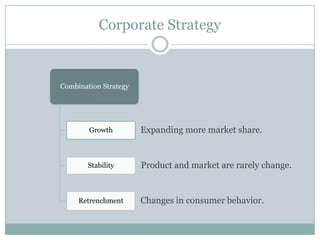
Corporate Strategy
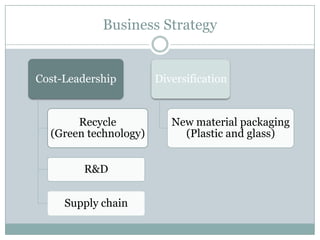
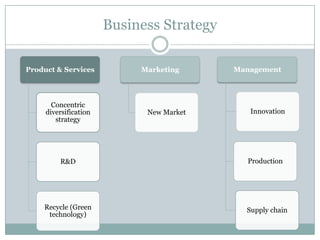
Business Strategy
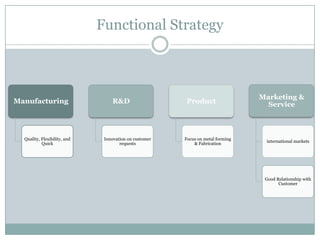
Functional Strategy
Crown Cork & Seal in 1989
Background
Industry Structure
Crown Cork & market share
Seal
Ball Corporation
5%
5%
Renolds Metals
5%
Centinental Can
13%

American
National
44%

Other
28%

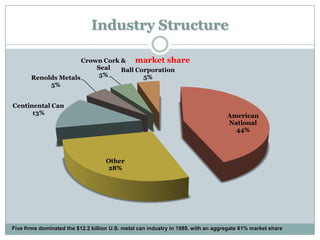
Five firms dominated the $12.2 billion U.S. metal can industry in 1989, with an aggregate 61% market share
Price
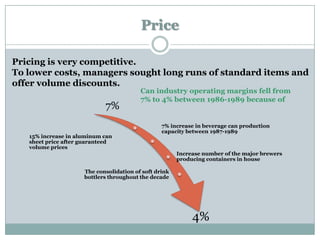
Pricing is very competitive.
To lower costs, managers sought long runs of standard items and
offer volume discounts.

7%
15% increase in aluminum can
sheet price after guaranteed
volume prices

Can industry operating margins fell from
7% to 4% between 1986-1989 because of

7% increase in beverage can production
capacity between 1987-1989

Increase number of the major brewers
producing containers in house
The consolidation of soft drink
bottlers throughout the decade

4%
Customers
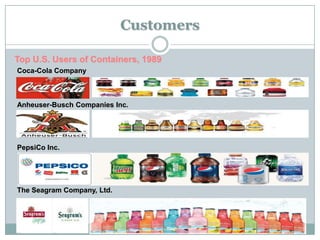
Top U.S. Users of Containers, 1989
Coca-Cola Company

Anheuser-Busch Companies Inc.

PepsiCo Inc.

The Seagram Company, Ltd.
Distribution
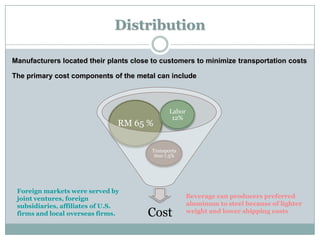
Manufacturers located their plants close to customers to minimize transportation costs

The primary cost components of the metal can include

RM 65 %

Labor
12%

Transporta
tion 7.5%

Foreign markets were served by
joint ventures, foreign
subsidiaries, affiliates of U.S.
firms and local overseas firms.

Cost

Beverage can producers preferred
aluminum to steel because of lighter
weight and lower shipping costs
Manufacturing

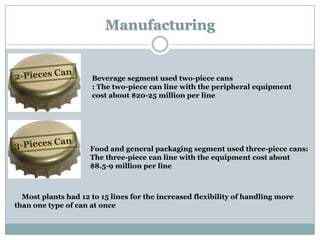
Beverage segment used two-piece cans
: The two-piece can line with the peripheral equipment
cost about $20-25 million per line

Food and general packaging segment used three-piece cans:
The three-piece can line with the equipment cost about
$8.5-9 million per line

Most plants had 12 to 15 lines for the increased flexibility of handling more
than one type of can at once
Suppliers
In 1970, steel accounted for 88% of metal cans, but dropped to 29% in 1989
Being lighter, more consistent quality and more economical to recycle, by 1989
aluminum accounted for 99% of the beer and 94% of the soft drink metal can

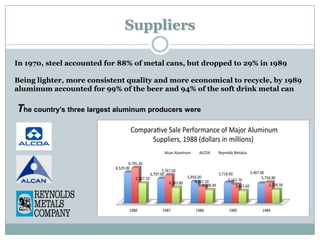
The country’s three largest aluminum producers were
Compara ve Sale Performance of Major Aluminum
Suppliers, 1988 (dollars in millions)
Alcan Aluminum
9,795.30
8,529.00
5,567.10

7,767.00
6,797.00
4,283.80

1988

1987

ALCOA

5,956.00
4,667.20
3,638.90

1986

Reynolds Metalsa

5,467.00
5,718.00
5,750.80
5,162.70
3,728.30
3,415.60

1985

1984
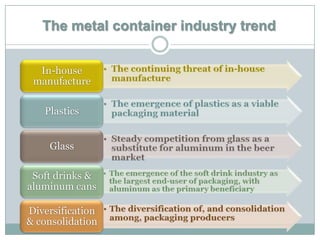
The metal container industry trend
In-house
manufacture

Plastics
Glass
Soft drinks &
aluminum cans

Diversification
& consolidation
In-house
manufacture
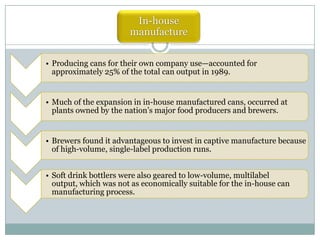
• Producing cans for their own company use—accounted for
approximately 25% of the total can output in 1989.

• Much of the expansion in in-house manufactured cans, occurred at
plants owned by the nation’s major food producers and brewers.

• Brewers found it advantageous to invest in captive manufacture because
of high-volume, single-label production runs.
• Soft drink bottlers were also geared to low-volume, multilabel
output, which was not as economically suitable for the in-house can
manufacturing process.
Plastics
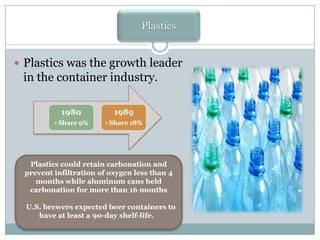
 Plastics was the growth leader

in the container industry.
1980

1989

• Share 9%

• Share 18%

Plastics could retain carbonation and
prevent infiltration of oxygen less than 4
months while aluminum cans held
carbonation for more than 16 months
U.S. brewers expected beer containers to
have at least a 90-day shelf-life.
Glass
Glass
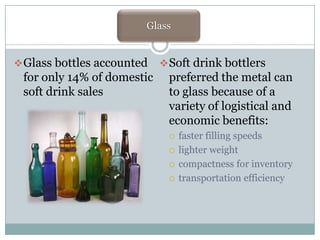
 Glass bottles accounted

for only 14% of domestic
soft drink sales

 Soft drink bottlers

preferred the metal can
to glass because of a
variety of logistical and
economic benefits:





faster filling speeds
lighter weight
compactness for inventory
transportation efficiency
Soft drinks &
aluminum cans
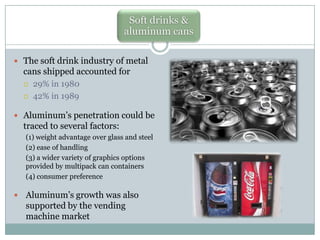
 The soft drink industry of metal

cans shipped accounted for



29% in 1980
42% in 1989

 Aluminum’s penetration could be

traced to several factors:
(1) weight advantage over glass and steel
(2) ease of handling
(3) a wider variety of graphics options
provided by multipack can containers
(4) consumer preference



Aluminum’s growth was also
supported by the vending
machine market
Diversification
& consolidation
Low profit margins, excess capacity, and rising material
and labor costs prompted a number of corporate diversifications and
subsequent consolidations throughout the 1970s and 1980s.
For example, American Can reduced its dependence on domestic
can manufacturing, moving into totally unrelated fields, such as
insurance.
Major Competitors
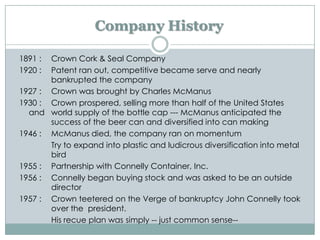
Company History
1891 :
1920 :

Crown Cork & Seal Company
Patent ran out, competitive became serve and nearly
bankrupted the company
1927 : Crown was brought by Charles McManus
1930 : Crown prospered, selling more than half of the United States
and world supply of the bottle cap --- McManus anticipated the
success of the beer can and diversified into can making
1946 : McManus died, the company ran on momentum
Try to expand into plastic and ludicrous diversification into metal
bird
1955 : Partnership with Connelly Container, Inc.
1956 : Connelly began buying stock and was asked to be an outside
director
1957 : Crown teetered on the Verge of bankruptcy John Connelly took
over the president.
His recue plan was simply -- just common sense--
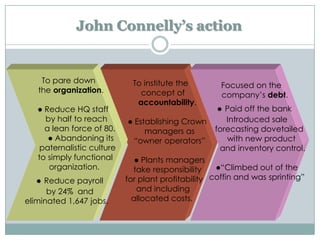
John Connelly’s action

To pare down
the organization.
Reduce HQ staff
by half to reach
a lean force of 80.
 Abandoning its
paternalistic culture
to simply functional
organization.

To institute the
concept of
accountability.



Reduce payroll
by 24% and
eliminated 1,647 jobs.




Establishing Crown
managers as
“owner operators”

Focused on the
company’s debt.
Paid off the bank
Introduced sale
forecasting dovetailed
with new product
and inventory control.


Plants managers
“Climbed out of the
take responsibility
for plant profitability coffin and was sprinting”
and including
allocated costs.

Connelly’s Strategy


Research and Development (R&D)
Crown’s technology strategy focused on enhancing the existing product line. We
do have tremendous skills in die forming and metal fabrication.



Marketing and customer service
Crown’s manufacturing emphasis on flexibility and quick response to customer’s
needs supported its marketing emphasis on putting the customer first.



Financing
Connelly then steadily reduced the debt/equity ratio from 42% in 1956 to 18.2% in
1976 and 5% in 1986.



International
Between 1955 and 1960, Crown received what were called “pioneer rights” from
many foreign governments aiming to build up the industrial sectors of their countries.



Performance
Connelly’s strategy met with substantial success throughout his tenure at Crown.
Avery’s Challenge

 Growing opportunities in plastic closures and

glass containers.

 Acquisition of Continental Can Canada

(CCC)
Problem statement
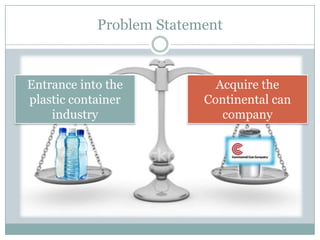
Problem Statement

Entrance into the
plastic container
industry

Acquire the
Continental can
company
Recommendation
Recommendation
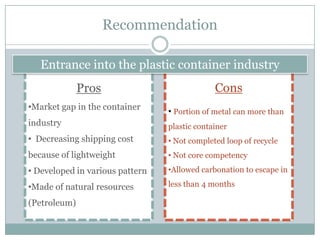
Entrance into the plastic container industry
Pros
•Market gap in the container

Cons
• Portion of metal can more than

industry

plastic container

• Decreasing shipping cost

• Not completed loop of recycle

because of lightweight

• Not core competency

• Developed in various pattern

•Allowed carbonation to escape in

•Made of natural resources

less than 4 months

(Petroleum)
Recommendation
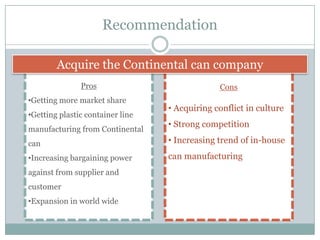
Acquire the Continental can company
Pros
•Getting more market share

•Getting plastic container line
manufacturing from Continental

Cons

• Acquiring conflict in culture
• Strong competition

can

• Increasing trend of in-house

•Increasing bargaining power

can manufacturing

against from supplier and
customer
•Expansion in world wide
Analysis & Strategy
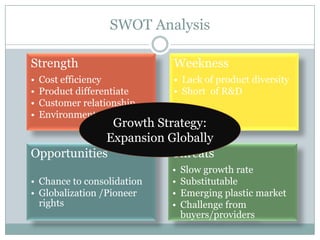
SWOT Analysis
Strength

Weekness

•
•
•
•

• Lack of product diversity
• Short of R&D

Cost efficiency
Product differentiate
Customer relationship
Environmental care

Growth Strategy:
Expansion Globally
Opportunities
Threats
• Chance to consolidation
• Globalization /Pioneer
rights

•
•
•
•

Slow growth rate
Substitutable
Emerging plastic market
Challenge from
buyers/providers
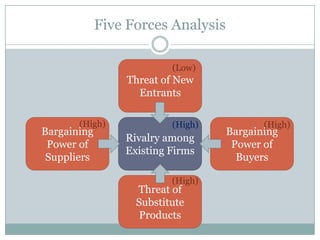
Five Forces Analysis
(Low)

Threat of New
Entrants
(High)

Bargaining
Power of
Suppliers

(High)

Rivalry among
Existing Firms
(High)

Threat of
Substitute
Products

(High)

Bargaining
Power of
Buyers
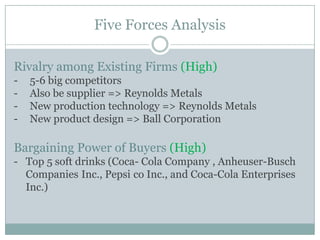
Five Forces Analysis
Rivalry among Existing Firms (High)
-

5-6 big competitors
Also be supplier => Reynolds Metals
New production technology => Reynolds Metals
New product design => Ball Corporation

Bargaining Power of Buyers (High)
- Top 5 soft drinks (Coca- Cola Company , Anheuser-Busch
Companies Inc., Pepsi co Inc., and Coca-Cola Enterprises
Inc.)
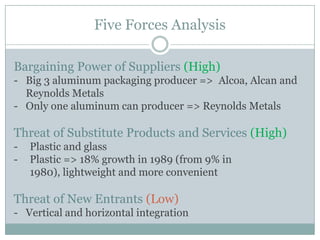
Five Forces Analysis
Bargaining Power of Suppliers (High)
- Big 3 aluminum packaging producer => Alcoa, Alcan and
Reynolds Metals
- Only one aluminum can producer => Reynolds Metals

Threat of Substitute Products and Services (High)
-

Plastic and glass
Plastic => 18% growth in 1989 (from 9% in
1980), lightweight and more convenient

Threat of New Entrants (Low)
- Vertical and horizontal integration
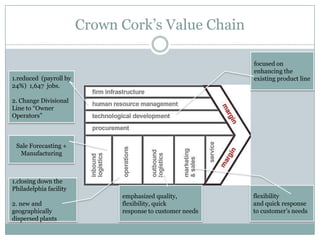
Crown Cork’s Value Chain
focused on
enhancing the
existing product line

1.reduced (payroll by
24%) 1,647 jobs.
2. Change Divisional
Line to “Owner
Operators”

Sale Forecasting +
Manufacturing

1.closing down the
Philadelphia facility

2. new and
geographically
dispersed plants

emphasized quality,
flexibility, quick
response to customer needs

flexibility
and quick response
to customer’s needs
Corporate Strategy

Combination Strategy

Growth

Expanding more market share.

Stability

Product and market are rarely change.

Retrenchment

Changes in consumer behavior.
Business Strategy

Cost-Leadership

Recycle
(Green technology)
R&D
Supply chain

Diversification

New material packaging
(Plastic and glass)
Business Strategy
Product & Services

Concentric
diversification
strategy

Marketing

New Market

Management

Innovation

R&D

Production

Recycle (Green
technology)

Supply chain
Functional Strategy

Manufacturing

Quality, Flexibility, and
Quick

R&D

Innovation on customer
requests

Product

Focus on metal forming
& Fabrication

Marketing &
Service

international markets

Good Relationship with
Customer

Crown Cork & Seal in 1989

  • 1.
    Crown Cork &Seal in 1989 MGMG555 Competitive Strategy and Industry Structure Instructor: Sarayuth Saengchan, Ph.D. College of Management, Mahidol University Trimester: 3/2013 Date: 01/02/2014
  • 2.
  • 3.
    Agenda  Crown Cork& Seal in 1989 Background  Problem Statement  Recommendation  Analysis    SWOT Analysis Five forces Value chain  Strategy    Corporate Strategy Business Strategy Functional Strategy
  • 4.
    Crown Cork &Seal in 1989 Background
  • 5.
    Industry Structure Crown Cork& market share Seal Ball Corporation 5% 5% Renolds Metals 5% Centinental Can 13% American National 44% Other 28% Five firms dominated the $12.2 billion U.S. metal can industry in 1989, with an aggregate 61% market share
  • 6.
    Price Pricing is verycompetitive. To lower costs, managers sought long runs of standard items and offer volume discounts. 7% 15% increase in aluminum can sheet price after guaranteed volume prices Can industry operating margins fell from 7% to 4% between 1986-1989 because of 7% increase in beverage can production capacity between 1987-1989 Increase number of the major brewers producing containers in house The consolidation of soft drink bottlers throughout the decade 4%
  • 7.
    Customers Top U.S. Usersof Containers, 1989 Coca-Cola Company Anheuser-Busch Companies Inc. PepsiCo Inc. The Seagram Company, Ltd.
  • 8.
    Distribution Manufacturers located theirplants close to customers to minimize transportation costs The primary cost components of the metal can include RM 65 % Labor 12% Transporta tion 7.5% Foreign markets were served by joint ventures, foreign subsidiaries, affiliates of U.S. firms and local overseas firms. Cost Beverage can producers preferred aluminum to steel because of lighter weight and lower shipping costs
  • 9.
    Manufacturing Beverage segment usedtwo-piece cans : The two-piece can line with the peripheral equipment cost about $20-25 million per line Food and general packaging segment used three-piece cans: The three-piece can line with the equipment cost about $8.5-9 million per line Most plants had 12 to 15 lines for the increased flexibility of handling more than one type of can at once
  • 10.
    Suppliers In 1970, steelaccounted for 88% of metal cans, but dropped to 29% in 1989 Being lighter, more consistent quality and more economical to recycle, by 1989 aluminum accounted for 99% of the beer and 94% of the soft drink metal can The country’s three largest aluminum producers were Compara ve Sale Performance of Major Aluminum Suppliers, 1988 (dollars in millions) Alcan Aluminum 9,795.30 8,529.00 5,567.10 7,767.00 6,797.00 4,283.80 1988 1987 ALCOA 5,956.00 4,667.20 3,638.90 1986 Reynolds Metalsa 5,467.00 5,718.00 5,750.80 5,162.70 3,728.30 3,415.60 1985 1984
  • 11.
    The metal containerindustry trend In-house manufacture Plastics Glass Soft drinks & aluminum cans Diversification & consolidation
  • 12.
    In-house manufacture • Producing cansfor their own company use—accounted for approximately 25% of the total can output in 1989. • Much of the expansion in in-house manufactured cans, occurred at plants owned by the nation’s major food producers and brewers. • Brewers found it advantageous to invest in captive manufacture because of high-volume, single-label production runs. • Soft drink bottlers were also geared to low-volume, multilabel output, which was not as economically suitable for the in-house can manufacturing process.
  • 13.
    Plastics  Plastics wasthe growth leader in the container industry. 1980 1989 • Share 9% • Share 18% Plastics could retain carbonation and prevent infiltration of oxygen less than 4 months while aluminum cans held carbonation for more than 16 months U.S. brewers expected beer containers to have at least a 90-day shelf-life.
  • 14.
    Glass Glass  Glass bottlesaccounted for only 14% of domestic soft drink sales  Soft drink bottlers preferred the metal can to glass because of a variety of logistical and economic benefits:     faster filling speeds lighter weight compactness for inventory transportation efficiency
  • 15.
    Soft drinks & aluminumcans  The soft drink industry of metal cans shipped accounted for   29% in 1980 42% in 1989  Aluminum’s penetration could be traced to several factors: (1) weight advantage over glass and steel (2) ease of handling (3) a wider variety of graphics options provided by multipack can containers (4) consumer preference  Aluminum’s growth was also supported by the vending machine market
  • 16.
    Diversification & consolidation Low profitmargins, excess capacity, and rising material and labor costs prompted a number of corporate diversifications and subsequent consolidations throughout the 1970s and 1980s. For example, American Can reduced its dependence on domestic can manufacturing, moving into totally unrelated fields, such as insurance.
  • 17.
  • 18.
    Company History 1891 : 1920: Crown Cork & Seal Company Patent ran out, competitive became serve and nearly bankrupted the company 1927 : Crown was brought by Charles McManus 1930 : Crown prospered, selling more than half of the United States and world supply of the bottle cap --- McManus anticipated the success of the beer can and diversified into can making 1946 : McManus died, the company ran on momentum Try to expand into plastic and ludicrous diversification into metal bird 1955 : Partnership with Connelly Container, Inc. 1956 : Connelly began buying stock and was asked to be an outside director 1957 : Crown teetered on the Verge of bankruptcy John Connelly took over the president. His recue plan was simply -- just common sense--
  • 19.
    John Connelly’s action Topare down the organization. Reduce HQ staff by half to reach a lean force of 80.  Abandoning its paternalistic culture to simply functional organization. To institute the concept of accountability.  Reduce payroll by 24% and eliminated 1,647 jobs.   Establishing Crown managers as “owner operators” Focused on the company’s debt. Paid off the bank Introduced sale forecasting dovetailed with new product and inventory control.  Plants managers “Climbed out of the take responsibility for plant profitability coffin and was sprinting” and including allocated costs. 
  • 20.
    Connelly’s Strategy  Research andDevelopment (R&D) Crown’s technology strategy focused on enhancing the existing product line. We do have tremendous skills in die forming and metal fabrication.  Marketing and customer service Crown’s manufacturing emphasis on flexibility and quick response to customer’s needs supported its marketing emphasis on putting the customer first.  Financing Connelly then steadily reduced the debt/equity ratio from 42% in 1956 to 18.2% in 1976 and 5% in 1986.  International Between 1955 and 1960, Crown received what were called “pioneer rights” from many foreign governments aiming to build up the industrial sectors of their countries.  Performance Connelly’s strategy met with substantial success throughout his tenure at Crown.
  • 21.
    Avery’s Challenge  Growingopportunities in plastic closures and glass containers.  Acquisition of Continental Can Canada (CCC)
  • 22.
  • 23.
    Problem Statement Entrance intothe plastic container industry Acquire the Continental can company
  • 24.
  • 25.
    Recommendation Entrance into theplastic container industry Pros •Market gap in the container Cons • Portion of metal can more than industry plastic container • Decreasing shipping cost • Not completed loop of recycle because of lightweight • Not core competency • Developed in various pattern •Allowed carbonation to escape in •Made of natural resources less than 4 months (Petroleum)
  • 26.
    Recommendation Acquire the Continentalcan company Pros •Getting more market share •Getting plastic container line manufacturing from Continental Cons • Acquiring conflict in culture • Strong competition can • Increasing trend of in-house •Increasing bargaining power can manufacturing against from supplier and customer •Expansion in world wide
  • 27.
  • 28.
    SWOT Analysis Strength Weekness • • • • • Lackof product diversity • Short of R&D Cost efficiency Product differentiate Customer relationship Environmental care Growth Strategy: Expansion Globally Opportunities Threats • Chance to consolidation • Globalization /Pioneer rights • • • • Slow growth rate Substitutable Emerging plastic market Challenge from buyers/providers
  • 29.
    Five Forces Analysis (Low) Threatof New Entrants (High) Bargaining Power of Suppliers (High) Rivalry among Existing Firms (High) Threat of Substitute Products (High) Bargaining Power of Buyers
  • 30.
    Five Forces Analysis Rivalryamong Existing Firms (High) - 5-6 big competitors Also be supplier => Reynolds Metals New production technology => Reynolds Metals New product design => Ball Corporation Bargaining Power of Buyers (High) - Top 5 soft drinks (Coca- Cola Company , Anheuser-Busch Companies Inc., Pepsi co Inc., and Coca-Cola Enterprises Inc.)
  • 31.
    Five Forces Analysis BargainingPower of Suppliers (High) - Big 3 aluminum packaging producer => Alcoa, Alcan and Reynolds Metals - Only one aluminum can producer => Reynolds Metals Threat of Substitute Products and Services (High) - Plastic and glass Plastic => 18% growth in 1989 (from 9% in 1980), lightweight and more convenient Threat of New Entrants (Low) - Vertical and horizontal integration
  • 32.
    Crown Cork’s ValueChain focused on enhancing the existing product line 1.reduced (payroll by 24%) 1,647 jobs. 2. Change Divisional Line to “Owner Operators” Sale Forecasting + Manufacturing 1.closing down the Philadelphia facility 2. new and geographically dispersed plants emphasized quality, flexibility, quick response to customer needs flexibility and quick response to customer’s needs
  • 33.
    Corporate Strategy Combination Strategy Growth Expandingmore market share. Stability Product and market are rarely change. Retrenchment Changes in consumer behavior.
  • 34.
    Business Strategy Cost-Leadership Recycle (Green technology) R&D Supplychain Diversification New material packaging (Plastic and glass)
  • 35.
    Business Strategy Product &Services Concentric diversification strategy Marketing New Market Management Innovation R&D Production Recycle (Green technology) Supply chain
  • 36.
    Functional Strategy Manufacturing Quality, Flexibility,and Quick R&D Innovation on customer requests Product Focus on metal forming & Fabrication Marketing & Service international markets Good Relationship with Customer