CASE STUDY
By E Santhosh Kumar, IIT Madras
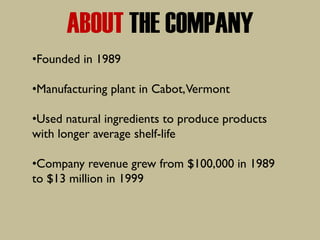
ABOUT THE COMPANY
•Founded in 1989
•Manufacturing plant in Cabot,Vermont
•Used natural ingredients to produce products
with longer average shelf-life
•Company revenue grew from $100,000 in 1989
to $13 million in 1999
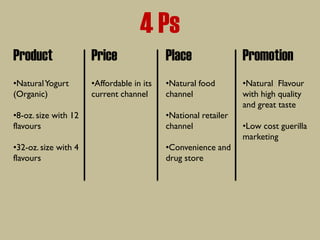
4 Ps
Product
•NaturalYogurt
(Organic)
•8-oz. size with 12
flavours
•32-oz. size with 4
flavours
Price
•Affordable in its
current channel
Place
•Natural food
channel
•National retailer
channel
•Convenience and
drug store
Promotion
•Natural Flavour
with high quality
and great taste
•Low cost guerilla
marketing
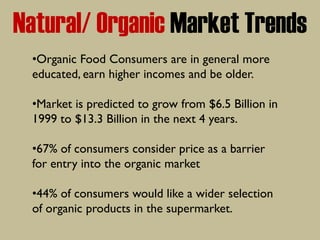
Natural/ Organic Market Trends
•Organic Food Consumers are in general more
educated, earn higher incomes and be older.
•Market is predicted to grow from $6.5 Billion in
1999 to $13.3 Billion in the next 4 years.
•67% of consumers consider price as a barrier
for entry into the organic market
•44% of consumers would like a wider selection
of organic products in the supermarket.
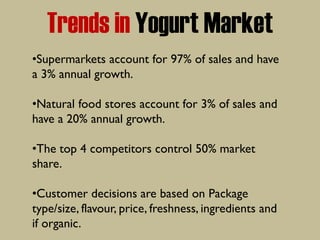
Trends in Yogurt Market
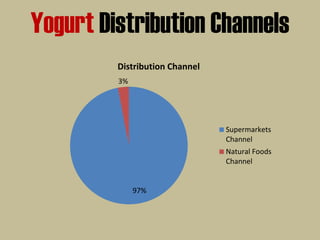
•Supermarkets account for 97% of sales and have
a 3% annual growth.
•Natural food stores account for 3% of sales and
have a 20% annual growth.
•The top 4 competitors control 50% market
share.
•Customer decisions are based on Package
type/size, flavour, price, freshness, ingredients and
if organic.
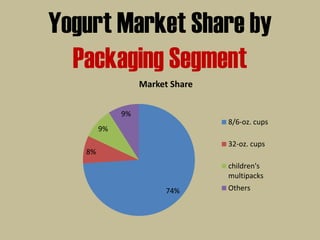
Yogurt Market Share by
Packaging Segment
74%
8%
9%
9%
Market Share
8/6-oz. cups
32-oz. cups
children's
multipacks
Others
Yogurt Distribution Channels
97%
3%
Distribution Channel
Supermarkets
Channel
Natural Foods
Channel
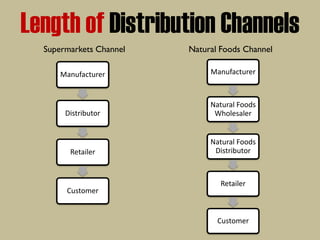
Length of Distribution Channels
Manufacturer
Distributor
Retailer
Customer
Manufacturer
Natural Foods
Wholesaler
Natural Foods
Distributor
Retailer
Customer
Supermarkets Channel Natural Foods Channel
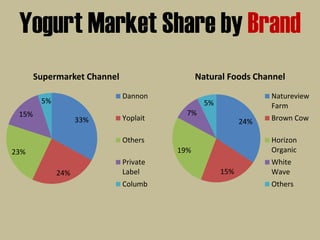
Yogurt Market Share by Brand
33%
24%
23%
15%
5%
Supermarket Channel
Dannon
Yoplait
Others
Private
Label
Columb
24%
15%
19%
7%
5%
Natural Foods Channel
Natureview
Farm
Brown Cow
Horizon
Organic
White
Wave
Others
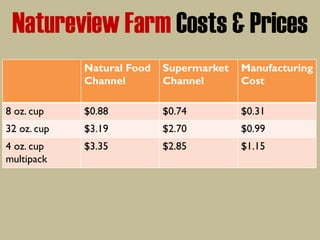
Natureview Farm Costs & Prices
Natural Food
Channel
Supermarket
Channel
Manufacturing
Cost
8 oz. cup $0.88 $0.74 $0.31
32 oz. cup $3.19 $2.70 $0.99
4 oz. cup
multipack
$3.35 $2.85 $1.15
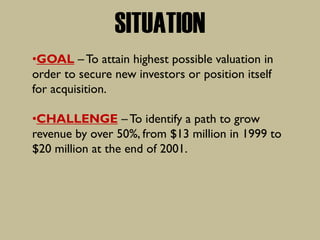
SITUATION
•GOAL – To attain highest possible valuation in
order to secure new investors or position itself
for acquisition.
•CHALLENGE – To identify a path to grow
revenue by over 50%, from $13 million in 1999 to
$20 million at the end of 2001.
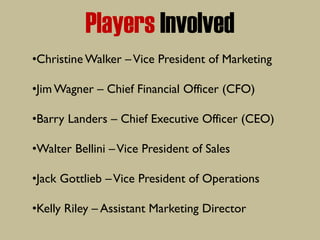
Players Involved
•Christine Walker –Vice President of Marketing
•Jim Wagner – Chief Financial Officer (CFO)
•Barry Landers – Chief Executive Officer (CEO)
•Walter Bellini –Vice President of Sales
•Jack Gottlieb –Vice President of Operations
•Kelly Riley – Assistant Marketing Director
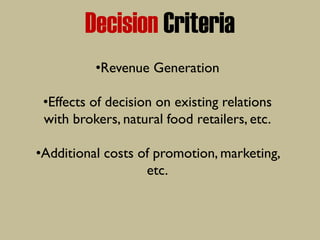
Decision Criteria
•Revenue Generation
•Effects of decision on existing relations
with brokers, natural food retailers, etc.
•Additional costs of promotion, marketing,
etc.
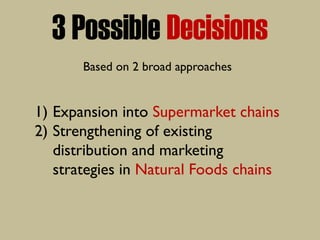
3 Possible Decisions
Based on 2 broad approaches
1) Expansion into Supermarket chains
2) Strengthening of existing
distribution and marketing
strategies in Natural Foods chains
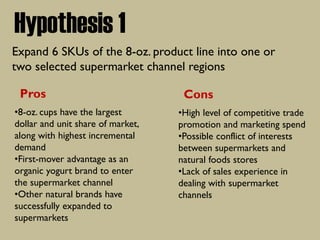
Hypothesis 1
Expand 6 SKUs of the 8-oz. product line into one or
two selected supermarket channel regions
•8-oz. cups have the largest
dollar and unit share of market,
along with highest incremental
demand
•First-mover advantage as an
organic yogurt brand to enter
the supermarket channel
•Other natural brands have
successfully expanded to
supermarkets
Pros
•High level of competitive trade
promotion and marketing spend
•Possible conflict of interests
between supermarkets and
natural foods stores
•Lack of sales experience in
dealing with supermarket
channels
Cons
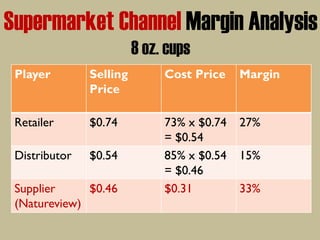
Supermarket Channel Margin Analysis
8 oz. cups
Player Selling
Price
Cost Price Margin
Retailer $0.74 73% x $0.74
= $0.54
27%
Distributor $0.54 85% x $0.54
= $0.46
15%
Supplier
(Natureview)
$0.46 $0.31 33%
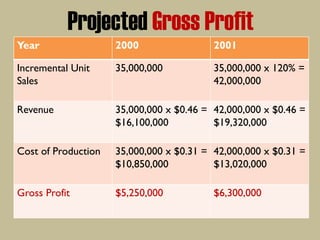
Projected Gross Profit
Year 2000 2001
Incremental Unit
Sales
35,000,000 35,000,000 x 120% =
42,000,000
Revenue 35,000,000 x $0.46 =
$16,100,000
42,000,000 x $0.46 =
$19,320,000
Cost of Production 35,000,000 x $0.31 =
$10,850,000
42,000,000 x $0.31 =
$13,020,000
Gross Profit $5,250,000 $6,300,000
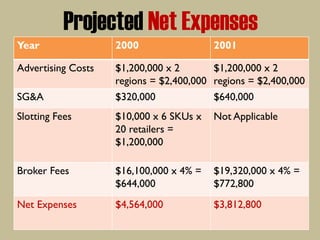
Projected Net Expenses
Year 2000 2001
Advertising Costs $1,200,000 x 2
regions = $2,400,000
$1,200,000 x 2
regions = $2,400,000
SG&A $320,000 $640,000
Slotting Fees $10,000 x 6 SKUs x
20 retailers =
$1,200,000
Not Applicable
Broker Fees $16,100,000 x 4% =
$644,000
$19,320,000 x 4% =
$772,800
Net Expenses $4,564,000 $3,812,800
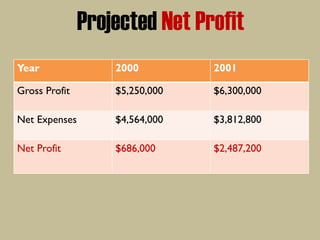
Projected Net Profit
Year 2000 2001
Gross Profit $5,250,000 $6,300,000
Net Expenses $4,564,000 $3,812,800
Net Profit $686,000 $2,487,200
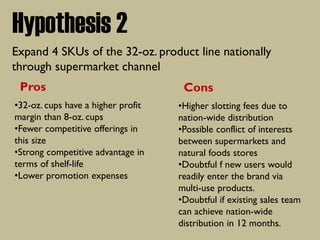
Hypothesis 2
Expand 4 SKUs of the 32-oz. product line nationally
through supermarket channel
•32-oz. cups have a higher profit
margin than 8-oz. cups
•Fewer competitive offerings in
this size
•Strong competitive advantage in
terms of shelf-life
•Lower promotion expenses
Pros
•Higher slotting fees due to
nation-wide distribution
•Possible conflict of interests
between supermarkets and
natural foods stores
•Doubtful f new users would
readily enter the brand via
multi-use products.
•Doubtful if existing sales team
can achieve nation-wide
distribution in 12 months.
Cons
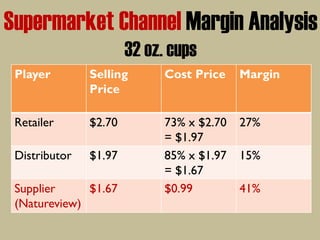
Supermarket Channel Margin Analysis
32 oz. cups
Player Selling
Price
Cost Price Margin
Retailer $2.70 73% x $2.70
= $1.97
27%
Distributor $1.97 85% x $1.97
= $1.67
15%
Supplier
(Natureview)
$1.67 $0.99 41%
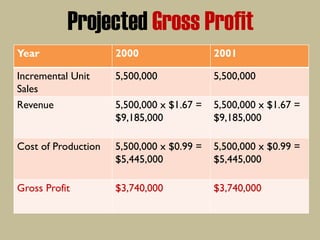
Projected Gross Profit
Year 2000 2001
Incremental Unit
Sales
5,500,000 5,500,000
Revenue 5,500,000 x $1.67 =
$9,185,000
5,500,000 x $1.67 =
$9,185,000
Cost of Production 5,500,000 x $0.99 =
$5,445,000
5,500,000 x $0.99 =
$5,445,000
Gross Profit $3,740,000 $3,740,000
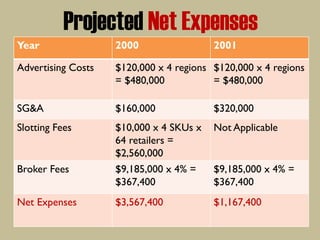
Projected Net Expenses
Year 2000 2001
Advertising Costs $120,000 x 4 regions
= $480,000
$120,000 x 4 regions
= $480,000
SG&A $160,000 $320,000
Slotting Fees $10,000 x 4 SKUs x
64 retailers =
$2,560,000
Not Applicable
Broker Fees $9,185,000 x 4% =
$367,400
$9,185,000 x 4% =
$367,400
Net Expenses $3,567,400 $1,167,400
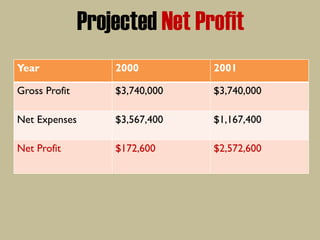
Projected Net Profit
Year 2000 2001
Gross Profit $3,740,000 $3,740,000
Net Expenses $3,567,400 $1,167,400
Net Profit $172,600 $2,572,600
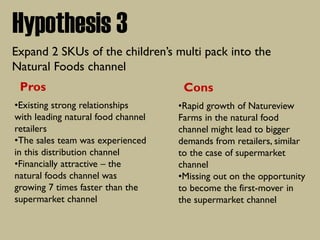
Hypothesis 3
Expand 2 SKUs of the children’s multi pack into the
Natural Foods channel
•Existing strong relationships
with leading natural food channel
retailers
•The sales team was experienced
in this distribution channel
•Financially attractive – the
natural foods channel was
growing 7 times faster than the
supermarket channel
Pros
•Rapid growth of Natureview
Farms in the natural food
channel might lead to bigger
demands from retailers, similar
to the case of supermarket
channel
•Missing out on the opportunity
to become the first-mover in
the supermarket channel
Cons
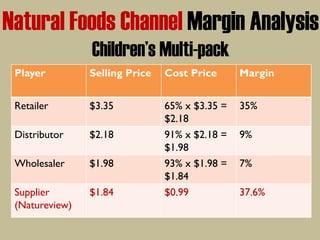
Natural Foods Channel Margin Analysis
Children’s Multi-pack
Player Selling Price Cost Price Margin
Retailer $3.35 65% x $3.35 =
$2.18
35%
Distributor $2.18 91% x $2.18 =
$1.98
9%
Wholesaler $1.98 93% x $1.98 =
$1.84
7%
Supplier
(Natureview)
$1.84 $0.99 37.6%
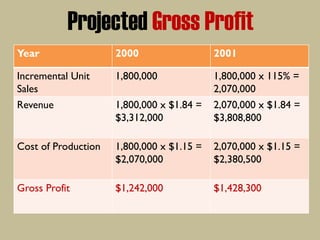
Projected Gross Profit
Year 2000 2001
Incremental Unit
Sales
1,800,000 1,800,000 x 115% =
2,070,000
Revenue 1,800,000 x $1.84 =
$3,312,000
2,070,000 x $1.84 =
$3,808,800
Cost of Production 1,800,000 x $1.15 =
$2,070,000
2,070,000 x $1.15 =
$2,380,500
Gross Profit $1,242,000 $1,428,300
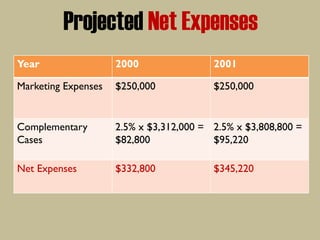
Projected Net Expenses
Year 2000 2001
Marketing Expenses $250,000 $250,000
Complementary
Cases
2.5% x $3,312,000 =
$82,800
2.5% x $3,808,800 =
$95,220
Net Expenses $332,800 $345,220
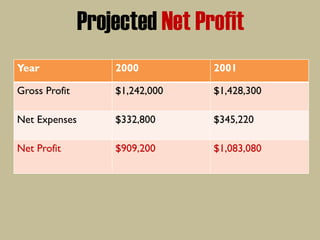
Projected Net Profit
Year 2000 2001
Gross Profit $1,242,000 $1,428,300
Net Expenses $332,800 $345,220
Net Profit $909,200 $1,083,080
Recommended Solution
Option 1 should be pursued for the following reasons
•Returns the highest expected increase in revenue among the
three options. Total revenue by 2001 is $32,320,000 , which
is well above the target $20 million
•First-mover advantage of organic yogurt manufacturer to
the supermarket channel.
•Exposure to a larger range of customers
•8 oz. yogurt cups have the maximum demand
•Short-term risk is compensated by large long-term revenue
increase
THANK
You
DISCLAIMER
Created by E. Santhosh Kumar, IIT Madras, during a
Marketing Internship by Prof. Sameer Mathur, IIM
Lucknow
Prof. Sameer Mathur, IIM LucknowE. Santhosh Kumar, IIT Madras

Natureview Farm - Harvard Case Study

  • 1.
    CASE STUDY By ESanthosh Kumar, IIT Madras
  • 2.
    ABOUT THE COMPANY •Foundedin 1989 •Manufacturing plant in Cabot,Vermont •Used natural ingredients to produce products with longer average shelf-life •Company revenue grew from $100,000 in 1989 to $13 million in 1999
  • 3.
    4 Ps Product •NaturalYogurt (Organic) •8-oz. sizewith 12 flavours •32-oz. size with 4 flavours Price •Affordable in its current channel Place •Natural food channel •National retailer channel •Convenience and drug store Promotion •Natural Flavour with high quality and great taste •Low cost guerilla marketing
  • 4.
    Natural/ Organic MarketTrends •Organic Food Consumers are in general more educated, earn higher incomes and be older. •Market is predicted to grow from $6.5 Billion in 1999 to $13.3 Billion in the next 4 years. •67% of consumers consider price as a barrier for entry into the organic market •44% of consumers would like a wider selection of organic products in the supermarket.
  • 5.
    Trends in YogurtMarket •Supermarkets account for 97% of sales and have a 3% annual growth. •Natural food stores account for 3% of sales and have a 20% annual growth. •The top 4 competitors control 50% market share. •Customer decisions are based on Package type/size, flavour, price, freshness, ingredients and if organic.
  • 6.
    Yogurt Market Shareby Packaging Segment 74% 8% 9% 9% Market Share 8/6-oz. cups 32-oz. cups children's multipacks Others
  • 7.
    Yogurt Distribution Channels 97% 3% DistributionChannel Supermarkets Channel Natural Foods Channel
  • 8.
    Length of DistributionChannels Manufacturer Distributor Retailer Customer Manufacturer Natural Foods Wholesaler Natural Foods Distributor Retailer Customer Supermarkets Channel Natural Foods Channel
  • 9.
    Yogurt Market Shareby Brand 33% 24% 23% 15% 5% Supermarket Channel Dannon Yoplait Others Private Label Columb 24% 15% 19% 7% 5% Natural Foods Channel Natureview Farm Brown Cow Horizon Organic White Wave Others
  • 10.
    Natureview Farm Costs& Prices Natural Food Channel Supermarket Channel Manufacturing Cost 8 oz. cup $0.88 $0.74 $0.31 32 oz. cup $3.19 $2.70 $0.99 4 oz. cup multipack $3.35 $2.85 $1.15
  • 11.
    SITUATION •GOAL – Toattain highest possible valuation in order to secure new investors or position itself for acquisition. •CHALLENGE – To identify a path to grow revenue by over 50%, from $13 million in 1999 to $20 million at the end of 2001.
  • 12.
    Players Involved •Christine Walker–Vice President of Marketing •Jim Wagner – Chief Financial Officer (CFO) •Barry Landers – Chief Executive Officer (CEO) •Walter Bellini –Vice President of Sales •Jack Gottlieb –Vice President of Operations •Kelly Riley – Assistant Marketing Director
  • 13.
    Decision Criteria •Revenue Generation •Effectsof decision on existing relations with brokers, natural food retailers, etc. •Additional costs of promotion, marketing, etc.
  • 14.
    3 Possible Decisions Basedon 2 broad approaches 1) Expansion into Supermarket chains 2) Strengthening of existing distribution and marketing strategies in Natural Foods chains
  • 15.
    Hypothesis 1 Expand 6SKUs of the 8-oz. product line into one or two selected supermarket channel regions •8-oz. cups have the largest dollar and unit share of market, along with highest incremental demand •First-mover advantage as an organic yogurt brand to enter the supermarket channel •Other natural brands have successfully expanded to supermarkets Pros •High level of competitive trade promotion and marketing spend •Possible conflict of interests between supermarkets and natural foods stores •Lack of sales experience in dealing with supermarket channels Cons
  • 16.
    Supermarket Channel MarginAnalysis 8 oz. cups Player Selling Price Cost Price Margin Retailer $0.74 73% x $0.74 = $0.54 27% Distributor $0.54 85% x $0.54 = $0.46 15% Supplier (Natureview) $0.46 $0.31 33%
  • 17.
    Projected Gross Profit Year2000 2001 Incremental Unit Sales 35,000,000 35,000,000 x 120% = 42,000,000 Revenue 35,000,000 x $0.46 = $16,100,000 42,000,000 x $0.46 = $19,320,000 Cost of Production 35,000,000 x $0.31 = $10,850,000 42,000,000 x $0.31 = $13,020,000 Gross Profit $5,250,000 $6,300,000
  • 18.
    Projected Net Expenses Year2000 2001 Advertising Costs $1,200,000 x 2 regions = $2,400,000 $1,200,000 x 2 regions = $2,400,000 SG&A $320,000 $640,000 Slotting Fees $10,000 x 6 SKUs x 20 retailers = $1,200,000 Not Applicable Broker Fees $16,100,000 x 4% = $644,000 $19,320,000 x 4% = $772,800 Net Expenses $4,564,000 $3,812,800
  • 19.
    Projected Net Profit Year2000 2001 Gross Profit $5,250,000 $6,300,000 Net Expenses $4,564,000 $3,812,800 Net Profit $686,000 $2,487,200
  • 20.
    Hypothesis 2 Expand 4SKUs of the 32-oz. product line nationally through supermarket channel •32-oz. cups have a higher profit margin than 8-oz. cups •Fewer competitive offerings in this size •Strong competitive advantage in terms of shelf-life •Lower promotion expenses Pros •Higher slotting fees due to nation-wide distribution •Possible conflict of interests between supermarkets and natural foods stores •Doubtful f new users would readily enter the brand via multi-use products. •Doubtful if existing sales team can achieve nation-wide distribution in 12 months. Cons
  • 21.
    Supermarket Channel MarginAnalysis 32 oz. cups Player Selling Price Cost Price Margin Retailer $2.70 73% x $2.70 = $1.97 27% Distributor $1.97 85% x $1.97 = $1.67 15% Supplier (Natureview) $1.67 $0.99 41%
  • 22.
    Projected Gross Profit Year2000 2001 Incremental Unit Sales 5,500,000 5,500,000 Revenue 5,500,000 x $1.67 = $9,185,000 5,500,000 x $1.67 = $9,185,000 Cost of Production 5,500,000 x $0.99 = $5,445,000 5,500,000 x $0.99 = $5,445,000 Gross Profit $3,740,000 $3,740,000
  • 23.
    Projected Net Expenses Year2000 2001 Advertising Costs $120,000 x 4 regions = $480,000 $120,000 x 4 regions = $480,000 SG&A $160,000 $320,000 Slotting Fees $10,000 x 4 SKUs x 64 retailers = $2,560,000 Not Applicable Broker Fees $9,185,000 x 4% = $367,400 $9,185,000 x 4% = $367,400 Net Expenses $3,567,400 $1,167,400
  • 24.
    Projected Net Profit Year2000 2001 Gross Profit $3,740,000 $3,740,000 Net Expenses $3,567,400 $1,167,400 Net Profit $172,600 $2,572,600
  • 25.
    Hypothesis 3 Expand 2SKUs of the children’s multi pack into the Natural Foods channel •Existing strong relationships with leading natural food channel retailers •The sales team was experienced in this distribution channel •Financially attractive – the natural foods channel was growing 7 times faster than the supermarket channel Pros •Rapid growth of Natureview Farms in the natural food channel might lead to bigger demands from retailers, similar to the case of supermarket channel •Missing out on the opportunity to become the first-mover in the supermarket channel Cons
  • 26.
    Natural Foods ChannelMargin Analysis Children’s Multi-pack Player Selling Price Cost Price Margin Retailer $3.35 65% x $3.35 = $2.18 35% Distributor $2.18 91% x $2.18 = $1.98 9% Wholesaler $1.98 93% x $1.98 = $1.84 7% Supplier (Natureview) $1.84 $0.99 37.6%
  • 27.
    Projected Gross Profit Year2000 2001 Incremental Unit Sales 1,800,000 1,800,000 x 115% = 2,070,000 Revenue 1,800,000 x $1.84 = $3,312,000 2,070,000 x $1.84 = $3,808,800 Cost of Production 1,800,000 x $1.15 = $2,070,000 2,070,000 x $1.15 = $2,380,500 Gross Profit $1,242,000 $1,428,300
  • 28.
    Projected Net Expenses Year2000 2001 Marketing Expenses $250,000 $250,000 Complementary Cases 2.5% x $3,312,000 = $82,800 2.5% x $3,808,800 = $95,220 Net Expenses $332,800 $345,220
  • 29.
    Projected Net Profit Year2000 2001 Gross Profit $1,242,000 $1,428,300 Net Expenses $332,800 $345,220 Net Profit $909,200 $1,083,080
  • 30.
    Recommended Solution Option 1should be pursued for the following reasons •Returns the highest expected increase in revenue among the three options. Total revenue by 2001 is $32,320,000 , which is well above the target $20 million •First-mover advantage of organic yogurt manufacturer to the supermarket channel. •Exposure to a larger range of customers •8 oz. yogurt cups have the maximum demand •Short-term risk is compensated by large long-term revenue increase
  • 31.
  • 32.
    DISCLAIMER Created by E.Santhosh Kumar, IIT Madras, during a Marketing Internship by Prof. Sameer Mathur, IIM Lucknow Prof. Sameer Mathur, IIM LucknowE. Santhosh Kumar, IIT Madras