Global Market Strategies
: Taking a Chinese Company Global
Team Members: Morteza Javadinia
Tor Halvorsrud
Aliasghar Bahoo
Torodi
Nathanael Bruchez
USI
Lecturer: Johannes M Pennigns
Agenda
 Case Overview
 Haier Strategy in Chinese Market
 Haier’s International Expansion Approaches
 6 Frameworks / Tools (Porter, Yip, Dunning, BCG,
PLC, Integration/Responsiveness Grids)
 Discussion
Case Overview
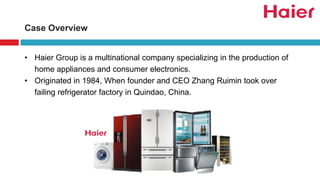
• Haier Group is a multinational company specializing in the production of
home appliances and consumer electronics.
• Originated in 1984, When founder and CEO Zhang Ruimin took over
failing refrigerator factory in Quindao, China.
Case Overview
• Zhang Ruimin took over in 1984, when it was approximately 300 refrigerator factories in china.
• Most of them produced poor quality products.
• Zhang saw this, and therefore went to the other direction : Focusing on high quality products and
service.
• Went into a JV with among others German manufacturer Liebherr which had technical expertize in
refrigerators.
• Had a high focus on becoming a «first class brand» through large scale operations.
• In 1992, After becoming Chinas leading refrigerator manufacturer, Haier Group started to look into
other similar businesses. Acquired companies with poor management and implemented new
manag. With same focus on quality and service.
• Went public in 1993, at the Shanghai stock Exchange.
• 1997, Started to target the rural areas of china.
• At the same time, they started to diversify their product line.
• 2004, became the number one appliance company in China.
• At the same time, experiencing stronger and stronger competition from domestic and multinational
companies who tried to break into the market.
Case Overview
• By 2004, the Haier Group was the largest home appliance maker, holding
approx.. 30% of the white goods market (third globally)
• They were the second-largest refrigerator manufacturer in the world, and
had a growing presence in the black goods market.
• At this stage, with domestic market success, they were considering going
abroad and become a multinational brand.
• But could they do this without loosing their position in china?
Strategy – Chinese
Market
• Between 1989 and 1996, reduction from 100 to 20 refrigerators
producers -> more competitive market.
• China entered the WTO in 2001 -> new competitors, multinationals.
Difficult start for them, for several reasons.
• That said, the multinationals reached 31% of refrigerators market share
in 2002, local companies being losing market share rapidly.
Strategy – Chinese
Market
Haier’s competitive advantages in the Chinese
market
• Haier is known in China for its high quality products ; It has therefore a
very good brand reputation.
• Closer to chinese customers (design, needs) in comparison with
multinationals.
• High investment in R&D (5-7% of revenues) and thus new products every
year, very innovative.
• High market responsiveness, focusing on meeting customers needs ; 42
distribution centers in China operating as sales companies.
Strategy – Chinese
Market
• High level of services, with better after-sales service than competitors ; According
to the customers, one of the biggest advantages of Haier.
• Very good distribution channels/network, with «Haier Logistics» ; Advantage over
multinationals, since establishing a logistics network in China is complicated.
• Staff cheaper than multinational competitors.
• That said -> these strengths in distribution and service networks, and the superior
knowledge of the domestic market may not last forever! They are provisory
advantages, since multinationals have already had some successes, contracting
people who understand the Chinese market, buying sales channels and services
Haier’s competitive advantages in the Chinese
market
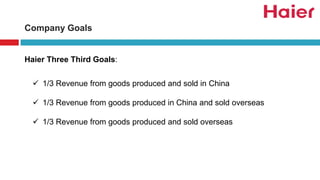
Company Goals
Haier Three Third Goals:
 1/3 Revenue from goods produced and sold in China
 1/3 Revenue from goods produced in China and sold overseas
 1/3 Revenue from goods produced and sold overseas
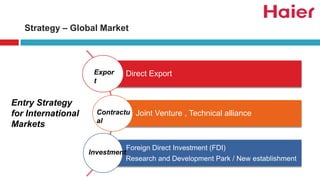
Direct Export
Joint Venture , Technical alliance
Foreign Direct Investment (FDI)
Research and Development Park / New establishment
Expor
t
Contractu
al
Investment
Entry Strategy
for International
Markets
Strategy – Global Market
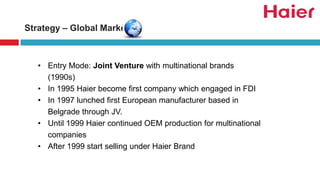
• Entry Mode: Joint Venture with multinational brands
(1990s)
• In 1995 Haier become first company which engaged in FDI
• In 1997 lunched first European manufacturer based in
Belgrade through JV.
• Until 1999 Haier continued OEM production for multinational
companies
• After 1999 start selling under Haier Brand
Strategy – Global Market
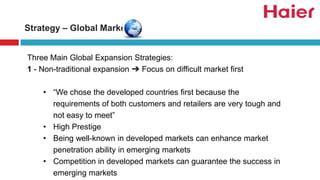
Three Main Global Expansion Strategies:
1 - Non-traditional expansion ➔ Focus on difficult market first
• “We chose the developed countries first because the
requirements of both customers and retailers are very tough and
not easy to meet”
• High Prestige
• Being well-known in developed markets can enhance market
penetration ability in emerging markets
• Competition in developed markets can guarantee the success in
emerging markets
Three Main Global Expansion Strategies:
2 – Begin with niche products
• “When we entered the U.S market, we found that nobody was
making competitive refrigerators for students or for offices.”
• Starting with mini-fridge , compact refrigerators
• “After we were successful in the niche products, then we started
to introduce regular products to the U.S market.”
Strategy – Global Market
Three Main Global Expansion Strategies:
3 – Staff with locals
• When entering a new market “ the first stage is to use the right
people to establish the right structure.”
• Why local staff: Local people know the Local market
Local people have Local thinking to satisfy the
needs of customer
• BUT ➔ Not all the locals are good for our brand.
• Goal ➔ “ Haier in each country be the Haier that they created”
Haier has to be perceived as a local brand.
Strategy – Global Market
Haier International Division: Joint Ventures on 5 continent
• The America
• Europe
• The Middle-East
• South Asia
• East Asia
Why they Succeeded : Focus on customer's need
1) Product Differentiation ➔ Importance of
R&D
2) Response Speed➔ Shortening the new
products production time (From Idea to
Strategy – Global Market
The America:
• 1994 JV with Welbilt
• 1999 Haier America
• Employing American staff
• Establishing industrial park in South Carolina (To build brand reputation ,
being quality oriented)
• Focus on niche which enabled Haier to avoid competition with GE,
Whirlpool and ..Haier Europe:
• 1990 JV with some brands in UK, Germany and France
• 2000 HQ in Varese – Italy
• Employing former sales executives of Italy’s Merloni as a local
experienced staff
• Europe and America were similar in terms of size and degree of
developments
Strategy – Global Market
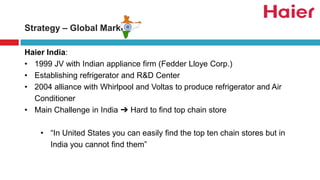
Haier India:
• 1999 JV with Indian appliance firm (Fedder Lloye Corp.)
• Establishing refrigerator and R&D Center
• 2004 alliance with Whirlpool and Voltas to produce refrigerator and Air
Conditioner
• Main Challenge in India ➔ Hard to find top chain store
• “In United States you can easily find the top ten chain stores but in
India you cannot find them”
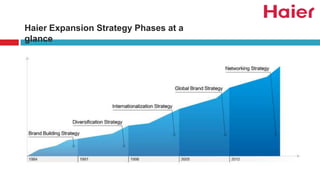
Strategy – Global Market
Haier Expansion Strategy Phases at a
glance
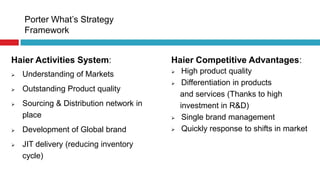
Porter What’s Strategy
Framework
Haier Activities System:
 Understanding of Markets
 Outstanding Product quality
 Sourcing & Distribution network in
place
 Development of Global brand
 JIT delivery (reducing inventory
cycle)
Haier Competitive Advantages:
 High product quality
 Differentiation in products
and services (Thanks to high
investment in R&D)
 Single brand management
 Quickly response to shifts in market
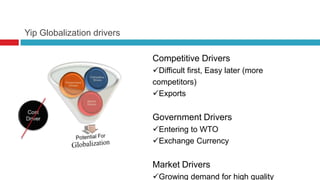
Yip Globalization drivers
Competitive Drivers
Difficult first, Easy later (more
competitors)
Exports
Government Drivers
Entering to WTO
Exchange Currency
Market Drivers
Growing demand for high quality
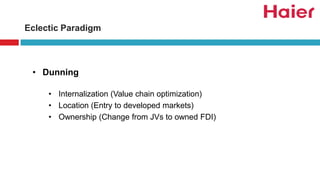
Eclectic Paradigm
• Dunning
• Internalization (Value chain optimization)
• Location (Entry to developed markets)
• Ownership (Change from JVs to owned FDI)
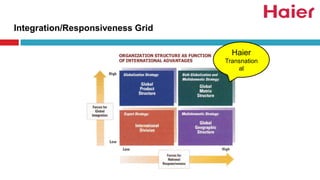
Integration/Responsiveness Grid
Haier
Transnation
al
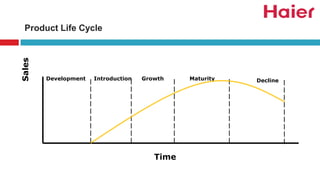
Sales
Time
Development Introduction Growth Maturity Decline
Product Life Cycle
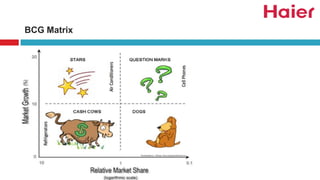
BCG Matrix
In global market: Continue Brand Building Initiatives
• An individualized brand
• The product quality, adaptability and flexibility
• Customer focused firm
In Domestic Market: Continuous Innovation
• A home company
• Increase quality
Recommendations:
Discussion
• Would Haier diversify their products by having different brand names, or
should the continue with one big brand?
• Would you use JVs as entry mode to global markets?
• Did they make the right strategy by entering to developed market rather
than easy markets?
Thanks for
your
Attention

Haier: Taking a Chinese Company Global

  • 1.
    Global Market Strategies :Taking a Chinese Company Global Team Members: Morteza Javadinia Tor Halvorsrud Aliasghar Bahoo Torodi Nathanael Bruchez USI Lecturer: Johannes M Pennigns
  • 2.
    Agenda  Case Overview Haier Strategy in Chinese Market  Haier’s International Expansion Approaches  6 Frameworks / Tools (Porter, Yip, Dunning, BCG, PLC, Integration/Responsiveness Grids)  Discussion
  • 3.
    Case Overview • HaierGroup is a multinational company specializing in the production of home appliances and consumer electronics. • Originated in 1984, When founder and CEO Zhang Ruimin took over failing refrigerator factory in Quindao, China.
  • 4.
    Case Overview • ZhangRuimin took over in 1984, when it was approximately 300 refrigerator factories in china. • Most of them produced poor quality products. • Zhang saw this, and therefore went to the other direction : Focusing on high quality products and service. • Went into a JV with among others German manufacturer Liebherr which had technical expertize in refrigerators. • Had a high focus on becoming a «first class brand» through large scale operations. • In 1992, After becoming Chinas leading refrigerator manufacturer, Haier Group started to look into other similar businesses. Acquired companies with poor management and implemented new manag. With same focus on quality and service. • Went public in 1993, at the Shanghai stock Exchange. • 1997, Started to target the rural areas of china. • At the same time, they started to diversify their product line. • 2004, became the number one appliance company in China. • At the same time, experiencing stronger and stronger competition from domestic and multinational companies who tried to break into the market.
  • 5.
    Case Overview • By2004, the Haier Group was the largest home appliance maker, holding approx.. 30% of the white goods market (third globally) • They were the second-largest refrigerator manufacturer in the world, and had a growing presence in the black goods market. • At this stage, with domestic market success, they were considering going abroad and become a multinational brand. • But could they do this without loosing their position in china?
  • 6.
    Strategy – Chinese Market •Between 1989 and 1996, reduction from 100 to 20 refrigerators producers -> more competitive market. • China entered the WTO in 2001 -> new competitors, multinationals. Difficult start for them, for several reasons. • That said, the multinationals reached 31% of refrigerators market share in 2002, local companies being losing market share rapidly.
  • 7.
    Strategy – Chinese Market Haier’scompetitive advantages in the Chinese market • Haier is known in China for its high quality products ; It has therefore a very good brand reputation. • Closer to chinese customers (design, needs) in comparison with multinationals. • High investment in R&D (5-7% of revenues) and thus new products every year, very innovative. • High market responsiveness, focusing on meeting customers needs ; 42 distribution centers in China operating as sales companies.
  • 8.
    Strategy – Chinese Market •High level of services, with better after-sales service than competitors ; According to the customers, one of the biggest advantages of Haier. • Very good distribution channels/network, with «Haier Logistics» ; Advantage over multinationals, since establishing a logistics network in China is complicated. • Staff cheaper than multinational competitors. • That said -> these strengths in distribution and service networks, and the superior knowledge of the domestic market may not last forever! They are provisory advantages, since multinationals have already had some successes, contracting people who understand the Chinese market, buying sales channels and services Haier’s competitive advantages in the Chinese market
  • 9.
    Company Goals Haier ThreeThird Goals:  1/3 Revenue from goods produced and sold in China  1/3 Revenue from goods produced in China and sold overseas  1/3 Revenue from goods produced and sold overseas
  • 10.
    Direct Export Joint Venture, Technical alliance Foreign Direct Investment (FDI) Research and Development Park / New establishment Expor t Contractu al Investment Entry Strategy for International Markets Strategy – Global Market
  • 11.
    Strategy – GlobalMarket • Entry Mode: Joint Venture with multinational brands (1990s) • In 1995 Haier become first company which engaged in FDI • In 1997 lunched first European manufacturer based in Belgrade through JV. • Until 1999 Haier continued OEM production for multinational companies • After 1999 start selling under Haier Brand
  • 12.
    Strategy – GlobalMarket Three Main Global Expansion Strategies: 1 - Non-traditional expansion ➔ Focus on difficult market first • “We chose the developed countries first because the requirements of both customers and retailers are very tough and not easy to meet” • High Prestige • Being well-known in developed markets can enhance market penetration ability in emerging markets • Competition in developed markets can guarantee the success in emerging markets
  • 13.
    Three Main GlobalExpansion Strategies: 2 – Begin with niche products • “When we entered the U.S market, we found that nobody was making competitive refrigerators for students or for offices.” • Starting with mini-fridge , compact refrigerators • “After we were successful in the niche products, then we started to introduce regular products to the U.S market.” Strategy – Global Market
  • 14.
    Three Main GlobalExpansion Strategies: 3 – Staff with locals • When entering a new market “ the first stage is to use the right people to establish the right structure.” • Why local staff: Local people know the Local market Local people have Local thinking to satisfy the needs of customer • BUT ➔ Not all the locals are good for our brand. • Goal ➔ “ Haier in each country be the Haier that they created” Haier has to be perceived as a local brand. Strategy – Global Market
  • 15.
    Haier International Division:Joint Ventures on 5 continent • The America • Europe • The Middle-East • South Asia • East Asia Why they Succeeded : Focus on customer's need 1) Product Differentiation ➔ Importance of R&D 2) Response Speed➔ Shortening the new products production time (From Idea to Strategy – Global Market
  • 16.
    The America: • 1994JV with Welbilt • 1999 Haier America • Employing American staff • Establishing industrial park in South Carolina (To build brand reputation , being quality oriented) • Focus on niche which enabled Haier to avoid competition with GE, Whirlpool and ..Haier Europe: • 1990 JV with some brands in UK, Germany and France • 2000 HQ in Varese – Italy • Employing former sales executives of Italy’s Merloni as a local experienced staff • Europe and America were similar in terms of size and degree of developments Strategy – Global Market
  • 17.
    Haier India: • 1999JV with Indian appliance firm (Fedder Lloye Corp.) • Establishing refrigerator and R&D Center • 2004 alliance with Whirlpool and Voltas to produce refrigerator and Air Conditioner • Main Challenge in India ➔ Hard to find top chain store • “In United States you can easily find the top ten chain stores but in India you cannot find them” Strategy – Global Market
  • 18.
    Haier Expansion StrategyPhases at a glance
  • 19.
    Porter What’s Strategy Framework HaierActivities System:  Understanding of Markets  Outstanding Product quality  Sourcing & Distribution network in place  Development of Global brand  JIT delivery (reducing inventory cycle) Haier Competitive Advantages:  High product quality  Differentiation in products and services (Thanks to high investment in R&D)  Single brand management  Quickly response to shifts in market
  • 20.
    Yip Globalization drivers CompetitiveDrivers Difficult first, Easy later (more competitors) Exports Government Drivers Entering to WTO Exchange Currency Market Drivers Growing demand for high quality
  • 21.
    Eclectic Paradigm • Dunning •Internalization (Value chain optimization) • Location (Entry to developed markets) • Ownership (Change from JVs to owned FDI)
  • 22.
  • 23.
    Sales Time Development Introduction GrowthMaturity Decline Product Life Cycle
  • 24.
  • 25.
    In global market:Continue Brand Building Initiatives • An individualized brand • The product quality, adaptability and flexibility • Customer focused firm In Domestic Market: Continuous Innovation • A home company • Increase quality Recommendations:
  • 26.
    Discussion • Would Haierdiversify their products by having different brand names, or should the continue with one big brand? • Would you use JVs as entry mode to global markets? • Did they make the right strategy by entering to developed market rather than easy markets?
  • 27.