



Doing Business Index
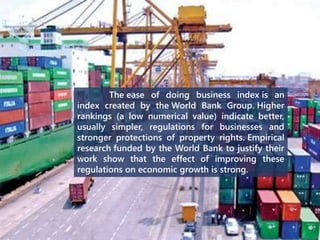
The ease of doing business index is an
index created by the World Bank Group. Higher
rankings (a low numerical value) indicate better,
usually simpler, regulations for businesses and
stronger protections of property rights. Empirical
research funded by the World Bank to justify their
work show that the effect of improving these
regulations on economic growth is strong.
Methodology
The index is based on the study of laws and
regulations, with the input and verification by more than
9,600 government officials, lawyers, business consultants,
accountants and other professionals in 185 economies
who routinely advise on or administer legal and
regulatory requirements.
The ease of doing business index is meant
to measure regulations directly affecting businesses
and does not directly measure more general
conditions such as a nation's proximity to large
markets, quality of infrastructure, inflation, or crime.
A nation's ranking on the index is based on the
average of 10 subindices:
Starting a business – Procedures, time, cost
and minimum capital to open a new business.
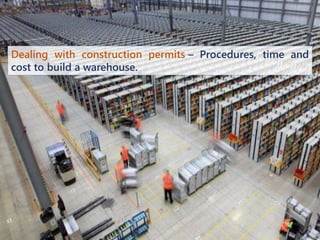
Dealing with construction permits – Procedures, time and
cost to build a warehouse.
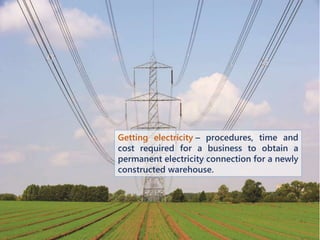
Getting electricity – procedures, time and
cost required for a business to obtain a
permanent electricity connection for a newly
constructed warehouse.
Registering property – Procedures, time and
cost to register commercial real estate.
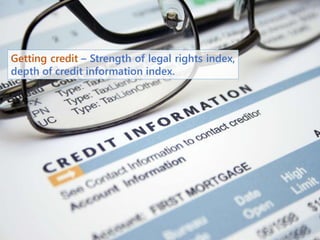
Getting credit – Strength of legal rights index,
depth of credit information index.
Protecting investors – Indices on the extent
of disclosure, extent of director liability and
ease of shareholder suits.
Paying taxes – Number of taxes
paid, hours per year spent
preparing tax returns and total
tax payable as share of gross
profit.
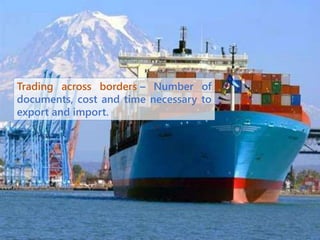
Trading across borders – Number of
documents, cost and time necessary to
export and import.
Enforcing contracts – Procedures, time and
cost to enforce a debt contract.
Resolving insolvency – The time,
cost and recovery rate (%) under
bankruptcy proceeding.
The Doing Business project also offers information on
following datasets:
Distance to frontier - Shows the distance of
each economy to the “frontier,” which represents the
highest performance observed on each of the
indicators across all economies included in Doing
Business since each indicator was included in Doing
Business
Entrepreneurship - Measures entrepreneurial
activity. The data is collected directly from 130
company registrars on the number of newly registered
firms over the past seven years
Good practices - Provide insights into how
governments have improved the regulatory
environment in the past in the areas measured by
Doing Business
Transparency in business regulation - Data on
the accessibility of regulatory information measures
how easy it is to access fee schedules for 4 regulatory
processes in the largest business city of an economy
Doing Business Index

Doing Business Index

  • 1.
  • 2.
    The ease ofdoing business index is an index created by the World Bank Group. Higher rankings (a low numerical value) indicate better, usually simpler, regulations for businesses and stronger protections of property rights. Empirical research funded by the World Bank to justify their work show that the effect of improving these regulations on economic growth is strong.
  • 3.
    Methodology The index isbased on the study of laws and regulations, with the input and verification by more than 9,600 government officials, lawyers, business consultants, accountants and other professionals in 185 economies who routinely advise on or administer legal and regulatory requirements.
  • 4.
    The ease ofdoing business index is meant to measure regulations directly affecting businesses and does not directly measure more general conditions such as a nation's proximity to large markets, quality of infrastructure, inflation, or crime. A nation's ranking on the index is based on the average of 10 subindices:
  • 5.
    Starting a business– Procedures, time, cost and minimum capital to open a new business.
  • 6.
    Dealing with constructionpermits – Procedures, time and cost to build a warehouse.
  • 7.
    Getting electricity –procedures, time and cost required for a business to obtain a permanent electricity connection for a newly constructed warehouse.
  • 8.
    Registering property –Procedures, time and cost to register commercial real estate.
  • 9.
    Getting credit –Strength of legal rights index, depth of credit information index.
  • 10.
    Protecting investors –Indices on the extent of disclosure, extent of director liability and ease of shareholder suits.
  • 11.
    Paying taxes –Number of taxes paid, hours per year spent preparing tax returns and total tax payable as share of gross profit.
  • 12.
    Trading across borders– Number of documents, cost and time necessary to export and import.
  • 13.
    Enforcing contracts –Procedures, time and cost to enforce a debt contract.
  • 14.
    Resolving insolvency –The time, cost and recovery rate (%) under bankruptcy proceeding.
  • 15.
    The Doing Businessproject also offers information on following datasets: Distance to frontier - Shows the distance of each economy to the “frontier,” which represents the highest performance observed on each of the indicators across all economies included in Doing Business since each indicator was included in Doing Business Entrepreneurship - Measures entrepreneurial activity. The data is collected directly from 130 company registrars on the number of newly registered firms over the past seven years Good practices - Provide insights into how governments have improved the regulatory environment in the past in the areas measured by Doing Business Transparency in business regulation - Data on the accessibility of regulatory information measures how easy it is to access fee schedules for 4 regulatory processes in the largest business city of an economy
  • 16.