National 
Innovation 
System 
Thanakrit Lersmethasakul 
Lersmethasakul@live.com
1.What is NIS ? 
“ .. the network of institutions in the public and private sectors whose activities and 
interactions initiate, import, modify and diffuse new technologies.” (Freeman, 1987) 
“ .. the elements and relationships which interact in the production, diffusion and use of 
new, and economically useful, knowledge ... and are either located within or rooted inside 
the borders of a nation state.” (Lundvall, 1992) 
“... a set of institutions whose interactions determine the innovative performance ... of 
national firms.” (Nelson, 1993) 
“ .. the national institutions, their incentive structures and their competencies, that 
determine the rate and direction of technological learning (or the volume and composition 
of change generating activities) in a country.” (Patel and Pavitt, 1994) 
“.. that set of distinct institutions which jointly and individually contribute to the 
development and diffusion of new technologies and which provides the framework within 
which governments form and implement policies to influence the innovation process. As 
such it is a system of interconnected institutions to create, store and transfer the 
knowledge, skills and artefacts which define new technologies.” (Metcalfe, 1995)
1.What is NIS ? 
The National Innovation System (NIS) is the flow of 
technology and information among people, enterprises and 
institutions which is key to the innovative process on the 
national level. 
The key mechanism (OECD) of NIS include 
- Joint industry activities 
- Public/private sector interactions 
- Technology diffusion 
- Personnel mobility
2. Why do we need it ? 
The NIS policies and programs help to enhance 
a country’s innovative and technological 
capacity while NIS approach offers improvements 
over alternative frameworks that conceptualize 
technological development in terms of inputs (e.g. 
science funding) and outputs (e.g. publications and 
patents). As a result, NIS bring to help policy 
makers develop approaches for enhancing 
innovative performance in the knowledge-base 
economies of today (Feinson).
3. How it has been used ? 
Two phases of NIS 
- Develop indicators to map knowledge flows. 
- Measuring institutional linkages, human 
resource flows, industrial clusters and 
innovative firm behaviors.
3. How it has been used ? 
Activities and functions (Feinson, 2003) within NIS 
for producing, diffusing and using innovations. 
- To create human capital. 
- To create and diffuse technological opportunities. 
- To create and diffuse products. 
- To incubate in order to provide facilities, equipment, and 
administrative support. 
- To facilitate regulation for technologies, materials, and products 
that may enlarge the market and enhance market access. 
- To legitimize technology and firms. 
- To create markets and diffuse market knowledge. 
- To enhance networking. 
- To direct technology, market, and partner research. 
- To facilitate financing. 
- To create a labor market that can be utilized.
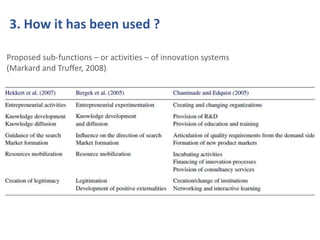
3. How it has been used ? 
Proposed sub-functions – or activities – of innovation systems 
(Markard and Truffer, 2008).
3. How it has been used ? 
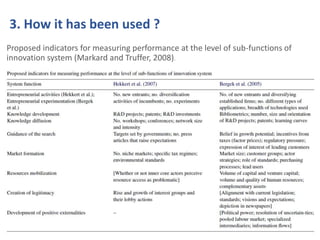
Proposed indicators for measuring performance at the level of sub-functions of 
innovation system (Markard and Truffer, 2008).
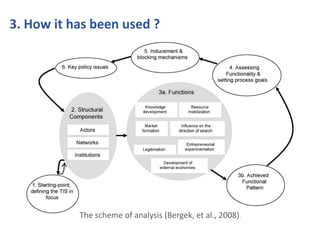
3. How it has been used ? 
The scheme of analysis (Bergek, et al., 2008).
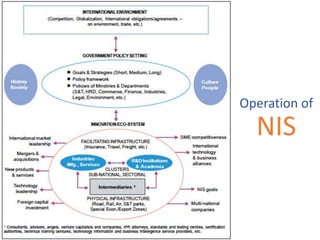
Operation of 
NIS
Example of NIS map 
Norwegian system of innovation
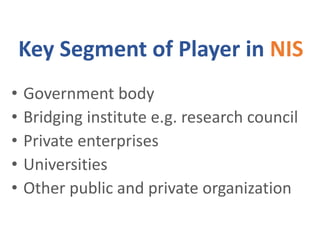
Key Segment of Player in NIS 
• Government body 
• Bridging institute e.g. research council 
• Private enterprises 
• Universities 
• Other public and private organization
Step in Analyzing NIS 
• Develop NIS map 
• Analyze the degree of relationship 
between each organization
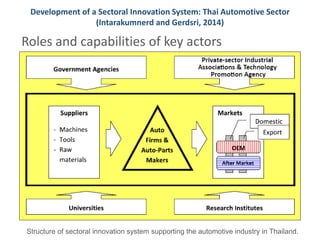
Development of a Sectoral Innovation System: Thai Automotive Sector 
(Intarakumnerd and Gerdsri, 2014) 
Roles and capabilities of key actors 
Structure of sectoral innovation system supporting the automotive industry in Thailand.
Development of a Sectoral Innovation System: Thai Automotive Sector 
(Intarakumnerd and Gerdsri, 2014) 
Roles and capabilities of key actors 
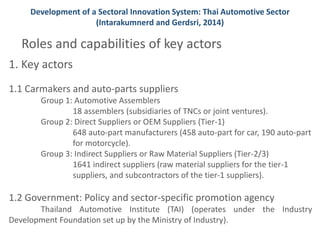
1. Key actors 
1.1 Carmakers and auto-parts suppliers 
Group 1: Automotive Assemblers 
18 assemblers (subsidiaries of TNCs or joint ventures). 
Group 2: Direct Suppliers or OEM Suppliers (Tier-1) 
648 auto-part manufacturers (458 auto-part for car, 190 auto-part 
for motorcycle). 
Group 3: Indirect Suppliers or Raw Material Suppliers (Tier-2/3) 
1641 indirect suppliers (raw material suppliers for the tier-1 
suppliers, and subcontractors of the tier-1 suppliers). 
1.2 Government: Policy and sector-specific promotion agency 
Thailand Automotive Institute (TAI) (operates under the Industry 
Development Foundation set up by the Ministry of Industry).
Development of a Sectoral Innovation System: Thai Automotive Sector 
(Intarakumnerd and Gerdsri, 2014) 
Roles and capabilities of key actors 
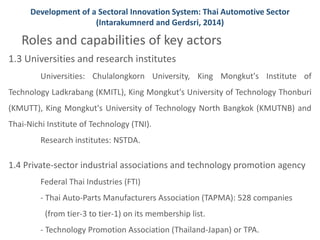
1.3 Universities and research institutes 
Universities: Chulalongkorn University, King Mongkut's Institute of 
Technology Ladkrabang (KMITL), King Mongkut's University of Technology Thonburi 
(KMUTT), King Mongkut's University of Technology North Bangkok (KMUTNB) and 
Thai-Nichi Institute of Technology (TNI). 
Research institutes: NSTDA. 
1.4 Private-sector industrial associations and technology promotion agency 
Federal Thai Industries (FTI) 
- Thai Auto-Parts Manufacturers Association (TAPMA): 528 companies 
(from tier-3 to tier-1) on its membership list. 
- Technology Promotion Association (Thailand-Japan) or TPA.
Development of a Sectoral Innovation System: Thai Automotive Sector 
(Intarakumnerd and Gerdsri, 2014) 
Roles and capabilities of key actors 
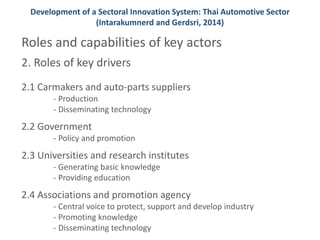
2. Roles of key drivers 
2.1 Carmakers and auto-parts suppliers 
- Production 
- Disseminating technology 
2.2 Government 
- Policy and promotion 
2.3 Universities and research institutes 
- Generating basic knowledge 
- Providing education 
2.4 Associations and promotion agency 
- Central voice to protect, support and develop industry 
- Promoting knowledge 
- Disseminating technology
Development of a Sectoral Innovation System: Thai Automotive Sector 
(Intarakumnerd and Gerdsri, 2014) 
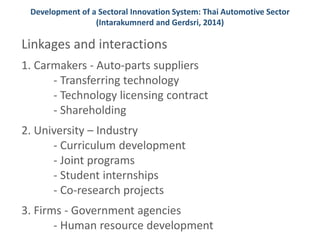
Linkages and interactions 
1. Carmakers - Auto-parts suppliers 
- Transferring technology 
- Technology licensing contract 
- Shareholding 
2. University – Industry 
- Curriculum development 
- Joint programs 
- Student internships 
- Co-research projects 
3. Firms - Government agencies 
- Human resource development
References 
Bergek, A., Jacobsson, S., Carlsson, B., Lindmarki, S., Rickne, A., 2005. Analysing the dynamics and 
functionality of sectoral innovation systems – a manual. In: 10 Year Anniversary DRUID Summer 
Conference, Copenhagen, June 27–29. 
Chaminade, C., Edquist, C., 2005. From Theory To Practice: The Use of Systems of Innovation Approach 
in Innovation Policy. Lund University, Lund. 
Feinson, S. (2003). National Innovation Systems Overview and Country Cases. 
Hekkert, M., Suurs, R.A.A., Negro, S., Kuhlmann, S., Smits, R., 2007. Functions of Innovation Systems: A 
new approach for analysing technological change. Technological Forecasting and Social Change 74 (4), 
413–432. 
Intarakumnerd, P., & Gerdsri, N. (2014). Implications of Technology Management and Policy on the 
Development of a Sectoral Innovation System: Lessons Learned Through the Evolution of Thai 
Automotive Sector. International Journal of Innovation and Technology Management, 11(03), 
1440009. doi: 10.1142/s0219877014400094 
Markard, J., & Truffer, B. (2008). Technological innovation systems and the multi-level perspective: 
Towards an integrated framework. Research Policy, 37(4), 596-615. doi: 10.1016/j.respol.2008.01.004 
National Innovation Systems. Organization for Economic Co-operation and Development.
“ .. the network of institutions in the public and 
private sectors whose activities and interactions 
initiate, import, modify and diffuse new technologies.” 
(Freeman, 1987) 
THANK YOU

National Innovation Systems

  • 1.
    National Innovation System Thanakrit Lersmethasakul Lersmethasakul@live.com
  • 2.
    1.What is NIS? “ .. the network of institutions in the public and private sectors whose activities and interactions initiate, import, modify and diffuse new technologies.” (Freeman, 1987) “ .. the elements and relationships which interact in the production, diffusion and use of new, and economically useful, knowledge ... and are either located within or rooted inside the borders of a nation state.” (Lundvall, 1992) “... a set of institutions whose interactions determine the innovative performance ... of national firms.” (Nelson, 1993) “ .. the national institutions, their incentive structures and their competencies, that determine the rate and direction of technological learning (or the volume and composition of change generating activities) in a country.” (Patel and Pavitt, 1994) “.. that set of distinct institutions which jointly and individually contribute to the development and diffusion of new technologies and which provides the framework within which governments form and implement policies to influence the innovation process. As such it is a system of interconnected institutions to create, store and transfer the knowledge, skills and artefacts which define new technologies.” (Metcalfe, 1995)
  • 3.
    1.What is NIS? The National Innovation System (NIS) is the flow of technology and information among people, enterprises and institutions which is key to the innovative process on the national level. The key mechanism (OECD) of NIS include - Joint industry activities - Public/private sector interactions - Technology diffusion - Personnel mobility
  • 4.
    2. Why dowe need it ? The NIS policies and programs help to enhance a country’s innovative and technological capacity while NIS approach offers improvements over alternative frameworks that conceptualize technological development in terms of inputs (e.g. science funding) and outputs (e.g. publications and patents). As a result, NIS bring to help policy makers develop approaches for enhancing innovative performance in the knowledge-base economies of today (Feinson).
  • 5.
    3. How ithas been used ? Two phases of NIS - Develop indicators to map knowledge flows. - Measuring institutional linkages, human resource flows, industrial clusters and innovative firm behaviors.
  • 6.
    3. How ithas been used ? Activities and functions (Feinson, 2003) within NIS for producing, diffusing and using innovations. - To create human capital. - To create and diffuse technological opportunities. - To create and diffuse products. - To incubate in order to provide facilities, equipment, and administrative support. - To facilitate regulation for technologies, materials, and products that may enlarge the market and enhance market access. - To legitimize technology and firms. - To create markets and diffuse market knowledge. - To enhance networking. - To direct technology, market, and partner research. - To facilitate financing. - To create a labor market that can be utilized.
  • 7.
    3. How ithas been used ? Proposed sub-functions – or activities – of innovation systems (Markard and Truffer, 2008).
  • 8.
    3. How ithas been used ? Proposed indicators for measuring performance at the level of sub-functions of innovation system (Markard and Truffer, 2008).
  • 9.
    3. How ithas been used ? The scheme of analysis (Bergek, et al., 2008).
  • 10.
  • 11.
    Example of NISmap Norwegian system of innovation
  • 12.
    Key Segment ofPlayer in NIS • Government body • Bridging institute e.g. research council • Private enterprises • Universities • Other public and private organization
  • 13.
    Step in AnalyzingNIS • Develop NIS map • Analyze the degree of relationship between each organization
  • 14.
    Development of aSectoral Innovation System: Thai Automotive Sector (Intarakumnerd and Gerdsri, 2014) Roles and capabilities of key actors Structure of sectoral innovation system supporting the automotive industry in Thailand.
  • 15.
    Development of aSectoral Innovation System: Thai Automotive Sector (Intarakumnerd and Gerdsri, 2014) Roles and capabilities of key actors 1. Key actors 1.1 Carmakers and auto-parts suppliers Group 1: Automotive Assemblers 18 assemblers (subsidiaries of TNCs or joint ventures). Group 2: Direct Suppliers or OEM Suppliers (Tier-1) 648 auto-part manufacturers (458 auto-part for car, 190 auto-part for motorcycle). Group 3: Indirect Suppliers or Raw Material Suppliers (Tier-2/3) 1641 indirect suppliers (raw material suppliers for the tier-1 suppliers, and subcontractors of the tier-1 suppliers). 1.2 Government: Policy and sector-specific promotion agency Thailand Automotive Institute (TAI) (operates under the Industry Development Foundation set up by the Ministry of Industry).
  • 16.
    Development of aSectoral Innovation System: Thai Automotive Sector (Intarakumnerd and Gerdsri, 2014) Roles and capabilities of key actors 1.3 Universities and research institutes Universities: Chulalongkorn University, King Mongkut's Institute of Technology Ladkrabang (KMITL), King Mongkut's University of Technology Thonburi (KMUTT), King Mongkut's University of Technology North Bangkok (KMUTNB) and Thai-Nichi Institute of Technology (TNI). Research institutes: NSTDA. 1.4 Private-sector industrial associations and technology promotion agency Federal Thai Industries (FTI) - Thai Auto-Parts Manufacturers Association (TAPMA): 528 companies (from tier-3 to tier-1) on its membership list. - Technology Promotion Association (Thailand-Japan) or TPA.
  • 17.
    Development of aSectoral Innovation System: Thai Automotive Sector (Intarakumnerd and Gerdsri, 2014) Roles and capabilities of key actors 2. Roles of key drivers 2.1 Carmakers and auto-parts suppliers - Production - Disseminating technology 2.2 Government - Policy and promotion 2.3 Universities and research institutes - Generating basic knowledge - Providing education 2.4 Associations and promotion agency - Central voice to protect, support and develop industry - Promoting knowledge - Disseminating technology
  • 18.
    Development of aSectoral Innovation System: Thai Automotive Sector (Intarakumnerd and Gerdsri, 2014) Linkages and interactions 1. Carmakers - Auto-parts suppliers - Transferring technology - Technology licensing contract - Shareholding 2. University – Industry - Curriculum development - Joint programs - Student internships - Co-research projects 3. Firms - Government agencies - Human resource development
  • 19.
    References Bergek, A.,Jacobsson, S., Carlsson, B., Lindmarki, S., Rickne, A., 2005. Analysing the dynamics and functionality of sectoral innovation systems – a manual. In: 10 Year Anniversary DRUID Summer Conference, Copenhagen, June 27–29. Chaminade, C., Edquist, C., 2005. From Theory To Practice: The Use of Systems of Innovation Approach in Innovation Policy. Lund University, Lund. Feinson, S. (2003). National Innovation Systems Overview and Country Cases. Hekkert, M., Suurs, R.A.A., Negro, S., Kuhlmann, S., Smits, R., 2007. Functions of Innovation Systems: A new approach for analysing technological change. Technological Forecasting and Social Change 74 (4), 413–432. Intarakumnerd, P., & Gerdsri, N. (2014). Implications of Technology Management and Policy on the Development of a Sectoral Innovation System: Lessons Learned Through the Evolution of Thai Automotive Sector. International Journal of Innovation and Technology Management, 11(03), 1440009. doi: 10.1142/s0219877014400094 Markard, J., & Truffer, B. (2008). Technological innovation systems and the multi-level perspective: Towards an integrated framework. Research Policy, 37(4), 596-615. doi: 10.1016/j.respol.2008.01.004 National Innovation Systems. Organization for Economic Co-operation and Development.
  • 20.
    “ .. thenetwork of institutions in the public and private sectors whose activities and interactions initiate, import, modify and diffuse new technologies.” (Freeman, 1987) THANK YOU