



By Thanakrit Lersmethasakul 
Email: lersmethasakul@live.com 
National 
Innovation 
Systems
Definitions 
“ .. the network of institutions in the public and private sectors whose 
activities and interactions initiate, import, modify and diffuse new 
technologies.” (Freeman, 1987) 
“ .. the elements and relationships which interact in the production, 
diffusion and use of new, and economically useful, knowledge ... and 
are either located within or rooted inside the borders of a nation 
state.” (Lundvall, 1992) 
“... a set of institutions whose interactions determine the innovative 
performance ... of national firms.” (Nelson, 1993)
“ .. the national institutions, their incentive structures and their 
competencies, that determine the rate and direction of technological 
learning (or the volume and composition of change generating 
activities) in a country.” (Patel and Pavitt, 1994) 
“.. that set of distinct institutions which jointly and individually 
contribute to the development and diffusion of new technologies and 
which provides the framework within which governments form and 
implement policies to influence the innovation process. As such it is a 
system of interconnected institutions to create, store and transfer the 
knowledge, skills and artefacts which define new technologies.” 
(Metcalfe, 1995)
National Innovation System (NIS) use to help 
policy makers develop approaches for 
enhancing innovative performance in the 
knowledge-base economies of today
Enterprises Universities Research Institutes 
How the various actors in a country interact in 
the innovation process ?
The smooth operation depends on the fluidity 
of knowledge flows among the actors. 
Tacit knowledge 
(know-how exchanged 
through informal channels) 
Codified knowledge 
(publication, patents, other sources)
Technology Performance depends to 
the interactions or linkages among the actors 
involved in innovation.
Innovative Performance depends to 
a large extent on how these actors relate to 
each other as elements of a collective 
system of knowledge creation and use as 
well as the technologies they use.
From NIS to Knowledge-based Economy 
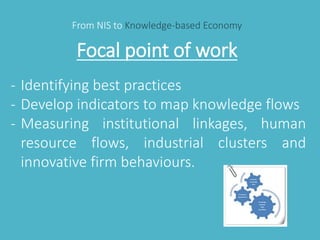
Focal point of work 
- Identifying best practices 
- Develop indicators to map knowledge flows 
- Measuring institutional linkages, human 
resource flows, industrial clusters and 
innovative firm behaviours.
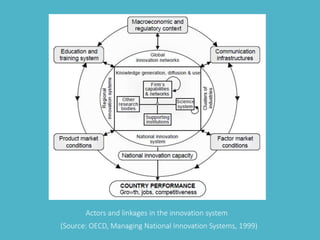
Actors and linkages in the innovation system 
(Source: OECD, Managing National Innovation Systems, 1999)
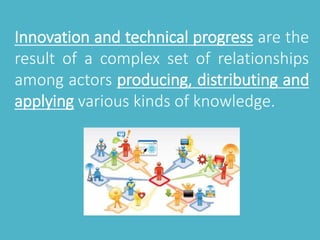
Innovation and technical progress are the 
result of a complex set of relationships 
among actors producing, distributing and 
applying various kinds of knowledge.
Activities and Functions within NIS 
Identification of the “functional boundaries” of an NIS, beyond 
the “overall function of producing, diffusing and using innovations”. 
Johnson and Jacobsson (2000) outline five primary functions: 
• Create ‘new’ knowledge 
• Guide the direction of the search process 
• Supply resources, i.e. capital and competence 
• Facilitate the creation of positive external economies (in the form 
of an exchange of information, knowledge, and visions) 
• Facilitate the formation of markets
Activities and Functions within NIS 
Other researchers have provided a somewhat expanded list including: 
• to create human capital 
• to create and diffuse technological opportunities 
• to create and diffuse products 
• to incubate in order to provide facilities, equipment, and administrative support 
• to facilitate regulation for technologies, materials, and products that may 
enlarge the market and enhance market access 
• to legitimize technology and firms 
• to create markets and diffuse market knowledge 
• to enhance networking 
• to direct technology, market, and partner research 
• to facilitate financing 
• to create a labor market that (can be utilized)
The Mechanism for Knowledge Flows include 
- Joint industry activities 
- Public/private sector interactions 
- Technology diffusion 
- Personnel mobility
The Assessment of Joint industry activities 
- The importance of collaborative enterprise activities - 
Products changed during the last three years as a share 
of sales by industry.
The Assessment of Public/private sector interactions 
- Joint research activities - the number of joint research and 
technical activities between firms and universities/research 
institutes. 
- Co-patents and co-publications - the number of co-patents or co-publications 
developed by enterprises in collaboration with a 
university or research institute. 
- Citation analysis - the practice of users of technical knowledge 
and ideas to cite their sources. 
- Firm surveys - Sources of knowledge useful in their innovative 
activities.
The Assessment of Technology diffusion 
- Firm surveys – the use of advanced manufacturing technologies 
or information technologies, the adoption rates of new 
technologies, the use of specific technologies in industry.
The Assessment of Personnel mobility 
- Firm surveys – the skills and networking capabilities of personnel, 
mobility of personnel.
The Analytical Approaches include 
- Innovation surveys (Firm-level) 
- Cluster interactions 
- International knowledge flows
Innovation Surveys (Firm-level) 
To analyze sources of knowledge of firms relevant to innovation.
The Questions of Innovation Surveys (Firm-level)* 
- Expenditure on activities related to product innovation 
- Outputs and sales of new or improved products 
- Sources of information relevant to innovation 
- Technology transfer and acquisition 
- R&D performance and technological collaboration 
- Perceptions of factors promoting or hampering innovation 
*Community Innovation Survey
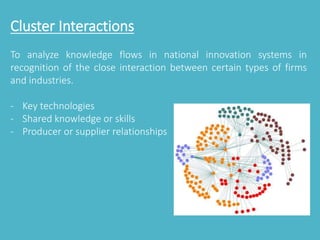
Cluster Interactions 
To analyze knowledge flows in national innovation systems in 
recognition of the close interaction between certain types of firms 
and industries. 
- Key technologies 
- Shared knowledge or skills 
- Producer or supplier relationships
International Knowledge Flows 
To analyze country-level interactions in creating a climate for 
innovation. 
- Technology acquired from abroad in capital and intermediate goods 
- Purchases of foreign patents and licenses 
- Technical alliances between firms of different countries 
- Trade in services such as technical consultancies 
- Foreign direct investment 
- Internationally co-authored publications
The NIS Project 
The NIS project has evolved along two tracks: 
1. General analysis 
- A comparison of national innovation systems based on a 
standardised set of quantitative indicators and information on 
countries’ institutional profiles. 
- The production of country reports on national patterns of 
knowledge flows and related aspects of innovation processes. 
2. Focus groups 
Advanced methodologies, data sets, or special research/policy 
interests co-operating in the following six areas: Innovative firms, 
Innovative firm networks, Clusters, Mobility of human resources, 
Organisational mapping, Catching-up economies.
Reference : - ORGANISATION FOR ECONOMIC CO-OPERATION AND DEVELOPMENT 
- National Innovation Systems Overview and Country Cases by Stephen Feinson

National Innovation Systems

  • 1.
    By Thanakrit Lersmethasakul Email: lersmethasakul@live.com National Innovation Systems
  • 2.
    Definitions “ ..the network of institutions in the public and private sectors whose activities and interactions initiate, import, modify and diffuse new technologies.” (Freeman, 1987) “ .. the elements and relationships which interact in the production, diffusion and use of new, and economically useful, knowledge ... and are either located within or rooted inside the borders of a nation state.” (Lundvall, 1992) “... a set of institutions whose interactions determine the innovative performance ... of national firms.” (Nelson, 1993)
  • 3.
    “ .. thenational institutions, their incentive structures and their competencies, that determine the rate and direction of technological learning (or the volume and composition of change generating activities) in a country.” (Patel and Pavitt, 1994) “.. that set of distinct institutions which jointly and individually contribute to the development and diffusion of new technologies and which provides the framework within which governments form and implement policies to influence the innovation process. As such it is a system of interconnected institutions to create, store and transfer the knowledge, skills and artefacts which define new technologies.” (Metcalfe, 1995)
  • 4.
    National Innovation System(NIS) use to help policy makers develop approaches for enhancing innovative performance in the knowledge-base economies of today
  • 5.
    Enterprises Universities ResearchInstitutes How the various actors in a country interact in the innovation process ?
  • 6.
    The smooth operationdepends on the fluidity of knowledge flows among the actors. Tacit knowledge (know-how exchanged through informal channels) Codified knowledge (publication, patents, other sources)
  • 7.
    Technology Performance dependsto the interactions or linkages among the actors involved in innovation.
  • 8.
    Innovative Performance dependsto a large extent on how these actors relate to each other as elements of a collective system of knowledge creation and use as well as the technologies they use.
  • 9.
    From NIS toKnowledge-based Economy Focal point of work - Identifying best practices - Develop indicators to map knowledge flows - Measuring institutional linkages, human resource flows, industrial clusters and innovative firm behaviours.
  • 10.
    Actors and linkagesin the innovation system (Source: OECD, Managing National Innovation Systems, 1999)
  • 11.
    Innovation and technicalprogress are the result of a complex set of relationships among actors producing, distributing and applying various kinds of knowledge.
  • 12.
    Activities and Functionswithin NIS Identification of the “functional boundaries” of an NIS, beyond the “overall function of producing, diffusing and using innovations”. Johnson and Jacobsson (2000) outline five primary functions: • Create ‘new’ knowledge • Guide the direction of the search process • Supply resources, i.e. capital and competence • Facilitate the creation of positive external economies (in the form of an exchange of information, knowledge, and visions) • Facilitate the formation of markets
  • 13.
    Activities and Functionswithin NIS Other researchers have provided a somewhat expanded list including: • to create human capital • to create and diffuse technological opportunities • to create and diffuse products • to incubate in order to provide facilities, equipment, and administrative support • to facilitate regulation for technologies, materials, and products that may enlarge the market and enhance market access • to legitimize technology and firms • to create markets and diffuse market knowledge • to enhance networking • to direct technology, market, and partner research • to facilitate financing • to create a labor market that (can be utilized)
  • 14.
    The Mechanism forKnowledge Flows include - Joint industry activities - Public/private sector interactions - Technology diffusion - Personnel mobility
  • 15.
    The Assessment ofJoint industry activities - The importance of collaborative enterprise activities - Products changed during the last three years as a share of sales by industry.
  • 16.
    The Assessment ofPublic/private sector interactions - Joint research activities - the number of joint research and technical activities between firms and universities/research institutes. - Co-patents and co-publications - the number of co-patents or co-publications developed by enterprises in collaboration with a university or research institute. - Citation analysis - the practice of users of technical knowledge and ideas to cite their sources. - Firm surveys - Sources of knowledge useful in their innovative activities.
  • 17.
    The Assessment ofTechnology diffusion - Firm surveys – the use of advanced manufacturing technologies or information technologies, the adoption rates of new technologies, the use of specific technologies in industry.
  • 18.
    The Assessment ofPersonnel mobility - Firm surveys – the skills and networking capabilities of personnel, mobility of personnel.
  • 19.
    The Analytical Approachesinclude - Innovation surveys (Firm-level) - Cluster interactions - International knowledge flows
  • 20.
    Innovation Surveys (Firm-level) To analyze sources of knowledge of firms relevant to innovation.
  • 21.
    The Questions ofInnovation Surveys (Firm-level)* - Expenditure on activities related to product innovation - Outputs and sales of new or improved products - Sources of information relevant to innovation - Technology transfer and acquisition - R&D performance and technological collaboration - Perceptions of factors promoting or hampering innovation *Community Innovation Survey
  • 22.
    Cluster Interactions Toanalyze knowledge flows in national innovation systems in recognition of the close interaction between certain types of firms and industries. - Key technologies - Shared knowledge or skills - Producer or supplier relationships
  • 23.
    International Knowledge Flows To analyze country-level interactions in creating a climate for innovation. - Technology acquired from abroad in capital and intermediate goods - Purchases of foreign patents and licenses - Technical alliances between firms of different countries - Trade in services such as technical consultancies - Foreign direct investment - Internationally co-authored publications
  • 24.
    The NIS Project The NIS project has evolved along two tracks: 1. General analysis - A comparison of national innovation systems based on a standardised set of quantitative indicators and information on countries’ institutional profiles. - The production of country reports on national patterns of knowledge flows and related aspects of innovation processes. 2. Focus groups Advanced methodologies, data sets, or special research/policy interests co-operating in the following six areas: Innovative firms, Innovative firm networks, Clusters, Mobility of human resources, Organisational mapping, Catching-up economies.
  • 25.
    Reference : -ORGANISATION FOR ECONOMIC CO-OPERATION AND DEVELOPMENT - National Innovation Systems Overview and Country Cases by Stephen Feinson