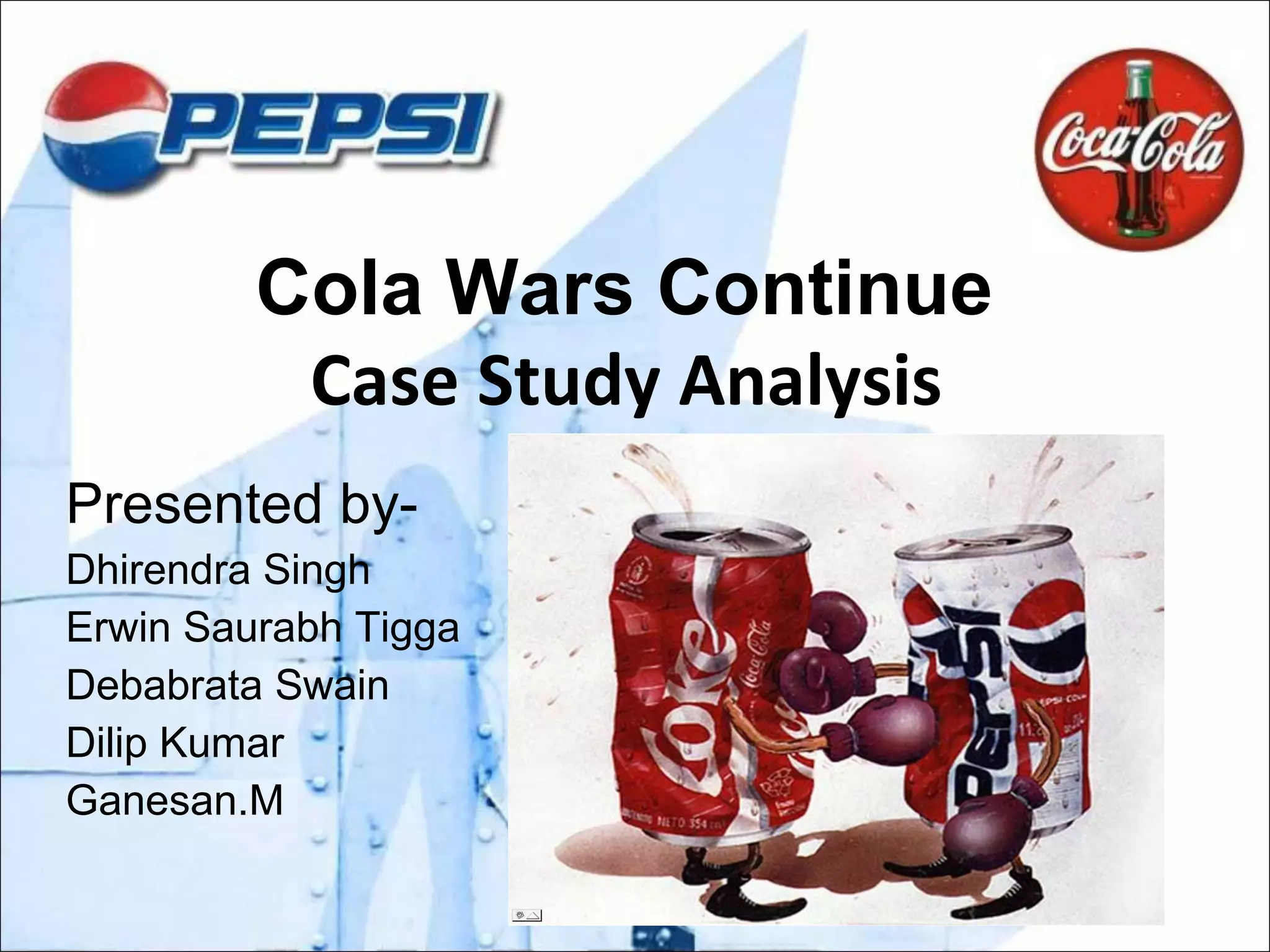
Cola Wars Continue  Case Study Analysis  Presented by- Dhirendra Singh Erwin Saurabh Tigga Debabrata Swain Dilip Kumar Ganesan.M
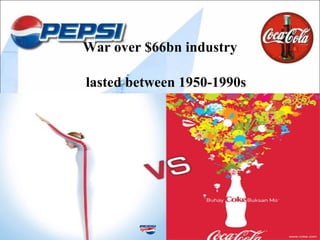
War over $66bn industry lasted between 1950-1990s
New Challenges Cola wars continued into the 21st century with new challenges Was their era of sustained growth and profitability coming to a close? Could they boost flagging domestic CSD sales?  Would newly popular beverages provide them with new (and profitable) revenue streams?
Production & distribution of CSD concentrate producers  Bottlers  Retail channels  suppliers
Concentrate Producer Blended raw material ingredients,packaged the mixture, shipped those container to the bottler. Key production investment areas  - machinery, overhead and labor. A typical manufacturing plant  cost - $25 million to  $50 million
Concentrate Producer Significant costs were for advertising, promotion, market research. Coca-Cola and Pepsi-Cola claimed a combined 74.8% of the U.S. CSD market in sales volume in 2004
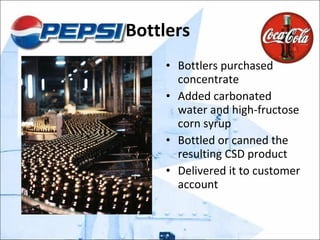
Bottlers  Bottlers purchased concentrate  Added carbonated water and high-fructose corn syrup  Bottled or canned the resulting CSD product Delivered it to customer account
Bottlers  Bottling process is capital intensive. Packaging accounted for 40% to 45% of sales, same for concentrate and sweeteners for 5% to 10%. Coke and Pepsi bottlers offered “direct store door delivery”. Cooperative merchandizing agreements is a key ingredient of soft drink sales.
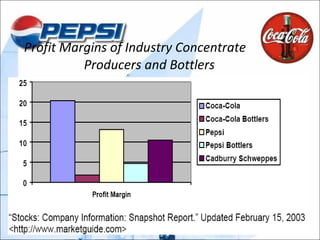
Profitability  Concentrate producer earn more profit than bottler. Cost of sale is more in bottler.
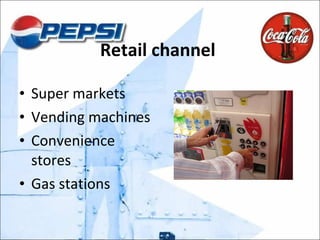
Retail   channel  Super markets Vending machines Convenience stores Gas stations
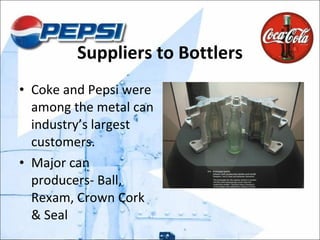
Suppliers to Bottlers Coke and Pepsi were among the metal can industry’s largest customers. Major can producers- Ball, Rexam, Crown Cork & Seal
 
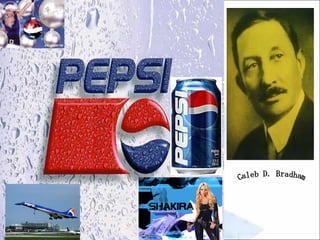
Caleb D. Bradham
Cola War begins “ Beat Coke”  “ Pepsi Generation” “ young at heart.” Concentrate Price 20% lower 1970 – larger bottlers “ American’s preferred taste”  “ No wonder Coke refreshes best”
Year 1960s –  the Armageddon Fanta (1960) Sprite (1961) Low calorie cola Tab   (1963) Non-CSD (Purchased) Minute Maid (fruit juice) Duncan foods (coffee, tea,  hot chocolate) Belmont Springs water   Teem (1960) Mountain Dew (1964) Diet Pepsi (1964) Non-CSD (Merged)  Frito Lays
Pepsi’s Challenge Blind taste test Eroded Coke’s Market share Part of Pepsi’s promotional strategy  not  a part of marketing research. Rebates Retail price cuts Advertisements that questions tests validity 1978 – Re-negotiation of contract with franchisee bottlers
Leadership 1980 – Roberto Goizueta Share price rose by 3500% Most valuable Brand Use of lower priced corn syrup against sugar Double spending on ads 1981-84 Sold non-CSD business Diet Coke (1982) 2001: Steve Reinemund “Grow the core add some more” Launched new CSD products (Sierra Mist, Mountain Dew code red) Acquisition of Quaker Oats  Net income raised by 17.6% per year ROI capital 29.3 (2003) from 9.5 (1996 )
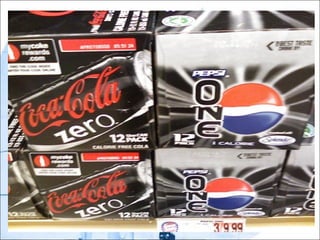
Product Launch Teem (1960) Mountain Dew (1964) Diet Pepsi (1964) Lemon Lime Slice (1984) Caffeine free Pepsi Cola (1987) Sierra Mist (2000) Mountain Dew Code Red (2001) Pepsi One (2005) Diet Coke with Splenda (2005) Fanta (1960) Sprite (1961) Low calorie cola Tab (1963) Diet Coke (1982) Caffeine free coke (1983)  Coca-Cola Classic (1985) New Coke (1985) Cherry Coke (1985) Sierra Mist Free (2004) Coca-Cola Zero (2005)


Expansions Acquired – Pizza hut (1978), Toco Bell (1986), KFC (1986) Merged with Frito Lay to form PepsiCo Pepsi purchased Quaker Oats Exclusive deals with Burger king, McDonalds Purchased Minute Maid, Duncan Foods, Belmont Springs water Acquired – Planet Java coffee drink brand Acquired - Mad River juices and tea
Marketing Campaigns Pepsi generation Young at heart Pepsi challenge Smart Spot – good for you  Americans Preferred Taste No wonder Coke refreshes best
Challenges Flat demand during 1998 to 2004. Contamination scare at India Obesity Issue Challenges of Internationalization
Challenges to Coca-Cola Performance & execution :  on providing alternative beverages  on adjusting key strategic relationships,  on cultivating international markets Currency crisis in Asia and Russia Recall in Belgium – (public relations disaster) Series of legal problems
1996-2004:reversal of fortune Pepsi flourished Acquisition of Quaker oats 3% growth 2004 Net income rose by 17.6% per year ROI  29.3% from 9.5%(1996) Shareholders return 46% Coke struggled Flat growth Annual growth in net income falls to 4.2% from 18%(1990-96) Shareholders return -26%
Quest for alternatives Market share: CSD- 80%(2000) to 73.1%(2004)  Diet soda-  24.6%(1997) to 29.1%(2004) Bottled water 6.6%(2000) to 13.2%(2004) Non-carbs 12.6%(2000) to 13.7%(2004) Non-carbs  & bottled water contribution to volume growth – coke 100% & Pepsi 75%
Quest for alternatives No longer designing of marketing course  Diet Pepsi, Pepsi One, Diet Coke with slpenda Diet Pepsi as flagship brand Non-CSD: total beverage company Reluctant to diversify
Evolving stuctures and stratgies System profitability Price war low -cost strategy  by the bottlers Incidence pricing Retailers resist price increases(Wal-Mart) Coke’s relationship with bottlers : Dysfunctional,
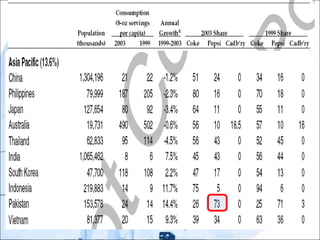
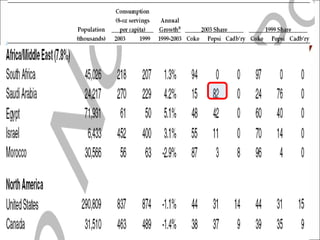
Internationalisation Next largest market : Mexico, Brazil, Germany, China, and the United Kingdom  Asia and Eastern Europe 837 eight ounce cans: 21 eight ounce cans Coke’s dominance  : Western Europe, much of Latin America, while  Pepsi  :Middle East and Southeast Asia. Coca-Cola became synonymous with American culture .  About 70% of Coke’s sales and about 80% of its profits came from outside the United States; only about one-third of Pepsi’s beverage sales took place overseas. Arab and Soviet exclusion of Coke
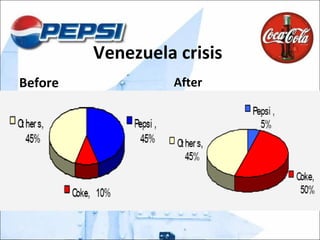
Venezuela crisis  Before  After
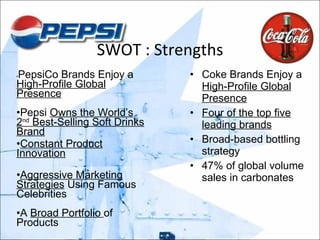
SWOT : Strengths Coke Brands Enjoy a  High-Profile Global Presence Four of the top five leading brands Broad-based bottling strategy 47% of global volume sales in carbonates • PepsiCo Brands Enjoy a  High-Profile Global Presence Pepsi  Owns the World’s 2 nd  Best-Selling Soft Drinks Brand Constant Product Innovation Aggressive Marketing Strategies  Using Famous Celebrities A  Broad Portfolio  of Products
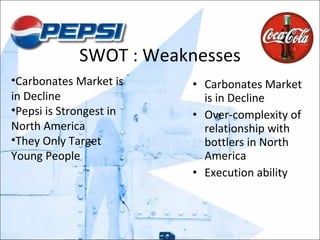
SWOT : Weaknesses Carbonates Market is in Decline Over-complexity of relationship with bottlers in North America Execution ability Carbonates Market is in Decline Pepsi is Strongest in North America They Only Target Young People
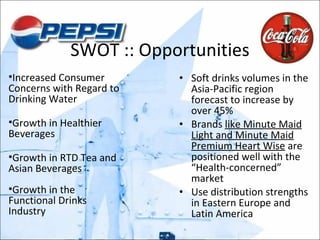
SWOT :: Opportunities Soft drinks volumes in the Asia-Pacific region forecast to increase by over 45% Brands  like Minute Maid Light and Minute Maid Premium Heart Wise  are positioned well with the “Health-concerned” market Use distribution strengths in Eastern Europe and Latin America Increased Consumer Concerns with Regard to Drinking Water Growth in Healthier Beverages Growth in RTD Tea and Asian Beverages Growth in the Functional Drinks Industry
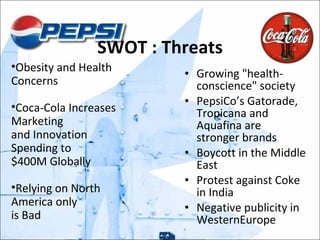
SWOT : Threats Growing "health-conscience" society PepsiCo’s Gatorade, Tropicana and Aquafina are stronger brands Boycott in the Middle East Protest against Coke in India Negative publicity in WesternEurope Obesity and Health Concerns Coca-Cola Increases Marketing and Innovation Spending to $400M Globally Relying on North America only is Bad
Profit Margins of Industry Concentrate  Producers and Bottlers
 
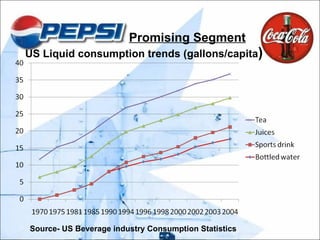
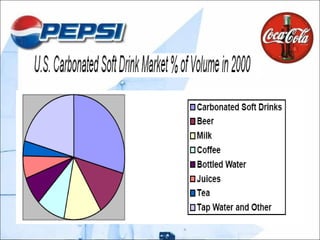
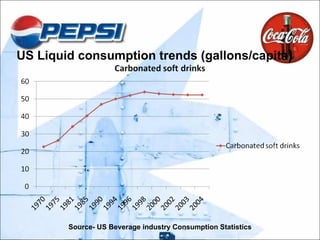
US Liquid consumption trends (gallons/capita ) Source- US Beverage industry Consumption Statistics
Promising Segment US Liquid consumption trends (gallons/capita ) Source- US Beverage industry Consumption Statistics
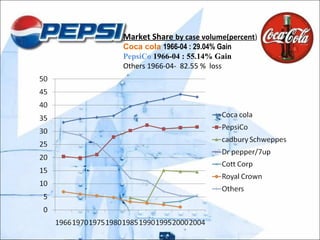
Market Share  by case volume(percent ) Coca cola  1966-04 : 29.04% Gain PepsiCo  1966-04 : 55.14% Gain Others 1966-04-  82.55 %  loss
 
 
Q:Who has been losing? Smaller Brands: Because-Entry Barrier, Duopoly
Q: Who has been wining the war? 1950: Coke have 47% and Pepsi have 10% 1970: Coke have 35% and Pepsi have 29% 1990: Coke have 41% and Pepsi have 32% 2000:Coke have 44%Pepsi have31.4% other beverage Cadbury Schweppes 14.7% 2006:Coke have 43.1% Pepsi have 31.7% Cadbury Schweppes 14.5%
Key questions Q: Could they boost flagging domestic CSD sales? Through Product innovation Aggressive marketing and promotion Packaging innovations
Would newly popular beverages provide them with new (and profitable) revenue streams? Yes Non carb and Bottled water contribution to Total volume growth: Coke-100%, Pepsi-75 Contamination issue, Obesity issue
Q-Can Coke and Pepsi sustain their profits in the wake of flattening demand and the growing popularity of non-CSDs? Coke and Pepsi did not just inherit this business they created it.  By diversification. Innovation : e.g  diet coke
Thank  you

Cola Wars03

  • 1.
    Cola Wars Continue Case Study Analysis Presented by- Dhirendra Singh Erwin Saurabh Tigga Debabrata Swain Dilip Kumar Ganesan.M
  • 2.
    War over $66bnindustry lasted between 1950-1990s
  • 3.
    New Challenges Colawars continued into the 21st century with new challenges Was their era of sustained growth and profitability coming to a close? Could they boost flagging domestic CSD sales? Would newly popular beverages provide them with new (and profitable) revenue streams?
  • 4.
    Production & distributionof CSD concentrate producers Bottlers Retail channels suppliers
  • 5.
    Concentrate Producer Blendedraw material ingredients,packaged the mixture, shipped those container to the bottler. Key production investment areas - machinery, overhead and labor. A typical manufacturing plant cost - $25 million to $50 million
  • 6.
    Concentrate Producer Significantcosts were for advertising, promotion, market research. Coca-Cola and Pepsi-Cola claimed a combined 74.8% of the U.S. CSD market in sales volume in 2004
  • 7.
    Bottlers Bottlerspurchased concentrate Added carbonated water and high-fructose corn syrup Bottled or canned the resulting CSD product Delivered it to customer account
  • 8.
    Bottlers Bottlingprocess is capital intensive. Packaging accounted for 40% to 45% of sales, same for concentrate and sweeteners for 5% to 10%. Coke and Pepsi bottlers offered “direct store door delivery”. Cooperative merchandizing agreements is a key ingredient of soft drink sales.
  • 9.
    Profitability Concentrateproducer earn more profit than bottler. Cost of sale is more in bottler.
  • 10.
    Retail channel Super markets Vending machines Convenience stores Gas stations
  • 11.
    Suppliers to BottlersCoke and Pepsi were among the metal can industry’s largest customers. Major can producers- Ball, Rexam, Crown Cork & Seal
  • 12.
  • 13.
  • 14.
    Cola War begins“ Beat Coke” “ Pepsi Generation” “ young at heart.” Concentrate Price 20% lower 1970 – larger bottlers “ American’s preferred taste” “ No wonder Coke refreshes best”
  • 15.
    Year 1960s – the Armageddon Fanta (1960) Sprite (1961) Low calorie cola Tab (1963) Non-CSD (Purchased) Minute Maid (fruit juice) Duncan foods (coffee, tea, hot chocolate) Belmont Springs water Teem (1960) Mountain Dew (1964) Diet Pepsi (1964) Non-CSD (Merged) Frito Lays
  • 16.
    Pepsi’s Challenge Blindtaste test Eroded Coke’s Market share Part of Pepsi’s promotional strategy not a part of marketing research. Rebates Retail price cuts Advertisements that questions tests validity 1978 – Re-negotiation of contract with franchisee bottlers
  • 17.
    Leadership 1980 –Roberto Goizueta Share price rose by 3500% Most valuable Brand Use of lower priced corn syrup against sugar Double spending on ads 1981-84 Sold non-CSD business Diet Coke (1982) 2001: Steve Reinemund “Grow the core add some more” Launched new CSD products (Sierra Mist, Mountain Dew code red) Acquisition of Quaker Oats Net income raised by 17.6% per year ROI capital 29.3 (2003) from 9.5 (1996 )
  • 18.
    Product Launch Teem(1960) Mountain Dew (1964) Diet Pepsi (1964) Lemon Lime Slice (1984) Caffeine free Pepsi Cola (1987) Sierra Mist (2000) Mountain Dew Code Red (2001) Pepsi One (2005) Diet Coke with Splenda (2005) Fanta (1960) Sprite (1961) Low calorie cola Tab (1963) Diet Coke (1982) Caffeine free coke (1983) Coca-Cola Classic (1985) New Coke (1985) Cherry Coke (1985) Sierra Mist Free (2004) Coca-Cola Zero (2005)
  • 19.
  • 20.
  • 21.
  • 22.
    Expansions Acquired –Pizza hut (1978), Toco Bell (1986), KFC (1986) Merged with Frito Lay to form PepsiCo Pepsi purchased Quaker Oats Exclusive deals with Burger king, McDonalds Purchased Minute Maid, Duncan Foods, Belmont Springs water Acquired – Planet Java coffee drink brand Acquired - Mad River juices and tea
  • 23.
    Marketing Campaigns Pepsigeneration Young at heart Pepsi challenge Smart Spot – good for you Americans Preferred Taste No wonder Coke refreshes best
  • 24.
    Challenges Flat demandduring 1998 to 2004. Contamination scare at India Obesity Issue Challenges of Internationalization
  • 25.
    Challenges to Coca-ColaPerformance & execution : on providing alternative beverages on adjusting key strategic relationships, on cultivating international markets Currency crisis in Asia and Russia Recall in Belgium – (public relations disaster) Series of legal problems
  • 26.
    1996-2004:reversal of fortunePepsi flourished Acquisition of Quaker oats 3% growth 2004 Net income rose by 17.6% per year ROI 29.3% from 9.5%(1996) Shareholders return 46% Coke struggled Flat growth Annual growth in net income falls to 4.2% from 18%(1990-96) Shareholders return -26%
  • 27.
    Quest for alternativesMarket share: CSD- 80%(2000) to 73.1%(2004) Diet soda- 24.6%(1997) to 29.1%(2004) Bottled water 6.6%(2000) to 13.2%(2004) Non-carbs 12.6%(2000) to 13.7%(2004) Non-carbs & bottled water contribution to volume growth – coke 100% & Pepsi 75%
  • 28.
    Quest for alternativesNo longer designing of marketing course Diet Pepsi, Pepsi One, Diet Coke with slpenda Diet Pepsi as flagship brand Non-CSD: total beverage company Reluctant to diversify
  • 29.
    Evolving stuctures andstratgies System profitability Price war low -cost strategy by the bottlers Incidence pricing Retailers resist price increases(Wal-Mart) Coke’s relationship with bottlers : Dysfunctional,
  • 30.
    Internationalisation Next largestmarket : Mexico, Brazil, Germany, China, and the United Kingdom Asia and Eastern Europe 837 eight ounce cans: 21 eight ounce cans Coke’s dominance : Western Europe, much of Latin America, while Pepsi :Middle East and Southeast Asia. Coca-Cola became synonymous with American culture . About 70% of Coke’s sales and about 80% of its profits came from outside the United States; only about one-third of Pepsi’s beverage sales took place overseas. Arab and Soviet exclusion of Coke
  • 31.
    Venezuela crisis Before After
  • 32.
    SWOT : StrengthsCoke Brands Enjoy a High-Profile Global Presence Four of the top five leading brands Broad-based bottling strategy 47% of global volume sales in carbonates • PepsiCo Brands Enjoy a High-Profile Global Presence Pepsi Owns the World’s 2 nd Best-Selling Soft Drinks Brand Constant Product Innovation Aggressive Marketing Strategies Using Famous Celebrities A Broad Portfolio of Products
  • 33.
    SWOT : WeaknessesCarbonates Market is in Decline Over-complexity of relationship with bottlers in North America Execution ability Carbonates Market is in Decline Pepsi is Strongest in North America They Only Target Young People
  • 34.
    SWOT :: OpportunitiesSoft drinks volumes in the Asia-Pacific region forecast to increase by over 45% Brands like Minute Maid Light and Minute Maid Premium Heart Wise are positioned well with the “Health-concerned” market Use distribution strengths in Eastern Europe and Latin America Increased Consumer Concerns with Regard to Drinking Water Growth in Healthier Beverages Growth in RTD Tea and Asian Beverages Growth in the Functional Drinks Industry
  • 35.
    SWOT : ThreatsGrowing "health-conscience" society PepsiCo’s Gatorade, Tropicana and Aquafina are stronger brands Boycott in the Middle East Protest against Coke in India Negative publicity in WesternEurope Obesity and Health Concerns Coca-Cola Increases Marketing and Innovation Spending to $400M Globally Relying on North America only is Bad
  • 36.
    Profit Margins ofIndustry Concentrate Producers and Bottlers
  • 37.
  • 38.
    US Liquid consumptiontrends (gallons/capita ) Source- US Beverage industry Consumption Statistics
  • 39.
    Promising Segment USLiquid consumption trends (gallons/capita ) Source- US Beverage industry Consumption Statistics
  • 40.
    Market Share by case volume(percent ) Coca cola 1966-04 : 29.04% Gain PepsiCo 1966-04 : 55.14% Gain Others 1966-04- 82.55 % loss
  • 41.
  • 42.
  • 43.
    Q:Who has beenlosing? Smaller Brands: Because-Entry Barrier, Duopoly
  • 44.
    Q: Who hasbeen wining the war? 1950: Coke have 47% and Pepsi have 10% 1970: Coke have 35% and Pepsi have 29% 1990: Coke have 41% and Pepsi have 32% 2000:Coke have 44%Pepsi have31.4% other beverage Cadbury Schweppes 14.7% 2006:Coke have 43.1% Pepsi have 31.7% Cadbury Schweppes 14.5%
  • 45.
    Key questions Q:Could they boost flagging domestic CSD sales? Through Product innovation Aggressive marketing and promotion Packaging innovations
  • 46.
    Would newly popularbeverages provide them with new (and profitable) revenue streams? Yes Non carb and Bottled water contribution to Total volume growth: Coke-100%, Pepsi-75 Contamination issue, Obesity issue
  • 47.
    Q-Can Coke andPepsi sustain their profits in the wake of flattening demand and the growing popularity of non-CSDs? Coke and Pepsi did not just inherit this business they created it. By diversification. Innovation : e.g diet coke
  • 48.