CROSSING OVER
BY: M. JANANI
III B.SC. ZOOLOGY
212018006
DEFINITION OF CROSSING OVER
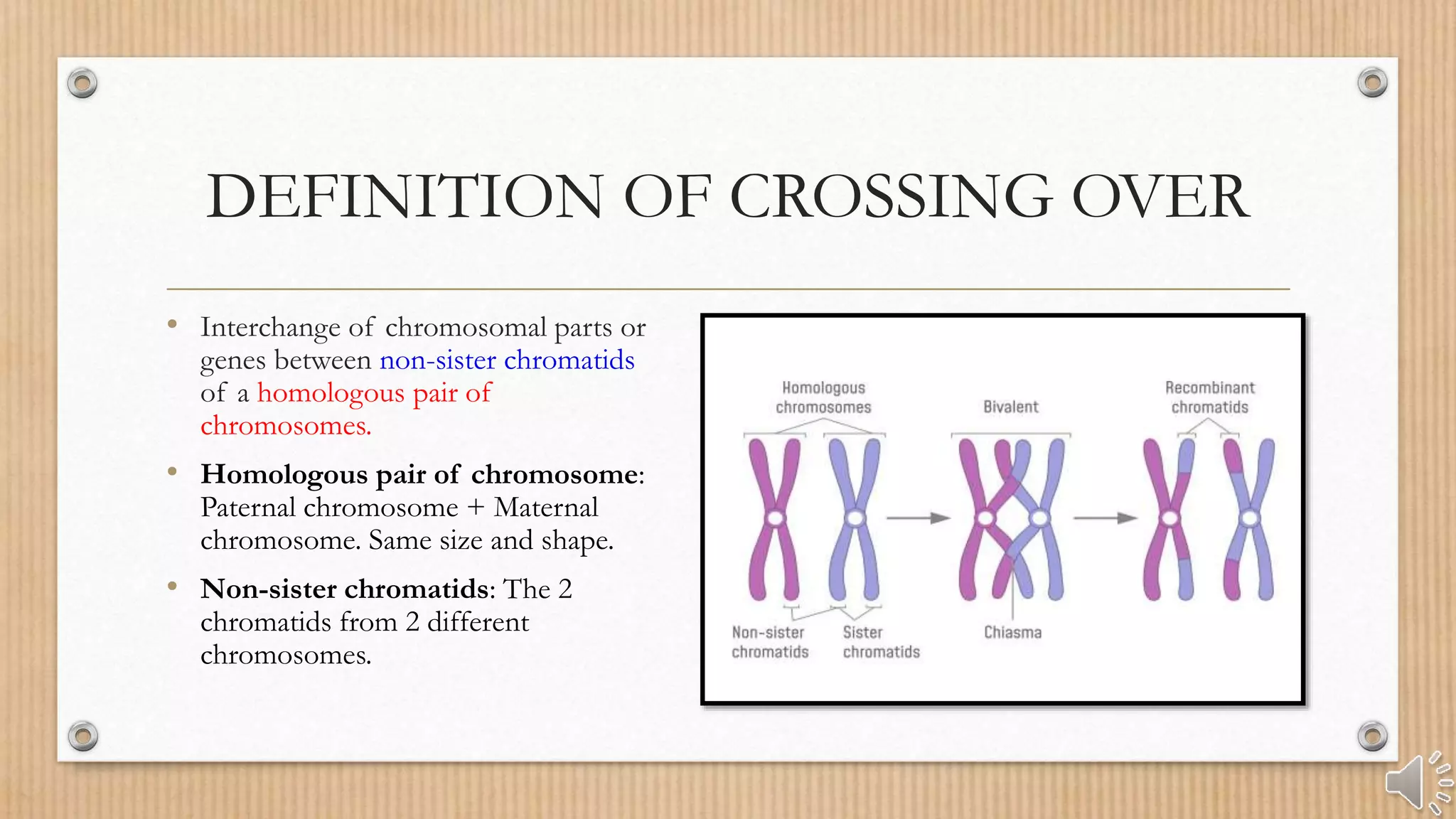
• Interchange of chromosomal parts or
genes between non-sister chromatids
of a homologous pair of
chromosomes.
• Homologous pair of chromosome:
Paternal chromosome + Maternal
chromosome. Same size and shape.
• Non-sister chromatids: The 2
chromatids from 2 different
chromosomes.
SALIENT FEATURES OF CROSSING
OVER
• Discovered by Morgan
• Crossing over results in recombination of genes , thus promoting genetic
diversity.
• Results in the formation of chiasmata ; the point of contact, the physical link,
between two non-sister chromatids belonging to homologous chromosomes. At a
given chiasma, an exchange of genetic material can occur. Absence of a chiasma
generally results in improper segregation and aneuploidy.
• It occurs during meiosis (pachytene).
• It occurs only between non-sister chromatids of homologous chromosomes.
SALIENT FEATURES OF CROSSING
OVER
• Number/Frequency/Percentage of crossing over depends on the length of the
chromosome and distance between the chromosomes
• Usually crossing over is less frequent near the centromere and tip of the
chromosome.
• Crossing over at one point prevents another crossing over nearby.
TYPES OF CROSSING OVER
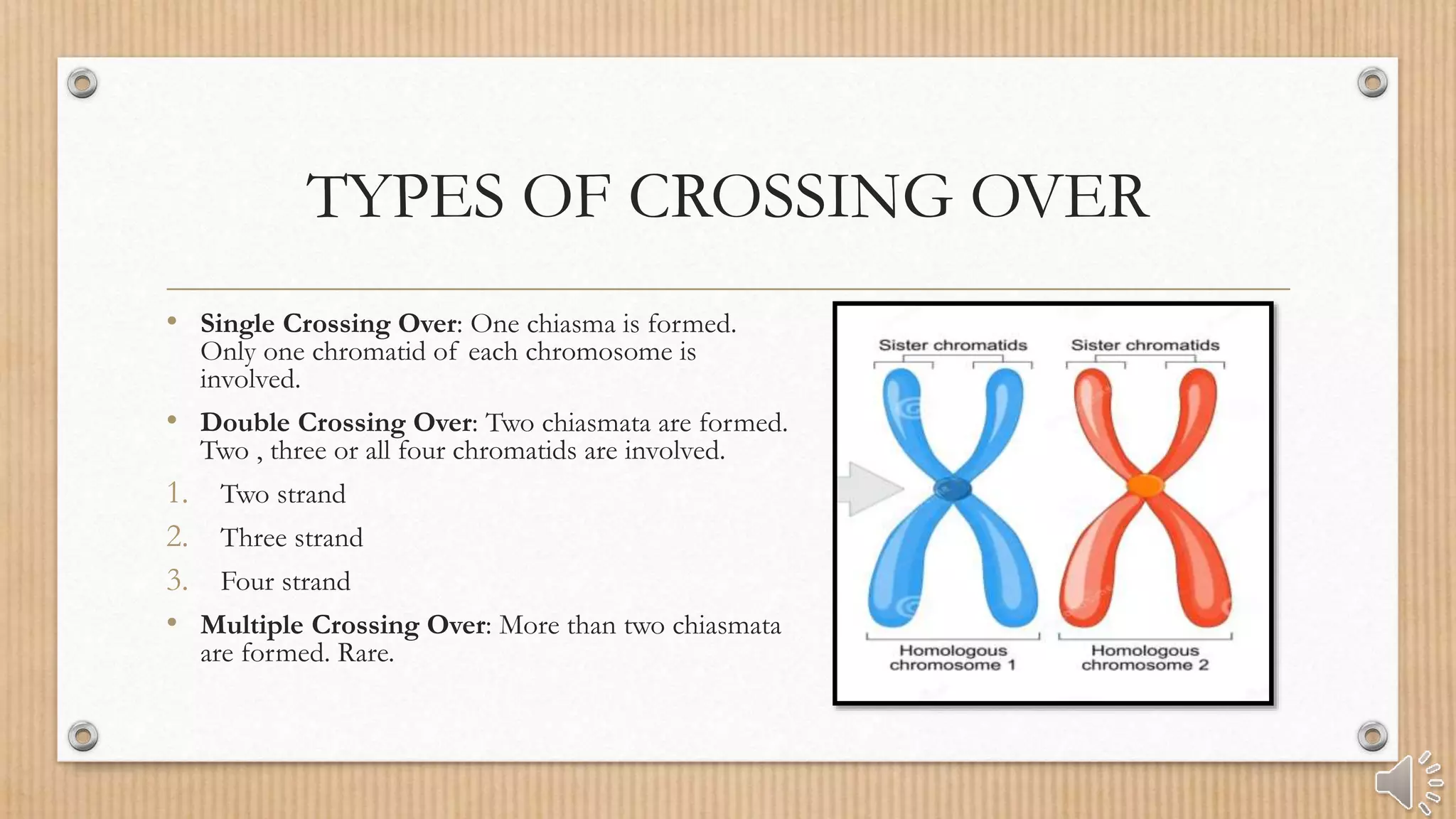
• Single Crossing Over: One chiasma is formed.
Only one chromatid of each chromosome is
involved.
• Double Crossing Over: Two chiasmata are formed.
Two , three or all four chromatids are involved.
1. Two strand
2. Three strand
3. Four strand
• Multiple Crossing Over: More than two chiasmata
are formed. Rare.
FACTORS AFFECTING CROSSING OVER
• Temperature
• X Rays
• Age
• Inversion of chromosome
• Location
• Interference
• Mutation
MECHANISMS OR THEORIES OF
CROSSING OVER
CHIASMA TYPE THEORY BREAKAGE FIRST THEORY
STRAIN OR TORSION
THEORY
• CONTACT FIRST THEORY
• DIFFERENTIAL
CONTRACTION THEORY
TETRAD ANALYSIS
SIGNIFICANCE
• Linear arrangement of genes
• Chromosome map
• Recombination
• Variations
THANK YOU

CROSSING OVER

  • 1.
    CROSSING OVER BY: M.JANANI III B.SC. ZOOLOGY 212018006
  • 2.
    DEFINITION OF CROSSINGOVER • Interchange of chromosomal parts or genes between non-sister chromatids of a homologous pair of chromosomes. • Homologous pair of chromosome: Paternal chromosome + Maternal chromosome. Same size and shape. • Non-sister chromatids: The 2 chromatids from 2 different chromosomes.
  • 3.
    SALIENT FEATURES OFCROSSING OVER • Discovered by Morgan • Crossing over results in recombination of genes , thus promoting genetic diversity. • Results in the formation of chiasmata ; the point of contact, the physical link, between two non-sister chromatids belonging to homologous chromosomes. At a given chiasma, an exchange of genetic material can occur. Absence of a chiasma generally results in improper segregation and aneuploidy. • It occurs during meiosis (pachytene). • It occurs only between non-sister chromatids of homologous chromosomes.
  • 4.
    SALIENT FEATURES OFCROSSING OVER • Number/Frequency/Percentage of crossing over depends on the length of the chromosome and distance between the chromosomes • Usually crossing over is less frequent near the centromere and tip of the chromosome. • Crossing over at one point prevents another crossing over nearby.
  • 5.
    TYPES OF CROSSINGOVER • Single Crossing Over: One chiasma is formed. Only one chromatid of each chromosome is involved. • Double Crossing Over: Two chiasmata are formed. Two , three or all four chromatids are involved. 1. Two strand 2. Three strand 3. Four strand • Multiple Crossing Over: More than two chiasmata are formed. Rare.
  • 6.
    FACTORS AFFECTING CROSSINGOVER • Temperature • X Rays • Age • Inversion of chromosome • Location • Interference • Mutation
  • 7.
    MECHANISMS OR THEORIESOF CROSSING OVER CHIASMA TYPE THEORY BREAKAGE FIRST THEORY
  • 8.
    STRAIN OR TORSION THEORY •CONTACT FIRST THEORY • DIFFERENTIAL CONTRACTION THEORY
  • 9.
  • 10.
    SIGNIFICANCE • Linear arrangementof genes • Chromosome map • Recombination • Variations
  • 11.