Cross-cultural
Understanding
Working with diverse
cultures
ME, China, Africa
General Rules
 Read about the culture & ask people
 Sincerely respect the culture and show it
 Don’t give the impression that yours is superior
 Be open about your own culture – share info
 Be respectful about local customs/beliefs
 Beware of your own prejudices
 Be very, very polite – always
 Don’t stick to your own kind – make local friends
2
Don’t be judgmental – it will show
2, Essential Aspects
of Culture
Universal/Group/Personal
Invisible/Visible
4
Universal, Cultural or
Personal
 Universal: Ways in which all people in
all groups are the same
 Cultural: What a particular group of
people have in common with each other and
how they are different from other groups
 Personal: Ways in which each one of us
is different from everyone else, including
those in our group.
5
U / C / P Preferences
Men opening the door for women
Feeling sad on death of one's mother
Wearing black for bereavement
Looking at a person in the eyes when talking
Being punctual for an appointment
Writing from left to right
Having a liking for white lilies
Respecting old people
Using handwriting analysis to hire a person
Sitting down when drinking water
Paying dowry (Husband price)
Widows wearing only white clothing
Bathing daily
Shaking hands as a way of greeting
Eating with one's fingers
Please differentiate
6
Visible & Invisible
 All cultures have visible and invisible aspects.
 Invisible aspects influence the visible aspects.
 To understand a visible aspect it is essential to
know which invisible aspect is influencing it
 Invisible aspects have their roots in religious
beliefs, historical events or epochs,
geographical / climatic influences, gender
significance
Language is the most common key to culture
7
Group Exercise -
 On the next slide are a number of things
which characterize a culture. Some of these
are visible, others invisible.
 Separate the visible and the invisible
aspects of culture.
 Show how a particular invisible aspect of
culture influences/determines a visible
manifestation of culture.
8
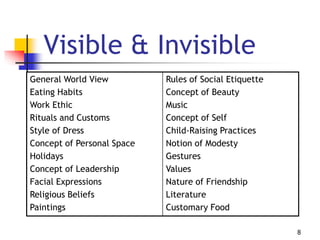
Visible & Invisible
General World View
Eating Habits
Work Ethic
Rituals and Customs
Style of Dress
Concept of Personal Space
Holidays
Concept of Leadership
Facial Expressions
Religious Beliefs
Paintings
Rules of Social Etiquette
Concept of Beauty
Music
Concept of Self
Child-Raising Practices
Notion of Modesty
Gestures
Values
Nature of Friendship
Literature
Customary Food
Reflection
 What are you prepared to do to work
with others?
 What are the things which will be
difficult and what will be easy?
 What is your plan to overcome
difficulties in order to succeed?
9
11
 Critical importance of maintaining face and
reputation. Never criticize, show up, or disgrace an
Arab publicly.
 Handshake: but not with women
 Importance of connections and networking (doing
business with the person, not the company)
 Work relationships are based on a sense of family,
security, and friendship. Preference for
personalized, oral communication.
Arab/ME Values
Essential to pronounce names correctly
 Decisions are made in personal encounters, not via
phone or letter. Most important decisions are made
by a small group of top executives who rely heavily
on emotion, feel, and interpersonal vibes.
 Great stress is given to elaborate hospitality in
business meetings. Arabs enjoy emotional, colorful,
close proximity communication.
 High value on commerce and business. Very shrewd
businessmen and very price conscious.
12
Arab/ME Values
Knowledge of Arabic is a major asset
Arab/ME Values
 Take care of those you are responsible for
 Your honor (‘Face’) is on the line
 Be loyal to your friends, nation/kingdom & religion
 Little difference between public & private behavior
 No backing down in public
 No tolerance of insults, especially to Allah & Islam
 Arabs hold royalty in high esteem. Rulers meet
openly with subjects on a grass roots level (Majlis)
to deal with their needs and problems.
13
There’s a great deal of social equality among Arabs
Do’s & Don’ts
 Never show the bottom of your foot. Keep both
feet on the ground and avoid crossing your legs.
 If your meeting with a company official in a Muslim
nation is frequently interrupted by drop-in
visitors, just sit patiently, since Arab cultures are
very polychronic (open to everyone).
 Arabs love children; they lavish a great deal of time
and attention on them. Likewise, the elderly are
greatly respected and cared for by their children.
Family is greatly valued and ties are maintained
 Very often, the first meeting (or first few meetings)
will simply be spent on polite small talk. While they
may seem casual, these preliminary meetings should
be taken seriously. During this time, your Arab
counterpart will be trying to evaluate subjectively if
business should take place in the future.
 Often, after an initial talk, your counterpart will
end the meeting and will invite you to come to
another meeting where the actual business
discussions will be conducted.
15
Do’s & Don’ts
Patience is the key. Impatience is fatal.
 Establishing a personal relationship of depth and
trust is one of the most important elements of
conducting business in the Middle East. You should
allow plenty of time for conducting transactions in
the Middle East. It is not acceptable to close deals
by phone or fax communication.
 Don’t be surprised if your Arab counterparts take
time to pray during a meeting. Simply be
patient. The period of prayer usually lasts only
about 20 minutes and the meeting will continue.
16
Do’s & Don’ts
Note similarities in culture with China, India & Africa
 In negotiating, a calm but firm, sincere and personal
approach works best. Arab business people do not
appreciate a ‘hard-sell’ approach or being hurried;
instead, lengthy haggling almost always occurs.
 Business meetings are rarely private. It is important
to be patient since there are often numerous
interruptions for phone calls and visitors. People
wander in and out of meetings, you may be asked to
deliver a presentation a number of times.
17
Do’s & Don’ts
Arabs will speak in Arabic to each other and no
insult is intended. Just be patient and smile.
 Generosity is considered one of the highest values in
Arab culture. The greatest compliment you can pay
your host is to acknowledge his generosity. Similarly,
when an Arab offers you a gift, it is impolite to refuse.
 Age is highly respected and associated with wisdom. To
increase your chances of success, it is recommended
that an older person be sent to meet with prospective
business partners. Sending a younger executive may
suggest to them that their business is not worthy of the
attention of the elders.
18
Do’s & Don’ts
Huge importance on politeness but don’t bow
 Arabs tend to stand very close and make direct eye
contact when talking to others. This is a sign of
courtesy and respect. They may also touch often, in
order to heighten communication.
 Be aware that people sometimes remove their shoes
before entering an Arab office. Check for shoes by
the door and leave your shoes there as well.
 To be invited to a meal in an Arab home is a great
honor. Men and women eat separately. Be sure to
thank your host for the honor.
19
Do’s & Don’ts
Your word is sacred & lying is the worst crime
 Never use the left hand for public matters (such as
eating, giving a business card, etc.)
 Don’t touch (back pat, shoulder tap, etc.)
 Never swear in public or talk about female family
members
 Avoid discussions of Middle Eastern politics
 Especially in the summer Arab businesses take a
very long siesta and work until late in the night
 Restaurants have family and bachelor areas
20
Do’s & Don’ts
In Arabia do as the Arabs do
21
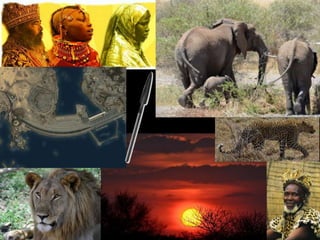
Africa
 Is a continent with many countries, cultures,
tribes, languages, colors and religions
 But some things are common to most of
them
 Most African business dealing is Westernized
 For others, observe, listen and ask politely if
you have a doubt
22
If in doubt follow your host
Address
 The northern countries bordering the
Mediterranean are Islamic, and you can
expect their kind of lavish generosity,
indirect business discussions, expansive
sense of time,
 You can never go wrong by using last names
and titles when you first meet. Academic
titles are commonly used.
23
Formality is safe. No first names
Local customs
 Conservative is the keyword.
 Africans are justly famous for the pleasure they take
in eating and entertaining and for their generosity.
If you are invited to someone's home almost
anywhere in Africa, be prepared – your host will go
all out to impress you.
 In business you are likely to be dealing with
Westernized Africans in big cities but do remember
that the real Africa (like the real India) is not in the
cities.
24
Take time out to see the real Africa
25
Biggest Chinese asset
 China National Highway (2743 km) 1951-57, with
elevation ranging from 300 – 5050 meters.
 Qinghai-Tibet highway (1160 km) 1950-54, starts from
Xining, Qinghai Province, crosses four mountains, Kunlun
Mountain (4,700 meters), Fenghuo Mountain (4,800
meters), Tangula Mountain ( 5,150 meters at the
mountain pass), and Nyainqentanglha Mountain.
 It spans three rivers, Tongtian River, Tuotuo River and
Chuma’er River, averaging 4,500 meters.
 Parts of it built on permafrost which rises and falls.
26Discipline
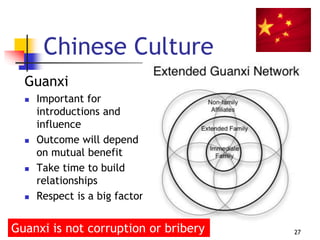
Chinese Culture
Guanxi
 Important for
introductions and
influence
 Outcome will depend
on mutual benefit
 Take time to build
relationships
 Respect is a big factor
27Guanxi is not corruption or bribery
Guanxi
 Guanxi – In literal terms, this central concept in Chinese
culture means ‘relationships’ or ‘connections’.
 Guanxi is networking, ‘wasta’, who-knows-who.
 Establishing a sincere, supportive relationship based on
mutual respect is a fundamental aspect of Chinese
culture.
 Having the right Guanxi is crucial for ensuring success in
business.
 Building Guanxi takes time and investment in relationships
28
Without Guanxi you will learn the meaning
of ‘The Great Wall of China’
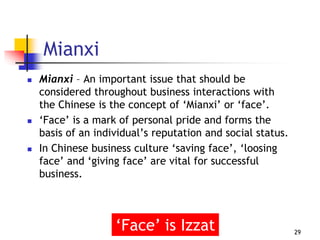
Mianxi
 Mianxi – An important issue that should be
considered throughout business interactions with
the Chinese is the concept of ‘Mianxi’ or ‘face’.
 ‘Face’ is a mark of personal pride and forms the
basis of an individual’s reputation and social status.
 In Chinese business culture ‘saving face’, ‘loosing
face’ and ‘giving face’ are vital for successful
business.
29
‘Face’ is Izzat
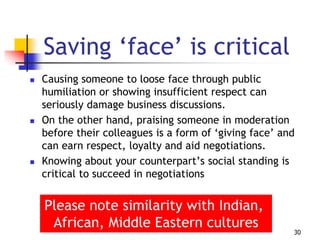
Saving ‘face’ is critical
 Causing someone to loose face through public
humiliation or showing insufficient respect can
seriously damage business discussions.
 On the other hand, praising someone in moderation
before their colleagues is a form of ‘giving face’ and
can earn respect, loyalty and aid negotiations.
 Knowing about your counterpart’s social standing is
critical to succeed in negotiations
30
Please note similarity with Indian,
African, Middle Eastern cultures
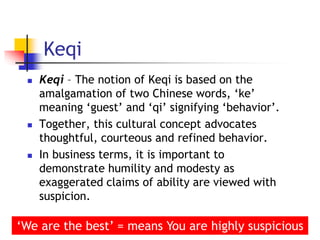
Keqi
 Keqi – The notion of Keqi is based on the
amalgamation of two Chinese words, ‘ke’
meaning ‘guest’ and ‘qi’ signifying ‘behavior’.
 Together, this cultural concept advocates
thoughtful, courteous and refined behavior.
 In business terms, it is important to
demonstrate humility and modesty as
exaggerated claims of ability are viewed with
suspicion.
31
‘We are the best’ = means You are highly suspicious
Do’s
 Maintain eye contact, avoiding eye contact is
considered untrustworthy.
 Address your Chinese counterparts with a
title and their last name. If the person does
not have a title, use ‘Mr’ or ‘Madam’.
 Wait for your Chinese counterpart to initiate
formal greetings. Handshakes are the most
popular gesture.
32
Smile, bow and let them take the lead
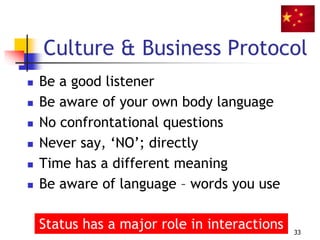
Culture & Business Protocol
 Be a good listener
 Be aware of your own body language
 No confrontational questions
 Never say, ‘NO’; directly
 Time has a different meaning
 Be aware of language – words you use
33
Status has a major role in interactions
Culture & Business Protocol
 Make friends first – business later
 Indirect approach better
 Use intermediaries
 Never put your counterpart in a spot
 ‘Face’ – has a lot of value
 Contracts & agreements are sacrosanct
34
Invest in good relationships – be genuine
Don’ts
 DON’T EVER BE LATE
 DON’T assume that a nod is a sign of
agreement but that the person is listening.
 DON’T show excessive emotion
 DON’T raise your voice. Speak softly
 DON’T ask direct questions
35
Never use first names – it is considered rude
Interpreting Language
 Everything is possible
 Nothing is easy
 Patience is the essence of success
 ‘You don’t understand’; means ‘We don’t
agree’
 Yes and No – both are not absolute so check
for conditions and possibilities
36
Western directness will backfire
Interpreting Language
 Chinese decide slowly but stick to their
decision
 Try to see and feel things their way
 When it looks easy – it is going to get tough
 If it looks tough - everything is possible
 Easy to get things done – provided you get
agreement from the people
37
Notice similarities with Indian culture
Business etiquette
 The exchanging of business cards is customary in
Chinese business culture. One side should be printed
in English and one in Chinese. You should present
your card with both hands and with the Chinese side
facing up. When accepting your colleague’s card
study it carefully before placing it on the table,
never in the back pocket, as this is extremely
disrespectful.
 Never sit with your feet in the direction of your
counterpart
38
More respect is better than less
 During negotiations, humbleness and patience is the
key to success. The Chinese use time knowingly and
there is always enough.
 Initial meetings will be more of a social opportunity
and not a negotiation discussion. Take the cue from
your counterpart to start talking business.
 Don’t talk business if you are invited to a social
event or dinner unless your counterpart initiates
conversation or invites you to do so
39
Business etiquette
Talking business during social events is bad manners
Chinese, African,
Middle Eastern
Similarities & Differences
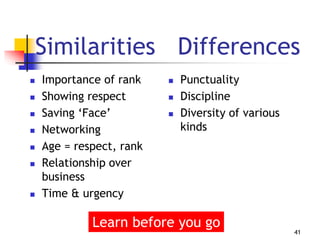
Similarities Differences
 Importance of rank
 Showing respect
 Saving ‘Face’
 Networking
 Age = respect, rank
 Relationship over
business
 Time & urgency
 Punctuality
 Discipline
 Diversity of various
kinds
41
Learn before you go
Cultures Consequences
Geert Hofstede’s Theory
Hofstede Analysis
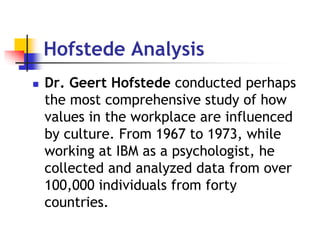
 Dr. Geert Hofstede conducted perhaps
the most comprehensive study of how
values in the workplace are influenced
by culture. From 1967 to 1973, while
working at IBM as a psychologist, he
collected and analyzed data from over
100,000 individuals from forty
countries.
Primary Dimensions – 1
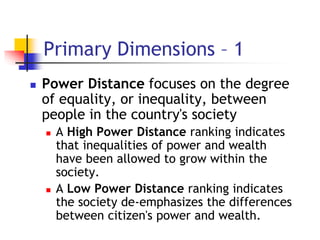
 Power Distance focuses on the degree
of equality, or inequality, between
people in the country's society
 A High Power Distance ranking indicates
that inequalities of power and wealth
have been allowed to grow within the
society.
 A Low Power Distance ranking indicates
the society de-emphasizes the differences
between citizen's power and wealth.
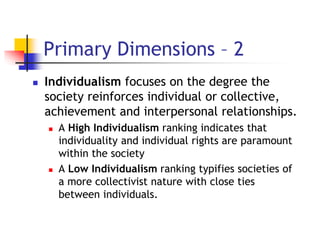
Primary Dimensions – 2
 Individualism focuses on the degree the
society reinforces individual or collective,
achievement and interpersonal relationships.
 A High Individualism ranking indicates that
individuality and individual rights are paramount
within the society
 A Low Individualism ranking typifies societies of
a more collectivist nature with close ties
between individuals.
Primary Dimensions – 3
 Masculinity focuses on the degree the
society reinforces, or does not reinforce, the
traditional masculine work role model of
male achievement, control, and power
 A High Masculinity ranking indicates the country
experiences a high degree of gender
differentiation.
 A Low Masculinity ranking indicates the country
has a low level of differentiation and
discrimination between genders
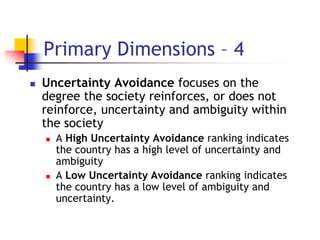
Primary Dimensions – 4
 Uncertainty Avoidance focuses on the
degree the society reinforces, or does not
reinforce, uncertainty and ambiguity within
the society
 A High Uncertainty Avoidance ranking indicates
the country has a high level of uncertainty and
ambiguity
 A Low Uncertainty Avoidance ranking indicates
the country has a low level of ambiguity and
uncertainty.
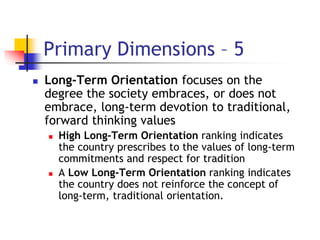
Primary Dimensions – 5
 Long-Term Orientation focuses on the
degree the society embraces, or does not
embrace, long-term devotion to traditional,
forward thinking values
 High Long-Term Orientation ranking indicates
the country prescribes to the values of long-term
commitments and respect for tradition
 A Low Long-Term Orientation ranking indicates
the country does not reinforce the concept of
long-term, traditional orientation.
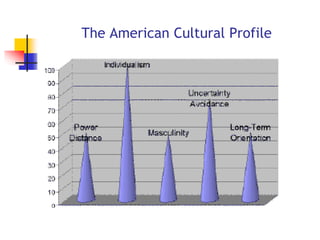
The American Cultural Profile
Exercise
 What do you think are the implications
of this culture to developing business?
 What could be some strategies you
could adopt to take advantage of the
strengths of this culture?
 What are some elements of this culture
which can cause you problems?
20 minutes
For comments/thought-share
www.yawarbaig.com

Cross cultural understanding

  • 1.
  • 2.
    General Rules  Readabout the culture & ask people  Sincerely respect the culture and show it  Don’t give the impression that yours is superior  Be open about your own culture – share info  Be respectful about local customs/beliefs  Beware of your own prejudices  Be very, very polite – always  Don’t stick to your own kind – make local friends 2 Don’t be judgmental – it will show
  • 3.
    2, Essential Aspects ofCulture Universal/Group/Personal Invisible/Visible
  • 4.
    4 Universal, Cultural or Personal Universal: Ways in which all people in all groups are the same  Cultural: What a particular group of people have in common with each other and how they are different from other groups  Personal: Ways in which each one of us is different from everyone else, including those in our group.
  • 5.
    5 U / C/ P Preferences Men opening the door for women Feeling sad on death of one's mother Wearing black for bereavement Looking at a person in the eyes when talking Being punctual for an appointment Writing from left to right Having a liking for white lilies Respecting old people Using handwriting analysis to hire a person Sitting down when drinking water Paying dowry (Husband price) Widows wearing only white clothing Bathing daily Shaking hands as a way of greeting Eating with one's fingers Please differentiate
  • 6.
    6 Visible & Invisible All cultures have visible and invisible aspects.  Invisible aspects influence the visible aspects.  To understand a visible aspect it is essential to know which invisible aspect is influencing it  Invisible aspects have their roots in religious beliefs, historical events or epochs, geographical / climatic influences, gender significance Language is the most common key to culture
  • 7.
    7 Group Exercise - On the next slide are a number of things which characterize a culture. Some of these are visible, others invisible.  Separate the visible and the invisible aspects of culture.  Show how a particular invisible aspect of culture influences/determines a visible manifestation of culture.
  • 8.
    8 Visible & Invisible GeneralWorld View Eating Habits Work Ethic Rituals and Customs Style of Dress Concept of Personal Space Holidays Concept of Leadership Facial Expressions Religious Beliefs Paintings Rules of Social Etiquette Concept of Beauty Music Concept of Self Child-Raising Practices Notion of Modesty Gestures Values Nature of Friendship Literature Customary Food
  • 9.
    Reflection  What areyou prepared to do to work with others?  What are the things which will be difficult and what will be easy?  What is your plan to overcome difficulties in order to succeed? 9
  • 11.
    11  Critical importanceof maintaining face and reputation. Never criticize, show up, or disgrace an Arab publicly.  Handshake: but not with women  Importance of connections and networking (doing business with the person, not the company)  Work relationships are based on a sense of family, security, and friendship. Preference for personalized, oral communication. Arab/ME Values Essential to pronounce names correctly
  • 12.
     Decisions aremade in personal encounters, not via phone or letter. Most important decisions are made by a small group of top executives who rely heavily on emotion, feel, and interpersonal vibes.  Great stress is given to elaborate hospitality in business meetings. Arabs enjoy emotional, colorful, close proximity communication.  High value on commerce and business. Very shrewd businessmen and very price conscious. 12 Arab/ME Values Knowledge of Arabic is a major asset
  • 13.
    Arab/ME Values  Takecare of those you are responsible for  Your honor (‘Face’) is on the line  Be loyal to your friends, nation/kingdom & religion  Little difference between public & private behavior  No backing down in public  No tolerance of insults, especially to Allah & Islam  Arabs hold royalty in high esteem. Rulers meet openly with subjects on a grass roots level (Majlis) to deal with their needs and problems. 13 There’s a great deal of social equality among Arabs
  • 14.
    Do’s & Don’ts Never show the bottom of your foot. Keep both feet on the ground and avoid crossing your legs.  If your meeting with a company official in a Muslim nation is frequently interrupted by drop-in visitors, just sit patiently, since Arab cultures are very polychronic (open to everyone).  Arabs love children; they lavish a great deal of time and attention on them. Likewise, the elderly are greatly respected and cared for by their children. Family is greatly valued and ties are maintained
  • 15.
     Very often,the first meeting (or first few meetings) will simply be spent on polite small talk. While they may seem casual, these preliminary meetings should be taken seriously. During this time, your Arab counterpart will be trying to evaluate subjectively if business should take place in the future.  Often, after an initial talk, your counterpart will end the meeting and will invite you to come to another meeting where the actual business discussions will be conducted. 15 Do’s & Don’ts Patience is the key. Impatience is fatal.
  • 16.
     Establishing apersonal relationship of depth and trust is one of the most important elements of conducting business in the Middle East. You should allow plenty of time for conducting transactions in the Middle East. It is not acceptable to close deals by phone or fax communication.  Don’t be surprised if your Arab counterparts take time to pray during a meeting. Simply be patient. The period of prayer usually lasts only about 20 minutes and the meeting will continue. 16 Do’s & Don’ts Note similarities in culture with China, India & Africa
  • 17.
     In negotiating,a calm but firm, sincere and personal approach works best. Arab business people do not appreciate a ‘hard-sell’ approach or being hurried; instead, lengthy haggling almost always occurs.  Business meetings are rarely private. It is important to be patient since there are often numerous interruptions for phone calls and visitors. People wander in and out of meetings, you may be asked to deliver a presentation a number of times. 17 Do’s & Don’ts Arabs will speak in Arabic to each other and no insult is intended. Just be patient and smile.
  • 18.
     Generosity isconsidered one of the highest values in Arab culture. The greatest compliment you can pay your host is to acknowledge his generosity. Similarly, when an Arab offers you a gift, it is impolite to refuse.  Age is highly respected and associated with wisdom. To increase your chances of success, it is recommended that an older person be sent to meet with prospective business partners. Sending a younger executive may suggest to them that their business is not worthy of the attention of the elders. 18 Do’s & Don’ts Huge importance on politeness but don’t bow
  • 19.
     Arabs tendto stand very close and make direct eye contact when talking to others. This is a sign of courtesy and respect. They may also touch often, in order to heighten communication.  Be aware that people sometimes remove their shoes before entering an Arab office. Check for shoes by the door and leave your shoes there as well.  To be invited to a meal in an Arab home is a great honor. Men and women eat separately. Be sure to thank your host for the honor. 19 Do’s & Don’ts Your word is sacred & lying is the worst crime
  • 20.
     Never usethe left hand for public matters (such as eating, giving a business card, etc.)  Don’t touch (back pat, shoulder tap, etc.)  Never swear in public or talk about female family members  Avoid discussions of Middle Eastern politics  Especially in the summer Arab businesses take a very long siesta and work until late in the night  Restaurants have family and bachelor areas 20 Do’s & Don’ts In Arabia do as the Arabs do
  • 21.
  • 22.
    Africa  Is acontinent with many countries, cultures, tribes, languages, colors and religions  But some things are common to most of them  Most African business dealing is Westernized  For others, observe, listen and ask politely if you have a doubt 22 If in doubt follow your host
  • 23.
    Address  The northerncountries bordering the Mediterranean are Islamic, and you can expect their kind of lavish generosity, indirect business discussions, expansive sense of time,  You can never go wrong by using last names and titles when you first meet. Academic titles are commonly used. 23 Formality is safe. No first names
  • 24.
    Local customs  Conservativeis the keyword.  Africans are justly famous for the pleasure they take in eating and entertaining and for their generosity. If you are invited to someone's home almost anywhere in Africa, be prepared – your host will go all out to impress you.  In business you are likely to be dealing with Westernized Africans in big cities but do remember that the real Africa (like the real India) is not in the cities. 24 Take time out to see the real Africa
  • 25.
  • 26.
    Biggest Chinese asset China National Highway (2743 km) 1951-57, with elevation ranging from 300 – 5050 meters.  Qinghai-Tibet highway (1160 km) 1950-54, starts from Xining, Qinghai Province, crosses four mountains, Kunlun Mountain (4,700 meters), Fenghuo Mountain (4,800 meters), Tangula Mountain ( 5,150 meters at the mountain pass), and Nyainqentanglha Mountain.  It spans three rivers, Tongtian River, Tuotuo River and Chuma’er River, averaging 4,500 meters.  Parts of it built on permafrost which rises and falls. 26Discipline
  • 27.
    Chinese Culture Guanxi  Importantfor introductions and influence  Outcome will depend on mutual benefit  Take time to build relationships  Respect is a big factor 27Guanxi is not corruption or bribery
  • 28.
    Guanxi  Guanxi –In literal terms, this central concept in Chinese culture means ‘relationships’ or ‘connections’.  Guanxi is networking, ‘wasta’, who-knows-who.  Establishing a sincere, supportive relationship based on mutual respect is a fundamental aspect of Chinese culture.  Having the right Guanxi is crucial for ensuring success in business.  Building Guanxi takes time and investment in relationships 28 Without Guanxi you will learn the meaning of ‘The Great Wall of China’
  • 29.
    Mianxi  Mianxi –An important issue that should be considered throughout business interactions with the Chinese is the concept of ‘Mianxi’ or ‘face’.  ‘Face’ is a mark of personal pride and forms the basis of an individual’s reputation and social status.  In Chinese business culture ‘saving face’, ‘loosing face’ and ‘giving face’ are vital for successful business. 29 ‘Face’ is Izzat
  • 30.
    Saving ‘face’ iscritical  Causing someone to loose face through public humiliation or showing insufficient respect can seriously damage business discussions.  On the other hand, praising someone in moderation before their colleagues is a form of ‘giving face’ and can earn respect, loyalty and aid negotiations.  Knowing about your counterpart’s social standing is critical to succeed in negotiations 30 Please note similarity with Indian, African, Middle Eastern cultures
  • 31.
    Keqi  Keqi –The notion of Keqi is based on the amalgamation of two Chinese words, ‘ke’ meaning ‘guest’ and ‘qi’ signifying ‘behavior’.  Together, this cultural concept advocates thoughtful, courteous and refined behavior.  In business terms, it is important to demonstrate humility and modesty as exaggerated claims of ability are viewed with suspicion. 31 ‘We are the best’ = means You are highly suspicious
  • 32.
    Do’s  Maintain eyecontact, avoiding eye contact is considered untrustworthy.  Address your Chinese counterparts with a title and their last name. If the person does not have a title, use ‘Mr’ or ‘Madam’.  Wait for your Chinese counterpart to initiate formal greetings. Handshakes are the most popular gesture. 32 Smile, bow and let them take the lead
  • 33.
    Culture & BusinessProtocol  Be a good listener  Be aware of your own body language  No confrontational questions  Never say, ‘NO’; directly  Time has a different meaning  Be aware of language – words you use 33 Status has a major role in interactions
  • 34.
    Culture & BusinessProtocol  Make friends first – business later  Indirect approach better  Use intermediaries  Never put your counterpart in a spot  ‘Face’ – has a lot of value  Contracts & agreements are sacrosanct 34 Invest in good relationships – be genuine
  • 35.
    Don’ts  DON’T EVERBE LATE  DON’T assume that a nod is a sign of agreement but that the person is listening.  DON’T show excessive emotion  DON’T raise your voice. Speak softly  DON’T ask direct questions 35 Never use first names – it is considered rude
  • 36.
    Interpreting Language  Everythingis possible  Nothing is easy  Patience is the essence of success  ‘You don’t understand’; means ‘We don’t agree’  Yes and No – both are not absolute so check for conditions and possibilities 36 Western directness will backfire
  • 37.
    Interpreting Language  Chinesedecide slowly but stick to their decision  Try to see and feel things their way  When it looks easy – it is going to get tough  If it looks tough - everything is possible  Easy to get things done – provided you get agreement from the people 37 Notice similarities with Indian culture
  • 38.
    Business etiquette  Theexchanging of business cards is customary in Chinese business culture. One side should be printed in English and one in Chinese. You should present your card with both hands and with the Chinese side facing up. When accepting your colleague’s card study it carefully before placing it on the table, never in the back pocket, as this is extremely disrespectful.  Never sit with your feet in the direction of your counterpart 38 More respect is better than less
  • 39.
     During negotiations,humbleness and patience is the key to success. The Chinese use time knowingly and there is always enough.  Initial meetings will be more of a social opportunity and not a negotiation discussion. Take the cue from your counterpart to start talking business.  Don’t talk business if you are invited to a social event or dinner unless your counterpart initiates conversation or invites you to do so 39 Business etiquette Talking business during social events is bad manners
  • 40.
  • 41.
    Similarities Differences  Importanceof rank  Showing respect  Saving ‘Face’  Networking  Age = respect, rank  Relationship over business  Time & urgency  Punctuality  Discipline  Diversity of various kinds 41 Learn before you go
  • 42.
  • 43.
    Hofstede Analysis  Dr.Geert Hofstede conducted perhaps the most comprehensive study of how values in the workplace are influenced by culture. From 1967 to 1973, while working at IBM as a psychologist, he collected and analyzed data from over 100,000 individuals from forty countries.
  • 44.
    Primary Dimensions –1  Power Distance focuses on the degree of equality, or inequality, between people in the country's society  A High Power Distance ranking indicates that inequalities of power and wealth have been allowed to grow within the society.  A Low Power Distance ranking indicates the society de-emphasizes the differences between citizen's power and wealth.
  • 45.
    Primary Dimensions –2  Individualism focuses on the degree the society reinforces individual or collective, achievement and interpersonal relationships.  A High Individualism ranking indicates that individuality and individual rights are paramount within the society  A Low Individualism ranking typifies societies of a more collectivist nature with close ties between individuals.
  • 46.
    Primary Dimensions –3  Masculinity focuses on the degree the society reinforces, or does not reinforce, the traditional masculine work role model of male achievement, control, and power  A High Masculinity ranking indicates the country experiences a high degree of gender differentiation.  A Low Masculinity ranking indicates the country has a low level of differentiation and discrimination between genders
  • 47.
    Primary Dimensions –4  Uncertainty Avoidance focuses on the degree the society reinforces, or does not reinforce, uncertainty and ambiguity within the society  A High Uncertainty Avoidance ranking indicates the country has a high level of uncertainty and ambiguity  A Low Uncertainty Avoidance ranking indicates the country has a low level of ambiguity and uncertainty.
  • 48.
    Primary Dimensions –5  Long-Term Orientation focuses on the degree the society embraces, or does not embrace, long-term devotion to traditional, forward thinking values  High Long-Term Orientation ranking indicates the country prescribes to the values of long-term commitments and respect for tradition  A Low Long-Term Orientation ranking indicates the country does not reinforce the concept of long-term, traditional orientation.
  • 49.
  • 50.
    Exercise  What doyou think are the implications of this culture to developing business?  What could be some strategies you could adopt to take advantage of the strengths of this culture?  What are some elements of this culture which can cause you problems? 20 minutes
  • 51.