Restoring dreams
Mirza Yawar Baig
Opening the world, one mind at a time©
Work Experience:
 International Speaker, Trainer, Author, Coach, Leadership
Consultant with 16 years in Corporate General
Management, 28 years in Training & Organizational
Development, specializing in Family Business Consulting &
Entrepreneurship
Director / Professional Member:
 Center for Conflict Resolution & Human Security
 Indian Society for Applied Behavioural Science
Entrepreneur:
 1994: Founded
Education:
 IIM-A , P-CMM®, MBTI©, WSA©, ISABS
Books:
 The Business of Family Business
 An Entrepreneur’s Diary
 Hiring Winners
 20.10.2010-55 – Life Lessons of 55 years
 Leadership Lessons from the life of Rasoolullah
 Understanding Islam – 52 Juma Khutbas
 Leadership is a Personal Choice
Member Consultant Panel:
USA
 GE Corporate University, Crotonville
 Oracle Corporate University, CA
 AMA International, New York
 Andersen Corporate University, MN
India
 SVP National Police Academy, Hyderabad
 AP Police Academy, Hyderabad
 SSB Academy, Gwaldam, Uttar Akhand
 LBS Academy of Administration, Mussoorie
Clients Include:
GE, Oracle, Motorola, Microsoft, IBM, Digital-Compaq,
National Semiconductor, Unilever, BSNL, Tata Indicom,
Colgate, Asian Paints, Siemens, Wartsila, MphasiS,
CavinKare, EXL Service, World Bank, ICRISAT, World Fish,
Tata Corporate, J & J, Accenture, Zeneca Seeds, Advanta,
Reuters, Air India, Yusuf Bin Ahmed Kanoo, Olam, Regal
Beloit, Reliance World, NIS Sparta, AMKA, Emami Group,
Suzlon, JP Morgan, SEW Infrastructure, LANCO, Expolanka
www.yawarbaig.com
Your Challenge as fellows
Is to make the transition from
philanthropy to community building
One requires money
The other requires dedication, skill, time
and energy
Won’t happen unless you see
value for yourself in it
Critical Need
Forget ‘sacrifice’
Think ‘investment’
Sacrifice always ends
Investment continues because you see
value in it
Your return is to know that you will receive
the rewards for this long after you have gone
What is the root of the problem?
Not the players
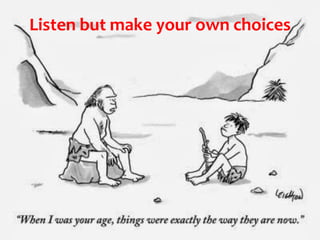
Listen but make your own choices
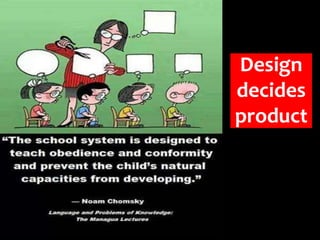
Design
decides
product
A world of contrasts
That speaks to us in the
language of signs – readable
only by those who can see.
“There's none so blind as those who will not listen.”
― Neil Gaiman, American Gods
Today’s benefits
Global access to information
Choice of what to see or listen to
Choice of careers and lifestyles
Lowering of entry barriers
Access to capital
Freedom to choose is confusing and frightening
Today’s challenges
How to understand the information?
How to choose what to see or listen to?
How to choose career or lifestyle?
What to do with low entry barriers
How to access funds?
Without this assets become liabilities
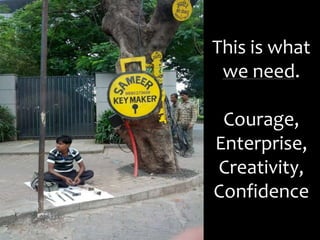
This is what
we need.
Courage,
Enterprise,
Creativity,
Confidence
What we need today is…
 Perspective to understand the present
 Courage to take risk in the future
 Ownership & responsibility for commons
 Communication & work with diverse groups
 Disagree without being disagreeable
 Critical thinking & learning from mistakes
Critical to survival skills
Stop to think
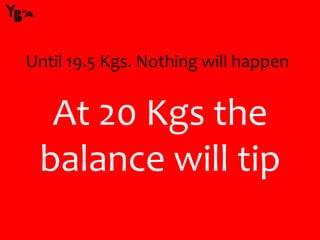
Until 19.5 Kgs. Nothing will happen
At 20 Kgs the
balance will tip
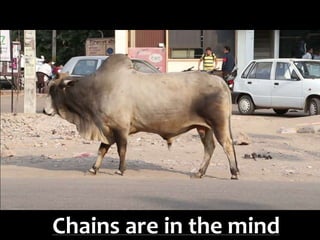
Chains are in the mind
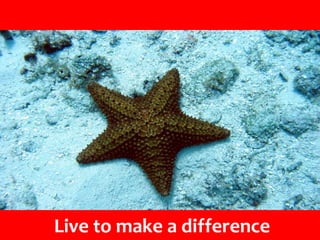
Live to make a difference
We’re free to choose but every
choice has a price
Stances of Success
“Master” or ‘Victim’
Window of Opportunity
 In the life of every man and woman comes a
time when they have a unique opportunity
to make an impact and influence others.
 To succeed we need to anticipate, prepare
and act with courage when it opens
The window remains open only for a time
Choose Your Stance in Life
Choose Wisely
Living life is about making choices:
 Choosing to be a “Victim”
 Or choosing to be a “Master”
Both stances are subject to the same givens
of society, environment, organization etc.
But have very different implications in
terms of development and happiness
Distinguishing features
Victims
 Complain about
what happened
 Think of excuses
 Blame others
 Lose hope & give up
 Masters
 Say, “What can I do
about it?”
 Think of solutions
 Own responsibility
 Have courage to try new
ways
 Win, even if they fail
Possible only when we can transcend our fear
Master? Or Victim?
And their solutions
1. Complacency
 “Good enough, never is.”
 The only use of history is to learn from it.
Gloating or lamenting about past glory is
the surest way of ensuring that it remains
in the past.
People who don’t learn from history are
condemned to repeat it
2. Not aiming high enough
“It is in the nature of extraordinary
goals to inspire extraordinary effort.”
“Satisfaction is directly proportional to
the degree of difficulty in reaching the
goal.”
Among the blind, the one-eyed man is king
Self-congratulation
 Is like self-strangulation and as lethal
 But unlike it – you feel nice while you die
 Ask tough questions
 Face harsh reality
 Take steps to change
If it happened in the past you had nothing to do with it
3. Excuses and blaming
 Stop blaming others for your situation
 Analyze what went wrong and create a plan
to avoid it in the future.
 Being objective, even hard, on yourself is the
best way to avoid repeating mistakes.
Making excuses indicates that you
still haven’t learnt your lesson
How to succeed?
The Crucial Question
How much do I truly need success?
 As much as I need food?
 Or as much as I need air?
40
Set your Goal
 Imagine that you are listening to your own farewell
speech being delivered by someone who has worked
with you, for many years and knows you very well.
 What would you like to hear?
41
Tools
1. Ta’alluq Ma’Allah: Tahajjud and Dua
2. Structuring time: Discipline
3. Manners: Ability to deal with people
4. Self – Assessment
Disciplined implementation
Remember
1. You can only give what you have so if you want
to give, check what you have
2. You can justify anything to yourself – but that
doesn’t make it right
3. Fundamental laws don’t change for anyone
Gravity is a fundamental law. So is
success – the difference between
free fall and free flight is in the
landing.
44
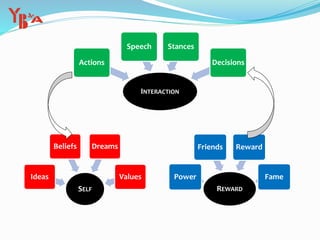
SELF
Ideas
Beliefs Dreams
Values
REWARD
Power
Friends Reward
Fame
INTERACTION
Actions
Speech Stances
Decisions
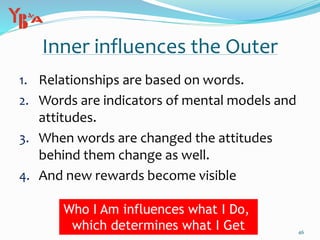
Inner influences the Outer
1. Relationships are based on words.
2. Words are indicators of mental models and
attitudes.
3. When words are changed the attitudes
behind them change as well.
4. And new rewards become visible
46
Who I Am influences what I Do,
which determines what I Get
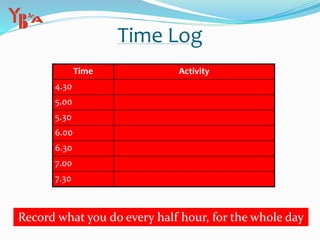
Time Activity
4.30
5.00
5.30
6.00
6.30
7.00
7.30
Record what you do every half hour, for the whole day
Time Log
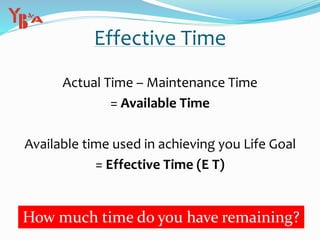
How much time do you have remaining?
Effective Time
Actual Time – Maintenance Time
= Available Time
Available time used in achieving you Life Goal
= Effective Time (E T)
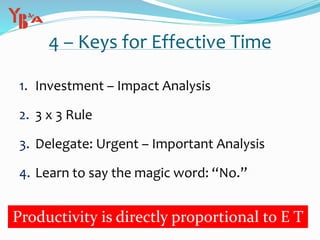
4 – Keys for Effective Time
1. Investment – Impact Analysis
2. 3 x 3 Rule
3. Delegate: Urgent – Important Analysis
4. Learn to say the magic word: “No.”
Productivity is directly proportional to E T
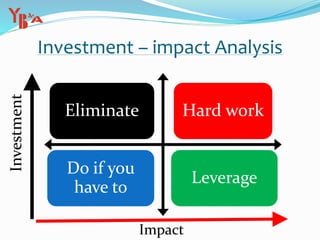
IMPACT
20% of what you do, produces 80% of the results
INVESTMENT
Investment – impact Analysis
Eliminate Hard work
Do if you
have to
Leverage
Investment
Impact
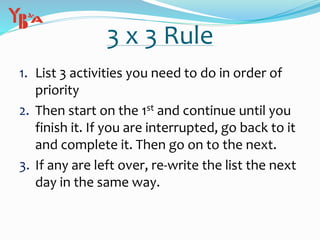
3 x 3 Rule
1. List 3 activities you need to do in order of
priority
2. Then start on the 1st and continue until you
finish it. If you are interrupted, go back to it
and complete it. Then go on to the next.
3. If any are left over, re-write the list the next
day in the same way.
IMPACT
20% of what you do, produces 80% of the results
INVESTMENT
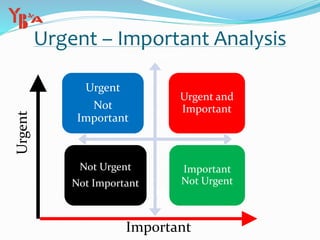
Urgent – Important Analysis
Urgent
Important
Urgent
Not
Important
Urgent and
Important
Not Urgent
Not Important
Important
Not Urgent
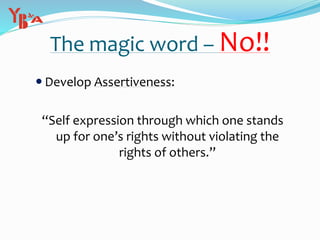
The magic word – No!!
 Develop Assertiveness:
“Self expression through which one stands
up for one’s rights without violating the
rights of others.”
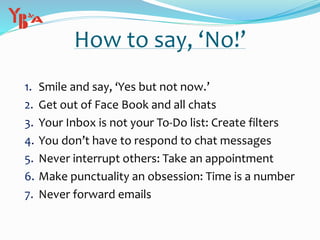
How to say, ‘No!’
1. Smile and say, ‘Yes but not now.’
2. Get out of Face Book and all chats
3. Your Inbox is not your To-Do list: Create filters
4. You don’t have to respond to chat messages
5. Never interrupt others: Take an appointment
6. Make punctuality an obsession: Time is a number
7. Never forward emails
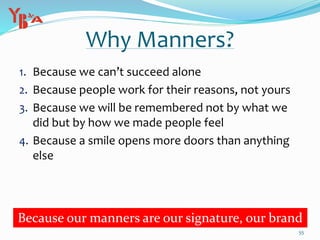
Why Manners?
1. Because we can’t succeed alone
2. Because people work for their reasons, not yours
3. Because we will be remembered not by what we
did but by how we made people feel
4. Because a smile opens more doors than anything
else
55
Because our manners are our signature, our brand
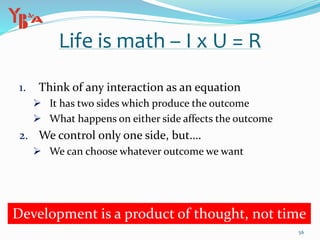
Life is math – I x U = R
1. Think of any interaction as an equation
 It has two sides which produce the outcome
 What happens on either side affects the outcome
2. We control only one side, but….
 We can choose whatever outcome we want
56
Development is a product of thought, not time
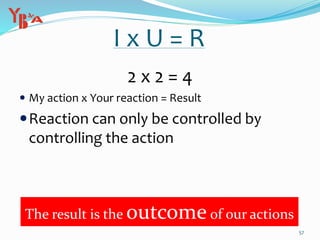
I x U = R
2 x 2 = 4
 My action x Your reaction = Result
Reaction can only be controlled by
controlling the action
57
The result is the outcome of our actions
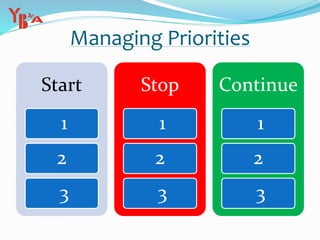
Managing Priorities
Start
1
2
3
Stop
1
2
3
Continue
1
2
3
The Price of Success
 Success, like everything else, has a price.
 We often don’t succeed simply because we
are not willing to pay that price.
 It is therefore essential that we are clear
about what the price of success in our lives is
and if we are willing to pay it.
So ask, ‘WiiFM?’
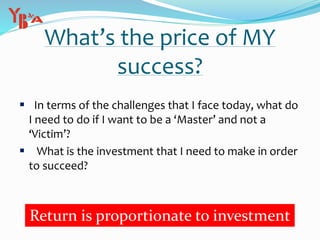
What’s the price of MY
success?
 In terms of the challenges that I face today, what do
I need to do if I want to be a ‘Master’ and not a
‘Victim’?
 What is the investment that I need to make in order
to succeed?
Return is proportionate to investment
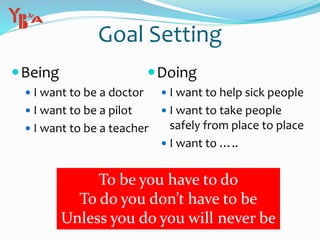
Goal Setting
Being
 I want to be a doctor
 I want to be a pilot
 I want to be a teacher
Doing
 I want to help sick people
 I want to take people
safely from place to place
 I want to …..
To be you have to do
To do you don’t have to be
Unless you do you will never be
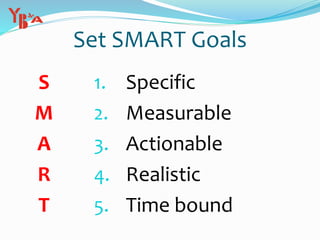
Set SMART Goals
S
M
A
R
T
1. Specific
2. Measurable
3. Actionable
4. Realistic
5. Time bound
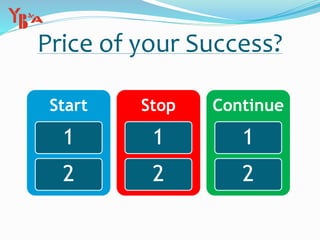
Price of your Success?
Start
1
2
Stop
1
2
Continue
1
2
www.yawarbaig.com
Twitter : myawarbaig
www.youtube.com/yawarbaigassociates

Change the Script

  • 1.
  • 2.
    Mirza Yawar Baig Openingthe world, one mind at a time© Work Experience:  International Speaker, Trainer, Author, Coach, Leadership Consultant with 16 years in Corporate General Management, 28 years in Training & Organizational Development, specializing in Family Business Consulting & Entrepreneurship Director / Professional Member:  Center for Conflict Resolution & Human Security  Indian Society for Applied Behavioural Science Entrepreneur:  1994: Founded Education:  IIM-A , P-CMM®, MBTI©, WSA©, ISABS Books:  The Business of Family Business  An Entrepreneur’s Diary  Hiring Winners  20.10.2010-55 – Life Lessons of 55 years  Leadership Lessons from the life of Rasoolullah  Understanding Islam – 52 Juma Khutbas  Leadership is a Personal Choice Member Consultant Panel: USA  GE Corporate University, Crotonville  Oracle Corporate University, CA  AMA International, New York  Andersen Corporate University, MN India  SVP National Police Academy, Hyderabad  AP Police Academy, Hyderabad  SSB Academy, Gwaldam, Uttar Akhand  LBS Academy of Administration, Mussoorie Clients Include: GE, Oracle, Motorola, Microsoft, IBM, Digital-Compaq, National Semiconductor, Unilever, BSNL, Tata Indicom, Colgate, Asian Paints, Siemens, Wartsila, MphasiS, CavinKare, EXL Service, World Bank, ICRISAT, World Fish, Tata Corporate, J & J, Accenture, Zeneca Seeds, Advanta, Reuters, Air India, Yusuf Bin Ahmed Kanoo, Olam, Regal Beloit, Reliance World, NIS Sparta, AMKA, Emami Group, Suzlon, JP Morgan, SEW Infrastructure, LANCO, Expolanka www.yawarbaig.com
  • 4.
    Your Challenge asfellows Is to make the transition from philanthropy to community building One requires money The other requires dedication, skill, time and energy Won’t happen unless you see value for yourself in it
  • 5.
    Critical Need Forget ‘sacrifice’ Think‘investment’ Sacrifice always ends Investment continues because you see value in it Your return is to know that you will receive the rewards for this long after you have gone
  • 6.
    What is theroot of the problem?
  • 8.
  • 9.
    Listen but makeyour own choices
  • 10.
  • 11.
    A world ofcontrasts That speaks to us in the language of signs – readable only by those who can see. “There's none so blind as those who will not listen.” ― Neil Gaiman, American Gods
  • 13.
    Today’s benefits Global accessto information Choice of what to see or listen to Choice of careers and lifestyles Lowering of entry barriers Access to capital Freedom to choose is confusing and frightening
  • 15.
    Today’s challenges How tounderstand the information? How to choose what to see or listen to? How to choose career or lifestyle? What to do with low entry barriers How to access funds? Without this assets become liabilities
  • 16.
    This is what weneed. Courage, Enterprise, Creativity, Confidence
  • 17.
    What we needtoday is…  Perspective to understand the present  Courage to take risk in the future  Ownership & responsibility for commons  Communication & work with diverse groups  Disagree without being disagreeable  Critical thinking & learning from mistakes Critical to survival skills
  • 18.
  • 20.
    Until 19.5 Kgs.Nothing will happen At 20 Kgs the balance will tip
  • 21.
    Chains are inthe mind
  • 22.
    Live to makea difference
  • 23.
    We’re free tochoose but every choice has a price
  • 24.
  • 25.
    Window of Opportunity In the life of every man and woman comes a time when they have a unique opportunity to make an impact and influence others.  To succeed we need to anticipate, prepare and act with courage when it opens The window remains open only for a time
  • 26.
  • 27.
    Choose Wisely Living lifeis about making choices:  Choosing to be a “Victim”  Or choosing to be a “Master” Both stances are subject to the same givens of society, environment, organization etc. But have very different implications in terms of development and happiness
  • 28.
    Distinguishing features Victims  Complainabout what happened  Think of excuses  Blame others  Lose hope & give up  Masters  Say, “What can I do about it?”  Think of solutions  Own responsibility  Have courage to try new ways  Win, even if they fail Possible only when we can transcend our fear
  • 29.
  • 31.
  • 32.
    1. Complacency  “Goodenough, never is.”  The only use of history is to learn from it. Gloating or lamenting about past glory is the surest way of ensuring that it remains in the past. People who don’t learn from history are condemned to repeat it
  • 34.
    2. Not aiminghigh enough “It is in the nature of extraordinary goals to inspire extraordinary effort.” “Satisfaction is directly proportional to the degree of difficulty in reaching the goal.” Among the blind, the one-eyed man is king
  • 35.
    Self-congratulation  Is likeself-strangulation and as lethal  But unlike it – you feel nice while you die  Ask tough questions  Face harsh reality  Take steps to change If it happened in the past you had nothing to do with it
  • 36.
    3. Excuses andblaming  Stop blaming others for your situation  Analyze what went wrong and create a plan to avoid it in the future.  Being objective, even hard, on yourself is the best way to avoid repeating mistakes. Making excuses indicates that you still haven’t learnt your lesson
  • 39.
  • 40.
    The Crucial Question Howmuch do I truly need success?  As much as I need food?  Or as much as I need air? 40
  • 41.
    Set your Goal Imagine that you are listening to your own farewell speech being delivered by someone who has worked with you, for many years and knows you very well.  What would you like to hear? 41
  • 42.
    Tools 1. Ta’alluq Ma’Allah:Tahajjud and Dua 2. Structuring time: Discipline 3. Manners: Ability to deal with people 4. Self – Assessment Disciplined implementation
  • 43.
    Remember 1. You canonly give what you have so if you want to give, check what you have 2. You can justify anything to yourself – but that doesn’t make it right 3. Fundamental laws don’t change for anyone
  • 44.
    Gravity is afundamental law. So is success – the difference between free fall and free flight is in the landing. 44
  • 45.
  • 46.
    Inner influences theOuter 1. Relationships are based on words. 2. Words are indicators of mental models and attitudes. 3. When words are changed the attitudes behind them change as well. 4. And new rewards become visible 46 Who I Am influences what I Do, which determines what I Get
  • 47.
    Time Activity 4.30 5.00 5.30 6.00 6.30 7.00 7.30 Record whatyou do every half hour, for the whole day Time Log
  • 48.
    How much timedo you have remaining? Effective Time Actual Time – Maintenance Time = Available Time Available time used in achieving you Life Goal = Effective Time (E T)
  • 49.
    4 – Keysfor Effective Time 1. Investment – Impact Analysis 2. 3 x 3 Rule 3. Delegate: Urgent – Important Analysis 4. Learn to say the magic word: “No.” Productivity is directly proportional to E T
  • 50.
    IMPACT 20% of whatyou do, produces 80% of the results INVESTMENT Investment – impact Analysis Eliminate Hard work Do if you have to Leverage Investment Impact
  • 51.
    3 x 3Rule 1. List 3 activities you need to do in order of priority 2. Then start on the 1st and continue until you finish it. If you are interrupted, go back to it and complete it. Then go on to the next. 3. If any are left over, re-write the list the next day in the same way.
  • 52.
    IMPACT 20% of whatyou do, produces 80% of the results INVESTMENT Urgent – Important Analysis Urgent Important Urgent Not Important Urgent and Important Not Urgent Not Important Important Not Urgent
  • 53.
    The magic word– No!!  Develop Assertiveness: “Self expression through which one stands up for one’s rights without violating the rights of others.”
  • 54.
    How to say,‘No!’ 1. Smile and say, ‘Yes but not now.’ 2. Get out of Face Book and all chats 3. Your Inbox is not your To-Do list: Create filters 4. You don’t have to respond to chat messages 5. Never interrupt others: Take an appointment 6. Make punctuality an obsession: Time is a number 7. Never forward emails
  • 55.
    Why Manners? 1. Becausewe can’t succeed alone 2. Because people work for their reasons, not yours 3. Because we will be remembered not by what we did but by how we made people feel 4. Because a smile opens more doors than anything else 55 Because our manners are our signature, our brand
  • 56.
    Life is math– I x U = R 1. Think of any interaction as an equation  It has two sides which produce the outcome  What happens on either side affects the outcome 2. We control only one side, but….  We can choose whatever outcome we want 56 Development is a product of thought, not time
  • 57.
    I x U= R 2 x 2 = 4  My action x Your reaction = Result Reaction can only be controlled by controlling the action 57 The result is the outcome of our actions
  • 58.
  • 59.
    The Price ofSuccess  Success, like everything else, has a price.  We often don’t succeed simply because we are not willing to pay that price.  It is therefore essential that we are clear about what the price of success in our lives is and if we are willing to pay it. So ask, ‘WiiFM?’
  • 60.
    What’s the priceof MY success?  In terms of the challenges that I face today, what do I need to do if I want to be a ‘Master’ and not a ‘Victim’?  What is the investment that I need to make in order to succeed? Return is proportionate to investment
  • 61.
    Goal Setting Being  Iwant to be a doctor  I want to be a pilot  I want to be a teacher Doing  I want to help sick people  I want to take people safely from place to place  I want to ….. To be you have to do To do you don’t have to be Unless you do you will never be
  • 62.
    Set SMART Goals S M A R T 1.Specific 2. Measurable 3. Actionable 4. Realistic 5. Time bound
  • 63.
    Price of yourSuccess? Start 1 2 Stop 1 2 Continue 1 2
  • 65.