A BITE OF
Cross-cultural Understanding
????
Cross-cultural Understanding is concerned
with understanding people from different
cultural backgrounds/culture of the people so
we can construct our attitudes and world view,
more tolerable and generous toward strange
ways that may be shown by other citizen of
another country .
Culture finds expression through the patterns of
behavior, decision-making processes, ethics, morals
and values on which a society is based. National
cultures are built up over many years, and spring
from a country’s history, geography, sociology,
language and religion.
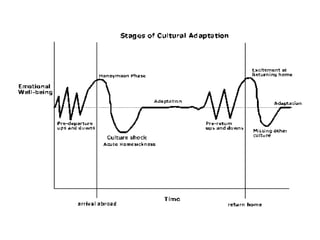
Many people who go abroad encounter
features in their host culture that they may
find disturbing. Reaction to these alien
aspects of the new culture can dampen
the entire experience in the country,
resulting in various kinds of negative
reactions.
• C.C misunderstanding arise when A
person from an alien culture misinterprets
a complex pattern when it has different
meaning
To adapt positively and effectively to the
host culture, it is necessary to overcome
the negative responses. The best way to
challenge these shortcomings is to name
these negative aspects, face them, and
come to terms with them
But the biggest problem is that most of this
dissonance derives from non-verbal
behavior, and therefore they are mostly
dangerous are very real, but difficult to
grasp.
Verbal communication is probably not an
issue, but adapting to the culture, with its
non-verbal and societal indicators, is
difficult and painful.
Non-verbal behavior is so deeply engrained
in the communicational system that it is
not often explained or acknowledged by
native speakers who, most of the time, are
unconscious of this phenomenon.
Learning another culture, developing
relationships with people you meet,
communicating efficiently, and adapting to
the environment is a complex task.
Each aspect of non-verbal communication
has a code or codes. These codes are
signals that have to be translated because
they point to hidden systems of cultural
belief.
Furthermore, they are charged with
ideological significance, what we call as so
pervasive that we often don't realize it
exists, just as we don't notice the air we
breathe
To understand the political, economic, social
and even personal behavior of any group
of people, we must first know the
dominant values of their culture which are
passed down from one generation to
another through learning.
There is no way to explain the behavior of
Americans unless you know their
dominant or mainstream culture.
Culture Analogy
Culture is like an iceberg. The tip of the
iceberg is the smallest part. Most of the
iceberg is submerged.
The same is true for a culture. That which you
can easily see – the behavior of people – is the
smallest part of culture.
It is external while the greatest part, internal
culture, is beneath the water level of awareness.
It is inside people’s heads.
- This internal culture includes our way
of thinking and perceiving.
- Most importantly, it contains the
values and beliefs unconsciously
learned while growing up in a
particular culture. These values and
beliefs determine most behavior.
The “Iceberg Analogy” of Culture
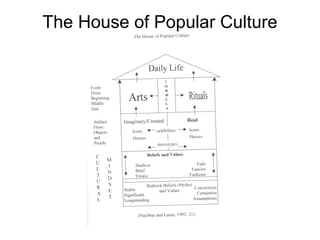
The House of Popular Culture
• Remember, these are generalizations.
Some people will be uncomfortable if you
do not touch them during a conversation.
The hard part is figuring out who wants
what.
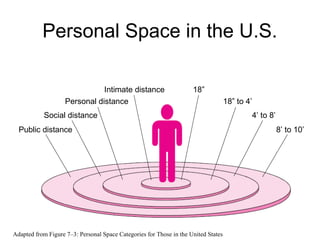
Personal Space in the U.S.
Intimate distance
Personal distance

18”

Social distance
Public distance

Adapted from Figure 7–3: Personal Space Categories for Those in the United States

18” to 4’
4’ to 8’
8’ to 10’
• Proxemics
– The study of the way that people use physical
space to convey messages
• Intimate distance is used for very confidential
communications
• Personal distance is used for talking with family and
close friends
• Social distance is used to handle most business
transactions
• Public distance is used when calling across the
room or giving a talk to a group

What ccu is, ? cross culture understanding

  • 1.
  • 2.
    ???? Cross-cultural Understanding isconcerned with understanding people from different cultural backgrounds/culture of the people so we can construct our attitudes and world view, more tolerable and generous toward strange ways that may be shown by other citizen of another country .
  • 3.
    Culture finds expressionthrough the patterns of behavior, decision-making processes, ethics, morals and values on which a society is based. National cultures are built up over many years, and spring from a country’s history, geography, sociology, language and religion.
  • 4.
    Many people whogo abroad encounter features in their host culture that they may find disturbing. Reaction to these alien aspects of the new culture can dampen the entire experience in the country, resulting in various kinds of negative reactions.
  • 5.
    • C.C misunderstandingarise when A person from an alien culture misinterprets a complex pattern when it has different meaning
  • 7.
    To adapt positivelyand effectively to the host culture, it is necessary to overcome the negative responses. The best way to challenge these shortcomings is to name these negative aspects, face them, and come to terms with them
  • 8.
    But the biggestproblem is that most of this dissonance derives from non-verbal behavior, and therefore they are mostly dangerous are very real, but difficult to grasp.
  • 9.
    Verbal communication isprobably not an issue, but adapting to the culture, with its non-verbal and societal indicators, is difficult and painful. Non-verbal behavior is so deeply engrained in the communicational system that it is not often explained or acknowledged by native speakers who, most of the time, are unconscious of this phenomenon.
  • 10.
    Learning another culture,developing relationships with people you meet, communicating efficiently, and adapting to the environment is a complex task.
  • 11.
    Each aspect ofnon-verbal communication has a code or codes. These codes are signals that have to be translated because they point to hidden systems of cultural belief.
  • 12.
    Furthermore, they arecharged with ideological significance, what we call as so pervasive that we often don't realize it exists, just as we don't notice the air we breathe
  • 13.
    To understand thepolitical, economic, social and even personal behavior of any group of people, we must first know the dominant values of their culture which are passed down from one generation to another through learning. There is no way to explain the behavior of Americans unless you know their dominant or mainstream culture.
  • 14.
    Culture Analogy Culture islike an iceberg. The tip of the iceberg is the smallest part. Most of the iceberg is submerged.
  • 15.
    The same istrue for a culture. That which you can easily see – the behavior of people – is the smallest part of culture. It is external while the greatest part, internal culture, is beneath the water level of awareness. It is inside people’s heads.
  • 16.
    - This internalculture includes our way of thinking and perceiving. - Most importantly, it contains the values and beliefs unconsciously learned while growing up in a particular culture. These values and beliefs determine most behavior.
  • 17.
  • 18.
    The House ofPopular Culture
  • 19.
    • Remember, theseare generalizations. Some people will be uncomfortable if you do not touch them during a conversation. The hard part is figuring out who wants what.
  • 20.
    Personal Space inthe U.S. Intimate distance Personal distance 18” Social distance Public distance Adapted from Figure 7–3: Personal Space Categories for Those in the United States 18” to 4’ 4’ to 8’ 8’ to 10’
  • 21.
    • Proxemics – Thestudy of the way that people use physical space to convey messages • Intimate distance is used for very confidential communications • Personal distance is used for talking with family and close friends • Social distance is used to handle most business transactions • Public distance is used when calling across the room or giving a talk to a group