High-context and low-
context cultures
PRESENTED TO= MISS HINA
PRESENTED BY= UZMA RANI
Different cultures, different
communication styles
 American people are believed to verbalize 150 things if they want to say
100 things (explicit understandings)
 When Japanese verbalize 70 things, they are trying to get other people
understand 100 things (implicit understandings and nonverbal cues )
 Different cultural communication rules and regulations
What is culture?
 Edward Tylor’s (1871)
 “that complex whole which includes knowledge, belief, art, morals, law,
custom, and any other capabilities and habits acquired by man as a
member of society”
What is communication?
 Communication is the act of conveying meanings from one entity or group
to another through the use of mutually understood signs, symbols, and
semiotic rules.
What is context?
 The context is an extension of the background, the system
and circumstances in which there is an ongoing
communicative act
Factors for Context of a Situation
 Who are you communicating with?
 Where are you?
 What are you communicating about?
 Why are you communicating?
Some background
 1959, Edward T. Hall wrote the book “The Silent Language”
 Founded the field of intercultural communications
 First mention of “high and low context cultures”
COMMUNICATION TOOLS FOR UNDERSTANDING
CULTURE
 High-context and Low-context Communication
 Refers to the degree to which speakers rely on factors other than explicit
speech to convey their messages
Significance
 Edward Hall believes that knowing the characteristics of high- and low-
context cultures is a key aspect for a successful conduct of communicative
acts
Where to find high-context and low
context cultures?
 Low context cultures- mainly cultures with Western European roots (North
America, Austrailia etc.)
 High context cultures- everywhere else
 Can also exist within companies, social groups etc.
 Both can exist simultaneously within a group
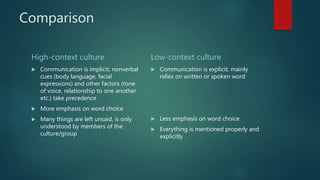
Comparison
High-context culture
 Communication is implicit; nonverbal
cues (body language, facial
expressions) and other factors (tone
of voice, relationship to one another
etc.) take precedence
 More emphasis on word choice
 Many things are left unsaid, is only
understood by members of the
culture/group
Low-context culture
 Communication is explicit; mainly
relies on written or spoken word
 Less emphasis on word choice
 Everything is mentioned properly and
explicitly
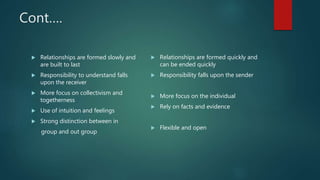
Cont….
 Relationships are formed slowly and
are built to last
 Responsibility to understand falls
upon the receiver
 More focus on collectivism and
togetherness
 Use of intuition and feelings
 Strong distinction between in
group and out group
 Relationships are formed quickly and
can be ended quickly
 Responsibility falls upon the sender
 More focus on the individual
 Rely on facts and evidence
 Flexible and open
Examples
 In Chinese culture, it is common for the hostess at a dinner party to serve
the guest less food. It is seen as a compliment for the guest to ask for
more. This also prevents the guest from losing face if he does not like the
food. ( high context culture)
 Germans are observed to recap their presentations after they have
presented. This is a common practice for them. They don’t rely on
nonverbal cues.
Question for audience?
 French people feel that German insult their intelligence by explaining the
obvious, while German feel that the French manager don’t provide any
directions.
high and low context culture

high and low context culture

  • 1.
    High-context and low- contextcultures PRESENTED TO= MISS HINA PRESENTED BY= UZMA RANI
  • 2.
    Different cultures, different communicationstyles  American people are believed to verbalize 150 things if they want to say 100 things (explicit understandings)  When Japanese verbalize 70 things, they are trying to get other people understand 100 things (implicit understandings and nonverbal cues )  Different cultural communication rules and regulations
  • 3.
    What is culture? Edward Tylor’s (1871)  “that complex whole which includes knowledge, belief, art, morals, law, custom, and any other capabilities and habits acquired by man as a member of society”
  • 4.
    What is communication? Communication is the act of conveying meanings from one entity or group to another through the use of mutually understood signs, symbols, and semiotic rules.
  • 5.
    What is context? The context is an extension of the background, the system and circumstances in which there is an ongoing communicative act
  • 6.
    Factors for Contextof a Situation  Who are you communicating with?  Where are you?  What are you communicating about?  Why are you communicating?
  • 7.
    Some background  1959,Edward T. Hall wrote the book “The Silent Language”  Founded the field of intercultural communications  First mention of “high and low context cultures”
  • 8.
    COMMUNICATION TOOLS FORUNDERSTANDING CULTURE  High-context and Low-context Communication  Refers to the degree to which speakers rely on factors other than explicit speech to convey their messages
  • 9.
    Significance  Edward Hallbelieves that knowing the characteristics of high- and low- context cultures is a key aspect for a successful conduct of communicative acts
  • 10.
    Where to findhigh-context and low context cultures?  Low context cultures- mainly cultures with Western European roots (North America, Austrailia etc.)  High context cultures- everywhere else  Can also exist within companies, social groups etc.  Both can exist simultaneously within a group
  • 12.
    Comparison High-context culture  Communicationis implicit; nonverbal cues (body language, facial expressions) and other factors (tone of voice, relationship to one another etc.) take precedence  More emphasis on word choice  Many things are left unsaid, is only understood by members of the culture/group Low-context culture  Communication is explicit; mainly relies on written or spoken word  Less emphasis on word choice  Everything is mentioned properly and explicitly
  • 13.
    Cont….  Relationships areformed slowly and are built to last  Responsibility to understand falls upon the receiver  More focus on collectivism and togetherness  Use of intuition and feelings  Strong distinction between in group and out group  Relationships are formed quickly and can be ended quickly  Responsibility falls upon the sender  More focus on the individual  Rely on facts and evidence  Flexible and open
  • 14.
    Examples  In Chineseculture, it is common for the hostess at a dinner party to serve the guest less food. It is seen as a compliment for the guest to ask for more. This also prevents the guest from losing face if he does not like the food. ( high context culture)  Germans are observed to recap their presentations after they have presented. This is a common practice for them. They don’t rely on nonverbal cues.
  • 15.
    Question for audience? French people feel that German insult their intelligence by explaining the obvious, while German feel that the French manager don’t provide any directions.