Cultural Shock
1
Content
2
 Definition
 Stage of Cultural Shock
 Alleviating Cultural Shock
 Aspects of Cultural Shock
 Relationship and Family Consideration
 Public and Private Self
Definition
3
What is cultural shock?
Cultural shock is the trauma you experience
when we move into a culture different from your
home culture.
Definition
4
Cultural Shock is a Communication problem that involves frustration
 Not understanding verbal and nonverbal communication of the host
culture
 Lack of food
 Unacceptable standard of cleanliness
 Different bathroom facilities
 Fear of personal safety
Cultural shock
5
 There are five progressive stages of Asia Shock that is
identified by Engholm (1991)
1. Frustration with the culture: Feeling annoy with the
food, language ect.
2. Unwilling to understand the rationale behind the local
way of doing thing: don’t try to understand the basis of
the behavior.
3. Ethnocentricity: the thinking that base on only our own
culture and race.
4. Racism: the belief that the qualities your own race is
the best
5. Avoidance of the culture: don’t accept the host culture.
Cultural shock
6
 Five strategies for coping with the new culture is
identified by Brislin(1881).
1. Unacceptance of the host culture: the think that they
are in their home culture.
2. Substitution: the people find and another things
instead of what they normal use or do in their home
culture.
3. Addition: they add some behavior and still maintain
their home culture.
4. Synthesis: something that different are combined.
5. Resynthesis: the different idea from integration.
Stage of Cultural Shock
7
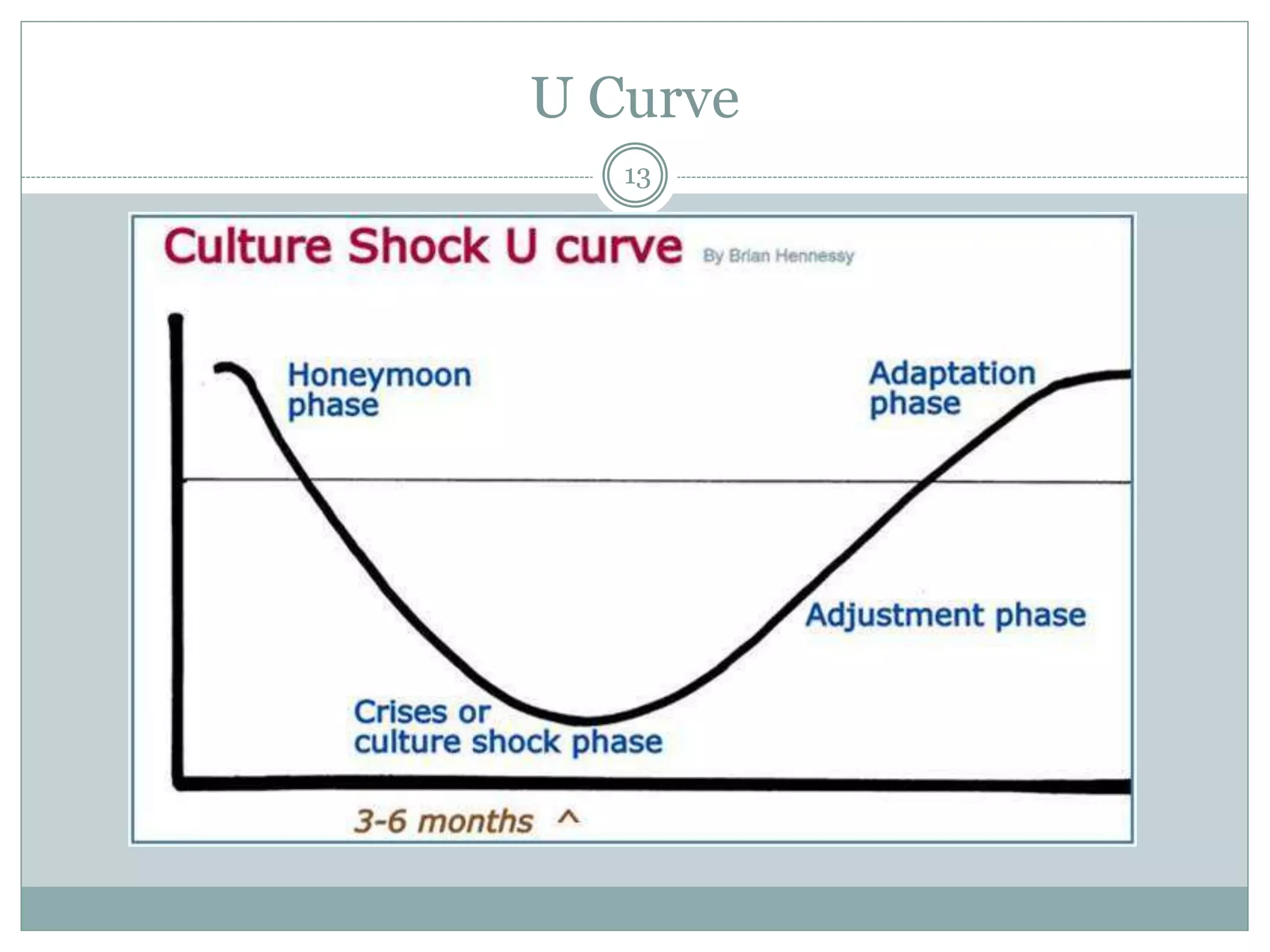
Cultural Sock generally goes through five stages
 Excitement or initial euphoria
 Crisis or disenchantment
 Adjustment
 Acceptance or adaptation
 Reentry
Stage of Cultural Shock
8
 Excitement or initial euphoria: everything is new
and different, you are fascinated with the food and the
people.
Stage of Cultural Shock
9
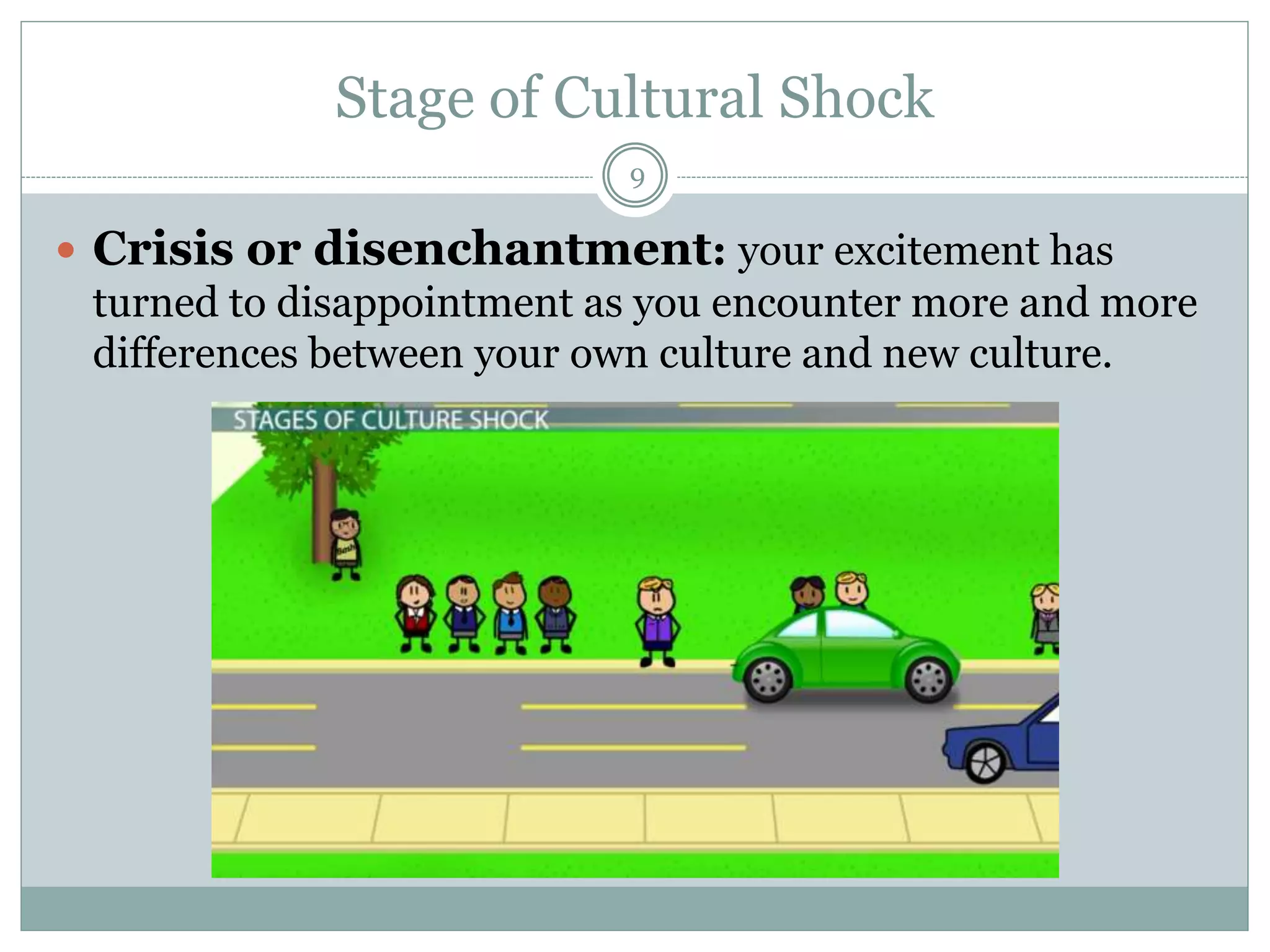
 Crisis or disenchantment: your excitement has
turned to disappointment as you encounter more and more
differences between your own culture and new culture.
Stage of Cultural Shock
10
 Adjustment: you begin to accept the new culture or you
return home.
Stage of Cultural Shock
11
 Acceptance or adaptation: you feel at home in the
new culture, become involved in activities of the culture, cultivate
friendship among the nationals, and feel comfortable in social
situation with people from the host culture.
Stage of Cultural Shock
12
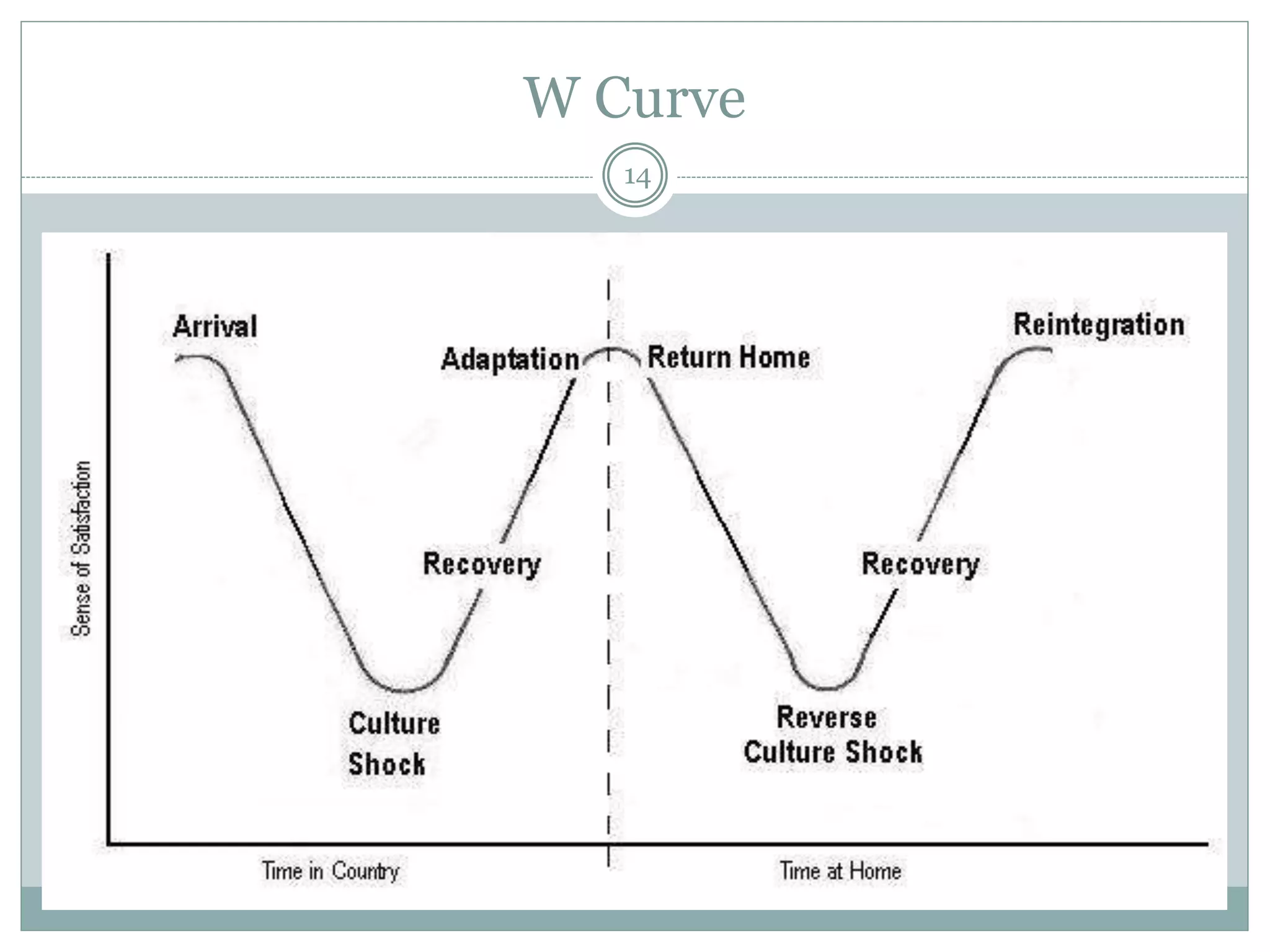
 Reentry: is experienced on returning to the home
country and may follow the stages identified earlier; initial,
crisis, adjustment, and acceptance or adaptation.
U Curve
13
W Curve
14
W Curve
15
Alleviating Cultural Shock
16
Alleviating Cultural Shock is the reducing cultural
shock by selecting employee for overseas assignment
who possess certain personal and professional
qualification.
Alleviating Cultural Shock
17
 Selecting oversea personnel
 Providing predeparture training for host country
 Providing feedback and rewards
 Developing employees to their maximum potential
Alleviating Cultural Shock
18
Selecting oversea
personnel : is the
process of looking for
candidates who already
have such qualification
as language proficiency
and overseas experience.
Alleviating Cultural Shock
19
Providing
predeparture
training for host
country : is learning
principle that affect the
success of training
programing for globle
manager.
Alleviating Cultural Shock
20
Providing predeparture training for host
country can be broken down into three step
• Observing and Emulating behaviors of person in
the host culture
• Retaining what has been learn
• Experimenting with the new behavior until it
become comfortable
Alleviating Cultural Shock
21
Approaches to intercultural training may group as follows:
• The intellectual model or the classroom model: participants are
given facts about the host country using a variety of instructional
methods, such as lectures, group discussions, and videotapes.
• The area training model or the simulation model: emphasize
affective goals, culture-specific content, and experiential processes.
• The self-awareness model or the human relation model: is
based on the assumption that the trainee with self understanding will
adapt to the new culture better and therefore be more affective in the
overseas assignment.
• The cultural awareness model: emphasize cultural insight, and
like the self-awareness model, stresses affective goals and an
experiential process.
Alleviating Cultural Shock
22
 The interaction approach: is based on participants’ interacting with
people in the host country, either nationals or U.S. persons who has
been in the host country for an extended time.
 The multidimensional approach: is based on the concept that
using any single training approach is not as affective as using an
approach that attempts to combine cognitive, affective, and behavioural
aspects of training.
Alleviating Cultural Shock
23
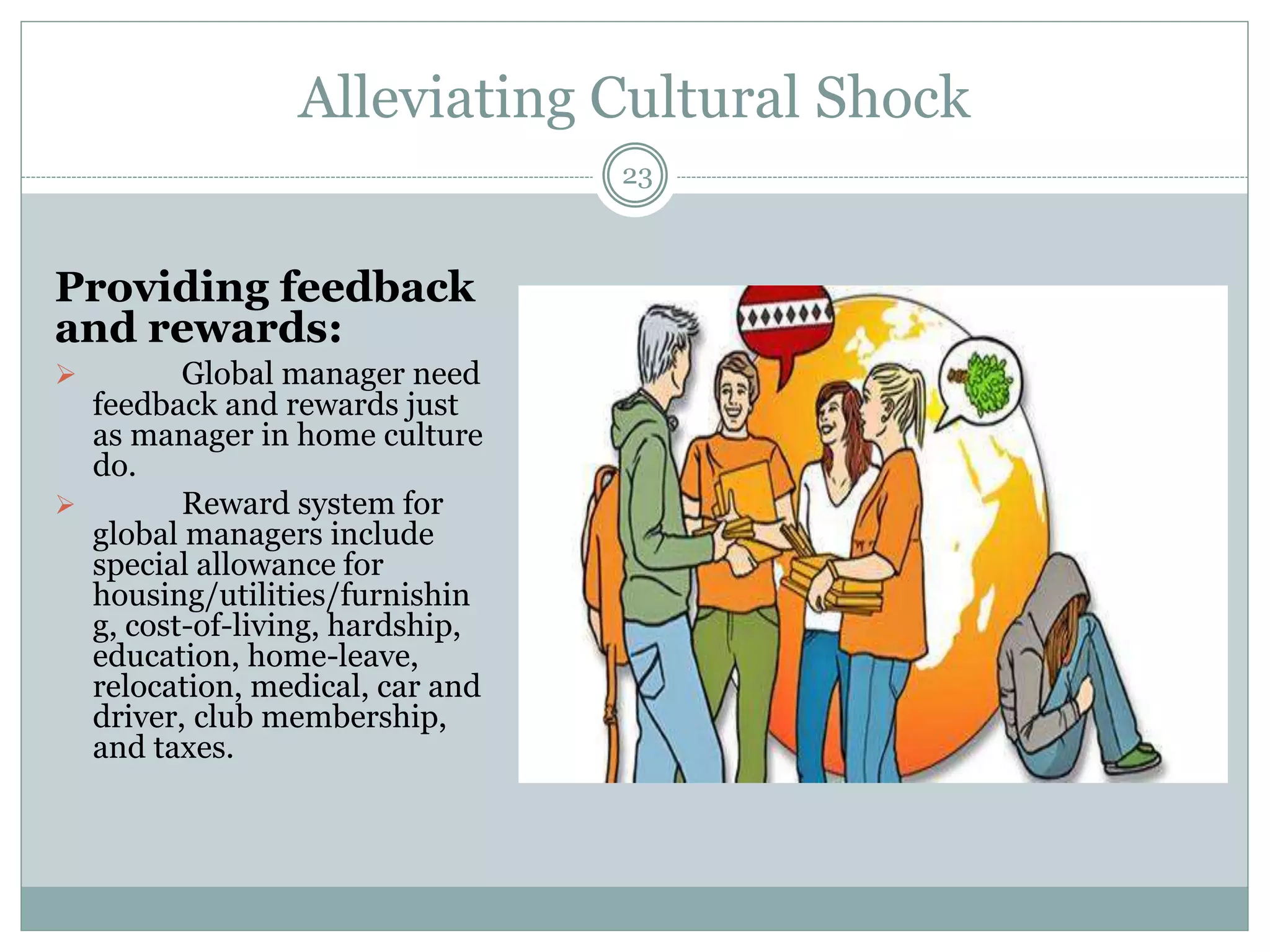
Providing feedback
and rewards:
 Global manager need
feedback and rewards just
as manager in home culture
do.
 Reward system for
global managers include
special allowance for
housing/utilities/furnishin
g, cost-of-living, hardship,
education, home-leave,
relocation, medical, car and
driver, club membership,
and taxes.
Alleviating Cultural Shock
24
Developing
employees to their
maximum potential:
 the company should
make clear the reason for
the new assignment, what
new skill and knowledge
will be learn, and how the
employee will contribute to
the company’s
development upon his or
her return.
Aspects of Cultural Shock
25
Aspects of Cultural Shock include 4 main
points:
1. Cultural Stress
2. Social Alienation
3. Social Class and Poverty / Wealth Extremes
4. Financial Matters
Aspects of Cultural Shock
26
1. Cultural Stress: is a stress that results from
contact with a different culture and the lack of
resources to manage the situation.
Aspects of Cultural Shock
27
Aspects of Cultural Shock
28
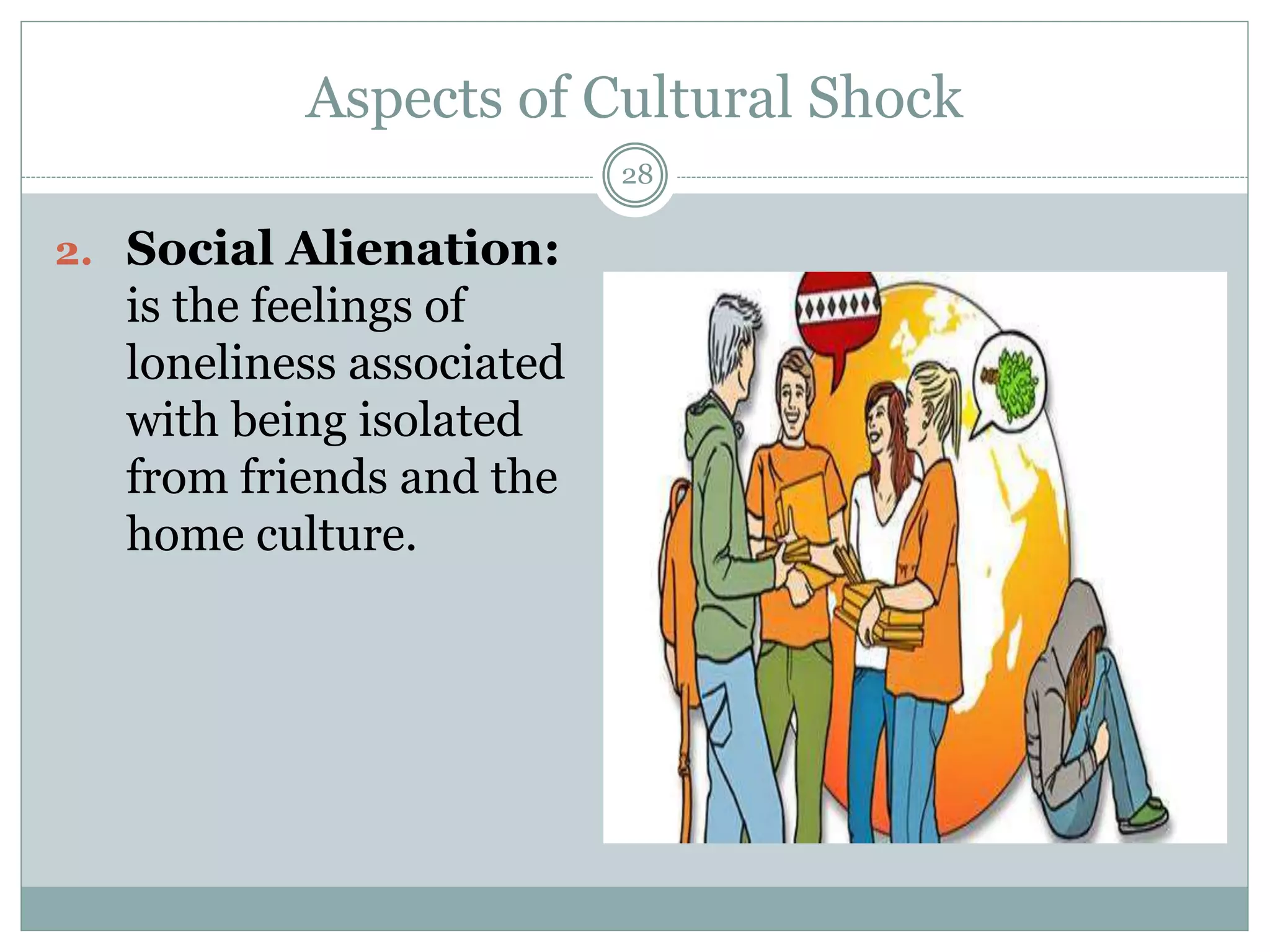
2. Social Alienation:
is the feelings of
loneliness associated
with being isolated
from friends and the
home culture.
Aspects of Cultural Shock
29
3. Social class and poverty/wealth extremes:
mentors in host culture can be helpful in advising
U.S. persons regarding acceptable ways of dealing
with poverty/wealth extremes.
Aspects of Cultural Shock
30
4. Financial Matters: is adapting to a new culture
and reentering the home culture involve financial
adjustments, companies should provide financial
consoling both to expatriates and repatriates.
Public and Private Self
31
Public self may include information about
• person’s work
• family
• interested or opinion on political and social
issues.
Private self may include information about
• attitude
• feeling
Public and Private Self
32
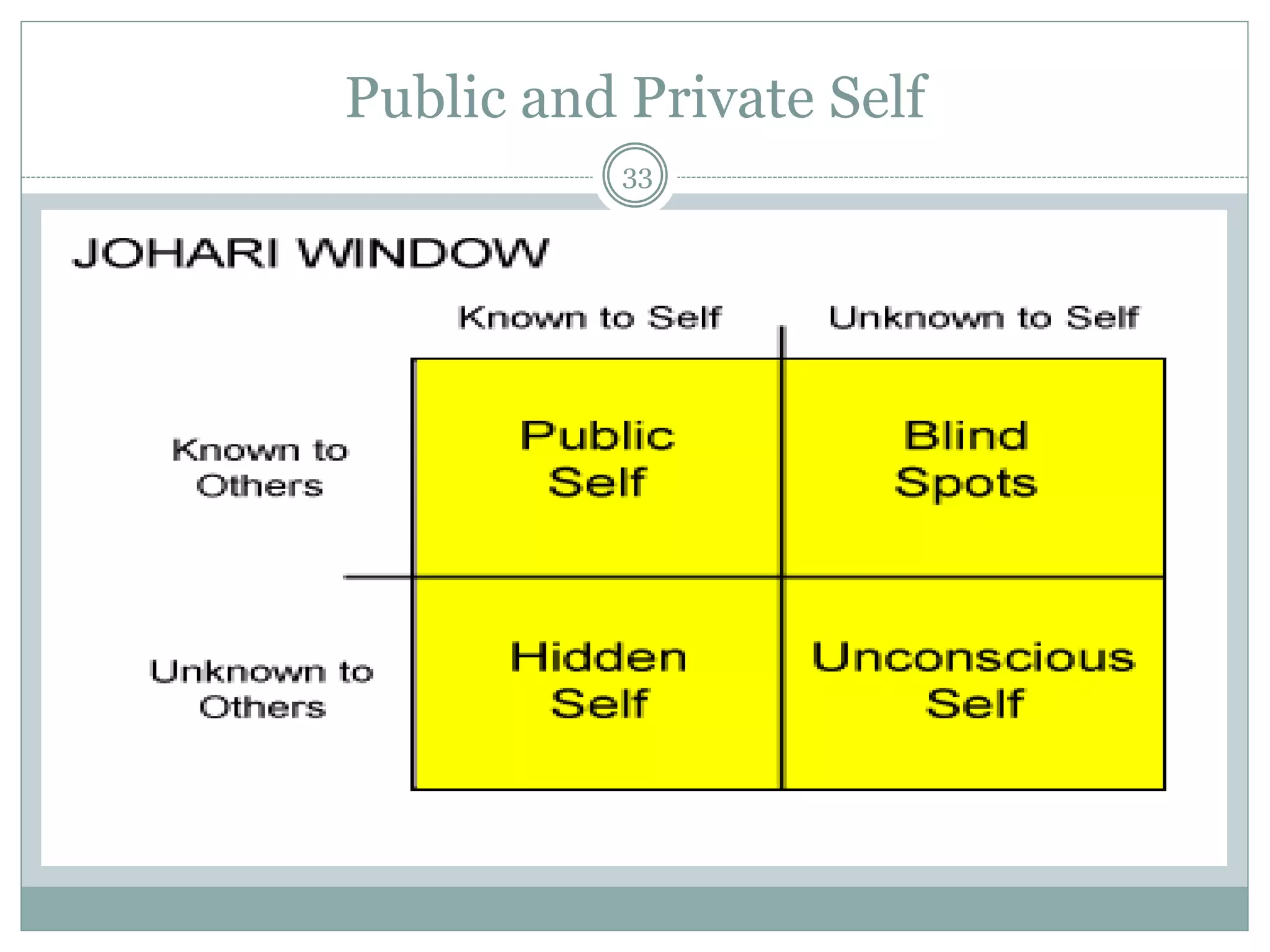
The Johari Window model was devised by American
psychologists Joseph Luft and Harry Ingham. This
window talk about the inner self is share with other.
Public and Private Self
33
Public and Private Self
34
 First window: public self
Known both to the person and to other
 Second window: blind spots
Known to other but not to the person
 Third window: hidden self
Known to person but is unknown to other
 Fourth window: unconscious self
Unknown both to the other and to the person
The End
35
Thank for your Attention.
Any Question?

Cultural shock

  • 1.
  • 2.
    Content 2  Definition  Stageof Cultural Shock  Alleviating Cultural Shock  Aspects of Cultural Shock  Relationship and Family Consideration  Public and Private Self
  • 3.
    Definition 3 What is culturalshock? Cultural shock is the trauma you experience when we move into a culture different from your home culture.
  • 4.
    Definition 4 Cultural Shock isa Communication problem that involves frustration  Not understanding verbal and nonverbal communication of the host culture  Lack of food  Unacceptable standard of cleanliness  Different bathroom facilities  Fear of personal safety
  • 5.
    Cultural shock 5  Thereare five progressive stages of Asia Shock that is identified by Engholm (1991) 1. Frustration with the culture: Feeling annoy with the food, language ect. 2. Unwilling to understand the rationale behind the local way of doing thing: don’t try to understand the basis of the behavior. 3. Ethnocentricity: the thinking that base on only our own culture and race. 4. Racism: the belief that the qualities your own race is the best 5. Avoidance of the culture: don’t accept the host culture.
  • 6.
    Cultural shock 6  Fivestrategies for coping with the new culture is identified by Brislin(1881). 1. Unacceptance of the host culture: the think that they are in their home culture. 2. Substitution: the people find and another things instead of what they normal use or do in their home culture. 3. Addition: they add some behavior and still maintain their home culture. 4. Synthesis: something that different are combined. 5. Resynthesis: the different idea from integration.
  • 7.
    Stage of CulturalShock 7 Cultural Sock generally goes through five stages  Excitement or initial euphoria  Crisis or disenchantment  Adjustment  Acceptance or adaptation  Reentry
  • 8.
    Stage of CulturalShock 8  Excitement or initial euphoria: everything is new and different, you are fascinated with the food and the people.
  • 9.
    Stage of CulturalShock 9  Crisis or disenchantment: your excitement has turned to disappointment as you encounter more and more differences between your own culture and new culture.
  • 10.
    Stage of CulturalShock 10  Adjustment: you begin to accept the new culture or you return home.
  • 11.
    Stage of CulturalShock 11  Acceptance or adaptation: you feel at home in the new culture, become involved in activities of the culture, cultivate friendship among the nationals, and feel comfortable in social situation with people from the host culture.
  • 12.
    Stage of CulturalShock 12  Reentry: is experienced on returning to the home country and may follow the stages identified earlier; initial, crisis, adjustment, and acceptance or adaptation.
  • 13.
  • 14.
  • 15.
  • 16.
    Alleviating Cultural Shock 16 AlleviatingCultural Shock is the reducing cultural shock by selecting employee for overseas assignment who possess certain personal and professional qualification.
  • 17.
    Alleviating Cultural Shock 17 Selecting oversea personnel  Providing predeparture training for host country  Providing feedback and rewards  Developing employees to their maximum potential
  • 18.
    Alleviating Cultural Shock 18 Selectingoversea personnel : is the process of looking for candidates who already have such qualification as language proficiency and overseas experience.
  • 19.
    Alleviating Cultural Shock 19 Providing predeparture trainingfor host country : is learning principle that affect the success of training programing for globle manager.
  • 20.
    Alleviating Cultural Shock 20 Providingpredeparture training for host country can be broken down into three step • Observing and Emulating behaviors of person in the host culture • Retaining what has been learn • Experimenting with the new behavior until it become comfortable
  • 21.
    Alleviating Cultural Shock 21 Approachesto intercultural training may group as follows: • The intellectual model or the classroom model: participants are given facts about the host country using a variety of instructional methods, such as lectures, group discussions, and videotapes. • The area training model or the simulation model: emphasize affective goals, culture-specific content, and experiential processes. • The self-awareness model or the human relation model: is based on the assumption that the trainee with self understanding will adapt to the new culture better and therefore be more affective in the overseas assignment. • The cultural awareness model: emphasize cultural insight, and like the self-awareness model, stresses affective goals and an experiential process.
  • 22.
    Alleviating Cultural Shock 22 The interaction approach: is based on participants’ interacting with people in the host country, either nationals or U.S. persons who has been in the host country for an extended time.  The multidimensional approach: is based on the concept that using any single training approach is not as affective as using an approach that attempts to combine cognitive, affective, and behavioural aspects of training.
  • 23.
    Alleviating Cultural Shock 23 Providingfeedback and rewards:  Global manager need feedback and rewards just as manager in home culture do.  Reward system for global managers include special allowance for housing/utilities/furnishin g, cost-of-living, hardship, education, home-leave, relocation, medical, car and driver, club membership, and taxes.
  • 24.
    Alleviating Cultural Shock 24 Developing employeesto their maximum potential:  the company should make clear the reason for the new assignment, what new skill and knowledge will be learn, and how the employee will contribute to the company’s development upon his or her return.
  • 25.
    Aspects of CulturalShock 25 Aspects of Cultural Shock include 4 main points: 1. Cultural Stress 2. Social Alienation 3. Social Class and Poverty / Wealth Extremes 4. Financial Matters
  • 26.
    Aspects of CulturalShock 26 1. Cultural Stress: is a stress that results from contact with a different culture and the lack of resources to manage the situation.
  • 27.
  • 28.
    Aspects of CulturalShock 28 2. Social Alienation: is the feelings of loneliness associated with being isolated from friends and the home culture.
  • 29.
    Aspects of CulturalShock 29 3. Social class and poverty/wealth extremes: mentors in host culture can be helpful in advising U.S. persons regarding acceptable ways of dealing with poverty/wealth extremes.
  • 30.
    Aspects of CulturalShock 30 4. Financial Matters: is adapting to a new culture and reentering the home culture involve financial adjustments, companies should provide financial consoling both to expatriates and repatriates.
  • 31.
    Public and PrivateSelf 31 Public self may include information about • person’s work • family • interested or opinion on political and social issues. Private self may include information about • attitude • feeling
  • 32.
    Public and PrivateSelf 32 The Johari Window model was devised by American psychologists Joseph Luft and Harry Ingham. This window talk about the inner self is share with other.
  • 33.
  • 34.
    Public and PrivateSelf 34  First window: public self Known both to the person and to other  Second window: blind spots Known to other but not to the person  Third window: hidden self Known to person but is unknown to other  Fourth window: unconscious self Unknown both to the other and to the person
  • 35.
    The End 35 Thank foryour Attention. Any Question?