CROP
PRODUCTION
AND
MANAGEMENT
Submitted By:
Hemant Karakoti
June, 2015
Dehradun, Uttarakhand
Contents
 Introduction
 Agricultural Practice
 Basic Practice of Crop Production
1. Preparation of Soil
2. Sowing
3. Adding Manure and Fertilisers
4. Irrigation
5. Protection from Weeds
6. Harvesting
7. Storage
Introduction
 All living organisms require food.
 Crop production is a branch of agriculture
that deals with growing crops for use as
food and fiber.
 Crop production includes grains, cotton,
tobacco, fruits, vegetables, nuts and
plants.
Agricultural Practice
 When plant of the same kind are grown
and cultivated at one place on a large
scale, it is called crop.
 Crops can be classified on the basis of
following season:
a. Kharif Crops: The crops which are sown
in the rainy season are called Kharif
crops.
b. Rabi Crops: The crops grown in the
winter season is called Rabi crop.
Basic Practice of Crop Production
 Cultivation of cops involves several
activities undertaken by farmers over a
period of time.
 These activities or tasks are referred to as
agricultural practices.
 These are as follows:
1. Preparation of soil
2. Sowing
3. Adding manure and fertilizers
4. Irrigation
5. Protecting from weeds
6. Harvesting
7. Storage
1: Preparation of Soil
 The process of loosing and turning of the soil is
called tilling or ploughing.
 Plough: It is used for tilling the soil, adding the
fertilizers to the crop, removing the weeds,
scraping of soil, etc.
 Hoe: It is used for removing weeds and for
loosening the soil.
 Cultivator: It is used for ploughing.
2: Sowing
 Before sowing, selection of good quality seeds
are more important.
 In sowing, little if any soil is placed over the seeds.
 More precisely, seeds
can be generally sown
into the soil by maintaining
a planting depth of about
2-3 times the size of the
seed.
3: Adding Manure and Fertilisers
 The substance which are added to the soil in the
form of nutrients for the healthy growth of plants
are called manure and fertilisers.
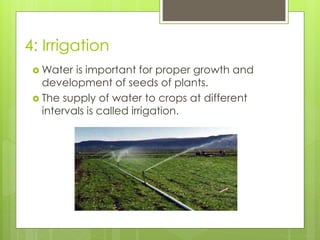
4: Irrigation
 Water is important for proper growth and
development of seeds of plants.
 The supply of water to crops at different
intervals is called irrigation.
5: Protection from Weeds
 Undesirable plants that’s may grow naturally
along with the crop is called weeds.
 The removal of weeds is called weeding.
 Weeds are also controlled by using certain
chemical s, called weedicides.
6: Harvesting
 The cutting of crop after it is mature is called
harvesting.
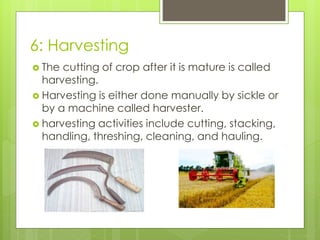
 Harvesting is either done manually by sickle or
by a machine called harvester.
 harvesting activities include cutting, stacking,
handling, threshing, cleaning, and hauling.
7: Storage
 storing grains in a proper storage place under
appropriate moisture and temperature to
prevent it from the attack of insects and to
preserve it for later use is called storage of grain.
THANK YOU !!

Crop Production & Management

  • 1.
  • 2.
    Contents  Introduction  AgriculturalPractice  Basic Practice of Crop Production 1. Preparation of Soil 2. Sowing 3. Adding Manure and Fertilisers 4. Irrigation 5. Protection from Weeds 6. Harvesting 7. Storage
  • 3.
    Introduction  All livingorganisms require food.  Crop production is a branch of agriculture that deals with growing crops for use as food and fiber.  Crop production includes grains, cotton, tobacco, fruits, vegetables, nuts and plants.
  • 4.
    Agricultural Practice  Whenplant of the same kind are grown and cultivated at one place on a large scale, it is called crop.  Crops can be classified on the basis of following season: a. Kharif Crops: The crops which are sown in the rainy season are called Kharif crops. b. Rabi Crops: The crops grown in the winter season is called Rabi crop.
  • 5.
    Basic Practice ofCrop Production  Cultivation of cops involves several activities undertaken by farmers over a period of time.  These activities or tasks are referred to as agricultural practices.  These are as follows: 1. Preparation of soil 2. Sowing 3. Adding manure and fertilizers 4. Irrigation 5. Protecting from weeds 6. Harvesting 7. Storage
  • 6.
    1: Preparation ofSoil  The process of loosing and turning of the soil is called tilling or ploughing.  Plough: It is used for tilling the soil, adding the fertilizers to the crop, removing the weeds, scraping of soil, etc.
  • 7.
     Hoe: Itis used for removing weeds and for loosening the soil.
  • 8.
     Cultivator: Itis used for ploughing.
  • 9.
    2: Sowing  Beforesowing, selection of good quality seeds are more important.  In sowing, little if any soil is placed over the seeds.  More precisely, seeds can be generally sown into the soil by maintaining a planting depth of about 2-3 times the size of the seed.
  • 10.
    3: Adding Manureand Fertilisers  The substance which are added to the soil in the form of nutrients for the healthy growth of plants are called manure and fertilisers.
  • 11.
    4: Irrigation  Wateris important for proper growth and development of seeds of plants.  The supply of water to crops at different intervals is called irrigation.
  • 12.
    5: Protection fromWeeds  Undesirable plants that’s may grow naturally along with the crop is called weeds.  The removal of weeds is called weeding.  Weeds are also controlled by using certain chemical s, called weedicides.
  • 13.
    6: Harvesting  Thecutting of crop after it is mature is called harvesting.  Harvesting is either done manually by sickle or by a machine called harvester.  harvesting activities include cutting, stacking, handling, threshing, cleaning, and hauling.
  • 14.
    7: Storage  storinggrains in a proper storage place under appropriate moisture and temperature to prevent it from the attack of insects and to preserve it for later use is called storage of grain.
  • 15.