Thinking out of the Box
Wade (1995) identifies 8 characteristics of 
critical thinking. Critical thinking involves: 
asking questions, 
defining a problem, 
examining evidence, 
analyzing assumptions and biases, 
avoiding emotional reasoning, 
avoiding oversimplification, 
considering other interpretations, and 
tolerating ambiguity.
To think creatively, we need to step outside the framework of 
what we see or hear. We have to observe, ask questions 
and analyze so that we can open up new thoughts and 
ideas on old matters or commonly-accepted arguments. 
Some fool once said, “The earth is round!” People shot down 
that conclusion without even looking at the supporting 
premises. “Of course it isn’t,” they shouted back. “That 
makes no sense!” Others tried to refute the claims. “The 
Earth can’t be round,” they put forth. “The ground is flat. 
See?”
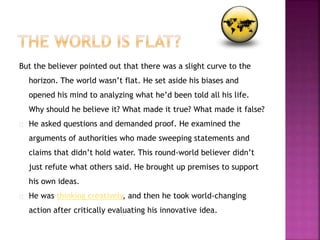
But the believer pointed out that there was a slight curve to the 
horizon. The world wasn’t flat. He set aside his biases and 
opened his mind to analyzing what he’d been told all his life. 
Why should he believe it? What made it true? What made it false? 
He asked questions and demanded proof. He examined the 
arguments of authorities who made sweeping statements and 
claims that didn’t hold water. This round-world believer didn’t 
just refute what others said. He brought up premises to support 
his own ideas. 
He was thinking creatively, and then he took world-changing 
action after critically evaluating his innovative idea.
Critical thinking and creative thinking go 
hand in hand. Creative thinking means 
generating ideas and processes; critical 
thinking evaluates those thoughts, allowing 
for rational decision. 
So how do you think critically to think more 
creatively? Here are a few quick tips:
Pay attention to words like ‘may’, ‘can’, and 
‘will’. There’s a huge difference between 
something that will [insert marvelous benefit 
here] and something that might do the same. 
Never accept anything at face value.
If a piece of content quotes an expert to help 
support the argument or conclusion, ask 
questions. What qualifies the individual to 
give advice? What credentials does the 
person have to make claims? Why is he or she 
an authority on the subject?
Over-generalization usually discredits an 
argument’s validity from the get-go. 
Knock down sentences that use words like ‘all’ 
and ‘everyone’. Not all people do, and not 
everyone knows. 
More careful wording such as ‘most’ and 
‘some’ pass muster more easily.
Whenever we attempt to do something and 
fail, we end up doing something else. As 
simplistic as this statement may seem, it is 
the first principle of creative accident. We 
may ask ourselves why we have failed to do 
what we intended, and this is the 
reasonable, expected thing to do.
But the creative accident provokes a different 
question: What have we done? Answering 
that question in a novel, unexpected way is 
the essential creative act. It is not luck, but 
rather creative insight of the highest order. 
Even when people set out to act purposefully 
and rationally to do something, they wind up 
doing things they did not intend.
John Wesley Hyatt, an Albany printer and mechanic, 
worked long and hard trying to find a substitute for 
billiard-ball ivory, then coming into short supply. He 
invented, instead, celluloid— the first commercially 
successful plastic. 
B.F. Skinner advised people that when you are 
working on something and find something interesting, 
drop everything else and study it. In fact, he 
emphasized this as a first principle of scientific 
methodology.
In principle, the unexpected event that gives rise to a 
creative invention is not all that different from the 
unexpected automobile breakdown that forces us to spend 
a night in a new and interesting town, the book sent to us 
in error that excites our imagination, or the closed 
restaurant that forces us to explore a different cuisine. 
But when looking for ideas or creative solutions, many of us 
ignore the unexpected and, consequently, lose the 
opportunity to turn chance into a creative opportunity.
By limiting your creativity, it needs to stretch 
beyond its comfort zone to find a solution. It 
goes through a warm-up process while your 
brain neurons start firing. Then you’ll get the 
burst of an idea that suddenly sparks a fire. 
For example, on the next slide is a mental 
challenge to break the creativity barrier:
Choose three random words. It doesn’t matter what they are. 
They could be sheep, lilac and dragon, for example. 
Write a three-paragraph blog post on copywriting, with each of 
your chosen words the focus of one paragraph. 
Devote all your resources. Unleash your creativity inside the 
restrictions to wander loose. Find ways to relate the words to the 
subject. Use metaphors. Use examples. Use history. Tell a story. 
Impossible? Not at all. 
Demanding? Sure. 
Worth it? Oh yeah.
By limiting your creativity, it needs to stretch beyond 
its comfort zone to find a solution. It goes through a 
warm-up process while your brain neurons start 
firing. Then you’ll get the burst of an idea that 
suddenly sparks a fire. 
You’ll write. You’ll feel the rush. 
And then you’ll enjoy the satisfying cool-down as you 
polish off you’re your post – lilacs, dragons and all. 
You’d be amazed at what your creativity can come up 
with. Are you up for the challenge?
Remember, when you are completing an assignment, 
use your creative and critical thinking skills. 
Think differently about what you’re asked to write. 
Don’t just write the same old tired ideas. See 
something in a new way! 
Analyze, problem-solve! 
When you’re writing about common concepts that 
anyone can find in a textbook or a resource, you 
aren’t being original.
Use what you know and apply it in a whole new 
way. 
You’ll be surprised at how exciting it is to come 
up with something new and fresh-- something 
that only you could have thought of. 
Go get ‘em!
http://www.copyblogger.com/fresh-content/ 
http://www.copyblogger.com/creative-accident/

Critical thinking

  • 1.
  • 2.
    Wade (1995) identifies8 characteristics of critical thinking. Critical thinking involves: asking questions, defining a problem, examining evidence, analyzing assumptions and biases, avoiding emotional reasoning, avoiding oversimplification, considering other interpretations, and tolerating ambiguity.
  • 3.
    To think creatively,we need to step outside the framework of what we see or hear. We have to observe, ask questions and analyze so that we can open up new thoughts and ideas on old matters or commonly-accepted arguments. Some fool once said, “The earth is round!” People shot down that conclusion without even looking at the supporting premises. “Of course it isn’t,” they shouted back. “That makes no sense!” Others tried to refute the claims. “The Earth can’t be round,” they put forth. “The ground is flat. See?”
  • 4.
    But the believerpointed out that there was a slight curve to the horizon. The world wasn’t flat. He set aside his biases and opened his mind to analyzing what he’d been told all his life. Why should he believe it? What made it true? What made it false? He asked questions and demanded proof. He examined the arguments of authorities who made sweeping statements and claims that didn’t hold water. This round-world believer didn’t just refute what others said. He brought up premises to support his own ideas. He was thinking creatively, and then he took world-changing action after critically evaluating his innovative idea.
  • 5.
    Critical thinking andcreative thinking go hand in hand. Creative thinking means generating ideas and processes; critical thinking evaluates those thoughts, allowing for rational decision. So how do you think critically to think more creatively? Here are a few quick tips:
  • 6.
    Pay attention towords like ‘may’, ‘can’, and ‘will’. There’s a huge difference between something that will [insert marvelous benefit here] and something that might do the same. Never accept anything at face value.
  • 7.
    If a pieceof content quotes an expert to help support the argument or conclusion, ask questions. What qualifies the individual to give advice? What credentials does the person have to make claims? Why is he or she an authority on the subject?
  • 8.
    Over-generalization usually discreditsan argument’s validity from the get-go. Knock down sentences that use words like ‘all’ and ‘everyone’. Not all people do, and not everyone knows. More careful wording such as ‘most’ and ‘some’ pass muster more easily.
  • 9.
    Whenever we attemptto do something and fail, we end up doing something else. As simplistic as this statement may seem, it is the first principle of creative accident. We may ask ourselves why we have failed to do what we intended, and this is the reasonable, expected thing to do.
  • 10.
    But the creativeaccident provokes a different question: What have we done? Answering that question in a novel, unexpected way is the essential creative act. It is not luck, but rather creative insight of the highest order. Even when people set out to act purposefully and rationally to do something, they wind up doing things they did not intend.
  • 11.
    John Wesley Hyatt,an Albany printer and mechanic, worked long and hard trying to find a substitute for billiard-ball ivory, then coming into short supply. He invented, instead, celluloid— the first commercially successful plastic. B.F. Skinner advised people that when you are working on something and find something interesting, drop everything else and study it. In fact, he emphasized this as a first principle of scientific methodology.
  • 12.
    In principle, theunexpected event that gives rise to a creative invention is not all that different from the unexpected automobile breakdown that forces us to spend a night in a new and interesting town, the book sent to us in error that excites our imagination, or the closed restaurant that forces us to explore a different cuisine. But when looking for ideas or creative solutions, many of us ignore the unexpected and, consequently, lose the opportunity to turn chance into a creative opportunity.
  • 13.
    By limiting yourcreativity, it needs to stretch beyond its comfort zone to find a solution. It goes through a warm-up process while your brain neurons start firing. Then you’ll get the burst of an idea that suddenly sparks a fire. For example, on the next slide is a mental challenge to break the creativity barrier:
  • 14.
    Choose three randomwords. It doesn’t matter what they are. They could be sheep, lilac and dragon, for example. Write a three-paragraph blog post on copywriting, with each of your chosen words the focus of one paragraph. Devote all your resources. Unleash your creativity inside the restrictions to wander loose. Find ways to relate the words to the subject. Use metaphors. Use examples. Use history. Tell a story. Impossible? Not at all. Demanding? Sure. Worth it? Oh yeah.
  • 15.
    By limiting yourcreativity, it needs to stretch beyond its comfort zone to find a solution. It goes through a warm-up process while your brain neurons start firing. Then you’ll get the burst of an idea that suddenly sparks a fire. You’ll write. You’ll feel the rush. And then you’ll enjoy the satisfying cool-down as you polish off you’re your post – lilacs, dragons and all. You’d be amazed at what your creativity can come up with. Are you up for the challenge?
  • 16.
    Remember, when youare completing an assignment, use your creative and critical thinking skills. Think differently about what you’re asked to write. Don’t just write the same old tired ideas. See something in a new way! Analyze, problem-solve! When you’re writing about common concepts that anyone can find in a textbook or a resource, you aren’t being original.
  • 17.
    Use what youknow and apply it in a whole new way. You’ll be surprised at how exciting it is to come up with something new and fresh-- something that only you could have thought of. Go get ‘em!
  • 18.