10 WAYS TO
JUMPSTART
CREATIVITY.
LIQUID AGENCY
A FEW IDEAS ON HOW
TO GET NEW IDEAS
BY MARTY NEUMEIER
NO.1
Think in metaphors.
Thinking about problems metaphorically moves your thinking
from the literal to the abstract, so you can move freely on a
different plane.
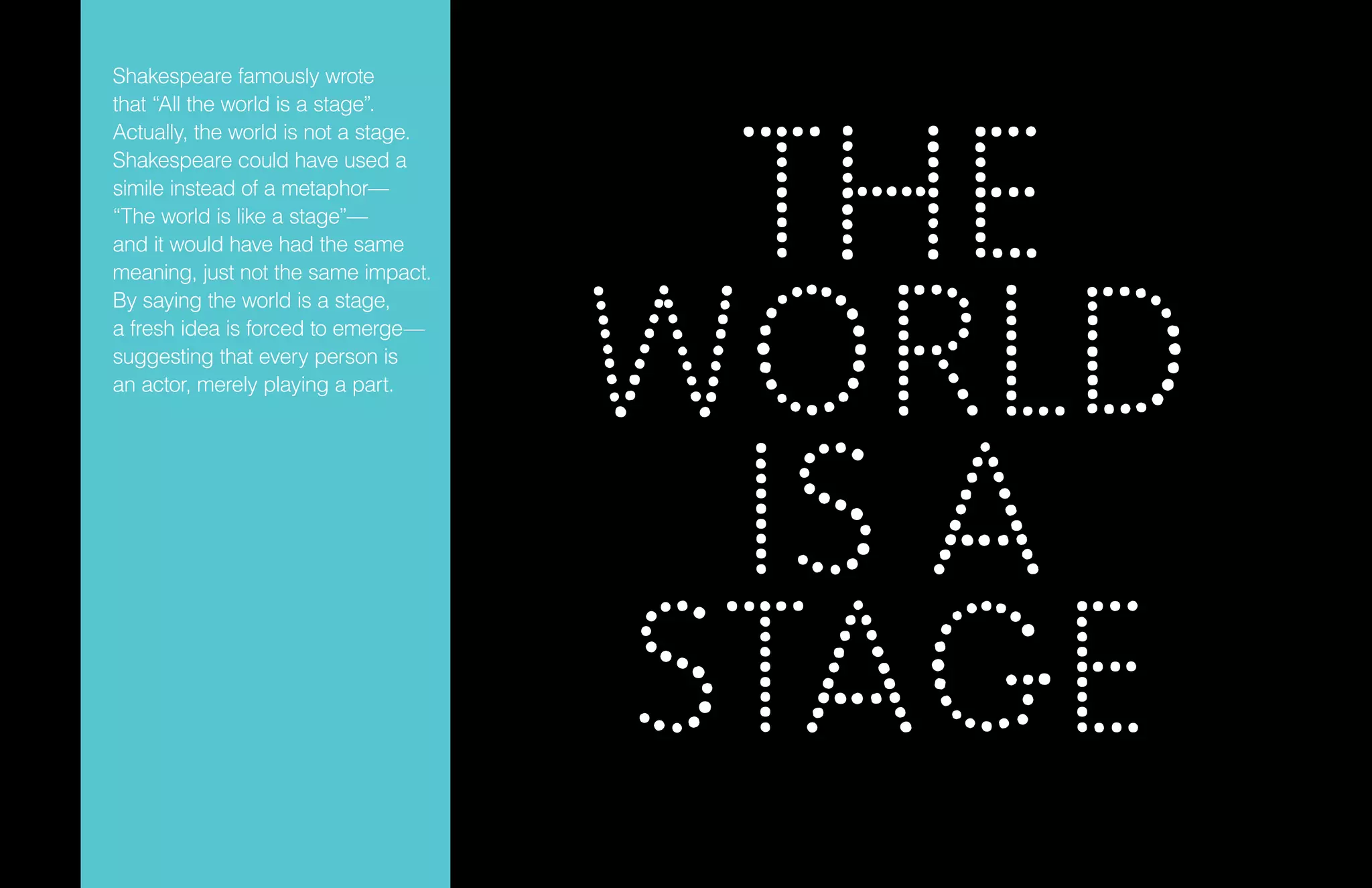
THE
WORLD
IS A
STAGE
Shakespeare famously wrote
that “All the world is a stage”.
Actually, the world is not a stage.
Shakespeare could have used a
simile instead of a metaphor—
“The world is like a stage”—
and it would have had the same
meaning, just not the same impact.
By saying the world is a stage,
a fresh idea is forced to emerge—
suggesting that every person is
an actor, merely playing a part.
Visual thinking can strip a problem down to its essence,
leading to profoundly simple conclusions that ordinary language
might not be able to reach.
NO.2
Think in pictures.
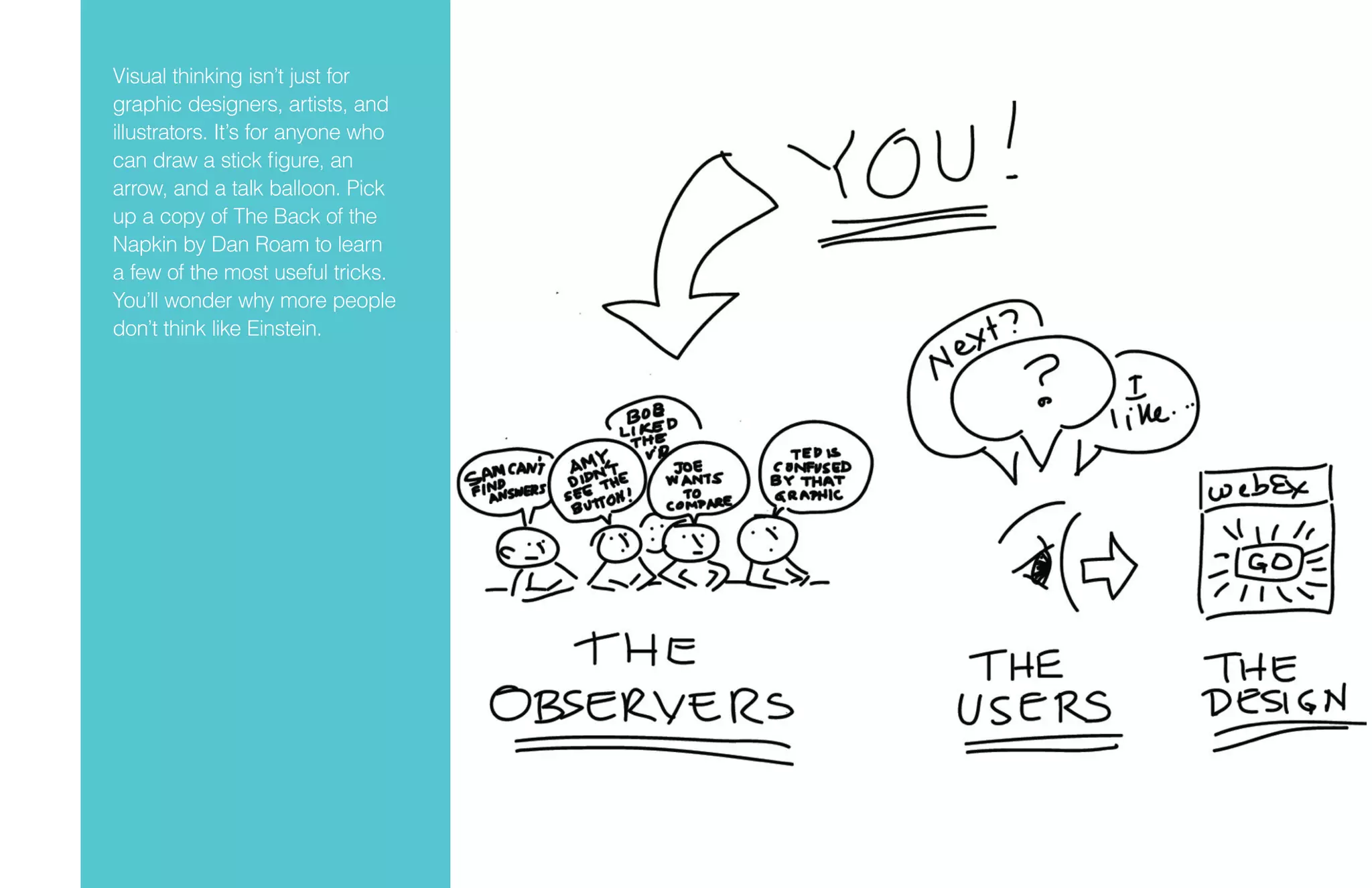
Visual thinking isn’t just for
graphic designers, artists, and
illustrators. It’s for anyone who
can draw a stick figure, an
arrow, and a talk balloon. Pick
up a copy of The Back of the
Napkin by Dan Roam to learn
a few of the most useful tricks.
You’ll wonder why more people
don’t think like Einstein.
Your brain builds up patterns of experience that act as
attractor states, making it hard to think in new ways. Think of
the worst place you could possibly start, and start there.
NO.3
Start from a different place.
Let’s say, for example, your task
is to negotiate a peace treaty
between warring states. So far
no amount of reasoning has
been able to bring the two sides
together. You could try more
reasoning, or better reasoning,
or perhaps the threat of
draconian intervention, but
these are likely to cause further
entrenchment. So you start from
a different place. What if you
suggest it anyway, just to make a
point about the absurdity of war?
Then, when the two parties reject
the idea, you can propose a less
dramatic solution: Arm wrestling
to the death, winner take all. No?
How about this? Arm wrestling,
and whoever loses buys the
other a beer.
While stealing is not the same as pure imagination, it still takes
a mental leap to see how an idea from one industry or discipline
might be used in another industry or discipline.
NO.4
Poach from other domains.
One fine summer day in 1948,
amateur inventor George de
Mestral took his dog for a walk
in the woods. Upon returning, he
found his dog and his pant legs
covered in pesky burrs. When he
put them under a microscope he
saw tiny hooks, perfectly suited
for attaching themselves to fur
and fabric. The result? Velcro.
A prepared mind can make novel connections under the right
circumstances. But it’s also possible to force connections by
introducing two unrelated ideas. Don’t fall in love with your first
idea. Novelty and innovation are two different things.
NO.5
Arrange blind dates.
What do you get when you
cross a bank with an Internet
café? A shoe store with a
charity? A Broadway show with
a circus performance? Adhesive
tape with a bookmark? You get
successful business models like
ING Direct, Tom’s Shoes, Cirque
du Soleil, and Post-it Notes.
Reversing the polarity in an assumption can release conceptual
energy. You can start by listing some assumptions about the
problem. Now, reverse the assumptions to see what happens.
What would it take to make these true?
NO.6
Reverse the polarity.
Everyone is familiar with the
problem of the office kitchen.
Let’s make some assumptions:
1. Employees don’t like doing
dishes.
2. It’s hard to tell whose dishes
are in the sink.
3. The dishes are company
property.
Now, reverse the assumptions to
see what happens.
1. Employees love doing dishes.
2. It’s easy to tell whose dishes
are in the sink.
3. The dishes are employee
property.
What would it take to make these
true? Well, employees might do
their dishes if they had a great
music system at the sink. What
if each item were personalized
with the employees’ names. Of
course, you could just lay down
the law, then enforce it. But that
seems a bit draconian.
If you can describe the central contradiction within a given
problem, you’re well on the way to solving it.
NO.7
Find the paradox.
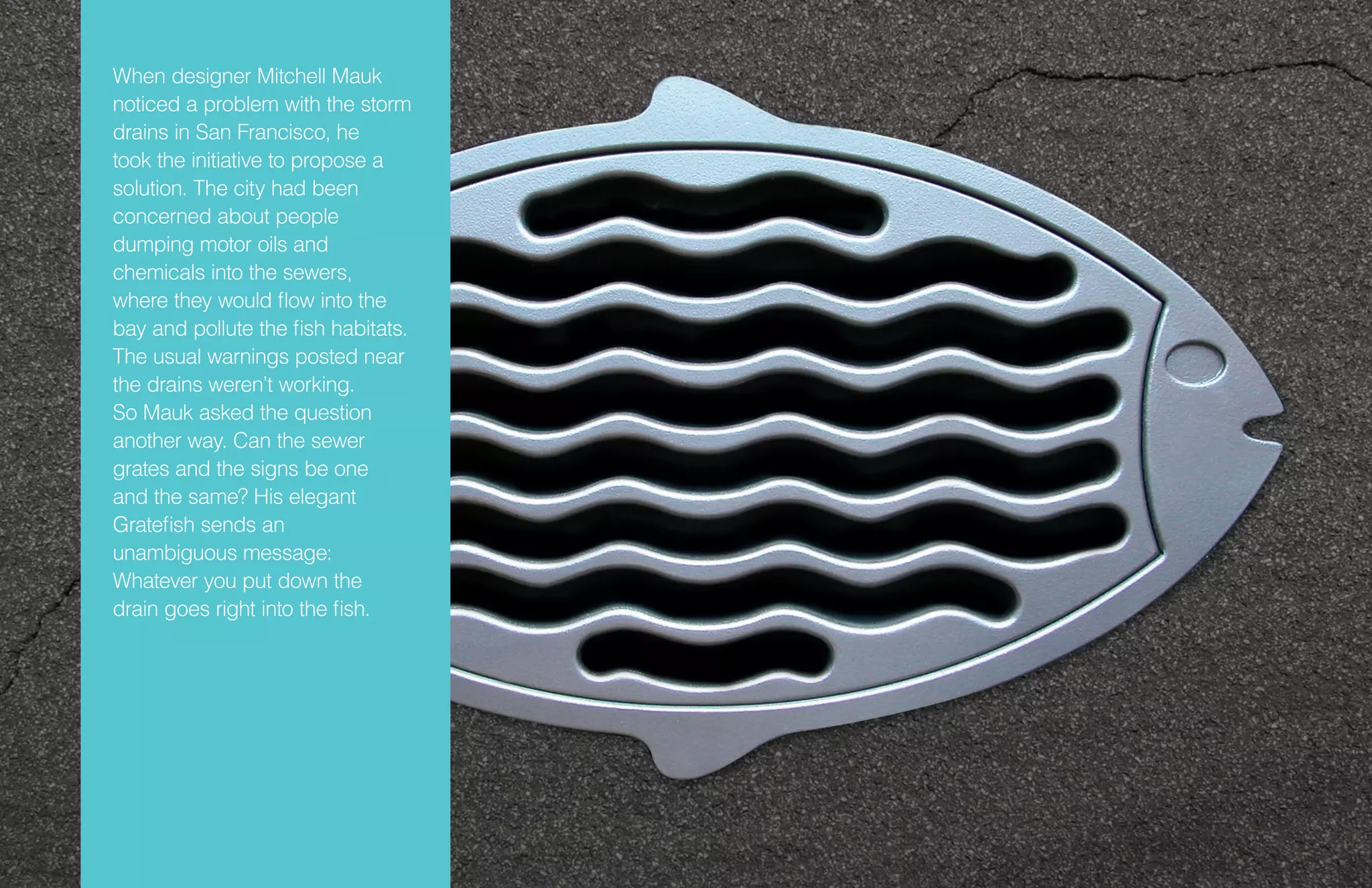
When designer Mitchell Mauk
noticed a problem with the storm
drains in San Francisco, he
took the initiative to propose a
solution. The city had been
concerned about people
dumping motor oils and
chemicals into the sewers,
where they would flow into the
bay and pollute the fish habitats.
The usual warnings posted near
the drains weren’t working.
So Mauk asked the question
another way. Can the sewer
grates and the signs be one
and the same? His elegant
Gratefish sends an
unambiguous message:
Whatever you put down the
drain goes right into the fish.
The questions are endless, but they don’t take much time to ask.
NO.8
Give it the third degree.
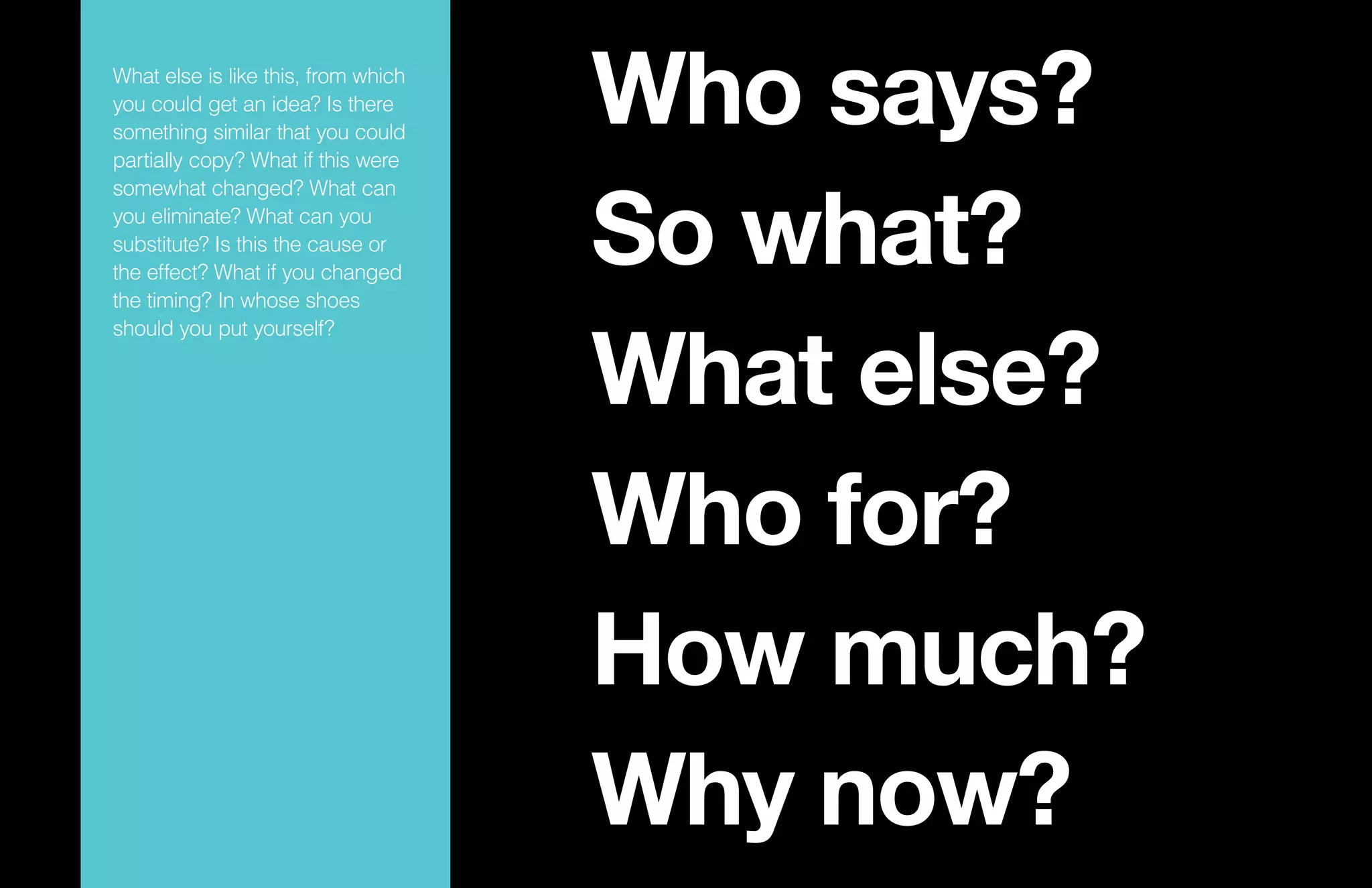
Who says?
So what?
What else?
Who for?
How much?
Why now?
What else is like this, from which
you could get an idea? Is there
something similar that you could
partially copy? What if this were
somewhat changed? What can
you eliminate? What can you
substitute? Is this the cause or
the effect? What if you changed
the timing? In whose shoes
should you put yourself?
The great thing about creative play is that mistakes don’t have
consequences. While most of the time you won’t find what
you’re looking for, sometimes you’ll find what you weren’t
looking for, and that can be even better. If you only found what
you expected to find, your idea probably isn’t new.
NO.9
Be alert for accidents.
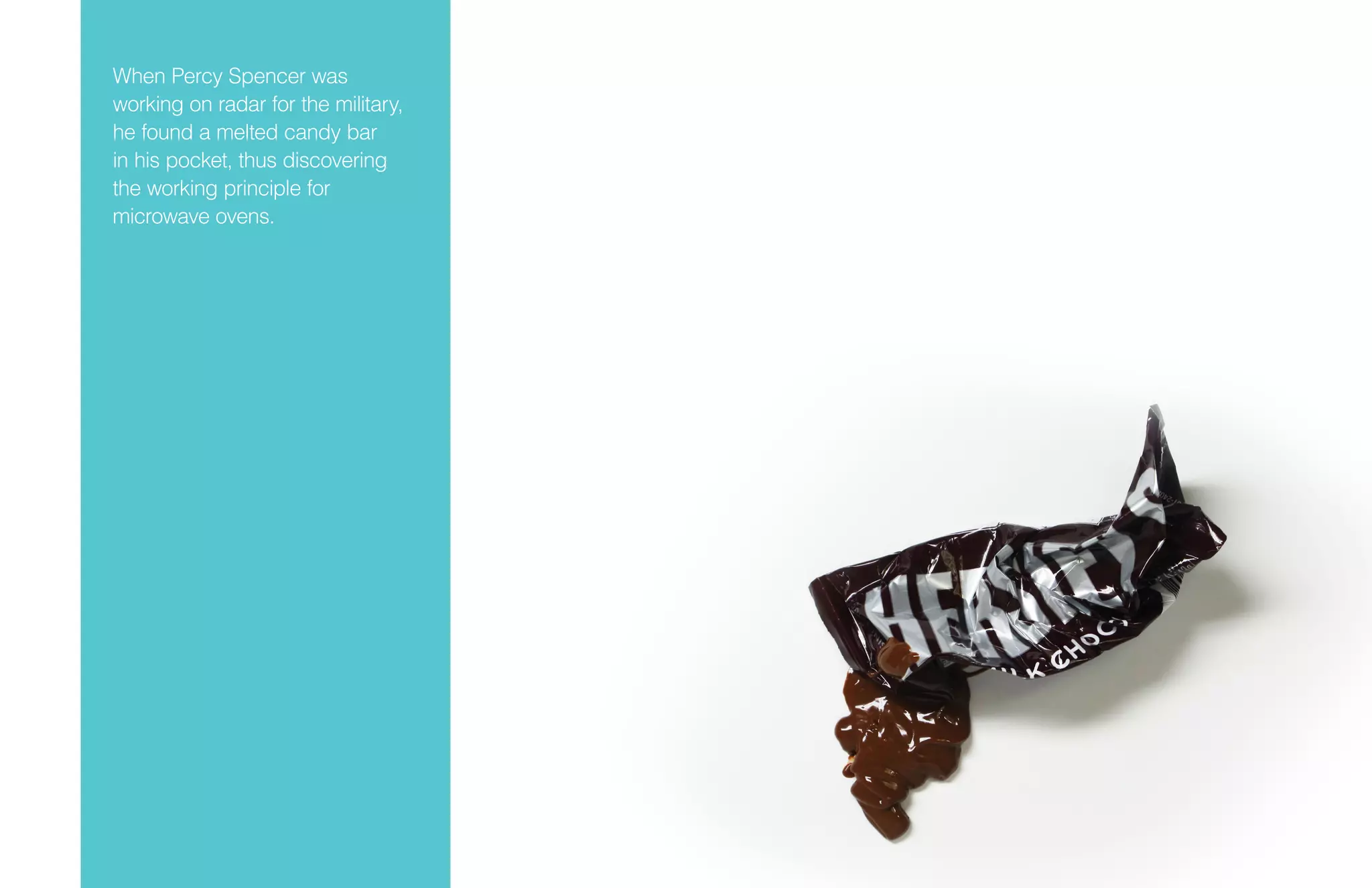
When Percy Spencer was
working on radar for the military,
he found a melted candy bar
in his pocket, thus discovering
the working principle for
microwave ovens.
“To hold one idea in mind means to hold a cloud of them.” says
Kevin Kelly. The value of ideas often lies in their ability to trigger
better ideas. If you don’t capture them, you can’t build on them.
NO.10
Write things down.
When I was a wannabe
songwriter in my teens (who
wasn’t?), I never worried that I
might forget a line of melody or
snippet of lyric. I told myself if it
were that good it would probably
come back to me. Conversely, I
believed if it didn’t come back to
me, it probably wasn’t that good.
There were two flaws in this
logic. First, I did forget good
musical ideas, and, second, the
value of ideas often lies in their
ability to trigger better ideas.
If you don’t capture them, you
can’t build on them.
BUY NOW
ON AMAZON
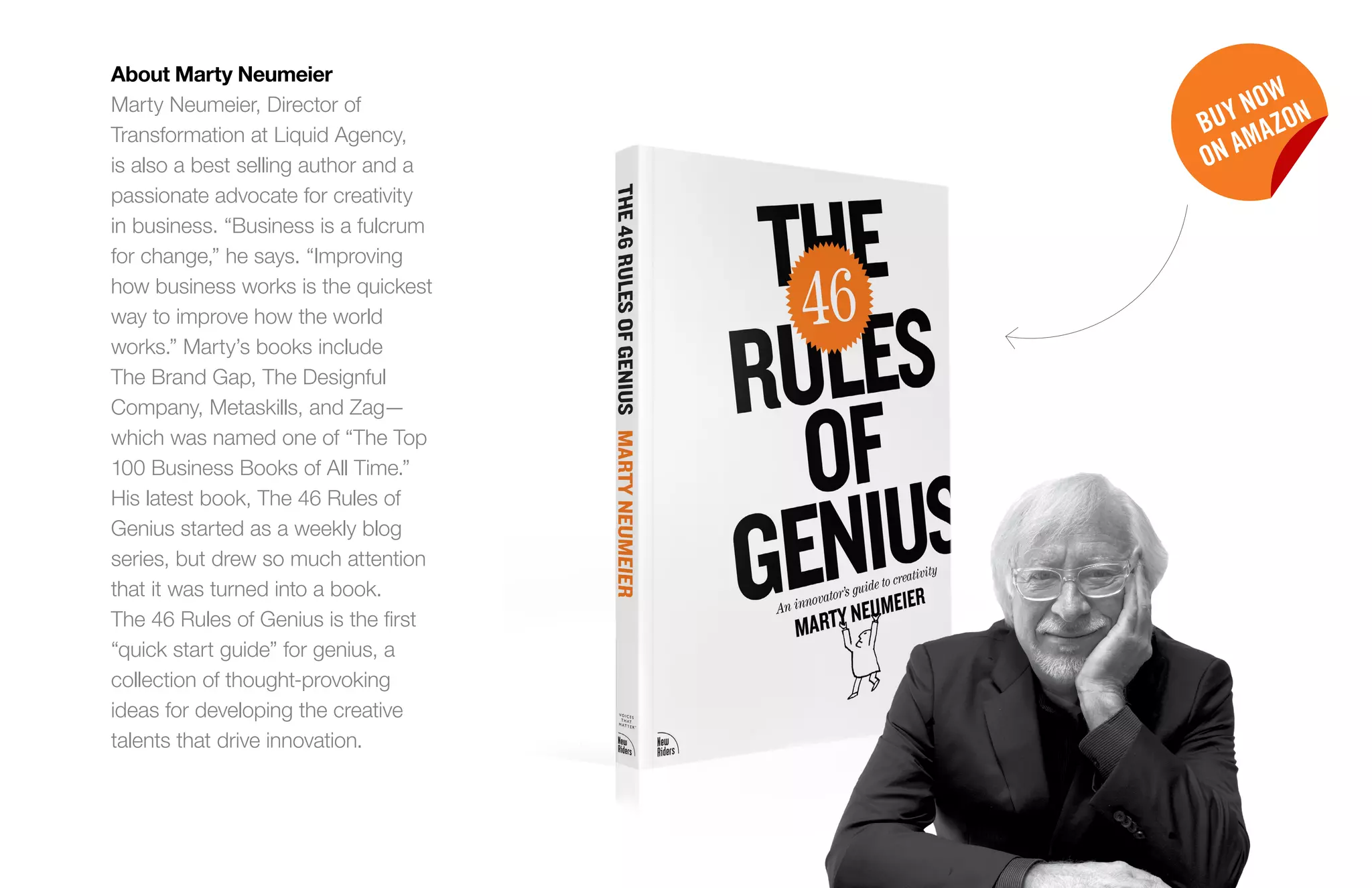
About Marty Neumeier
Marty Neumeier, Director of
Transformation at Liquid Agency,
is also a best selling author and a
passionate advocate for creativity
in business. “Business is a fulcrum
for change,” he says. “Improving
how business works is the quickest
way to improve how the world
works.” Marty’s books include
The Brand Gap, The Designful
Company, Metaskills, and Zag—
which was named one of “The Top
100 Business Books of All Time.”
His latest book, The 46 Rules of
Genius started as a weekly blog
series, but drew so much attention
that it was turned into a book.
The 46 Rules of Genius is the first
“quick start guide” for genius, a
collection of thought-provoking
ideas for developing the creative
talents that drive innovation.
We’re a brand experience agency. 
We develop holistic brand experiences that
help propel business forward. And we do it by
working with our clients in a highly collaborative
way that embraces experimentation, curiosity
and big thinking.
If you’d like to learn more about us, please visit
liquidagency.com
Our offices.
US
San Jose
448 S Market Street
San Jose, CA 95113
San Francisco
251 Rhode Island Street
Ste 204
San Francisco, CA 94103
Portland
910 NW Hoyt Street
Portland, OR 97209
New York
85 Delancey Street
Third Floor
New York, NY 10002
EUROPE
20-22 High Street, Ruddington
Nottingham NG11 6EH
England
LATAM
Luis Pasteur 5280 OF. 203
Vitacura
Santiago de Chile

10 Ways to Jumpstart Creativity

  • 1.
    10 WAYS TO JUMPSTART CREATIVITY. LIQUIDAGENCY A FEW IDEAS ON HOW TO GET NEW IDEAS BY MARTY NEUMEIER
  • 2.
    NO.1 Think in metaphors. Thinkingabout problems metaphorically moves your thinking from the literal to the abstract, so you can move freely on a different plane.
  • 3.
    THE WORLD IS A STAGE Shakespeare famouslywrote that “All the world is a stage”. Actually, the world is not a stage. Shakespeare could have used a simile instead of a metaphor— “The world is like a stage”— and it would have had the same meaning, just not the same impact. By saying the world is a stage, a fresh idea is forced to emerge— suggesting that every person is an actor, merely playing a part.
  • 4.
    Visual thinking canstrip a problem down to its essence, leading to profoundly simple conclusions that ordinary language might not be able to reach. NO.2 Think in pictures.
  • 5.
    Visual thinking isn’tjust for graphic designers, artists, and illustrators. It’s for anyone who can draw a stick figure, an arrow, and a talk balloon. Pick up a copy of The Back of the Napkin by Dan Roam to learn a few of the most useful tricks. You’ll wonder why more people don’t think like Einstein.
  • 6.
    Your brain buildsup patterns of experience that act as attractor states, making it hard to think in new ways. Think of the worst place you could possibly start, and start there. NO.3 Start from a different place.
  • 7.
    Let’s say, forexample, your task is to negotiate a peace treaty between warring states. So far no amount of reasoning has been able to bring the two sides together. You could try more reasoning, or better reasoning, or perhaps the threat of draconian intervention, but these are likely to cause further entrenchment. So you start from a different place. What if you suggest it anyway, just to make a point about the absurdity of war? Then, when the two parties reject the idea, you can propose a less dramatic solution: Arm wrestling to the death, winner take all. No? How about this? Arm wrestling, and whoever loses buys the other a beer.
  • 8.
    While stealing isnot the same as pure imagination, it still takes a mental leap to see how an idea from one industry or discipline might be used in another industry or discipline. NO.4 Poach from other domains.
  • 9.
    One fine summerday in 1948, amateur inventor George de Mestral took his dog for a walk in the woods. Upon returning, he found his dog and his pant legs covered in pesky burrs. When he put them under a microscope he saw tiny hooks, perfectly suited for attaching themselves to fur and fabric. The result? Velcro.
  • 10.
    A prepared mindcan make novel connections under the right circumstances. But it’s also possible to force connections by introducing two unrelated ideas. Don’t fall in love with your first idea. Novelty and innovation are two different things. NO.5 Arrange blind dates.
  • 11.
    What do youget when you cross a bank with an Internet café? A shoe store with a charity? A Broadway show with a circus performance? Adhesive tape with a bookmark? You get successful business models like ING Direct, Tom’s Shoes, Cirque du Soleil, and Post-it Notes.
  • 12.
    Reversing the polarityin an assumption can release conceptual energy. You can start by listing some assumptions about the problem. Now, reverse the assumptions to see what happens. What would it take to make these true? NO.6 Reverse the polarity.
  • 13.
    Everyone is familiarwith the problem of the office kitchen. Let’s make some assumptions: 1. Employees don’t like doing dishes. 2. It’s hard to tell whose dishes are in the sink. 3. The dishes are company property. Now, reverse the assumptions to see what happens. 1. Employees love doing dishes. 2. It’s easy to tell whose dishes are in the sink. 3. The dishes are employee property. What would it take to make these true? Well, employees might do their dishes if they had a great music system at the sink. What if each item were personalized with the employees’ names. Of course, you could just lay down the law, then enforce it. But that seems a bit draconian.
  • 14.
    If you candescribe the central contradiction within a given problem, you’re well on the way to solving it. NO.7 Find the paradox.
  • 15.
    When designer MitchellMauk noticed a problem with the storm drains in San Francisco, he took the initiative to propose a solution. The city had been concerned about people dumping motor oils and chemicals into the sewers, where they would flow into the bay and pollute the fish habitats. The usual warnings posted near the drains weren’t working. So Mauk asked the question another way. Can the sewer grates and the signs be one and the same? His elegant Gratefish sends an unambiguous message: Whatever you put down the drain goes right into the fish.
  • 16.
    The questions areendless, but they don’t take much time to ask. NO.8 Give it the third degree.
  • 17.
    Who says? So what? Whatelse? Who for? How much? Why now? What else is like this, from which you could get an idea? Is there something similar that you could partially copy? What if this were somewhat changed? What can you eliminate? What can you substitute? Is this the cause or the effect? What if you changed the timing? In whose shoes should you put yourself?
  • 18.
    The great thingabout creative play is that mistakes don’t have consequences. While most of the time you won’t find what you’re looking for, sometimes you’ll find what you weren’t looking for, and that can be even better. If you only found what you expected to find, your idea probably isn’t new. NO.9 Be alert for accidents.
  • 19.
    When Percy Spencerwas working on radar for the military, he found a melted candy bar in his pocket, thus discovering the working principle for microwave ovens.
  • 20.
    “To hold oneidea in mind means to hold a cloud of them.” says Kevin Kelly. The value of ideas often lies in their ability to trigger better ideas. If you don’t capture them, you can’t build on them. NO.10 Write things down.
  • 21.
    When I wasa wannabe songwriter in my teens (who wasn’t?), I never worried that I might forget a line of melody or snippet of lyric. I told myself if it were that good it would probably come back to me. Conversely, I believed if it didn’t come back to me, it probably wasn’t that good. There were two flaws in this logic. First, I did forget good musical ideas, and, second, the value of ideas often lies in their ability to trigger better ideas. If you don’t capture them, you can’t build on them.
  • 22.
    BUY NOW ON AMAZON AboutMarty Neumeier Marty Neumeier, Director of Transformation at Liquid Agency, is also a best selling author and a passionate advocate for creativity in business. “Business is a fulcrum for change,” he says. “Improving how business works is the quickest way to improve how the world works.” Marty’s books include The Brand Gap, The Designful Company, Metaskills, and Zag— which was named one of “The Top 100 Business Books of All Time.” His latest book, The 46 Rules of Genius started as a weekly blog series, but drew so much attention that it was turned into a book. The 46 Rules of Genius is the first “quick start guide” for genius, a collection of thought-provoking ideas for developing the creative talents that drive innovation.
  • 23.
    We’re a brandexperience agency. We develop holistic brand experiences that help propel business forward. And we do it by working with our clients in a highly collaborative way that embraces experimentation, curiosity and big thinking. If you’d like to learn more about us, please visit liquidagency.com Our offices. US San Jose 448 S Market Street San Jose, CA 95113 San Francisco 251 Rhode Island Street Ste 204 San Francisco, CA 94103 Portland 910 NW Hoyt Street Portland, OR 97209 New York 85 Delancey Street Third Floor New York, NY 10002 EUROPE 20-22 High Street, Ruddington Nottingham NG11 6EH England LATAM Luis Pasteur 5280 OF. 203 Vitacura Santiago de Chile