
WELCOME
A Challenge
• Please write a One Sentence Definition of CREATIVITY
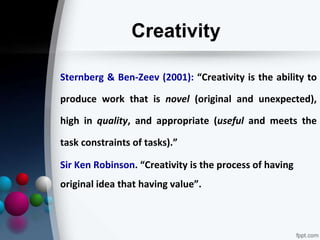
Creativity
Sternberg & Ben-Zeev (2001): “Creativity is the ability to
produce work that is novel (original and unexpected),
high in quality, and appropriate (useful and meets the
task constraints of tasks).”
Sir Ken Robinson. “Creativity is the process of having
original idea that having value”.
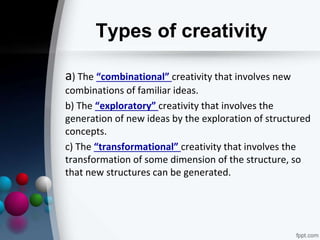
Types of creativity
a) The “combinational” creativity that involves new
combinations of familiar ideas.
b) The “exploratory” creativity that involves the
generation of new ideas by the exploration of structured
concepts.
c) The “transformational” creativity that involves the
transformation of some dimension of the structure, so
that new structures can be generated.
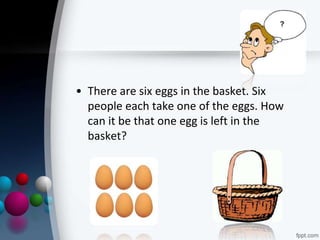
• There are six eggs in the basket. Six
people each take one of the eggs. How
can it be that one egg is left in the
basket?
Creativity and Innovation
• “Creativity and innovation are normally complementary
activities,
• Creativity generates the basis of innovation,
• Which, in its development, raises difficulties that must be
solved once again, with creativity.
• (European Commission 1998). “It is not possible to
conceive innovation without creative ideas, as these are
the starting point.”
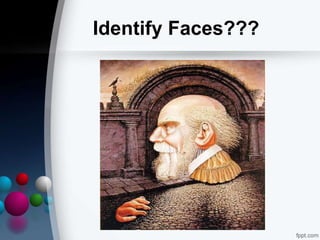
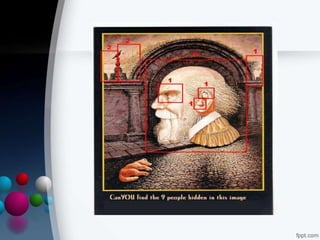
Identify Faces???
Objectives of Creativity
• To think beyond existing boundaries,
• To awake curiosity,
• To break away from rational, conventional ideas and
formalized procedures,
• To rely on the imagination, the divergent, the random
and to consider multiple solutions and alternatives
(Candy 1997, Schlange and Juttner 1997).
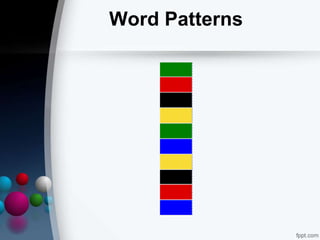
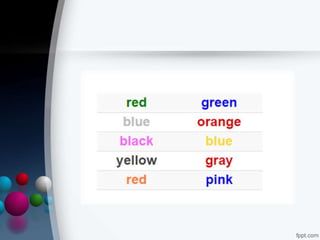
Word Patterns
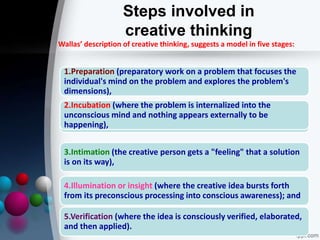
Steps involved in
creative thinking
1.Preparation (preparatory work on a problem that focuses the
individual's mind on the problem and explores the problem's
dimensions),
3.Intimation (the creative person gets a "feeling" that a solution
is on its way),
2.Incubation (where the problem is internalized into the
unconscious mind and nothing appears externally to be
happening),
4.Illumination or insight (where the creative idea bursts forth
from its preconscious processing into conscious awareness); and
5.Verification (where the idea is consciously verified, elaborated,
and then applied).
Wallas’ description of creative thinking, suggests a model in five stages:
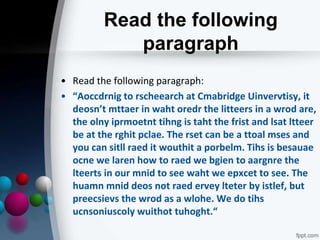
Read the following
paragraph
• Read the following paragraph:
• “Aoccdrnig to rscheearch at Cmabridge Uinvervtisy, it
deosn’t mttaer in waht oredr the litteers in a wrod are,
the olny iprmoetnt tihng is taht the frist and lsat ltteer
be at the rghit pclae. The rset can be a ttoal mses and
you can sitll raed it wouthit a porbelm. Tihs is besauae
ocne we laren how to raed we bgien to aargnre the
lteerts in our mnid to see waht we epxcet to see. The
huamn mnid deos not raed ervey lteter by istlef, but
preecsievs the wrod as a wlohe. We do tihs
ucnsoniuscoly wuithot tuhoght.“
Conti…
• In our paragraph, your brain takes a bit of
information (the first and last letters) and
activates the “word” channel and you see and
understand the word. This is why when we sit
down and try to will new ideas or solutions, we
tend to keep coming up with the same-old, same-
old ideas. Information is flowing down the same
ruts and grooves making the same-old
connections producing the same old ideas over
and over again.
Competencies essential for creative
expression
• Creativity expert Robert Epstein, a visiting scholar at
the University of California, San Diego, has identified
four competencies essential for creative expression:
 Capturing—preserving new ideas.
 Challenging—giving ourselves tough problems to solve.
 Broadening—boosting creativity by learning interesting
new things.
 Surrounding—associating with interesting and diverse
things and people.
Characteristics of the
Creative Person
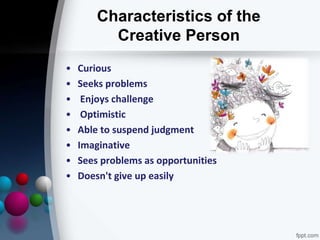
• Curious
• Seeks problems
• Enjoys challenge
• Optimistic
• Able to suspend judgment
• Imaginative
• Sees problems as opportunities
• Doesn't give up easily
Out of the box concept
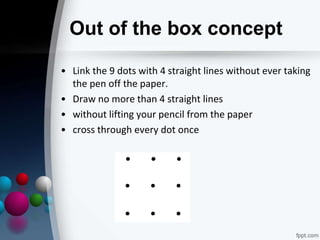
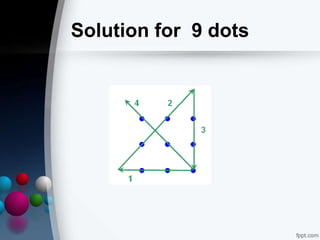
• Link the 9 dots with 4 straight lines without ever taking
the pen off the paper.
• Draw no more than 4 straight lines
• without lifting your pencil from the paper
• cross through every dot once
Solution for 9 dots
Conti…
Conti…
Conti…
Conti…
Conti…
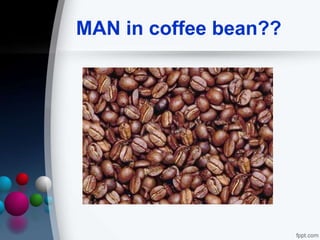
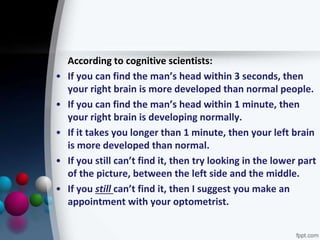
MAN in coffee bean??
According to cognitive scientists:
• If you can find the man’s head within 3 seconds, then
your right brain is more developed than normal people.
• If you can find the man’s head within 1 minute, then
your right brain is developing normally.
• If it takes you longer than 1 minute, then your left brain
is more developed than normal.
• If you still can’t find it, then try looking in the lower part
of the picture, between the left side and the middle.
• If you still can’t find it, then I suggest you make an
appointment with your optometrist.
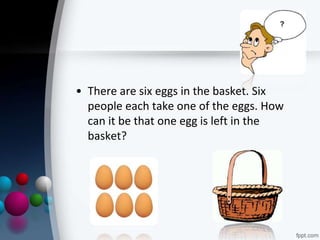
• There are six eggs in the basket. Six
people each take one of the eggs. How
can it be that one egg is left in the
basket?
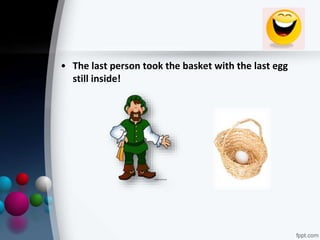
• The last person took the basket with the last egg
still inside!
How to boost your
creativity
1. Commit Yourself to Developing Your Creativity
2. Become an Expert
3. Reward Your Curiosity
4. Realize that Creativity is Sometimes Its Own Reward
5. Be Willing to Take Risks
Conti…
6. Build Your Confidence
7. Make Time for Creativity
8. Overcome Negative Attitudes that Block Creativity
9. Fight Your Fear of Failure
10. Brainstorm to Inspire New Ideas
Conti…
11. Realize That Most Problems Have Multiple
Solutions
12. Keep a Creativity Journal
13. Create a Mind Map
14. Challenge Yourself
15. Look for Sources of Inspiration
Conti…
16. Create Opportunities for Creativity
17. Consider Alternative Scenarios
18. Create a Flow Chart
19. Try the Snowball Technique
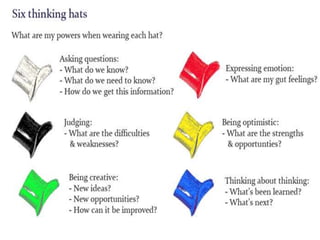
20. Try the "Six Hats" Technique
Tests of creativity
Consequences test (Guilford, 1954):
Imagine all the things that might possibly happen if all
national and local law were suddenly abolished.
Remote Associates Test (Mednick,1962):
Find a fourth world that is associated with each of
these three words
Dew - comb - bee -
Dream - break - light -
Remote Associates Test (Mednick,1962):
Find a fourth world that is associated with each of
these three words
Dew - comb - bee - Honey
Dream - break - light - Day
Unusual Uses Test (Guilford,1954):
Name as many uses as you can think of for:
- toothpick
1. Wood filler
2. Touch up furniture and
woodwork
3. Repair ornaments
4. Fill small holes
5. Sew buttons
6. Mark tape
Cleaning uses
7. Clean brushes
8. Clean cracks and gaps
9. Clean the phone
10. Clean keyboards
11. Wash your hands
12. Add sequins and jewels
13. Stir tiny paint cans
14. Finish or fix projects
15. Make doll furniture
16. Build a remote control yacht
17. Make a sculpture
18. Build a bridge
19. Make a box
20. Teach math
21. Plant an avocado
22. Repair a bent stem
23. Repair a garden hose leak
24. Test soil moisture
25. Deter cutworms
• Word Association Test (Getzel and Jackson, 1962):
Write as many meanings as you can for each of the
following words:
Alone:
When alone, books give good company.
Youth alone brings changes in society
Obstacles to creativity
Obstacles to creativity stem from
• Perceptual
• Cultural
• Emotional blocks
Perceptual blocks
• Perceptual blocks prevent people from seeing what
the real problem is.
• Difficulty is experienced in isolating the problem and
distinguishing between cause and effect.
• Perceptual blocks cause people to miss the
relationships between different aspects of the
problem and potential solutions, and they fail to use
all their senses in observing.
Cultural blocks
• Cultural blocks occur when people are constrained
by traditions and beliefs.
• The desire is to conform to the adopted pattern
and people are wary about being seen as either too
inquisitive, or too accepting.
• Difficulties arise both from over-generalizing and
from placing too much faith in statistics.
Emotional blocks
• Emotional blocks occur when people are limited by
their insecurities.
• Fear of making mistakes or looking foolish holds
people back.
• We may feel pressured by time constraints and
grab the first idea that comes along in the desire to
succeed quickly.
• Emotional blocks also can result in a lack of drive to
see the problem through to completion and
implementation of a solution.
• Rigid thinking and a distrust of colleagues can also
hold people back.
Ability of Creativity

Ability of Creativity

  • 1.
  • 3.
    A Challenge • Pleasewrite a One Sentence Definition of CREATIVITY
  • 7.
    Creativity Sternberg & Ben-Zeev(2001): “Creativity is the ability to produce work that is novel (original and unexpected), high in quality, and appropriate (useful and meets the task constraints of tasks).” Sir Ken Robinson. “Creativity is the process of having original idea that having value”.
  • 8.
    Types of creativity a)The “combinational” creativity that involves new combinations of familiar ideas. b) The “exploratory” creativity that involves the generation of new ideas by the exploration of structured concepts. c) The “transformational” creativity that involves the transformation of some dimension of the structure, so that new structures can be generated.
  • 9.
    • There aresix eggs in the basket. Six people each take one of the eggs. How can it be that one egg is left in the basket?
  • 10.
    Creativity and Innovation •“Creativity and innovation are normally complementary activities, • Creativity generates the basis of innovation, • Which, in its development, raises difficulties that must be solved once again, with creativity. • (European Commission 1998). “It is not possible to conceive innovation without creative ideas, as these are the starting point.”
  • 11.
  • 13.
    Objectives of Creativity •To think beyond existing boundaries, • To awake curiosity, • To break away from rational, conventional ideas and formalized procedures, • To rely on the imagination, the divergent, the random and to consider multiple solutions and alternatives (Candy 1997, Schlange and Juttner 1997).
  • 14.
  • 16.
    Steps involved in creativethinking 1.Preparation (preparatory work on a problem that focuses the individual's mind on the problem and explores the problem's dimensions), 3.Intimation (the creative person gets a "feeling" that a solution is on its way), 2.Incubation (where the problem is internalized into the unconscious mind and nothing appears externally to be happening), 4.Illumination or insight (where the creative idea bursts forth from its preconscious processing into conscious awareness); and 5.Verification (where the idea is consciously verified, elaborated, and then applied). Wallas’ description of creative thinking, suggests a model in five stages:
  • 17.
    Read the following paragraph •Read the following paragraph: • “Aoccdrnig to rscheearch at Cmabridge Uinvervtisy, it deosn’t mttaer in waht oredr the litteers in a wrod are, the olny iprmoetnt tihng is taht the frist and lsat ltteer be at the rghit pclae. The rset can be a ttoal mses and you can sitll raed it wouthit a porbelm. Tihs is besauae ocne we laren how to raed we bgien to aargnre the lteerts in our mnid to see waht we epxcet to see. The huamn mnid deos not raed ervey lteter by istlef, but preecsievs the wrod as a wlohe. We do tihs ucnsoniuscoly wuithot tuhoght.“
  • 18.
    Conti… • In ourparagraph, your brain takes a bit of information (the first and last letters) and activates the “word” channel and you see and understand the word. This is why when we sit down and try to will new ideas or solutions, we tend to keep coming up with the same-old, same- old ideas. Information is flowing down the same ruts and grooves making the same-old connections producing the same old ideas over and over again.
  • 19.
    Competencies essential forcreative expression • Creativity expert Robert Epstein, a visiting scholar at the University of California, San Diego, has identified four competencies essential for creative expression:  Capturing—preserving new ideas.  Challenging—giving ourselves tough problems to solve.  Broadening—boosting creativity by learning interesting new things.  Surrounding—associating with interesting and diverse things and people.
  • 20.
    Characteristics of the CreativePerson • Curious • Seeks problems • Enjoys challenge • Optimistic • Able to suspend judgment • Imaginative • Sees problems as opportunities • Doesn't give up easily
  • 21.
    Out of thebox concept • Link the 9 dots with 4 straight lines without ever taking the pen off the paper. • Draw no more than 4 straight lines • without lifting your pencil from the paper • cross through every dot once
  • 22.
  • 24.
  • 25.
  • 26.
  • 27.
  • 28.
  • 29.
  • 30.
    According to cognitivescientists: • If you can find the man’s head within 3 seconds, then your right brain is more developed than normal people. • If you can find the man’s head within 1 minute, then your right brain is developing normally. • If it takes you longer than 1 minute, then your left brain is more developed than normal. • If you still can’t find it, then try looking in the lower part of the picture, between the left side and the middle. • If you still can’t find it, then I suggest you make an appointment with your optometrist.
  • 31.
    • There aresix eggs in the basket. Six people each take one of the eggs. How can it be that one egg is left in the basket?
  • 32.
    • The lastperson took the basket with the last egg still inside!
  • 33.
    How to boostyour creativity 1. Commit Yourself to Developing Your Creativity 2. Become an Expert 3. Reward Your Curiosity 4. Realize that Creativity is Sometimes Its Own Reward 5. Be Willing to Take Risks
  • 34.
    Conti… 6. Build YourConfidence 7. Make Time for Creativity 8. Overcome Negative Attitudes that Block Creativity 9. Fight Your Fear of Failure 10. Brainstorm to Inspire New Ideas
  • 35.
    Conti… 11. Realize ThatMost Problems Have Multiple Solutions 12. Keep a Creativity Journal 13. Create a Mind Map 14. Challenge Yourself 15. Look for Sources of Inspiration
  • 36.
    Conti… 16. Create Opportunitiesfor Creativity 17. Consider Alternative Scenarios 18. Create a Flow Chart 19. Try the Snowball Technique 20. Try the "Six Hats" Technique
  • 38.
    Tests of creativity Consequencestest (Guilford, 1954): Imagine all the things that might possibly happen if all national and local law were suddenly abolished.
  • 39.
    Remote Associates Test(Mednick,1962): Find a fourth world that is associated with each of these three words Dew - comb - bee - Dream - break - light -
  • 40.
    Remote Associates Test(Mednick,1962): Find a fourth world that is associated with each of these three words Dew - comb - bee - Honey Dream - break - light - Day
  • 41.
    Unusual Uses Test(Guilford,1954): Name as many uses as you can think of for: - toothpick
  • 42.
    1. Wood filler 2.Touch up furniture and woodwork 3. Repair ornaments 4. Fill small holes 5. Sew buttons 6. Mark tape Cleaning uses 7. Clean brushes 8. Clean cracks and gaps 9. Clean the phone 10. Clean keyboards 11. Wash your hands 12. Add sequins and jewels 13. Stir tiny paint cans 14. Finish or fix projects 15. Make doll furniture 16. Build a remote control yacht 17. Make a sculpture 18. Build a bridge 19. Make a box 20. Teach math 21. Plant an avocado 22. Repair a bent stem 23. Repair a garden hose leak 24. Test soil moisture 25. Deter cutworms
  • 43.
    • Word AssociationTest (Getzel and Jackson, 1962): Write as many meanings as you can for each of the following words: Alone: When alone, books give good company. Youth alone brings changes in society
  • 44.
    Obstacles to creativity Obstaclesto creativity stem from • Perceptual • Cultural • Emotional blocks
  • 45.
    Perceptual blocks • Perceptualblocks prevent people from seeing what the real problem is. • Difficulty is experienced in isolating the problem and distinguishing between cause and effect. • Perceptual blocks cause people to miss the relationships between different aspects of the problem and potential solutions, and they fail to use all their senses in observing.
  • 46.
    Cultural blocks • Culturalblocks occur when people are constrained by traditions and beliefs. • The desire is to conform to the adopted pattern and people are wary about being seen as either too inquisitive, or too accepting. • Difficulties arise both from over-generalizing and from placing too much faith in statistics.
  • 47.
    Emotional blocks • Emotionalblocks occur when people are limited by their insecurities. • Fear of making mistakes or looking foolish holds people back. • We may feel pressured by time constraints and grab the first idea that comes along in the desire to succeed quickly. • Emotional blocks also can result in a lack of drive to see the problem through to completion and implementation of a solution. • Rigid thinking and a distrust of colleagues can also hold people back.