


Presented By
Haroon Akhtar
Umer Khan
Presented To
Dr. Rana Muhammad Ayyoub
12/13/2018 UVAS Business School, M.Phil-2016 1

CRITICAL REFLEXIVITY
12/13/2018 UVAS Business School, M.Phil-2016 2

At one end stands reflection, defined simply as ‘thinking
about’ something after the event. At the other end stands
reflexivity; a more immediate and dynamic process which
involves continuing self-awareness.
Critical reflection lies somewhere in between
(Boud, 1998; Stephens and Reimer, 1993; Clark, 2004).
Reflection and Reflexivity
12/13/2018 UVAS Business School, M.Phil-2016 3

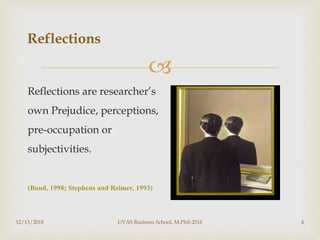
Reflections are researcher’s
own Prejudice, perceptions,
pre-occupation or
subjectivities.
(Boud, 1998; Stephens and Reimer, 1993)
Reflections
12/13/2018 UVAS Business School, M.Phil-2016 4
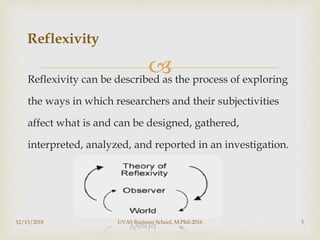
Reflexivity can be described as the process of exploring
the ways in which researchers and their subjectivities
affect what is and can be designed, gathered,
interpreted, analyzed, and reported in an investigation.
Reflexivity
12/13/2018 UVAS Business School, M.Phil-2016 5
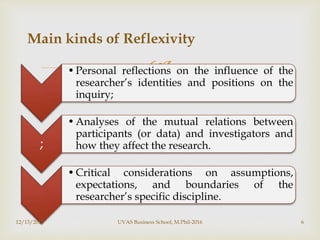
•Personal reflections on the influence of the
researcher’s identities and positions on the
inquiry;
;
•Analyses of the mutual relations between
participants (or data) and investigators and
how they affect the research.
•Critical considerations on assumptions,
expectations, and boundaries of the
researcher’s specific discipline.
Main kinds of Reflexivity
12/13/2018 UVAS Business School, M.Phil-2016 6
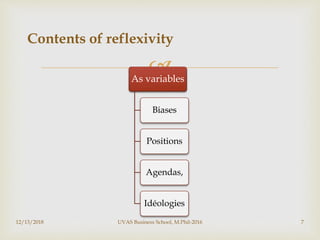
As variables
Biases
Positions
Agendas,
Idéologies
Contents of reflexivity
12/13/2018 UVAS Business School, M.Phil-2016 7

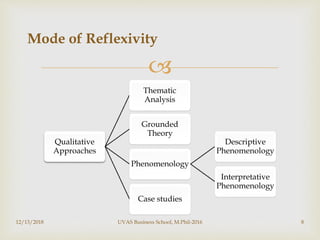
Qualitative
Approaches
Thematic
Analysis
Grounded
Theory
Phenomenology
Descriptive
Phenomenology
Interpretative
Phenomenology
Case studies
Mode of Reflexivity
12/13/2018 UVAS Business School, M.Phil-2016 8
Dawn Freshwater and Gary Rolfe
 Faculty of Medicine and, Health Sciences, University of Nottingham,
Queens Medical Centre, Nottingham
 Issue published: January 1, 2001
Critically Reflexivity: A Politically & Ethically
engaged Research Method for Nursing (Paper # 01)
12/13/2018 UVAS Business School, M.Phil-2016 9

 Traditional interpretations of research tend to
bifurcate research knowledge and practice
knowledge, with knowledge derived from practice
and direct interaction with patients being perceived
as knowledge that is not formally admissible by the
traditional scientific model
Abstract
12/13/2018 UVAS Business School, M.Phil-2016 10

 Beginning with an analysis of knowledge and power
we explore the contribution of reflexivity to the
development of a politically and ethically engaged
research process in nursing.
 In discussing critical reflexivity as a research method,
we will outline the focus of reflexive research and the
role of the reflexive researcher.
Introduction
12/13/2018 UVAS Business School, M.Phil-2016 11
Knowledge and power are indeed, two sides of same coin,
those with knowledge assume as:
Knowledge tend to assume position of Power
And those assume with power define:
What is to count valid knowledge in self-perpetuating cycle.
(Foucault, 1980)
Which Explains the Following:
Current imbalance with Quantity Methodology and their
Concurrent Funding,
Qualitative Methodologies which explore issues where
variables can’t be so strongly governed
12/13/2018 UVAS Business School, M.Phil-2016 12
Introduction: Knowledge/Power
 This challenge to technical rationality suggest not only
 A new approach to research but also,
 A new approach to practice. ( new professional researcher)
In further developing the concept of reflective inquiry, we
will also be discussing the notion of Reflexivity, used by some
researcher synonymously, with term reflection.
12/13/2018 UVAS Business School, M.Phil-2016 13
Towards a New Methodology
Reflection and Reflective Research

 The focus of reflexive research
 The role of reflexive researcher
 Validity and Reliability
 Reflexive data collection method
 Reflexive data representing method
12/13/2018 UVAS Business School, M.Phil-2016 14
Some relevant Process to Reflexivity in
Paper

 What has been presented here is reflexive research
method which aims to challenge the traditionally
hierarchy established between research and practice
with purpose of legitimatizing practice as locale for
generation of knowledge.
12/13/2018 UVAS Business School, M.Phil-2016 15
Conclusion
 Kitt Lyngsnes
 Nord University, kitt.m.lyngsnes@nord.no
A Reflexive Eye on a Collaborative Action
Research Project in School ( Paper # 02)
12/13/2018 UVAS Business School, M.Phil-2016 16

 This article presents a reflexive analysis of a collaborative
action research project based on the “Nordic tradition” of
action research.
In this project I, in the role of researcher:
 four teachers in a Norwegian primary/lower secondary
school to develop teaching practice focused on students’
learning.
Abstract
12/13/2018 UVAS Business School, M.Phil-2016 17
Extensive research evidence suggests that the quality of teaching
has a critical effect on student learning and achievement
consequently, facilitating teachers’ teaching skills and
professional learning is important in order to improve student
outcomes (Darling-Hammond, 2000; Hattie, 2009).
For this purpose we need :
 Professional knowledge
 Skills and
 Attitudes (Wilson, Barrar and Fung (2007)
Introduction
12/13/2018 UVAS Business School, M.Phil-2016 18
The etymological root of the word reflexivity to bend back
upon oneself
 In research terms,
As thoughtful, self-aware analysis of the inter subjective
dynamics between researcher and the participants.
(Lynch, 2000, p. 27)
Reflexivity as Methodology
12/13/2018 UVAS Business School, M.Phil-2016 19
The school that participated in the collaborative action
research project was a combined primary and lower
secondary school in one of Norway’s largest cities with
pupils from the first to the tenth grade.
 Data Collection
 Classroom observations
 group-interview with the teachers
Reflexivity as Methodology (cont…)
12/13/2018 UVAS Business School, M.Phil-2016 20
 I have recognized the immense importance of exercising
reflexivity both during and after an action research project.
 I have recognized the immense importance of exercising
reflexivity both during and after an action research project.
 In the first round reflexivity was carried out simultaneously
throughout the period of the collaboration and provided insight
and alternative actions in the day-to day progress of the project
 In the second round the thorough re-examination of the data,
constitutes a retrospective reflexive analysis
Discussion And Conclusion
12/13/2018 UVAS Business School, M.Phil-2016 21

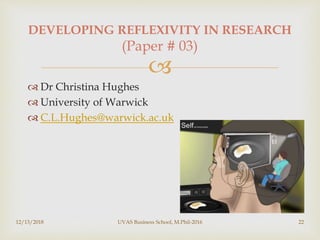
 Dr Christina Hughes
 University of Warwick
 C.L.Hughes@warwick.ac.uk
DEVELOPING REFLEXIVITY IN RESEARCH
(Paper # 03)
12/13/2018 UVAS Business School, M.Phil-2016 22
This package is concerned to:
to place the researcher at the center of an analysis of the
knowledge produced through social research
Drawing biographical aspects like,
values, politics, employment
motives, personal status's
Furthermore:
social divisions of age, gender, sexuality, ethnicity and
ability as they specifically apply to the researcher.
Abstract of the Paper
12/13/2018 UVAS Business School, M.Phil-2016 23
Mezirow's Seven Different Levels of Reflection (Jarvis, 1995: 96)
 Reflectivity:
Awareness of specific perception, meaning, behavior
 Affective Reflectivity:
Awareness of how the individual feels about what is being perceived, thought or acted upon
 Discriminant Reflectivity:
Assessing the efficacy of perception, etc
 Judgmental Reflectivity:
Making and becoming aware of the value of judgments made
Introduction
12/13/2018 UVAS Business School, M.Phil-2016 24
 Conceptual reflectivity:
Assessing the extent to which the concepts employed are
adequate for the judgement
 Psychic reflectivity:
Recognition of the habit of making percipient judgments on the
basis of limited information
 Theoretical reflectivity;
Awareness of why one set of perspectives is more or less
adequate to explain personal experience.
Introduction Continue…
12/13/2018 UVAS Business School, M.Phil-2016 25
 The key to practitioner success is "developing one's own
continuing theory of practice under real-time conditions'
(Argyris and Schon, 1974: 157)
 Reflection in Action: Schon's The Sequence of Moments (Reeves,
1994: 105)
 .Routine Response
 · Surprise
 · Reflection
 · Question Assumptions
 · On the spot experiment
12/13/2018 UVAS Business School, M.Phil-2016 26
Methodology

 A greater consciousness of narrative devices and
strategies of persuasion has led to greater risk taking
and experimentation in the presentation of research
data ( Perriton 1999, Richardson, 1990);
12/13/2018 UVAS Business School, M.Phil-2016 27
Conclusion & Recommendation

Critical reflexivity

  • 1.
    Presented By Haroon Akhtar UmerKhan Presented To Dr. Rana Muhammad Ayyoub 12/13/2018 UVAS Business School, M.Phil-2016 1
  • 2.
     CRITICAL REFLEXIVITY 12/13/2018 UVASBusiness School, M.Phil-2016 2
  • 3.
     At one endstands reflection, defined simply as ‘thinking about’ something after the event. At the other end stands reflexivity; a more immediate and dynamic process which involves continuing self-awareness. Critical reflection lies somewhere in between (Boud, 1998; Stephens and Reimer, 1993; Clark, 2004). Reflection and Reflexivity 12/13/2018 UVAS Business School, M.Phil-2016 3
  • 4.
     Reflections are researcher’s ownPrejudice, perceptions, pre-occupation or subjectivities. (Boud, 1998; Stephens and Reimer, 1993) Reflections 12/13/2018 UVAS Business School, M.Phil-2016 4
  • 5.
    Reflexivity can bedescribed as the process of exploring the ways in which researchers and their subjectivities affect what is and can be designed, gathered, interpreted, analyzed, and reported in an investigation. Reflexivity 12/13/2018 UVAS Business School, M.Phil-2016 5
  • 6.
    •Personal reflections onthe influence of the researcher’s identities and positions on the inquiry; ; •Analyses of the mutual relations between participants (or data) and investigators and how they affect the research. •Critical considerations on assumptions, expectations, and boundaries of the researcher’s specific discipline. Main kinds of Reflexivity 12/13/2018 UVAS Business School, M.Phil-2016 6
  • 7.
    As variables Biases Positions Agendas, Idéologies Contents ofreflexivity 12/13/2018 UVAS Business School, M.Phil-2016 7
  • 8.
  • 9.
    Dawn Freshwater andGary Rolfe  Faculty of Medicine and, Health Sciences, University of Nottingham, Queens Medical Centre, Nottingham  Issue published: January 1, 2001 Critically Reflexivity: A Politically & Ethically engaged Research Method for Nursing (Paper # 01) 12/13/2018 UVAS Business School, M.Phil-2016 9
  • 10.
      Traditional interpretationsof research tend to bifurcate research knowledge and practice knowledge, with knowledge derived from practice and direct interaction with patients being perceived as knowledge that is not formally admissible by the traditional scientific model Abstract 12/13/2018 UVAS Business School, M.Phil-2016 10
  • 11.
      Beginning withan analysis of knowledge and power we explore the contribution of reflexivity to the development of a politically and ethically engaged research process in nursing.  In discussing critical reflexivity as a research method, we will outline the focus of reflexive research and the role of the reflexive researcher. Introduction 12/13/2018 UVAS Business School, M.Phil-2016 11
  • 12.
    Knowledge and powerare indeed, two sides of same coin, those with knowledge assume as: Knowledge tend to assume position of Power And those assume with power define: What is to count valid knowledge in self-perpetuating cycle. (Foucault, 1980) Which Explains the Following: Current imbalance with Quantity Methodology and their Concurrent Funding, Qualitative Methodologies which explore issues where variables can’t be so strongly governed 12/13/2018 UVAS Business School, M.Phil-2016 12 Introduction: Knowledge/Power
  • 13.
     This challengeto technical rationality suggest not only  A new approach to research but also,  A new approach to practice. ( new professional researcher) In further developing the concept of reflective inquiry, we will also be discussing the notion of Reflexivity, used by some researcher synonymously, with term reflection. 12/13/2018 UVAS Business School, M.Phil-2016 13 Towards a New Methodology Reflection and Reflective Research
  • 14.
      The focusof reflexive research  The role of reflexive researcher  Validity and Reliability  Reflexive data collection method  Reflexive data representing method 12/13/2018 UVAS Business School, M.Phil-2016 14 Some relevant Process to Reflexivity in Paper
  • 15.
      What hasbeen presented here is reflexive research method which aims to challenge the traditionally hierarchy established between research and practice with purpose of legitimatizing practice as locale for generation of knowledge. 12/13/2018 UVAS Business School, M.Phil-2016 15 Conclusion
  • 16.
     Kitt Lyngsnes Nord University, kitt.m.lyngsnes@nord.no A Reflexive Eye on a Collaborative Action Research Project in School ( Paper # 02) 12/13/2018 UVAS Business School, M.Phil-2016 16
  • 17.
      This articlepresents a reflexive analysis of a collaborative action research project based on the “Nordic tradition” of action research. In this project I, in the role of researcher:  four teachers in a Norwegian primary/lower secondary school to develop teaching practice focused on students’ learning. Abstract 12/13/2018 UVAS Business School, M.Phil-2016 17
  • 18.
    Extensive research evidencesuggests that the quality of teaching has a critical effect on student learning and achievement consequently, facilitating teachers’ teaching skills and professional learning is important in order to improve student outcomes (Darling-Hammond, 2000; Hattie, 2009). For this purpose we need :  Professional knowledge  Skills and  Attitudes (Wilson, Barrar and Fung (2007) Introduction 12/13/2018 UVAS Business School, M.Phil-2016 18
  • 19.
    The etymological rootof the word reflexivity to bend back upon oneself  In research terms, As thoughtful, self-aware analysis of the inter subjective dynamics between researcher and the participants. (Lynch, 2000, p. 27) Reflexivity as Methodology 12/13/2018 UVAS Business School, M.Phil-2016 19
  • 20.
    The school thatparticipated in the collaborative action research project was a combined primary and lower secondary school in one of Norway’s largest cities with pupils from the first to the tenth grade.  Data Collection  Classroom observations  group-interview with the teachers Reflexivity as Methodology (cont…) 12/13/2018 UVAS Business School, M.Phil-2016 20
  • 21.
     I haverecognized the immense importance of exercising reflexivity both during and after an action research project.  I have recognized the immense importance of exercising reflexivity both during and after an action research project.  In the first round reflexivity was carried out simultaneously throughout the period of the collaboration and provided insight and alternative actions in the day-to day progress of the project  In the second round the thorough re-examination of the data, constitutes a retrospective reflexive analysis Discussion And Conclusion 12/13/2018 UVAS Business School, M.Phil-2016 21
  • 22.
      Dr ChristinaHughes  University of Warwick  C.L.Hughes@warwick.ac.uk DEVELOPING REFLEXIVITY IN RESEARCH (Paper # 03) 12/13/2018 UVAS Business School, M.Phil-2016 22
  • 23.
    This package isconcerned to: to place the researcher at the center of an analysis of the knowledge produced through social research Drawing biographical aspects like, values, politics, employment motives, personal status's Furthermore: social divisions of age, gender, sexuality, ethnicity and ability as they specifically apply to the researcher. Abstract of the Paper 12/13/2018 UVAS Business School, M.Phil-2016 23
  • 24.
    Mezirow's Seven DifferentLevels of Reflection (Jarvis, 1995: 96)  Reflectivity: Awareness of specific perception, meaning, behavior  Affective Reflectivity: Awareness of how the individual feels about what is being perceived, thought or acted upon  Discriminant Reflectivity: Assessing the efficacy of perception, etc  Judgmental Reflectivity: Making and becoming aware of the value of judgments made Introduction 12/13/2018 UVAS Business School, M.Phil-2016 24
  • 25.
     Conceptual reflectivity: Assessingthe extent to which the concepts employed are adequate for the judgement  Psychic reflectivity: Recognition of the habit of making percipient judgments on the basis of limited information  Theoretical reflectivity; Awareness of why one set of perspectives is more or less adequate to explain personal experience. Introduction Continue… 12/13/2018 UVAS Business School, M.Phil-2016 25
  • 26.
     The keyto practitioner success is "developing one's own continuing theory of practice under real-time conditions' (Argyris and Schon, 1974: 157)  Reflection in Action: Schon's The Sequence of Moments (Reeves, 1994: 105)  .Routine Response  · Surprise  · Reflection  · Question Assumptions  · On the spot experiment 12/13/2018 UVAS Business School, M.Phil-2016 26 Methodology
  • 27.
      A greaterconsciousness of narrative devices and strategies of persuasion has led to greater risk taking and experimentation in the presentation of research data ( Perriton 1999, Richardson, 1990); 12/13/2018 UVAS Business School, M.Phil-2016 27 Conclusion & Recommendation