Research Paper
The International Journal of Indian Psychology
ISSN 2348-5396 (e) | ISSN: 2349-3429 (p)
Volume 7, Issue 1, DIP: 18.01.043/20190701
DOI: 10.25215/0701.043
http://www.ijip.in | January- March, 2019
© 2019, Ravi. R; licensee IJIP. This is an Open Access Research distributed under the terms of the Creative
Commons Attribution License (www.creativecommons.org/licenses/by/2.0), which permits unrestricted use,
distribution, and reproduction in any Medium, provided the original work is properly cited.
A Deeper Look in Reflexivity
Rajeshwari Ravi1
*
ABSTRACT
The present article is an attempt to explore Reflexivity in depth in Qualitative Research in the
field of Psychology. This article explores what reflexivity is and how it is an important tool
for today’s social scientists. It’s further tries to uncover the difference between reflexivity and
reflection and discusses some of the famous works in by Foucault, Bourdieu etc. The present
work also looks at some of the difficulties associated with the art of reflexivity as well. This
article thus aims to bring into focus one of the most important and yet neglected skill in social
science research.
Keywords: Reflexivity, Reflection, Foucault, Bourdieu, Research
When I hear the term reflexivity two things come to my mind immediately one is the reflex
actions that I have studied about in biology and second is me looking at things through my
own perspective along with other perspectives as well.
Reflexivity comes from the Latin word ‘reflexivus’ which means to bend back or turn back.
Now when I came across this meaning I started to understand why when the word comes in
my mind I think about looking at things from my own perspective. Further reflexivity as a
process is all about naturally and inherently looking to find connections with the object or
person in focus with oneself just like the reflex actions that happen involuntarily and
automatically.
Reflexivity is defined as the process of using self reference (bending back) when
investigating or analysing an object/person/concept/event etc. It is the ability to not only be a
mere passive observer but to be an active agent as well.
Reflexivity epistemologically in social science is the way to understand an object of study in
a circular and a bidirectional manner. This means that the researcher and the researched both
affect each other and there is no one way causal relationship rather a bi or multi directional
relationship exists.
Hence reflexivity is a highly integrating process in which a person not only looks and
understands things on the basis of external factors like society, culture etc but actively takes
1
Research Student, Dept. of Psychology, University Of Delhi, New Delhi, India
*Responding Author
Received: January 23, 2019; Revision Received: February 20, 2019; Accepted: February 24, 2019
A Deeper Look in Reflexivity
© The International Journal of Indian Psychology, ISSN 2348-5396 (e)| ISSN: 2349-3429 (p) | 384
part and shapes that view and tries to merge the different views and form a deepened
understanding. For instance when a counsellor works with a client even his or her metal
processes, schemas, personal life etc too influences the way in which the counsellor
approaches the client’s issues and that is why even if all counsellors have studied the same
theories but who uses which theoretical framework and when differs from counsellor to
counsellor and this is where reflexivity comes into play.
Reflexivity has a long history. It was first brought to light by sociologists William and
Dorothy in their book The Child in America (1928). In their book they state “If men define
situations as real, they are real in their consequences” this was later known as the Thomas
theorem which means that situations that individuals define as true become the truth for later
in 1948 them. Later in 1948 Robert Merton further researched on the Thomas theorem and
gave the concept of self-fulfilling prophecy- which explains how people accommodate their
behaviour according so that a statement which would have been false becomes true or vice-
versa.
Then reflexivity paved its way in general science first through the works of Karl Popper and
he termed it as the Oedipal Effect (The Poverty of Historicism, 1957). Oedipal Effect he
describes as the ‘the effect of a prediction on the predicted event, the prediction either
causing or preventing the event that it predicts, or more generally the influence of an item of
information on the situation to which the information refers’ , this means that there is no such
thing as an exact and accurate social predictions/conclusions.
Between 1954 and 1960 reflexivity took the form of reflexive prediction and was used in
economics. It was made popular by Herbert Simon and Lucas Critique. Even works of Karl
Marx shows the use of reflexivity not only in psychology but also in economics and
management as well.
Reflexivity became the topic of interest/issue as well as a solution as a modern approach to
problems. It was during this time that works by Bourdieu, Giddens and Focoult became
pioneering in this field.
Pierre Bourdieu was a French sociologist and a philosopher among many other things. His
view on reflexivity was rather an important turning point for the field especially for using
reflexivity in research work especially in the field of social sciences.
According to Bourdieu researchers are full of biases, stereotypes, assumptions etc of their
own thus which according to him can harm the process of research itself. Thus for him
reflexivity is a solution as only when one becomes reflexive about oneself can they
understand and learn to be objective and carry out the research properly.
Thus Bourdieu looked at reflexivity as a solution rather than as a problem and it was because
of him that reflexive thinking gained importance in the research field not only in sociology
but also in other social sciences field as well.
Then around 1960’s Michel Foucault became a prominent figure. It was in 1966 that in his
book The Order of Things: An Archaeology of Human Sciences, he talked about the concept
of reflexive thinking. He talked about through analysing the shift in paradigm from
Renaissance to the Modern period. He says that each historical period or phase has an
episteme and this episteme or the knowledge to understand is dynamic in nature. And
A Deeper Look in Reflexivity
© The International Journal of Indian Psychology, ISSN 2348-5396 (e)| ISSN: 2349-3429 (p) | 385
according to him borrowing the concept of The Age of Man from Immanuel Kant’s work he
mentions that it is during this period that man started to become both the subject and the
object and this is where reflexivity comes into the picture.
And thus according to Foucault it is due to this reflexive thinking that works in social
sciences are far from being objective and each and every person has their own truth which is
neither right nor wrong.
Around the same time Giddens a Social Psychologist too worked upon reflexivity and in his
Structuration theory he notes that how with time the society is evolving and becoming more
and more self aware and reflective leading to reflexive thinking. This he termed as the
reflexive modernity.
Thus reflexivity started gaining prominence during 1970’s and 1980’s it was in this time that
Ashmore and Woolgar two great minds and supporters of reflexive thinking put forward their
ideas. Ashmore through his groundbreaking textual work titled ‘The Thesis of Reflexivity’
explained how reflexivity is not a problem but rather it is a practical issue that arises while
doing research or in scholarly pursuits. According to Ashmore reflexive thinking is a part of
any and every method of analysis used in research.
Woolgar (1988) along with Ashmore gave the concept of the continuum of reflexivity which
ranges from the benign introspection (weak reflexivity) to radical constitutive reflexivity
(strong reflexivity).
In the above mentioned two categories it can be noted that both of them are highly different
from each other. The introspection represents a more positivist approach whereby the object
and the way they are represented in the world both are distinct from each other. And the
analysis is highly objective. The radical constitutive reflexivity works on an interpretive
approach and herein there is no one objective outlook of the way the object is represented but
rather it focuses on the various ways in which it is represented and the different relationships
they have. Thus in Woolgar’s words in this category the representation and object are not
distinct but rather are intimately interconnected.
Hence it can be seen that reflexive thinking has been shaped over the years by the works of
sociologists and psychologists and researchers especially qualitative researchers.
Thus through the historical preview it can be concluded that reflexivity is the ability to be a
part of the object and to analyse it by taking into consideration the relationships one shares
with it and then while analysing maintain a bi-directional relationship. Thus it is highly
interpretive in nature.
As I was typing the above lines it then came to my mind that how is reflexivity is different
from reflectivity and while trying to go through different works I found Rachel Shaw’s work
and in her paper ‘ Embedding Reflexivity within Experiential Qualitative Psychology’ she
clearly captures the difference between the two.
Reflection is very closely related to introspection and hence is based more on a positivist
approach. It is the process of portraying and ensuring that the representation of the reality of
self (it can be of the participant or of oneself) is as accurate as possible. On the other hand
reflexivity means bending back or turning back and thus it means that reflecting one’s own
A Deeper Look in Reflexivity
© The International Journal of Indian Psychology, ISSN 2348-5396 (e)| ISSN: 2349-3429 (p) | 386
thinking to oneself. Hence reflexivity has an interpretive approach which constitutes that
people and the world are interrelated and are engaged in a dialogic relationship thus creating
multiple versions of reality.
Thus reflexive thinking or reflexivity also has the component of reflection in terms that one’s
own view of reality is also considered in analysis as well. It is thus seen that reflexivity is a
holistic approach to the field of research especially for social sciences.
I think that reflexivity is important in researches of social sciences because as the name
mentions we live in a society and thus the way we construct our idea of reality is not entirely
either by self or by the society it is rather a collaborative and a communicative
interrelationship that exists and thus when we aim to study and analyse concepts of social
sciences it is very important to be open, accepting and integrative of various viewpoints and
at the same time as a researcher not be passive but be an active agent for a holistic and an
applicable understanding.
Now as I was reading and understanding more about reflexivity I started to think that
reflexivity cannot be as linear and simple as it looks it definitely will have some layers to it
and that is when I got to know that reflexivity exists in many varieties.
These varieties or types of reflexivity arise from the approach they take, the topic of study
and how it functions or works.
Hence the different types of reflexivity are:
1. Personal Reflexivity- This is one of the most basic types of reflexivity. It refers to the
fact that how we do not need any particular object for reflexivity to occur rather
because a part of reflexivity is reflection and as discussed earlier it is more of looking
at oneself objectively. Thus personal reflexivity is the process of understanding and
interpreting one’s own worldview.
This in extreme can at times even take the form of the Narcissistic for of reflexivity
wherein an individual’s viewpoint centres only on himself or herself thus clouding the
judgment further.
2. Epistemological Reflexivity- Epistemology means the theory of knowledge. It refers
to the way we know things and understand them. So epistemological reflexivity is the
type of reflexivity where it takes the form of a method or a way to study, analyse and
interpret a topic/object/researched.
3. Critical Reflexivity- This is the type of reflexivity wherein the reflexive process is
done with an aim to evaluate a concept. Thus it will be more detailed and holistic in
nature.
4. Sociological Reflexivity- This type of reflexivity focuses on the social basis of
knowledge rather than the method of knowing it. Thus it looks into the fact that how
different social positions can affect the researched object.
Thus it can be noted that how reflexivity is multifaceted. Reflexivity has a huge role to play
in the arena of research especially in qualitative research a method used extensively by
researchers of social sciences.
Qualitative method of research unlike the quantitative focuses on understanding a concept or
an object with respective to its relationships it shares with others and also with the researcher
as well. It follows an interpretivist approach i.e. looking and understanding the subjective
A Deeper Look in Reflexivity
© The International Journal of Indian Psychology, ISSN 2348-5396 (e)| ISSN: 2349-3429 (p) | 387
experiences individuals engaging in social interactions. And thus it can be seen that
qualitative methodology of research is very closely related to the hermeneutics and
phenomenological school of thought as well.
Hence it is necessary to understand the principles of qualitative inquiry to understand the
concept of reflexivity (Streubert Speziale & Rinaldi Carpenter, 2003; van der Riet, 2012)
These principles include ensuring methodological cohesion, working inductively, being a
responsive investigator, acquiring adequate and appropriate sample, and attending to
relational ethics (Morse, Barrett, & Olsen, 2002). Practicing reflexivity is a significant
component of qualitative research (Morse et al., 2002) but as a process, it should be
embedded in all the principles (van de Riet, 2012) and “relate to the degree of influence that
the researchers exert, either intentionally or unintentionally, on the findings” (Jootun,
McGhee, & Marland, 2009).
To understand the working of reflexivity in qualitative research Bourdieu’s view is the best
fit. Bourdieu’s view of reflexivity is termed as the epistemic reflexivity. Now according to
him the society is comprised of overlapping fields and are autonomous worlds enabling a
sophisticated analysis of social positionality. And further each actor has his or her own
unique position in the society and thus have a different view of the world and it was these
different views which was of great importance to Bourdieu and integrating them while
researching a topic is of utmost importance.
Bourdieu (1994) views epistemic reflexivity as a means of underwriting rather than
undermining scientific knowledge; without this deus ex machina, his work becomes just
another viewpoint among many equally partial and equally valid views.
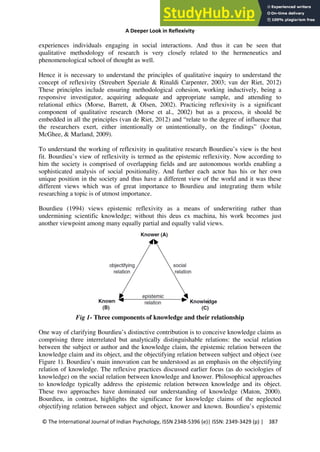
Fig 1- Three components of knowledge and their relationship
One way of clarifying Bourdieu’s distinctive contribution is to conceive knowledge claims as
comprising three interrelated but analytically distinguishable relations: the social relation
between the subject or author and the knowledge claim, the epistemic relation between the
knowledge claim and its object, and the objectifying relation between subject and object (see
Figure 1). Bourdieu’s main innovation can be understood as an emphasis on the objectifying
relation of knowledge. The reflexive practices discussed earlier focus (as do sociologies of
knowledge) on the social relation between knowledge and knower. Philosophical approaches
to knowledge typically address the epistemic relation between knowledge and its object.
These two approaches have dominated our understanding of knowledge (Maton, 2000).
Bourdieu, in contrast, highlights the significance for knowledge claims of the neglected
objectifying relation between subject and object, knower and known. Bourdieu’s epistemic
A Deeper Look in Reflexivity
© The International Journal of Indian Psychology, ISSN 2348-5396 (e)| ISSN: 2349-3429 (p) | 388
reflexivity comprises making the objectifying relation itself the object for analysis; the
resultant objectification of objectification is, he argues, the epistemological basis for social
scientific knowledge.
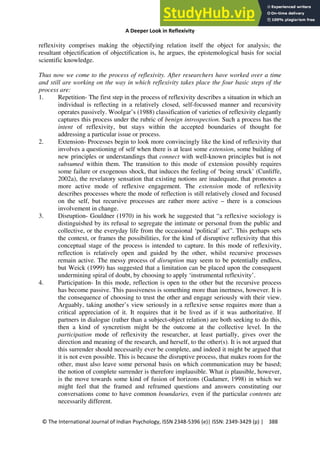
Thus now we come to the process of reflexivity. After researchers have worked over a time
and still are working on the way in which reflexivity takes place the four basic steps of the
process are:
1. Repetition- The first step in the process of reflexivity describes a situation in which an
individual is reflecting in a relatively closed, self-focussed manner and recursivity
operates passively. Woolgar’s (1988) classification of varieties of reflexivity elegantly
captures this process under the rubric of benign introspection. Such a process has the
intent of reflexivity, but stays within the accepted boundaries of thought for
addressing a particular issue or process.
2. Extension- Processes begin to look more convincingly like the kind of reflexivity that
involves a questioning of self when there is at least some extension, some building of
new principles or understandings that connect with well-known principles but is not
subsumed within them. The transition to this mode of extension possibly requires
some failure or exogenous shock, that induces the feeling of ‘being struck’ (Cunliffe,
2002a), the revelatory sensation that existing notions are inadequate, that promotes a
more active mode of reflexive engagement. The extension mode of reflexivity
describes processes where the mode of reflection is still relatively closed and focused
on the self, but recursive processes are rather more active – there is a conscious
involvement in change.
3. Disruption- Gouldner (1970) in his work he suggested that “a reflexive sociology is
distinguished by its refusal to segregate the intimate or personal from the public and
collective, or the everyday life from the occasional ‘political’ act”. This perhaps sets
the context, or frames the possibilities, for the kind of disruptive reflexivity that this
conceptual stage of the process is intended to capture. In this mode of reflexivity,
reflection is relatively open and guided by the other, whilst recursive processes
remain active. The messy process of disruption may seem to be potentially endless,
but Weick (1999) has suggested that a limitation can be placed upon the consequent
undermining spiral of doubt, by choosing to apply ‘instrumental reflexivity’.
4. Participation- In this mode, reflection is open to the other but the recursive process
has become passive. This passiveness is something more than inertness, however. It is
the consequence of choosing to trust the other and engage seriously with their view.
Arguably, taking another’s view seriously in a reflexive sense requires more than a
critical appreciation of it. It requires that it be lived as if it was authoritative. If
partners in dialogue (rather than a subject-object relation) are both seeking to do this,
then a kind of syncretism might be the outcome at the collective level. In the
participation mode of reflexivity the researcher, at least partially, gives over the
direction and meaning of the research, and herself, to the other(s). It is not argued that
this surrender should necessarily ever be complete, and indeed it might be argued that
it is not even possible. This is because the disruptive process, that makes room for the
other, must also leave some personal basis on which communication may be based;
the notion of complete surrender is therefore implausible. What is plausible, however,
is the move towards some kind of fusion of horizons (Gadamer, 1998) in which we
might feel that the framed and reframed questions and answers constituting our
conversations come to have common boundaries, even if the particular contents are
necessarily different.
A Deeper Look in Reflexivity
© The International Journal of Indian Psychology, ISSN 2348-5396 (e)| ISSN: 2349-3429 (p) | 389
Fig 2- The Meta-Process of Reflexivity
Further MacIntosh and Coupland (2010) presented four ways in which the above shown
meta-process of reflexivity can be interrupted and/or reversed. These four ways are:
1. The transition from repetition to extension may be abandoned by the qualitative
researcher simply choosing to exclude data which do not fit with her current set of
assumptions – what may be more or less legitimately classified as the ‘exclusion of
outliers’.
2. The transition from extension to disruption may be reversed if the researcher feels that
the process is too uncomfortable, and/or that a more instrumental and less challenging
approach would be more logical.
3. The transition from disruption to participation may never obtain, if the researcher
becomes locked into a pattern of radical doubt which rejects the reality (however
constructed) of everything.
4. Participation which reaches towards a ‘fusion of horizons’ but then collapses into
rejection and a confusing withdrawal into a process of disruption.
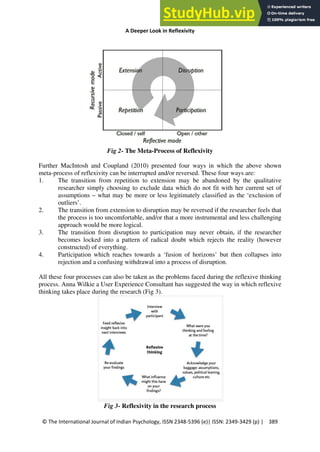
All these four processes can also be taken as the problems faced during the reflexive thinking
process. Anna Wilkie a User Experience Consultant has suggested the way in which reflexive
thinking takes place during the research (Fig 3).
Fig 3- Reflexivity in the research process
A Deeper Look in Reflexivity
© The International Journal of Indian Psychology, ISSN 2348-5396 (e)| ISSN: 2349-3429 (p) | 390
In qualitative research one of the most common ways to collect data is by interviewing
participants. Interview is the process of seeking answers to questions through the process of
conversation. And a good interview in qualitative research is not merely to just sit with a list
of questions and ask them robotically and record the answers but rather the interview is done
in a very conversational and in-depth manner with taking care of each and every nuances.
When I was studying how reflexivity can be incorporated in qualitative research and
especially in the method of interview I came across this flowchart by Anna Wilkie (Fig 3) in
which she has explained the how reflexivity occurs during the process of the interview.
So this starts with the process of interview. Now before taking an interview even the
experiences of the previous interviews of the interviewer, his or her own ideas, perceptions,
knowledge about the interviewed topic, emotions etc too influences the way in which he or
she will take the interview.
Then during the interview even the type of questions the researcher asks and the points on
which he or she wants to focus on and how they interpret it also gets influenced by the
researcher’s pre existing knowledge and his or her reflections.
Then once the interview is done while organising and analysing the data obtained the
researcher even considers and gets influenced by how he or she thought and felt about the
interview and even what they thought and felt during the time the interview was happening.
These become the means by which the researcher starts to become a part of the researched
and thus reflexivity comes into the picture. This further gets extended when the researcher
starts to even consider his or her political, cultural views/ideologies etc.
Next step to include reflexive thinking is when the researcher then thinks and understands
the ways in which his or her pre-existing knowledge and reflections influence the interview
data and its interpretation. This stage is wherein the researcher integrates with the
participant/researched and the interpretation of the information takes a holistic form. And
thus with the attained reflexive knowledge the researcher can then go into the field again with
more awareness making qualitative research strong.
For example - When a researcher with an aim to understand life after divorce goes to
interview participants the very fact that he or she chooses this topic has personal connection
as it can be that either the researcher has been divorced or has seen up close experiences of
divorce. While collecting data i.e. interviewing he or she will also get influenced by his or her
knowledge, ideas, feelings and personal experiences of divorce which will affect the way in
which the questions are asked and the type of questions asked etc.
Then while organising and collecting data as well the researcher will use his or her reflections
as well thus in the end the end understanding is an enmeshed one based on the participant’s
and one’s own viewpoint as well. Thus this is how reflexive thinking works. Hence this will
then add to the researcher’s existing idea about divorce and will make him or her more aware.
Thus according to me reflexivity in qualitative research is an ongoing and a dynamic process
which gives shape to the insight of the researcher.
This above example also reminds me of my practical work wherein our task is to reflect on a
story that we connect to and I realised that as I moved from summarising the story to
unbecoming myself and moved towards becoming the character and revisiting the story from
A Deeper Look in Reflexivity
© The International Journal of Indian Psychology, ISSN 2348-5396 (e)| ISSN: 2349-3429 (p) | 391
the character’s point of view there were a lot my own baggage that I projected and carried
onto the character.. Even looking back now the choice of my story too has a very strong
influence of my innermost feelings and thoughts and at the end I borrowed some from the
character and lent some to the character.
I feel that any work especially if it is a work of art or is based on society will have reflexive
thinking in it as the one who is doing it is also a part of it, just like while writing this
assignment or while creating a piece of art I become a part of it and get involved in it and that
becomes so deep that the result is not only one ways but rather bi-diretional.
According to me reflexivity binds the researcher, the participant and the topic of research
together and makes the researcher an active part of the process rather than being a mere
spectator. I think it is important in the arena of research especially qualitative research that
reflexivity be present because it helps the researchers become aware of how the values,
opinions and experiences they have brought to the research and how it can be useful.
It also gives the researcher an understanding of how the research process has had an influence
on him/her. Thus it provides the researcher a sense of self awareness as well. Further
reflexivity brings in a sense of confidence and accountability in the relationship of the
researcher and the participant as well as the aim, agenda and even views of the researcher is
shared with the participant as well and thus transparency exists.
Reflexivity thus makes the research process not only a mere data collection process rather
makes it an enriching process where the understanding obtained is holistic and in-depth. But
reflexivity comes with its own set of challenges as well. The very first drawback of including
reflexivity in research is imposing or altering the participant’s view i.e. the researcher’s
viewpoint might hinder or colour participant’s views. Thus making the researcher more
important than participant.
Reflexivity takes a lot of time and self-discipline and patience which thus makes the process
of research tedious as well. I also think that reflexivity can at times become very challenging
for the researcher especially emotionally because it might uncover all the
frustrations/anger/feeling overwhelmed/self-doubt etc while reflecting on ones’ own
thoughts, emotions and actions thus affecting the researcher and also the participant and the
researched topic as well.
Hence in my opinion reflexivity is like a blender even just like raw fruits and vegetables go in
blender but the juice that comes out of the blender has its own taste after mixing and
integrating all the stuff similarly reflexivity helps like a blender to blend and integrate the
participant/researched and the researcher’s views so that a an in-depth, integrative and a
holistic understanding as well.
According to me in social sciences there is a high need of reflexive thinking as all of us co-
exist and when we study a social phenomenon it is extremely important that different views
are taken into consideration and in that researcher too becomes an active part of it as well.
Thus reflexivity according to me is highly essential for the research process especially in
qualitative research as Pierre Bourdieu (1970) suggests that reflexivity is when research is
being done with conscious attention i.e. it means that just mere focus on the topic is not
necessary rather an involvement and an awareness is required not only on the part of the
participant but on the part of the researcher as well.
A Deeper Look in Reflexivity
© The International Journal of Indian Psychology, ISSN 2348-5396 (e)| ISSN: 2349-3429 (p) | 392
Reflexivity is a two way or bi-directional process whereby the researcher(knower) and the
researched(known) influence each other and in the end there is always a part of the researcher
that is given to the researched and is taken from the researched and similarly the researched
gives something but also gets influenced by the researcher as well
REFERENCES
Bartilet, J. L. (1970). Foucault, Discourse and the Call for Reflexivity. Retrieved from
http://theoryworkshop.weebly.com/uploads/9/0/9/1/9091667/foucault_discourse_refl
exivity.pdf
Bourdieu, P & Wacquant (1992). An Invittaion to Reflexive Sociology. The University of
Chicago Press.
Hughes, C. (2011). Developing Reflexivity in Research. Retrieved from
http://www2.warwick.ac.uk/fac/soc/sociology/staff/academicstaff/hughes/researchpr
ocess/
Maton, K. (2003). Reflexivity, relationism, & research: Pierre Bourdieu and the epistemic
conditions of social scientific knowledge. Space and Culture, 6(1), 52–65.
https://doi.org/10.1177/1206331202238962
Palaganas, E. C., Sanchez, M. C., Molintas, M. P., & Caricativo, R. D. (2017). Reflexivity in
Qualitative Research: A Journey of Learning. The Qualitative Report, 22(2), 426–
438. Retrieved from http://nsuworks.nova.edu/tqr%0Ahttp://nsuworks.nov
Shaw, R. (2010). Qualitative Research in Psychology Embedding Reflexivity Within
Experiential. Qualitative Research in Psychology, 7(3), 233–243.
https://doi.org/10.1080/1478088080
Woolgar, S. (1988). Reflexivity is the Ethnographer of the Text. In Knowledge and
Reflexivity.
Acknowledgements
The authors profoundly appreciate all the people who have successfully contributed in
ensuring this paper is in place. Their contributions are acknowledged however their names
cannot be able to be mentioned.
Conflict of Interest
The authors colorfully declare this paper to bear not conflict of interests
How to cite this article: Ravi. R (2019). A Deeper Look in Reflexivity.International Journal of
Indian Psychology, 7(1), 383-392, DIP:18.01.043/20190701, DOI:10.25215/0701.043

A Deeper Look In Reflexivity

  • 1.
    Research Paper The InternationalJournal of Indian Psychology ISSN 2348-5396 (e) | ISSN: 2349-3429 (p) Volume 7, Issue 1, DIP: 18.01.043/20190701 DOI: 10.25215/0701.043 http://www.ijip.in | January- March, 2019 © 2019, Ravi. R; licensee IJIP. This is an Open Access Research distributed under the terms of the Creative Commons Attribution License (www.creativecommons.org/licenses/by/2.0), which permits unrestricted use, distribution, and reproduction in any Medium, provided the original work is properly cited. A Deeper Look in Reflexivity Rajeshwari Ravi1 * ABSTRACT The present article is an attempt to explore Reflexivity in depth in Qualitative Research in the field of Psychology. This article explores what reflexivity is and how it is an important tool for today’s social scientists. It’s further tries to uncover the difference between reflexivity and reflection and discusses some of the famous works in by Foucault, Bourdieu etc. The present work also looks at some of the difficulties associated with the art of reflexivity as well. This article thus aims to bring into focus one of the most important and yet neglected skill in social science research. Keywords: Reflexivity, Reflection, Foucault, Bourdieu, Research When I hear the term reflexivity two things come to my mind immediately one is the reflex actions that I have studied about in biology and second is me looking at things through my own perspective along with other perspectives as well. Reflexivity comes from the Latin word ‘reflexivus’ which means to bend back or turn back. Now when I came across this meaning I started to understand why when the word comes in my mind I think about looking at things from my own perspective. Further reflexivity as a process is all about naturally and inherently looking to find connections with the object or person in focus with oneself just like the reflex actions that happen involuntarily and automatically. Reflexivity is defined as the process of using self reference (bending back) when investigating or analysing an object/person/concept/event etc. It is the ability to not only be a mere passive observer but to be an active agent as well. Reflexivity epistemologically in social science is the way to understand an object of study in a circular and a bidirectional manner. This means that the researcher and the researched both affect each other and there is no one way causal relationship rather a bi or multi directional relationship exists. Hence reflexivity is a highly integrating process in which a person not only looks and understands things on the basis of external factors like society, culture etc but actively takes 1 Research Student, Dept. of Psychology, University Of Delhi, New Delhi, India *Responding Author Received: January 23, 2019; Revision Received: February 20, 2019; Accepted: February 24, 2019
  • 2.
    A Deeper Lookin Reflexivity © The International Journal of Indian Psychology, ISSN 2348-5396 (e)| ISSN: 2349-3429 (p) | 384 part and shapes that view and tries to merge the different views and form a deepened understanding. For instance when a counsellor works with a client even his or her metal processes, schemas, personal life etc too influences the way in which the counsellor approaches the client’s issues and that is why even if all counsellors have studied the same theories but who uses which theoretical framework and when differs from counsellor to counsellor and this is where reflexivity comes into play. Reflexivity has a long history. It was first brought to light by sociologists William and Dorothy in their book The Child in America (1928). In their book they state “If men define situations as real, they are real in their consequences” this was later known as the Thomas theorem which means that situations that individuals define as true become the truth for later in 1948 them. Later in 1948 Robert Merton further researched on the Thomas theorem and gave the concept of self-fulfilling prophecy- which explains how people accommodate their behaviour according so that a statement which would have been false becomes true or vice- versa. Then reflexivity paved its way in general science first through the works of Karl Popper and he termed it as the Oedipal Effect (The Poverty of Historicism, 1957). Oedipal Effect he describes as the ‘the effect of a prediction on the predicted event, the prediction either causing or preventing the event that it predicts, or more generally the influence of an item of information on the situation to which the information refers’ , this means that there is no such thing as an exact and accurate social predictions/conclusions. Between 1954 and 1960 reflexivity took the form of reflexive prediction and was used in economics. It was made popular by Herbert Simon and Lucas Critique. Even works of Karl Marx shows the use of reflexivity not only in psychology but also in economics and management as well. Reflexivity became the topic of interest/issue as well as a solution as a modern approach to problems. It was during this time that works by Bourdieu, Giddens and Focoult became pioneering in this field. Pierre Bourdieu was a French sociologist and a philosopher among many other things. His view on reflexivity was rather an important turning point for the field especially for using reflexivity in research work especially in the field of social sciences. According to Bourdieu researchers are full of biases, stereotypes, assumptions etc of their own thus which according to him can harm the process of research itself. Thus for him reflexivity is a solution as only when one becomes reflexive about oneself can they understand and learn to be objective and carry out the research properly. Thus Bourdieu looked at reflexivity as a solution rather than as a problem and it was because of him that reflexive thinking gained importance in the research field not only in sociology but also in other social sciences field as well. Then around 1960’s Michel Foucault became a prominent figure. It was in 1966 that in his book The Order of Things: An Archaeology of Human Sciences, he talked about the concept of reflexive thinking. He talked about through analysing the shift in paradigm from Renaissance to the Modern period. He says that each historical period or phase has an episteme and this episteme or the knowledge to understand is dynamic in nature. And
  • 3.
    A Deeper Lookin Reflexivity © The International Journal of Indian Psychology, ISSN 2348-5396 (e)| ISSN: 2349-3429 (p) | 385 according to him borrowing the concept of The Age of Man from Immanuel Kant’s work he mentions that it is during this period that man started to become both the subject and the object and this is where reflexivity comes into the picture. And thus according to Foucault it is due to this reflexive thinking that works in social sciences are far from being objective and each and every person has their own truth which is neither right nor wrong. Around the same time Giddens a Social Psychologist too worked upon reflexivity and in his Structuration theory he notes that how with time the society is evolving and becoming more and more self aware and reflective leading to reflexive thinking. This he termed as the reflexive modernity. Thus reflexivity started gaining prominence during 1970’s and 1980’s it was in this time that Ashmore and Woolgar two great minds and supporters of reflexive thinking put forward their ideas. Ashmore through his groundbreaking textual work titled ‘The Thesis of Reflexivity’ explained how reflexivity is not a problem but rather it is a practical issue that arises while doing research or in scholarly pursuits. According to Ashmore reflexive thinking is a part of any and every method of analysis used in research. Woolgar (1988) along with Ashmore gave the concept of the continuum of reflexivity which ranges from the benign introspection (weak reflexivity) to radical constitutive reflexivity (strong reflexivity). In the above mentioned two categories it can be noted that both of them are highly different from each other. The introspection represents a more positivist approach whereby the object and the way they are represented in the world both are distinct from each other. And the analysis is highly objective. The radical constitutive reflexivity works on an interpretive approach and herein there is no one objective outlook of the way the object is represented but rather it focuses on the various ways in which it is represented and the different relationships they have. Thus in Woolgar’s words in this category the representation and object are not distinct but rather are intimately interconnected. Hence it can be seen that reflexive thinking has been shaped over the years by the works of sociologists and psychologists and researchers especially qualitative researchers. Thus through the historical preview it can be concluded that reflexivity is the ability to be a part of the object and to analyse it by taking into consideration the relationships one shares with it and then while analysing maintain a bi-directional relationship. Thus it is highly interpretive in nature. As I was typing the above lines it then came to my mind that how is reflexivity is different from reflectivity and while trying to go through different works I found Rachel Shaw’s work and in her paper ‘ Embedding Reflexivity within Experiential Qualitative Psychology’ she clearly captures the difference between the two. Reflection is very closely related to introspection and hence is based more on a positivist approach. It is the process of portraying and ensuring that the representation of the reality of self (it can be of the participant or of oneself) is as accurate as possible. On the other hand reflexivity means bending back or turning back and thus it means that reflecting one’s own
  • 4.
    A Deeper Lookin Reflexivity © The International Journal of Indian Psychology, ISSN 2348-5396 (e)| ISSN: 2349-3429 (p) | 386 thinking to oneself. Hence reflexivity has an interpretive approach which constitutes that people and the world are interrelated and are engaged in a dialogic relationship thus creating multiple versions of reality. Thus reflexive thinking or reflexivity also has the component of reflection in terms that one’s own view of reality is also considered in analysis as well. It is thus seen that reflexivity is a holistic approach to the field of research especially for social sciences. I think that reflexivity is important in researches of social sciences because as the name mentions we live in a society and thus the way we construct our idea of reality is not entirely either by self or by the society it is rather a collaborative and a communicative interrelationship that exists and thus when we aim to study and analyse concepts of social sciences it is very important to be open, accepting and integrative of various viewpoints and at the same time as a researcher not be passive but be an active agent for a holistic and an applicable understanding. Now as I was reading and understanding more about reflexivity I started to think that reflexivity cannot be as linear and simple as it looks it definitely will have some layers to it and that is when I got to know that reflexivity exists in many varieties. These varieties or types of reflexivity arise from the approach they take, the topic of study and how it functions or works. Hence the different types of reflexivity are: 1. Personal Reflexivity- This is one of the most basic types of reflexivity. It refers to the fact that how we do not need any particular object for reflexivity to occur rather because a part of reflexivity is reflection and as discussed earlier it is more of looking at oneself objectively. Thus personal reflexivity is the process of understanding and interpreting one’s own worldview. This in extreme can at times even take the form of the Narcissistic for of reflexivity wherein an individual’s viewpoint centres only on himself or herself thus clouding the judgment further. 2. Epistemological Reflexivity- Epistemology means the theory of knowledge. It refers to the way we know things and understand them. So epistemological reflexivity is the type of reflexivity where it takes the form of a method or a way to study, analyse and interpret a topic/object/researched. 3. Critical Reflexivity- This is the type of reflexivity wherein the reflexive process is done with an aim to evaluate a concept. Thus it will be more detailed and holistic in nature. 4. Sociological Reflexivity- This type of reflexivity focuses on the social basis of knowledge rather than the method of knowing it. Thus it looks into the fact that how different social positions can affect the researched object. Thus it can be noted that how reflexivity is multifaceted. Reflexivity has a huge role to play in the arena of research especially in qualitative research a method used extensively by researchers of social sciences. Qualitative method of research unlike the quantitative focuses on understanding a concept or an object with respective to its relationships it shares with others and also with the researcher as well. It follows an interpretivist approach i.e. looking and understanding the subjective
  • 5.
    A Deeper Lookin Reflexivity © The International Journal of Indian Psychology, ISSN 2348-5396 (e)| ISSN: 2349-3429 (p) | 387 experiences individuals engaging in social interactions. And thus it can be seen that qualitative methodology of research is very closely related to the hermeneutics and phenomenological school of thought as well. Hence it is necessary to understand the principles of qualitative inquiry to understand the concept of reflexivity (Streubert Speziale & Rinaldi Carpenter, 2003; van der Riet, 2012) These principles include ensuring methodological cohesion, working inductively, being a responsive investigator, acquiring adequate and appropriate sample, and attending to relational ethics (Morse, Barrett, & Olsen, 2002). Practicing reflexivity is a significant component of qualitative research (Morse et al., 2002) but as a process, it should be embedded in all the principles (van de Riet, 2012) and “relate to the degree of influence that the researchers exert, either intentionally or unintentionally, on the findings” (Jootun, McGhee, & Marland, 2009). To understand the working of reflexivity in qualitative research Bourdieu’s view is the best fit. Bourdieu’s view of reflexivity is termed as the epistemic reflexivity. Now according to him the society is comprised of overlapping fields and are autonomous worlds enabling a sophisticated analysis of social positionality. And further each actor has his or her own unique position in the society and thus have a different view of the world and it was these different views which was of great importance to Bourdieu and integrating them while researching a topic is of utmost importance. Bourdieu (1994) views epistemic reflexivity as a means of underwriting rather than undermining scientific knowledge; without this deus ex machina, his work becomes just another viewpoint among many equally partial and equally valid views. Fig 1- Three components of knowledge and their relationship One way of clarifying Bourdieu’s distinctive contribution is to conceive knowledge claims as comprising three interrelated but analytically distinguishable relations: the social relation between the subject or author and the knowledge claim, the epistemic relation between the knowledge claim and its object, and the objectifying relation between subject and object (see Figure 1). Bourdieu’s main innovation can be understood as an emphasis on the objectifying relation of knowledge. The reflexive practices discussed earlier focus (as do sociologies of knowledge) on the social relation between knowledge and knower. Philosophical approaches to knowledge typically address the epistemic relation between knowledge and its object. These two approaches have dominated our understanding of knowledge (Maton, 2000). Bourdieu, in contrast, highlights the significance for knowledge claims of the neglected objectifying relation between subject and object, knower and known. Bourdieu’s epistemic
  • 6.
    A Deeper Lookin Reflexivity © The International Journal of Indian Psychology, ISSN 2348-5396 (e)| ISSN: 2349-3429 (p) | 388 reflexivity comprises making the objectifying relation itself the object for analysis; the resultant objectification of objectification is, he argues, the epistemological basis for social scientific knowledge. Thus now we come to the process of reflexivity. After researchers have worked over a time and still are working on the way in which reflexivity takes place the four basic steps of the process are: 1. Repetition- The first step in the process of reflexivity describes a situation in which an individual is reflecting in a relatively closed, self-focussed manner and recursivity operates passively. Woolgar’s (1988) classification of varieties of reflexivity elegantly captures this process under the rubric of benign introspection. Such a process has the intent of reflexivity, but stays within the accepted boundaries of thought for addressing a particular issue or process. 2. Extension- Processes begin to look more convincingly like the kind of reflexivity that involves a questioning of self when there is at least some extension, some building of new principles or understandings that connect with well-known principles but is not subsumed within them. The transition to this mode of extension possibly requires some failure or exogenous shock, that induces the feeling of ‘being struck’ (Cunliffe, 2002a), the revelatory sensation that existing notions are inadequate, that promotes a more active mode of reflexive engagement. The extension mode of reflexivity describes processes where the mode of reflection is still relatively closed and focused on the self, but recursive processes are rather more active – there is a conscious involvement in change. 3. Disruption- Gouldner (1970) in his work he suggested that “a reflexive sociology is distinguished by its refusal to segregate the intimate or personal from the public and collective, or the everyday life from the occasional ‘political’ act”. This perhaps sets the context, or frames the possibilities, for the kind of disruptive reflexivity that this conceptual stage of the process is intended to capture. In this mode of reflexivity, reflection is relatively open and guided by the other, whilst recursive processes remain active. The messy process of disruption may seem to be potentially endless, but Weick (1999) has suggested that a limitation can be placed upon the consequent undermining spiral of doubt, by choosing to apply ‘instrumental reflexivity’. 4. Participation- In this mode, reflection is open to the other but the recursive process has become passive. This passiveness is something more than inertness, however. It is the consequence of choosing to trust the other and engage seriously with their view. Arguably, taking another’s view seriously in a reflexive sense requires more than a critical appreciation of it. It requires that it be lived as if it was authoritative. If partners in dialogue (rather than a subject-object relation) are both seeking to do this, then a kind of syncretism might be the outcome at the collective level. In the participation mode of reflexivity the researcher, at least partially, gives over the direction and meaning of the research, and herself, to the other(s). It is not argued that this surrender should necessarily ever be complete, and indeed it might be argued that it is not even possible. This is because the disruptive process, that makes room for the other, must also leave some personal basis on which communication may be based; the notion of complete surrender is therefore implausible. What is plausible, however, is the move towards some kind of fusion of horizons (Gadamer, 1998) in which we might feel that the framed and reframed questions and answers constituting our conversations come to have common boundaries, even if the particular contents are necessarily different.
  • 7.
    A Deeper Lookin Reflexivity © The International Journal of Indian Psychology, ISSN 2348-5396 (e)| ISSN: 2349-3429 (p) | 389 Fig 2- The Meta-Process of Reflexivity Further MacIntosh and Coupland (2010) presented four ways in which the above shown meta-process of reflexivity can be interrupted and/or reversed. These four ways are: 1. The transition from repetition to extension may be abandoned by the qualitative researcher simply choosing to exclude data which do not fit with her current set of assumptions – what may be more or less legitimately classified as the ‘exclusion of outliers’. 2. The transition from extension to disruption may be reversed if the researcher feels that the process is too uncomfortable, and/or that a more instrumental and less challenging approach would be more logical. 3. The transition from disruption to participation may never obtain, if the researcher becomes locked into a pattern of radical doubt which rejects the reality (however constructed) of everything. 4. Participation which reaches towards a ‘fusion of horizons’ but then collapses into rejection and a confusing withdrawal into a process of disruption. All these four processes can also be taken as the problems faced during the reflexive thinking process. Anna Wilkie a User Experience Consultant has suggested the way in which reflexive thinking takes place during the research (Fig 3). Fig 3- Reflexivity in the research process
  • 8.
    A Deeper Lookin Reflexivity © The International Journal of Indian Psychology, ISSN 2348-5396 (e)| ISSN: 2349-3429 (p) | 390 In qualitative research one of the most common ways to collect data is by interviewing participants. Interview is the process of seeking answers to questions through the process of conversation. And a good interview in qualitative research is not merely to just sit with a list of questions and ask them robotically and record the answers but rather the interview is done in a very conversational and in-depth manner with taking care of each and every nuances. When I was studying how reflexivity can be incorporated in qualitative research and especially in the method of interview I came across this flowchart by Anna Wilkie (Fig 3) in which she has explained the how reflexivity occurs during the process of the interview. So this starts with the process of interview. Now before taking an interview even the experiences of the previous interviews of the interviewer, his or her own ideas, perceptions, knowledge about the interviewed topic, emotions etc too influences the way in which he or she will take the interview. Then during the interview even the type of questions the researcher asks and the points on which he or she wants to focus on and how they interpret it also gets influenced by the researcher’s pre existing knowledge and his or her reflections. Then once the interview is done while organising and analysing the data obtained the researcher even considers and gets influenced by how he or she thought and felt about the interview and even what they thought and felt during the time the interview was happening. These become the means by which the researcher starts to become a part of the researched and thus reflexivity comes into the picture. This further gets extended when the researcher starts to even consider his or her political, cultural views/ideologies etc. Next step to include reflexive thinking is when the researcher then thinks and understands the ways in which his or her pre-existing knowledge and reflections influence the interview data and its interpretation. This stage is wherein the researcher integrates with the participant/researched and the interpretation of the information takes a holistic form. And thus with the attained reflexive knowledge the researcher can then go into the field again with more awareness making qualitative research strong. For example - When a researcher with an aim to understand life after divorce goes to interview participants the very fact that he or she chooses this topic has personal connection as it can be that either the researcher has been divorced or has seen up close experiences of divorce. While collecting data i.e. interviewing he or she will also get influenced by his or her knowledge, ideas, feelings and personal experiences of divorce which will affect the way in which the questions are asked and the type of questions asked etc. Then while organising and collecting data as well the researcher will use his or her reflections as well thus in the end the end understanding is an enmeshed one based on the participant’s and one’s own viewpoint as well. Thus this is how reflexive thinking works. Hence this will then add to the researcher’s existing idea about divorce and will make him or her more aware. Thus according to me reflexivity in qualitative research is an ongoing and a dynamic process which gives shape to the insight of the researcher. This above example also reminds me of my practical work wherein our task is to reflect on a story that we connect to and I realised that as I moved from summarising the story to unbecoming myself and moved towards becoming the character and revisiting the story from
  • 9.
    A Deeper Lookin Reflexivity © The International Journal of Indian Psychology, ISSN 2348-5396 (e)| ISSN: 2349-3429 (p) | 391 the character’s point of view there were a lot my own baggage that I projected and carried onto the character.. Even looking back now the choice of my story too has a very strong influence of my innermost feelings and thoughts and at the end I borrowed some from the character and lent some to the character. I feel that any work especially if it is a work of art or is based on society will have reflexive thinking in it as the one who is doing it is also a part of it, just like while writing this assignment or while creating a piece of art I become a part of it and get involved in it and that becomes so deep that the result is not only one ways but rather bi-diretional. According to me reflexivity binds the researcher, the participant and the topic of research together and makes the researcher an active part of the process rather than being a mere spectator. I think it is important in the arena of research especially qualitative research that reflexivity be present because it helps the researchers become aware of how the values, opinions and experiences they have brought to the research and how it can be useful. It also gives the researcher an understanding of how the research process has had an influence on him/her. Thus it provides the researcher a sense of self awareness as well. Further reflexivity brings in a sense of confidence and accountability in the relationship of the researcher and the participant as well as the aim, agenda and even views of the researcher is shared with the participant as well and thus transparency exists. Reflexivity thus makes the research process not only a mere data collection process rather makes it an enriching process where the understanding obtained is holistic and in-depth. But reflexivity comes with its own set of challenges as well. The very first drawback of including reflexivity in research is imposing or altering the participant’s view i.e. the researcher’s viewpoint might hinder or colour participant’s views. Thus making the researcher more important than participant. Reflexivity takes a lot of time and self-discipline and patience which thus makes the process of research tedious as well. I also think that reflexivity can at times become very challenging for the researcher especially emotionally because it might uncover all the frustrations/anger/feeling overwhelmed/self-doubt etc while reflecting on ones’ own thoughts, emotions and actions thus affecting the researcher and also the participant and the researched topic as well. Hence in my opinion reflexivity is like a blender even just like raw fruits and vegetables go in blender but the juice that comes out of the blender has its own taste after mixing and integrating all the stuff similarly reflexivity helps like a blender to blend and integrate the participant/researched and the researcher’s views so that a an in-depth, integrative and a holistic understanding as well. According to me in social sciences there is a high need of reflexive thinking as all of us co- exist and when we study a social phenomenon it is extremely important that different views are taken into consideration and in that researcher too becomes an active part of it as well. Thus reflexivity according to me is highly essential for the research process especially in qualitative research as Pierre Bourdieu (1970) suggests that reflexivity is when research is being done with conscious attention i.e. it means that just mere focus on the topic is not necessary rather an involvement and an awareness is required not only on the part of the participant but on the part of the researcher as well.
  • 10.
    A Deeper Lookin Reflexivity © The International Journal of Indian Psychology, ISSN 2348-5396 (e)| ISSN: 2349-3429 (p) | 392 Reflexivity is a two way or bi-directional process whereby the researcher(knower) and the researched(known) influence each other and in the end there is always a part of the researcher that is given to the researched and is taken from the researched and similarly the researched gives something but also gets influenced by the researcher as well REFERENCES Bartilet, J. L. (1970). Foucault, Discourse and the Call for Reflexivity. Retrieved from http://theoryworkshop.weebly.com/uploads/9/0/9/1/9091667/foucault_discourse_refl exivity.pdf Bourdieu, P & Wacquant (1992). An Invittaion to Reflexive Sociology. The University of Chicago Press. Hughes, C. (2011). Developing Reflexivity in Research. Retrieved from http://www2.warwick.ac.uk/fac/soc/sociology/staff/academicstaff/hughes/researchpr ocess/ Maton, K. (2003). Reflexivity, relationism, & research: Pierre Bourdieu and the epistemic conditions of social scientific knowledge. Space and Culture, 6(1), 52–65. https://doi.org/10.1177/1206331202238962 Palaganas, E. C., Sanchez, M. C., Molintas, M. P., & Caricativo, R. D. (2017). Reflexivity in Qualitative Research: A Journey of Learning. The Qualitative Report, 22(2), 426– 438. Retrieved from http://nsuworks.nova.edu/tqr%0Ahttp://nsuworks.nov Shaw, R. (2010). Qualitative Research in Psychology Embedding Reflexivity Within Experiential. Qualitative Research in Psychology, 7(3), 233–243. https://doi.org/10.1080/1478088080 Woolgar, S. (1988). Reflexivity is the Ethnographer of the Text. In Knowledge and Reflexivity. Acknowledgements The authors profoundly appreciate all the people who have successfully contributed in ensuring this paper is in place. Their contributions are acknowledged however their names cannot be able to be mentioned. Conflict of Interest The authors colorfully declare this paper to bear not conflict of interests How to cite this article: Ravi. R (2019). A Deeper Look in Reflexivity.International Journal of Indian Psychology, 7(1), 383-392, DIP:18.01.043/20190701, DOI:10.25215/0701.043