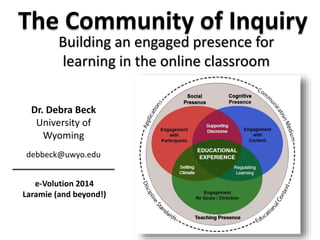
The Community of Inquiry 
Building an engaged presence for 
learning in the online classroom 
Dr. Debra Beck 
University of 
Wyoming 
debbeck@uwyo.edu 
e-Volution 2014 
Laramie (and beyond!)
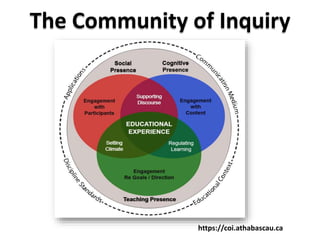
The Community of Inquiry 
https://coi.athabascau.ca
Some C of I Background
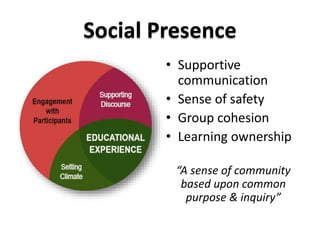
Social Presence 
• Supportive 
communication 
• Sense of safety 
• Group cohesion 
• Learning ownership 
“A sense of community 
based upon common 
purpose & inquiry”
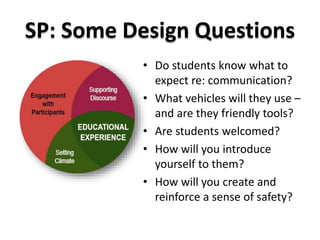
SP: Some Design Questions 
• Do students know what to 
expect re: communication? 
• What vehicles will they use – 
and are they friendly tools? 
• Are students welcomed? 
• How will you introduce 
yourself to them? 
• How will you create and 
reinforce a sense of safety?
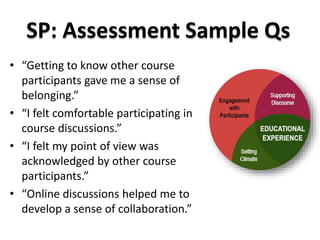
SP: Assessment Sample Qs 
• “Getting to know other course 
participants gave me a sense of 
belonging.” 
• “I felt comfortable participating in 
course discussions.” 
• “I felt my point of view was 
acknowledged by other course 
participants.” 
• “Online discussions helped me to 
develop a sense of collaboration.”
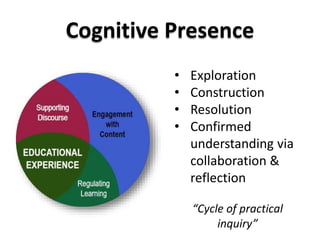
Cognitive Presence 
• Exploration 
• Construction 
• Resolution 
• Confirmed 
understanding via 
collaboration & 
reflection 
“Cycle of practical 
inquiry”
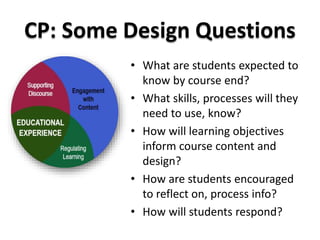
CP: Some Design Questions 
• What are students expected to 
know by course end? 
• What skills, processes will they 
need to use, know? 
• How will learning objectives 
inform course content and 
design? 
• How are students encouraged 
to reflect on, process info? 
• How will students respond?
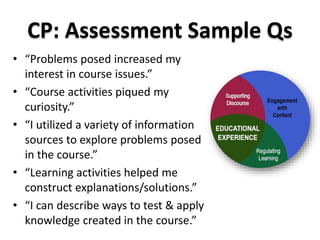
CP: Assessment Sample Qs 
• “Problems posed increased my 
interest in course issues.” 
• “Course activities piqued my 
curiosity.” 
• “I utilized a variety of information 
sources to explore problems posed 
in the course.” 
• “Learning activities helped me 
construct explanations/solutions.” 
• “I can describe ways to test & apply 
knowledge created in the course.”
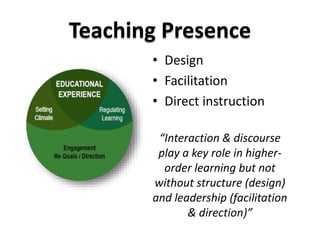
Teaching Presence 
• Design 
• Facilitation 
• Direct instruction 
“Interaction & discourse 
play a key role in higher-order 
learning but not 
without structure (design) 
and leadership (facilitation 
& direction)”
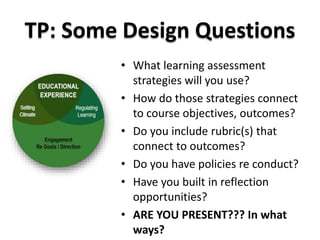
TP: Some Design Questions 
• What learning assessment 
strategies will you use? 
• How do those strategies connect 
to course objectives, outcomes? 
• Do you include rubric(s) that 
connect to outcomes? 
• Do you have policies re conduct? 
• Have you built in reflection 
opportunities? 
• ARE YOU PRESENT??? In what 
ways?
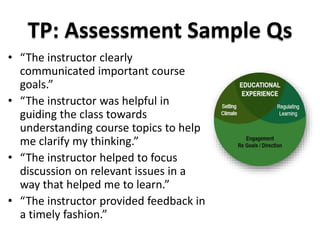
TP: Assessment Sample Qs 
• “The instructor clearly 
communicated important course 
goals.” 
• “The instructor was helpful in 
guiding the class towards 
understanding course topics to help 
me clarify my thinking.” 
• “The instructor helped to focus 
discussion on relevant issues in a 
way that helped me to learn.” 
• “The instructor provided feedback in 
a timely fashion.”
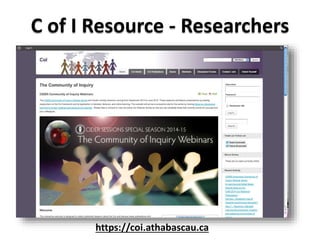
C of I Resource - Researchers 
https://coi.athabascau.ca
C of I Resource - Pinterest 
http://www.pinterest.com/npmaven/
C of I Resource - Diigo

The Community of Inquiry: Building an engaged presence for learning in the online classroom

  • 1.
    The Community ofInquiry Building an engaged presence for learning in the online classroom Dr. Debra Beck University of Wyoming debbeck@uwyo.edu e-Volution 2014 Laramie (and beyond!)
  • 2.
    The Community ofInquiry https://coi.athabascau.ca
  • 3.
    Some C ofI Background
  • 4.
    Social Presence •Supportive communication • Sense of safety • Group cohesion • Learning ownership “A sense of community based upon common purpose & inquiry”
  • 5.
    SP: Some DesignQuestions • Do students know what to expect re: communication? • What vehicles will they use – and are they friendly tools? • Are students welcomed? • How will you introduce yourself to them? • How will you create and reinforce a sense of safety?
  • 6.
    SP: Assessment SampleQs • “Getting to know other course participants gave me a sense of belonging.” • “I felt comfortable participating in course discussions.” • “I felt my point of view was acknowledged by other course participants.” • “Online discussions helped me to develop a sense of collaboration.”
  • 7.
    Cognitive Presence •Exploration • Construction • Resolution • Confirmed understanding via collaboration & reflection “Cycle of practical inquiry”
  • 8.
    CP: Some DesignQuestions • What are students expected to know by course end? • What skills, processes will they need to use, know? • How will learning objectives inform course content and design? • How are students encouraged to reflect on, process info? • How will students respond?
  • 9.
    CP: Assessment SampleQs • “Problems posed increased my interest in course issues.” • “Course activities piqued my curiosity.” • “I utilized a variety of information sources to explore problems posed in the course.” • “Learning activities helped me construct explanations/solutions.” • “I can describe ways to test & apply knowledge created in the course.”
  • 10.
    Teaching Presence •Design • Facilitation • Direct instruction “Interaction & discourse play a key role in higher-order learning but not without structure (design) and leadership (facilitation & direction)”
  • 11.
    TP: Some DesignQuestions • What learning assessment strategies will you use? • How do those strategies connect to course objectives, outcomes? • Do you include rubric(s) that connect to outcomes? • Do you have policies re conduct? • Have you built in reflection opportunities? • ARE YOU PRESENT??? In what ways?
  • 12.
    TP: Assessment SampleQs • “The instructor clearly communicated important course goals.” • “The instructor was helpful in guiding the class towards understanding course topics to help me clarify my thinking.” • “The instructor helped to focus discussion on relevant issues in a way that helped me to learn.” • “The instructor provided feedback in a timely fashion.”
  • 13.
    C of IResource - Researchers https://coi.athabascau.ca
  • 14.
    C of IResource - Pinterest http://www.pinterest.com/npmaven/
  • 15.
    C of IResource - Diigo