University of Zambia Undergraduate
Anaesthesia Placement
University Teaching Hospital Lusaka
Dr Phil Dart
UK Anaesthetic Fellow
Critical Care Medicine
An introduction to high dependancy and intensive care
University Teaching Hospital, Lusaka
Dr Philip Dart
Learning Objectives
On completion of this module the student should;
 Understand the services offered by critical care
units
 Know the teams involved
 Understand some of the criteria for critical care
review and intervention
 Know the mechanism of action of some of the
drugs unique to critical care
Intensive Care
 Intensive care units (ICUs) are specialist hospital
wards. They provide intensive care (treatment
and monitoring) for people in a critically ill or
unstable condition.
 High dependancy wards are hospital wards
offering a higher level of monitoring and nursing
care than normal wards, but which generally do
not offer organ support
 ICU’s and HDU’s are collectively known as critical
care units
Intensive Care
 Multi-disciplinary unit
 Doctors – anaesthetic, medical, surgical, specialist
 Nurses – specialist higher training and
qualifications
 Physiotherapists
 Nutritionists
 Speech and language therapists
 Technical support
 Chaplaincy, counselling
 And more
Intensive Care Medicine
 Different specialty leads depending on location
globally
 UK, Europe, Australia – traditionally anaesthetic
lead
 America – Medical ICU led by physicians,
Surgical by surgeons
 Many countries now developing separate
faculties or colleges, e.g. FICM (UK), ANZICS
(Australia/NZ)
 Rapidly expanding field of medicine globally
Intensive care – What can we do?
Organ support
Artificially supporting one or more organ system whilst
the body recovers from the insult or definitive
management of pathology
 Respiratory support – non-invasive ventilation, invasive
ventilation, ECMO
 Cardiovascular support – Vasopressor and inotropic
drugs, Aortic baloon pumps
 Renal Support – continuous veno-venous filtration and
others
Intensive care – What can we do?
Monitoring
 1 to 1 or 1 to 2 nursing ratios
 Beat to beat blood pressure and cardiac output
monitoring
 invasive arterial blood pressure monitoring, LiDCCo,
PICCo, Swan-Ganz pulmonary venous catheter
 Continuous intracerebral pressure and
oxygenation monitoring
And more
ICU – who to admit?
 There is no easy answer!!
 Intensive care has been defined as “a service for
patients with potentially recoverable conditions who
can benefit from more detailed observation and
invasive treatment than can safely be provided in
general wards or high dependency areas.”
 It is usually reserved for patients with potential or
established organ failure.
 Early referral is particularly important. If referral is
delayed until the patient’s life is clearly at risk, the
chances of full recovery are jeopardised
Signs of organ system failure
Cardiovascular
 Cardiovascular failure (‘shock’) means that tissue
perfusion is inadequate to meet metabolic demands
for oxygen and nutrients. If uncorrected this can lead
to irreversible tissue hypoxia and cell death
 Cardiovascular failure is a common indication for
admission to the critical care unit.
 The aim of treatment is to support tissue perfusion
and oxygen delivery which can be achieved through
the use of vasoactive drugs (inotropes and
vasopressors)
Signs of organ system failure
 Cardiovascular
 Shock refractory to treatment (fluids, antibiotics or
whatever the patient specific situation require)
 Typically seen as: hypotension or relative
hypotension with – oliguria and worsening renal
function, confusion or drowsiness which is NOT
RESPONDING TO TREATMENT
 These patients may require vasopressor drugs (to
increase blood pressure) or inotropic drugs (to help
augment contraction of the myocardium)
 Review – causes of shock
 Obstructive (PE/PTx/Tamponade)
 Hypovolaemic (fluid loss/blood loss)
 Cardiogenic (MI/Arrythmias/Valve failure)
 Distributive (Sepsis/Neurogenic/anaphylaxis)
Signs of organ system failure
 Respiratory
 Respiratory distress (Failure to oxygenate and/or
ventilate)
 Signs and symptoms: persistent high resp rate, low
saturations, feeling exhausted
 Arterial Blood Gas analysis derangement –
hypoxia, hypercarbia, acidosis, alkalosis
 Which is NOT RESPONDING to your current
management
 Supplemental oxygen, non-invasive ventilation
Signs of organ system failure
 Renal
 Admission for renal replacement therapy alone
will depend on local provision of service
 Patients requiring long term dialysis usually
admitted to renal wards rather than ICU
 Renal replacement system used in ICU
HaemoFILTRATION rather than HaemoDIALYSIS
 Don’t worry about the intricacies
 Filtration slower but less cardiovascular instability
 No Absolute indications for Haemofiltration but
potential indications include:
 Hyperkalaemia [K+
] >6.5 mmol/l or rapidly rising
[K+
]
 Suspected uraemic organ involvement
(pericarditis/encephalopathy/neuropathy/myopath
y
 Urea >30mmol/L
 Gross fluid overload
 Clinically significant organ oedema (especially
lung)
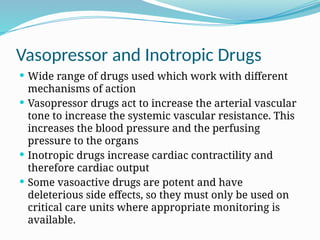
Vasopressor and Inotropic Drugs
 Wide range of drugs used which work with different
mechanisms of action
 Vasopressor drugs act to increase the arterial vascular
tone to increase the systemic vascular resistance. This
increases the blood pressure and the perfusing
pressure to the organs
 Inotropic drugs increase cardiac contractility and
therefore cardiac output
 Some vasoactive drugs are potent and have
deleterious side effects, so they must only be used on
critical care units where appropriate monitoring is
available.
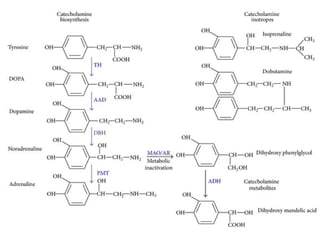
 For the upcoming test you are expected to be
able to reproduce the following:
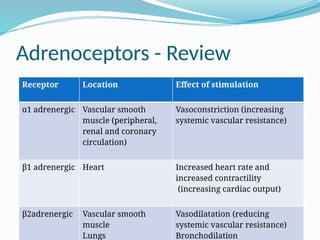
Adrenoceptors - Review
Receptor Location Effect of stimulation
α1 adrenergic Vascular smooth
muscle (peripheral,
renal and coronary
circulation)
Vasoconstriction (increasing
systemic vascular resistance)
β1 adrenergic Heart Increased heart rate and
increased contractility
(increasing cardiac output)
β2adrenergic Vascular smooth
muscle
Lungs
Vasodilatation (reducing
systemic vascular resistance)
Bronchodilation
Adrenaline
 Naturally occuring inotrope and vasopressor
 Both α1, β1 and β2 activity
 Increases heart rate, stroke volume and cardiac
output (β1)
 Causes vasocontriction and increased systemic
vascular resistance (α1)
 Side effects – Tachycardia and tacharrythmia,
increased myocardial oxygen demand
 High concentrations can cause reduced cardiac
output and arrest
Noradrenaline
 Mainly α1 agonist
 Action – vasoconstriction increasing systemic
vascular resistance
 Side effects – reduced renal perfusion as a result
of vasoconstriction, increased afterload will
reduce stroke volume and increase myocardial
oxygen demand
Dobutamine
 β 1 and β2 agonist
 β 1 effect causes increased heart rate and cardiac
output
 Β2 effect causes vasodilation and reduced
systemic vascular resistance
 Side effects include tachyarrythmia and
increased myocardial oxygen consumption
 Β2 side effects - risk of hypotension
Summary of Key Points
 All specialties interact with ICU
 Rapidly growing field
 Offers monitoring and organ support
unavailable elsewhere
 Think about referring if:
 Realistic prospect of recovery and one or more
failing organ system
 Recognise sick patients – late referrals cost lives

Critical care introduction anesthesiology

  • 1.
    University of ZambiaUndergraduate Anaesthesia Placement University Teaching Hospital Lusaka Dr Phil Dart UK Anaesthetic Fellow
  • 2.
    Critical Care Medicine Anintroduction to high dependancy and intensive care University Teaching Hospital, Lusaka Dr Philip Dart
  • 3.
    Learning Objectives On completionof this module the student should;  Understand the services offered by critical care units  Know the teams involved  Understand some of the criteria for critical care review and intervention  Know the mechanism of action of some of the drugs unique to critical care
  • 4.
    Intensive Care  Intensivecare units (ICUs) are specialist hospital wards. They provide intensive care (treatment and monitoring) for people in a critically ill or unstable condition.  High dependancy wards are hospital wards offering a higher level of monitoring and nursing care than normal wards, but which generally do not offer organ support  ICU’s and HDU’s are collectively known as critical care units
  • 5.
    Intensive Care  Multi-disciplinaryunit  Doctors – anaesthetic, medical, surgical, specialist  Nurses – specialist higher training and qualifications  Physiotherapists  Nutritionists  Speech and language therapists  Technical support  Chaplaincy, counselling  And more
  • 6.
    Intensive Care Medicine Different specialty leads depending on location globally  UK, Europe, Australia – traditionally anaesthetic lead  America – Medical ICU led by physicians, Surgical by surgeons  Many countries now developing separate faculties or colleges, e.g. FICM (UK), ANZICS (Australia/NZ)  Rapidly expanding field of medicine globally
  • 7.
    Intensive care –What can we do? Organ support Artificially supporting one or more organ system whilst the body recovers from the insult or definitive management of pathology  Respiratory support – non-invasive ventilation, invasive ventilation, ECMO  Cardiovascular support – Vasopressor and inotropic drugs, Aortic baloon pumps  Renal Support – continuous veno-venous filtration and others
  • 8.
    Intensive care –What can we do? Monitoring  1 to 1 or 1 to 2 nursing ratios  Beat to beat blood pressure and cardiac output monitoring  invasive arterial blood pressure monitoring, LiDCCo, PICCo, Swan-Ganz pulmonary venous catheter  Continuous intracerebral pressure and oxygenation monitoring And more
  • 9.
    ICU – whoto admit?  There is no easy answer!!  Intensive care has been defined as “a service for patients with potentially recoverable conditions who can benefit from more detailed observation and invasive treatment than can safely be provided in general wards or high dependency areas.”  It is usually reserved for patients with potential or established organ failure.  Early referral is particularly important. If referral is delayed until the patient’s life is clearly at risk, the chances of full recovery are jeopardised
  • 10.
    Signs of organsystem failure Cardiovascular  Cardiovascular failure (‘shock’) means that tissue perfusion is inadequate to meet metabolic demands for oxygen and nutrients. If uncorrected this can lead to irreversible tissue hypoxia and cell death  Cardiovascular failure is a common indication for admission to the critical care unit.  The aim of treatment is to support tissue perfusion and oxygen delivery which can be achieved through the use of vasoactive drugs (inotropes and vasopressors)
  • 11.
    Signs of organsystem failure  Cardiovascular  Shock refractory to treatment (fluids, antibiotics or whatever the patient specific situation require)  Typically seen as: hypotension or relative hypotension with – oliguria and worsening renal function, confusion or drowsiness which is NOT RESPONDING TO TREATMENT  These patients may require vasopressor drugs (to increase blood pressure) or inotropic drugs (to help augment contraction of the myocardium)
  • 12.
     Review –causes of shock  Obstructive (PE/PTx/Tamponade)  Hypovolaemic (fluid loss/blood loss)  Cardiogenic (MI/Arrythmias/Valve failure)  Distributive (Sepsis/Neurogenic/anaphylaxis)
  • 13.
    Signs of organsystem failure  Respiratory  Respiratory distress (Failure to oxygenate and/or ventilate)  Signs and symptoms: persistent high resp rate, low saturations, feeling exhausted  Arterial Blood Gas analysis derangement – hypoxia, hypercarbia, acidosis, alkalosis  Which is NOT RESPONDING to your current management  Supplemental oxygen, non-invasive ventilation
  • 14.
    Signs of organsystem failure  Renal  Admission for renal replacement therapy alone will depend on local provision of service  Patients requiring long term dialysis usually admitted to renal wards rather than ICU  Renal replacement system used in ICU HaemoFILTRATION rather than HaemoDIALYSIS  Don’t worry about the intricacies  Filtration slower but less cardiovascular instability
  • 15.
     No Absoluteindications for Haemofiltration but potential indications include:  Hyperkalaemia [K+ ] >6.5 mmol/l or rapidly rising [K+ ]  Suspected uraemic organ involvement (pericarditis/encephalopathy/neuropathy/myopath y  Urea >30mmol/L  Gross fluid overload  Clinically significant organ oedema (especially lung)
  • 16.
    Vasopressor and InotropicDrugs  Wide range of drugs used which work with different mechanisms of action  Vasopressor drugs act to increase the arterial vascular tone to increase the systemic vascular resistance. This increases the blood pressure and the perfusing pressure to the organs  Inotropic drugs increase cardiac contractility and therefore cardiac output  Some vasoactive drugs are potent and have deleterious side effects, so they must only be used on critical care units where appropriate monitoring is available.
  • 17.
     For theupcoming test you are expected to be able to reproduce the following:
  • 19.
    Adrenoceptors - Review ReceptorLocation Effect of stimulation α1 adrenergic Vascular smooth muscle (peripheral, renal and coronary circulation) Vasoconstriction (increasing systemic vascular resistance) β1 adrenergic Heart Increased heart rate and increased contractility (increasing cardiac output) β2adrenergic Vascular smooth muscle Lungs Vasodilatation (reducing systemic vascular resistance) Bronchodilation
  • 20.
    Adrenaline  Naturally occuringinotrope and vasopressor  Both α1, β1 and β2 activity  Increases heart rate, stroke volume and cardiac output (β1)  Causes vasocontriction and increased systemic vascular resistance (α1)  Side effects – Tachycardia and tacharrythmia, increased myocardial oxygen demand  High concentrations can cause reduced cardiac output and arrest
  • 21.
    Noradrenaline  Mainly α1agonist  Action – vasoconstriction increasing systemic vascular resistance  Side effects – reduced renal perfusion as a result of vasoconstriction, increased afterload will reduce stroke volume and increase myocardial oxygen demand
  • 22.
    Dobutamine  β 1and β2 agonist  β 1 effect causes increased heart rate and cardiac output  Β2 effect causes vasodilation and reduced systemic vascular resistance  Side effects include tachyarrythmia and increased myocardial oxygen consumption  Β2 side effects - risk of hypotension
  • 23.
    Summary of KeyPoints  All specialties interact with ICU  Rapidly growing field  Offers monitoring and organ support unavailable elsewhere  Think about referring if:  Realistic prospect of recovery and one or more failing organ system  Recognise sick patients – late referrals cost lives