ASTHMA
KRNA PROGRAM 2006
Block 3
Tom Dainty, CRNA
ASTHMA
 Asthma is an inflammatory, hyperreactivity disorder
of the airways which results in bronchial constriction
and airway obstruction during an attack.
 Asthma is experienced by about 5-7% of the U.S.
population.
 There is a worldwide increase in the incidence of
asthma with resulting morbidity and mortality.
ASTHMA
 The hyperreactive tendency of asthmatic
airways may complicate the delivery of
general anesthesia.
 A patient presenting with airway obstruction
as a result of asthma will experience
wheezing, cough, and dyspnea which is
usually reversible.
ASTHMA
 The potential for the reversibility of
respiratory obstruction with asthma is what
differentiates asthma from the fixed
obstructive causes of chronic obstructive
pulmonary disease.
ASTHMA
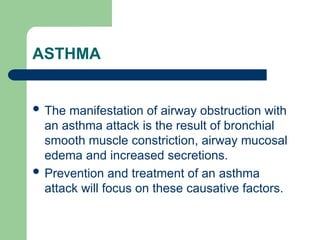
 The manifestation of airway obstruction with
an asthma attack is the result of bronchial
smooth muscle constriction, airway mucosal
edema and increased secretions.
 Prevention and treatment of an asthma
attack will focus on these causative factors.
ASTHMA
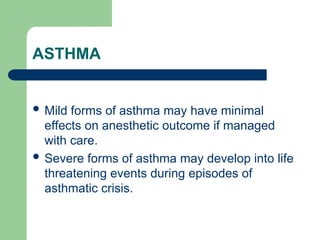
 Mild forms of asthma may have minimal
effects on anesthetic outcome if managed
with care.
 Severe forms of asthma may develop into life
threatening events during episodes of
asthmatic crisis.
FORCED EXPIRATORY VOLUME
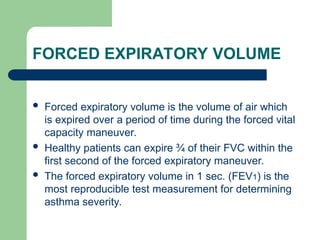
 Forced expiratory volume is the volume of air which
is expired over a period of time during the forced vital
capacity maneuver.
 Healthy patients can expire ¾ of their FVC within the
first second of the forced expiratory maneuver.
 The forced expiratory volume in 1 sec. (FEV1) is the
most reproducible test measurement for determining
asthma severity.
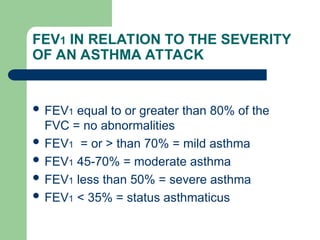
FEV1 IN RELATION TO THE SEVERITY
OF AN ASTHMA ATTACK
 FEV1 equal to or greater than 80% of the
FVC = no abnormalities
 FEV1 = or > than 70% = mild asthma
 FEV1 45-70% = moderate asthma
 FEV1 less than 50% = severe asthma
 FEV1 < 35% = status asthmaticus
CLINICAL CLASSIFICATIONS OF
ASTHMA
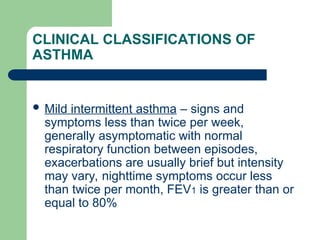
 Mild intermittent asthma – signs and
symptoms less than twice per week,
generally asymptomatic with normal
respiratory function between episodes,
exacerbations are usually brief but intensity
may vary, nighttime symptoms occur less
than twice per month, FEV1 is greater than or
equal to 80%
CLINICAL CLASSIFICATIONS OF
ASTHMA
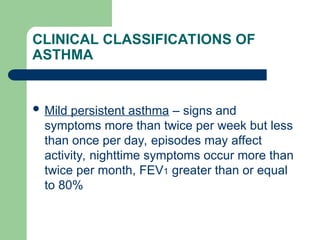
 Mild persistent asthma – signs and
symptoms more than twice per week but less
than once per day, episodes may affect
activity, nighttime symptoms occur more than
twice per month, FEV1 greater than or equal
to 80%
CLINICAL CLASSIFICATIONS OF
ASTHMA
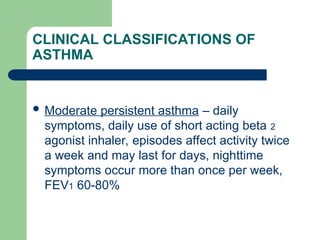
 Moderate persistent asthma – daily
symptoms, daily use of short acting beta 2
agonist inhaler, episodes affect activity twice
a week and may last for days, nighttime
symptoms occur more than once per week,
FEV1 60-80%
CLINICAL CLASSIFICATIONS OF
ASTHMA
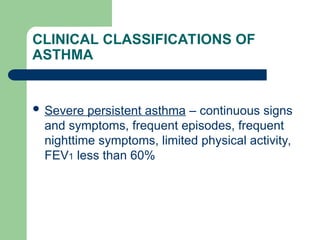
 Severe persistent asthma – continuous signs
and symptoms, frequent episodes, frequent
nighttime symptoms, limited physical activity,
FEV1 less than 60%
ASTHMA
 It will be very helpful to identify the exacerbating
circumstances of asthmatic symptoms during a
preoperative interview.
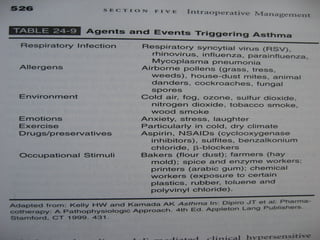
 Many patients are unable to identify exact causative
factors but others may relate attacks to upper
respiratory infections, environmental sources, or
psychological events which should be ruled out or
eliminated prior to the delivery of an anesthetic.
ASTHMA
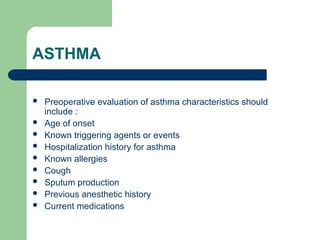
 Preoperative evaluation of asthma characteristics should
include :
 Age of onset
 Known triggering agents or events
 Hospitalization history for asthma
 Known allergies
 Cough
 Sputum production
 Previous anesthetic history
 Current medications
ASTHMA
Avoiding elective surgery during
episodes of upper respiratory
infection in an asthmatic patient may
prevent intraoperative and
postoperative respiratory complications.
ASTHMA
Hyperreactivity of the airway may exist for
three to six weeks following an upper
respiratory infection in an asthmatic patient.
The use of histamine releasing drugs
should be avoided in asthmatic patients.
ASTHMA
 Diphenhydramine may be coadministered
with H2 blockers to help prevent H1 mediated
bronchoconstriction.
 Anticholinergics, inhaled, will prevent vagally
stimulated bronchospasm but parenteral(IV)
administration will cause an increased
viscosity of secretions(dry mouth).
ASTHMA DRUG THERAPY
 Inhaled beta2 agonists, by metered-dose
inhaler, are the first line selection
bronchodilators. (albuterol, salmeterol)
 Beta2 agonist should be administered
preoperatively and be available for
intraoperative administration.
ASTHMA DRUG THERAPY
 Vagal stimulation causes an increase in
intracellular cyclic guanosine
monophosphate (cGMP) which is responsible
for bronchoconstriction.
 Anticholinergics block formation of cGMP,
therefore promote bronchodilation.
ASTHMA DRUG THERAPY
 Ipratropium bromide (Atrovent) inhaler,
blocks cGMP without the undesirable drying
effect which parenteral anticholinergics
produce.
 Glycopyrrolate or atropine 0.2-0.8mg may be
administered by nebulizer.
ASTHMA DRUG THERAPY
Inhaled anti-inflammatory drugs are
often used as a component of chronic
therapy.
Inhaled metered-dose
corticosteroids help decrease airway
inflammation.
STATUS ASTHMATICUS
 Status asthmaticus is defined as unresolving
bronchospasm that, despite initial treatment,
is considered life threatening.
 PaCO2 which is high indicates poor
exchange of carbon dioxide and indicates
that respiratory failure is worsening.
STATUS ASMATICUS
 Lung function is greatly reduced. If
measured, FEV1 will be less than 25% of
normal.
 Impending respiratory failure will require
tracheal intubation and mechanical
ventilation.
TREATMENT OF STATUS ASMATICUS
 Metered-dose beta2 agonist Q 15-20 min.
 Intravenous corticosteroids – may take up to 12 hr.
for effect.
 Supplemental oxygen
 Consider intubation and mechanical ventilation if
PaCO2 is greater than 50mmHg
 General anesthesia with volatile anesthetic as last
resort.
ANESTHETIC MANAGEMENT OF
ASTHMATIC PATIENT
 Airway manipulation can be avoided by
implementing regional anesthesia.
 If general anesthesia is required, stimulation of the
airway should be minimized to avoid bronchospasm.
 The patient should continue asthma drug therapy
preoperatively.
 Avoid the use of any histamine releasing drugs
such as curare, atracurium, mivacurium,
morphine and meperidine.
ANESTHETIC MANAGEMENT
 Propofol is a good choice for intravenous induction.
The bronchodilating effect of ketamine makes it an
acceptable alternative.
 Intravenous lidocaine 1.5mg/kg is helpful in blunting
laryngeal reflexes.
 Increased depth of anesthesia should be achieved
with an inhalation agent, to further reduce airway
reflexes, before laryngoscopy.
ANESTHETIC MANAGEMENT
 Mechanical ventilation should be provided with a
slow rate at tidal volumes of 10ml/kg or less to allow
optimal gas exchange.
 A relatively fast inspiratory flow rate with a
prolonged expiratory phase will help prevent air
trapping.
 Adequate hydration with intravenous fluids will
reduce secretion viscosity.
ANESTHETIC MANAGEMENT
 Intraoperative bronchospasm, indicated by
wheezing and increased peak airway
pressures, should be treated with metered-
dose inhaled beta2 agonist and by increasing
inhalation agent concentration.
 Other causes of increased peak pressures
should also be considered.
ANESTHETIC MANAGEMENT
 Other potential causes of increased peak airway
pressure include :
- Inadequate depth of anesthesia
- Obstruction of ET tube by secretions, kinking of the
tube or overinflation of the tube cuff.
- Endobronchial intubation
- Aspiration
- Pulmonary edema or embolus
- Pneumothorax
ANESTHETIC MANAGEMENT
 Emergence should also involve minimal airway
manipulation.
 Intravenous lidocaine will blunt reflexes. Some
clinicians incorporate a lidocaine infusion (1-2
mg/min) during emergence to blunt reflexes.
 If possible, extubation while the patient is deeply
anesthetized may reduce the incidence of
bronchospasm.
ANESTHETIC MANAGEMENT
 Metered-dose beta2 agonist may be delivered
via the endotracheal tube before emergence.
(carrier gas used in inhalers may interfere
with mass spectrometer readings)
 Reversal of nodepolarizing neuromuscular
blocking agents with an anticholinesterase will
not induce bronchospasm if preceded by the
appropriate dose of anticholinergic.
ANESTHETIC MANAGEMENT
 Management of general anesthesia for an
asthmatic patient should focus on smooth
induction and emergence to avoid triggering
bronchospasm.
ASTHMA AND ANESTHETIC CONSIDERATIONS PPPT

  • 1.
  • 2.
    ASTHMA  Asthma isan inflammatory, hyperreactivity disorder of the airways which results in bronchial constriction and airway obstruction during an attack.  Asthma is experienced by about 5-7% of the U.S. population.  There is a worldwide increase in the incidence of asthma with resulting morbidity and mortality.
  • 3.
    ASTHMA  The hyperreactivetendency of asthmatic airways may complicate the delivery of general anesthesia.  A patient presenting with airway obstruction as a result of asthma will experience wheezing, cough, and dyspnea which is usually reversible.
  • 4.
    ASTHMA  The potentialfor the reversibility of respiratory obstruction with asthma is what differentiates asthma from the fixed obstructive causes of chronic obstructive pulmonary disease.
  • 5.
    ASTHMA  The manifestationof airway obstruction with an asthma attack is the result of bronchial smooth muscle constriction, airway mucosal edema and increased secretions.  Prevention and treatment of an asthma attack will focus on these causative factors.
  • 6.
    ASTHMA  Mild formsof asthma may have minimal effects on anesthetic outcome if managed with care.  Severe forms of asthma may develop into life threatening events during episodes of asthmatic crisis.
  • 7.
    FORCED EXPIRATORY VOLUME Forced expiratory volume is the volume of air which is expired over a period of time during the forced vital capacity maneuver.  Healthy patients can expire ¾ of their FVC within the first second of the forced expiratory maneuver.  The forced expiratory volume in 1 sec. (FEV1) is the most reproducible test measurement for determining asthma severity.
  • 8.
    FEV1 IN RELATIONTO THE SEVERITY OF AN ASTHMA ATTACK  FEV1 equal to or greater than 80% of the FVC = no abnormalities  FEV1 = or > than 70% = mild asthma  FEV1 45-70% = moderate asthma  FEV1 less than 50% = severe asthma  FEV1 < 35% = status asthmaticus
  • 9.
    CLINICAL CLASSIFICATIONS OF ASTHMA Mild intermittent asthma – signs and symptoms less than twice per week, generally asymptomatic with normal respiratory function between episodes, exacerbations are usually brief but intensity may vary, nighttime symptoms occur less than twice per month, FEV1 is greater than or equal to 80%
  • 10.
    CLINICAL CLASSIFICATIONS OF ASTHMA Mild persistent asthma – signs and symptoms more than twice per week but less than once per day, episodes may affect activity, nighttime symptoms occur more than twice per month, FEV1 greater than or equal to 80%
  • 11.
    CLINICAL CLASSIFICATIONS OF ASTHMA Moderate persistent asthma – daily symptoms, daily use of short acting beta 2 agonist inhaler, episodes affect activity twice a week and may last for days, nighttime symptoms occur more than once per week, FEV1 60-80%
  • 12.
    CLINICAL CLASSIFICATIONS OF ASTHMA Severe persistent asthma – continuous signs and symptoms, frequent episodes, frequent nighttime symptoms, limited physical activity, FEV1 less than 60%
  • 13.
    ASTHMA  It willbe very helpful to identify the exacerbating circumstances of asthmatic symptoms during a preoperative interview.  Many patients are unable to identify exact causative factors but others may relate attacks to upper respiratory infections, environmental sources, or psychological events which should be ruled out or eliminated prior to the delivery of an anesthetic.
  • 15.
    ASTHMA  Preoperative evaluationof asthma characteristics should include :  Age of onset  Known triggering agents or events  Hospitalization history for asthma  Known allergies  Cough  Sputum production  Previous anesthetic history  Current medications
  • 16.
    ASTHMA Avoiding elective surgeryduring episodes of upper respiratory infection in an asthmatic patient may prevent intraoperative and postoperative respiratory complications.
  • 17.
    ASTHMA Hyperreactivity of theairway may exist for three to six weeks following an upper respiratory infection in an asthmatic patient. The use of histamine releasing drugs should be avoided in asthmatic patients.
  • 18.
    ASTHMA  Diphenhydramine maybe coadministered with H2 blockers to help prevent H1 mediated bronchoconstriction.  Anticholinergics, inhaled, will prevent vagally stimulated bronchospasm but parenteral(IV) administration will cause an increased viscosity of secretions(dry mouth).
  • 19.
    ASTHMA DRUG THERAPY Inhaled beta2 agonists, by metered-dose inhaler, are the first line selection bronchodilators. (albuterol, salmeterol)  Beta2 agonist should be administered preoperatively and be available for intraoperative administration.
  • 20.
    ASTHMA DRUG THERAPY Vagal stimulation causes an increase in intracellular cyclic guanosine monophosphate (cGMP) which is responsible for bronchoconstriction.  Anticholinergics block formation of cGMP, therefore promote bronchodilation.
  • 21.
    ASTHMA DRUG THERAPY Ipratropium bromide (Atrovent) inhaler, blocks cGMP without the undesirable drying effect which parenteral anticholinergics produce.  Glycopyrrolate or atropine 0.2-0.8mg may be administered by nebulizer.
  • 22.
    ASTHMA DRUG THERAPY Inhaledanti-inflammatory drugs are often used as a component of chronic therapy. Inhaled metered-dose corticosteroids help decrease airway inflammation.
  • 23.
    STATUS ASTHMATICUS  Statusasthmaticus is defined as unresolving bronchospasm that, despite initial treatment, is considered life threatening.  PaCO2 which is high indicates poor exchange of carbon dioxide and indicates that respiratory failure is worsening.
  • 24.
    STATUS ASMATICUS  Lungfunction is greatly reduced. If measured, FEV1 will be less than 25% of normal.  Impending respiratory failure will require tracheal intubation and mechanical ventilation.
  • 25.
    TREATMENT OF STATUSASMATICUS  Metered-dose beta2 agonist Q 15-20 min.  Intravenous corticosteroids – may take up to 12 hr. for effect.  Supplemental oxygen  Consider intubation and mechanical ventilation if PaCO2 is greater than 50mmHg  General anesthesia with volatile anesthetic as last resort.
  • 26.
    ANESTHETIC MANAGEMENT OF ASTHMATICPATIENT  Airway manipulation can be avoided by implementing regional anesthesia.  If general anesthesia is required, stimulation of the airway should be minimized to avoid bronchospasm.  The patient should continue asthma drug therapy preoperatively.  Avoid the use of any histamine releasing drugs such as curare, atracurium, mivacurium, morphine and meperidine.
  • 27.
    ANESTHETIC MANAGEMENT  Propofolis a good choice for intravenous induction. The bronchodilating effect of ketamine makes it an acceptable alternative.  Intravenous lidocaine 1.5mg/kg is helpful in blunting laryngeal reflexes.  Increased depth of anesthesia should be achieved with an inhalation agent, to further reduce airway reflexes, before laryngoscopy.
  • 28.
    ANESTHETIC MANAGEMENT  Mechanicalventilation should be provided with a slow rate at tidal volumes of 10ml/kg or less to allow optimal gas exchange.  A relatively fast inspiratory flow rate with a prolonged expiratory phase will help prevent air trapping.  Adequate hydration with intravenous fluids will reduce secretion viscosity.
  • 29.
    ANESTHETIC MANAGEMENT  Intraoperativebronchospasm, indicated by wheezing and increased peak airway pressures, should be treated with metered- dose inhaled beta2 agonist and by increasing inhalation agent concentration.  Other causes of increased peak pressures should also be considered.
  • 30.
    ANESTHETIC MANAGEMENT  Otherpotential causes of increased peak airway pressure include : - Inadequate depth of anesthesia - Obstruction of ET tube by secretions, kinking of the tube or overinflation of the tube cuff. - Endobronchial intubation - Aspiration - Pulmonary edema or embolus - Pneumothorax
  • 31.
    ANESTHETIC MANAGEMENT  Emergenceshould also involve minimal airway manipulation.  Intravenous lidocaine will blunt reflexes. Some clinicians incorporate a lidocaine infusion (1-2 mg/min) during emergence to blunt reflexes.  If possible, extubation while the patient is deeply anesthetized may reduce the incidence of bronchospasm.
  • 32.
    ANESTHETIC MANAGEMENT  Metered-dosebeta2 agonist may be delivered via the endotracheal tube before emergence. (carrier gas used in inhalers may interfere with mass spectrometer readings)  Reversal of nodepolarizing neuromuscular blocking agents with an anticholinesterase will not induce bronchospasm if preceded by the appropriate dose of anticholinergic.
  • 33.
    ANESTHETIC MANAGEMENT  Managementof general anesthesia for an asthmatic patient should focus on smooth induction and emergence to avoid triggering bronchospasm.