Infective Endocarditis
Dr C. Chiluba
Dr C. Chiluba
Definition
Definition
 Infective endocarditis is microbial infection
of the endocardial surface of the heart
 Commonly involves the valves
 Characterised by formation of vegetation
that are composed of:
– Inflammatory cells
– Fibrin
– Platelets
 May be classified as
– Acute or subacute
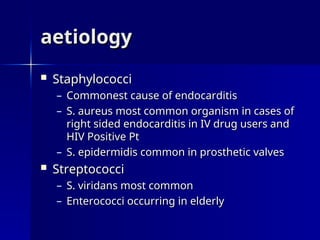
aetiology
aetiology
 Staphylococci
Staphylococci
– Commonest cause of endocarditis
Commonest cause of endocarditis
– S. aureus most common organism in cases of
S. aureus most common organism in cases of
right sided endocarditis in IV drug users and
HIV Positive Pt
HIV Positive Pt
– S. epidermidis common in prosthetic valves
S. epidermidis common in prosthetic valves
 Streptococci
Streptococci
– S. viridans most common
S. viridans most common
– Enterococci occurring in elderly
Enterococci occurring in elderly
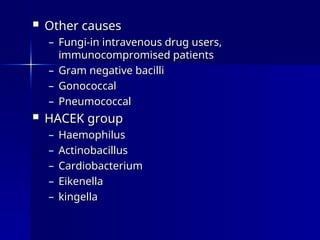
 Other causes
Other causes
– Fungi-in intravenous drug users,
Fungi-in intravenous drug users,
immunocompromised patients
– Gram negative bacilli
Gram negative bacilli
– Gonococcal
Gonococcal
– Pneumococcal
Pneumococcal
 HACEK group
HACEK group
– Haemophilus
Haemophilus
– Actinobacillus
Actinobacillus
– Cardiobacterium
Cardiobacterium
– Eikenella
Eikenella
– kingella
kingella
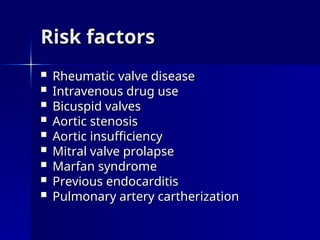
Risk factors
Risk factors
 Rheumatic valve disease
Rheumatic valve disease
 Intravenous drug use
Intravenous drug use
 Bicuspid valves
Bicuspid valves
 Aortic stenosis
Aortic stenosis
 Aortic insufficiency
Aortic insufficiency
 Mitral valve prolapse
Mitral valve prolapse
 Marfan syndrome
Marfan syndrome
 Previous endocarditis
Previous endocarditis
 Pulmonary artery cartherization
Pulmonary artery cartherization
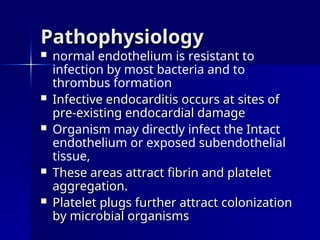
Pathophysiology
Pathophysiology
 normal endothelium is resistant to
infection by most bacteria and to
thrombus formation
 Infective endocarditis occurs at sites of
Infective endocarditis occurs at sites of
pre-existing endocardial damage
 Organism may directly infect the Intact
endothelium or exposed subendothelial
tissue,
 These areas attract fibrin and platelet
These areas attract fibrin and platelet
aggregation.
aggregation.
 Platelet plugs further attract colonization
Platelet plugs further attract colonization
by microbial organisms
Pathophysiology cont.d
 Vegetations may grow
Vegetations may grow
 Large vegetations
Large vegetations
– may break away as emboli
may break away as emboli
– May destroy adjacent tissues
May destroy adjacent tissues
– May cause aneurysm
May cause aneurysm
Frequency of cardiac
valve involvement
valve involvement
 mitral>aortic>tricuspid>pulmonary
mitral>aortic>tricuspid>pulmonary
 30% of patients have concomitant
30% of patients have concomitant
aortic and mitral valve involvement
 5% of patients have simultaneous
5% of patients have simultaneous
involvement of left and right sided
heart valves
heart valves
Clinical features
Clinical features
 Highly variable
Highly variable
 Can be acute or subacute
Can be acute or subacute
 Can be classed as
Can be classed as
– Native valve endocarditis
Native valve endocarditis
– Prosthetic valve endocarditis
Prosthetic valve endocarditis
– Endocarditis in intravenous drug users
Endocarditis in intravenous drug users
Features continued
Features continued
 Fever
Fever
– Generally present but may be absent in
Generally present but may be absent in
elderly or immunosuppressed
– In subacute endocarditis, fever is typically
low-grade and rarely exceeds 39.4C
 Cardiac Manifestations
– Heart murmur
Heart murmur
– CCF in 30 to 40%
CCF in 30 to 40%
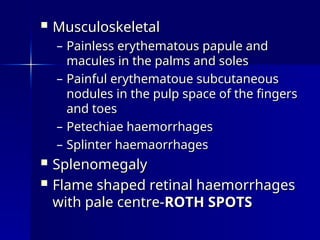
 Musculoskeletal
Musculoskeletal
– Painless erythematous papule and
Painless erythematous papule and
macules in the palms and soles
– Painful erythematoue subcutaneous
Painful erythematoue subcutaneous
nodules in the pulp space of the fingers
and toes
and toes
– Petechiae haemorrhages
Petechiae haemorrhages
– Splinter haemaorrhages
Splinter haemaorrhages
 Splenomegaly
Splenomegaly
 Flame shaped retinal haemorrhages
Flame shaped retinal haemorrhages
with pale centre-
with pale centre-ROTH SPOTS
ROTH SPOTS
Diagnosis
Diagnosis
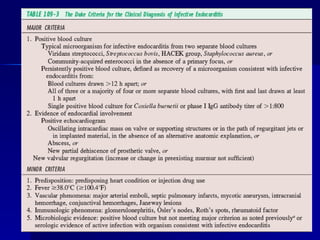
 Diagnosis is made using the duke
Diagnosis is made using the duke
criteria
criteria
investigations
investigations
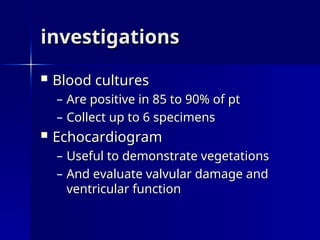
 Blood cultures
Blood cultures
– Are positive in 85 to 90% of pt
Are positive in 85 to 90% of pt
– Collect up to 6 specimens
Collect up to 6 specimens
 Echocardiogram
Echocardiogram
– Useful to demonstrate vegetations
Useful to demonstrate vegetations
– And evaluate valvular damage and
And evaluate valvular damage and
ventricular function
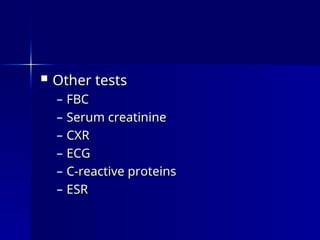
 Other tests
Other tests
– FBC
FBC
– Serum creatinine
Serum creatinine
– CXR
CXR
– ECG
ECG
– C-reactive proteins
C-reactive proteins
– ESR
ESR
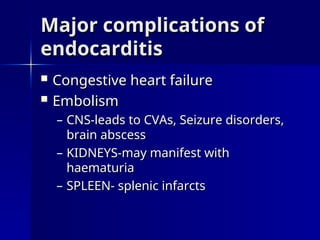
Major complications of
endocarditis
endocarditis
 Congestive heart failure
Congestive heart failure
 Embolism
Embolism
– CNS-leads to CVAs, Seizure disorders,
CNS-leads to CVAs, Seizure disorders,
brain abscess
brain abscess
– KIDNEYS-may manifest with
KIDNEYS-may manifest with
haematuria
haematuria
– SPLEEN- splenic infarcts
SPLEEN- splenic infarcts
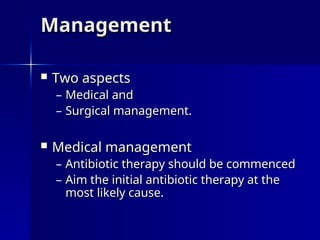
Management
Management
 Two aspects
Two aspects
– Medical and
Medical and
– Surgical management.
Surgical management.
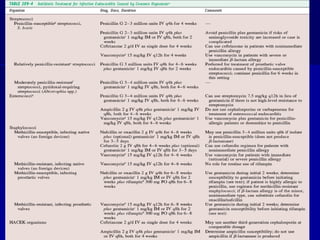
 Medical management
Medical management
– Antibiotic therapy should be commenced
Antibiotic therapy should be commenced
– Aim the initial antibiotic therapy at the
Aim the initial antibiotic therapy at the
most likely cause.
most likely cause.
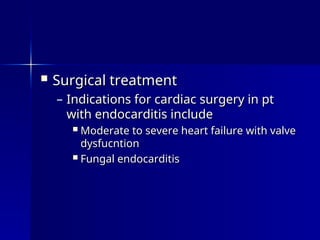
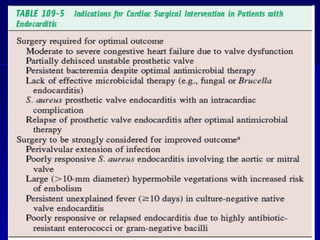
 Surgical treatment
Surgical treatment
– Indications for cardiac surgery in pt
Indications for cardiac surgery in pt
with endocarditis include
 Moderate to severe heart failure with valve
Moderate to severe heart failure with valve
dysfucntion
dysfucntion
 Fungal endocarditis
Fungal endocarditis
Prophylaxis
Prophylaxis
 Cardiac conditions for which
Cardiac conditions for which
prophylaxis is indicated include
– High risk
High risk
– And low risk factors
And low risk factors
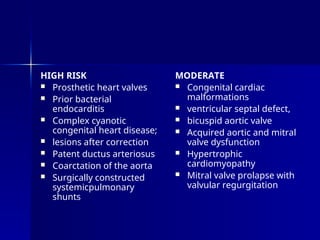
HIGH RISK
 Prosthetic heart valves
 Prior bacterial
endocarditis
 Complex cyanotic
congenital heart disease;
 lesions after correction
 Patent ductus arteriosus
 Coarctation of the aorta
 Surgically constructed
systemicpulmonary
shunts
MODERATE
 Congenital cardiac
malformations
 ventricular septal defect,
 bicuspid aortic valve
 Acquired aortic and mitral
valve dysfunction
 Hypertrophic
cardiomyopathy
 Mitral valve prolapse with
valvular regurgitation

internal medicine Infective Endcarditis.ppt

  • 1.
  • 2.
    Definition Definition  Infective endocarditisis microbial infection of the endocardial surface of the heart  Commonly involves the valves  Characterised by formation of vegetation that are composed of: – Inflammatory cells – Fibrin – Platelets  May be classified as – Acute or subacute
  • 3.
    aetiology aetiology  Staphylococci Staphylococci – Commonestcause of endocarditis Commonest cause of endocarditis – S. aureus most common organism in cases of S. aureus most common organism in cases of right sided endocarditis in IV drug users and right sided endocarditis in IV drug users and HIV Positive Pt HIV Positive Pt – S. epidermidis common in prosthetic valves S. epidermidis common in prosthetic valves  Streptococci Streptococci – S. viridans most common S. viridans most common – Enterococci occurring in elderly Enterococci occurring in elderly
  • 4.
     Other causes Othercauses – Fungi-in intravenous drug users, Fungi-in intravenous drug users, immunocompromised patients immunocompromised patients – Gram negative bacilli Gram negative bacilli – Gonococcal Gonococcal – Pneumococcal Pneumococcal  HACEK group HACEK group – Haemophilus Haemophilus – Actinobacillus Actinobacillus – Cardiobacterium Cardiobacterium – Eikenella Eikenella – kingella kingella
  • 5.
    Risk factors Risk factors Rheumatic valve disease Rheumatic valve disease  Intravenous drug use Intravenous drug use  Bicuspid valves Bicuspid valves  Aortic stenosis Aortic stenosis  Aortic insufficiency Aortic insufficiency  Mitral valve prolapse Mitral valve prolapse  Marfan syndrome Marfan syndrome  Previous endocarditis Previous endocarditis  Pulmonary artery cartherization Pulmonary artery cartherization
  • 6.
    Pathophysiology Pathophysiology  normal endotheliumis resistant to infection by most bacteria and to thrombus formation  Infective endocarditis occurs at sites of Infective endocarditis occurs at sites of pre-existing endocardial damage pre-existing endocardial damage  Organism may directly infect the Intact endothelium or exposed subendothelial tissue,  These areas attract fibrin and platelet These areas attract fibrin and platelet aggregation. aggregation.  Platelet plugs further attract colonization Platelet plugs further attract colonization by microbial organisms by microbial organisms
  • 7.
    Pathophysiology cont.d Pathophysiology cont.d Vegetations may grow Vegetations may grow  Large vegetations Large vegetations – may break away as emboli may break away as emboli – May destroy adjacent tissues May destroy adjacent tissues – May cause aneurysm May cause aneurysm
  • 8.
    Frequency of cardiac Frequencyof cardiac valve involvement valve involvement  mitral>aortic>tricuspid>pulmonary mitral>aortic>tricuspid>pulmonary  30% of patients have concomitant 30% of patients have concomitant aortic and mitral valve involvement aortic and mitral valve involvement  5% of patients have simultaneous 5% of patients have simultaneous involvement of left and right sided involvement of left and right sided heart valves heart valves
  • 9.
    Clinical features Clinical features Highly variable Highly variable  Can be acute or subacute Can be acute or subacute  Can be classed as Can be classed as – Native valve endocarditis Native valve endocarditis – Prosthetic valve endocarditis Prosthetic valve endocarditis – Endocarditis in intravenous drug users Endocarditis in intravenous drug users
  • 10.
    Features continued Features continued Fever Fever – Generally present but may be absent in Generally present but may be absent in elderly or immunosuppressed elderly or immunosuppressed – In subacute endocarditis, fever is typically low-grade and rarely exceeds 39.4C  Cardiac Manifestations – Heart murmur Heart murmur – CCF in 30 to 40% CCF in 30 to 40%
  • 11.
     Musculoskeletal Musculoskeletal – Painlesserythematous papule and Painless erythematous papule and macules in the palms and soles macules in the palms and soles – Painful erythematoue subcutaneous Painful erythematoue subcutaneous nodules in the pulp space of the fingers nodules in the pulp space of the fingers and toes and toes – Petechiae haemorrhages Petechiae haemorrhages – Splinter haemaorrhages Splinter haemaorrhages  Splenomegaly Splenomegaly  Flame shaped retinal haemorrhages Flame shaped retinal haemorrhages with pale centre- with pale centre-ROTH SPOTS ROTH SPOTS
  • 12.
    Diagnosis Diagnosis  Diagnosis ismade using the duke Diagnosis is made using the duke criteria criteria
  • 13.
    investigations investigations  Blood cultures Bloodcultures – Are positive in 85 to 90% of pt Are positive in 85 to 90% of pt – Collect up to 6 specimens Collect up to 6 specimens  Echocardiogram Echocardiogram – Useful to demonstrate vegetations Useful to demonstrate vegetations – And evaluate valvular damage and And evaluate valvular damage and ventricular function ventricular function
  • 14.
     Other tests Othertests – FBC FBC – Serum creatinine Serum creatinine – CXR CXR – ECG ECG – C-reactive proteins C-reactive proteins – ESR ESR
  • 16.
    Major complications of Majorcomplications of endocarditis endocarditis  Congestive heart failure Congestive heart failure  Embolism Embolism – CNS-leads to CVAs, Seizure disorders, CNS-leads to CVAs, Seizure disorders, brain abscess brain abscess – KIDNEYS-may manifest with KIDNEYS-may manifest with haematuria haematuria – SPLEEN- splenic infarcts SPLEEN- splenic infarcts
  • 17.
    Management Management  Two aspects Twoaspects – Medical and Medical and – Surgical management. Surgical management.  Medical management Medical management – Antibiotic therapy should be commenced Antibiotic therapy should be commenced – Aim the initial antibiotic therapy at the Aim the initial antibiotic therapy at the most likely cause. most likely cause.
  • 19.
     Surgical treatment Surgicaltreatment – Indications for cardiac surgery in pt Indications for cardiac surgery in pt with endocarditis include with endocarditis include  Moderate to severe heart failure with valve Moderate to severe heart failure with valve dysfucntion dysfucntion  Fungal endocarditis Fungal endocarditis
  • 21.
    Prophylaxis Prophylaxis  Cardiac conditionsfor which Cardiac conditions for which prophylaxis is indicated include prophylaxis is indicated include – High risk High risk – And low risk factors And low risk factors
  • 22.
    HIGH RISK  Prostheticheart valves  Prior bacterial endocarditis  Complex cyanotic congenital heart disease;  lesions after correction  Patent ductus arteriosus  Coarctation of the aorta  Surgically constructed systemicpulmonary shunts MODERATE  Congenital cardiac malformations  ventricular septal defect,  bicuspid aortic valve  Acquired aortic and mitral valve dysfunction  Hypertrophic cardiomyopathy  Mitral valve prolapse with valvular regurgitation