Shock
Dr SAM GEORGE
CONSULTANT ANAESTHESIA & INTENSIVE CARE
Overview
Definitions
Initial Assessment – ABC
Stages of Shock
Physiologic Determinants of Shock
Types of Shock
Common Features of Shock
Work-up
Generic Approach to Management
Case scenarios and Management
Take Home Points
Definition of Shock
Inadequate perfusion and oxygenation of cells
Hypotension is not a requirement
Why should you care?
High mortality - 20-90%
Early on the effects of O2 deprivation on the cell are
REVERSIBLE
Early intervention reduces mortality
Remember!
Assessment Intervention and Monitoring happens
together in acute scenarios.
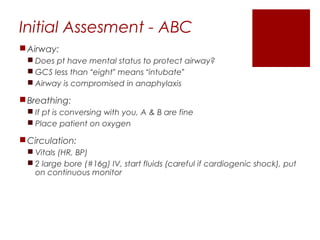
Initial Assesment - ABC
Airway:
 Does pt have mental status to protect airway?
 GCS less than “eight” means “intubate”
 Airway is compromised in anaphylaxis
Breathing:
 If pt is conversing with you, A & B are fine
 Place patient on oxygen
Circulation:
 Vitals (HR, BP)
 2 large bore (#16g) IV, start fluids (careful if cardiogenic shock), put
on continuous monitor
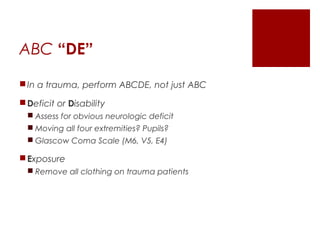
ABC “DE”
In a trauma, perform ABCDE, not just ABC
Deficit or Disability
 Assess for obvious neurologic deficit
 Moving all four extremities? Pupils?
 Glascow Coma Scale (M6, V5, E4)
Exposure
 Remove all clothing on trauma patients
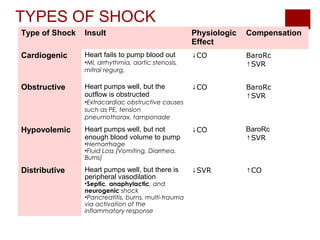
TYPES OF SHOCK
Type of Shock Insult Physiologic
Effect
Compensation
Cardiogenic Heart fails to pump blood out
•MI, arrhythmia, aortic stenosis,
mitral regurg,
↓CO BaroRc
↑SVR
Obstructive Heart pumps well, but the
outflow is obstructed
•Extracardiac obstructive causes
such as PE, tension
pneumothorax, tamponade
↓CO BaroRc
↑SVR
Hypovolemic Heart pumps well, but not
enough blood volume to pump
•Hemorrhage
•Fluid Loss (Vomiting, Diarrhea,
Burns)
↓CO BaroRc
↑SVR
Distributive Heart pumps well, but there is
peripheral vasodilation
•Septic, anaphylactic, and
neurogenic shock
•Pancreatitis, burns, multi-trauma
via activation of the
inflammatory response
↓SVR ↑CO
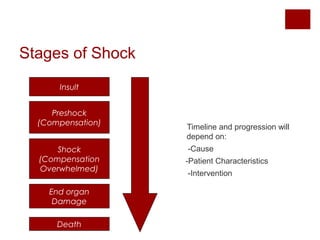
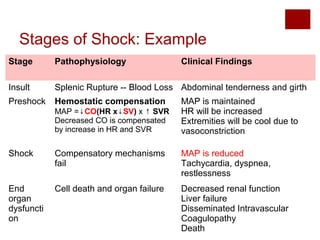
Stages of Shock
Timeline and progression will
depend on:
-Cause
-Patient Characteristics
-Intervention
Insult
Preshock
(Compensation)
Shock
(Compensation
Overwhelmed)
End organ
Damage
Death
Stages of Shock: Example
Stage Pathophysiology Clinical Findings
Insult Splenic Rupture -- Blood Loss Abdominal tenderness and girth
Preshock Hemostatic compensation
MAP =↓CO(HR x↓SV) x ↑ SVR
Decreased CO is compensated
by increase in HR and SVR
MAP is maintained
HR will be increased
Extremities will be cool due to
vasoconstriction
Shock Compensatory mechanisms
fail
MAP is reduced
Tachycardia, dyspnea,
restlessness
End
organ
dysfuncti
on
Cell death and organ failure Decreased renal function
Liver failure
Disseminated Intravascular
Coagulopathy
Death
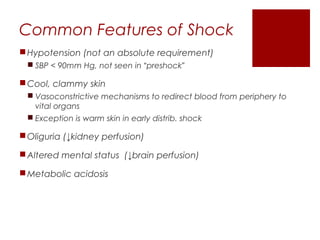
Common Features of Shock
Hypotension (not an absolute requirement)
 SBP < 90mm Hg, not seen in “preshock”
Cool, clammy skin
 Vasoconstrictive mechanisms to redirect blood from periphery to
vital organs
 Exception is warm skin in early distrib. shock
Oliguria (↓kidney perfusion)
Altered mental status (↓brain perfusion)
Metabolic acidosis
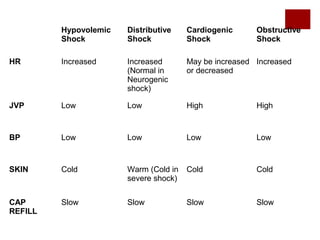
Hypovolemic
Shock
Distributive
Shock
Cardiogenic
Shock
Obstructive
Shock
HR Increased Increased
(Normal in
Neurogenic
shock)
May be increased
or decreased
Increased
JVP Low Low High High
BP Low Low Low Low
SKIN Cold Warm (Cold in
severe shock)
Cold Cold
CAP
REFILL
Slow Slow Slow Slow
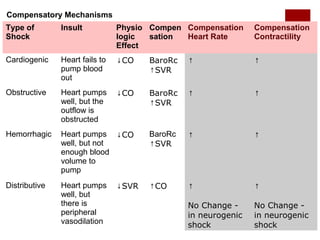
Type of
Shock
Insult Physio
logic
Effect
Compen
sation
Compensation
Heart Rate
Compensation
Contractility
Cardiogenic Heart fails to
pump blood
out
↓CO BaroRc
↑SVR
↑ ↑
Obstructive Heart pumps
well, but the
outflow is
obstructed
↓CO BaroRc
↑SVR
↑ ↑
Hemorrhagic Heart pumps
well, but not
enough blood
volume to
pump
↓CO BaroRc
↑SVR
↑ ↑
Distributive Heart pumps
well, but
there is
peripheral
vasodilation
↓SVR ↑CO ↑
No Change -
in neurogenic
shock
↑
No Change -
in neurogenic
shock
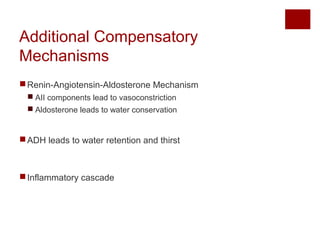
Compensatory Mechanisms
Additional Compensatory
Mechanisms
Renin-Angiotensin-Aldosterone Mechanism
 AII components lead to vasoconstriction
 Aldosterone leads to water conservation
ADH leads to water retention and thirst
Inflammatory cascade
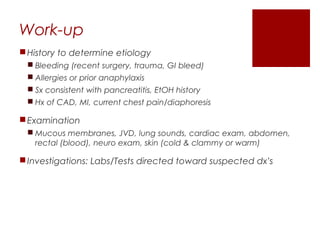
Work-up
History to determine etiology
 Bleeding (recent surgery, trauma, GI bleed)
 Allergies or prior anaphylaxis
 Sx consistent with pancreatitis, EtOH history
 Hx of CAD, MI, current chest pain/diaphoresis
Examination
 Mucous membranes, JVD, lung sounds, cardiac exam, abdomen,
rectal (blood), neuro exam, skin (cold & clammy or warm)
Investigations: Labs/Tests directed toward suspected dx’s
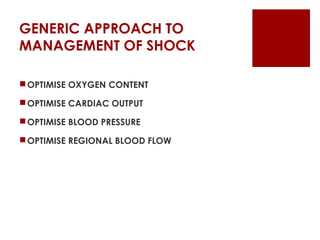
GENERIC APPROACH TO
MANAGEMENT OF SHOCK
OPTIMISE OXYGEN CONTENT
OPTIMISE CARDIAC OUTPUT
OPTIMISE BLOOD PRESSURE
OPTIMISE REGIONAL BLOOD FLOW
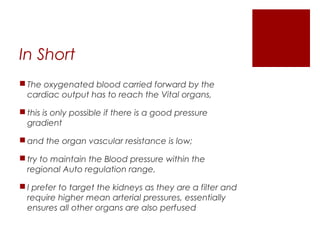
In Short
 The oxygenated blood carried forward by the
cardiac output has to reach the Vital organs,
 this is only possible if there is a good pressure
gradient
 and the organ vascular resistance is low;
 try to maintain the Blood pressure within the
regional Auto regulation range,
 I prefer to target the kidneys as they are a filter and
require higher mean arterial pressures, essentially
ensures all other organs are also perfused
OPTIMISE OXYGEN CONTENT
Hb
Check if appears pale or anaemic
Check Hb and coagulation status
Sao2
just a pulse oximeter tells you the SpO2
Check SaO2 on ABG
OPTIMISE CARDIAC OUTPUT
CO = Stroke volume (SV) x Heart rate (HR)
STROKE VOLUME depends on
Preload
Contractility
Afterload
Check each component of
Cardiac Output
 Stroke Volume (depends on 3 factors)
 Preload
 Look at response to fluid bolus
 If improves BP could be suggestive of
decreased preload (volume) and a
reasonable contractility.
 If no improvement or worsening BP could be
suggestive of a Contractility problem or excess
preload (volume) situation
 Look at CVP
Check each component of
Cardiac Output
 Contractility
 Check any history suggestive of Ischaemic
disease or CCF
 Check ECHO and ECG results
 A high systolic pressure could be suggestive of
good contractility
Check each component of
Cardiac Output
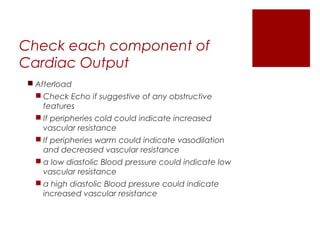
 Afterload
 Check Echo if suggestive of any obstructive
features
 If peripheries cold could indicate increased
vascular resistance
 If peripheries warm could indicate vasodilation
and decreased vascular resistance
 a low diastolic Blood pressure could indicate low
vascular resistance
 a high diastolic Blood pressure could indicate
increased vascular resistance
Check each component of
Cardiac Output
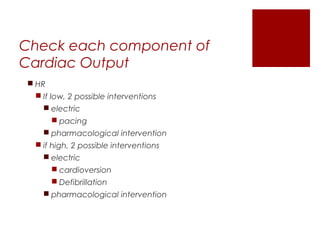
 HR
 If low, 2 possible interventions
 electric
 pacing
 pharmacological intervention
 if high, 2 possible interventions
 electric
 cardioversion
 Defibrillation
 pharmacological intervention
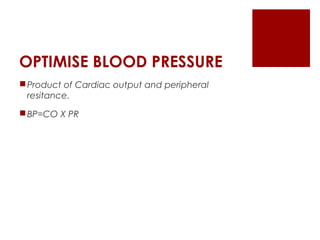
OPTIMISE BLOOD PRESSURE
Product of Cardiac output and peripheral
resitance.
BP=CO X PR
OPTIMISE REGIONAL BLOOD
FLOW
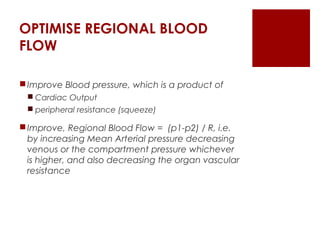
Improve Blood pressure, which is a product of
 Cardiac Output
 peripheral resistance (squeeze)
Improve, Regional Blood Flow = (p1-p2) / R, i.e.
by increasing Mean Arterial pressure decreasing
venous or the compartment pressure whichever
is higher, and also decreasing the organ vascular
resistance
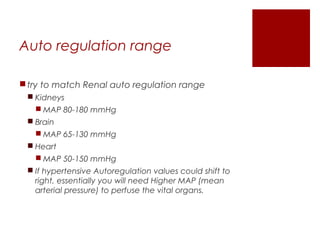
Auto regulation range
try to match Renal auto regulation range
 Kidneys
 MAP 80-180 mmHg
 Brain
 MAP 65-130 mmHg
 Heart
 MAP 50-150 mmHg
 If hypertensive Autoregulation values could shift to
right, essentially you will need Higher MAP (mean
arterial pressure) to perfuse the vital organs.
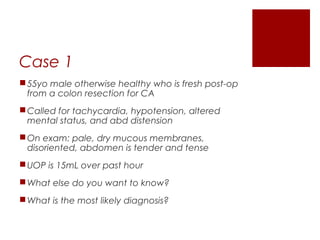
Case 1
55yo male otherwise healthy who is fresh post-op
from a colon resection for CA
Called for tachycardia, hypotension, altered
mental status, and abd distension
On exam: pale, dry mucous membranes,
disoriented, abdomen is tender and tense
UOP is 15mL over past hour
What else do you want to know?
What is the most likely diagnosis?
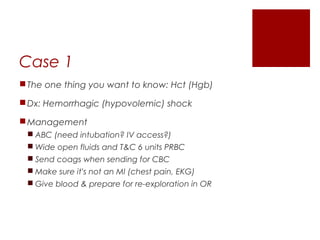
Case 1
The one thing you want to know: Hct (Hgb)
Dx: Hemorrhagic (hypovolemic) shock
Management
 ABC (need intubation? IV access?)
 Wide open fluids and T&C 6 units PRBC
 Send coags when sending for CBC
 Make sure it’s not an MI (chest pain, EKG)
 Give blood & prepare for re-exploration in OR
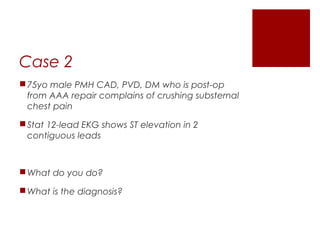
Case 2
75yo male PMH CAD, PVD, DM who is post-op
from AAA repair complains of crushing substernal
chest pain
Stat 12-lead EKG shows ST elevation in 2
contiguous leads
What do you do?
What is the diagnosis?
Case 2
ABC, get good access, continuous monitor
Dx: Acute ST elevation MI
Treatment: “MONA”
 Oxygen, Aspirin, Nitroglycerin, Morphine
 Beta-blockade (no heparin or tPA due to surg)
 Plavix & GP IIb/IIIa inhibitor (i.e. eptifibatide)
 Stat cardiology consult for cardiac cath
Case 2, continued
Cath reveals critical stenosis of left main s/p
balloon angioplasty
24 hrs later, in ICU intubated
Vitals: 80/50
On exam: cool, clammy extremities
Echocardiogram: severe LV dysfunction
What is the diagnosis & management?
Case 2, continued
Dx: Cardiogenic shock 2ndary to STEMI
Management
 RESUSCITATIVE CARE (remember, ABC)
 SUPPORTIVE CARE Ventilator support Inotropes and
Vasopressors Cardiac output monitoring to optimize
volume status and cardiac function
 May need intra-aortic balloon pump
 DEFINITIVE CARE
 PCI Thrombolysis, Aspirin, Heparin (maintain coronary
patency)
Case 3
60yo male heavy drinker brought in by EMS with nausea,
vomiting, severe epigastric pain radiating to the back
Tachycardic, hypotensive
Altered mentation, dry mucous membranes, minimal UOP after
Foley
What is the most likely diagnosis?
 Differential diagnosis?
How do you manage this patient?
Case 3
Acute pancreatitis
 DDx of acute abdomen: Perforated viscus, acute mesenteric
ischemia, cholecystitis, SBO, Ruptured AAA, MI
Hypovolemic shock from vomiting and Distributive shock from
the inflammation: vasodilation, vasopermeability (3rd
-space)
Management
 RESUSCITATIVE CARE (remember, ABC) These pts require heavy,
heavy fluid resus
SUPPORTIVE CARE NPO, NGT feed post-pyloric, consider CT
scan
DEFINITIVE CARE
Case 4
55yo male also post-op from colon resection for
CA, epidural placed for post-operative pain
control
Called by nurse for hypotension and
bradycardia
Abdomen soft, no pallor, altered mentation
Hct is 38
Most likely diagnosis?
Case 4
Neurogenic shock 2ndary to epidural
Differentiated from hypovolemic due to bradycardia
Management
 RESUSCITATIVE CARE (remember, ABC) IVF
 SUPPORTIVE CARE If BP does not respond, then alpha-agonist such as
phenylephrine until above measures stabilize patient, then wean the
vasopressor
 DEFINITIVE CARE Turn down or turn off epidural,
Case 5
25yo male presents with diffuse abdominal pain
of 1day duration, started initially as epigastric
pain after a meal. Takes ibuprofen 3x a day.
Vitals: hypotensive, tachycardic
Tense abdomen, involuntary guarding, altered
mental status, oliguric
What is the diagnosis & management?
Case 5
Septic shock 2ndary to perf duodenal ulcer
 This patient has diffuse peritonitis
Management:
Management
 RESUSCITATIVE CARE (remember, ABC) IV & resuscitation (requires
heavy fluids)
 SUPPORTIVE CARE If pt, does not respond to fluids, may need
vasopressors (norepinephrine)
 Have beta-agonist effects to help pump function as well as alpha-
agonist for periph vasoconstriction
 DEFINITIVE CARE
 Broad-spectrum IV antibiotics
 Emergent OR for ex-lap, washout & repair
Take Home Points
Shock = poor tissue perfusion/oxygenation
Know difference btw compensated/uncomp shock
3 types are based on physiology of shock
Hypovolemic due to decreased preload
Cardiogenic due to decreased SV or CO
Distributive due to decreased SVR
Know the common signs a/w shock
Oliguria, AMS, cool/clammy skin, acidosis
Work-up & management starts with ABC
Aggressive resuscitation except if cardiogenic
Vasopressors if hypotensive despite fluids
Thanks
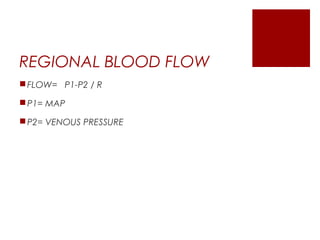
MAP
Diastolic + 1/3 Pulse pressure
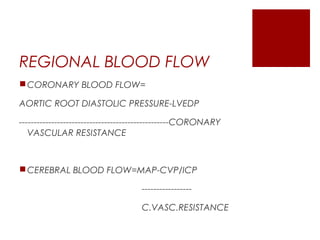
REGIONAL BLOOD FLOW
FLOW= P1-P2 / R
P1= MAP
P2= VENOUS PRESSURE
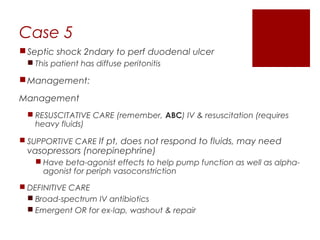
REGIONAL BLOOD FLOW
CORONARY BLOOD FLOW=
AORTIC ROOT DIASTOLIC PRESSURE-LVEDP
---------------------------------------------------CORONARY
VASCULAR RESISTANCE
CEREBRAL BLOOD FLOW=MAP-CVP/ICP
-----------------
C.VASC.RESISTANCE

Shock

  • 1.
    Shock Dr SAM GEORGE CONSULTANTANAESTHESIA & INTENSIVE CARE
  • 2.
    Overview Definitions Initial Assessment –ABC Stages of Shock Physiologic Determinants of Shock Types of Shock Common Features of Shock Work-up Generic Approach to Management Case scenarios and Management Take Home Points
  • 3.
    Definition of Shock Inadequateperfusion and oxygenation of cells Hypotension is not a requirement
  • 4.
    Why should youcare? High mortality - 20-90% Early on the effects of O2 deprivation on the cell are REVERSIBLE Early intervention reduces mortality
  • 5.
    Remember! Assessment Intervention andMonitoring happens together in acute scenarios.
  • 6.
    Initial Assesment -ABC Airway:  Does pt have mental status to protect airway?  GCS less than “eight” means “intubate”  Airway is compromised in anaphylaxis Breathing:  If pt is conversing with you, A & B are fine  Place patient on oxygen Circulation:  Vitals (HR, BP)  2 large bore (#16g) IV, start fluids (careful if cardiogenic shock), put on continuous monitor
  • 7.
    ABC “DE” In atrauma, perform ABCDE, not just ABC Deficit or Disability  Assess for obvious neurologic deficit  Moving all four extremities? Pupils?  Glascow Coma Scale (M6, V5, E4) Exposure  Remove all clothing on trauma patients
  • 8.
    TYPES OF SHOCK Typeof Shock Insult Physiologic Effect Compensation Cardiogenic Heart fails to pump blood out •MI, arrhythmia, aortic stenosis, mitral regurg, ↓CO BaroRc ↑SVR Obstructive Heart pumps well, but the outflow is obstructed •Extracardiac obstructive causes such as PE, tension pneumothorax, tamponade ↓CO BaroRc ↑SVR Hypovolemic Heart pumps well, but not enough blood volume to pump •Hemorrhage •Fluid Loss (Vomiting, Diarrhea, Burns) ↓CO BaroRc ↑SVR Distributive Heart pumps well, but there is peripheral vasodilation •Septic, anaphylactic, and neurogenic shock •Pancreatitis, burns, multi-trauma via activation of the inflammatory response ↓SVR ↑CO
  • 9.
    Stages of Shock Timelineand progression will depend on: -Cause -Patient Characteristics -Intervention Insult Preshock (Compensation) Shock (Compensation Overwhelmed) End organ Damage Death
  • 10.
    Stages of Shock:Example Stage Pathophysiology Clinical Findings Insult Splenic Rupture -- Blood Loss Abdominal tenderness and girth Preshock Hemostatic compensation MAP =↓CO(HR x↓SV) x ↑ SVR Decreased CO is compensated by increase in HR and SVR MAP is maintained HR will be increased Extremities will be cool due to vasoconstriction Shock Compensatory mechanisms fail MAP is reduced Tachycardia, dyspnea, restlessness End organ dysfuncti on Cell death and organ failure Decreased renal function Liver failure Disseminated Intravascular Coagulopathy Death
  • 11.
    Common Features ofShock Hypotension (not an absolute requirement)  SBP < 90mm Hg, not seen in “preshock” Cool, clammy skin  Vasoconstrictive mechanisms to redirect blood from periphery to vital organs  Exception is warm skin in early distrib. shock Oliguria (↓kidney perfusion) Altered mental status (↓brain perfusion) Metabolic acidosis
  • 12.
    Hypovolemic Shock Distributive Shock Cardiogenic Shock Obstructive Shock HR Increased Increased (Normalin Neurogenic shock) May be increased or decreased Increased JVP Low Low High High BP Low Low Low Low SKIN Cold Warm (Cold in severe shock) Cold Cold CAP REFILL Slow Slow Slow Slow
  • 13.
    Type of Shock Insult Physio logic Effect Compen sation Compensation HeartRate Compensation Contractility Cardiogenic Heart fails to pump blood out ↓CO BaroRc ↑SVR ↑ ↑ Obstructive Heart pumps well, but the outflow is obstructed ↓CO BaroRc ↑SVR ↑ ↑ Hemorrhagic Heart pumps well, but not enough blood volume to pump ↓CO BaroRc ↑SVR ↑ ↑ Distributive Heart pumps well, but there is peripheral vasodilation ↓SVR ↑CO ↑ No Change - in neurogenic shock ↑ No Change - in neurogenic shock Compensatory Mechanisms
  • 14.
    Additional Compensatory Mechanisms Renin-Angiotensin-Aldosterone Mechanism AII components lead to vasoconstriction  Aldosterone leads to water conservation ADH leads to water retention and thirst Inflammatory cascade
  • 15.
    Work-up History to determineetiology  Bleeding (recent surgery, trauma, GI bleed)  Allergies or prior anaphylaxis  Sx consistent with pancreatitis, EtOH history  Hx of CAD, MI, current chest pain/diaphoresis Examination  Mucous membranes, JVD, lung sounds, cardiac exam, abdomen, rectal (blood), neuro exam, skin (cold & clammy or warm) Investigations: Labs/Tests directed toward suspected dx’s
  • 16.
    GENERIC APPROACH TO MANAGEMENTOF SHOCK OPTIMISE OXYGEN CONTENT OPTIMISE CARDIAC OUTPUT OPTIMISE BLOOD PRESSURE OPTIMISE REGIONAL BLOOD FLOW
  • 17.
    In Short  Theoxygenated blood carried forward by the cardiac output has to reach the Vital organs,  this is only possible if there is a good pressure gradient  and the organ vascular resistance is low;  try to maintain the Blood pressure within the regional Auto regulation range,  I prefer to target the kidneys as they are a filter and require higher mean arterial pressures, essentially ensures all other organs are also perfused
  • 18.
    OPTIMISE OXYGEN CONTENT Hb Checkif appears pale or anaemic Check Hb and coagulation status Sao2 just a pulse oximeter tells you the SpO2 Check SaO2 on ABG
  • 19.
    OPTIMISE CARDIAC OUTPUT CO= Stroke volume (SV) x Heart rate (HR) STROKE VOLUME depends on Preload Contractility Afterload
  • 20.
    Check each componentof Cardiac Output  Stroke Volume (depends on 3 factors)  Preload  Look at response to fluid bolus  If improves BP could be suggestive of decreased preload (volume) and a reasonable contractility.  If no improvement or worsening BP could be suggestive of a Contractility problem or excess preload (volume) situation  Look at CVP
  • 21.
    Check each componentof Cardiac Output  Contractility  Check any history suggestive of Ischaemic disease or CCF  Check ECHO and ECG results  A high systolic pressure could be suggestive of good contractility
  • 22.
    Check each componentof Cardiac Output  Afterload  Check Echo if suggestive of any obstructive features  If peripheries cold could indicate increased vascular resistance  If peripheries warm could indicate vasodilation and decreased vascular resistance  a low diastolic Blood pressure could indicate low vascular resistance  a high diastolic Blood pressure could indicate increased vascular resistance
  • 23.
    Check each componentof Cardiac Output  HR  If low, 2 possible interventions  electric  pacing  pharmacological intervention  if high, 2 possible interventions  electric  cardioversion  Defibrillation  pharmacological intervention
  • 24.
    OPTIMISE BLOOD PRESSURE Productof Cardiac output and peripheral resitance. BP=CO X PR
  • 25.
    OPTIMISE REGIONAL BLOOD FLOW ImproveBlood pressure, which is a product of  Cardiac Output  peripheral resistance (squeeze) Improve, Regional Blood Flow = (p1-p2) / R, i.e. by increasing Mean Arterial pressure decreasing venous or the compartment pressure whichever is higher, and also decreasing the organ vascular resistance
  • 26.
    Auto regulation range tryto match Renal auto regulation range  Kidneys  MAP 80-180 mmHg  Brain  MAP 65-130 mmHg  Heart  MAP 50-150 mmHg  If hypertensive Autoregulation values could shift to right, essentially you will need Higher MAP (mean arterial pressure) to perfuse the vital organs.
  • 27.
    Case 1 55yo maleotherwise healthy who is fresh post-op from a colon resection for CA Called for tachycardia, hypotension, altered mental status, and abd distension On exam: pale, dry mucous membranes, disoriented, abdomen is tender and tense UOP is 15mL over past hour What else do you want to know? What is the most likely diagnosis?
  • 28.
    Case 1 The onething you want to know: Hct (Hgb) Dx: Hemorrhagic (hypovolemic) shock Management  ABC (need intubation? IV access?)  Wide open fluids and T&C 6 units PRBC  Send coags when sending for CBC  Make sure it’s not an MI (chest pain, EKG)  Give blood & prepare for re-exploration in OR
  • 29.
    Case 2 75yo malePMH CAD, PVD, DM who is post-op from AAA repair complains of crushing substernal chest pain Stat 12-lead EKG shows ST elevation in 2 contiguous leads What do you do? What is the diagnosis?
  • 30.
    Case 2 ABC, getgood access, continuous monitor Dx: Acute ST elevation MI Treatment: “MONA”  Oxygen, Aspirin, Nitroglycerin, Morphine  Beta-blockade (no heparin or tPA due to surg)  Plavix & GP IIb/IIIa inhibitor (i.e. eptifibatide)  Stat cardiology consult for cardiac cath
  • 31.
    Case 2, continued Cathreveals critical stenosis of left main s/p balloon angioplasty 24 hrs later, in ICU intubated Vitals: 80/50 On exam: cool, clammy extremities Echocardiogram: severe LV dysfunction What is the diagnosis & management?
  • 32.
    Case 2, continued Dx:Cardiogenic shock 2ndary to STEMI Management  RESUSCITATIVE CARE (remember, ABC)  SUPPORTIVE CARE Ventilator support Inotropes and Vasopressors Cardiac output monitoring to optimize volume status and cardiac function  May need intra-aortic balloon pump  DEFINITIVE CARE  PCI Thrombolysis, Aspirin, Heparin (maintain coronary patency)
  • 33.
    Case 3 60yo maleheavy drinker brought in by EMS with nausea, vomiting, severe epigastric pain radiating to the back Tachycardic, hypotensive Altered mentation, dry mucous membranes, minimal UOP after Foley What is the most likely diagnosis?  Differential diagnosis? How do you manage this patient?
  • 34.
    Case 3 Acute pancreatitis DDx of acute abdomen: Perforated viscus, acute mesenteric ischemia, cholecystitis, SBO, Ruptured AAA, MI Hypovolemic shock from vomiting and Distributive shock from the inflammation: vasodilation, vasopermeability (3rd -space) Management  RESUSCITATIVE CARE (remember, ABC) These pts require heavy, heavy fluid resus SUPPORTIVE CARE NPO, NGT feed post-pyloric, consider CT scan DEFINITIVE CARE
  • 35.
    Case 4 55yo malealso post-op from colon resection for CA, epidural placed for post-operative pain control Called by nurse for hypotension and bradycardia Abdomen soft, no pallor, altered mentation Hct is 38 Most likely diagnosis?
  • 36.
    Case 4 Neurogenic shock2ndary to epidural Differentiated from hypovolemic due to bradycardia Management  RESUSCITATIVE CARE (remember, ABC) IVF  SUPPORTIVE CARE If BP does not respond, then alpha-agonist such as phenylephrine until above measures stabilize patient, then wean the vasopressor  DEFINITIVE CARE Turn down or turn off epidural,
  • 37.
    Case 5 25yo malepresents with diffuse abdominal pain of 1day duration, started initially as epigastric pain after a meal. Takes ibuprofen 3x a day. Vitals: hypotensive, tachycardic Tense abdomen, involuntary guarding, altered mental status, oliguric What is the diagnosis & management?
  • 38.
    Case 5 Septic shock2ndary to perf duodenal ulcer  This patient has diffuse peritonitis Management: Management  RESUSCITATIVE CARE (remember, ABC) IV & resuscitation (requires heavy fluids)  SUPPORTIVE CARE If pt, does not respond to fluids, may need vasopressors (norepinephrine)  Have beta-agonist effects to help pump function as well as alpha- agonist for periph vasoconstriction  DEFINITIVE CARE  Broad-spectrum IV antibiotics  Emergent OR for ex-lap, washout & repair
  • 39.
    Take Home Points Shock= poor tissue perfusion/oxygenation Know difference btw compensated/uncomp shock 3 types are based on physiology of shock Hypovolemic due to decreased preload Cardiogenic due to decreased SV or CO Distributive due to decreased SVR Know the common signs a/w shock Oliguria, AMS, cool/clammy skin, acidosis Work-up & management starts with ABC Aggressive resuscitation except if cardiogenic Vasopressors if hypotensive despite fluids
  • 40.
  • 41.
    MAP Diastolic + 1/3Pulse pressure
  • 42.
    REGIONAL BLOOD FLOW FLOW=P1-P2 / R P1= MAP P2= VENOUS PRESSURE
  • 43.
    REGIONAL BLOOD FLOW CORONARYBLOOD FLOW= AORTIC ROOT DIASTOLIC PRESSURE-LVEDP ---------------------------------------------------CORONARY VASCULAR RESISTANCE CEREBRAL BLOOD FLOW=MAP-CVP/ICP ----------------- C.VASC.RESISTANCE

Editor's Notes

  • #4 Notes: The inadequate perfusion and oxygenation leads to first cellular dysfunction and then organ dysfunction. -Cellular effects include cell membrane ion pump dysfunction, intracellular edema, leakage of intracellular contents into the extracellular space, and inadequate regulation of intracellular pH. -Systemic effects include alterations in the serum pH, endothelial dysfunction, as well as further stimulation of inflammatory and antiinflammatory cascades that lead to multiorgan dysfunction
  • #5 Notes: Mortality due to shock is high. It is estimated that 35 to 60% of patients die within one month of the onset of septic shock. The mortality rate may be even higher among patients with cardiogenic shock; it is estimated to be 60 to 90%. Mortality due to hypovolemic shock is more variable. Early intervention can prevent the cascade of detrimental effects of O2 deprivation on the cells and organs
  • #10 Notes: All forms of shock go through “stages “ of shock. How quickly the patient goes through the stages depends on the cause of shock, patient characteristics, and how quickly we intervene. For example, a healthy adult can be asymptomatic despite a 10% reduction in total effective blood volume. OR if a healthy patient is bleeding slowly from a bleeding ulcer, he will be able to compensate for the blood loss for a long time. If the blood loss is very rapid (e.g. from splenic rupture in Case 1), the patient may progress to death within minutes going through all stages within minutes to hours Preshock — Preshock is also referred to as warm shock or compensated shock. It is characterized by rapid compensation for diminished tissue perfusion by various homeostatic mechanisms. As an example, compensatory mechanisms during preshock may allow an otherwise healthy adult to be asymptomatic despite a 10 percent reduction in total effective blood volume. Tachycardia, peripheral vasoconstriction, and either a modest increase or decrease in systemic blood pressure may be the only clinical signs of shock. Shock — During shock, the compensatory mechanisms become overwhelmed and signs and symptoms of organ dysfunction appear. These include tachycardia, dyspnea, restlessness, diaphoresis, metabolic acidosis, oliguria, and cool clammy skin. End-organ dysfunction — Progressive end-organ dysfunction leads to irreversible organ damage and patient death. End organ dysfunction - typically correspond to a significant physiologic perturbation Examples include a 20 to 25% reduction in effective blood volume in hypovolemic shock, a fall in the cardiac index to less than 2.5 L/min/M2 in cardiogenic shock, or activation of innumerable mediators of the systemic inflammatory response syndrome (SIRS) in distributive shock. During this stage, urine output may decline further (culminating inanuria and acute renal failure), acidemia decreases the cardiac output and alters cellular metabolic processes, and restlessness evolves into agitation, obtundation, and coma. REFERENCES: Up to date - Shock to Adults: Types, presentation, diagnostic approach
  • #13 Notes: This is a summary slide
  • #14 Notes: The earlier table was oversimplified. Regardless of the type of SHOCK all components of the equation will compensate for the physiologic change induced by the insult, however some will be more effective than others
  • #23 may be considered as the ventricular wall tension required to eject the stroke volume during systole. Afterload relates to the mechanical resistance to shortening of the cardiac muscle fibers.