CRISPR TECHNOLOGY
Guided by:
Mr.Baji.K
Presented by:
P.Navaneeth Krishna Menon
INTRODUCTION
• What is CRISPR Technology?
• Clustered Regularly
Interspaced Short
Palindromic Repeats.
• CRISPR/Cas system is
used for genome editing.
2
CRISPR/Cas System
• CRISPRs are segments of prokaryotic DNA
containing short repetitions of base sequences.
• CRISPR/Cas system is a prokaryotic
immune system that confers
resistance to foreign genetic elements
such as phages.
• Much easier to design compared to its
predecessors zinc finger nucleases and
TALENs.
3
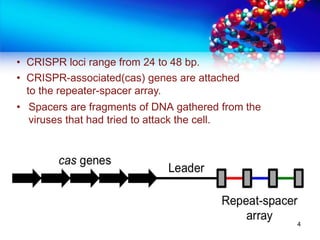
• Spacers are fragments of DNA gathered from the
viruses that had tried to attack the cell.
• CRISPR loci range from 24 to 48 bp.
• CRISPR-associated(cas) genes are attached
to the repeater-spacer array.
4
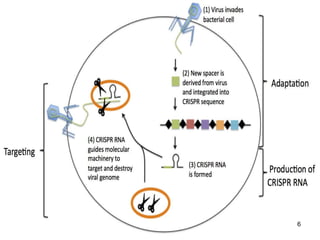
Action of CRISPR
The CRISPR immune system works to protect
bacteria from repeated viral attack via three basic
steps:
(1) Adaptation
(2) Production of CRISPR RNA
(3) Targeting
5
6
APPLICATIONS
In industry:
CRISPR system are advantageous for
industrial processes that utilize bacterial
cultures.
CRISPR-based immunity can be employed
to make these cultures more resistant to
viral attack, which would otherwise impede
productivity.
Eg: Streptococcus thermophilus, which is
used to make yogurts and cheeses.
7
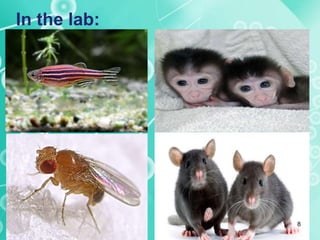
In the lab:
8
9
IIn Medicine:
Treatment of genetic diseases.
To make more specific antibiotics that
target only disease-causing bacterial
strains while sparing beneficial bacteria.
Researches are being carried out to
make WBCs resistant to HIV infection.
10
CONCLUSION
Jennifer Doudna ,Emmanuelle Charpentier and Feng Zhang
11
12
13
REFERENCE
• http://sitn.hms.harvard.edu/flash/2014/crispr-genetic-
engineering-technique/
• Horvath P, Barrangou R (2010). "CRISPR/Cas, the immune
system of bacteria and archaea". Science 327 (5962): 167–70
• https://www.addgene.org/crispr/guide/
• Sawyer E (9 February 2013). "Editing Genomes with the
Bacterial Immune System".Scitable (blog). Nature Publishing
Group.
14
15

CRISPR technology -A revolutionary discovery

  • 1.
  • 2.
    INTRODUCTION • What isCRISPR Technology? • Clustered Regularly Interspaced Short Palindromic Repeats. • CRISPR/Cas system is used for genome editing. 2
  • 3.
    CRISPR/Cas System • CRISPRsare segments of prokaryotic DNA containing short repetitions of base sequences. • CRISPR/Cas system is a prokaryotic immune system that confers resistance to foreign genetic elements such as phages. • Much easier to design compared to its predecessors zinc finger nucleases and TALENs. 3
  • 4.
    • Spacers arefragments of DNA gathered from the viruses that had tried to attack the cell. • CRISPR loci range from 24 to 48 bp. • CRISPR-associated(cas) genes are attached to the repeater-spacer array. 4
  • 5.
    Action of CRISPR TheCRISPR immune system works to protect bacteria from repeated viral attack via three basic steps: (1) Adaptation (2) Production of CRISPR RNA (3) Targeting 5
  • 6.
  • 7.
    APPLICATIONS In industry: CRISPR systemare advantageous for industrial processes that utilize bacterial cultures. CRISPR-based immunity can be employed to make these cultures more resistant to viral attack, which would otherwise impede productivity. Eg: Streptococcus thermophilus, which is used to make yogurts and cheeses. 7
  • 8.
  • 9.
  • 10.
    IIn Medicine: Treatment ofgenetic diseases. To make more specific antibiotics that target only disease-causing bacterial strains while sparing beneficial bacteria. Researches are being carried out to make WBCs resistant to HIV infection. 10
  • 11.
    CONCLUSION Jennifer Doudna ,EmmanuelleCharpentier and Feng Zhang 11
  • 12.
  • 13.
  • 14.
    REFERENCE • http://sitn.hms.harvard.edu/flash/2014/crispr-genetic- engineering-technique/ • HorvathP, Barrangou R (2010). "CRISPR/Cas, the immune system of bacteria and archaea". Science 327 (5962): 167–70 • https://www.addgene.org/crispr/guide/ • Sawyer E (9 February 2013). "Editing Genomes with the Bacterial Immune System".Scitable (blog). Nature Publishing Group. 14
  • 15.