Click to edit Master text styles
Second level
Third level
Fourth level
Fifth level
CRISP
R :A
NEW
BREAK
THRO
UGH
Dr. SHERIN SHAJI
Dr. VEDICA SETHI
Dr. ZEENATH GHOUSKHAN
INTRODUCTION
•Genome editing is a form of genetic engineering
in which DNA sequences are inserted , deleted or
replaced in the genome of living organisms using
molecular scissors like nucleases.
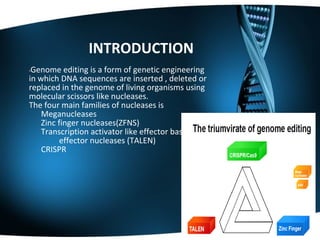
The four main families of nucleases is
Meganucleases
Zinc finger nucleases(ZFNS)
Transcription activator like effector based
effector nucleases (TALEN)
CRISPR
CRISPR : CLUSTERED
REGULARLY INTERSPACED
SHORT PALINDROMIC REPEAT
•It is a prokaryotic immune system that
confers resistance to foreign genetic
elements such as those present within
plasmids and phages that provides a form of
acquired immunity.
•It forms the basis of a genome editing
technology known as CRISPR-Cas9 that
allows permanent modifications of genes
within organisms.
•CRISPR-Cas system consist of two key
molecules that introduce a change into the
DNA sequence
1. Cas 9 - act as molecular scissors
2. gRNA – guides Cas9 to the right part
of the genome
gRNA = crispr rRNA + tracrRNA
4HISTORY: Key Events
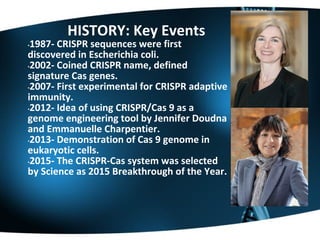
•1987- CRISPR sequences were first
discovered in Escherichia coli.
•2002- Coined CRISPR name, defined
signature Cas genes.
•2007- First experimental for CRISPR adaptive
immunity.
•2012- Idea of using CRISPR/Cas 9 as a
genome engineering tool by Jennifer Doudna
and Emmanuelle Charpentier.
•2013- Demonstration of Cas 9 genome in
eukaryotic cells.
•2015- The CRISPR-Cas system was selected
by Science as 2015 Breakthrough of the Year.
Different CRISPR-Cas
system in Bacterial
Adaptive Immunity-
•Type 1 – contain Cas3 gene which
encodes large proteins with
separate helicase and DNAase
activity, in addition to genes
encoding protien that form cascade
like complexes with different
compositions.
•Type 2 – includes HNH type
system in which Cas9, a single very
large protein is sufficient to
generate crRNA and cleaving the
target DNA in addition to
ubiquitous Cas 1 and Cas 2.
•Type 3 - contain polymerase and
RAMP modules in which at least
some of the RAMPs seem to be
involved in the processing of the
spacer–repeat transcripts,
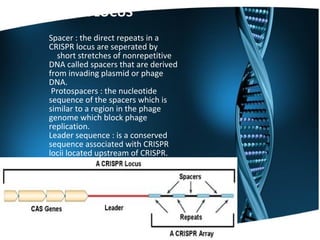
CRISPR LOCUS
Spacer : the direct repeats in a
CRISPR locus are seperated by
short stretches of nonrepetitive
DNA called spacers that are derived
from invading plasmid or phage
DNA.
Protospacers : the nucleotide
sequence of the spacers which is
similar to a region in the phage
genome which block phage
replication.
Leader sequence : is a conserved
sequence associated with CRISPR
locii located upstream of CRISPR.
CRISPR array : composed of series
of repeats interspaced by spacer
sequences acquired from invading
genome.
KEY COMPONENTS OF
CRISPR
crRNA :
contains the guide RNA that locates the
correct section of host DNA along with a
region that binds to tracrRNA (in a hairpin
loop form) forming an active complex.
tracrRNA :
binds to crRNA and forms an active
complex.
gRNA :
a combined RNA consisting of tracrRNA
and at least one crRNA.
Cas 9 :
they are RNA guided DNA endonuclease
associated with CRISPR to interrograte
foreign DNA.
MECHANISM OF ACTION OF
CRISPR
WHAT MAKES CRISPR
SYSTEM
THE IDEAL GENOME
EDITING TOOL?
•High potency and specificity
•Broadly applicable to both invivo and
exvivo application
•Simple editing tools, allow unique
ability to scale and optimize speed
•Potential one time curative treatment
for genetic disease
•Ability to target multiple DNA site
simultaneously which makes it different
from other genome editing tools like
ZFNs and TALENs
•Multifunctional programability to insert,
delete or repair gene
APPLICATION OF CRISPR IN
MODERN MEDICINE
•To understand the role that specific
mutations in specific genes influence a
particular trait of an organism.
•To recreate known stable mutations in cell
lines that can serve as models of a particular
disease.
•To create stable mutations in whole
organisms (plants / animals) and create
strains that can be used in research or
commerce.
•To create gene therapies in order to treat or
diagnose congenital diseases, infections, or
cancers especially new outbreaks like ZIKA
virus
•To create gene drives that can modify
populations of organisms in a specific way
CRISPR TREATMENT FOR
DUCHENE MUSCULAR
DYSTROPHY
•New gene editing enzyme CRISPR cpf1
corrected DMD in human cell
•DMD mutation in dystrophin gene
•CRISPR cpf1 differ from CRISPR Cas9 :
much smaller than Cas9 enzyme
which make it easier for the delivery to
muscles
• skipping a mutation region or
precisely repairing a mutation in gene
CRISPR cpf1 mediated genome editing
corrects DMD mutation but also muscle
contractility and strength
CRISPR targets point mutation in exon 23
it creates a stop codon and serve as a
model of DMD
Efficacy by using a two vector system of
CRISPR rather than single vectors for the
guide RNA and Cas9 which will restore
the dystrophin positive fibers
Recovery: cell level- decrease infiltration,
inflammatory cells and decrease fibrosis
and reversal of necerosis.
Final outcome:
•Improved grip strength
•Force generation,
resistance against eccentric
contractions
•Decreased blood levels of
creatinine kinase
•Dystrophin expression on
vascular smooth muscle
•Important source of
oxygenation during activity
and cardiomyocytes-
restored dystrophin.
TREATMENT FOR
MYOTUBULAR
MYOPATHY
•Is a X-linked genetic disease
affecting new born boys.
•Caused by mutation in
MTM1 gene encoding
myotubularin, a protein
involved in functioning of
muscle cells.
•Research conducted by
University of Washington and
Harvard Medical School in
USA achieved a new method
of treatment of MM by gene
CORRECTION OF BETA-
THALASSEMIA MUTATION USING
CRISPR CAS9
•Beta- Thalassemia caused by mutation in
human Hb heritage.
•Creation of human induced pluripotent stem
cells (iPSC) from Beta Thalassemia patients
could offer an approach to cure the disease.
•Correction of disease causing mutation in
iPSC’s restore normal function and provide a
rich source of cells in transplantation.
•CRISPR/Cas9 correct the HBB mutation in
patient derived iPSC without leaving any
residual foot print.
CRISPR-Cas13a:
DIAGNOSTIC TOOL
FOR ZIKA AND
DENGUE VIRUS “The
Sherlock”
•SHERLOCK uses an RNA guide that
gloms onto RNA, not DNA, and an
enzyme called Cas13a cuts the
genetic material. Once Cas13a
snips the target, it starts
indiscriminately cutting any RNA it
encounters.
• A team lead by bioengineer James
Collins and CRISPR genome-editing
pioneer Feng Zhang, both from the
Broad Institute in Cambridge,
Massachusetts, has now shown
that these “collateral” cuts can
form the basis for the SHERLOCK
•The researchers demonstrate that
SHERLOCK can detect viral and bacterial
infections, cancer mutations found at low
frequencies, and subtle DNA sequence
variations known as single nucleotide
polymorphisms that are linked to other
diseases.
•SHERLOCK, a somewhat strained acronym
coined by the team, stands for specific high
sensitivity enzymatic reporter unlocking.
•To exploit SHERLOCK for detecting small
amounts of virus, the researchers spiked
samples containing Zika or dengue virus with
so-called fluorescent reporter RNA. When
this RNA is cut, it effectively shoots off
fluorescent flares.
•The team then unleashed Cas13a connected
to a bit of RNA that targeted genetic
sequences from either Zika or dengue. Once
Cas13a found and sliced even a few viral
sequences, it subsequently snipped the
fluorescent reporters and created a
detectable signal indicating the presence of
the virus.
The
detectio
n
sensitivit
y of the
new
CRISPR-
Cas13a
system
for
specific
genetic
material
is 1
million
times
better
than the
most
common
ly used
diagnost
CRISPR: TARGETS
CANCER IN FIRST
HUMAN TRIAL
•Normally, T cells survey the body to seek
out and destroy abnormal cells that may
be turning cancerous. These cells often
have strange proteins on their surface
that alert T cells that they’re up to no
good. However, in an evolutionary
approach, cancer cells often gain the
ability to “switch off” any T cell that gets
in their way, effectively blocking the
attack.
•Many of the most successful cancer
therapies try to circumvent this response
by boosting the immune system. A 2015
study led by Dr. Carl June of UPenn, who
is advising the new trial, used an older,
less efficient gene engineering technique
called zinc finger nucleases to give T cells
better ability to fight off HIV. The therapy
The Plan;
•In all, scientists will recruit 18 patients
with three types of cancer (myeloma,
sarcoma or melanoma) who have
stopped responding to existing
treatment. The two-year trial will take
place at three centers that are members
of the Parker Institute For Cancer
Immunotherapy, including UPenn, UC
San Francisco and the University of
Texas.
•The researchers will remove T cells from
the patients and, using a harmless virus
to deliver the CRISPR machinery into the
cells, perform three gene edits on them.
The first edit will insert a gene for a
protein called the NY-ESO-1 receptor.
This protein gives T cells the power to
better recognize and home in on
cancerous cells.
•Unfortunately, T cells have two native
proteins that interfere with this process,
so the second edit will remove these
•The third edit gives T cells staying power:
it will remove a gene that allows cancer
cells to recognize the immune cell and
prevent the cancer from shutting off the
attack.
•Because CRISPR doesn’t work every time,
not all the cells will get every modification.
In the end, the engineered cells will be a
mixture with various combinations of the
proposed changes. Only 3-4% may contain
all three .After the edits, the researchers
will infuse the cells back into the patients
and closely monitor for any issues.
•One of the biggest worries is that CRISPR
might inadvertently snip other genes,
potentially creating new cancer genes or
triggering existing ones. Using various
tests, the team plans to carefully measure
the growth rate of the engineered T cells
and test for genomic abnormalities.But the
outlook is bright.
•In a test run using T cells from healthy
•Another worry is that
the technique itself
could activate the
body’s immune
response. CRISPR uses
an enzyme called Cas9,
which originates from
bacteria, to do the
snipping. Although
there are ways to
protect the edited cells
from the immune
system, they could still
be attacked.
• The last concern isn’t
scientific, but pertains
to UPenn’s potential
conflict of interest.
June, who will serve as
an advisor to the trial,
has several patents on
T cell engineering for
cancer and is involved
in several companies
CONCLUSION:
•The CRISPR/Cas 9 technique is one of a number of
gene-editing tools. Many favor the CRISPR/Cas9
technique because of its high degree of flexibility
and accuracy in cutting and pasting DNA.
•One of the reasons for its popularity is that it makes
it possible to carry out genetic engineering on an
unprecedented scale at a very low cost.
•How it differs from previous genetic engineering
techniques is that it allows for the introduction or
removal of more than one gene at a time.
•This makes it possible to manipulate many different
genes in a cell line, plant or animal very quickly,
reducing the process from taking a number of years
to a matter of weeks.
• It is also different in that it is not species-specific,
so can be used on organisms previously resistant to
genetic engineering.
•The technique is already being explored
for a wide number of applications in fields
ranging from agriculture through to human
health.
• In agriculture it could help in the design
of new grains, roots and fruits. Within the
context of health it could pave the way to
the development of new treatments for
rare metabolic disorders and genetic
diseases ranging from hemophilia through
to Huntingdon's disease.
• It is also being utilized in the creation of
transgenic animals to produce organs for
transplants into human patients.
• The technology is also being investigated
for gene therapy. Such therapy aims to
insert normal genes into the cells of people
who suffer from genetic disorders such as
cystic fibrosis, hemophilia or Tay Sachs.
•Several start-up companies have been
founded to exploit the technology
commercially and large pharmaceutical
companies are also exploring its use for
drug discovery and development purposes.
REFERENCES:
https://futurism.com/images/how-crispr-works-the-future-of-genetic-
engineering/
https://musculardystrophynews.com/crispr-cas9-treatment-dmd/
cgen.ucla.edu/2016/06/umms-scientists-use-crispr-to-discover-zika-and-
dengue-weaknesses/
https://musculardystrophynews.com/2017/03/27/x-linked-myotubular-
myopathy-boys-focus-recensus-study/
https://www.nature.com/articles/srep32463
https://singularityhub.com/2016/06/26/75-crispr-targets-cancer-in-first-
human-trial-what-you-need-to-know/
https://en.wikipedia.org/wiki/CRISPR
CRISPR

CRISPR

  • 1.
    Click to editMaster text styles Second level Third level Fourth level Fifth level CRISP R :A NEW BREAK THRO UGH Dr. SHERIN SHAJI Dr. VEDICA SETHI Dr. ZEENATH GHOUSKHAN
  • 2.
    INTRODUCTION •Genome editing isa form of genetic engineering in which DNA sequences are inserted , deleted or replaced in the genome of living organisms using molecular scissors like nucleases. The four main families of nucleases is Meganucleases Zinc finger nucleases(ZFNS) Transcription activator like effector based effector nucleases (TALEN) CRISPR
  • 3.
    CRISPR : CLUSTERED REGULARLYINTERSPACED SHORT PALINDROMIC REPEAT •It is a prokaryotic immune system that confers resistance to foreign genetic elements such as those present within plasmids and phages that provides a form of acquired immunity. •It forms the basis of a genome editing technology known as CRISPR-Cas9 that allows permanent modifications of genes within organisms. •CRISPR-Cas system consist of two key molecules that introduce a change into the DNA sequence 1. Cas 9 - act as molecular scissors 2. gRNA – guides Cas9 to the right part of the genome gRNA = crispr rRNA + tracrRNA
  • 4.
    4HISTORY: Key Events •1987-CRISPR sequences were first discovered in Escherichia coli. •2002- Coined CRISPR name, defined signature Cas genes. •2007- First experimental for CRISPR adaptive immunity. •2012- Idea of using CRISPR/Cas 9 as a genome engineering tool by Jennifer Doudna and Emmanuelle Charpentier. •2013- Demonstration of Cas 9 genome in eukaryotic cells. •2015- The CRISPR-Cas system was selected by Science as 2015 Breakthrough of the Year.
  • 5.
    Different CRISPR-Cas system inBacterial Adaptive Immunity- •Type 1 – contain Cas3 gene which encodes large proteins with separate helicase and DNAase activity, in addition to genes encoding protien that form cascade like complexes with different compositions. •Type 2 – includes HNH type system in which Cas9, a single very large protein is sufficient to generate crRNA and cleaving the target DNA in addition to ubiquitous Cas 1 and Cas 2. •Type 3 - contain polymerase and RAMP modules in which at least some of the RAMPs seem to be involved in the processing of the spacer–repeat transcripts,
  • 7.
    CRISPR LOCUS Spacer :the direct repeats in a CRISPR locus are seperated by short stretches of nonrepetitive DNA called spacers that are derived from invading plasmid or phage DNA. Protospacers : the nucleotide sequence of the spacers which is similar to a region in the phage genome which block phage replication. Leader sequence : is a conserved sequence associated with CRISPR locii located upstream of CRISPR. CRISPR array : composed of series of repeats interspaced by spacer sequences acquired from invading genome.
  • 8.
    KEY COMPONENTS OF CRISPR crRNA: contains the guide RNA that locates the correct section of host DNA along with a region that binds to tracrRNA (in a hairpin loop form) forming an active complex. tracrRNA : binds to crRNA and forms an active complex. gRNA : a combined RNA consisting of tracrRNA and at least one crRNA. Cas 9 : they are RNA guided DNA endonuclease associated with CRISPR to interrograte foreign DNA.
  • 9.
  • 10.
    WHAT MAKES CRISPR SYSTEM THEIDEAL GENOME EDITING TOOL? •High potency and specificity •Broadly applicable to both invivo and exvivo application •Simple editing tools, allow unique ability to scale and optimize speed •Potential one time curative treatment for genetic disease •Ability to target multiple DNA site simultaneously which makes it different from other genome editing tools like ZFNs and TALENs •Multifunctional programability to insert, delete or repair gene
  • 12.
    APPLICATION OF CRISPRIN MODERN MEDICINE •To understand the role that specific mutations in specific genes influence a particular trait of an organism. •To recreate known stable mutations in cell lines that can serve as models of a particular disease. •To create stable mutations in whole organisms (plants / animals) and create strains that can be used in research or commerce. •To create gene therapies in order to treat or diagnose congenital diseases, infections, or cancers especially new outbreaks like ZIKA virus •To create gene drives that can modify populations of organisms in a specific way
  • 14.
    CRISPR TREATMENT FOR DUCHENEMUSCULAR DYSTROPHY •New gene editing enzyme CRISPR cpf1 corrected DMD in human cell •DMD mutation in dystrophin gene •CRISPR cpf1 differ from CRISPR Cas9 : much smaller than Cas9 enzyme which make it easier for the delivery to muscles • skipping a mutation region or precisely repairing a mutation in gene CRISPR cpf1 mediated genome editing corrects DMD mutation but also muscle contractility and strength
  • 15.
    CRISPR targets pointmutation in exon 23 it creates a stop codon and serve as a model of DMD Efficacy by using a two vector system of CRISPR rather than single vectors for the guide RNA and Cas9 which will restore the dystrophin positive fibers Recovery: cell level- decrease infiltration, inflammatory cells and decrease fibrosis and reversal of necerosis.
  • 16.
    Final outcome: •Improved gripstrength •Force generation, resistance against eccentric contractions •Decreased blood levels of creatinine kinase •Dystrophin expression on vascular smooth muscle •Important source of oxygenation during activity and cardiomyocytes- restored dystrophin.
  • 18.
    TREATMENT FOR MYOTUBULAR MYOPATHY •Is aX-linked genetic disease affecting new born boys. •Caused by mutation in MTM1 gene encoding myotubularin, a protein involved in functioning of muscle cells. •Research conducted by University of Washington and Harvard Medical School in USA achieved a new method of treatment of MM by gene
  • 19.
    CORRECTION OF BETA- THALASSEMIAMUTATION USING CRISPR CAS9 •Beta- Thalassemia caused by mutation in human Hb heritage. •Creation of human induced pluripotent stem cells (iPSC) from Beta Thalassemia patients could offer an approach to cure the disease. •Correction of disease causing mutation in iPSC’s restore normal function and provide a rich source of cells in transplantation. •CRISPR/Cas9 correct the HBB mutation in patient derived iPSC without leaving any residual foot print.
  • 21.
    CRISPR-Cas13a: DIAGNOSTIC TOOL FOR ZIKAAND DENGUE VIRUS “The Sherlock” •SHERLOCK uses an RNA guide that gloms onto RNA, not DNA, and an enzyme called Cas13a cuts the genetic material. Once Cas13a snips the target, it starts indiscriminately cutting any RNA it encounters. • A team lead by bioengineer James Collins and CRISPR genome-editing pioneer Feng Zhang, both from the Broad Institute in Cambridge, Massachusetts, has now shown that these “collateral” cuts can form the basis for the SHERLOCK
  • 22.
    •The researchers demonstratethat SHERLOCK can detect viral and bacterial infections, cancer mutations found at low frequencies, and subtle DNA sequence variations known as single nucleotide polymorphisms that are linked to other diseases. •SHERLOCK, a somewhat strained acronym coined by the team, stands for specific high sensitivity enzymatic reporter unlocking. •To exploit SHERLOCK for detecting small amounts of virus, the researchers spiked samples containing Zika or dengue virus with so-called fluorescent reporter RNA. When this RNA is cut, it effectively shoots off fluorescent flares. •The team then unleashed Cas13a connected to a bit of RNA that targeted genetic sequences from either Zika or dengue. Once Cas13a found and sliced even a few viral sequences, it subsequently snipped the fluorescent reporters and created a detectable signal indicating the presence of the virus.
  • 23.
  • 24.
    CRISPR: TARGETS CANCER INFIRST HUMAN TRIAL •Normally, T cells survey the body to seek out and destroy abnormal cells that may be turning cancerous. These cells often have strange proteins on their surface that alert T cells that they’re up to no good. However, in an evolutionary approach, cancer cells often gain the ability to “switch off” any T cell that gets in their way, effectively blocking the attack. •Many of the most successful cancer therapies try to circumvent this response by boosting the immune system. A 2015 study led by Dr. Carl June of UPenn, who is advising the new trial, used an older, less efficient gene engineering technique called zinc finger nucleases to give T cells better ability to fight off HIV. The therapy
  • 25.
    The Plan; •In all,scientists will recruit 18 patients with three types of cancer (myeloma, sarcoma or melanoma) who have stopped responding to existing treatment. The two-year trial will take place at three centers that are members of the Parker Institute For Cancer Immunotherapy, including UPenn, UC San Francisco and the University of Texas. •The researchers will remove T cells from the patients and, using a harmless virus to deliver the CRISPR machinery into the cells, perform three gene edits on them. The first edit will insert a gene for a protein called the NY-ESO-1 receptor. This protein gives T cells the power to better recognize and home in on cancerous cells. •Unfortunately, T cells have two native proteins that interfere with this process, so the second edit will remove these
  • 26.
    •The third editgives T cells staying power: it will remove a gene that allows cancer cells to recognize the immune cell and prevent the cancer from shutting off the attack. •Because CRISPR doesn’t work every time, not all the cells will get every modification. In the end, the engineered cells will be a mixture with various combinations of the proposed changes. Only 3-4% may contain all three .After the edits, the researchers will infuse the cells back into the patients and closely monitor for any issues. •One of the biggest worries is that CRISPR might inadvertently snip other genes, potentially creating new cancer genes or triggering existing ones. Using various tests, the team plans to carefully measure the growth rate of the engineered T cells and test for genomic abnormalities.But the outlook is bright. •In a test run using T cells from healthy
  • 27.
    •Another worry isthat the technique itself could activate the body’s immune response. CRISPR uses an enzyme called Cas9, which originates from bacteria, to do the snipping. Although there are ways to protect the edited cells from the immune system, they could still be attacked. • The last concern isn’t scientific, but pertains to UPenn’s potential conflict of interest. June, who will serve as an advisor to the trial, has several patents on T cell engineering for cancer and is involved in several companies
  • 30.
    CONCLUSION: •The CRISPR/Cas 9technique is one of a number of gene-editing tools. Many favor the CRISPR/Cas9 technique because of its high degree of flexibility and accuracy in cutting and pasting DNA. •One of the reasons for its popularity is that it makes it possible to carry out genetic engineering on an unprecedented scale at a very low cost. •How it differs from previous genetic engineering techniques is that it allows for the introduction or removal of more than one gene at a time. •This makes it possible to manipulate many different genes in a cell line, plant or animal very quickly, reducing the process from taking a number of years to a matter of weeks. • It is also different in that it is not species-specific, so can be used on organisms previously resistant to genetic engineering.
  • 31.
    •The technique isalready being explored for a wide number of applications in fields ranging from agriculture through to human health. • In agriculture it could help in the design of new grains, roots and fruits. Within the context of health it could pave the way to the development of new treatments for rare metabolic disorders and genetic diseases ranging from hemophilia through to Huntingdon's disease. • It is also being utilized in the creation of transgenic animals to produce organs for transplants into human patients. • The technology is also being investigated for gene therapy. Such therapy aims to insert normal genes into the cells of people who suffer from genetic disorders such as cystic fibrosis, hemophilia or Tay Sachs. •Several start-up companies have been founded to exploit the technology commercially and large pharmaceutical companies are also exploring its use for drug discovery and development purposes.
  • 33.