GENOME EDITING
Prepared by,
ADITHYA P BALAKRISHNAN
Reg. No: 04-AGRMA-01724-18
M. Sc. (Agri.)
Dept. of Genetics and Plant Breeding
C. P. C. A, S. D. A. U
Submitted to,
Dr. KAPIL TIWARI
Assistant Professor
Dept of GPB
S. D. A. U
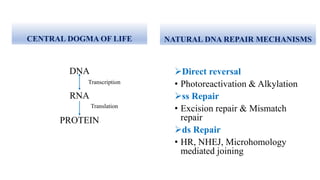
CENTRAL DOGMA OF LIFE
DNA
RNA
PROTEIN
NATURAL DNA REPAIR MECHANISMS
Direct reversal
• Photoreactivation & Alkylation
ss Repair
• Excision repair & Mismatch
repair
ds Repair
• HR, NHEJ, Microhomology
mediated joining
Transcription
Translation
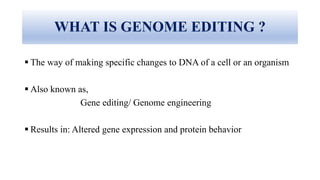
WHAT IS GENOME EDITING ?
 The way of making specific changes to DNA of a cell or an organism
 Also known as,
Gene editing/ Genome engineering
 Results in: Altered gene expression and protein behavior
KNOCKOUT KNOCKDOWN & KNOCKIN
GENE TARGETING
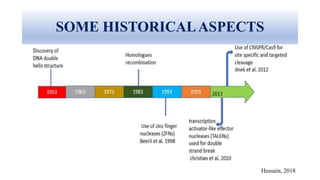
SOME HISTORICALASPECTS
Hussain, 2018
AVAILABLE TECHNIQUES
GENOME EDITING
TECHNIQUES
Conventional
genome
editing systems
Chemical
system
Protein based
nuclease
system
Homing
endonuclease
system
RNA-protein
based system
Techniques
in research
Conventional
homologous
recombination
ssODNs
homologous
recombination
Peptide NA
systems
Meganuclease
system
ZFN systems
TALEN systems
Adeno-
associated
virus (AAA)
systems
CRISPER
system
Type-1
CRISPER-Cas
Type-2
CRISPER-Cas
Type-3
CRISPER-Cas
ODN
techniques
Using novel
proteins
-Argonautes,
Integrases,
Recombinases
Synthetic
genomicsKhan, 2019
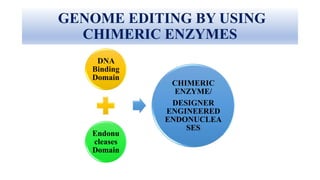
GENOME EDITING BY USING
CHIMERIC ENZYMES
DNA
Binding
Domain
Endonu
cleases
Domain
CHIMERIC
ENZYME/
DESIGNER
ENGINEERED
ENDONUCLEA
SES
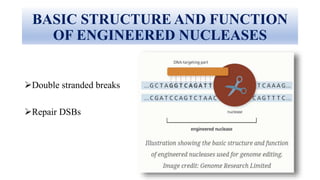
BASIC STRUCTURE AND FUNCTION
OF ENGINEERED NUCLEASES
Double stranded breaks
Repair DSBs
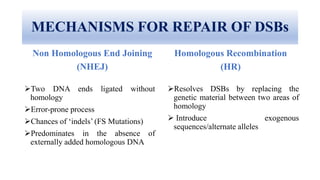
MECHANISMS FOR REPAIR OF DSBs
Non Homologous End Joining
(NHEJ)
Two DNA ends ligated without
homology
Error-prone process
Chances of ‘indels’ (FS Mutations)
Predominates in the absence of
externally added homologous DNA
Homologous Recombination
(HR)
Resolves DSBs by replacing the
genetic material between two areas of
homology
 Introduce exogenous
sequences/alternate alleles
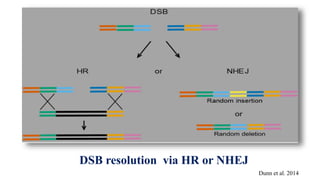
DSB resolution via HR or NHEJ
Dunn et al. 2014
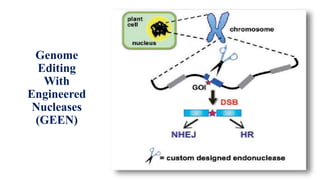
Genome
Editing
With
Engineered
Nucleases
(GEEN)
MEGANUCLEASES
Microbial
endodeoxyribonucleases with
long recognition sequences (20-
40bp)
Discovery: late 1980s
Most specific naturally
occurring restriction enzymes
Two main enzyme families
Eg; I-CreI, I-SceI
Meganucleases
Intron
endonucleases
Intein
endonucleases
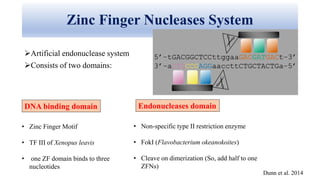
Zinc Finger Nucleases System
Artificial endonuclease system
Consists of two domains:
DNA binding domain Endonucleases domain
• Zinc Finger Motif
• TF III of Xenopus leavis
• one ZF domain binds to three
nucleotides
• Non-specific type II restriction enzyme
• FokI (Flavobacterium okeanokoites)
• Cleave on dimerization (So, add half to one
ZFNs)
Dunn et al. 2014
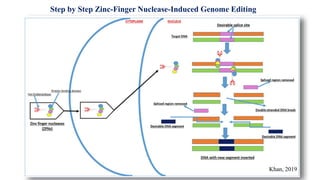
Step by Step Zinc-Finger Nuclease-Induced Genome Editing
Khan, 2019
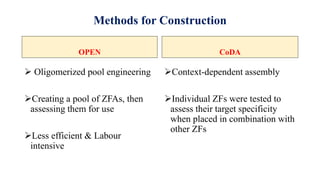
Methods for Construction
OPEN
 Oligomerized pool engineering
Creating a pool of ZFAs, then
assessing them for use
Less efficient & Labour
intensive
CoDA
Context-dependent assembly
Individual ZFs were tested to
assess their target specificity
when placed in combination with
other ZFs
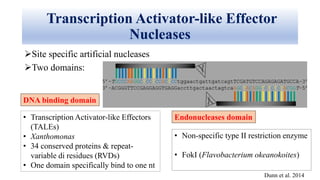
Transcription Activator-like Effector
Nucleases
Site specific artificial nucleases
Two domains:
DNA binding domain
Endonucleases domain• Transcription Activator-like Effectors
(TALEs)
• Xanthomonas
• 34 conserved proteins & repeat-
variable di residues (RVDs)
• One domain specifically bind to one nt
• Non-specific type II restriction enzyme
• FokI (Flavobacterium okeanokoites)
Dunn et al. 2014
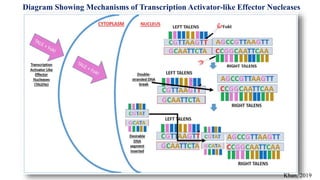
Diagram Showing Mechanisms of Transcription Activator-like Effector Nucleases
Khan, 2019
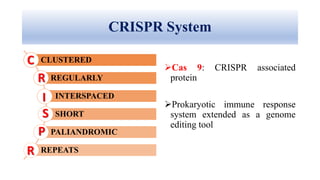
CRISPR System
CLUSTERED
REGULARLY
INTERSPACED
SHORT
PALIANDROMIC
REPEATS
Cas 9: CRISPR associated
protein
Prokaryotic immune response
system extended as a genome
editing tool
C
R
I
S
P
R
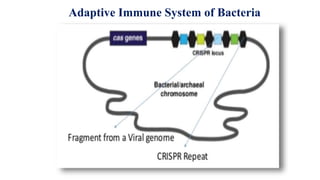
Adaptive Immune System of Bacteria
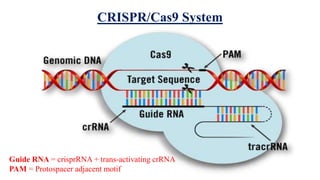
CRISPR/Cas9 System
Guide RNA = crisprRNA + trans-activating crRNA
PAM = Protospacer adjacent motif
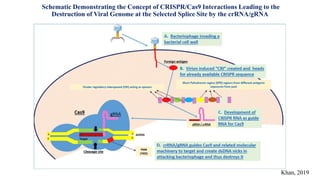
Schematic Demonstrating the Concept of CRISPR/Cas9 Interactions Leading to the
Destruction of Viral Genome at the Selected Splice Site by the crRNA/gRNA
Khan, 2019
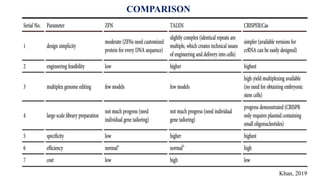
COMPARISON
Khan, 2019
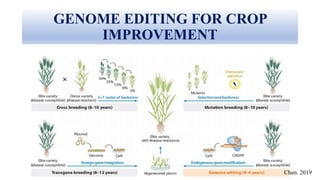
GENOME EDITING FOR CROP
IMPROVEMENT
Chen. 2019
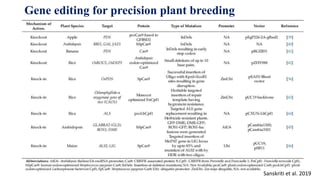
Gene editing for precision plant breeding
Sanskriti et al. 2019
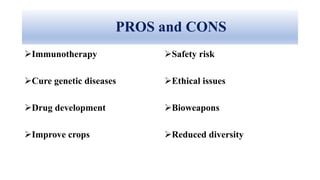
PROS and CONS
Safety risk
Ethical issues
Bioweapons
Reduced diversity
Immunotherapy
Cure genetic diseases
Drug development
Improve crops
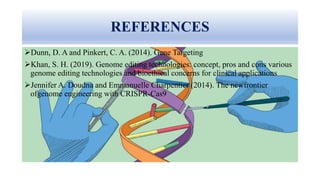
REFERENCES
Dunn, D. A and Pinkert, C. A. (2014). Gene Targeting
Khan, S. H. (2019). Genome editing technologies: concept, pros and cons various
genome editing technologies and bioethical concerns for clinical applications
Jennifer A. Doudna and Emmanuelle Charpentier (2014). The newfrontier
ofgenome engineering with CRISPR-Cas9
Genome editing

Genome editing

  • 1.
    GENOME EDITING Prepared by, ADITHYAP BALAKRISHNAN Reg. No: 04-AGRMA-01724-18 M. Sc. (Agri.) Dept. of Genetics and Plant Breeding C. P. C. A, S. D. A. U Submitted to, Dr. KAPIL TIWARI Assistant Professor Dept of GPB S. D. A. U
  • 2.
    CENTRAL DOGMA OFLIFE DNA RNA PROTEIN NATURAL DNA REPAIR MECHANISMS Direct reversal • Photoreactivation & Alkylation ss Repair • Excision repair & Mismatch repair ds Repair • HR, NHEJ, Microhomology mediated joining Transcription Translation
  • 3.
    WHAT IS GENOMEEDITING ?  The way of making specific changes to DNA of a cell or an organism  Also known as, Gene editing/ Genome engineering  Results in: Altered gene expression and protein behavior
  • 4.
    KNOCKOUT KNOCKDOWN &KNOCKIN GENE TARGETING
  • 5.
  • 6.
    AVAILABLE TECHNIQUES GENOME EDITING TECHNIQUES Conventional genome editingsystems Chemical system Protein based nuclease system Homing endonuclease system RNA-protein based system Techniques in research Conventional homologous recombination ssODNs homologous recombination Peptide NA systems Meganuclease system ZFN systems TALEN systems Adeno- associated virus (AAA) systems CRISPER system Type-1 CRISPER-Cas Type-2 CRISPER-Cas Type-3 CRISPER-Cas ODN techniques Using novel proteins -Argonautes, Integrases, Recombinases Synthetic genomicsKhan, 2019
  • 7.
    GENOME EDITING BYUSING CHIMERIC ENZYMES DNA Binding Domain Endonu cleases Domain CHIMERIC ENZYME/ DESIGNER ENGINEERED ENDONUCLEA SES
  • 8.
    BASIC STRUCTURE ANDFUNCTION OF ENGINEERED NUCLEASES Double stranded breaks Repair DSBs
  • 9.
    MECHANISMS FOR REPAIROF DSBs Non Homologous End Joining (NHEJ) Two DNA ends ligated without homology Error-prone process Chances of ‘indels’ (FS Mutations) Predominates in the absence of externally added homologous DNA Homologous Recombination (HR) Resolves DSBs by replacing the genetic material between two areas of homology  Introduce exogenous sequences/alternate alleles
  • 10.
    DSB resolution viaHR or NHEJ Dunn et al. 2014
  • 11.
  • 12.
    MEGANUCLEASES Microbial endodeoxyribonucleases with long recognitionsequences (20- 40bp) Discovery: late 1980s Most specific naturally occurring restriction enzymes Two main enzyme families Eg; I-CreI, I-SceI Meganucleases Intron endonucleases Intein endonucleases
  • 13.
    Zinc Finger NucleasesSystem Artificial endonuclease system Consists of two domains: DNA binding domain Endonucleases domain • Zinc Finger Motif • TF III of Xenopus leavis • one ZF domain binds to three nucleotides • Non-specific type II restriction enzyme • FokI (Flavobacterium okeanokoites) • Cleave on dimerization (So, add half to one ZFNs) Dunn et al. 2014
  • 14.
    Step by StepZinc-Finger Nuclease-Induced Genome Editing Khan, 2019
  • 15.
    Methods for Construction OPEN Oligomerized pool engineering Creating a pool of ZFAs, then assessing them for use Less efficient & Labour intensive CoDA Context-dependent assembly Individual ZFs were tested to assess their target specificity when placed in combination with other ZFs
  • 16.
    Transcription Activator-like Effector Nucleases Sitespecific artificial nucleases Two domains: DNA binding domain Endonucleases domain• Transcription Activator-like Effectors (TALEs) • Xanthomonas • 34 conserved proteins & repeat- variable di residues (RVDs) • One domain specifically bind to one nt • Non-specific type II restriction enzyme • FokI (Flavobacterium okeanokoites) Dunn et al. 2014
  • 17.
    Diagram Showing Mechanismsof Transcription Activator-like Effector Nucleases Khan, 2019
  • 18.
    CRISPR System CLUSTERED REGULARLY INTERSPACED SHORT PALIANDROMIC REPEATS Cas 9:CRISPR associated protein Prokaryotic immune response system extended as a genome editing tool C R I S P R
  • 19.
  • 20.
    CRISPR/Cas9 System Guide RNA= crisprRNA + trans-activating crRNA PAM = Protospacer adjacent motif
  • 21.
    Schematic Demonstrating theConcept of CRISPR/Cas9 Interactions Leading to the Destruction of Viral Genome at the Selected Splice Site by the crRNA/gRNA Khan, 2019
  • 22.
  • 23.
    GENOME EDITING FORCROP IMPROVEMENT Chen. 2019
  • 24.
    Gene editing forprecision plant breeding Sanskriti et al. 2019
  • 25.
    PROS and CONS Safetyrisk Ethical issues Bioweapons Reduced diversity Immunotherapy Cure genetic diseases Drug development Improve crops
  • 26.
    REFERENCES Dunn, D. Aand Pinkert, C. A. (2014). Gene Targeting Khan, S. H. (2019). Genome editing technologies: concept, pros and cons various genome editing technologies and bioethical concerns for clinical applications Jennifer A. Doudna and Emmanuelle Charpentier (2014). The newfrontier ofgenome engineering with CRISPR-Cas9