CONCRETE TECHNOLOGY
AND MASONRY
STRUCTURES
Mr. Nripesh Jha
Concrete
• Most widely used material for construction
• Consists of cement, water, Aggregates & admixtures
• Known as Green concrete in wet state
• Known as hardened concrete when gets matured
The subject which deals with the fundamental principle of concrete is
known as concrete technology.
Uses of concrete in structure
• Its simplicity
• Durability
• High strength
• Excellent resistance to water
• Molded in desired shape and size
• Cheapest and locally available materials
Types of concrete
1. Plain Cement Concrete (PCC)
Reinforcement is not provided
Strong in compression but weak in tension
PCC ( used in foundation)
Reinforced Cement Concrete (RCC)
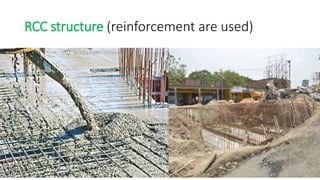
Reinforcement is provided
Bears both tensile and compressive force
Reinforced Cement Concrete has good
compressive stress (because of concrete).
RCC also has high tensile stress (because of steel).
It has good resistance to damage by fire and weathering
(because of concrete).
RCC protects steel bars from buckling and twisting at the
high temperature.
RCC prevents steel from rusting.
RCC structure (reinforcement are used)
• RCC
Pre-stressed cement concrete
Stresses are induced before its actual use
Bears high compressive and tensile strength
Long-term Durability
Pre-stressed concrete
Concrete materials
(aggregates, cement, water & admixtures)
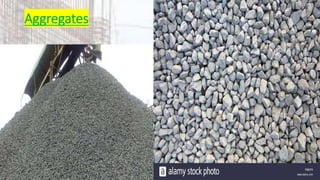
AGGREGATES
• Occupies 70 to 80% of volume of concrete
• Known as inert material (chemically inactive)
• Increases the density of concrete
• Increases the workability of concrete
• Should be of proper size, shape, hard, strong, durable
• Are called fillers or sometimes cheap fillers
Aggregates
Cement
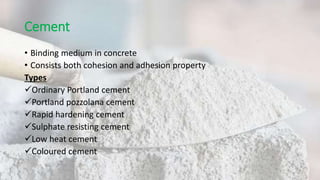
• Binding medium in concrete
• Consists both cohesion and adhesion property
Types
Ordinary Portland cement
Portland pozzolana cement
Rapid hardening cement
Sulphate resisting cement
Low heat cement
Coloured cement
Water
Water is required for
• Mixing of concrete
• Curing of concrete
• Washing aggregates
• Cement hydration
Minimum water cement ratio for concrete is 0.45
Admixtures
• Defined as a material, other than cement, water and aggregates which is
used as an concrete ingredient before or during mixing
Uses
1. To accelerate the initial set of concrete
2. To retard the initial set
3. To enhance the workability
4. To reduce the segregation
5. To increase the strength of concrete by reducing the water content
6. To increase the bond between new and old concrete surface
7. To produce non-skid wearing surface
Admixtures
Frequently used terms in concrete
segregation:-
Separating out of the ingredients of concrete mix so that the mix is
no longer in homogenous condition.
Occurs in two ways
oSeparating out of the coarser particles from the rest of the mix
oThe paste (cement slurry) separates from rest of mix
It depends upon handling, transportation and placing.
Dropping of concrete from height results in segregation.
Insufficient mix concrete with excess water.
Excess vibration i.e. vibration for long time results in segregation.
Segregation in concrete
Bleeding
Form of segregation in which some of water in mix tends to rise to surface of
freshly placed concrete.
Caused by
Inability of solid constituent of mix to hold all the mixing water when they
settle down during compaction
Due to poorly graded concrete, over compaction & high workability mix
As a result of bleeding the top layer of concrete placed may become too wet and
porous thus making the concrete un-durable.
Bleeding in concrete
Bleeding
Bleeding may be reduced by
 Proper proportioning, uniform and complete controlled compaction.
 Using of pozzolanic materials and air entrains agent.
Concrete as 3 phase system
1. Aggregate phase
Includes the aggregate particles of varying shape and size.
2. Binding medium phase
Consists of loose mass of hydrated cement and paste.
3. Transition phase
Represents interfacial region between the coarse aggregate particles and
hydrated cement paste.
Concrete mix
1. Nominal mix
Having fixed cement aggregate ratio
M20 = 1: 1.5: 3 ( for hydraulic structure piles & foundation)
M15 = 1:2:4 ( for RCC, beam, column, etc)
M10 = 1:3:6 ( for mass concrete work)
Concrete mix
2. Design mix
Defined as the process of selecting suitable ingredients for concrete
and determining their proportions, which would produce as
economically as possible
(Refer to IS codes and NBC codes for design mix)
Workability of concrete
• Workability of concrete describes the ease or difficulty with
which the concrete is handled, transported and placed
between the forms with minimum loss of homogenity.
Workability of concrete is important because
1. When the concrete mixture is too wet coarse
aggregate settle at the bottom concrete becomes
non-uniform composition.
2. When the concrete mixture is too dry difficult to
handle and place it in position.
Tests of workability of concrete
1. Slump test
2. Compacting factor test
3. Flow test
4. Vee Bee test
5. Kelly ball test
Shrinkage and creep in concrete
• shrinkage is the contraction in the concrete caused by
moisture loss from drying concrete.
Creep
• Deformation of structure under sustained load.
• Basically, long term pressure or stress on concrete can make
it change shape.
• This deformation usually occurs in the direction the force is
being applied. Like a concrete column getting more
compressed, or a beam bending.
• Creep does not necessarily cause concrete to fail or break
apart. When a load is applied to concrete, it experiences an
instantaneous elastic strain which develops into creep strain
if the load is sustained.
Various strength of concrete
• Tensile strength:- very weak due to its brittle nature.
Tensile strength is considered
Negligible in comparison to
Compressive strength.
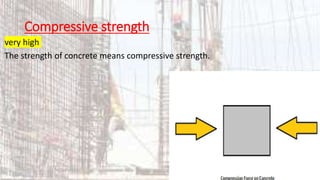
Compressive strength
very high
The strength of concrete means compressive strength.
Shear strength
• Occurs due to combination of tensile & compressive stress.
• Due to application of torsion.
Bond strength
• Defined as resistance to slip of the reinforcement bars which
are embedded in concrete.
• Occurs due to adhesion between concrete and steel.
Masonry
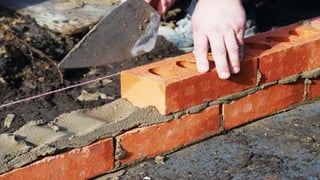
• Masonry is the building of structures from individual units,
which are often laid in and bound together by mortar.
• The term masonry can also refer to the units themselves.
Philadelphia City Hall: One of Our Favorite Masonry Buildings is Also the Tallest
Traditional Masonry Building in the World
The colosseum in Rome, Italy
The pyramids in Cairo, Egypt
Masonry unit
• Individual unit bonded to similar units with the help of
mortar and forms a masonry element such as wall, column,
piers etc.
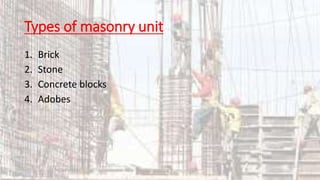
Types of masonry unit
1. Brick
2. Stone
3. Concrete blocks
4. Adobes
THANK YOU
NRIPESH JHA
Question and Answer

Concrete technology and masonry structures

  • 1.
  • 5.
    Concrete • Most widelyused material for construction • Consists of cement, water, Aggregates & admixtures • Known as Green concrete in wet state • Known as hardened concrete when gets matured The subject which deals with the fundamental principle of concrete is known as concrete technology.
  • 6.
    Uses of concretein structure • Its simplicity • Durability • High strength • Excellent resistance to water • Molded in desired shape and size • Cheapest and locally available materials
  • 7.
    Types of concrete 1.Plain Cement Concrete (PCC) Reinforcement is not provided Strong in compression but weak in tension
  • 8.
    PCC ( usedin foundation)
  • 10.
    Reinforced Cement Concrete(RCC) Reinforcement is provided Bears both tensile and compressive force Reinforced Cement Concrete has good compressive stress (because of concrete). RCC also has high tensile stress (because of steel). It has good resistance to damage by fire and weathering (because of concrete). RCC protects steel bars from buckling and twisting at the high temperature. RCC prevents steel from rusting.
  • 11.
  • 12.
  • 13.
    Pre-stressed cement concrete Stressesare induced before its actual use Bears high compressive and tensile strength Long-term Durability
  • 14.
  • 16.
    Concrete materials (aggregates, cement,water & admixtures) AGGREGATES • Occupies 70 to 80% of volume of concrete • Known as inert material (chemically inactive) • Increases the density of concrete • Increases the workability of concrete • Should be of proper size, shape, hard, strong, durable • Are called fillers or sometimes cheap fillers
  • 18.
  • 19.
    Cement • Binding mediumin concrete • Consists both cohesion and adhesion property Types Ordinary Portland cement Portland pozzolana cement Rapid hardening cement Sulphate resisting cement Low heat cement Coloured cement
  • 21.
    Water Water is requiredfor • Mixing of concrete • Curing of concrete • Washing aggregates • Cement hydration Minimum water cement ratio for concrete is 0.45
  • 22.
    Admixtures • Defined asa material, other than cement, water and aggregates which is used as an concrete ingredient before or during mixing Uses 1. To accelerate the initial set of concrete 2. To retard the initial set 3. To enhance the workability 4. To reduce the segregation 5. To increase the strength of concrete by reducing the water content 6. To increase the bond between new and old concrete surface 7. To produce non-skid wearing surface
  • 23.
  • 24.
    Frequently used termsin concrete segregation:- Separating out of the ingredients of concrete mix so that the mix is no longer in homogenous condition. Occurs in two ways oSeparating out of the coarser particles from the rest of the mix oThe paste (cement slurry) separates from rest of mix It depends upon handling, transportation and placing. Dropping of concrete from height results in segregation. Insufficient mix concrete with excess water. Excess vibration i.e. vibration for long time results in segregation.
  • 25.
  • 26.
    Bleeding Form of segregationin which some of water in mix tends to rise to surface of freshly placed concrete. Caused by Inability of solid constituent of mix to hold all the mixing water when they settle down during compaction Due to poorly graded concrete, over compaction & high workability mix As a result of bleeding the top layer of concrete placed may become too wet and porous thus making the concrete un-durable.
  • 27.
  • 28.
    Bleeding Bleeding may bereduced by  Proper proportioning, uniform and complete controlled compaction.  Using of pozzolanic materials and air entrains agent.
  • 30.
    Concrete as 3phase system 1. Aggregate phase Includes the aggregate particles of varying shape and size. 2. Binding medium phase Consists of loose mass of hydrated cement and paste. 3. Transition phase Represents interfacial region between the coarse aggregate particles and hydrated cement paste.
  • 31.
    Concrete mix 1. Nominalmix Having fixed cement aggregate ratio M20 = 1: 1.5: 3 ( for hydraulic structure piles & foundation) M15 = 1:2:4 ( for RCC, beam, column, etc) M10 = 1:3:6 ( for mass concrete work)
  • 32.
    Concrete mix 2. Designmix Defined as the process of selecting suitable ingredients for concrete and determining their proportions, which would produce as economically as possible (Refer to IS codes and NBC codes for design mix)
  • 33.
    Workability of concrete •Workability of concrete describes the ease or difficulty with which the concrete is handled, transported and placed between the forms with minimum loss of homogenity.
  • 34.
    Workability of concreteis important because 1. When the concrete mixture is too wet coarse aggregate settle at the bottom concrete becomes non-uniform composition. 2. When the concrete mixture is too dry difficult to handle and place it in position.
  • 35.
    Tests of workabilityof concrete 1. Slump test 2. Compacting factor test 3. Flow test 4. Vee Bee test 5. Kelly ball test
  • 43.
    Shrinkage and creepin concrete • shrinkage is the contraction in the concrete caused by moisture loss from drying concrete.
  • 46.
    Creep • Deformation ofstructure under sustained load. • Basically, long term pressure or stress on concrete can make it change shape. • This deformation usually occurs in the direction the force is being applied. Like a concrete column getting more compressed, or a beam bending. • Creep does not necessarily cause concrete to fail or break apart. When a load is applied to concrete, it experiences an instantaneous elastic strain which develops into creep strain if the load is sustained.
  • 49.
    Various strength ofconcrete • Tensile strength:- very weak due to its brittle nature. Tensile strength is considered Negligible in comparison to Compressive strength.
  • 50.
    Compressive strength very high Thestrength of concrete means compressive strength.
  • 51.
    Shear strength • Occursdue to combination of tensile & compressive stress. • Due to application of torsion. Bond strength • Defined as resistance to slip of the reinforcement bars which are embedded in concrete. • Occurs due to adhesion between concrete and steel.
  • 52.
    Masonry • Masonry isthe building of structures from individual units, which are often laid in and bound together by mortar. • The term masonry can also refer to the units themselves.
  • 54.
    Philadelphia City Hall:One of Our Favorite Masonry Buildings is Also the Tallest Traditional Masonry Building in the World
  • 56.
    The colosseum inRome, Italy
  • 58.
    The pyramids inCairo, Egypt
  • 59.
    Masonry unit • Individualunit bonded to similar units with the help of mortar and forms a masonry element such as wall, column, piers etc.
  • 60.
    Types of masonryunit 1. Brick 2. Stone 3. Concrete blocks 4. Adobes
  • 67.