Construction Materials
CE1100
Chapter 6:Early age properties of concrete
Meenakshi
Department of Civil Engineering
Meenakshi@ce.iith.ac.in
Office no – 303, Block B
1
Students
B. Tech 2nd Semester
4
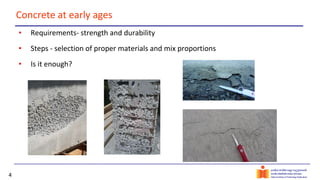
Concrete at earlyages
• Requirements- strength and durability
• Steps - selection of proper materials and mix proportions
• Is it enough?
5.
5
Concrete at earlyages
• Importance to operations at early age
• Early age – insignificant amount of time – 2 to 3 days mostly
• numerous operations are performed
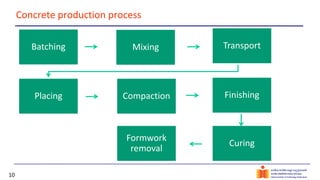
• Batching, mixing, transportation, placing, compaction, finishing and removal of form work
• Structural adequacy
• Characteristics of fresh concrete: workability, setting time, and maturity or rate of strength
gain
• Early-age operations
7
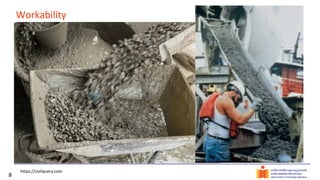
Workability
• ASTM C125
•Workability is property determining the effort required to manipulate a freshly mixed quantity
of concrete with minimum loss of homogeneity.
• Manipulate – placing, compacting, and finishing
• effort required to manipulate
• minimum loss of homogeneity
• Workability is a composite property
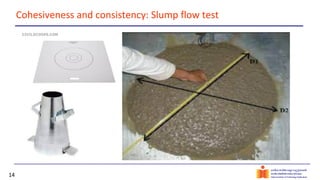
• Consistency - the ease of flow
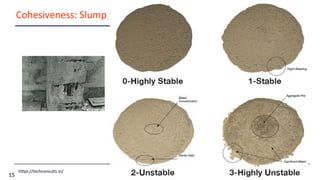
• Cohesiveness – stability or the tendency to bleed (opposite of water-holding capacity) or
segregate (opposite of coarse-aggregate-holding capacity)
https://civilquery.com
9
Workability
• Is notabsolute, it depends on
• Type of construction
• Massive construction without reinforcement
• Congested reinforced members
• Method of placement
• Pumps or chutes
• Method of compaction
• Vibrators or hand tamping
• Method of finishing
11
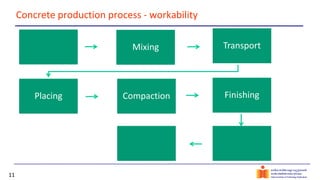
Concrete production process- workability
Batching Mixing Transport
Placing Finishing
Concrete
Curing
Compaction
Formwork
removal
12.
12
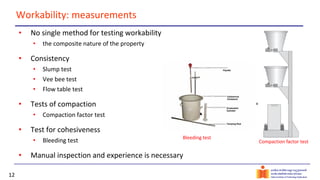
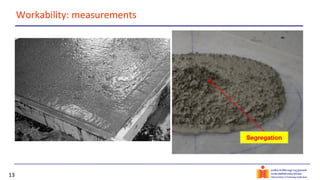
Workability: measurements
• Nosingle method for testing workability
• the composite nature of the property
• Consistency
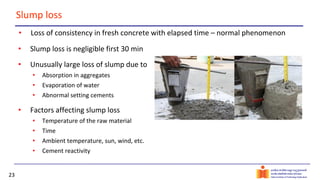
• Slump test
• Vee bee test
• Flow table test
• Tests of compaction
• Compaction factor test
• Test for cohesiveness
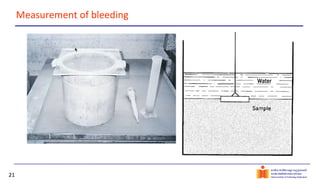
• Bleeding test
• Manual inspection and experience is necessary
Compaction factor test
Bleeding test
16
Segregation
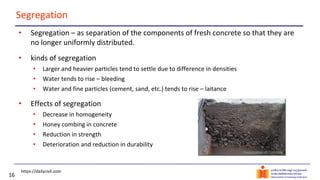
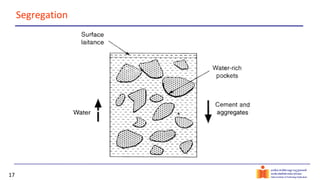
• Segregation –as separation of the components of fresh concrete so that they are
no longer uniformly distributed.
• kinds of segregation
• Larger and heavier particles tend to settle due to difference in densities
• Water tends to rise – bleeding
• Water and fine particles (cement, sand, etc.) tends to rise – laitance
• Effects of segregation
• Decrease in homogeneity
• Honey combing in concrete
• Reduction in strength
• Deterioration and reduction in durability
https://dailycivil.com
18
Causes of segregationin concrete
• Excessive water content in the mix.
• Use of high water-cement ratio
• Use of poor graded aggregates
• Low amount of fines in concrete
• Improper design of the mix
• Improper placement practices
• Poor compaction of concrete
• Over vibration of concrete
19.
19
Bleeding
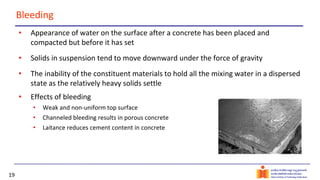
• Appearance ofwater on the surface after a concrete has been placed and
compacted but before it has set
• Solids in suspension tend to move downward under the force of gravity
• The inability of the constituent materials to hold all the mixing water in a dispersed
state as the relatively heavy solids settle
• Effects of bleeding
• Weak and non-uniform top surface
• Channeled bleeding results in porous concrete
• Laitance reduces cement content in concrete
20.
20
Bleeding
• Control ofbleeding
• Increase in fineness of cement and fine particles
• Reducing water content
• Increase in C3A, CaCl2 and alkali content
• Use of pozzolana
• Air entrainment
22
Factors affecting workability
•Consistency & cohesiveness - oppositely influenced by changing a particular variable.
• Water content
• High water content – more consistency – may segregate and bleed
• Cement content
• Very low cement content leads to harsh mixes
• very high proportion of cement or a very fine cement – excellent cohesiveness but sticky
• Aggregate characteristics
• Fine sand and angular aggregates reduce workability. Poor grading leads to segregation
• Admixtures
• Entrained air increases the paste volume and improves the consistency
• Pozzolanic admixtures
23.
23
Slump loss
• Lossof consistency in fresh concrete with elapsed time – normal phenomenon
• Slump loss is negligible first 30 min
• Unusually large loss of slump due to
• Absorption in aggregates
• Evaporation of water
• Abnormal setting cements
• Factors affecting slump loss
• Temperature of the raw material
• Time
• Ambient temperature, sun, wind, etc.
• Cement reactivity
24.
24
Setting
• Reactions betweencement and water – primary cause of setting of concrete
• Setting of cement doesn’t coincide with setting of concrete
• Stiffening, setting, and hardening are physical manifestations of the progressive
hydration reaction of cement
• setting of concrete – the onset of solidification in a fresh concrete mixture
• The initial set
• the time at which fresh concrete can no longer be properly mixed, placed, and compacted
• Point at which the stiffening starts
• The final set
• the time after which strength begins to develop at a significant rate
• Point at which the structure is fully rigid
25.
25
Setting
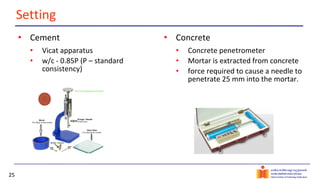
• Cement
• Vicatapparatus
• w/c - 0.85P (P – standard
consistency)
• Concrete
• Concrete penetrometer
• Mortar is extracted from concrete
• force required to cause a needle to
penetrate 25 mm into the mortar.
26.
26
Factor affecting settingtime
• Cement composition
• quick setting, false setting, or flash setting
• water/cement ratio
• filling of void space
• Temperature
• Temperature influences rate of hydration
• Admixtures
• Accelerate or retard
27.
27
Volume changes inconcrete
• Concrete changes slightly in volume
• Volume change – an increase or decrease
in volume due to temperature and
moisture cycles, chemical factors, etc.
• Volume changes may or may not lead to
cracking
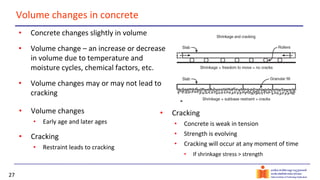
• Volume changes
• Early age and later ages
• Cracking
• Restraint leads to cracking
• Cracking
• Concrete is weak in tension
• Strength is evolving
• Cracking will occur at any moment of time
• If shrinkage stress > strength
29
Early age crackingin concrete
• Cement paste is not stable – it can shrink and expand and can lead to cracking
• Early age – cracking is easily possible due to lower strength
• Reasons
• Rapid evaporation of bleed water before setting
• Chemical shrinkage
• High thermal gradients
• Autogenous shrinkage
• Drying of concrete
• Early removal of formwork
• Improper compaction
30.
30
Early age cracking
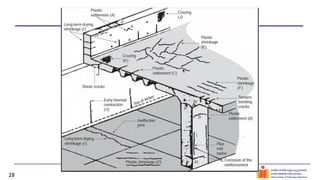
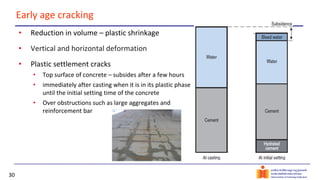
•Reduction in volume – plastic shrinkage
• Vertical and horizontal deformation
• Plastic settlement cracks
• Top surface of concrete – subsides after a few hours
• immediately after casting when it is in its plastic phase
until the initial setting time of the concrete
• Over obstructions such as large aggregates and
reinforcement bar
31.
31
Early age cracking
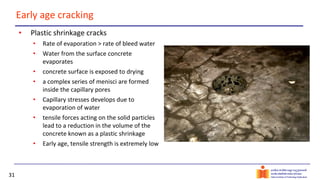
•Plastic shrinkage cracks
• Rate of evaporation > rate of bleed water
• Water from the surface concrete
evaporates
• concrete surface is exposed to drying
• a complex series of menisci are formed
inside the capillary pores
• Capillary stresses develops due to
evaporation of water
• tensile forces acting on the solid particles
lead to a reduction in the volume of the
concrete known as a plastic shrinkage
• Early age, tensile strength is extremely low
32.
32
Prevention of plasticshrinkage
• Minimize evaporation of water
• Fogging
• Wind breaks
• Shading
• Plastic sheet covers
• Wet burlap
• Spray on finishing aids
• Moisten the subgrade and form
• Moisten aggregates that are dry and absorptive
• Keep the fresh concrete temperature low by cooling the aggregate and mixing
water.
35
Chemical and autogenousshrinkage
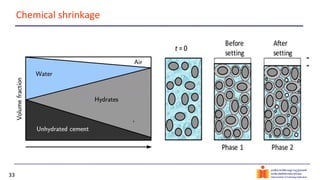
• Chemical shrinkage
• Volume change during the hydration resulted by formation of hydration products with lower
volume in comparison with the volume of the initial reactants (water and cement) during the
hardening process
• Driving force for autogenous shrinkage
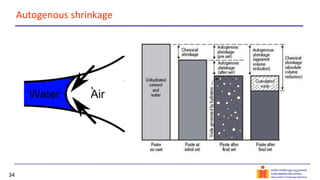
• autogenous shrinkage
• Macroscopic volume reduction of cementitious materials when cement hydrates after initial
setting.
• It does not include volume change due to loss or ingress of substances, temperature variation,
and application of an external force and restraint.
36.
36
Autogenous shrinkage
• Concretewith low w/c ratio
• Concrete with high binder content
• Concrete with silica fume
• Concrete with finely ground slag
• High strength concrete is more susceptible to autogenous shrinkage
37.
37
Drying shrinkage
• Concreteshrinks on the removal of water
• Also happens in mature concrete
• Drying shrinkage is due to loss of water from fine capillaries
• causes an increase in tensile stress, which may lead to cracking
38.
38
Thermal shrinkage
• solidsexpand on heating and contract on cooling.
• The strain associated with change in temperature will depend on the
• coefficient of thermal expansion and the magnitude of temperature drop or rise.
• In massive structures
• High heat is produced by cement hydration
• Relatively poor heat dissipation conditions due to large structures
• results in a large rise in concrete temperature within a few days after placement
• Subsequently, cooling to the ambient temperature often causes the concrete to crack