Creep Deformation in Materials
Academic Resource Center
Agenda
• Define creep and discuss its importance in
materials engineering.
• Identify the primary mechanisms of creep
deformation.
• Creep model parameters.
• Detail experimental ways to determine creep.
• Discuss design options to minimize creep
deformation.
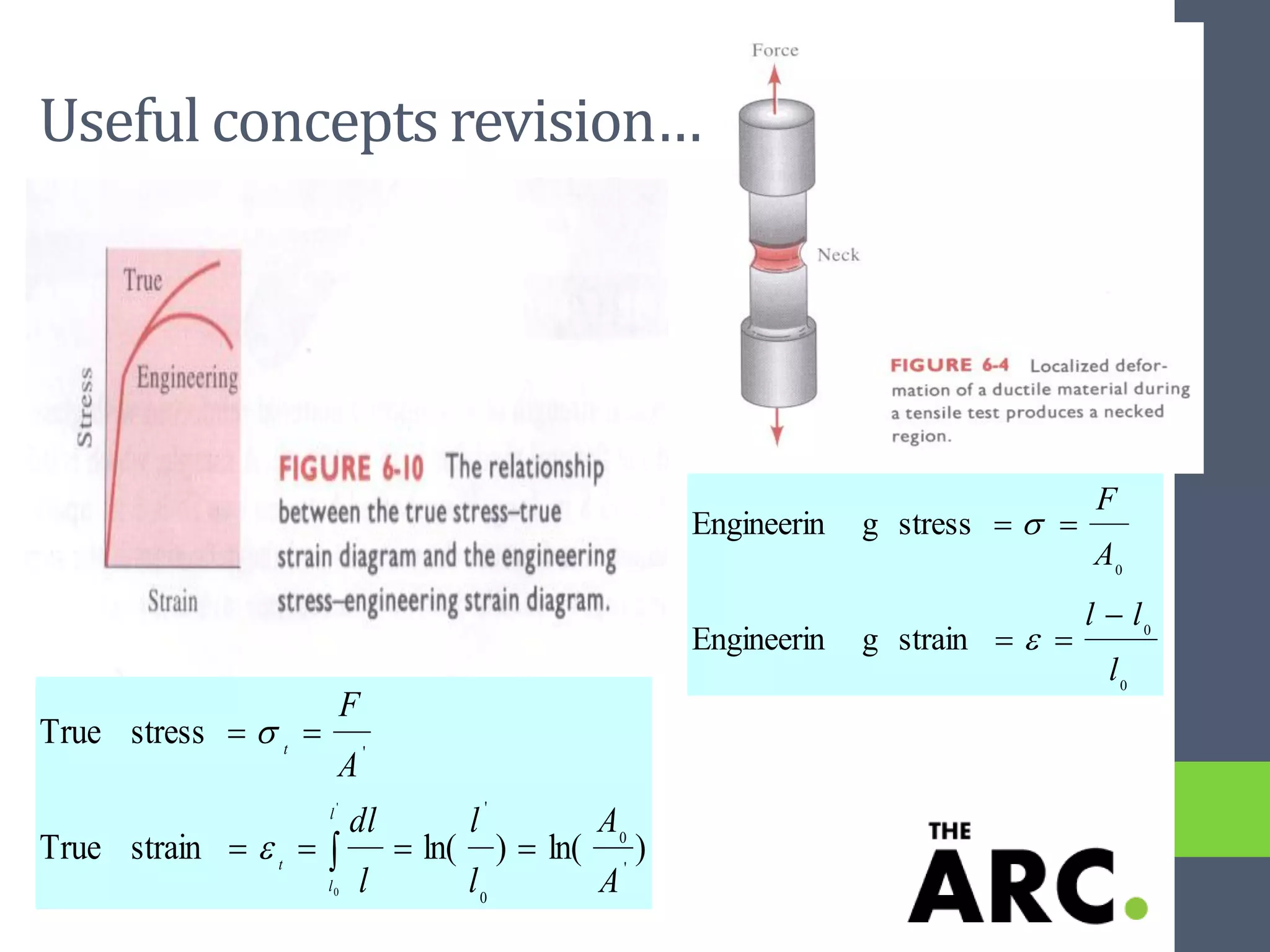
Useful concepts revision…
0
0
0
strain
g
Engineerin
stress
g
Engineerin
l
l
l
A
F







)
ln(
)
ln(
strain
True
stress
True
'
0
0
'
'
'
0 A
A
l
l
l
dl
A
F
l
l
t
t









Creep
• It is a time- dependent deformation under a
certain applied load.
• Generally occurs at high temperature
(thermal creep), but can also happen at room
temperature in certain materials (e.g. lead or
glass), albeit much slower.
• As a result, the material undergoes a time
dependent increase in length, which could be
dangerous while in service.
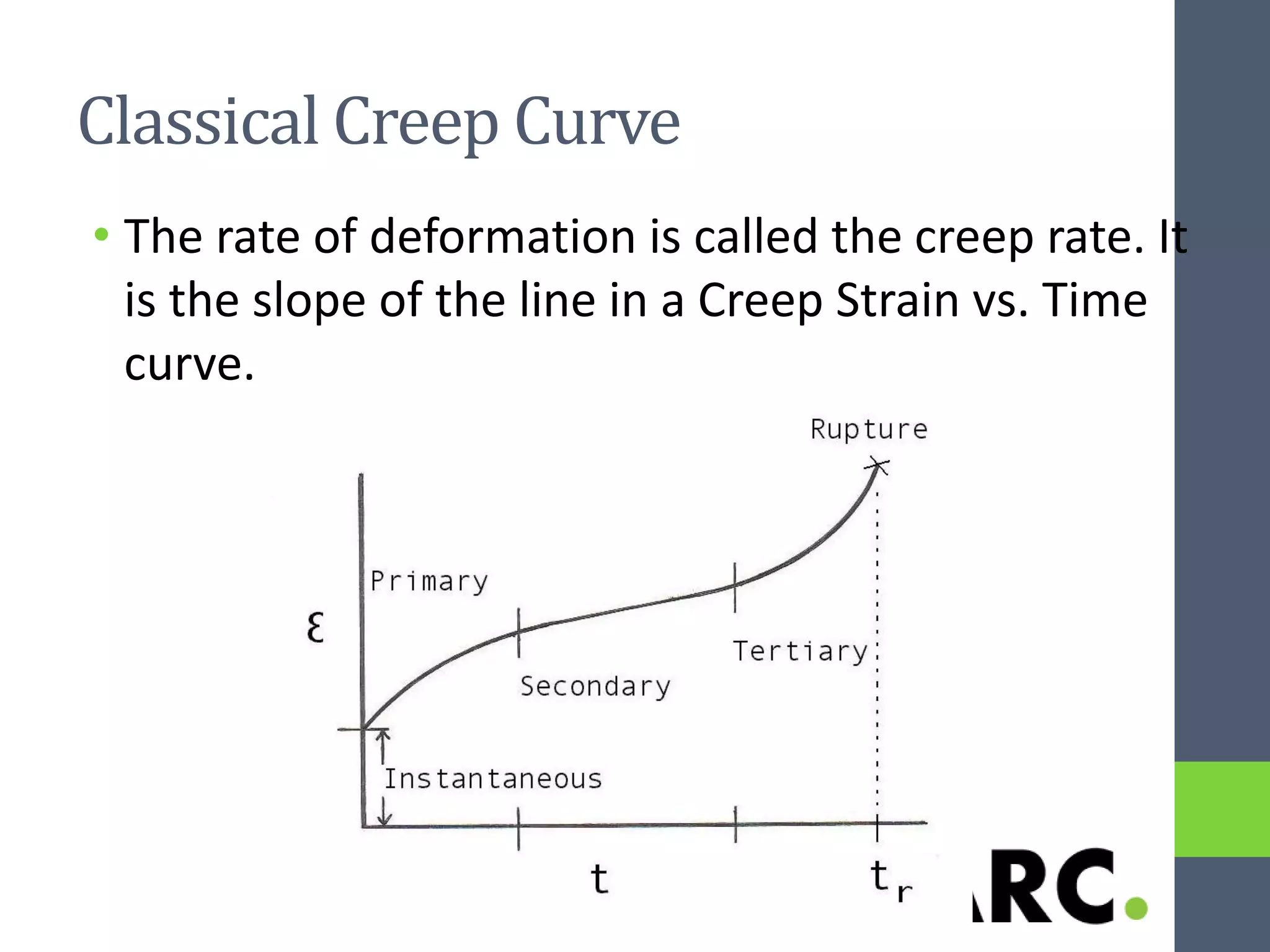
Classical Creep Curve
• The rate of deformation is called the creep rate. It
is the slope of the line in a Creep Strain vs. Time
curve.
Creep Stages
• Primary Creep: starts at a rapid rate and slows with time.
• Secondary Creep: has a relatively uniform rate.
• Tertiary Creep: has an accelerated creep rate and terminates
when the material breaks or ruptures. It is associated with
both necking and formation of grain boundary voids.
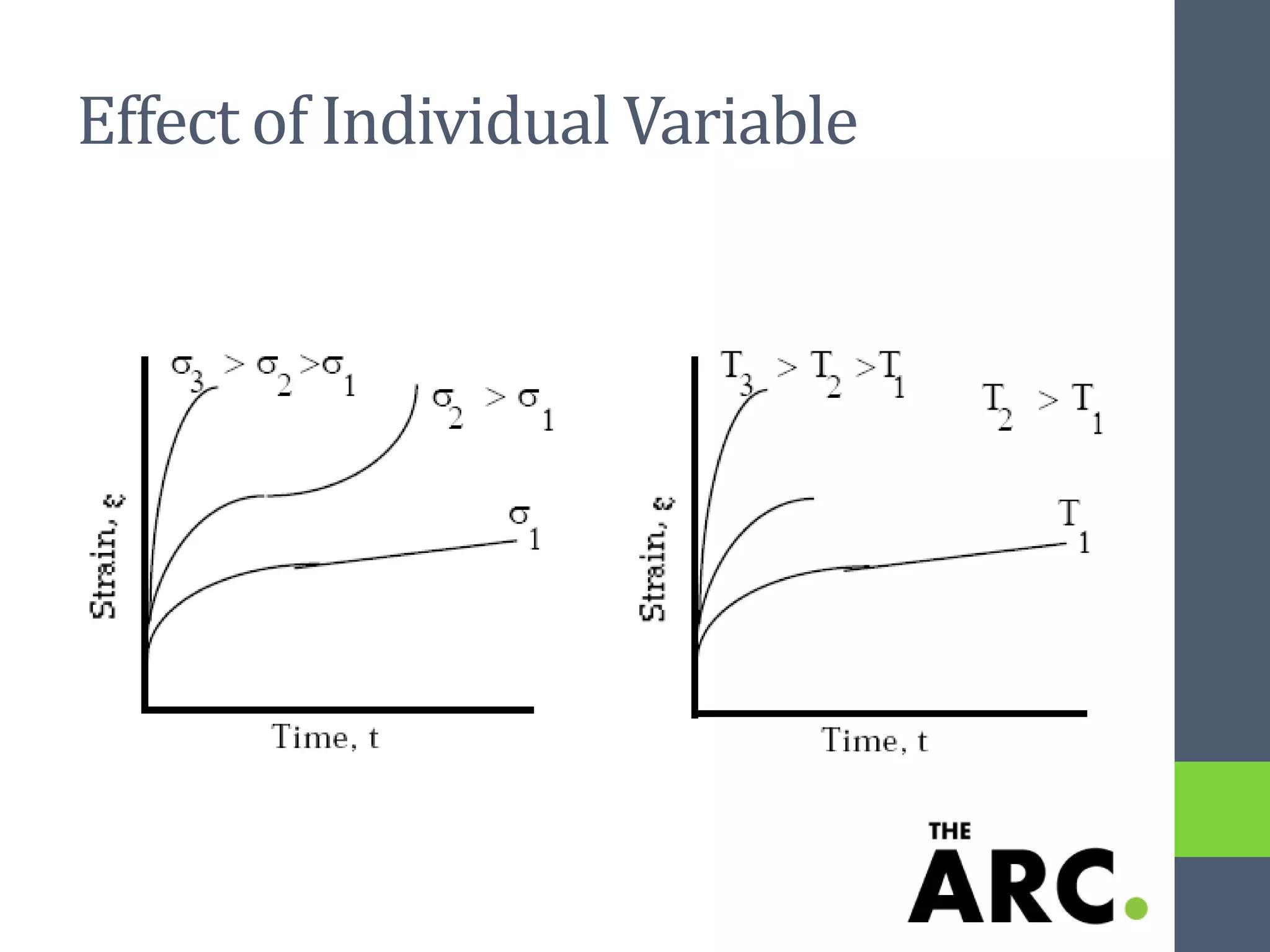
Effect of Temperature & Stress
Effect of Individual Variable
Characteristics of Creep
• Creep in service is usually affected by
changing conditions of loading and
temperature
• The number of possible stress-temperature-
time combinations is infinite.
• The creep mechanisms is often different
between metals, plastics, rubber, concrete.
Creep Mechanisms
• Bulk Diffusion (Nabarro-Herring creep)
• Creep rate decreases as grain size increases
• Grain Boundary Diffusion (Coble creep)
• Stronger grain size dependence than Nabarro Herring
• Dislocation climb/creep
• Controlled by movement of dislocations, strong dependence on applied
stress.
• Thermally activated glide
• Occurs in polymers and other viscoelastic materials
Creep Test
• Measures dimensional changes accurately at
constant high temperature and constant load or
stress.
• Useful for modeling long term applications which
are strain limited.
• Provides prediction of life expectancy before
service. This is important for example turbine
blades.
Creep Test cont’d
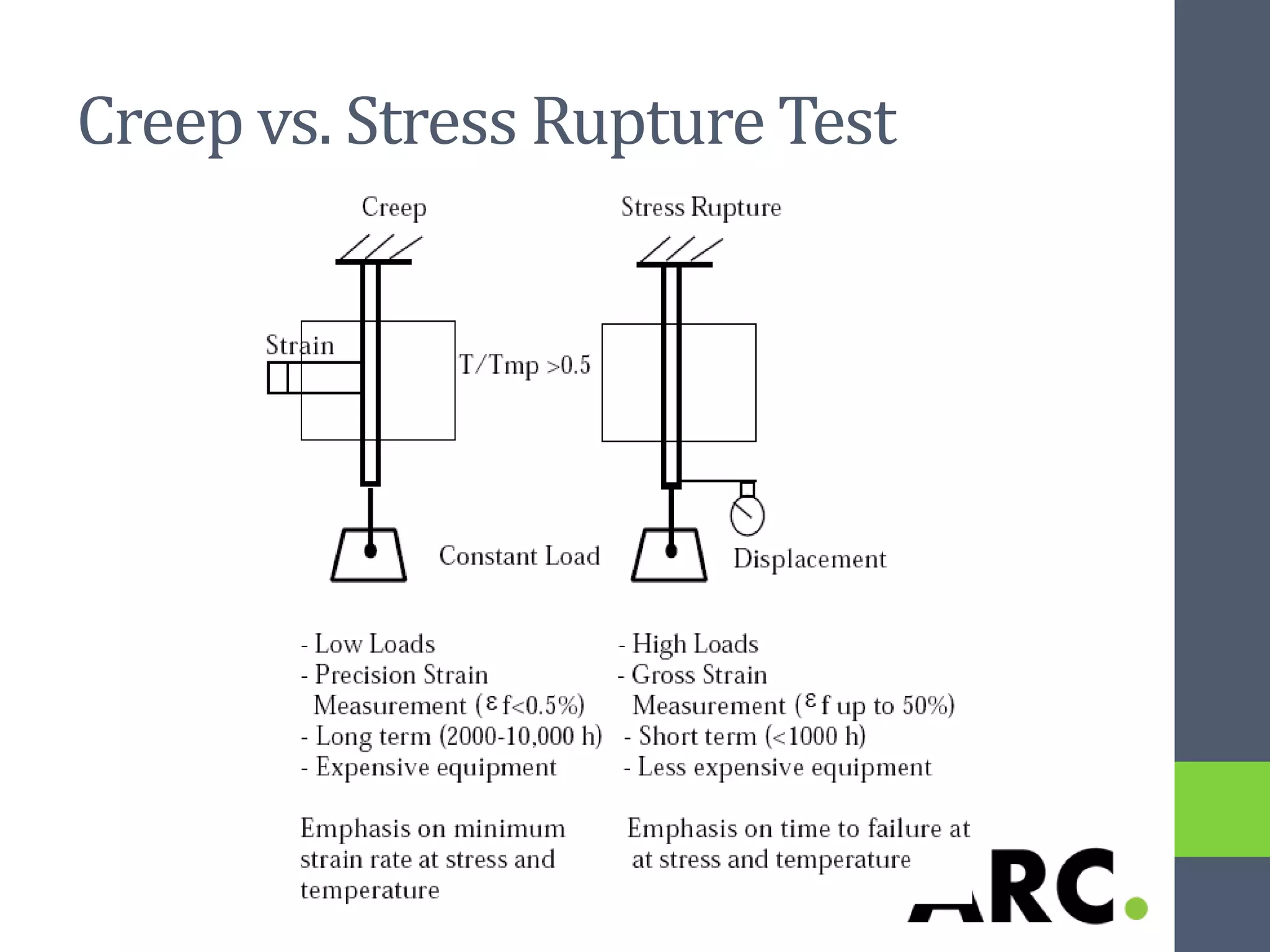
• Measures strain vs. time at constant T and
Load (Similar to graph seen previously).
• Relatively low loads and creep rate
• Long duration 2000 to 10,000 hours.
• Not always fracture.
• Strain typically less than 0.5%.
Creep Test cont’d
• Creep generally occurs at elevated
temperatures, so it is common for this type of
testing to be performed with an
environmental chamber for precise
heating/cooling control.
• Temperature control is critical to minimize
the effects of thermal expansion on the
sample.
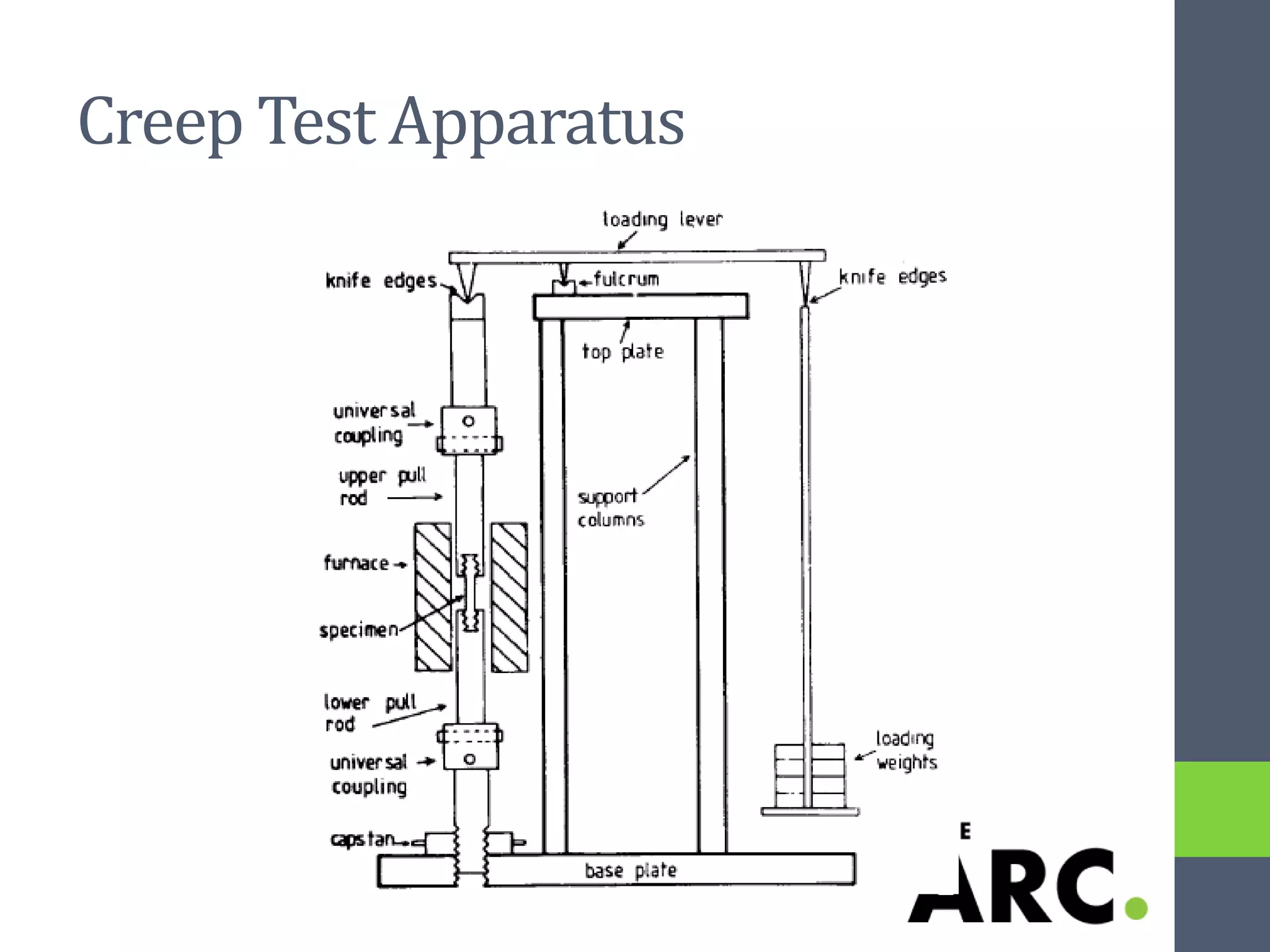
Creep Test: General Procedure
• The unloaded specimen is first heated to the
required T and the gage length is measured.
• The predetermined load is applied quickly
without shock.
• Measurement of the extension are observed
at frequent interval.
• Average of about 50 readings should be
taken.
Creep Test Apparatus
Creep Parameters
• To predict the stress and time for long lives
on the basis of much shorter data.
• Plant life 30 to 40 years
• Creep data is usually not available beyond
lives of more than 30000 hrs.
• Larson Miller Parameter and other material
specific models are used.
Larson Miller Parameter
• Model based on Arrhenius rate equation.
LMP= T(C+log tr)
Where T = temperature (K or ºR)
tr = time before failure (hours)
C= material specific constant
• Predicts rupture lives given certain temperature
and stress.
• First used by General Electric in the 50’s to
perform research on turbine blades.
Stress Rupture Tests
• Determines the time necessary for material to
result in failure under a overload.
• Useful in materials selection where dimensional
tolerances are acceptable, but rupture cannot be
tolerated.
• Generally performed at elevated temperatures.
• Smooth, notched, flat specimens or samples of
any combination can be tested.
Creep vs. Stress Rupture Test
Design Considerations to avoid
Creep
• Reduce the effect of grain boundaries:
• Use single crystal material with large grains.
• Addition of solid solutions to eliminate vacancies.
• Employ materials of high melting
temperatures.
• Consult Creep Test Data during materials
Selection
• Type of service application
• Set adequate inspection intervals according to life
expectancy.
References
• Abbaschian, Reed-Hill. “Physical Metallurgy
Principles”. 4th edition. 2009
• Dowling, Norman E. Mechanical Behavior of
Materials.3rd edition. 2007
• “Larson Miller Parameter”
http://www.twi.co.uk/technical-
knowledge/faqs/material-faqs/faq-what-is-the-
larson-miller-parameter/

Materials creep

  • 1.
    Creep Deformation inMaterials Academic Resource Center
  • 2.
    Agenda • Define creepand discuss its importance in materials engineering. • Identify the primary mechanisms of creep deformation. • Creep model parameters. • Detail experimental ways to determine creep. • Discuss design options to minimize creep deformation.
  • 3.
  • 4.
    Creep • It isa time- dependent deformation under a certain applied load. • Generally occurs at high temperature (thermal creep), but can also happen at room temperature in certain materials (e.g. lead or glass), albeit much slower. • As a result, the material undergoes a time dependent increase in length, which could be dangerous while in service.
  • 5.
    Classical Creep Curve •The rate of deformation is called the creep rate. It is the slope of the line in a Creep Strain vs. Time curve.
  • 6.
    Creep Stages • PrimaryCreep: starts at a rapid rate and slows with time. • Secondary Creep: has a relatively uniform rate. • Tertiary Creep: has an accelerated creep rate and terminates when the material breaks or ruptures. It is associated with both necking and formation of grain boundary voids.
  • 7.
  • 8.
  • 9.
    Characteristics of Creep •Creep in service is usually affected by changing conditions of loading and temperature • The number of possible stress-temperature- time combinations is infinite. • The creep mechanisms is often different between metals, plastics, rubber, concrete.
  • 10.
    Creep Mechanisms • BulkDiffusion (Nabarro-Herring creep) • Creep rate decreases as grain size increases • Grain Boundary Diffusion (Coble creep) • Stronger grain size dependence than Nabarro Herring • Dislocation climb/creep • Controlled by movement of dislocations, strong dependence on applied stress. • Thermally activated glide • Occurs in polymers and other viscoelastic materials
  • 11.
    Creep Test • Measuresdimensional changes accurately at constant high temperature and constant load or stress. • Useful for modeling long term applications which are strain limited. • Provides prediction of life expectancy before service. This is important for example turbine blades.
  • 12.
    Creep Test cont’d •Measures strain vs. time at constant T and Load (Similar to graph seen previously). • Relatively low loads and creep rate • Long duration 2000 to 10,000 hours. • Not always fracture. • Strain typically less than 0.5%.
  • 13.
    Creep Test cont’d •Creep generally occurs at elevated temperatures, so it is common for this type of testing to be performed with an environmental chamber for precise heating/cooling control. • Temperature control is critical to minimize the effects of thermal expansion on the sample.
  • 14.
    Creep Test: GeneralProcedure • The unloaded specimen is first heated to the required T and the gage length is measured. • The predetermined load is applied quickly without shock. • Measurement of the extension are observed at frequent interval. • Average of about 50 readings should be taken.
  • 15.
  • 16.
    Creep Parameters • Topredict the stress and time for long lives on the basis of much shorter data. • Plant life 30 to 40 years • Creep data is usually not available beyond lives of more than 30000 hrs. • Larson Miller Parameter and other material specific models are used.
  • 17.
    Larson Miller Parameter •Model based on Arrhenius rate equation. LMP= T(C+log tr) Where T = temperature (K or ºR) tr = time before failure (hours) C= material specific constant • Predicts rupture lives given certain temperature and stress. • First used by General Electric in the 50’s to perform research on turbine blades.
  • 18.
    Stress Rupture Tests •Determines the time necessary for material to result in failure under a overload. • Useful in materials selection where dimensional tolerances are acceptable, but rupture cannot be tolerated. • Generally performed at elevated temperatures. • Smooth, notched, flat specimens or samples of any combination can be tested.
  • 19.
    Creep vs. StressRupture Test
  • 20.
    Design Considerations toavoid Creep • Reduce the effect of grain boundaries: • Use single crystal material with large grains. • Addition of solid solutions to eliminate vacancies. • Employ materials of high melting temperatures. • Consult Creep Test Data during materials Selection • Type of service application • Set adequate inspection intervals according to life expectancy.
  • 21.
    References • Abbaschian, Reed-Hill.“Physical Metallurgy Principles”. 4th edition. 2009 • Dowling, Norman E. Mechanical Behavior of Materials.3rd edition. 2007 • “Larson Miller Parameter” http://www.twi.co.uk/technical- knowledge/faqs/material-faqs/faq-what-is-the- larson-miller-parameter/