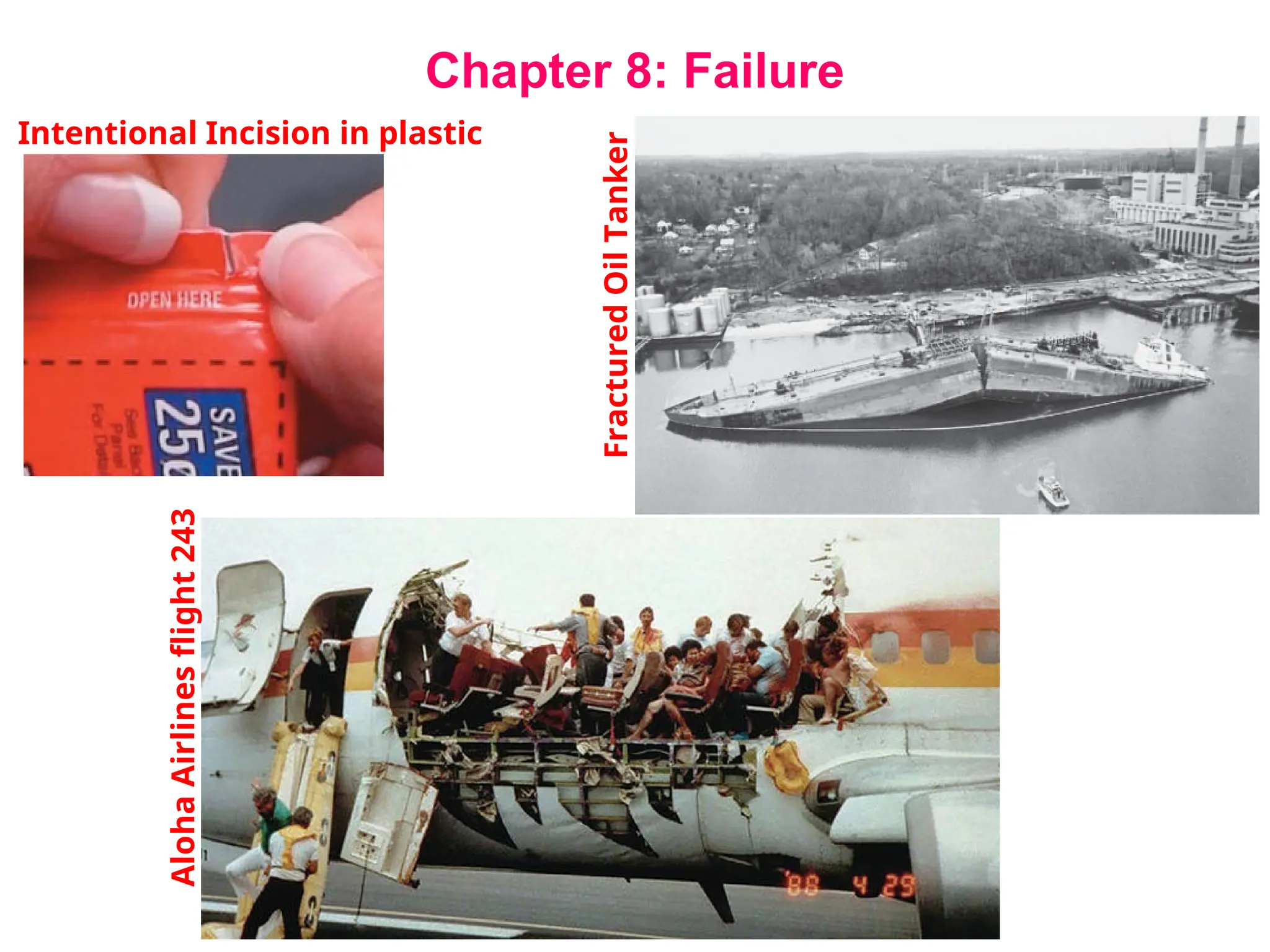
Chapter 8: Failure
Aloha
Airlines
flight
243
Fractured
Oil
Tanker
Intentional Incision in plastic
Concept Check 8.1
Cite two situations in which the possibility of failure is part of
the design of a component or product.
Answer: Several situations in which the possibility of failure is
part of the design of a component or product are as follows:
1.The pull tab on the top of aluminum beverage cans
2.Aluminum utility/light poles that reside along freeways—a
minimum of damage occurs to a vehicle when it collides with
the pole.
3.In some machinery components, a shear pin is used to
connect a gear or pulley to a shaft—the pin is designed shear
off before damage is done to either the shaft or gear in an
overload situation
Topics to be covered
Simple fracture
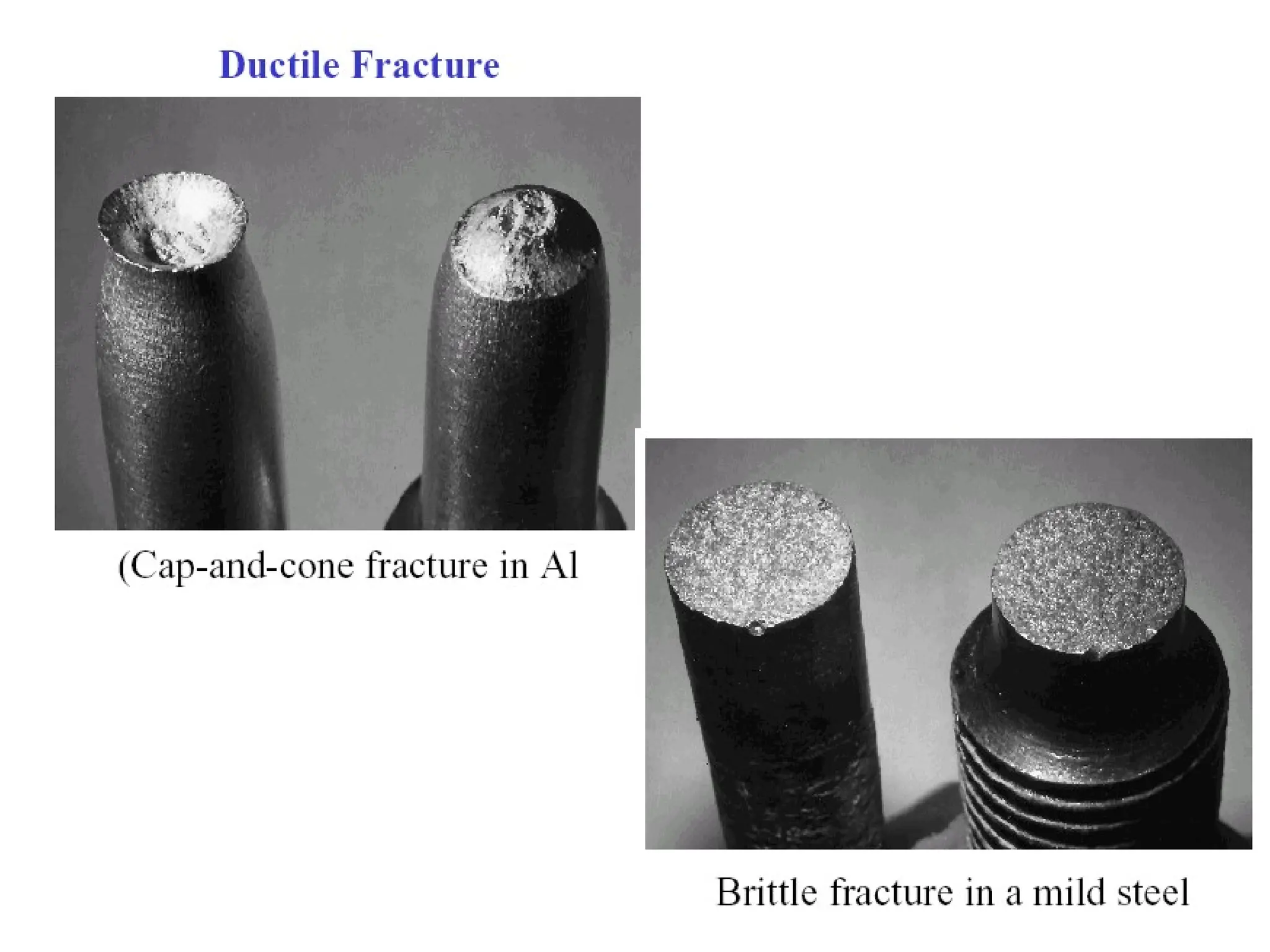
– Ductile
– Brittle
Fundamentals of fracture mechanics
Fracture toughness testing
Ductile-to-brittle transition
Fatigue (when cyclic stresses are imposed)
Creep (time-dependent deformation, normally at elevated temperatures)
Chapter 8: Failure
Cavities, Cracks, Voids, Notches, Surface Scratches, Corners
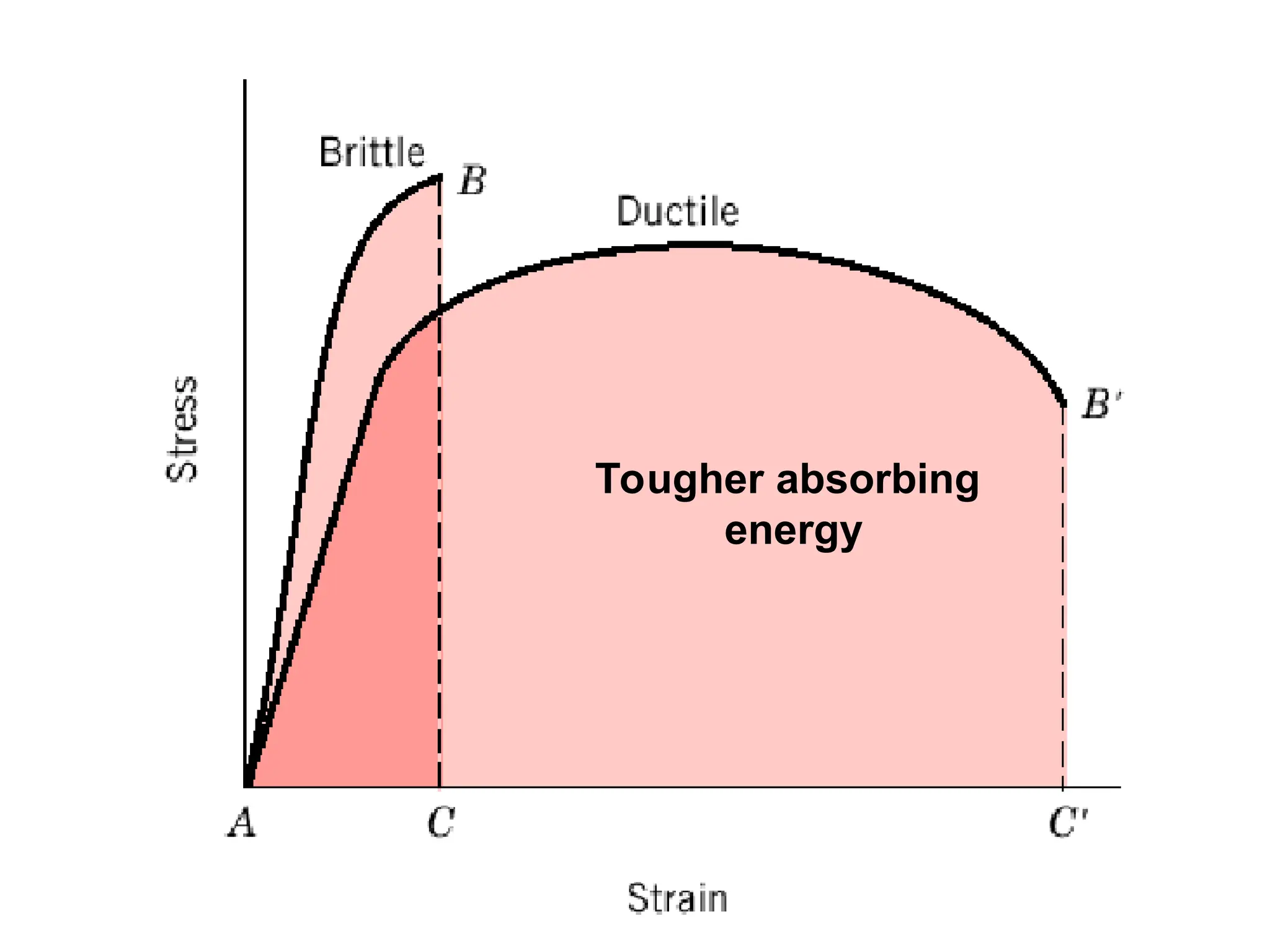
Tougher absorbing
energy
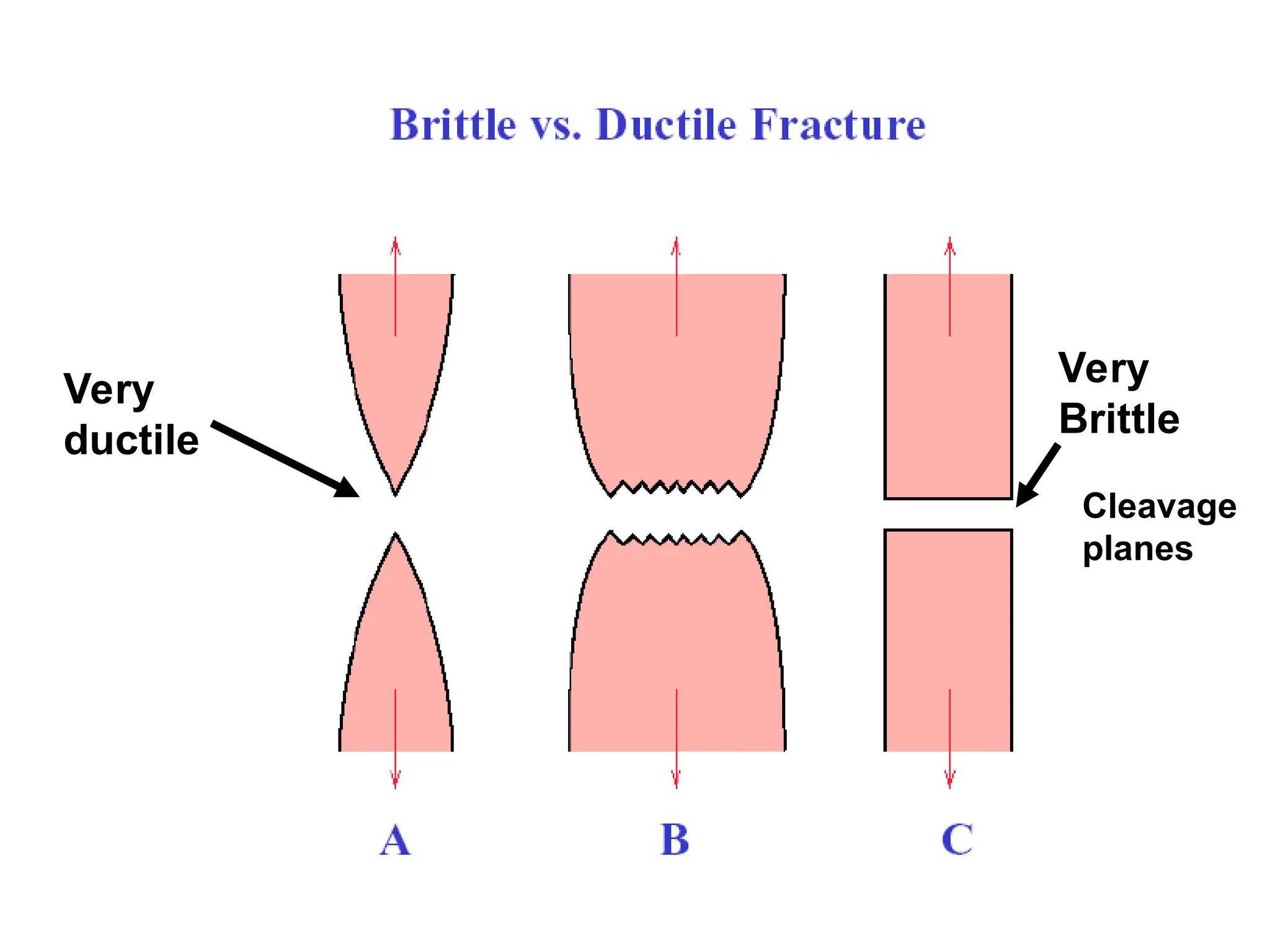
Very
ductile
Very
Brittle
Cleavage
planes
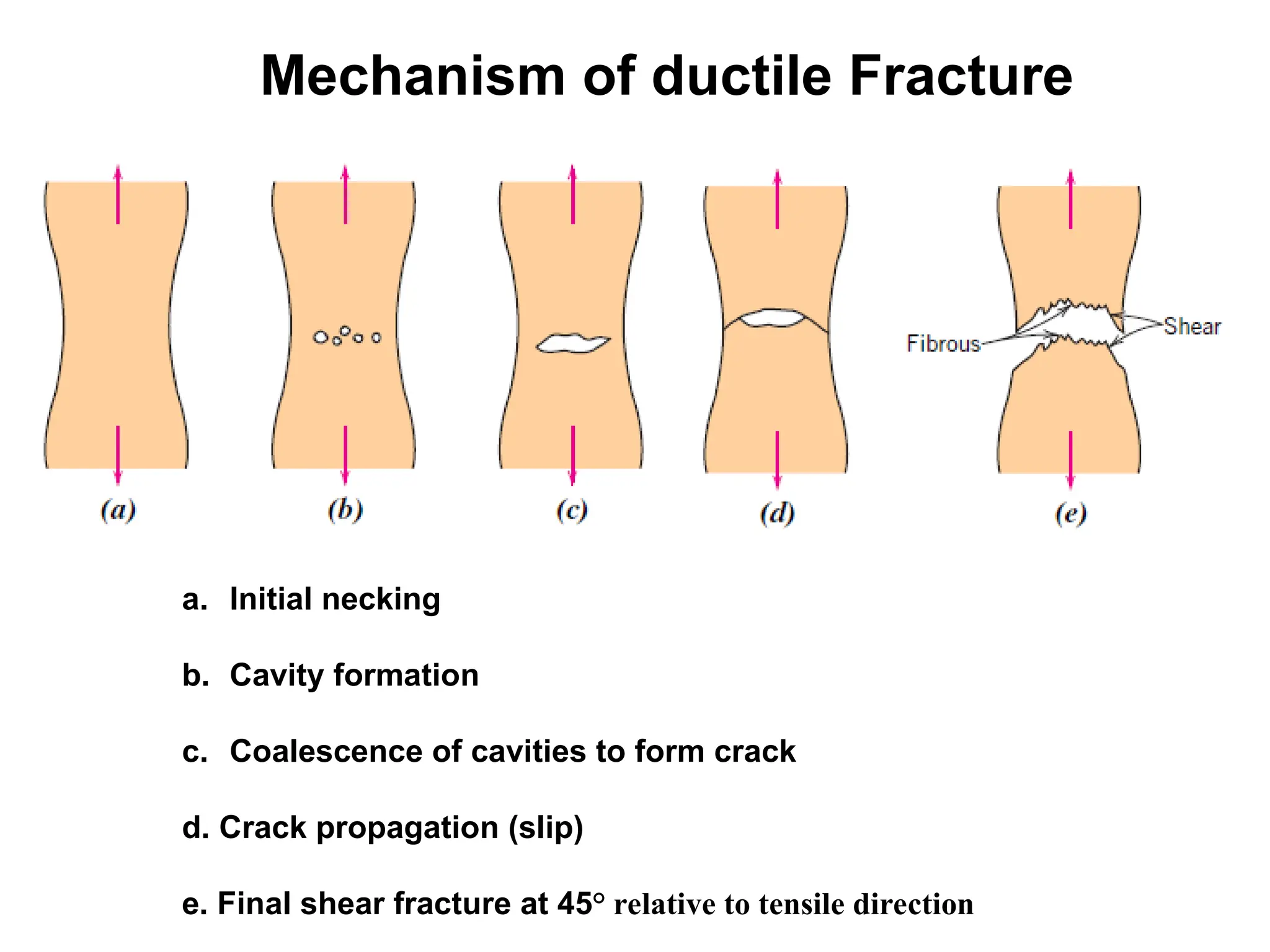
a. Initial necking
b. Cavity formation
c. Coalescence of cavities to form crack
d. Crack propagation (slip)
e. Final shear fracture at 45° relative to tensile direction
Mechanism of ductile Fracture
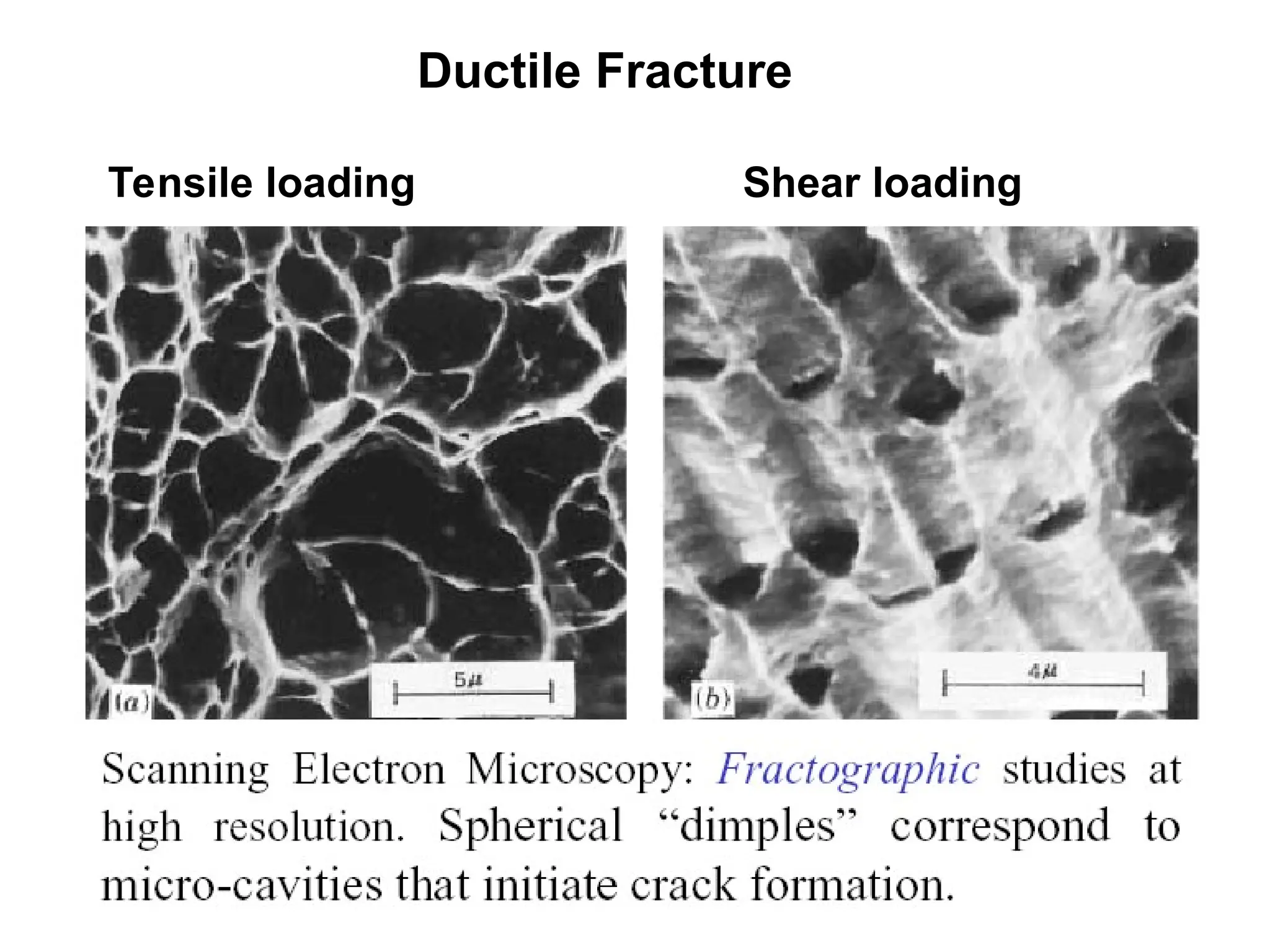
Tensile loading Shear loading
Ductile Fracture
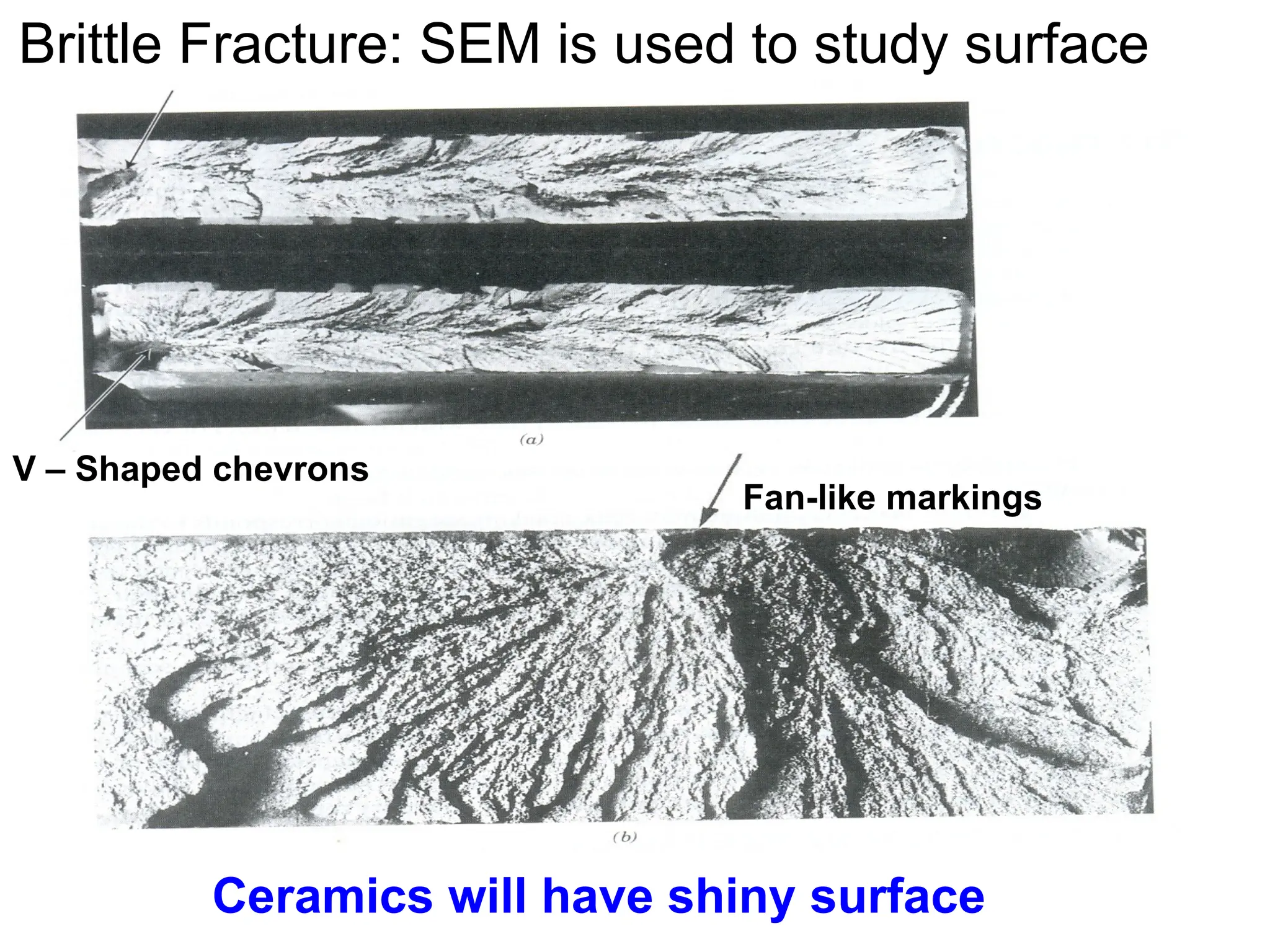
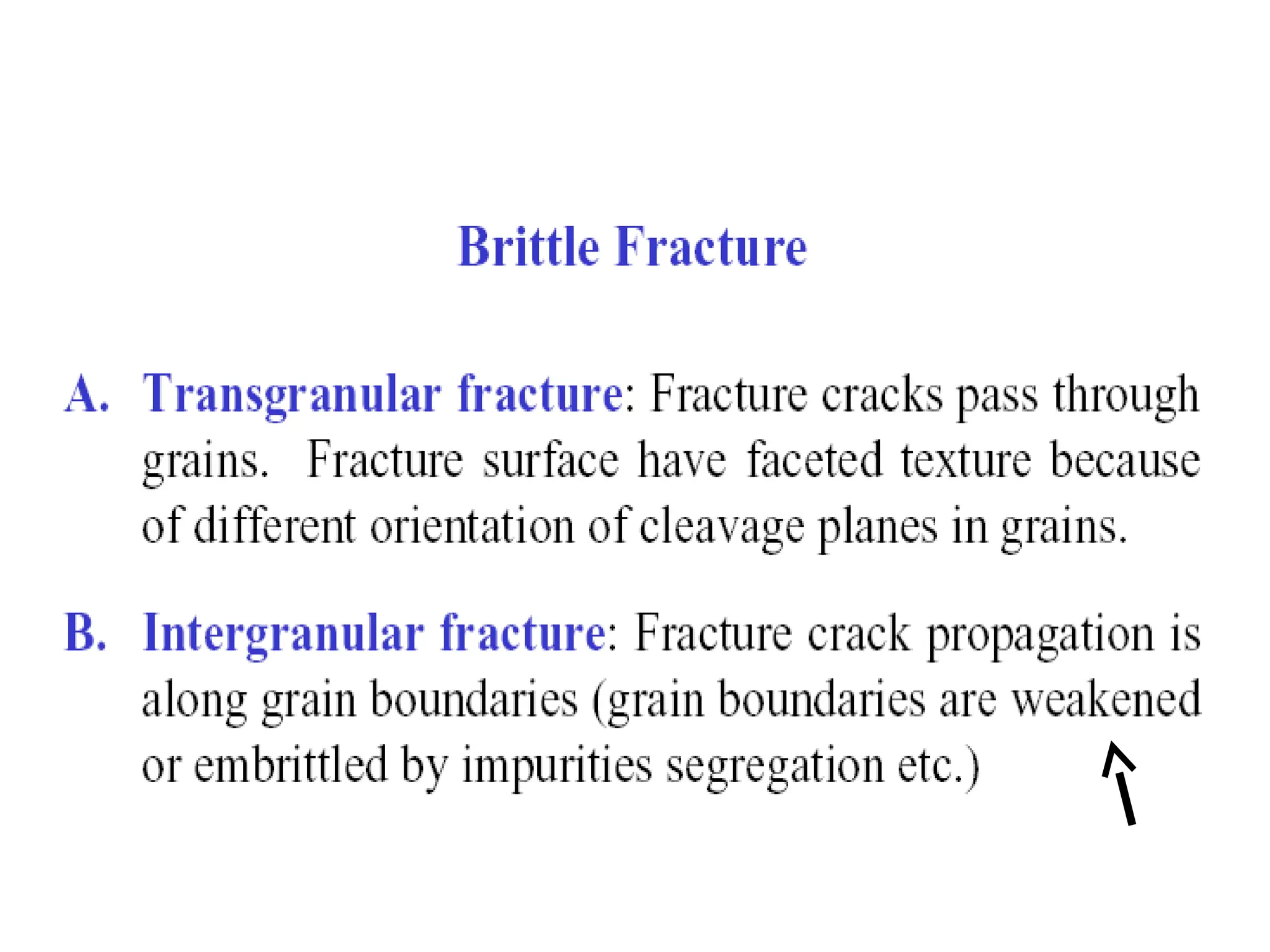
Brittle Fracture: SEM is used to study surface
V – Shaped chevrons
Fan-like markings
Ceramics will have shiny surface
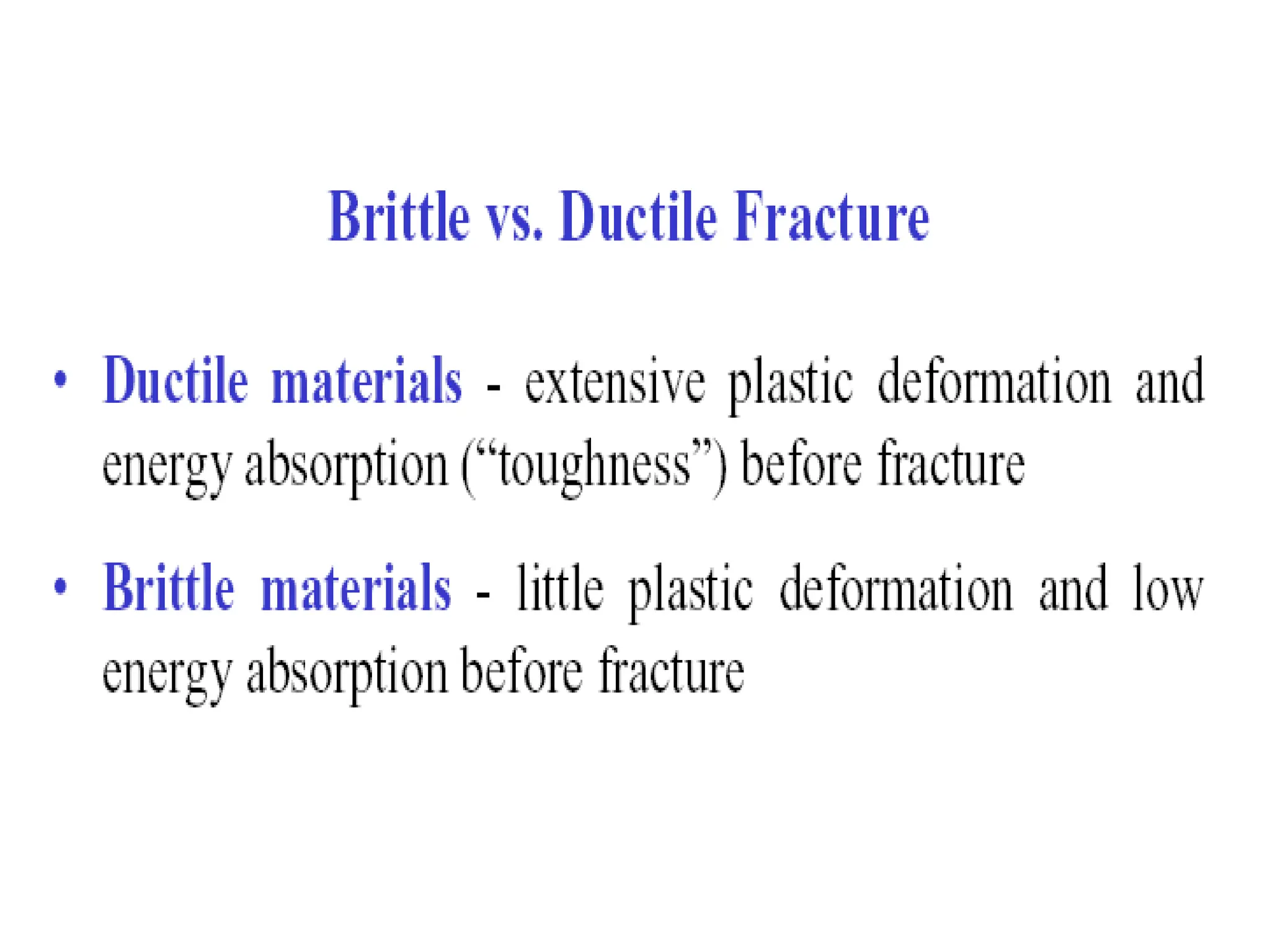
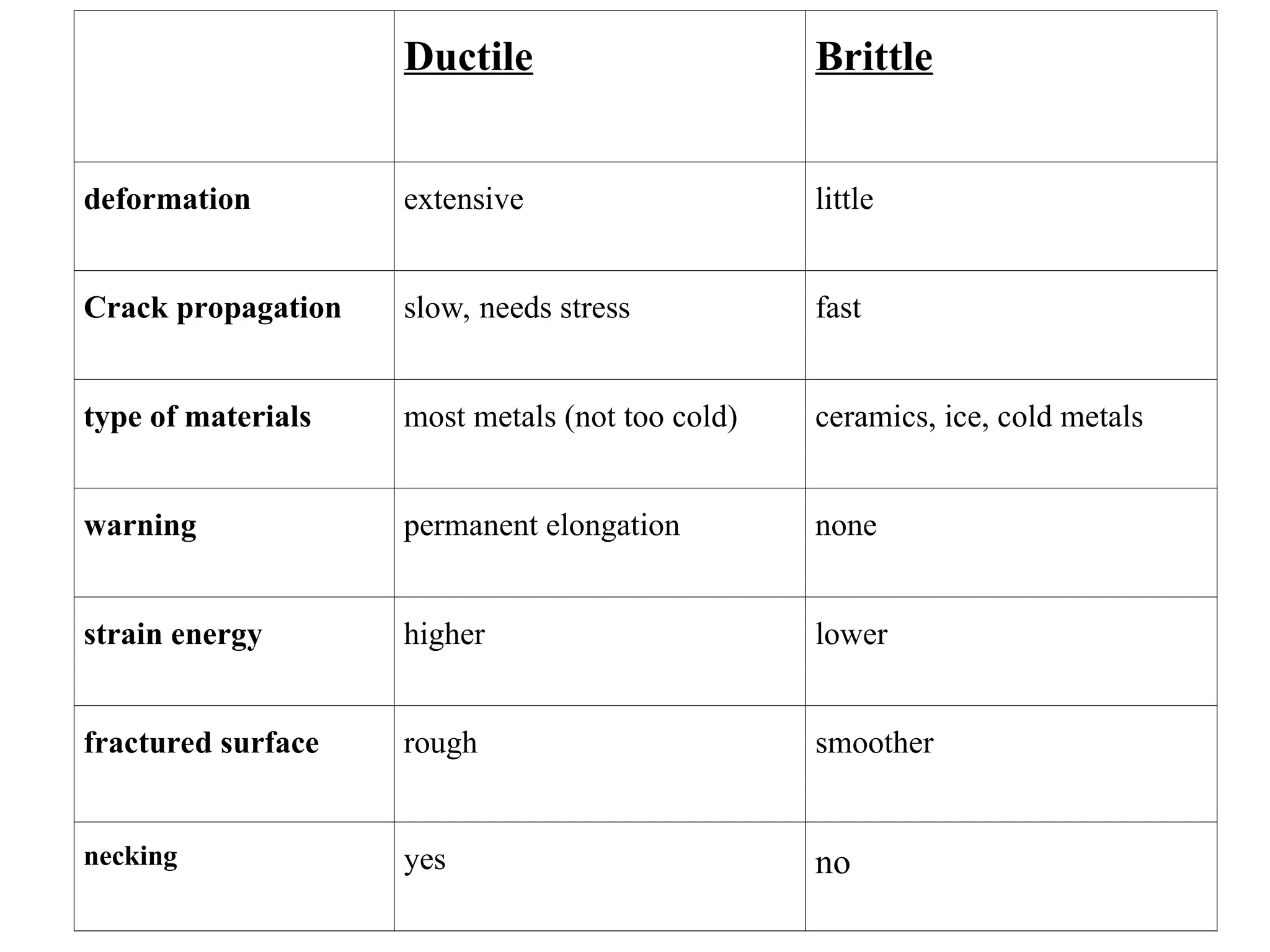
Ductile Brittle
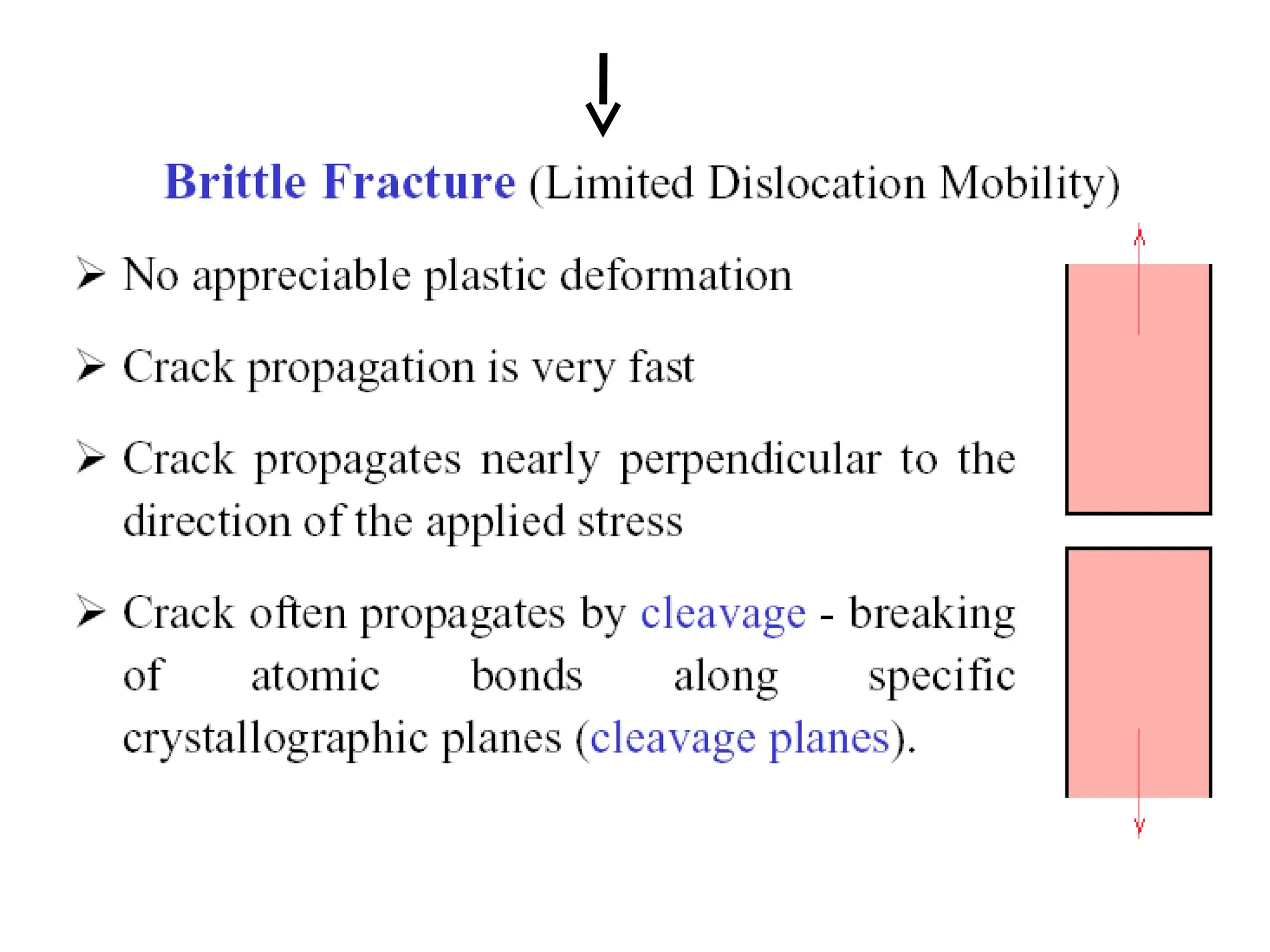
deformation extensive little
Crack propagation slow, needs stress fast
type of materials most metals (not too cold) ceramics, ice, cold metals
warning permanent elongation none
strain energy higher lower
fractured surface rough smoother
necking yes no
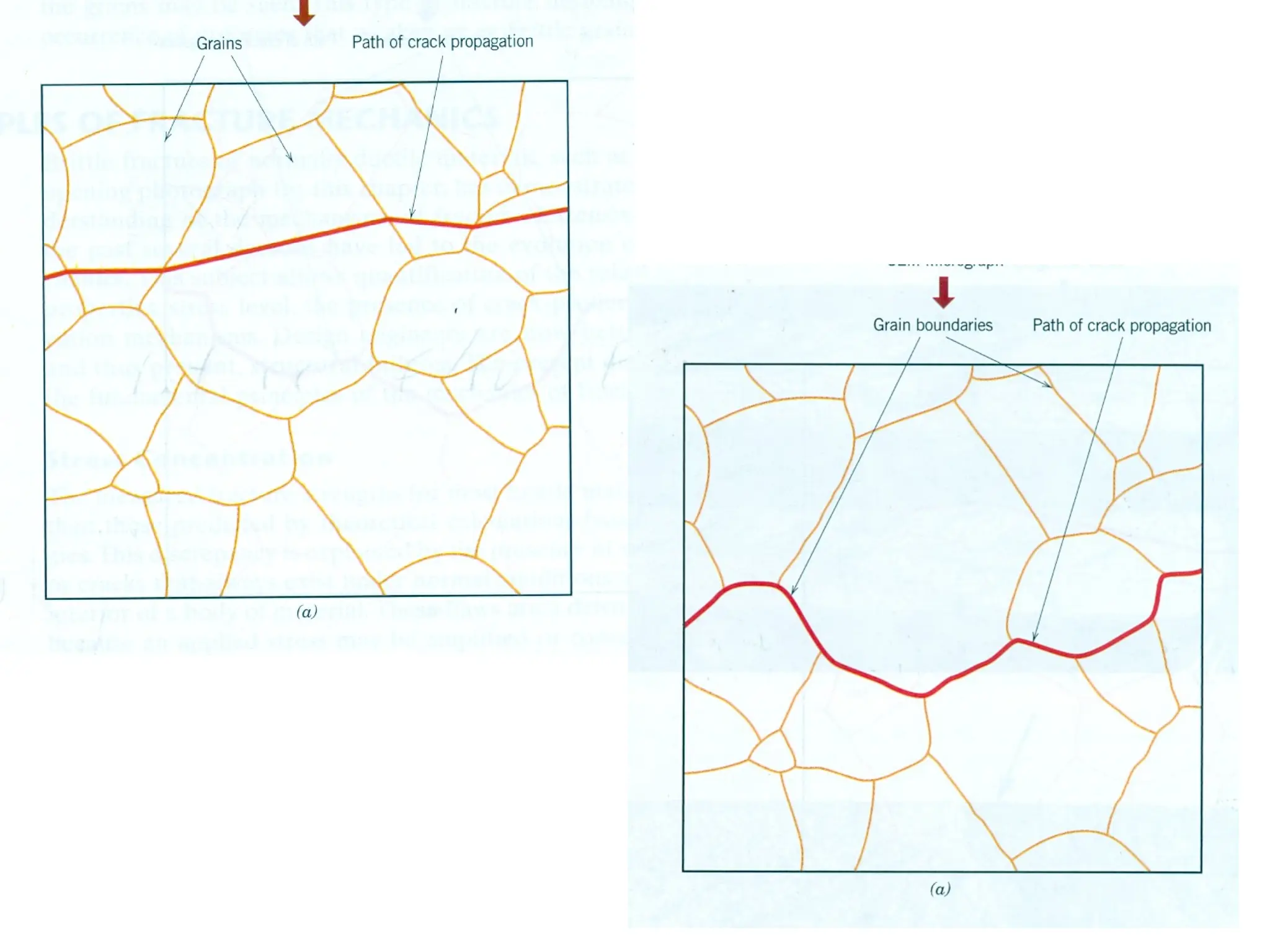
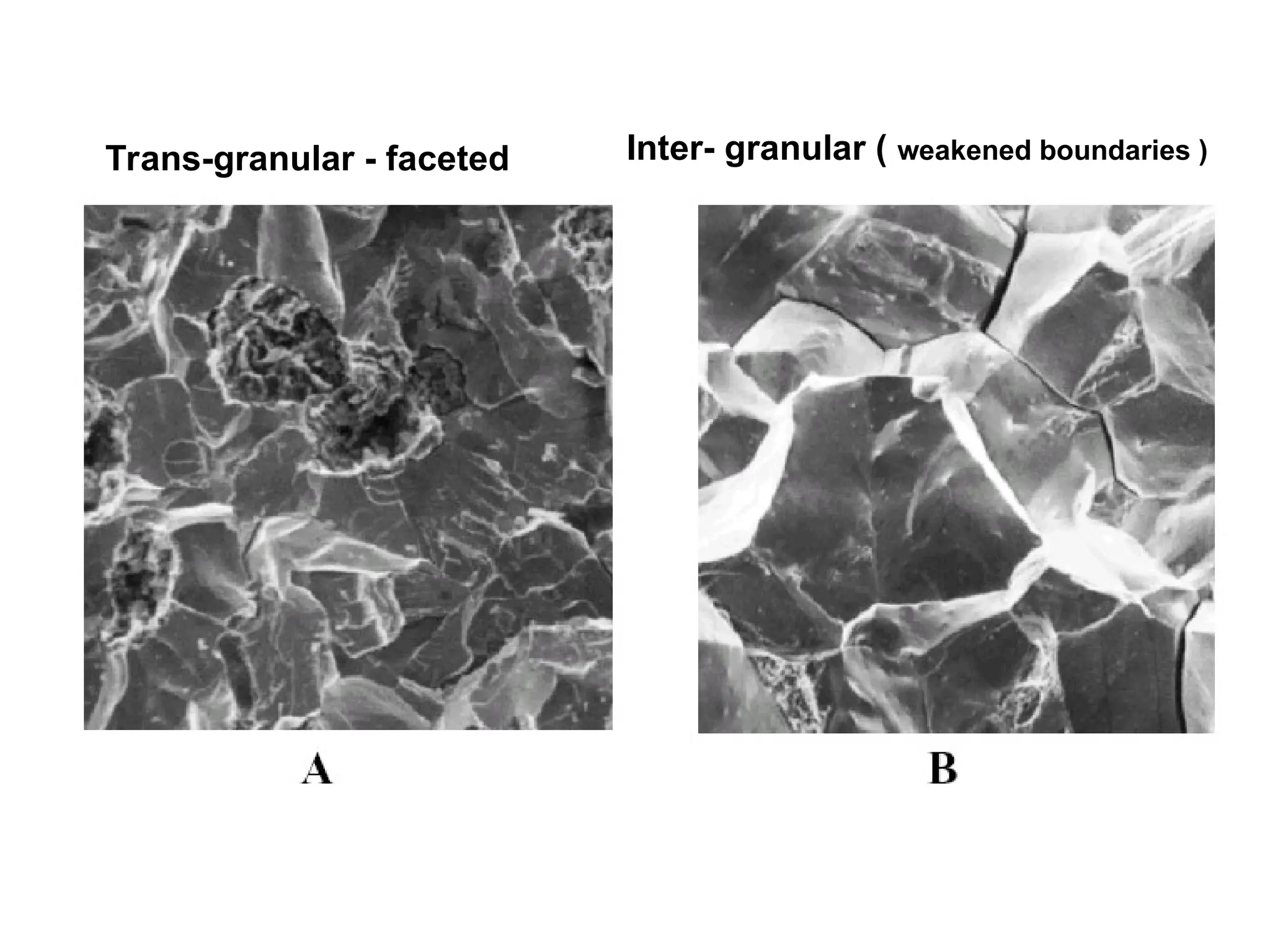
Trans-granular - faceted Inter- granular ( weakened boundaries )
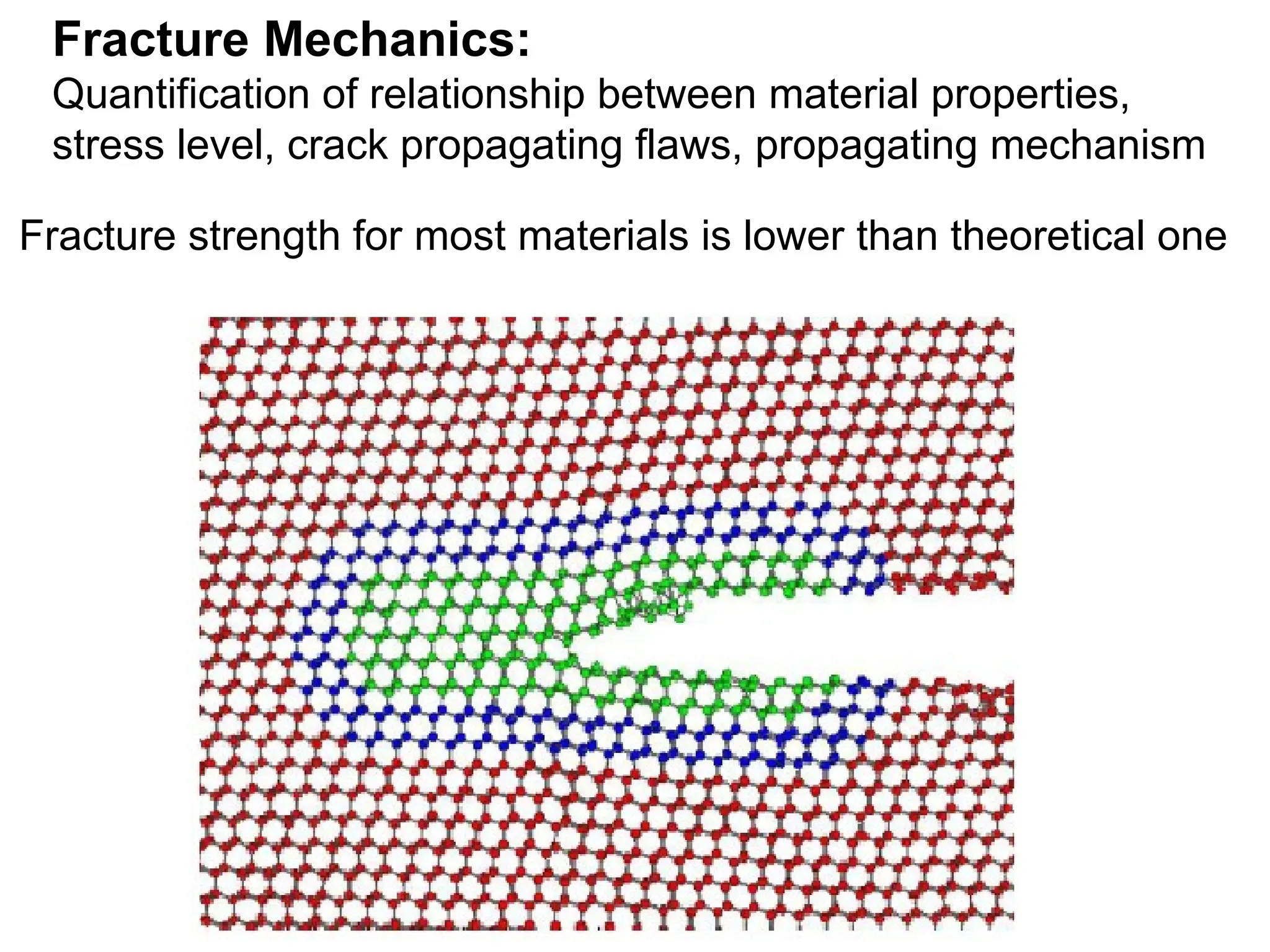
Fracture Mechanics:
Quantification of relationship between material properties,
stress level, crack propagating flaws, propagating mechanism
Fracture strength for most materials is lower than theoretical one
Stress
Raisers
Much smaller forces are required for fracture. Why
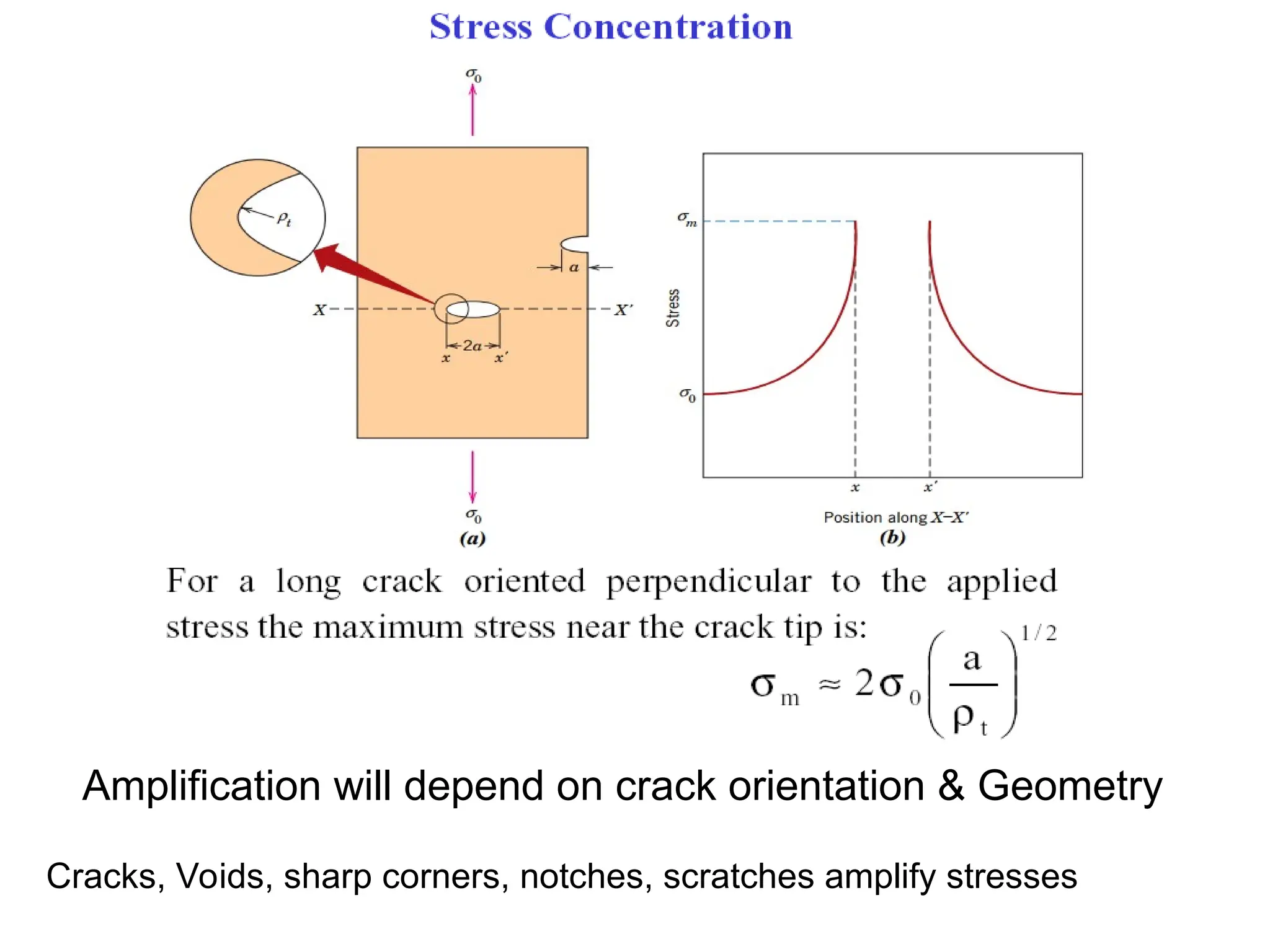
Amplification will depend on crack orientation & Geometry
Cracks, Voids, sharp corners, notches, scratches amplify stresses
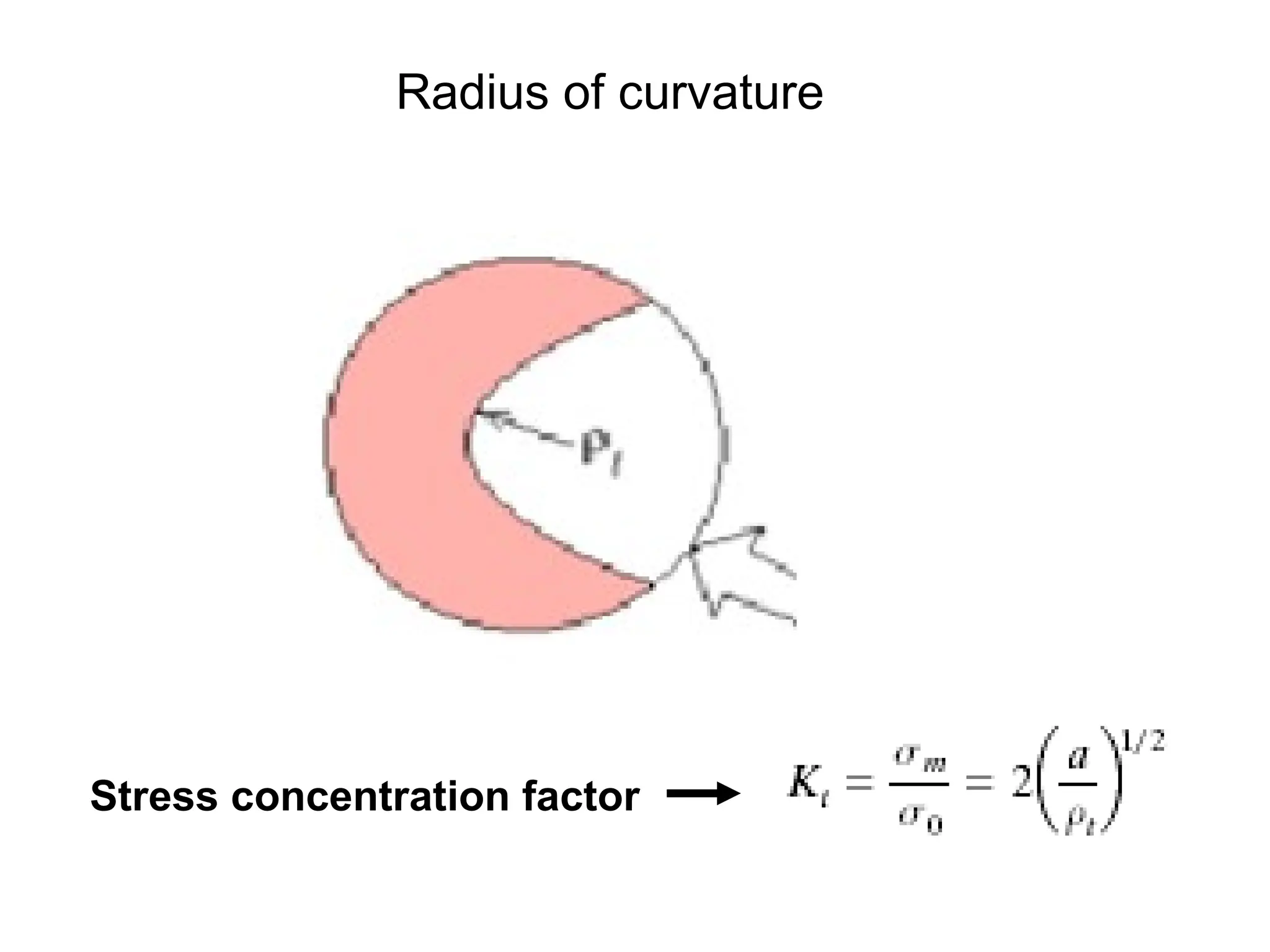
Radius of curvature
Stress concentration factor
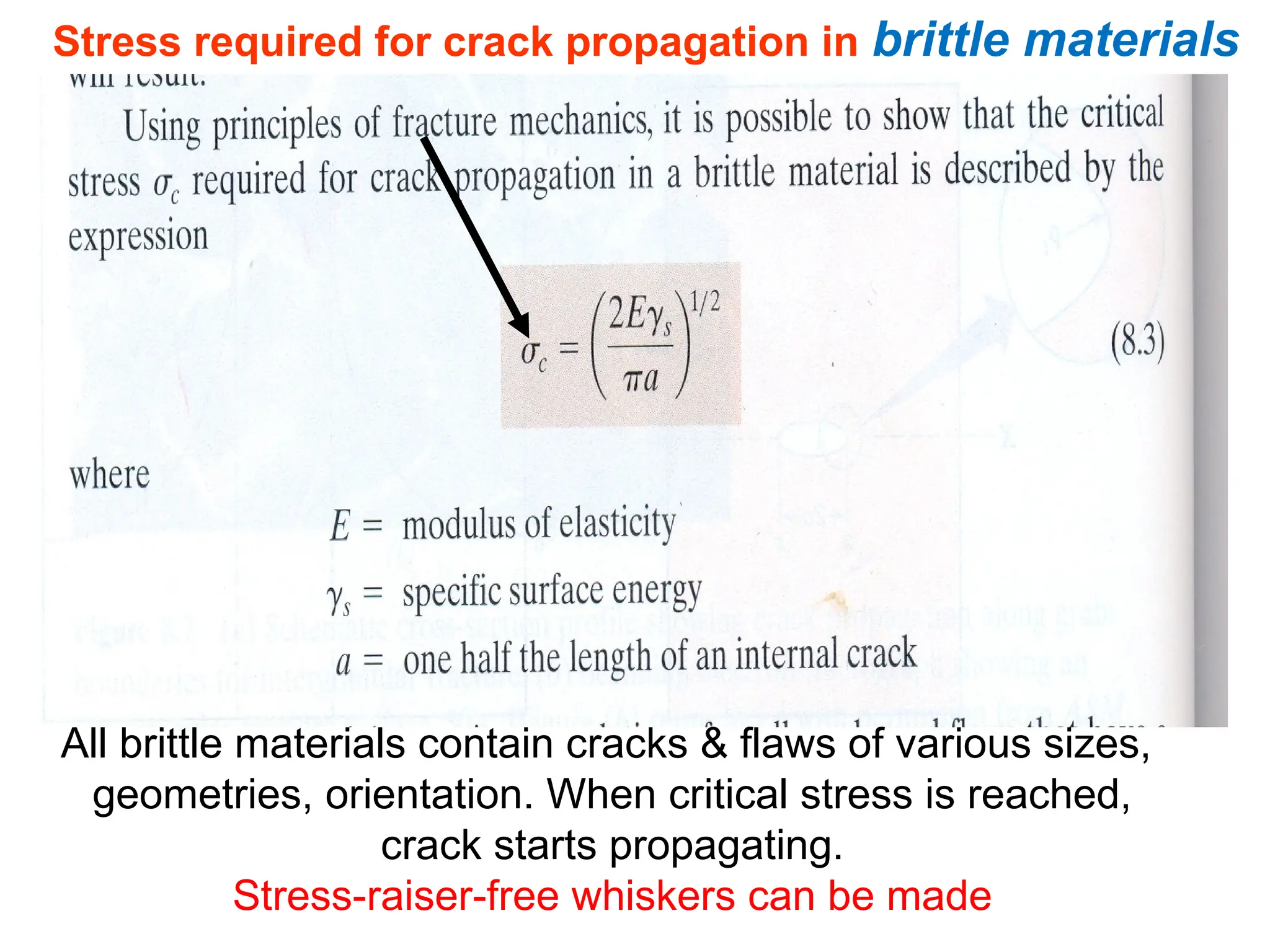
Stress required for crack propagation in brittle materials
All brittle materials contain cracks & flaws of various sizes,
geometries, orientation. When critical stress is reached,
crack starts propagating.
Stress-raiser-free whiskers can be made
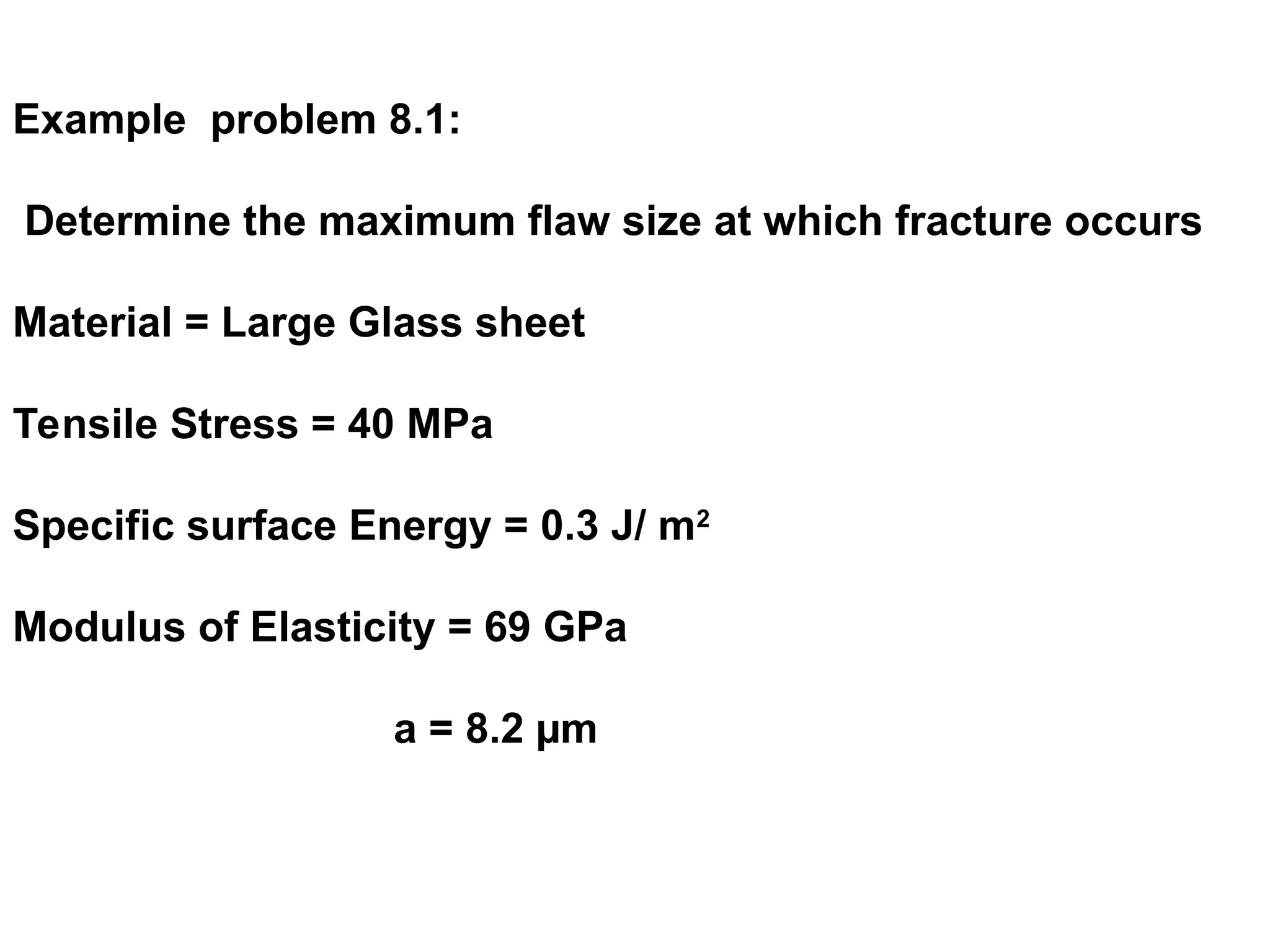
Example problem 8.1:
Determine the maximum flaw size at which fracture occurs
Material = Large Glass sheet
Tensile Stress = 40 MPa
Specific surface Energy = 0.3 J/ m2
Modulus of Elasticity = 69 GPa
a = 8.2 µm
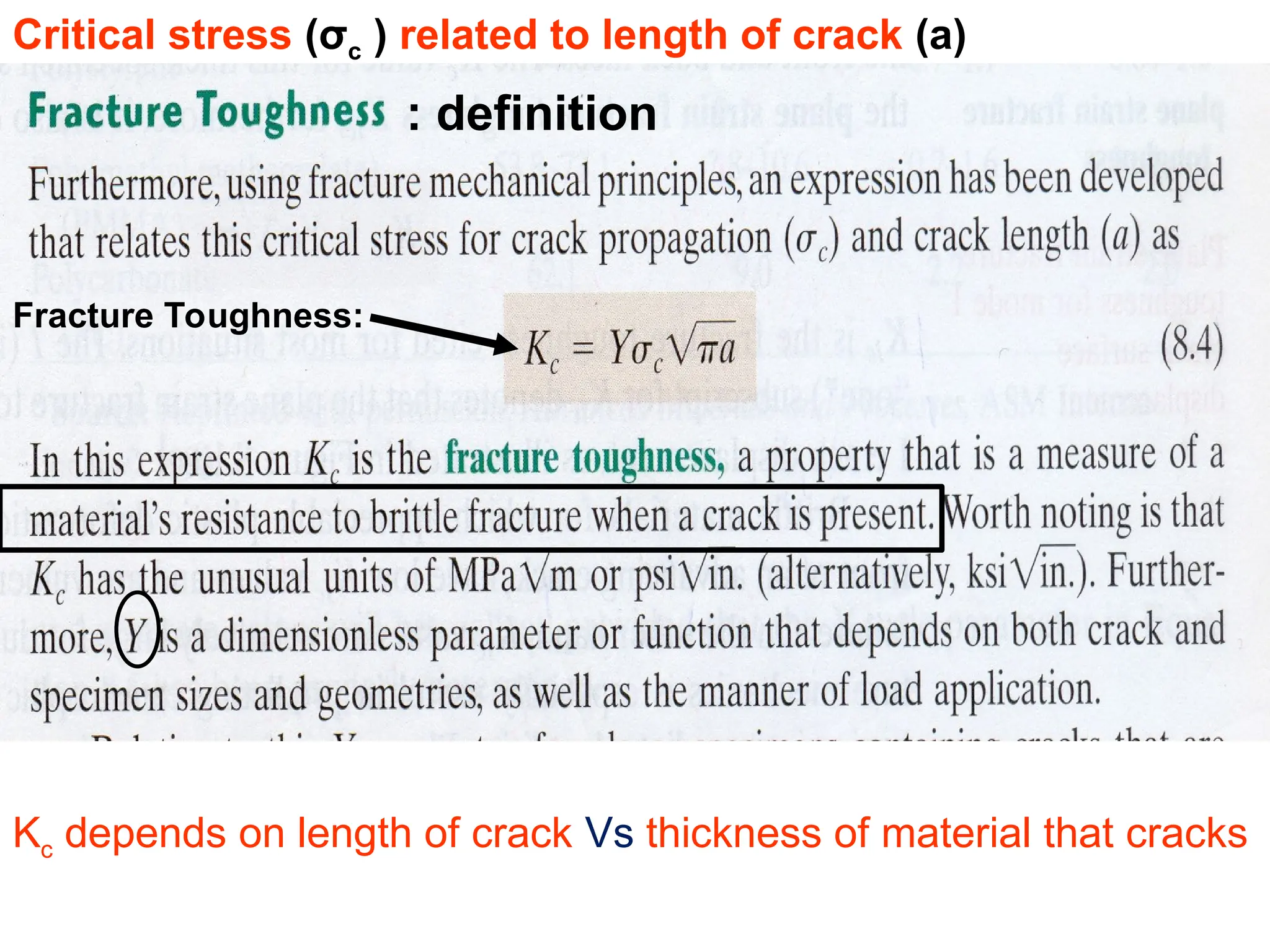
Fracture Toughness:
Critical stress (σc ) related to length of crack (a)
: definition
Kc depends on length of crack Vs thickness of material that cracks
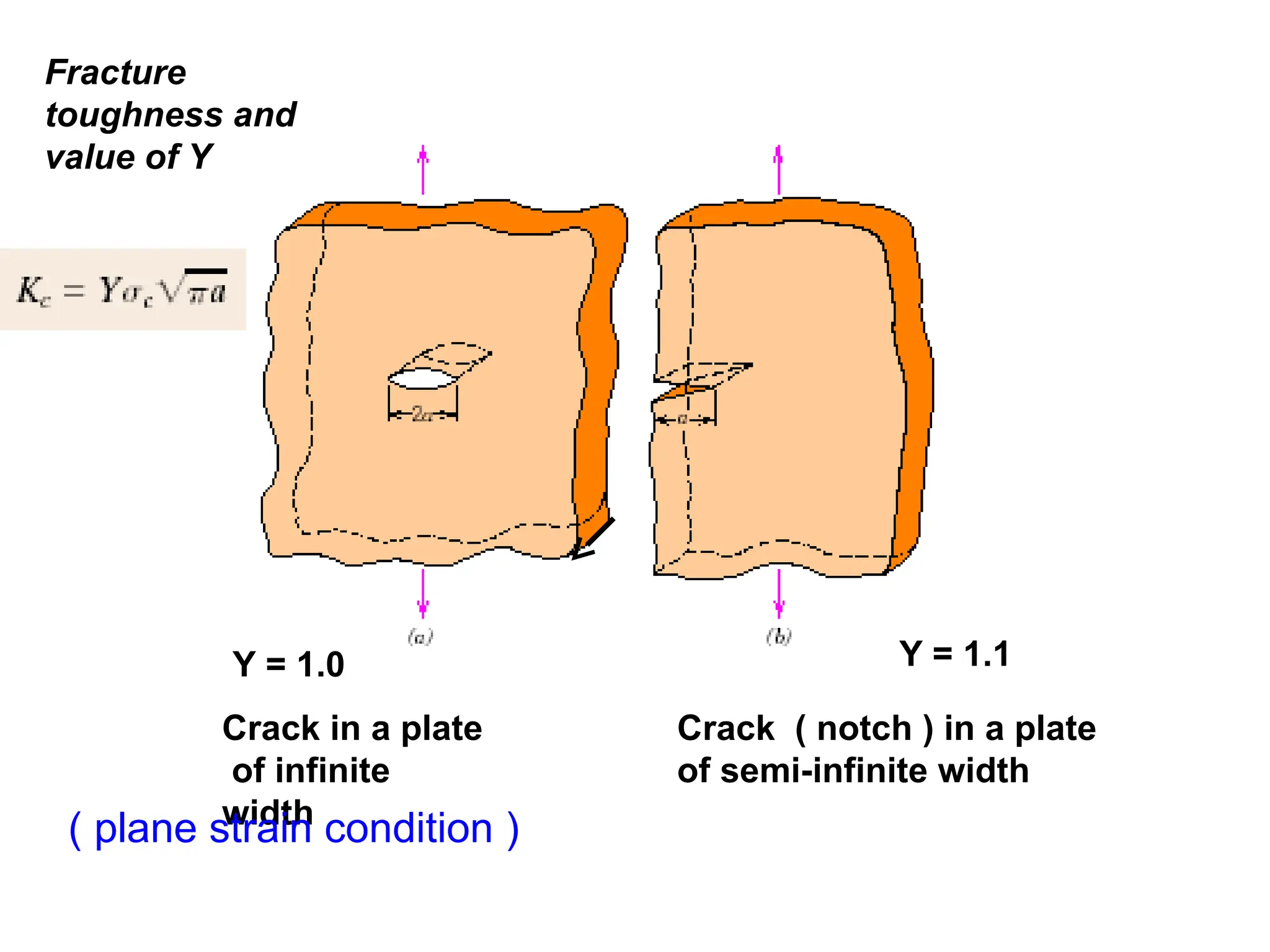
Y = 1.0 Y = 1.1
Crack in a plate
of infinite
width
Crack ( notch ) in a plate
of semi-infinite width
Fracture
toughness and
value of Y
( plane strain condition )
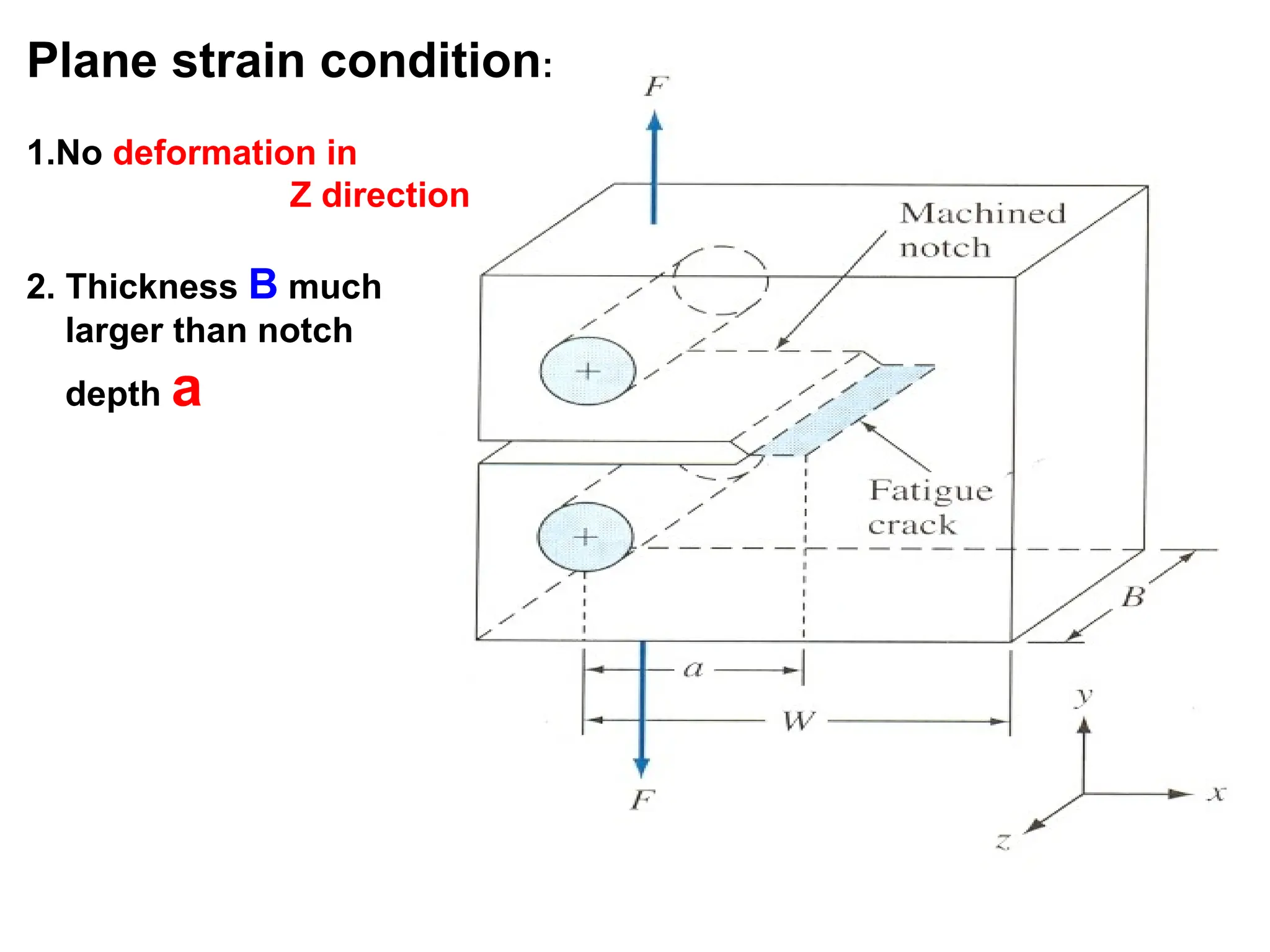
Plane strain condition:
1.No deformation in
Z direction
2. Thickness B much
larger than notch
depth a
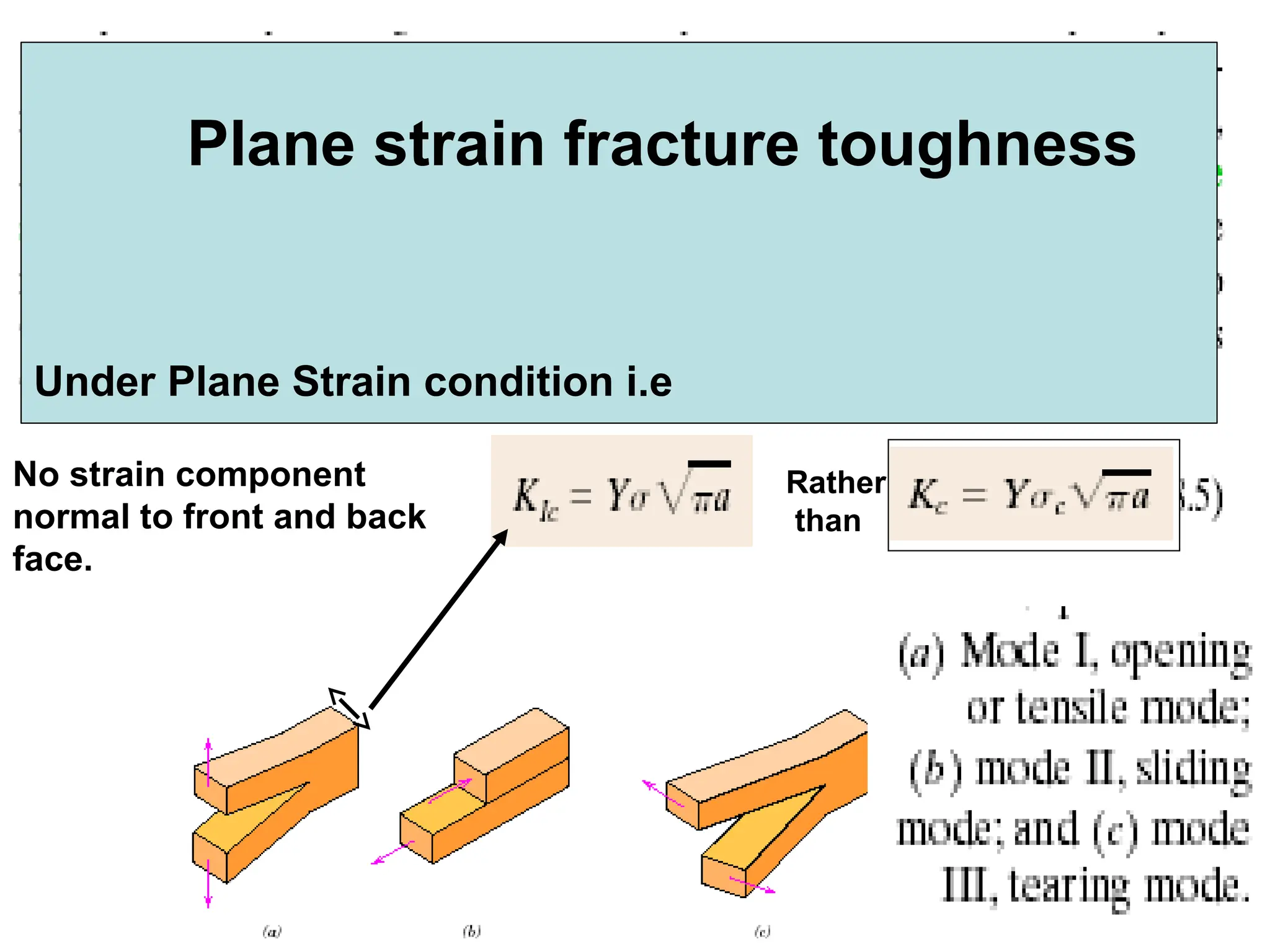
No strain component
normal to front and back
face.
Under Plane Strain condition i.e
Rather
than
Plane strain fracture toughness
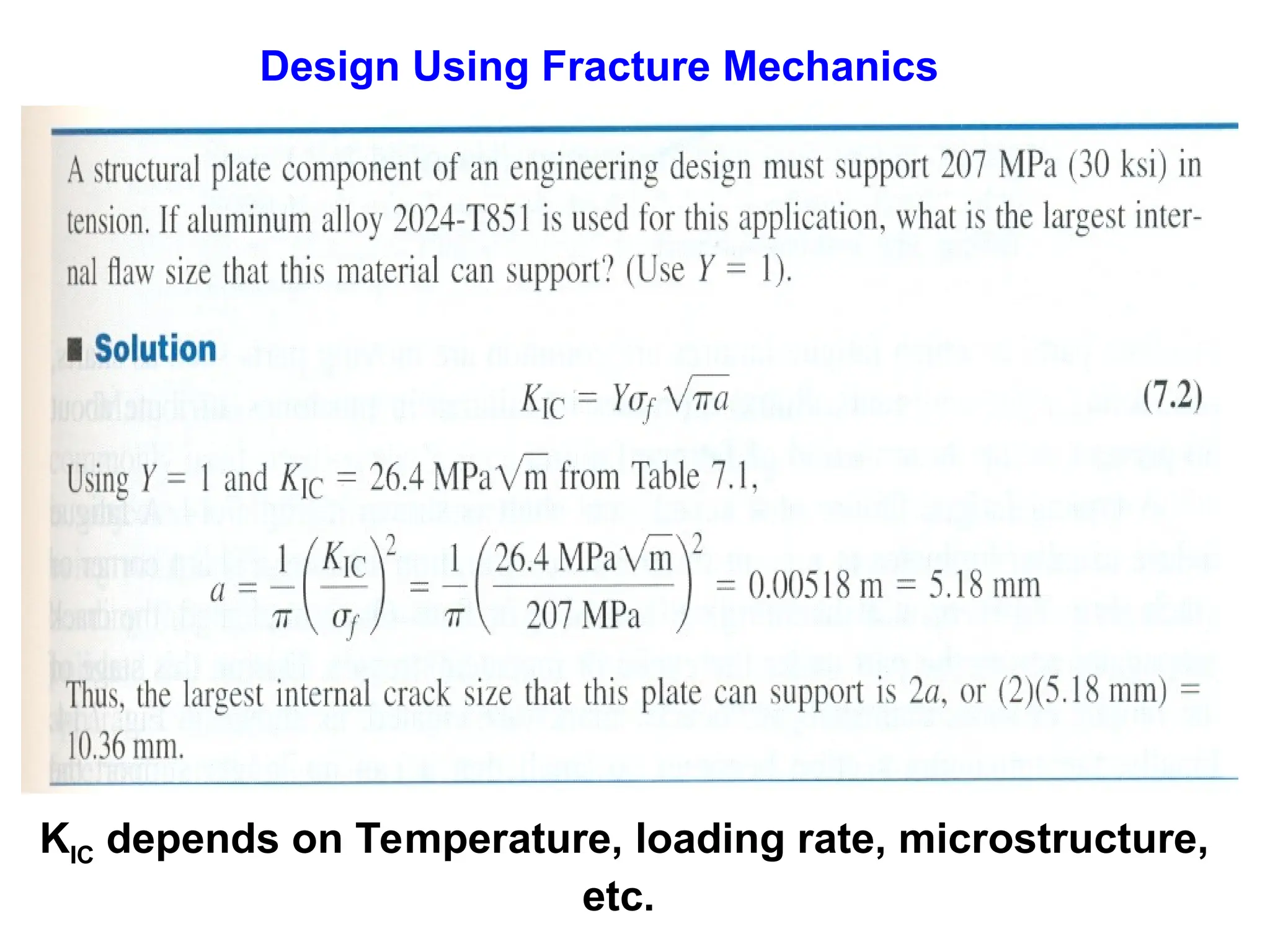
Design Using Fracture Mechanics
KIC depends on Temperature, loading rate, microstructure,
etc.
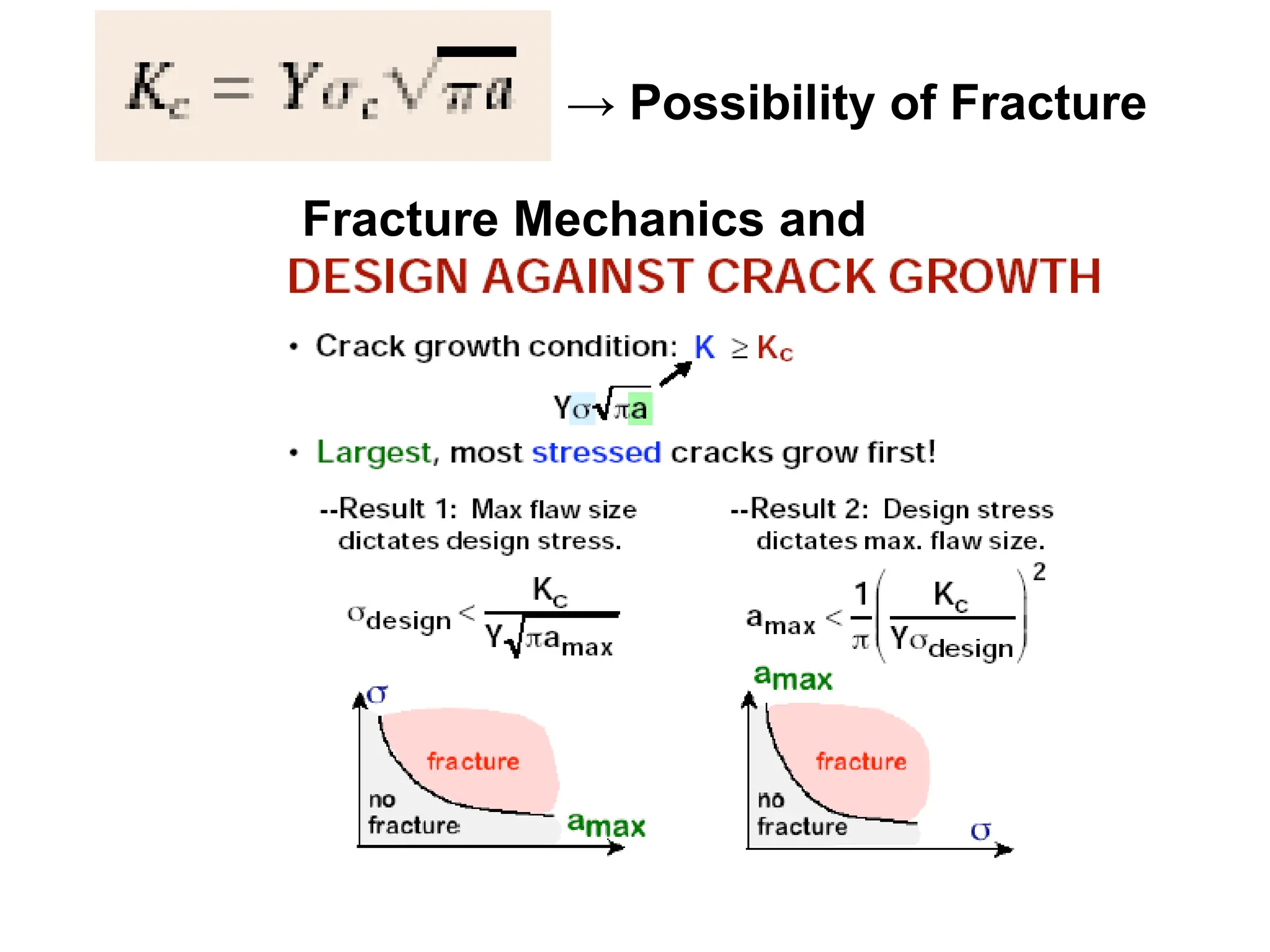
Fracture Mechanics and
→ Possibility of Fracture
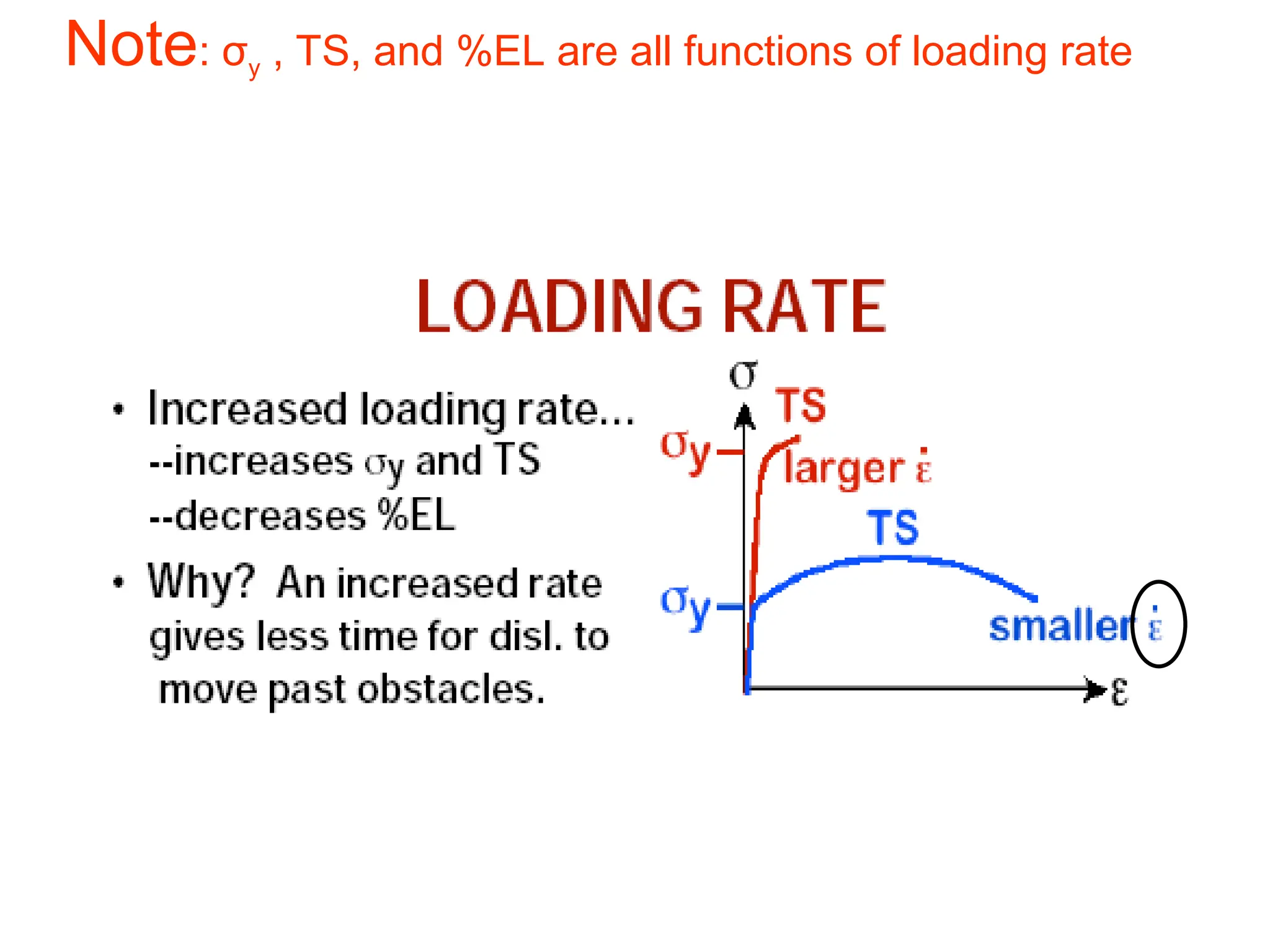
Note: σy , TS, and %EL are all functions of loading rate
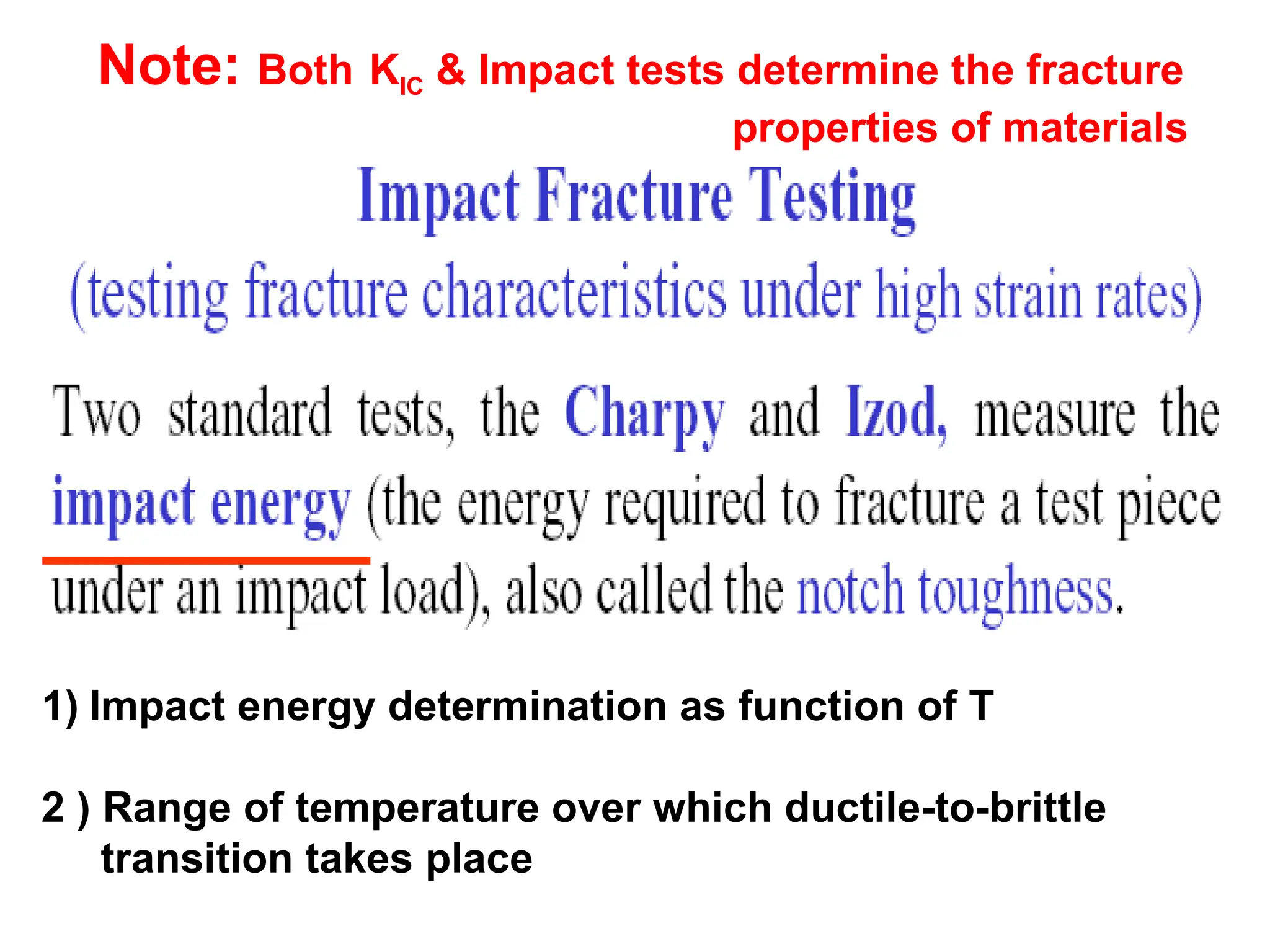
1) Impact energy determination as function of T
2 ) Range of temperature over which ductile-to-brittle
transition takes place
Note: Both KIC & Impact tests determine the fracture
properties of materials
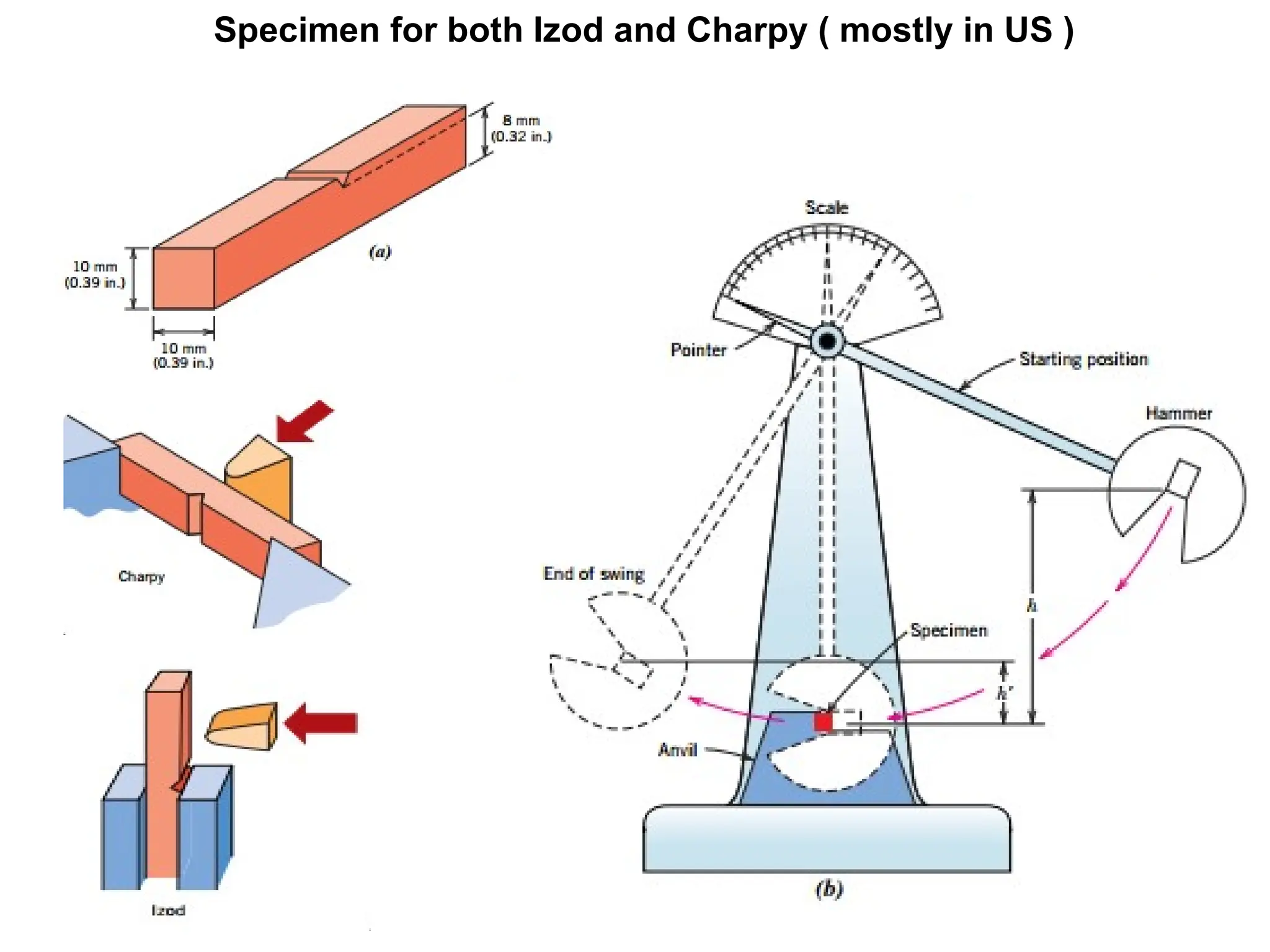
Specimen for both Izod and Charpy ( mostly in US )
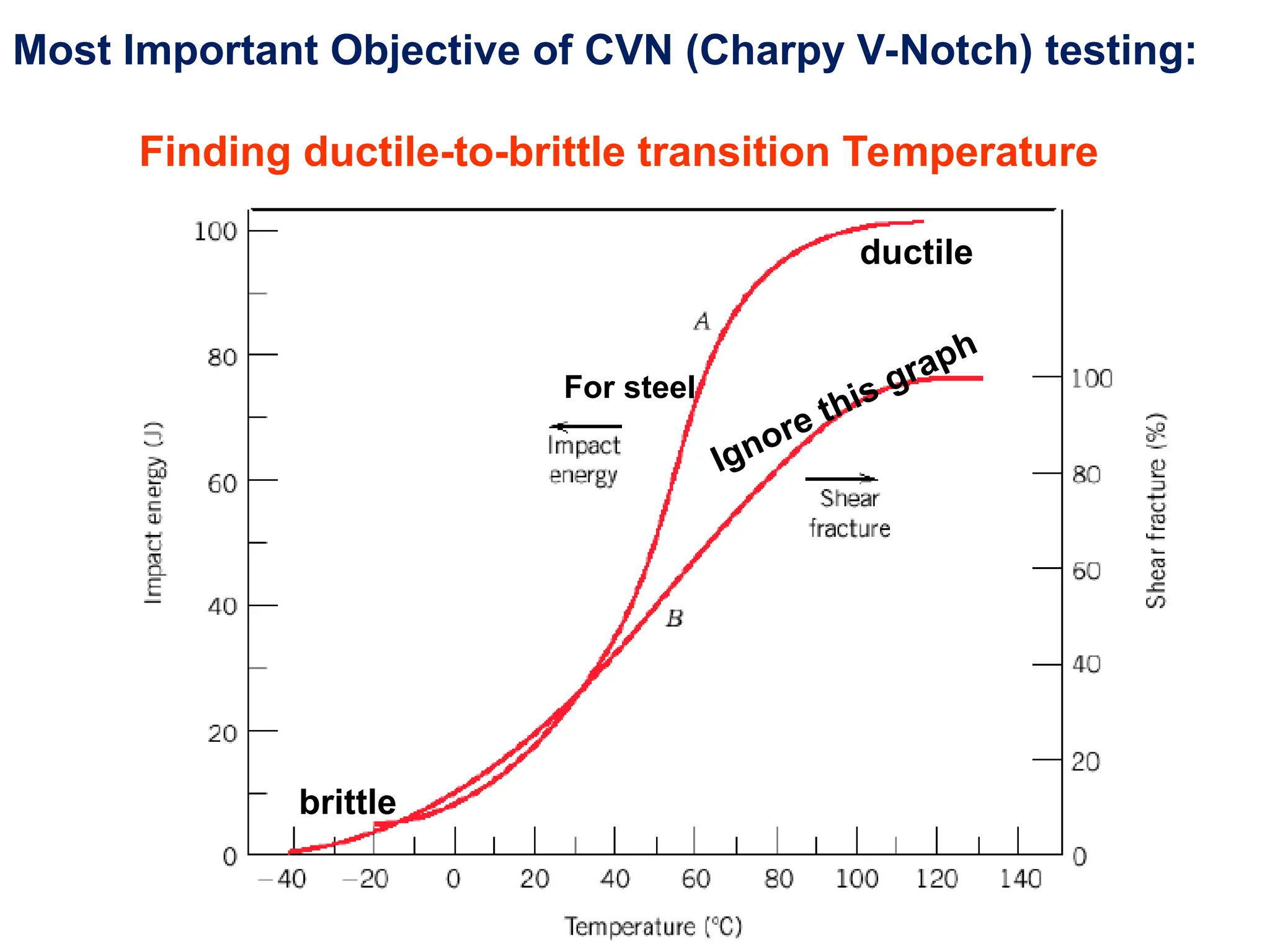
Most Important Objective of CVN (Charpy V-Notch) testing:
Finding ductile-to-brittle transition Temperature
For steel
Ignore this graph
brittle
ductile
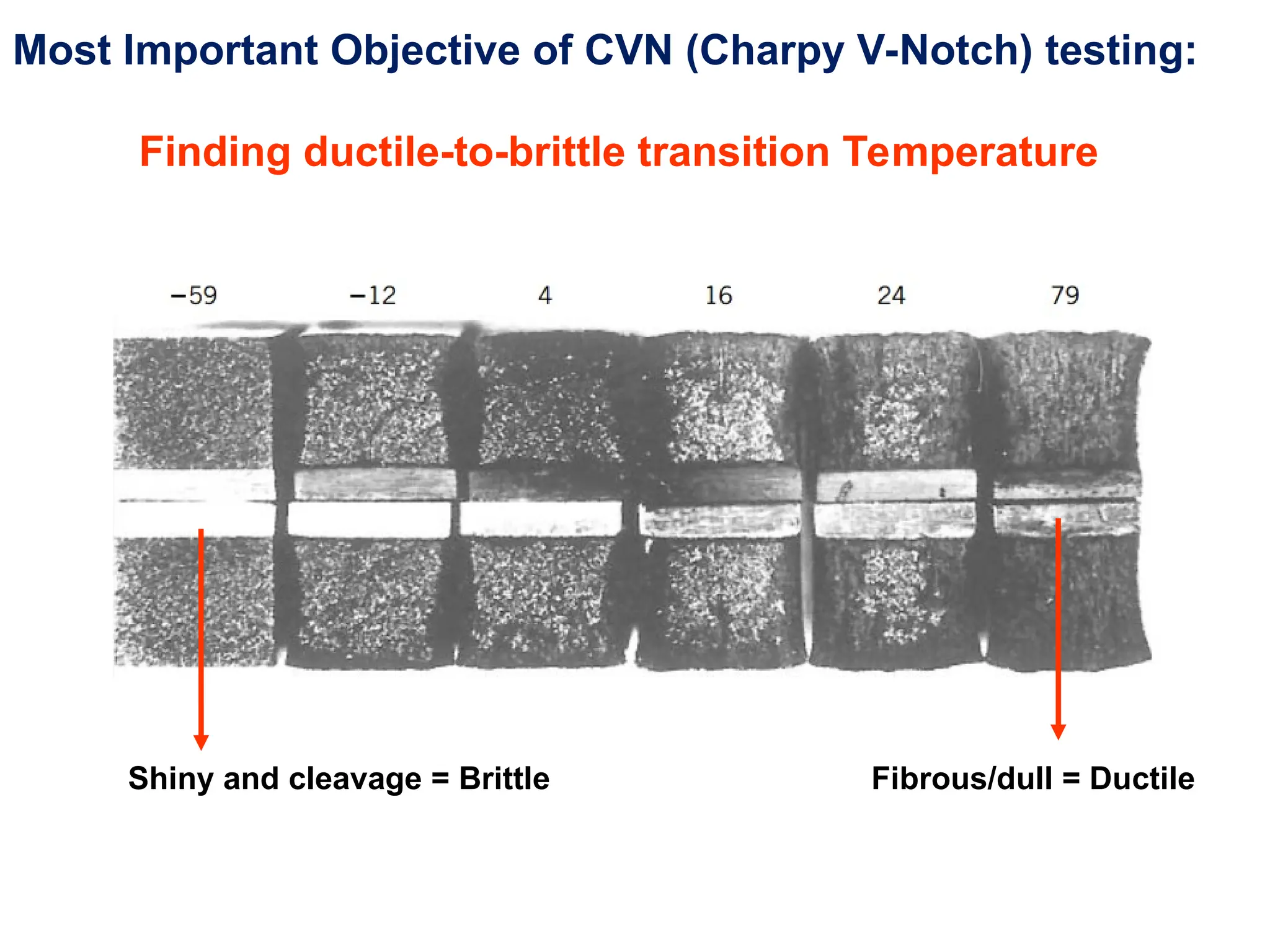
Most Important Objective of CVN (Charpy V-Notch) testing:
Finding ductile-to-brittle transition Temperature
Shiny and cleavage = Brittle Fibrous/dull = Ductile
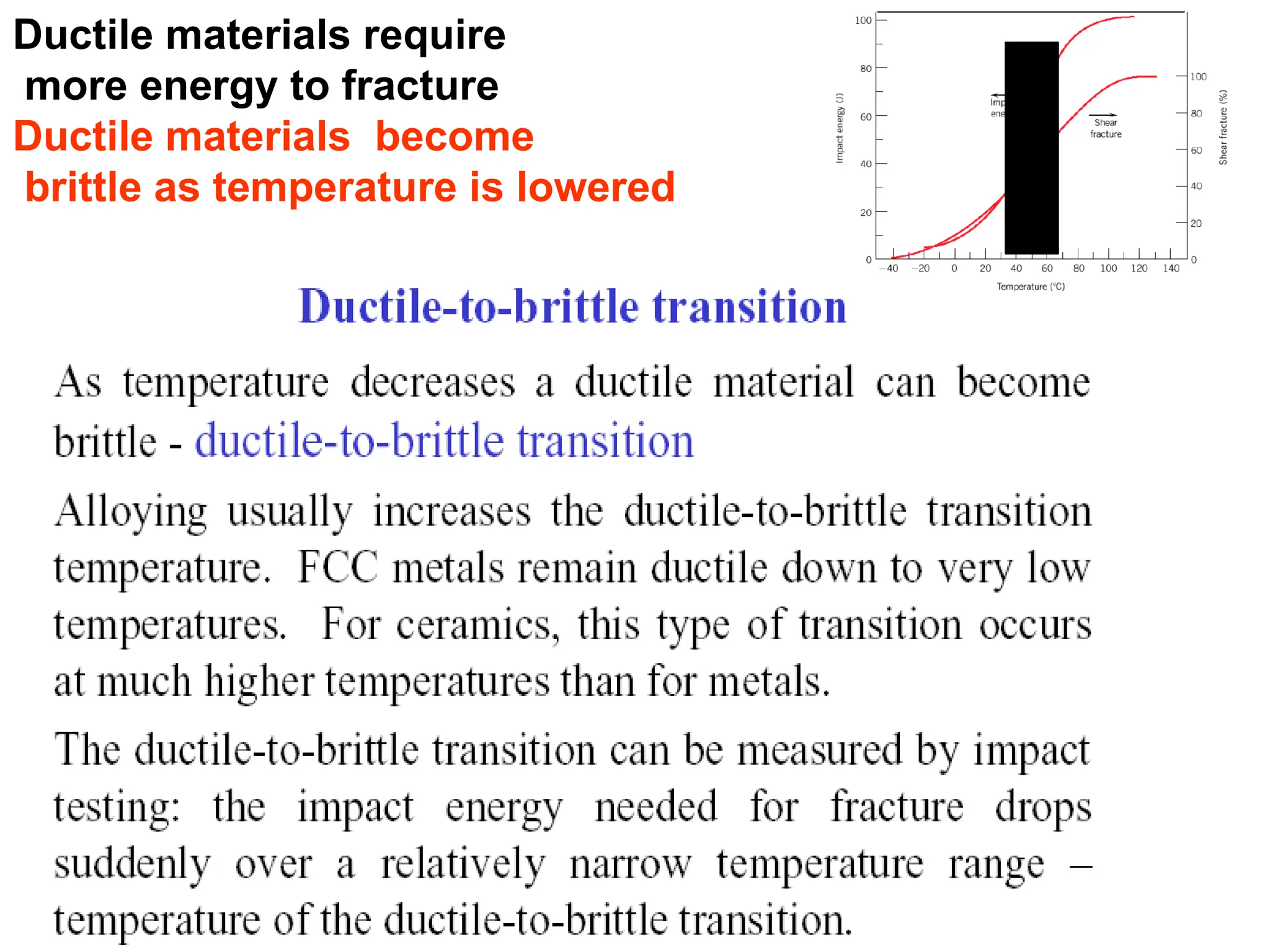
Ductile materials require
more energy to fracture
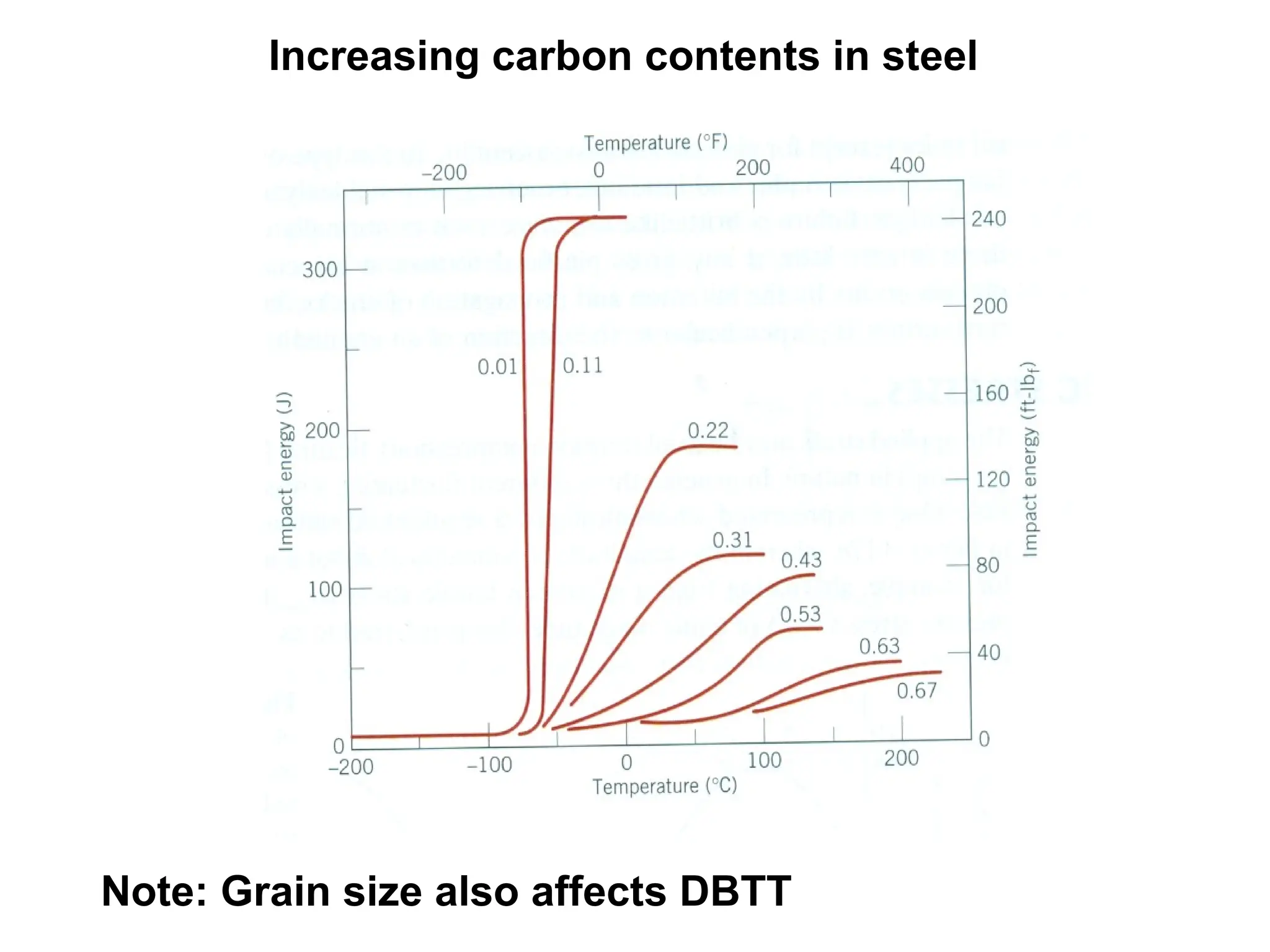
Ductile materials become
brittle as temperature is lowered
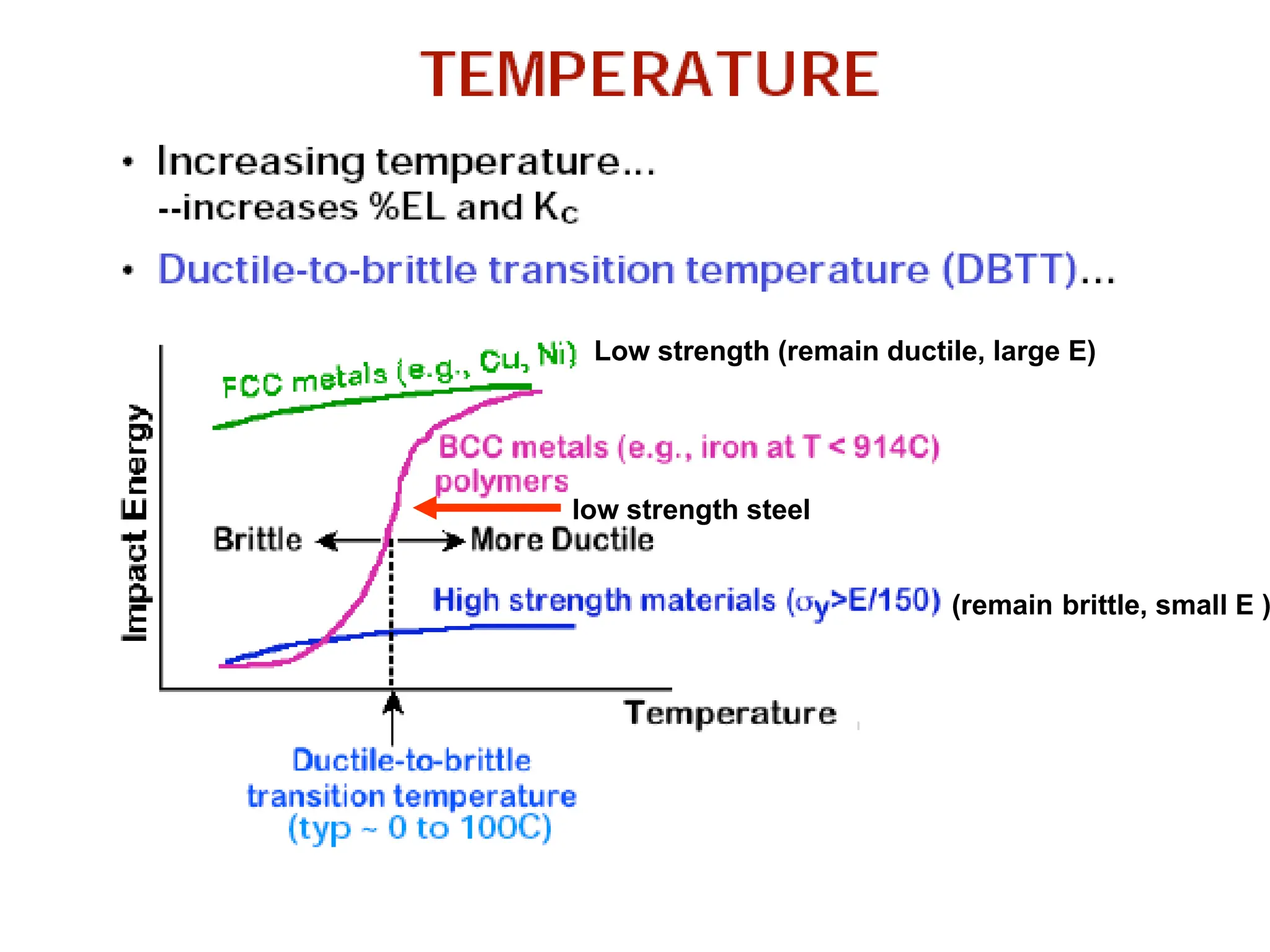
Low strength (remain ductile, large E)
(remain brittle, small E )
low strength steel
Increasing carbon contents in steel
Note: Grain size also affects DBTT
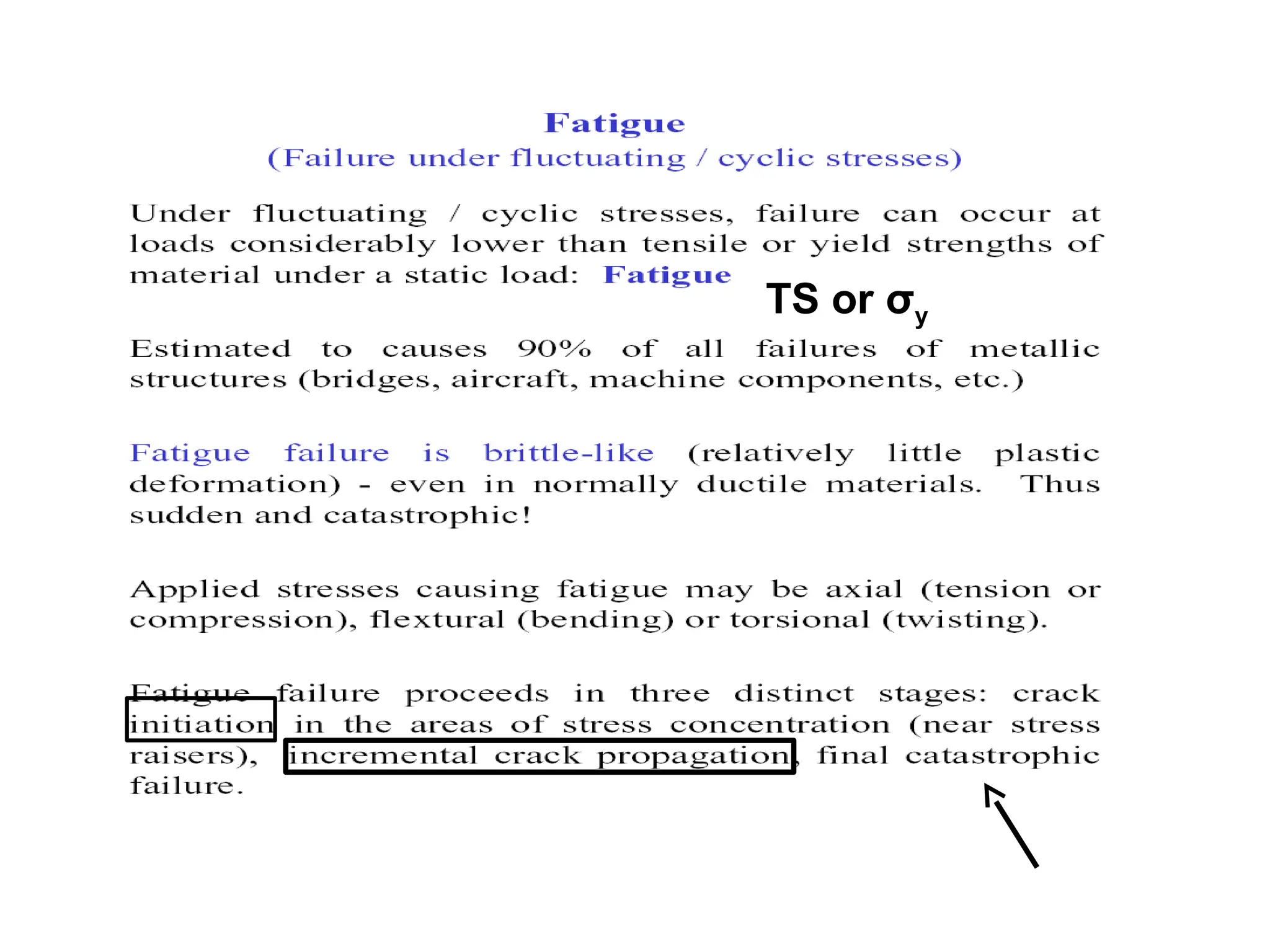
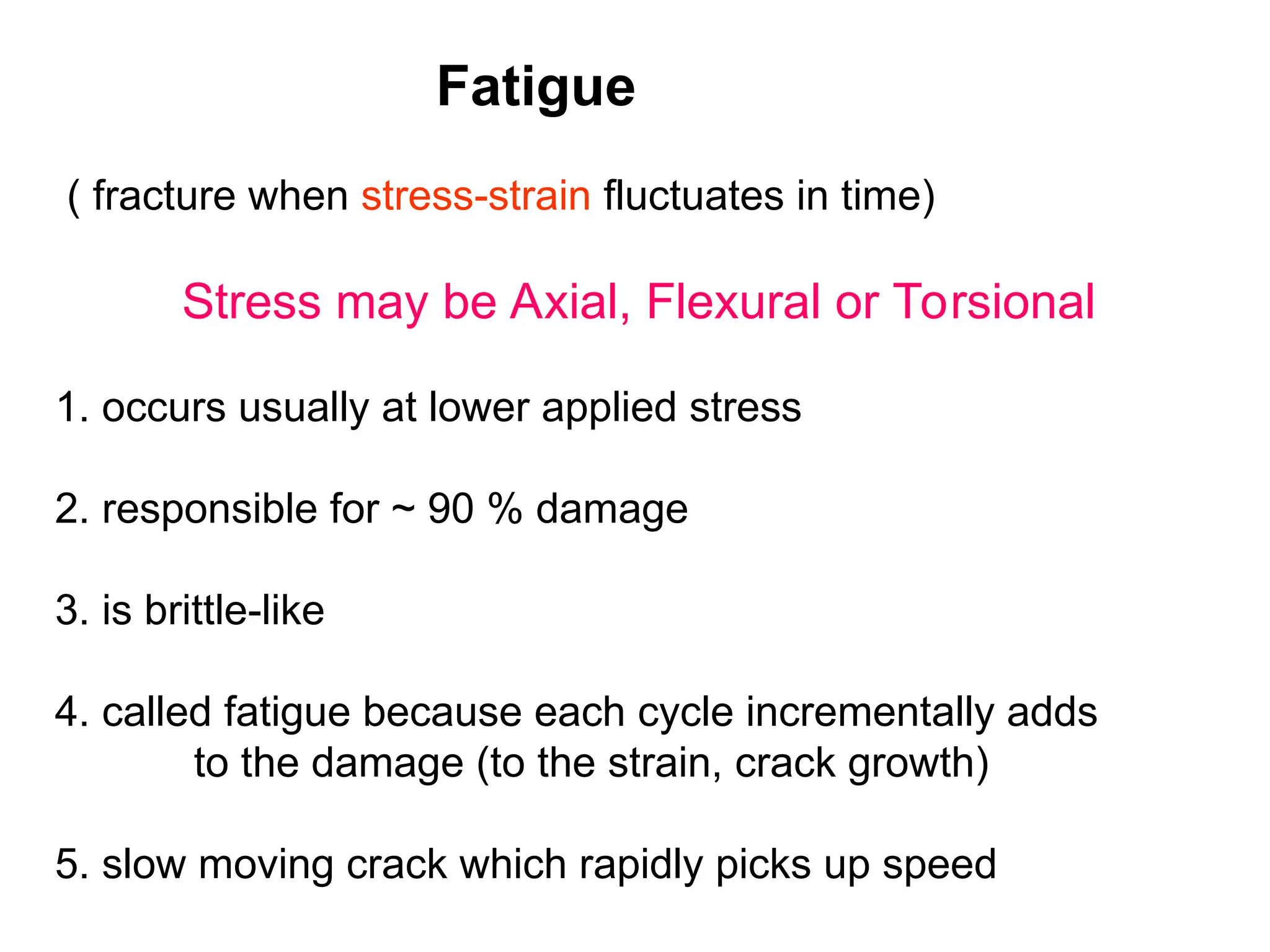
Fatigue
( fracture when stress-strain fluctuates in time)
Stress may be Axial, Flexural or Torsional
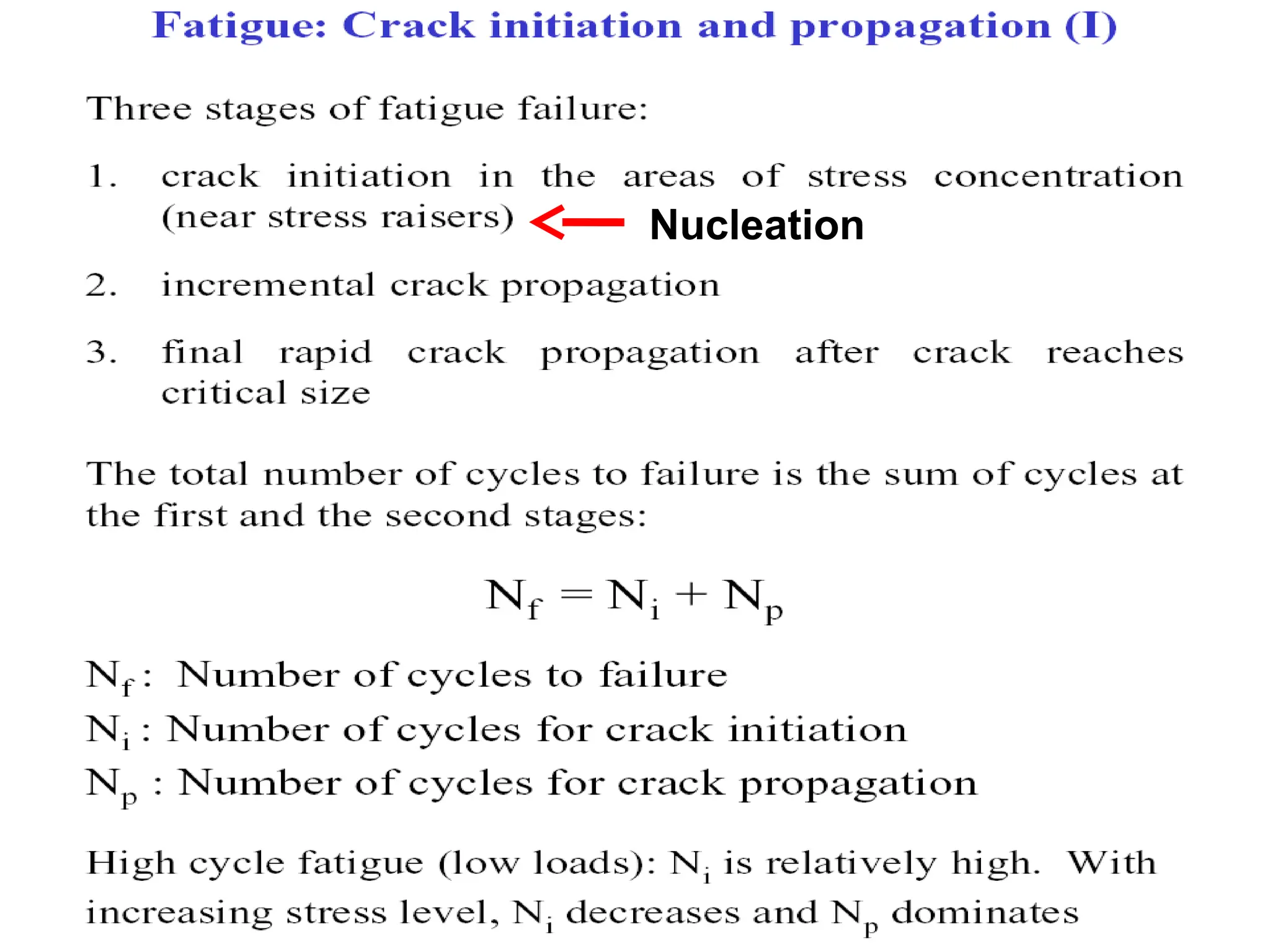
1. occurs usually at lower applied stress
2. responsible for ~ 90 % damage
3. is brittle-like
4. called fatigue because each cycle incrementally adds
to the damage (to the strain, crack growth)
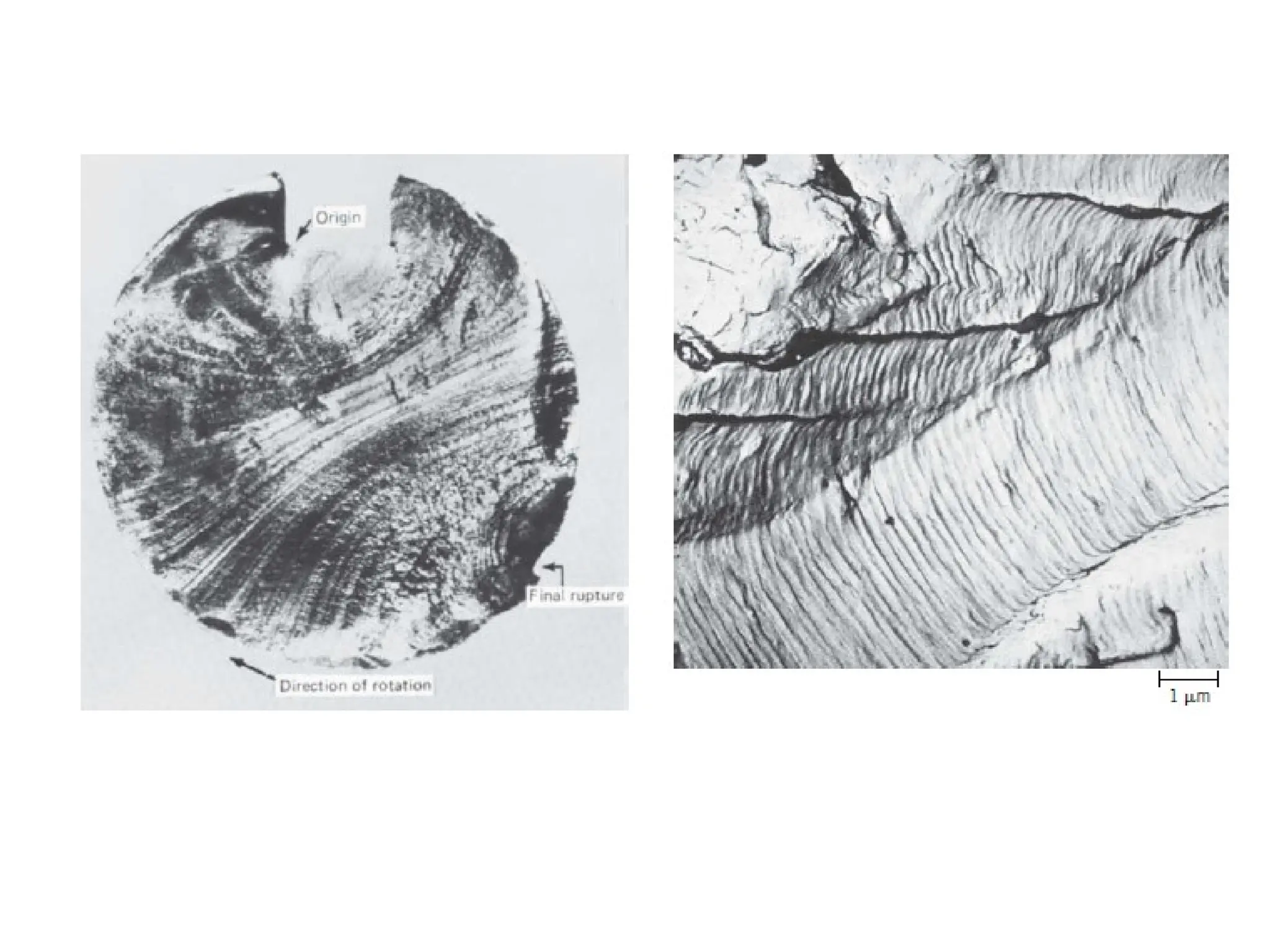
5. slow moving crack which rapidly picks up speed
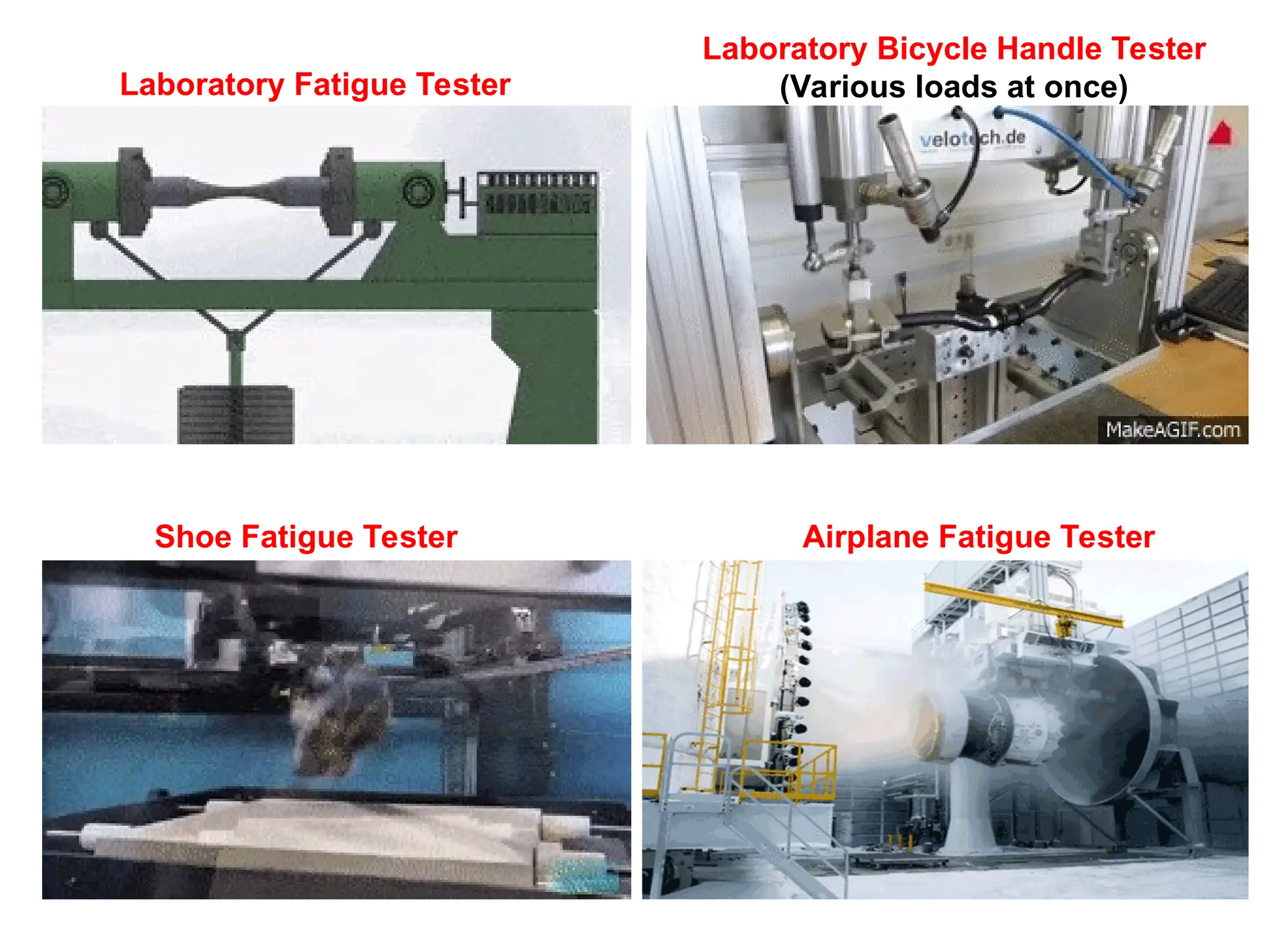
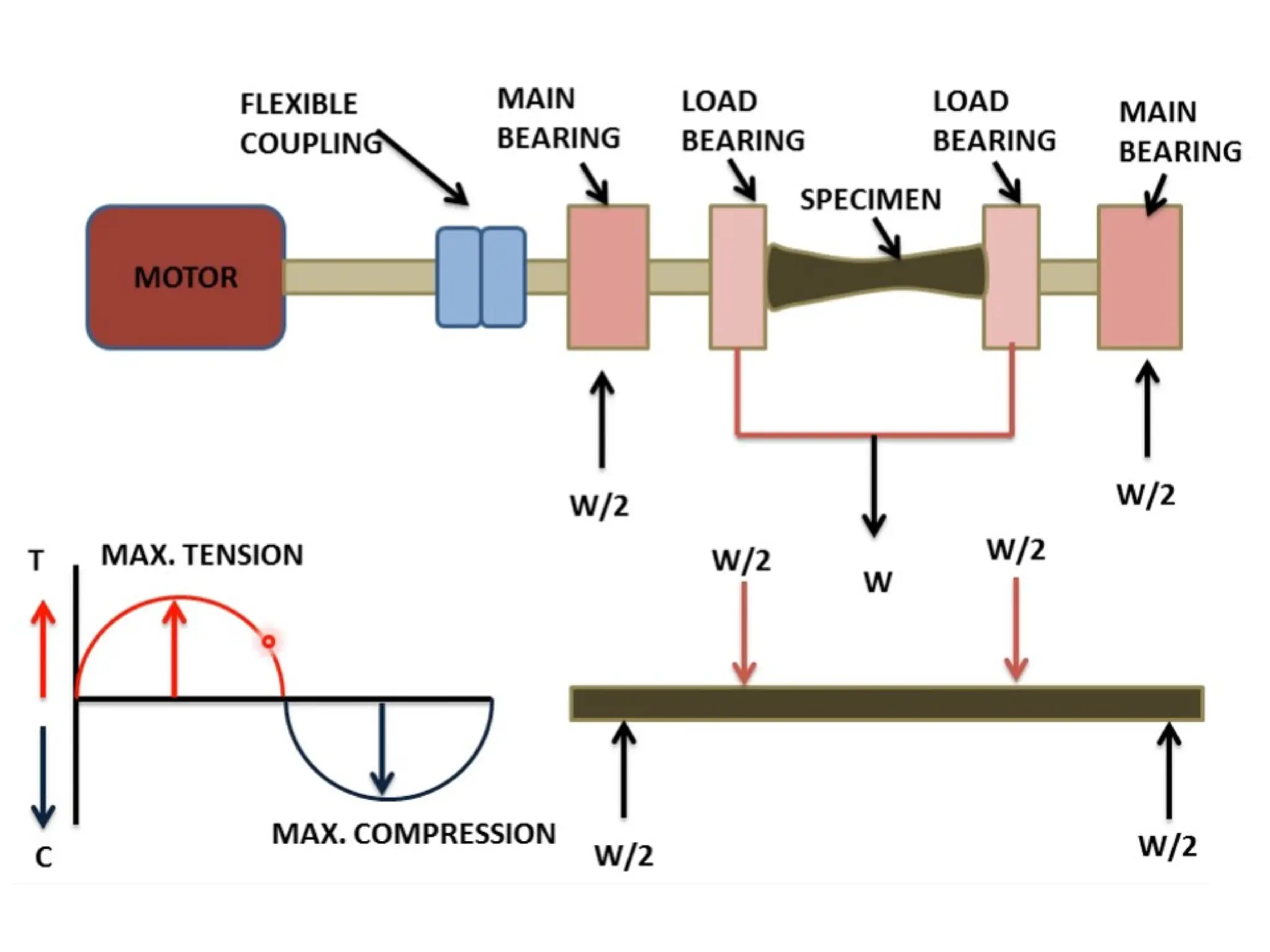
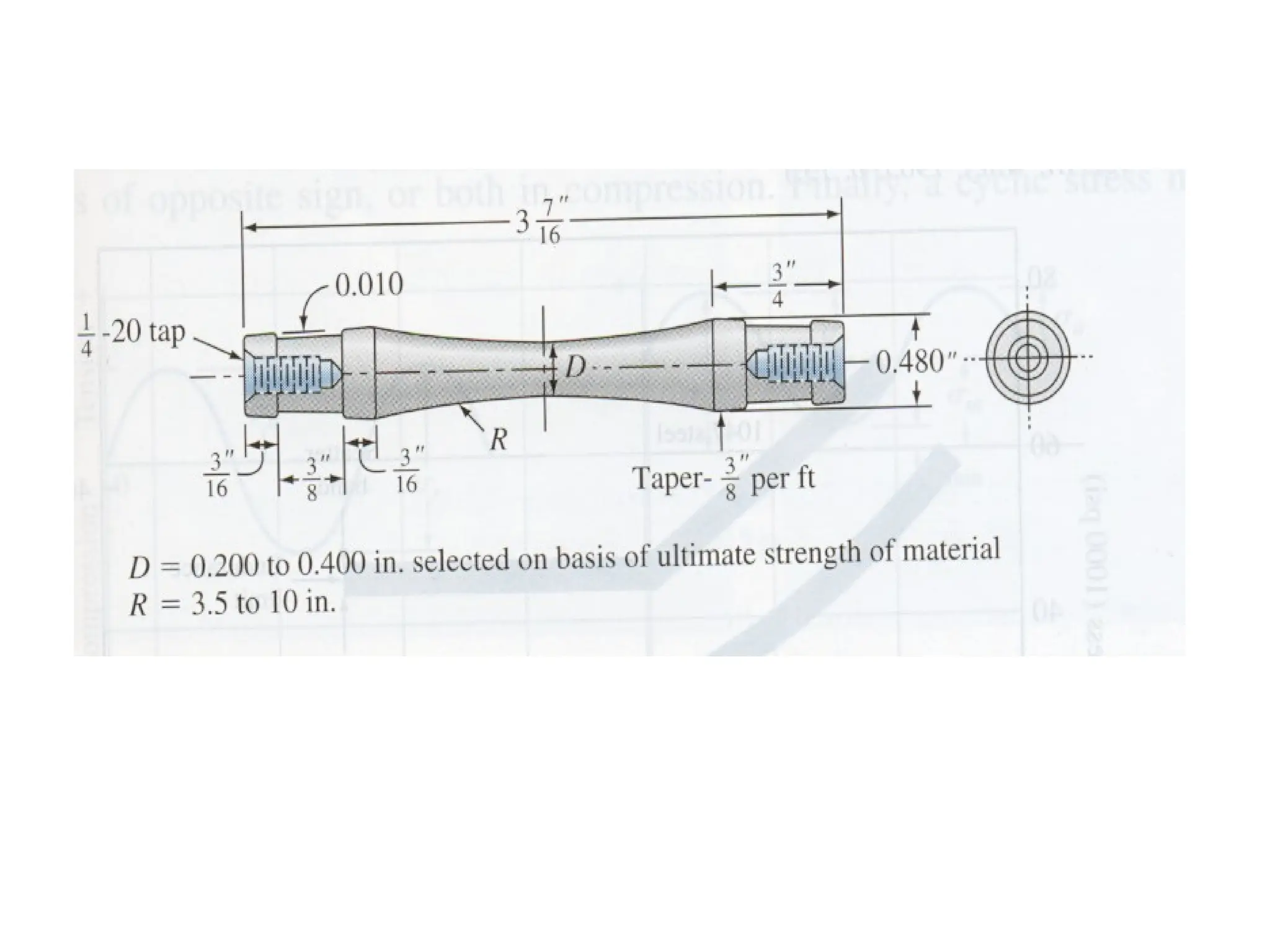
Laboratory Fatigue Tester
Laboratory Bicycle Handle Tester
(Various loads at once)
Shoe Fatigue Tester Airplane Fatigue Tester
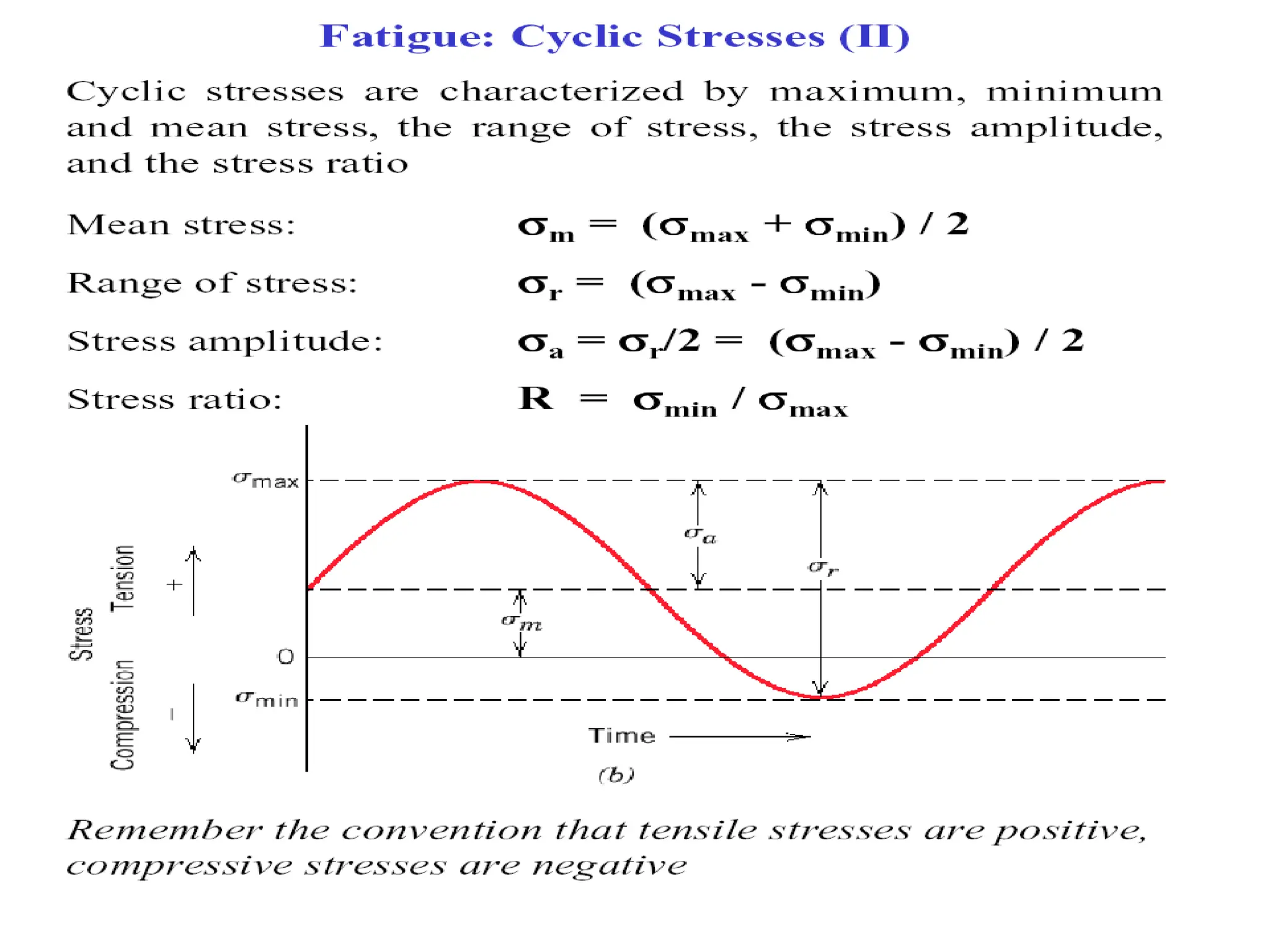
TS or σy
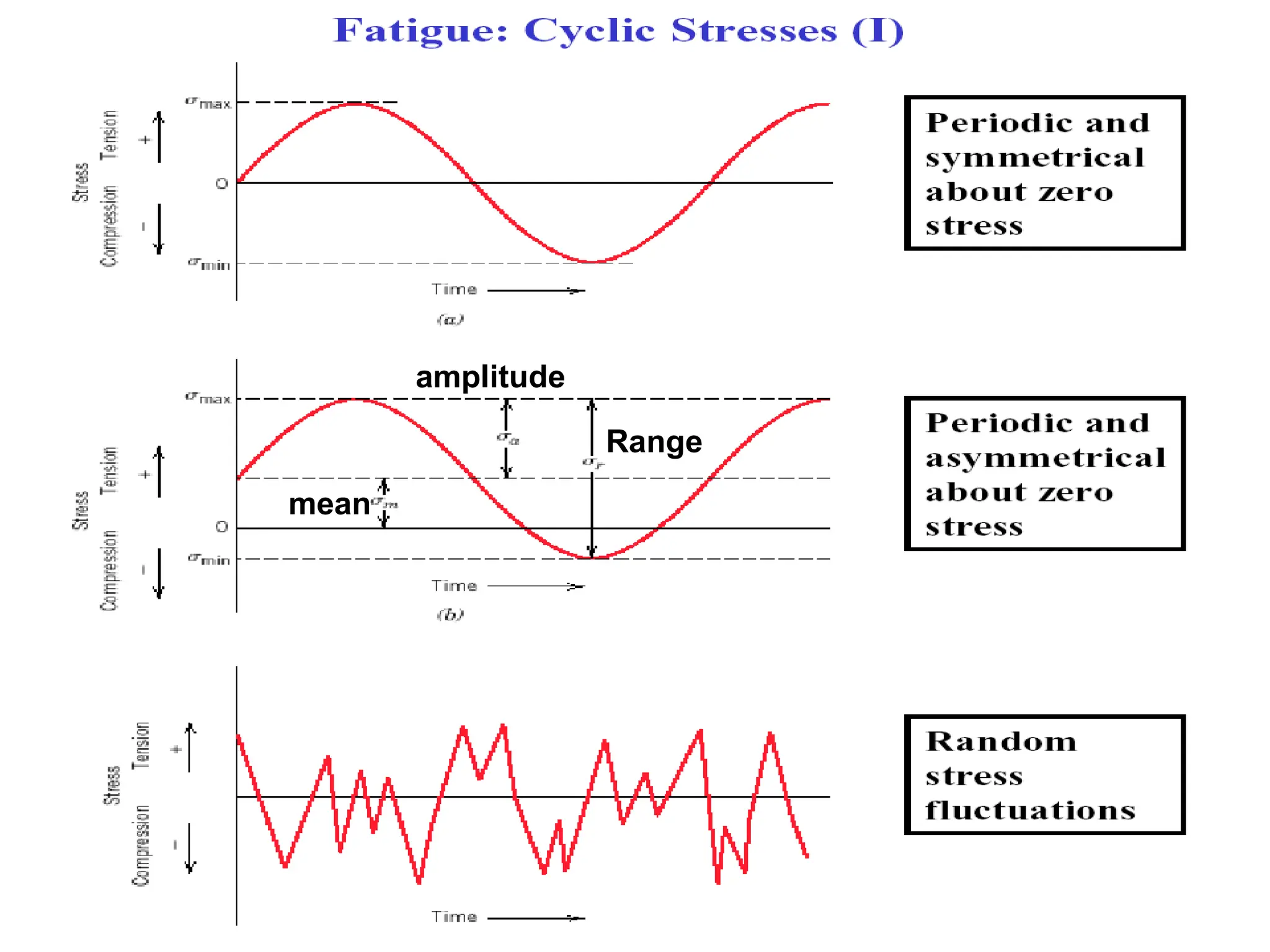
mean
Range
amplitude
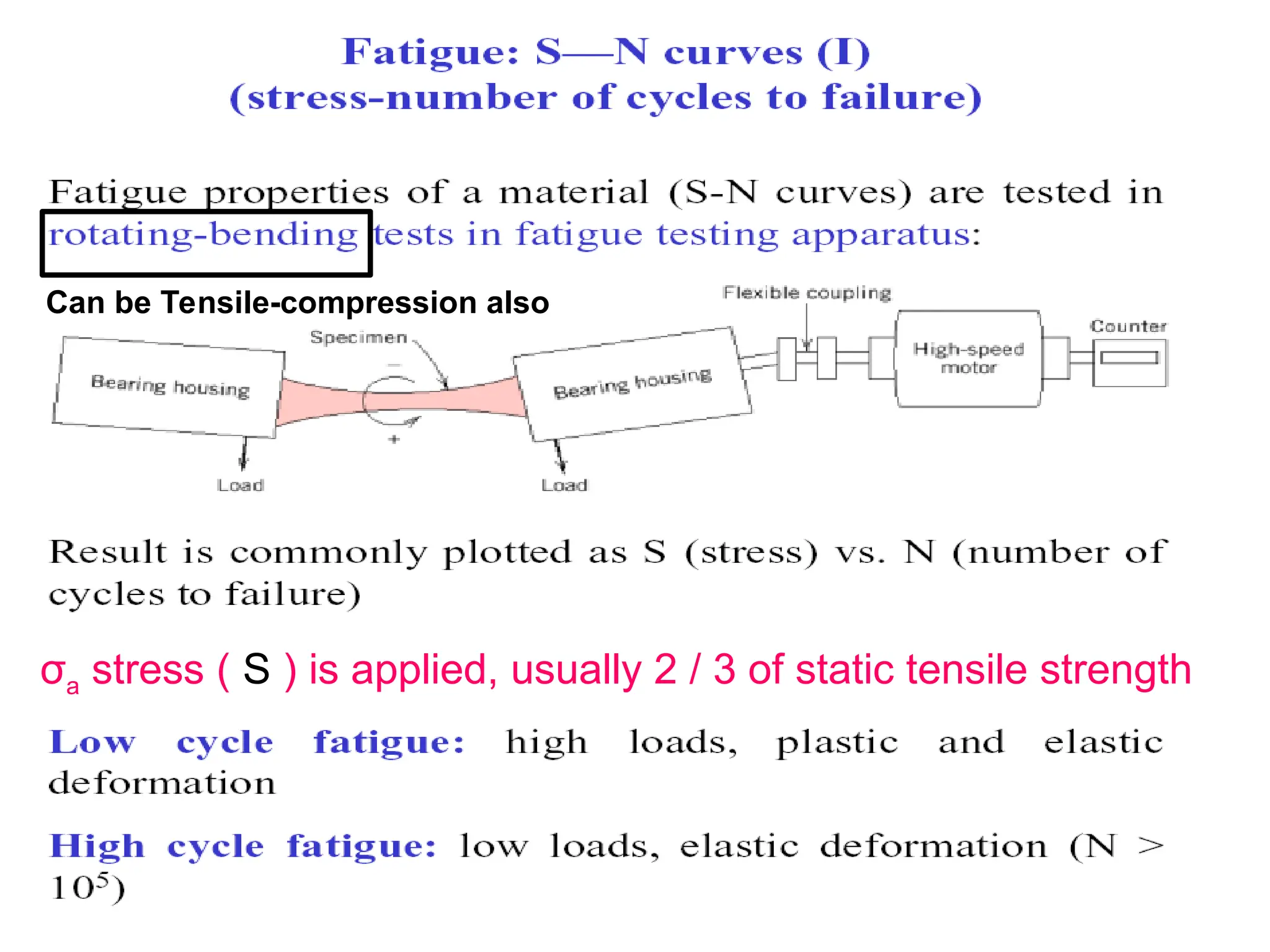
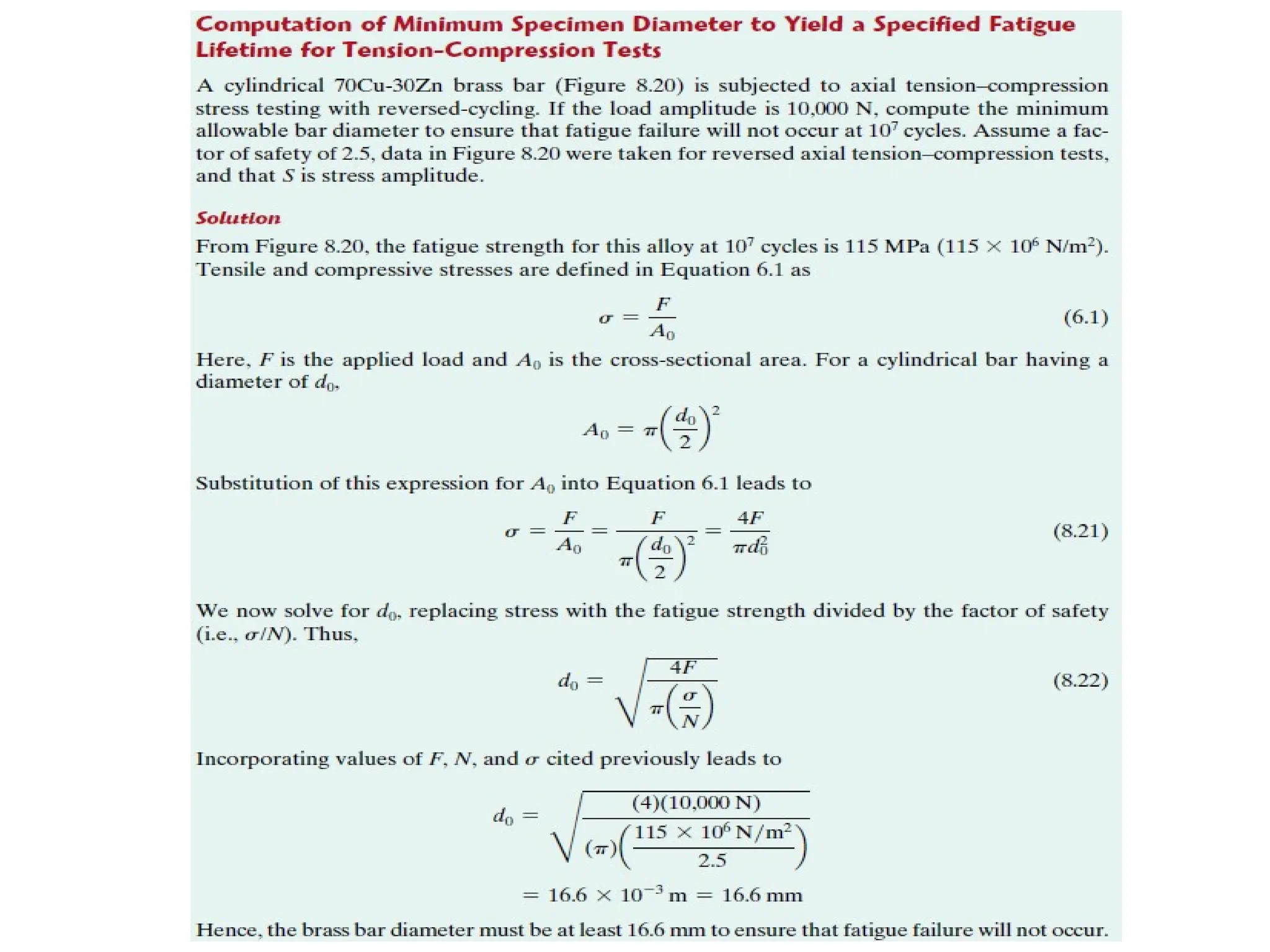
σa stress ( S ) is applied, usually 2 / 3 of static tensile strength
Can be Tensile-compression also
https://www.youtube.com/watch?v=LhUclxBUV_E
Demonstration of Fatigue Testing
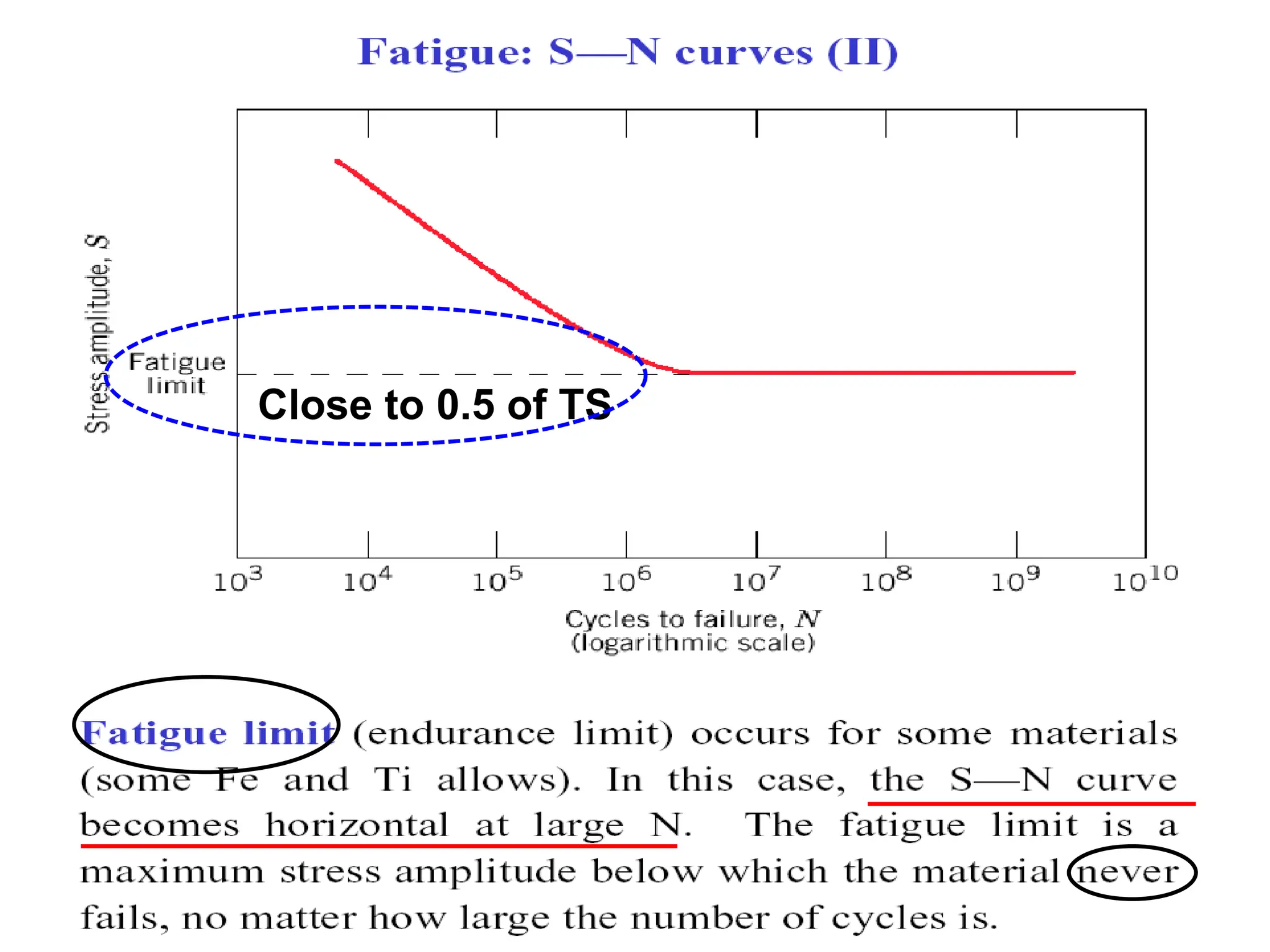
Close to 0.5 of TS
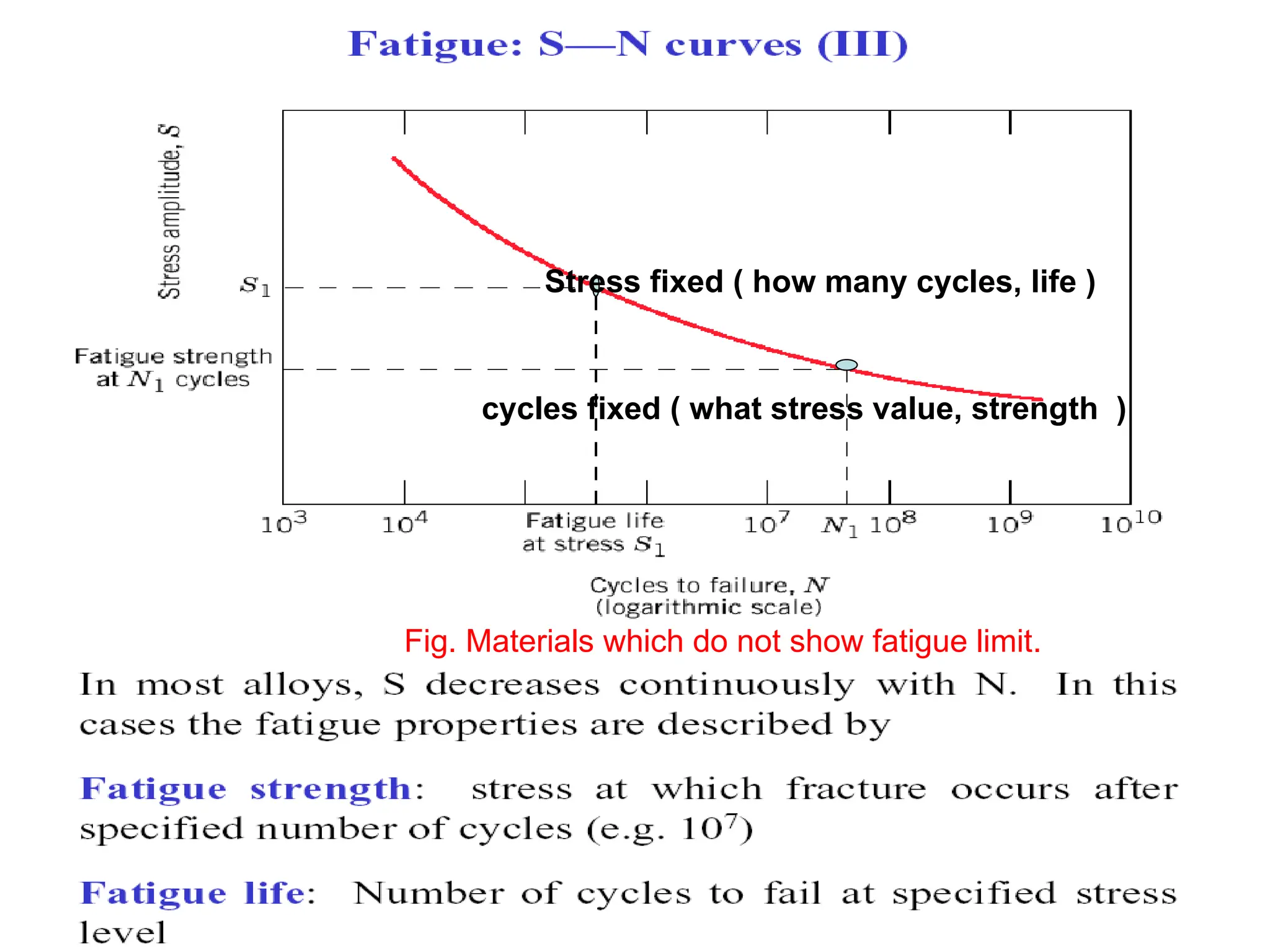
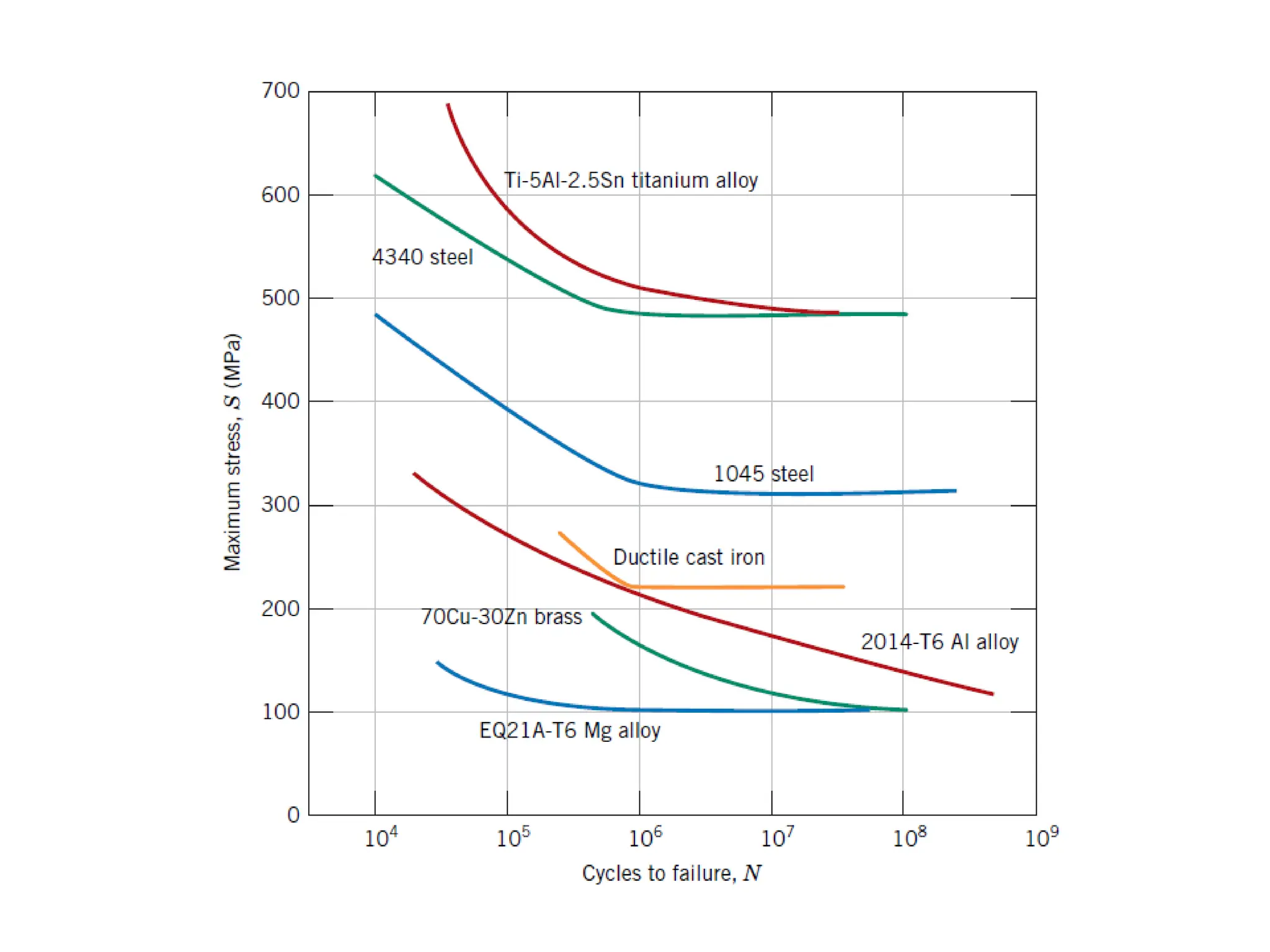
cycles fixed ( what stress value, strength )
Stress fixed ( how many cycles, life )
Fig. Materials which do not show fatigue limit.
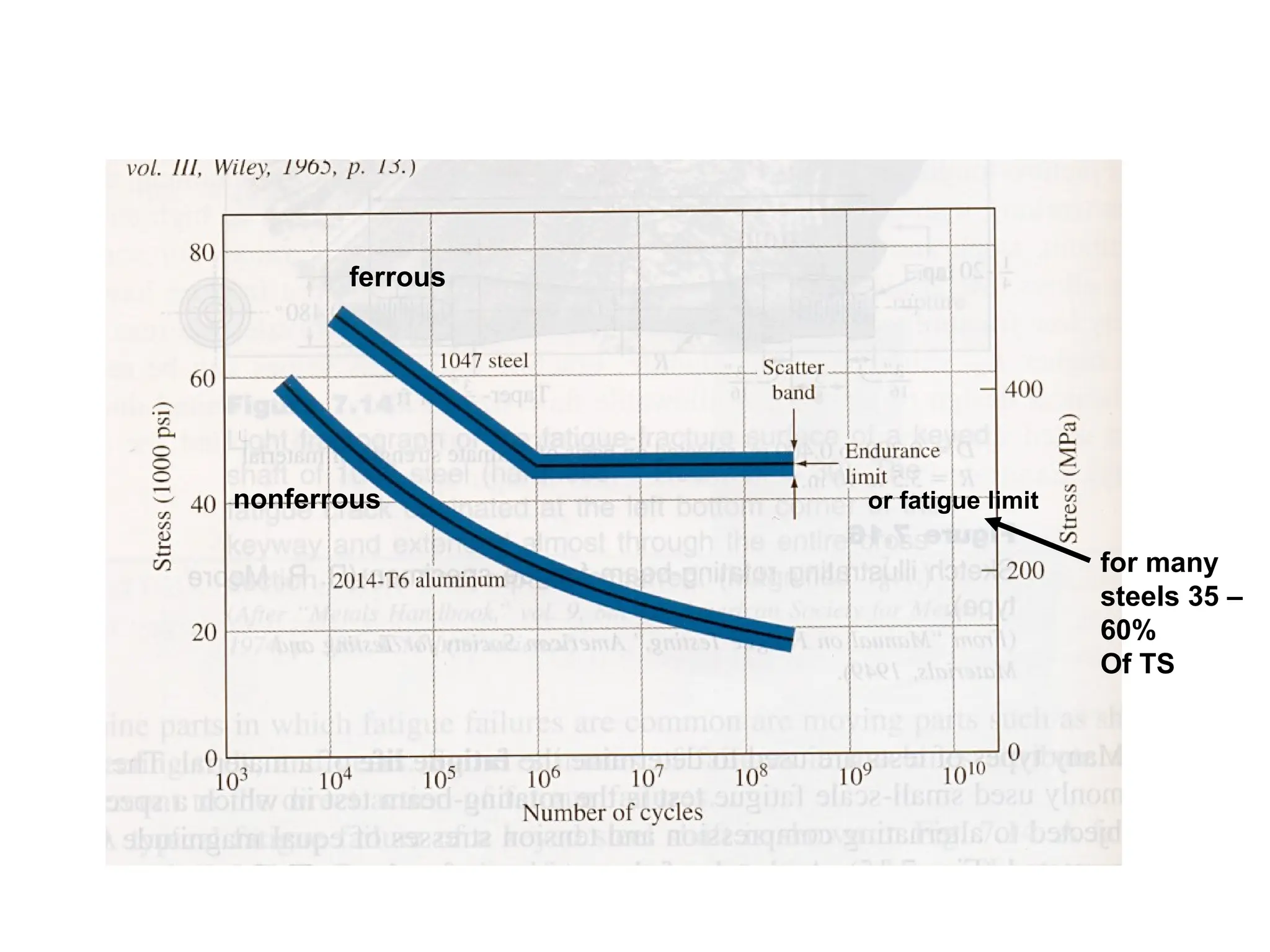
or fatigue limit
for many
steels 35 –
60%
Of TS
ferrous
nonferrous
Nucleation
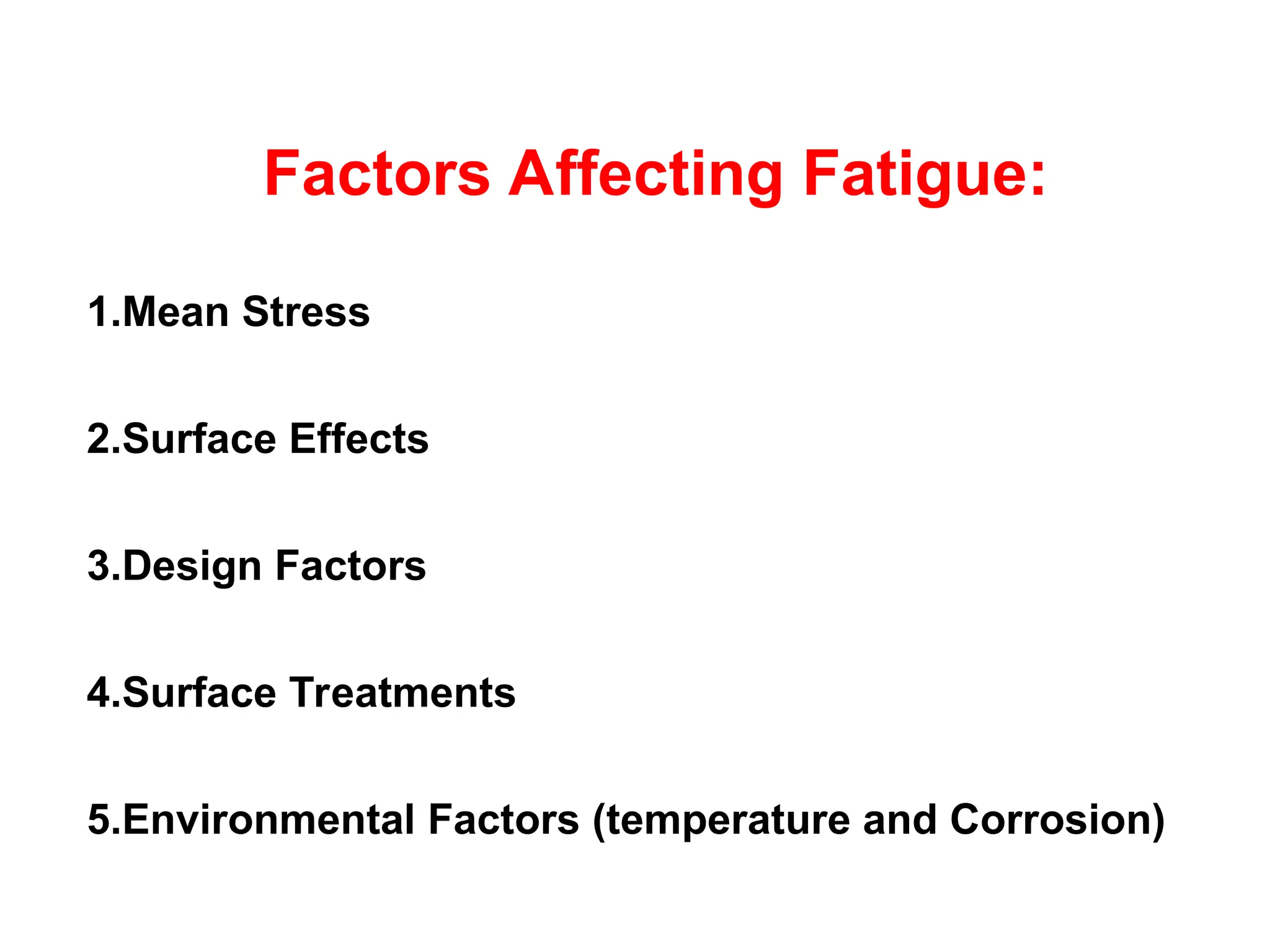
Factors Affecting Fatigue:
1.Mean Stress
2.Surface Effects
3.Design Factors
4.Surface Treatments
5.Environmental Factors (temperature and Corrosion)
( no. of cycles to fracture at certain stress )
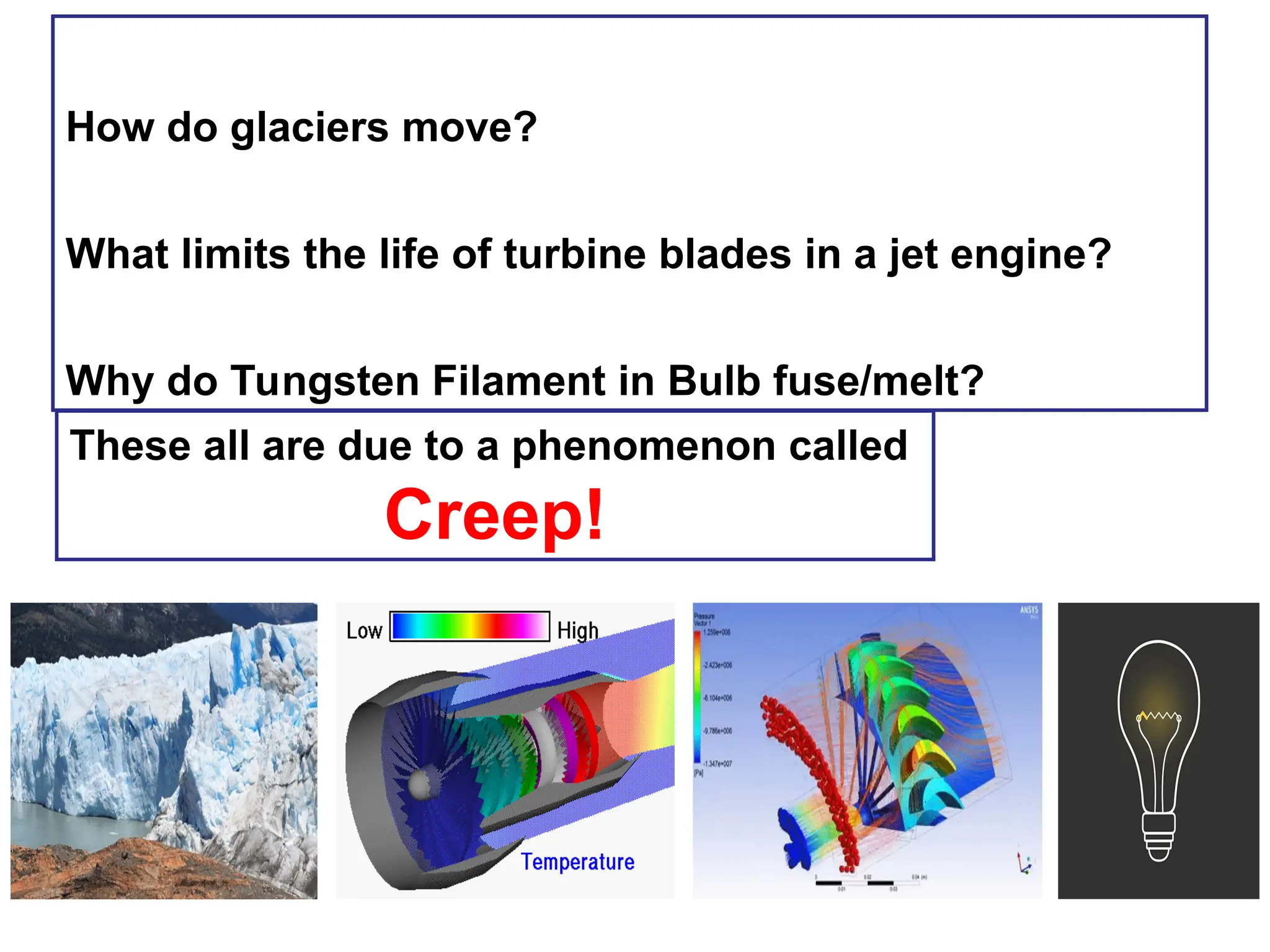
How do glaciers move?
What limits the life of turbine blades in a jet engine?
Why do Tungsten Filament in Bulb fuse/melt?
These all are due to a phenomenon called
Creep!
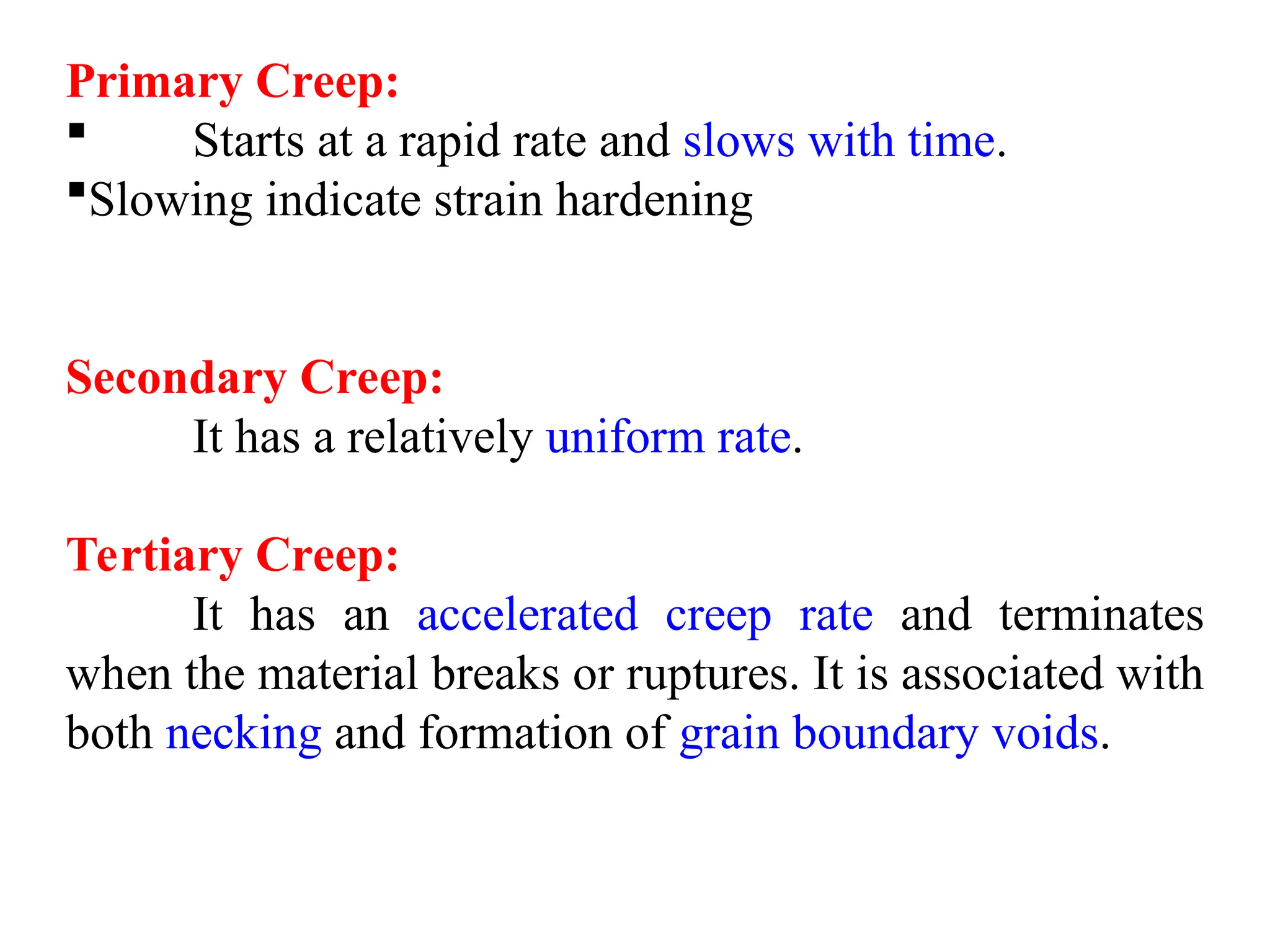
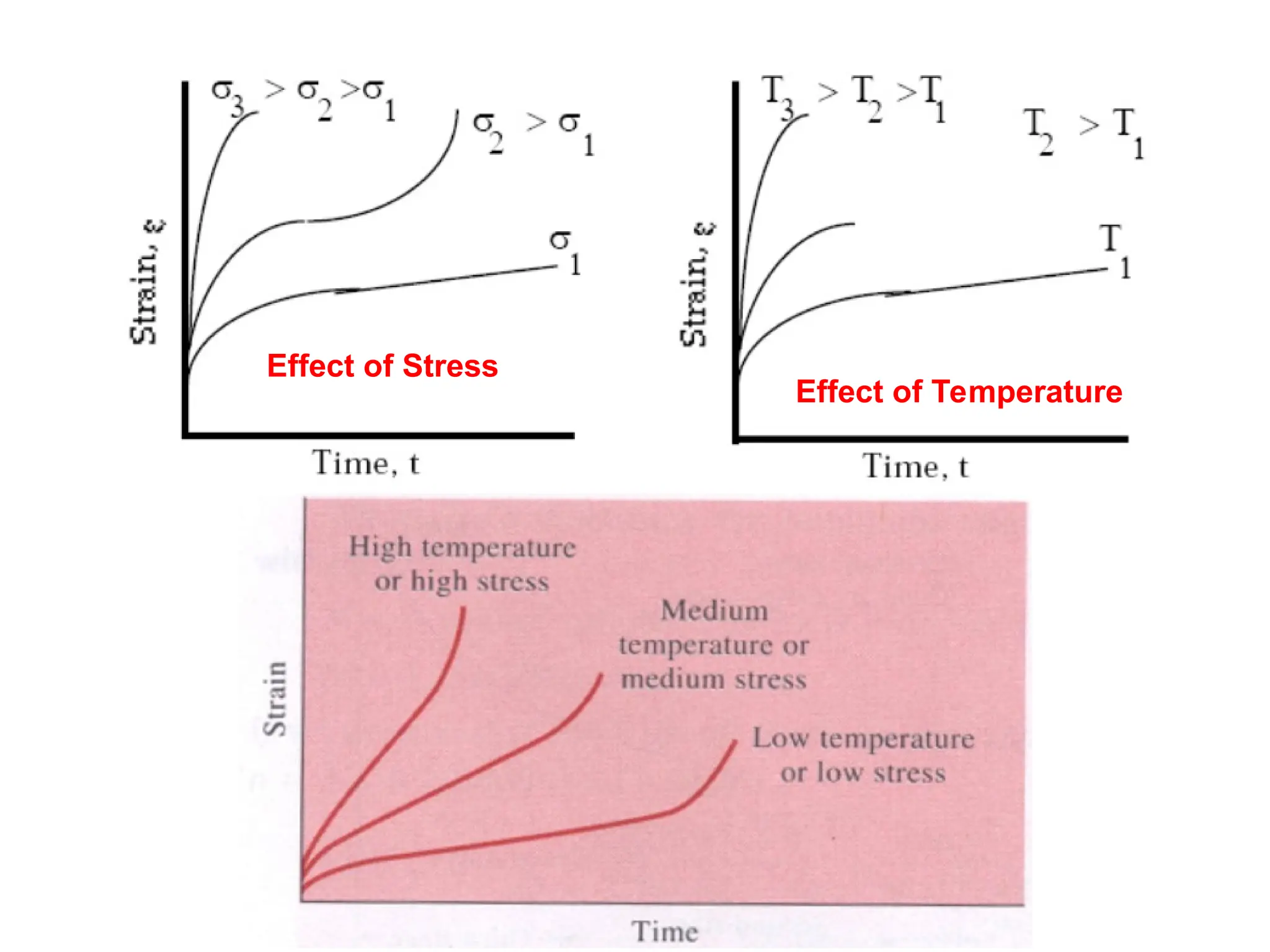
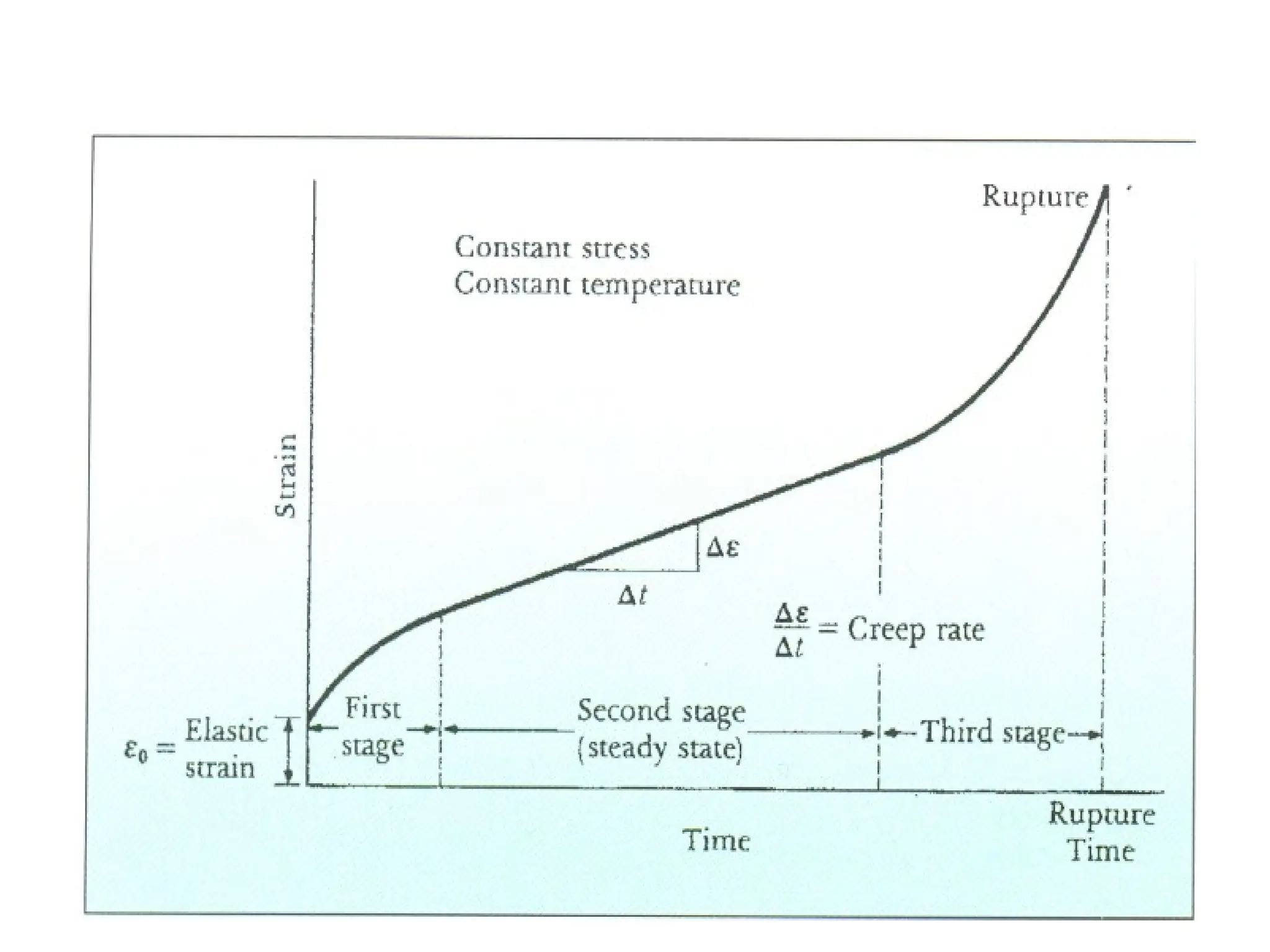
Primary Creep:
 Starts at a rapid rate and slows with time.
Slowing indicate strain hardening
Secondary Creep:
It has a relatively uniform rate.
Tertiary Creep:
It has an accelerated creep rate and terminates
when the material breaks or ruptures. It is associated with
both necking and formation of grain boundary voids.
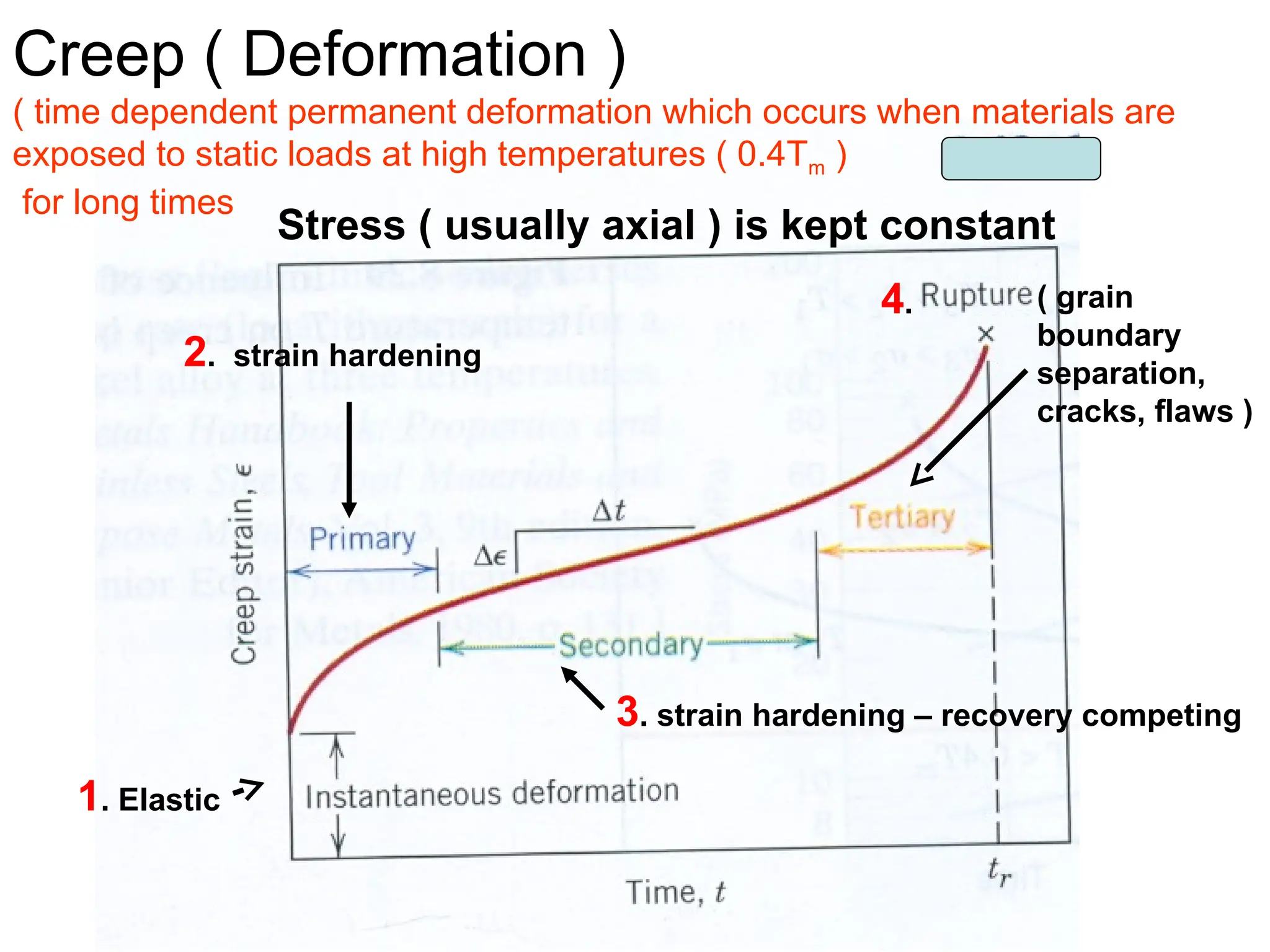
Creep ( Deformation )
( time dependent permanent deformation which occurs when materials are
exposed to static loads at high temperatures ( 0.4Tm )
for long times
Stress ( usually axial ) is kept constant
2. strain hardening
3. strain hardening – recovery competing
( grain
boundary
separation,
cracks, flaws )
1. Elastic
4.
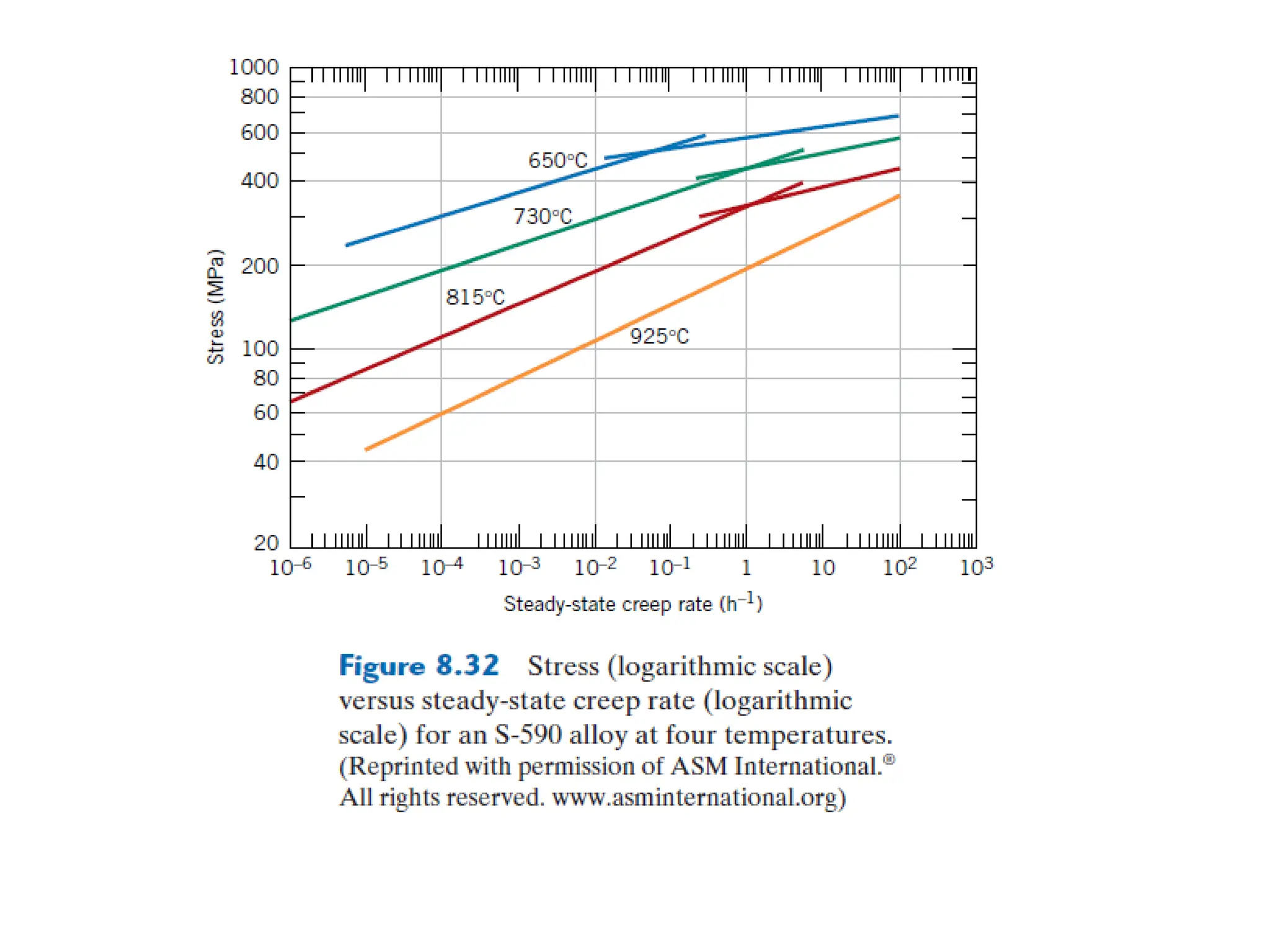
Effect of Stress
Effect of Temperature
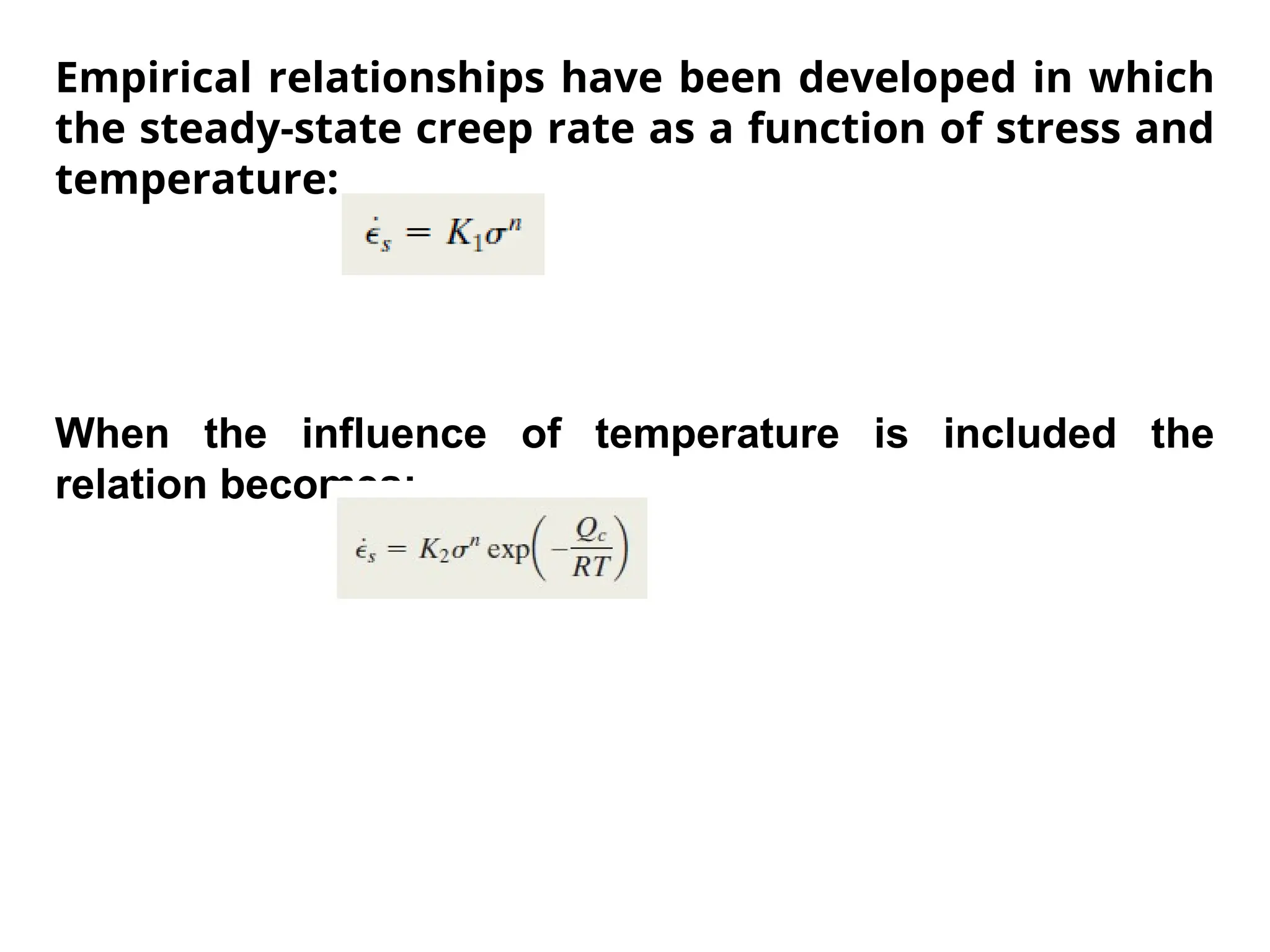
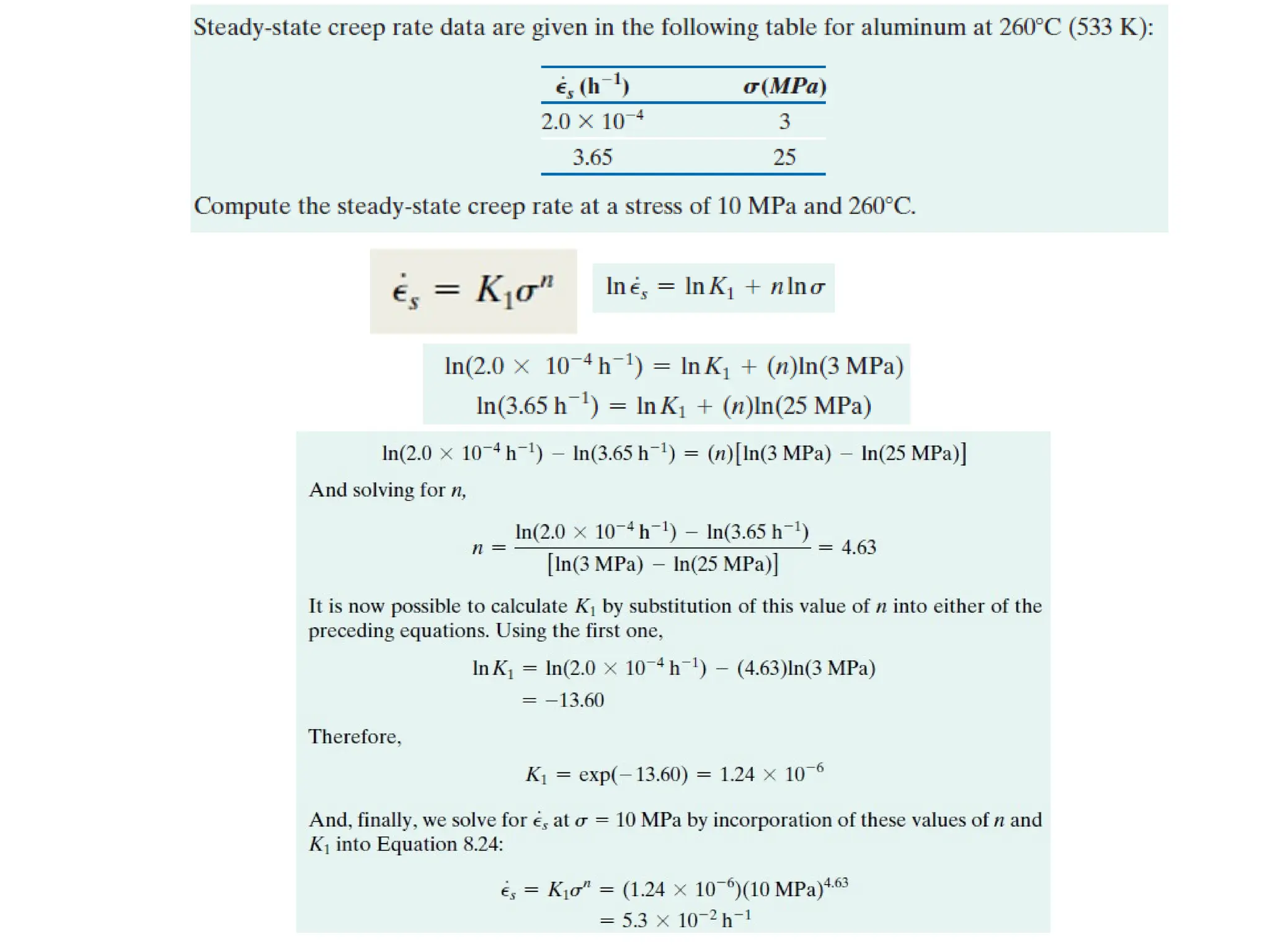
Empirical relationships have been developed in which
the steady-state creep rate as a function of stress and
temperature:
When the influence of temperature is included the
relation becomes:
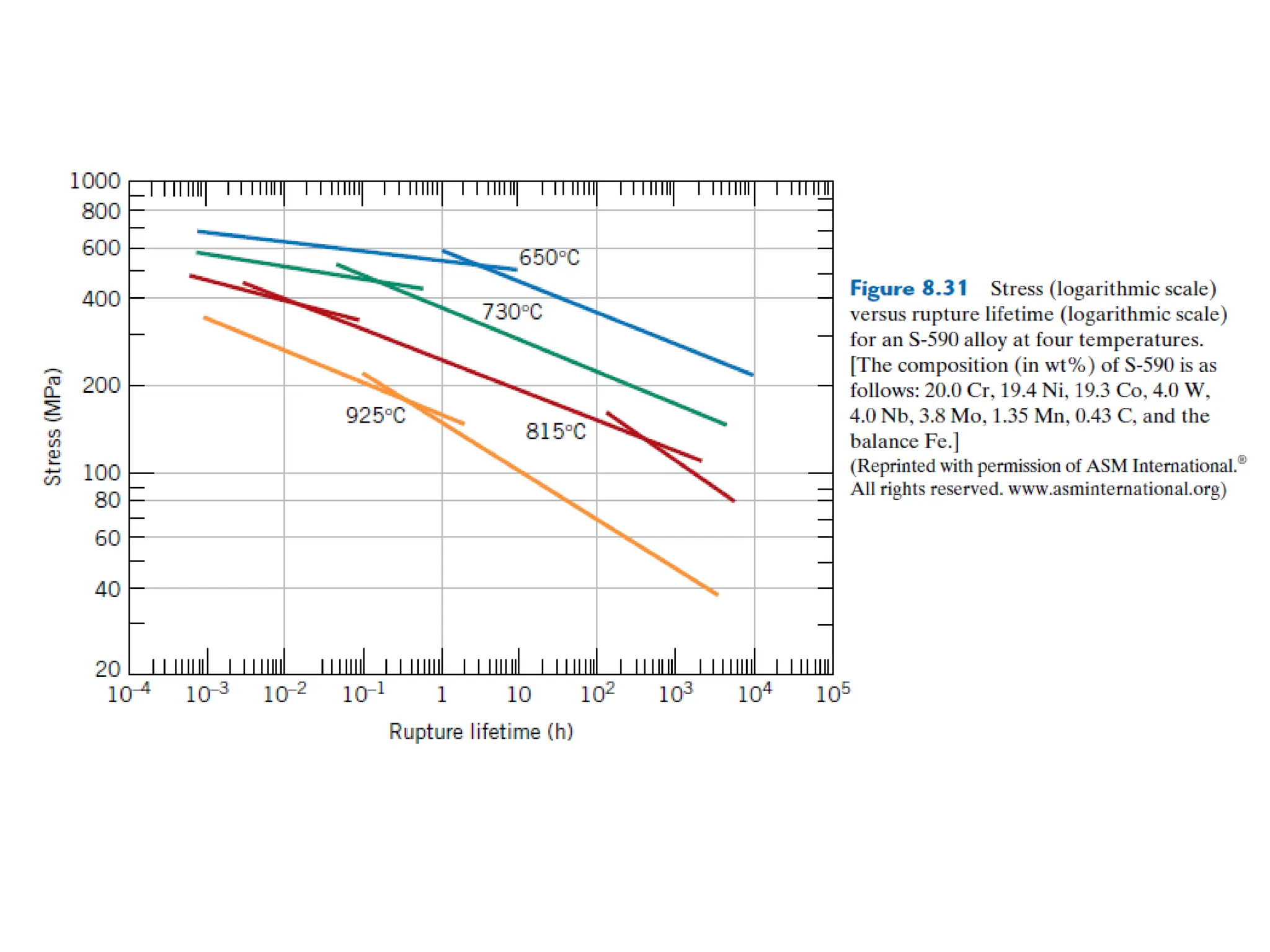
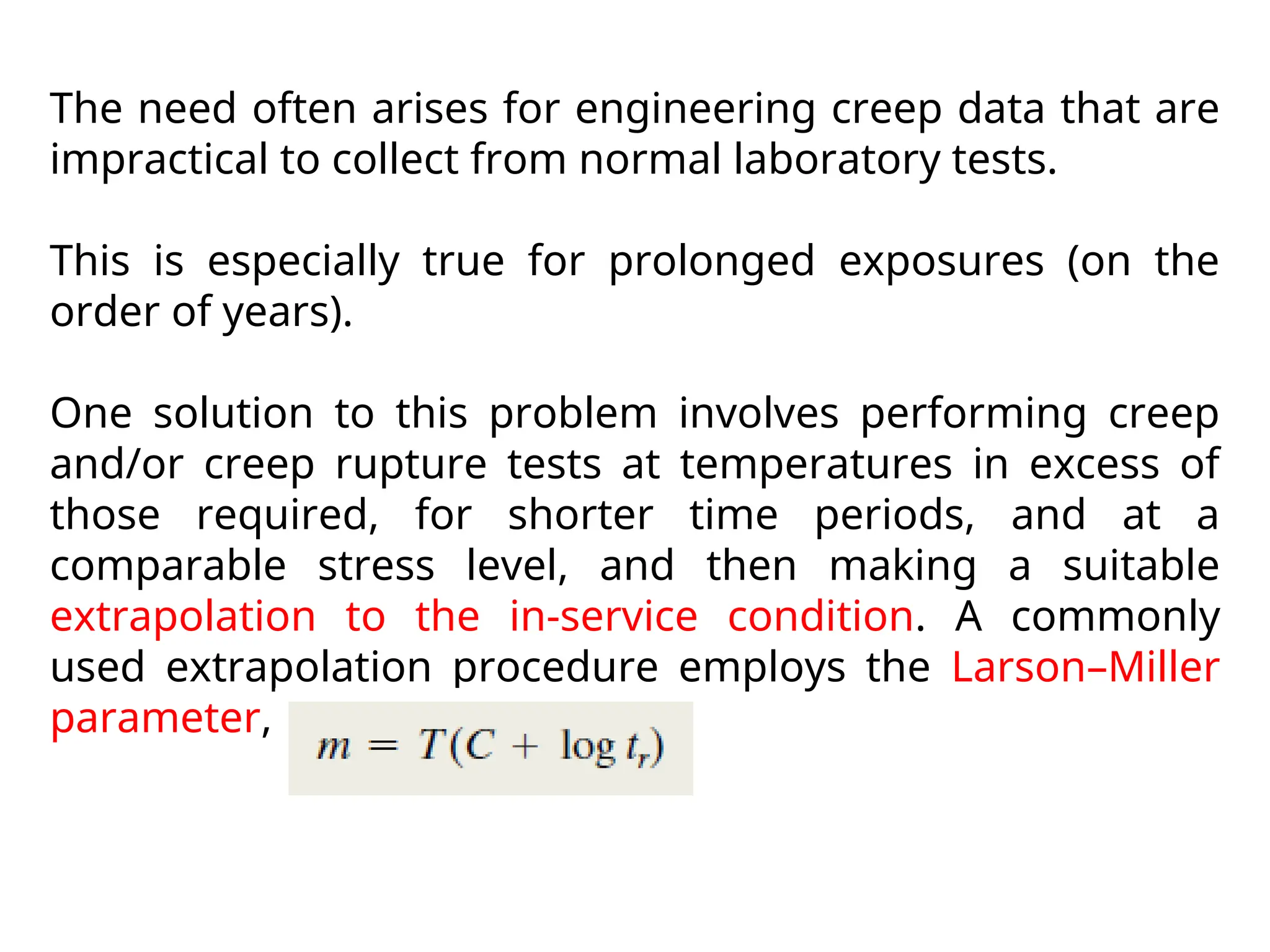
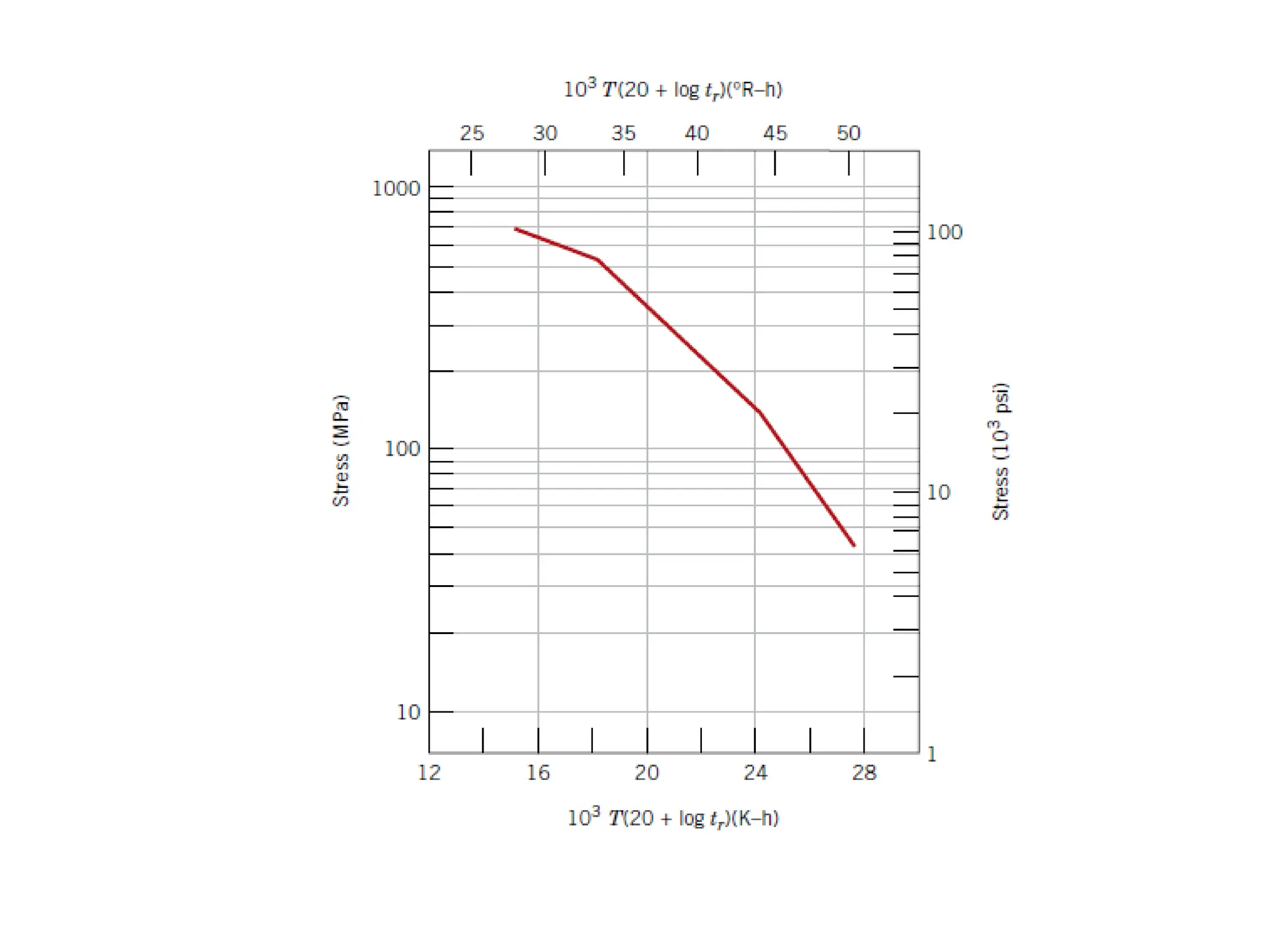
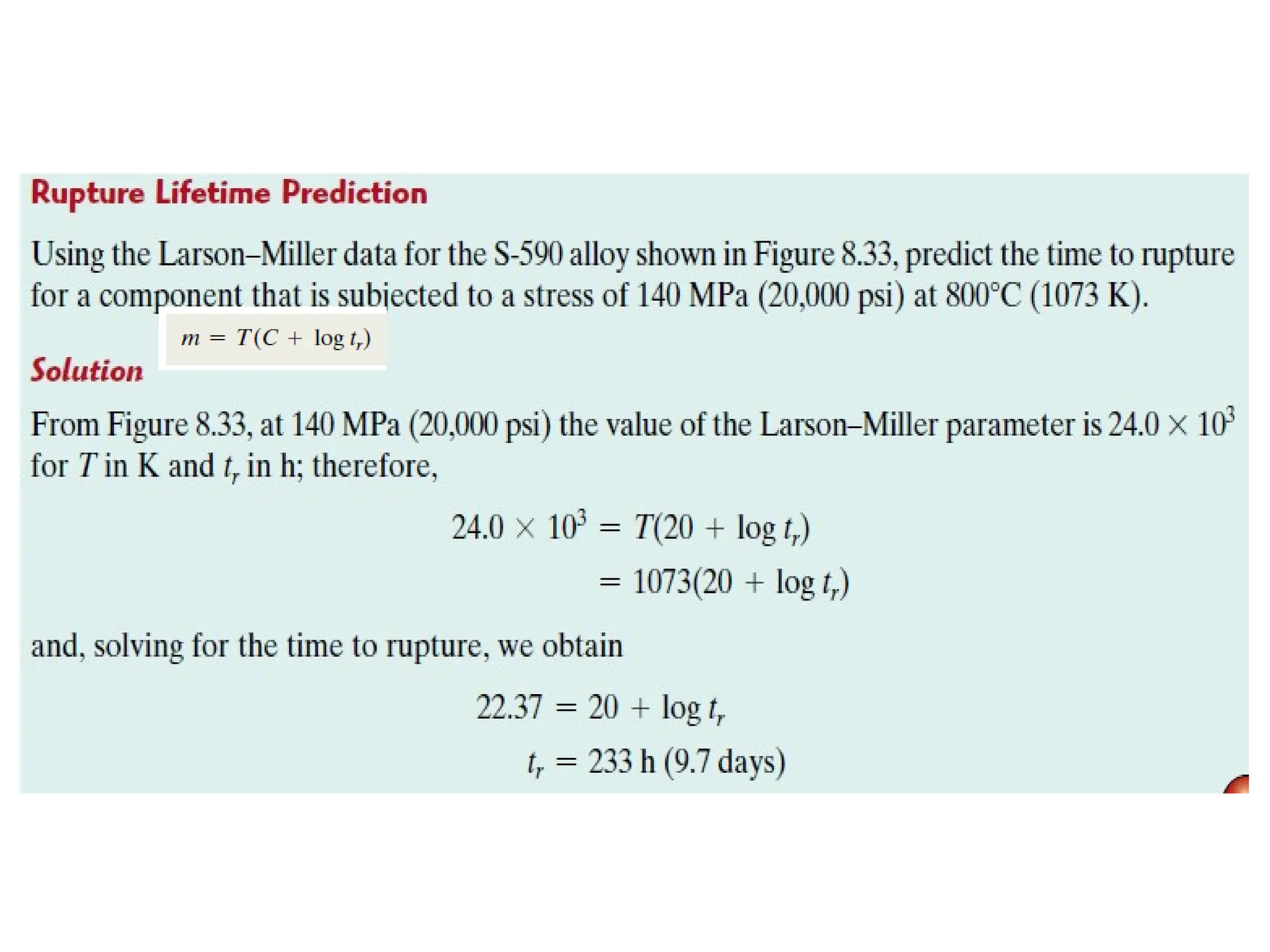
The need often arises for engineering creep data that are
impractical to collect from normal laboratory tests.
This is especially true for prolonged exposures (on the
order of years).
One solution to this problem involves performing creep
and/or creep rupture tests at temperatures in excess of
those required, for shorter time periods, and at a
comparable stress level, and then making a suitable
extrapolation to the in-service condition. A commonly
used extrapolation procedure employs the Larson–Miller
parameter, m, defined as:
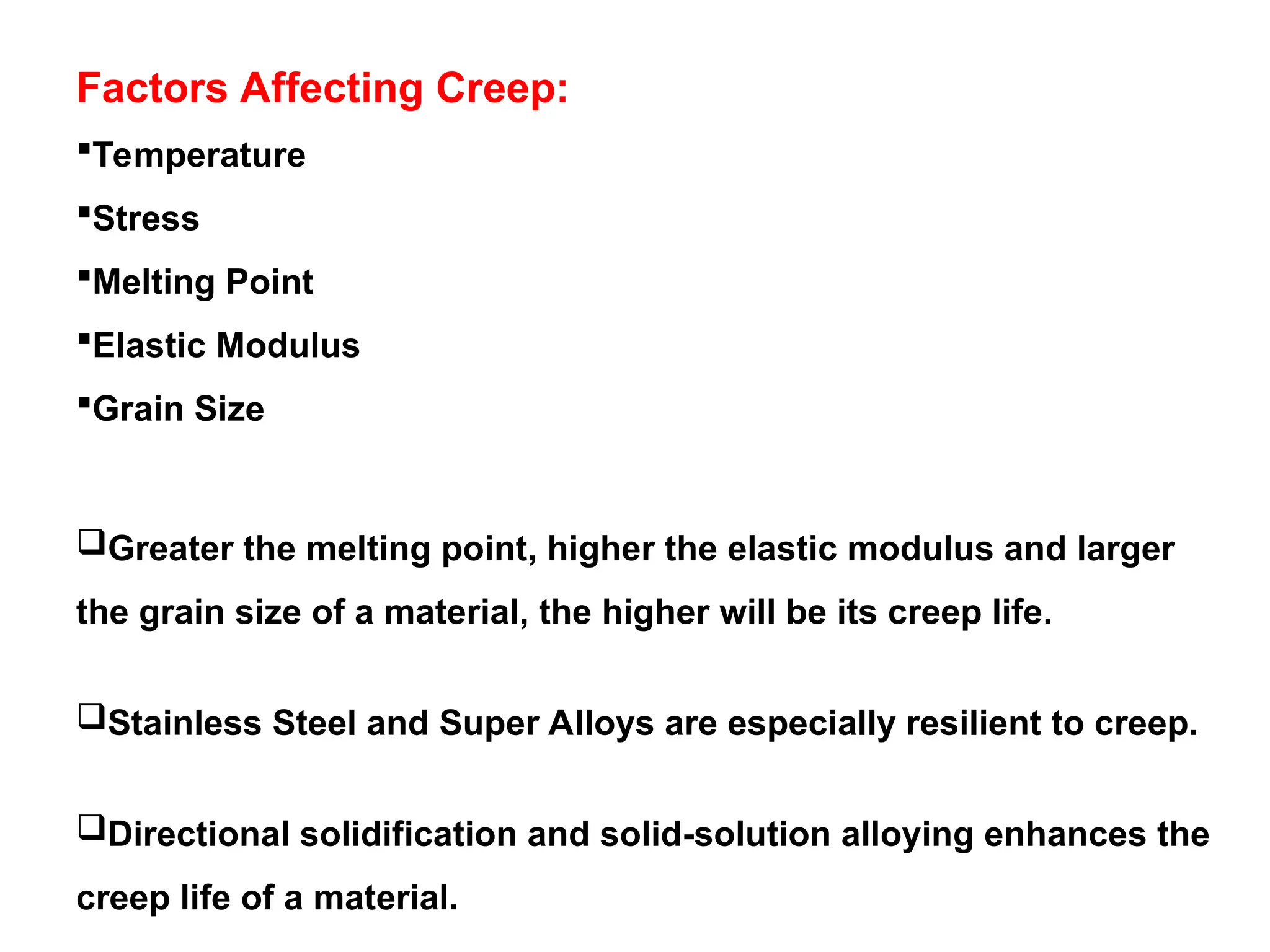
Factors Affecting Creep:
Temperature
Stress
Melting Point
Elastic Modulus
Grain Size
Greater the melting point, higher the elastic modulus and larger
the grain size of a material, the higher will be its creep life.
Stainless Steel and Super Alloys are especially resilient to creep.
Directional solidification and solid-solution alloying enhances the
creep life of a material.
Chapter#8 Failure-Spring 2021-3 MTM Eng.ppt

  • 1.
  • 2.
    Concept Check 8.1 Citetwo situations in which the possibility of failure is part of the design of a component or product. Answer: Several situations in which the possibility of failure is part of the design of a component or product are as follows: 1.The pull tab on the top of aluminum beverage cans 2.Aluminum utility/light poles that reside along freeways—a minimum of damage occurs to a vehicle when it collides with the pole. 3.In some machinery components, a shear pin is used to connect a gear or pulley to a shaft—the pin is designed shear off before damage is done to either the shaft or gear in an overload situation
  • 3.
    Topics to becovered Simple fracture – Ductile – Brittle Fundamentals of fracture mechanics Fracture toughness testing Ductile-to-brittle transition Fatigue (when cyclic stresses are imposed) Creep (time-dependent deformation, normally at elevated temperatures)
  • 4.
    Chapter 8: Failure Cavities,Cracks, Voids, Notches, Surface Scratches, Corners
  • 8.
  • 9.
  • 10.
    a. Initial necking b.Cavity formation c. Coalescence of cavities to form crack d. Crack propagation (slip) e. Final shear fracture at 45° relative to tensile direction Mechanism of ductile Fracture
  • 11.
    Tensile loading Shearloading Ductile Fracture
  • 13.
    Brittle Fracture: SEMis used to study surface V – Shaped chevrons Fan-like markings Ceramics will have shiny surface
  • 14.
    Ductile Brittle deformation extensivelittle Crack propagation slow, needs stress fast type of materials most metals (not too cold) ceramics, ice, cold metals warning permanent elongation none strain energy higher lower fractured surface rough smoother necking yes no
  • 17.
    Trans-granular - facetedInter- granular ( weakened boundaries )
  • 18.
    Fracture Mechanics: Quantification ofrelationship between material properties, stress level, crack propagating flaws, propagating mechanism Fracture strength for most materials is lower than theoretical one
  • 19.
    Stress Raisers Much smaller forcesare required for fracture. Why
  • 20.
    Amplification will dependon crack orientation & Geometry Cracks, Voids, sharp corners, notches, scratches amplify stresses
  • 21.
    Radius of curvature Stressconcentration factor
  • 22.
    Stress required forcrack propagation in brittle materials All brittle materials contain cracks & flaws of various sizes, geometries, orientation. When critical stress is reached, crack starts propagating. Stress-raiser-free whiskers can be made
  • 23.
    Example problem 8.1: Determinethe maximum flaw size at which fracture occurs Material = Large Glass sheet Tensile Stress = 40 MPa Specific surface Energy = 0.3 J/ m2 Modulus of Elasticity = 69 GPa a = 8.2 µm
  • 24.
    Fracture Toughness: Critical stress(σc ) related to length of crack (a) : definition Kc depends on length of crack Vs thickness of material that cracks
  • 25.
    Y = 1.0Y = 1.1 Crack in a plate of infinite width Crack ( notch ) in a plate of semi-infinite width Fracture toughness and value of Y ( plane strain condition )
  • 26.
    Plane strain condition: 1.Nodeformation in Z direction 2. Thickness B much larger than notch depth a
  • 27.
    No strain component normalto front and back face. Under Plane Strain condition i.e Rather than Plane strain fracture toughness
  • 28.
    Design Using FractureMechanics KIC depends on Temperature, loading rate, microstructure, etc.
  • 29.
    Fracture Mechanics and →Possibility of Fracture
  • 30.
    Note: σy ,TS, and %EL are all functions of loading rate
  • 31.
    1) Impact energydetermination as function of T 2 ) Range of temperature over which ductile-to-brittle transition takes place Note: Both KIC & Impact tests determine the fracture properties of materials
  • 33.
    Specimen for bothIzod and Charpy ( mostly in US )
  • 34.
    Most Important Objectiveof CVN (Charpy V-Notch) testing: Finding ductile-to-brittle transition Temperature For steel Ignore this graph brittle ductile
  • 35.
    Most Important Objectiveof CVN (Charpy V-Notch) testing: Finding ductile-to-brittle transition Temperature Shiny and cleavage = Brittle Fibrous/dull = Ductile
  • 36.
    Ductile materials require moreenergy to fracture Ductile materials become brittle as temperature is lowered
  • 37.
    Low strength (remainductile, large E) (remain brittle, small E ) low strength steel
  • 38.
    Increasing carbon contentsin steel Note: Grain size also affects DBTT
  • 39.
    Fatigue ( fracture whenstress-strain fluctuates in time) Stress may be Axial, Flexural or Torsional 1. occurs usually at lower applied stress 2. responsible for ~ 90 % damage 3. is brittle-like 4. called fatigue because each cycle incrementally adds to the damage (to the strain, crack growth) 5. slow moving crack which rapidly picks up speed
  • 40.
    Laboratory Fatigue Tester LaboratoryBicycle Handle Tester (Various loads at once) Shoe Fatigue Tester Airplane Fatigue Tester
  • 41.
  • 42.
  • 46.
    σa stress (S ) is applied, usually 2 / 3 of static tensile strength Can be Tensile-compression also
  • 48.
  • 49.
  • 50.
    cycles fixed (what stress value, strength ) Stress fixed ( how many cycles, life ) Fig. Materials which do not show fatigue limit.
  • 51.
    or fatigue limit formany steels 35 – 60% Of TS ferrous nonferrous
  • 56.
  • 58.
    Factors Affecting Fatigue: 1.MeanStress 2.Surface Effects 3.Design Factors 4.Surface Treatments 5.Environmental Factors (temperature and Corrosion)
  • 59.
    ( no. ofcycles to fracture at certain stress )
  • 60.
    How do glaciersmove? What limits the life of turbine blades in a jet engine? Why do Tungsten Filament in Bulb fuse/melt? These all are due to a phenomenon called Creep!
  • 61.
    Primary Creep:  Startsat a rapid rate and slows with time. Slowing indicate strain hardening Secondary Creep: It has a relatively uniform rate. Tertiary Creep: It has an accelerated creep rate and terminates when the material breaks or ruptures. It is associated with both necking and formation of grain boundary voids.
  • 62.
    Creep ( Deformation) ( time dependent permanent deformation which occurs when materials are exposed to static loads at high temperatures ( 0.4Tm ) for long times Stress ( usually axial ) is kept constant 2. strain hardening 3. strain hardening – recovery competing ( grain boundary separation, cracks, flaws ) 1. Elastic 4.
  • 64.
  • 68.
    Empirical relationships havebeen developed in which the steady-state creep rate as a function of stress and temperature: When the influence of temperature is included the relation becomes:
  • 70.
    The need oftenarises for engineering creep data that are impractical to collect from normal laboratory tests. This is especially true for prolonged exposures (on the order of years). One solution to this problem involves performing creep and/or creep rupture tests at temperatures in excess of those required, for shorter time periods, and at a comparable stress level, and then making a suitable extrapolation to the in-service condition. A commonly used extrapolation procedure employs the Larson–Miller parameter, m, defined as:
  • 73.
    Factors Affecting Creep: Temperature Stress MeltingPoint Elastic Modulus Grain Size Greater the melting point, higher the elastic modulus and larger the grain size of a material, the higher will be its creep life. Stainless Steel and Super Alloys are especially resilient to creep. Directional solidification and solid-solution alloying enhances the creep life of a material.