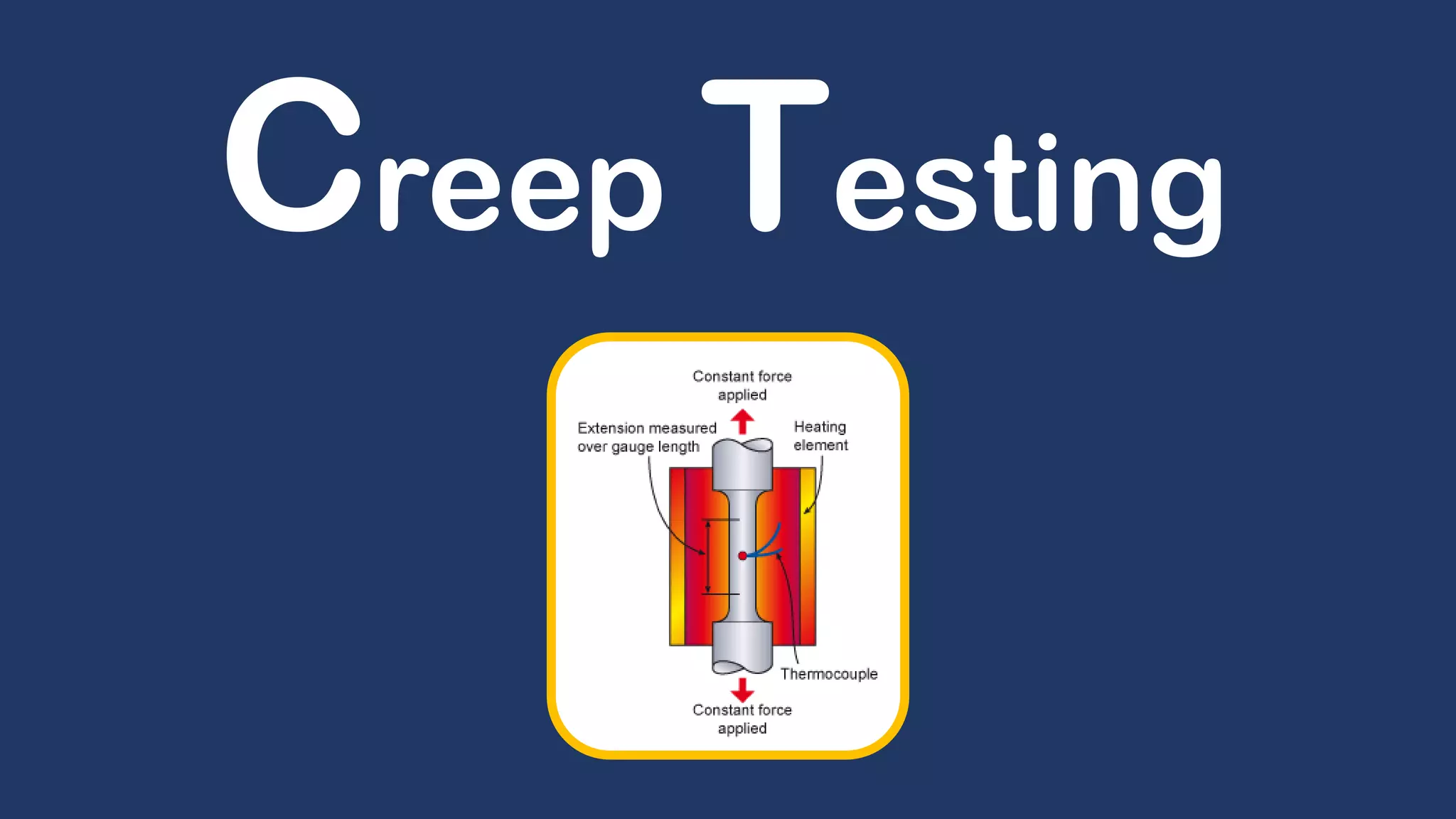
Creep Testing
➢ Intro (Muhammad Sa’eed)
➢ Mechanism (Hassan Tarek)
➢ Specimen (Muhammad Sayed)
➢ Machine (Muhammad Zaki)
➢ Procedures (Najeh Fayez)
Outlines
➢ Results (Amir Mos’ad)
➢ Effect of temperature (Islam M. Reda)
➢ Rupture strength (Muhammad Ali)
➢ Precautions (Mahmoud Mukhtar)
➢ Apps (Muhammad Mostafa)
introduction
MECHANISMS OF CREEP
Testing
MECHANISMS OF CREEP Testing
➢ MECHANISMS OF CREEP
a) Dislocation climb
b) Vacancy Diffusion
c) Grain boundary sliding
➢ Dislocation movement
MECHANISMS OF CREEP Testing Cont…
➢ Vacancy Diffusion
MECHANISMS OF CREEP Testing Cont…
➢ Grain boundary sliding
MECHANISMS OF CREEP Testing Cont…
Specimen Preparation For
Creep Test
• Specimen materials ( ferrous – non ferrous)
Specimen Preparation For Creep Test
1. Round cross – section specimen.
2. Sheet or plate specimen.
• Specimen shape :
➢ Specimen Preparation For Creep Test
Specimen Preparation For Creep Test Cont…
1. Round cross – section specimen.
2. Sheet or plate specimen
 threaded ends
 shouldered ends
• The gage length of a specimen should be uniform.
• Specimens should be smooth and free from scratches or
other stress raisers and should be machined to minimize
cold working or surface distortion.
• the stress or the load required to provide a certain stress,
the smallest original cross-sectional area should be used.
Specimen Preparation For Creep Test Cont…
Machine
Machine
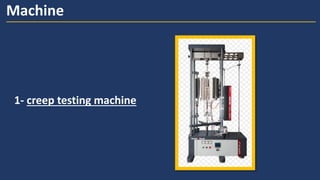
1- creep testing machine
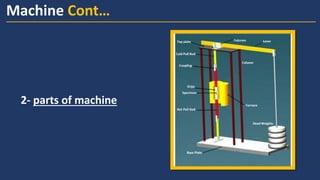
Machine Cont…
2- parts of machine
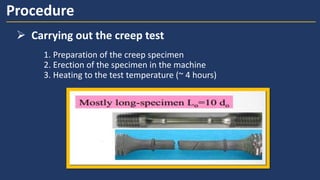
Procedure
Procedure
1. Preparation of the creep specimen
2. Erection of the specimen in the machine
3. Heating to the test temperature (~ 4 hours)
➢ Carrying out the creep test
Procedure Cont…
4. Starting the test
5. Following up the test up to fracture
6. Ending the test
➢ Carrying out the creep test
** The test temperature should be constant and non-switch off of the electric current should be insured.
• starting data acquisition
• loading the specimen
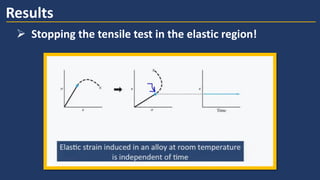
Results
➢ Stopping the tensile test in the elastic region!
Results
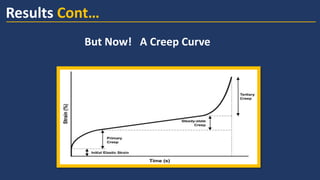
But Now! A Creep Curve
Results Cont…
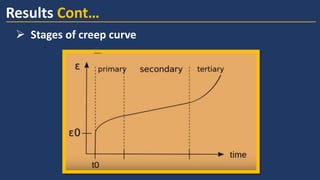
➢ Stages of creep curve
Results Cont…
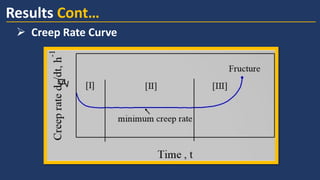
➢ Creep Rate Curve
Results Cont…
Temperature
Temperature
➢ Temperature Effect on Creep Test
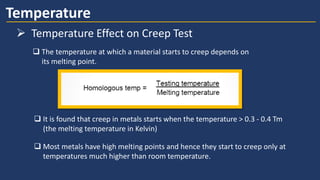
 The temperature at which a material starts to creep depends on
its melting point.
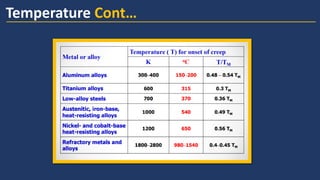
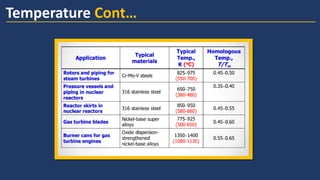
 It is found that creep in metals starts when the temperature > 0.3 - 0.4 Tm
(the melting temperature in Kelvin)
 Most metals have high melting points and hence they start to creep only at
temperatures much higher than room temperature.
Temperature Cont…
Temperature Cont…
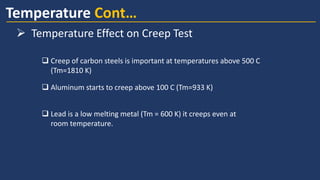
 Aluminum starts to creep above 100 C (Tm=933 K)
 Creep of carbon steels is important at temperatures above 500 C
(Tm=1810 K)
 Lead is a low melting metal (Tm = 600 K) it creeps even at
room temperature.
Temperature Cont…
➢ Temperature Effect on Creep Test
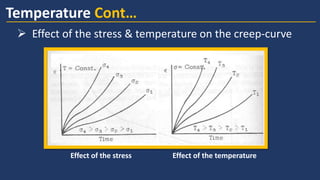
Effect of the stress Effect of the temperature
➢ Effect of the stress & temperature on the creep-curve
Temperature Cont…
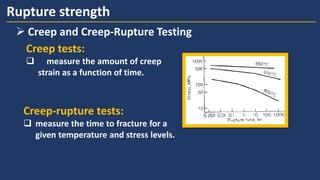
Rupture strength
➢ Creep and Creep-Rupture Testing
Rupture strength
Creep tests:
 measure the amount of creep
strain as a function of time.
Creep-rupture tests:
 measure the time to fracture for a
given temperature and stress levels.
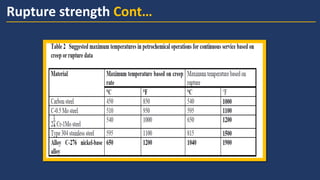
Rupture strength Cont…
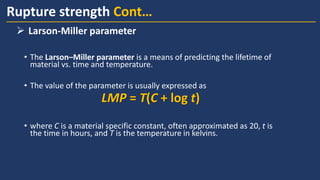
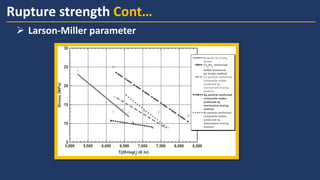
• The Larson–Miller parameter is a means of predicting the lifetime of
material vs. time and temperature.
• The value of the parameter is usually expressed as
LMP = T(C + log t)
• where C is a material specific constant, often approximated as 20, t is
the time in hours, and T is the temperature in kelvins.
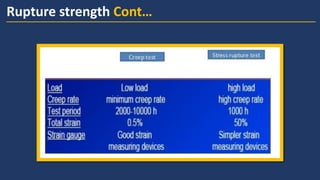
Rupture strength Cont…
➢ Larson-Miller parameter
Rupture strength Cont…
➢ Larson-Miller parameter
Precautions
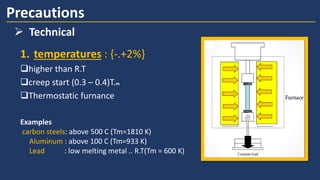
1. temperatures : {-.+2%}
higher than R.T
creep start (0.3 – 0.4)T.m
Thermostatic furnance
Precautions
➢ Technical
Examples
carbon steels: above 500 C (Tm=1810 K)
Aluminum : above 100 C (Tm=933 K)
Lead : low melting metal .. R.T(Tm = 600 K)
2. Load :-
• constant
• uniaxial Load
• Applied smoothly and gently… (shock/failure) specimen
3. Free from vibration
4. Measuring devices must be very sensitive
5. Humidity : { -.+ 5%}
Precautions Cont…
➢ Technical
➢ Safety
Precautions Cont…
Creep applications in industry
 Displacement-limited applications
 Rupture-limted applications
 Stress-relaxation limited applications
Creep applications in industry
Creep applications in industry Cont…
➢Displacement-limited applications
Displacement-limited applications in which
precise dimensions or small clearances must be
maintained such as in:
*Turbine rotors in jet engines
*Steam turbines.
➢Rupture-limited applications
Rupture-limited applications in which precise dimensions are
not essential but fracture must be
avoided such as in:
*High-pressure steam tubes and pipes
*Pressure vessel
Creep applications in industry Cont…
➢Stress-relaxation-limited applications
Stress-relaxation-limited applications in which an initial
tension relaxes with time such as in:
*Suspended cables
*Tightened bolts
Creep applications in industry Cont…

Creep Testing

  • 1.
  • 2.
    ➢ Intro (MuhammadSa’eed) ➢ Mechanism (Hassan Tarek) ➢ Specimen (Muhammad Sayed) ➢ Machine (Muhammad Zaki) ➢ Procedures (Najeh Fayez) Outlines ➢ Results (Amir Mos’ad) ➢ Effect of temperature (Islam M. Reda) ➢ Rupture strength (Muhammad Ali) ➢ Precautions (Mahmoud Mukhtar) ➢ Apps (Muhammad Mostafa)
  • 3.
  • 4.
  • 5.
    MECHANISMS OF CREEPTesting ➢ MECHANISMS OF CREEP a) Dislocation climb b) Vacancy Diffusion c) Grain boundary sliding
  • 6.
    ➢ Dislocation movement MECHANISMSOF CREEP Testing Cont…
  • 7.
    ➢ Vacancy Diffusion MECHANISMSOF CREEP Testing Cont…
  • 8.
    ➢ Grain boundarysliding MECHANISMS OF CREEP Testing Cont…
  • 9.
  • 10.
    • Specimen materials( ferrous – non ferrous) Specimen Preparation For Creep Test 1. Round cross – section specimen. 2. Sheet or plate specimen. • Specimen shape : ➢ Specimen Preparation For Creep Test
  • 11.
    Specimen Preparation ForCreep Test Cont… 1. Round cross – section specimen. 2. Sheet or plate specimen  threaded ends  shouldered ends
  • 12.
    • The gagelength of a specimen should be uniform. • Specimens should be smooth and free from scratches or other stress raisers and should be machined to minimize cold working or surface distortion. • the stress or the load required to provide a certain stress, the smallest original cross-sectional area should be used. Specimen Preparation For Creep Test Cont…
  • 13.
  • 14.
  • 15.
  • 16.
  • 17.
    Procedure 1. Preparation ofthe creep specimen 2. Erection of the specimen in the machine 3. Heating to the test temperature (~ 4 hours) ➢ Carrying out the creep test
  • 18.
    Procedure Cont… 4. Startingthe test 5. Following up the test up to fracture 6. Ending the test ➢ Carrying out the creep test ** The test temperature should be constant and non-switch off of the electric current should be insured. • starting data acquisition • loading the specimen
  • 19.
  • 20.
    ➢ Stopping thetensile test in the elastic region! Results
  • 21.
    But Now! ACreep Curve Results Cont…
  • 22.
    ➢ Stages ofcreep curve Results Cont…
  • 23.
    ➢ Creep RateCurve Results Cont…
  • 24.
  • 25.
    Temperature ➢ Temperature Effecton Creep Test  The temperature at which a material starts to creep depends on its melting point.  It is found that creep in metals starts when the temperature > 0.3 - 0.4 Tm (the melting temperature in Kelvin)  Most metals have high melting points and hence they start to creep only at temperatures much higher than room temperature.
  • 26.
  • 27.
  • 28.
     Aluminum startsto creep above 100 C (Tm=933 K)  Creep of carbon steels is important at temperatures above 500 C (Tm=1810 K)  Lead is a low melting metal (Tm = 600 K) it creeps even at room temperature. Temperature Cont… ➢ Temperature Effect on Creep Test
  • 29.
    Effect of thestress Effect of the temperature ➢ Effect of the stress & temperature on the creep-curve Temperature Cont…
  • 30.
  • 31.
    ➢ Creep andCreep-Rupture Testing Rupture strength Creep tests:  measure the amount of creep strain as a function of time. Creep-rupture tests:  measure the time to fracture for a given temperature and stress levels.
  • 32.
  • 33.
  • 34.
    • The Larson–Millerparameter is a means of predicting the lifetime of material vs. time and temperature. • The value of the parameter is usually expressed as LMP = T(C + log t) • where C is a material specific constant, often approximated as 20, t is the time in hours, and T is the temperature in kelvins. Rupture strength Cont… ➢ Larson-Miller parameter
  • 35.
    Rupture strength Cont… ➢Larson-Miller parameter
  • 36.
  • 37.
    1. temperatures :{-.+2%} higher than R.T creep start (0.3 – 0.4)T.m Thermostatic furnance Precautions ➢ Technical Examples carbon steels: above 500 C (Tm=1810 K) Aluminum : above 100 C (Tm=933 K) Lead : low melting metal .. R.T(Tm = 600 K)
  • 38.
    2. Load :- •constant • uniaxial Load • Applied smoothly and gently… (shock/failure) specimen 3. Free from vibration 4. Measuring devices must be very sensitive 5. Humidity : { -.+ 5%} Precautions Cont… ➢ Technical
  • 39.
  • 40.
  • 41.
     Displacement-limited applications Rupture-limted applications  Stress-relaxation limited applications Creep applications in industry
  • 42.
    Creep applications inindustry Cont… ➢Displacement-limited applications Displacement-limited applications in which precise dimensions or small clearances must be maintained such as in: *Turbine rotors in jet engines *Steam turbines.
  • 43.
    ➢Rupture-limited applications Rupture-limited applicationsin which precise dimensions are not essential but fracture must be avoided such as in: *High-pressure steam tubes and pipes *Pressure vessel Creep applications in industry Cont…
  • 44.
    ➢Stress-relaxation-limited applications Stress-relaxation-limited applicationsin which an initial tension relaxes with time such as in: *Suspended cables *Tightened bolts Creep applications in industry Cont…