


Credit rating
 Credit rating evaluates the credit worthiness of a debtor, especially
a business (company) or a government. It is an evaluation made by a credit
rating agency of the debtor's ability to pay back the debt and the likelihood
of default.
 Credit ratings are determined by credit ratings agencies. The credit rating
represents the credit rating agency's evaluation of qualitative and
quantitative information for a company or government; including non-
public information obtained by the credit rating agencies analysts.
 Credit ratings are not based on mathematical formulas. Instead, credit
rating agencies use their judgment and experience in determining what
public and private information should be considered in giving a rating to a
particular company or government.
Meaning of Credit Rating
 The credit rating is used by individuals and entities that purchase the bonds
issued by companies and governments to determine the likelihood that the
company/government will pay its bond obligations.
 A poor credit rating indicates a credit rating agency's opinion that the company
or government has a high risk of defaulting, based on the agency's analysis of
the entity's history and analysis of long term economic prospects.
SEBI Credit Rating Agency
Regulations
 Registration
 Obligations
 Restriction on Securities
 Inspection/Investigation
 Action in Default
General Obligations
 Code of Conduct
 Agreement with the Client
 Monitoring of Ratings
 Procedure for Review of Rating
 Disclosures of Rating Definitions and Rationale
 Submission of Information to the SEBI
 Compliance with Circulars Issued by the SEBI
 Appointment of Compliance Officer
 Maintenance of Books of Accounts and Records
 Steps on Auditor’s Report
 Confidentiality
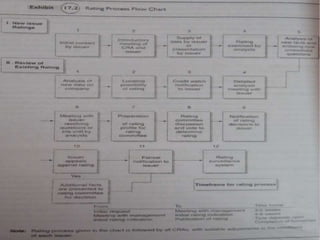
 Rating Process
CREDIT RATING METHODOLOGY
Consist of 4 areas:
 Business Risk analysis- Assessment of the company’s environment,
focusing on the strength of the industry prospects, pattern of business
cycles as well as factors affecting the industry.
 Financial Risk Analysis- Analysis of financial strength of the issuer. It is
largely measured through quantitative means, particularly by using
financial ratios.
 Management Risk Evaluation- In this stage, analyst compares the
company’s business strengths and financial plans to provide insights into
management’s abilities, with respect to forecasting and implementation of
plans.
 Fundamental analysis- Analysis of liquidity management, asset quality,
profitability, resources and interest and tax sensitivity.
To the investors
 Helps in Investment Decision : Credit rating gives an idea to the investors about
the credibility of the issuer company, and the risk factor attached to a particular
instrument. So the investors can decide whether to invest in such companies or
not. Higher the rating, the more will be the willingness to invest in these
instruments and visa-versa.
 Benefits of Rating Reviews : The rating agency regularly reviews the rating given
to a particular instrument. So, the present investors can decide whether to keep the
instrument or to sell it. For e.g. if the instrument is downgraded, then the investor
may decide to sell it and if the rating is maintained or upgraded, he may decide to
keep the instrument until the next rating or maturity.
 Assurance of Safety : High credit rating gives assurance to the investors about the
safety of the instrument and minimum risk of bankruptcy. The companies which
get a high rating for their instruments, will try to maintain healthy financial
discipline. This will protect them from bankruptcy. So the investors will be safe.
BENEFITS OF CREDIT RATING
 Easy Understandability of Investment Proposal : The rating agencies gives
rating symbols to the instrument, which can be easily understood by investors.
This helps them to understand the investment proposal of an issuer company.
For e.g. AAA (Triple A), given by CRISIL for debentures ensures highest
safety, whereas debentures rated D are in default or expect to default on
maturity.
 Choice of Instruments : Credit rating enables an investor to select a particular
instrument from many alternatives available. This choice depends upon the
safety or risk of the instrument.
 Saves Investor's Time and Effort : Credit ratings enable an investor to his
save time and effort in analyzing the financial strength of an issuer company.
This is because the investor can depend on the rating done by professional
rating agency, in order to take an investment decision. He/She need not waste
time and effort to collect and analyse the financial information about
the credit standing of the issuer company.
To the company
 Improves Corporate Image : Credit rating helps to improve the corporate
image of a company. High credit rating creates confidence and trust in the
minds of the investors about the company. Therefore, the company enjoys a
good corporate image in the market.
 Lowers Cost of Borrowing : Companies that have high credit rating for their
debt instruments will get funds at lower costs from the market. High rating will
enable the company to offer low interest rates on fixed deposits, debentures
and other debt securities. The investors will accept low interest rates because
they prefer low risk instruments. A company with high rating for its
instruments can reduce the cost of public issue to raise funds, because it need
not spend heavily on advertising for attracting investors.
Benefits of Credit Rating
 Wider Audience for Borrowing : A company with high rating for its
instruments can get a wider audience for borrowing. It can approach financial
institutions, banks, investing companies. This is because the credit ratings are
easily understood not only by the financial institutions and banks, but also by
the general public.
 Good for Non-Popular Companies : Credit rating is beneficial to the non-
popular companies, such as closely-held companies. If the credit rating is
good, the public will invest in these companies, even if they do not know
these companies.
 Act as a Marketing Tool : Credit rating not only helps to develop a good
image of the company among the investors, but also among the
customers, dealers, suppliers, etc. High credit rating can act as a marketing
tool to develop confidence in the minds of customers, dealer, suppliers, etc.
 Helps in Growth and Expansion : Credit rating enables a company to grow
and expand. This is because better credit rating will enable a company to get
finance easily for growth and expansion
Credit Rating Agencies in India
 CRISIL Ltd
 ICRA Ltd
 CARE Ltd
 FITCH Ratings India Ltd
 Small and Medium Enterprises Rating Agency (SMERA)
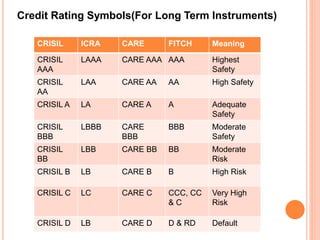
CRISIL ICRA CARE FITCH Meaning
CRISIL
AAA
LAAA CARE AAA AAA Highest
Safety
CRISIL
AA
LAA CARE AA AA High Safety
CRISIL A LA CARE A A Adequate
Safety
CRISIL
BBB
LBBB CARE
BBB
BBB Moderate
Safety
CRISIL
BB
LBB CARE BB BB Moderate
Risk
CRISIL B LB CARE B B High Risk
CRISIL C LC CARE C CCC, CC
& C
Very High
Risk
CRISIL D LB CARE D D & RD Default
Credit Rating Symbols(For Long Term Instruments)
Ratings other than Debt
Instruments/Companies
 Country ratings
 Rating of Chit Funds
 Rating of States of India
 Rating of Real Estate Builders & Developers
 Rating of Banks of India
 Rating of Asset Management Companies
 Rating of Stock Brokers
Thank You

Credit rating

  • 1.
  • 2.
     Credit ratingevaluates the credit worthiness of a debtor, especially a business (company) or a government. It is an evaluation made by a credit rating agency of the debtor's ability to pay back the debt and the likelihood of default.  Credit ratings are determined by credit ratings agencies. The credit rating represents the credit rating agency's evaluation of qualitative and quantitative information for a company or government; including non- public information obtained by the credit rating agencies analysts.  Credit ratings are not based on mathematical formulas. Instead, credit rating agencies use their judgment and experience in determining what public and private information should be considered in giving a rating to a particular company or government. Meaning of Credit Rating
  • 3.
     The creditrating is used by individuals and entities that purchase the bonds issued by companies and governments to determine the likelihood that the company/government will pay its bond obligations.  A poor credit rating indicates a credit rating agency's opinion that the company or government has a high risk of defaulting, based on the agency's analysis of the entity's history and analysis of long term economic prospects.
  • 4.
    SEBI Credit RatingAgency Regulations  Registration  Obligations  Restriction on Securities  Inspection/Investigation  Action in Default
  • 5.
    General Obligations  Codeof Conduct  Agreement with the Client  Monitoring of Ratings  Procedure for Review of Rating  Disclosures of Rating Definitions and Rationale  Submission of Information to the SEBI  Compliance with Circulars Issued by the SEBI  Appointment of Compliance Officer  Maintenance of Books of Accounts and Records  Steps on Auditor’s Report  Confidentiality  Rating Process
  • 6.
    CREDIT RATING METHODOLOGY Consistof 4 areas:  Business Risk analysis- Assessment of the company’s environment, focusing on the strength of the industry prospects, pattern of business cycles as well as factors affecting the industry.  Financial Risk Analysis- Analysis of financial strength of the issuer. It is largely measured through quantitative means, particularly by using financial ratios.  Management Risk Evaluation- In this stage, analyst compares the company’s business strengths and financial plans to provide insights into management’s abilities, with respect to forecasting and implementation of plans.  Fundamental analysis- Analysis of liquidity management, asset quality, profitability, resources and interest and tax sensitivity.
  • 8.
    To the investors Helps in Investment Decision : Credit rating gives an idea to the investors about the credibility of the issuer company, and the risk factor attached to a particular instrument. So the investors can decide whether to invest in such companies or not. Higher the rating, the more will be the willingness to invest in these instruments and visa-versa.  Benefits of Rating Reviews : The rating agency regularly reviews the rating given to a particular instrument. So, the present investors can decide whether to keep the instrument or to sell it. For e.g. if the instrument is downgraded, then the investor may decide to sell it and if the rating is maintained or upgraded, he may decide to keep the instrument until the next rating or maturity.  Assurance of Safety : High credit rating gives assurance to the investors about the safety of the instrument and minimum risk of bankruptcy. The companies which get a high rating for their instruments, will try to maintain healthy financial discipline. This will protect them from bankruptcy. So the investors will be safe. BENEFITS OF CREDIT RATING
  • 9.
     Easy Understandabilityof Investment Proposal : The rating agencies gives rating symbols to the instrument, which can be easily understood by investors. This helps them to understand the investment proposal of an issuer company. For e.g. AAA (Triple A), given by CRISIL for debentures ensures highest safety, whereas debentures rated D are in default or expect to default on maturity.  Choice of Instruments : Credit rating enables an investor to select a particular instrument from many alternatives available. This choice depends upon the safety or risk of the instrument.  Saves Investor's Time and Effort : Credit ratings enable an investor to his save time and effort in analyzing the financial strength of an issuer company. This is because the investor can depend on the rating done by professional rating agency, in order to take an investment decision. He/She need not waste time and effort to collect and analyse the financial information about the credit standing of the issuer company.
  • 10.
    To the company Improves Corporate Image : Credit rating helps to improve the corporate image of a company. High credit rating creates confidence and trust in the minds of the investors about the company. Therefore, the company enjoys a good corporate image in the market.  Lowers Cost of Borrowing : Companies that have high credit rating for their debt instruments will get funds at lower costs from the market. High rating will enable the company to offer low interest rates on fixed deposits, debentures and other debt securities. The investors will accept low interest rates because they prefer low risk instruments. A company with high rating for its instruments can reduce the cost of public issue to raise funds, because it need not spend heavily on advertising for attracting investors. Benefits of Credit Rating
  • 11.
     Wider Audiencefor Borrowing : A company with high rating for its instruments can get a wider audience for borrowing. It can approach financial institutions, banks, investing companies. This is because the credit ratings are easily understood not only by the financial institutions and banks, but also by the general public.  Good for Non-Popular Companies : Credit rating is beneficial to the non- popular companies, such as closely-held companies. If the credit rating is good, the public will invest in these companies, even if they do not know these companies.  Act as a Marketing Tool : Credit rating not only helps to develop a good image of the company among the investors, but also among the customers, dealers, suppliers, etc. High credit rating can act as a marketing tool to develop confidence in the minds of customers, dealer, suppliers, etc.  Helps in Growth and Expansion : Credit rating enables a company to grow and expand. This is because better credit rating will enable a company to get finance easily for growth and expansion
  • 12.
    Credit Rating Agenciesin India  CRISIL Ltd  ICRA Ltd  CARE Ltd  FITCH Ratings India Ltd  Small and Medium Enterprises Rating Agency (SMERA)
  • 13.
    CRISIL ICRA CAREFITCH Meaning CRISIL AAA LAAA CARE AAA AAA Highest Safety CRISIL AA LAA CARE AA AA High Safety CRISIL A LA CARE A A Adequate Safety CRISIL BBB LBBB CARE BBB BBB Moderate Safety CRISIL BB LBB CARE BB BB Moderate Risk CRISIL B LB CARE B B High Risk CRISIL C LC CARE C CCC, CC & C Very High Risk CRISIL D LB CARE D D & RD Default Credit Rating Symbols(For Long Term Instruments)
  • 14.
    Ratings other thanDebt Instruments/Companies  Country ratings  Rating of Chit Funds  Rating of States of India  Rating of Real Estate Builders & Developers  Rating of Banks of India  Rating of Asset Management Companies  Rating of Stock Brokers
  • 15.