CREDIT
RATING
By: Ashish Kumar
Sanjay Ranjan
Priyanka Srivastava
Sabana
MEANING
• A credit rating evaluates the credit worthiness of a debtor, especially a business
(company) or a government.
• Credit ratings are not based on mathematical formulas. Instead, credit rating
agencies use their judgment and experience in determining what public and private
information should be considered in giving a rating to a particular company or
government.
• The credit rating is used by individuals and entities that purchase the bonds issued
by companies and governments to determine the likelihood that the government
will pay its bond obligations.
REGISTRATION
• Credit Rating agencies are regulated by SEBI.
• Registration with SEBI is mandatory for carrying out the rating Business.
• A registration fee of Rs. 25000 should be paid to SEBI
PROMOTER
A Credit rating agency can be promoted by:
• Public Financial Institution
• Scheduled Bank
• Foreign Bank operating in India with RBI approval
• Foreign Credit Rating agency having at least five years experience in rating securities
• Any company having a continuous net worth of minimum 100 cores for the previous
five years.
ELIGIBILITY CRITERIA
• Is set up and registered as a company .
• Has specified rating activity as one of its main objects in its Memorandum of
Association.
• Has a minimum Net worth of Rs 5 Crore.
• Has adequate Infrastructure .
• Promoters have professional competence, financial soundness and a general
reputation of fairness and integrity in Business transactions , to the satisfaction of
SEBI.
• Has employed persons with adequate professional and other relevant experience, as
per SEBI directions
GRANT OF CERTIFICATE OF
REGISTRATION
• SEBI will grant to eligible applicants a Certificate of Registration on the payment of a
fee of Rs 5,00,000 subject to certain conditions
THERE ARE FOUR CREDIT RATING
AGENCIES IN INDIA
• CRISIL(Credit Rating Information Services of India Ltd)
• ICRA(Information and Credit Rating Services ltd)
• CARE (Credit Analysis and Research Ltd)
• FITCH India
CRISIL
• The first rating agency ‘Credit Rating Information Services of India Ltd. , CRISIL, was
promoted jointly in 1987 jointly by the ICICI and the UTI.
• It pioneered the concept of credit rating in the country and since then has
introduced new concepts in credit rating services and has diversified into related
areas of information and advisory activities.
• It became public in 1993.
• In 1996, it formed a strategic alliance with S&P rating group.
ICRA LTD
• Information and Credit Rating Services (ICRA) has been promoted by IFCI Ltd as the
main promoter and started operations in 1991.
• It provides Rating, Information and Advisory services ranging from strategic
consulting to risk management and regulatory practice.
• The main objectives of ICRA are to assist investors both individual and institutional
in making well informed decisions.
• To provide regulators with market driven systems to encourage the healthy growth
of capital markets.
• It provides rating services, information services and advisory services.
CARE LTD.
• Credit Analysis and Research Ltd or CARE is promoted by IDBI jointly with Financial
Institutions, Public/Private Sector Banks and Private Finance Companies.
• It commenced its credit rating operations in October, 1993 and offers a wide range
of products and Services in the field of Credit Information and Equity Research.
• It also provides advisory services in the areas of securitisation of transactions and
structuring Financial Instruments.
FITCH RATINGS INDIA LTD.
• It is the latest entrant in the credit rating Business in the country as a joint venture
between the international credit Rating agency Duff and Phelps and JM Financial
and Alliance Group.
• In addition to debt instruments, it also rates companies and countries on request.
NEED FOR CREDIT RATING
• It is necessary in view of the growing number of cases of defaults in payment of
interest and repayment of principal sum borrowed by way of fixed deposits, issue of
debentures or preference shares or commercial papers.
• Maintenance of investor’s confidence, since defaults shatter the confidence of
investors in corporate instruments.
• Protect the interest of investors who can not into merits of the debt instruments of a
company.
• Motivate savers to invest in industry and trade.
OBJECTIVES OF CREDIT RATING
• The main objective is to provide superior and low cost info to investors for taking a
decision regarding risk return trade off, but it also helps to market participants in
the following ways:
• Improves a healthy discipline on borrowers
• Lends greater credence to financial and other representations,
• Facilitates formulation of public guidelines on institutional investments,
• Helps merchant bankers, brokers, regulatory authorities, etc., in discharging their
functions related to debt issues
TYPES OF RATING
• SOVEREIGN CREDIT RATING:
A sovereign credit rating is the credit rating of a sovereign entity, i.e., a national
government. The sovereign credit rating indicates the risk level of the investing
environment of a country and is used by investors looking to invest abroad. It takes
political risk into account.
• SHORT TERM RATING:
A short-term rating is a probability factor of an individual going into default within a
year. This is in contrast to long-term rating which is evaluated over a long timeframe.
In the past institutional investors preferred to consider long-term ratings. Nowadays,
short- term ratings are commonly used.
CONTINUE……
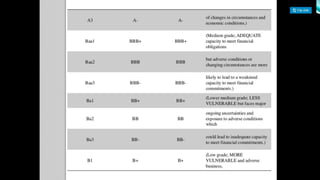
• CORPORATE CREDIT RATING:
The credit rating of a corporation is a financial indicator to potential investors of
debt securities such as bonds. Credit rating is usually of a financial instrument such as
a bond, rather than the whole corporation and have letter designations such as A, B,
C.
BENEFITS OF CREDIT RATING
To the investors:
• Helps in Investment Decision :Credit rating gives an idea to the investors about the
credibility of the issuer company, and the risk factor attached to a particular
instrument. So the investors can decide whether to invest in such companies or not.
Higher the rating, the more will be the willingness to invest in these instruments and
visa-versa.
• Assurance of Safety :High credit rating gives assurance to the investors about the
safety of the instrument and minimum risk of bankruptcy.
CONTINUE…….
• Easy Understandability of Investment Proposal :The rating agencies gives rating
symbols to the instrument, which can be easily understood by investors. This helps
them to understand the investment proposal of an issuer company.
• Saves Investors Time and Effort :Credit ratings enable an investor to his save time
and effort in analyzing the financial strength of an issuer company.
• Choice of Instruments :Credit rating enables an investor to select a particular
instrument from many alternatives available. This choice depends upon the safety or
risk of the instrument.
BENEFITS OF CREDIT RATING
To the company:
• Improves Corporate Image :Credit rating helps to improve the corporate image of a company.
High credit rating creates confidence and trust in the minds of the investors about the
company.
• Wider Audience for Borrowing :A company with high rating for its instruments can get a wider
audience for borrowing. It can approach financial institutions, banks, investing companies. This
is because the credit ratings are easily understood not only by the financial institutions and
banks, but also by the general public.
• Good for Non-Popular Companies :Credit rating is beneficial to the non- popular companies,
such as closely-held companies. If the credit rating is good, the public will invest in these
companies, even if they do not know these companies.
CONTINUE…..
• Act as a Marketing Tool :High credit rating can act as a marketing tool to develop
confidence in the minds of customers, dealer, suppliers, etc.
• Helps in Growth and Expansion :Credit rating enables a company to grow and
expand. This is because better credit rating will enable a company to get finance
easily for growth and expansion
CREDIT RATING METHODOLOGY
Consist of 4 areas:
• Business analysis-covers an analysis of industry risk, market position in the country, operating
efficiency of the company and legal position.
• Financial Analysis-analysis of accounting quality, earnings protection, cash flow adequacy and
financial flexibility.
• Management Evaluation-study of track record of the management’s capacity to overcome
adverse situations, goals, philosophy and strategies.
• Fundamental analysis-analysis of liquidity management, asset quality, profitability and interest
and tax sensitivity.
CREDIT RATING METHODOLOGY
Steps:
• information is collected and then analyzed by a team of professionals in an agency.
• If necessary, meetings with top management suppliers and dealers and a visit to the plant of
proposed sites are arranged to collect additional data. This team of professionals submit their
recommendations to the rating committee.
• Committee discusses this report and then assigns rating.
• Rating assigned is then notified to the issuer and only on his acceptance, rating is published.
• Assures confidentiality of information.
• Once the issuer decides to use and publish the rating, agency has to continuously monitor it
over the entire life of instrument, called surveillance.
Credit rating

Credit rating

  • 1.
    CREDIT RATING By: Ashish Kumar SanjayRanjan Priyanka Srivastava Sabana
  • 2.
    MEANING • A creditrating evaluates the credit worthiness of a debtor, especially a business (company) or a government. • Credit ratings are not based on mathematical formulas. Instead, credit rating agencies use their judgment and experience in determining what public and private information should be considered in giving a rating to a particular company or government. • The credit rating is used by individuals and entities that purchase the bonds issued by companies and governments to determine the likelihood that the government will pay its bond obligations.
  • 3.
    REGISTRATION • Credit Ratingagencies are regulated by SEBI. • Registration with SEBI is mandatory for carrying out the rating Business. • A registration fee of Rs. 25000 should be paid to SEBI
  • 4.
    PROMOTER A Credit ratingagency can be promoted by: • Public Financial Institution • Scheduled Bank • Foreign Bank operating in India with RBI approval • Foreign Credit Rating agency having at least five years experience in rating securities • Any company having a continuous net worth of minimum 100 cores for the previous five years.
  • 5.
    ELIGIBILITY CRITERIA • Isset up and registered as a company . • Has specified rating activity as one of its main objects in its Memorandum of Association. • Has a minimum Net worth of Rs 5 Crore. • Has adequate Infrastructure . • Promoters have professional competence, financial soundness and a general reputation of fairness and integrity in Business transactions , to the satisfaction of SEBI. • Has employed persons with adequate professional and other relevant experience, as per SEBI directions
  • 6.
    GRANT OF CERTIFICATEOF REGISTRATION • SEBI will grant to eligible applicants a Certificate of Registration on the payment of a fee of Rs 5,00,000 subject to certain conditions
  • 7.
    THERE ARE FOURCREDIT RATING AGENCIES IN INDIA • CRISIL(Credit Rating Information Services of India Ltd) • ICRA(Information and Credit Rating Services ltd) • CARE (Credit Analysis and Research Ltd) • FITCH India
  • 8.
    CRISIL • The firstrating agency ‘Credit Rating Information Services of India Ltd. , CRISIL, was promoted jointly in 1987 jointly by the ICICI and the UTI. • It pioneered the concept of credit rating in the country and since then has introduced new concepts in credit rating services and has diversified into related areas of information and advisory activities. • It became public in 1993. • In 1996, it formed a strategic alliance with S&P rating group.
  • 9.
    ICRA LTD • Informationand Credit Rating Services (ICRA) has been promoted by IFCI Ltd as the main promoter and started operations in 1991. • It provides Rating, Information and Advisory services ranging from strategic consulting to risk management and regulatory practice. • The main objectives of ICRA are to assist investors both individual and institutional in making well informed decisions. • To provide regulators with market driven systems to encourage the healthy growth of capital markets. • It provides rating services, information services and advisory services.
  • 10.
    CARE LTD. • CreditAnalysis and Research Ltd or CARE is promoted by IDBI jointly with Financial Institutions, Public/Private Sector Banks and Private Finance Companies. • It commenced its credit rating operations in October, 1993 and offers a wide range of products and Services in the field of Credit Information and Equity Research. • It also provides advisory services in the areas of securitisation of transactions and structuring Financial Instruments.
  • 11.
    FITCH RATINGS INDIALTD. • It is the latest entrant in the credit rating Business in the country as a joint venture between the international credit Rating agency Duff and Phelps and JM Financial and Alliance Group. • In addition to debt instruments, it also rates companies and countries on request.
  • 12.
    NEED FOR CREDITRATING • It is necessary in view of the growing number of cases of defaults in payment of interest and repayment of principal sum borrowed by way of fixed deposits, issue of debentures or preference shares or commercial papers. • Maintenance of investor’s confidence, since defaults shatter the confidence of investors in corporate instruments. • Protect the interest of investors who can not into merits of the debt instruments of a company. • Motivate savers to invest in industry and trade.
  • 13.
    OBJECTIVES OF CREDITRATING • The main objective is to provide superior and low cost info to investors for taking a decision regarding risk return trade off, but it also helps to market participants in the following ways: • Improves a healthy discipline on borrowers • Lends greater credence to financial and other representations, • Facilitates formulation of public guidelines on institutional investments, • Helps merchant bankers, brokers, regulatory authorities, etc., in discharging their functions related to debt issues
  • 14.
    TYPES OF RATING •SOVEREIGN CREDIT RATING: A sovereign credit rating is the credit rating of a sovereign entity, i.e., a national government. The sovereign credit rating indicates the risk level of the investing environment of a country and is used by investors looking to invest abroad. It takes political risk into account. • SHORT TERM RATING: A short-term rating is a probability factor of an individual going into default within a year. This is in contrast to long-term rating which is evaluated over a long timeframe. In the past institutional investors preferred to consider long-term ratings. Nowadays, short- term ratings are commonly used.
  • 15.
    CONTINUE…… • CORPORATE CREDITRATING: The credit rating of a corporation is a financial indicator to potential investors of debt securities such as bonds. Credit rating is usually of a financial instrument such as a bond, rather than the whole corporation and have letter designations such as A, B, C.
  • 19.
    BENEFITS OF CREDITRATING To the investors: • Helps in Investment Decision :Credit rating gives an idea to the investors about the credibility of the issuer company, and the risk factor attached to a particular instrument. So the investors can decide whether to invest in such companies or not. Higher the rating, the more will be the willingness to invest in these instruments and visa-versa. • Assurance of Safety :High credit rating gives assurance to the investors about the safety of the instrument and minimum risk of bankruptcy.
  • 20.
    CONTINUE……. • Easy Understandabilityof Investment Proposal :The rating agencies gives rating symbols to the instrument, which can be easily understood by investors. This helps them to understand the investment proposal of an issuer company. • Saves Investors Time and Effort :Credit ratings enable an investor to his save time and effort in analyzing the financial strength of an issuer company. • Choice of Instruments :Credit rating enables an investor to select a particular instrument from many alternatives available. This choice depends upon the safety or risk of the instrument.
  • 21.
    BENEFITS OF CREDITRATING To the company: • Improves Corporate Image :Credit rating helps to improve the corporate image of a company. High credit rating creates confidence and trust in the minds of the investors about the company. • Wider Audience for Borrowing :A company with high rating for its instruments can get a wider audience for borrowing. It can approach financial institutions, banks, investing companies. This is because the credit ratings are easily understood not only by the financial institutions and banks, but also by the general public. • Good for Non-Popular Companies :Credit rating is beneficial to the non- popular companies, such as closely-held companies. If the credit rating is good, the public will invest in these companies, even if they do not know these companies.
  • 22.
    CONTINUE….. • Act asa Marketing Tool :High credit rating can act as a marketing tool to develop confidence in the minds of customers, dealer, suppliers, etc. • Helps in Growth and Expansion :Credit rating enables a company to grow and expand. This is because better credit rating will enable a company to get finance easily for growth and expansion
  • 23.
    CREDIT RATING METHODOLOGY Consistof 4 areas: • Business analysis-covers an analysis of industry risk, market position in the country, operating efficiency of the company and legal position. • Financial Analysis-analysis of accounting quality, earnings protection, cash flow adequacy and financial flexibility. • Management Evaluation-study of track record of the management’s capacity to overcome adverse situations, goals, philosophy and strategies. • Fundamental analysis-analysis of liquidity management, asset quality, profitability and interest and tax sensitivity.
  • 24.
    CREDIT RATING METHODOLOGY Steps: •information is collected and then analyzed by a team of professionals in an agency. • If necessary, meetings with top management suppliers and dealers and a visit to the plant of proposed sites are arranged to collect additional data. This team of professionals submit their recommendations to the rating committee. • Committee discusses this report and then assigns rating. • Rating assigned is then notified to the issuer and only on his acceptance, rating is published. • Assures confidentiality of information. • Once the issuer decides to use and publish the rating, agency has to continuously monitor it over the entire life of instrument, called surveillance.