In Insurance Services in India
Abstract
Insurance Regulatory and Development Authority (IRDA) is an
autonomous apex statutory body which regulates and develops the
insurance industry in India. It was constituted by a Parliament of
India act called Insurance Regulatory and Development Authority Act,
1999 and duly passed by the Government of India. The agency
operates from its headquarters at Hyderabad, Telangana where it
shifted from Delhi in 2001. It serves as an Authority to protect the
interests of holders of insurance policies, to regulate, promote and
ensure orderly growth of the insurance industry and for matters
connected therewith. IRDA role is to protect rights of policy holders &
they provide registration certification to life insurance companies &
responsible for renewal, modification, cancellation & suspension of
this registered certificate. It plays a prominent role in regulating
investment of funds by insurance companies. Further, regulating
maintenance of margin of solvency, adjudication of disputes between
insurers and intermediaries or insurance intermediaries.
Introduction
 The IRDA Act, 1999 was passed as per the major
recommendation of the Malhotra Committee report (7 Jan,
1994) which recommended establishment of an independent
regulatory authority for insurance sector in India
 As stated in the act mission of IRDA is "to protect the
interests of the policyholders, to regulate, promote and
ensure orderly growth of the insurance industry and for
matters connected therewith or incidental thereto.“
 As per current guidelines issued by IRDA, Insurance
Companies are not permitted to invest in Indian Depository
Receipts (IDR), while they are permitted to invest in Equity
shares/ Bonds/ Debentures.
Composition of IRDA
Section 4 of IRDA Act 1999; specify the
composition of the Authority as follows;
The ten member team should consist of,
 A Chairman;
 Five whole time members;
 Four part time members,
(All appointed by Government of India).
Main Functions Of IRDA
The duties, powers and functions of IRDA are
laid down in Section 14 of IRDA Act 1999 are:
 Issue to the applicant a certificate of registration, renew,
modify, withdraw, suspend or cancel such registration
 Protection of the interests of the policy holders in
matters concerning assigning of policy, nomination by
policy holders, insurable interest, settlement of insurance
claim, surrender value of policy and other terms and
conditions of contracts of insurance
 Specifying requisite qualifications, code of conduct and
practical training for intermediary or insurance intermediaries
and agents
 Specifying the code of conduct for surveyors and loss
assessors
 Promoting efficiency in the conduct of insurance business
 Promoting and regulating professional organizations
connected with the insurance and re-insurance business
 Levying fees and other charges for carrying out the purposes
of this Act
 Calling for information from, undertaking inspection of,
conducting enquiries and investigations including audit of the
insurers, intermediaries, insurance intermediaries and other
organizations connected with the insurance business
 Control and regulation of the rates, advantages, terms and
conditions that may be offered by insurers in respect of
general insurance business not so controlled and regulated by
the Tariff Advisory Committee under section 64U of the
Insurance Act, 1938 (4 of 1938)
 Specifying the form and manner in which books of account
shall be maintained and statement of accounts shall be
rendered by insurers and other insurance intermediaries
 Specifying the percentage of premium income of the insurer
to finance schemes for promoting and regulating professional
organizations referred to in clause (f)
 Specifying the percentage of life insurance business and
general insurance business to be undertaken by the insurer in
the rural or social sector
 Regulating investment of funds by insurance companies
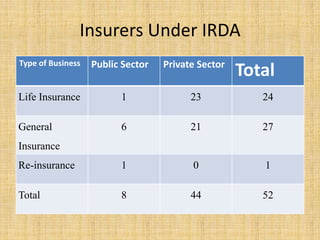
Insurers Under IRDA
Type of Business Public Sector Private Sector
Total
Life Insurance 1 23 24
General
Insurance
6 21 27
Re-insurance 1 0 1
Total 8 44 52
Financial Facts
The total premium for the life insurance sector
remained flat at Rs.2.87 lakhs crore in 2012-13.
The total non-life insurance premium increased
to Rs. 62,973 crore in 2012-13 as compared to
52,876 crore in 2011-12. The growth rate of
premium of non-life insurance sector declined to
19.10 percent in 2012-13 as compared to 24.19
percent in 2011-12.
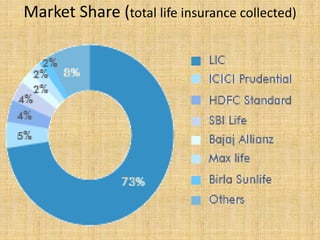
Market Share (total life insurance collected)
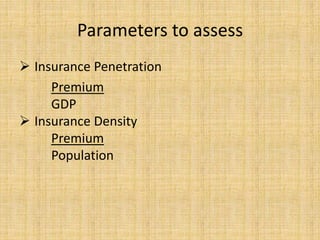
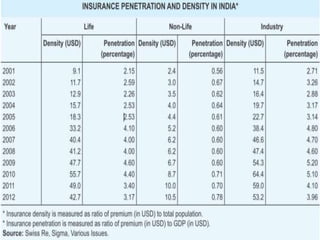
Parameters to assess
 Insurance Penetration
Premium
GDP
 Insurance Density
Premium
Population
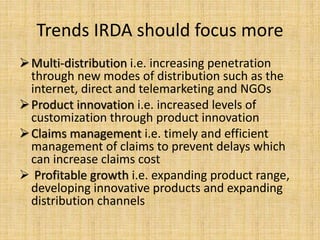
Trends IRDA should focus more
Multi-distribution i.e. increasing penetration
through new modes of distribution such as the
internet, direct and telemarketing and NGOs
Product innovation i.e. increased levels of
customization through product innovation
Claims management i.e. timely and efficient
management of claims to prevent delays which
can increase claims cost
 Profitable growth i.e. expanding product range,
developing innovative products and expanding
distribution channels
Major Reasons for downfall
Some possible major reasons for downfall in 2012:
 Products strategy and design
Cost
Taxation
Distribution
Prospects and challenges of various channels
Compensation
Customer service
Governance and regulatory issues
Factors impacting growth of non-life insurance
The non-life insurance industry has been growing in
excess of 20% over the last two years however the
penetration was as low as 0.7% of the GDP in FY10.The
key factors for the growth include:
 Product pricing, innovation and simplicity
 Distribution
 Compensation
 Micro-insurance in non-life widening reach
 Governance and regulatory changes
 Health insurance
 Innovative products to counter the competition
 Improved fraud control mechanisms
 Standardization to reduce claim loss
 Reducing inefficiencies by revisiting third party
administrator (TPA) agreements
Way Forward
The Indian insurance market is poised for
strong growth in the long run.
It stands at the threshold of moving towards a
stable position, delivering “stable profitable
growth”.
Significant latent market
Channelizing industry focus
Conclusion
There is huge potential to tap the rural
segments which are still untouched in the
industry. The success and growth of the
insurance sector depends on the efforts being
made by the insurance companies, on cost
effectiveness and strong distribution network,
integrated training and development programs
for staff and agents, customized solutions and
most advanced technology providing quick
services, and financial stability. Competitiveness
and smart marketing strategies will add new
dimensions to the insurance business in the
coming years.
Take Away
IRDA needs to remove this disparity to open
up investment opportunity by Insurance
Companies and thereby also enhance the
liquidity of IDRs.
Insurance Sector has power to penetrate
provided innovative methods are tried keeping
customer demand in mind and he is provided
hassle free services
Role of irda

Role of irda

  • 1.
  • 2.
    Abstract Insurance Regulatory andDevelopment Authority (IRDA) is an autonomous apex statutory body which regulates and develops the insurance industry in India. It was constituted by a Parliament of India act called Insurance Regulatory and Development Authority Act, 1999 and duly passed by the Government of India. The agency operates from its headquarters at Hyderabad, Telangana where it shifted from Delhi in 2001. It serves as an Authority to protect the interests of holders of insurance policies, to regulate, promote and ensure orderly growth of the insurance industry and for matters connected therewith. IRDA role is to protect rights of policy holders & they provide registration certification to life insurance companies & responsible for renewal, modification, cancellation & suspension of this registered certificate. It plays a prominent role in regulating investment of funds by insurance companies. Further, regulating maintenance of margin of solvency, adjudication of disputes between insurers and intermediaries or insurance intermediaries.
  • 3.
    Introduction  The IRDAAct, 1999 was passed as per the major recommendation of the Malhotra Committee report (7 Jan, 1994) which recommended establishment of an independent regulatory authority for insurance sector in India  As stated in the act mission of IRDA is "to protect the interests of the policyholders, to regulate, promote and ensure orderly growth of the insurance industry and for matters connected therewith or incidental thereto.“  As per current guidelines issued by IRDA, Insurance Companies are not permitted to invest in Indian Depository Receipts (IDR), while they are permitted to invest in Equity shares/ Bonds/ Debentures.
  • 4.
    Composition of IRDA Section4 of IRDA Act 1999; specify the composition of the Authority as follows; The ten member team should consist of,  A Chairman;  Five whole time members;  Four part time members, (All appointed by Government of India).
  • 5.
    Main Functions OfIRDA The duties, powers and functions of IRDA are laid down in Section 14 of IRDA Act 1999 are:  Issue to the applicant a certificate of registration, renew, modify, withdraw, suspend or cancel such registration  Protection of the interests of the policy holders in matters concerning assigning of policy, nomination by policy holders, insurable interest, settlement of insurance claim, surrender value of policy and other terms and conditions of contracts of insurance
  • 6.
     Specifying requisitequalifications, code of conduct and practical training for intermediary or insurance intermediaries and agents  Specifying the code of conduct for surveyors and loss assessors  Promoting efficiency in the conduct of insurance business  Promoting and regulating professional organizations connected with the insurance and re-insurance business  Levying fees and other charges for carrying out the purposes of this Act  Calling for information from, undertaking inspection of, conducting enquiries and investigations including audit of the insurers, intermediaries, insurance intermediaries and other organizations connected with the insurance business
  • 7.
     Control andregulation of the rates, advantages, terms and conditions that may be offered by insurers in respect of general insurance business not so controlled and regulated by the Tariff Advisory Committee under section 64U of the Insurance Act, 1938 (4 of 1938)  Specifying the form and manner in which books of account shall be maintained and statement of accounts shall be rendered by insurers and other insurance intermediaries  Specifying the percentage of premium income of the insurer to finance schemes for promoting and regulating professional organizations referred to in clause (f)  Specifying the percentage of life insurance business and general insurance business to be undertaken by the insurer in the rural or social sector  Regulating investment of funds by insurance companies
  • 8.
    Insurers Under IRDA Typeof Business Public Sector Private Sector Total Life Insurance 1 23 24 General Insurance 6 21 27 Re-insurance 1 0 1 Total 8 44 52
  • 9.
    Financial Facts The totalpremium for the life insurance sector remained flat at Rs.2.87 lakhs crore in 2012-13. The total non-life insurance premium increased to Rs. 62,973 crore in 2012-13 as compared to 52,876 crore in 2011-12. The growth rate of premium of non-life insurance sector declined to 19.10 percent in 2012-13 as compared to 24.19 percent in 2011-12.
  • 10.
    Market Share (totallife insurance collected)
  • 11.
    Parameters to assess Insurance Penetration Premium GDP  Insurance Density Premium Population
  • 13.
    Trends IRDA shouldfocus more Multi-distribution i.e. increasing penetration through new modes of distribution such as the internet, direct and telemarketing and NGOs Product innovation i.e. increased levels of customization through product innovation Claims management i.e. timely and efficient management of claims to prevent delays which can increase claims cost  Profitable growth i.e. expanding product range, developing innovative products and expanding distribution channels
  • 14.
    Major Reasons fordownfall Some possible major reasons for downfall in 2012:  Products strategy and design Cost Taxation Distribution Prospects and challenges of various channels Compensation Customer service Governance and regulatory issues
  • 15.
    Factors impacting growthof non-life insurance The non-life insurance industry has been growing in excess of 20% over the last two years however the penetration was as low as 0.7% of the GDP in FY10.The key factors for the growth include:  Product pricing, innovation and simplicity  Distribution  Compensation  Micro-insurance in non-life widening reach  Governance and regulatory changes  Health insurance  Innovative products to counter the competition  Improved fraud control mechanisms  Standardization to reduce claim loss  Reducing inefficiencies by revisiting third party administrator (TPA) agreements
  • 16.
    Way Forward The Indianinsurance market is poised for strong growth in the long run. It stands at the threshold of moving towards a stable position, delivering “stable profitable growth”. Significant latent market Channelizing industry focus
  • 17.
    Conclusion There is hugepotential to tap the rural segments which are still untouched in the industry. The success and growth of the insurance sector depends on the efforts being made by the insurance companies, on cost effectiveness and strong distribution network, integrated training and development programs for staff and agents, customized solutions and most advanced technology providing quick services, and financial stability. Competitiveness and smart marketing strategies will add new dimensions to the insurance business in the coming years.
  • 18.
    Take Away IRDA needsto remove this disparity to open up investment opportunity by Insurance Companies and thereby also enhance the liquidity of IDRs. Insurance Sector has power to penetrate provided innovative methods are tried keeping customer demand in mind and he is provided hassle free services

Editor's Notes

  • #11 2-Birla Sunlife,Maxlife,Bajaj; 4-HDFC,SBI; 5-ICICI