Meaning of Credit Rating:-
 A Credit rating issued by a credit rating agency is an rating
of the credit worthness of individual financial securities and
Debt issued by corporations, government issued securities
 A credit rating estimates the credit worthness of an a
financial security,a coeporate,local government or even a
country.
 Credit rating are give by rating agencies to companies and
debt instruments,are designed to capacity the chance that a
company will default on its duty to creditors.
 Thus ,they give investors idea of the risk related with
loaning money to the organization (operation,entity)being
rated.
 Credit ratings are forward-looking opinions about credit
risk.It express the agency’s opinion about the ability and
willingness of an issuer
 Such as a corporation or state or city government,to meet
its financial duty in full and on time.
 Credit rating are calculated from financial history and
current assets and liabilities.
Function of credit rating agency:-
 Provide easy to understand information:-
Rating agencies collect information, then scan
information to explain complex information in
a simple and readily understood manner.
 Provide basic for investment:-An
investment rated by a credit rating enjoy
higher confidence from investor.Investors can
make an estimate(judge) of the risk and
return related with a particular rated issue
while investing money in them.
 Healthy discipiline on corporate
borrowers:- Higher credit rating to any credit
investment makes the financial instrument
(bond,mortage security) more attractive to
investor.Corporation can borrow money more
cheaply if they maintain high credit rating on
their debt.
 Formation of public policy:-Once the debt
securitied are rated professionally, it would
be easier to formulate public policy guideline
as to the allow of securities to be included in
different kinds of institutional portfolios.
 Provides basis for assessing risk and
return:-The information provided by credit
rating agencies is useful to possible investors
in deciding whether to invest in debt
securities or not. The rating are assess from
time to time.the rating provide a basic for
assessing risk and return attached to a
particular debt security
Benefits of Credit Rating
to Investors
 Helps in Investment Decision :
Credit rating gives an idea to the investors about the validity
of the issuer company, and the risk factor attached to a particular
instrument. So the investors can decide whether to invest in such
companies or not. Higher the rating, the more will be the
willingness to invest in these instruments and vice-versa.
 Benefits of Rating Reviews (study)
The rating agency regularly reviews the rating given to a
particular instrument. So, the present investors can decide
whether to keep the instrument or to sell it. For e.g. if the
instrument is get decrease, then the investor may decide to sell
it and if the rating is maintained or increase, he may decide to
keep the instrument until the next rating or maturity.
 Promice of Safety
High credit rating gives promice to the investors about the
safety of the instrument and minimum risk of insolvency. The
companies which get a high rating for their instruments, will try
to maintain healthy financial discipline. This will protect them
from insolvency. So the investors will be safe.
 Easy Understandability of Investment Proposal
The rating agencies gives rating symbols to the instrument,
which can be easily understood by investors. This helps them to
understand the investment proposal of an issuer company. For
e.g. AAA (Triple A), given by CRISIL for debentures ensures
highest safety, whereas debentures rated D are in default or
expect to default on maturity.
 Choice of Instruments
Credit rating enables an investor to select a particular
instrument from many alternatives available. This choice
depends upon the safety or risk of the instrument.
 Saves Investor's Time and Effort
Credit ratings enable an investor to his save time and effort in
analysing(use) the financial strength of an issuer company. This
is because the investor can depend on the rating done by
professional rating agency, in order to take an investment
decision. He need not waste his time and effort to collect and
analyse the financial information about the credit standing of the
issuer company.
Benefits of Credit Rating to Company
 Improves Corporate Image :
Credit rating helps to improve the corporate image of a
company. High credit rating creates confidence and trust in
the minds of the investors about the company. Therefore, the
company enjoys a good corporate image in the market.
 Lowers Cost of Borrowing
Companies that have high credit rating for their debt
instruments will get funds at lower costs from the market.
High rating will enable the company to offer low interest rates
on fixed deposits, debentures and other debt securities. The
investors will accept low interest rates because they prefer
low risk instruments.
 Wider Audience for Borrowing
A company with high rating for its instruments can get
a wider audience for borrowing. This is because the credit
ratings are easily understood not only by the financial
institutions and banks, but also by the general public.
 Good for Non-Popular Companies
Credit rating is beneficial to the non-popular companies,
such as closely-held companies. If the credit rating is good,
the public will invest in these companies, even if they do not
know these companies.
 Act as a Marketing Tool :
Credit rating not only helps to develop a good image of
the company among the investors, but also among the
customers, dealers, suppliers, etc. High credit rating can act
as a marketing tool to develop confidence in the minds of
customers, dealer, suppliers, etc.
 Helps in Growth and Expansion
Credit rating enables a company to grow and expand. This is
because better credit rating will enable a company to get
finance easily for growth and expansion.
Demerits of Credit Rating
 Possibility of Bias Exist
The information collected by the rating agency may be
subject to personal bias of the rating team. However, rating
agencies try their best to provide opinion of the credit quality of
the company and/or instrument. If not, they will not be trusted.
 Improper Disclosure(report) May Happen :
The company being rated may not disclose certain material
facts to the investigating team of the rating agency. This can
affect the quality of credit rating.
 Impact of Changing Environment
Rating is done based on present and past data of the
company. So, it will be difficult to guess the future financial
position of the company. Many changes take place due to
changes in economic, political, social, technological, legal and
other environments. All this will affect the working of the
company being rated. Therefore, rating is not a guarantee for
financial soundness of the company.
 Problems for New Companies
There may be problems for new companies to collect funds
from the market. This is because, a new company may not be in
a position to prove its financial soundness. Therefore, it may
receive lower credit ratings. This will make it difficult to collect
funds from the market.
 Reduce in importance by Rating Agency
The credit-rating agencies time-to-time review the ratings
given to a particular instrument. If the performance of a
company is not as expected, then the rating agency will reduce
in importance the instrument. This will affect the image of the
company.
 Difference in Rating :
There are cases, where different ratings are provided by
various rating agencies for the same instrument. These
differences may be due to many reasons. This will create
confusion in the minds of the investor.
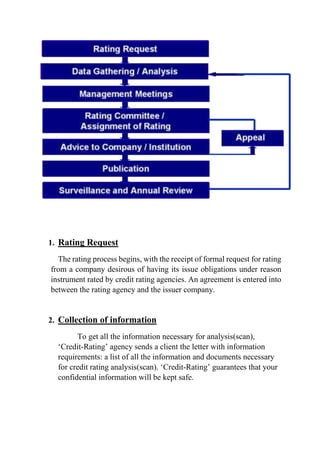
CREDIT RATING PROCESS:-
1. Rating Request
The rating process begins, with the receipt of formal request for rating
from a company desirous of having its issue obligations under reason
instrument rated by credit rating agencies. An agreement is entered into
between the rating agency and the issuer company.
2. Collection of information
To get all the information necessary for analysis(scan),
‘Credit-Rating’ agency sends a client the letter with information
requirements: a list of all the information and documents necessary
for credit rating analysis(scan). ‘Credit-Rating’ guarantees that your
confidential information will be kept safe.
3. Management Meetings
Meetings and consultations with client company managers and
officials are very important in the process of credit rating
assignment. As a rule, we need two or three meetings. In the first
meeting analysts would ask questions about financial plans and
further development prospects. This information helps us to remain
objective in assessment of client’s financial position for the long-
term period.
4. Rating committee/Assignment of Rating
Rating team of the agnecy examines all the data, information
and documents. It also considers all the points presented by the
client. The team then recommends the rating.
5. Advice to the Company/ institution:
The Company/ institution are informed about the rating
proposed by the rating agencies.
6. Appeal
If the Company/ institution feel that the rating can be
improved and has adequate reason for it, it can appeal so to the
agency. Such appeal should be substantiated with proper reasoning
and justification. On appeal the agency may or may not revise the
rating.
7. Publication
On finalize of rating, it is formally communicated to
client, to regulator and after their acceptance it is released for genral public
8. Surveliance and Annual Review
Rating is a dynamic activity. So rating has to be monitored
continuously. Also it is mandatory.

Credit rating

  • 1.
    Meaning of CreditRating:-  A Credit rating issued by a credit rating agency is an rating of the credit worthness of individual financial securities and Debt issued by corporations, government issued securities  A credit rating estimates the credit worthness of an a financial security,a coeporate,local government or even a country.  Credit rating are give by rating agencies to companies and debt instruments,are designed to capacity the chance that a company will default on its duty to creditors.  Thus ,they give investors idea of the risk related with loaning money to the organization (operation,entity)being rated.  Credit ratings are forward-looking opinions about credit risk.It express the agency’s opinion about the ability and willingness of an issuer  Such as a corporation or state or city government,to meet its financial duty in full and on time.  Credit rating are calculated from financial history and current assets and liabilities. Function of credit rating agency:-
  • 2.
     Provide easyto understand information:- Rating agencies collect information, then scan information to explain complex information in a simple and readily understood manner.  Provide basic for investment:-An investment rated by a credit rating enjoy higher confidence from investor.Investors can make an estimate(judge) of the risk and return related with a particular rated issue while investing money in them.  Healthy discipiline on corporate borrowers:- Higher credit rating to any credit investment makes the financial instrument (bond,mortage security) more attractive to investor.Corporation can borrow money more cheaply if they maintain high credit rating on their debt.  Formation of public policy:-Once the debt securitied are rated professionally, it would
  • 3.
    be easier toformulate public policy guideline as to the allow of securities to be included in different kinds of institutional portfolios.  Provides basis for assessing risk and return:-The information provided by credit rating agencies is useful to possible investors in deciding whether to invest in debt securities or not. The rating are assess from time to time.the rating provide a basic for assessing risk and return attached to a particular debt security
  • 4.
    Benefits of CreditRating to Investors  Helps in Investment Decision : Credit rating gives an idea to the investors about the validity of the issuer company, and the risk factor attached to a particular instrument. So the investors can decide whether to invest in such companies or not. Higher the rating, the more will be the willingness to invest in these instruments and vice-versa.  Benefits of Rating Reviews (study) The rating agency regularly reviews the rating given to a particular instrument. So, the present investors can decide whether to keep the instrument or to sell it. For e.g. if the instrument is get decrease, then the investor may decide to sell it and if the rating is maintained or increase, he may decide to keep the instrument until the next rating or maturity.  Promice of Safety High credit rating gives promice to the investors about the safety of the instrument and minimum risk of insolvency. The companies which get a high rating for their instruments, will try to maintain healthy financial discipline. This will protect them from insolvency. So the investors will be safe.  Easy Understandability of Investment Proposal The rating agencies gives rating symbols to the instrument, which can be easily understood by investors. This helps them to understand the investment proposal of an issuer company. For e.g. AAA (Triple A), given by CRISIL for debentures ensures highest safety, whereas debentures rated D are in default or expect to default on maturity.
  • 5.
     Choice ofInstruments Credit rating enables an investor to select a particular instrument from many alternatives available. This choice depends upon the safety or risk of the instrument.  Saves Investor's Time and Effort Credit ratings enable an investor to his save time and effort in analysing(use) the financial strength of an issuer company. This is because the investor can depend on the rating done by professional rating agency, in order to take an investment decision. He need not waste his time and effort to collect and analyse the financial information about the credit standing of the issuer company. Benefits of Credit Rating to Company  Improves Corporate Image : Credit rating helps to improve the corporate image of a company. High credit rating creates confidence and trust in the minds of the investors about the company. Therefore, the company enjoys a good corporate image in the market.  Lowers Cost of Borrowing Companies that have high credit rating for their debt instruments will get funds at lower costs from the market. High rating will enable the company to offer low interest rates on fixed deposits, debentures and other debt securities. The investors will accept low interest rates because they prefer low risk instruments.  Wider Audience for Borrowing
  • 6.
    A company withhigh rating for its instruments can get a wider audience for borrowing. This is because the credit ratings are easily understood not only by the financial institutions and banks, but also by the general public.  Good for Non-Popular Companies Credit rating is beneficial to the non-popular companies, such as closely-held companies. If the credit rating is good, the public will invest in these companies, even if they do not know these companies.  Act as a Marketing Tool : Credit rating not only helps to develop a good image of the company among the investors, but also among the customers, dealers, suppliers, etc. High credit rating can act as a marketing tool to develop confidence in the minds of customers, dealer, suppliers, etc.  Helps in Growth and Expansion Credit rating enables a company to grow and expand. This is because better credit rating will enable a company to get finance easily for growth and expansion.
  • 7.
    Demerits of CreditRating  Possibility of Bias Exist The information collected by the rating agency may be subject to personal bias of the rating team. However, rating agencies try their best to provide opinion of the credit quality of the company and/or instrument. If not, they will not be trusted.  Improper Disclosure(report) May Happen : The company being rated may not disclose certain material facts to the investigating team of the rating agency. This can affect the quality of credit rating.  Impact of Changing Environment Rating is done based on present and past data of the company. So, it will be difficult to guess the future financial position of the company. Many changes take place due to changes in economic, political, social, technological, legal and other environments. All this will affect the working of the company being rated. Therefore, rating is not a guarantee for financial soundness of the company.  Problems for New Companies There may be problems for new companies to collect funds from the market. This is because, a new company may not be in a position to prove its financial soundness. Therefore, it may receive lower credit ratings. This will make it difficult to collect funds from the market.  Reduce in importance by Rating Agency The credit-rating agencies time-to-time review the ratings given to a particular instrument. If the performance of a company is not as expected, then the rating agency will reduce
  • 8.
    in importance theinstrument. This will affect the image of the company.  Difference in Rating : There are cases, where different ratings are provided by various rating agencies for the same instrument. These differences may be due to many reasons. This will create confusion in the minds of the investor. CREDIT RATING PROCESS:-
  • 9.
    1. Rating Request Therating process begins, with the receipt of formal request for rating from a company desirous of having its issue obligations under reason instrument rated by credit rating agencies. An agreement is entered into between the rating agency and the issuer company. 2. Collection of information To get all the information necessary for analysis(scan), ‘Credit-Rating’ agency sends a client the letter with information requirements: a list of all the information and documents necessary for credit rating analysis(scan). ‘Credit-Rating’ guarantees that your confidential information will be kept safe.
  • 10.
    3. Management Meetings Meetingsand consultations with client company managers and officials are very important in the process of credit rating assignment. As a rule, we need two or three meetings. In the first meeting analysts would ask questions about financial plans and further development prospects. This information helps us to remain objective in assessment of client’s financial position for the long- term period. 4. Rating committee/Assignment of Rating Rating team of the agnecy examines all the data, information and documents. It also considers all the points presented by the client. The team then recommends the rating. 5. Advice to the Company/ institution: The Company/ institution are informed about the rating proposed by the rating agencies. 6. Appeal If the Company/ institution feel that the rating can be improved and has adequate reason for it, it can appeal so to the agency. Such appeal should be substantiated with proper reasoning and justification. On appeal the agency may or may not revise the rating. 7. Publication On finalize of rating, it is formally communicated to client, to regulator and after their acceptance it is released for genral public
  • 11.
    8. Surveliance andAnnual Review Rating is a dynamic activity. So rating has to be monitored continuously. Also it is mandatory.