Submitted to:
Prof. Megha Jain
Submitted by:
Shreta Maheshwari
Ayush Malviya
Ayushi Rathore
Akash Chouhan
Apkesha Malviya
Mayur Yadav
Nikhil Bijlani
Satyam Kesarwani
Credit Rating
A credit rating estimates the credit worthiness
of an a financial security, a corporation, local
government or even
a country.
An estimate of the ability of a person or
organization to fulfill their financial
commitments, based on previous dealings.
Importance
Credit ratings for borrowers are based on
substantial due diligence conducted by the
rating agencies. While a borrower will strive to
have the highest possible credit rating since it
has a major impact on interest rates charged
by lenders, the rating agencies must take a
balanced and objective view of the borrower’s
financial situation and capacity to
service/repay the debt.
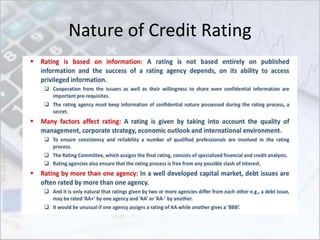
Nature of Credit Rating
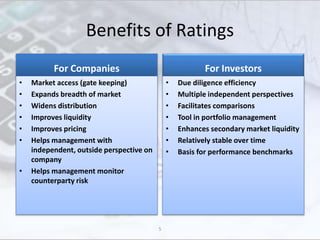
Benefits of Ratings
For Companies
• Market access (gate keeping)
• Expands breadth of market
• Widens distribution
• Improves liquidity
• Improves pricing
• Helps management with
independent, outside perspective on
company
• Helps management monitor
counterparty risk
For Investors
• Due diligence efficiency
• Multiple independent perspectives
• Facilitates comparisons
• Tool in portfolio management
• Enhances secondary market liquidity
• Relatively stable over time
• Basis for performance benchmarks
5
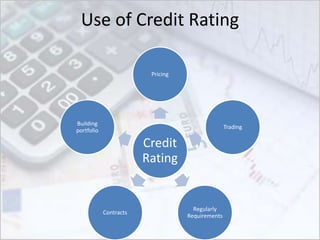
Use of Credit Rating
Credit
Rating
Pricing
Trading
Regularly
Requirements
Contracts
Building
portfolio
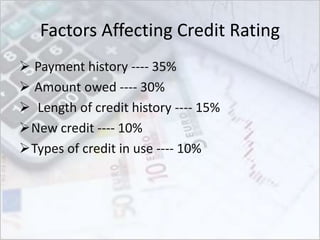
Factors Affecting Credit Rating
 Payment history ---- 35%
 Amount owed ---- 30%
 Length of credit history ---- 15%
New credit ---- 10%
Types of credit in use ---- 10%
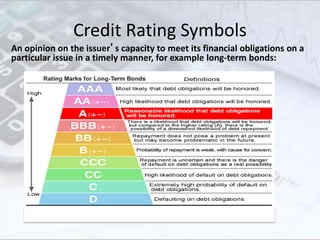
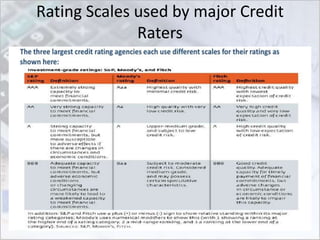
Credit Rating Symbols
An opinion on the issuer’s capacity to meet its financial obligations on a
particular issue in a timely manner, for example long-term bonds:
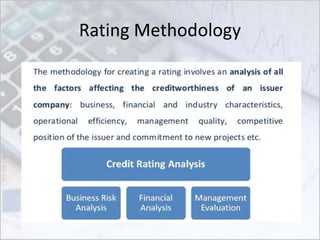
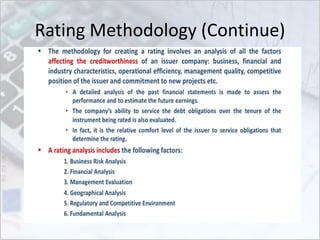
Rating Methodology
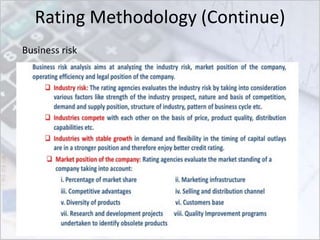
Rating Methodology (Continue)
Business risk
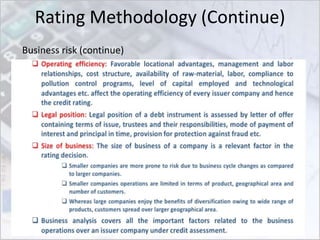
Rating Methodology (Continue)
Business risk (continue)
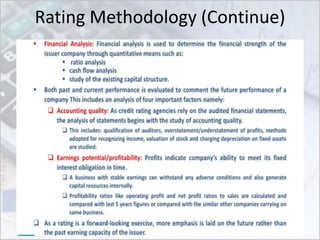
Rating Methodology (Continue)
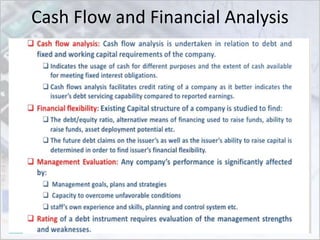
Cash Flow and Financial Analysis
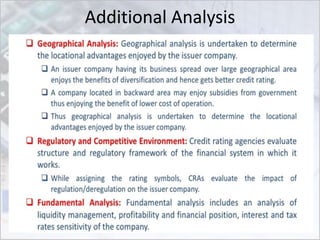
Additional Analysis
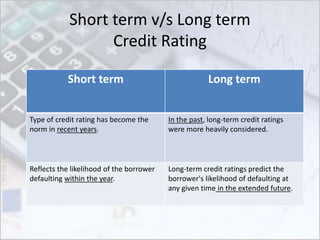
Short term v/s Long term
Credit Rating
Short term Long term
Type of credit rating has become the
norm in recent years.
In the past, long-term credit ratings
were more heavily considered.
Reflects the likelihood of the borrower
defaulting within the year.
Long-term credit ratings predict the
borrower's likelihood of defaulting at
any given time in the extended future.
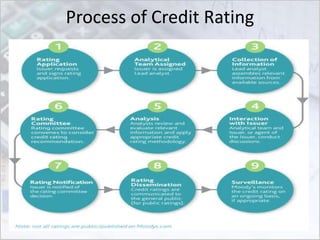
Process of Credit Rating
Distinction Between Credit Rating and
Reporting
A credit reporting agency is responsible for
compiling financial data that is necessary for loan
decisions.
A credit rating agency does all the statistical
assessments that are involved in placing a rating
on a company or organization’s credit history..
A credit rating agency is responsible for providing
investors with information about an organization’s
creditworthiness.
Nationally Recognized Statistical Rating
Organization
• In 1975, the U.S. Securities Exchange Commission
established the ‘Nationally Recognized Statistical
Rating Organization’ (NRSRO) designation
• Three of best known rating agencies in the U.S. were
named:
• Moody’s Investor Services
• Standard and Poor’s
• Fitch Rating
• In 2003, the SEC approved a fourth NRSRO, Dominion
Bond Rating Services (DBRS) from Canada.
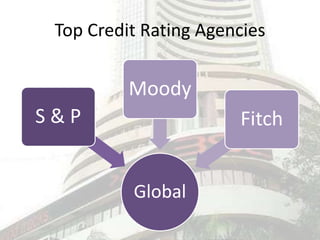
Top Credit Rating Agencies
Global
S & P
Moody
Fitch
Standard And Poor’s
• Established in ---- 1957
• Corporate office ---- New York City, New York,
US
• Business ---- credit ratings, research
• Market Share ---- last price in USD – 2018.94
Moody’s
• Established in ---- 1909
• Corporate office ---- New York City, New York,
US
• Business ---- credit ratings, research, credit risk
management and other services
• Market Share ---- last price in USD – 97.93
Fitch Ratings
• Established in ---- 1914
• Corporate office ---- New York and London
• Business ----credit ratings and research; Fitch
Solution, analytical tools and risk services;
BMI research, an independent provider of
country risk and industry and Fitch Learning.
• Market Share ---- last price in USD –
Rating Scales used by major Credit
Raters
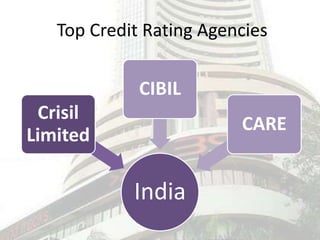
Top Credit Rating Agencies
India
Crisil
Limited
CIBIL
CARE
Crisil Ltd
• Established in ---- 1987
• CEO --- Mr. Ashu Suyash
• Headquarter ---- Mumbai, Maharashtra
• Business ---- A Global analytical company
providing ratings, research and risk, and policy
advisory services.
• Market Share ---- last price in USD –
• Majority shareholder is hold by S&P.
CIBIL
• Established in ---- August 2000 (It’s a Credit
Information Company)
• CEO --- Mr. Satish Pillai
• Headquarter ---- Nariman Point, Mumbai
• Business ---- help loan providers manage their
business or help consumers secure credit
faster and at better terms
• Market Share ---- last price in USD –
CARE
• Established in ---- April 1993
• Corporate office ---- Somaiya Hospital Road,
Sion (East), Mumbai 400 022.
• Business ---- the entire spectrum of credit
rating
• Market Share
it has established itself as the second-largest
credit rating agency in India. With the rating
volume of debt as Rs. 68.08 lakh crore
Advantages of Credit Rating
Benefits to Investors
 Safety of investments.
 Recognition of risk and
returns.
 Freedom of investment
decisions.
 Wider choice of investments
 Dependable credibility of
issuer
 Easy understanding of
investment proposals
Benefits the Company
 Easier to raise funding
 Reduced cost of borrowing
 Reduce cost of public issues
 Ratings can build up image
 Ratings facilitates growth
 Recognition to unknown
companies
Slide 33
Benefits to Intermediaries
For brokers ratings make it easier to persuade clients to select an investment proposal of
investment in highly rated instruments.
Disadvantages of Credit Rating
Credit rating suffers from the following limitations:
 Non-disclosure of significant information
 Static study
 Rating is no certificate of soundness
 Rating may be biased
 Rating under unfavorable conditions
 Difference in rating grades
 Improper Disclosure May Happen
 Impact of Changing Environment
 Problems for New Companies
 Downgrading by Rating Agency
Conclusion
• Moody is consider the best credit rating
agency in the world.
• It is consider while dealing in capital market
and debt for investing in a company,
corporation or in the country.
Reference
• A Brief History Of Credit Rating
Agencies http://www.investopedia.com/articles/bonds/09/history-credit-
rating-agencies.asp#ixzz3pHOrey7h
• http://www.careratings.com/about-us.aspx
• http://www.crisil.com/index.jsp
• https://www.cibil.com/search/node/market%20share
• https://www.google.co.in/#q=fitch+ratings
• https://www.moodys.com/researchandratings/region/asia-
pacific/india/00400000000C/4294965089/4294967230/-1/0/-/0/-/-/-/-/-/-
/-/en/global/pdf/-/rra
• http://www.hoovers.com/company-information/cs/company-
profile.MOODYS_CORPORATION.bfdac814a90fd613.html
• http://markets.ft.com/research/Markets/Tearsheets/Summary?s=INX:IOM
• http://www.careratings.com/about-us.aspx
Credit rating

Credit rating

  • 1.
    Submitted to: Prof. MeghaJain Submitted by: Shreta Maheshwari Ayush Malviya Ayushi Rathore Akash Chouhan Apkesha Malviya Mayur Yadav Nikhil Bijlani Satyam Kesarwani
  • 2.
    Credit Rating A creditrating estimates the credit worthiness of an a financial security, a corporation, local government or even a country. An estimate of the ability of a person or organization to fulfill their financial commitments, based on previous dealings.
  • 3.
    Importance Credit ratings forborrowers are based on substantial due diligence conducted by the rating agencies. While a borrower will strive to have the highest possible credit rating since it has a major impact on interest rates charged by lenders, the rating agencies must take a balanced and objective view of the borrower’s financial situation and capacity to service/repay the debt.
  • 4.
  • 5.
    Benefits of Ratings ForCompanies • Market access (gate keeping) • Expands breadth of market • Widens distribution • Improves liquidity • Improves pricing • Helps management with independent, outside perspective on company • Helps management monitor counterparty risk For Investors • Due diligence efficiency • Multiple independent perspectives • Facilitates comparisons • Tool in portfolio management • Enhances secondary market liquidity • Relatively stable over time • Basis for performance benchmarks 5
  • 6.
    Use of CreditRating Credit Rating Pricing Trading Regularly Requirements Contracts Building portfolio
  • 7.
    Factors Affecting CreditRating  Payment history ---- 35%  Amount owed ---- 30%  Length of credit history ---- 15% New credit ---- 10% Types of credit in use ---- 10%
  • 8.
    Credit Rating Symbols Anopinion on the issuer’s capacity to meet its financial obligations on a particular issue in a timely manner, for example long-term bonds:
  • 9.
  • 10.
  • 11.
  • 12.
  • 13.
  • 14.
    Cash Flow andFinancial Analysis
  • 15.
  • 16.
    Short term v/sLong term Credit Rating Short term Long term Type of credit rating has become the norm in recent years. In the past, long-term credit ratings were more heavily considered. Reflects the likelihood of the borrower defaulting within the year. Long-term credit ratings predict the borrower's likelihood of defaulting at any given time in the extended future.
  • 17.
  • 21.
    Distinction Between CreditRating and Reporting A credit reporting agency is responsible for compiling financial data that is necessary for loan decisions. A credit rating agency does all the statistical assessments that are involved in placing a rating on a company or organization’s credit history.. A credit rating agency is responsible for providing investors with information about an organization’s creditworthiness.
  • 23.
    Nationally Recognized StatisticalRating Organization • In 1975, the U.S. Securities Exchange Commission established the ‘Nationally Recognized Statistical Rating Organization’ (NRSRO) designation • Three of best known rating agencies in the U.S. were named: • Moody’s Investor Services • Standard and Poor’s • Fitch Rating • In 2003, the SEC approved a fourth NRSRO, Dominion Bond Rating Services (DBRS) from Canada.
  • 24.
    Top Credit RatingAgencies Global S & P Moody Fitch
  • 25.
    Standard And Poor’s •Established in ---- 1957 • Corporate office ---- New York City, New York, US • Business ---- credit ratings, research • Market Share ---- last price in USD – 2018.94
  • 26.
    Moody’s • Established in---- 1909 • Corporate office ---- New York City, New York, US • Business ---- credit ratings, research, credit risk management and other services • Market Share ---- last price in USD – 97.93
  • 27.
    Fitch Ratings • Establishedin ---- 1914 • Corporate office ---- New York and London • Business ----credit ratings and research; Fitch Solution, analytical tools and risk services; BMI research, an independent provider of country risk and industry and Fitch Learning. • Market Share ---- last price in USD –
  • 28.
    Rating Scales usedby major Credit Raters
  • 29.
    Top Credit RatingAgencies India Crisil Limited CIBIL CARE
  • 30.
    Crisil Ltd • Establishedin ---- 1987 • CEO --- Mr. Ashu Suyash • Headquarter ---- Mumbai, Maharashtra • Business ---- A Global analytical company providing ratings, research and risk, and policy advisory services. • Market Share ---- last price in USD – • Majority shareholder is hold by S&P.
  • 31.
    CIBIL • Established in---- August 2000 (It’s a Credit Information Company) • CEO --- Mr. Satish Pillai • Headquarter ---- Nariman Point, Mumbai • Business ---- help loan providers manage their business or help consumers secure credit faster and at better terms • Market Share ---- last price in USD –
  • 32.
    CARE • Established in---- April 1993 • Corporate office ---- Somaiya Hospital Road, Sion (East), Mumbai 400 022. • Business ---- the entire spectrum of credit rating • Market Share it has established itself as the second-largest credit rating agency in India. With the rating volume of debt as Rs. 68.08 lakh crore
  • 33.
    Advantages of CreditRating Benefits to Investors  Safety of investments.  Recognition of risk and returns.  Freedom of investment decisions.  Wider choice of investments  Dependable credibility of issuer  Easy understanding of investment proposals Benefits the Company  Easier to raise funding  Reduced cost of borrowing  Reduce cost of public issues  Ratings can build up image  Ratings facilitates growth  Recognition to unknown companies Slide 33 Benefits to Intermediaries For brokers ratings make it easier to persuade clients to select an investment proposal of investment in highly rated instruments.
  • 34.
    Disadvantages of CreditRating Credit rating suffers from the following limitations:  Non-disclosure of significant information  Static study  Rating is no certificate of soundness  Rating may be biased  Rating under unfavorable conditions  Difference in rating grades  Improper Disclosure May Happen  Impact of Changing Environment  Problems for New Companies  Downgrading by Rating Agency
  • 35.
    Conclusion • Moody isconsider the best credit rating agency in the world. • It is consider while dealing in capital market and debt for investing in a company, corporation or in the country.
  • 36.
    Reference • A BriefHistory Of Credit Rating Agencies http://www.investopedia.com/articles/bonds/09/history-credit- rating-agencies.asp#ixzz3pHOrey7h • http://www.careratings.com/about-us.aspx • http://www.crisil.com/index.jsp • https://www.cibil.com/search/node/market%20share • https://www.google.co.in/#q=fitch+ratings • https://www.moodys.com/researchandratings/region/asia- pacific/india/00400000000C/4294965089/4294967230/-1/0/-/0/-/-/-/-/-/- /-/en/global/pdf/-/rra • http://www.hoovers.com/company-information/cs/company- profile.MOODYS_CORPORATION.bfdac814a90fd613.html • http://markets.ft.com/research/Markets/Tearsheets/Summary?s=INX:IOM • http://www.careratings.com/about-us.aspx

Editor's Notes

  • #34 Benefits to Investors Safety of investments. Credit rating gives an idea in advance to the investors about the degree of financial strength of the issuer company. Based on rating he decides about the investment. Highly rated issues gives an assurance to the investors of safety of Investments and minimizes his risk. Recognition of risk and returns. Credit rating symbols indicate both the returns expected and the risk attached to a particular issue. It becomes easier for the investor to understand the worth of the issuer company just by looking at the symbol because the issue is backed by the financial strength of the company. Freedom of investment decisions. Investors need not seek advise from the stock brokers, merchant bankers or the portfolio managers before making investments. Investors today are free and independent to take investment decisions themselves. They base their decisions on rating symbols attached to a particular security. Each rating symbol assigned to a particular investment suggests the creditworthiness of the investment and indicates the degree of risk involved in it. Wider choice of investments. As it is mandatory to rate debt obligations for every issuer company, at any particular time, wide range of credit rated instruments are available for making investment. Depending upon his own ability to bear risk, the investor can make choice of the securities in which investment is to be made. Dependable credibility of issuer. Absence of any link between the rater and rated firm ensures dependable credibility of issuer and attracts investors. As rating agency has no vested interest in issue to be rated, and has no business connections or links with the Board of Directors. In other words, it operates independent of the issuer company, the rating given by it is always accepted by the investors. Easy understanding of investment proposals. Investors require no analytical knowledge on their part about the issuer company. Depending upon rating symbols assigned by the rating agencies they can proceed with decisions to make investment in any particular rated security of a company. Benefits to Company Easy to raise resources. A company with highly rated instrument finds it easy to raise resources from the public. Even though investors in different sections of the society understand the degree of risk and uncertainty attached to a particular security but they still get attracted towards the highly rated instruments. Reduced cost of borrowing. Investors always like to make Investments in such instrument, which ensure safety and easy liquidity rather than high rate of return. A company can reduce the cost of borrowings by quoting lesser interest on those fixed deposits or debentures or bonds, which are highly rated. Reduced cost of public issues. A company with highly rated instruments has to make least efforts in raising funds through public. It can reduce its expenditure on press and publicity. Rating facilitates best pricing and timing of issues. Rating builds up image. Companies with highly rated instrument enjoy better goodwill and corporate image in the eyes of customers, shareholders, investors and creditors. Customers feel confident of the quality of goods manufactured, shareholders are sure of high returns, investors feel secured of their investments and creditors are assured of timely payments of interest and principal. Rating facilitates growth. Rating motivates the promoters to undertake expansion of their operations or diversify their production activities thus leading to the growth of the company in future. Moreover highly rated companies find it easy to raise funds from public through new issues or through credit from banks and FIs to finance their expansion activities. Recognition to unknown companies. Credit rating provides recognition to relatively unknown companies going for public issues through wide investor base. While entering into market, investors rely more on the rating grades than on ‘name recognition’
  • #35 Non-disclosure of significant information : Firm being rated may not provide significant or material information, which is likely to affect the investor’s decision as to investment, to the investigation team of the credit rating company. Thus any decisions taken in the absence of such significant information may put investors at a loss. Static study : Rating is a static study of present and past historic data of the company at one particular point of time. Number of factors including economic, political, environment, and government policies have direct bearing on the working of a company. Any changes after the assignment of rating symbols may defeat the very purpose of risk indicativeness of rating. Rating is no certificate of soundness : Rating grades by the rating agencies are only an opinion about the capability of the company to meets its interest obligations. Rating symbols do not pinpoint towards quality of products or management or staff etc. In other words rating does not give a certificate of the complete soundness of the company. Users should form an independent view of the rating symbol. Rating may be biased : Personal bias of the investigating team might affect the quality of the rating. The companies having lower grade rating do not advertise or use the rating while raising funds from the public. In such a case the investors cannot get the true information about the risk involved in the instrument. Rating under unfavorable conditions : Rating grades are not always representative of the true image of a company. A company might be given low grade because it was passing through unfavorable conditions when rated. Thus, misleading conclusions may be drawn by the investors which hampers the company’s interest. Difference in rating grades : Same instrument may be rated differently by the two rating agencies because of the personal judgment of the investigating staff on qualitative aspects. This may further confuse the investors. Improper Disclosure May Happen : The company being rated may not disclose certain material facts to the investigating team of the rating agency. This can affect the quality of credit rating. Impact of Changing Environment : Rating is done based on present and past data of the company. So, it will be difficult to predict the future financial position of the company. Many changes take place due to changes in economic, political, social, technological, legal and other environments. All this will affect the working of the company being rated. Therefore, rating is not a guarantee for financial soundness of the company. Problems for New Companies : There may be problems for new companies to collect funds from the market. This is because, a new company may not be in a position to prove its financial soundness. Therefore, it may receive lower credit ratings. This will make it difficult to collect funds from the market. Downgrading by Rating Agency : The credit-rating agencies periodically review the ratings given to a particular instrument. If the performance of a company is not as expected, then the rating agency will downgrade the instrument. This will affect the image of the company.
  • #36 Non-disclosure of significant information : Firm being rated may not provide significant or material information, which is likely to affect the investor’s decision as to investment, to the investigation team of the credit rating company. Thus any decisions taken in the absence of such significant information may put investors at a loss. Static study : Rating is a static study of present and past historic data of the company at one particular point of time. Number of factors including economic, political, environment, and government policies have direct bearing on the working of a company. Any changes after the assignment of rating symbols may defeat the very purpose of risk indicativeness of rating. Rating is no certificate of soundness : Rating grades by the rating agencies are only an opinion about the capability of the company to meets its interest obligations. Rating symbols do not pinpoint towards quality of products or management or staff etc. In other words rating does not give a certificate of the complete soundness of the company. Users should form an independent view of the rating symbol. Rating may be biased : Personal bias of the investigating team might affect the quality of the rating. The companies having lower grade rating do not advertise or use the rating while raising funds from the public. In such a case the investors cannot get the true information about the risk involved in the instrument. Rating under unfavorable conditions : Rating grades are not always representative of the true image of a company. A company might be given low grade because it was passing through unfavorable conditions when rated. Thus, misleading conclusions may be drawn by the investors which hampers the company’s interest. Difference in rating grades : Same instrument may be rated differently by the two rating agencies because of the personal judgment of the investigating staff on qualitative aspects. This may further confuse the investors. Improper Disclosure May Happen : The company being rated may not disclose certain material facts to the investigating team of the rating agency. This can affect the quality of credit rating. Impact of Changing Environment : Rating is done based on present and past data of the company. So, it will be difficult to predict the future financial position of the company. Many changes take place due to changes in economic, political, social, technological, legal and other environments. All this will affect the working of the company being rated. Therefore, rating is not a guarantee for financial soundness of the company. Problems for New Companies : There may be problems for new companies to collect funds from the market. This is because, a new company may not be in a position to prove its financial soundness. Therefore, it may receive lower credit ratings. This will make it difficult to collect funds from the market. Downgrading by Rating Agency : The credit-rating agencies periodically review the ratings given to a particular instrument. If the performance of a company is not as expected, then the rating agency will downgrade the instrument. This will affect the image of the company.