


Presented by,
Anitta Clarance
CREDIT RATING
• It evaluates the credit worthiness of a debtor, especially a business (company) or a
government
• Credit ratings are determined by credit ratings agencies like CRISIL, CARE and
S&P
• It is the rating agency’s opinion on the likelihood of rated debt obligation being
repaid in full and on time
• A simple alphanumeric symbol is normally used to convey a credit rating
MEANING :
• India’s first credit rating agency CRISIL was set up in 29 January 1987
• It is incorporated, promoted by the erstwhile ICICI Ltd along with UTI and other financial
institutions
• Mr. N Vaghul and Mr. pradip Shah are CRISIL’s first Chairman and managing Director
respectively
• The first private sector credit rating institution in India was DUFF & PHELPS CREDIT
RATING INDIA PVT.LTD formed in 1995
ORGIN OF CREDIT RATING IN INDIA
• According to CRISIL:
“ Credit rating is unbiased, objective and independent opinion as to an issuer’s
capacity to meet financial obligation”
DEFINITION :
• Credit rating are not based on mathematical formulas. Instead, credit rating
agencies use their judgment and experience in determining what public and private
information should be considered in giving a rating to a particular company or
government
• Poor credit rating indicates – high risk of defaulting
• It establish a link between risk and return
• They provide a yardstick against which to measure the risk inherent in any instrument
• An investor uses the rating to asses the risk level and compares the offered rate of return
with his expected rate of return
IMPORTANCE
• Benefits to company:
a. Improved corporate image
b. Good for non popular companies
c. Act as a marketing tool
d. Reduced costs of borrowings
e. Easy to raise resource
f. Helps in growth and expansion
BENEFITS
• Benefits to investors:
a. Helps in investment decision
b. Choice of instruments
c. Easy understandability of investment proposal
d. Dependable credibility of issuer
e. Advantages of continuous monitoring
• provide superior and low cost information to investors for taking decision regarding risk
return trade off
• Encourages greater information disclosure, better accounting standards and improved
financial information
• May reduce interest costs for highly rated companies
• Act as a marketing tool
• Helps merchant bankers, brokers,etc., in discharging their functions related to debt issues
OBJECTIVES
• Maintenance of investor’s confidence, since default shatter the confidence of investors in
corporate instruments
• Protect the interest of investors who can not investigate much into the merits of the debt
instruments of a company
• Motivate savers to invest in industry and trade
NEED
• CRISIL Limited
• Fitch Rating India Private Ltd.
• ICRA Ltd
• Credit Analysis and Research Ltd(CARE)
• Credit Information Bureau India Ltd ( CIBIL)
• SME Rating Agency of India Ltd. (SMERA)
CREDIT RATING AGENCIES IN INDIA
• BONDS
• DEBENTURES
• FIXED DEPOSITS
• COMMERCIAL PAPERS
• INTERCORPORATE DEPOSITS
• AND MANY MORE ITEMS
ITEMS RATED
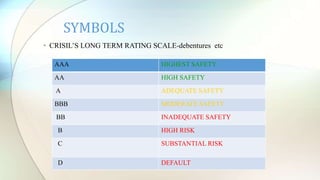
• CRISIL’S LONG TERM RATING SCALE-debentures etc
SYMBOLS
AAA HIGHEST SAFETY
AA HIGH SAFETY
A ADEQUATE SAFETY
BBB MODERATE SAFETY
BB INADEQUATE SAFETY
B HIGH RISK
C SUBSTANTIAL RISK
D DEFAULT
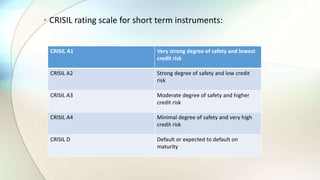
• CRISIL rating scale for short term instruments:
CRISIL A1 Very strong degree of safety and lowest
credit risk
CRISIL A2 Strong degree of safety and low credit
risk
CRISIL A3 Moderate degree of safety and higher
credit risk
CRISIL A4 Minimal degree of safety and very high
credit risk
CRISIL D Default or expected to default on
maturity
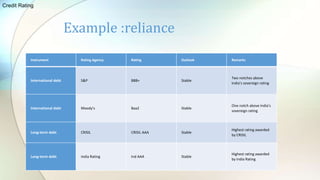
Instrument Rating Agency Rating Outlook Remarks
International debt S&P BBB+ Stable
Two notches above
India's sovereign rating
International debt Moody's Baa2 Stable
One notch above India's
sovereign rating
Long-term debt CRISIL CRISIL AAA Stable
Highest rating awarded
by CRISIL
Long-term debt India Rating Ind AAA Stable
Highest rating awarded
by India Rating
Example :reliance
Credit Rating
Credit rating

Credit rating

  • 1.
  • 2.
    • It evaluatesthe credit worthiness of a debtor, especially a business (company) or a government • Credit ratings are determined by credit ratings agencies like CRISIL, CARE and S&P • It is the rating agency’s opinion on the likelihood of rated debt obligation being repaid in full and on time • A simple alphanumeric symbol is normally used to convey a credit rating MEANING :
  • 3.
    • India’s firstcredit rating agency CRISIL was set up in 29 January 1987 • It is incorporated, promoted by the erstwhile ICICI Ltd along with UTI and other financial institutions • Mr. N Vaghul and Mr. pradip Shah are CRISIL’s first Chairman and managing Director respectively • The first private sector credit rating institution in India was DUFF & PHELPS CREDIT RATING INDIA PVT.LTD formed in 1995 ORGIN OF CREDIT RATING IN INDIA
  • 4.
    • According toCRISIL: “ Credit rating is unbiased, objective and independent opinion as to an issuer’s capacity to meet financial obligation” DEFINITION :
  • 5.
    • Credit ratingare not based on mathematical formulas. Instead, credit rating agencies use their judgment and experience in determining what public and private information should be considered in giving a rating to a particular company or government • Poor credit rating indicates – high risk of defaulting
  • 6.
    • It establisha link between risk and return • They provide a yardstick against which to measure the risk inherent in any instrument • An investor uses the rating to asses the risk level and compares the offered rate of return with his expected rate of return IMPORTANCE
  • 7.
    • Benefits tocompany: a. Improved corporate image b. Good for non popular companies c. Act as a marketing tool d. Reduced costs of borrowings e. Easy to raise resource f. Helps in growth and expansion BENEFITS
  • 8.
    • Benefits toinvestors: a. Helps in investment decision b. Choice of instruments c. Easy understandability of investment proposal d. Dependable credibility of issuer e. Advantages of continuous monitoring
  • 9.
    • provide superiorand low cost information to investors for taking decision regarding risk return trade off • Encourages greater information disclosure, better accounting standards and improved financial information • May reduce interest costs for highly rated companies • Act as a marketing tool • Helps merchant bankers, brokers,etc., in discharging their functions related to debt issues OBJECTIVES
  • 10.
    • Maintenance ofinvestor’s confidence, since default shatter the confidence of investors in corporate instruments • Protect the interest of investors who can not investigate much into the merits of the debt instruments of a company • Motivate savers to invest in industry and trade NEED
  • 11.
    • CRISIL Limited •Fitch Rating India Private Ltd. • ICRA Ltd • Credit Analysis and Research Ltd(CARE) • Credit Information Bureau India Ltd ( CIBIL) • SME Rating Agency of India Ltd. (SMERA) CREDIT RATING AGENCIES IN INDIA
  • 12.
    • BONDS • DEBENTURES •FIXED DEPOSITS • COMMERCIAL PAPERS • INTERCORPORATE DEPOSITS • AND MANY MORE ITEMS ITEMS RATED
  • 13.
    • CRISIL’S LONGTERM RATING SCALE-debentures etc SYMBOLS AAA HIGHEST SAFETY AA HIGH SAFETY A ADEQUATE SAFETY BBB MODERATE SAFETY BB INADEQUATE SAFETY B HIGH RISK C SUBSTANTIAL RISK D DEFAULT
  • 14.
    • CRISIL ratingscale for short term instruments: CRISIL A1 Very strong degree of safety and lowest credit risk CRISIL A2 Strong degree of safety and low credit risk CRISIL A3 Moderate degree of safety and higher credit risk CRISIL A4 Minimal degree of safety and very high credit risk CRISIL D Default or expected to default on maturity
  • 15.
    Instrument Rating AgencyRating Outlook Remarks International debt S&P BBB+ Stable Two notches above India's sovereign rating International debt Moody's Baa2 Stable One notch above India's sovereign rating Long-term debt CRISIL CRISIL AAA Stable Highest rating awarded by CRISIL Long-term debt India Rating Ind AAA Stable Highest rating awarded by India Rating Example :reliance Credit Rating