Swayam Siddhi College of Mgt & Research
SSCMR Presentor : Prof. Rahul Shah
CAPITAL ADEQUACY NORMS
Swayam Siddhi College of Mgt & Research
SSCMR Presentor : Prof. Rahul Shah
Importance of Capital for Banks
Capital is a key ingredient for safe and sound banks and
here is why. Banks take on risks and may suffer losses if the
risks materialize. To stay safe and protect people’s deposits,
banks have to be able to absorb such losses and keep going
in good times and bad. That’s what bank capital is used for.
Swayam Siddhi College of Mgt & Research
SSCMR Presentor : Prof. Rahul Shah
How Much Capital Bank Should Hold????
The answer lies in the risks it takes. The bigger the risks,
the more capital it needs. That’s why it’s essential that
banks continuously assess the risks they are exposed to
and the losses they may incur. Their assessments are
checked and challenged by banking supervisors.
Supervisors are responsible for monitoring banks’
financial health, and checking their capital levels is an
important part of this.
Swayam Siddhi College of Mgt & Research
SSCMR Presentor : Prof. Rahul Shah
What is Capital ?
Put simply, capital is the money that a bank has obtained from its
shareholders and other investors and any profit that it has made
and not paid out. Consequently, if a bank wants to expand its
capital base, it can do so for example by issuing more shares or
retaining profits, rather than paying them out as dividends to
shareholders.
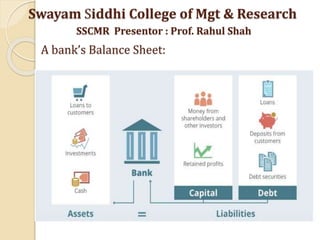
Overall, every bank has two sources of funds: capital and debt.
Debt is the money that it has borrowed from its lenders and will
have to pay back. Debt includes among other things deposits
from customers, debt securities issued and loans taken out by
the bank.
Funds from these two sources are employed by the bank in a
number of ways, for example to give loans to customers or to
make other investments. These loans and other investments are
the bank’s assets, along with funds that are held as cash.
Swayam Siddhi College of Mgt & Research
SSCMR Presentor : Prof. Rahul Shah
A bank’s Balance Sheet:
Swayam Siddhi College of Mgt & Research
SSCMR Presentor : Prof. Rahul Shah
How does Capital keep Banks Safe?
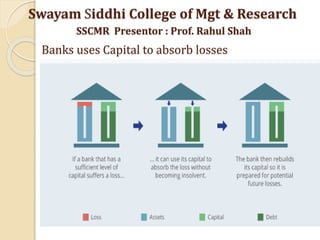
Capital acts like a financial cushion against losses. When, for
example, many borrowers are suddenly unable to pay back
their loans, or some of the bank’s investments fall in value, the
bank will make a loss and without a capital cushion might
even go bankrupt. However, if it has a solid capital base, it will
use it to absorb the loss and continue to operate and serve its
customers.
Swayam Siddhi College of Mgt & Research
SSCMR Presentor : Prof. Rahul Shah
Banks uses Capital to absorb losses
Banks in the process of financial intermediation are
confronted with various kinds of financial and non-
financial risks viz.:
CreditRisk
LiquidityRisk
MarketRisk
OperationalRisk
Swayam Siddhi College of Mgt & Research
SSCMR Presentor : Prof. Rahul Shah
Risk Exposure
Loans and advances given by the banks to
its customers is are an Asset to the bank.
A loan (an asset for the bank) turns as NPA when the EMI,
principal or interest component for the loan is not paid
within 90 days from the due date.
Thus a Bad Loan is an asset that ceases to generate any
income for the bank
Swayam Siddhi College of Mgt & Research
SSCMR Presentor : Prof. Rahul Shah
Non Performing Assets
• The Basel Committee on Banking Supervision was
established in 1974, by the Bank of International
Settlements (BIS). In order to help the banks to
recognize the different kinds of risks and to take adequate
steps
• An international organization founded in Basel,
Switzerland in 1930 to serve as a Bank for Central
banks.

Swayam Siddhi College of Mgt & Research
SSCMR Presentor : Prof. Rahul Shah
Risk Management Through Basel Committee
• As per Basel Committee guidelines issued capital
adequacy was considered panacea for risk management.
• All banks were advised to have Capital Adequacy Ratio
(CAR) at least 8%. CAR is the ratio of capital to risk weighted
assets and it provides the cushion to the depositors in case of
bankruptcy.
• Committee consisting of members from each of the G10
countries. It is represented by central bank governors of
each of the G10 countries.

• Thirteen industrialized Nations that meet on an annual
basis to consult each other on international financial matters.
Swayam Siddhi College of Mgt & Research
SSCMR Presentor : Prof. Rahul Shah
Risk Management Through Basel Committee
The member countries are: France,
Germany, Belgium, Italy, Japan, the
Netherlands, Sweden, the United Kingdom, the United
States and Canada, with Switzerland, Luxembourg, Spain
It meets regularly 4 times a year.
Swayam Siddhi College of Mgt & Research
SSCMR Presentor : Prof. Rahul Shah
Risk Management Through Basel Committee
The basic approach of capital adequacy
framework is that a bank should have sufficient capital to
provide a stable resource to absorb any
losses arising from the risks in its business.
For supervisory purposes capital is split into two
categories:
Tier I and Tier II. These categories represent different
instruments’ quality as capital:
Swayam Siddhi College of Mgt & Research
SSCMR Presentor : Prof. Rahul Shah
Capital Adequacy Framework
Tier I Capital consists:
Equity Capital (Shareholders' Funds)
DisclosedReserves:
◦ Premium over shares,
◦ Retained earnings,
◦ Legal reserve
It is a bank’s highest quality capital because it is fully
available to cover losses.
Swayam Siddhi College of Mgt & Research
SSCMR Presentor : Prof. Rahul Shah
Capital Adequacy Framework
Legal reserves are the only assets that
are permitted by government regulations.
Divided into The two asset categories:
Required Reserve (Vault cash & Reserve
deposits )
Excess Reserve (Reserve for loan purposes)
Legal Reserve:
Swayam Siddhi College of Mgt & Research
SSCMR Presentor : Prof. Rahul Shah
Capital Adequacy Framework
Vault Cash (Required Reserve)
Paper bills and metal coins kept on the bank premises,
both the vault and teller drawers.
To satisfy currency withdrawal demands of depositors.
Vault cash is not part of the official M1 money supply.
M1 includes only the paper bills and metal coins that is in
circulation and held by the nonbank public.
Swayam Siddhi College of Mgt & Research
SSCMR Presentor : Prof. Rahul Shah
Capital Adequacy Framework
Reserve deposits are the one that regulators require.
These are deposits that banks keep with the Reserve Bank
Of India System.
Required reserves are specified as a fraction of
outstanding deposits--usually about 3 percent -15 percent
Swayam Siddhi College of Mgt & Research
SSCMR Presentor : Prof. Rahul Shah
Capital Adequacy Framework
Reserve Deposits (Required Reserve)
Excess Reserve
Any legal (or total) reserves over and above those required
by regulators are excess reserves.
These excess reserves are used for loans, which makes
them exceedingly important to the banking industry.
Tier II capitalConsists:
Undisclosed reserves
Revaluation reserves
General provisions
Subordinated debt
Hybrid Instruments.
This capital is less permanent in nature.
The loss absorption capacity of Tier II capital is lower
than that of Tier I capital.
Swayam Siddhi College of Mgt & Research
SSCMR Presentor : Prof. Rahul Shah
Capital Adequacy Framework
Undisclosed reserves are not common.
They are accepted by some regulators where a bank has
made a profit but this has not appeared in normal retained
profits or in general reserves of the bank.
Many countries do not accept this as an accounting
concept or a legitimate form of capital
Swayam Siddhi College of Mgt & Research
SSCMR Presentor : Prof. Rahul Shah
Capital Adequacy Framework
Undisclosed Reserve
Revaluation reserve is created when a bank has an asset
revalued and an increase in value is brought to account.
Example: A bank owns the land and building of its head-
offices and bought them for $100 a century ago.
A current revaluation is very likely to show a large
increase in value. The increase would be added to a
revaluation reserve.
Swayam Siddhi College of Mgt & Research
SSCMR Presentor : Prof. Rahul Shah
Capital Adequacy Framework
Revaluation Reserve
Adequate care must be taken to ensure that sufficient
provisions have been made to meet all known losses and
foreseeable potential losses before considering as part of
Tier II Capital.
Swayam Siddhi College of Mgt & Research
SSCMR Presentor : Prof. Rahul Shah
Capital Adequacy Framework
General Provisions and Loss Reserve
DEBT and
Have some characteristics of both
EQUITY.
These are close to equity in nature, in that they are able to
take losses on the face value without triggering a
liquidation of the bank, they may be counted as capital.
Example: Preferred stock usually carries no voting rights
but may carry a dividend and may have priority over
common stock in the payment of dividends and upon
liquidation.
Swayam Siddhi College of Mgt & Research
SSCMR Presentor : Prof. Rahul Shah
Capital Adequacy Framework
Hybrid Instruments
Such debt is referred to as subordinate, because the debt
providers (the lenders) have subordinate status in
relationship to the Normal debt.
A typical example for this would be when a promoter of a
company invests money in the form of debt, rather than in
the form of stock.
Subordinated debt has a lower priority than other bonds
of the issuer in case of liquidation during bankruptcy. It has
minimum maturity period is 5 years.
Swayam Siddhi College of Mgt & Research
SSCMR Presentor : Prof. Rahul Shah
Capital Adequacy Framework
Subordinated Term Debt
The first accord was the Basel I. It was issued in 1988 and
focused mainly on credit risk.
Banks with international presence are required to hold
capital equal to 8 % of the risk-weighted assets.
Carrying risk weights of zero (for gilts bond ), ten, twenty,
fifty, and up to one hundred percent ( Corporate debt).
It standardizes risk-based capital requirements for banks
across countries as per following measurement:
Swayam Siddhi College of Mgt & Research
SSCMR Presentor : Prof. Rahul Shah
Basel I Norm
CAR = Tier I + Tier II
Risk Weighted Assets
A measure of a bank's capital. It is expressed as a
percentage of a bank's risk weighted credit exposures.
Swayam Siddhi College of Mgt & Research
SSCMR Presentor : Prof. Rahul Shah
Basel I Norm
Capital to Risk Weighted Assets Ratio
•
•
It can be arrived simply by multiplying it with
factor that reflects its risk.
•
Low risk assets are multiplied by a low number, high risk
assets by 100% (i.e. 1).
Risk weighted assets is a measure of the amount of a
banks assets, adjusted for risk.
Swayam Siddhi College of Mgt & Research
SSCMR Presentor : Prof. Rahul Shah
Basel I Norm
Risk Weighted Assets
Swayam Siddhi College of Mgt & Research
SSCMR Presentor : Prof. Rahul Shah
Basel I Norm
Risk Weighted Assets
The main use of risk weighted assets is to calculate Tier1
and Tier 2 capital adequacy ratios.
If its capital is 10% of its assets, then it can lose 10% of
its assets without becoming Insolvent.
Insolvency is simply being unable to pay liabilities;
Liabilities > Assets
Swayam Siddhi College of Mgt & Research
SSCMR Presentor : Prof. Rahul Shah
Basel II Norm
Basel II is the second set of international banking
regulations defined by the Basel Committee on Bank
Supervision (BCBS). It is an extension of the regulations for
minimum capital requirements as defined under Basel I. The
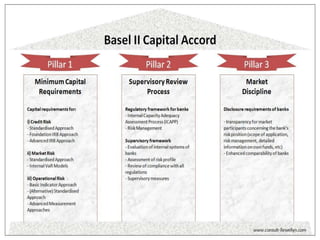
Basel II framework operates under three pillars:
•Capital adequacy requirements
•Supervisory review
•Market discipline
Pillar 1 includes 3 risks now, operational risk + credit
risk + market risk to meet international standards.
Commercial banks in India adopt Standardized
Approach(SA) for credit risk.
Standardized Approach , the rating assigned by the
eligible external credit rating agencies, largely supports
the measure of credit risk.
Swayam Siddhi College of Mgt & Research
SSCMR Presentor : Prof. Rahul Shah
Basel II Norm
Swayam Siddhi College of Mgt & Research
SSCMR Presentor : Prof. Rahul Shah
Basel II Norm
Banks rely upon the ratings assigned by the external credit
rating agencies chosen by the RBI for assigning risk weights
for capital adequacy purposes. As:
a) Credit Analysis and Research Ltd.
b) CRISIL Ltd.
c) FITCH Ltd. and
d) ICRA Ltd.
International credit rating agencies :
a) Fitch;
b) Moody's; and
c) Standard & Poor's.
Banks must disclose the names of the credit rating
agencies that they use for the risk weighting of their
assets.
The risk weights associated with the particular rating
grades as determined by RBI for each eligible credit
rating agency as well as the aggregated risk weighted
assets.
Swayam Siddhi College of Mgt & Research
SSCMR Presentor : Prof. Rahul Shah
Basel II Norm

Pillar 2: Supervisory Review Process (SRP) — The
establishment of suitable risk management systems in banks
and their review by the supervisory authority (RBI).
As in terms of the Pillar 2 requirements of the New Capital
Adequacy Framework, banks are expected to operate at a
level well above the minimum requirement
Swayam Siddhi College of Mgt & Research
SSCMR Presentor : Prof. Rahul Shah
Basel II Norm
Pillar 3: Market Discipline — seeks to achieve increased
transparency through expanded disclosure requirements
tor banks.
For such comprehensive disclosure, IT structure must be
in place for supporting data collection and generating MIS
which is compatible with Pillar 3 requirements
Swayam Siddhi College of Mgt & Research
SSCMR Presentor : Prof. Rahul Shah
Basel II Norm
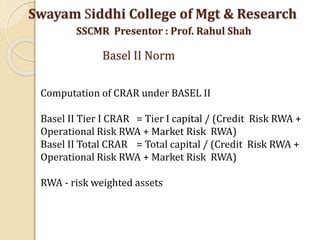
Computation of CRAR under BASEL II
Basel II Tier I CRAR = Tier I capital / (Credit Risk RWA +
Operational Risk RWA + Market Risk RWA)
Basel II Total CRAR = Total capital / (Credit Risk RWA +
Operational Risk RWA + Market Risk RWA)
RWA - risk weighted assets
Swayam Siddhi College of Mgt & Research
SSCMR Presentor : Prof. Rahul Shah
Basel II Norm
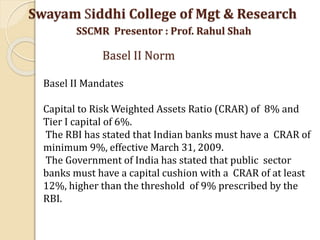
Basel II Mandates
Capital to Risk Weighted Assets Ratio (CRAR) of 8% and
Tier I capital of 6%.
The RBI has stated that Indian banks must have a CRAR of
minimum 9%, effective March 31, 2009.
The Government of India has stated that public sector
banks must have a capital cushion with a CRAR of at least
12%, higher than the threshold of 9% prescribed by the
RBI.
Swayam Siddhi College of Mgt & Research
SSCMR Presentor : Prof. Rahul Shah
Basel II Norm
Failure to adhere to Basel II can attract RBI action
including restricting lending and investment activities.
However, private sector banks as well as public sector
banks are likely to comply with Basel II norms since March
31, 2009
Swayam Siddhi College of Mgt & Research
SSCMR Presentor : Prof. Rahul Shah
Basel II Norm
What is "Basel III"
A global regulatory standardon
 bank capital adequacy
 stress testing and
 market liquidity risk
With a set of reform measures to improve
 Regulation
 supervision and
 risk management
Swayam Siddhi College of Mgt & Research
SSCMR Presentor : Prof. Rahul Shah
Basel III Norm
 Reducing profitability of small banks and threat of takeover
 Lack of comprehensive approach to address risks
 Self-regulation in area of asset securitization
 Lack of safety
 Inability to strengthen the stability of financial system
 Failure to achieve large capital reductions
Swayam Siddhi College of Mgt & Research
SSCMR Presentor : Prof. Rahul Shah
Why Basel III Norm
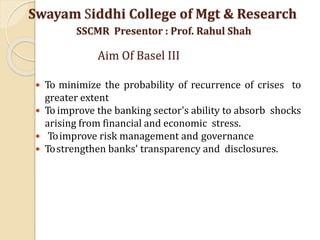
 To minimize the probability of recurrence of crises to
greater extent
 To improve the banking sector's ability to absorb shocks
arising from financial and economic stress.
 Toimprove risk management and governance
 Tostrengthen banks' transparency and disclosures.
Swayam Siddhi College of Mgt & Research
SSCMR Presentor : Prof. Rahul Shah
Aim Of Basel III
 Bank-level, or micro prudential, regulation, which will
help raise the resilience of individual banking
institutions to periods of stress.
 Macro prudential, system wide risks that can build up
across the banking sector as well as the procyclical
amplification of these risks over time.
Swayam Siddhi College of Mgt & Research
SSCMR Presentor : Prof. Rahul Shah
Target of Basel III
Micro- prudential elements
• Tominimize the risk contained with individual
institutions
The elements are:
 Definition of capital
 Enhancing risk coverage of capital
 leverage ratio
 International liquidity framework
Swayam Siddhi College of Mgt & Research
SSCMR Presentor : Prof. Rahul Shah
Basel III Norm
Macro- prudential elements
 Totake care of the issues relating to the systemic risk
The elements are:
 Leverage ratio
 Capital conservation buffer
 Countercyclical capital buffer
 Addressing the procyclicality of provisioning requirements
 Addressing interconnectedness
 Addressing the too- big to- fail problems
 Addressing reliance on external credit rating agencies.
Swayam Siddhi College of Mgt & Research
SSCMR Presentor : Prof. Rahul Shah
Basel III Norm
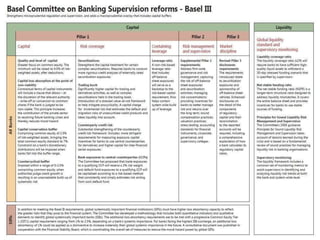
Pillar 1- Minimum Capital Requirements
• Calculate Required Capital based on
 Market risk
 Credit risk
 Operational risk
• Used to monitor funding concentration
Swayam Siddhi College of Mgt & Research
SSCMR Presentor : Prof. Rahul Shah
Basel III Norm
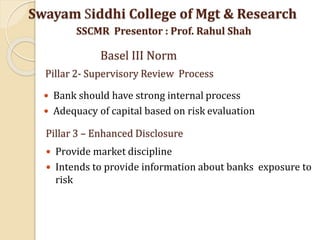
Pillar 2- Supervisory Review Process
 Bank should have strong internal process
 Adequacy of capital based on risk evaluation
Swayam Siddhi College of Mgt & Research
SSCMR Presentor : Prof. Rahul Shah
Basel III Norm
Pillar 3 – Enhanced Disclosure
 Provide market discipline
 Intends to provide information about banks exposure to
risk
The relationship among the three pillars:
 Second pillar – supervisory review process to ensure the first
pillar
- intended to ensure that the banks have adequate capital
 Third pillar – compliments first and second pillar
- a discipline followed by the bank such as disclosing
capital structure, tier-i and tier-ii capital and approaches to
assess the capital adequacy
i.e. assessment of the first pillar.
 Model of commercial banks interpret first pillar as a closure
threshold rather than bank’s asset allocation
Swayam Siddhi College of Mgt & Research
SSCMR Presentor : Prof. Rahul Shah
Basel III Norm
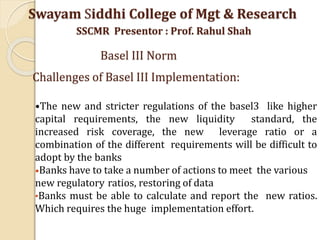
•The new and stricter regulations of the basel3 like higher
capital requirements, the new liquidity standard, the
increased risk coverage, the new leverage ratio or a
combination of the different requirements will be difficult to
adopt by the banks
•Banks have to take a number of actions to meet the various
new regulatory ratios, restoring of data
•Banks must be able to calculate and report the new ratios.
Which requires the huge implementation effort.
Swayam Siddhi College of Mgt & Research
SSCMR Presentor : Prof. Rahul Shah
Basel III Norm
Challenges of Basel III Implementation:
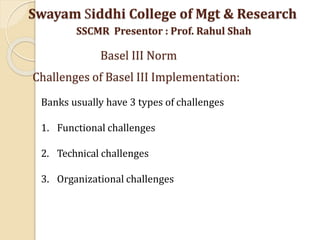
Banks usually have 3 types of challenges
1. Functional challenges
2. Technical challenges
3. Organizational challenges
Swayam Siddhi College of Mgt & Research
SSCMR Presentor : Prof. Rahul Shah
Basel III Norm
Challenges of Basel III Implementation:
•Developing specifications for the new regulatory
requirements, such as the mapping of positions (assets and
liabilities) to the new liquidity and funding categories in the
LCR and NSFR calculations.
•the specification of the new requirements for trading book
positions and within the CCR framework (e.g. CVA) as well as
adjustments of the limit systems with regard to the new
capital and liquidity ratios.
•Crucial is the integration of new regulatory requirements into
existing capital and risk management as some measures to
improve new ratios (e.g. liquidity ratios) might have a negative
effect on existing figures.
Swayam Siddhi College of Mgt & Research
SSCMR Presentor : Prof. Rahul Shah
Basel III Norm
Functional Challenges
•The technical challenges includes the availability of data, data
completeness, and data quality and data consistency to
calculate the new ratios.
•The financial reporting system with regard to the new ratios
and the creation of effective interfaces with the existing risk
management systems.
Swayam Siddhi College of Mgt & Research
SSCMR Presentor : Prof. Rahul Shah
Basel III Norm
Technical Challenges
•The operational challenges includes stricter capital
definition lowers banks’ available capital. At the same
time the risk weighted
(RWA) for
assets securitizations,
trading book positions and certain
counterparty credit risk exposures are significantly
increased.
•The stricter capital requirements, the introduction of the
LCR and NSFR will force banks to rethink their liquidity
position, and potentially require banks to increase their
stock of high-quality liquid assets and to use more stable
sources of funding.
Swayam Siddhi College of Mgt & Research
SSCMR Presentor : Prof. Rahul Shah
Basel III Norm
Operational Challenges
•Basel III also introduces a non-risk based leverage ratio of 3
percent. Group1 banks are failed in maintaining the this
leverage ratio
•The banks will experience increased pressure on their
Return on Equity (RoE) due to increased capital and liquidity
costs, which along with increased RWAs will put pressure on
margins across all segments
Swayam Siddhi College of Mgt & Research
SSCMR Presentor : Prof. Rahul Shah
Basel III Norm
Capital…
 Indian banks need to raise Rs 1.5 lakh crore to Rs 1.75
lakh crore as capital to meet the BASEL- III
requirements.
 Can PSU banks mobilize this sort of capital?
- Probably
government is
NO, The alternate to the
either to reduce shareholding
below 50% or slowdown PSU growth
 Can private banks raise this sort of money?
- They probably can, because Rs 500 billion was
raised in last 5 years
Swayam Siddhi College of Mgt & Research
SSCMR Presentor : Prof. Rahul Shah
Basel III Norm
Indian Scenario
Problems for PSUs
 Capital adequacy ratio
- has been stipulated at 9%, unchanged from what
the regulator requires in India currently, banks here will
need to raise more money than under the current Basel
II norms because several capital instruments cannot be
included under the new definition.
Ex: Perpetual Bond
 Maintaining an 8% tier I capital ratio
 More additions to non-performing assets
 Unamortized expenditure on pension liabilities
Swayam Siddhi College of Mgt & Research
SSCMR Presentor : Prof. Rahul Shah
Basel III Norm
Indian Scenario
The Indian economy is also expected to grow at an
annual growth rate of 8-9% for next 10 years or so. This
would undoubtedly necessitate a considerable growth
in bank capital.
Swayam Siddhi College of Mgt & Research
SSCMR Presentor : Prof. Rahul Shah
Basel III Norm
Indian Scenario
Issues relating to SLR and LCR
 India, banks are statutorily required to hold minimum reserves of
high-quality liquid assets at 24% of net demand and time liabilities.
 The proportion of liquid assets in total assets of
banks will increase substantially, if the SLR
reserves are not reckoned towards the LCR
(Liquidity coverage ratio) and banks are to meet
the entire LCR with
assets, thereby lowering
additional
their
liquid
income
significantly.
 RBI is examining to what extent the SLR
requirements could be reckoned towards the
liquidity requirement under Basel III.
Swayam Siddhi College of Mgt & Research
SSCMR Presentor : Prof. Rahul Shah
Basel III Norm
Indian Scenario
 Retail banks will be affected least, though institutions with
very low capital ratios may find themselves under
significant pressure.
 Corporate banks will be affected primarily in specialized
lending and trade finance.
 Investment banks will find several core businesses
profoundly affected, particularly trading and securitization
businesses.
 Balance sheet restructuring and business-model
adjustments could potentially mitigate up to 40 percent of
Basel III’s RoE impact, on an average.
 Government banks may have to sacrifice growth
Swayam Siddhi College of Mgt & Research
SSCMR Presentor : Prof. Rahul Shah
Basel III Norm
Profitability
 The impact of credit requirements on the profitability of
banks would depend upon sensitivity of lending rates to
capital structure of banks and sensitivity of the credit
growth to the lending rates.
 When banks with low core Tier I shore up their capital to
around 9% required, their return on equity (RoE) could
drop by 1-4%.
 Basel III will force banks to plough back a larger chunk of
their profit into the balance sheet.
 Banks might have to rationalize dividend policies so that
more profit could be retained and used as capital,
indicating a lower dividend for the government.
Swayam Siddhi College of Mgt & Research
SSCMR Presentor : Prof. Rahul Shah
Basel III Norm
Profitability
 Demonstrate that the banking system is recovering well from the
global financial crisis of 2008 and has been developing the resilience to
future shocks.
 Contribute to a bank’s competitiveness by delivering better
management insight into the business, allowing it to take advantage of
future opportunities.
 Strengthen the financial system of both developing and developed
countries by addressing the weaknesses in the measurement of risk
under Basel II framework.
 Delivers a much safer financial system with reduced probability of
banking crises at affordable costs. The impact of costs is minimized
through long phase-in.
 It is expected that as the proportion of equity in the capital structure of
banks rises, it would reduce the incremental costs of raising further
equity as well as non-common equity capital.
Swayam Siddhi College of Mgt & Research
SSCMR Presentor : Prof. Rahul Shah
Basel III Norm
Benefits Of Implementation
The Reserve Bank’s approach has been to adopt Basel III
capital and liquidity guidelines with more conservatism and
at a quicker pace. The impact of these rules is not going to be
onerous and there will be considerable advantage in adopting
Basel III by our banks.
Swayam Siddhi College of Mgt & Research
SSCMR Presentor : Prof. Rahul Shah
Basel III Norm
RBI’s Approach
Swayam Siddhi College of Mgt & Research
SSCMR Presentor : Prof. Rahul Shah
THANK YOU…!!!

Capital adequacy norms

  • 1.
    Swayam Siddhi Collegeof Mgt & Research SSCMR Presentor : Prof. Rahul Shah CAPITAL ADEQUACY NORMS
  • 2.
    Swayam Siddhi Collegeof Mgt & Research SSCMR Presentor : Prof. Rahul Shah Importance of Capital for Banks Capital is a key ingredient for safe and sound banks and here is why. Banks take on risks and may suffer losses if the risks materialize. To stay safe and protect people’s deposits, banks have to be able to absorb such losses and keep going in good times and bad. That’s what bank capital is used for.
  • 3.
    Swayam Siddhi Collegeof Mgt & Research SSCMR Presentor : Prof. Rahul Shah How Much Capital Bank Should Hold???? The answer lies in the risks it takes. The bigger the risks, the more capital it needs. That’s why it’s essential that banks continuously assess the risks they are exposed to and the losses they may incur. Their assessments are checked and challenged by banking supervisors. Supervisors are responsible for monitoring banks’ financial health, and checking their capital levels is an important part of this.
  • 4.
    Swayam Siddhi Collegeof Mgt & Research SSCMR Presentor : Prof. Rahul Shah What is Capital ? Put simply, capital is the money that a bank has obtained from its shareholders and other investors and any profit that it has made and not paid out. Consequently, if a bank wants to expand its capital base, it can do so for example by issuing more shares or retaining profits, rather than paying them out as dividends to shareholders. Overall, every bank has two sources of funds: capital and debt. Debt is the money that it has borrowed from its lenders and will have to pay back. Debt includes among other things deposits from customers, debt securities issued and loans taken out by the bank. Funds from these two sources are employed by the bank in a number of ways, for example to give loans to customers or to make other investments. These loans and other investments are the bank’s assets, along with funds that are held as cash.
  • 5.
    Swayam Siddhi Collegeof Mgt & Research SSCMR Presentor : Prof. Rahul Shah A bank’s Balance Sheet:
  • 6.
    Swayam Siddhi Collegeof Mgt & Research SSCMR Presentor : Prof. Rahul Shah How does Capital keep Banks Safe? Capital acts like a financial cushion against losses. When, for example, many borrowers are suddenly unable to pay back their loans, or some of the bank’s investments fall in value, the bank will make a loss and without a capital cushion might even go bankrupt. However, if it has a solid capital base, it will use it to absorb the loss and continue to operate and serve its customers.
  • 7.
    Swayam Siddhi Collegeof Mgt & Research SSCMR Presentor : Prof. Rahul Shah Banks uses Capital to absorb losses
  • 8.
    Banks in theprocess of financial intermediation are confronted with various kinds of financial and non- financial risks viz.: CreditRisk LiquidityRisk MarketRisk OperationalRisk Swayam Siddhi College of Mgt & Research SSCMR Presentor : Prof. Rahul Shah Risk Exposure
  • 9.
    Loans and advancesgiven by the banks to its customers is are an Asset to the bank. A loan (an asset for the bank) turns as NPA when the EMI, principal or interest component for the loan is not paid within 90 days from the due date. Thus a Bad Loan is an asset that ceases to generate any income for the bank Swayam Siddhi College of Mgt & Research SSCMR Presentor : Prof. Rahul Shah Non Performing Assets
  • 10.
    • The BaselCommittee on Banking Supervision was established in 1974, by the Bank of International Settlements (BIS). In order to help the banks to recognize the different kinds of risks and to take adequate steps • An international organization founded in Basel, Switzerland in 1930 to serve as a Bank for Central banks. Swayam Siddhi College of Mgt & Research SSCMR Presentor : Prof. Rahul Shah Risk Management Through Basel Committee
  • 11.
    • As perBasel Committee guidelines issued capital adequacy was considered panacea for risk management. • All banks were advised to have Capital Adequacy Ratio (CAR) at least 8%. CAR is the ratio of capital to risk weighted assets and it provides the cushion to the depositors in case of bankruptcy. • Committee consisting of members from each of the G10 countries. It is represented by central bank governors of each of the G10 countries. • Thirteen industrialized Nations that meet on an annual basis to consult each other on international financial matters. Swayam Siddhi College of Mgt & Research SSCMR Presentor : Prof. Rahul Shah Risk Management Through Basel Committee
  • 12.
    The member countriesare: France, Germany, Belgium, Italy, Japan, the Netherlands, Sweden, the United Kingdom, the United States and Canada, with Switzerland, Luxembourg, Spain It meets regularly 4 times a year. Swayam Siddhi College of Mgt & Research SSCMR Presentor : Prof. Rahul Shah Risk Management Through Basel Committee
  • 13.
    The basic approachof capital adequacy framework is that a bank should have sufficient capital to provide a stable resource to absorb any losses arising from the risks in its business. For supervisory purposes capital is split into two categories: Tier I and Tier II. These categories represent different instruments’ quality as capital: Swayam Siddhi College of Mgt & Research SSCMR Presentor : Prof. Rahul Shah Capital Adequacy Framework
  • 14.
    Tier I Capitalconsists: Equity Capital (Shareholders' Funds) DisclosedReserves: ◦ Premium over shares, ◦ Retained earnings, ◦ Legal reserve It is a bank’s highest quality capital because it is fully available to cover losses. Swayam Siddhi College of Mgt & Research SSCMR Presentor : Prof. Rahul Shah Capital Adequacy Framework
  • 15.
    Legal reserves arethe only assets that are permitted by government regulations. Divided into The two asset categories: Required Reserve (Vault cash & Reserve deposits ) Excess Reserve (Reserve for loan purposes) Legal Reserve: Swayam Siddhi College of Mgt & Research SSCMR Presentor : Prof. Rahul Shah Capital Adequacy Framework
  • 16.
    Vault Cash (RequiredReserve) Paper bills and metal coins kept on the bank premises, both the vault and teller drawers. To satisfy currency withdrawal demands of depositors. Vault cash is not part of the official M1 money supply. M1 includes only the paper bills and metal coins that is in circulation and held by the nonbank public. Swayam Siddhi College of Mgt & Research SSCMR Presentor : Prof. Rahul Shah Capital Adequacy Framework
  • 17.
    Reserve deposits arethe one that regulators require. These are deposits that banks keep with the Reserve Bank Of India System. Required reserves are specified as a fraction of outstanding deposits--usually about 3 percent -15 percent Swayam Siddhi College of Mgt & Research SSCMR Presentor : Prof. Rahul Shah Capital Adequacy Framework Reserve Deposits (Required Reserve) Excess Reserve Any legal (or total) reserves over and above those required by regulators are excess reserves. These excess reserves are used for loans, which makes them exceedingly important to the banking industry.
  • 18.
    Tier II capitalConsists: Undisclosedreserves Revaluation reserves General provisions Subordinated debt Hybrid Instruments. This capital is less permanent in nature. The loss absorption capacity of Tier II capital is lower than that of Tier I capital. Swayam Siddhi College of Mgt & Research SSCMR Presentor : Prof. Rahul Shah Capital Adequacy Framework
  • 19.
    Undisclosed reserves arenot common. They are accepted by some regulators where a bank has made a profit but this has not appeared in normal retained profits or in general reserves of the bank. Many countries do not accept this as an accounting concept or a legitimate form of capital Swayam Siddhi College of Mgt & Research SSCMR Presentor : Prof. Rahul Shah Capital Adequacy Framework Undisclosed Reserve
  • 20.
    Revaluation reserve iscreated when a bank has an asset revalued and an increase in value is brought to account. Example: A bank owns the land and building of its head- offices and bought them for $100 a century ago. A current revaluation is very likely to show a large increase in value. The increase would be added to a revaluation reserve. Swayam Siddhi College of Mgt & Research SSCMR Presentor : Prof. Rahul Shah Capital Adequacy Framework Revaluation Reserve
  • 21.
    Adequate care mustbe taken to ensure that sufficient provisions have been made to meet all known losses and foreseeable potential losses before considering as part of Tier II Capital. Swayam Siddhi College of Mgt & Research SSCMR Presentor : Prof. Rahul Shah Capital Adequacy Framework General Provisions and Loss Reserve
  • 22.
    DEBT and Have somecharacteristics of both EQUITY. These are close to equity in nature, in that they are able to take losses on the face value without triggering a liquidation of the bank, they may be counted as capital. Example: Preferred stock usually carries no voting rights but may carry a dividend and may have priority over common stock in the payment of dividends and upon liquidation. Swayam Siddhi College of Mgt & Research SSCMR Presentor : Prof. Rahul Shah Capital Adequacy Framework Hybrid Instruments
  • 23.
    Such debt isreferred to as subordinate, because the debt providers (the lenders) have subordinate status in relationship to the Normal debt. A typical example for this would be when a promoter of a company invests money in the form of debt, rather than in the form of stock. Subordinated debt has a lower priority than other bonds of the issuer in case of liquidation during bankruptcy. It has minimum maturity period is 5 years. Swayam Siddhi College of Mgt & Research SSCMR Presentor : Prof. Rahul Shah Capital Adequacy Framework Subordinated Term Debt
  • 24.
    The first accordwas the Basel I. It was issued in 1988 and focused mainly on credit risk. Banks with international presence are required to hold capital equal to 8 % of the risk-weighted assets. Carrying risk weights of zero (for gilts bond ), ten, twenty, fifty, and up to one hundred percent ( Corporate debt). It standardizes risk-based capital requirements for banks across countries as per following measurement: Swayam Siddhi College of Mgt & Research SSCMR Presentor : Prof. Rahul Shah Basel I Norm
  • 25.
    CAR = TierI + Tier II Risk Weighted Assets A measure of a bank's capital. It is expressed as a percentage of a bank's risk weighted credit exposures. Swayam Siddhi College of Mgt & Research SSCMR Presentor : Prof. Rahul Shah Basel I Norm Capital to Risk Weighted Assets Ratio
  • 26.
    • • It can bearrived simply by multiplying it with factor that reflects its risk. • Low risk assets are multiplied by a low number, high risk assets by 100% (i.e. 1). Risk weighted assets is a measure of the amount of a banks assets, adjusted for risk. Swayam Siddhi College of Mgt & Research SSCMR Presentor : Prof. Rahul Shah Basel I Norm Risk Weighted Assets
  • 27.
    Swayam Siddhi Collegeof Mgt & Research SSCMR Presentor : Prof. Rahul Shah Basel I Norm Risk Weighted Assets The main use of risk weighted assets is to calculate Tier1 and Tier 2 capital adequacy ratios. If its capital is 10% of its assets, then it can lose 10% of its assets without becoming Insolvent. Insolvency is simply being unable to pay liabilities; Liabilities > Assets
  • 28.
    Swayam Siddhi Collegeof Mgt & Research SSCMR Presentor : Prof. Rahul Shah Basel II Norm Basel II is the second set of international banking regulations defined by the Basel Committee on Bank Supervision (BCBS). It is an extension of the regulations for minimum capital requirements as defined under Basel I. The Basel II framework operates under three pillars: •Capital adequacy requirements •Supervisory review •Market discipline
  • 29.
    Pillar 1 includes3 risks now, operational risk + credit risk + market risk to meet international standards. Commercial banks in India adopt Standardized Approach(SA) for credit risk. Standardized Approach , the rating assigned by the eligible external credit rating agencies, largely supports the measure of credit risk. Swayam Siddhi College of Mgt & Research SSCMR Presentor : Prof. Rahul Shah Basel II Norm
  • 30.
    Swayam Siddhi Collegeof Mgt & Research SSCMR Presentor : Prof. Rahul Shah Basel II Norm Banks rely upon the ratings assigned by the external credit rating agencies chosen by the RBI for assigning risk weights for capital adequacy purposes. As: a) Credit Analysis and Research Ltd. b) CRISIL Ltd. c) FITCH Ltd. and d) ICRA Ltd. International credit rating agencies : a) Fitch; b) Moody's; and c) Standard & Poor's.
  • 31.
    Banks must disclosethe names of the credit rating agencies that they use for the risk weighting of their assets. The risk weights associated with the particular rating grades as determined by RBI for each eligible credit rating agency as well as the aggregated risk weighted assets. Swayam Siddhi College of Mgt & Research SSCMR Presentor : Prof. Rahul Shah Basel II Norm
  • 32.
     Pillar 2: SupervisoryReview Process (SRP) — The establishment of suitable risk management systems in banks and their review by the supervisory authority (RBI). As in terms of the Pillar 2 requirements of the New Capital Adequacy Framework, banks are expected to operate at a level well above the minimum requirement Swayam Siddhi College of Mgt & Research SSCMR Presentor : Prof. Rahul Shah Basel II Norm
  • 33.
    Pillar 3: MarketDiscipline — seeks to achieve increased transparency through expanded disclosure requirements tor banks. For such comprehensive disclosure, IT structure must be in place for supporting data collection and generating MIS which is compatible with Pillar 3 requirements Swayam Siddhi College of Mgt & Research SSCMR Presentor : Prof. Rahul Shah Basel II Norm
  • 35.
    Computation of CRARunder BASEL II Basel II Tier I CRAR = Tier I capital / (Credit Risk RWA + Operational Risk RWA + Market Risk RWA) Basel II Total CRAR = Total capital / (Credit Risk RWA + Operational Risk RWA + Market Risk RWA) RWA - risk weighted assets Swayam Siddhi College of Mgt & Research SSCMR Presentor : Prof. Rahul Shah Basel II Norm
  • 36.
    Basel II Mandates Capitalto Risk Weighted Assets Ratio (CRAR) of 8% and Tier I capital of 6%. The RBI has stated that Indian banks must have a CRAR of minimum 9%, effective March 31, 2009. The Government of India has stated that public sector banks must have a capital cushion with a CRAR of at least 12%, higher than the threshold of 9% prescribed by the RBI. Swayam Siddhi College of Mgt & Research SSCMR Presentor : Prof. Rahul Shah Basel II Norm
  • 37.
    Failure to adhereto Basel II can attract RBI action including restricting lending and investment activities. However, private sector banks as well as public sector banks are likely to comply with Basel II norms since March 31, 2009 Swayam Siddhi College of Mgt & Research SSCMR Presentor : Prof. Rahul Shah Basel II Norm
  • 38.
    What is "BaselIII" A global regulatory standardon  bank capital adequacy  stress testing and  market liquidity risk With a set of reform measures to improve  Regulation  supervision and  risk management Swayam Siddhi College of Mgt & Research SSCMR Presentor : Prof. Rahul Shah Basel III Norm
  • 39.
     Reducing profitabilityof small banks and threat of takeover  Lack of comprehensive approach to address risks  Self-regulation in area of asset securitization  Lack of safety  Inability to strengthen the stability of financial system  Failure to achieve large capital reductions Swayam Siddhi College of Mgt & Research SSCMR Presentor : Prof. Rahul Shah Why Basel III Norm
  • 40.
     To minimizethe probability of recurrence of crises to greater extent  To improve the banking sector's ability to absorb shocks arising from financial and economic stress.  Toimprove risk management and governance  Tostrengthen banks' transparency and disclosures. Swayam Siddhi College of Mgt & Research SSCMR Presentor : Prof. Rahul Shah Aim Of Basel III
  • 41.
     Bank-level, ormicro prudential, regulation, which will help raise the resilience of individual banking institutions to periods of stress.  Macro prudential, system wide risks that can build up across the banking sector as well as the procyclical amplification of these risks over time. Swayam Siddhi College of Mgt & Research SSCMR Presentor : Prof. Rahul Shah Target of Basel III
  • 42.
    Micro- prudential elements •Tominimize the risk contained with individual institutions The elements are:  Definition of capital  Enhancing risk coverage of capital  leverage ratio  International liquidity framework Swayam Siddhi College of Mgt & Research SSCMR Presentor : Prof. Rahul Shah Basel III Norm
  • 43.
    Macro- prudential elements Totake care of the issues relating to the systemic risk The elements are:  Leverage ratio  Capital conservation buffer  Countercyclical capital buffer  Addressing the procyclicality of provisioning requirements  Addressing interconnectedness  Addressing the too- big to- fail problems  Addressing reliance on external credit rating agencies. Swayam Siddhi College of Mgt & Research SSCMR Presentor : Prof. Rahul Shah Basel III Norm
  • 44.
    Pillar 1- MinimumCapital Requirements • Calculate Required Capital based on  Market risk  Credit risk  Operational risk • Used to monitor funding concentration Swayam Siddhi College of Mgt & Research SSCMR Presentor : Prof. Rahul Shah Basel III Norm
  • 45.
    Pillar 2- SupervisoryReview Process  Bank should have strong internal process  Adequacy of capital based on risk evaluation Swayam Siddhi College of Mgt & Research SSCMR Presentor : Prof. Rahul Shah Basel III Norm Pillar 3 – Enhanced Disclosure  Provide market discipline  Intends to provide information about banks exposure to risk
  • 47.
    The relationship amongthe three pillars:  Second pillar – supervisory review process to ensure the first pillar - intended to ensure that the banks have adequate capital  Third pillar – compliments first and second pillar - a discipline followed by the bank such as disclosing capital structure, tier-i and tier-ii capital and approaches to assess the capital adequacy i.e. assessment of the first pillar.  Model of commercial banks interpret first pillar as a closure threshold rather than bank’s asset allocation Swayam Siddhi College of Mgt & Research SSCMR Presentor : Prof. Rahul Shah Basel III Norm
  • 48.
    •The new andstricter regulations of the basel3 like higher capital requirements, the new liquidity standard, the increased risk coverage, the new leverage ratio or a combination of the different requirements will be difficult to adopt by the banks •Banks have to take a number of actions to meet the various new regulatory ratios, restoring of data •Banks must be able to calculate and report the new ratios. Which requires the huge implementation effort. Swayam Siddhi College of Mgt & Research SSCMR Presentor : Prof. Rahul Shah Basel III Norm Challenges of Basel III Implementation:
  • 49.
    Banks usually have3 types of challenges 1. Functional challenges 2. Technical challenges 3. Organizational challenges Swayam Siddhi College of Mgt & Research SSCMR Presentor : Prof. Rahul Shah Basel III Norm Challenges of Basel III Implementation:
  • 50.
    •Developing specifications forthe new regulatory requirements, such as the mapping of positions (assets and liabilities) to the new liquidity and funding categories in the LCR and NSFR calculations. •the specification of the new requirements for trading book positions and within the CCR framework (e.g. CVA) as well as adjustments of the limit systems with regard to the new capital and liquidity ratios. •Crucial is the integration of new regulatory requirements into existing capital and risk management as some measures to improve new ratios (e.g. liquidity ratios) might have a negative effect on existing figures. Swayam Siddhi College of Mgt & Research SSCMR Presentor : Prof. Rahul Shah Basel III Norm Functional Challenges
  • 51.
    •The technical challengesincludes the availability of data, data completeness, and data quality and data consistency to calculate the new ratios. •The financial reporting system with regard to the new ratios and the creation of effective interfaces with the existing risk management systems. Swayam Siddhi College of Mgt & Research SSCMR Presentor : Prof. Rahul Shah Basel III Norm Technical Challenges
  • 52.
    •The operational challengesincludes stricter capital definition lowers banks’ available capital. At the same time the risk weighted (RWA) for assets securitizations, trading book positions and certain counterparty credit risk exposures are significantly increased. •The stricter capital requirements, the introduction of the LCR and NSFR will force banks to rethink their liquidity position, and potentially require banks to increase their stock of high-quality liquid assets and to use more stable sources of funding. Swayam Siddhi College of Mgt & Research SSCMR Presentor : Prof. Rahul Shah Basel III Norm Operational Challenges
  • 53.
    •Basel III alsointroduces a non-risk based leverage ratio of 3 percent. Group1 banks are failed in maintaining the this leverage ratio •The banks will experience increased pressure on their Return on Equity (RoE) due to increased capital and liquidity costs, which along with increased RWAs will put pressure on margins across all segments Swayam Siddhi College of Mgt & Research SSCMR Presentor : Prof. Rahul Shah Basel III Norm
  • 54.
    Capital…  Indian banksneed to raise Rs 1.5 lakh crore to Rs 1.75 lakh crore as capital to meet the BASEL- III requirements.  Can PSU banks mobilize this sort of capital? - Probably government is NO, The alternate to the either to reduce shareholding below 50% or slowdown PSU growth  Can private banks raise this sort of money? - They probably can, because Rs 500 billion was raised in last 5 years Swayam Siddhi College of Mgt & Research SSCMR Presentor : Prof. Rahul Shah Basel III Norm Indian Scenario
  • 55.
    Problems for PSUs Capital adequacy ratio - has been stipulated at 9%, unchanged from what the regulator requires in India currently, banks here will need to raise more money than under the current Basel II norms because several capital instruments cannot be included under the new definition. Ex: Perpetual Bond  Maintaining an 8% tier I capital ratio  More additions to non-performing assets  Unamortized expenditure on pension liabilities Swayam Siddhi College of Mgt & Research SSCMR Presentor : Prof. Rahul Shah Basel III Norm Indian Scenario
  • 56.
    The Indian economyis also expected to grow at an annual growth rate of 8-9% for next 10 years or so. This would undoubtedly necessitate a considerable growth in bank capital. Swayam Siddhi College of Mgt & Research SSCMR Presentor : Prof. Rahul Shah Basel III Norm Indian Scenario
  • 57.
    Issues relating toSLR and LCR  India, banks are statutorily required to hold minimum reserves of high-quality liquid assets at 24% of net demand and time liabilities.  The proportion of liquid assets in total assets of banks will increase substantially, if the SLR reserves are not reckoned towards the LCR (Liquidity coverage ratio) and banks are to meet the entire LCR with assets, thereby lowering additional their liquid income significantly.  RBI is examining to what extent the SLR requirements could be reckoned towards the liquidity requirement under Basel III. Swayam Siddhi College of Mgt & Research SSCMR Presentor : Prof. Rahul Shah Basel III Norm Indian Scenario
  • 58.
     Retail bankswill be affected least, though institutions with very low capital ratios may find themselves under significant pressure.  Corporate banks will be affected primarily in specialized lending and trade finance.  Investment banks will find several core businesses profoundly affected, particularly trading and securitization businesses.  Balance sheet restructuring and business-model adjustments could potentially mitigate up to 40 percent of Basel III’s RoE impact, on an average.  Government banks may have to sacrifice growth Swayam Siddhi College of Mgt & Research SSCMR Presentor : Prof. Rahul Shah Basel III Norm Profitability
  • 59.
     The impactof credit requirements on the profitability of banks would depend upon sensitivity of lending rates to capital structure of banks and sensitivity of the credit growth to the lending rates.  When banks with low core Tier I shore up their capital to around 9% required, their return on equity (RoE) could drop by 1-4%.  Basel III will force banks to plough back a larger chunk of their profit into the balance sheet.  Banks might have to rationalize dividend policies so that more profit could be retained and used as capital, indicating a lower dividend for the government. Swayam Siddhi College of Mgt & Research SSCMR Presentor : Prof. Rahul Shah Basel III Norm Profitability
  • 60.
     Demonstrate thatthe banking system is recovering well from the global financial crisis of 2008 and has been developing the resilience to future shocks.  Contribute to a bank’s competitiveness by delivering better management insight into the business, allowing it to take advantage of future opportunities.  Strengthen the financial system of both developing and developed countries by addressing the weaknesses in the measurement of risk under Basel II framework.  Delivers a much safer financial system with reduced probability of banking crises at affordable costs. The impact of costs is minimized through long phase-in.  It is expected that as the proportion of equity in the capital structure of banks rises, it would reduce the incremental costs of raising further equity as well as non-common equity capital. Swayam Siddhi College of Mgt & Research SSCMR Presentor : Prof. Rahul Shah Basel III Norm Benefits Of Implementation
  • 61.
    The Reserve Bank’sapproach has been to adopt Basel III capital and liquidity guidelines with more conservatism and at a quicker pace. The impact of these rules is not going to be onerous and there will be considerable advantage in adopting Basel III by our banks. Swayam Siddhi College of Mgt & Research SSCMR Presentor : Prof. Rahul Shah Basel III Norm RBI’s Approach
  • 62.
    Swayam Siddhi Collegeof Mgt & Research SSCMR Presentor : Prof. Rahul Shah THANK YOU…!!!