



CREDIT RATING 
SAUMYA SINGH 
1321760
Meaning 
 A credit rating measures creditworthiness, or 
the ability to pay back a loan. 
 Credit rating refers to assessment of the 
financial position of the company based on 
various parameters.
Contd.. 
 A credit ratings agency is a company that 
assigns credit ratings to institutions that issue 
debt obligations (i.e. assets backed by 
receivables on loans, such as mortgage-backed 
securities). 
 Companies that issue credit scores for 
individuals are usually called credit bureaus 
and are distinct from corporate ratings 
agencies.
Functions of Credit Rating 
Agencies 
1. Provides unbiased opinion 
2. Provides quality and dependable 
information 
3. Provides information at low cost
Contd.. 
4. Provide easy to understand information: 
Rating agencies 
5. Provide basis for investment 
6. Healthy discipline on corporate borrowers 
7. Formation of public policy
Top Three Credit Rating 
Agencies 
In the United States : 
 Moody‘s 
 Standard & Poor's 
 Fitch Ratings 
In India : 
 CRISIL (Credit Rating Information Services of 
India Limited) 
 CIBIL (Credit Information Bureau India Limited) 
 Fitch Ratings India Private Ltd.
Uses of Credit Rating 
A. Benefits to Investors : 
1. Safety of investments. 
2. Recognition of risk and returns. 
3. Freedom of investment decisions 
4. Wider choice of investments 
5. Dependable credibility of issuer
Contd.. 
B. To the Company : 
1. Easy to raise resources 
2. Reduced cost of borrowing 
3. Reduced cost of public issues 
4. Rating builds up image 
5. Rating facilitates growth 
6. Recognition to unknown companies
Contd.. 
C. Benefits to Intermediaries : 
 Stock brokers have to make less efforts in 
persuading their clients to select an 
investment proposal of making investment in 
highly rated instruments.
Credit Rating Of Banks 
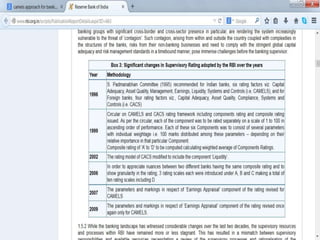
 Credit Rating of banks are done on a certain 
parameters, unlike other companies. 
 CRISIL and ICRA both are engaged in rating of 
banks based on the following six parameters, 
also called CAMELS approach.
Contd.. 
 (C)apital adequacy 
 (A)ssets 
 (M)anagement Capability 
 (E)arnings 
 (L)iquidity (also called asset liability 
management) 
 (S)ensitivity (sensitivity to market risk, especially 
interest rate risk)
Contd.. 
 C - C stands for capital adequacy of banks. 
 A bank need to maintain at least 10 % capital 
against risky assets of the bank.
Contd.. 
 A - A stands for asset quality. 
 The loan is examined to determine non-performing assets. 
An asset/loan is considered non-performing asset where 
either interest or principal is unpaid for two quarters or 
more. 
 Ratios like NPA to Net Advances, Adequacy of Provision & 
Debt Service Coverage Ratio are also calculated to know 
exact picture of quality of asset of a bank.
Contd.. 
 M- M stands for management capabilities. 
 Here, the efficiency and effectiveness of 
management in framing plans and policies is 
examined. Ratios like ROI, Return on Capital 
Employed (ROC E), Return on Assets (ROA) are 
calculated to comment upon bank’s efficiency to 
utilise the assets.
Contd.. 
 E – E stands for earnings. 
 It is the ability to earn an appropriate return on 
its assets which enables the institution to fund 
expansion, remain competitive, and replenish 
and/or increase capital.
Contd.. 
 L - L indicates liquidity position. 
 Liquid and current ratios are determined to 
find out banks ability to meet its short-term 
claims.
Contd.. 
 S - S stands for sensitivity to market risks. 
 It addresses interest rate risk, the sensitivity 
of all loans and deposits to relatively abrupt 
and unexpected shifts in interest rates.
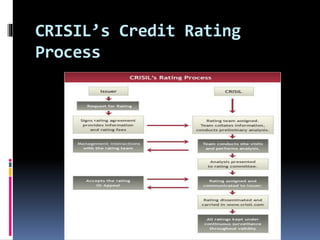
CRISIL’s Credit Rating 
Process
CRISIL’s Credit Rating Scale 
 Credit Ratings - Long Term Scale 
 Credit Ratings - Short Term Scale 
 Credit Ratings - Long Term Structured Finance 
Scale 
 Credit Ratings - Short Term Structured Finance 
Scale 
 Credit Ratings - Fixed Deposit Scale 
 Credit Ratings - Corporate Credit Scale
CRISIL’s Rating Scale for 
Long-Term Instruments 
 CRISIL AAA - (Highest Safety) 
Instruments with this rating are considered to 
have the highest degree of safety regarding 
timely servicing of financial obligations. Such 
instruments carry lowest credit risk. 
 CRISIL AA - (High Safety) 
Instruments with this rating are considered to 
have high degree of safety regarding timely 
servicing of financial obligations. Such 
instruments carry very low credit risk.
Contd.. 
 CRISIL A - (Adequate Safety) 
Instruments with this rating are considered to 
have adequate degree of safety regarding timely 
servicing of financial obligations. Such 
instruments carry low credit risk. 
 CRISIL BBB - (Moderate Safety) 
Instruments with this rating are considered to 
have moderate degree of safety regarding timely 
servicing of financial obligations. Such 
instruments carry moderate credit risk.
Contd.. 
 CRISIL BB - (Moderate Risk) 
Instruments with this rating are considered to 
have moderate risk of default regarding 
timely servicing of financial obligations. 
 CRISIL B - (High Risk) 
Instruments with this rating are considered to 
have high risk of default regarding timely 
servicing of financial obligations.
Contd.. 
 CRISIL C - (Very High Risk) 
Instruments with this rating are considered to 
have very high risk of default regarding 
timely servicing of financial obligations 
 CRISIL D - (Default) 
Instruments with this rating are in default or 
are expected to be in default soon.
Factors Affecting Assigned 
Ratings 
1. The security issuer’s ability to service its debt. In 
order, they calculate the past and likely future cash 
flows and compare with fixed interest obligations 
of the issuer. 
2. The volume and composition of outstanding debt. 
3. The stability of the future cash flows and earning 
capacity of company. 
4. The interest coverage ratio i.e. how many number of 
times the issuer is able to meet its fixed interest 
obligations.
Contd.. 
5. Ratio of current assets to current liabilities (i.e. 
current ratio (CR)) is calculated to assess the 
liquidity position of the issuing firm. 
6. The value of assets pledged as collateral security 
and the security’s priority of claim against the 
issuing firm’s assets. 
7. Market position of the company products is 
judged by the demand for the products, 
competitors market share, distribution channels, 
etc.
Contd.. 
8. Operational efficiency is judged by capacity 
utilisation, prospects of expansion, 
modernisation and diversification, availability 
of raw material etc. 
9. Track record of promoters, directors and 
expertise of staff also affect the rating of a 
company.
Instruments for Rating 
i. Equity shares issued by a company. 
ii. Preference shares issued by a company. 
iii. Bonds/debentures issued by corporate, 
government etc. 
iv. Commercial papers issued by manufacturing 
companies, finance companies, banks and 
financial institutions for raising sh0l1-term loans.
Contd.. 
v. Fixed deposits raised for medium-term ranking as 
unsecured borrowings. 
vi. Borrowers who have borrowed money. 
vii. Individuals. 
viii. Asset backed securities are assessed to determine 
the risk associated with them. The objective is to 
determine quantum of cash flows emerging from the 
asset that would be sufficient to meet committed 
payments.
THANK YOU! 


Credit rating

  • 1.
    CREDIT RATING SAUMYASINGH 1321760
  • 2.
    Meaning  Acredit rating measures creditworthiness, or the ability to pay back a loan.  Credit rating refers to assessment of the financial position of the company based on various parameters.
  • 3.
    Contd..  Acredit ratings agency is a company that assigns credit ratings to institutions that issue debt obligations (i.e. assets backed by receivables on loans, such as mortgage-backed securities).  Companies that issue credit scores for individuals are usually called credit bureaus and are distinct from corporate ratings agencies.
  • 4.
    Functions of CreditRating Agencies 1. Provides unbiased opinion 2. Provides quality and dependable information 3. Provides information at low cost
  • 5.
    Contd.. 4. Provideeasy to understand information: Rating agencies 5. Provide basis for investment 6. Healthy discipline on corporate borrowers 7. Formation of public policy
  • 6.
    Top Three CreditRating Agencies In the United States :  Moody‘s  Standard & Poor's  Fitch Ratings In India :  CRISIL (Credit Rating Information Services of India Limited)  CIBIL (Credit Information Bureau India Limited)  Fitch Ratings India Private Ltd.
  • 7.
    Uses of CreditRating A. Benefits to Investors : 1. Safety of investments. 2. Recognition of risk and returns. 3. Freedom of investment decisions 4. Wider choice of investments 5. Dependable credibility of issuer
  • 8.
    Contd.. B. Tothe Company : 1. Easy to raise resources 2. Reduced cost of borrowing 3. Reduced cost of public issues 4. Rating builds up image 5. Rating facilitates growth 6. Recognition to unknown companies
  • 9.
    Contd.. C. Benefitsto Intermediaries :  Stock brokers have to make less efforts in persuading their clients to select an investment proposal of making investment in highly rated instruments.
  • 10.
    Credit Rating OfBanks  Credit Rating of banks are done on a certain parameters, unlike other companies.  CRISIL and ICRA both are engaged in rating of banks based on the following six parameters, also called CAMELS approach.
  • 11.
    Contd..  (C)apitaladequacy  (A)ssets  (M)anagement Capability  (E)arnings  (L)iquidity (also called asset liability management)  (S)ensitivity (sensitivity to market risk, especially interest rate risk)
  • 12.
    Contd..  C- C stands for capital adequacy of banks.  A bank need to maintain at least 10 % capital against risky assets of the bank.
  • 13.
    Contd..  A- A stands for asset quality.  The loan is examined to determine non-performing assets. An asset/loan is considered non-performing asset where either interest or principal is unpaid for two quarters or more.  Ratios like NPA to Net Advances, Adequacy of Provision & Debt Service Coverage Ratio are also calculated to know exact picture of quality of asset of a bank.
  • 14.
    Contd..  M-M stands for management capabilities.  Here, the efficiency and effectiveness of management in framing plans and policies is examined. Ratios like ROI, Return on Capital Employed (ROC E), Return on Assets (ROA) are calculated to comment upon bank’s efficiency to utilise the assets.
  • 15.
    Contd..  E– E stands for earnings.  It is the ability to earn an appropriate return on its assets which enables the institution to fund expansion, remain competitive, and replenish and/or increase capital.
  • 16.
    Contd..  L- L indicates liquidity position.  Liquid and current ratios are determined to find out banks ability to meet its short-term claims.
  • 17.
    Contd..  S- S stands for sensitivity to market risks.  It addresses interest rate risk, the sensitivity of all loans and deposits to relatively abrupt and unexpected shifts in interest rates.
  • 19.
  • 20.
    CRISIL’s Credit RatingScale  Credit Ratings - Long Term Scale  Credit Ratings - Short Term Scale  Credit Ratings - Long Term Structured Finance Scale  Credit Ratings - Short Term Structured Finance Scale  Credit Ratings - Fixed Deposit Scale  Credit Ratings - Corporate Credit Scale
  • 21.
    CRISIL’s Rating Scalefor Long-Term Instruments  CRISIL AAA - (Highest Safety) Instruments with this rating are considered to have the highest degree of safety regarding timely servicing of financial obligations. Such instruments carry lowest credit risk.  CRISIL AA - (High Safety) Instruments with this rating are considered to have high degree of safety regarding timely servicing of financial obligations. Such instruments carry very low credit risk.
  • 22.
    Contd..  CRISILA - (Adequate Safety) Instruments with this rating are considered to have adequate degree of safety regarding timely servicing of financial obligations. Such instruments carry low credit risk.  CRISIL BBB - (Moderate Safety) Instruments with this rating are considered to have moderate degree of safety regarding timely servicing of financial obligations. Such instruments carry moderate credit risk.
  • 23.
    Contd..  CRISILBB - (Moderate Risk) Instruments with this rating are considered to have moderate risk of default regarding timely servicing of financial obligations.  CRISIL B - (High Risk) Instruments with this rating are considered to have high risk of default regarding timely servicing of financial obligations.
  • 24.
    Contd..  CRISILC - (Very High Risk) Instruments with this rating are considered to have very high risk of default regarding timely servicing of financial obligations  CRISIL D - (Default) Instruments with this rating are in default or are expected to be in default soon.
  • 25.
    Factors Affecting Assigned Ratings 1. The security issuer’s ability to service its debt. In order, they calculate the past and likely future cash flows and compare with fixed interest obligations of the issuer. 2. The volume and composition of outstanding debt. 3. The stability of the future cash flows and earning capacity of company. 4. The interest coverage ratio i.e. how many number of times the issuer is able to meet its fixed interest obligations.
  • 26.
    Contd.. 5. Ratioof current assets to current liabilities (i.e. current ratio (CR)) is calculated to assess the liquidity position of the issuing firm. 6. The value of assets pledged as collateral security and the security’s priority of claim against the issuing firm’s assets. 7. Market position of the company products is judged by the demand for the products, competitors market share, distribution channels, etc.
  • 27.
    Contd.. 8. Operationalefficiency is judged by capacity utilisation, prospects of expansion, modernisation and diversification, availability of raw material etc. 9. Track record of promoters, directors and expertise of staff also affect the rating of a company.
  • 28.
    Instruments for Rating i. Equity shares issued by a company. ii. Preference shares issued by a company. iii. Bonds/debentures issued by corporate, government etc. iv. Commercial papers issued by manufacturing companies, finance companies, banks and financial institutions for raising sh0l1-term loans.
  • 29.
    Contd.. v. Fixeddeposits raised for medium-term ranking as unsecured borrowings. vi. Borrowers who have borrowed money. vii. Individuals. viii. Asset backed securities are assessed to determine the risk associated with them. The objective is to determine quantum of cash flows emerging from the asset that would be sufficient to meet committed payments.
  • 30.