System of Linear Equation
Made By:-
Name/Enrolment no:-
• Nitishkant Dubey- 150860131007
• Feba Daniel- 150860131008
• Vikshit Ganjoo- 150860131009
• Prachi Gite- 150860131010
• Anjani Halpati- 150860131011
Subject code:-2110015
Contents
• Gauss Elimination
• Gauss Jordan
• Cramer's Rule
Gauss Elimination
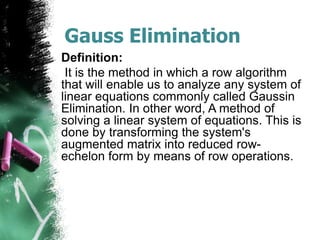
Definition:
It is the method in which a row algorithm
that will enable us to analyze any system of
linear equations commonly called Gaussin
Elimination. In other word, A method of
solving a linear system of equations. This is
done by transforming the system's
augmented matrix into reduced row-
echelon form by means of row operations.
Example
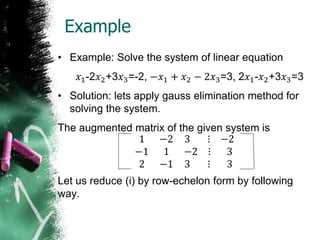
• Example: Solve the system of linear equation
𝑥1-2𝑥2+3𝑥3=-2, −𝑥1 + 𝑥2 − 2𝑥3=3, 2𝑥1-𝑥2+3𝑥3=3
• Solution: lets apply gauss elimination method for
solving the system.
The augmented matrix of the given system is
1 −2 3 ⋮
−1 1 −2 ⋮
2 −1 3 ⋮
−2
3
3
Let us reduce (i) by row-echelon form by following
way.
𝑅2+𝑅1, 𝑅3 − 2𝑅1
1 −2 3 ⋮
0 −1 1 ⋮
0 3 −3 ⋮
−2
1
7
𝑅2(-1), 𝑅3 − 3𝑅2
1 −2 3 ⋮
0 1 −1 ⋮
0 0 0 ⋮
−2
−1
10
𝑅3/10
1 −2 3 ⋮
0 1 −1 ⋮
0 0 0 ⋮
−2
−1
1
Which is require row equivalent form.
By going back to equations, we get
𝑥1-2𝑥2+3𝑥3=-2, 𝑥2-𝑥3=-1,0=1
Gauss Jordan
The method of finding the inverse of an given non-
singular matrix by elementary row transformations
is called gauss Jordan method.
Working Rule:
• [A:I]
• A reduces to 𝐴−1
Example
• Example: Find the inverse of matrix.
𝐴 =
1 2
1 3
• Solution: We have to first check about the
existence of 𝐴−1.
𝐴 =
1 2
1 3
= 3 - 2= 1 ≠ 0
Therefore 𝐴−1 exist.
Now,
[A:I] =
1 2 ⋮ 1 0
1 3 ⋮ 0 1
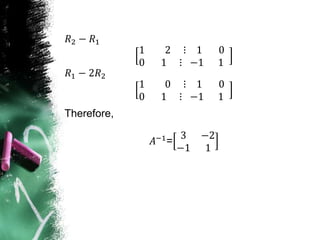
𝑅2 − 𝑅1
1 2 ⋮ 1 0
0 1 ⋮ −1 1
𝑅1 − 2𝑅2
1 0 ⋮ 1 0
0 1 ⋮ −1 1
Therefore,
𝐴−1
=
3 −2
−1 1
Cramer’s Rule
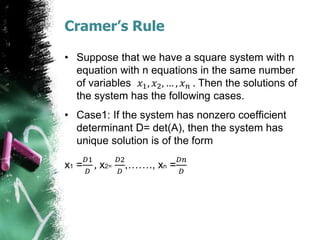
• Suppose that we have a square system with n
equation with n equations in the same number
of variables 𝑥1, 𝑥2, … , 𝑥 𝑛 . Then the solutions of
the system has the following cases.
• Case1: If the system has nonzero coefficient
determinant D= det(A), then the system has
unique solution is of the form
x1 =
𝐷1
𝐷
, x2=
𝐷2
𝐷
,……., xn =
𝐷𝑛
𝐷
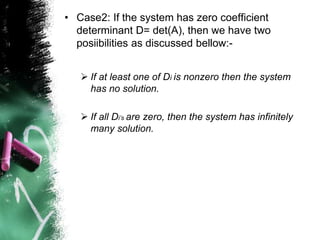
• Case2: If the system has zero coefficient
determinant D= det(A), then we have two
posiibilities as discussed bellow:-
 If at least one of Di is nonzero then the system
has no solution.
 If all Di’s are zero, then the system has infinitely
many solution.
Example
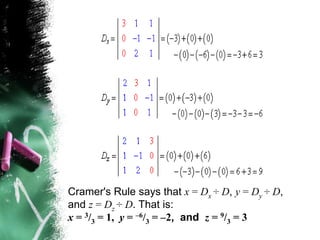
• Example: solve the following with Cramer's rule
2x + y + z = 3
x – y – z = 0
x + 2y + z = 0
• Solution: Evaluating each determinant, we get:
Cramer's Rule says that x = Dx ÷ D, y = Dy ÷ D,
and z = Dz ÷ D. That is:
x = 3/3 = 1, y = –6/3 = –2, and z = 9/3 = 3
System of linear equations

System of linear equations

  • 1.
    System of LinearEquation Made By:- Name/Enrolment no:- • Nitishkant Dubey- 150860131007 • Feba Daniel- 150860131008 • Vikshit Ganjoo- 150860131009 • Prachi Gite- 150860131010 • Anjani Halpati- 150860131011 Subject code:-2110015
  • 2.
    Contents • Gauss Elimination •Gauss Jordan • Cramer's Rule
  • 4.
    Gauss Elimination Definition: It isthe method in which a row algorithm that will enable us to analyze any system of linear equations commonly called Gaussin Elimination. In other word, A method of solving a linear system of equations. This is done by transforming the system's augmented matrix into reduced row- echelon form by means of row operations.
  • 5.
    Example • Example: Solvethe system of linear equation 𝑥1-2𝑥2+3𝑥3=-2, −𝑥1 + 𝑥2 − 2𝑥3=3, 2𝑥1-𝑥2+3𝑥3=3 • Solution: lets apply gauss elimination method for solving the system. The augmented matrix of the given system is 1 −2 3 ⋮ −1 1 −2 ⋮ 2 −1 3 ⋮ −2 3 3 Let us reduce (i) by row-echelon form by following way.
  • 6.
    𝑅2+𝑅1, 𝑅3 −2𝑅1 1 −2 3 ⋮ 0 −1 1 ⋮ 0 3 −3 ⋮ −2 1 7 𝑅2(-1), 𝑅3 − 3𝑅2 1 −2 3 ⋮ 0 1 −1 ⋮ 0 0 0 ⋮ −2 −1 10 𝑅3/10 1 −2 3 ⋮ 0 1 −1 ⋮ 0 0 0 ⋮ −2 −1 1 Which is require row equivalent form. By going back to equations, we get 𝑥1-2𝑥2+3𝑥3=-2, 𝑥2-𝑥3=-1,0=1
  • 8.
    Gauss Jordan The methodof finding the inverse of an given non- singular matrix by elementary row transformations is called gauss Jordan method. Working Rule: • [A:I] • A reduces to 𝐴−1
  • 9.
    Example • Example: Findthe inverse of matrix. 𝐴 = 1 2 1 3 • Solution: We have to first check about the existence of 𝐴−1. 𝐴 = 1 2 1 3 = 3 - 2= 1 ≠ 0 Therefore 𝐴−1 exist. Now, [A:I] = 1 2 ⋮ 1 0 1 3 ⋮ 0 1
  • 10.
    𝑅2 − 𝑅1 12 ⋮ 1 0 0 1 ⋮ −1 1 𝑅1 − 2𝑅2 1 0 ⋮ 1 0 0 1 ⋮ −1 1 Therefore, 𝐴−1 = 3 −2 −1 1
  • 12.
    Cramer’s Rule • Supposethat we have a square system with n equation with n equations in the same number of variables 𝑥1, 𝑥2, … , 𝑥 𝑛 . Then the solutions of the system has the following cases. • Case1: If the system has nonzero coefficient determinant D= det(A), then the system has unique solution is of the form x1 = 𝐷1 𝐷 , x2= 𝐷2 𝐷 ,……., xn = 𝐷𝑛 𝐷
  • 13.
    • Case2: Ifthe system has zero coefficient determinant D= det(A), then we have two posiibilities as discussed bellow:-  If at least one of Di is nonzero then the system has no solution.  If all Di’s are zero, then the system has infinitely many solution.
  • 14.
    Example • Example: solvethe following with Cramer's rule 2x + y + z = 3 x – y – z = 0 x + 2y + z = 0 • Solution: Evaluating each determinant, we get:
  • 15.
    Cramer's Rule saysthat x = Dx ÷ D, y = Dy ÷ D, and z = Dz ÷ D. That is: x = 3/3 = 1, y = –6/3 = –2, and z = 9/3 = 3