
Role of Headspace in Gas Chromatography
(its importance and Limitation)
Chandra Prakash Singh
Research Associate
Jubilant Life Sciences, Noida
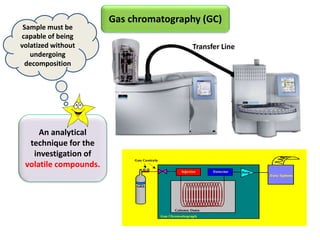
Gas chromatography (GC)
An analytical
technique for the
investigation of
volatile compounds.
Sample must be
capable of being
volatized without
undergoing
decomposition
Transfer Line
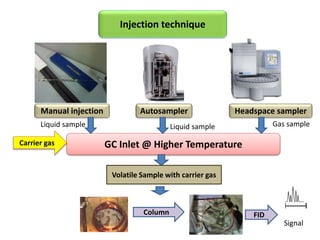
Injection technique
Manual injection Autosampler Headspace sampler
Liquid sample Liquid sample Gas sample
GC Inlet @ Higher Temperature
Signal
Volatile Sample with carrier gas
Carrier gas
Column FID
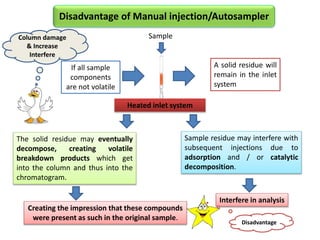
If all sample
components
are not volatile
Disadvantage of Manual injection/Autosampler
Sample residue may interfere with
subsequent injections due to
adsorption and / or catalytic
decomposition.
The solid residue may eventually
decompose, creating volatile
breakdown products which get
into the column and thus into the
chromatogram.
A solid residue will
remain in the inlet
system
Sample
Heated inlet system
Creating the impression that these compounds
were present as such in the original sample.
Interfere in analysis
Disadvantage
Column damage
& Increase
Interfere
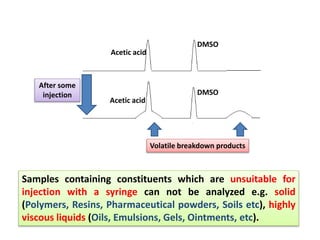
Acetic acid
Acetic acid
DMSO
DMSO
After some
injection
Volatile breakdown products
Samples containing constituents which are unsuitable for
injection with a syringe can not be analyzed e.g. solid
(Polymers, Resins, Pharmaceutical powders, Soils etc), highly
viscous liquids (Oils, Emulsions, Gels, Ointments, etc).
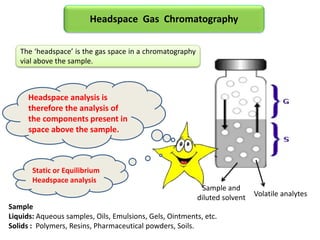
The ‘headspace’ is the gas space in a chromatography
vial above the sample.
Volatile analytes
Sample and
diluted solvent
Headspace Gas Chromatography
Sample
Liquids: Aqueous samples, Oils, Emulsions, Gels, Ointments, etc.
Solids : Polymers, Resins, Pharmaceutical powders, Soils.
Headspace analysis is
therefore the analysis of
the components present in
space above the sample.
Static or Equilibrium
Headspace analysis
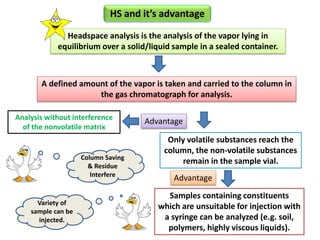
A defined amount of the vapor is taken and carried to the column in
the gas chromatograph for analysis.
Headspace analysis is the analysis of the vapor lying in
equilibrium over a solid/liquid sample in a sealed container.
Only volatile substances reach the
column, the non-volatile substances
remain in the sample vial.
Samples containing constituents
which are unsuitable for injection with
a syringe can be analyzed (e.g. soil,
polymers, highly viscous liquids).
Column Saving
& Residue
Interfere
Variety of
sample can be
injected.
Advantage
AdvantageAnalysis without interference
of the nonvolatile matrix
HS and it’s advantage
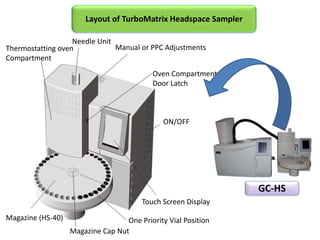
Magazine (HS-40)
Magazine Cap Nut
One Priority Vial Position
Oven Compartment
Door Latch
Manual or PPC Adjustments
Needle Unit
Thermostatting oven
Compartment
Touch Screen Display
ON/OFF
GC-HS
Layout of TurboMatrix Headspace Sampler
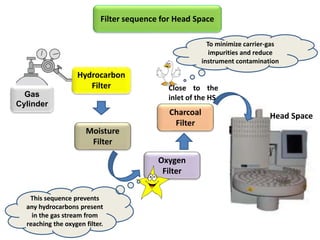
Gas
Cylinder
Hydrocarbon
Filter
Moisture
Filter
Oxygen
Filter
Charcoal
Filter
Head Space
This sequence prevents
any hydrocarbons present
in the gas stream from
reaching the oxygen filter.
To minimize carrier-gas
impurities and reduce
instrument contamination
Close to the
inlet of the HS
Filter sequence for Head Space
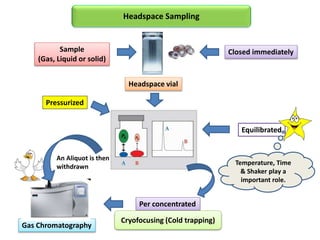
Headspace sampling
Sample
(Gas, Liquid or solid)
Headspace vial
Closed immediately
Equilibrated
Pressurized
An Aliquot is then
withdrawn
Gas Chromatography
Per concentrated
Headspace Sampling
Temperature, Time
& Shaker play a
important role.
Cryofocusing (Cold trapping)
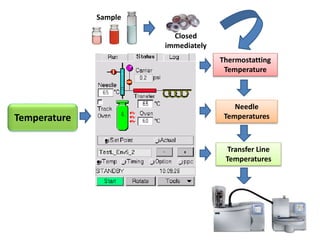
Temperature
Needle
Temperatures
Transfer Line
Temperatures
Thermostatting
Temperature
Sample
Closed
immediately
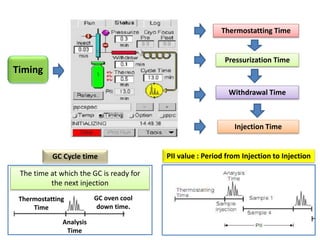
Timing
Pressurization Time
Withdrawal Time
Thermostatting Time
Injection Time
GC Cycle time PII value : Period from Injection to Injection
Thermostatting
Time
Analysis
Time
The time at which the GC is ready for
the next injection
GC oven cool
down time.
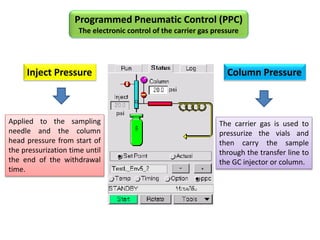
Programmed Pneumatic Control (PPC)
The electronic control of the carrier gas pressure
Column PressureInject Pressure
The carrier gas is used to
pressurize the vials and
then carry the sample
through the transfer line to
the GC injector or column.
Applied to the sampling
needle and the column
head pressure from start of
the pressurization time until
the end of the withdrawal
time.
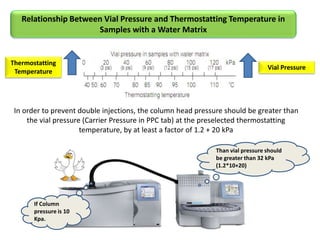
In order to prevent double injections, the column head pressure should be greater than
the vial pressure (Carrier Pressure in PPC tab) at the preselected thermostatting
temperature, by at least a factor of 1.2 + 20 kPa
Relationship Between Vial Pressure and Thermostatting Temperature in
Samples with a Water Matrix
Thermostatting
Temperature
Vial Pressure
If Column
pressure is 10
Kpa.
Than vial pressure should
be greater than 32 kPa
(1.2*10+20)
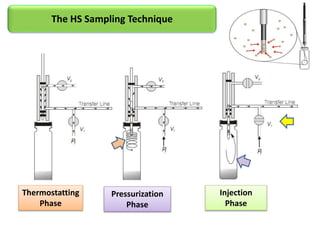
Injection
Phase
The HS Sampling Technique
Pressurization
Phase
Thermostatting
Phase
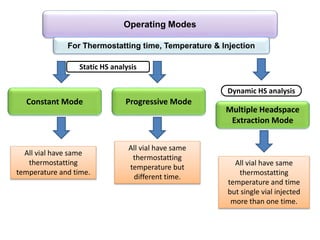
Operating Modes
Constant Mode Progressive Mode
Multiple Headspace
Extraction Mode
All vial have same
thermostatting
temperature and time.
All vial have same
thermostatting
temperature but
different time.
All vial have same
thermostatting
temperature and time
but single vial injected
more than one time.
For Thermostatting time, Temperature & Injection
Static HS analysis
Dynamic HS analysis
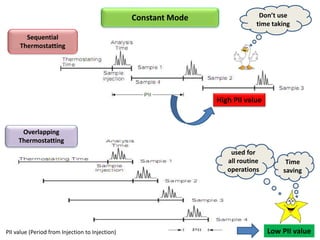
PII value (Period from Injection to Injection)
Sequential
Thermostatting
Overlapping
Thermostatting
Constant Mode
High PII value
Low PII value
Time
saving
Don’t use
time taking
used for
all routine
operations
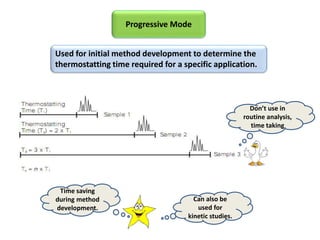
Time saving
during method
development.
Don’t use in
routine analysis,
time taking
Can also be
used for
kinetic studies.
Progressive Mode
Used for initial method development to determine the
thermostatting time required for a specific application.
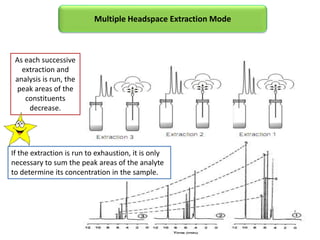
Multiple Headspace Extraction Mode
As each successive
extraction and
analysis is run, the
peak areas of the
constituents
decrease.
If the extraction is run to exhaustion, it is only
necessary to sum the peak areas of the analyte
to determine its concentration in the sample.
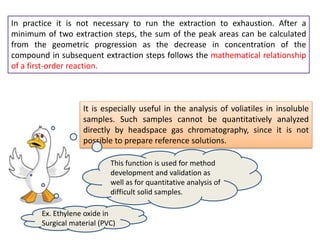
It is especially useful in the analysis of voliatiles in insoluble
samples. Such samples cannot be quantitatively analyzed
directly by headspace gas chromatography, since it is not
possible to prepare reference solutions.
In practice it is not necessary to run the extraction to exhaustion. After a
minimum of two extraction steps, the sum of the peak areas can be calculated
from the geometric progression as the decrease in concentration of the
compound in subsequent extraction steps follows the mathematical relationship
of a first-order reaction.
This function is used for method
development and validation as
well as for quantitative analysis of
difficult solid samples.
Ex. Ethylene oxide in
Surgical material (PVC)
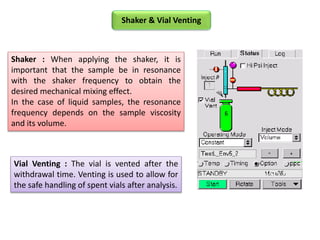
Shaker : When applying the shaker, it is
important that the sample be in resonance
with the shaker frequency to obtain the
desired mechanical mixing effect.
In the case of liquid samples, the resonance
frequency depends on the sample viscosity
and its volume.
Vial Venting : The vial is vented after the
withdrawal time. Venting is used to allow for
the safe handling of spent vials after analysis.
Shaker & Vial Venting
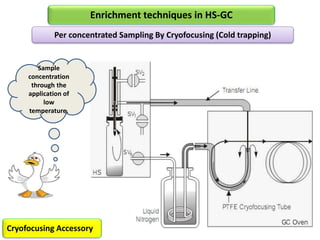
Per concentrated Sampling By Cryofocusing (Cold trapping)
Cryofocusing Accessory
Sample
concentration
through the
application of
low
temperature.
Enrichment techniques in HS-GC
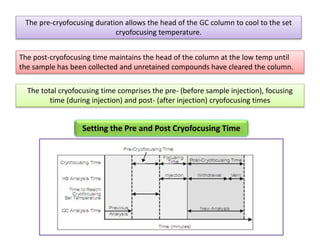
Setting the Pre and Post Cryofocusing Time
The pre-cryofocusing duration allows the head of the GC column to cool to the set
cryofocusing temperature.
The post-cryofocusing time maintains the head of the column at the low temp until
the sample has been collected and unretained compounds have cleared the column.
The total cryofocusing time comprises the pre- (before sample injection), focusing
time (during injection) and post- (after injection) cryofocusing times
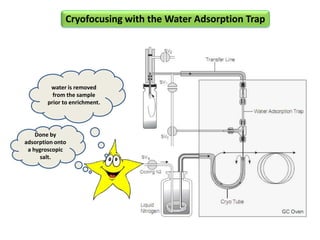
Cryofocusing with the Water Adsorption Trap
Done by
adsorption onto
a hygroscopic
salt.
water is removed
from the sample
prior to enrichment.
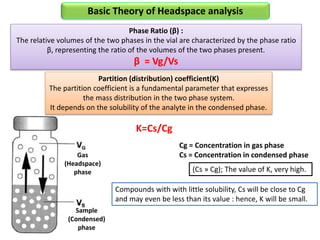
Phase Ratio (β) :
The relative volumes of the two phases in the vial are characterized by the phase ratio
β, representing the ratio of the volumes of the two phases present.
β = Vg/Vs
Sample
(Condensed)
phase
Gas
(Headspace)
phase
Partition (distribution) coefficient(K)
The partition coefficient is a fundamental parameter that expresses
the mass distribution in the two phase system.
It depends on the solubility of the analyte in the condensed phase.
Compounds with with little solubility, Cs will be close to Cg
and may even be less than its value : hence, K will be small.
(Cs » Cg); The value of K, very high.
K=Cs/Cg
Cg = Concentration in gas phase
Cs = Concentration in condensed phase
Basic Theory of Headspace analysis
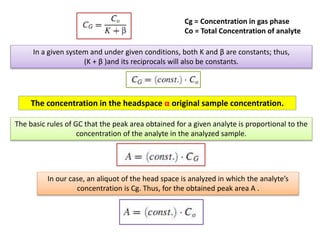
In a given system and under given conditions, both K and β are constants; thus,
(K + β )and its reciprocals will also be constants.
The concentration in the headspace α original sample concentration.
The basic rules of GC that the peak area obtained for a given analyte is proportional to the
concentration of the analyte in the analyzed sample.
In our case, an aliquot of the head space is analyzed in which the analyte’s
concentration is Cg. Thus, for the obtained peak area A .
Cg = Concentration in gas phase
Co = Total Concentration of analyte
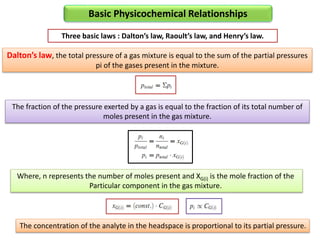
Three basic laws : Dalton’s law, Raoult’s law, and Henry’s law.
Dalton’s law, the total pressure of a gas mixture is equal to the sum of the partial pressures
pi of the gases present in the mixture.
The fraction of the pressure exerted by a gas is equal to the fraction of its total number of
moles present in the gas mixture.
Where, n represents the number of moles present and XG(i) is the mole fraction of the
Particular component in the gas mixture.
The concentration of the analyte in the headspace is proportional to its partial pressure.
Basic Physicochemical Relationships
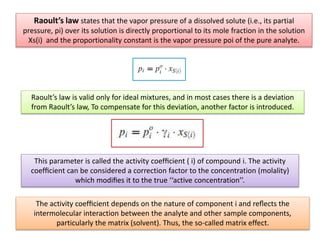
Raoult’s law states that the vapor pressure of a dissolved solute (i.e., its partial
pressure, pi) over its solution is directly proportional to its mole fraction in the solution
Xs(i) and the proportionality constant is the vapor pressure poi of the pure analyte.
Raoult’s law is valid only for ideal mixtures, and in most cases there is a deviation
from Raoult’s law, To compensate for this deviation, another factor is introduced.
This parameter is called the activity coefficient ( i) of compound i. The activity
coefficient can be considered a correction factor to the concentration (molality)
which modifies it to the true ‘‘active concentration’’.
The activity coefficient depends on the nature of component i and reflects the
intermolecular interaction between the analyte and other sample components,
particularly the matrix (solvent). Thus, the so-called matrix effect.
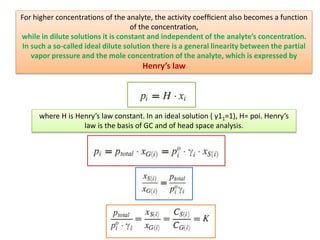
For higher concentrations of the analyte, the activity coefficient also becomes a function
of the concentration,
while in dilute solutions it is constant and independent of the analyte’s concentration.
In such a so-called ideal dilute solution there is a general linearity between the partial
vapor pressure and the mole concentration of the analyte, which is expressed by
Henry’s law
where H is Henry’s law constant. In an ideal solution ( γ11=1), H= poi. Henry’s
law is the basis of GC and of head space analysis.
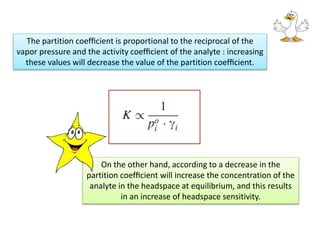
On the other hand, according to a decrease in the
partition coefficient will increase the concentration of the
analyte in the headspace at equilibrium, and this results
in an increase of headspace sensitivity.
The partition coefficient is proportional to the reciprocal of the
vapor pressure and the activity coefficient of the analyte : increasing
these values will decrease the value of the partition coefficient.
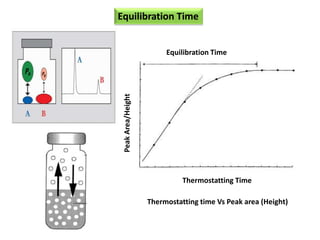
Equilibration Time
Thermostatting Time
PeakArea/Height
Thermostatting time Vs Peak area (Height)
Equilibration Time
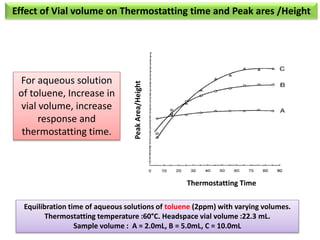
Equilibration time of aqueous solutions of toluene (2ppm) with varying volumes.
Thermostatting temperature :60°C. Headspace vial volume :22.3 mL.
Sample volume : A = 2.0mL, B = 5.0mL, C = 10.0mL
Thermostatting Time
PeakArea/Height
Effect of Vial volume on Thermostatting time and Peak ares /Height
For aqueous solution
of toluene, Increase in
vial volume, increase
response and
thermostatting time.
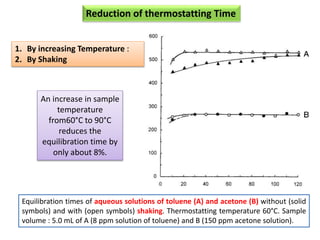
Equilibration times of aqueous solutions of toluene (A) and acetone (B) without (solid
symbols) and with (open symbols) shaking. Thermostatting temperature 60°C. Sample
volume : 5.0 mL of A (8 ppm solution of toluene) and B (150 ppm acetone solution).
Reduction of thermostatting Time
1. By increasing Temperature :
2. By Shaking
An increase in sample
temperature
from60°C to 90°C
reduces the
equilibration time by
only about 8%.
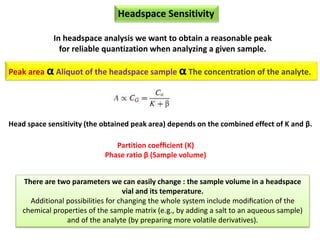
Headspace Sensitivity
In headspace analysis we want to obtain a reasonable peak
for reliable quantization when analyzing a given sample.
Head space sensitivity (the obtained peak area) depends on the combined effect of K and β.
Partition coefficient (K)
Phase ratio β (Sample volume)
There are two parameters we can easily change : the sample volume in a headspace
vial and its temperature.
Additional possibilities for changing the whole system include modification of the
chemical properties of the sample matrix (e.g., by adding a salt to an aqueous sample)
and of the analyte (by preparing more volatile derivatives).
Peak area α Aliquot of the headspace sample α The concentration of the analyte.
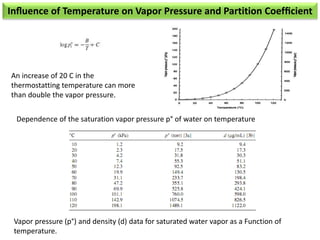
Dependence of the saturation vapor pressure p° of water on temperature
Vapor pressure (p°) and density (d) data for saturated water vapor as a Function of
temperature.
Influence of Temperature on Vapor Pressure and Partition Coefficient
An increase of 20 C in the
thermostatting temperature can more
than double the vapor pressure.
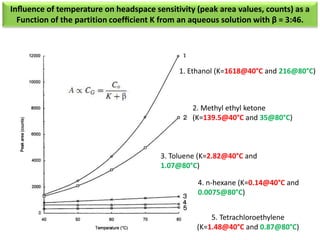
Influence of temperature on headspace sensitivity (peak area values, counts) as a
Function of the partition coefficient K from an aqueous solution with β = 3:46.
1. Ethanol (K=1618@40°C and 216@80°C)
2. Methyl ethyl ketone
(K=139.5@40°C and 35@80°C)
3. Toluene (K=2.82@40°C and
1.07@80°C)
4. n-hexane (K=0.14@40°C and
0.0075@80°C)
5. Tetrachloroethylene
(K=1.48@40°C and 0.87@80°C)
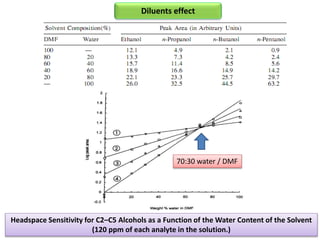
Headspace Sensitivity for C2–C5 Alcohols as a Function of the Water Content of the Solvent
(120 ppm of each analyte in the solution.)
70:30 water / DMF
Diluents effect
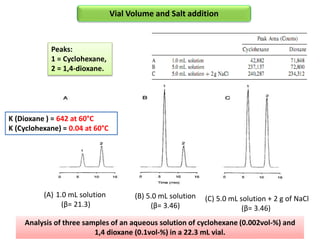
Analysis of three samples of an aqueous solution of cyclohexane (0.002vol-%) and
1,4 dioxane (0.1vol-%) in a 22.3 mL vial.
(A) 1.0 mL solution
(β= 21.3)
(B) 5.0 mL solution
(β= 3.46)
(C) 5.0 mL solution + 2 g of NaCl
(β= 3.46)
Peaks:
1 = Cyclohexane,
2 = 1,4-dioxane.
K (Dioxane ) = 642 at 60°C
K (Cyclohexane) = 0.04 at 60°C
Vial Volume and Salt addition
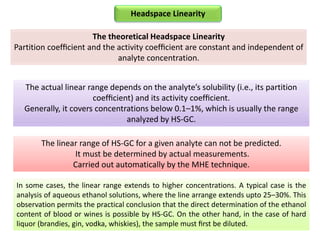
The theoretical Headspace Linearity
Partition coefficient and the activity coefficient are constant and independent of
analyte concentration.
In some cases, the linear range extends to higher concentrations. A typical case is the
analysis of aqueous ethanol solutions, where the line arrange extends upto 25–30%. This
observation permits the practical conclusion that the direct determination of the ethanol
content of blood or wines is possible by HS-GC. On the other hand, in the case of hard
liquor (brandies, gin, vodka, whiskies), the sample must first be diluted.
The linear range of HS-GC for a given analyte can not be predicted.
It must be determined by actual measurements.
Carried out automatically by the MHE technique.
Headspace Linearity
The actual linear range depends on the analyte’s solubility (i.e., its partition
coefficient) and its activity coefficient.
Generally, it covers concentrations below 0.1–1%, which is usually the range
analyzed by HS-GC.
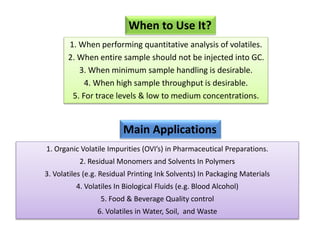
When to Use It?
Main Applications
1. Organic Volatile Impurities (OVI’s) in Pharmaceutical Preparations.
2. Residual Monomers and Solvents In Polymers
3. Volatiles (e.g. Residual Printing Ink Solvents) In Packaging Materials
4. Volatiles In Biological Fluids (e.g. Blood Alcohol)
5. Food & Beverage Quality control
6. Volatiles in Water, Soil, and Waste
1. When performing quantitative analysis of volatiles.
2. When entire sample should not be injected into GC.
3. When minimum sample handling is desirable.
4. When high sample throughput is desirable.
5. For trace levels & low to medium concentrations.
Limitations
1. Very limited use of low boiling solvents (like Methanol, DCM, Acetone etc.)
2. Response of high boiling point analyte are low.
3. Run time long.
4. One sample can not be injected more than one time.
5. Limited higher temperature can be applied for thermostatting.
6. Prolong heating leads to sample decomposition.
7. Method development is critical and time taking.
8. Commonly used organic solvent (like DMSO,DMF, NMP and DMA)are
carcinogenic and extremely hazardous.
9. Sample preparation takes proper care.
10.Contamination are higher during sample preparation and analysis.
11.Needs high purity gasses.
12.Costly technique.
THANKS

cpsingh_jubl

  • 1.
    Role of Headspacein Gas Chromatography (its importance and Limitation) Chandra Prakash Singh Research Associate Jubilant Life Sciences, Noida
  • 2.
    Gas chromatography (GC) Ananalytical technique for the investigation of volatile compounds. Sample must be capable of being volatized without undergoing decomposition Transfer Line
  • 3.
    Injection technique Manual injectionAutosampler Headspace sampler Liquid sample Liquid sample Gas sample GC Inlet @ Higher Temperature Signal Volatile Sample with carrier gas Carrier gas Column FID
  • 4.
    If all sample components arenot volatile Disadvantage of Manual injection/Autosampler Sample residue may interfere with subsequent injections due to adsorption and / or catalytic decomposition. The solid residue may eventually decompose, creating volatile breakdown products which get into the column and thus into the chromatogram. A solid residue will remain in the inlet system Sample Heated inlet system Creating the impression that these compounds were present as such in the original sample. Interfere in analysis Disadvantage Column damage & Increase Interfere
  • 5.
    Acetic acid Acetic acid DMSO DMSO Aftersome injection Volatile breakdown products Samples containing constituents which are unsuitable for injection with a syringe can not be analyzed e.g. solid (Polymers, Resins, Pharmaceutical powders, Soils etc), highly viscous liquids (Oils, Emulsions, Gels, Ointments, etc).
  • 6.
    The ‘headspace’ isthe gas space in a chromatography vial above the sample. Volatile analytes Sample and diluted solvent Headspace Gas Chromatography Sample Liquids: Aqueous samples, Oils, Emulsions, Gels, Ointments, etc. Solids : Polymers, Resins, Pharmaceutical powders, Soils. Headspace analysis is therefore the analysis of the components present in space above the sample. Static or Equilibrium Headspace analysis
  • 7.
    A defined amountof the vapor is taken and carried to the column in the gas chromatograph for analysis. Headspace analysis is the analysis of the vapor lying in equilibrium over a solid/liquid sample in a sealed container. Only volatile substances reach the column, the non-volatile substances remain in the sample vial. Samples containing constituents which are unsuitable for injection with a syringe can be analyzed (e.g. soil, polymers, highly viscous liquids). Column Saving & Residue Interfere Variety of sample can be injected. Advantage AdvantageAnalysis without interference of the nonvolatile matrix HS and it’s advantage
  • 8.
    Magazine (HS-40) Magazine CapNut One Priority Vial Position Oven Compartment Door Latch Manual or PPC Adjustments Needle Unit Thermostatting oven Compartment Touch Screen Display ON/OFF GC-HS Layout of TurboMatrix Headspace Sampler
  • 9.
    Gas Cylinder Hydrocarbon Filter Moisture Filter Oxygen Filter Charcoal Filter Head Space This sequenceprevents any hydrocarbons present in the gas stream from reaching the oxygen filter. To minimize carrier-gas impurities and reduce instrument contamination Close to the inlet of the HS Filter sequence for Head Space
  • 10.
    Headspace sampling Sample (Gas, Liquidor solid) Headspace vial Closed immediately Equilibrated Pressurized An Aliquot is then withdrawn Gas Chromatography Per concentrated Headspace Sampling Temperature, Time & Shaker play a important role. Cryofocusing (Cold trapping)
  • 11.
  • 12.
    Timing Pressurization Time Withdrawal Time ThermostattingTime Injection Time GC Cycle time PII value : Period from Injection to Injection Thermostatting Time Analysis Time The time at which the GC is ready for the next injection GC oven cool down time.
  • 13.
    Programmed Pneumatic Control(PPC) The electronic control of the carrier gas pressure Column PressureInject Pressure The carrier gas is used to pressurize the vials and then carry the sample through the transfer line to the GC injector or column. Applied to the sampling needle and the column head pressure from start of the pressurization time until the end of the withdrawal time.
  • 14.
    In order toprevent double injections, the column head pressure should be greater than the vial pressure (Carrier Pressure in PPC tab) at the preselected thermostatting temperature, by at least a factor of 1.2 + 20 kPa Relationship Between Vial Pressure and Thermostatting Temperature in Samples with a Water Matrix Thermostatting Temperature Vial Pressure If Column pressure is 10 Kpa. Than vial pressure should be greater than 32 kPa (1.2*10+20)
  • 15.
    Injection Phase The HS SamplingTechnique Pressurization Phase Thermostatting Phase
  • 16.
    Operating Modes Constant ModeProgressive Mode Multiple Headspace Extraction Mode All vial have same thermostatting temperature and time. All vial have same thermostatting temperature but different time. All vial have same thermostatting temperature and time but single vial injected more than one time. For Thermostatting time, Temperature & Injection Static HS analysis Dynamic HS analysis
  • 17.
    PII value (Periodfrom Injection to Injection) Sequential Thermostatting Overlapping Thermostatting Constant Mode High PII value Low PII value Time saving Don’t use time taking used for all routine operations
  • 18.
    Time saving during method development. Don’tuse in routine analysis, time taking Can also be used for kinetic studies. Progressive Mode Used for initial method development to determine the thermostatting time required for a specific application.
  • 19.
    Multiple Headspace ExtractionMode As each successive extraction and analysis is run, the peak areas of the constituents decrease. If the extraction is run to exhaustion, it is only necessary to sum the peak areas of the analyte to determine its concentration in the sample.
  • 20.
    It is especiallyuseful in the analysis of voliatiles in insoluble samples. Such samples cannot be quantitatively analyzed directly by headspace gas chromatography, since it is not possible to prepare reference solutions. In practice it is not necessary to run the extraction to exhaustion. After a minimum of two extraction steps, the sum of the peak areas can be calculated from the geometric progression as the decrease in concentration of the compound in subsequent extraction steps follows the mathematical relationship of a first-order reaction. This function is used for method development and validation as well as for quantitative analysis of difficult solid samples. Ex. Ethylene oxide in Surgical material (PVC)
  • 21.
    Shaker : Whenapplying the shaker, it is important that the sample be in resonance with the shaker frequency to obtain the desired mechanical mixing effect. In the case of liquid samples, the resonance frequency depends on the sample viscosity and its volume. Vial Venting : The vial is vented after the withdrawal time. Venting is used to allow for the safe handling of spent vials after analysis. Shaker & Vial Venting
  • 22.
    Per concentrated SamplingBy Cryofocusing (Cold trapping) Cryofocusing Accessory Sample concentration through the application of low temperature. Enrichment techniques in HS-GC
  • 23.
    Setting the Preand Post Cryofocusing Time The pre-cryofocusing duration allows the head of the GC column to cool to the set cryofocusing temperature. The post-cryofocusing time maintains the head of the column at the low temp until the sample has been collected and unretained compounds have cleared the column. The total cryofocusing time comprises the pre- (before sample injection), focusing time (during injection) and post- (after injection) cryofocusing times
  • 24.
    Cryofocusing with theWater Adsorption Trap Done by adsorption onto a hygroscopic salt. water is removed from the sample prior to enrichment.
  • 25.
    Phase Ratio (β): The relative volumes of the two phases in the vial are characterized by the phase ratio β, representing the ratio of the volumes of the two phases present. β = Vg/Vs Sample (Condensed) phase Gas (Headspace) phase Partition (distribution) coefficient(K) The partition coefficient is a fundamental parameter that expresses the mass distribution in the two phase system. It depends on the solubility of the analyte in the condensed phase. Compounds with with little solubility, Cs will be close to Cg and may even be less than its value : hence, K will be small. (Cs » Cg); The value of K, very high. K=Cs/Cg Cg = Concentration in gas phase Cs = Concentration in condensed phase Basic Theory of Headspace analysis
  • 26.
    In a givensystem and under given conditions, both K and β are constants; thus, (K + β )and its reciprocals will also be constants. The concentration in the headspace α original sample concentration. The basic rules of GC that the peak area obtained for a given analyte is proportional to the concentration of the analyte in the analyzed sample. In our case, an aliquot of the head space is analyzed in which the analyte’s concentration is Cg. Thus, for the obtained peak area A . Cg = Concentration in gas phase Co = Total Concentration of analyte
  • 27.
    Three basic laws: Dalton’s law, Raoult’s law, and Henry’s law. Dalton’s law, the total pressure of a gas mixture is equal to the sum of the partial pressures pi of the gases present in the mixture. The fraction of the pressure exerted by a gas is equal to the fraction of its total number of moles present in the gas mixture. Where, n represents the number of moles present and XG(i) is the mole fraction of the Particular component in the gas mixture. The concentration of the analyte in the headspace is proportional to its partial pressure. Basic Physicochemical Relationships
  • 28.
    Raoult’s law statesthat the vapor pressure of a dissolved solute (i.e., its partial pressure, pi) over its solution is directly proportional to its mole fraction in the solution Xs(i) and the proportionality constant is the vapor pressure poi of the pure analyte. Raoult’s law is valid only for ideal mixtures, and in most cases there is a deviation from Raoult’s law, To compensate for this deviation, another factor is introduced. This parameter is called the activity coefficient ( i) of compound i. The activity coefficient can be considered a correction factor to the concentration (molality) which modifies it to the true ‘‘active concentration’’. The activity coefficient depends on the nature of component i and reflects the intermolecular interaction between the analyte and other sample components, particularly the matrix (solvent). Thus, the so-called matrix effect.
  • 29.
    For higher concentrationsof the analyte, the activity coefficient also becomes a function of the concentration, while in dilute solutions it is constant and independent of the analyte’s concentration. In such a so-called ideal dilute solution there is a general linearity between the partial vapor pressure and the mole concentration of the analyte, which is expressed by Henry’s law where H is Henry’s law constant. In an ideal solution ( γ11=1), H= poi. Henry’s law is the basis of GC and of head space analysis.
  • 30.
    On the otherhand, according to a decrease in the partition coefficient will increase the concentration of the analyte in the headspace at equilibrium, and this results in an increase of headspace sensitivity. The partition coefficient is proportional to the reciprocal of the vapor pressure and the activity coefficient of the analyte : increasing these values will decrease the value of the partition coefficient.
  • 31.
    Equilibration Time Thermostatting Time PeakArea/Height Thermostattingtime Vs Peak area (Height) Equilibration Time
  • 32.
    Equilibration time ofaqueous solutions of toluene (2ppm) with varying volumes. Thermostatting temperature :60°C. Headspace vial volume :22.3 mL. Sample volume : A = 2.0mL, B = 5.0mL, C = 10.0mL Thermostatting Time PeakArea/Height Effect of Vial volume on Thermostatting time and Peak ares /Height For aqueous solution of toluene, Increase in vial volume, increase response and thermostatting time.
  • 33.
    Equilibration times ofaqueous solutions of toluene (A) and acetone (B) without (solid symbols) and with (open symbols) shaking. Thermostatting temperature 60°C. Sample volume : 5.0 mL of A (8 ppm solution of toluene) and B (150 ppm acetone solution). Reduction of thermostatting Time 1. By increasing Temperature : 2. By Shaking An increase in sample temperature from60°C to 90°C reduces the equilibration time by only about 8%.
  • 34.
    Headspace Sensitivity In headspaceanalysis we want to obtain a reasonable peak for reliable quantization when analyzing a given sample. Head space sensitivity (the obtained peak area) depends on the combined effect of K and β. Partition coefficient (K) Phase ratio β (Sample volume) There are two parameters we can easily change : the sample volume in a headspace vial and its temperature. Additional possibilities for changing the whole system include modification of the chemical properties of the sample matrix (e.g., by adding a salt to an aqueous sample) and of the analyte (by preparing more volatile derivatives). Peak area α Aliquot of the headspace sample α The concentration of the analyte.
  • 35.
    Dependence of thesaturation vapor pressure p° of water on temperature Vapor pressure (p°) and density (d) data for saturated water vapor as a Function of temperature. Influence of Temperature on Vapor Pressure and Partition Coefficient An increase of 20 C in the thermostatting temperature can more than double the vapor pressure.
  • 36.
    Influence of temperatureon headspace sensitivity (peak area values, counts) as a Function of the partition coefficient K from an aqueous solution with β = 3:46. 1. Ethanol (K=1618@40°C and 216@80°C) 2. Methyl ethyl ketone (K=139.5@40°C and 35@80°C) 3. Toluene (K=2.82@40°C and 1.07@80°C) 4. n-hexane (K=0.14@40°C and 0.0075@80°C) 5. Tetrachloroethylene (K=1.48@40°C and 0.87@80°C)
  • 37.
    Headspace Sensitivity forC2–C5 Alcohols as a Function of the Water Content of the Solvent (120 ppm of each analyte in the solution.) 70:30 water / DMF Diluents effect
  • 38.
    Analysis of threesamples of an aqueous solution of cyclohexane (0.002vol-%) and 1,4 dioxane (0.1vol-%) in a 22.3 mL vial. (A) 1.0 mL solution (β= 21.3) (B) 5.0 mL solution (β= 3.46) (C) 5.0 mL solution + 2 g of NaCl (β= 3.46) Peaks: 1 = Cyclohexane, 2 = 1,4-dioxane. K (Dioxane ) = 642 at 60°C K (Cyclohexane) = 0.04 at 60°C Vial Volume and Salt addition
  • 39.
    The theoretical HeadspaceLinearity Partition coefficient and the activity coefficient are constant and independent of analyte concentration. In some cases, the linear range extends to higher concentrations. A typical case is the analysis of aqueous ethanol solutions, where the line arrange extends upto 25–30%. This observation permits the practical conclusion that the direct determination of the ethanol content of blood or wines is possible by HS-GC. On the other hand, in the case of hard liquor (brandies, gin, vodka, whiskies), the sample must first be diluted. The linear range of HS-GC for a given analyte can not be predicted. It must be determined by actual measurements. Carried out automatically by the MHE technique. Headspace Linearity The actual linear range depends on the analyte’s solubility (i.e., its partition coefficient) and its activity coefficient. Generally, it covers concentrations below 0.1–1%, which is usually the range analyzed by HS-GC.
  • 40.
    When to UseIt? Main Applications 1. Organic Volatile Impurities (OVI’s) in Pharmaceutical Preparations. 2. Residual Monomers and Solvents In Polymers 3. Volatiles (e.g. Residual Printing Ink Solvents) In Packaging Materials 4. Volatiles In Biological Fluids (e.g. Blood Alcohol) 5. Food & Beverage Quality control 6. Volatiles in Water, Soil, and Waste 1. When performing quantitative analysis of volatiles. 2. When entire sample should not be injected into GC. 3. When minimum sample handling is desirable. 4. When high sample throughput is desirable. 5. For trace levels & low to medium concentrations.
  • 41.
    Limitations 1. Very limiteduse of low boiling solvents (like Methanol, DCM, Acetone etc.) 2. Response of high boiling point analyte are low. 3. Run time long. 4. One sample can not be injected more than one time. 5. Limited higher temperature can be applied for thermostatting. 6. Prolong heating leads to sample decomposition. 7. Method development is critical and time taking. 8. Commonly used organic solvent (like DMSO,DMF, NMP and DMA)are carcinogenic and extremely hazardous. 9. Sample preparation takes proper care. 10.Contamination are higher during sample preparation and analysis. 11.Needs high purity gasses. 12.Costly technique.
  • 42.