Microwave Digestion
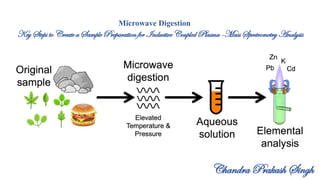
Key Steps to Create a Sample Preparation for Inductive Coupled Plasma -Mass Spectrometry Analysis
Chandra Prakash Singh
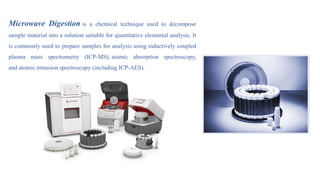
Microwave Digestion is a chemical technique used to decompose
sample material into a solution suitable for quantitative elemental analysis. It
is commonly used to prepare samples for analysis using inductively coupled
plasma mass spectrometry (ICP-MS), atomic absorption spectroscopy,
and atomic emission spectroscopy (including ICP-AES).
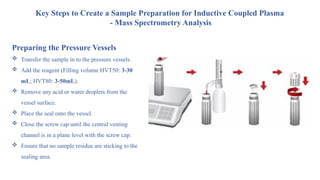
Preparing the Pressure Vessels
 Transfer the sample in to the pressure vessels.
 Add the reagent (Filling volume HVT50: 3-30
mL; HVT80: 3-50mL).
 Remove any acid or water droplets from the
vessel surface.
 Place the seal onto the vessel.
 Close the screw cap until the central venting
channel is in a plane level with the screw cap.
 Ensure that no sample residue are sticking to the
sealing area.
Key Steps to Create a Sample Preparation for Inductive Coupled Plasma
- Mass Spectrometry Analysis
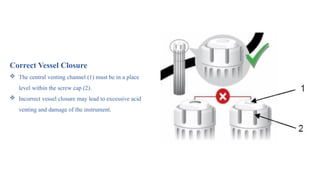
Correct Vessel Closure
 The central venting channel (1) must be in a place
level within the screw cap (2).
 Incorrect vessel closure may lead to excessive acid
venting and damage of the instrument.
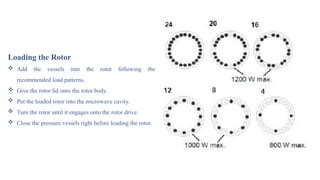
Loading the Rotor
 Add the vessels into the rotor following the
recommended load patterns.
 Give the rotor lid onto the rotor body.
 Put the loaded rotor into the microwave cavity.
 Turn the rotor until it engages onto the rotor drive.
 Close the pressure vessels right before loading the rotor.
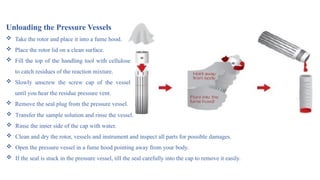
Unloading the Pressure Vessels
 Take the rotor and place it into a fume hood.
 Place the rotor lid on a clean surface.
 Fill the top of the handling tool with cellulose
to catch residues of the reaction mixture.
 Slowly unscrew the screw cap of the vessel
until you hear the residue pressure vent.
 Remove the seal plug from the pressure vessel.
 Transfer the sample solution and rinse the vessel.
 Rinse the inner side of the cap with water.
 Clean and dry the rotor, vessels and instrument and inspect all parts for possible damages.
 Open the pressure vessel in a fume hood pointing away from your body.
 If the seal is stuck in the pressure vessel, till the seal carefully into the cap to remove it easily.
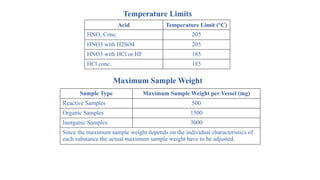
Acid Temperature Limit (°C)
HNO3 Conc. 205
HNO3 with H2SO4 205
HNO3 with HCl or HF 185
HCl conc. 185
Temperature Limits
Sample Type Maximum Sample Weight per Vessel (mg)
Reactive Samples 500
Organic Samples 1500
Inorganic Samples 3000
Since the maximum sample weight depends on the individual characteristics of
each substance the actual maximum sample weight have to be adjusted.
Maximum Sample Weight
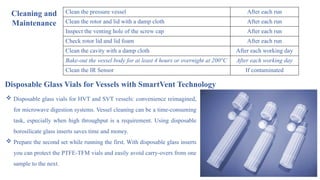
Clean the pressure vessel After each run
Clean the rotor and lid with a damp cloth After each run
Inspect the venting hole of the screw cap After each run
Check rotor lid and lid foam After each run
Clean the cavity with a damp cloth After each working day
Bake-out the vessel body for at least 4 hours or overnight at 200°C After each working day
Clean the IR Sensor If contaminated
Cleaning and
Maintenance
Disposable Glass Vials for Vessels with SmartVent Technology
 Disposable glass vials for HVT and SVT vessels: convenience reimagined,
for microwave digestion systems. Vessel cleaning can be a time-consuming
task, especially when high throughput is a requirement. Using disposable
borosilicate glass inserts saves time and money.
 Prepare the second set while running the first. With disposable glass inserts
you can protect the PTFE-TFM vials and easily avoid carry-overs from one
sample to the next.
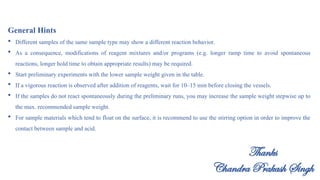
General Hints
 Different samples of the same sample type may show a different reaction behavior.
 As a consequence, modifications of reagent mixtures and/or programs (e.g. longer ramp time to avoid spontaneous
reactions, longer hold time to obtain appropriate results) may be required.
 Start preliminary experiments with the lower sample weight given in the table.
 If a vigorous reaction is observed after addition of reagents, wait for 10–15 min before closing the vessels.
 If the samples do not react spontaneously during the preliminary runs, you may increase the sample weight stepwise up to
the max. recommended sample weight.
 For sample materials which tend to float on the surface, it is recommend to use the stirring option in order to improve the
contact between sample and acid.
Thanks
Chandra Prakash Singh
Microwave Digestion for ICPMS Sample Preparation

  • 1.
    Microwave Digestion Key Stepsto Create a Sample Preparation for Inductive Coupled Plasma -Mass Spectrometry Analysis Chandra Prakash Singh
  • 2.
    Microwave Digestion isa chemical technique used to decompose sample material into a solution suitable for quantitative elemental analysis. It is commonly used to prepare samples for analysis using inductively coupled plasma mass spectrometry (ICP-MS), atomic absorption spectroscopy, and atomic emission spectroscopy (including ICP-AES).
  • 3.
    Preparing the PressureVessels  Transfer the sample in to the pressure vessels.  Add the reagent (Filling volume HVT50: 3-30 mL; HVT80: 3-50mL).  Remove any acid or water droplets from the vessel surface.  Place the seal onto the vessel.  Close the screw cap until the central venting channel is in a plane level with the screw cap.  Ensure that no sample residue are sticking to the sealing area. Key Steps to Create a Sample Preparation for Inductive Coupled Plasma - Mass Spectrometry Analysis
  • 4.
    Correct Vessel Closure The central venting channel (1) must be in a place level within the screw cap (2).  Incorrect vessel closure may lead to excessive acid venting and damage of the instrument.
  • 5.
    Loading the Rotor Add the vessels into the rotor following the recommended load patterns.  Give the rotor lid onto the rotor body.  Put the loaded rotor into the microwave cavity.  Turn the rotor until it engages onto the rotor drive.  Close the pressure vessels right before loading the rotor.
  • 6.
    Unloading the PressureVessels  Take the rotor and place it into a fume hood.  Place the rotor lid on a clean surface.  Fill the top of the handling tool with cellulose to catch residues of the reaction mixture.  Slowly unscrew the screw cap of the vessel until you hear the residue pressure vent.  Remove the seal plug from the pressure vessel.  Transfer the sample solution and rinse the vessel.  Rinse the inner side of the cap with water.  Clean and dry the rotor, vessels and instrument and inspect all parts for possible damages.  Open the pressure vessel in a fume hood pointing away from your body.  If the seal is stuck in the pressure vessel, till the seal carefully into the cap to remove it easily.
  • 7.
    Acid Temperature Limit(°C) HNO3 Conc. 205 HNO3 with H2SO4 205 HNO3 with HCl or HF 185 HCl conc. 185 Temperature Limits Sample Type Maximum Sample Weight per Vessel (mg) Reactive Samples 500 Organic Samples 1500 Inorganic Samples 3000 Since the maximum sample weight depends on the individual characteristics of each substance the actual maximum sample weight have to be adjusted. Maximum Sample Weight
  • 8.
    Clean the pressurevessel After each run Clean the rotor and lid with a damp cloth After each run Inspect the venting hole of the screw cap After each run Check rotor lid and lid foam After each run Clean the cavity with a damp cloth After each working day Bake-out the vessel body for at least 4 hours or overnight at 200°C After each working day Clean the IR Sensor If contaminated Cleaning and Maintenance Disposable Glass Vials for Vessels with SmartVent Technology  Disposable glass vials for HVT and SVT vessels: convenience reimagined, for microwave digestion systems. Vessel cleaning can be a time-consuming task, especially when high throughput is a requirement. Using disposable borosilicate glass inserts saves time and money.  Prepare the second set while running the first. With disposable glass inserts you can protect the PTFE-TFM vials and easily avoid carry-overs from one sample to the next.
  • 9.
    General Hints  Differentsamples of the same sample type may show a different reaction behavior.  As a consequence, modifications of reagent mixtures and/or programs (e.g. longer ramp time to avoid spontaneous reactions, longer hold time to obtain appropriate results) may be required.  Start preliminary experiments with the lower sample weight given in the table.  If a vigorous reaction is observed after addition of reagents, wait for 10–15 min before closing the vessels.  If the samples do not react spontaneously during the preliminary runs, you may increase the sample weight stepwise up to the max. recommended sample weight.  For sample materials which tend to float on the surface, it is recommend to use the stirring option in order to improve the contact between sample and acid. Thanks Chandra Prakash Singh