Bioanalytical Samples Preparation
Presented by: Mr. Ashok Choudhary
Bioanalytical Quality Monitor
Bioanalytical Research Department
INTRODUCTION
• Life Cycle of Bioanalytical Samples:
• Sample Collection
• Sample Management
• Sample Preparation
• Sample Analysis
Sample Preparation
Bioanalytical Sample Preparation:
The bioanalytical sample preparation is step in the bioanalytical process typically consists of an
extraction procedure that results in the isolation and enrichment of components (analyte/metabo
lite) of interest from a biological matrix. (e.g. Plasma, Urine, Skin, Saliva, etc).
 Objective
Sample preparation / treatment is essential step of chromatographic analysis and intended for:-
• Clean up by Remove unwanted sample matrix components
• Improve Detection Limits
• Improve Specificity
• Improve Reproducibility
• Improve Recovery
• Improve Instrument life
• Reduce backpressure and LC system fouling
Why is sample preparation required?
• Current Sample = Unsuitable for further analysis!!!… Why?
• Too dirty- Contains other sample matrix components that interfere with the analysis.
• Too dilute- Analyte(s) not concentrated enough for quantitative detection.
• Present sample matrix incompatible with or harmful to the chromatographic column/ syste
m.
Why is sample preparation especially
important in Bioanalysis?
Due to many types of sample matrices encountered:
• Plasma- Proteins, lipids, and other endogenous macromolecules
• Urine- Contains uric acid and many nitrogenous base products
• Serum
• Bile- Bilirubin, Cholesterol, Fatty acids
• Tissue Homogenates
• Saliva
• Seminal Fluid
• Others
Sample Preparation
 Pre-requisite
Sample Preparation required
• Time, it’s time consuming process
• Patience, tedious techniques/procedures
• Costly Chemicals, Reagents, Solvents and Consumables.
• Significant amount of man power
• Costly instrumentation for automated sample preparation.
Sample Preparation
 Precautions
• Lab should be equipped with all necessary contingency arrangements.
• Personnel should perfectly be aware of Good Laboratory Practices (GLP) an
d all relevant Standard Operating Procedures (SOP) to be followed while sa
mple Preparation.
• Personnel should be trained, and with all required safety measurements.
• Handle biological matrices with taking proper care to avoid any health hazar
d.
• Don’t rush while preparing samples as samples are precious.
Sample Preparation
 Classification of Sample Preparation Techniques:
1. Protein Precipitation (PPT)
2. Liquid-Liquid Extraction (LLE)
3. Solid Phase Extraction (SPE)
4. Hybrid Extraction Techniques i.e. Combination of two or more tec
hniques.
e.g. PPT and SPE or PPT and LLE.
Sample Preparation
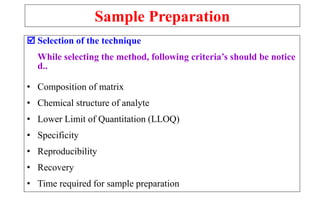
 Selection of the technique
While selecting the method, following criteria’s should be notice
d..
• Composition of matrix
• Chemical structure of analyte
• Lower Limit of Quantitation (LLOQ)
• Specificity
• Reproducibility
• Recovery
• Time required for sample preparation
Sample Preparation
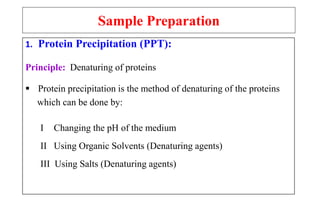
1. Protein Precipitation (PPT):
Principle: Denaturing of proteins
 Protein precipitation is the method of denaturing of the proteins
which can be done by:
I Changing the pH of the medium
II Using Organic Solvents (Denaturing agents)
III Using Salts (Denaturing agents)
Sample Preparation
Protein Precipitation
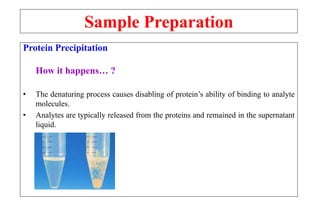
How it happens… ?
• The denaturing process causes disabling of protein’s ability of binding to analyte
molecules.
• Analytes are typically released from the proteins and remained in the supernatant
liquid.
Sample Preparation
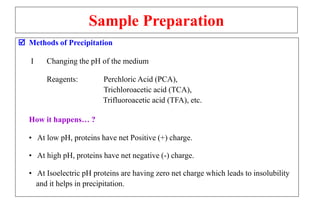
 Methods of Precipitation
I Changing the pH of the medium
Reagents: Perchloric Acid (PCA),
Trichloroacetic acid (TCA),
Trifluoroacetic acid (TFA), etc.
How it happens… ?
• At low pH, proteins have net Positive (+) charge.
• At high pH, proteins have net negative (-) charge.
• At Isoelectric pH proteins are having zero net charge which leads to insolubility
and it helps in precipitation.
Sample Preparation
 Methods of Precipitation
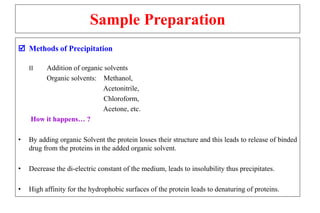
II Addition of organic solvents
Organic solvents: Methanol,
Acetonitrile,
Chloroform,
Acetone, etc.
How it happens… ?
• By adding organic Solvent the protein losses their structure and this leads to release of binded
drug from the proteins in the added organic solvent.
• Decrease the di-electric constant of the medium, leads to insolubility thus precipitates.
• High affinity for the hydrophobic surfaces of the protein leads to denaturing of proteins.
Sample Preparation
 Methods of Precipitation
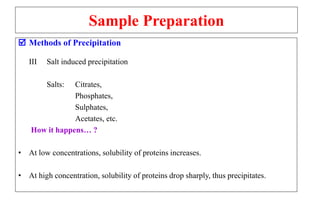
III Salt induced precipitation
Salts: Citrates,
Phosphates,
Sulphates,
Acetates, etc.
How it happens… ?
• At low concentrations, solubility of proteins increases.
• At high concentration, solubility of proteins drop sharply, thus precipitates.
Sample Preparation
Protein Precipitation
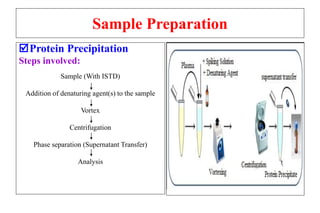
Steps involved:
Sample (With ISTD)
Addition of denaturing agent(s) to the sample
Vortex
Centrifugation
Phase separation (Supernatant Transfer)
Analysis
Sample Preparation
 Protein Precipitation
Advantages
• Less steps involved, easy to implement
• Simple and time saving process.
• Excellent Reproducibility
• No evaporation, in most of the cases
• Cost effective (Less usage of Manpower or chemicals or (Consumables)
Sample Preparation
 Protein Precipitation
Disadvantages
• In-complete clean-up
• Ineffective at removing salts and lipids
• Massive ion suppression, in case of LC/MS/MS analysis
• Low specificity
• Low recovery
• Low sensitivity
Sample Preparation
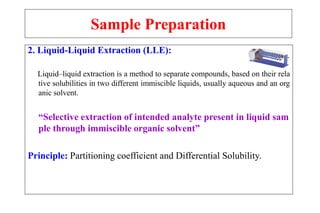
2. Liquid-Liquid Extraction (LLE):
Liquid–liquid extraction is a method to separate compounds, based on their rela
tive solubilities in two different immiscible liquids, usually aqueous and an org
anic solvent.
“Selective extraction of intended analyte present in liquid sam
ple through immiscible organic solvent”
Principle: Partitioning coefficient and Differential Solubility.
Sample Preparation
Liquid-Liquid Extraction
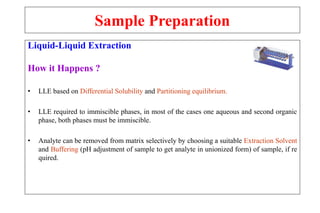
How it Happens ?
• LLE based on Differential Solubility and Partitioning equilibrium.
• LLE required to immiscible phases, in most of the cases one aqueous and second organic
phase, both phases must be immiscible.
• Analyte can be removed from matrix selectively by choosing a suitable Extraction Solvent
and Buffering (pH adjustment of sample to get analyte in unionized form) of sample, if re
quired.
Sample Preparation
Liquid-Liquid Extraction
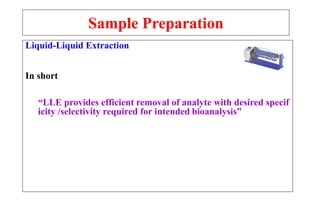
In short
“LLE provides efficient removal of analyte with desired specif
icity /selectivity required for intended bioanalysis”
Sample Preparation
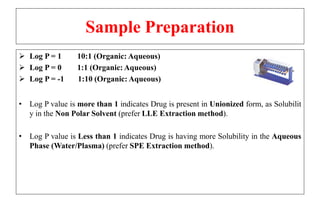
 Log P = 1 10:1 (Organic: Aqueous)
 Log P = 0 1:1 (Organic: Aqueous)
 Log P = -1 1:10 (Organic: Aqueous)
• Log P value is more than 1 indicates Drug is present in Unionized form, as Solubilit
y in the Non Polar Solvent (prefer LLE Extraction method).
• Log P value is Less than 1 indicates Drug is having more Solubility in the Aqueous
Phase (Water/Plasma) (prefer SPE Extraction method).
Sample Preparation
Liquid-Liquid Extraction
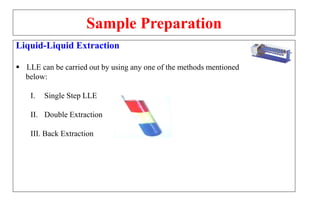
 LLE can be carried out by using any one of the methods mentioned
below:
I. Single Step LLE
II. Double Extraction
III. Back Extraction
Sample Preparation
Liquid-Liquid Extraction
 Selection of Extraction Solvent
Selection of extraction solvent depends on:
 Analyte Characteristics
• Structure
• pKa
• Solubility
 Solvent Characteristics
• Miscibility • Inertness
• Purity • Volatility
• Efficiency • Viscosity
• Polarity • Density
Sample Preparation
Liquid-Liquid Extraction
Commonly used Extraction Solvents
• Tertiary-Butyl Methyl Ether (TBME)
• Dichloromethane (DCM)
• Ethyl Acetate
• Diethyl Ether
• Hexane etc.
Any solvent as individual or in combination with any other suitable solvent
can be used as an extraction solvent.
Sample Preparation
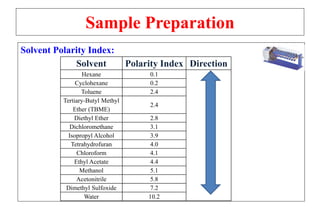
Solvent Polarity Index:
Solvent Polarity Index Direction
Hexane 0.1
Cyclohexane 0.2
Toluene 2.4
Tertiary-Butyl Methyl
Ether (TBME)
2.4
Diethyl Ether 2.8
Dichloromethane 3.1
Isopropyl Alcohol 3.9
Tetrahydrofuran 4.0
Chloroform 4.1
Ethyl Acetate 4.4
Methanol 5.1
Acetonitrile 5.8
Dimethyl Sulfoxide 7.2
Water 10.2
Sample Preparation
Liquid-Liquid Extraction
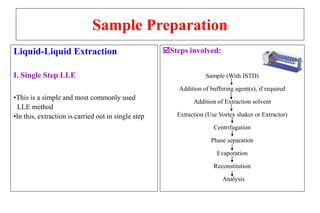
I. Single Step LLE
•This is a simple and most commonly used
LLE method
•In this, extraction is carried out in single step
Steps involved:
Sample (With ISTD)
Addition of buffering agent(s), if required
Addition of Extraction solvent
Extraction (Use Vortex shaker or Extractor)
Centrifugation
Phase separation
Evaporation
Reconstitution
Analysis
Sample Preparation
Liquid-Liquid Extraction
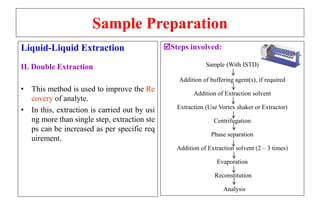
II. Double Extraction
• This method is used to improve the Re
covery of analyte.
• In this, extraction is carried out by usi
ng more than single step, extraction ste
ps can be increased as per specific req
uirement.
Steps involved:
Sample (With ISTD)
Addition of buffering agent(s), if required
Addition of Extraction solvent
Extraction (Use Vortex shaker or Extractor)
Centrifugation
Phase separation
Addition of Extraction solvent (2 – 3 times)
Evaporation
Reconstitution
Analysis
Sample Preparation
Liquid-Liquid Extraction
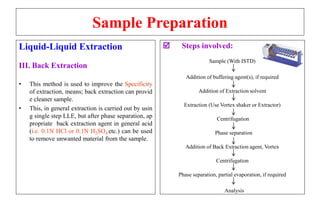
III. Back Extraction
• This method is used to improve the Specificity
of extraction, means; back extraction can provid
e cleaner sample.
• This, in general extraction is carried out by usin
g single step LLE, but after phase separation, ap
propriate back extraction agent in general acid
(i.e. 0.1N HCl or 0.1N H2SO4 etc.) can be used
to remove unwanted material from the sample.
 Steps involved:
Sample (With ISTD)
Addition of buffering agent(s), if required
Addition of Extraction solvent
Extraction (Use Vortex shaker or Extractor)
Centrifugation
Phase separation
Addition of Back Extraction agent, Vortex
Centrifugation
Phase separation, partial evaporation, if required
Analysis
Sample Preparation
Liquid-Liquid Extraction
Advantages
• Specific
• Sensitive
• Reproducible
• Reasonably, Good Recovery
• Increase no. of injections
• Improve column life
• Improve Instrument life
Sample Preparation
Liquid-Liquid Extraction
 Disadvantages
• Washing/Cleaning, is difficult to incorporate.
• Tedious process, difficult to implement and reproduce, needs expertise.
• Emulsion formation is potential problem.
• Time consuming, involves so many tedious steps.
• Needs significant amount of manpower, higher volumes of costly organic sol-vents and costly
consumables to take care of compatibility issues.
• Reproducibility may be a problem in terms of Area, in some cases Area Ratio also.
• Health hazards, personal safety is a question.
Sample Preparation
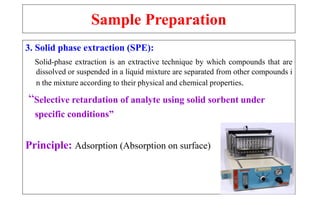
3. Solid phase extraction (SPE):
Solid-phase extraction is an extractive technique by which compounds that are
dissolved or suspended in a liquid mixture are separated from other compounds i
n the mixture according to their physical and chemical properties.
“Selective retardation of analyte using solid sorbent under
specific conditions”
Principle: Adsorption (Absorption on surface)
Sample Preparation
 Objective
Solid phase extraction is intended for
• Clean up
• Class fractionation
• Improve Detection Limits, Concentrate the analyte
• Improve Specificity
• Improve Reproducibility
• Improve Recovery
• Improve Instrument life
Sample Preparation
 Solid phase extraction
 How it Happens ?
• SPE is based on the selective Adsorption mechanism.
• If the targeted analytes are adsorbed on the solid phase, they can selectively be re
moved / eluted by using an appropriate Elution Solvent (solvent /solvent mixture).
Elution : Removal of analyte from adsorbent
Sample Preparation
 Solid phase extraction
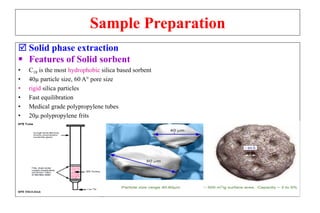
 Features of Solid sorbent
• C18 is the most hydrophobic silica based sorbent
• 40µ particle size, 60 A° pore size
• rigid silica particles
• Fast equilibration
• Medical grade polypropylene tubes
• 20µ polypropylene frits
Sample Preparation
Types of Solid Phase Extraction:
1.) Normal Phase (Polar) Extraction
2.) Reverse Phase (Non-Polar) Extraction
3.) Ion Exchange Extraction
Sample Preparation
1.) Normal Phase (Polar) extraction The stationary bed is strongly polar (Hydrophilic)
in nature and elution Solution is non-polar (Hydrophobic).
e.g.:- C8, C18 Silica Bonded StrataX Cartridges, Generik H2P-40 is made of polymer of d
ivinyl benzene (DVB) Orochem.
2.) Reverse Phase (Non-polar) extraction The stationary bed is non-polar (Hydrophobi
c) in nature, while the elution Solution is a polar (Hydrophilic), such as mixtures of water
and methanol or acetonitrile.
e.g.:- C18, tC18, C8, CN, Diol, HLB, Porapak RDX, NH2
3.) Ion exchange extraction The stationary bed has an ionically charged surface of oppo
site charge to the sample ions (cation, anion, and covalent). This technique is used almost
exclusively with ionic or ionizable samples. The stronger charge on the sample, the stron
ger it will be attracted to the ionic surface and, thus, the longer it will take to elute (extra
ct).
e.g.:- SCX, WCX, SAX, WAX (NH2, Accell™ Plus QMA, Accell Plus CM)
Sample Preparation
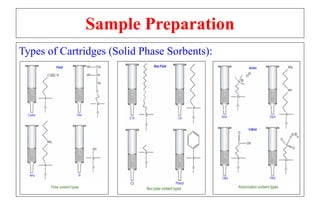
Types of Cartridges (Solid Phase Sorbents):
Sample Preparation
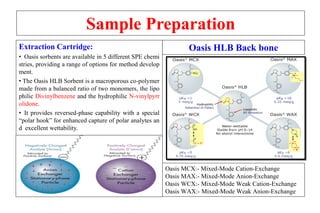
Extraction Cartridge:
• Oasis sorbents are available in 5 different SPE chemi
stries, providing a range of options for method develop
ment.
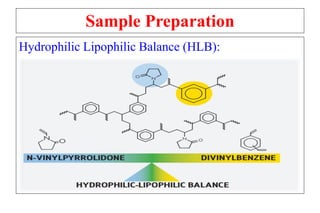
• The Oasis HLB Sorbent is a macroporous co-polymer
made from a balanced ratio of two monomers, the lipo
philic Divinylbenzene and the hydrophilic N-vinylpyrr
olidone.
• It provides reversed-phase capability with a special
“polar hook” for enhanced capture of polar analytes an
d excellent wettability.
Oasis MCX:- Mixed-Mode Cation-Exchange
Oasis MAX:- Mixed-Mode Anion-Exchange
Oasis WCX:- Mixed-Mode Weak Cation-Exchange
Oasis WAX:- Mixed-Mode Weak Anion-Exchange
Oasis HLB Back bone
Sample Preparation
Hydrophilic Lipophilic Balance (HLB):
Sample Preparation
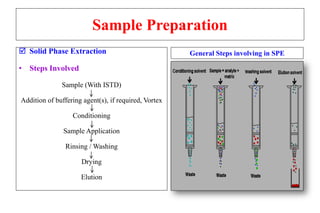
 Solid Phase Extraction
• Steps Involved
Sample (With ISTD)
Addition of buffering agent(s), if required, Vortex
Conditioning
Sample Application
Rinsing / Washing
Drying
Elution
General Steps involving in SPE
Sample Preparation
 Solid Phase Extraction
1. Conditioning:
Solvent is passed through the SPE material to wet the bonded functional groups => ensures consistent
interaction.
Conditioning Solvents
Methanol, Acetonitrile, small volumes of DCM, t-BME or any other organic solvent, Water, Buffer.
All SPE tubes are required to be conditioned with appropriate solvents prior to sample application. Condition is
must to:
• Activate the sites of stationary phase bed.
• Avoid drying and keep the sites in arising position.
• Remove any dust, moisture or any other process contaminants.
• Remove the excess of Conditioning solvent prior to sample application.
Sample Preparation
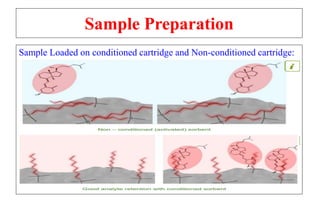
Sample Loaded on conditioned cartridge and Non-conditioned cartridge:
Sample Preparation
 Solid phase extraction
Sample Pre-treatment (Equilibrium):
Sorbent/ phase is treated with a solution that is similar (in polarity, pH, etc.) to
the sample matrix => maximizes retention.
• It involves:
Transfer of recommended sample volume into intended sample tube.
Addition of appropriate volume of Internal Standard to the sample, vortex.
Addition of appropriate volume of suitable buffering reagent to the sample,
vortex.
Sample Preparation
 Solid Phase Extraction
2. Sample Application (Loading):
• Apply sample from the top of the cartridge at a slow flow rate without any break,
take care that no sample drop should remain on the inner wall of the cartridges.
• Slow rate is necessary to allow analyte to interact with adsorbent thus to achieve the
retention of analytes because of forming temporary weak bonding with sorbent
components.
Sample Preparation
 Solid Phase Extraction
3. Rinsing or Washing:
Selectively remove unwanted interferences co-extracted with the analyte without prematurely
eluting analytes of interest.
Rinsing or Washing solvents – assists to achieve or improve specificity.
Water
Buffers, different pHs
It is intended for the:
• Removal of matrix components or other interferences by washing the cartridge with relative
weak, dilute solvent or solvent mixtures or buffers.
• Interferences that are weakly retained than the analytes are drained out from the cartridge .
Sample Preparation
 Solid Phase Extraction
4. Drying:
• Drying can be done by applying appropriate vacuum for recommended time
period with help of Vacuum pump.
•Recommended drying time is 2-3 minutes.
It is intended for the:
• Removal of excess washing solvents / buffers to:-
Avoid any interaction / precipitation possibility.
Avoid any blockage of cartridges due to air bubble formation
during elution.
Sample Preparation
 Solid Phase Extraction
5. Elution:
Removing analytes of interest with a solvent that overcomes the primary and secondary retention
interactions b/w sorbent and analytes of interest.
Elution Solvents:
Methanol, Acetonitrile, acidic or alkaline MeOH or MeCN, small volumes of DCM, t-BME or any
other organic solvent in combination with MeOH or MeCN or any other suitable mixture.
It is intended for the:
 Passing of strong solvent through cartridge at a slow flow rate thus allowing more soak time on the
packing to reach maximum extraction efficiency.
 Cleavage of weak bonds formed between analyte and sorbent.
 Usage of multiple small volumes to improve elution.
Sample Preparation
 Solid Phase Extraction
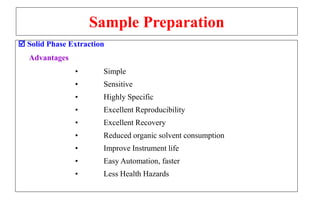
Advantages
• Simple
• Sensitive
• Highly Specific
• Excellent Reproducibility
• Excellent Recovery
• Reduced organic solvent consumption
• Improve Instrument life
• Easy Automation, faster
• Less Health Hazards
Sample Preparation
 Solid Phase Extraction
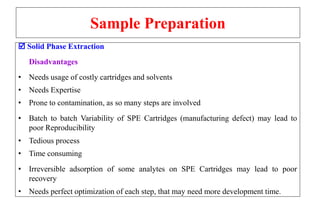
Disadvantages
• Needs usage of costly cartridges and solvents
• Needs Expertise
• Prone to contamination, as so many steps are involved
• Batch to batch Variability of SPE Cartridges (manufacturing defect) may lead to
poor Reproducibility
• Tedious process
• Time consuming
• Irreversible adsorption of some analytes on SPE Cartridges may lead to poor
recovery
• Needs perfect optimization of each step, that may need more development time.
Sample Preparation
4. Hybrid Extraction
“Selective extraction of analyte by using the combination of two or m
ore extraction techniques”
Sample Preparation
 Objective
Hybrid Extraction is intended for
• Clean up
• Improve Specificity
• Improve Detection Limits
• Improve Recovery
Sample Preparation
 Hybrid Extraction
Advantages
• Specific
• Sensitive
• Reproducible
Sample Preparation
 Hybrid Extraction
Disadvantages
• Needs usage of costly chemicals and consumables
• Needs Expertise
• Prone to contamination, as so many steps are involved
• Prone to Variability, as so many steps are involved, in case of insufficient expertise
• Tedious process
• Time consuming
• Needs perfect optimization of each step, that may need more development time.
Sample Preparation
Conclusions And Outlook:
Sample preparation (extraction) is a key component of successful bioanalytical sample
analysis. Extraction, purification, and pre-concentration techniques are particularly
relevant for the quantification of trace analytes in complex sample bio-matrixes.
End of The PresentationEnd of The Presentation

Bioanalytical sample preparation

  • 1.
    Bioanalytical Samples Preparation Presentedby: Mr. Ashok Choudhary Bioanalytical Quality Monitor Bioanalytical Research Department
  • 2.
    INTRODUCTION • Life Cycleof Bioanalytical Samples: • Sample Collection • Sample Management • Sample Preparation • Sample Analysis
  • 3.
    Sample Preparation Bioanalytical SamplePreparation: The bioanalytical sample preparation is step in the bioanalytical process typically consists of an extraction procedure that results in the isolation and enrichment of components (analyte/metabo lite) of interest from a biological matrix. (e.g. Plasma, Urine, Skin, Saliva, etc).  Objective Sample preparation / treatment is essential step of chromatographic analysis and intended for:- • Clean up by Remove unwanted sample matrix components • Improve Detection Limits • Improve Specificity • Improve Reproducibility • Improve Recovery • Improve Instrument life • Reduce backpressure and LC system fouling
  • 4.
    Why is samplepreparation required? • Current Sample = Unsuitable for further analysis!!!… Why? • Too dirty- Contains other sample matrix components that interfere with the analysis. • Too dilute- Analyte(s) not concentrated enough for quantitative detection. • Present sample matrix incompatible with or harmful to the chromatographic column/ syste m.
  • 5.
    Why is samplepreparation especially important in Bioanalysis? Due to many types of sample matrices encountered: • Plasma- Proteins, lipids, and other endogenous macromolecules • Urine- Contains uric acid and many nitrogenous base products • Serum • Bile- Bilirubin, Cholesterol, Fatty acids • Tissue Homogenates • Saliva • Seminal Fluid • Others
  • 6.
    Sample Preparation  Pre-requisite SamplePreparation required • Time, it’s time consuming process • Patience, tedious techniques/procedures • Costly Chemicals, Reagents, Solvents and Consumables. • Significant amount of man power • Costly instrumentation for automated sample preparation.
  • 7.
    Sample Preparation  Precautions •Lab should be equipped with all necessary contingency arrangements. • Personnel should perfectly be aware of Good Laboratory Practices (GLP) an d all relevant Standard Operating Procedures (SOP) to be followed while sa mple Preparation. • Personnel should be trained, and with all required safety measurements. • Handle biological matrices with taking proper care to avoid any health hazar d. • Don’t rush while preparing samples as samples are precious.
  • 8.
    Sample Preparation  Classificationof Sample Preparation Techniques: 1. Protein Precipitation (PPT) 2. Liquid-Liquid Extraction (LLE) 3. Solid Phase Extraction (SPE) 4. Hybrid Extraction Techniques i.e. Combination of two or more tec hniques. e.g. PPT and SPE or PPT and LLE.
  • 9.
    Sample Preparation  Selectionof the technique While selecting the method, following criteria’s should be notice d.. • Composition of matrix • Chemical structure of analyte • Lower Limit of Quantitation (LLOQ) • Specificity • Reproducibility • Recovery • Time required for sample preparation
  • 10.
    Sample Preparation 1. ProteinPrecipitation (PPT): Principle: Denaturing of proteins  Protein precipitation is the method of denaturing of the proteins which can be done by: I Changing the pH of the medium II Using Organic Solvents (Denaturing agents) III Using Salts (Denaturing agents)
  • 11.
    Sample Preparation Protein Precipitation Howit happens… ? • The denaturing process causes disabling of protein’s ability of binding to analyte molecules. • Analytes are typically released from the proteins and remained in the supernatant liquid.
  • 12.
    Sample Preparation  Methodsof Precipitation I Changing the pH of the medium Reagents: Perchloric Acid (PCA), Trichloroacetic acid (TCA), Trifluoroacetic acid (TFA), etc. How it happens… ? • At low pH, proteins have net Positive (+) charge. • At high pH, proteins have net negative (-) charge. • At Isoelectric pH proteins are having zero net charge which leads to insolubility and it helps in precipitation.
  • 13.
    Sample Preparation  Methodsof Precipitation II Addition of organic solvents Organic solvents: Methanol, Acetonitrile, Chloroform, Acetone, etc. How it happens… ? • By adding organic Solvent the protein losses their structure and this leads to release of binded drug from the proteins in the added organic solvent. • Decrease the di-electric constant of the medium, leads to insolubility thus precipitates. • High affinity for the hydrophobic surfaces of the protein leads to denaturing of proteins.
  • 14.
    Sample Preparation  Methodsof Precipitation III Salt induced precipitation Salts: Citrates, Phosphates, Sulphates, Acetates, etc. How it happens… ? • At low concentrations, solubility of proteins increases. • At high concentration, solubility of proteins drop sharply, thus precipitates.
  • 15.
    Sample Preparation Protein Precipitation Stepsinvolved: Sample (With ISTD) Addition of denaturing agent(s) to the sample Vortex Centrifugation Phase separation (Supernatant Transfer) Analysis
  • 16.
    Sample Preparation  ProteinPrecipitation Advantages • Less steps involved, easy to implement • Simple and time saving process. • Excellent Reproducibility • No evaporation, in most of the cases • Cost effective (Less usage of Manpower or chemicals or (Consumables)
  • 17.
    Sample Preparation  ProteinPrecipitation Disadvantages • In-complete clean-up • Ineffective at removing salts and lipids • Massive ion suppression, in case of LC/MS/MS analysis • Low specificity • Low recovery • Low sensitivity
  • 18.
    Sample Preparation 2. Liquid-LiquidExtraction (LLE): Liquid–liquid extraction is a method to separate compounds, based on their rela tive solubilities in two different immiscible liquids, usually aqueous and an org anic solvent. “Selective extraction of intended analyte present in liquid sam ple through immiscible organic solvent” Principle: Partitioning coefficient and Differential Solubility.
  • 19.
    Sample Preparation Liquid-Liquid Extraction Howit Happens ? • LLE based on Differential Solubility and Partitioning equilibrium. • LLE required to immiscible phases, in most of the cases one aqueous and second organic phase, both phases must be immiscible. • Analyte can be removed from matrix selectively by choosing a suitable Extraction Solvent and Buffering (pH adjustment of sample to get analyte in unionized form) of sample, if re quired.
  • 20.
    Sample Preparation Liquid-Liquid Extraction Inshort “LLE provides efficient removal of analyte with desired specif icity /selectivity required for intended bioanalysis”
  • 21.
    Sample Preparation  LogP = 1 10:1 (Organic: Aqueous)  Log P = 0 1:1 (Organic: Aqueous)  Log P = -1 1:10 (Organic: Aqueous) • Log P value is more than 1 indicates Drug is present in Unionized form, as Solubilit y in the Non Polar Solvent (prefer LLE Extraction method). • Log P value is Less than 1 indicates Drug is having more Solubility in the Aqueous Phase (Water/Plasma) (prefer SPE Extraction method).
  • 22.
    Sample Preparation Liquid-Liquid Extraction LLE can be carried out by using any one of the methods mentioned below: I. Single Step LLE II. Double Extraction III. Back Extraction
  • 23.
    Sample Preparation Liquid-Liquid Extraction Selection of Extraction Solvent Selection of extraction solvent depends on:  Analyte Characteristics • Structure • pKa • Solubility  Solvent Characteristics • Miscibility • Inertness • Purity • Volatility • Efficiency • Viscosity • Polarity • Density
  • 24.
    Sample Preparation Liquid-Liquid Extraction Commonlyused Extraction Solvents • Tertiary-Butyl Methyl Ether (TBME) • Dichloromethane (DCM) • Ethyl Acetate • Diethyl Ether • Hexane etc. Any solvent as individual or in combination with any other suitable solvent can be used as an extraction solvent.
  • 25.
    Sample Preparation Solvent PolarityIndex: Solvent Polarity Index Direction Hexane 0.1 Cyclohexane 0.2 Toluene 2.4 Tertiary-Butyl Methyl Ether (TBME) 2.4 Diethyl Ether 2.8 Dichloromethane 3.1 Isopropyl Alcohol 3.9 Tetrahydrofuran 4.0 Chloroform 4.1 Ethyl Acetate 4.4 Methanol 5.1 Acetonitrile 5.8 Dimethyl Sulfoxide 7.2 Water 10.2
  • 26.
    Sample Preparation Liquid-Liquid Extraction I.Single Step LLE •This is a simple and most commonly used LLE method •In this, extraction is carried out in single step Steps involved: Sample (With ISTD) Addition of buffering agent(s), if required Addition of Extraction solvent Extraction (Use Vortex shaker or Extractor) Centrifugation Phase separation Evaporation Reconstitution Analysis
  • 27.
    Sample Preparation Liquid-Liquid Extraction II.Double Extraction • This method is used to improve the Re covery of analyte. • In this, extraction is carried out by usi ng more than single step, extraction ste ps can be increased as per specific req uirement. Steps involved: Sample (With ISTD) Addition of buffering agent(s), if required Addition of Extraction solvent Extraction (Use Vortex shaker or Extractor) Centrifugation Phase separation Addition of Extraction solvent (2 – 3 times) Evaporation Reconstitution Analysis
  • 28.
    Sample Preparation Liquid-Liquid Extraction III.Back Extraction • This method is used to improve the Specificity of extraction, means; back extraction can provid e cleaner sample. • This, in general extraction is carried out by usin g single step LLE, but after phase separation, ap propriate back extraction agent in general acid (i.e. 0.1N HCl or 0.1N H2SO4 etc.) can be used to remove unwanted material from the sample.  Steps involved: Sample (With ISTD) Addition of buffering agent(s), if required Addition of Extraction solvent Extraction (Use Vortex shaker or Extractor) Centrifugation Phase separation Addition of Back Extraction agent, Vortex Centrifugation Phase separation, partial evaporation, if required Analysis
  • 29.
    Sample Preparation Liquid-Liquid Extraction Advantages •Specific • Sensitive • Reproducible • Reasonably, Good Recovery • Increase no. of injections • Improve column life • Improve Instrument life
  • 30.
    Sample Preparation Liquid-Liquid Extraction Disadvantages • Washing/Cleaning, is difficult to incorporate. • Tedious process, difficult to implement and reproduce, needs expertise. • Emulsion formation is potential problem. • Time consuming, involves so many tedious steps. • Needs significant amount of manpower, higher volumes of costly organic sol-vents and costly consumables to take care of compatibility issues. • Reproducibility may be a problem in terms of Area, in some cases Area Ratio also. • Health hazards, personal safety is a question.
  • 31.
    Sample Preparation 3. Solidphase extraction (SPE): Solid-phase extraction is an extractive technique by which compounds that are dissolved or suspended in a liquid mixture are separated from other compounds i n the mixture according to their physical and chemical properties. “Selective retardation of analyte using solid sorbent under specific conditions” Principle: Adsorption (Absorption on surface)
  • 32.
    Sample Preparation  Objective Solidphase extraction is intended for • Clean up • Class fractionation • Improve Detection Limits, Concentrate the analyte • Improve Specificity • Improve Reproducibility • Improve Recovery • Improve Instrument life
  • 33.
    Sample Preparation  Solidphase extraction  How it Happens ? • SPE is based on the selective Adsorption mechanism. • If the targeted analytes are adsorbed on the solid phase, they can selectively be re moved / eluted by using an appropriate Elution Solvent (solvent /solvent mixture). Elution : Removal of analyte from adsorbent
  • 34.
    Sample Preparation  Solidphase extraction  Features of Solid sorbent • C18 is the most hydrophobic silica based sorbent • 40µ particle size, 60 A° pore size • rigid silica particles • Fast equilibration • Medical grade polypropylene tubes • 20µ polypropylene frits
  • 35.
    Sample Preparation Types ofSolid Phase Extraction: 1.) Normal Phase (Polar) Extraction 2.) Reverse Phase (Non-Polar) Extraction 3.) Ion Exchange Extraction
  • 36.
    Sample Preparation 1.) NormalPhase (Polar) extraction The stationary bed is strongly polar (Hydrophilic) in nature and elution Solution is non-polar (Hydrophobic). e.g.:- C8, C18 Silica Bonded StrataX Cartridges, Generik H2P-40 is made of polymer of d ivinyl benzene (DVB) Orochem. 2.) Reverse Phase (Non-polar) extraction The stationary bed is non-polar (Hydrophobi c) in nature, while the elution Solution is a polar (Hydrophilic), such as mixtures of water and methanol or acetonitrile. e.g.:- C18, tC18, C8, CN, Diol, HLB, Porapak RDX, NH2 3.) Ion exchange extraction The stationary bed has an ionically charged surface of oppo site charge to the sample ions (cation, anion, and covalent). This technique is used almost exclusively with ionic or ionizable samples. The stronger charge on the sample, the stron ger it will be attracted to the ionic surface and, thus, the longer it will take to elute (extra ct). e.g.:- SCX, WCX, SAX, WAX (NH2, Accell™ Plus QMA, Accell Plus CM)
  • 37.
    Sample Preparation Types ofCartridges (Solid Phase Sorbents):
  • 38.
    Sample Preparation Extraction Cartridge: •Oasis sorbents are available in 5 different SPE chemi stries, providing a range of options for method develop ment. • The Oasis HLB Sorbent is a macroporous co-polymer made from a balanced ratio of two monomers, the lipo philic Divinylbenzene and the hydrophilic N-vinylpyrr olidone. • It provides reversed-phase capability with a special “polar hook” for enhanced capture of polar analytes an d excellent wettability. Oasis MCX:- Mixed-Mode Cation-Exchange Oasis MAX:- Mixed-Mode Anion-Exchange Oasis WCX:- Mixed-Mode Weak Cation-Exchange Oasis WAX:- Mixed-Mode Weak Anion-Exchange Oasis HLB Back bone
  • 39.
  • 40.
    Sample Preparation  SolidPhase Extraction • Steps Involved Sample (With ISTD) Addition of buffering agent(s), if required, Vortex Conditioning Sample Application Rinsing / Washing Drying Elution General Steps involving in SPE
  • 41.
    Sample Preparation  SolidPhase Extraction 1. Conditioning: Solvent is passed through the SPE material to wet the bonded functional groups => ensures consistent interaction. Conditioning Solvents Methanol, Acetonitrile, small volumes of DCM, t-BME or any other organic solvent, Water, Buffer. All SPE tubes are required to be conditioned with appropriate solvents prior to sample application. Condition is must to: • Activate the sites of stationary phase bed. • Avoid drying and keep the sites in arising position. • Remove any dust, moisture or any other process contaminants. • Remove the excess of Conditioning solvent prior to sample application.
  • 42.
    Sample Preparation Sample Loadedon conditioned cartridge and Non-conditioned cartridge:
  • 43.
    Sample Preparation  Solidphase extraction Sample Pre-treatment (Equilibrium): Sorbent/ phase is treated with a solution that is similar (in polarity, pH, etc.) to the sample matrix => maximizes retention. • It involves: Transfer of recommended sample volume into intended sample tube. Addition of appropriate volume of Internal Standard to the sample, vortex. Addition of appropriate volume of suitable buffering reagent to the sample, vortex.
  • 44.
    Sample Preparation  SolidPhase Extraction 2. Sample Application (Loading): • Apply sample from the top of the cartridge at a slow flow rate without any break, take care that no sample drop should remain on the inner wall of the cartridges. • Slow rate is necessary to allow analyte to interact with adsorbent thus to achieve the retention of analytes because of forming temporary weak bonding with sorbent components.
  • 45.
    Sample Preparation  SolidPhase Extraction 3. Rinsing or Washing: Selectively remove unwanted interferences co-extracted with the analyte without prematurely eluting analytes of interest. Rinsing or Washing solvents – assists to achieve or improve specificity. Water Buffers, different pHs It is intended for the: • Removal of matrix components or other interferences by washing the cartridge with relative weak, dilute solvent or solvent mixtures or buffers. • Interferences that are weakly retained than the analytes are drained out from the cartridge .
  • 46.
    Sample Preparation  SolidPhase Extraction 4. Drying: • Drying can be done by applying appropriate vacuum for recommended time period with help of Vacuum pump. •Recommended drying time is 2-3 minutes. It is intended for the: • Removal of excess washing solvents / buffers to:- Avoid any interaction / precipitation possibility. Avoid any blockage of cartridges due to air bubble formation during elution.
  • 47.
    Sample Preparation  SolidPhase Extraction 5. Elution: Removing analytes of interest with a solvent that overcomes the primary and secondary retention interactions b/w sorbent and analytes of interest. Elution Solvents: Methanol, Acetonitrile, acidic or alkaline MeOH or MeCN, small volumes of DCM, t-BME or any other organic solvent in combination with MeOH or MeCN or any other suitable mixture. It is intended for the:  Passing of strong solvent through cartridge at a slow flow rate thus allowing more soak time on the packing to reach maximum extraction efficiency.  Cleavage of weak bonds formed between analyte and sorbent.  Usage of multiple small volumes to improve elution.
  • 48.
    Sample Preparation  SolidPhase Extraction Advantages • Simple • Sensitive • Highly Specific • Excellent Reproducibility • Excellent Recovery • Reduced organic solvent consumption • Improve Instrument life • Easy Automation, faster • Less Health Hazards
  • 49.
    Sample Preparation  SolidPhase Extraction Disadvantages • Needs usage of costly cartridges and solvents • Needs Expertise • Prone to contamination, as so many steps are involved • Batch to batch Variability of SPE Cartridges (manufacturing defect) may lead to poor Reproducibility • Tedious process • Time consuming • Irreversible adsorption of some analytes on SPE Cartridges may lead to poor recovery • Needs perfect optimization of each step, that may need more development time.
  • 50.
    Sample Preparation 4. HybridExtraction “Selective extraction of analyte by using the combination of two or m ore extraction techniques”
  • 51.
    Sample Preparation  Objective HybridExtraction is intended for • Clean up • Improve Specificity • Improve Detection Limits • Improve Recovery
  • 52.
    Sample Preparation  HybridExtraction Advantages • Specific • Sensitive • Reproducible
  • 53.
    Sample Preparation  HybridExtraction Disadvantages • Needs usage of costly chemicals and consumables • Needs Expertise • Prone to contamination, as so many steps are involved • Prone to Variability, as so many steps are involved, in case of insufficient expertise • Tedious process • Time consuming • Needs perfect optimization of each step, that may need more development time.
  • 54.
    Sample Preparation Conclusions AndOutlook: Sample preparation (extraction) is a key component of successful bioanalytical sample analysis. Extraction, purification, and pre-concentration techniques are particularly relevant for the quantification of trace analytes in complex sample bio-matrixes.
  • 55.
    End of ThePresentationEnd of The Presentation