Guidance for Industry ANDAs: Pharmaceutical Solid Polymorphism
Chemistry, Manufacturing, and Controls Information
Chandra Prakash Singh
Polymorphic Forms And Polymorphism
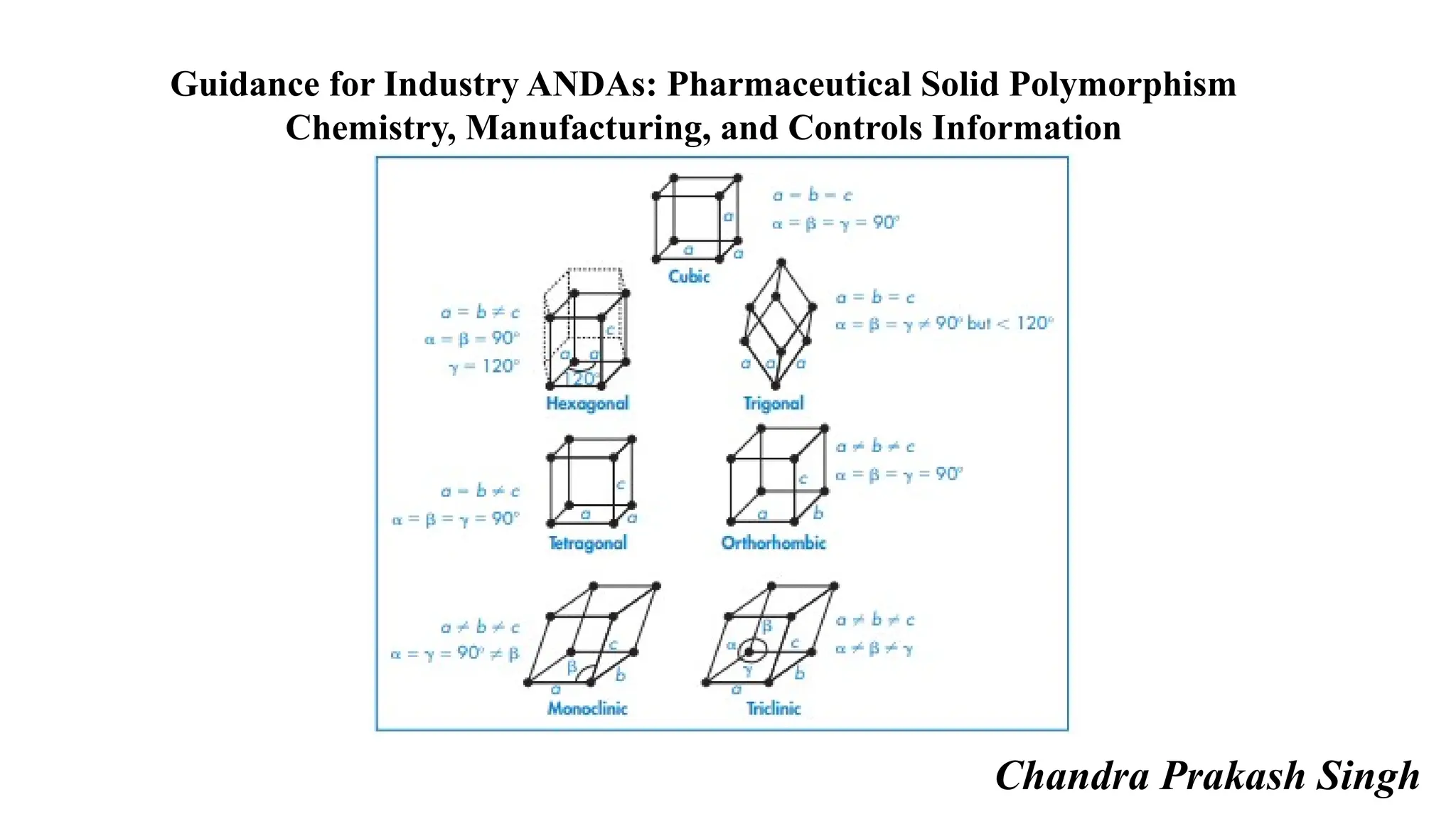
 Crystalline forms have different arrangements and/or conformations of the molecules in the crystal lattice.
 Amorphous forms consist of disordered arrangements of molecules that do not possess a distinguishable crystal lattice.
 Solvates are crystal forms containing either stoichiometric or nonstoichiometric amounts of a solvent. If the incorporated
solvent is water, the solvate is commonly known as a hydrate.
Importance of Pharmaceutical Solid Polymorphism
 Polymorphic forms of a drug substance can have different chemical and physical properties, including melting point,
chemical reactivity, apparent solubility, dissolution rate, optical and mechanical properties, vapor pressure, and density.
 These properties can have a direct effect on the ability to process and/or manufacture the drug substance and the drug
product, as well as on drug product stability, dissolution, and bioavailability. Thus, polymorphism can affect the quality,
safety, and efficacy of the drug product.
Characterization of Polymorphs
 There are a number of methods that can be used to characterize polymorphs of a drug substance.
 Demonstration of a nonequivalent structure by single crystal X-ray diffraction is currently regarded as the definitive
evidence of polymorphism.
 X-ray powder diffraction can also be used to provide unequivocal proof of polymorphism.
 Other methods, including microscopy, thermal analysis (e.g., differential scanning calorimetry, thermal gravimetric
analysis, and hot-stage microscopy), and spectroscopy (e.g., infrared [IR], Raman, solid-state nuclear magnetic resonance
[ssNMR]) are helpful to further characterize polymorphic forms.
Note: A drug substance may exist in many polymorphic forms, but some forms may be rare and not likely to form. For example, in one approved drug product, the
drug substance can exist in at least twenty polymorphic forms, but in reality only a subset of polymorphic forms has the potential to develop under the process
conditions used to manufacture the drug substance and drug product. Therefore, it is recommend that to consider only those polymorphs that are likely to form
during manufacture of the drug substance, manufacture of the drug product, or while the drug substance or drug product is in storage.
Influence of Polymorphism On Drug Substance And Drug Product
1. Influence on Solubility, Dissolution, and Bioavailability (BA) and Bioequivalence (BE)
 The solid-state properties of a drug substance can have a significant influence on the apparent solubility of the drug
substance. Since polymorphic forms differ in their internal solid-state structure, a drug substance that exists in various
polymorphic forms can have different aqueous solubilities and dissolution rates.
 When there are differences in the apparent solubilities of the various polymorphic forms, it is recommend that to focus on
the potential effect such differences can have on drug product bioavailability (BA) and bioequivalence (BE).
 Whether drug product BA/BE can be affected by the differences in apparent solubilities of the various polymorphic forms
depends on the various physiological factors that govern the rate and extent of drug absorption including gastrointestinal
motility, drug dissolution, and intestinal permeability.
 In this context, the Biopharmaceutics Classification System (BCS) provides a useful scientific framework for regulatory
decisions regarding drug substance polymorphism.
 Bioavailability (BA) is defined in 21 CFR 320.1(a) as “the rate and extent to which the active ingredient or active moiety is absorbed from a drug product
and becomes available at the site of action."
 Bioequivalence (BE) is defined in 21 CFR 320.1(e) as “the absence of a significant difference in the rate and extent to which the active ingredient or active
moiety in pharmaceutical equivalents or pharmaceutical alternatives becomes available at the site of drug action when administered at the same molar
dose under similar conditions in an appropriately designed study.”
 For a drug whose absorption is only limited by its dissolution, large differences in the apparent solubilities of the various
polymorphic forms are likely to affect BA/BE.
 On the other hand, for a drug whose absorption is only limited by its intestinal permeability, differences in the apparent
solubilities of the various polymorphic forms are less likely to affect BA/BE.
 Furthermore, when the apparent solubilities of the polymorphic forms are sufficiently high and drug dissolution is rapid in
relation to gastric emptying, differences in the solubilities of the polymorphic forms are unlikely to affect BA/BE.
 Upon demonstration of in-vivo bioequivalence between the generic drug product and the reference listed drug (RLD), in-
vitro dissolution testing is then used to assess the lot-to-lot quality of the generic drug product.
 Drug product dissolution testing frequently provides a suitable means to identify and control the quality of the product
from both the bioavailability and physical (stability) perspectives.
 In particular, inadvertent changes to the polymorphic form that may affect drug product BA/BE can often be detected by
drug product dissolution testing.
 Apparent solubility refers to the concentration of material at apparent equilibrium (supersaturation). Apparent solubility is distinct from true thermodynamic
solubility, which is reached at infinite equilibrium time.
 The term generic drug product refers to a new drug product for which approval is sought in an ANDA submitted under section 505(j) of the Act.
 See 21 CFR 314.3 (b) (providing that reference listed drug means the listed drug identified by FDA as the drug product upon which an applicant relies in
seeking approval of its abbreviated application).
 Section 505(j)(4)(A) provides that FDA must approve an ANDA if, among other things, the methods used in, or the facilities and controls used for, the
manufacture, processing, and packing of the drug are adequate to assure and preserve its identity, strength, quality, and purity.
2. Influence on Manufacturing of the Drug Product
 Drug substance polymorphic forms can also exhibit different physical and mechanical properties, including
hygroscopicity, particle shape, density, flowability, and compactibility, which in turn may affect processing of the drug
substance and/or manufacturing of the drug product.
 Since an ANDA applicant should demonstrate that the generic drug product can be manufactured reliably using a
validated process, it is recommend that to pay close attention to polymorphism as it relates to pharmaceutical
processing.
 The effect of polymorphism on pharmaceutical processing also depends on the formulation and the manufacturing
process. For a drug product manufactured by direct compression, the solid state properties of the active ingredient will
likely be critical to the manufacture of the drug product, particularly when it constitutes the bulk of the tablet mass.
 On the other hand, for a drug product manufactured by wet granulation, the solid-state properties of the active
ingredient are often masked by the resultant granulation, and the solid-state properties of the active ingredient are less
likely to affect the manufacture of the drug product.
 In the context of the effect of polymorphism on pharmaceutical processing, what is most relevant is the ability to
consistently manufacture a drug product that conforms to applicable in-process controls and release specifications.
 Polymorphic forms of the drug substance can undergo phase conversion when exposed to a range of manufacturing
processes, such as drying, milling, micronization, wet granulation, spray drying, and compaction. Exposure to
environmental conditions such as humidity and temperature can also induce polymorph conversion.
 The extent of conversion generally depends on the relative stability of the polymorphs, kinetic barriers to phase
conversion, and applied stress.
 Nonetheless, phase conversion generally is not of serious concern, provided that the conversion occurs consistently, as a
part of a validated manufacturing process where critical manufacturing process variables are well understood and
controlled, and when drug product BA/BE has been demonstrated.
3. Influence on Stability
 Polymorphs can have different physical and chemical (reactivity) properties.
 The most thermodynamically stable polymorphic form of a drug substance is often chosen during development based on
the minimal potential for conversion to another polymorphic form and on its greater chemical stability. However, a
metastable form can be chosen for various reasons, including bioavailability enhancement.
 Since an ANDA applicant must demonstrate that the generic drug product exhibits adequate stability, we recommend that
you focus on the potential effect that a polymorphic form can have on drug product stability.
 Nonetheless, because drug product stability is affected by a multitude of other factors, including formulation,
manufacturing process, and packaging, it is the stability of the drug product and not stability of the drug substance
polymorphic form that should be the most relevant measure of drug quality.
Polymorphism and Sameness in ANDAs
 Section 505(j)(2) of the Act specifies that an ANDA must contain, among other things, information to show that the
active ingredient in the generic drug product is the "same as" that of the RLD.
 Under section 505(j)(4) of the Act, FDA must approve an ANDA unless the agency finds, among other things, that the
ANDA contains insufficient information to show that the active ingredient is the same as that in the RLD.
 FDA regulations implementing section 505(j) of the Act provide that an ANDA is suitable for consideration and approval
if the generic drug product is the "same as" the RLD.
 Specifically, 21 CFR 314.92(a)(1) provides that the term "same as" means, among other things, "identical in active
ingredient(s)." The drug substance in a generic drug product is considered to be the same as the drug substance in the
RLD if it meets the same standards for identity.
 When a United States Pharmacopeia (USP) monograph exists for a particular drug substance, standards for identity
generally refer to the definition (e.g. chemical name, empirical formula, molecular structure, description) at the
beginning of the monograph. However, FDA may prescribe additional standards that are material to the sameness of a
drug substance.
 Polymorphic forms of a drug substance differ in internal solid-state structure, but not in chemical structure. In the
context of sameness of active ingredient(s) in the preamble to the 1992 final rule, FDA specifically rejected a proposal
that would have required an ANDA applicant to show that the active ingredient in its generic drug product and the
active ingredient in the RLD "exhibit the same physical and chemical characteristics, that no additional residues or
impurities can result from the different manufacture or synthesis process and that the stereochemistry characteristics
and solid state forms of the drug have not been altered." Therefore, differences in drug substance polymorphic forms do
not render drug substances different active ingredients for the purposes of ANDA approvals within the meaning of the
Act and FDA regulations.
 In addition to meeting the standards for identity, each ANDA applicant is required to demonstrate that, among other
things, the drug product exhibits sufficient stability and is bioequivalent to the RLD.
 While the polymorphic form can affect drug product stability and bioequivalence, these performance characteristics are
also dependent on the formulation, the manufacturing process, and other physicochemical properties (e.g., particle size,
moisture) of both the drug substance and formulation excipients.
 Using a drug substance polymorphic form that is different from that of the RLD may not preclude an ANDA applicant
from formulating a generic drug product that exhibits bioequivalence and stability, and the drug substance in the
generic drug product need not have the same polymorphic form as the drug substance in the RLD.
 Over the years, FDA has approved a number of ANDAs in which the drug substance in the generic drug product had a
different polymorphic form from the drug substance in the respective RLD (e.g., warfarin sodium, famotidine, and
ranitidine).
 FDA also has approved some ANDAs in which the drug substance in the generic drug product differed in solvate or
hydrate forms from the drug substance in the corresponding RLD (e.g., terazosin hydrochloride, ampicillin, and
cefadroxil).
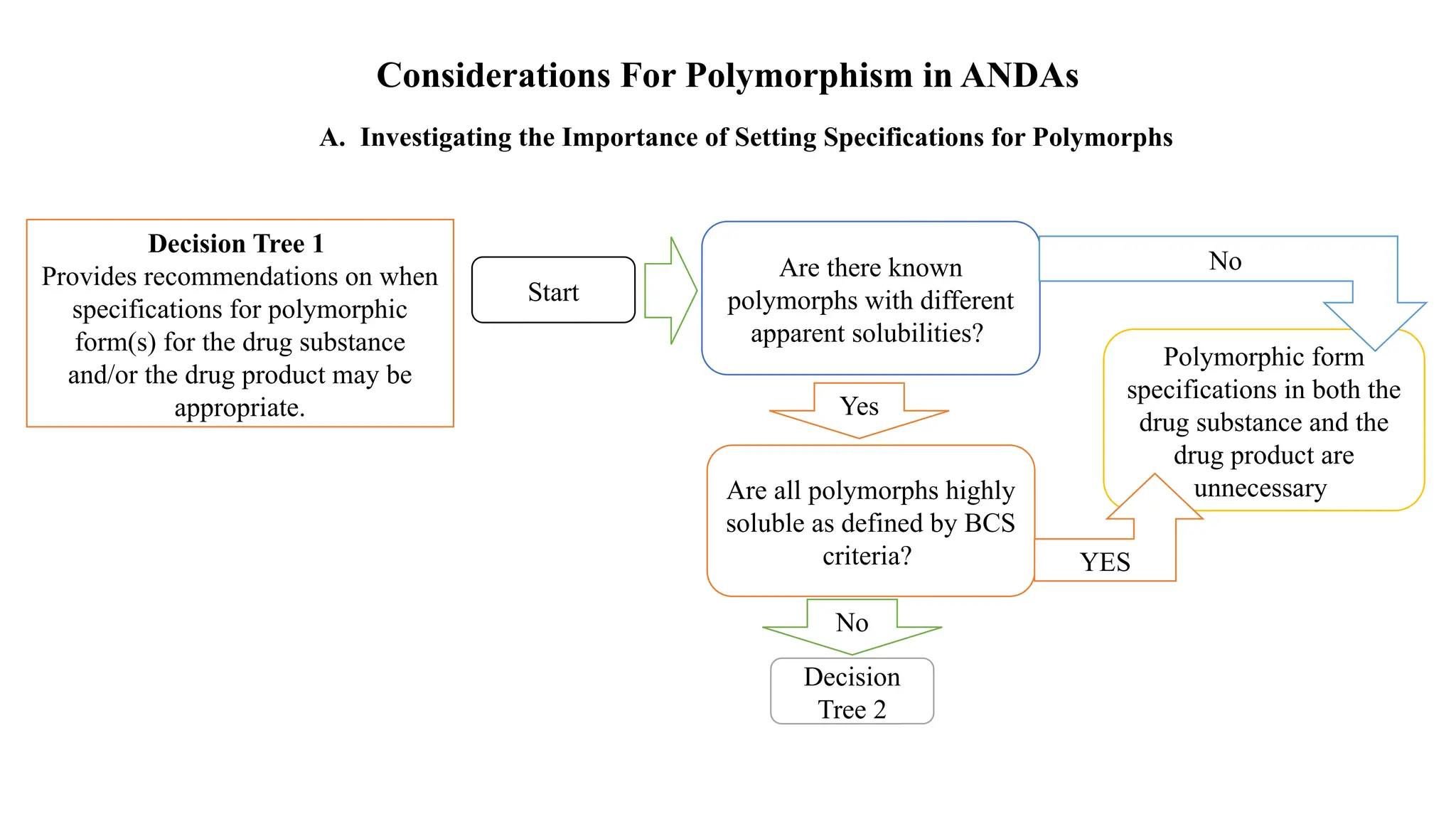
Decision Tree 1
Provides recommendations on when
specifications for polymorphic
form(s) for the drug substance
and/or the drug product may be
appropriate.
Start
Are there known
polymorphs with different
apparent solubilities?
Polymorphic form
specifications in both the
drug substance and the
drug product are
unnecessary
Are all polymorphs highly
soluble as defined by BCS
criteria?
Yes
YES
No
Decision
Tree 2
No
Considerations For Polymorphism in ANDAs
A. Investigating the Importance of Setting Specifications for Polymorphs
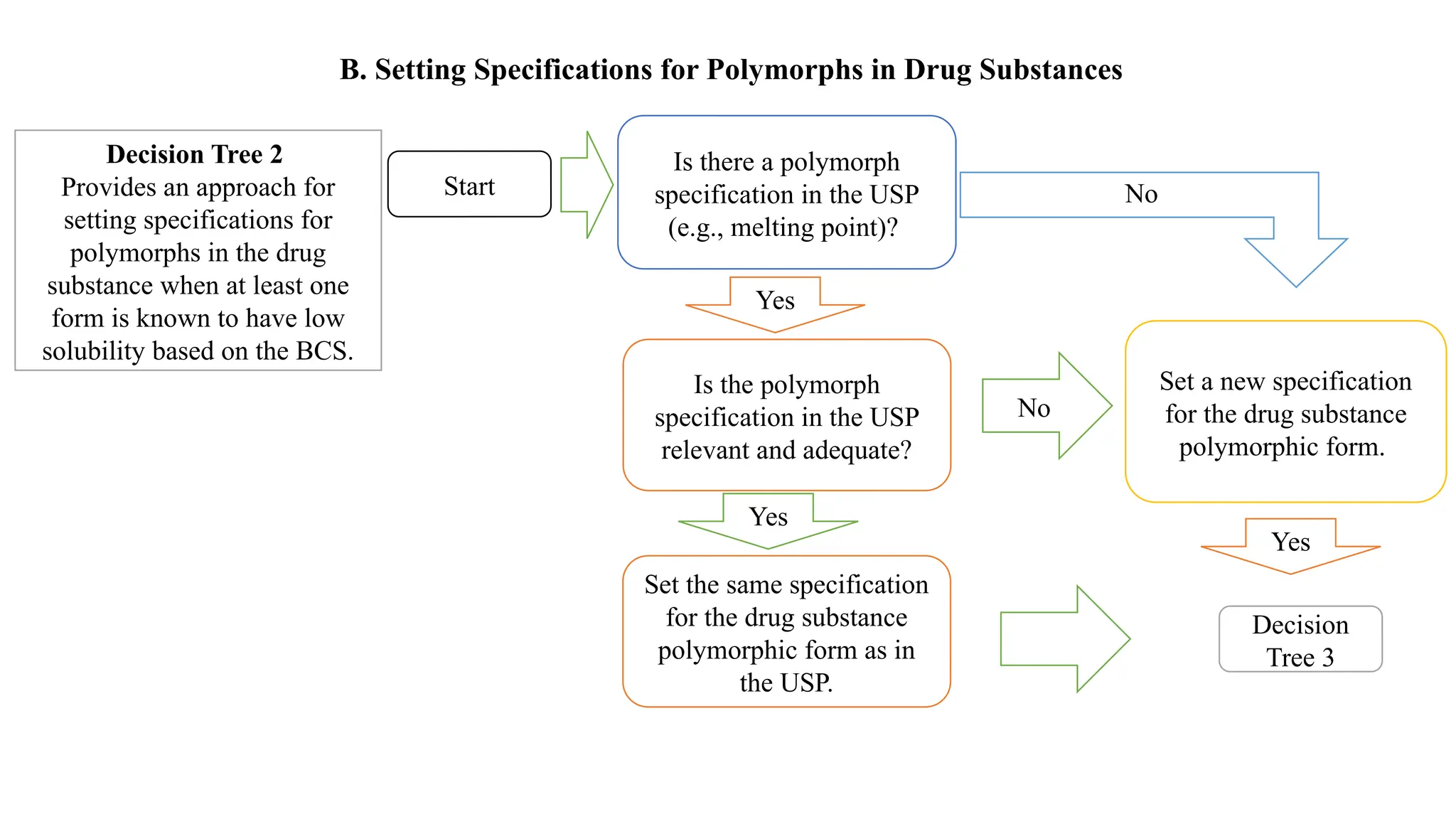
Decision Tree 2
Provides an approach for
setting specifications for
polymorphs in the drug
substance when at least one
form is known to have low
solubility based on the BCS.
Start
Is there a polymorph
specification in the USP
(e.g., melting point)?
Set a new specification
for the drug substance
polymorphic form.
Is the polymorph
specification in the USP
relevant and adequate?
Yes
Yes
Decision
Tree 3
No
Set the same specification
for the drug substance
polymorphic form as in
the USP.
Yes
No
B. Setting Specifications for Polymorphs in Drug Substances
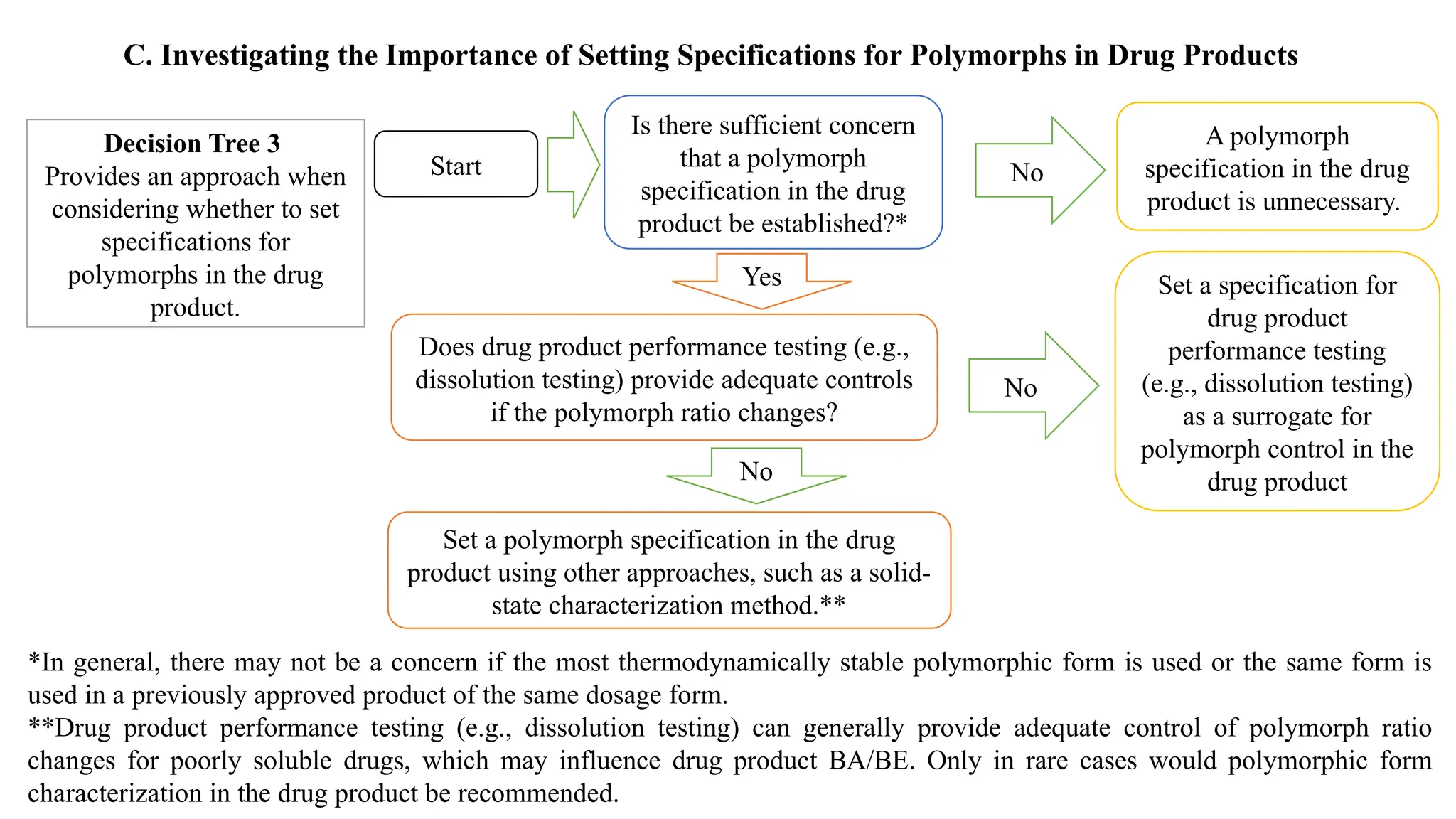
Decision Tree 3
Provides an approach when
considering whether to set
specifications for
polymorphs in the drug
product.
Start
Is there sufficient concern
that a polymorph
specification in the drug
product be established?*
A polymorph
specification in the drug
product is unnecessary.
Does drug product performance testing (e.g.,
dissolution testing) provide adequate controls
if the polymorph ratio changes?
Yes
No
Set a polymorph specification in the drug
product using other approaches, such as a solid-
state characterization method.**
No
No
Set a specification for
drug product
performance testing
(e.g., dissolution testing)
as a surrogate for
polymorph control in the
drug product
*In general, there may not be a concern if the most thermodynamically stable polymorphic form is used or the same form is
used in a previously approved product of the same dosage form.
**Drug product performance testing (e.g., dissolution testing) can generally provide adequate control of polymorph ratio
changes for poorly soluble drugs, which may influence drug product BA/BE. Only in rare cases would polymorphic form
characterization in the drug product be recommended.
C. Investigating the Importance of Setting Specifications for Polymorphs in Drug Products
Thanks

Pharmaceutical Solid Polymorphism. Guidance for Industry ANDAs: Pharmaceutical Solid Polymorphism Chemistry, Manufacturing, and Controls Information.

  • 1.
    Guidance for IndustryANDAs: Pharmaceutical Solid Polymorphism Chemistry, Manufacturing, and Controls Information Chandra Prakash Singh
  • 2.
    Polymorphic Forms AndPolymorphism  Crystalline forms have different arrangements and/or conformations of the molecules in the crystal lattice.  Amorphous forms consist of disordered arrangements of molecules that do not possess a distinguishable crystal lattice.  Solvates are crystal forms containing either stoichiometric or nonstoichiometric amounts of a solvent. If the incorporated solvent is water, the solvate is commonly known as a hydrate. Importance of Pharmaceutical Solid Polymorphism  Polymorphic forms of a drug substance can have different chemical and physical properties, including melting point, chemical reactivity, apparent solubility, dissolution rate, optical and mechanical properties, vapor pressure, and density.  These properties can have a direct effect on the ability to process and/or manufacture the drug substance and the drug product, as well as on drug product stability, dissolution, and bioavailability. Thus, polymorphism can affect the quality, safety, and efficacy of the drug product.
  • 3.
    Characterization of Polymorphs There are a number of methods that can be used to characterize polymorphs of a drug substance.  Demonstration of a nonequivalent structure by single crystal X-ray diffraction is currently regarded as the definitive evidence of polymorphism.  X-ray powder diffraction can also be used to provide unequivocal proof of polymorphism.  Other methods, including microscopy, thermal analysis (e.g., differential scanning calorimetry, thermal gravimetric analysis, and hot-stage microscopy), and spectroscopy (e.g., infrared [IR], Raman, solid-state nuclear magnetic resonance [ssNMR]) are helpful to further characterize polymorphic forms. Note: A drug substance may exist in many polymorphic forms, but some forms may be rare and not likely to form. For example, in one approved drug product, the drug substance can exist in at least twenty polymorphic forms, but in reality only a subset of polymorphic forms has the potential to develop under the process conditions used to manufacture the drug substance and drug product. Therefore, it is recommend that to consider only those polymorphs that are likely to form during manufacture of the drug substance, manufacture of the drug product, or while the drug substance or drug product is in storage.
  • 4.
    Influence of PolymorphismOn Drug Substance And Drug Product 1. Influence on Solubility, Dissolution, and Bioavailability (BA) and Bioequivalence (BE)  The solid-state properties of a drug substance can have a significant influence on the apparent solubility of the drug substance. Since polymorphic forms differ in their internal solid-state structure, a drug substance that exists in various polymorphic forms can have different aqueous solubilities and dissolution rates.  When there are differences in the apparent solubilities of the various polymorphic forms, it is recommend that to focus on the potential effect such differences can have on drug product bioavailability (BA) and bioequivalence (BE).  Whether drug product BA/BE can be affected by the differences in apparent solubilities of the various polymorphic forms depends on the various physiological factors that govern the rate and extent of drug absorption including gastrointestinal motility, drug dissolution, and intestinal permeability.  In this context, the Biopharmaceutics Classification System (BCS) provides a useful scientific framework for regulatory decisions regarding drug substance polymorphism.  Bioavailability (BA) is defined in 21 CFR 320.1(a) as “the rate and extent to which the active ingredient or active moiety is absorbed from a drug product and becomes available at the site of action."  Bioequivalence (BE) is defined in 21 CFR 320.1(e) as “the absence of a significant difference in the rate and extent to which the active ingredient or active moiety in pharmaceutical equivalents or pharmaceutical alternatives becomes available at the site of drug action when administered at the same molar dose under similar conditions in an appropriately designed study.”
  • 5.
     For adrug whose absorption is only limited by its dissolution, large differences in the apparent solubilities of the various polymorphic forms are likely to affect BA/BE.  On the other hand, for a drug whose absorption is only limited by its intestinal permeability, differences in the apparent solubilities of the various polymorphic forms are less likely to affect BA/BE.  Furthermore, when the apparent solubilities of the polymorphic forms are sufficiently high and drug dissolution is rapid in relation to gastric emptying, differences in the solubilities of the polymorphic forms are unlikely to affect BA/BE.  Upon demonstration of in-vivo bioequivalence between the generic drug product and the reference listed drug (RLD), in- vitro dissolution testing is then used to assess the lot-to-lot quality of the generic drug product.  Drug product dissolution testing frequently provides a suitable means to identify and control the quality of the product from both the bioavailability and physical (stability) perspectives.  In particular, inadvertent changes to the polymorphic form that may affect drug product BA/BE can often be detected by drug product dissolution testing.  Apparent solubility refers to the concentration of material at apparent equilibrium (supersaturation). Apparent solubility is distinct from true thermodynamic solubility, which is reached at infinite equilibrium time.  The term generic drug product refers to a new drug product for which approval is sought in an ANDA submitted under section 505(j) of the Act.  See 21 CFR 314.3 (b) (providing that reference listed drug means the listed drug identified by FDA as the drug product upon which an applicant relies in seeking approval of its abbreviated application).  Section 505(j)(4)(A) provides that FDA must approve an ANDA if, among other things, the methods used in, or the facilities and controls used for, the manufacture, processing, and packing of the drug are adequate to assure and preserve its identity, strength, quality, and purity.
  • 6.
    2. Influence onManufacturing of the Drug Product  Drug substance polymorphic forms can also exhibit different physical and mechanical properties, including hygroscopicity, particle shape, density, flowability, and compactibility, which in turn may affect processing of the drug substance and/or manufacturing of the drug product.  Since an ANDA applicant should demonstrate that the generic drug product can be manufactured reliably using a validated process, it is recommend that to pay close attention to polymorphism as it relates to pharmaceutical processing.  The effect of polymorphism on pharmaceutical processing also depends on the formulation and the manufacturing process. For a drug product manufactured by direct compression, the solid state properties of the active ingredient will likely be critical to the manufacture of the drug product, particularly when it constitutes the bulk of the tablet mass.  On the other hand, for a drug product manufactured by wet granulation, the solid-state properties of the active ingredient are often masked by the resultant granulation, and the solid-state properties of the active ingredient are less likely to affect the manufacture of the drug product.
  • 7.
     In thecontext of the effect of polymorphism on pharmaceutical processing, what is most relevant is the ability to consistently manufacture a drug product that conforms to applicable in-process controls and release specifications.  Polymorphic forms of the drug substance can undergo phase conversion when exposed to a range of manufacturing processes, such as drying, milling, micronization, wet granulation, spray drying, and compaction. Exposure to environmental conditions such as humidity and temperature can also induce polymorph conversion.  The extent of conversion generally depends on the relative stability of the polymorphs, kinetic barriers to phase conversion, and applied stress.  Nonetheless, phase conversion generally is not of serious concern, provided that the conversion occurs consistently, as a part of a validated manufacturing process where critical manufacturing process variables are well understood and controlled, and when drug product BA/BE has been demonstrated.
  • 8.
    3. Influence onStability  Polymorphs can have different physical and chemical (reactivity) properties.  The most thermodynamically stable polymorphic form of a drug substance is often chosen during development based on the minimal potential for conversion to another polymorphic form and on its greater chemical stability. However, a metastable form can be chosen for various reasons, including bioavailability enhancement.  Since an ANDA applicant must demonstrate that the generic drug product exhibits adequate stability, we recommend that you focus on the potential effect that a polymorphic form can have on drug product stability.  Nonetheless, because drug product stability is affected by a multitude of other factors, including formulation, manufacturing process, and packaging, it is the stability of the drug product and not stability of the drug substance polymorphic form that should be the most relevant measure of drug quality.
  • 9.
    Polymorphism and Samenessin ANDAs  Section 505(j)(2) of the Act specifies that an ANDA must contain, among other things, information to show that the active ingredient in the generic drug product is the "same as" that of the RLD.  Under section 505(j)(4) of the Act, FDA must approve an ANDA unless the agency finds, among other things, that the ANDA contains insufficient information to show that the active ingredient is the same as that in the RLD.  FDA regulations implementing section 505(j) of the Act provide that an ANDA is suitable for consideration and approval if the generic drug product is the "same as" the RLD.  Specifically, 21 CFR 314.92(a)(1) provides that the term "same as" means, among other things, "identical in active ingredient(s)." The drug substance in a generic drug product is considered to be the same as the drug substance in the RLD if it meets the same standards for identity.  When a United States Pharmacopeia (USP) monograph exists for a particular drug substance, standards for identity generally refer to the definition (e.g. chemical name, empirical formula, molecular structure, description) at the beginning of the monograph. However, FDA may prescribe additional standards that are material to the sameness of a drug substance.
  • 10.
     Polymorphic formsof a drug substance differ in internal solid-state structure, but not in chemical structure. In the context of sameness of active ingredient(s) in the preamble to the 1992 final rule, FDA specifically rejected a proposal that would have required an ANDA applicant to show that the active ingredient in its generic drug product and the active ingredient in the RLD "exhibit the same physical and chemical characteristics, that no additional residues or impurities can result from the different manufacture or synthesis process and that the stereochemistry characteristics and solid state forms of the drug have not been altered." Therefore, differences in drug substance polymorphic forms do not render drug substances different active ingredients for the purposes of ANDA approvals within the meaning of the Act and FDA regulations.  In addition to meeting the standards for identity, each ANDA applicant is required to demonstrate that, among other things, the drug product exhibits sufficient stability and is bioequivalent to the RLD.  While the polymorphic form can affect drug product stability and bioequivalence, these performance characteristics are also dependent on the formulation, the manufacturing process, and other physicochemical properties (e.g., particle size, moisture) of both the drug substance and formulation excipients.
  • 11.
     Using adrug substance polymorphic form that is different from that of the RLD may not preclude an ANDA applicant from formulating a generic drug product that exhibits bioequivalence and stability, and the drug substance in the generic drug product need not have the same polymorphic form as the drug substance in the RLD.  Over the years, FDA has approved a number of ANDAs in which the drug substance in the generic drug product had a different polymorphic form from the drug substance in the respective RLD (e.g., warfarin sodium, famotidine, and ranitidine).  FDA also has approved some ANDAs in which the drug substance in the generic drug product differed in solvate or hydrate forms from the drug substance in the corresponding RLD (e.g., terazosin hydrochloride, ampicillin, and cefadroxil).
  • 12.
    Decision Tree 1 Providesrecommendations on when specifications for polymorphic form(s) for the drug substance and/or the drug product may be appropriate. Start Are there known polymorphs with different apparent solubilities? Polymorphic form specifications in both the drug substance and the drug product are unnecessary Are all polymorphs highly soluble as defined by BCS criteria? Yes YES No Decision Tree 2 No Considerations For Polymorphism in ANDAs A. Investigating the Importance of Setting Specifications for Polymorphs
  • 13.
    Decision Tree 2 Providesan approach for setting specifications for polymorphs in the drug substance when at least one form is known to have low solubility based on the BCS. Start Is there a polymorph specification in the USP (e.g., melting point)? Set a new specification for the drug substance polymorphic form. Is the polymorph specification in the USP relevant and adequate? Yes Yes Decision Tree 3 No Set the same specification for the drug substance polymorphic form as in the USP. Yes No B. Setting Specifications for Polymorphs in Drug Substances
  • 14.
    Decision Tree 3 Providesan approach when considering whether to set specifications for polymorphs in the drug product. Start Is there sufficient concern that a polymorph specification in the drug product be established?* A polymorph specification in the drug product is unnecessary. Does drug product performance testing (e.g., dissolution testing) provide adequate controls if the polymorph ratio changes? Yes No Set a polymorph specification in the drug product using other approaches, such as a solid- state characterization method.** No No Set a specification for drug product performance testing (e.g., dissolution testing) as a surrogate for polymorph control in the drug product *In general, there may not be a concern if the most thermodynamically stable polymorphic form is used or the same form is used in a previously approved product of the same dosage form. **Drug product performance testing (e.g., dissolution testing) can generally provide adequate control of polymorph ratio changes for poorly soluble drugs, which may influence drug product BA/BE. Only in rare cases would polymorphic form characterization in the drug product be recommended. C. Investigating the Importance of Setting Specifications for Polymorphs in Drug Products
  • 15.